A shopper checks stock online, drives to the store, and finds the shelf empty. Your website said 12 in stock. Your POS knew it was 2. Your OMS never got the memo.
That gap is not a customer experience problem. It is a data architecture problem.
Most retail teams still run POS, order management, CRM, inventory, and ecommerce as separate systems that sync on a delay, or never. Each one holds a partial view of the same customer, the same order, the same unit of stock. The result is oversells, blind spots, and staff who trust no single screen.
The stakes are climbing. One forecast pegs the unified commerce platform market at USD 12.5 billion in 2024, growing to USD 36.4 billion by 2033 at a 13.2% CAGR, per LinkedIn's 2024 Unified Commerce Platform Market analysis. Retailers are not buying storefront software. They are buying an operating model that treats inventory, orders, customers, and pricing as one record.
This guide is for the teams making that decision. If you are a product marketer, ecommerce lead, or commerce architect weighing vendors, the friction below is the one worth solving first.
What's inside
This guide compares 9 unified commerce platform tools for 2026, built for evaluators who need to shortlist against a real POS, OMS, CRM, and ERP stack. It is not a glossary explainer.
We chose platforms on four criteria that matter to unified commerce buyers:
- Real-time inventory and order visibility across channels
- Depth of the order management system and fulfillment control
- Integration reach into POS, CRM, ERP, and PIM systems
- Architecture flexibility, from suite to composable and API-first
Each entry includes verified pricing where public, a G2 rating, and a clear note on who the platform fits.
TL;DR
- Best for enterprise commerce orchestration: Salesforce Commerce Cloud, for teams standardizing B2B, B2C, and D2C on one stack.
- Best for composable architecture: commercetools, for teams building a custom unified commerce stack API-first.
- Best for mid-market retail teams: BigCommerce, for flexible growth without a full rebuild.
- Best for centralized operations and OMS depth: Kibo Commerce, for retailers prioritizing order visibility.
- Best for fast omnichannel deployment: Shopify, for merchants unifying retail and online quickly.
- Best for enterprise suite alignment: SAP Commerce Cloud and Oracle Commerce, for complex global operations.
- Best for modular B2B commerce: Elastic Path and Adobe Commerce, for extensibility without a monolith.
What is a unified commerce platform?
A unified commerce platform is a single system that connects every commerce channel and back-office function to one shared data model, so inventory, orders, customers, and pricing live as a single source of truth rather than syncing across silos.
That definition matters because it separates unified commerce from the marketing layer most teams already have. The platform is the backbone. It is where the transactional truth sits.
Core components a unified commerce platform typically connects:
- Point of sale (POS): In-store transactions feeding the same order and inventory record as digital.
- Order management system (OMS): Centralized order capture, routing, and fulfillment orchestration.
- Customer relationship management (CRM): Unified customer profiles and purchase history across channels.
- Enterprise resource planning (ERP): Financials, procurement, and back-office data tied to commerce.
- Product information management (PIM): Consistent catalog, pricing, and product data everywhere.
- Inventory and fulfillment: Real-time stock visibility spanning stores, warehouses, and third parties.
Key capabilities buyers look for:
- Real-time inventory visibility across every channel and location
- Customer data synchronization into one profile
- Order routing and fulfillment visibility end to end
- Consistent pricing and promotions across touchpoints
- Composable architecture and API-first integration
- Reporting that reads from one dataset, not five
The distinction is operational. Omnichannel connects the customer experience. Unified commerce connects the systems underneath it.
Unified commerce platform vs omnichannel
The terms get used interchangeably, and that costs teams real money in scoping. Omnichannel is about the customer-facing experience: consistent branding, cross-channel journeys, a cart that follows the shopper. Unified commerce is about the data and systems that make those experiences accurate.
You can run an omnichannel strategy on fragmented back-end systems. Plenty of retailers do. The store, the app, and the website all look connected until a shopper tries to return an online order in-store and the system cannot find it. That is omnichannel without unified commerce.
Unified commerce vs omnichannel comes down to depth versus surface.
| Dimension | Omnichannel | Unified commerce |
|---|---|---|
| Primary focus | Customer experience across channels | Systems and data model beneath channels |
| Data model | Often synced across separate systems | Single source of truth, real-time |
| Inventory | Channel-level views, periodic sync | One real-time inventory record |
| Customer profile | Stitched together per channel | Unified profile across all touchpoints |
| Failure mode | Experience looks connected, data lags | Data stays consistent by design |
Put simply, omnichannel is the promise. Unified commerce is the infrastructure that keeps the promise from breaking.
What to look for in a unified commerce platform
The right platform depends on your existing stack and your operational complexity. These are the criteria worth pressure-testing before a demo.
- API-first architecture: Every capability should be accessible via API so you can connect POS, OMS, CRM, and ERP without brittle middleware.
- Composable or modular design: The ability to swap or add components without a full re-platform protects you as needs change.
- Real-time inventory and order visibility: Stock and order state should update once and read everywhere, not sync on a schedule.
- POS, CRM, ERP, and PIM integrations: Native or well-documented connectors reduce implementation risk and time to value.
- Unified customer profile and reporting: One profile and one reporting layer that read from the same dataset across channels.
- Fulfillment flexibility: Native support for BOPIS, ship from store, and flexible order routing.
- Governance, scalability, and AI-readiness: Role controls, audit trails, and clean data structures that support AI-ready commerce and future agentic commerce use cases.
If a platform forces you to reconcile two customer records or two inventory counts, it is not delivering unified commerce. It is delivering integration debt.
When to use a unified commerce platform
Not every retailer needs to re-platform tomorrow. But a few operational patterns make the case obvious.
Unify inventory across channels
Inventory blind spots quietly kill conversion and service. When your website shows stock your store already sold, you oversell online and disappoint in person. Real-time inventory visibility fixes that by maintaining one stock record that every channel reads and order routing draws from. It also lets you sell down to the last unit with confidence instead of holding safety buffers that lock up working capital.
Support buy online, pick up in store and ship from store
BOPIS and ship from store depend entirely on knowing what is where, in real time. A unified commerce platform turns every store into a fulfillment node. Shop online pick up in store works because the platform can confirm local stock and route the order to that location. Ship from store works because the OMS can see store inventory as fulfillable. Both improve customer experience and use inventory you already paid for.
Reduce internal friction across retail operations
A shared data layer helps everyone downstream. Merchandising sees true sell-through. Store staff trust one screen for stock and order status. Support resolves cross-channel returns without hunting across systems. Marketing builds on accurate customer profiles instead of guesses. The friction you remove internally shows up as speed and consistency for the customer.
Comparison table
This table is built for shortlisting, not final selection. Use it to narrow a field, then pressure-test the top two or three against your actual POS, OMS, CRM, and ERP stack. Pricing reflects verified public figures at the time of writing; several enterprise platforms publish pricing only through sales, which is normal for this category.
| # | Product | Best for | Key differentiator | Pricing | G2 rating |
|---|---|---|---|---|---|
| 1 | Salesforce Commerce Cloud | Enterprise commerce orchestration | AI-driven, unified Salesforce commerce stack | Contact sales | 4.4/5 |
| 2 | Shopify | Fast omnichannel deployment | All-in-one retail and online commerce | From $29/mo | 4.4/5 |
| 3 | BigCommerce | Mid-market flexible growth | Open, API-first with multi-storefront | From $29/mo | 4.2/5 |
| 4 | Kibo Commerce | Centralized OMS and orchestration | Composable commerce with deep OMS | Contact sales | 4.1/5 |
| 5 | Adobe Commerce | Extensible enterprise ecommerce | Deep customization, composable core | Contact sales | 4.0/5 |
| 6 | SAP Commerce Cloud | SAP-integrated global operations | B2B, B2C, B2B2C on one platform | Contact sales | 4.3/5 |
| 7 | Oracle Commerce | Enterprise back-office alignment | Customizable storefronts, Oracle stack | Contact sales | 4.0/5 |
| 8 | commercetools | Composable, API-first stacks | Order-based pricing, headless core | Contact sales | 4.5/5 |
| 9 | Elastic Path | Modular B2B commerce | Composable without a monolith | From $49,500/yr | 4.2/5 |
1. Salesforce Commerce Cloud
Salesforce Commerce Cloud is a cloud-based commerce platform spanning B2B, B2C, and D2C, positioned as the commerce layer of the broader Salesforce stack. For teams already running Salesforce CRM, it turns customer data, service, and marketing into shared context for every transaction. That connection is the core of its unified commerce pitch: one customer record, one order history, one pricing model across channels.
The strength here is breadth plus ecosystem gravity. AI-driven merchandising, headless and composable commerce, and native order management sit inside a platform that thousands of enterprises already trust for CRM. If your commerce data and your customer data live in the same place, personalization and reporting stop being an integration project.
Best for: Enterprises standardizing B2B, B2C, and D2C commerce on a unified Salesforce stack.
Key strengths
- AI-driven commerce and merchandising
- Headless and composable commerce architecture
- Native order management and fulfillment
- Deep Salesforce CRM and service integration
Why choose Salesforce Commerce Cloud: If your organization is already invested in Salesforce, the unified customer profile comes close to free. Pressure-test it if you run heavy non-Salesforce systems, since the value concentrates around the ecosystem.
Salesforce Commerce Cloud pricing: Salesforce lists B2B, B2C, D2C Commerce, and Order Management on its editions page but does not publish numeric prices. Pricing is available through sales.
2. Shopify

Shopify built its reputation on ecommerce speed, but its POS and unified operations tooling now make it a real unified commerce contender for brands with overlapping retail and online sales. One admin manages online store, in-person POS, checkout, and multi-channel selling, which keeps inventory and orders reading from the same record.
For merchants who want to move fast without a long implementation cycle, Shopify is hard to beat on time to value. The tradeoff is that very complex enterprise operations, deep ERP orchestration, or highly custom B2B pricing may push you toward Plus or toward a more configurable platform.
Best for: Merchants unifying retail and online operations quickly with an all-in-one platform.
Key strengths
- Online store builder and multi-channel selling
- Shopify POS for in-person and online sync
- Shopify Payments and unified checkout
- Fast deployment and low operational overhead
Why choose Shopify: Pick Shopify when speed and simplicity matter more than deep back-office customization. It unifies retail and digital cleanly for growing brands.
Shopify pricing: Basic is $29/mo, Grow is $79/mo, and Advanced is $299/mo, all billed yearly. Shopify Plus starts from $2,300/mo on a 3-year term. A 3-day free trial is available, followed by $1/month for 3 months.
3. BigCommerce

BigCommerce is an open, API-first ecommerce platform for B2C and B2B businesses, built for teams that want composable growth without rebuilding everything at once. Its headless support and multi-storefront management let you extend toward unified commerce incrementally, connecting POS, OMS, and ERP systems through documented APIs rather than closed connectors.
The appeal for mid-market retail is control without complexity overload. You get B2B commerce tools, SEO and merchandising features, and the flexibility to go headless when you are ready, while keeping a working storefront live the whole time.
Best for: Mid-market teams wanting flexible, API-first growth without a full re-platform.
Key strengths
- Multi-storefront management
- B2B commerce tools
- Headless and API-first architecture
- SEO and merchandising controls
Why choose BigCommerce: Choose BigCommerce if you want composable flexibility on a mid-market budget. It scales toward unified commerce without forcing an all-or-nothing rebuild.
BigCommerce pricing: Core is $29/mo, Growth is $79/mo, and Scale is $299/mo, all billed annually. Performance is custom, starting at $1,499/mo billed annually. A free trial is available.
4. Kibo Commerce
Kibo Commerce is a composable, headless commerce and order management platform for B2B and B2C, positioned as the transactional backbone rather than just a storefront. Its OMS depth is the standout: centralized order capture, routing, and fulfillment orchestration built to give retailers a single view of order and inventory state across channels.
For retailers where fulfillment complexity is the core problem, Kibo leads with order visibility. Microservices architecture means you can adopt the OMS, the commerce engine, or both, which suits teams modernizing toward unified commerce in stages.
Best for: Retailers prioritizing centralized orchestration, OMS depth, and order visibility.
Key strengths
- B2B and B2C commerce on one platform
- Deep order management and routing
- Catalog, pricing, and promotions engine
- Composable microservices architecture
Why choose Kibo Commerce: Choose Kibo when order management and fulfillment orchestration are your primary pain, not the storefront. Its OMS depth anchors a genuine unified commerce backbone.
Kibo Commerce pricing: Kibo publishes Starter, Essentials, Advanced, and Complete packaging tiers for Commerce and Order Management but does not list numeric prices. Pricing is available through a demo or sales conversation.
5. Adobe Commerce
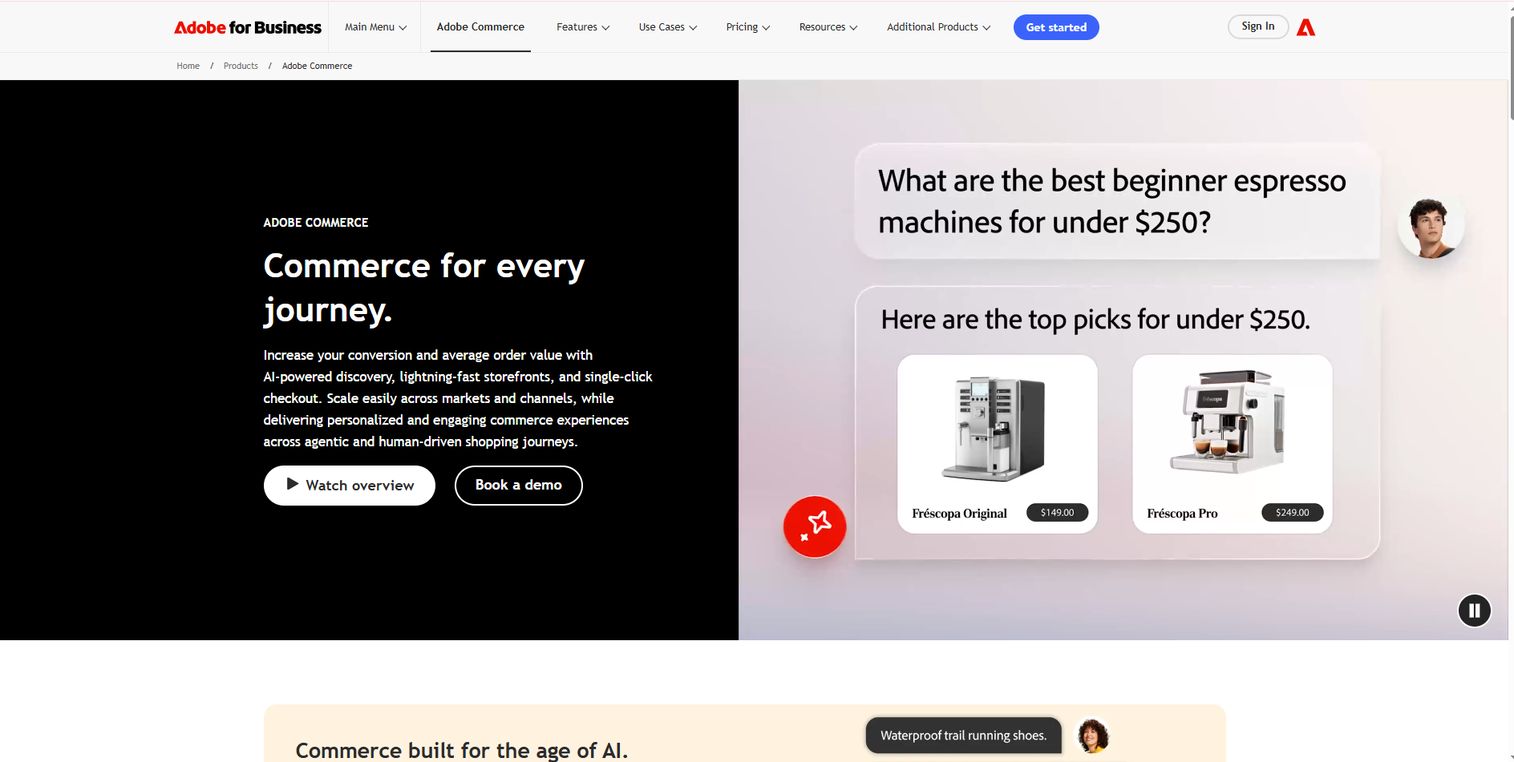
Adobe Commerce, formerly Magento Commerce, is Adobe's enterprise ecommerce platform for B2B and B2C, known for deep customization and extensibility. For teams that need to bend commerce logic to complex requirements, its composable, API-first architecture and large extension marketplace give room to orchestrate across systems.
The fit is strongest for organizations already invested in Adobe's experience and content tooling, or those needing global, multi-brand storefronts with heavy personalization. It rewards teams with development resources who want control over the commerce layer rather than a fixed template.
Best for: Enterprises needing scalable B2B/B2C ecommerce with deep customization.
Key strengths
- Global, multi-brand B2B and B2C storefronts
- Personalization and merchandising
- Composable, API-first commerce architecture
- Extensive extension marketplace
Why choose Adobe Commerce: Choose Adobe Commerce when extensibility and Adobe ecosystem alignment matter most. It suits teams with development capacity who want to shape commerce logic precisely.
Adobe Commerce pricing: Adobe offers Adobe Commerce as a Cloud Service (SaaS), Adobe Commerce on Cloud (PaaS), and Adobe Commerce Optimizer. All use custom pricing available through sales rather than public numeric figures.
6. SAP Commerce Cloud
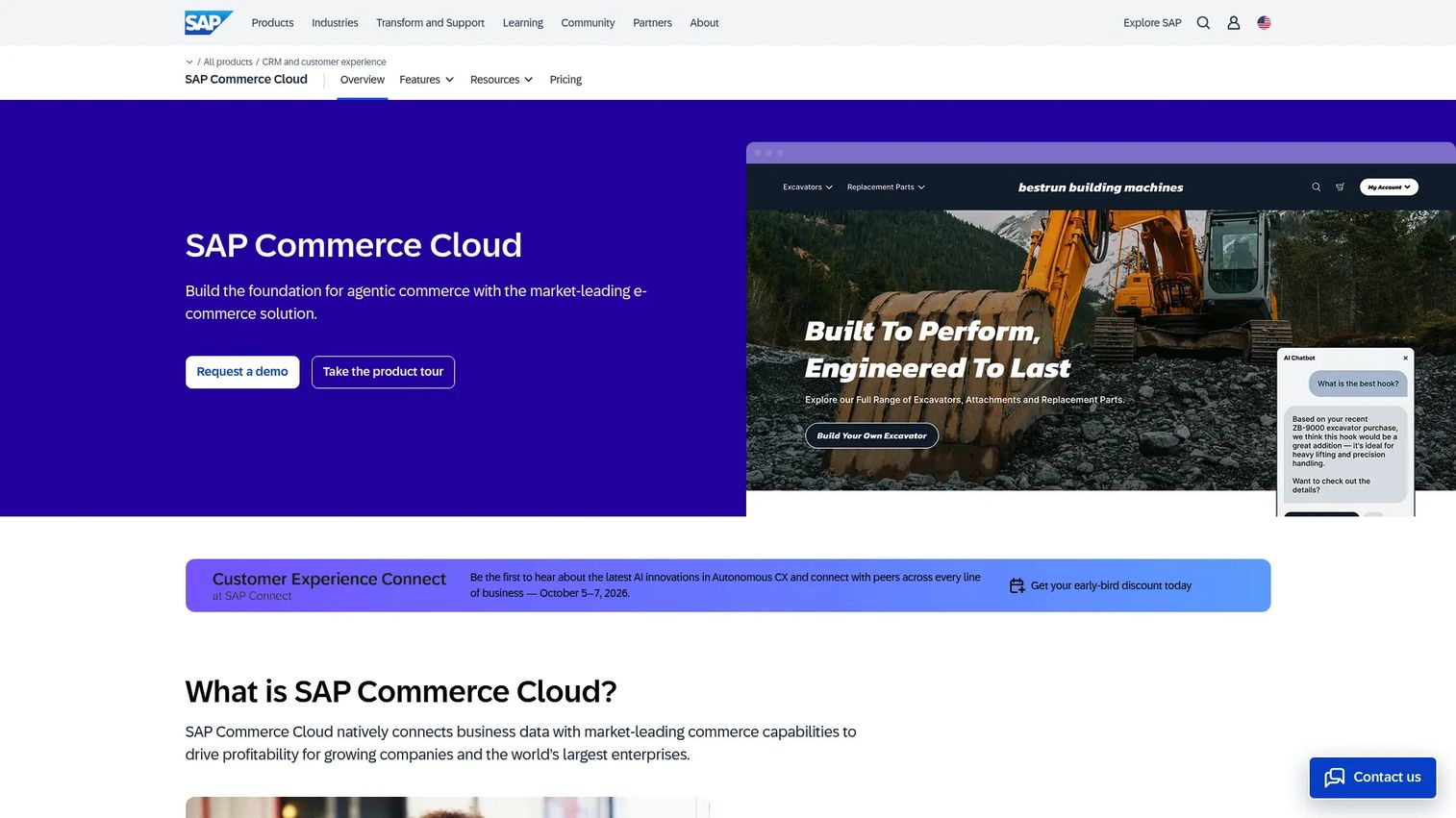
SAP Commerce Cloud is an enterprise digital commerce platform supporting B2B, B2C, and B2B2C on one platform, built for organizations with complex, global operations. Its natural advantage is proximity to SAP's ERP and back-office systems, which makes data consistency between commerce and financials, procurement, and inventory less of an integration burden.
For large enterprises already running SAP, the platform extends unified commerce into ERP-adjacent territory that most storefront tools cannot reach. A composable storefront and AI-assisted search round out the customer-facing side while the back-office stays connected.
Best for: Large enterprises needing complex, SAP-integrated commerce operations.
Key strengths
- B2B, B2C, and B2B2C commerce on one platform
- Composable storefront
- AI-assisted search and shopping
- Deep SAP ERP and back-office alignment
Why choose SAP Commerce Cloud: Choose SAP Commerce Cloud when your operations already run on SAP and ERP-level data consistency is non-negotiable. It excels at global, high-complexity commerce.
SAP Commerce Cloud pricing: SAP uses a request-a-quote model and does not display public numeric pricing. Pricing is available through sales.
7. Oracle Commerce
Oracle Commerce is Oracle's cloud commerce platform for building customizable B2B and B2C storefronts, aimed at enterprises that need broad commerce support tied into the Oracle ecosystem. Its REST APIs and webhooks make it a candidate for orchestrating commerce alongside back-office systems and customer data at enterprise scale.
The fit follows the ecosystem: organizations standardized on Oracle for ERP, data, or CX will find the unified commerce story easier to build here. It rewards teams that value customization and enterprise integration depth over speed of deployment.
Best for: Large enterprises needing a highly customizable commerce platform with Oracle ecosystem integration.
Key strengths
- Customizable B2B and B2C storefronts
- REST APIs and webhooks for integrations
- Enterprise-scale commerce capabilities
- Oracle ecosystem alignment
Why choose Oracle Commerce: Choose Oracle Commerce when your enterprise runs on Oracle and needs commerce that integrates deeply with existing back-office systems. It suits customization-heavy programs.
Oracle Commerce pricing: Oracle does not display public numeric pricing for the platform on its site. Pricing is available through Oracle sales.
8. commercetools
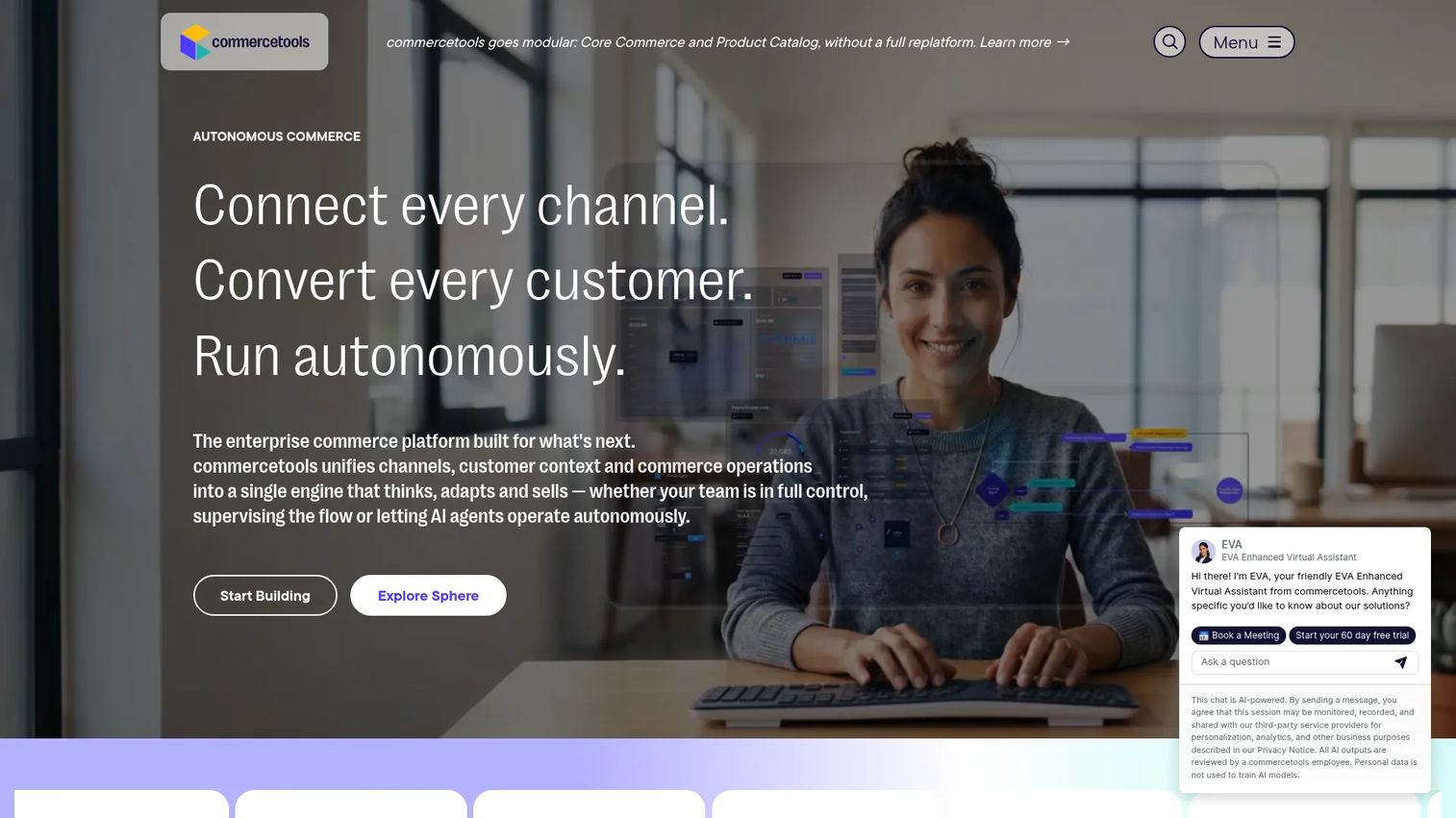
commercetools is a composable, API-first commerce platform for enterprise digital commerce, and one of the names most associated with the composable commerce movement. It gives teams building a custom unified commerce stack the raw commerce services, order management, and B2B capabilities to assemble exactly the architecture they want.
The strength is flexibility with a clear commercial model. Order-based pricing with unlimited catalogs, channels, and storefronts fits teams scaling across brands and regions. B2B features like Business Units, buyer approval flows, and quote management make it viable for complex enterprise selling, not just headless B2C.
Best for: Enterprises needing a composable, API-driven commerce platform they control.
Key strengths
- Order-based pricing with unlimited catalogs, channels, and storefronts
- B2B capabilities: Business Units, role permissions, approvals, quotes
- Checkout, order management, and shopping lists
- Headless, API-first core
Why choose commercetools: Choose commercetools when you have the engineering capacity to build a bespoke stack and want maximum architectural control. It anchors composable unified commerce at scale.
commercetools pricing: commercetools does not publish numeric pricing and directs buyers to sales for plans. A free trial with no sales call is available to get started.
9. Elastic Path
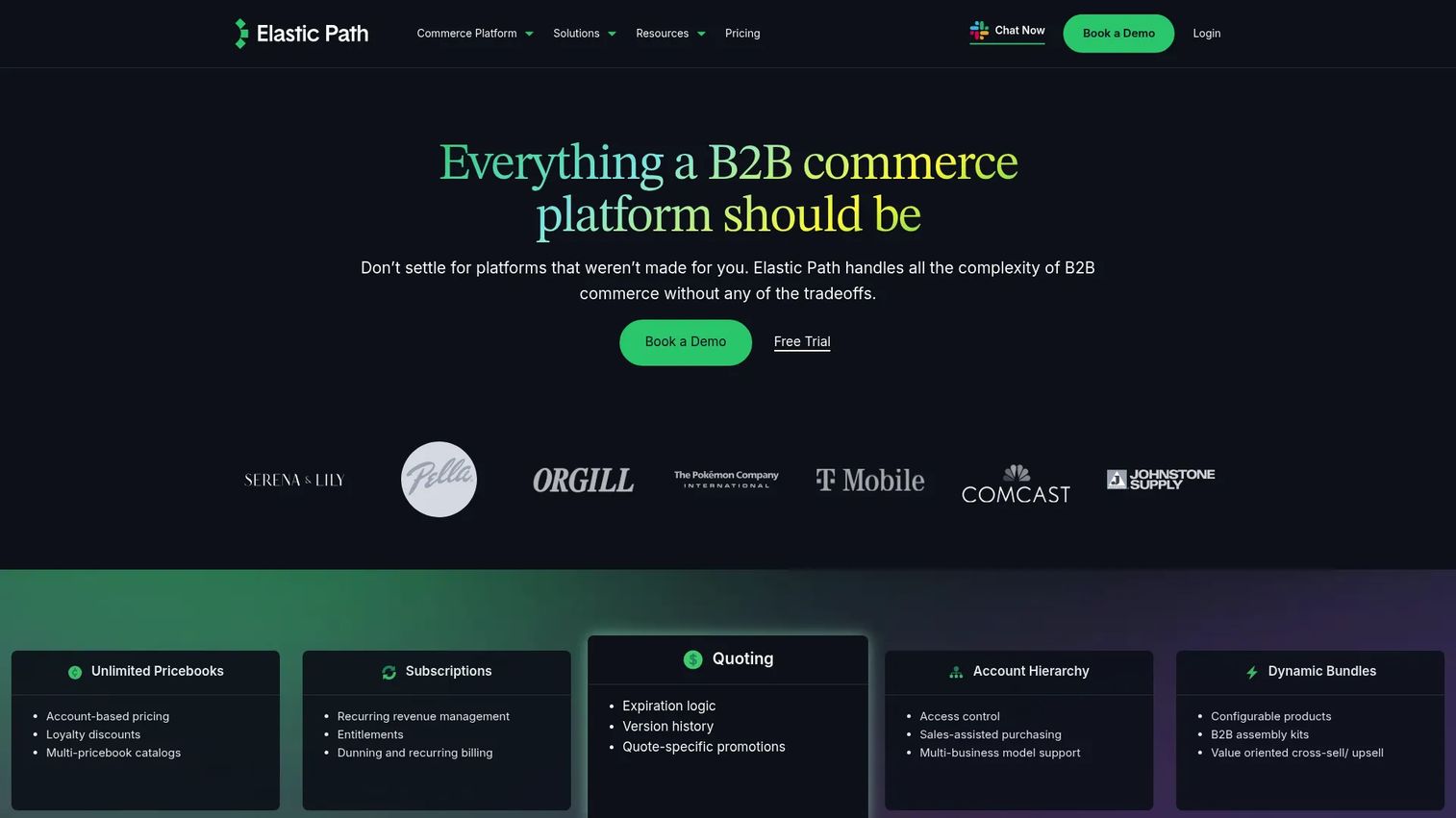
Elastic Path is a composable commerce platform for B2B and multi-channel commerce, built for companies that want composable flexibility without committing to a monolith. It leans into complex catalog and pricing needs, with unlimited catalogs, price books, account hierarchies, and quoting for organizations where the selling model is anything but simple.
For B2B businesses with intricate pricing, subscriptions, and integration requirements, Elastic Path provides the orchestration depth to unify channels while keeping architecture modular. Advanced promotions, subscriptions, iPaaS, and commerce extensions round out the toolkit.
Best for: B2B organizations needing composable commerce with complex pricing and catalog requirements.
Key strengths
- Unlimited catalogs and price books
- Account hierarchies and quoting
- Advanced pricing, promotions, and subscriptions
- iPaaS and commerce extensions
Why choose Elastic Path: Choose Elastic Path when B2B pricing complexity is your defining challenge and you want composable architecture without a monolith. It handles intricate catalogs and quoting well.
Elastic Path pricing: Elastic Path publishes two public models, order-based and GMV-based, each starting at $49,500/year. Professional and Enterprise tiers use custom, volume-based pricing. A free trial is available.
Considerations before you commit
Shortlisting is the easy part. These are the factors that decide whether a unified commerce platform delivers or turns into integration debt.
Integration depth with your existing stack
Map every system the platform must touch: POS, OMS, CRM, ERP, and PIM. Confirm whether connectors are native, documented APIs, or custom builds. The difference between a native POS integration and a bespoke one is often months of implementation and a recurring maintenance line.
Real-time data, not scheduled sync
Ask exactly how inventory and order state propagate. Batch sync every few minutes is not the same as a single record read in real time. For BOPIS and ship from store, latency is the difference between a confirmed pickup and an oversell.
Architecture fit: suite, composable, or hybrid
A full suite reduces integration work but concentrates risk in one vendor. Composable and API-first ecommerce platforms give flexibility but require engineering capacity to assemble and maintain. Be honest about your team's ability to own a composable architecture before choosing one.
Total cost beyond the license
Several platforms here publish pricing only through sales. Factor implementation, integration, ongoing development, and support into the real number. A lower license fee with heavy custom integration can cost more than a higher fee with native connectors.
AI-readiness and governance
Clean, unified data is the prerequisite for AI-ready commerce and emerging agentic commerce use cases. Check role controls, audit trails, and data structure quality now, because retrofitting governance later is painful.
Conclusion
Unified commerce is an operating model, not a storefront upgrade. The platform you choose decides whether inventory, orders, customers, and pricing behave as one record or five.
The best fit follows your stack and your complexity. Salesforce Commerce Cloud, SAP Commerce Cloud, and Oracle Commerce suit enterprises standardizing on a broad suite. commercetools, Elastic Path, and Adobe Commerce reward teams building composable, API-first architectures with engineering capacity. BigCommerce fits mid-market teams wanting flexibility without a rebuild, Shopify wins on speed for brands unifying retail and online, and Kibo Commerce leads when OMS depth and order orchestration are the core problem.
Your next step is concrete: list your current POS, OMS, CRM, and ERP systems, then score your top two or three platforms against how natively each one connects to that stack. Shortlist against integration reality, not feature lists, and the right unified commerce platform gets easier to see.
FAQs
A unified commerce platform is a single system that connects every sales channel and back-office function to one shared data model. Inventory, orders, customer profiles, and pricing live as a single source of truth instead of syncing across separate POS, OMS, CRM, and ERP systems. The goal is one accurate record every channel reads from in real time.
Omnichannel focuses on the customer experience across channels, like a consistent cart and branding. Unified commerce focuses on the systems and data model underneath that experience. You can run omnichannel on fragmented back-end systems, but it breaks when data lags. Unified commerce keeps the data consistent by design, so the experience stays accurate.
At minimum, a unified commerce platform should connect POS, order management (OMS), CRM, and ERP, plus product information management (PIM) and inventory and fulfillment systems. The value comes from these systems reading and writing to one shared data layer rather than syncing on a delay. Native connectors and documented APIs reduce the integration burden.
Real-time inventory prevents overselling online while shelves are empty in store, and it lets you sell down to the last unit with confidence. It is also the foundation for BOPIS and ship from store, which both depend on knowing exactly what stock is available at each location. Scheduled sync introduces latency that turns confirmed orders into disappointments.
No. Enterprises often lead because their fragmentation is most expensive, but mid-market teams benefit too. Platforms like BigCommerce and Shopify make unified operations accessible without an enterprise budget or a multi-year implementation. The trigger is operational complexity across channels, not company size alone.
API-first means every capability of the platform is accessible through an API, so you can connect, extend, and orchestrate systems programmatically rather than relying on closed, fixed connectors. It underpins composable architecture, letting teams assemble or swap components. An API-first ecommerce platform gives more flexibility but usually asks for more engineering capacity to run well.
BOPIS and ship from store both require real-time visibility into store-level inventory and flexible order routing. A unified commerce platform turns each store into a fulfillment node by treating store stock as fulfillable and letting the OMS route orders to the best location. Without a single inventory record, both fulfillment models are unreliable.
Start with your existing stack. List your current POS, OMS, CRM, and ERP systems, then score each platform on how natively it connects to them. Confirm whether data moves in real time or on a schedule, whether the architecture is suite or composable, and what the total cost looks like including integration and ongoing development. Shortlist against integration reality, not feature checklists.