You launched a campaign that converted on the website, then watched the same shoppers bounce when the in-store inventory said "out of stock." The cart was right. The customer record was wrong. And nobody could tell you why, because the storefront, the POS, the CRM, and the marketplace listings each held a different version of the truth.
That fragmentation is the real cost of running channels that do not talk to each other. The global retail omnichannel commerce platform market is expected to reach USD 11.9 billion in 2026 and grow to USD 36.6 billion by 2033 at a 17.4% CAGR, according to Persistence Market Research (2024). The spend is climbing because the math is clear: merchants with a strong omnichannel strategy retain over 89% of their customers, and organizations running an omnichannel customer engagement strategy report an average 9.5% annual revenue increase versus 3.4% for those that do not (Maximize Market Research, 2024).
For a growth marketer, the question is not "which platform sells online." Every platform sells online. The question is which one keeps customer data, inventory, and conversion paths consistent across every channel without adding another disconnected tab to your stack. The same way a clean customer data platform decides whether your attribution holds up, the omnichannel platform you pick decides whether your campaigns fire against accurate inventory and a single customer profile. This guide compares eight options through that lens: reach, data quality, fulfillment, and measurable ROI.
What's inside
This guide is for ecommerce managers, retail marketers, and growth teams evaluating an omnichannel ecommerce platform that connects storefronts, marketplaces, POS, CRM, and fulfillment under one roof. We picked the eight platforms below on five criteria that matter to teams accountable for revenue, not just retail architecture:
- Omnichannel depth: how many channels sync natively versus through middleware.
- Integration breadth: ERP, POS, CRM, and order management connections.
- Personalization and AI: how well the platform supports tailored experiences and discovery.
- Inventory and fulfillment: real-time stock sync, BOPIS, and order routing.
- Usability for growth teams: speed to launch, reporting, and how much engineering you need.
TL;DR
Short on time? Here is the quick decision shortcut before you scroll.
- Best for channel-heavy commerce and feed management: BigCommerce.
- Best for CRM-led enterprise commerce: Salesforce Commerce Cloud.
- Best for retailers unifying commerce and customer engagement: Voyado.
- Best for fast operational setup and ecosystem flexibility: Shopify Plus.
- Best for deep customization and catalog complexity: Adobe Commerce.
- Best for AI-driven discovery and conversion: Bloomreach Commerce.
- Best for enterprise back-office and ERP-heavy operations: Oracle Commerce Cloud and SAP Commerce Cloud.
What are omnichannel ecommerce platforms?
An omnichannel ecommerce platform is software that unifies selling, customer data, inventory, and fulfillment across every channel a brand uses, so the online store, physical stores, marketplaces, and social commerce all draw from one consistent system.
The difference between omnichannel and multichannel is not the number of channels. It is whether those channels share a single source of truth. Multichannel commerce runs each channel as its own silo. Omnichannel commerce connects them, so a customer who browses on mobile, buys in store, and returns through the marketplace is one record with one history.
For growth teams, the capabilities that actually move the needle in omnichannel ecommerce software are:
- Unified customer data: one profile per shopper across channels, so your segmentation, lifecycle flows, and attribution stay accurate.
- Inventory consistency: real-time stock levels shared across web, store, and marketplace, so campaigns never drive traffic to phantom inventory.
- Order management: centralized order routing, returns, and fulfillment logic that supports BOPIS and ship-from-store.
- Personalization and discovery: search, recommendations, and merchandising tuned to behavior across the full journey.
- Channel syndication: product feeds pushed to Google, Meta, Amazon, Walmart, and other surfaces without manual reformatting.
These are the building blocks of omnichannel commerce. Get them right and your campaigns run against accurate data. Get them wrong and you spend your week reconciling spreadsheets instead of optimizing funnels.
When to use an omnichannel ecommerce platform
Not every brand needs a full omnichannel commerce platform on day one. Here are the three triggers that usually justify the move.
Expand into new channels
When you are adding marketplaces, social commerce, or in-store selling on top of your website, manual channel management stops scaling. An omnichannel marketplace strategy means listing the same catalog across Amazon, Walmart, Google, and Meta without rebuilding feeds for each. If your team is reformatting product data by hand or losing sales because a listing went stale, that is the signal to consolidate channel syndication into one platform.
Fix fragmented customer data
When your CRM, email tool, and commerce data each hold a different version of the customer, your campaigns degrade. Attribution gets fuzzy. Lifecycle flows trigger on stale signals. The case for ecommerce and omnichannel platforms with unified profiles is strongest here: one record per customer keeps your segmentation defensible and your CFO confident in the numbers.
Improve fulfillment consistency
When inventory sync, BOPIS, or order management is blocking conversion, the fix is operational. If shoppers abandon carts because stock data is wrong, or store associates cannot see online orders, you need real-time inventory and centralized order management. This is where omnichannel ecommerce solutions earn their cost: fewer oversells, faster fulfillment, and conversion paths that do not break at checkout.
Comparison table
Here is a compact view of all eight platforms, sorted by relevance to channel-heavy, growth-focused commerce rather than alphabetically. Use it to shortlist before reading the full sections.
| # | Product | Intent | Key differentiation | Pricing | G2 rating |
|---|---|---|---|---|---|
| 1 | BigCommerce | Channel expansion and feed management | Native multi-storefront plus Feedonomics feed syndication | From $39/month | 4.2/5 |
| 2 | Salesforce Commerce Cloud | CRM-led enterprise commerce | Unified customer data on the Salesforce backbone | Contact for pricing | 4.4/5 |
| 3 | Voyado | Retail commerce and customer engagement | Loyalty, CRM, and discovery in one retail platform | Custom (platform + usage fee) | 4.5/5 |
| 4 | Shopify Plus | Fast setup and ecosystem flexibility | Large app ecosystem with quick operational launch | From $2,300/month | 4.4/5 |
| 5 | Adobe Commerce | Customization and catalog complexity | Deep flexibility with experience management | Contact for pricing | 4.0/5 |
| 6 | Bloomreach Commerce | AI discovery and conversion | Autonomous search and personalization layer | Request pricing | 4.6/5 |
| 7 | Oracle Commerce Cloud | Enterprise orchestration | Native fit with broader Oracle systems and ERP | Contact for pricing | 4.1/5 |
| 8 | SAP Commerce Cloud | Global, ERP-heavy operations | SAP-native commerce for complex order volumes | Price upon request | 4.3/5 |
1. BigCommerce
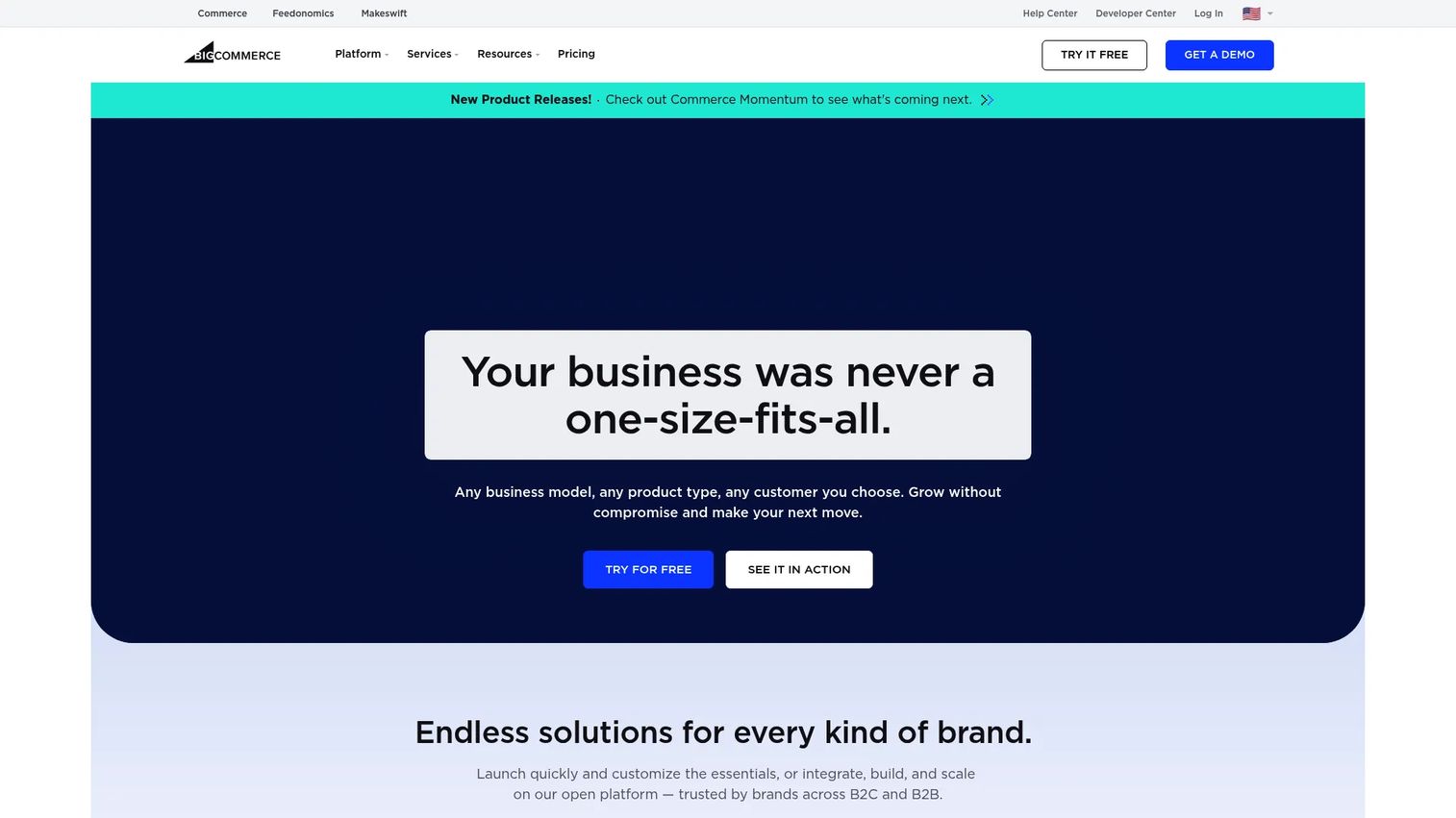
BigCommerce is built for merchants who sell everywhere and need the channel plumbing to keep up. It supports B2C, B2B, and headless commerce, and its acquisition of Feedonomics gives it serious feed management muscle for syndicating catalogs across marketplaces, comparison engines, and ad platforms. For a channel-heavy commerce team, that combination is the draw: list once, push everywhere, and keep listings accurate without manual reformatting.
Best for: Brands running multiple storefronts and marketplaces that need strong feed syndication and operational scale.
Key strengths
- Multi-storefront: run several branded storefronts from one backend, useful for regional sites or sub-brands.
- Feedonomics feed management: push and optimize product feeds across Google, Meta, Amazon, and Walmart without rebuilding data per channel.
- B2B features and price lists: native B2B selling with customer-specific pricing on the same platform as your D2C store.
Why choose BigCommerce: If your growth depends on omnichannel marketplace reach and clean feeds, BigCommerce removes the manual feed work that eats marketer time. The technical SEO controls and checkout customization also give growth teams levers to optimize conversion without filing engineering tickets for every change.
BigCommerce pricing: BigCommerce publishes four plans: Core at $39/month, Growth at $105/month, Scale at $399/month, and Performance starting at $1,499 per month billed annually. Annual-billed prices are also shown for the lower tiers. There is no free tier, but the public pricing gives you a clear entry point at the lower end and room to scale.
2. Salesforce Commerce Cloud
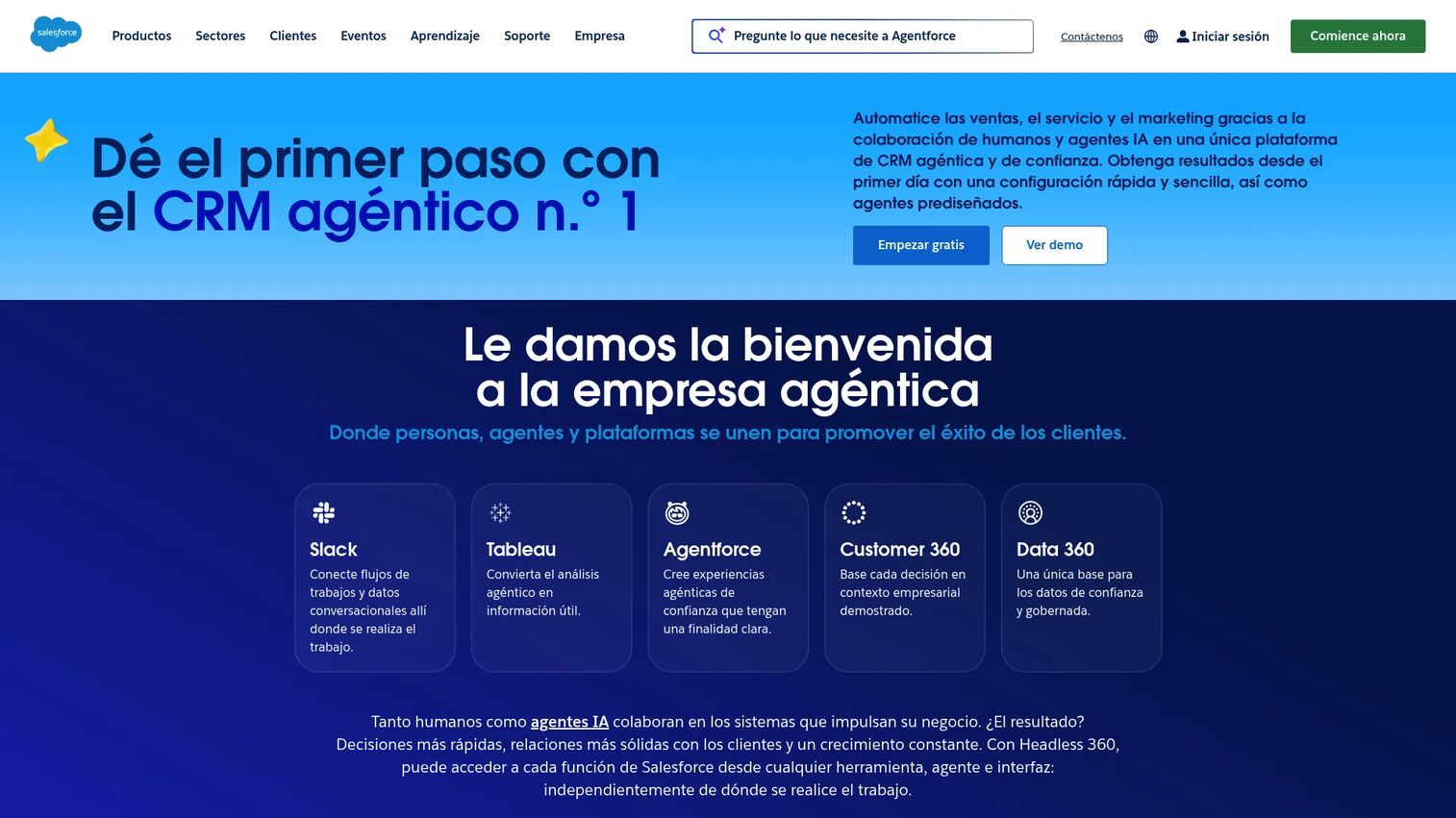
Salesforce Commerce Cloud, now presented as Agentforce Commerce, is the enterprise choice for teams already living inside the Salesforce ecosystem. It covers B2B, B2C, and D2C selling, with order management, composable commerce, and headless delivery models. The real pull for marketers is the data backbone: commerce data sits next to CRM data, so customer profiles, service history, and purchase behavior live in one system.
Best for: Enterprises that want unified B2B and B2C commerce tightly integrated with Salesforce CRM.
Key strengths
- Unified customer data: commerce and CRM share one profile, so segmentation and lifecycle flows run on accurate, connected data.
- AI and automation: agent-driven merchant automation and personalization built into the commerce experience.
- Composable and headless commerce: flexible storefront delivery models for teams that want to decouple front and back end.
Why choose Salesforce Commerce Cloud: If your marketing and service teams already run on Salesforce, putting commerce on the same backbone removes the integration tax. Attribution gets cleaner because the customer record is shared, and that is the kind of data quality a CFO will actually trust.
Salesforce Commerce Cloud pricing: Salesforce does not expose numeric standalone pricing for Commerce Cloud. The public pricing page lists editions such as Commerce Cloud B2C Premium, B2B Growth, and Order Management Growth, all shown as contact for pricing. A no-cost Foundations offer exists for eligible Sales and Service Enterprise customers, but it is not a standalone Commerce Cloud free plan.
3. Voyado
Voyado takes a retail-first angle on omnichannel commerce. Instead of leading with storefront architecture, it leads with the customer: unified profiles, loyalty, marketing automation, and product discovery in one place. For retailers that already have a store and want commerce and customer engagement coordinated rather than bolted together, that focus is what sets it apart from broader enterprise suites.
Best for: Mid-market and enterprise retailers that want CRM, loyalty, marketing automation, and discovery unified in one retail platform.
Key strengths
- Unified customer profiles: one view of the shopper across online and in-store, the foundation for accurate omnichannel campaigns.
- AI-driven campaign automation and loyalty: lifecycle marketing and loyalty management built for retail behavior patterns.
- Retail search, recommendations, and merchandising: product discovery tuned to drive conversion across channels.
Why choose Voyado: If your priority is coordinating campaigns, loyalty, and discovery against a single customer record, Voyado keeps engagement and commerce in one system. That cuts the data-reconciliation work that drains retail marketing teams and keeps your lifecycle flows firing on current signals.
Voyado pricing: Voyado does not publish fixed list prices. Pricing is a tailored SaaS subscription with a fixed platform fee plus usage-based fees that scale with your business, and the company asks prospects to contact sales for a quote.
4. Shopify Plus

Shopify Plus is the enterprise plan for high-volume brands that want speed without sacrificing scale. If you are selling in volume and want to expand without a long implementation cycle, Plus is built for that. The large app ecosystem, POS integration, and multi-channel selling make it a favorite for growth teams that need to move fast and add capabilities without waiting on engineering.
Best for: High-volume merchants that want enterprise-grade commerce, B2B, and checkout customization with fast operational setup.
Key strengths
- Large app ecosystem: broad integration options for marketing, fulfillment, and analytics without custom builds.
- Checkout customization and Checkout Branding API: tune the highest-impact conversion surface to your brand.
- Higher API limits, B2B, and expansion stores: unlimited catalogs, bot protection, and stores for new regions or brands.
Why choose Shopify Plus: For growth teams that value time-to-value, Shopify Plus gets you live faster than heavier enterprise suites and lets you add channels through apps rather than projects. That speed matters when your roadmap is full and engineering bandwidth is scarce.
Shopify Plus pricing: Shopify lists Plus starting from $2,300/month on its pricing page. The Help Center shows localized pricing by term, with US pricing at $2,500 USD/month for a one-year term and $2,300 USD/month for a three-year term. A separate paid Plus trial is referenced at $399/month. For higher-volume businesses, a variable platform fee based on revenue and business model may apply, differing for B2B and D2C.
5. Adobe Commerce

Adobe Commerce, formerly Magento, is the platform for teams that need to customize almost everything. It is a global, cloud-native platform designed to handle unlimited traffic, millions of products, over 200K orders per hour, and hundreds of brands and regional sites. The flexibility is the point: complex catalogs, custom storefronts, and deep experience management for brands that have outgrown templated platforms.
Best for: Enterprises with the technical resources to build and maintain a scalable, highly customized commerce platform.
Key strengths
- AI-powered storefront and merchandising: personalization and discovery tuned through Adobe's experience tooling.
- Multi-site, multi-language, multi-brand: run hundreds of regional sites and brands from one platform.
- B2B functionality and composable integrations: native B2B plus composable commerce for flexible architecture.
Why choose Adobe Commerce: If your catalog and storefront requirements are too complex for off-the-shelf platforms and you have engineering to support it, Adobe Commerce gives you the control. The trade-off versus lighter platforms is a heavier implementation profile, so it fits teams ready to invest in customization rather than speed.
Adobe Commerce pricing: Adobe does not publish numeric pricing for Commerce. The pricing page shows editions including Adobe Commerce as a Cloud Service, Adobe Commerce on Cloud, and Adobe Commerce Optimizer, and directs visitors to contact sales for customized pricing.
6. Bloomreach Commerce
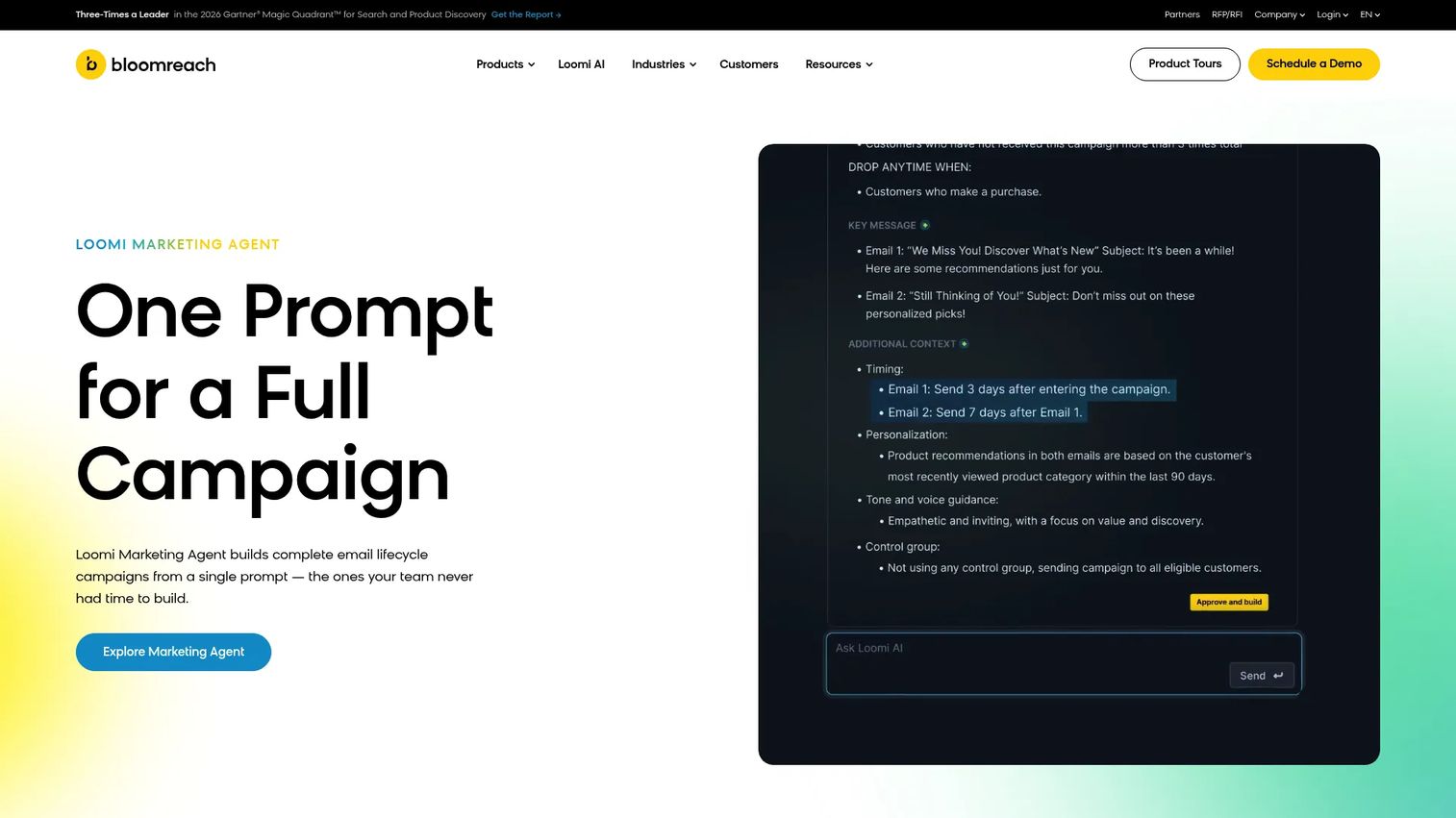
Bloomreach Commerce is the experience-layer choice for brands obsessed with conversion and discovery. Rather than owning the full commerce backend, it focuses on AI-driven search, merchandising, personalization, and marketing across the customer journey. Its AI-driven site search delivers relevant results across search and facet navigation, which is exactly the lever a marketer pulls to lift on-site conversion.
Best for: Enterprise commerce teams that need AI-driven personalization and product discovery on top of their commerce stack.
Key strengths
- Autonomous Search: AI search and faceted navigation that surface relevant products and reduce zero-result pages.
- Autonomous Marketing: personalization and campaign automation tied to behavioral data.
- Conversational Shopping: AI-assisted discovery that guides shoppers toward purchase.
Why choose Bloomreach Commerce: If your commerce platform is fine but discovery and personalization are leaving conversion on the table, Bloomreach is the layer that fixes it. Marketers care because better search and recommendations move the metrics they own: conversion rate, average order value, and revenue per visit.
Bloomreach Commerce pricing: Bloomreach does not display public numeric pricing. Its modules, Autonomous Marketing, Autonomous Search, and Conversational Shopping, are offered on annual plans with quotes based on business size, the products you select, and usage or commit volume. Contact sales for pricing.
7. Oracle Commerce Cloud
Oracle Commerce Cloud is a scalable, flexible commerce solution designed to run in the Oracle Cloud. Its strongest argument is orchestration: for large organizations already running Oracle systems, commerce that connects natively to broader ERP, finance, and back-office operations removes a layer of integration work. It is built for complex retail operations spread across regions, channels, and systems.
Best for: Large organizations with deep back-office and ERP requirements that want commerce inside the Oracle ecosystem.
Key strengths
- Native Oracle integration: connects directly to Oracle ERP, finance, and supply chain systems.
- Enterprise orchestration: coordinates commerce across distributed, multi-system operations.
- Scalable cloud architecture: built to handle complex, high-volume retail operations.
Why choose Oracle Commerce Cloud: If your organization already runs on Oracle and your operational complexity lives in the back office, this platform reduces the friction of stitching commerce to ERP. The value is less about storefront flash and more about keeping a distributed, multi-system operation coordinated.
Oracle Commerce Cloud pricing: Oracle does not publish a public starting price for Commerce Cloud. Pricing is handled through sales, typically scoped to the broader Oracle Cloud deployment and your operational requirements. Contact Oracle for a quote.
8. SAP Commerce Cloud

SAP Commerce Cloud is a unified platform that delivers personalization and efficiency by fueling embedded AI with holistic, end-to-end business data. It supports B2B, B2C, B2B2C, and D2C, but its real strength is operational and ERP fit rather than surface-level storefront features. For global enterprises with complex commerce processes and high order volumes, SAP-native commerce keeps the entire operation connected.
Best for: Large enterprises that need a scalable, SAP-native commerce platform for complex, global operations.
Key strengths
- Unified commerce experiences: consistent selling across B2B, B2C, B2B2C, and D2C models.
- Order management: centralized order routing and fulfillment for high-volume operations.
- Product content management: structured catalog and content control across markets.
Why choose SAP Commerce Cloud: If your business runs on SAP and your commerce challenge is operational complexity at global scale, this platform fits the back office cleanly. SAP has been named a Leader 11 times since 2014, which signals durable enterprise commitment for organizations making a long-term platform bet.
SAP Commerce Cloud pricing: SAP lists multiple editions, including composable, premier, and cloud ERP editions, priced in blocks of annual orders or by Gross Merchandise Value. Public pricing is request-based and shown as price upon request rather than a numeric list price.
How to choose the right omnichannel platform
The right omnichannel ecommerce platform depends on which problem is loudest for your team right now, not on which vendor has the longest feature list. Use these criteria to narrow the field.
Channel reach and feed management
Count the channels you sell on today and the ones on your roadmap. If marketplace and social expansion is the priority, weight platforms with native syndication, like BigCommerce, over those that lean on middleware. Phantom listings and manual feed work are the silent tax here.
Customer data unification
Decide where the single customer record should live. If your stack is CRM-led, a platform that shares one profile, such as Salesforce Commerce Cloud or Voyado, keeps attribution defensible. Fragmented profiles quietly break lifecycle marketing.
Fulfillment and inventory consistency
If carts break because inventory data is wrong, prioritize real-time sync, BOPIS, and centralized order management. The enterprise orchestration platforms, Oracle and SAP, earn their place when operational complexity is the bottleneck.
Implementation profile and time-to-value
Be honest about your engineering bandwidth. Shopify Plus gets you live fast; Adobe Commerce rewards teams ready to invest in customization. Match the implementation profile to the resources you actually have, not the ones you wish you had.
Conclusion
There is no single best omnichannel commerce platform, only the best fit for the problem you are solving. If channel expansion and clean feeds are the priority, BigCommerce leads on syndication and operational scale. If unified customer data on a CRM backbone matters most, Salesforce Commerce Cloud and Voyado keep your attribution and lifecycle marketing honest. For fast setup and ecosystem flexibility, Shopify Plus gets you live quickly. For deep customization, Adobe Commerce gives technical teams full control. For AI-driven discovery and conversion, Bloomreach is the experience layer worth adding. And for ERP-heavy, global operations, Oracle Commerce Cloud and SAP Commerce Cloud orchestrate the back office natively.
Your next step: shortlist two platforms against the criterion that hurts most today, whether that is channel reach, data quality, fulfillment, or speed. Then run a scoped evaluation against your real catalog and customer data, not a generic demo. The platform that keeps your campaigns firing against accurate data is the one that pays for itself.
FAQs
An omnichannel ecommerce platform is software that unifies selling, customer data, inventory, and fulfillment across every channel a brand uses, including the web store, physical stores, marketplaces, and social commerce. The goal is one consistent system so a single customer record and accurate inventory power every touchpoint.
Multichannel commerce runs each channel as its own silo with separate data and inventory. Omnichannel commerce connects those channels to a single source of truth, so a shopper who browses on mobile, buys in store, and returns through a marketplace stays one unified profile with one history.
For retailers that want commerce and customer engagement in one place, Voyado is a strong fit because it unifies CRM, loyalty, marketing automation, and product discovery. Brands that need a broader enterprise suite often weigh Salesforce Commerce Cloud or SAP Commerce Cloud instead, depending on their existing systems.
Yes. Most omnichannel ecommerce software connects to ERP, POS, CRM, and order management systems, either natively or through integrations. Oracle Commerce Cloud and SAP Commerce Cloud are built to connect deeply with their own ERP ecosystems, while platforms like Shopify Plus and BigCommerce offer broad integration options through apps and APIs.
For omnichannel marketplace expansion and feed management, BigCommerce stands out because its Feedonomics capabilities syndicate catalogs across Amazon, Walmart, Google, and Meta without manual reformatting. That removes the feed work that slows down channel-heavy teams.
Marketers track conversion rate by channel, customer retention, average order value, revenue per visitor, and the lift from unified customer data on attribution. The headline benchmark is telling: organizations with an omnichannel customer engagement strategy report an average 9.5% annual revenue increase versus 3.4% without one, per Maximize Market Research (2024).
It is worth it when channel sprawl, fragmented customer data, or inventory inconsistency starts costing conversions. Mid-market brands often start with a platform like Shopify Plus or Voyado that balances omnichannel depth with a manageable implementation profile, then layer on discovery or ERP integration as they scale.