You closed a big quarter. Then a nexus letter shows up from a state you did not know you owed. Now finance is reconstructing 18 months of transactions in a spreadsheet, and your diligence timeline just got a new line item nobody wants to explain to the board.
That is how tax breaks at scale. Not with a bang, but with a slow accumulation of unfiled returns, misapplied rates, and manual work that quietly becomes a hidden liability. The moment you sell across more states or countries, indirect tax compliance stops being a back-office chore and starts being a growth risk. Every new jurisdiction adds rules. Every new product SKU adds edge cases. Every manual filing adds a chance for error that an auditor will eventually find.
The market reflects the pressure. The global tax management software market is expected to grow from USD 22.97 billion in 2026 to USD 56.02 billion by 2034, an 11.80% CAGR, according to Fortune Business Insights (2026). Companies are not buying this software for fun. They are buying it because manual multi-jurisdiction tax compliance does not survive contact with real revenue.
This guide is written for founders and finance leaders who want tax to disappear into the stack, not become another fire drill. The goal is simple: pick a system that reduces operational drag, protects cash, and keeps you audit-ready when the questions come. If you are also stress-testing adjacent systems, our roundups on audit management software and the best customer data platform options cover the neighboring parts of a clean finance and RevOps stack.
What's inside
This guide covers seven tax compliance platforms chosen for breadth of coverage, automation depth, ERP fit, e-invoicing support, and audit-ready workflows. It is built for SaaS founders and finance leaders comparing platforms, not for tax specialists who already know the field cold.
We selected tools based on four criteria:
- Coverage: sales tax, VAT, and multi-jurisdiction support that scales with expansion.
- Automation: calculation, returns, and filing that runs without manual babysitting.
- Integration: clean ERP tax integration and connectors into billing and accounting.
- Defensibility: reporting, reconciliation, and controls that hold up under audit.
Guideflow is a demo automation platform, not a tax product, so it does not appear in this list. If you are researching how to show a product without a live call, our AI sales tools roundup is a better starting point.
TL;DR
- Best overall for breadth: Avalara. Broad coverage across sales tax, VAT, e-invoicing, returns, and exemptions, with deep integration reach.
- Best for enterprise ERP depth: Vertex. Built for large and mid-market companies running tax determination across multiple systems.
- Best for complex compliance operations: Thomson Reuters ONESOURCE. A broad tax automation software suite spanning indirect, direct, and information reporting.
- Best for ecommerce sellers: TaxCloud. Practical sales tax software with pay-as-you-go filing and SST support.
- Best for outsourced expertise: TaxValet. A fractional sales tax department that runs filings for you, with audit defense included.
- Best for straightforward US sales tax: TaxJar. Clean automated calculation, nexus tracking, and AutoFile for growing teams.
- Best for SaaS revenue models: Anrok. Purpose-built sales tax and VAT compliance for recurring-revenue businesses.
What is tax compliance software?
Tax compliance software automates the determination, calculation, filing, and reporting of taxes a business owes across the jurisdictions where it operates. Instead of tracking rates in spreadsheets and filing returns by hand, the platform applies the correct tax to each transaction, prepares returns, and keeps an audit trail.
For most scaling SaaS companies, the center of gravity is indirect tax: sales and use tax in the United States, VAT compliance software needs in Europe, and GST elsewhere. As companies expand, that widens into global tax compliance software territory, where e-invoicing mandates and country-specific reporting rules come into play.
The main building blocks look like this:
- Tax determination software: applies the right rate and rules to each transaction based on product type, location, and exemptions.
- Returns and reporting: prepares, files, and remits returns on the right schedule for each jurisdiction.
- E-invoicing software: generates and transmits compliant invoices where governments mandate real-time or near-real-time reporting.
- Reconciliation workflows: match filed amounts against collected amounts so nothing drifts between systems.
- Trusted tax data: maintained rate tables and rules content, so you are not chasing rate changes manually.
- ERP tax integration: connectors that push tax logic into the systems where transactions actually happen.
Why each matters is simple. Determination keeps you from over- or under-charging. Returns automation keeps you from missing deadlines. E-invoicing keeps you compliant in mandate countries. Reconciliation keeps your numbers defensible. And trusted tax data means you are not the reason a rate was wrong.
The stronger platforms treat sales tax software as one layer inside a broader compliance platform, so you do not outgrow the tool the moment you cross a border.
When to use tax compliance software
Expanding into new tax jurisdictions
The clearest trigger is expansion. The moment you cross an economic nexus threshold in a new state or start selling into a new country, your obligations multiply overnight. A platform that tracks nexus and applies multi-jurisdiction tax compliance rules keeps you ahead of the letters instead of reacting to them.
Replacing spreadsheets
If your compliance still lives in a spreadsheet maintained by one person, that is a single point of failure. Spreadsheets do not scale with transaction volume, and they do not survive that person leaving. Moving to tax automation software turns a fragile manual process into a repeatable system.
Automating filing
Missed deadlines create penalties and interest that compound. Tax filing automation prepares and submits returns on schedule across every jurisdiction, so finance is not manually tracking dozens of due dates. This is where sales and use tax obligations stop consuming a week every month.
Integrating tax into ERP workflows
When tax logic lives outside your billing and accounting systems, reconciliation gets ugly fast. Pushing determination into the ERP means the right tax is calculated at the point of transaction, and your books stay clean without a separate cleanup pass.
Comparison table
Sorted by relevance to scaling SaaS teams evaluating breadth, integration, and audit readiness. Pricing and ratings reflect verified, first-party or G2-reported values where available.
| # | Product | Intent | Key use case | Pricing | G2 rating |
|---|---|---|---|---|---|
| 1 | Avalara | Broad multi-tax automation | Sales tax, VAT, e-invoicing, returns, exemptions | Varies by product; select offers from $119 | 4.0/5 |
| 2 | Vertex | Enterprise ERP tax | Indirect tax determination across ERP and billing | Revenue-based, custom | 4.4/5 |
| 3 | Thomson Reuters ONESOURCE | Complex compliance suite | Indirect, direct, and information reporting | Custom | 3.8/5 |
| 4 | TaxCloud | Ecommerce sales tax | Calculation, nexus, filing, SST | From $45/filing; Premium $79/mo | 4.5/5 |
| 5 | TaxValet | Managed compliance | Outsourced multi-state filings and audit defense | $1k–$4k/month | 4.8/5 |
| 6 | TaxJar | US sales tax automation | Calculation, nexus tracking, AutoFile | From $39/month | 4.7/5 |
| 7 | Anrok | SaaS tax compliance | Sales tax and VAT for recurring revenue | Editions; contact sales | 4.4/5 |
1. Avalara

Avalara is a tax compliance software platform built to automate calculation, returns, exemptions, and e-invoicing across sales, use, and VAT. Its scope is deliberately broad: rather than solving one tax type, it aims to be the single system a company runs indirect tax through as it expands into new states and countries. For a founder, the appeal is coverage that does not run out when you cross a border.
The core engine, AvaTax, applies the correct rate and rules to each transaction in real time. Returns preparation and filing handle the schedule side, and exemption certificate management keeps tax-exempt sales defensible when an auditor asks. That combination is what makes Avalara a reasonable default for teams that want one platform to grow into.
Best for: Businesses that need automated tax compliance across sales, filing, exemptions, and global tax workflows in one place.
Key strengths
- AvaTax calculation: applies accurate sales and use tax rates at the point of transaction across jurisdictions.
- Returns and filing: prepares and files returns so finance is not tracking deadlines by hand.
- Exemption management: stores and validates certificates to keep exempt sales audit-ready.
Why choose Avalara: The pitch is breadth and integration reach. If you expect to add jurisdictions, product lines, and eventually international VAT obligations, a platform that already covers those paths beats stitching together point tools later. Avalara suits teams that want to buy once and scale into the coverage.
Avalara pricing: Avalara states that pricing varies by product, services, integrations, transaction volume, jurisdictions, and SST enrollment. It publishes select set-price offers, such as License Guidance from as low as $119 and Sales Tax Registration at $403 per location. There is no free tier listed on the pricing page. Its G2 rating is 4.0/5.
2. Vertex
Vertex is an enterprise tax technology platform focused on indirect tax determination, compliance, and reporting. Where lighter tools stop at calculation, Vertex is built to run tax logic consistently across many connected systems, which is why it lands with large and mid-market companies. If your transactions flow through an ERP, a billing platform, and a procurement system, Vertex is designed to keep the tax treatment identical across all of them.
Its strength is depth. Vertex handles tax determination across sales and use tax, VAT, and GST, layers in e-invoicing and compliance reporting, and connects into ERP, ecommerce, procurement, POS, and subscription billing systems. That ERP tax integration is the reason enterprise finance teams standardize on it.
Best for: Large and mid-market companies needing automated indirect tax compliance across multiple systems.
Key strengths
- Multi-tax determination: consistent treatment across sales/use tax, VAT, and GST.
- E-invoicing and reporting: compliant invoice generation and reporting for mandate jurisdictions.
- Broad integrations: connectors into ERP, ecommerce, procurement, POS, and subscription billing.
Why choose Vertex: Vertex earns its place when your systems landscape is complex and you cannot afford tax to be calculated three different ways in three different tools. It is the choice for teams that treat tax determination as infrastructure rather than a monthly task, and that want a single engine feeding every transaction source.
Vertex pricing: Vertex uses a revenue-based pricing model with a multi-year price lock, and does not publish numeric pricing on its site. Expect a custom quote tied to your revenue and system footprint. Its G2 rating is 4.4/5.
3. Thomson Reuters ONESOURCE
Thomson Reuters ONESOURCE is a cloud-native tax, trade, and financial reporting platform aimed at corporate compliance teams. It sits at the broad end of the market, covering far more than indirect tax. If your obligations span statutory reporting, information reporting, and trade compliance alongside sales tax and VAT, ONESOURCE is built to hold all of it in one workflow.
The platform automates indirect tax, direct tax, statutory reporting, and information reporting, and connects through a large library of certified connectors and in-house technology solutions. That reach is why it appeals to companies with genuinely complex compliance operations, where corporate tax software and indirect tax cannot live in separate silos.
Best for: Large enterprises needing a broad tax and trade compliance platform.
Key strengths
- End-to-end workflows: tax, trade, and financial reporting handled in one system.
- Multi-domain automation: indirect tax, direct tax, statutory, and information reporting.
- Deep integrations: 200+ in-house solutions plus prebuilt certified connectors.
Why choose ONESOURCE: ONESOURCE fits teams whose compliance footprint is wide enough that point tools create gaps. When you need direct tax, indirect tax, and reconciliation workflows managed together, the suite approach reduces the number of systems finance has to reconcile at close. It is a fit for scale and complexity rather than simplicity.
ONESOURCE pricing: Thomson Reuters does not publish public pricing for ONESOURCE and directs prospects to contact sales for a quote. Its G2 rating is 3.8/5.
4. TaxCloud
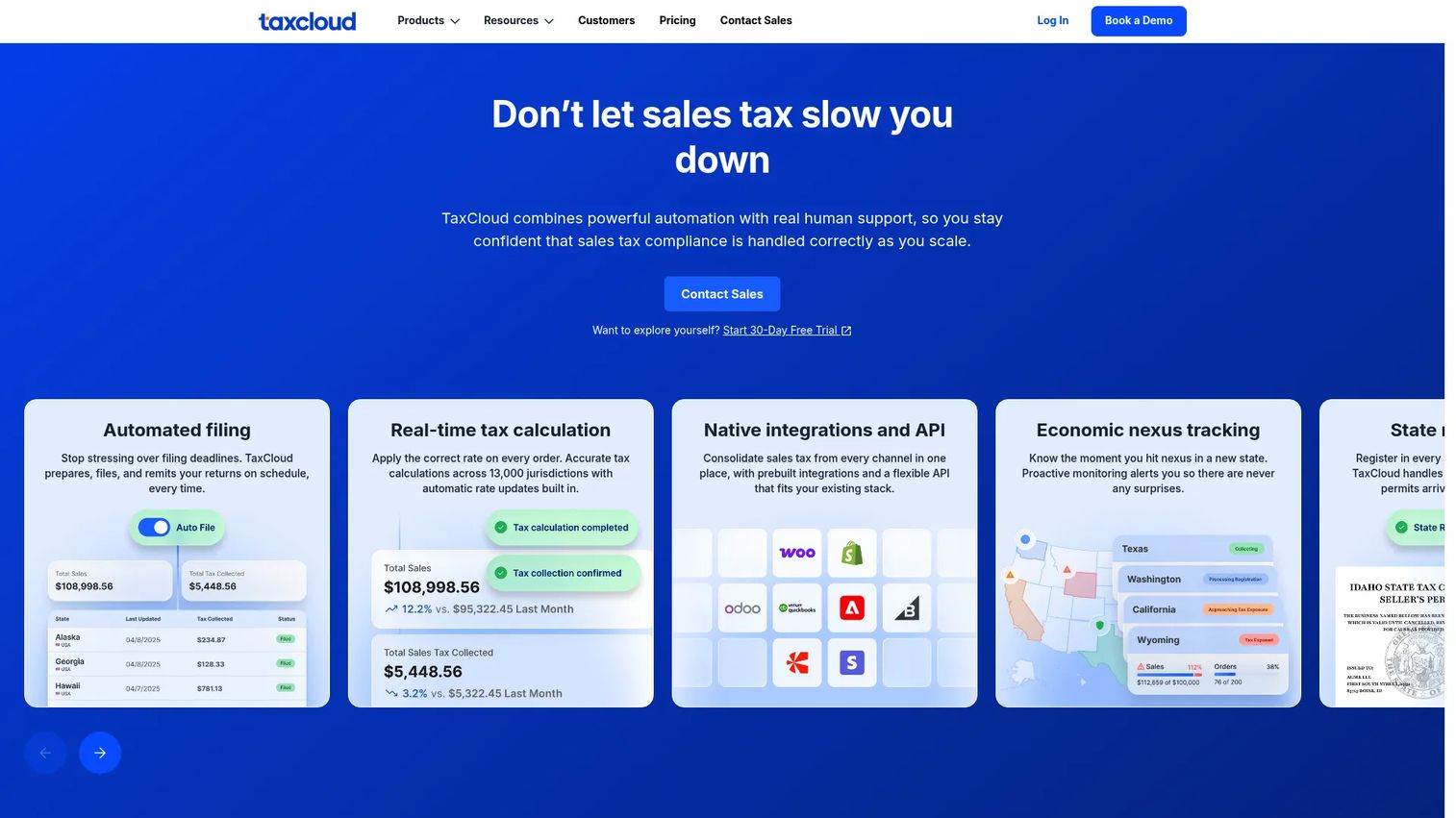
TaxCloud is sales tax compliance software built with ecommerce and multi-state sellers in mind. It keeps the scope practical: calculate the right tax, monitor where you have nexus, and handle filing and remittance without a heavy implementation. For a team that wants straightforward automation rather than an enterprise suite, that focus is the point.
The platform covers sales tax calculation, nexus monitoring and insights, and filing and remittance, with Streamlined Sales Tax (SST) support baked in. That makes it a clean fit for sellers who need reliable coverage across many states without standing up a large tax operation.
Best for: Multi-state ecommerce sellers needing tax calculation, filing, and SST support.
Key strengths
- Sales tax calculation: accurate rates applied across states at checkout.
- Nexus monitoring: insights that flag where new obligations are forming.
- Filing and remittance: returns and payments handled on schedule.
Why choose TaxCloud: TaxCloud suits growing businesses that want automation without complexity. If your primary need is sales and use tax across US states rather than a global VAT footprint, its pay-as-you-go filing model keeps costs predictable while you scale. It is a pragmatic option for teams that want the job done cleanly.
TaxCloud pricing: TaxCloud offers pay-as-you-go filing at $45 per filing without a subscription, plus monthly and annual filing subscription plans. Its Premium edition is reported at $79 per month, and a free trial is available. Its G2 rating is 4.5/5.
5. TaxValet
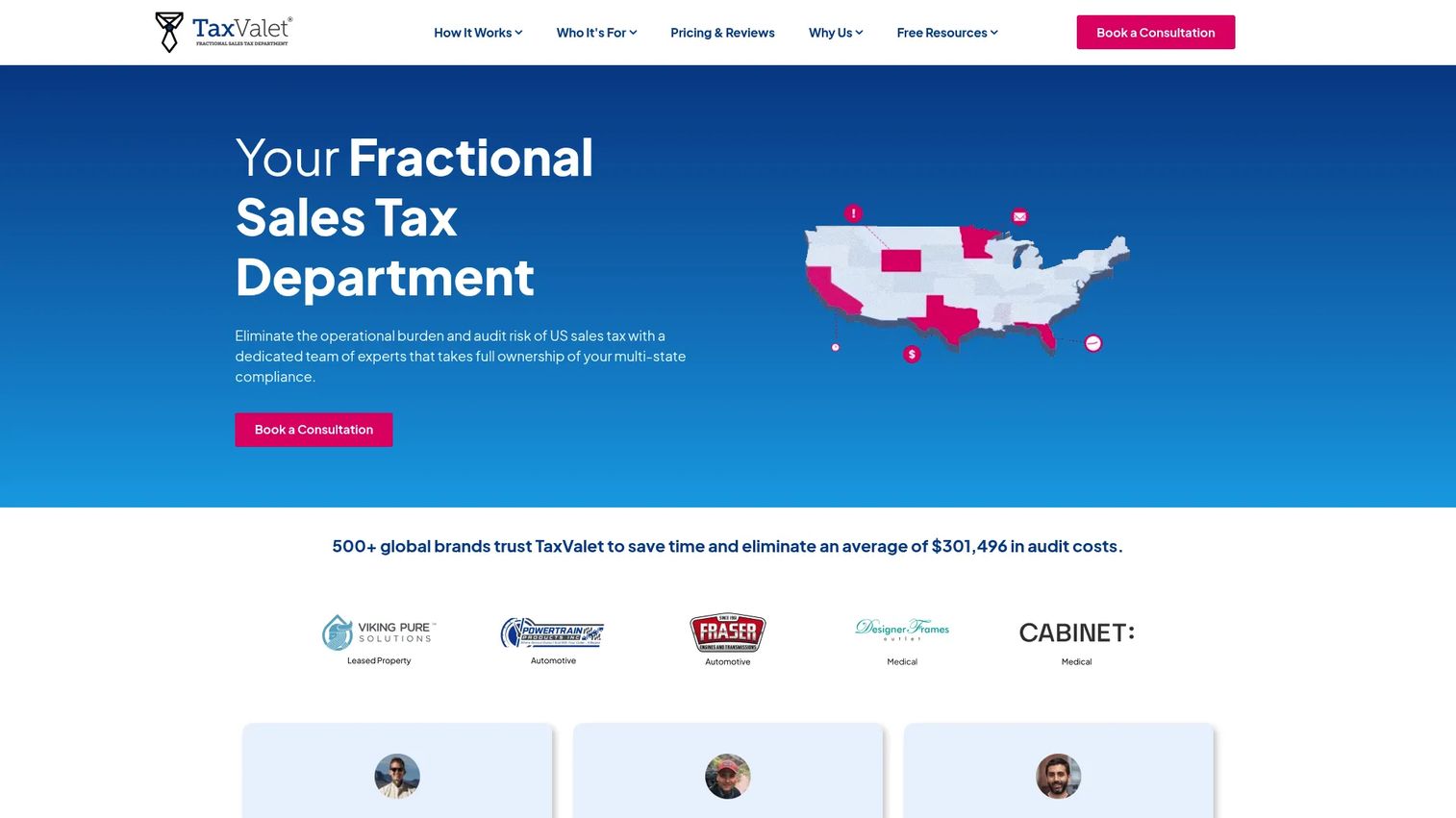
TaxValet is different from the rest of this list. Instead of handing you software to run, it operates as a fractional sales tax department that manages multi-state US sales tax compliance for you. Nexus determination, registrations, filings, payments, and audit defense are handled by their team. For founders who would rather not own tax as an internal function, that service-plus-software model is the entire pitch.
The service covers nexus determination and reviews, end-to-end filings and payments, and audit defense that comes with an audit-protection guarantee. When hands-on expertise matters more than a DIY dashboard, TaxValet is built to remove tax from your plate entirely.
Best for: Fast-growing businesses that want outsourced, expert-led multi-state sales tax compliance.
Key strengths
- Nexus determination: expert reviews of where you owe and why.
- End-to-end filings: registrations, filings, and payments managed for you.
- Audit defense: representation backed by an audit-protection guarantee.
Why choose TaxValet: Choose TaxValet when the cost of getting tax wrong outweighs the cost of doing it yourself, and when finance time is better spent elsewhere. It is a strong fit for teams scaling faster than they can staff, who want audit-ready compliance without building an internal tax team.
TaxValet pricing: TaxValet uses predictable flat monthly pricing with no overage charges or surprise add-ons. Its Fractional Sales Tax Department service runs $1,000 to $4,000 per month depending on scope. Its G2 rating is 4.8/5, the highest on this list.
6. TaxJar
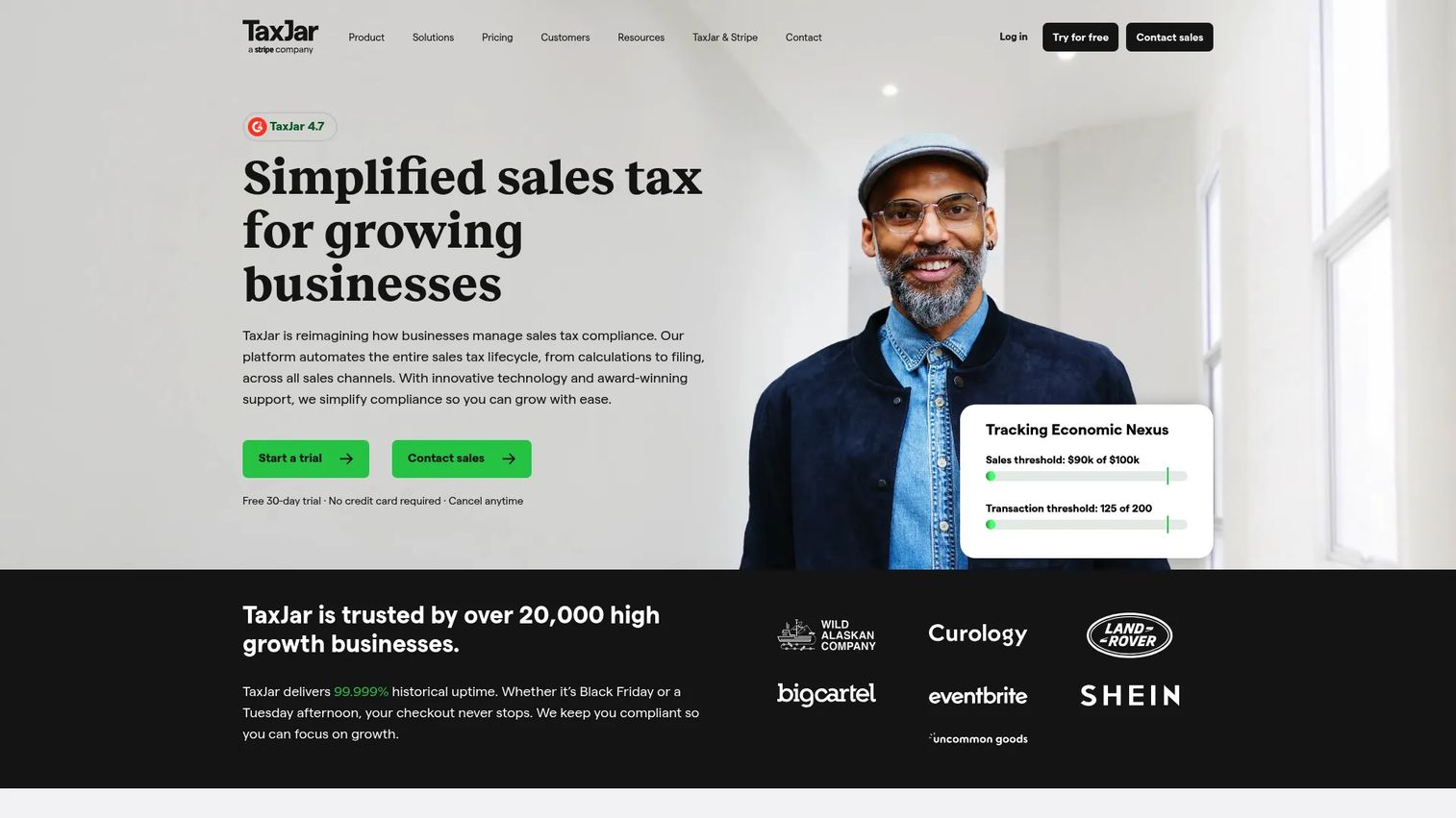
TaxJar is sales tax compliance software for US businesses, covering calculation, nexus tracking, filing, and remittance. It is narrower in scope than the enterprise suites, and that is by design. Teams with straightforward US sales and use tax needs often prefer a focused product that does its job well over a broad platform they only partly use.
The product delivers real-time sales tax calculations via API, economic nexus tracking with notifications, and automated filing through AutoFile. For a growing SaaS or ecommerce team, that covers the core loop of calculate, monitor, and file without extra overhead.
Best for: Ecommerce teams that need automated US sales tax calculation, nexus monitoring, and filing.
Key strengths
- API calculations: real-time rates delivered straight into your checkout or billing.
- Nexus tracking: economic nexus alerts so new obligations do not surprise you.
- AutoFile: automated filing and remittance on schedule.
Why choose TaxJar: TaxJar fits teams whose scope is genuinely US-focused and who value clean automation over breadth. If you do not need global VAT or a full compliance suite yet, a narrower product with transparent pricing keeps the stack simple. It is easy to adopt and easy to reason about.
TaxJar pricing: TaxJar offers two plans, Starter from $39 per month and Professional from $99 per month, each with multiple order-volume tiers. A 30-day free trial is available, and annual billing comes with a 10%+ discount. Its G2 rating is 4.7/5.
7. Anrok
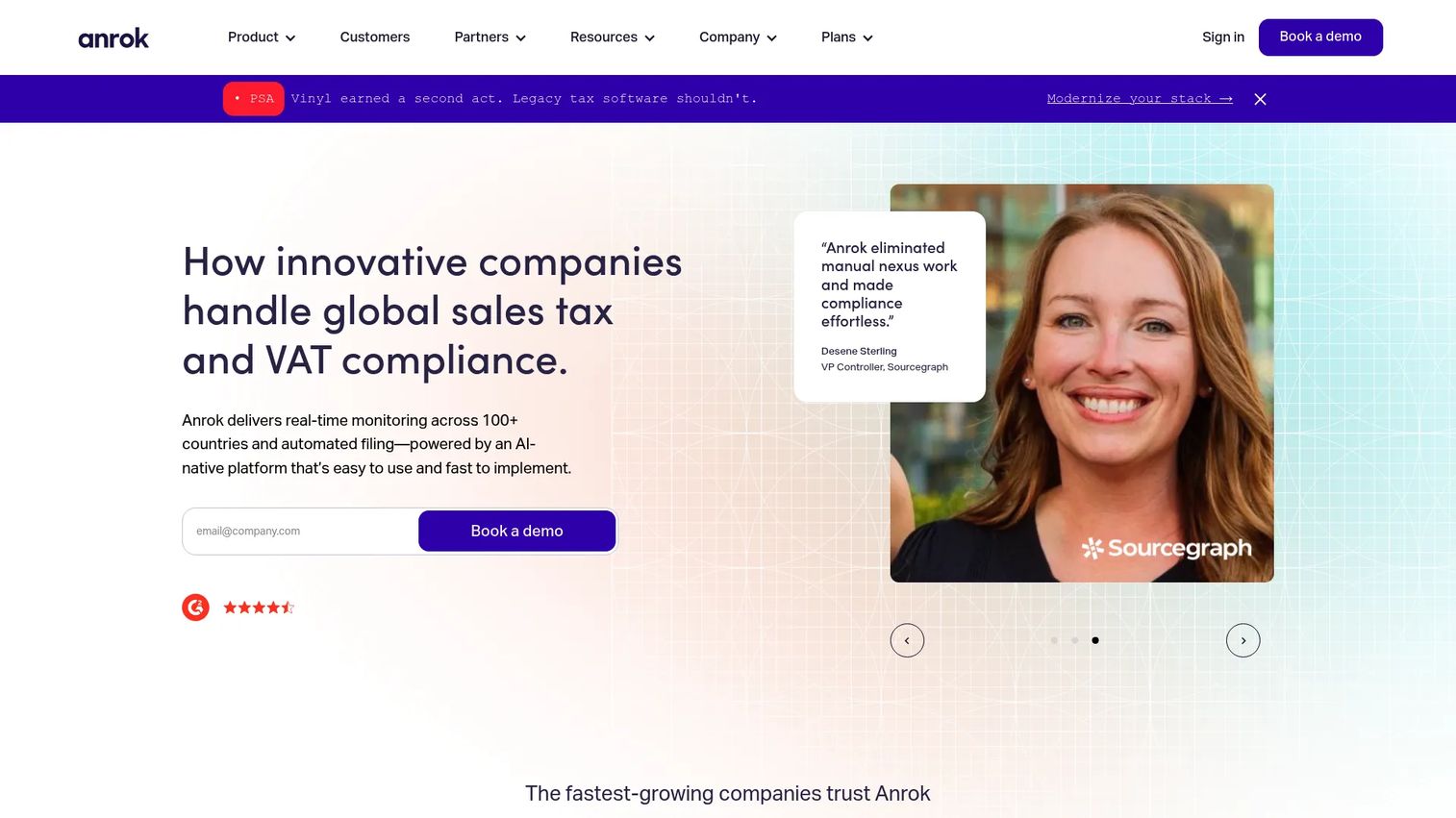
Anrok is a global sales tax and VAT compliance platform built for modern, recurring-revenue businesses. That SaaS-native framing is the reason it belongs on a founder's shortlist: it is designed around subscription billing, digital products, and the nexus questions that come with selling software everywhere. If your revenue model is recurring rather than transactional retail, Anrok speaks your language.
The platform provides real-time nexus and exposure monitoring, sales tax, VAT, and GST calculation and filing, and no-code integrations with billing, ERP, HRIS, and accounting systems. For a modern finance stack, that connective tissue is what keeps tax from becoming a manual reconciliation project every month.
Best for: Companies needing automated sales tax and VAT compliance across multiple jurisdictions.
Key strengths
- Exposure monitoring: real-time nexus tracking tuned for recurring revenue.
- Multi-tax calculation: sales tax, VAT, and GST calculation and filing.
- No-code integrations: connectors into billing, ERP, HRIS, and accounting.
Why choose Anrok: Anrok is worth evaluating alongside the broader platforms when your product is software and your billing is subscription-based. Recurring-revenue companies face nexus and exposure questions that retail-oriented tools were not designed around, and Anrok's SaaS focus targets exactly that. It fits founders who want tax handled the way their business actually runs.
Anrok pricing: Anrok lists three editions, Starter, Core, and Growth, with pricing available on request through sales. A free trial is referenced. Its G2 rating is 4.4/5.
Considerations before you buy
Choosing a tax compliance platform at Series B is less about feature checklists and more about fit with how your company actually operates. Run through these before you commit.
ERP and billing fit
The platform has to push tax logic into the systems where transactions happen. Confirm native ERP tax integration and billing connectors for your exact stack, not a generic promise. If reconciliation still requires manual exports, you have not solved the problem.
Jurisdiction coverage
Map your coverage to your roadmap, not just your current footprint. If you plan to sell into Europe next year, VAT compliance software support and e-invoicing coverage matter now, so you do not migrate again in 12 months.
Reporting and reconciliation depth
Audit-ready compliance depends on clean reconciliation workflows and tax data management. Check that filed amounts, collected amounts, and reported amounts can be tied together without a spreadsheet. Shallow reporting is where audit exposure hides.
Audit defensibility
Ask what happens when an auditor calls. Some platforms give you the records; a managed service defends the position. Decide how much of that risk you want to own internally versus outsource.
Automation and oversight
Tax automation software should reduce manual work, but the strongest setups keep a human-in-the-loop AI or expert review on edge cases. Full automation on clean transactions, human judgment on the ambiguous ones. That balance is what keeps errors from scaling with volume.
Implementation effort
For a 50-person company, a six-month rollout is a real cost. Ask for a realistic timeline to first filing, and talk to a peer at your stage before signing.
Conclusion
There is no single winner here, because the right choice depends on how your company runs. For breadth that scales into global tax compliance software territory, Avalara is the default. For enterprise ERP depth, Vertex. For complex, multi-domain compliance, Thomson Reuters ONESOURCE. For practical ecommerce sales tax, TaxCloud. For outsourced expertise and audit-ready compliance without an internal tax team, TaxValet. For clean US sales tax automation, TaxJar. And for SaaS-native, recurring-revenue models, Anrok.
Optimize for the thing your business actually needs: breadth if you are expanding fast, control if you have complex systems, or service-led simplicity if finance time is your scarce resource. The smartest move is to shortlist two platforms that fit your stage, run them past a peer who scaled through the same transition, and pressure-test the implementation timeline before you sign.
Tax should disappear into your stack, not become a recurring fire drill. Pick the system that gets you there and move on to the parts of the business only you can solve. If you are building out the rest of your GTM and finance tooling, the Guideflow best AI sales tools and AI customer service software guides cover the neighboring decisions.
FAQs
It automates the determination, calculation, filing, and reporting of taxes a business owes across jurisdictions. Instead of manual spreadsheets, it applies the correct tax to each transaction, prepares returns, and keeps an audit trail. The point is to reduce error and free finance from repetitive filing work.
Prioritize ERP tax integration, multi-jurisdiction coverage that matches your expansion roadmap, and reporting depth that supports audit-ready compliance. For recurring-revenue businesses, nexus monitoring tuned to subscription billing matters more than retail-oriented features. Match the tool to how your revenue actually flows.
Sales tax software focuses on calculating, tracking, and filing sales and use tax, usually within one country. Broader tax compliance platforms extend into VAT, GST, e-invoicing, direct tax, and information reporting. If you sell internationally or need corporate tax software alongside indirect tax, the broader suite fits better.
Many do. E-invoicing software capabilities are increasingly standard because governments in a growing list of countries mandate real-time or near-real-time invoice reporting. Platforms like Vertex and Avalara build e-invoicing into their compliance workflows, which matters if you are expanding into mandate jurisdictions.
Yes, and it is one of the most important criteria. Strong ERP tax integration pushes tax determination into the system where transactions happen, so the right tax is applied at the point of sale and reconciliation stays clean. Confirm native connectors for your specific ERP and billing platform before buying.
It depends on how much risk and workload you want to own. Managed services like TaxValet handle filings and audit defense with expert oversight, which suits teams scaling faster than they can staff. DIY platforms give you more control and often lower cost, if you have the internal capacity to run them.
For broad global tax compliance software coverage, Avalara, Vertex, and Thomson Reuters ONESOURCE lead, because they handle VAT, GST, e-invoicing, and multi-country reporting. Anrok is a strong fit for SaaS companies going global with recurring revenue. The right pick depends on your systems complexity and how many jurisdictions you touch.
Check whether filed, collected, and reported amounts can be reconciled without manual exports, and how long the platform retains supporting records. Ask what happens during an actual audit, whether you get the data or active defense. A human-in-the-loop AI or expert review layer on ambiguous transactions is a strong signal of defensibility.