Sales gamification software turns routine CRM activities into competitions with points, leaderboards, and rewards. The idea is simple: make the behaviors that build pipeline feel more like a game, and reps will do more of them.
Choosing the right sales gamification software can transform how your team performs. The best platforms connect directly to your CRM and automate recognition in real time. See our guide to sales performance management software for related tools.
Most teams start searching for these tools when motivation is slipping or activity numbers are flat. New hires taking too long to ramp is another common trigger. 52% of sales leaders rate their team's engagement as very low.
This guide covers 14 platforms worth evaluating, breaks down the key features that actually matter, and explains when gamification makes sense for your sales motion.
What this guide covers: tools, features, and evaluation tips
This guide covers everything you need to know about sales gamification software: what it is, how it works, and when it makes sense for your team. You'll find detailed reviews of 14 tools, complete with pricing, G2 ratings, and the specific use cases where each one shines. We also break down the key features to look for and the questions to ask during your evaluation, so you can confidently choose a platform that fits your sales motion and budget.
TL;DR
- Best for enterprise sales teams: Ambition combines gamification with coaching and scorecards
- Best for real-time recognition: SalesScreen delivers instant TV celebrations for deal wins
- Best for Salesforce-native teams: LevelEleven lives inside your CRM
- Best for budget-conscious teams: Pointagram offers simple gamification starting at $5/user
Pairing gamification with interactive product training can cut rep ramp time and build deeper product expertise across your team.
What is sales gamification software
Sales gamification software applies game mechanics like points, badges, leaderboards, and challenges to sales activities. The goal is straightforward: motivate reps, create healthy competition, and drive the specific behaviors that lead to more pipeline and closed deals.
These platforms connect directly to your CRM, automatically tracking activities and rewarding the actions that matter most. Instead of manually updating spreadsheets or chasing reps for activity reports, the software handles scoring and recognition in real time.
How gamification for sales works
The core loop follows a simple pattern: set goals, track progress, provide recognition.
- Activity tracking: The software pulls data from your CRM, monitoring calls made, emails sent, meetings booked, and deals progressing through stages
- Scoring engine: Points are assigned to different activities based on their importance, so you can weight behaviors that drive your specific sales process
- Recognition layer: Progress shows up on public leaderboards, and reps earn badges or level up when they hit milestones
- Rewards fulfillment: Prizes, SPIFFs, or other recognition can trigger automatically when reps meet predefined thresholds
Types of sales gamification software platforms
The market breaks down into a few main categories, and understanding the differences helps you narrow your search.
- Standalone gamification tools: Purpose-built for running contests, displaying leaderboards, and managing recognition. Spinify and SalesScreen fall here.
- CRM gamification add-ons: Native integrations that bring gamification directly into Salesforce or HubSpot without switching tools.
- Sales performance management suites: Comprehensive platforms combining gamification with coaching, analytics, and goal setting. Ambition is the primary example.
- Incentive compensation platforms: Tools that gamify the commission and compensation process, giving reps real-time visibility into earnings. Everstage and Xoxoday fit this category.
When to use sales gamification tools
Gamification isn't just about making work fun. It's a strategic tool for solving specific business challenges. Here are the situations where gamification platforms deliver the most value.
Motivating remote and hybrid sales teams
Distributed teams miss the natural energy of a physical sales floor. Gamification creates digital visibility and fosters competition even when reps work from different locations. Leaderboards displayed on office TVs or accessible via mobile apps can recreate that shared workspace buzz.
Driving activity-based selling behaviors
Gamification works especially well for reinforcing leading indicators like calls made or demos scheduled, rather than focusing only on lagging results like closed revenue. When you want reps concentrating on pipeline-building activities, gamification keeps those behaviors front and center.
Reinforcing sales training and onboarding
Gamification can accelerate ramp time for new hires, with ramp times exceeding 10 months at 40% of companies. Explore the best sales training software to support onboarding. Rewarding the completion of training modules, certifications, and product knowledge quizzes motivates reps to master essential skills quickly.
Pairing gamified learning with interactive demos lets new reps practice in realistic, hands-on product environments.
Running sales contests and SPIFFs
SPIFFs (Special Performance Incentive Funds) are short-term incentives for driving specific outcomes. Sales gamification platforms automate the entire process, from setup and tracking to prize fulfillment, eliminating manual spreadsheet work. See also our roundup of best sales compensation software.
Sales gamification software comparison table
| # | Product | Intent | Key differentiation | Pricing | G2 rating |
|---|---|---|---|---|---|
| 1 | Ambition | Enterprise sales performance | Fantasy contests and integrated coaching | Custom | 4.6/5 |
| 2 | SalesScreen | Real-time recognition | Live TV celebrations for deal wins | Starts at $25/user | 4.7/5 |
| 3 | Plecto | Customizable dashboards | Drag-and-drop dashboard builder | Starts at $300/month | 4.6/5 |
| 4 | Spinify | Recognition and culture | Custom achievement badges and goal-setting | Starts at $16/user | 4.6/5 |
| 5 | OneUp Sales | CRM-native gamification | Automated leaderboards from CRM data | Custom | 4.8/5 |
| 6 | Hoopla by Raydiant | TV-based celebrations | Newsflash-style TV announcements | Custom | 4.4/5 |
| 7 | ZIZO | Behavior-based gamification | Focuses on driving specific activities | Custom | 4.7/5 |
| 8 | SmartWinnr | Gamified learning and coaching | AI-powered coaching and quiz-based learning | Starts at $15/user | 4.7/5 |
| 9 | Everstage | Incentive management | Gamified commission tracking | Custom | 4.9/5 |
| 10 | Xoxoday Compass | Automated incentive payouts | Global reward catalog and automation | Custom | 4.6/5 |
| 11 | LevelEleven | Salesforce-native gamification | Deep integration within Salesforce | Custom | 4.4/5 |
| 12 | Centrical | Unified performance management | Gamification, microlearning, and coaching | Custom | 4.5/5 |
| 13 | SetSail | AI-powered micro-incentives | Rewards small, high-quality behaviors | Custom | 4.6/5 |
| 14 | Pointagram | Lightweight gamification | Simple setup for small teams | Starts at $5/user | 4.3/5 |
14 best sales gamification software tools reviewed
The following sales gamification software tools were evaluated based on CRM integration depth, ease of setup, variety of gamification mechanics, analytics capabilities, and pricing transparency. For broader context, see our guide to sales enablement software tools.
1. Ambition
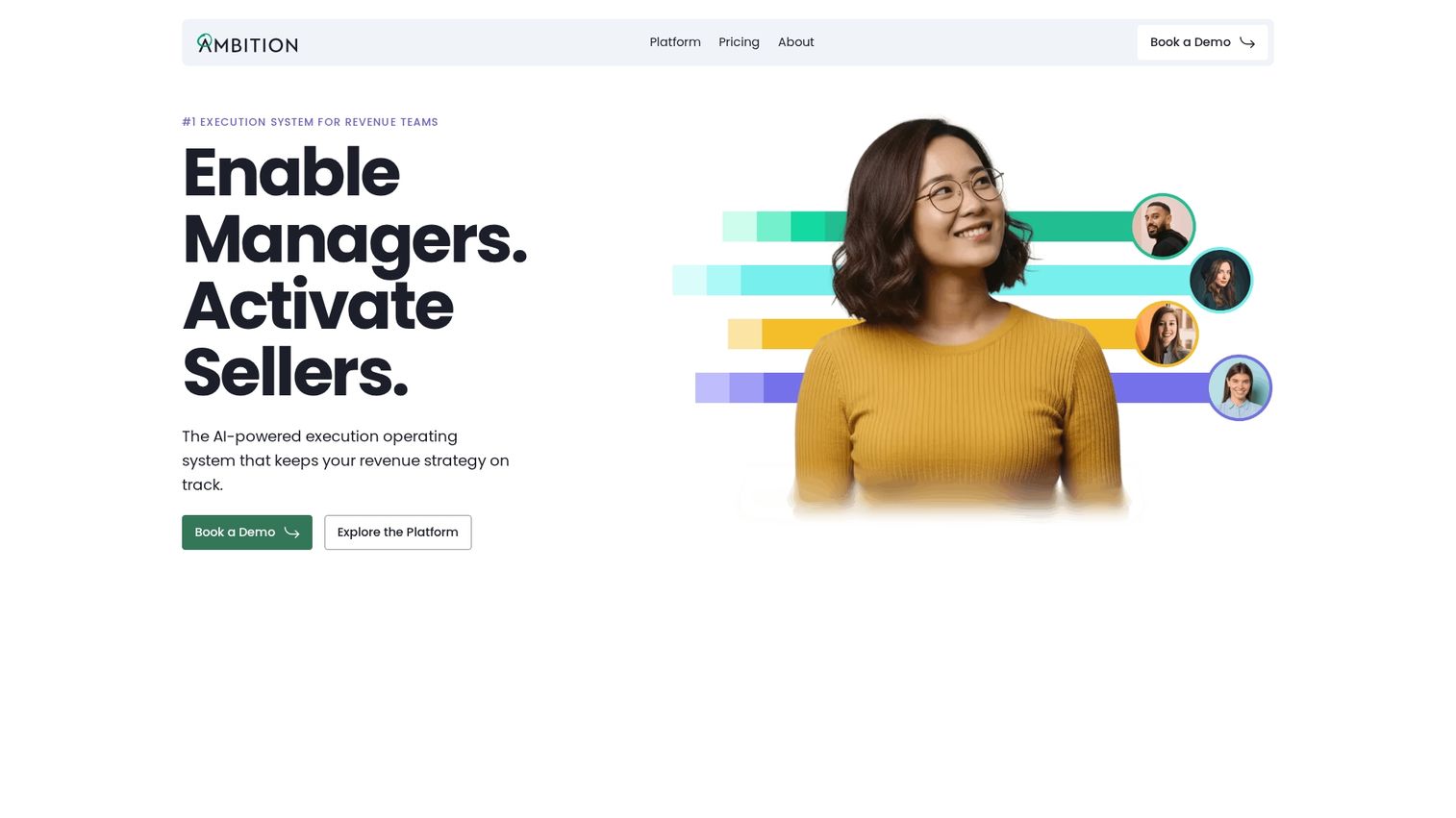
Ambition is a leading sales performance management platform combining robust gamification with manager coaching and rep scorecards. It's best suited for enterprise teams wanting fantasy-style contests, dynamic TV leaderboards, and integrated coaching workflows in one system.
The platform stands out for its fantasy sports-inspired competitions where reps draft teammates and compete in leagues, creating deeper engagement than standard leaderboards. Ambition also unifies gamification with structured coaching, letting managers set cadences, track one-on-one completion, and tie coaching directly to performance metrics.
Key strengths
- Fantasy-style contests: Draft-based competitions and league formats that mirror fantasy sports, driving higher engagement through team-based strategy
- Salesforce-native integration: Built directly into Salesforce with automatic data sync, eliminating manual updates and ensuring real-time accuracy
- Structured coaching cadences: Manager workflows for scheduling, tracking, and documenting coaching sessions tied to individual rep performance data
- Sales TV dashboards: Broadcast-quality displays showing live leaderboards, deal celebrations, and KPI tracking for in-office visibility
Best for
Enterprise sales organizations with 50+ reps looking for a comprehensive platform that combines gamification, coaching infrastructure, and performance analytics in a single system. Compare options in our best sales acceleration software guide.
Pricing
Custom pricing based on team size and feature requirements. Contact Ambition for a quote.
G2 rating
4.6/5 based on 600+ reviews
2. SalesScreen
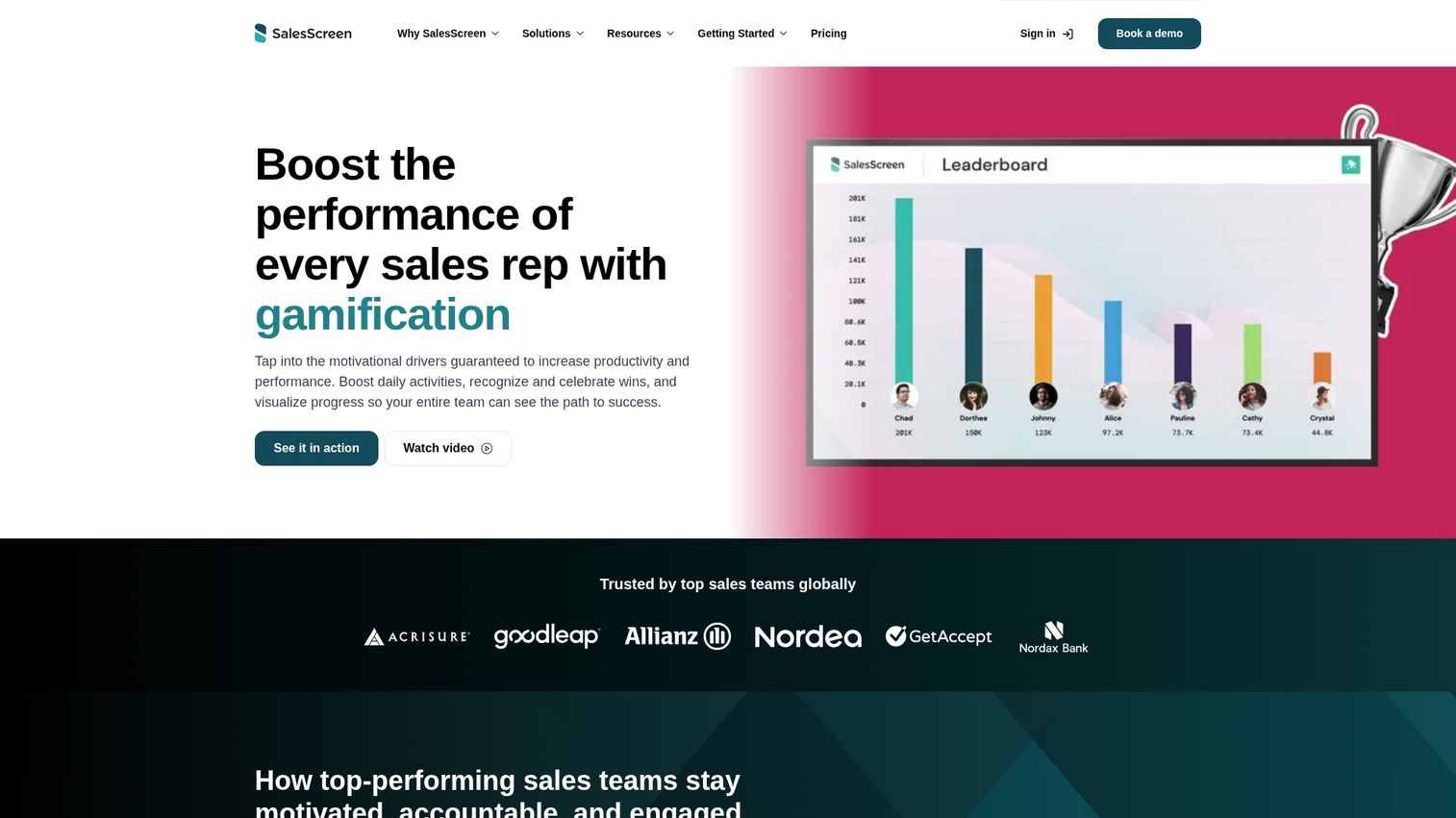
SalesScreen is a real-time leaderboard and celebration platform known for engaging TV displays that show live deal wins with custom animations and music. It's perfect for high-energy sales floors looking to provide instant recognition.
The platform excels at creating memorable moments when deals close. Reps see their wins broadcast immediately across office screens with personalized animations, sound effects, and team shoutouts. This instant visibility drives momentum and keeps energy high throughout the day.
Key strengths
- Real-time celebrations: Trigger instant TV broadcasts with custom videos, GIFs, and music when deals close.
- Mobile app for remote teams: iOS and Android apps show live leaderboards and milestone notifications for distributed reps.
- Pre-built contest templates: Launch competitions in minutes using ready-made formats for common scenarios like most calls made, highest revenue, or fastest deal velocity.
- Integrations with major CRMs: Native connections to Salesforce, HubSpot, Pipedrive, and other platforms automatically sync deal data and activity metrics without manual updates.
Best for
Sales teams with 10-200 reps who want high-visibility recognition and work in environments where TV displays or shared screens can create collective energy around wins. For outside reps, see our best field sales software guide.
Pricing
Starts at $25 per user per month
G2 rating
4.7/5 based on 200+ reviews
3. Plecto
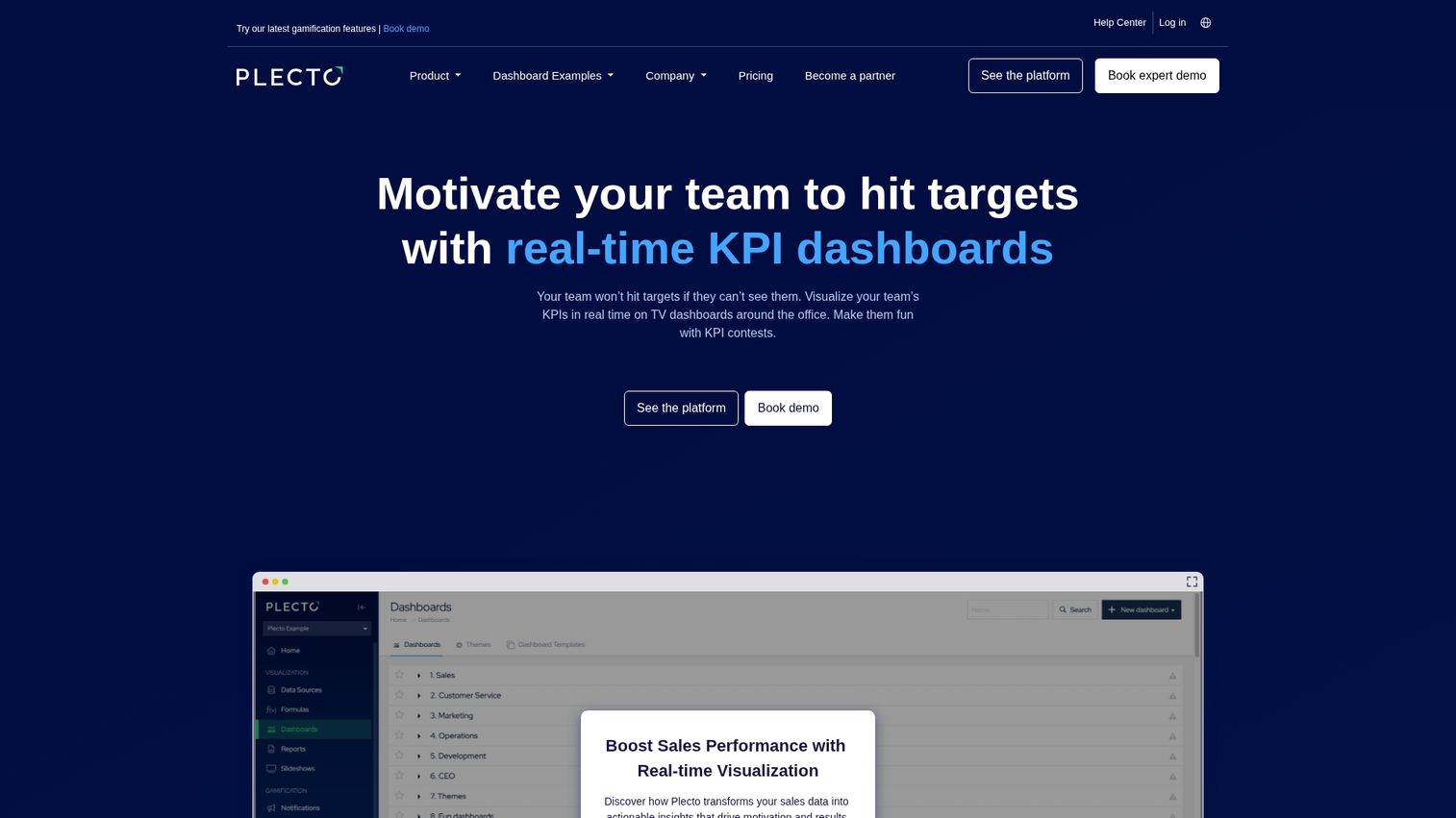
Plecto is a highly customizable dashboard platform designed to make sales performance visible across the organization. It's ideal for teams wanting flexibility to build their own KPI dashboards from scratch with gamification elements layered on top.
The platform's strength lies in its visual flexibility. You can create custom dashboards tracking any metric that matters. Then add gamification widgets like leaderboards and contests directly into those views.
This approach works well for teams with unique KPIs or those wanting to visualize performance data in specific ways that off-the-shelf solutions don't support.
Key strengths
- Drag-and-drop dashboard builder: Create custom KPI visualizations without coding by arranging widgets and charts.
- 100+ data integrations: Connect Salesforce, HubSpot, Google Sheets, SQL databases, and other sources into unified dashboards.
- Contest widgets: Layer gamification directly onto your dashboards with built-in competition modules that track progress toward goals and display rankings in real time
- Real-time notifications and alerts: Automated alerts notify reps via email, Slack, or SMS for milestones and contest updates.
Best for
Sales operations teams with 20-500 reps who need highly customized performance dashboards and want gamification as one component of a broader visibility strategy.
Pricing
Starts at $300 per month for small teams, with custom pricing for larger organizations
G2 rating
4.6/5 based on 100+ reviews
4. Spinify
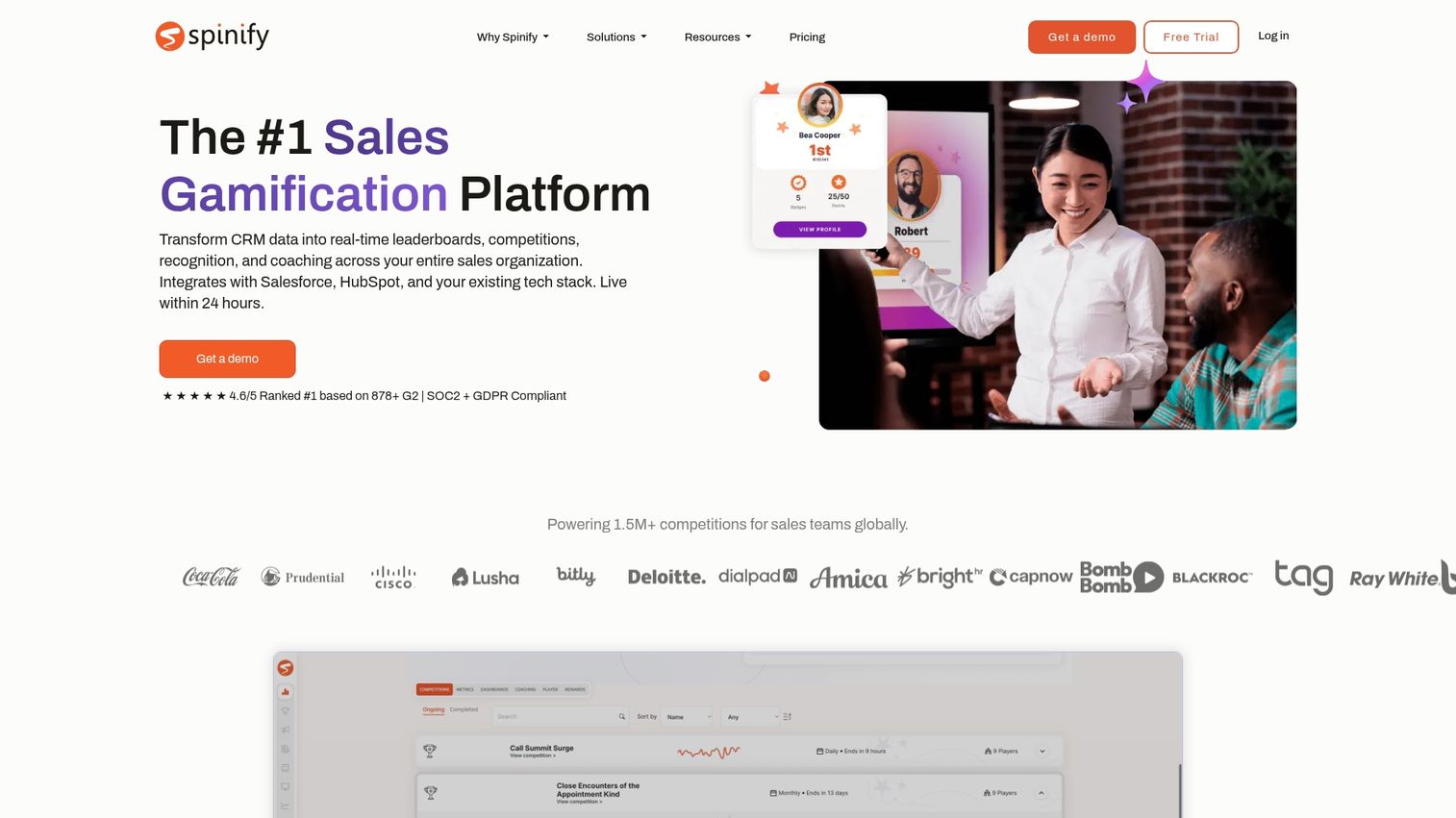
Spinify is a gamified recognition platform that excels at building positive culture with customizable leaderboards and achievement badges. It's best for teams wanting to foster recognition that extends beyond revenue metrics to include behaviors like collaboration, training completion, and customer satisfaction.
The platform's strength lies in its flexibility to recognize diverse contributions across your sales organization. You can create custom badges for achievements unique to your culture and set up multi-metric competitions. Recognition programs can celebrate both individual excellence and team collaboration.
Key strengths
- Custom achievement badges: Design unlimited badge types for milestones with personalized graphics and messaging.
- TV and mobile leaderboards: Display real-time rankings on office screens and mobile apps for all reps.
- Slack and Teams notifications: Automatically post achievements, contest updates, and milestone celebrations directly into your team's communication channels for immediate visibility.
- Goal-setting workflows: Let reps set personal targets within the platform, track progress visually, and receive automated encouragement as they approach milestones.
Best for
Sales teams of 15-300 reps who prioritize culture and want to recognize behaviors beyond closed revenue. Especially suited for hybrid or remote teams.
Pricing
Starts at $16 per user per month
G2 rating
4.6/5 based on 150+ reviews
5. OneUp Sales
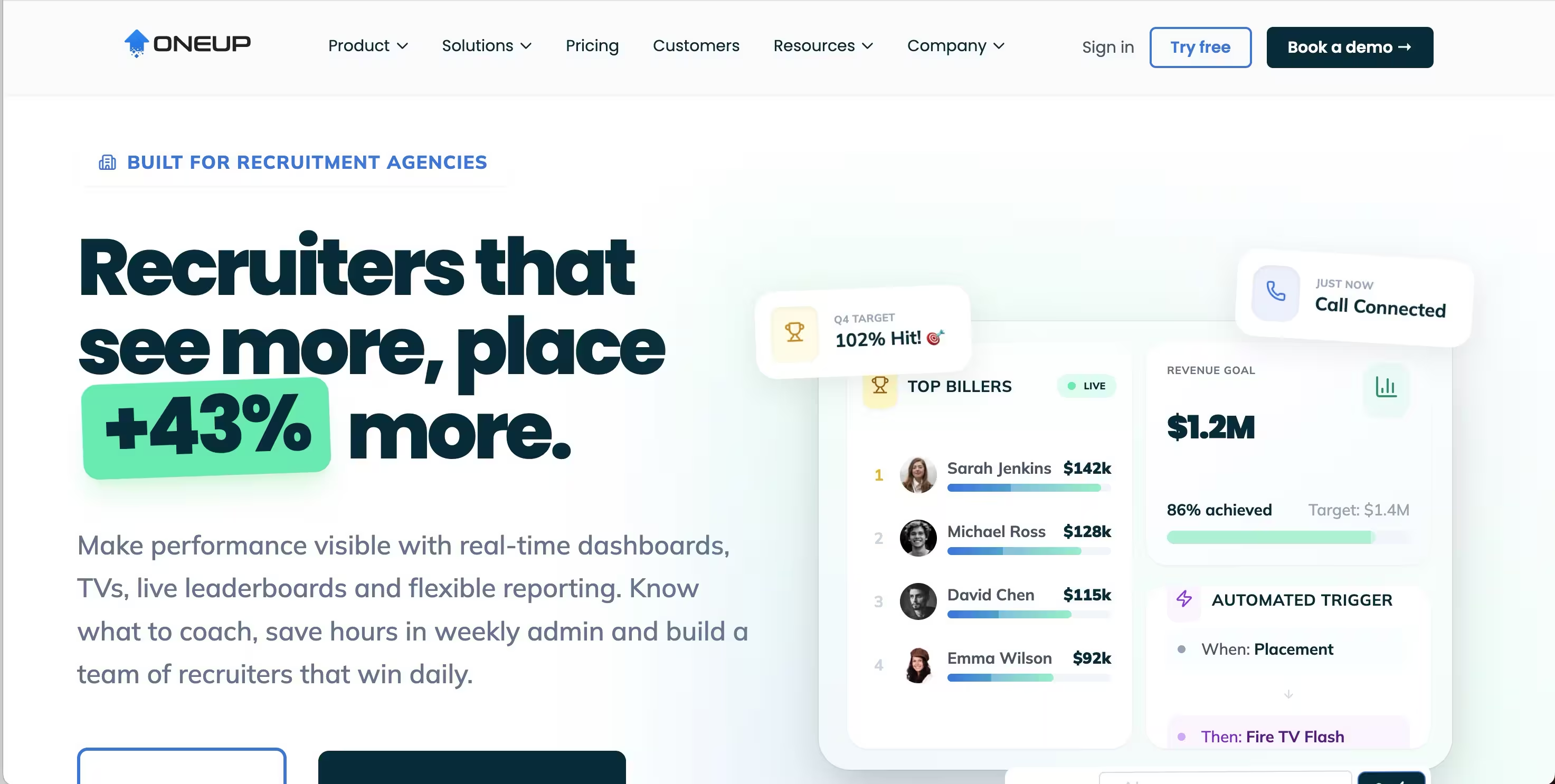
OneUp Sales offers data-driven gamification with strong CRM integrations. It's best for teams wanting fully automated leaderboards that pull data directly from Salesforce or HubSpot without manual entry or ongoing maintenance.
The platform eliminates the administrative burden of running competitions by automatically syncing CRM data and updating leaderboards in real time. Once you configure which metrics matter, OneUp handles the rest, letting managers focus on coaching rather than spreadsheet management.
Key strengths
- Automatic CRM sync: Native integrations with Salesforce, HubSpot, and Pipedrive pull activity and deal data continuously, ensuring leaderboards reflect current performance without manual updates
- League tables for ongoing competition: Create season-long competitions with promotion and relegation mechanics similar to sports leagues, keeping engagement high over extended periods
- Achievement tracking: Monitor individual rep progress toward personal goals and team targets with visual progress bars and milestone notifications
- Manager reporting dashboards: Access detailed analytics showing which competitions drive the most activity, which reps respond best to gamification, and overall ROI of your contests
Best for
Sales teams of 10-200 reps using Salesforce or HubSpot who want set-it-and-forget-it automation with minimal ongoing administration required.
Pricing
Custom pricing based on team size and CRM platform
G2 rating
4.8/5 based on 80+ reviews
6. Hoopla by Raydiant
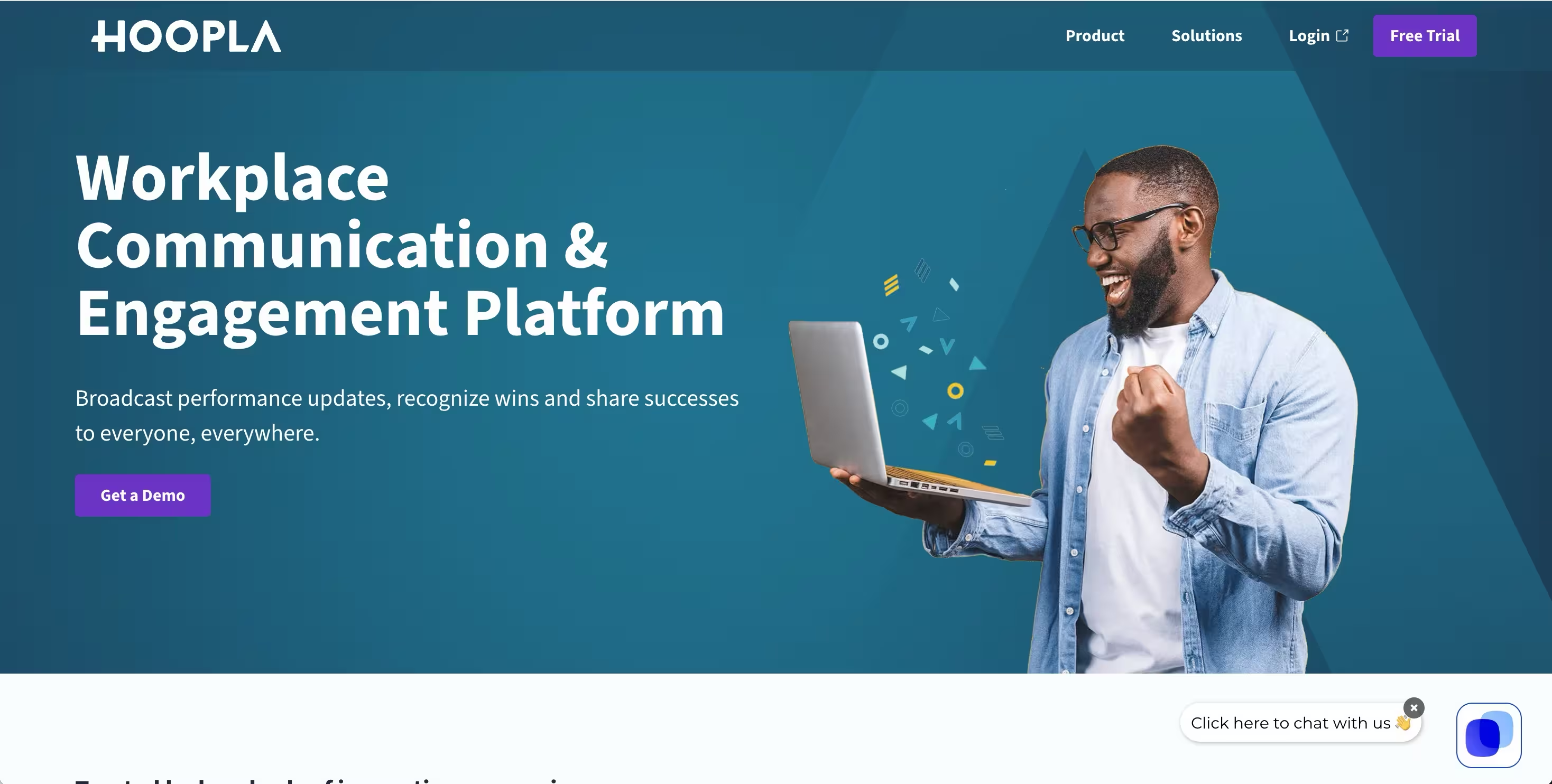
Hoopla (now part of Raydiant's platform) is a TV-style sales gamification platform designed for high-energy, in-office environments. It's famous for "newsflash"-style announcements that dramatically celebrate closed deals with broadcast-quality graphics and sound effects.
The platform transforms ordinary office TVs into dynamic celebration stations. When a rep closes a deal or hits a milestone, Hoopla interrupts regular leaderboard displays with breaking-news-style announcements complete with the rep's photo, deal details, and custom animations. This creates memorable moments that energize the entire floor and make every win feel significant.
Key strengths
- TV newsflash celebrations: Broadcast-style interruptions with custom graphics, music, and animations that take over office screens when deals close, creating high-visibility recognition moments
- Mobile leaderboards: Full-featured mobile apps let remote reps view live standings, receive push notifications for achievements, and participate in contests from anywhere
- Milestone alerts: Automated notifications when reps hit significant thresholds like quarterly quota, 10 deals closed, or personal records, triggering both TV displays and mobile alerts
- Contest management features: Pre-built templates for common competition formats plus custom contest builders that let you define rules, scoring, duration, and prizes
Best for
Sales teams of 20-500 reps working primarily in office environments with TV displays, particularly those in high-velocity sales motions where frequent wins create natural celebration opportunities.
Pricing
Custom pricing based on team size and feature requirements
G2 rating
4.4/5 based on 100+ reviews
7. ZIZO
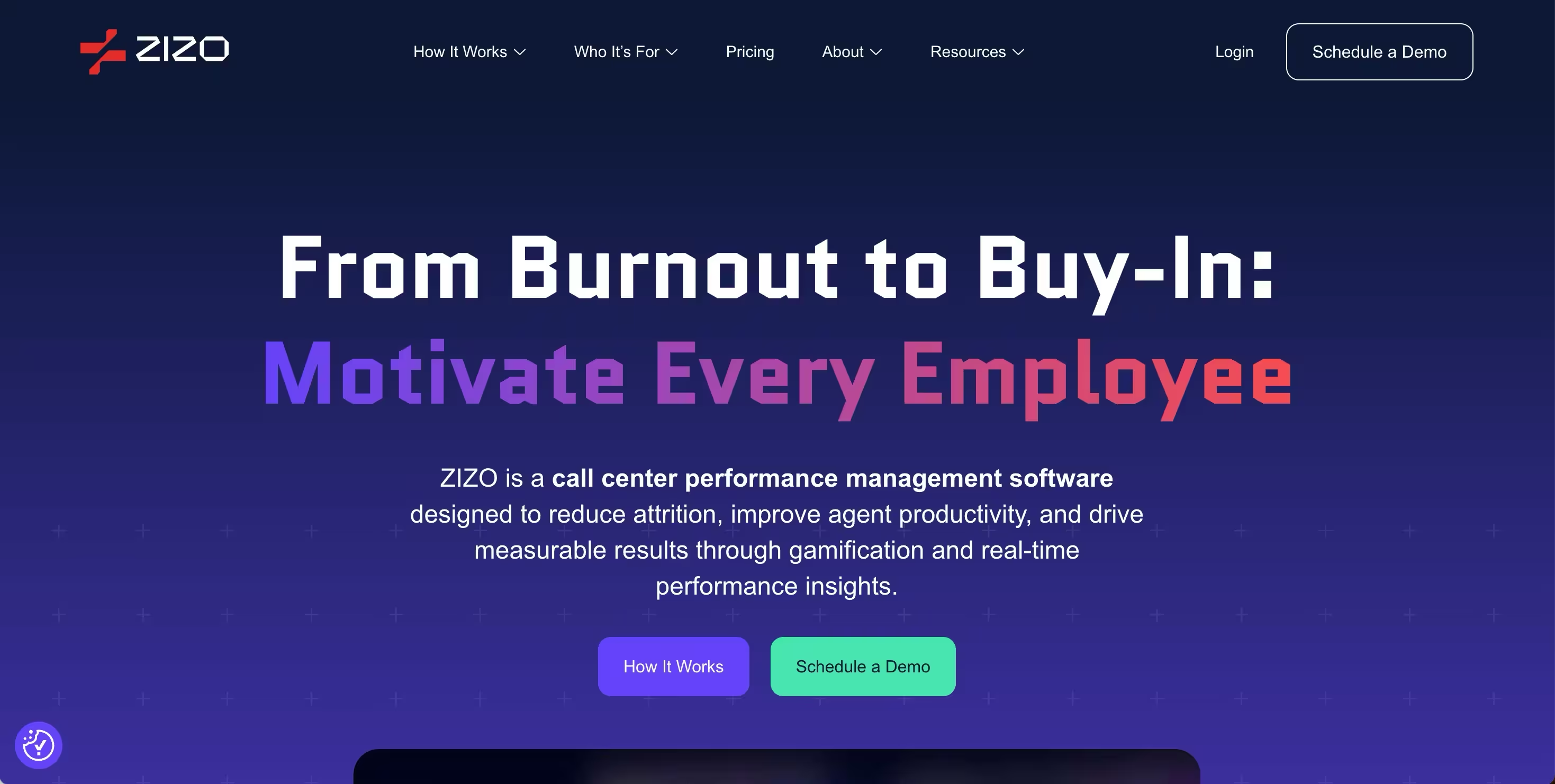
ZIZO is a gamification platform focused on driving measurable behavior change. It's best for sales leaders wanting to gamify specific pipeline-building activities like prospecting calls and discovery meetings, not just final results like closed revenue.
The platform's behavior-first approach helps teams focus on the activities that actually generate pipeline. Instead of only rewarding outcomes that take weeks or months to materialize, ZIZO lets you assign points to daily actions reps control directly, creating immediate feedback loops that reinforce productive habits.
Key strengths
- Behavior-based scoring engine: Assign custom point values to specific activities like calls made, emails sent, or meetings booked, with the flexibility to weight behaviors based on their importance to your sales process
- Custom challenge builder: Create time-bound competitions targeting specific behaviors you want to increase, with configurable rules, team structures, and success criteria
- Team and individual competitions: Run simultaneous contests at both levels, letting reps compete individually while also contributing to team goals that foster collaboration
- Performance analytics dashboard: Track which gamified activities correlate with pipeline growth and closed deals, helping you refine your scoring model based on actual results
Best for
Sales teams of 25-300 reps with clearly defined activity metrics who want to drive specific behavioral changes and have the data infrastructure to track those activities consistently.
Pricing
Custom pricing based on team size and integration requirements
G2 rating
4.7/5 based on 90+ reviews
8. SmartWinnr
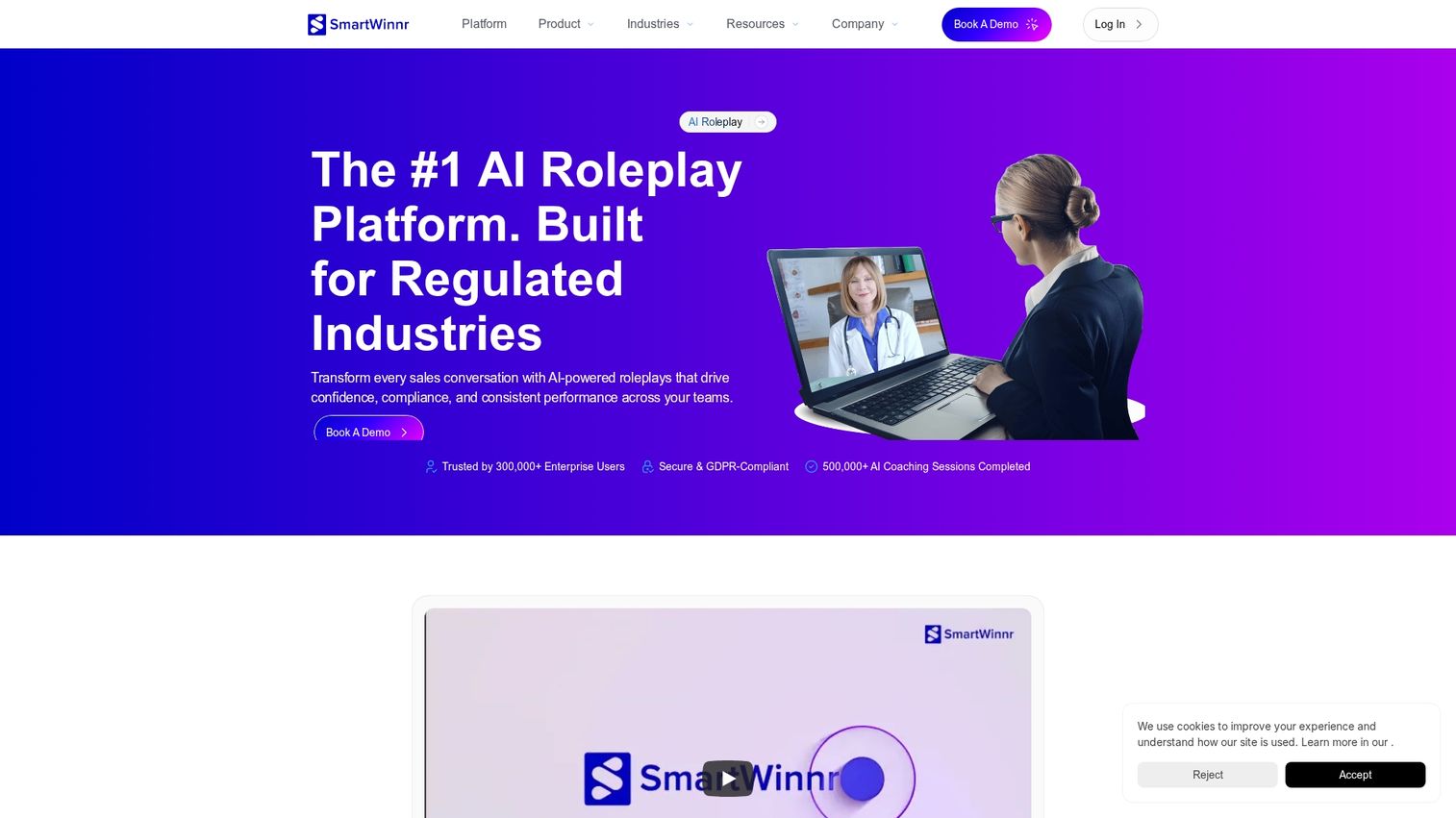
SmartWinnr combines sales gamification with learning and coaching. It's excellent for organizations wanting to gamify both sales performance and ongoing training. Particularly suited for distributed teams or complex product portfolios.
The platform stands out by treating learning as a continuous, gamified activity rather than a one-time event. Reps earn points not just for closing deals but also for completing training modules, passing product quizzes, and improving their skills through video coaching exercises. This dual focus helps teams maintain high performance while simultaneously building the knowledge base that sustains it.
Key strengths
- AI-powered coaching recommendations: Machine learning suggests personalized coaching and training based on performance gaps.
- Quiz-based learning modules: Mobile app delivers bite-sized quizzes with leaderboards and point rewards for completion.
- Video coaching capabilities: Reps record pitch videos that managers review and score for gamified feedback.
- Gamified certifications: Multi-stage certification paths where reps unlock badges by completing training and assessments.
Best for
Sales organizations of 30-500 reps with complex products requiring ongoing training. Particularly suited for SaaS, medical devices, or financial services where product knowledge impacts win rates. See our guide on how to train software users effectively.
Pricing
Starts at $15 per user per month
G2 rating
4.7/5 based on 90+ reviews
9. Everstage
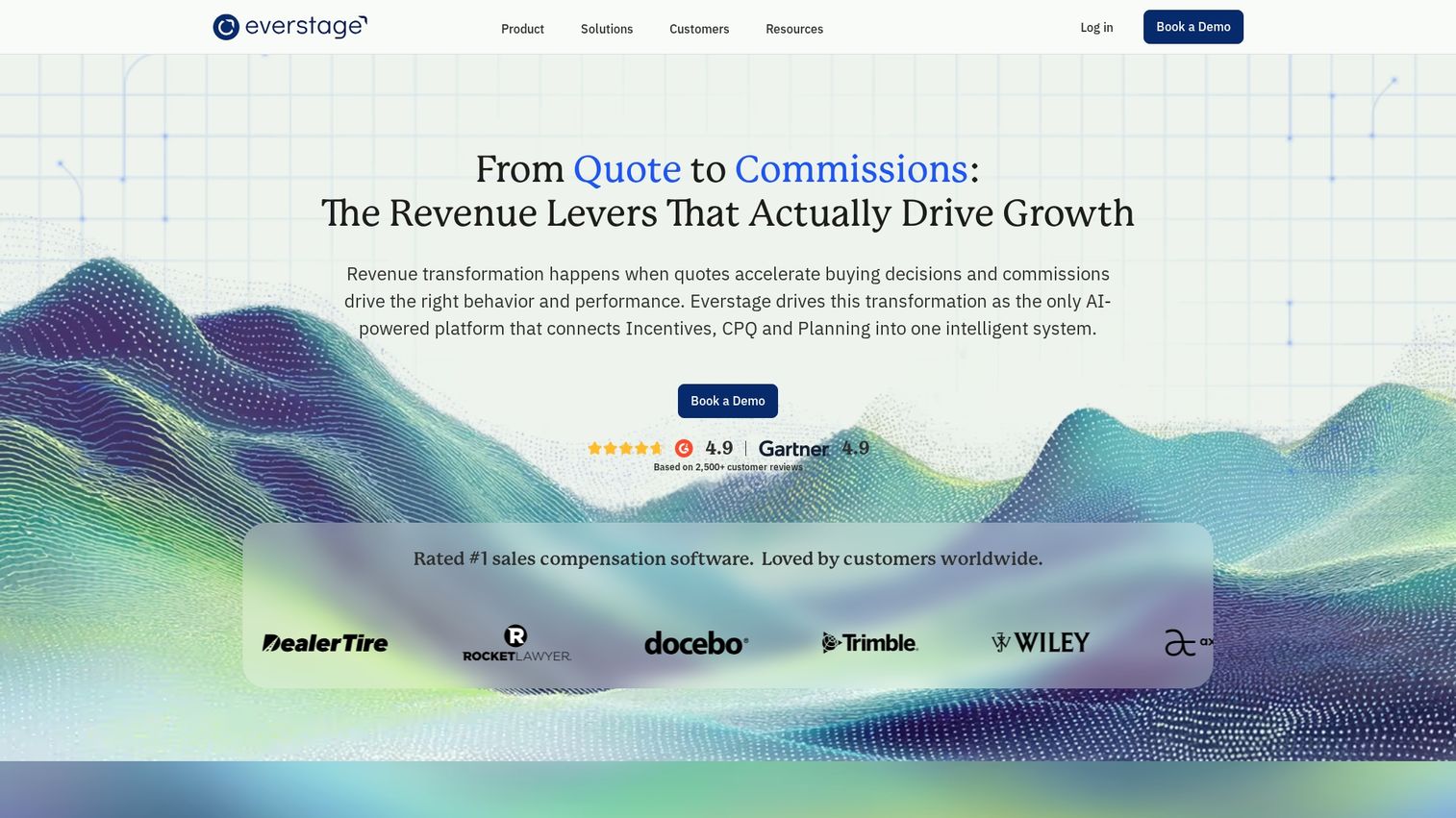
Everstage is a gamified commission tracking and incentive management platform. It's best for teams looking to make compensation transparent and engaging with real-time earnings visibility.
Key strengths
- Real-time commission visibility
- "What-if" earnings calculators
- Leaderboards based on earnings
- Payout automation
10. Xoxoday Compass
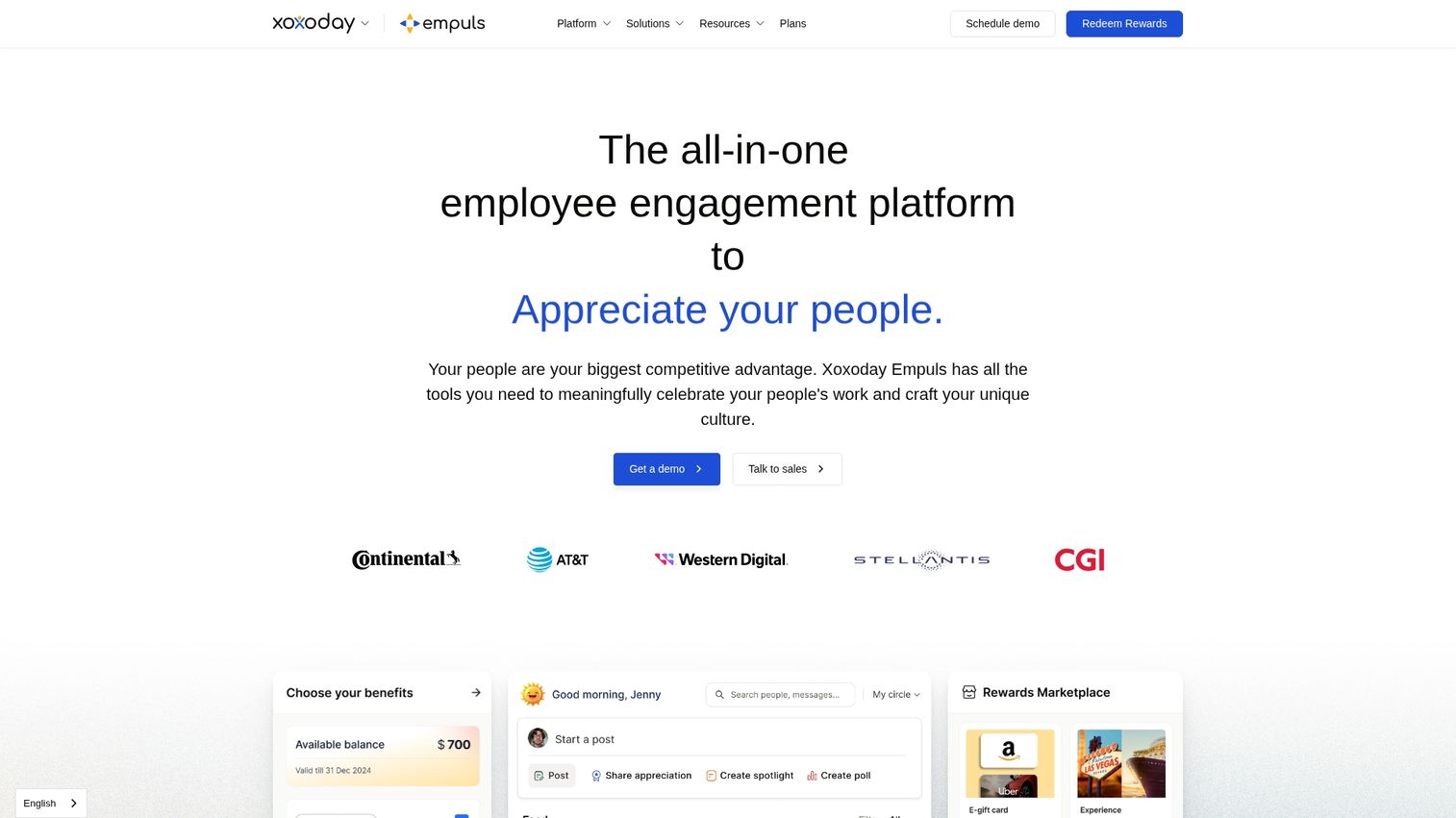
Xoxoday Compass is an automated incentive and reward distribution platform. It's particularly well-suited for global teams needing an extensive rewards catalog and automated payout workflows across regions.
Key strengths
- Global reward catalog
- Automated incentive calculations
- Gamified challenges
- Multi-currency support
11. LevelEleven
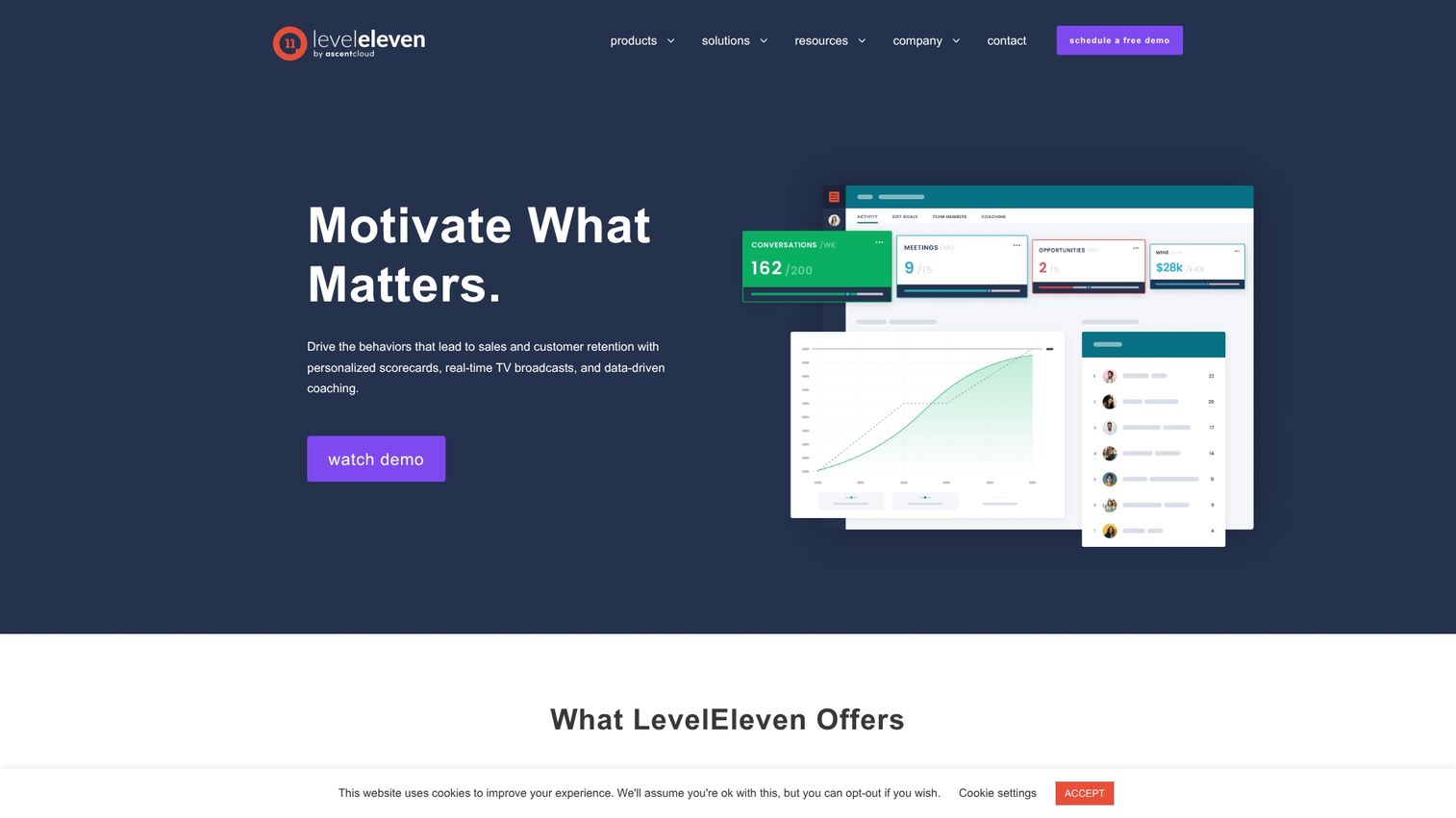
LevelEleven is a sales performance management solution with gamification features built specifically for Salesforce. It's the top choice for organizations deeply embedded in the Salesforce ecosystem who want gamification without leaving their CRM interface.
The platform's native Salesforce architecture means everything happens inside the environment your reps already work in daily. Leaderboards, scorecards, and contest standings appear directly in Salesforce tabs, eliminating the need to switch between applications or learn new interfaces. This tight integration ensures data accuracy and makes adoption nearly frictionless for teams already comfortable with Salesforce.
Key strengths
- Salesforce-native application: Built directly into Salesforce as a managed package, with all gamification features accessible through native tabs and components that match Salesforce's look and feel, requiring zero context switching for reps
- Real-time rep scorecards: Individual performance dashboards showing each rep's progress toward quota, activity completion rates, and ranking across multiple metrics, updated automatically as Salesforce data changes
- Contest automation: Pre-configured competition templates for common scenarios like most pipeline created or fastest deal velocity, with automated start/stop scheduling and winner notifications that require minimal manual administration
- Integrated coaching workflows: Manager tools for setting one-on-one cadences, documenting coaching sessions, and tracking action items directly tied to individual rep scorecards, creating a closed loop between performance visibility and improvement
Best for
Sales organizations of 25-1,000+ reps using Salesforce as their primary CRM who want gamification that feels like a natural extension of their existing workflow rather than a separate tool to manage.
Pricing
Custom pricing based on Salesforce edition and user count
G2 rating
4.4/5 based on 100+ reviews
12. Centrical
Centrical is a comprehensive employee performance management platform combining gamification with microlearning and personalized coaching. It's designed for large sales organizations needing unified motivation, skill development, and performance tracking in a single system.
The platform stands out by treating performance improvement as a holistic challenge rather than just a gamification layer. Centrical combines real-time performance tracking with bite-sized learning content and AI-driven coaching recommendations, creating a continuous improvement loop that addresses both motivation and skill gaps simultaneously.
Key strengths
- Microlearning modules: Short, mobile-friendly training content delivered in 3-5 minute bursts that reps complete during downtime, with spaced repetition algorithms that reinforce key concepts over time and track knowledge retention rates
- Personalized coaching plans: AI analyzes individual performance data to generate customized development paths for each rep, automatically recommending specific training modules, skill exercises, and coaching focus areas based on their unique gaps and strengths
- Gamified challenges: Multi-layered competition formats including individual quests, team missions, and organization-wide tournaments, with customizable point systems that reward both performance outcomes and learning activities
- Performance analytics: Unified dashboards showing correlations between training completion, coaching engagement, and actual sales results, helping leaders identify which development activities drive the strongest business impact
Best for
Enterprise sales organizations with 100+ reps who need to manage performance, learning, and coaching in one platform, particularly those in regulated industries or complex sales environments where ongoing skill development is critical to success.
Pricing
Custom pricing based on user count and feature requirements
G2 rating
4.5/5 based on 70+ reviews
13. SetSail
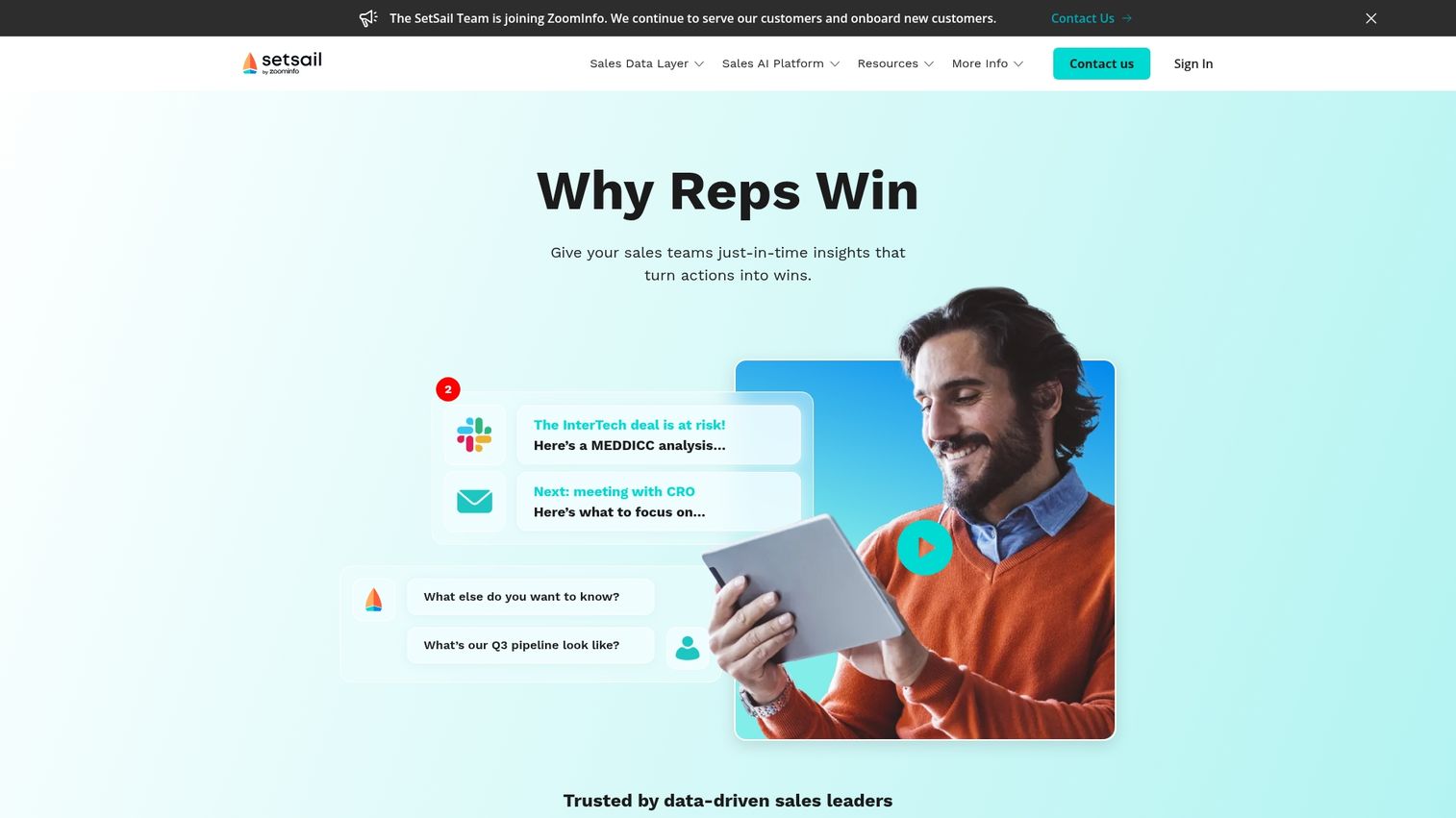
SetSail is an AI-powered sales engagement platform that uses gamified micro-incentives to reinforce high-quality selling behaviors. Unlike traditional gamification that rewards volume metrics, SetSail focuses on the quality of actions - rewarding reps for writing personalized emails, engaging multiple stakeholders in deals, or advancing opportunities through meaningful conversations. It's best for teams wanting to shift focus from activity quantity to the behaviors that actually move deals forward.
The platform's AI analyzes email content, meeting patterns, and deal progression to identify which specific actions correlate with closed revenue. It then automatically rewards those behaviors with small cash bonuses, creating immediate positive reinforcement for quality work that might otherwise go unrecognized until a deal closes weeks or months later.
Key strengths
- AI-driven behavior signals: Machine learning models analyze email quality, stakeholder engagement patterns, and deal velocity to identify which specific rep actions predict success, automatically surfacing best practices and rewarding reps who consistently execute them
- Micro-bonuses for small wins: Instant cash rewards ranging from $5-50 trigger automatically when reps complete high-value actions like multi-threading a deal or sending a highly personalized email, creating immediate positive reinforcement without waiting for deal closure
- Deal quality scoring: Proprietary algorithms assess deal health based on engagement breadth, communication patterns, and progression velocity, giving reps and managers early warning signals about at-risk opportunities before they stall
- Deep CRM integration: Native connections to Salesforce and other platforms automatically capture email activity, meeting data, and opportunity changes, eliminating manual logging while ensuring accurate behavior tracking and bonus calculations
Best for
Sales teams of 20-500 reps in complex B2B environments where deal quality and multi-threading matter more than raw activity volume, particularly organizations wanting to reward strategic selling behaviors that traditional gamification overlooks.
Pricing
Custom pricing based on team size and bonus budget allocation
G2 rating
4.6/5 based on 50+ reviews
14. Pointagram
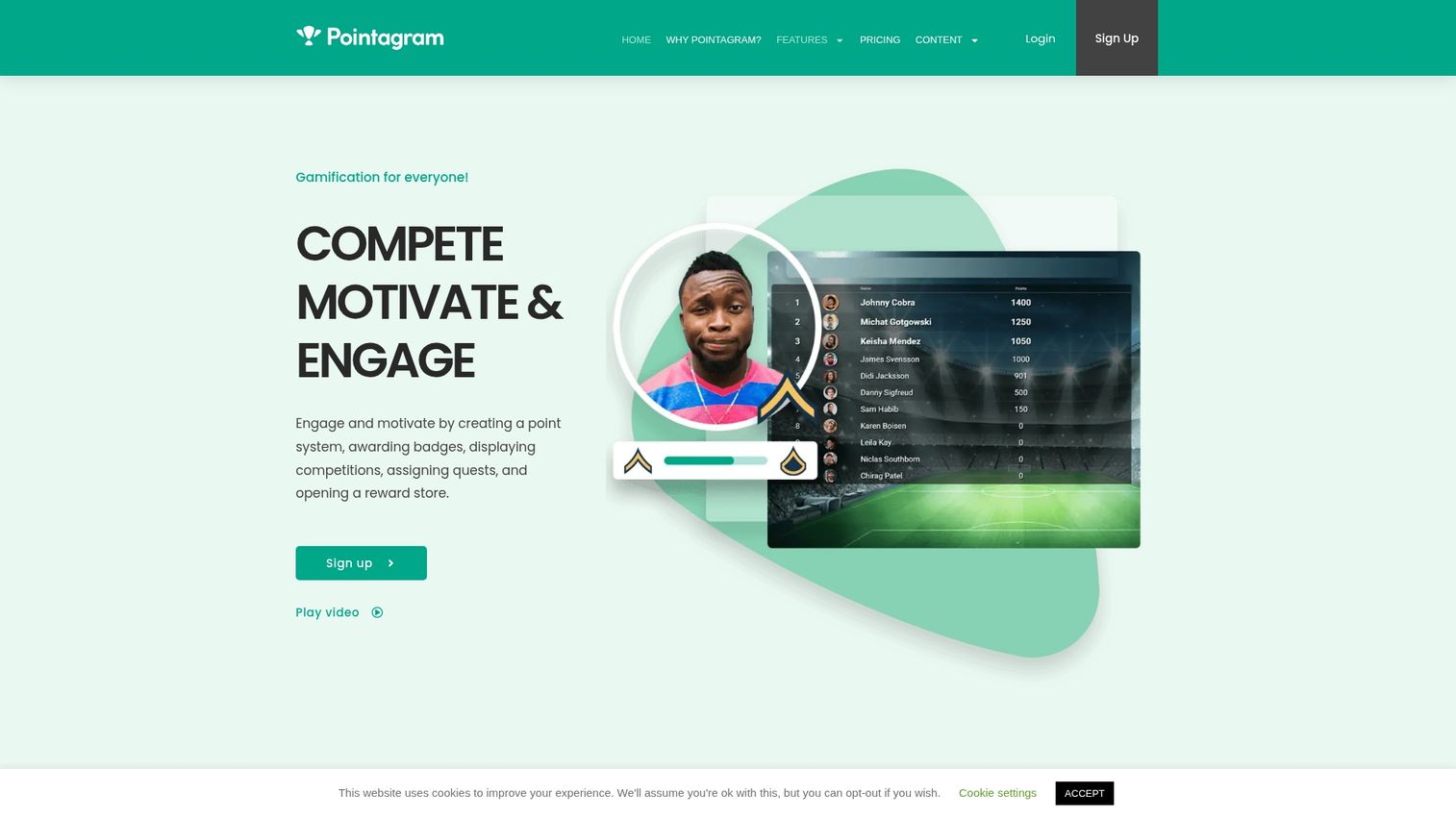
Pointagram is a lightweight gamification app designed for small to mid-size teams. It's the best option for organizations wanting simple points and badges without enterprise-level complexity or cost. The platform strips away advanced features like AI-powered coaching or fantasy-style contests, focusing instead on core gamification mechanics that teams can implement and manage without dedicated sales ops support.
Pointagram works well for teams testing gamification for the first time or those with straightforward sales motions where basic recognition drives results. The platform's simplicity means less training overhead and faster time to value, though it lacks the depth needed for complex enterprise sales environments with multiple product lines or intricate compensation structures.
Key strengths
- Quick and easy setup: Launch your first contest in under an hour with minimal configuration required, using straightforward point assignment rules and pre-built leaderboard templates that don't require technical expertise or IT involvement
- Simple badge and point systems: Create custom badges for specific achievements and assign point values to activities tracked in your CRM, with visual progress indicators that show reps exactly where they stand without overwhelming complexity
- Team competitions: Run both individual and team-based contests with flexible scoring that lets you balance personal achievement with collaborative goals, fostering healthy competition without sacrificing team cohesion
- Affordable pricing: Entry-level plans start at $5 per user per month, making it accessible for small teams with limited budgets who want to test gamification's impact before committing to enterprise-grade platforms
Best for
Small sales teams of 5-50 reps with straightforward sales processes who want to add basic gamification without complex implementation, ongoing administration burden, or significant budget allocation.
Pricing
Starts at $5 per user per month
G2 rating
4.3/5 based on 40+ reviews
How to choose the best sales gamification software
Use the following criteria as a guide when evaluating vendors. The right questions will help you find the platform that fits your team's specific situation.
CRM and gamification tool integration
Gamification only works if data flows automatically and in real time from your CRM. Evaluate whether the tool offers native integration with your specific CRM. Manual data entry kills adoption and creates unnecessary work.
Ease of setup and rep adoption
Complex implementations often fail. Look for tools offering pre-built contest templates, quick onboarding, and intuitive mobile apps that reps will actually use. Low adoption means a wasted investment regardless of platform capabilities.
Customization for your sales process
Your sales motion is unique. Evaluate whether you can customize which activities earn points, create custom badges aligned with your culture, and build contests around your specific KPIs.
Analytics and performance tracking
You want to measure the impact of gamification efforts. Look for strong reporting showing individual vs. team performance, ROI of specific contests, and behavior trends over time.
Pricing and total cost of ownership
Pricing models vary widely, from per-user fees to platform-level subscriptions. Factor in implementation costs, hardware like TVs if needed, and ongoing administration time.
Key features in a sales gamification platform
When evaluating tools, make sure they include the following core capabilities.
Real-time leaderboards and dashboards
Leaderboards create visibility and foster healthy competition. The best platforms offer dynamic TV displays for in-office teams and mobile apps for remote reps, updating in real time as CRM data syncs.
Contest and challenge builders
A good platform offers variety: individual vs. team competitions, short-term sprints, and bracket-style tournaments. Look for pre-built templates plus customization options for unique competitions.
Points, badges, and reward systems
Points, badges, and rewards are the core mechanics of gamification:
- Points: Earned for completing key activities, accumulating over time to show progress
- Badges: Visual achievements for hitting milestones like closing a first deal or making 100 calls
- Rewards: Tangible prizes triggered when users reach point thresholds or win competitions
Coaching and microlearning modules
Some advanced platforms combine gamification with training features. Gamified quizzes, video coaching feedback, and skill certifications help reps build critical skills while earning recognition.
Mobile apps for field sales teams
A mobile app is crucial for outside sales and remote teams. Reps can check standings, receive contest notifications, and track progress on the go.
Benefits of gamifying your sales process
Implementing gamification can deliver tangible business results:
- Increased activity volume: Reps complete more calls, emails, and meetings when activities earn points and recognition
- Faster onboarding: New reps ramp up more quickly when training is gamified with clear milestones
- Better visibility: Managers see in real time who is active and who might benefit from coaching
- Improved retention: Recognition and engagement can reduce costly sales team turnover, which can cost over $115,000 per rep
- Data-driven coaching: Activity data reveals behaviors that separate top performers from the rest
How interactive demos support sales training gamification
Gamified training works best when reps can practice skills in realistic environments. Interactive demos let reps experience the product they're selling without needing access to complex production systems.
Managers can track demo completion as a gamified metric, awarding points or badges to reps who master key product workflows. For example, pre-sales teams use Guideflow to create specific training scenarios that reps complete to earn points, ensuring they're certified and ready for live customer calls.
Build a higher-performing sales team today
Start by auditing the key sales behaviors you want to drive and incentivize. From there, evaluate sales gamification software based on CRM integration, ease of use, and suitability for your team's size and culture.
Combining a strong gamification approach with modern training tools like interactive product demos will accelerate your results and build a more skilled, motivated sales team. Explore interactive demos for presales to see how they fit your workflow.
Start your journey with Guideflow today!
FAQs about sales gamification software
Yes, gamification can be effective for teams as small as 3-5 reps, though competitive dynamics differ. Look for tools with affordable per-user pricing and quick setup designed for SMBs. Pointagram and Spinify both offer entry points suitable for smaller organizations.
Gamification motivates reps through points, badges, and recognition for activities, while commission tracking calculates actual monetary compensation owed. Some platforms like Everstage combine both by gamifying earnings visibility, but they serve different primary purposes.
Use a mix of team-based competitions alongside individual ones. Recognize personal improvement and milestones, not just top ranks. Focus on gamifying activities reps can control rather than only lagging results like closed revenue.
Focus on leading indicators reps have direct control over: calls made, emails sent, meetings booked, demos completed, and new pipeline created. Gamifying only closed revenue can demotivate reps with longer sales cycles.
Some platforms offer free tiers with limited features, and tools like Pointagram have affordable entry-level plans starting at $5/user. Most enterprise-grade platforms require paid plans, typically starting around $15-30 per user per month.
Simple tools with pre-built CRM integrations can launch in days. More complex enterprise platforms with custom scoring rules and TV hardware setups may take several weeks to fully implement.
Yes, many teams integrate their gamification platform with an LMS or demo creation tool to track training completion as a gamified metric. Platforms like Guideflow provide analytics on demo engagement that can feed directly into a gamification scoring engine.