
Every inventory team lives inside the same tension. Hold too much stock and working capital sits frozen on shelves. Hold too little and service levels slip, orders go unfilled, and customers churn. The middle path is narrow, and it moves constantly as demand shifts, lead times wobble, and networks grow more complex.
The stakes are getting larger. The global inventory optimization market is projected to grow from $6.6 billion in 2026 to $14.0 billion by 2033, an 11.5% CAGR, with software accounting for 68.6% of revenue in 2026, according to Coherent Market Insights (2026). Teams are pouring budget into this problem because manual planning no longer keeps pace.
The best tools do more than forecast demand. They help you decide what to stock, where to place it, and how much risk to carry at each node in your network. That is a decision problem, not a reporting problem. This guide is written for buyers evaluating software, not for readers looking for supply chain theory. If you are trying to build a shortlist of inventory optimization tools that make repeatable, data-backed decisions, this is your starting point.
What's inside
This guide covers seven inventory optimization tools chosen for planning depth, AI-driven recommendations, replenishment automation, multi-echelon support, and ERP integration. We favored software that helps product, operations, and supply chain teams make decisions they can repeat and defend, not just dashboards that describe the past.
For each tool you will see where it is strongest and which buying scenarios it fits best. We looked at how each platform handles demand forecasting, safety stock optimization, and network-level tradeoffs, plus how cleanly it connects to the ERP and planning stack you already run. The goal is a shortlist you can act on, not a feature dump.
TL;DR
- Most complete for complex networks: GAINS, for teams that need trade-off visibility and policy optimization across many nodes.
- Best for mid-market and ERP-connected planning: Netstock, for SMBs that want predictive inventory recommendations without building everything from scratch.
- Best AI-first enterprise option: C3 AI, for large SKU counts, messy data environments, and continuous optimization.
- Best broad enterprise planning suite: SAP Integrated Business Planning, for teams that need inventory decisions to sit inside end-to-end planning.
- Best for retail network visibility: RELEX Solutions and Zebra Technologies, for store and DC balancing under demand volatility.
- Best for probabilistic, service-level planning: ToolsGroup, for teams managing forecast uncertainty and lead time variability.
The right pick depends on whether working capital optimization, fill rate improvement, or enterprise planning breadth matters most to your team.
What is inventory optimization software?
Inventory optimization software is software that recommends how much inventory to hold, where to place it, and when to replenish, based on demand patterns, service targets, and supply constraints. It sits a layer above basic tracking. Where inventory management software records what you have, inventory optimization software decides what you should have.
Most buyers evaluating inventory planning software should expect these core capabilities:
- Demand forecasting: Statistical and AI models that predict future demand at the SKU and location level, including seasonality and trend.
- Safety stock optimization: Calculating buffer stock that protects service levels against demand and lead time variability, rather than using flat rules.
- Reorder point optimization: Setting order triggers that reflect real demand and replenishment timing instead of static thresholds.
- Replenishment automation: Generating order recommendations that planners can review and push into execution, reducing manual cycles.
- Inventory policy optimization: Tuning min/max levels, order quantities, and review periods so each item carries the right policy for its behavior.
- Multi-echelon inventory optimization: Optimizing stock across the entire network so decisions at one node account for their effect on others.
- ERP integration: Connecting to the systems of record that hold inventory balances, orders, and item data.
Underneath all of it is the same balancing act: hold enough to hit service level and fill rate targets, avoid stockouts, cut excess inventory, and free up working capital. Good software makes those tradeoffs explicit instead of hiding them inside a spreadsheet.
When to use inventory optimization software
Reduce stockouts without overbuying
This category earns its place when service levels are slipping and planners are still leaning on static reorder points. If demand is changing faster than manual review cycles can absorb, flat rules quietly drift out of date. Stockout reduction and excess inventory reduction usually move together once policies reflect actual demand and lead time variability rather than last year's assumptions.
Manage inventory across multiple locations
When you run distribution centers, stores, plants, and suppliers that depend on each other, local decisions create network-wide consequences. Overstocking one DC can starve another. Multi-echelon inventory optimization matters most here, because it optimizes the whole network at once instead of tuning each site in isolation. If you have more than a couple of stocking tiers, this is where the real savings sit.
Automate replenishment decisions
Some teams want recommendations they can trust and operationalize inside existing ERP or planning workflows. Replenishment automation reduces the manual review load and makes decisions consistent across planners, shifts, and regions. The point is not to remove humans, but to let them spend time on exceptions and strategy instead of recalculating reorder points by hand.
Comparison table
The table below compares the seven tools by intent, standout strength, pricing, and G2 rating. Read it for depth, not just names. A tool that fits a 200-store retailer is rarely the same one that fits a 12-plant manufacturer, so match the intent column to your own network shape first.
| # | Product | Intent | Key differentiation | Pricing | G2 rating |
|---|---|---|---|---|---|
| 1 | GAINS | Complex-network decision optimization | Trade-off visibility, MEIO, and policy optimization | Not publicly listed | 3.2/5 |
| 2 | Netstock | Mid-market, ERP-connected planning | AI recommendations with fast ERP integration | From $900/month, annual | 4.6/5 |
| 3 | C3 AI | Enterprise AI at scale | Data unification and continuous AI optimization | Contact sales | 4.0/5 |
| 4 | Zebra Technologies | Retail and frontline operations | Inventory visibility across devices and stores | Contact sales | 4.3/5 |
| 5 | ToolsGroup | Service-level, probabilistic planning | Probabilistic forecasting and MEIO | Contact sales | 4.6/5 |
| 6 | SAP Integrated Business Planning | Broad enterprise planning suite | Inventory inside end-to-end S&OP | Contact sales | 4.3/5 |
| 7 | RELEX Solutions | Retail network planning | Unified demand, inventory, and promotions | Contact sales | Not listed |
1. GAINS

GAINS is a supply chain planning and inventory optimization platform built for teams that treat inventory as a network decision, not a per-SKU chore. Its approach centers on making tradeoffs visible: what does one more day of service cost in working capital, and where on the network does that dollar buy the most protection? For manufacturers, distributors, and retailers running many stocking tiers, that framing is the whole game.
Best for: Manufacturers, distributors, and retailers that need trade-off visibility and inventory policy optimization across a complex, multi-echelon network.
Key strengths
- Multi-echelon planning: Optimizes stock across the full network so a decision at one node accounts for its effect on every other node.
- Policy optimization: Tunes item-level policies against service and cost targets instead of applying flat rules across the catalog.
- Demand and inventory planning: Pairs demand forecasting with automated stocking strategies so recommendations reflect real variability.
Why choose GAINS: If your inventory problem is really a network problem, GAINS is built for that shape. It handles lead time uncertainty and network-level tradeoffs as first-class inputs, which matters when local optimization keeps creating downstream stockouts or overstock. Teams that have outgrown spreadsheet-driven reorder logic and want defensible policy decisions across many nodes get the most value here.
GAINS pricing: GAINS does not publish pricing on its site, and no public starting price was available at the time of writing. Expect an enterprise sales conversation scoped to your network size and modules. On G2, GAINS holds a 3.2/5 rating.
2. Netstock
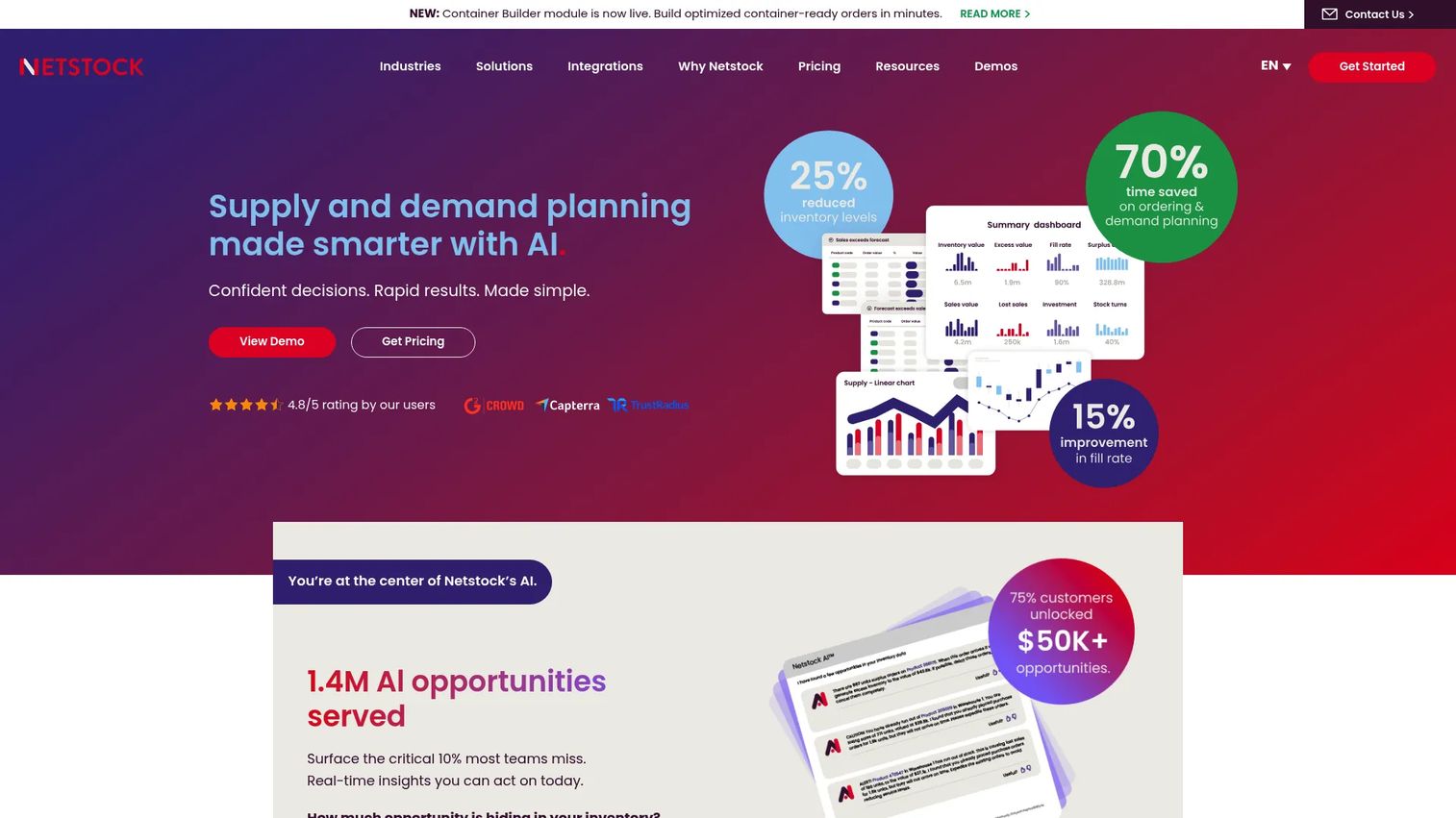
Netstock is AI-powered supply and demand planning software built for teams that want predictive inventory recommendations without standing up a heavy planning stack. It leans on tight ERP integration and clear dashboards, so planners get a prioritization layer on top of the systems they already run. For a mid-market operation, that combination of speed and practicality is the draw.
Best for: SMBs and mid-market teams that want inventory, demand, and supply planning connected to their ERP without a long implementation.
Key strengths
- AI recommendations: Predictive inventory recommendations that surface what to order, what to watch, and where risk is building.
- Inventory classification and KPIs: Dashboards and item classification that show planners where to focus first, not just what happened.
- ERP integration: Fast connections into common ERPs so forecasts and orders flow without manual re-keying.
Why choose Netstock: Netstock fits teams that need a clearer prioritization layer more than a bespoke optimization engine. It handles safety stock logic, replenishment planning, and reporting in a way planners can adopt quickly, which lowers the operational overhead that stalls larger deployments. If you want measurable fill rate improvement without a multi-quarter rollout, it is a strong candidate.
Netstock pricing: Netstock offers annual subscriptions starting at $900/month, with pricing based on the product and bundle you select. Individual plan prices, across Essentials, Advanced, Commercial, and its Expert planning tiers, are quoted rather than publicly listed. There is no free tier. Netstock holds a 4.6/5 rating on G2.
3. C3 AI
C3 AI is an enterprise AI application company whose platform supports inventory optimization at scale for organizations with large SKU counts and complex, fragmented data. Rather than a packaged planning app first, it approaches the problem as an AI and data unification challenge: pull data together, model it, and generate recommendations that update continuously. This is the AI inventory optimization software choice for teams that already think in terms of models and pipelines.
Best for: Large enterprises with high SKU volume, messy data environments, and a mandate for advanced AI-driven optimization.
Key strengths
- Data unification: Consolidates data across systems so optimization runs on a single, coherent picture of the network.
- Reorder parameter optimization: Generates reorder and stocking recommendations with confidence scoring so planners can weigh them.
- Near real-time updates: Refreshes recommendations as conditions change rather than on a fixed batch cadence.
Why choose C3 AI: C3 AI suits organizations that prioritize advanced AI and enterprise-scale deployment over out-of-the-box simplicity. If your data lives in many systems and your SKU count runs into the hundreds of thousands, its data unification and continuous optimization approach earns its place. Teams with data science resources to partner on deployment get the most from it.
C3 AI pricing: C3 AI does not display public numeric pricing and directs buyers to contact sales; investor materials describe a consumption-based model. Plan on an enterprise procurement cycle. C3 AI holds a 4.0/5 rating on G2.
4. Zebra Technologies

Zebra Technologies is an enterprise hardware, software, and services company for frontline operations, and it earns a place here for retail and operational teams where inventory visibility drives planning. Zebra pairs rugged devices, scanners, and RFID with frontline software for inventory visibility and task management, which makes it relevant when the accuracy of your stock picture is the constraint. You cannot optimize what you cannot see.
Best for: Large retail and operations teams where store-level inventory visibility and seasonal management matter as much as the planning math.
Key strengths
- Inventory visibility: Frontline software that gives teams an accurate, real-time view of stock across stores and locations.
- Frontline workflows: Task management and scheduling that turn inventory signals into action on the floor.
- Device and RFID breadth: Rugged computers, scanners, and RFID that keep the underlying data clean at the source.
Why choose Zebra Technologies: Zebra is the right fit when your inventory problem starts with data accuracy at the edge, not the optimization engine. Retailers managing seasonal swings across many stores benefit from tight visibility and frontline execution feeding their planning. If accurate, device-level inventory data is your bottleneck, Zebra addresses it directly.
Zebra Technologies pricing: Zebra does not publish software pricing and directs buyers to contact sales, with packaging that varies by hardware, software, and services scope. Zebra holds a 4.3/5 rating on G2.
5. ToolsGroup
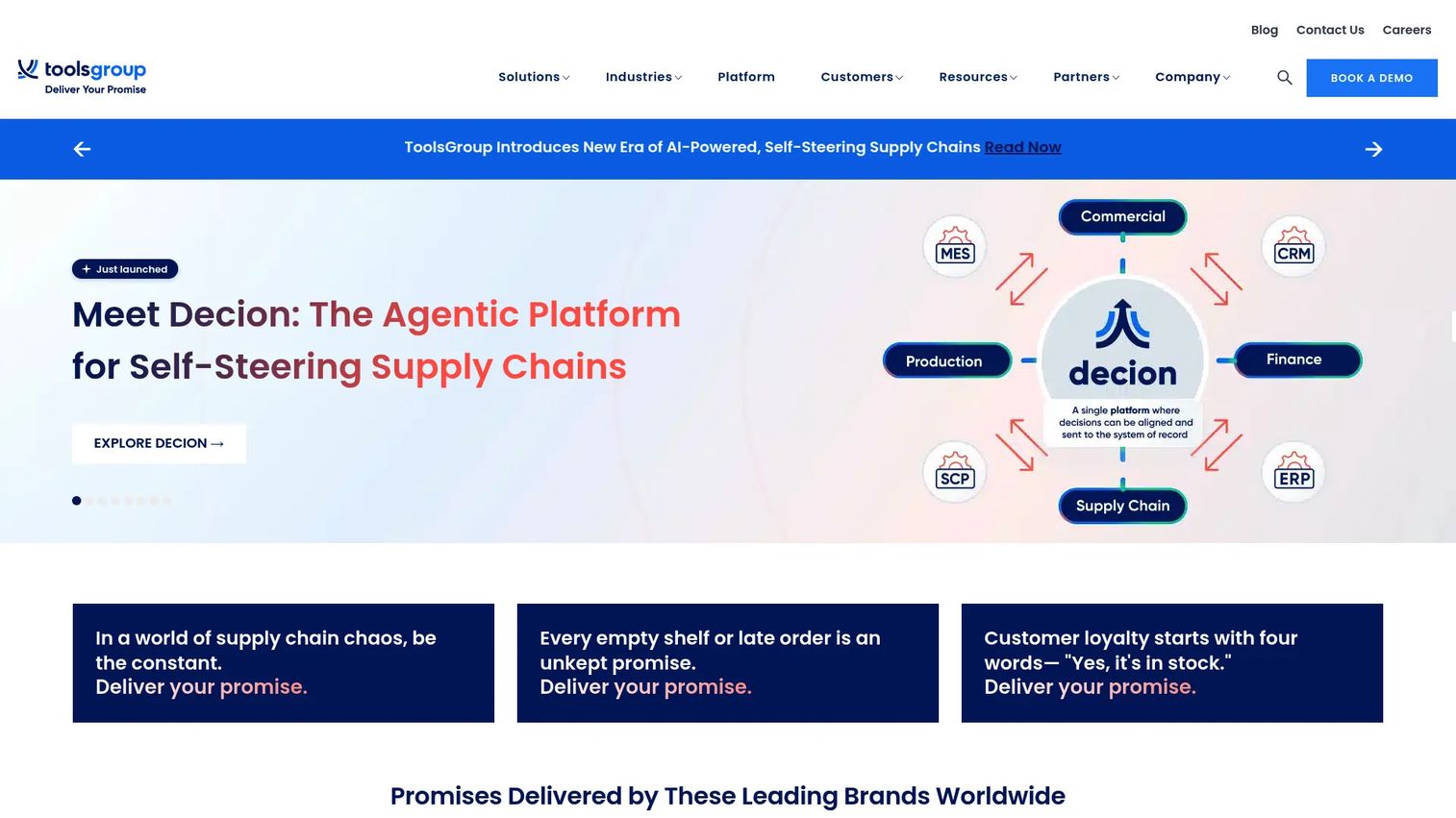
ToolsGroup is AI-powered supply chain planning and optimization software built for teams that plan around uncertainty rather than pretending it away. Its probabilistic approach models the full range of likely demand outcomes, then sets inventory to hit service targets given that spread. For teams wrestling with forecast error and lead time variability, that is a meaningfully different model than deterministic point forecasts.
Best for: Retailers and manufacturers that need service-level optimization and probabilistic planning across an uncertain, multi-tier network.
Key strengths
- Probabilistic forecasting: Models demand as a distribution so plans reflect real uncertainty instead of a single guessed number.
- Multi-echelon inventory optimization: Optimizes stock across the network to hit service targets at the lowest total inventory.
- Pricing and demand integration: Connects demand planning with pricing so commercial and inventory decisions stay aligned.
Why choose ToolsGroup: ToolsGroup fits teams whose biggest planning enemy is variability, not volume. Its probabilistic and multi-echelon methods are built for service-level optimization when demand is spiky and lead times swing. Supply chain teams that want to hit a target fill rate at the lowest possible inventory investment should shortlist it.
ToolsGroup pricing: ToolsGroup does not publish public pricing on its site, so expect an enterprise sales conversation scoped to your network and modules. ToolsGroup holds a 4.6/5 rating on G2.
6. SAP Integrated Business Planning
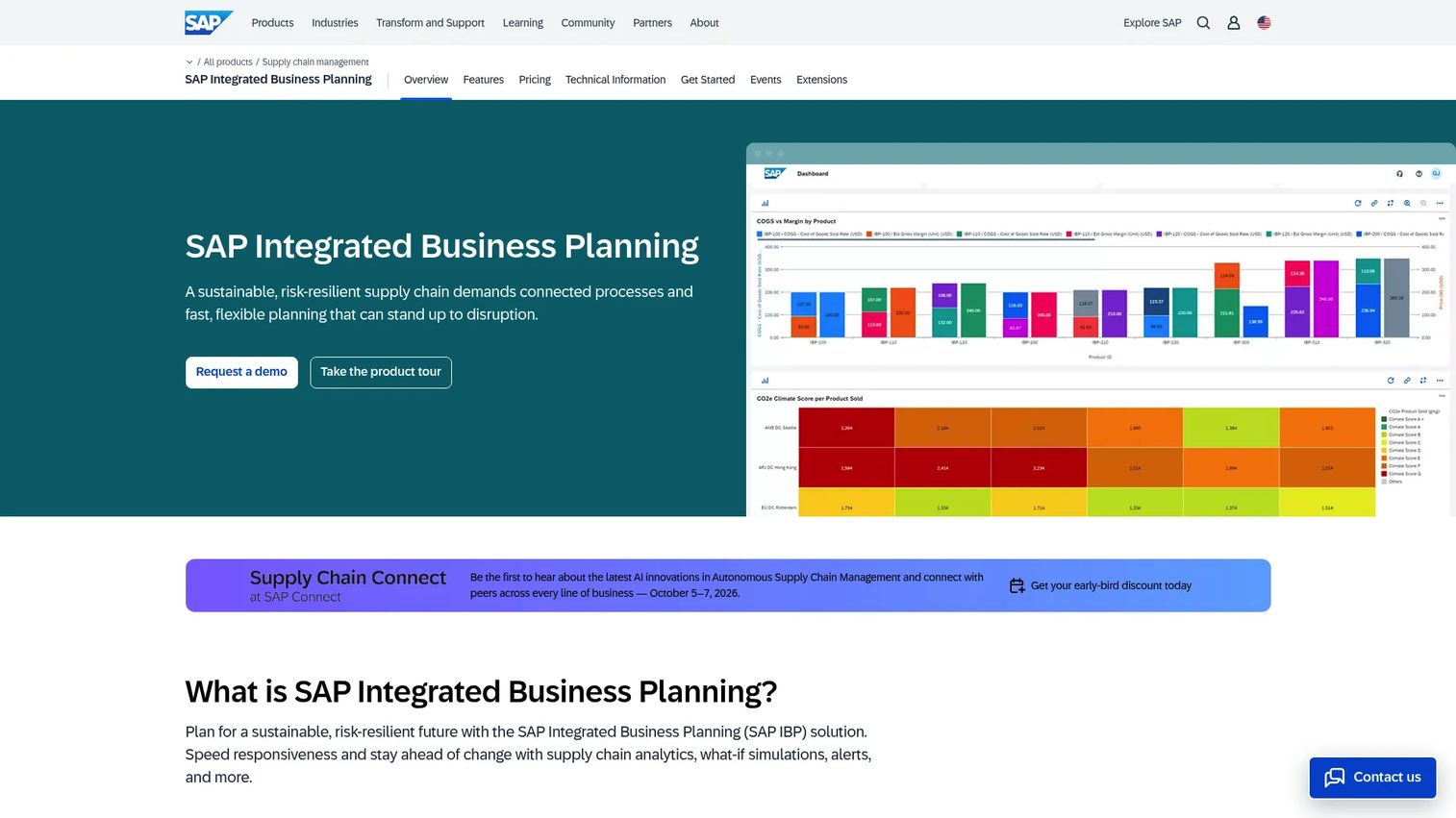
SAP Integrated Business Planning is cloud-based supply chain planning software that treats inventory optimization as one component of a broader planning layer spanning demand, supply, and sales and operations planning. For teams already deep in the SAP ecosystem, or those that need inventory decisions to sit inside end-to-end planning, that integration is the point. Inventory does not get optimized in a vacuum; it moves with the supply and demand plan.
Best for: Enterprises that need inventory decisions embedded in a broader, integrated supply chain planning stack.
Key strengths
- AI-assisted demand forecasting: Demand sensing and forecasting that feed inventory and supply decisions from one plan.
- Response and supply planning: Multilevel planning and rough-cut capacity planning so inventory reflects real supply constraints.
- Sales and operations planning: Real-time planning, scenario simulation, and collaboration that keep inventory aligned with the business plan.
Why choose SAP Integrated Business Planning: SAP IBP makes sense when inventory optimization needs to live inside a larger planning system rather than stand alone. If supply, demand, and inventory decisions must reconcile in one place, and especially if you already run SAP, the ecosystem fit reduces integration friction. It is a planning suite choice, not a point solution.
SAP Integrated Business Planning pricing: SAP maintains a pricing page but does not display a public price, directing buyers to request a demo or contact sales. Plan on an enterprise licensing conversation. SAP IBP holds a 4.3/5 rating on G2.
7. RELEX Solutions
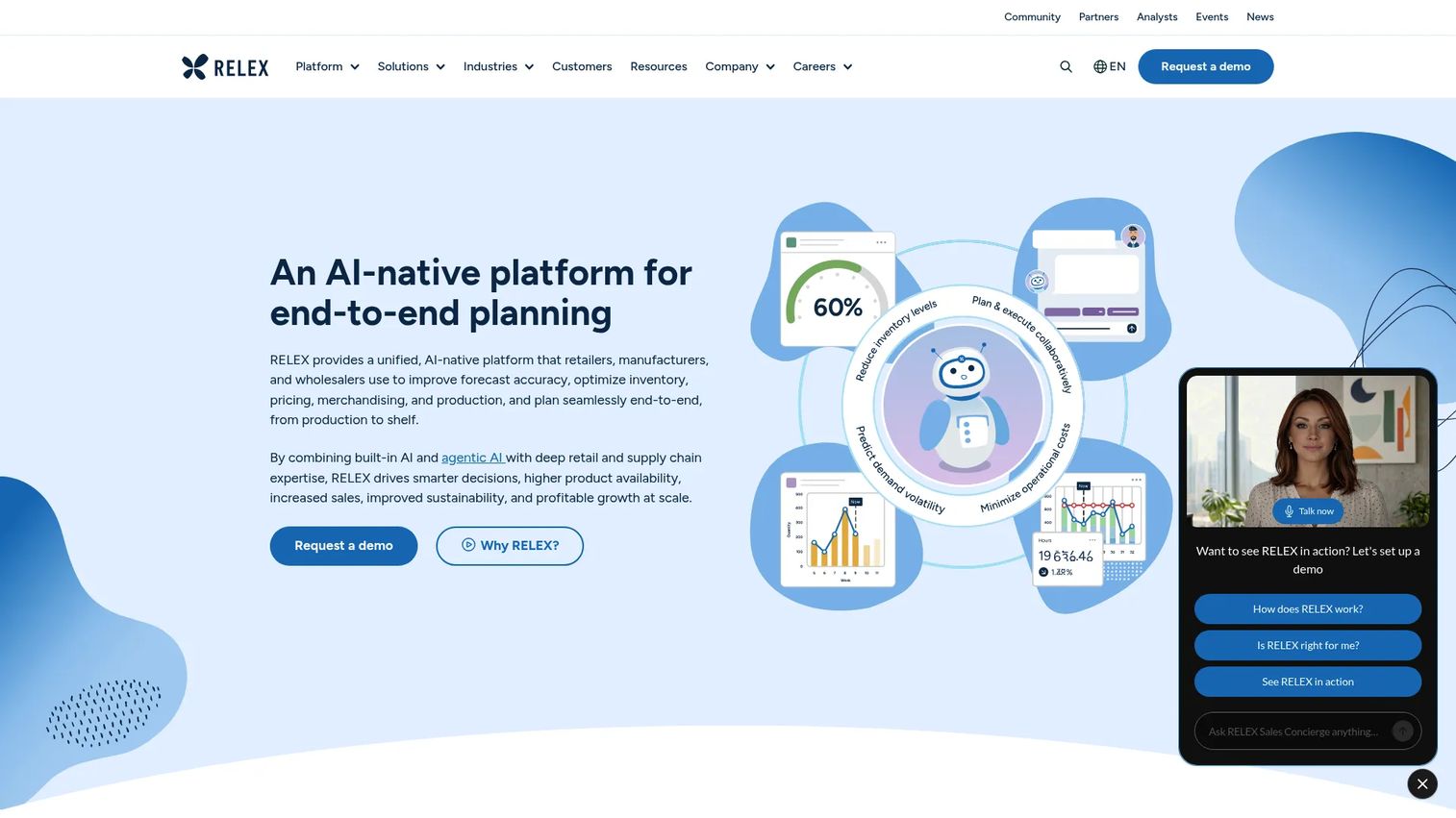
RELEX Solutions is an AI-native retail and supply chain planning platform built for retailers, manufacturers, wholesalers, and distributors that plan at store-network scale. Its strength shows in retail-shaped problems: demand that swings with promotions and seasons, store and DC balancing, and the working capital pressure of holding stock across hundreds of locations. It unifies demand, inventory, and promotions in one plan rather than bolting them together.
Best for: Retail and consumer goods teams that need forecasting, replenishment, and store network planning at scale.
Key strengths
- Demand planning and forecasting: AI-native forecasting tuned for retail volatility, including promotions and seasonality.
- Inventory and replenishment automation: Automated replenishment that balances stock across stores and distribution centers.
- Pricing and promotions optimization: Aligns pricing and promotion plans with inventory so demand spikes do not create stockouts.
Why choose RELEX Solutions: RELEX differs from more generic inventory planning tools by being built around the retail network from the start. If your challenge is balancing store and DC inventory under promotional demand, while protecting working capital, its unified planning model fits closely. Retailers and CPG teams managing volatility across many locations are its core audience.
RELEX Solutions pricing: RELEX does not publish public pricing, and G2 notes that pricing details are not currently available, so expect a scoped enterprise conversation. A current overall G2 rating was not listed at the time of writing.
Considerations before you buy
Picking inventory optimization software is less about the longest feature list and more about fit with your network shape, data, and team. Work through these before you commit.
Forecasting and policy approach
Ask whether the tool uses deterministic point forecasts or probabilistic models, and how it sets safety stock and reorder point optimization. The right answer depends on how variable your demand and lead times are. Spiky demand rewards probabilistic methods; stable demand may not need them.
Multi-location and multi-echelon fit
If you run more than a couple of stocking tiers, confirm the platform does true multi-echelon inventory optimization, not just per-location tuning. Local optimization across a network usually leaves money on the table. Match the tool's depth to how interconnected your nodes actually are.
ERP integration depth
Inventory optimization software only works on clean, current data. Verify how the tool connects to your ERP, how often it syncs, and whether item, order, and balance data flow both ways. Shallow integration creates manual re-keying that quietly erodes the value.
Clarity of recommendations
A recommendation your planners do not trust does not get used. Evaluate how clearly the tool explains why it suggests an order, a policy change, or a buffer level. Explainability drives adoption, and adoption drives the working capital optimization you are buying it for.
Conclusion
The right inventory optimization software depends less on brand and more on the shape of your problem. If you need advanced trade-off optimization across a complex network, GAINS and ToolsGroup lead on planning depth. If you want predictive replenishment without a heavy rollout, Netstock fits mid-market teams well. C3 AI suits enterprises betting on AI at scale, while SAP Integrated Business Planning is the choice when inventory has to live inside broader supply chain planning. For retail network visibility and volatility, RELEX Solutions and Zebra Technologies are the strongest fits.
The common thread is working capital optimization: every one of these tools exists to help you cut excess inventory and improve fill rate without trading away service levels. Start by mapping your own network complexity, data readiness, and forecasting needs, then match those to two or three tools from this list and run a scoped evaluation. The best next step is a focused pilot on a subset of SKUs, not a category-wide bet.
FAQs
It helps teams decide what to stock, where to place inventory, and when to reorder, based on service targets, demand patterns, and supply constraints. Rather than just tracking balances, it generates recommendations that balance service levels, stockout risk, and working capital. The goal is repeatable, data-backed decisions instead of manual rules of thumb.
No. Inventory management software tracks and controls what you have: counts, locations, movements, and orders. Inventory optimization software focuses on decision-making, recommending how much to hold and when to replenish. Many teams run both, with the optimization layer sitting on top of the system of record.
Common inputs include demand history, lead times, current inventory balances, service level targets, supplier constraints, and location-level data. The quality of the recommendations depends directly on the quality and freshness of that data. Clean ERP integration is what keeps those inputs current.
AI can improve forecast quality by detecting patterns and seasonality that static rules miss, and it can model variability rather than assume it away. It also generates recommendations that update far faster than manual review cycles. AI inventory optimization software is most useful when SKU counts are high and demand shifts quickly.
Multi-echelon inventory optimization is worth it once you run multiple warehouses, stores, plants, or suppliers whose decisions affect each other. At that point, optimizing one location in isolation creates network-wide consequences, like overstocking one DC while starving another. If you have more than a couple of stocking tiers, the network-level savings usually justify it.
Yes, if it helps you cut excess stock while preserving service levels. By setting safety stock and reorder points to reflect real demand and lead time variability, it frees capital tied up in inventory you do not need. The realized value depends heavily on implementation quality and data integrity.
Compare the forecasting approach, replenishment logic, ERP integration depth, multi-location support, and the clarity of the recommendations. Those five factors determine whether the tool fits your network and whether your planners will actually trust and adopt it. Feature breadth matters less than fit with your specific problem.
Timelines vary widely based on data readiness, the number of integrations, and how complex your planning network is. A mid-market ERP-connected rollout can move quickly, while an enterprise multi-echelon deployment spanning many systems takes longer. The biggest driver is usually the state of your data, not the software itself.