A poorly planned shelf costs you money before a single customer walks in. The wrong product faces the aisle, the high-margin SKU sits at ankle height, and your best-selling category gets squeezed into half the space it earns. Multiply that across hundreds of stores and the cost of weak space allocation stops being a rounding error. It becomes a structural drag on sales per square foot.
Retail space planning software exists to fix exactly that problem. It gives merchandising and operations teams a system to design store layouts, build and standardize planograms, and tie space decisions to real sales and inventory data. The category sits next to store planning software and floor planning software, and it overlaps heavily with planogram software, but the job is bigger than any single workflow. Done well, it connects what sits on the shelf to what the data says should sit there.
The market reflects that growing importance. Retail space planning software was valued at USD1.32 billion in2025, according to The Insight Partners, with sustained growth expected through2034. The adjacent planogram solutions market is moving even faster, projected to grow at a 14.4% CAGR through2032, per Intel Market Research. Retailers are investing because the returns show up in sales lift, fewer stock-outs, and better retail ROI per location.
If you have ever wrestled with inconsistent layouts across stores or struggled to prove the sales impact of a reset, this guide is for you. The same evaluation discipline applies whether you are choosing planning software or comparing demo formats in our best event planning software roundup. Let's get into the shortlist.
What's inside
This guide is for category managers, merchandising leaders, store planners, and retail operations teams comparing retail store planning software in2026. We focused on tools that solve real operational problems: improving sales per square foot, standardizing layouts across locations, and connecting space decisions to assortment and inventory.
We selected and ranked the seven tools below on four criteria:
- Planning depth: how well the tool handles macro floor planning and micro planogram work
- Data integration: whether space decisions connect to sales, inventory, and merchandising data
- Scalability: support for multi-store, multi-format retail operations
- Optimization capability: AI, clustering, and analytics that surface missed sales
The list spans AI-led optimization, traditional AutoCAD-based planning, and planogram execution so you can match a tool to your current planning maturity.
TL;DR
Short on time? Here is how the shortlist breaks down by buying pattern:
- Best for AI-led space optimization: Impact Analytics, with predictive optimization, space elasticity, and store clustering
- Best for enterprise unified merchandising: RELEX Solutions, connecting space to assortment, pricing, promotions, and inventory
- Best for AutoCAD-based floor planning: StoreSpace, built for macro and micro space planning with a collaboration portal
- Best for planogram-heavy retail and CPG teams: DotActiv, with transparent per-license pricing and a free tier
- Best for automated assortment and inventory-aware planning: LEAFIO, with shelf efficiency and merchandising automation
- Best for large, complex supply chain retail: Blue Yonder, with end-to-end connected planning
What is retail space planning software?
Retail space planning software is a category of tools that lets retailers design store layouts and shelf planograms, then optimize them against sales, inventory, and merchandising data to improve space productivity. It is the system that decides not just what you sell, but where every product physically sits.
The category is often confused with adjacent terms, so it helps to separate them:
- Planogram software focuses on the shelf level: which SKU sits in which slot, facings, and visual merchandising compliance
- Floor planning software focuses on the macro level: aisle layout, fixture placement, and traffic flow across the whole store
- Store planning software is a broader umbrella covering both, plus store-specific formatting
- Space planning software for retail ties all of it to performance data, which is what separates true optimization from static diagramming
The strongest platforms cover capabilities across all of these layers:
- Macro floor planning: fixture planning, adjacency analysis, and traffic flow design
- Micro planogram software: shelf-level SKU placement, facings, and merchandising reports
- Store clustering: grouping stores by format, demographics, or sales behavior to tailor layouts
- Heatmapping and floor plan color shading: visualizing performance and space allocation at a glance
- Assortment and inventory planning links: connecting space to what stock the layout can actually hold
- Sales lift analytics: measuring the revenue impact of a reset before and after
Space planning never lives in isolation. It connects to category management, assortment planning, replenishment, pricing, and promotions. When a category gets more shelf space, replenishment frequency, safety stock, and promotional calendars all shift with it. The best tools make that connection explicit instead of leaving it to spreadsheets.
When to use retail space planning software
Not every retailer needs the same workflow. These are the four scenarios where the category earns its cost.
Optimize store layouts for higher sales per square foot
When your sales per square foot is flat or declining, the layout itself is usually part of the problem. Retail space optimization tools help you test category flow, reallocate shelf space toward high-velocity SKUs, and model the sales lift of a new layout before you reset a single store. This is where heatmapping and adjacency analysis pay off, surfacing the dead zones and the categories that deserve more room.
Standardize planograms across multiple locations
Running 50 or 500 stores without standardized planograms means 50 or 500 versions of the truth. Merchandising planogram software lets you build a master planogram, push it to every location, and enforce store execution so local variance does not quietly erode margins. The goal is consistency where it matters and controlled flexibility where local demand justifies it.
Align space decisions with merchandising and inventory planning
A great planogram that the shelf cannot physically stock is a failed planogram. Retail store planning software helps coordinate assortment, replenishment, and promotions so the layout reflects what you can actually keep on the shelf. This alignment reduces stock-outs and keeps space decisions tethered to inventory reality.
Improve store-specific layouts for different formats
Grocery space planning, pharmacy planogram software, apparel space planning, and CPG planogram software all demand different workflows. A grocer optimizes for perishables and high-frequency replenishment. An apparel chain plans around seasonal collections and visual presentation. Store clustering lets you tailor layouts by format without rebuilding from scratch each time.
Comparison table
The tools below differ mainly in where they put their weight: AI-driven optimization, traditional floor planning, or planogram execution within a broader merchandising stack. Use the table to match a tool to the job you care about most, then read the full section for fit.
| # | Product | Intent | Key differentiation | Pricing | G2 rating |
|---|---|---|---|---|---|
| 1 | Impact Analytics | AI retail space planning | Space elasticity, adjacency intelligence, store clustering | Contact sales | 4.5/5 |
| 2 | RELEX Solutions | Unified merchandising and planning | Connected planning across assortment, pricing, promotions, inventory | Contact sales | 4.6/5 |
| 3 | StoreSpace | Floor planning software | AutoCAD-based macro and micro space planning | Contact sales | Not rated |
| 4 | Vision Group Retail | Store execution and shelf intelligence | AI image recognition and planogram compliance | Contact sales | Not rated |
| 5 | DotActiv | Category management and planograms | Transparent per-license pricing with a free tier | From $0/license per year | 4.5/5 |
| 6 | LEAFIO | Automated assortment and space planning | Inventory-aware shelf efficiency automation | Contact sales | 5.0/5 |
| 7 | Blue Yonder | Enterprise supply chain and planning | End-to-end connected planning at scale | Contact sales | 4.1/5 |
1. Impact Analytics
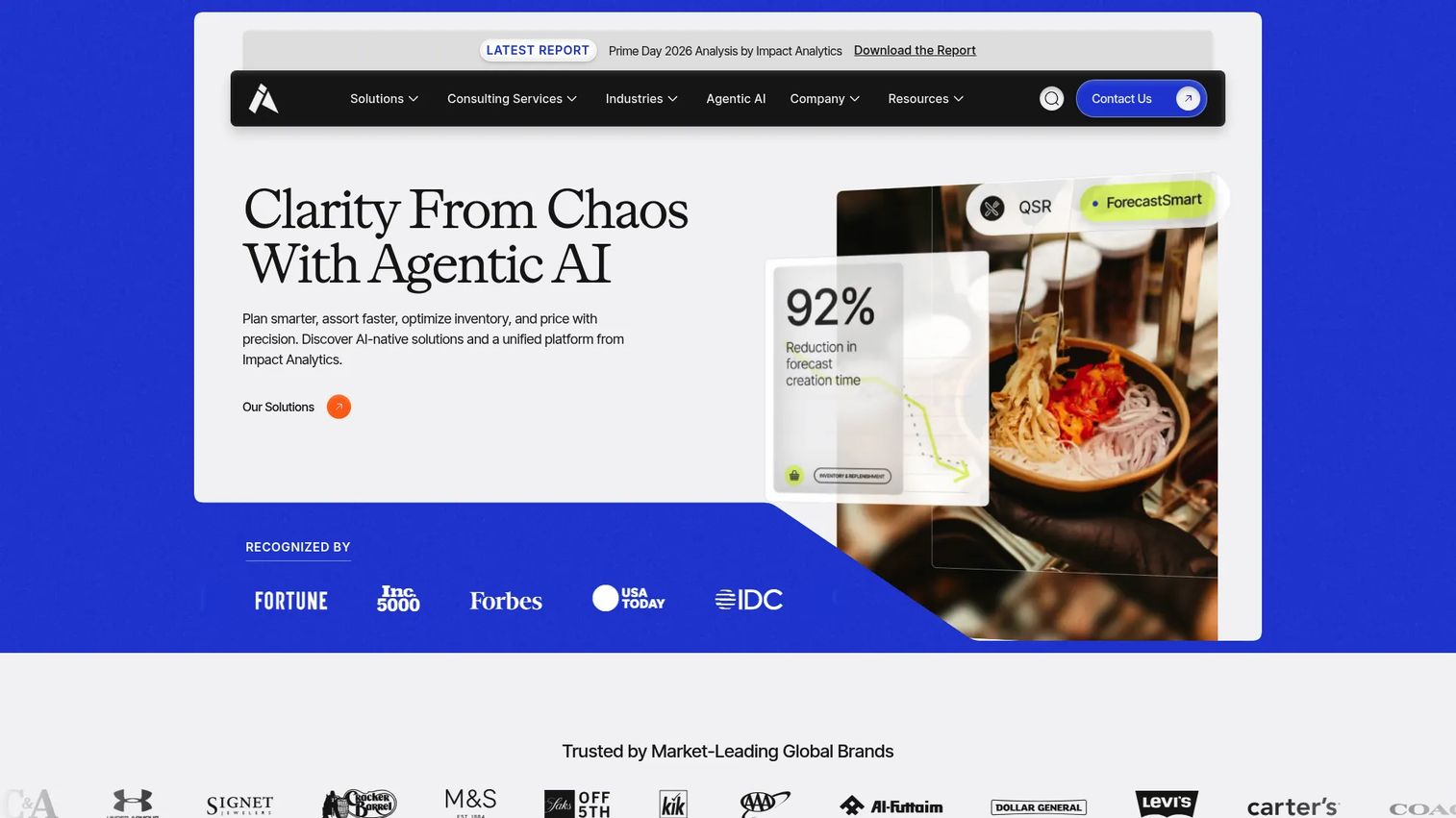
Impact Analytics is an AI-native retail planning platform that spans pricing, merchandising, and supply chain, with space planning as a core pillar through its SpaceSmart capability. The product leans hard into predictive optimization, using AI to find missed sales opportunities that static planograms hide. For merchandising teams who want the software to surface decisions rather than just diagram them, this is the most analytically aggressive option on the list.
Where it stands out is the optimization layer. Instead of asking a planner to guess how much space a category deserves, Impact Analytics models space elasticity, runs adjacency analysis to find which categories lift each other, and uses store clustering to tailor layouts by location behavior. The result is space allocation grounded in predicted demand, not last year's habit.
Best for: Retail enterprises that want AI-driven space optimization tied to measurable ROI and missed-sales discovery.
Key strengths
- Space elasticity modeling: predicts how sales respond to changes in shelf space so you allocate room where it actually lifts revenue
- Adjacency intelligence: identifies which category placements drive cross-category sales for smarter floor flow
- Store clustering: groups stores by behavior so layouts reflect local demand rather than a single national template
Why choose Impact Analytics: This is the tool for teams whose biggest gap is analytical, not visual. If you already build planograms but struggle to prove which layout decisions actually move revenue, the AI-native approach turns space planning into a quantified exercise. It fits enterprises that treat space as a lever for retail ROI, not a compliance checkbox. The platform is also SOC 2 Type II attested, which matters for enterprise procurement and security review.
Impact Analytics pricing: Impact Analytics does not publish public pricing. Product and pricing pages direct visitors to contact sales for a quote scoped to their retail footprint. Plan on an enterprise-style engagement rather than a self-serve signup.
2. RELEX Solutions
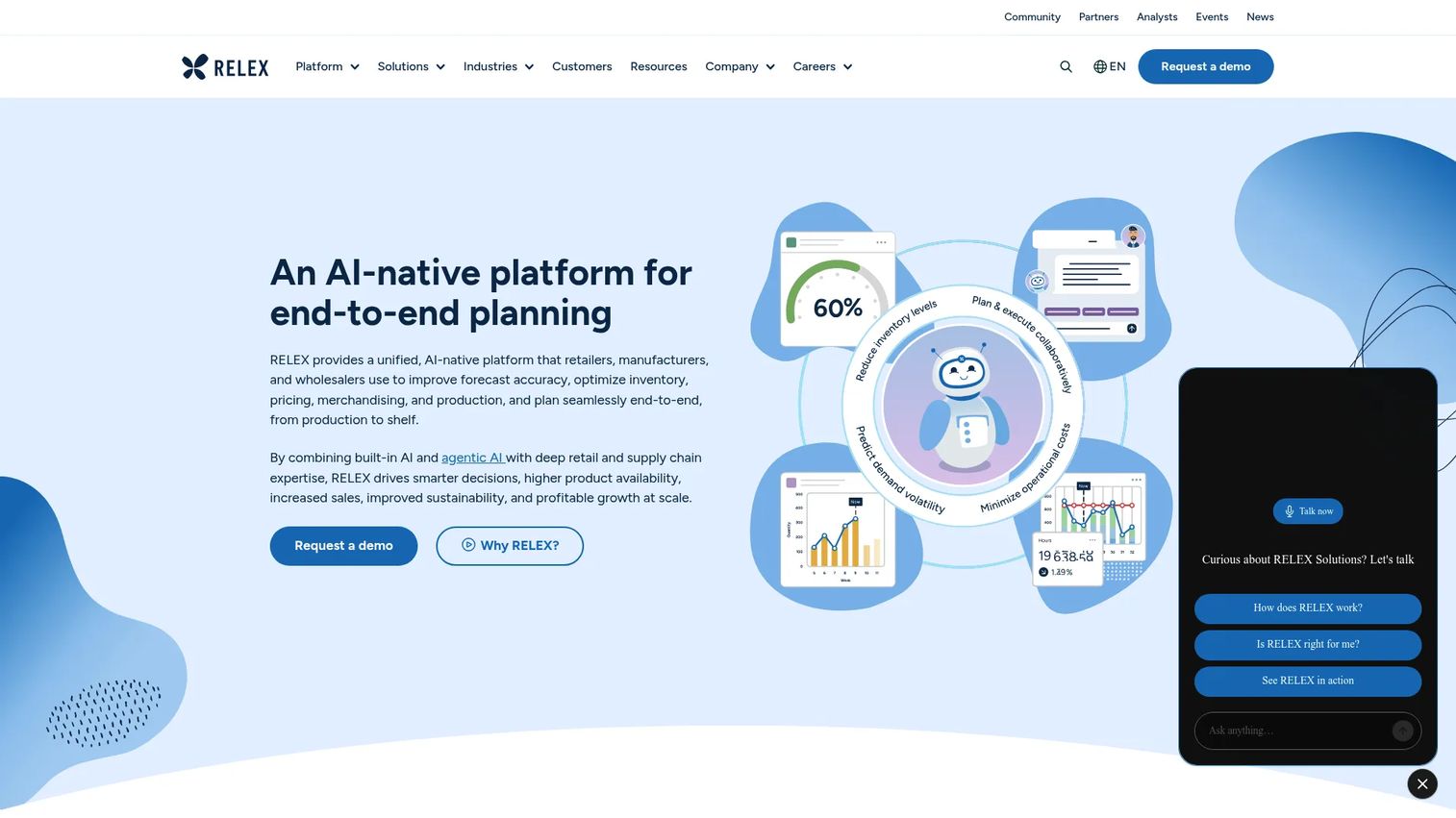
RELEX Solutions is an AI-native platform for retail and supply chain planning, with floor planning and space management sitting inside a much larger unified planning system. Its strength is connection: space decisions do not live in a silo, they flow into and out of demand planning, replenishment, pricing, and promotions. For enterprise merchandising teams that want one system of record across the planning stack, this is the most integrated option here.
The space planning capabilities themselves are workflow-focused. RELEX supports real-time floor plan delivery, heatmaps for performance visualization, and fixture reports that store teams can execute against. Because it connects to the broader platform, a space change reflects in inventory and replenishment automatically, which keeps store execution honest.
Best for: Large retailers, manufacturers, and wholesalers that want space planning unified with demand, inventory, pricing, and supply chain planning.
Key strengths
- Connected planning: links floor and space decisions to assortment, pricing, promotions, and inventory in one platform
- Heatmaps and fixture reports: turn performance data into visual layouts and executable fixture-level instructions
- Real-time planning: updates flow across the planning stack so space, demand, and replenishment stay in sync
Why choose RELEX Solutions: Choose RELEX when fragmentation is your real problem. If space planning, demand forecasting, and replenishment currently live in separate tools that never talk, the unified model eliminates the reconciliation work. It suits enterprise teams managing complex, multi-format operations where a layout change has to ripple through inventory and promotions without manual re-keying.
RELEX Solutions pricing: RELEX does not list public pricing on its site, and sales run through a quote and demo process. Expect enterprise packaging scoped to your footprint and planning scope rather than a fixed published rate.
3. StoreSpace
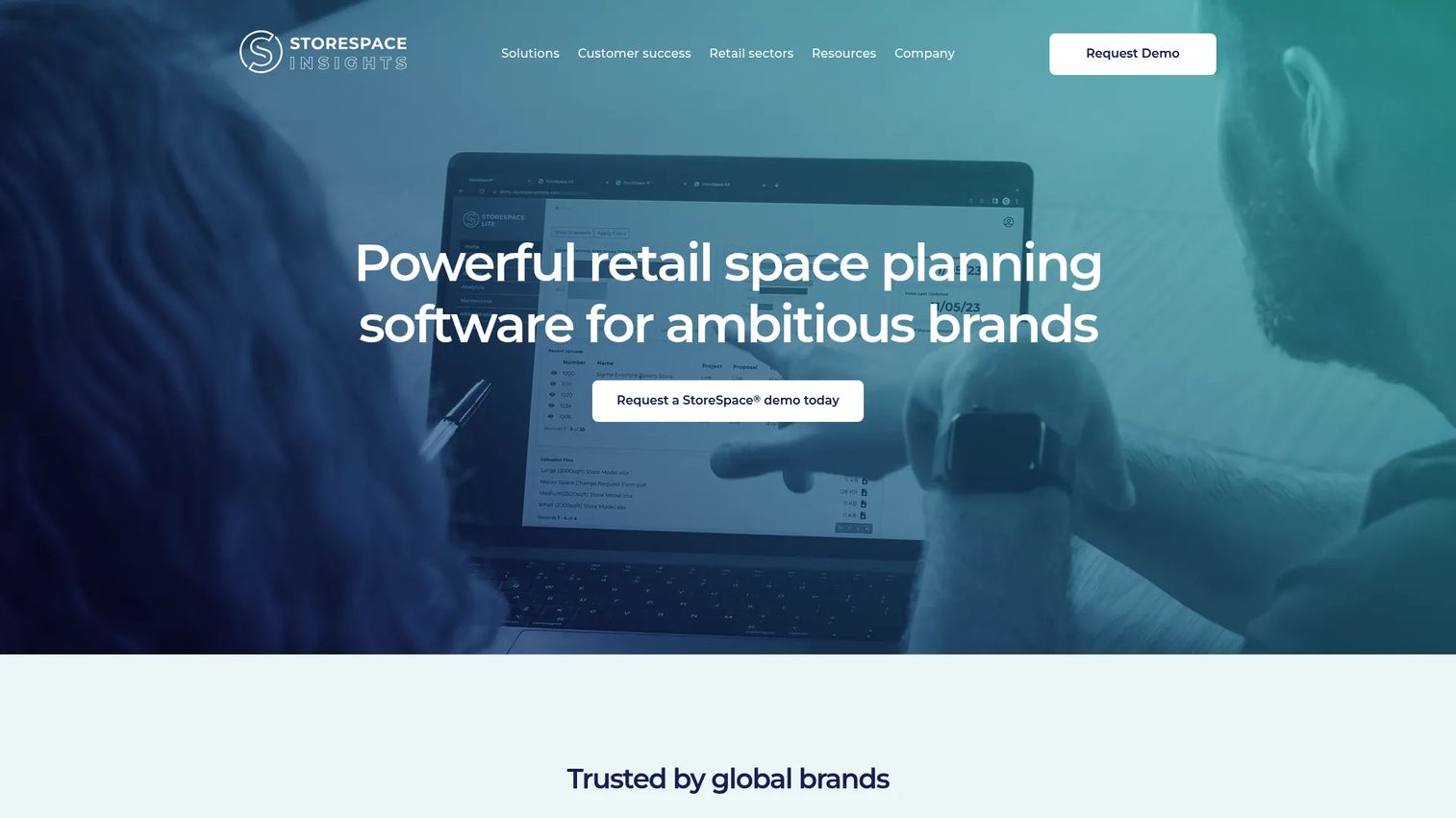
StoreSpace is retail space planning software built around AutoCAD-based floor planning, designed for teams that want a precise, drafting-grade planning environment. It handles both macro space planning, the overall store layout and fixture placement, and micro space planning at the shelf level. For organizations that already think in CAD and want planning fidelity rather than a simplified drag-and-drop tool, StoreSpace fits that traditional workflow with modern collaboration layered on top.
The collaboration piece comes through StoreSpaceOnline, a portal that lets in-store teams view plans, communicate, and execute against the layout. The platform also integrates planograms with sales data, so the precision of the drafting environment connects to actual performance. It is available in more than 20 languages and trusted by retailers across more than 20 countries, which signals real global scalability.
Best for: Retailers that want centralized macro and micro space planning in an AutoCAD-grade environment with a shared collaboration portal.
Key strengths
- AutoCAD-based planning: delivers drafting-grade precision for floor layouts and fixture placement
- Macro and micro planning: handles whole-store layout and shelf-level planograms in one environment
- StoreSpaceOnline portal: lets in-store teams access plans, communicate, and execute against the layout
Why choose StoreSpace: This is the pick for planning teams with a drafting mindset. If your planners are comfortable in CAD and want layout precision plus a clean way to push plans to stores, StoreSpace delivers an integrated planning environment without forcing a workflow change. It is solution-led rather than analytics-first, so it suits teams that value execution and precision over predictive modeling.
StoreSpace pricing: StoreSpace does not publish a fixed price. The company notes that license pricing depends on store count and number of users, and directs prospective buyers to contact the team for a scoped quote.
4. Vision Group Retail
Vision Group Retail is a retail AI platform built around image recognition, IoT monitoring, and store execution, with planogram compliance as a central use case. Rather than only designing layouts, it verifies them: AI-powered shelf image recognition checks whether the planogram on paper matches the shelf in reality. For retail and CPG teams whose real problem is execution drift between plan and shelf, this closes that gap.
The platform combines planogram tracking with pricing, inventory, and asset monitoring, giving merchandising teams a way to enforce store execution at scale. Where most tools on this list focus on building the plan, Vision Group Retail emphasizes verifying compliance in the field, which makes it a strong complement to a dedicated planning tool.
Best for: Enterprise retail and CPG teams that need AI-driven store execution and planogram compliance verification.
Key strengths
- AI shelf image recognition: automatically checks whether shelves match the planogram, catching compliance gaps fast
- Retail IoT and asset monitoring: tracks store conditions and assets alongside merchandising compliance
- Integrated tracking: combines planogram, pricing, and inventory monitoring in one execution platform
Why choose Vision Group Retail: Choose this when your planograms are sound but execution in stores is not. If audits keep finding shelves that do not match the plan, image recognition turns compliance from a manual, sampled chore into an automated, scaled signal. It fits CPG suppliers and large retailers focused on closing the gap between intended and actual store execution.
Vision Group Retail pricing: Vision Group Retail does not display public pricing or named plans. Pricing runs through a demo and contact-sales process, scoped to the deployment.
5. DotActiv
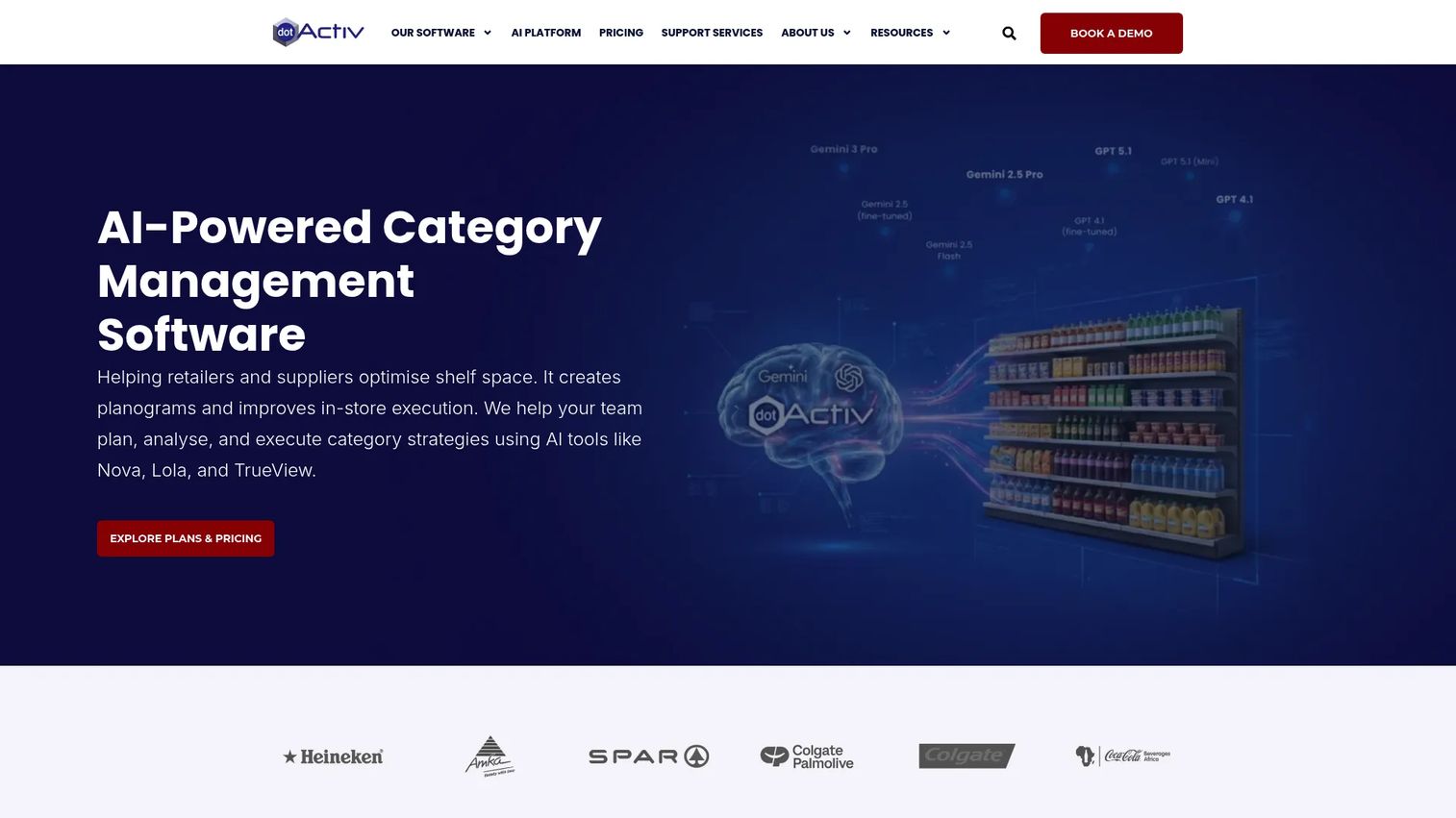
DotActiv is AI-powered category management software built for retailers and suppliers who live in planograms and shelf-space optimization. It generates planograms, produces merchandising reports, and handles assortment, clustering, and floor planning, with AI tools like Nova, Lola, and TrueView layered into the workflow. For planogram-heavy operations that want depth without an enterprise sales cycle, DotActiv stands out for one rare reason: transparent, published pricing.
The category management focus is what sets it apart. Built on more than 30 years of category management experience, DotActiv treats planograms as part of a larger discipline that includes assortment decisions, store clustering, and floor planning. That makes it practical for teams that want their layout work grounded in category strategy rather than treated as isolated diagramming.
Best for: Retailers and suppliers that need planograms, assortment planning, and shelf-space optimization with clear, accessible pricing.
Key strengths
- Planogram generation and reporting: builds planograms and produces merchandising reports tied to category strategy
- Assortment, clustering, and floor planning: covers the full category management workflow in one tool
- AI tools (Nova, Lola, TrueView): layers automation and analysis onto the planning workflow
Why choose DotActiv: DotActiv is the most accessible entry point on this list. With a free tier and paid plans that scale by license, it lets smaller teams and suppliers start planogram work without a six-figure commitment. The deep category management heritage means it fits teams that think about space as an extension of assortment and clustering, not a standalone task.
DotActiv pricing: DotActiv publishes per-license annual pricing. Plans run Free at $0/license per year, Lite at $800/license per year, Pro at $2,000/license per year, Enterprise at $4,500/license per year, and Enterprise AI at $7,500/license per year. A separate once-off $2,700 initiation fee applies to Premium Support Services. The free tier makes it easy to evaluate before committing.
6. LEAFIO
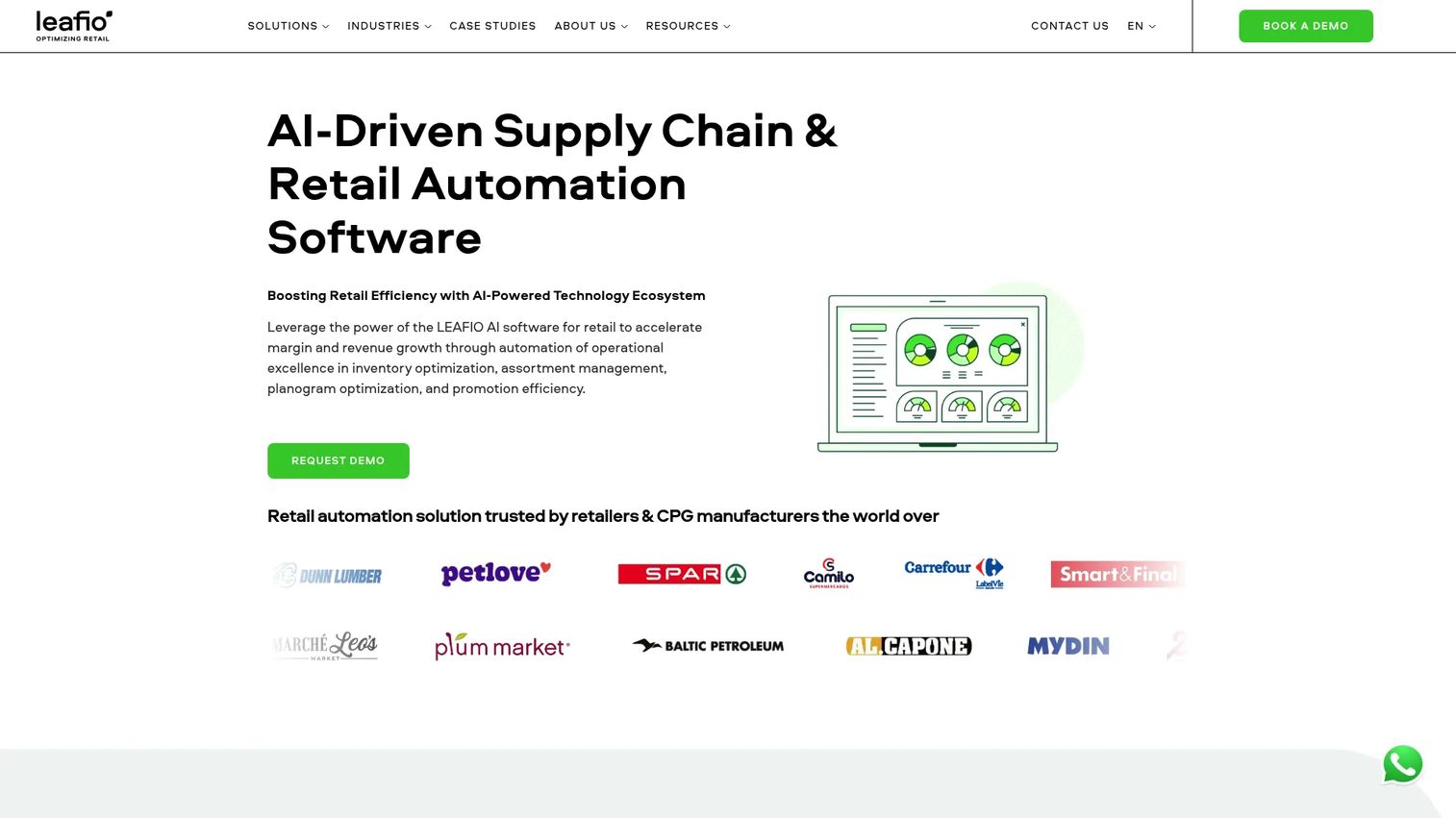
LEAFIO is an AI-powered retail automation platform spanning supply chain, inventory, merchandising, and promotion optimization, with shelf efficiency and planogram generation as part of the merchandising suite. Its angle on space planning is automation: instead of planners hand-building every layout, LEAFIO generates inventory-aware planograms that reflect what the shelf can actually hold. With more than 15 years in the industry and over 250 implementations across 40+ countries, it has the operational track record to back the automation claims.
What makes LEAFIO distinct is how tightly it couples space to inventory. Shelf efficiency planning works alongside inventory optimization and assortment performance, so a planogram is never disconnected from replenishment reality. For retailers whose stock-outs trace back to layouts the supply chain cannot support, that integration is the point.
Best for: Retailers and CPG manufacturers that need automated, inventory-aware merchandising and space planning.
Key strengths
- Inventory optimization: ties space planning to stock levels so layouts reflect what the shelf can actually hold
- Assortment performance: analyzes which products earn their space and which do not
- Shelf efficiency and planogram generation: automates planogram creation grounded in demand and inventory data
Why choose LEAFIO: Choose LEAFIO when automation and inventory alignment are your priorities. If manual planogram building is a bottleneck and your stock-outs trace back to layouts that ignore replenishment limits, the automated, inventory-aware approach addresses both. Its track record across 250+ implementations and 100M+ SKU locations signals it can handle scale.
LEAFIO pricing: LEAFIO does not publish public pricing. The site uses demo and contact-sales prompts rather than listing a fixed rate, so pricing is scoped per deployment. Expect packaging tied to your store count and module mix.
7. Blue Yonder

Blue Yonder is an AI-driven supply chain software platform covering planning, execution, transportation, warehouse, and retail operations, with space and merchandising planning fitting inside a much larger enterprise suite. For large retailers whose space decisions cannot be separated from forecasting, fulfillment, and supply chain complexity, Blue Yonder positions space planning as one node in an end-to-end connected planning system.
The strength here is breadth and governance. Built on a common data cloud with integrated AI and ML forecasting, Blue Yonder synchronizes forecasting, fulfillment, warehousing, transportation, and labor. That makes it suited to enterprises that need category-level governance and connected planning across the entire operation, not just the shelf.
Best for: Large enterprises that need space and merchandising planning embedded in end-to-end supply chain planning and execution.
Key strengths
- End-to-end platform: connects space and merchandising to forecasting, fulfillment, warehousing, and transportation
- Integrated AI/ML forecasting: uses a common data cloud to drive demand and supply decisions across the operation
- Multi-channel planning: supports extensible, complex supply chain planning at enterprise scale
Why choose Blue Yonder: Blue Yonder is the pick for enterprise complexity. If your organization already needs heavyweight supply chain planning and wants space and merchandising decisions governed inside the same system, the connected platform avoids stitching together separate tools. It fits large retailers managing multi-channel operations where space is one piece of a much larger planning puzzle.
Blue Yonder pricing: Blue Yonder does not publicly display pricing. The site directs visitors to contact sales for a product demonstration and a scoped quote, consistent with enterprise supply chain software packaging.
How to choose retail space planning software
Use these criteria to narrow the shortlist before you book demos.
Planning depth versus optimization
Decide whether your gap is building plans or proving them. If your planners already produce solid planograms but struggle to show sales impact, an AI-led optimization tool earns its keep. If you need a precise environment to design layouts in the first place, a drafting-grade or category management tool matters more.
Integration with your data stack
Space planning only delivers retail ROI when it connects to sales, inventory, assortment, and pricing data. Verify which systems each tool integrates with and whether space changes flow into replenishment automatically. A tool that cannot see inventory will plan layouts your shelves cannot stock.
Scale and store format coverage
Confirm the tool handles your store count and your formats. Grocery, pharmacy, apparel, and CPG each need different workflows, and store clustering capability separates tools that tailor layouts from those that force one national template.
Execution and compliance
A great plan that stores ignore is wasted. Check how each tool pushes plans to the field and whether it verifies store execution. Image recognition and execution portals close the gap between the planogram on paper and the shelf in reality.
Conclusion
The right retail space planning software depends on what you are actually trying to fix. If your gap is analytical, Impact Analytics brings the most aggressive AI optimization with space elasticity and adjacency intelligence. If fragmentation across planning systems is the problem, RELEX Solutions and Blue Yonder offer unified, connected planning at enterprise scale. For drafting-grade floor planning, StoreSpace fits a CAD-first workflow, while DotActiv and LEAFIO win on category management depth and inventory-aware automation. Vision Group Retail closes the loop on store execution and compliance.
Start with the tool that matches your current planning maturity. If you are early, DotActiv's free tier lets you build real planograms without a commitment. If you run complex multi-format operations, the connected enterprise platforms are worth the longer evaluation. Whatever you choose, anchor the decision in measurable sales lift and space productivity, not feature checklists.
Start your journey with Guideflow today!
FAQs
Retail space planning software helps retailers design store layouts and shelf planograms, then optimize them against sales, inventory, and merchandising data to improve space productivity. It spans macro floor planning and micro planogram work, and the best tools tie every space decision to measurable performance so you can prove sales lift rather than guess at it.
Planogram software focuses on the shelf level: which SKU sits where, how many facings it gets, and merchandising compliance. Retail space planning software is broader, covering both shelf-level planograms and macro floor planning, fixture placement, and traffic flow, while tying it all to performance data. Planogram software is one capability inside the larger space planning category.
Multi-store retailers feel the need most, because inconsistent layouts across locations quietly erode margins. Grocery chains, pharmacies, apparel retailers, and CPG suppliers all benefit, though each needs different workflows. Any operation where sales per square foot matters and where layouts vary by store will see the clearest return from store planning software.
It can, when it models space elasticity and adjacency rather than just drawing layouts. AI tools predict how sales respond to space changes, surface missed opportunities static planograms hide, and use store clustering to tailor layouts to local demand. The lift comes from allocating space based on predicted performance instead of historical habit.
Sales data, inventory and replenishment systems, assortment planning, and pricing are the critical integrations. Space decisions that cannot see inventory will produce layouts the shelf cannot stock, and decisions disconnected from sales data cannot be measured. Confirm a tool connects to your data stack before you commit, because integration depth determines whether you can prove retail ROI.
Yes, though each format uses it differently. Grocery space planning optimizes for perishables and high-frequency replenishment, apparel space planning revolves around seasonal collections and visual presentation, and pharmacy planogram software handles regulated categories and tight shelf space. Store clustering lets one tool tailor layouts across all three formats without rebuilding from scratch.
Evaluate planning depth, data integration, scalability across store counts and formats, and optimization capability. For enterprise specifically, weigh how well space planning connects to demand, inventory, pricing, and promotions, and whether the platform offers category-level governance. Tools like RELEX Solutions and Blue Yonder lead on connected, enterprise-scale planning.
Look for planogram generation, merchandising reports, assortment and clustering support, and a way to enforce store execution across locations. The strongest merchandising planogram software ties shelf decisions to category strategy and inventory, so a planogram reflects both what sells and what the shelf can physically hold. Transparent pricing and a free or trial tier also make evaluation far easier.