Alert queues grow faster than analyst headcount. Security teams spend hours on repetitive evidence gathering, and every automated response creates a governance question someone in Legal or Engineering hasn't answered yet.
The problem isn't awareness. According to Cybersecurity Insiders (2025), 87% of organizations are already deploying, piloting, or evaluating AI-powered SOC tools. The real challenge is choosing a platform that reduces repetitive analyst work without creating unreviewable risk or a maintenance burden your team can't sustain.
From a product manager's seat, that means aligning Security, Engineering, and Legal around the same operating model. Security needs faster triage. Engineering needs fewer integration handoffs. Legal needs an audit trail for AI-driven actions. The platform that threads all three is the one worth buying.
This guide covers 12 AI SOC platforms evaluated against those cross-functional constraints, with verified pricing, G2 ratings, and clear guidance on which environment each one fits.
What's inside
This guide is for security leaders, product managers, and technical evaluators comparing AI security operations center platforms for 2026.
Items were chosen and evaluated based on:
- Breadth of AI-assisted triage, investigation, and response capabilities
- Fit across common security stack configurations (Microsoft-first, Google-first, endpoint-led, vendor-neutral)
- Verified pricing signals and G2 ratings from current listings
- Evidence of bounded autonomy, approval controls, and audit logging
TL;DR
- Best for agentic investigation and orchestration: Torq HyperSOC, for teams wanting AI-led workflows with strong automation coverage
- Best for Palo Alto Networks environments: Cortex XSIAM, for enterprises consolidating SOC operations around a broader security platform
- Best for Microsoft-first organizations: Microsoft Sentinel, where Azure, Defender, and Entra data are already central
- Best for Google Cloud security operations: Google Security Operations, for teams built around Google's security data and AI stack
- Best for vendor-neutral telemetry coverage: Stellar Cyber Open XDR, for heterogeneous environments avoiding single-vendor lock-in
The right AI SOC platform depends on your telemetry footprint, response authority model, and the operational work your team can sustain after implementation.
What is AI SOC software?
AI SOC software is a security operations platform that uses machine learning, generative AI, and automated workflows to ingest alerts, enrich evidence, investigate incidents, and support or execute approved response actions.
The core operating model moves through six layers:
- Telemetry ingestion: Logs, endpoint signals, cloud events, identity data, network traffic, and threat intelligence feeds
- Normalization and correlation: Linking disparate events into an investigation context
- AI triage: Prioritizing alerts and removing repetitive manual review
- Investigation: Building evidence timelines, mapping activity to known attacker behavior, and surfacing investigative hypotheses
- Response orchestration: Triggering containment, ticketing, enrichment, or remediation under defined approval controls
- Learning loop: Using analyst feedback and incident outcomes to refine detections and playbooks
Key capabilities to look for
- Multi-source security telemetry ingestion
- Automated alert enrichment and deduplication
- AI-supported incident investigation
- Detection engineering assistance
- Configurable approval gates for response actions
- Case management and evidence trails
- SOAR workflow automation
- Natural-language querying
- Threat intelligence enrichment
- Role-based access and audit logs
How AI SOC relates to adjacent categories
Many vendors describe themselves as an AI SOC while primarily delivering SIEM, SOAR, or XDR capabilities. The distinctions matter when you're evaluating what's native versus what requires integration.
| Category | Primary job | Role in an AI SOC |
|---|---|---|
| SIEM | Collect, search, correlate, and retain security data | Data foundation and detection layer |
| SOAR | Automate response workflows | Orchestration and action layer |
| XDR | Correlate signals across security domains | Broader detection and response context |
| UEBA | Find anomalous behavior | Entity and behavioral analytics |
| AI SOC | Coordinate AI-led triage, investigation, and bounded response | Operating model across the security workflow |
Assess what each vendor delivers natively, what requires your existing tooling, and what creates a new integration dependency.
When to use an AI SOC platform
Reduce repetitive alert investigation
Analysts in high-volume environments spend significant time gathering the same artifacts, checking the same indicators, and closing similar low-risk alerts. An AI SOC standardizes those investigative steps while escalating genuine exceptions. According to Cybersecurity Insiders (2025), 60% of AI adopters report reducing investigation time by at least 25%.
Scale security operations without linear headcount growth
Cloud, identity, endpoint, and SaaS telemetry grows faster than analyst capacity. The AI SOC market reflects that pressure: MarketsandMarkets (2026) values the market at $15.05 billion in 2025, projected to reach $47.07 billion by 2031. Scaling depends on data quality and integration coverage, not AI alone.
Create a governed response layer across fragmented tooling
Teams with a SIEM, an endpoint platform, a ticketing system, and cloud controls often have no consistent response process connecting them. An AI SOC can serve as a coordination layer when the platform supports transparent, controlled, and auditable actions across those tools.
AI SOC platform comparison
Evaluate each platform as part of a security operating model, not as a standalone AI feature. Verify telemetry coverage, automation boundaries, pricing model, and response authority during a proof of value before committing.
Pricing and G2 ratings verified October 2026 from each vendor's pricing page and G2 listing.
| # | Product | Best for | Key differentiator | Pricing | G2 rating |
|---|---|---|---|---|---|
| 1 | Torq HyperSOC | Agentic investigation and orchestration | AI agents paired with no-code automation across 300+ integrations | Custom pricing | 4.8/5 |
| 2 | Cortex XSIAM | Palo Alto Networks environments | Unified SIEM, XDR, SOAR, and exposure management | Custom pricing | 4.4/5 |
| 3 | Microsoft Sentinel | Microsoft-first security teams | Cloud-native SIEM with usage-based ingestion pricing | Pay-as-you-go; free trial up to 10 GB/day for 31 days | 4.4/5 |
| 4 | Google Security Operations | Google Cloud environments | SIEM, SOAR, and Gemini AI across a unified data platform | Custom pricing | 4.4/5 |
| 5 | CrowdStrike Falcon Next-Gen SIEM | Endpoint-led security operations | AI-native SIEM with Charlotte Agentic SOAR and Falcon telemetry | From $7.99/device/month; 15-day free trial | 4.0/5 |
| 6 | Splunk Enterprise Security | Large enterprises with mature detection engineering | Deep SIEM customization with SOAR, UEBA, and AI-assisted investigations | Custom pricing (quote-based) | 4.3/5 |
| 7 | Elastic Security | Flexible, search-led security teams | Open data architecture with usage-based ingestion pricing | From $0.09/GB ingested | 4.5/5 |
| 8 | Exabeam New-Scale | Behavior analytics and analyst productivity | UEBA-led investigation with automated incident timelines | Custom pricing | 4.2/5 |
| 9 | Securonix Unified Defense SIEM | Large SOCs needing analytics and automation | Unified SIEM, UEBA, and SOAR with 365 days of hot searchable data | Custom pricing | 4.0/5 |
| 10 | Swimlane Turbine | Automation-heavy SOC teams | Low-code SOAR platform with AI-assisted playbook creation | Custom pricing | 4.5/5 |
| 11 | Stellar Cyber Open XDR | Vendor-neutral telemetry environments | Open XDR architecture under a single license | Custom pricing | 4.9/5 |
| 12 | UnderDefense Agentic AI SOC | Teams needing managed AI SOC support | AI-led SOC operations with 24/7 concierge analyst coverage | Free platform tier; SOCaaS from $11/device/month | 4.9/5 |
Best 12 AI SOC platforms for 2026
1. Torq HyperSOC
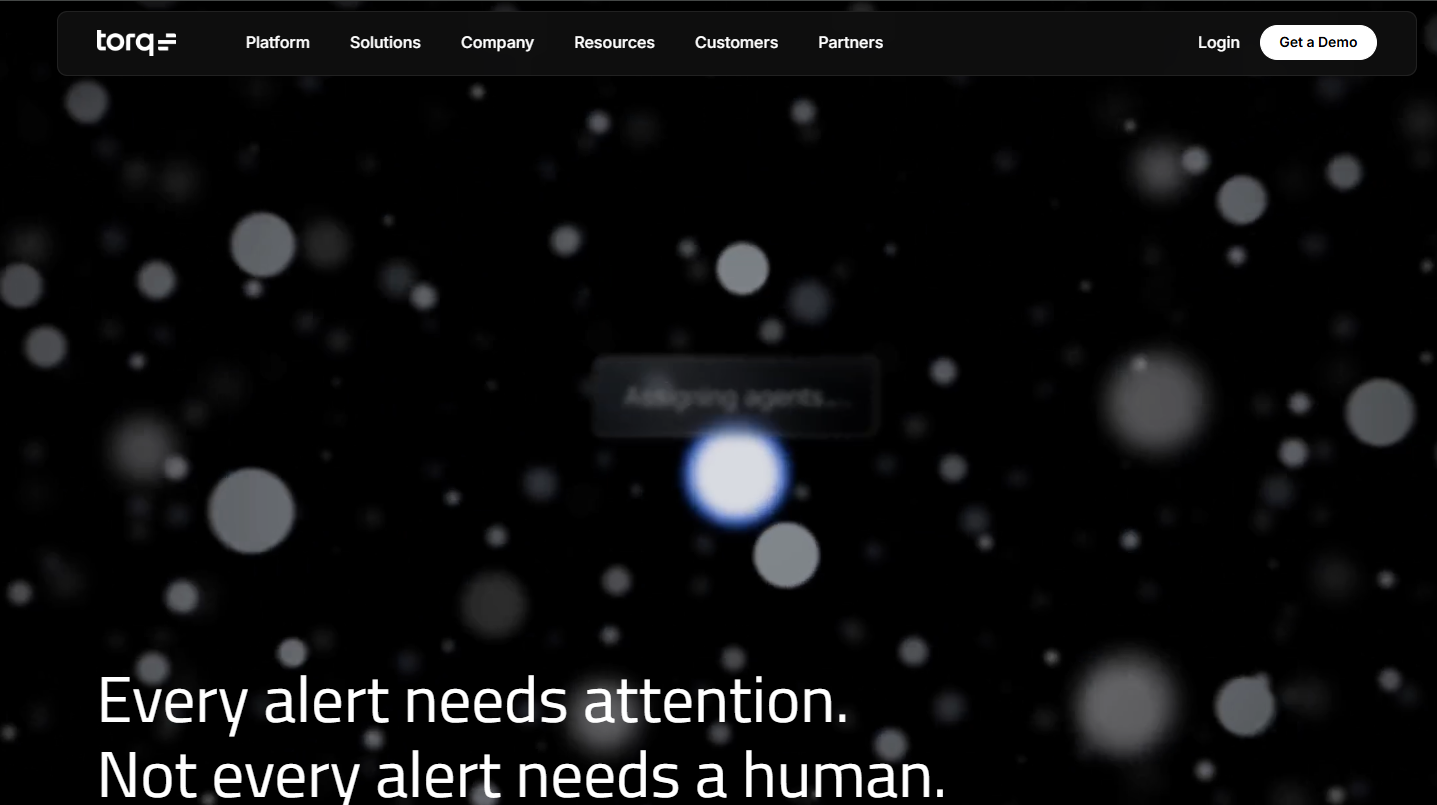
Torq HyperSOC is an AI-driven autonomous security operations platform built for enterprise SOC and MSSP teams that want to automate investigation and response without writing custom code. The platform pairs AI agents with no-code workflow automation across 300+ integrations, covering alert triage, case management, evidence enrichment, and remediation. Teams can configure human approval gates on higher-risk actions while running lower-risk workflows autonomously.
Best for: Enterprise SOC and MSSP teams that need AI-assisted investigation with flexible automation coverage across a diverse toolset.
Key features
- AI-driven event analysis and alert triage
- Automated case management and evidence collection
- AI-assisted investigation and threat enrichment
- Autonomous or human-supervised remediation
- No-code workflow automation with 300+ integrations
Why choose Torq HyperSOC: It's a strong fit for teams that have identified their highest-volume, most repetitive workflows and want to formalize them into reusable, auditable automations. Before buying, confirm how workflows are tested before production deployment and how incident decisions are logged.
Torq HyperSOC pricing: Torq directs prospects to request a demo for pricing. Contact sales for an enterprise quote and confirm what usage drivers (workflow runs, integrations, alert volume) determine the contract.
G2 rating: 4.8/5
2. Cortex XSIAM
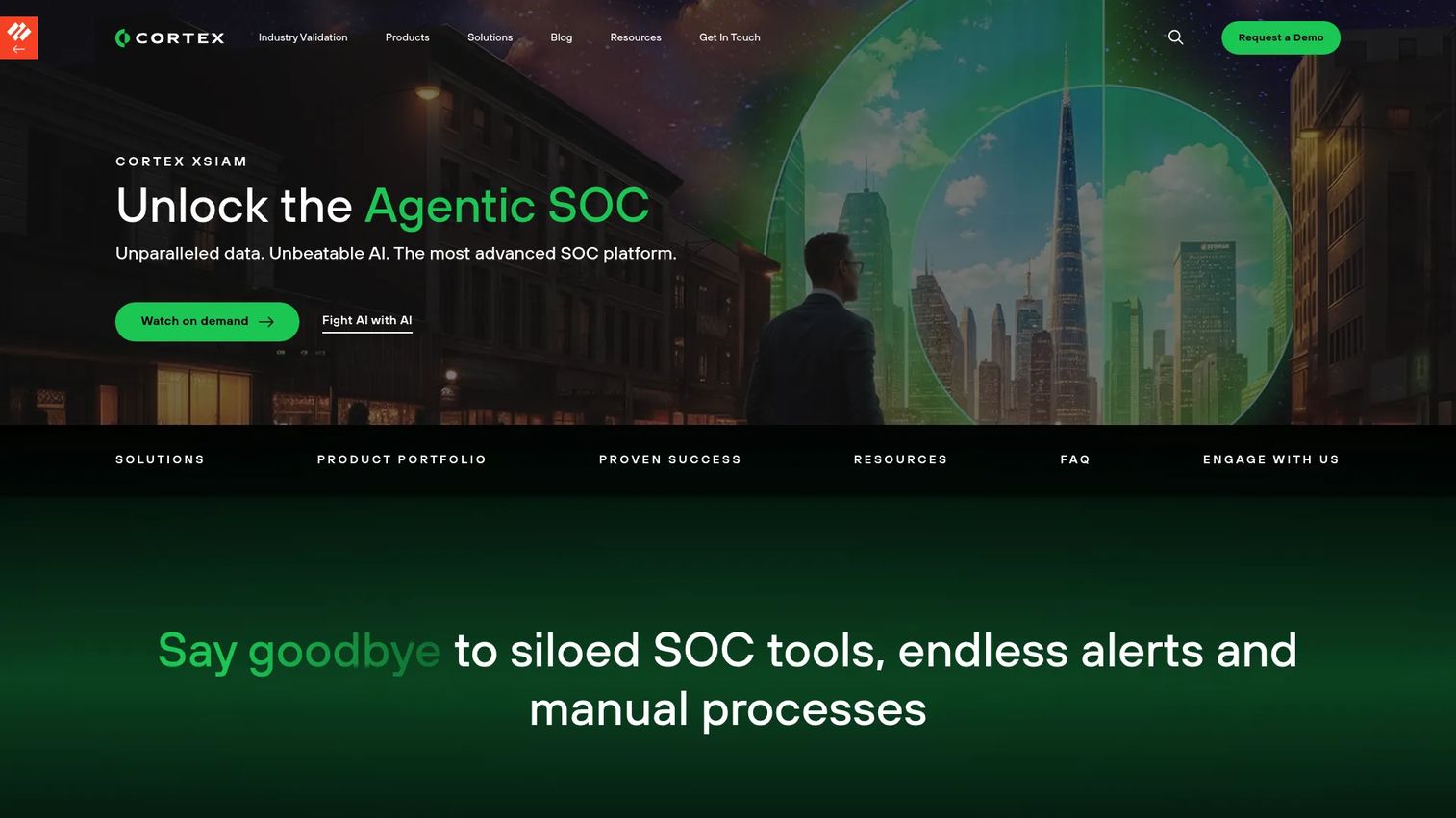
Cortex XSIAM is Palo Alto Networks' AI-driven security operations platform that brings SIEM, XDR, SOAR, cloud security, exposure management, and threat intelligence under a single interface. The platform correlates alerts across endpoint, network, identity, cloud, and third-party sources, then uses AI to prioritize incidents and support investigation. Agentic AI capabilities support autonomous investigation and response alongside human approval workflows.
Best for: Enterprise security operations teams that run a significant portion of their security program on Palo Alto Networks technology and want fewer tool handoffs during investigation.
Key features
- Unified security data across endpoint, network, identity, and cloud
- AI-driven alert correlation and intelligent prioritization
- Agentic AI for autonomous investigation and response
- Automation and orchestration across connected tools
- Incident investigation workspace with case management
Why choose Cortex XSIAM: The consolidation value is real for organizations already committed to the Palo Alto Networks platform. For PMs evaluating this purchase, confirm which use cases require additional products, data sources, or professional services before assuming full coverage from day one.
Cortex XSIAM pricing: Palo Alto Networks directs prospects to contact sales for pricing. Confirm bundle requirements and whether specific capabilities are gated by platform tier or adjacent product licensing.
G2 rating: 4.4/5
3. Microsoft Sentinel
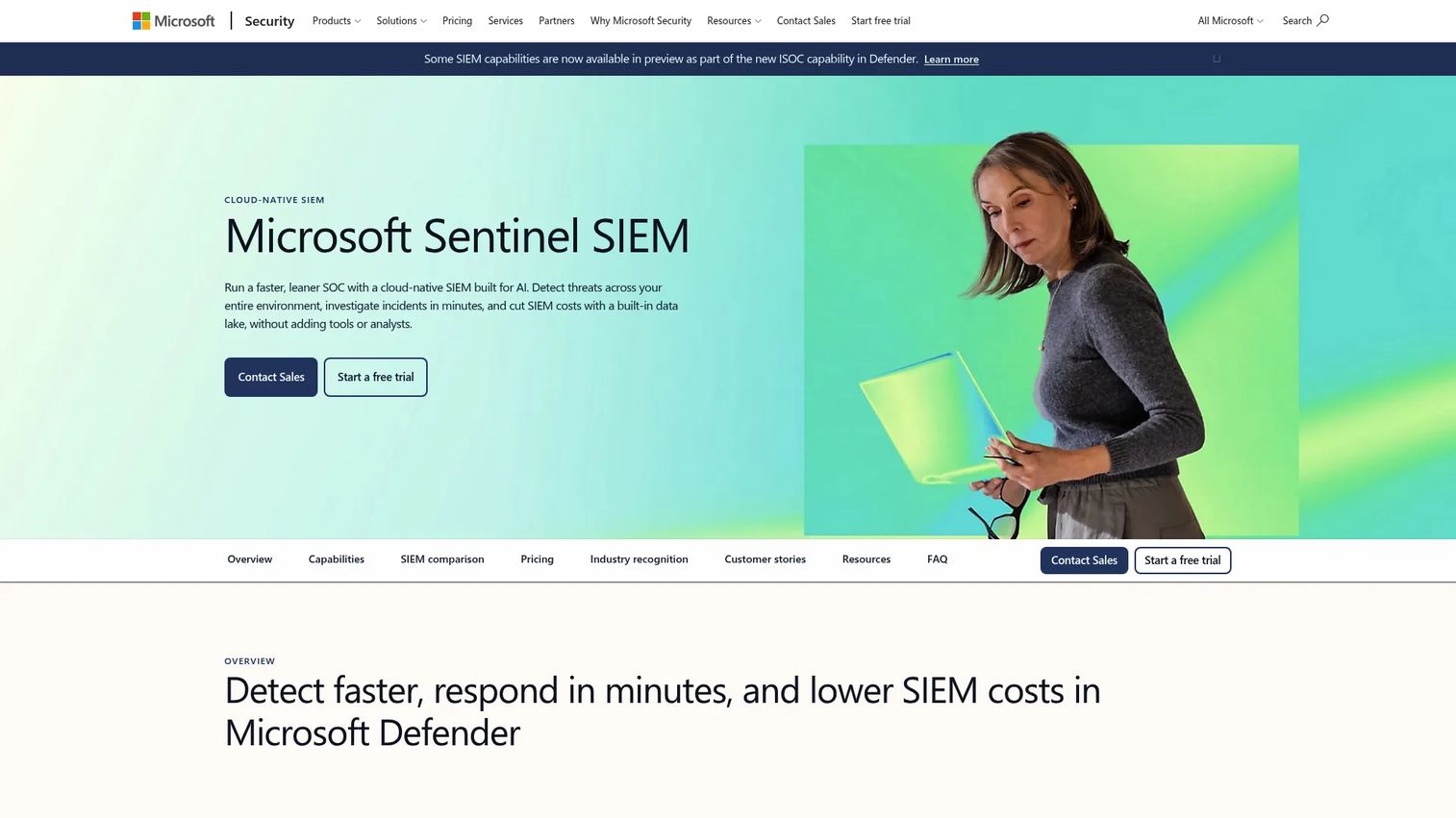
Microsoft Sentinel is a cloud-native SIEM and SOAR platform built on Azure. It ingests security data across Microsoft and third-party sources into a unified security data lake, applies analytics and behavioral detection rules, and supports AI-assisted investigation and automated response playbooks. For organizations already running Azure, Defender, and Entra, it creates significantly fewer integration decisions than a third-party SIEM.
Best for: Microsoft-first security teams where Azure, Defender, and Entra data form the core of day-to-day security operations.
Key features
- Cloud-native SIEM with unified security data lake
- Microsoft security data connectors and third-party integrations
- Detection analytics rules and machine-learning-based UEBA
- Automation playbooks for response orchestration
- AI-assisted investigation and threat intelligence enrichment
Why choose Microsoft Sentinel: It eliminates a significant layer of integration friction when Microsoft security telemetry is already central. For PMs, the key decision is whether your team can manage ingestion cost, retention architecture, and ongoing detection content. Model cost against peak telemetry months, not average alert volume.
Microsoft Sentinel pricing: Pricing is usage-based on data ingested into analytics or data lake tiers. A free trial waives charges for up to 10 GB/day of analytics ingestion for 31 days. Commitment tiers are available for higher ingestion volumes.
G2 rating: 4.4/5
4. Google Security Operations
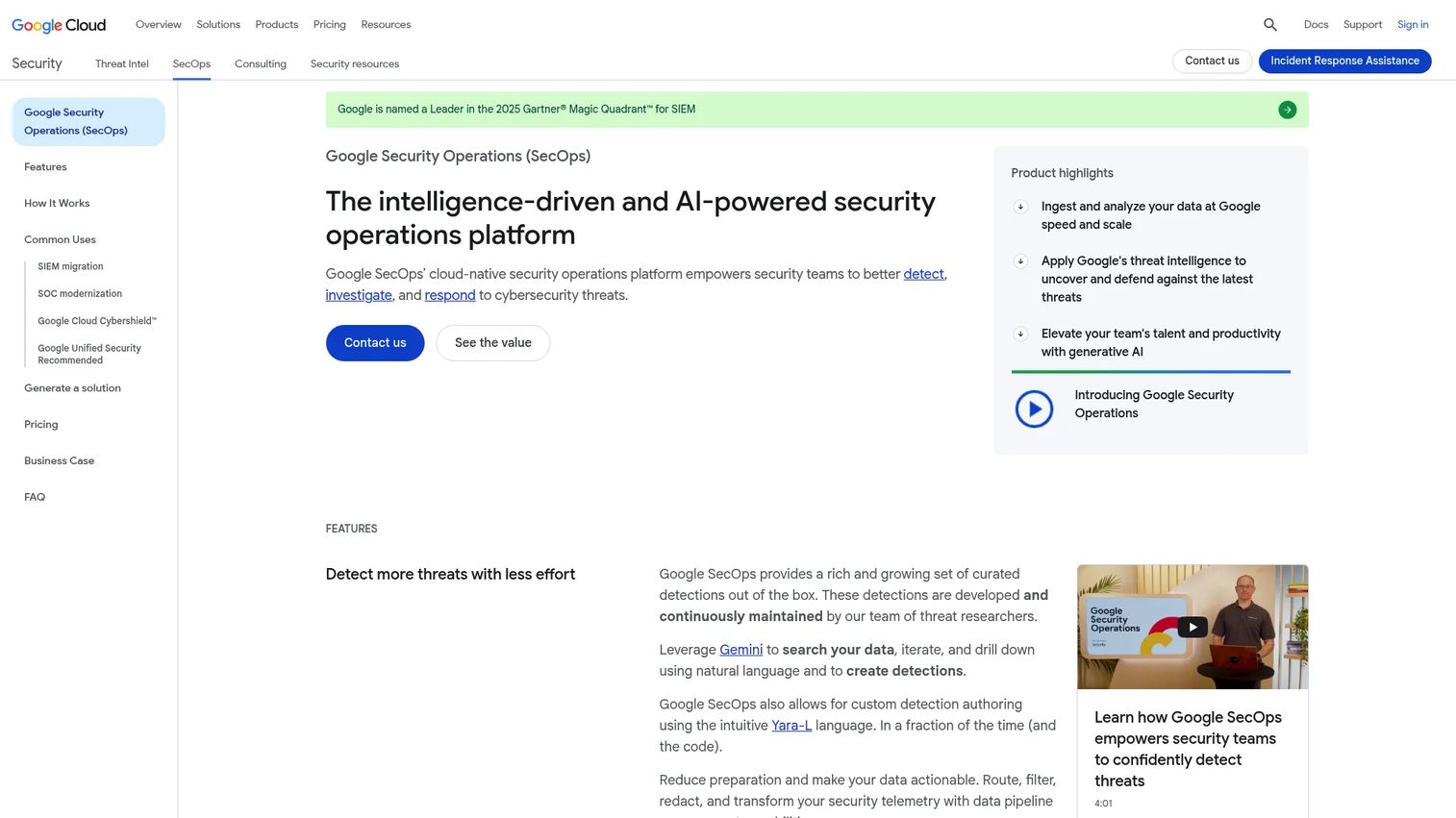
Google Security Operations is an intelligence-driven, AI-powered security operations platform that combines SIEM, SOAR, and threat intelligence in a unified environment. It supports large-scale security telemetry analysis, detection with curated and custom YARA-L rules, and investigation via Gemini-assisted analyst experiences. SOAR playbooks and orchestration across 300+ tools support automated and human-approved response. One year of security telemetry retention is included at no additional cost across all packages.
Best for: Security teams with Google Cloud commitments or a preference for Google's security data, AI, and detection infrastructure.
Key features
- Large-scale security telemetry ingestion and analysis
- Threat detection with YARA-L curated and custom rules
- Gemini-assisted investigation and case management
- SOAR playbooks and orchestration across 300+ connected tools
- Threat intelligence context and alert graphing
Why choose Google Security Operations: It's the natural choice for teams whose cloud strategy centers on Google infrastructure. Before committing, confirm data onboarding effort, rule portability from any existing SIEM, and the degree of tuning your environment requires.
Google Security Operations pricing: Three packages (Standard, Enterprise, Enterprise Plus) are available; all require contacting sales for pricing. One year of security telemetry retention is included across packages.
G2 rating: 4.4/5
5. CrowdStrike Falcon Next-Gen SIEM
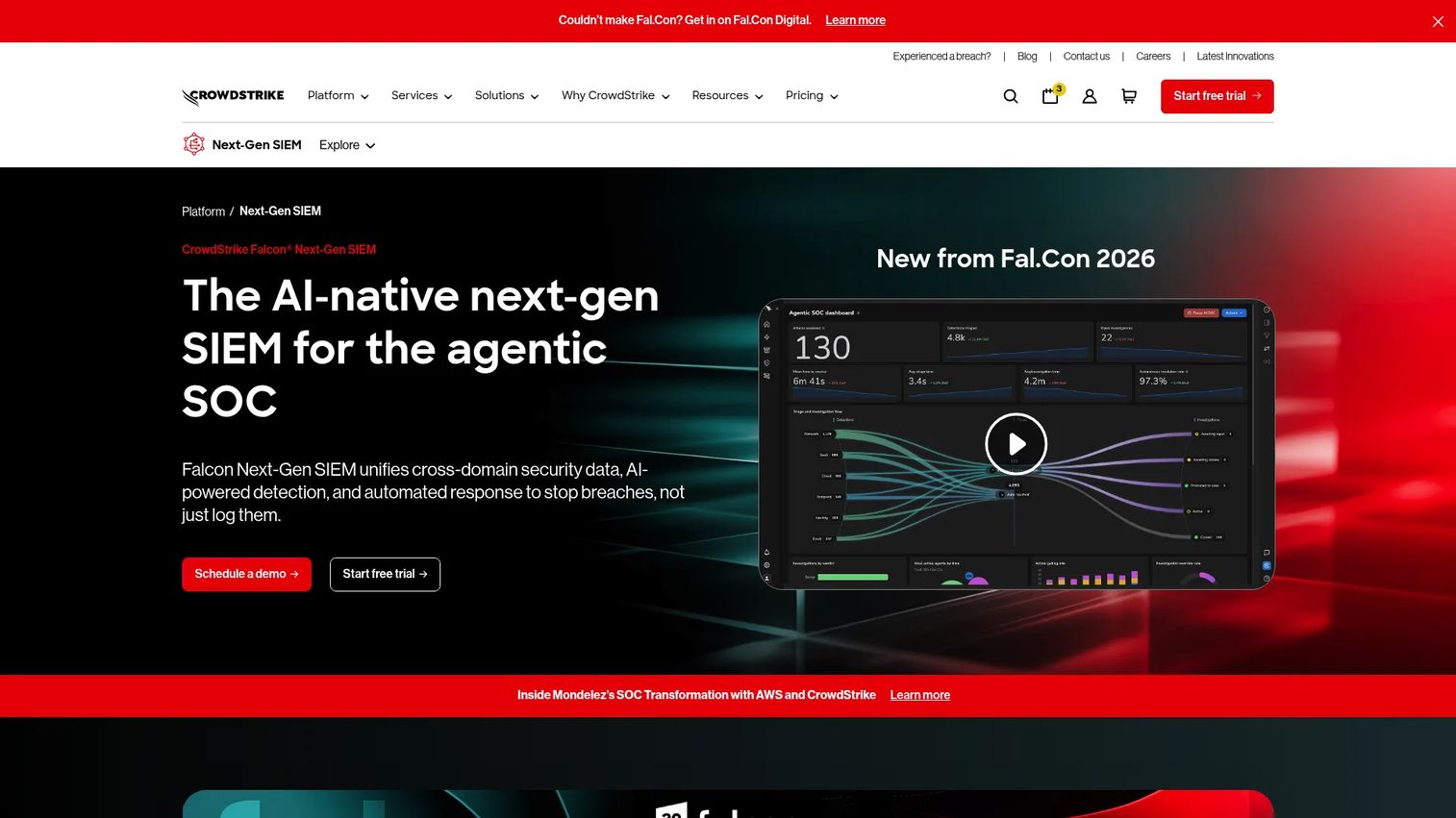
CrowdStrike Falcon Next-Gen SIEM is an AI-native SIEM that extends CrowdStrike's endpoint telemetry into broader security operations. The platform delivers petabyte-scale index-free search, AI-powered threat detection, Charlotte Agentic SOAR for governed workflow automation, and real-time data ingestion through Falcon Onum. It's designed to reduce context switching for teams already running Falcon for endpoint protection.
Best for: Endpoint-led security operations teams standardized on Falcon that want SIEM capabilities close to their existing platform data.
Key features
- Cross-domain security data unification with petabyte-scale search
- AI-powered threat detection and agentic investigation
- Charlotte Agentic SOAR for governed workflow automation
- Real-time data ingestion, transformation, and enrichment via Falcon Onum
- Endpoint and identity context from Falcon telemetry
Why choose CrowdStrike Falcon Next-Gen SIEM: The reduction in context switching is meaningful for teams already inside the Falcon platform. Ask whether non-CrowdStrike data sources receive the same depth of analysis and response support before assuming full parity.
CrowdStrike Falcon Next-Gen SIEM pricing: Falcon bundles including Next-Gen SIEM start at $7.99 per device per month. A 15-day free trial is available. Standalone Next-Gen SIEM pricing requires contacting sales; confirm ingestion factors and any endpoint licensing dependencies.
G2 rating: 4.0/5
6. Splunk Enterprise Security
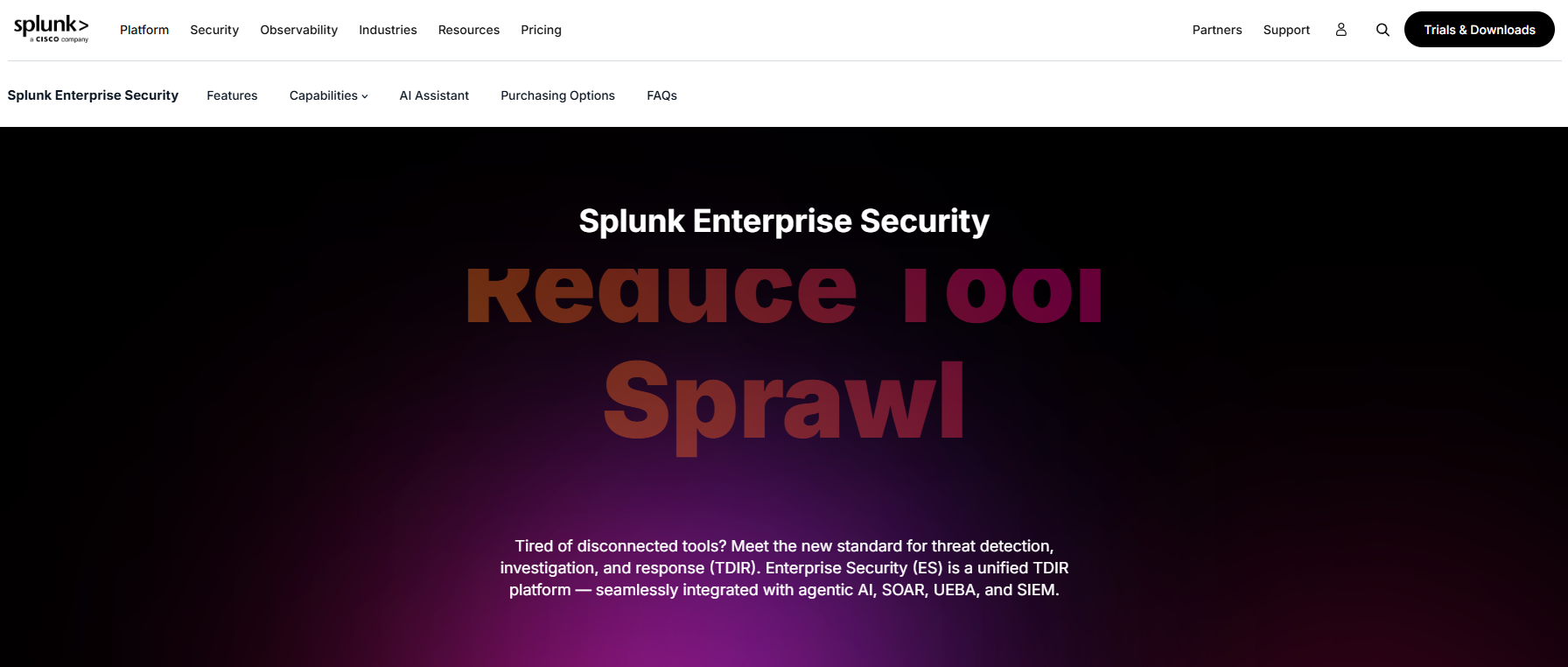
Splunk Enterprise Security is a unified threat detection, investigation, and response platform for medium-to-large security operations teams. The platform integrates SIEM, SOAR, UEBA, threat intelligence, and AI-assisted investigation in two editions. Essentials includes AI, SIEM, Detection Studio, threat intelligence, and Exposure Analytics. Premier adds SOAR, UEBA, and Automated Threat Analysis. Extensive data integration support and deep search capabilities make it a mature choice for teams with complex data pipelines.
Best for: Large enterprises with mature detection engineering, complex data sources, and established Splunk workflows that need control over detections and operational reporting.
Key features
- SIEM with real-time security data collection, correlation, and analysis
- SOAR automation, case management, and event management
- Machine-learning UEBA for insider threat and compromised account detection
- Detection Studio with MITRE ATT&CK mapping and detection lifecycle management
- Risk-based alerting, threat intelligence, and AI-assisted investigations
Why choose Splunk Enterprise Security: It fits teams that need deep control over detection content and data models. For PMs, budget for the people and processes required to maintain that flexibility; the platform rewards investment in detection engineering.
Splunk Enterprise Security pricing: Essentials and Premier editions are available; both require a quote. Pricing reflects workload and ingestion factors. Contact sales to model cost against your expected data volumes.
G2 rating: 4.3/5
7. Elastic Security
Elastic Security is a unified security operations platform combining SIEM, XDR, endpoint security, cloud security, and AI-assisted investigation. Its serverless pricing model is usage-based on ingestion and retention, making cost more predictable at varying data volumes. The platform supports prebuilt and custom detection rules, UEBA and anomaly detection, threat intelligence enrichment, and an AI assistant for analyst workflows. Schema flexibility and broad data access make it a strong option for teams that want to retain control over their security data architecture.
Best for: Security teams that need flexible data ingestion, search-led investigation, detection engineering control, and AI-assisted operations without committing to a single vendor's endpoint or cloud stack.
Key features
- Search-driven security investigations with prebuilt and custom detection rules
- UEBA and anomaly detection for behavioral threat identification
- AI assistant for analyst investigation and query support
- Endpoint protection against malware, ransomware, and malicious behavior
- Threat intelligence enrichment and cloud security posture management
Why choose Elastic Security: It's a strong choice for technical teams that value schema flexibility and investigation depth across diverse data sources. Validate the data engineering workload, retention economics, and which AI features are available in your planned tier before committing.
Elastic Security pricing: Security Analytics Essentials starts at $0.09 per ingested GB; Security Analytics Complete starts at $0.11 per ingested GB. Retention costs are separate at $0.017 to $0.019 per GB per month.
G2 rating: 4.5/5
8. Exabeam New-Scale
Exabeam New-Scale is a cloud-native security operations platform that unifies SIEM, behavioral analytics, threat detection, investigation, and response with AI-driven automation. Its UEBA and Agent Behavior Analytics capabilities produce dynamic risk scores and automated incident timelines, helping analysts understand what happened without manually reconstructing each sequence. AI-driven Nova agents support investigation workflows and automation. Prebuilt collectors, parsers, and detection rules reduce content-building overhead.
Best for: Enterprise SOC teams where identity context, behavior analytics, and investigation consistency are the primary gaps in current operations.
Key features
- Cloud-native SIEM with high-performance natural-language search
- UEBA and Agent Behavior Analytics with dynamic risk scoring
- Automated incident timelines for faster investigation
- AI-driven Nova agents for investigation and workflow automation
- Prebuilt detection rules, dashboards, and response playbooks
Why choose Exabeam New-Scale: Its behavioral analytics approach meaningfully reduces false positives in environments where insider threat and compromised credential patterns are the primary concern. Ask how behavioral models are tuned, explained, and validated against your specific threat model before deployment.
Exabeam New-Scale pricing: Exabeam directs prospects to contact sales for pricing. The platform is described as including core capabilities with add-on options. Confirm the data, user, or event drivers that affect your contract cost.
G2 rating: 4.2/5
9. Securonix Unified Defense SIEM
Securonix Unified Defense SIEM is a cloud-native platform that combines SIEM, UEBA, SOAR, threat intelligence, behavioral analytics, and agentic AI for enterprise security operations. The platform provides 365 days of always-hot searchable data, an Autonomous Threat Sweeper for retroactive threat hunting, and a single unified data layer for detection, investigation, and response. Three packaging tiers (Basic, Standard, and All-In) cover progressively broader capability sets, with the All-In package including Unified Defense SIEM, the Autonomous Threat Sweeper, SOAR, and Securonix Investigate.
Best for: Large organizations and mature SOC teams seeking unified, scalable threat detection, investigation, and automation without maintaining multiple separate platforms.
Key features
- Unified SIEM, UEBA, SOAR, and threat intelligence
- Agentic AI for alert triage, investigation, enrichment, and response
- 365 days of always-hot searchable data
- Autonomous Threat Sweeper for retroactive threat hunting
- Built-in SOAR with automated response playbooks and MITRE ATT&CK-aligned content
Why choose Securonix Unified Defense SIEM: The combination of behavioral analytics, hot data retention, and automation in a single platform reduces the operational overhead of stitching separate SIEM, UEBA, and SOAR tools together. Run a proof of value with production-like telemetry volumes and realistic false-positive patterns before finalizing.
Securonix Unified Defense SIEM pricing: Pricing is consumption-based and contact-sales only across Basic, Standard, and All-In tiers. Confirm the ingestion volume assumptions and service components included in your package.
G2 rating: 4.0/5
10. Swimlane Turbine
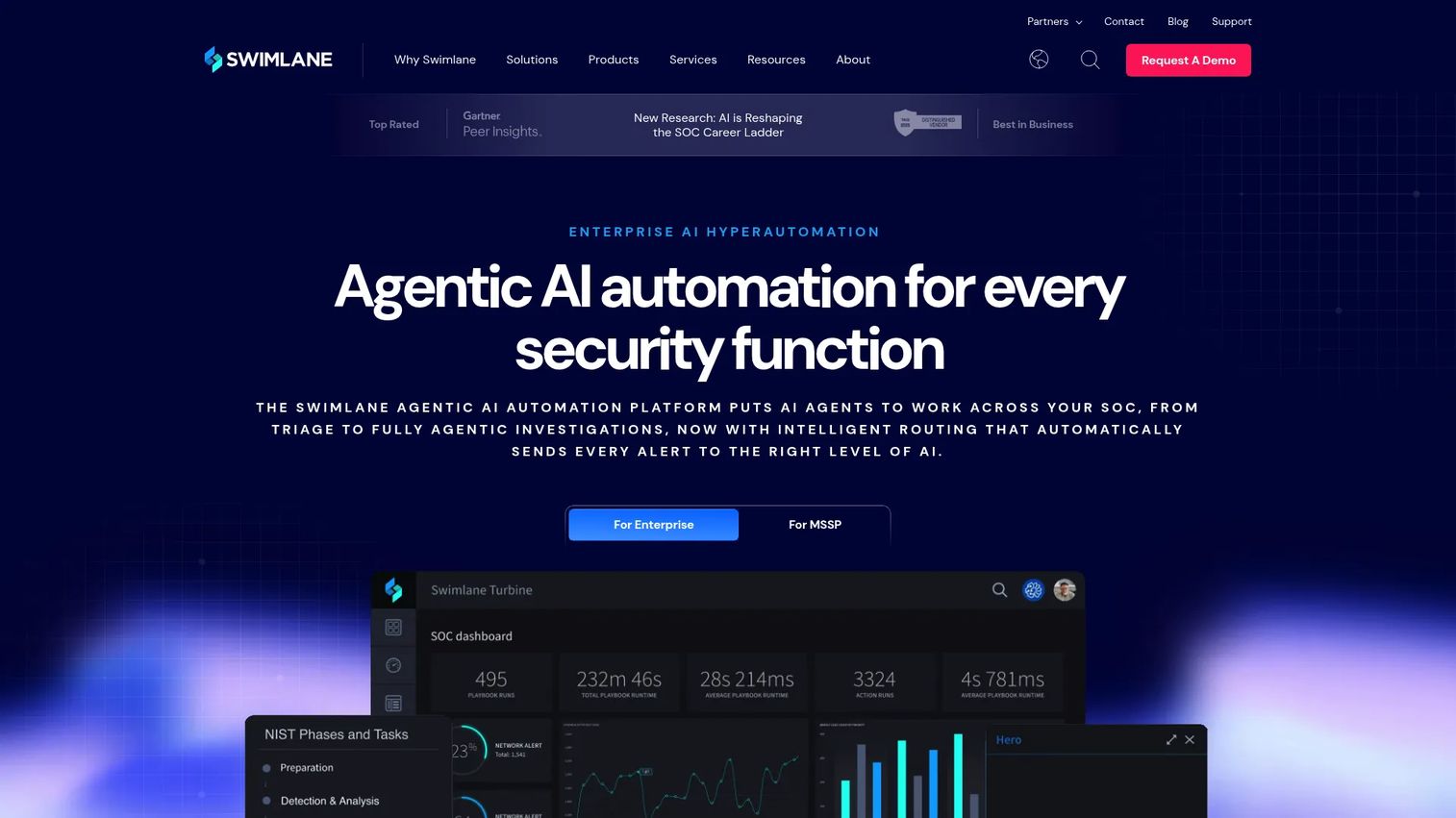
Swimlane Turbine is a cloud-scale, low-code security automation and SOAR platform built for enterprise security teams and MSSPs. Turbine Canvas provides a visual playbook and AI agent builder, while Hero AI enables natural-language playbook creation and generative AI capabilities within workflows. The platform manages case management, dashboards, and AI-augmented reporting, with remote agents and webhooks supporting real-time telemetry collection. It's positioned as an orchestration and automation layer rather than a SIEM replacement.
Best for: Automation-heavy SOC teams where the primary bottleneck is repetitive cross-tool response work rather than detection coverage.
Key features
- Low-code playbook and AI agent builder via Turbine Canvas
- Hero AI for natural-language playbook creation and in-flow generative AI
- Autonomous integrations and API connectivity across the security stack
- Case management, dashboards, and AI-augmented reporting
- Remote agents and webhooks for real-time automation and telemetry collection
Why choose Swimlane Turbine: It's a strong contender when teams have already identified which response workflows consume the most analyst time and want to formalize them without writing code. Evaluate workflow governance, maintenance ownership, and how quickly the team can improve playbooks after incidents expose gaps.
Swimlane Turbine pricing: Swimlane uses value-based, tiered pricing across Base, Advantage, Premium, and Enterprise packages, measured by automation events per day. Contact sales for pricing; no free tier is confirmed.
G2 rating: 4.5/5
11. Stellar Cyber Open XDR
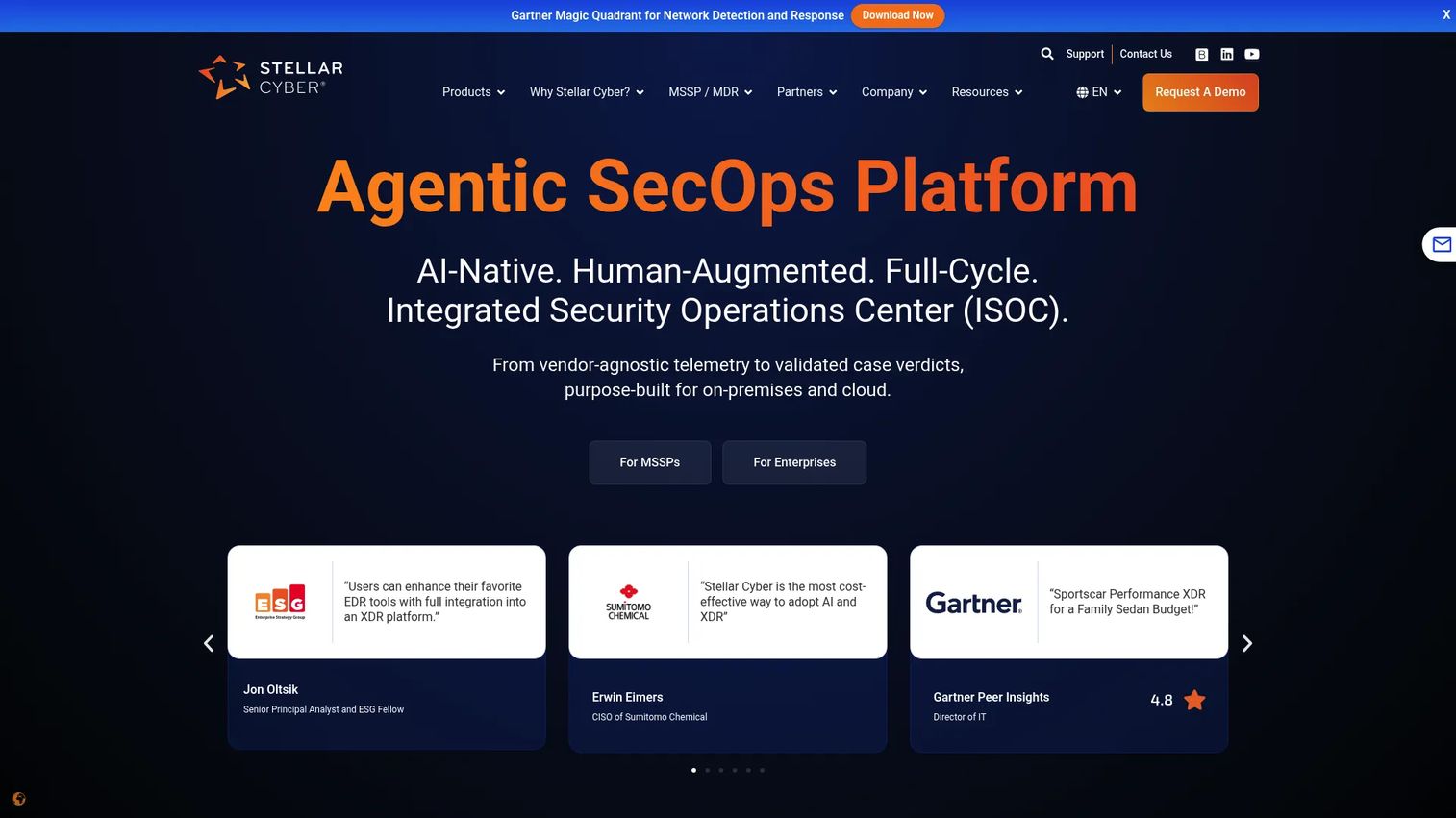
Stellar Cyber Open XDR is an open, unified cybersecurity platform for end-to-end threat detection and response across existing security, IT, OT, and productivity tools. Its single-license model bundles next-generation SIEM, NDR, threat intelligence, IDS, SOAR, UEBA, and file integrity monitoring. AI-driven threat detection and correlation work across heterogeneous data sources without requiring organizations to replace existing security tools. Managed security operations support options are also available for teams that need additional coverage.
Best for: Security teams and MSSPs with heterogeneous tooling that want vendor-neutral telemetry coverage and unified detection without rebuilding their SOC around one vendor's endpoint or cloud platform.
Key features
- Open XDR architecture with AI-driven threat detection and correlation
- Next-gen SIEM, NDR, IDS, SOAR, UEBA, and file integrity monitoring in a single license
- Multi-source telemetry ingestion across existing security and IT tools
- Automated investigation and response with cross-tool integration
- Managed security operations support options for lean teams
Why choose Stellar Cyber Open XDR: Its vendor-neutral approach is genuinely differentiated for teams with mixed stacks who want to avoid rebuilding the SOC around a new anchor platform. Validate connector coverage for your most critical identity, cloud, endpoint, and network sources before committing.
Stellar Cyber Open XDR pricing: Pricing is quote-based, with all platform capabilities included under a single license. Contact sales for a volume-based quote and confirm deployment options.
G2 rating: 4.9/5
12. UnderDefense Agentic AI SOC
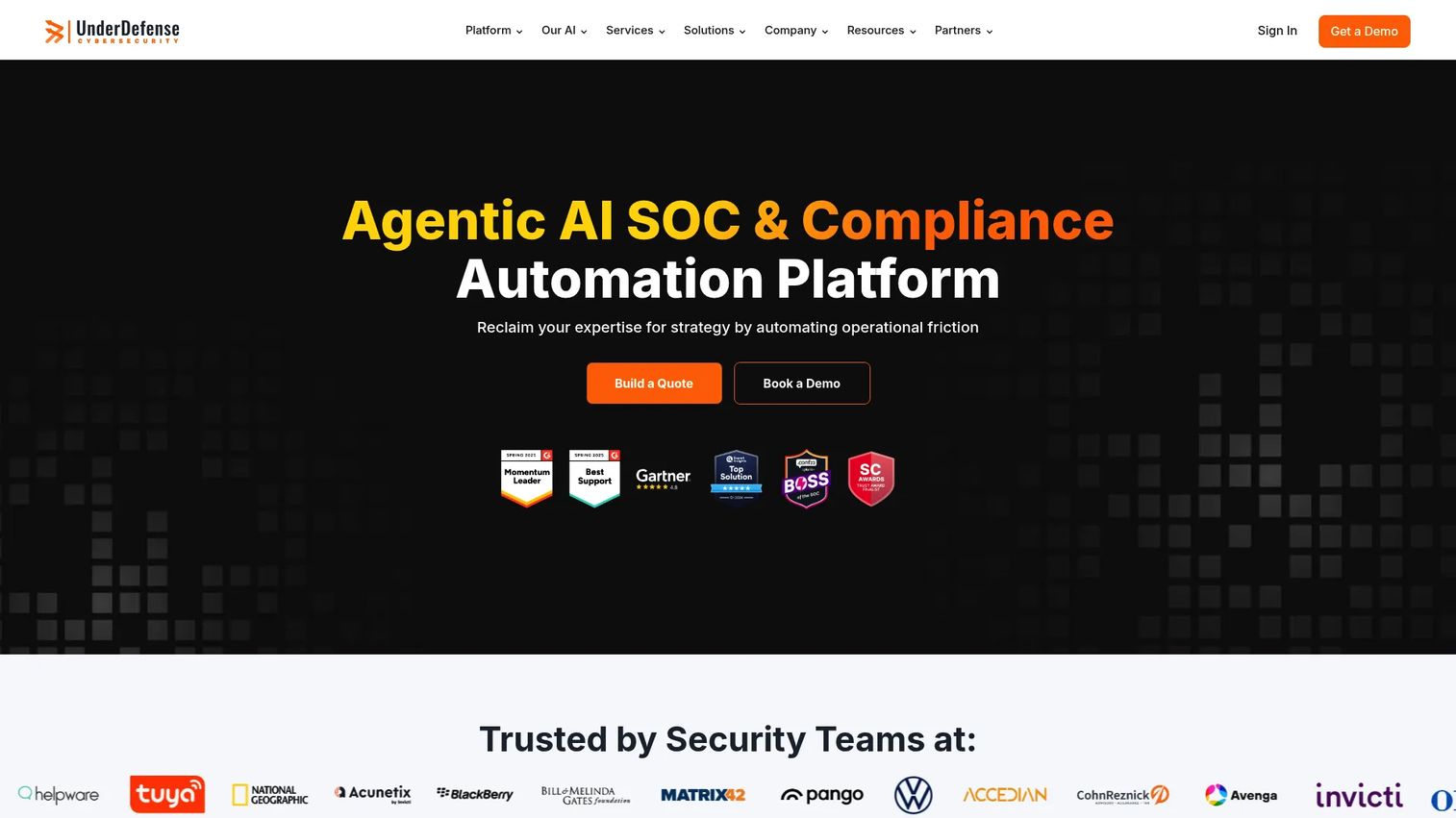
UnderDefense Agentic AI SOC is an agentic AI SOC and compliance automation platform that combines automated alert investigation, threat detection, incident response, and 24/7 concierge security analyst support. Agentic capabilities handle enrichment, correlation, triage, and investigation, while 250 security-tool integrations support response across existing SIEM, EDR, cloud, identity, and SaaS tools. Compliance automation and continuous evidence collection are included. This model suits teams seeking operational coverage rather than a platform their internal analysts run alone.
Best for: Organizations with limited internal analyst capacity that need AI-led SOC operations backed by expert managed support, with clear escalation paths and defined service boundaries.
Key features
- Agentic alert enrichment, correlation, triage, and investigation
- 24/7 concierge security analysts and incident response support
- Automated incident response with ready-to-use playbooks
- 250 security-tool integrations across SIEM, EDR, cloud, and identity
- Compliance automation and continuous evidence collection
Why choose UnderDefense Agentic AI SOC: It's an appropriate choice for organizations that need operational coverage beyond what an internal team can provide. Before signing, define which actions the provider performs, which remain with the customer, and how shared incident ownership and escalation work in practice.
UnderDefense Agentic AI SOC pricing: A free platform tier is available. SOCaaS starts at $11 per device per month. Standard, Enhanced, and Professional plans use custom per-asset annual pricing; contact sales for a quote.
G2 rating: 4.9/5
Considerations when choosing an AI SOC platform
Telemetry coverage and data quality
The platform can only investigate what it can access and normalize. Inventory your highest-value identity, cloud, endpoint, network, SaaS, and application data sources before evaluating vendors. A platform with strong AI but thin connector coverage for your actual environment will underperform immediately.
Bounded autonomy and response controls
Define which actions can happen automatically before you evaluate any platform. Common early candidates include enrichment, ticket creation, notification, and evidence collection. Higher-risk actions such as containment or account changes need explicit approval policies, rollback procedures, and documented accountability.
Explainability and audit trails
Ask every vendor how the platform explains an AI-generated conclusion. Your team should see the evidence, source systems, reasoning path, analyst edits, response actions, and timestamps. This is a legal and governance requirement, not a nice-to-have.
Integration ownership and maintenance
A platform demo often looks clean before connectors meet real authentication, API limits, schema changes, and custom internal systems. Assign a technical owner for integrations and include maintenance work in your total cost model. The engineering opportunity cost is real.
Pilot design and measurement
Do not judge a proof of value by feature coverage alone. Baseline alert volume, time to triage, analyst time per investigation, false-positive closure rate, escalation rate, and incident response time before the pilot begins. Without a baseline, you can't measure what the platform actually changed.
How to choose the right AI SOC platform for your team
If your security stack already centers on Microsoft
Start with Microsoft Sentinel. It generally creates the fewest data and identity integration decisions when Azure, Defender, and Entra are already embedded in daily operations. Confirm ingestion economics and automation requirements early to avoid cost surprises at scale.
If endpoint telemetry drives most investigations
Evaluate CrowdStrike Falcon Next-Gen SIEM or Cortex XSIAM. Both reduce context switching for teams relying on their broader security platforms. Compare third-party data source coverage before assuming your existing vendor handles every investigation workflow.
If you need vendor-neutral data control
Prioritize Elastic Security, Stellar Cyber Open XDR, or Splunk Enterprise Security. These platforms suit teams with mixed data sources, mature detection engineering, or a need to preserve flexibility across cloud and endpoint vendors. Elastic's usage-based pricing makes cost modeling more transparent at varying ingestion volumes.
If repetitive response workflows are the bottleneck
Evaluate Torq HyperSOC or Swimlane Turbine. Focus the pilot on repeatable, lower-risk workflows: Phishing investigation, identity alerts, endpoint enrichment, and ticket routing. Measure how often human intervention remains necessary after the first 90 days.
If your team needs operational coverage alongside software
Consider UnderDefense Agentic AI SOC. Define the service boundary, escalation paths, and accountability model before purchasing. This option fits lean teams that need managed support, not only a platform to configure.
Conclusion
An AI SOC platform isn't defined by a chatbot. The value comes from stronger alert prioritization, evidence-backed investigation, controlled response workflows, and a measurable reduction in analyst time on repetitive tasks.
The best platform depends on existing telemetry, staffing model, response authority, and data architecture. Torq HyperSOC leads for teams prioritizing agentic orchestration. Microsoft Sentinel is the natural starting point for Microsoft-first organizations. Elastic Security and Stellar Cyber Open XDR suit teams that need schema flexibility and vendor-neutral coverage. UnderDefense fits lean teams that need managed coverage alongside AI-led investigation.
Shortlist two or three platforms, choose one high-volume workflow, and run a pilot against a baseline. The vendor that produces faster, explainable investigations with less operational overhead is the one worth expanding.
Security buyers often need to validate workflows across analysts, architects, procurement, and leadership. Interactive product demos and controlled sandbox experiences let you show the product without scheduling another walkthrough for every stakeholder. A Demo Center can organize role-specific walkthroughs for your buying committee in a single branded destination.
Start your journey with Guideflow today!
FAQs
An AI SOC (AI security operations center) is a security operations approach that uses machine learning and generative AI to support alert triage, evidence investigation, decision support, and approved response workflows. It can refer to a unified platform, an operating model layered on top of existing SIEM and SOAR tools, or a combination of both. The defining characteristic is AI-assisted automation across the investigation and response lifecycle, not simply an AI chat interface on top of a legacy SIEM.
A traditional SOC relies heavily on analysts manually collecting evidence, correlating alerts across tools, and coordinating response actions. An AI SOC automates repetitive investigative steps, prioritizes the alerts most likely to require attention, and can execute pre-approved response actions autonomously. Human governance remains essential for higher-risk actions in both models; the AI SOC shifts analyst time from repetitive triage toward judgment-intensive work.
Agentic AI in a SOC refers to AI that can plan and execute multi-step tasks across connected security systems without requiring a human to initiate each action. In practice, this means the AI can gather evidence, correlate events, propose or execute containment actions, and update case management automatically. Mature implementations define permissions, maintain audit logs, and require human approval for higher-consequence actions before execution.
No. AI reduces repetitive alert handling and accelerates evidence collection, but analysts remain responsible for judgment, escalation decisions, threat modeling, incident leadership, and any action with material business impact. According to Cybersecurity Insiders (2025), only 31% of organizations use AI across core detection and response workflows, which reflects the continued need for human oversight across most security operations teams.
Establish baselines before the pilot begins: Mean time to triage, mean time to respond, analyst hours per investigation, false-positive closure rate, alerts escalated to incidents, critical data source coverage, and time spent maintaining integrations. Compare those numbers at 30, 60, and 90 days after deployment. SOC automation ROI becomes defensible when you can show changes in those specific metrics, not in vendor-provided dashboards.
Start with low-risk, high-volume repetitive tasks: Alert enrichment, evidence gathering, duplicate alert grouping, ticket creation, asset context collection, and notifications. These create immediate time savings with minimal governance risk. Move to containment and remediation only after your team has validated approval controls, rollback paths, and exception handling across at least one full incident cycle.
Not exactly. SIEM centralizes security data collection, search, and detection. SOAR orchestrates response workflows and playbooks. An AI SOC uses AI across triage, investigation, and governed response, typically on top of SIEM and SOAR capabilities. Many vendors now market unified platforms that combine all three. The buyer should assess which capabilities are native to the platform and which require integrating existing SIEM or SOAR investments.
Timing depends on data source readiness, identity and endpoint integrations, detection content maturity, approval model design, and pilot scope. A phased rollout starting with one well-defined workflow typically shows measurable results within 60 to 90 days. Full deployment across a complex environment can take six months or more. Vendors offering professional services as part of onboarding can accelerate early workflows, but internal ownership of connectors and playbooks is essential for long-term maintainability. For more context on agentic AI platforms and evaluation frameworks, see related guidance on AI governance tools and best AI security posture management tools.