Your SOC gets thousands of alerts a day. Analysts triage a fraction of them. The rest sit in a queue while the team chases false positives, resets credentials by hand, and copies indicators between five different consoles.
That gap between alert volume and human capacity is exactly what security orchestration, automation, and response software was built to close. The category is growing fast for a reason. The global SOAR market reached USD 1.87 billion in 2025 and is projected to hit USD 4.42 billion by 2030 at an 18.82% CAGR, according to Mordor Intelligence (2025). Cloud-based deployments already account for 71% of that market.
A SOAR platform sits on top of your detection stack and automates the repetitive parts of incident response: enrichment, triage, containment, and case management. Done well, it turns a 45-minute manual investigation into a two-minute automated playbook and frees your analysts for the work only humans can do.
This guide breaks down eight SOAR tools worth evaluating in 2026, what each does well, where it fits, and what you should know before you shortlist. If you also evaluate adjacent categories, our roundups of AI cybersecurity solutions, AI security posture management tools, and AI orchestration platforms cover neighboring parts of the security and automation stack.
What's inside
This guide is written for SOC managers, security engineers, and platform evaluators comparing SOAR cybersecurity tools mid-research. We selected the eight platforms based on four criteria that matter most to security operations buyers: playbook and workflow depth, integration breadth across your existing stack, case management and incident response capabilities, and deployment flexibility from SME to enterprise. Every product here is a real, actively maintained SOAR or security automation platform. Pricing and ratings reflect verified first-party and G2 sources where public data exists.
TL;DR
- Best-known enterprise SOAR: Cortex XSOAR, for teams that want deep playbook automation plus native threat intelligence management.
- Best for low-code automation: Tines, for security and operations teams that build orchestration-heavy workflows without heavy scripting.
- Best for Splunk-centric SOCs: Splunk SOAR, for teams already invested in the Splunk ecosystem.
- Best for autonomous triage: Torq, for SOCs prioritizing AI-assisted investigation and remediation.
- Best for existing platform investment: ServiceNow Security Incident Response, for enterprises already standardized on ServiceNow workflows.
- Highest rated on G2: FortiSOAR, for teams and MSSPs inside the Fortinet ecosystem.
What is SOAR software?
SOAR software is a category of security operations tooling that connects your security tools, automates incident response workflows, and centralizes case management so analysts can detect, investigate, and remediate threats faster and more consistently.
The term stands for security orchestration, automation, and response. Each word maps to a distinct capability:
- Orchestration: Connecting disparate security and IT tools (SIEM, EDR, firewalls, ticketing, threat intel feeds) so they act as one coordinated system.
- Automation: Running repeatable tasks (enrichment, lookups, containment, notifications) through playbooks without manual clicks.
- Response: Executing containment and remediation actions, tracking them in a case, and documenting the full incident timeline.
Core features you will see across most SOAR platforms:
- Playbooks and workflows: Visual, often low-code builders that codify how the SOC handles a given alert type.
- Case management: A structured record of each incident with evidence, timelines, assignments, and audit trails.
- Integrations and connectors: Prebuilt links to hundreds of third-party security and IT tools.
- Alert triage automation: Deduplication, enrichment, and prioritization that cut down analyst noise.
- Threat intelligence operationalization: Ingesting indicators and applying them automatically across detection and response.
- Dashboards and reporting: SOC performance metrics, SLA tracking, and analyst throughput.
SOAR grew out of a simple problem. Detection tools got very good at generating alerts. Human capacity to act on them did not scale at the same rate. SOAR is the layer that closes that gap by turning documented response procedures into executable automation.
When to use SOAR software
Not every security team needs a full SOAR platform on day one. Here is how to know it fits your situation.
Reduce alert fatigue and manual triage
If your analysts spend most of their day deduplicating alerts, enriching indicators, and chasing false positives, SOAR is a direct fix. Automated triage playbooks handle the repetitive first pass so humans focus on genuine threats. This is the single most common reason teams adopt incident response automation.
Standardize incident response across the team
When your best analyst handles an incident one way and a junior analyst handles it another, outcomes vary and audits get painful. SOAR playbooks encode a consistent response every time, regardless of who is on shift. This matters most for teams scaling headcount or operating across multiple regions and time zones.
Connect a fragmented security stack
If your SOC juggles a SIEM, several EDR consoles, a threat intel platform, and a ticketing system that do not talk to each other, orchestration is the value. SOAR becomes the connective tissue that lets one alert trigger coordinated action across all of them.
Comparison table
Here is a side-by-side view of the eight SOAR platforms in this guide. Public pricing is quote-based for most enterprise SOAR tools, so we note where first-party numbers were not published rather than guess.
| # | Product | Intent | Key differentiation | Pricing | G2 rating |
|---|---|---|---|---|---|
| 1 | Cortex XSOAR | Enterprise SOAR with native threat intel | Visual playbook automation plus threat intelligence management | Quote-based | 4.6/5 |
| 2 | Tines | Low-code workflow automation | Story-based automation with AI Agent and self-hosting | Free tier; paid quote-based | 4.7/5 |
| 3 | Splunk SOAR | SOAR for Splunk-centric SOCs | 300+ integrations and 2,800+ automated actions | Quote-based | 4.4/5 |
| 4 | Torq | AI-driven SOC automation | Agentic triage and autonomous investigation | Quote-based | 4.8/5 |
| 5 | IBM Security QRadar SOAR | Enterprise incident response orchestration | Dynamic playbooks plus breach response module | Predictable, quote-based | 4.0/5 |
| 6 | ServiceNow Security Incident Response | SOAR inside the ServiceNow platform | Workflow orchestration with MITRE ATT&CK integration | Quote-based | 4.4/5 |
| 7 | Swimlane Turbine | AI automation at scale | Low-code automation priced on daily actions | Quote-based | 4.5/5 |
| 8 | FortiSOAR | SOAR for the Fortinet ecosystem | Centralized incident management and broad connectors | Quote-based | 4.9/5 |
1. Cortex XSOAR
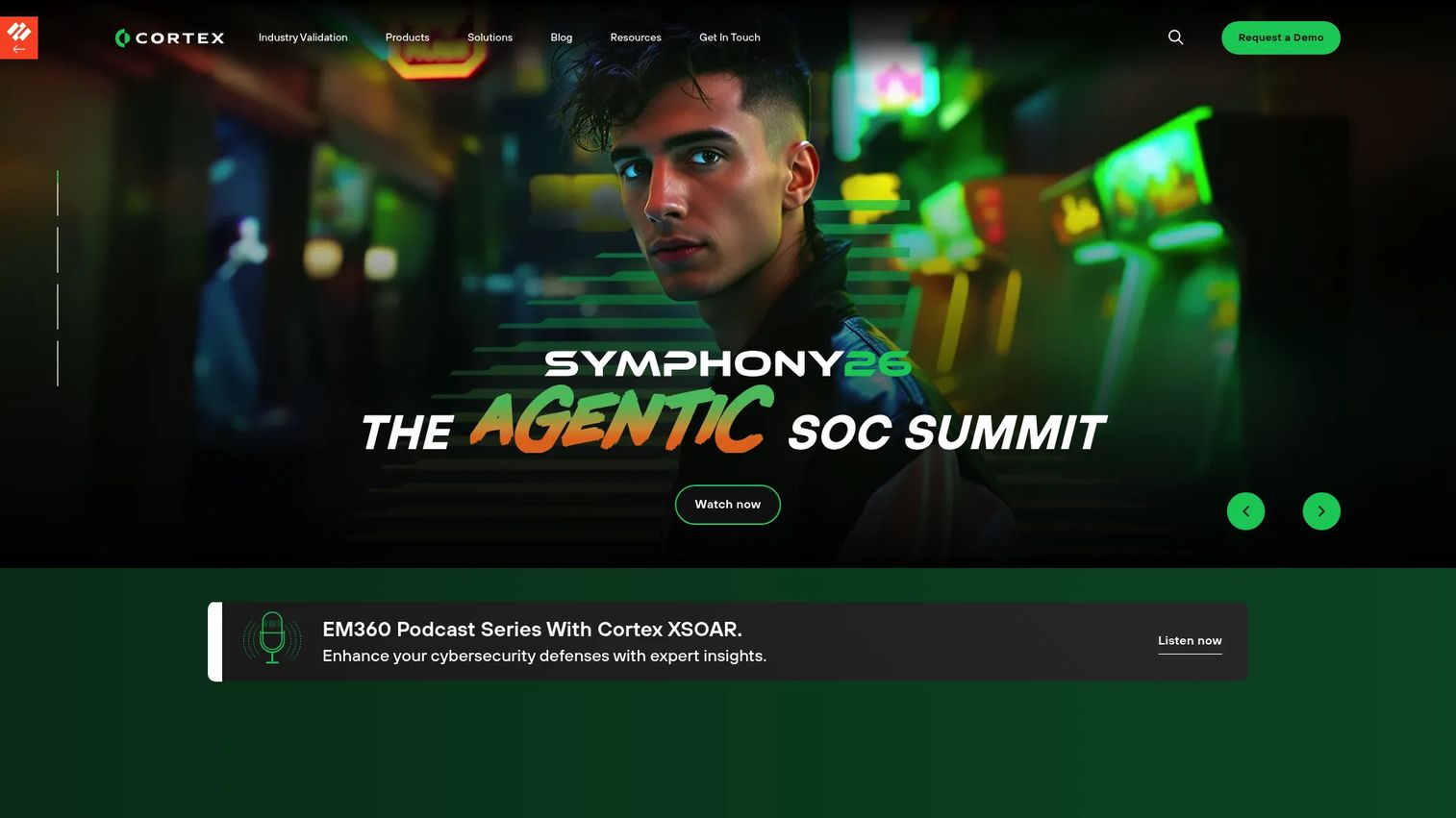
Cortex XSOAR is Palo Alto Networks' security orchestration, automation, and response platform and one of the most widely deployed SOAR tools in enterprise SOCs. It pairs visual playbook automation with built-in threat intelligence management, so teams can orchestrate response and operationalize indicators in the same system. For many buyers it is the reference point every other SOAR platform gets compared against.
Best for: Security teams automating incident response and threat operations at enterprise scale.
Key strengths
- Visual playbook automation: Build and run response workflows through a drag-and-drop editor without deep scripting.
- Incident investigation and case management: Centralize evidence, timelines, and analyst assignments in a single record.
- Threat intelligence management: Ingest, score, and act on indicators natively, without a separate TIP.
Why choose Cortex XSOAR: If you want breadth and a large integration marketplace, XSOAR is the default enterprise choice. It fits teams with mature SOC processes that want to codify complex, multi-tool response playbooks and manage threat intel in the same place they run automation. The tradeoff for that depth is that it rewards teams with the process maturity to use it fully.
Cortex XSOAR pricing: Palo Alto Networks does not publish a public price on its product or licensing pages. The first-party FAQ notes that SaaS migration for existing single-tenant customers is at no charge, with multi-tenant pricing provided later. Expect a quote-based enterprise motion. On G2, Cortex XSOAR holds a 4.6/5 rating.
2. Tines
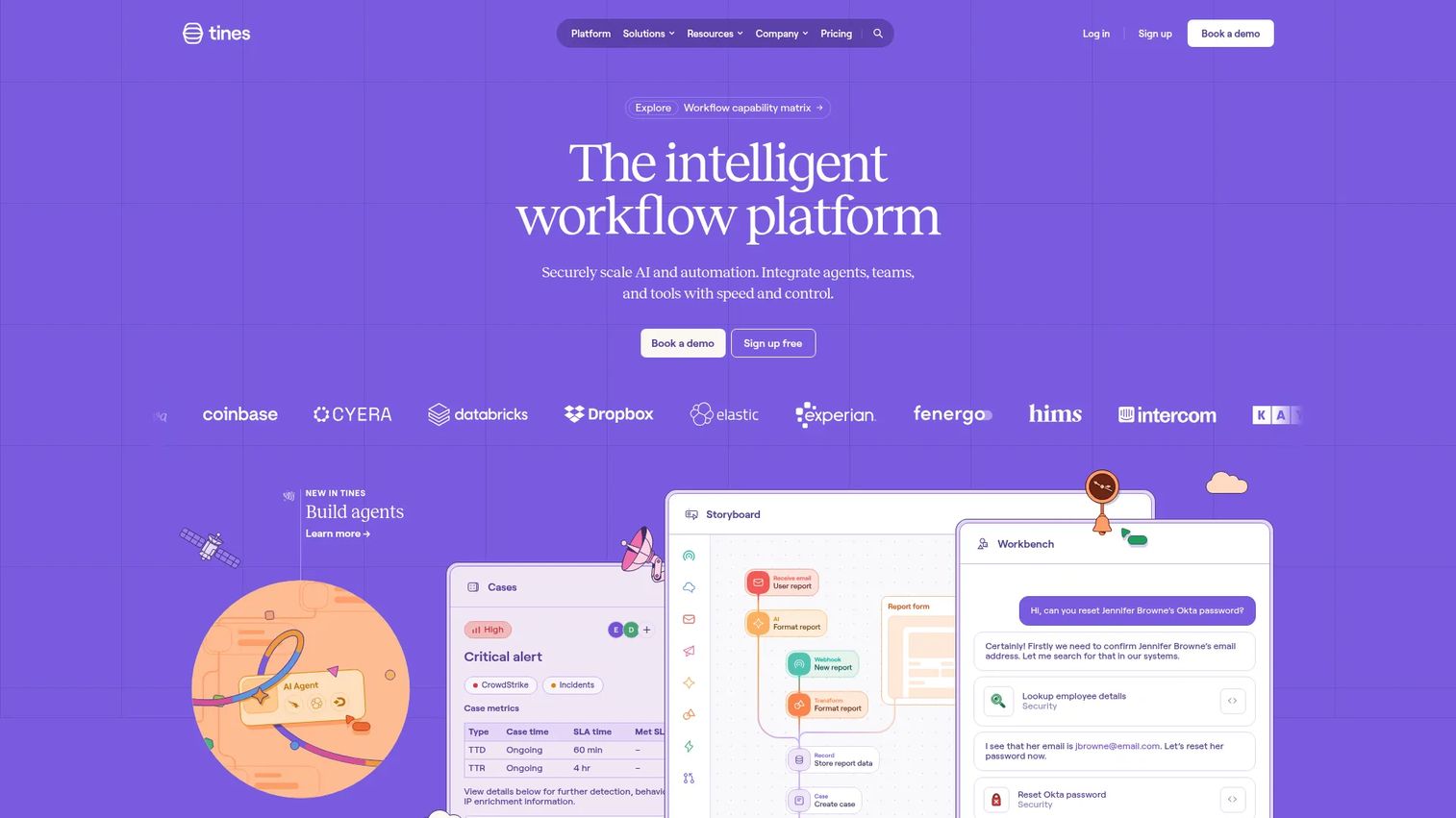
Tines is an intelligent workflow automation platform that many security teams evaluate when orchestration flexibility matters more than a prescriptive SOAR framework. It uses a story-based model for building automations, and its low-code approach appeals to teams that want to connect anything without heavy engineering. Beyond security, operations teams use it for automation well outside the SOC.
Best for: Security and operations teams automating repetitive workflows with low-code and no-code tooling.
Key strengths
- Workflow automation stories: Build orchestration logic visually, from simple enrichment to multi-step response.
- AI Agent and Workbench: Layer AI-assisted actions and investigation into automated workflows.
- Apps, cases, dashboards, and self-hosting: Manage cases, visualize outcomes, and self-host for stricter environments.
Why choose Tines: Tines suits teams that value automation flexibility over an opinionated SOAR structure. If your use cases span security and broader operations, or if you want to self-host for compliance reasons, it fits well. It rewards teams comfortable building their own logic rather than adopting prepackaged playbooks.
Tines pricing: Tines offers a forever-free Community Edition, plus Business and Enterprise editions with pricing available on request. The free tier makes it easy to prototype workflows before committing budget. On G2, Tines holds a 4.7/5 rating.
3. Splunk SOAR
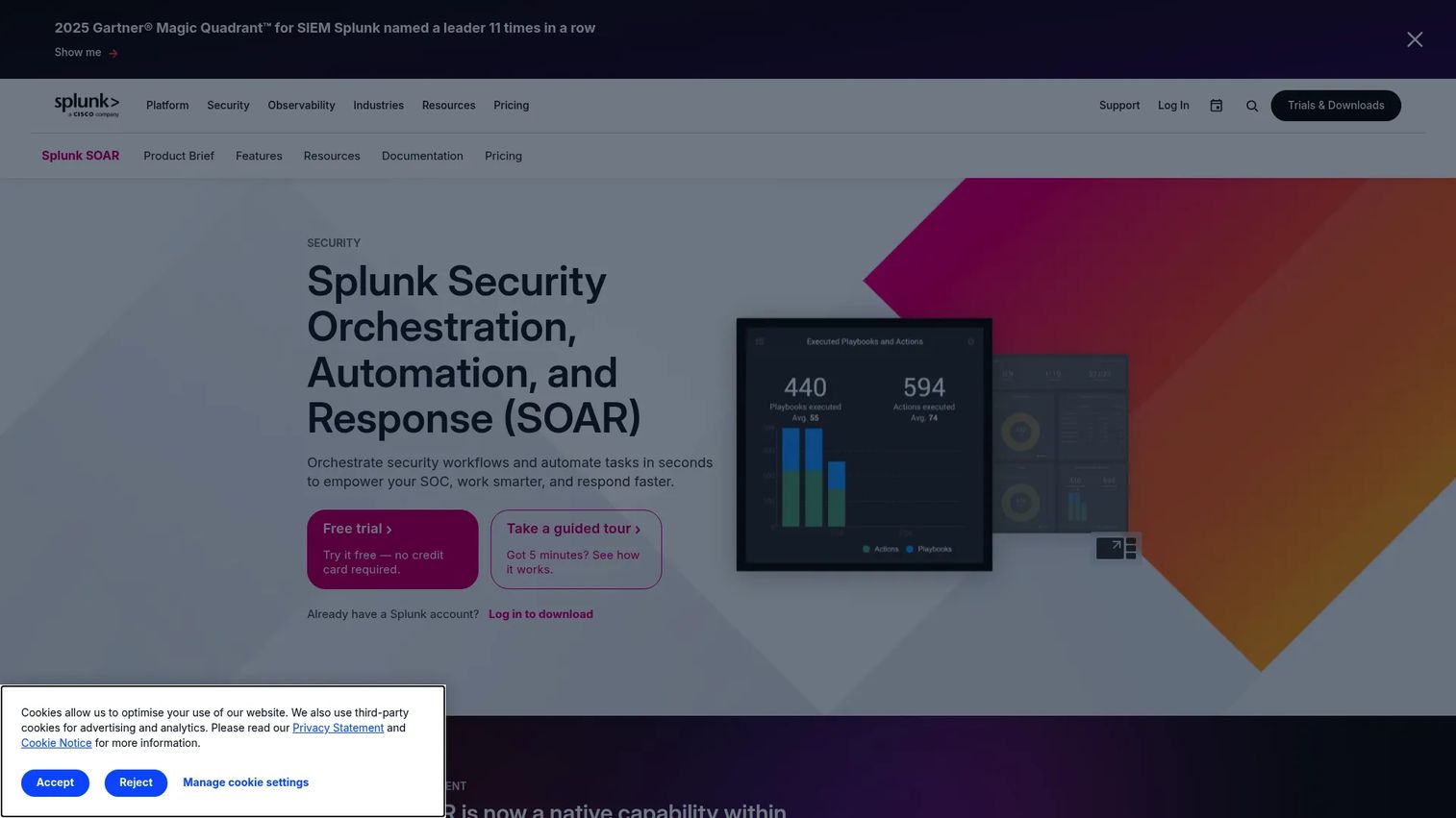
Splunk SOAR is the security orchestration, automation, and response platform built to automate SOC workflows, and it fits most naturally in teams already invested in Splunk. It ships with a Visual Playbook Editor and a deep library of integrations and automated actions, so incident response playbooks can span your entire detection stack.
Best for: Security teams needing SOAR automation and case management in Splunk-centric environments.
Key strengths
- Automated playbooks: Codify response steps and run them consistently across alert types.
- Broad app integrations: Connect across 300+ third-party tools and 2,800+ automated actions.
- Case management and Visual Playbook Editor: Track incidents and build automations in a visual interface.
Why choose Splunk SOAR: For SOCs that already run Splunk as their SIEM or data platform, the tight ecosystem fit reduces integration friction and keeps automation close to the data. Teams outside the Splunk world still get a capable SOAR, but the value compounds most when the broader Splunk stack is in play.
Splunk SOAR pricing: Splunk does not publish a specific SOAR price on its site; pricing is quote-based and directed through Splunk's pricing page. On G2, Splunk SOAR holds a 4.4/5 rating.
4. Torq
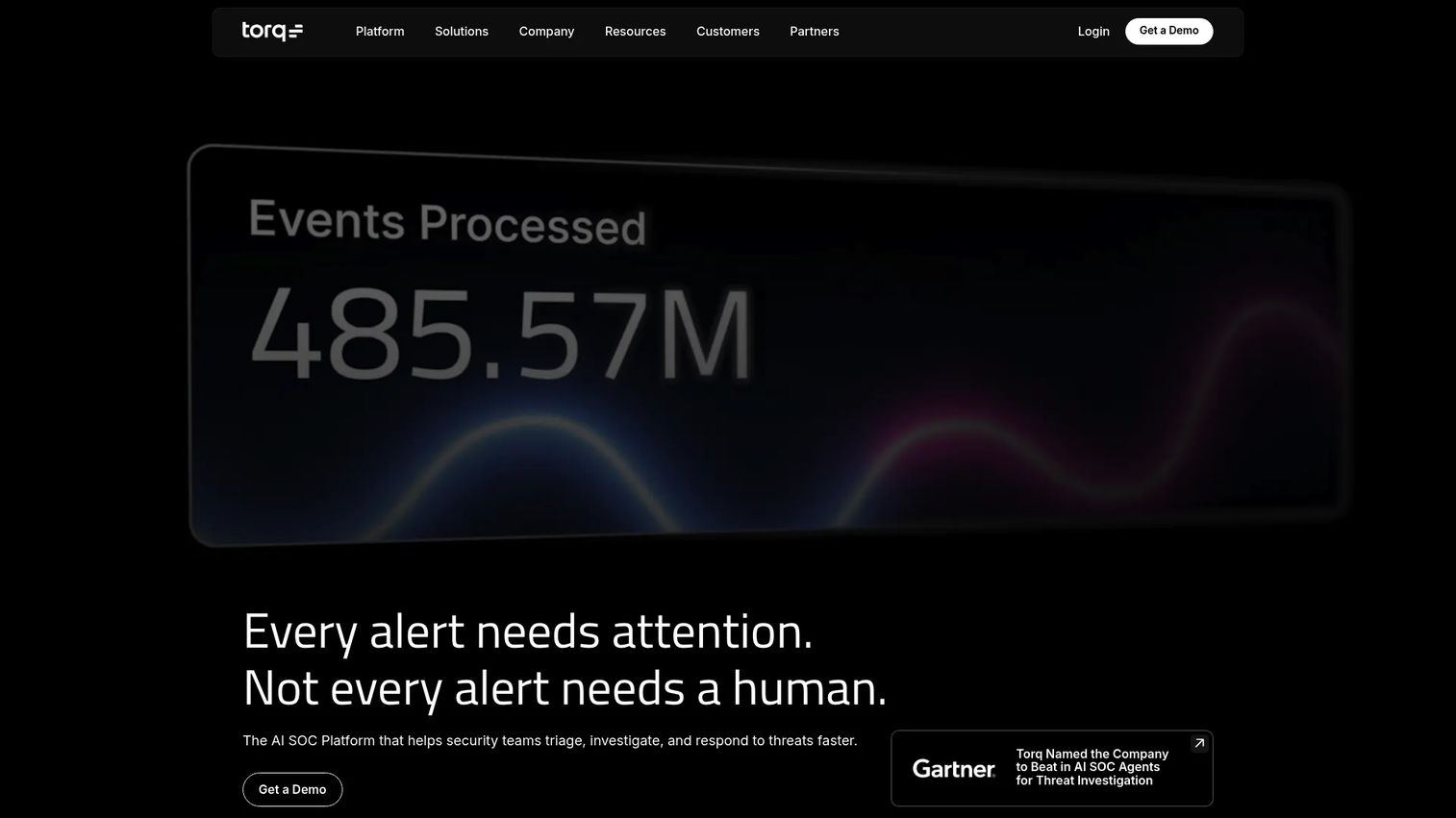
Torq is an AI SOC platform built to help security teams triage, investigate, and respond to threats faster with a strong automation posture. It leans hard into agentic AI, using autonomous triage to filter noise before a human ever sees an alert. Teams that compare it against larger platforms usually do so because they want AI-assisted workflow building without heavy setup.
Best for: Security operations teams wanting autonomous triage, investigation, and remediation automation.
Key strengths
- Agentic triage: De-duplicate events and filter false positives automatically before analyst review.
- Case management: Track incidents with transparent evidence, timelines, and assignments.
- AI agents and Socrates: Run autonomous investigation and response with AI-driven decisioning.
Why choose Torq: Torq fits SOCs prioritizing AI-first automation and fast time-to-value. If your primary pain is alert volume and you want the platform to handle first-pass triage autonomously, its agentic model is the differentiator. It appeals to teams comfortable trusting automation with more of the investigation loop.
Torq pricing: Torq publicly documents usage-based AI credit allocations across tiers (Dev, Essential, Pro, Elite, Elite+), but does not list a base subscription price on its site. Expect a quote-based motion tied to usage. On G2, Torq holds a 4.8/5 rating, among the highest in this list.
5. IBM Security QRadar SOAR
IBM Security QRadar SOAR is IBM's security orchestration, automation, and response platform, built to accelerate incident response and standardize security workflows across large operations. It stands out for dynamic playbooks that adapt as an incident evolves, plus a dedicated breach response module for managing regulatory and privacy obligations.
Best for: Enterprise security teams that need SOAR automation and incident response orchestration.
Key strengths
- Dynamic playbooks: Automated workflows that adapt to incident conditions in real time.
- Case management: Investigate and prioritize incidents in a structured, auditable record.
- Breach Response: Manage data breach and privacy regulation requirements within the platform.
Why choose IBM Security QRadar SOAR: For enterprises with heavy compliance and breach-notification obligations, the built-in breach response capability is a genuine differentiator. It fits organizations that need governance and regulatory workflows alongside SOAR automation, especially those already inside the QRadar ecosystem.
IBM Security QRadar SOAR pricing: IBM describes unlimited usage and predictable pricing but shows no numeric price on its pricing page. Expect a quote-based enterprise model with no free tier. On G2, QRadar SOAR holds a 4.0/5 rating.
6. ServiceNow Security Incident Response
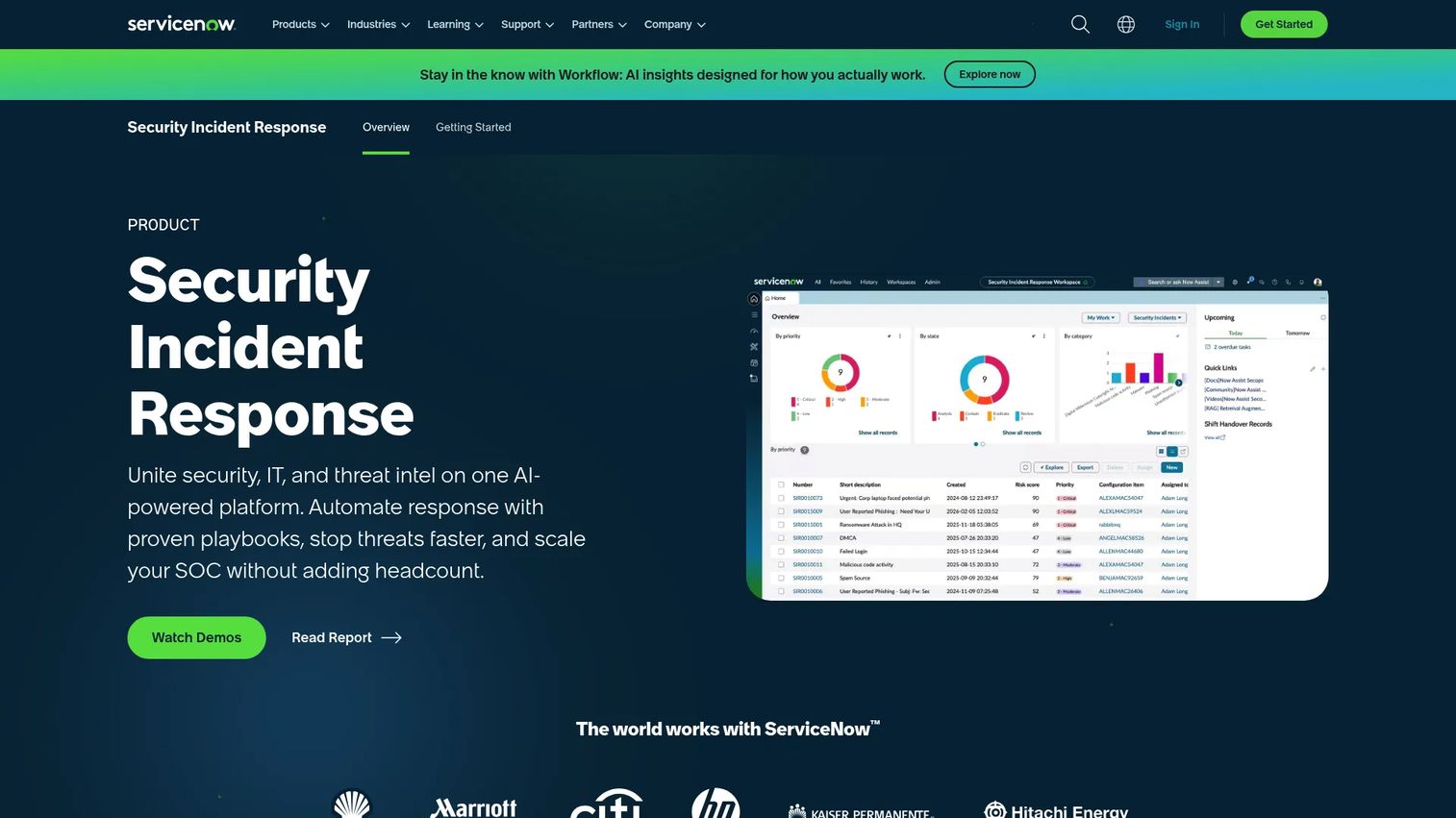
ServiceNow Security Incident Response is security orchestration and automation software that helps teams detect, investigate, and remediate incidents inside the ServiceNow platform. Its strongest argument is process alignment: if your organization already runs ServiceNow for IT and enterprise workflows, security response plugs into the same system of record and the same cross-team orchestration.
Best for: Enterprise security teams needing SOAR-style incident response and cross-team orchestration.
Key strengths
- Workflow management: Prioritize and remediate incidents through structured, repeatable workflows.
- Operations dashboard: Get SOC performance visibility across incidents and SLAs.
- MITRE ATT&CK integration: Map incidents to adversary tactics, with major incident management support.
Why choose ServiceNow Security Incident Response: The case for ServiceNow is organizational, not just technical. Teams already invested in ServiceNow get security response that shares data, workflows, and process governance with IT and the rest of the business. That cross-team alignment is hard to replicate with a standalone SOAR.
ServiceNow Security Incident Response pricing: ServiceNow does not publish public pricing; the product page directs buyers to contact sales. Expect a quote-based enterprise motion. On G2, ServiceNow holds a 4.4/5 seller rating.
7. Swimlane Turbine
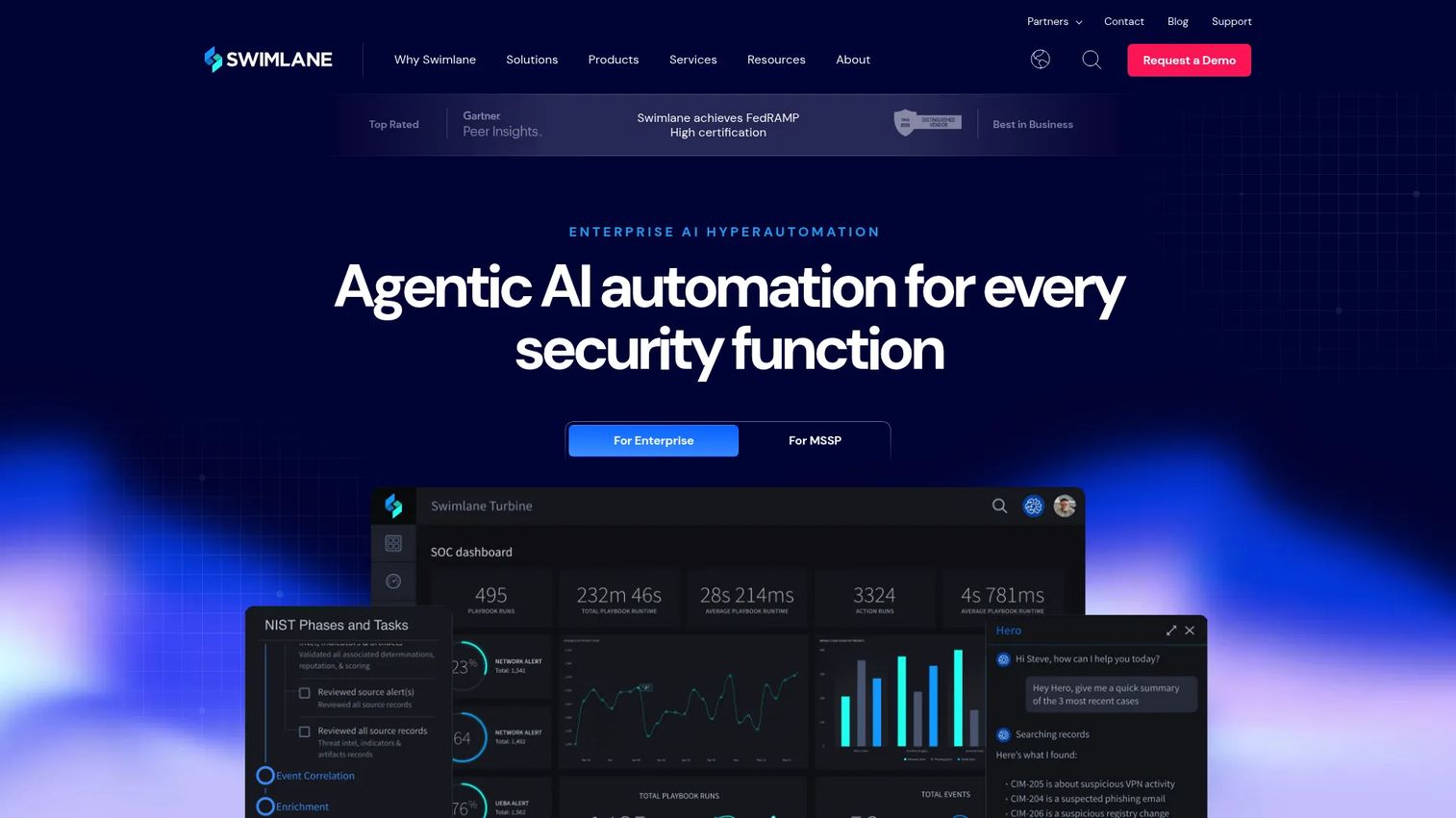
Swimlane Turbine is an AI automation platform for security operations teams, built for automation at scale and analyst workflow support. It combines low-code playbooks with case management and reporting, and it is designed to standardize SOC processes across high volumes of daily actions. Teams that need alert triage, case handling, and consistent process at scale tend to shortlist it.
Best for: Security teams automating SOC workflows and incident response.
Key strengths
- Low-code AI automation: Build playbooks and automate response without deep engineering effort.
- Case management, dashboards, and reporting: Track incidents and measure SOC performance in one place.
- Broad integrations: Connect across security and IT systems for coordinated response.
Why choose Swimlane Turbine: Swimlane suits teams that prioritize automation volume and operational efficiency, especially where standardizing analyst workflows across many alert types is the goal. Its action-based model aligns cost with actual automation scale, which fits high-throughput SOCs.
Swimlane Turbine pricing: Swimlane prices Turbine on a tiered model based on average daily actions automated. Public numbers were not visible, and some tiers are framed as custom. Expect a quote-based motion aligned to usage. On G2, Swimlane holds a 4.5/5 rating.
8. FortiSOAR
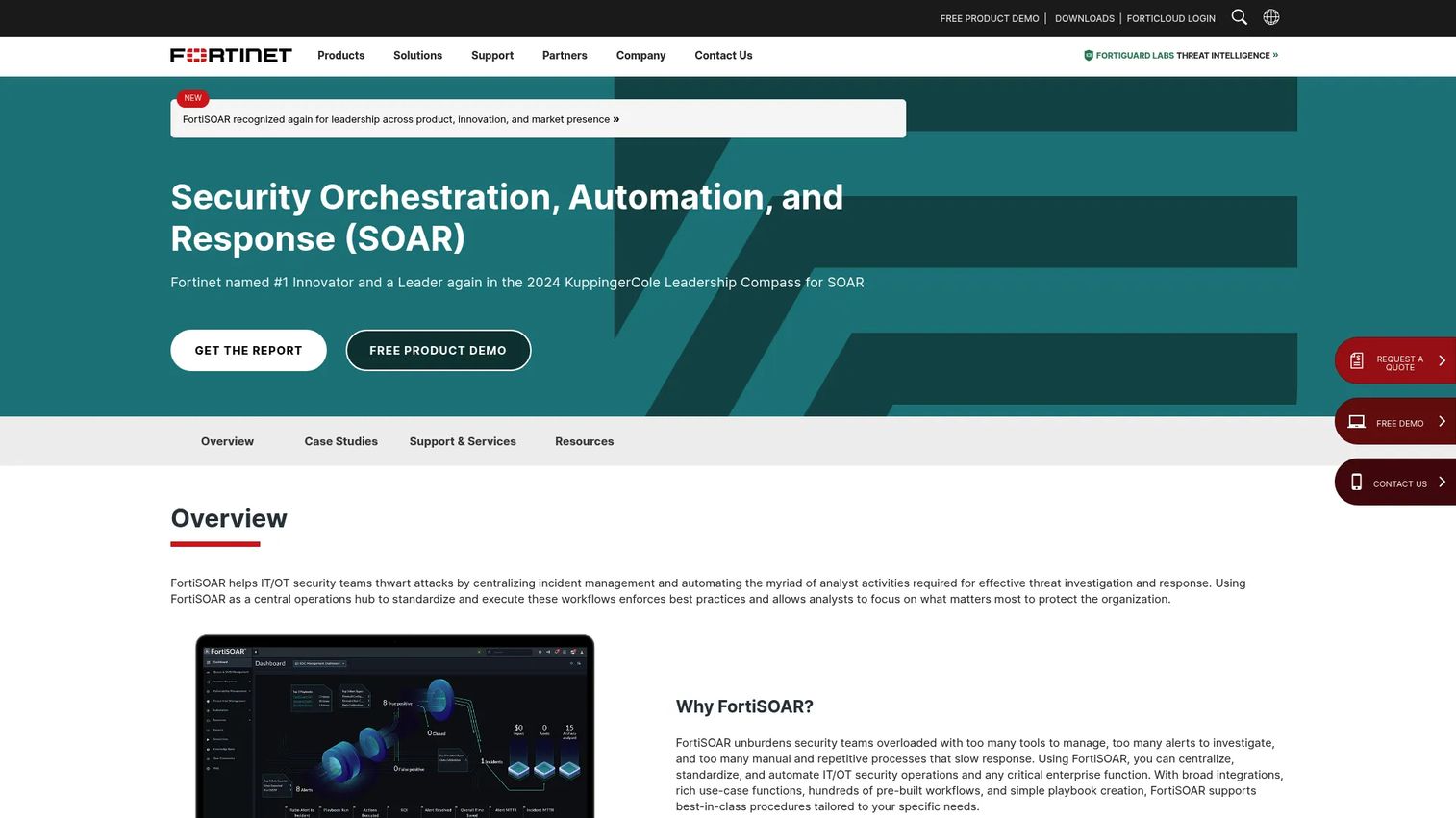
FortiSOAR is Fortinet's security orchestration, automation, and response platform for centralized incident management and automated response. It aligns naturally with the broader Fortinet Security Fabric, so teams with an existing Fortinet footprint get tight integration across their stack. It also holds the highest G2 rating in this list, and it serves MSSPs as well as internal SOCs.
Best for: Security teams and MSSPs needing SOAR automation and case management.
Key strengths
- Centralized incident management: Coordinate detection, investigation, and response from one console.
- Visual playbook automation: Build and run response workflows through a visual editor.
- Broad integrations and connectors: Connect across security and IT tools inside and beyond the Fortinet ecosystem.
Why choose FortiSOAR: For teams already running Fortinet products, FortiSOAR reduces integration overhead and keeps automation inside a familiar ecosystem. Its multi-tenancy support also makes it a common choice for MSSPs managing multiple client environments. Compared to more platform-agnostic options, its strongest fit is the existing Fortinet customer.
FortiSOAR pricing: Fortinet describes editions and licensing models, including FortiFlex-based subscriptions, but does not publish a public price on its primary product pages. Expect a quote-based motion. On G2, FortiSOAR holds a 4.9/5 rating, the highest in this list.
Considerations before you choose
A SOAR platform is a multi-year commitment that touches your entire security stack. Work through these criteria before you shortlist.
Integration depth
Your SOAR is only as strong as the tools it connects to. Map your current SIEM, EDR, firewalls, ticketing, and threat intel feeds, then check each vendor's connector library for native support. Missing integrations mean custom development and ongoing maintenance you did not budget for.
Playbook complexity and maintainability
Evaluate not just whether you can build a playbook, but how easily your team maintains it as your environment changes. Visual, low-code builders lower the barrier, but complex conditional logic still needs skilled hands. Ask how versioning, testing, and rollback work.
Case management and reporting
Automation without a strong case record leaves gaps in your audit trail. Look for structured evidence capture, timelines, analyst assignments, and reporting that satisfies both SOC metrics and compliance needs. This is what turns automation into defensible incident response.
Deployment model and scale
Cloud, on-premises, and hybrid each carry different security, latency, and compliance implications. Cloud-based SOAR captured 71% of the market in 2024, per Mordor Intelligence, but regulated environments may still require on-prem or self-hosting. Confirm the model matches your org size, from SME through enterprise.
Conclusion
The right SOAR platform depends less on a feature checklist and more on where your team sits today.
Enterprise security teams that want broad integrations and native threat intelligence gravitate toward Cortex XSOAR or IBM Security QRadar SOAR. Teams already living inside a vendor ecosystem should weigh Splunk SOAR, ServiceNow Security Incident Response, or FortiSOAR, where the platform fit removes integration friction. Teams prioritizing low-code automation flexibility tend to compare Tines and Swimlane Turbine. And SOCs where alert volume is the core pain, and autonomous triage is the goal, look hard at Torq.
Before you commit, compare integration depth against your actual stack, test playbook complexity with a real incident type, scrutinize the case management and reporting model, and confirm the deployment model fits your compliance reality. Shortlist two or three, run a proof of concept with your own alerts, and let the results decide.
Whichever direction you go, the goal is the same: turn the alerts your team cannot get to today into automated, consistent, documented response.
FAQs
SOAR software stands for security orchestration, automation, and response. It connects your security tools, automates repetitive incident response tasks through playbooks, and centralizes case management. The goal is to help SOC analysts detect, investigate, and remediate threats faster and more consistently than manual processes allow.
SOAR improves incident response by automating the repetitive first steps: enrichment, deduplication, triage, and containment. What might take an analyst 45 minutes of manual clicking becomes a two-minute automated playbook. That speed reduces mean time to respond and frees analysts to focus on genuine threats rather than false positives.
A SIEM collects, correlates, and alerts on log and event data from across your environment. SOAR sits on top of that detection layer and automates what happens after an alert fires, including enrichment, response, and case management. In short, SIEM detects and SOAR acts. Many teams run both, with the SIEM feeding alerts into SOAR playbooks.
XDR unifies detection and response across endpoints, network, and cloud into a single native platform, usually from one vendor. SOAR is vendor-agnostic orchestration that automates workflows across many tools, including your XDR. XDR focuses on integrated detection; SOAR focuses on automating and coordinating response across whatever tools you already run.
Prioritize integration depth with your existing stack, a maintainable playbook and workflow builder, strong case management with audit trails, and alert triage automation that actually reduces noise. Threat intelligence operationalization, reporting for SOC and compliance metrics, and a deployment model that fits your org round out the checklist.
No. While large enterprises held 78% of SOAR revenue in 2024 per Mordor Intelligence, the SME segment is projected to grow fastest at 19.6% CAGR through 2030. Cloud-based and low-code options have lowered the barrier, so smaller security teams increasingly adopt SOAR to stretch limited analyst capacity.
SOAR platforms ship with prebuilt connectors to hundreds of security and IT tools, including SIEMs, EDR, firewalls, ticketing systems, and threat intel feeds. These connectors let a single alert trigger coordinated actions across your stack. When a native connector does not exist, most platforms support custom integrations through APIs.
Threat intelligence operationalization means turning raw indicators, such as malicious IPs, domains, and file hashes, into automated action. Instead of an analyst manually checking a feed, a SOAR platform ingests, scores, and applies that intelligence across detection and response playbooks automatically. It closes the gap between knowing about a threat and acting on it.