Your reps sat through onboarding. They passed the certification. Three weeks later, half of them still cannot find the battlecard for your top competitor, and the talk track from last quarter's launch never made it into a single call.
That gap between "training delivered" and "behavior changed" is the real problem. It is not that people do not want to learn. It is that learning content sits scattered across drives, wikis, slide decks, and someone's bookmarks, with no system pointing the right person to the right resource at the right moment. Sellers protect their time aggressively. If finding the answer takes longer than guessing, they guess.
A learning experience platform exists to close that gap. The category is growing fast for a reason: the global LXP market was valued at USD508.5 million in 2020 and projected to reach USD2.19 billion by 2026, a 25.3% compound annual growth rate, according to Facts & Factors research published in 2021. Enterprise teams are spending because the old model of pushing content at people and hoping it sticks does not move win rates, ramp time, or stage conversion.
The right LXP surfaces learning in the flow of work, personalizes what each person sees, and gives you the analytics to prove any of it changed behavior. For sales enablement teams, that translates directly into faster ramp, cleaner certification, and content people actually use. The same shift toward interactive, measurable experiences is reshaping adjacent categories too, from content creation to marketing analytics.
What's inside
This guide ranks eight learning experience platform tools for 2026 and explains where each one fits. We built the shortlist around five criteria that matter most to enablement and L&D teams: personalized learning, content curation, skills development, analytics, and integrations with your existing stack.
You will find a quick comparison table, a plain-language breakdown of what an LXP is and how it differs from an LMS, a buyer's lens written for enablement teams, and a section on when an LXP actually earns its place. Each tool entry covers what it does well, who it fits, and what to expect on pricing. The goal is a real buying decision, not another glossary.
TL;DR
- Best for enterprise skills development and talent depth: Cornerstone, with broad learning orchestration and skills intelligence built for large programs.
- Best for collaborative and social learning: 360Learning, where subject matter experts build and share content in a peer-driven model.
- Best for AI-driven discovery at scale: Docebo, with automation and personalization across employee, partner, and customer audiences.
- Best for skills-first learning paths: Degreed, which maps content to a skills architecture and surfaces internal and external learning.
- Best for people development plus performance: Learn Amp, blending learning, engagement, and manager-led coaching.
- Best for AI-assisted content curation: CYPHER Learning, pairing personalized learning with strong automation and analytics.
Every pick supports employee upskilling and AI-powered recommendations. The differences come down to your content model, governance needs, and how you measure impact.
What is a learning experience platform?
A learning experience platform (LXP) is a learner-centric software system that aggregates content from many sources, personalizes what each user sees, and helps people discover and consume learning in the flow of work. Where a traditional LMS organizes structured, admin-assigned courses, an LXP is built around discovery, recommendation, and learner control.
That distinction sits at the center of the lxp vs lms debate. An LMS is usually compliance and administration oriented: assign a course, track completion, run the audit. An LXP, sometimes called a learner experience platform, flips the model toward the individual. It recommends content, curates pathways, and treats the learner more like a consumer browsing a personalized feed than an employee working through a mandatory queue.
Core capabilities you should expect from an lxp learning platform:
- Content aggregation: Pull internal documents, third-party courses, videos, and articles into one searchable destination.
- AI-powered recommendations: Surface relevant content based on role, skills, behavior, and goals.
- Personalized learning paths: Build role-based and skills-based journeys that adapt to each learner.
- Content curation: Let admins and subject matter experts package and recommend the best resources.
- Skills development: Map learning to a skills framework so people close real gaps, not just rack up completions.
- Social learning and user-generated content: Enable peers and experts to create, share, and endorse knowledge.
- Analytics: Track engagement, completion, content usage, and evidence of learning impact.
- Mobile learning: Give distributed teams and field sellers anytime, anywhere access.
For enablement teams, the appeal is not "more content." It is discoverability, governance, and measurement. An LXP helps reps find the right learning at the right deal stage, keeps content from going stale, and gives managers visibility into who is ready and who is not. That is the difference between a library nobody opens and a system that moves ramp time and win rates.
What a learning experience platform should do for enablement teams
Most LXP buying guides speak generic L&D. Enablement has sharper requirements, because the output is revenue behavior, not course completions. Here is what to weigh.
Role-based learning paths
A sales rep, an SE, and a customer success manager need different readiness. Look for a platform that builds distinct paths by role, segment, and tenure, then adapts as someone ramps. The point is to get a new hire to first meeting, first opportunity, and first close faster, not to assign everyone the same playlist.
Manager-friendly reporting
If frontline managers cannot see who is certified, who is behind, and where talk-track adherence is slipping, your analytics are decoration. Prioritize reporting that managers can actually read and act on in a one-on-one, mapped to ramp cohorts and certification status, not just raw completion counts.
Fast content updates and governance
Product changes weekly. Messaging shifts mid-quarter. Competitive threats appear overnight. The platform has to make updating, versioning, and expiring content fast, so a deprecated battlecard does not keep circulating. Governance is the difference between consistent messaging and message drift across the field.
Integrations with CRM and your content stack
Learning that lives away from the workflow gets ignored. The strongest fit connects to your CRM, sales engagement, conferencing, call recording, and knowledge base, so learning shows up where reps already work and adoption signals flow back into reporting. The same logic applies whether you are evaluating an LXP or a customer data platform.
When to use a learning experience platform
An LXP is not the answer to every training problem. It earns its keep in specific situations.
Onboarding and ramp at scale. When headcount growth outpaces your ability to onboard one-to-one, an LXP standardizes ramp paths and certification so quality holds as cohorts grow. New hires self-serve the right learning instead of waiting on a calendar.
Ongoing role-based learning. Readiness is not a one-time event. An LXP keeps reps current on methodology, discovery, objection handling, and new positioning through continuous, personalized learning rather than annual training dumps.
Closing skills gaps. When leadership pushes for higher win rates or shorter cycles, skills development becomes the lever. A skills-first LXP maps where the team is weak and routes targeted learning to close those gaps.
Cross-functional knowledge sharing. Product, PMM, and the field all hold knowledge the others need. An LXP with social learning and user-generated content turns scattered expertise into shared, searchable resources, which supports launch readiness when new messaging rolls out.
Enterprise content discovery. Large organizations drown in content. An LXP makes learning findable across hundreds of sources, so people stop recreating what already exists. If your problem is broader content sprawl, a dedicated content marketing or component content management system may pair alongside it.
Comparison table
The tools below are ranked by relevance for modern enterprise learning and enablement use cases. Most LXP vendors price through sales conversations rather than public tiers, so confirm current pricing and ratings directly with each vendor at evaluation time. G2 ratings reflect listings at the time of writing.
| # | Product | Intent | Key use case | Pricing | G2 rating |
|---|---|---|---|---|---|
| 1 | Cornerstone | Enterprise learning and talent | Skills development and talent depth at scale | Sales-led / custom | 4.4/5 |
| 2 | 360Learning | Collaborative learning | Peer-driven content creation and social learning | Sales-led / custom | 4.6/5 |
| 3 | Docebo | Scalable multi-audience learning | AI-driven discovery across employees, partners, customers | Sales-led / custom | 4.3/5 |
| 4 | Degreed | Skills-first discovery | Skills architecture and upskilling pathways | Sales-led / custom | 4.3/5 |
| 5 | Learn Amp | People development | Learning plus performance and progression | Plan-based (Spark, Grow, Amplify) | 4.8/5 |
| 6 | CYPHER Learning | AI-powered learning | Personalized learning and content curation | Sales-led / custom | 4.4/5 |
| 7 | EdCast by Cornerstone | Content discovery layer | Unified content aggregation across sources | Sales-led / custom | 4.5/5 |
| 8 | Absorb LMS | Training delivery and reporting | Structured enablement, certification, multi-audience | Sales-led / custom | 4.5/5 |
1. Cornerstone
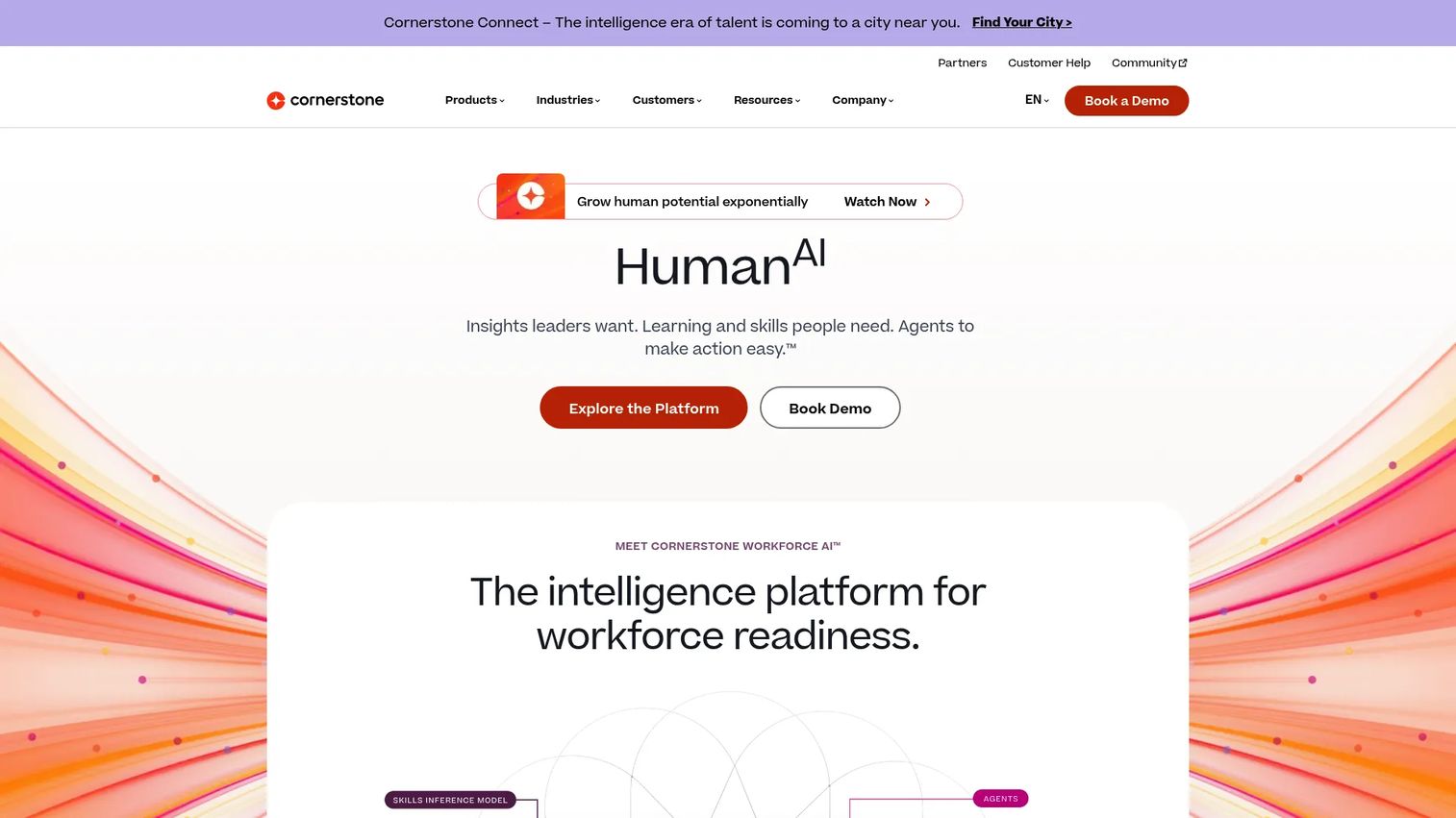
Cornerstone is enterprise workforce readiness software spanning learning, skills, talent, and workforce intelligence. It is built for large organizations that need learning and talent development working as one system rather than a standalone course catalog. The platform pairs AI-powered learning with talent development and internal mobility tools, plus curated content subscriptions that give programs depth without building everything in-house.
For enablement leaders running global teams, the draw is orchestration. Cornerstone connects skills development, personalized learning, and analytics under enterprise governance, which matters when you are certifying hundreds of reps across regions and need consistency to hold.
Best for: Large organizations needing enterprise learning and talent development software in one platform.
Key strengths
- AI-powered learning platform: Surfaces relevant content and recommendations based on role and skills.
- Talent and internal mobility tools: Connects learning to career pathing and skills-based development.
- Content subscriptions: Adds curated learning libraries so programs scale without constant in-house production.
Why choose Cornerstone: Choose Cornerstone when learning is one piece of a broader talent strategy and you need enterprise-grade governance, skills intelligence, and reporting across a large, distributed workforce. It fits organizations that have outgrown point tools and want learning, skills, and talent in a single system of record.
Cornerstone pricing: Cornerstone does not publish public pricing. It is sales-led and quoted based on organization size, modules, and audience scope. Plan to scope requirements with their team to get an accurate quote. The platform holds a 4.4/5 rating on G2.
2. 360Learning
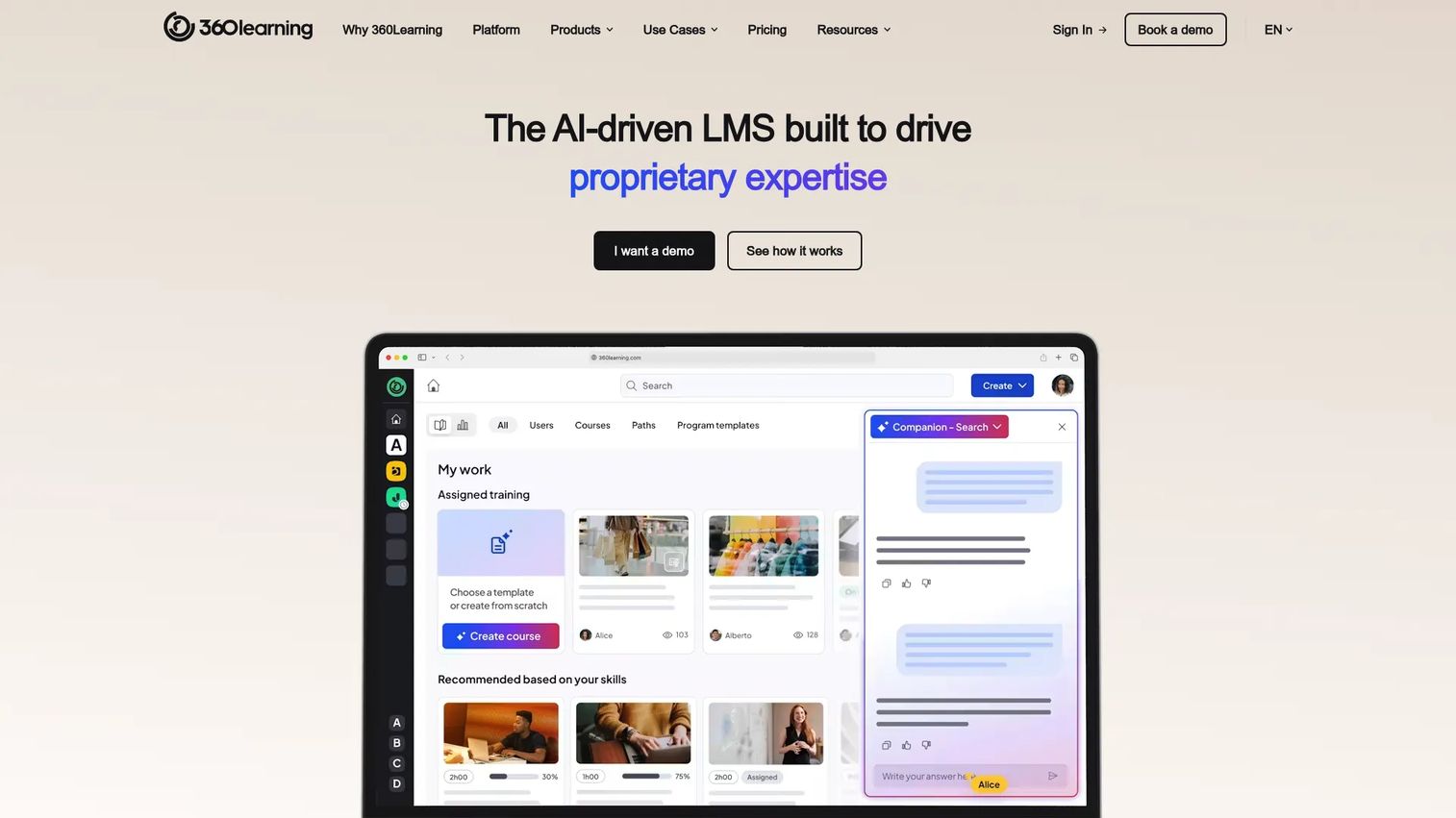
360Learning is an AI-powered collaborative learning platform built for employee training, onboarding, and compliance. Its defining trait is collaborative authoring: subject matter experts across the business build, share, and improve content together, instead of routing everything through a central L&D bottleneck. That model produces content faster and keeps it closer to the people who actually know the material.
For enablement teams, this maps cleanly to knowledge sharing. Your top reps, SEs, and PMMs hold field knowledge that rarely makes it into formal training. 360Learning turns that expertise into user-generated content and social learning that the rest of the team can find and use.
Best for: Teams that want collaborative, AI-assisted learning with strong reporting and integrations.
Key strengths
- AI content builder: Speeds up content creation so material ships while it is still relevant.
- Automated user management and SSO: Reduces admin overhead as teams scale.
- Reporting and learning analytics: Tracks engagement and completion to connect learning to outcomes.
Why choose 360Learning: Choose 360Learning when you want peer-driven learning and fast content production over a top-down model. It fits organizations where the best knowledge lives in the field and you want a system that captures and distributes it without long production cycles.
360Learning pricing: 360Learning presents pricing through a demo and sales conversation rather than public tiers. Scope your team size and use case with their team for a quote. It holds a 4.6/5 rating on G2.
3. Docebo
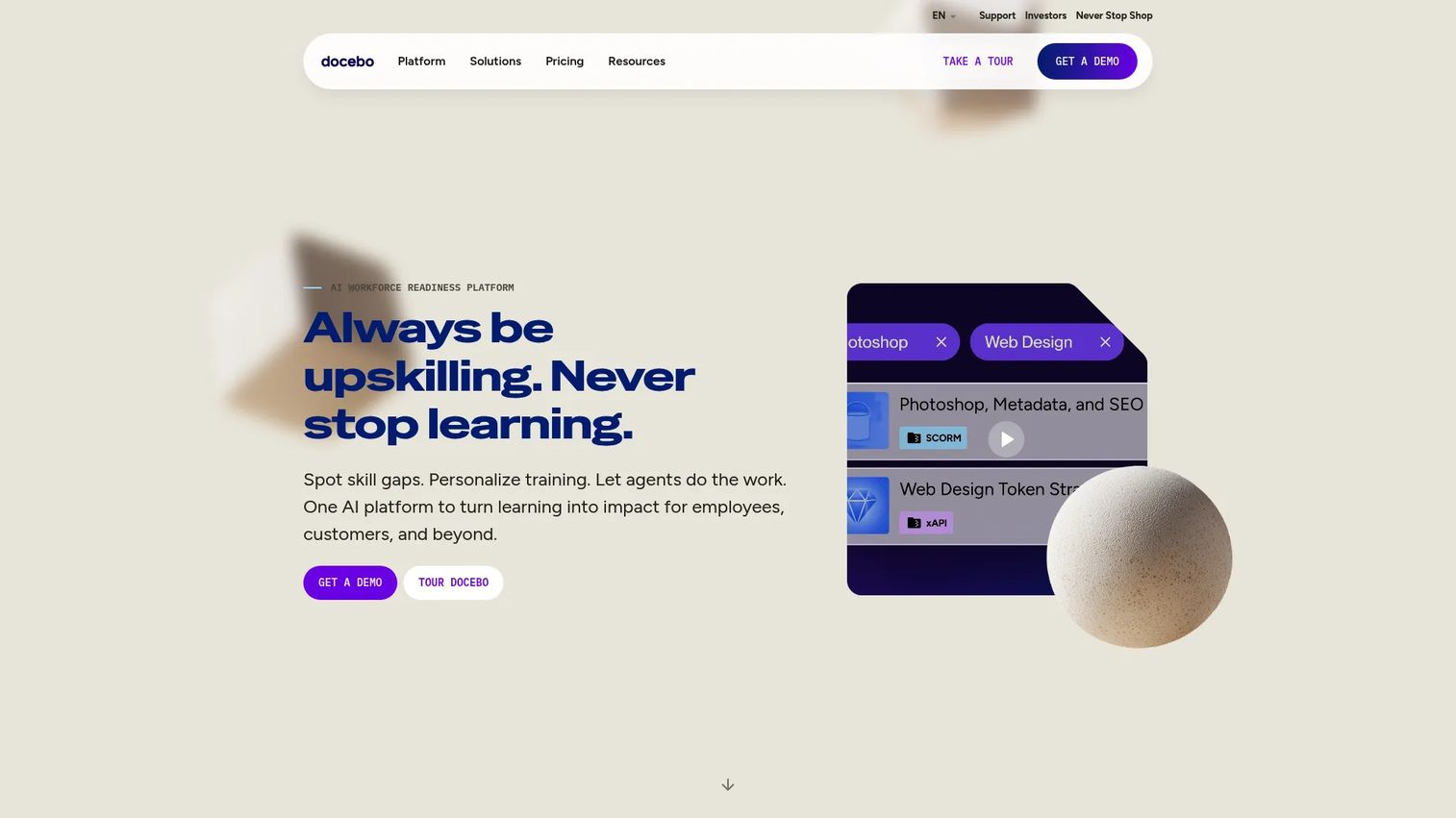
Docebo is an AI-powered learning platform for employee, partner, and customer training. It is built to scale across multiple audiences from one system, which suits large, distributed programs that need to train internal teams and external partners with the same infrastructure. Automation and AI-driven content creation reduce the manual lift of keeping a large catalog current.
For enablement programs that span regions and audiences, Docebo's automation is the headline. It handles personalization and multi-audience support so the right learning reaches the right group without manual assignment for every cohort.
Best for: Mid-market to enterprise teams needing scalable learning across employees, partners, and customers.
Key strengths
- AI-powered content creation: Accelerates building and updating courses across a large catalog.
- Personalization and multi-audience support: Tailors learning across internal and external groups.
- Reporting, analytics, and workflow automation: Reduces manual administration as programs grow.
Why choose Docebo: Choose Docebo when you train more than just employees and need one platform to serve partners and customers alongside internal teams. Its automation and AI-driven discovery fit large programs where manual administration would not scale.
Docebo pricing: Docebo uses custom pricing based on product tier and active users, organized into plans such as Elevate and Enterprise. Numeric pricing is not published, so request a quote scoped to your audiences. Docebo holds a 4.3/5 rating on G2.
4. Degreed
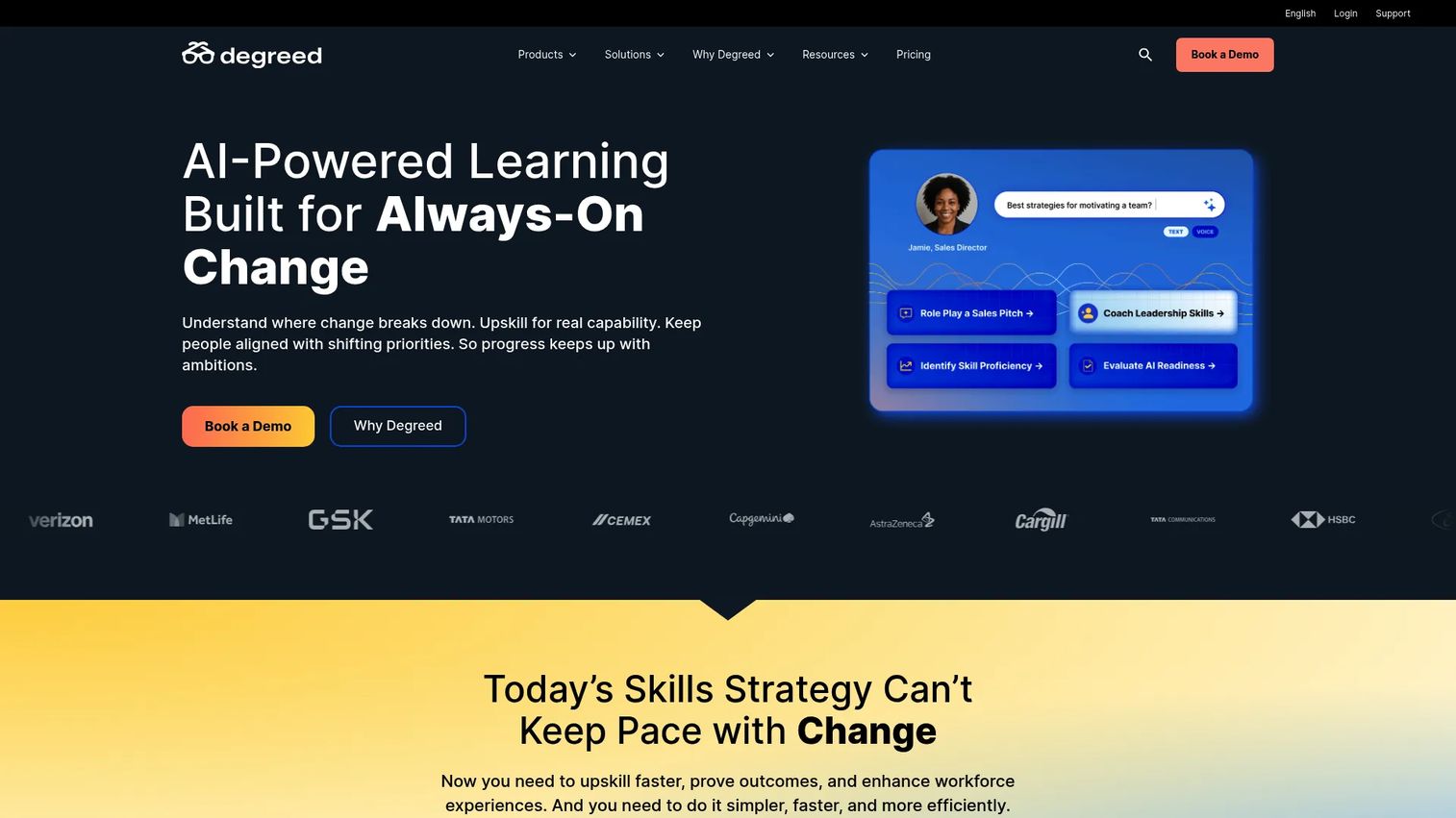
Degreed is an AI-powered enterprise learning and upskilling platform built around skills first. Instead of organizing learning by course catalog, it organizes around a skills architecture, then helps employees discover internal and external content that closes specific gaps. For organizations where skills development is the strategic priority, that framing changes how people find and consume learning.
For enablement, the skills-first model is useful when leadership ties growth to capability building. Degreed maps role-based learning journeys against a skills framework and uses AI recommendations to route people toward the right next step rather than a generic playlist.
Best for: Large organizations needing skills-based learning and workforce upskilling.
Key strengths
- Skills-first platform: Organizes learning around capabilities so people close real gaps.
- Personalized learning and AI recommendations: Surfaces relevant content across internal and external sources.
- Skills intelligence, analytics, and automation: Gives leadership visibility into capability across the workforce.
Why choose Degreed: Choose Degreed when your program is built around a skills strategy and you want learning that maps directly to capability gaps. It fits enterprises that need to see, and grow, the skills of a large workforce rather than just track course completions.
Degreed pricing: Degreed uses personalized enterprise pricing and asks teams to contact sales for a quote. A free Degreed Personal tier exists as a separate consumer offering, distinct from enterprise plans. Degreed holds a 4.3/5 rating on G2.
5. Learn Amp
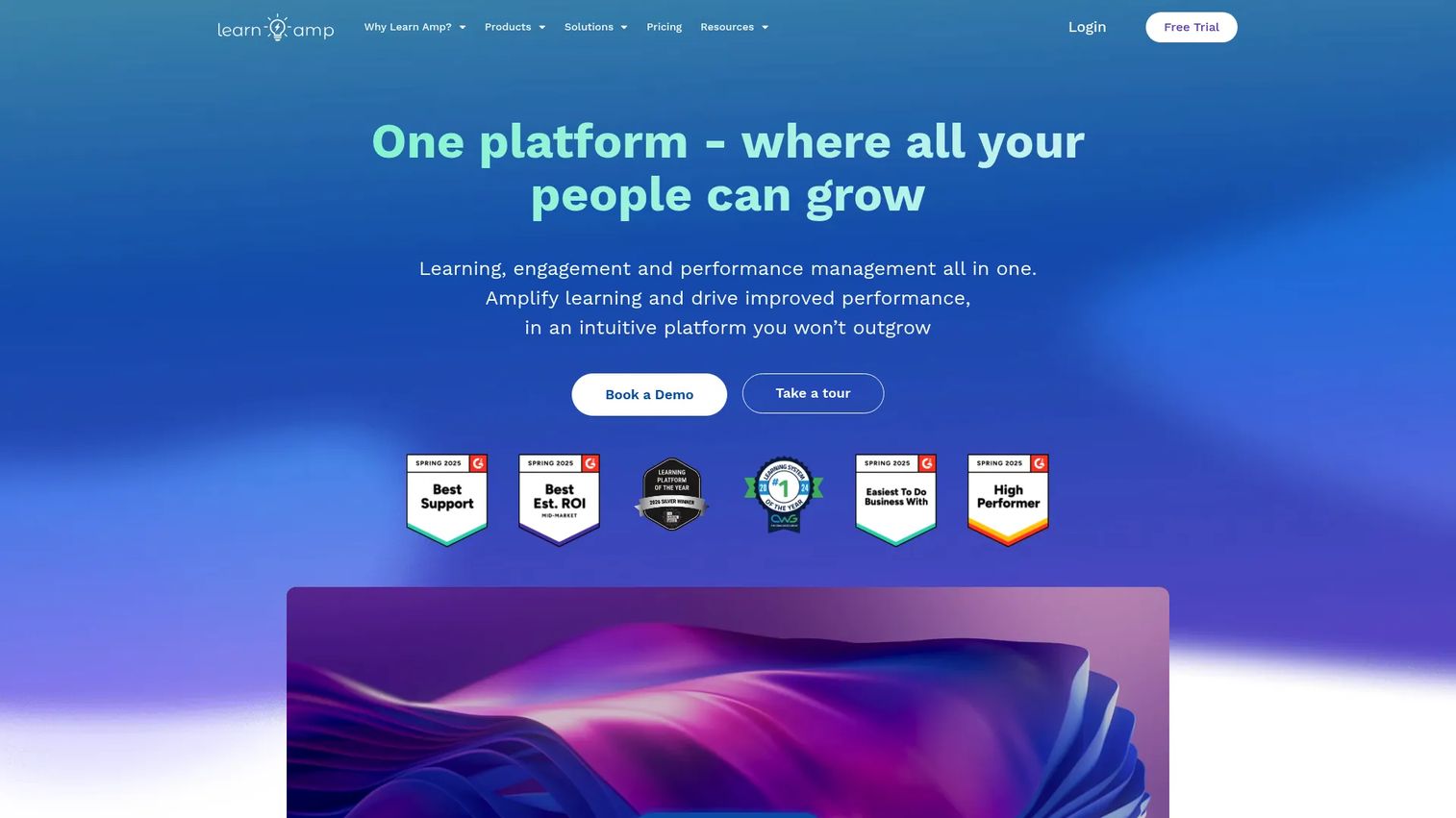
Learn Amp is an employee development platform that blends learning, performance, progression, and collaboration. Rather than treating learning as a standalone activity, it connects development to goals and manager coaching, which makes it a strong fit for teams that want continuous growth wired into the day-to-day, not just a training portal.
For enablement, the value is manager-led coaching. Learn Amp supports performance and goal alignment alongside learning, so frontline managers can connect development to real targets, which is where most behavior change actually happens.
Best for: Mid-market to enterprise teams needing an all-in-one employee development platform.
Key strengths
- AI-supported learning modules: Delivers personalized learning across development needs.
- Performance and goal alignment: Ties learning to objectives managers can coach against.
- Skills, CPD, and progression tools: Supports continuous development and clear growth pathways.
Why choose Learn Amp: Choose Learn Amp when you want learning and people development under one roof, with manager coaching and progression built in. It fits teams that treat development as continuous and want engagement and performance tied to the learning experience.
Learn Amp pricing: Learn Amp publishes three plans, Spark, Grow, and Amplify, priced per user per month and billed annually. Monthly billing is available for up to 500 users; larger teams contact sales for custom pricing. Learn Amp holds a 4.8/5 rating on G2.
6. CYPHER Learning
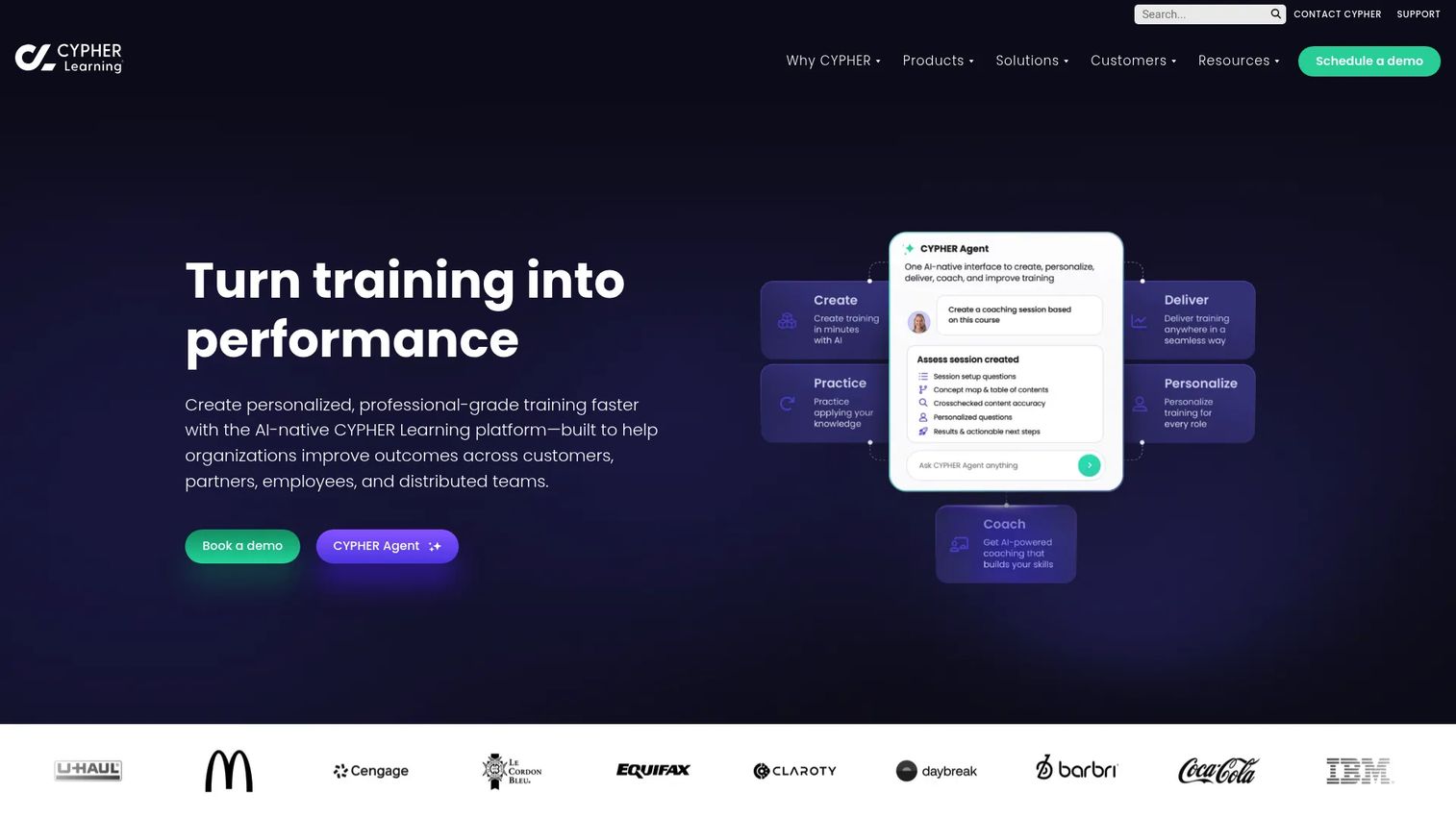
CYPHER Learning is an AI-powered learning platform for training and education that blends personalized learning, content curation, and analytics. Its strength is automation: adaptive learning and mastery tracking adjust to each learner, while built-in authoring and analytics keep the experience personalized without heavy manual effort.
For enablement teams, the appeal is discoverability and AI-assisted learning flows. CYPHER pairs personalization with content authoring and analytics, and supports mobile access, so distributed and field-based teams can learn wherever they work.
Best for: Organizations seeking an AI-enabled learning platform with strong automation and customization.
Key strengths
- AI-powered personalization and automation: Tailors learning and reduces manual administration.
- Adaptive learning and mastery tracking: Adjusts to each learner and confirms genuine competence.
- Content authoring and analytics: Builds and measures learning in one place.
Why choose CYPHER Learning: Choose CYPHER Learning when you want strong AI-driven personalization and automation without a heavy admin burden. It fits teams that value adaptive, mastery-based learning and want authoring and analytics in a single customizable platform.
CYPHER Learning pricing: CYPHER Learning does not list public pricing and directs prospects to contact their team for a quote. Scope your learner count and use case to get accurate numbers. CYPHER Learning holds a 4.4/5 rating on G2.
7. EdCast by Cornerstone
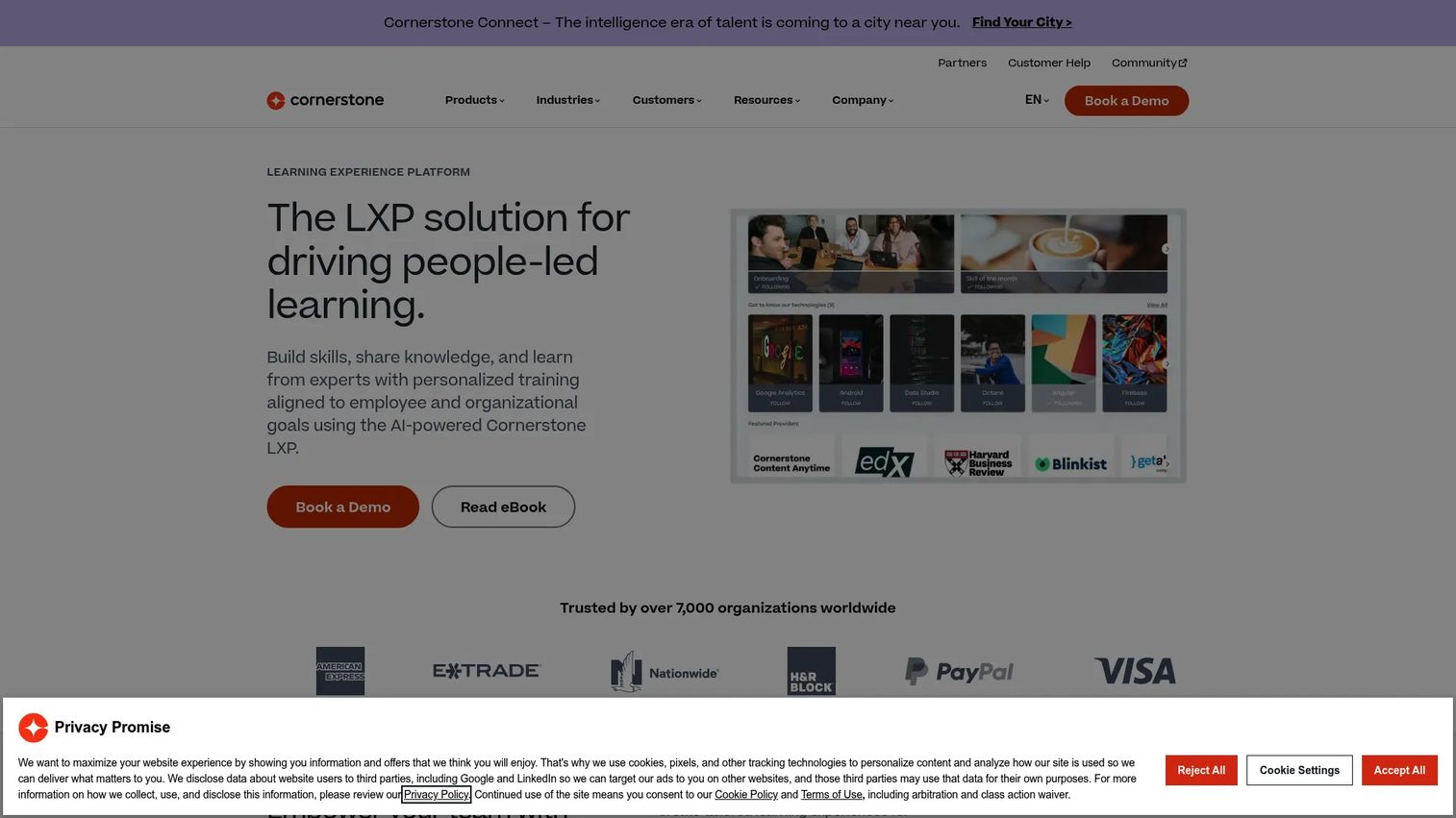
EdCast by Cornerstone is an AI-powered learning experience platform focused on personalized, skills-based learning and content discovery. Its core job is aggregation: pulling content from many sources into a unified discovery layer so people find relevant learning across a sprawling enterprise ecosystem rather than hunting through silos.
For enablement, EdCast shines as the content discovery layer across multiple sources. When learning lives in a dozen systems, EdCast surfaces it through AI-driven personalized discovery, so reps spend less time searching and more time learning.
Best for: Enterprise teams wanting personalized learning, skill development, and content curation in a discovery-first layer.
Key strengths
- AI-driven personalized learning paths: Recommends content based on role, skills, and behavior.
- Content aggregation and delivery: Unifies learning from many sources into one discovery surface.
- Knowledge sharing and collaboration: Lets teams contribute and surface peer knowledge.
Why choose EdCast by Cornerstone: Choose EdCast when content discovery across many sources is your central problem and you want an AI-driven layer that unifies it. It fits enterprises with large, fragmented content ecosystems that need personalized discovery on top.
EdCast by Cornerstone pricing: EdCast is sold through Cornerstone with quote-based, sales-led pricing rather than public tiers. Scope your requirements with their team for a quote. EdCast holds a 4.5/5 rating on G2.
8. Absorb LMS
Absorb LMS is an AI-powered learning management system for employee, customer, partner, and member training. While it leans more toward structured LMS delivery than pure discovery, it brings a strong mix of training delivery, content access, and reporting, which suits teams that need certification and audit-ready records alongside a modern learning experience.
For enablement, Absorb fits structured programs. When you need reliable certification, multi-audience training, and clean reporting, its delivery and analytics handle the parts of enablement that demand rigor and a paper trail.
Best for: Mid-market and enterprise organizations needing branded, scalable training across multiple audiences.
Key strengths
- AI-powered course creation and personalization: Speeds content building and tailors delivery.
- eCommerce for selling courses: Supports external training and customer education revenue.
- SCORM, xAPI, and HTML5 support: Handles standards-based content and detailed tracking.
Why choose Absorb LMS: Choose Absorb when structured training delivery, certification, and reporting matter as much as discovery. It fits teams training multiple audiences who need branded, scalable delivery with the standards support that compliance and certification require.
Absorb LMS pricing: Absorb does not publish public pricing and routes prospects to a pricing request form scoped to organization size and needs. Request a quote for accurate numbers. Absorb LMS holds a 4.5/5 rating, verified on Capterra.
Considerations before you buy
Feature lists blur together fast. These are the criteria that actually separate platforms once you get into evaluation.
Governance and content maintenance
Ask how versioning, ownership, approvals, and expiration work. The platforms that prevent stale content from circulating are the ones that protect messaging consistency. For enablement, a deprecated battlecard in the field is worse than no battlecard.
Integrations with your stack
Confirm native connections to your CRM, sales engagement, conferencing, call recording, and knowledge base. Learning that does not reach the workflow gets ignored. Integration depth also determines whether adoption signals flow back into your reporting.
Analytics depth and exportability
Look past completion counts. You want content usage by asset, stage, and segment, plus evidence that learning changed behavior. Check whether you can export and combine that data with your other analytics platforms for a full picture.
Content curation quality
A good LXP curates, not just stores. Evaluate how well it recommends content, how subject matter experts package learning, and how easily peers contribute user-generated content that stays discoverable.
Mobile access and ease of maintenance
Field sellers and distributed teams need mobile learning that works anywhere. Pair that with how easily a small team can keep the platform current. A system nobody can maintain decays fast, no matter how rich the feature set.
Conclusion
The eight learning experience platforms here group into a few clear shapes. For enterprise scale and talent depth, Cornerstone and EdCast by Cornerstone lead, with Docebo strong when you train partners and customers alongside employees. For collaborative, peer-driven learning, 360Learning stands out. For skills-first discovery and upskilling, Degreed is the sharpest fit. Learn Amp blends learning with performance and progression, CYPHER Learning brings AI-driven personalization, and Absorb LMS anchors structured delivery, certification, and reporting.
The right LXP is the one that fits your content model, governance needs, and measurement expectations, not the one with the longest feature list. An enablement team chasing faster ramp and consistent execution will weigh these differently than an L&D team focused on broad upskilling.
Pick one or two that match your situation and run a real pilot. Load actual content, route a real cohort through it, and watch the analytics. Adoption and measurable impact, not the demo, tell you whether a platform earns a place in your stack.
Start your journey with Guideflow today!
FAQs
A learning experience platform is software that helps people find and consume learning content the way they browse a personalized feed, rather than working through assigned courses. It aggregates content from many sources, recommends what is relevant to each person, and surfaces learning in the flow of work. The focus is discovery and learner control, not just administration.
The lxp vs lms distinction comes down to orientation. An LMS is usually admin and compliance focused: assign courses, track completion, run audits. An LXP is learner-centric, built around personalized recommendations, content curation, and discovery. Many organizations run both, using the LMS for structured certification and the LXP for self-directed, continuous learning.
It depends on the problem. If reps struggle to find the right learning at the right deal stage, if onboarding does not scale with headcount, or if content goes stale faster than you can update it, an LXP helps. The payoff shows up in faster ramp, cleaner certification, better content findability, and visibility into whether learning changed behavior.
Prioritize personalized learning, content curation, skills mapping, analytics, integrations, and mobile access. Personalization and curation drive whether people actually engage, skills mapping connects learning to capability gaps, and analytics prove impact. Integrations determine whether learning reaches the workflow, and mobile access matters for distributed and field teams.
Yes. Most modern LXPs let internal subject matter experts, peers, and managers create and share content, then endorse or curate the best of it. This social learning model captures field knowledge that rarely makes it into formal training, which is especially valuable for enablement teams whose top reps and SEs hold knowledge the rest of the team needs.
Go beyond completion rates. Look for adoption and engagement metrics, content usage by asset, stage, and segment, and evidence that learning influenced outcomes like ramp time or stage conversion. The best analytics export cleanly and combine with your CRM and reporting stack, so you can connect learning activity to behavior and results rather than treating engagement as a black box.
For distributed teams and field sellers, yes. Mobile learning means people can consume content between meetings, on the road, or wherever they work, instead of only at a desk. Anytime, anywhere access raises the odds that learning actually happens, which directly affects adoption and the consistency of execution across a spread-out team.
Start with your use case, content strategy, governance needs, and integration requirements, then shortlist against those rather than feature counts. Decide whether you need skills-first discovery, collaborative authoring, multi-audience training, or structured certification, since that points you toward different tools. Run a pilot with real content and a real cohort, and let adoption and measurable impact make the final call.