Pick the wrong core platform and you feel it every day for years. Front-desk staff bounce between a scheduler that doesn't talk to your EHR. Claims sit in a queue because eligibility never got checked. Patients no-show because reminders never fired. The exam room slows down because charting takes twelve clicks instead of four. None of these are feature problems. They're system problems, and they compound.
The optometry software market reflects how central this decision has become. The global optometry practice management software segment is forecast to grow from USD 397.8 million in 2025 to USD 765.7 million by 2032 at a 9.8% CAGR, according to 360iResearch (2026). North America alone is expected to add USD 644.6 million in optometry software spend between 2025 and 2029 at a 7% CAGR, per Technavio (2024). The takeaway for a buyer is simple: more practices are consolidating disconnected tools into one platform, and the cost of choosing poorly is measured in staff hours, denied claims, and lost patients.
If you approach this the way a founder evaluates any foundational system, the logic holds. You're not buying features. You're buying whether daily operations become repeatable, whether owners get visibility across locations, and whether admin drag goes down instead of up. The same discipline that goes into evaluating a contract lifecycle management software rollout or a best account based marketing software tools migration applies here: check integration depth, implementation risk, and total workflow fit before the demo dazzles you.
What's inside
This guide compares six optometry software platforms for practices evaluating EHR, practice management, billing, patient communication, and reporting. We selected each based on breadth of workflow coverage, cloud accessibility, implementation and support, compliance posture, optical retail support, and fit across small to multi-location practices. Each entry includes what it does well, who it fits, verified pricing where public, and a G2 rating where one is available. The goal is a shortlist you can act on, not a feature encyclopedia.
TL;DR
- Best all-in-one platform for most practices: RevolutionEHR, a mature cloud EHR and practice management stack.
- Best cloud-first option for optical retail and multi-location workflows: Eye Cloud Pro, with POS, inventory, and per-location pricing.
- Best for communication-heavy practices: Adit, built around texting, voice, forms, and front-desk automation.
- Best for insurance and scheduling workflows: Eyefinity Encompass, strong on eligibility, claims, and patient engagement.
- Best for smaller practices wanting simplicity: Crystal PM, focused on core workflow and customization.
- Best for teams evaluating a modern cloud stack: iTRUST, cloud-based optometry operations for practices moving off legacy systems.
What is optometry software?
Optometry software is the software stack that combines EHR, practice management, scheduling, billing, claims, patient communication, payments, and reporting into one system for eye care practices. It replaces the patchwork of a standalone scheduler, a separate billing tool, a disconnected messaging service, and paper charts with a single platform where clinical and front-desk work share the same record.
Most modern optometry practice management software covers these core areas:
- Cloud-based access and remote workflows: log in from any location or device without maintaining on-site servers.
- Charting and exam documentation: structured exam templates, image management, and fast clinical notes.
- Appointment scheduling and reminders: online booking, calendar views, and automated patient reminders.
- Billing, claims, and payment processing: eligibility checks, claims submission, ERA posting, and integrated payments.
- Patient intake, portal, and self-service: digital intake forms, a patient portal for eye care practices, and self-scheduling.
- Reporting and multi-location oversight: practice analytics for optometry, dashboards, and standardized reporting across sites.
The distinction worth knowing: optometry EHR software handles the clinical record and exam workflow, while practice management software handles scheduling, billing, and operations. The best cloud based optometry software combines both so a single patient record flows from booking to exam to claim without re-entry.
When to use optometry software
When you need one system for clinical and front-desk workflows
Disconnected tools create silent tax. A scheduler that doesn't sync to the EHR means double entry. A billing tool that doesn't see the exam means missed charges. Practices move to an integrated platform when staff spend more time reconciling systems than serving patients. One record, shared across the front desk and the exam lane, removes that friction and gives owners a single source of truth.
When you need to reduce billing and claims friction
Denied claims are expensive. Every rejection means rework, delayed revenue, and staff time chasing corrections. Integrated optometry billing software with real-time eligibility, clean claim scrubbing, and automated ERA posting cuts the denial rate and shortens the revenue cycle. If your team manually checks insurance or rekeys claims into a separate clearinghouse, revenue cycle management for optometry is where an integrated platform pays for itself fastest.
When you need cloud access and multi-location visibility
Distributed practices care about consistency. Owners want the same workflows, the same reporting, and the same permissions across every site, plus the ability to check performance without driving to each location. Cloud based optometry software delivers remote access, standardized dashboards, and role-based permissions so a two-location or ten-location group runs the same way everywhere. This is the operational visibility that makes scaling repeatable instead of chaotic.
Comparison table
Here's how the six optometry software platforms compare on intent, core use case, verified public pricing, and G2 rating. The way founders evaluate a best contract management software tools shortlist applies here too: match the platform to your bottleneck, not the longest feature list.
| # | Product | Intent | Key use case | Pricing | G2 rating |
|---|---|---|---|---|---|
| 1 | RevolutionEHR | All-in-one cloud EHR and PM | Independent practices wanting a mature, complete platform | From $319/mo | 4.1/5 |
| 2 | Eye Cloud Pro | Cloud PM plus optical retail | Practices needing clinical plus POS and inventory | From $259/mo per location | Not listed |
| 3 | Adit | Communication and automation | Front-desk automation and patient engagement | Custom | 4.8/5 |
| 4 | Eyefinity Encompass | Scheduling and claims-centric | Insurance-heavy and multi-location practices | From $340/mo | 3.7/5 |
| 5 | Crystal PM | Smaller-practice simplicity | Independent practices wanting core PM and EHR | Contact for pricing | 4.3/5 |
| 6 | iTRUST | Modern cloud operations | Practices moving off legacy systems | Contact for pricing | Not listed |
1. RevolutionEHR
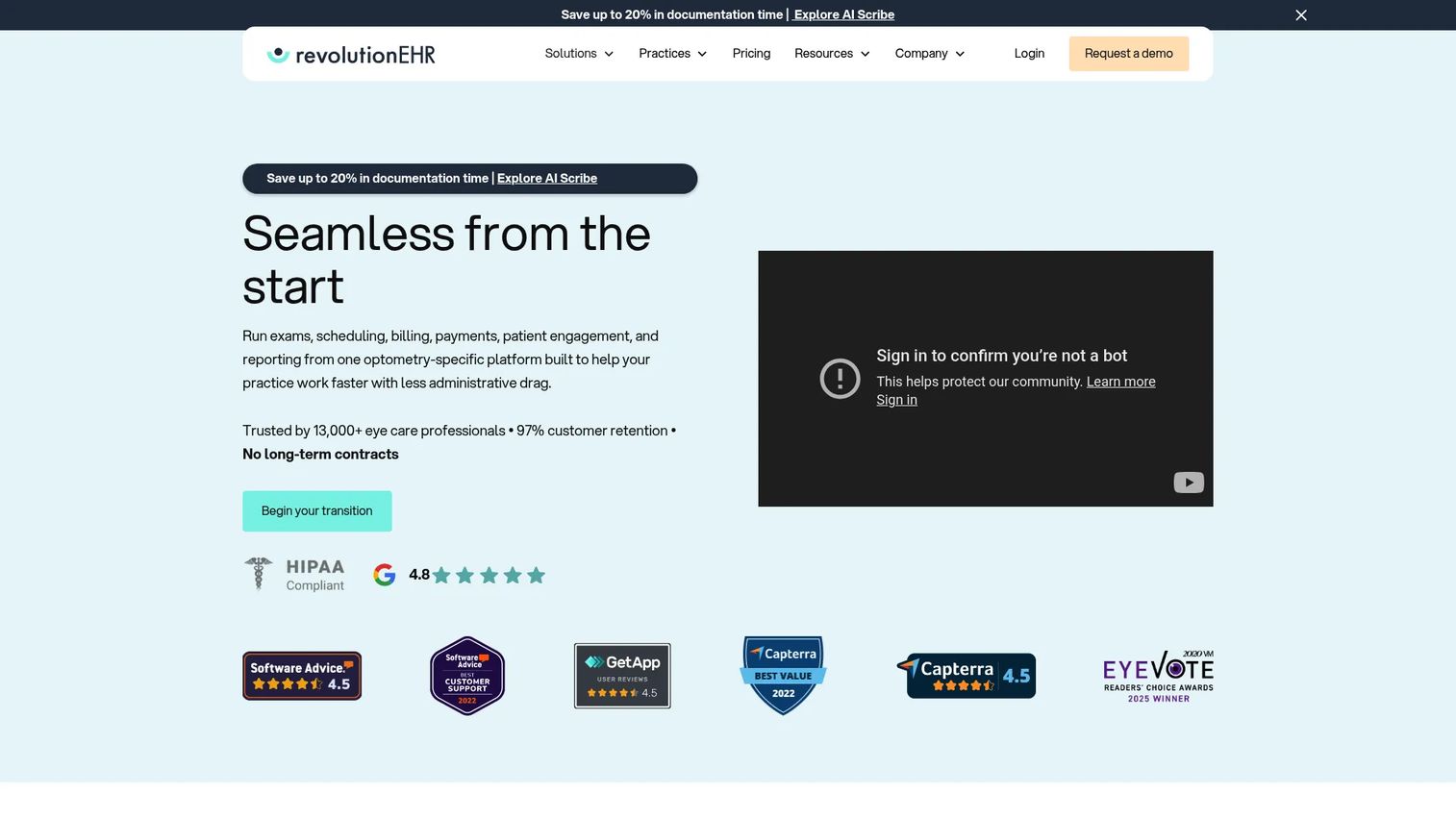
RevolutionEHR is the category benchmark for all-in-one optometry operations. It's a cloud-based optometry EHR and practice management platform that ties charting, scheduling, intake, billing, claims, payments, patient engagement, and reporting into one connected record. For a practice that wants a mature system rather than a stitched-together stack, it covers the full clinical-to-financial workflow without handing off to third-party tools at every step.
The depth is where it earns the top spot. Exam documentation runs through structured optometry templates, embedded payments handle patient collections, and the clearinghouse workflow moves claims and eligibility inside the same system your front desk already lives in. That end-to-end coverage is what makes daily operations repeatable across staff.
Best for: Independent optometry practices ready to commit to a robust, all-in-one cloud platform.
Key strengths
- End-to-end workflow: EHR, scheduling, billing, claims, and payments in one connected record, removing double entry.
- Embedded payments and clearinghouse: patient collections and claims move inside the platform instead of a separate tool.
- Patient engagement and reporting: built-in patient communication plus practice analytics for owner visibility.
Why choose RevolutionEHR: Choose it when you want breadth and maturity over minimalism. The platform rewards practices that are ready to run their whole operation in one place and want fewer vendors to manage. If your bottleneck is fragmentation across tools, this consolidates it.
RevolutionEHR pricing: Pricing is based on the number of doctors, billed monthly. Exam or optical-only locations start at $319/month. RevolutionEHR Core is $455/month, Advanced starts at $660/month, and Premium starts at $830/month. Bundle discounts are available, and one-time setup and database conversion fees apply. There is no free tier. Its G2 rating is 4.1/5.
2. Eye Cloud Pro
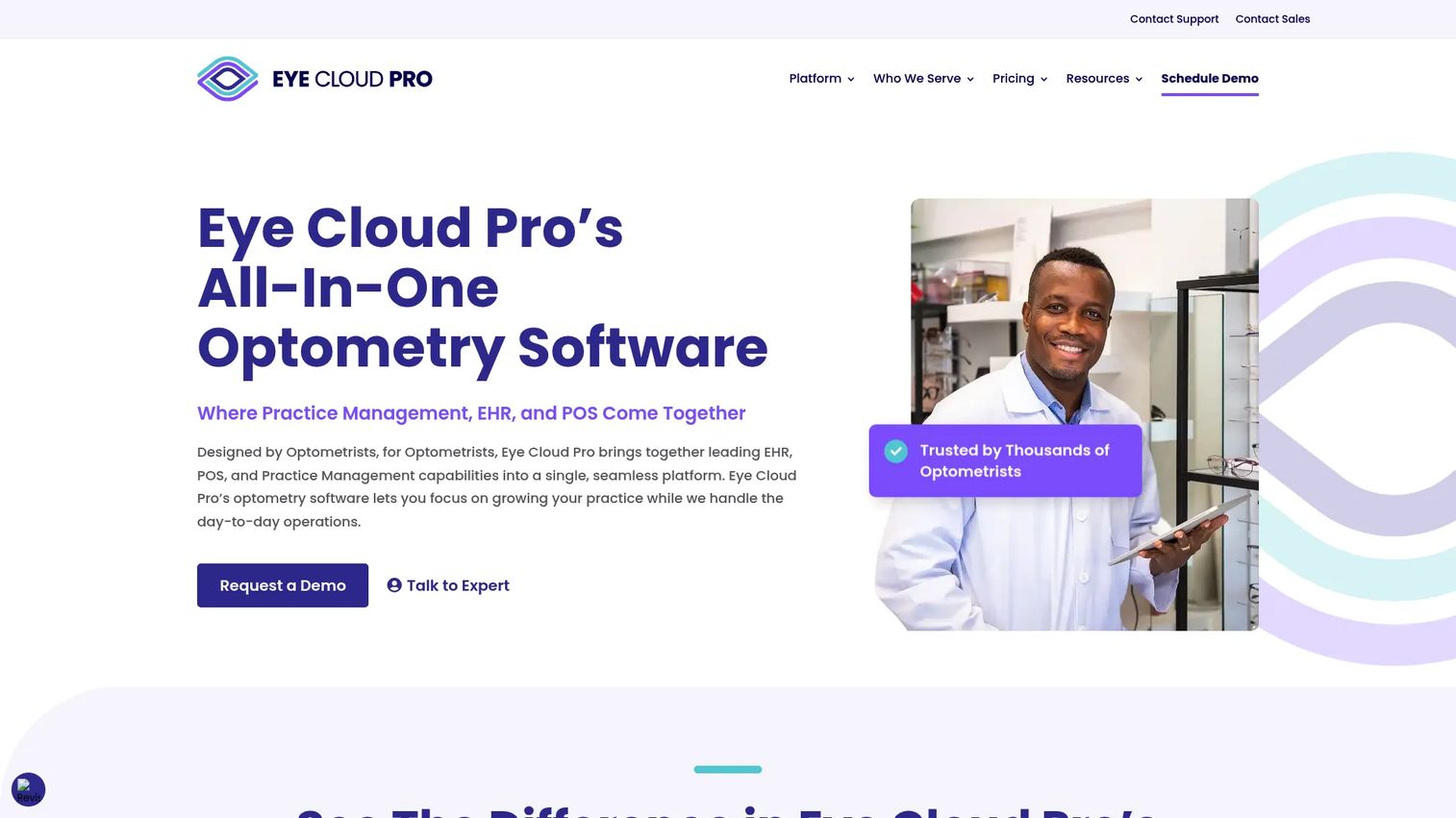
Eye Cloud Pro is cloud-native optometry software that combines practice management, EHR, and point of sale in one platform. Its edge is the optical retail angle: inventory management, POS, and payments sit alongside scheduling, billing, and patient communication. For practices where the optical dispensary is a real revenue line, that retail-adjacent coverage matters as much as the clinical record.
Because it's fully cloud-based, remote access and multi-location workflows are native rather than bolted on. Per-location pricing makes it straightforward to reason about cost as you add sites, which is useful for groups scaling deliberately.
Best for: Optometry practices that need an all-in-one cloud platform spanning clinical and optical retail workflows.
Key strengths
- Optical retail plus clinical: POS, inventory, and payments alongside EHR and practice management in one system.
- Cloud-native access: remote login and multi-location optometry software workflows without on-site servers.
- Patient communication: two-way SMS messaging and reporting built into the practice management layer.
Why choose Eye Cloud Pro: Choose it when optical retail is a core part of your business and you want inventory, POS, and clinical workflows unified. Onboarding, support, and the user community are worth evaluating as part of your fit check, since retail-heavy setups benefit from strong implementation help.
Eye Cloud Pro pricing: Three public packages, priced monthly per location. Eye Cloud Doctor starts at $259/month per location, Eye Cloud Retail at $299/month per location, and Eye Cloud Pro at $379/month per location. A one-time setup and data conversion fee may apply, noted at $1,000 per location. There is no free tier, and a public G2 rating was not listed at review time.
3. Adit
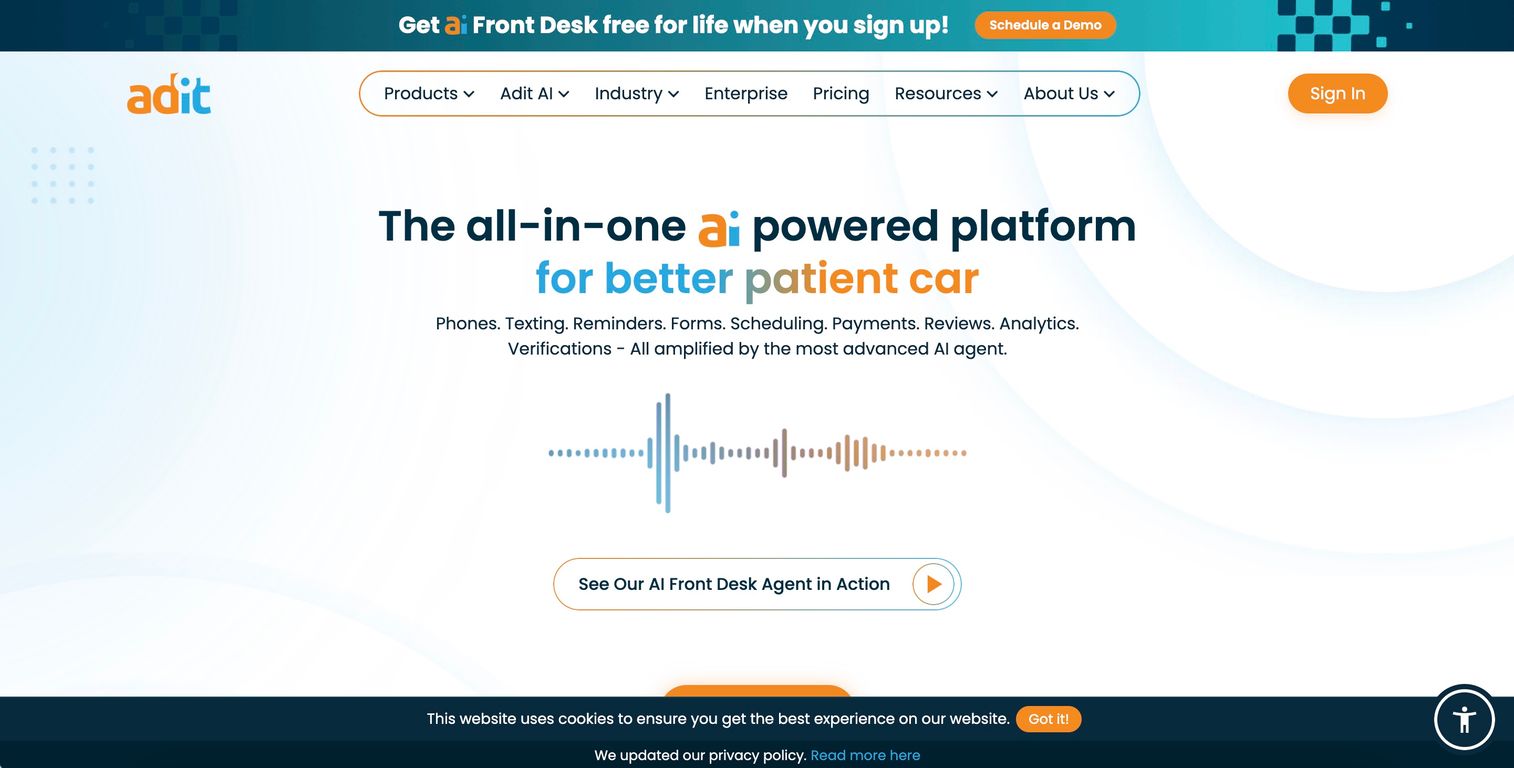
Adit is an all-in-one, AI-forward practice management platform built around communication and front-desk automation. Its strength is patient engagement for optometry practices: texting, voice, email, internal chat, eFax, online scheduling, digital forms, reminders, reviews, and recall workflows all run from one place. If your front desk is drowning in phone tag and manual outreach, this is where the time savings show up.
Beyond communication, Adit layers in practice analytics, treatment plans, insurance verifications, integrated payments through Adit Pay, and AI features like Call Intelligence and an AI Front Desk. It leans more toward operations and growth than deep clinical charting, so pair it with your clinical needs assessment.
Best for: Practices that prioritize front-desk automation, patient reminders and intake forms, and high-volume patient communication.
Key strengths
- Unified communication: texting, voice, email, chat, and eFax plus a mobile app in one interface.
- Front-desk automation: online scheduling, digital forms, reminders, reviews, and recall workflows reduce manual outreach.
- Analytics and AI: practice analytics, Adit Pay, insurance verifications, and AI Call Intelligence for the front desk.
Why choose Adit: Choose it when your biggest bottleneck is front-desk load and patient communication, not clinical documentation depth. The AI and automation angle fits practices that want to reduce repetitive outreach and capture more booked appointments without adding staff.
Adit pricing: Adit does not publish subscription pricing on its site and prompts visitors to schedule a demo. The pricing page notes tech packages carry no binding contracts and references included usage limits with overages, but not a public plan price. Its G2 rating is 4.8/5.
4. Eyefinity Encompass
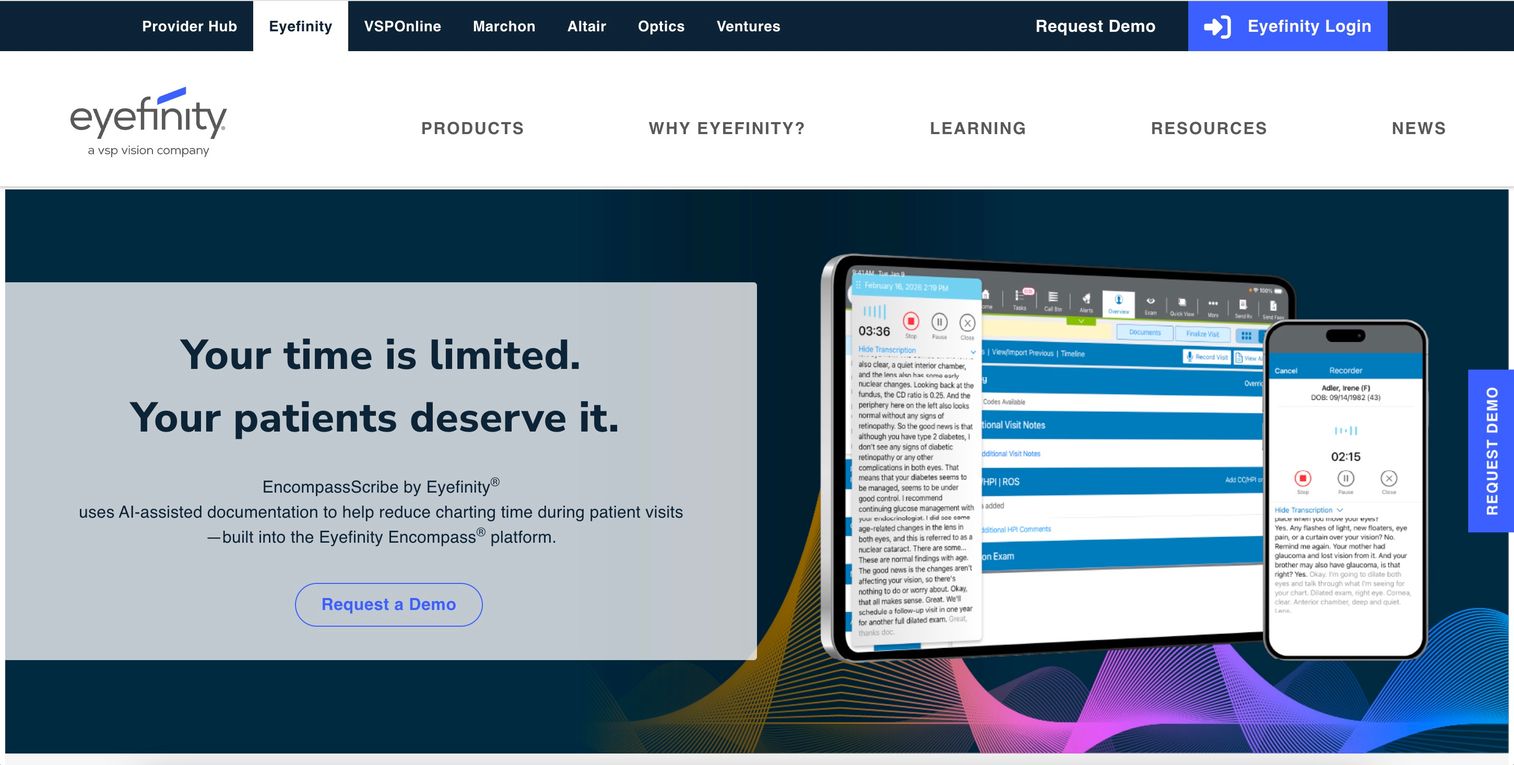
Eyefinity is a cloud-based optometric practice management, EHR, patient engagement, and analytics platform with a clear center of gravity: insurance and revenue cycle workflows. It's built for practices where eligibility, claims, and ERA handling drive the day, and it pairs that with online appointment scheduling, image management, and EncompassMessage two-way texting.
The multi-location and compliance posture is prominent, which fits groups that need standardized operations and centralized oversight. If your revenue cycle is where deals get stuck, this is the platform to shortlist for optometry claims management.
Best for: Insurance-heavy and multi-location eye care practices that need strong eligibility, claims, and standardized operations.
Key strengths
- Insurance and claims workflow: eligibility, claims, and ERA handling built into the core platform.
- Patient engagement: online scheduling, EncompassMessage two-way texting, and reminders in one system.
- Multi-location management: standardized workflows, analytics, and centralized oversight across sites.
Why choose Eyefinity Encompass: Choose it when insurance and scheduling are your operational core and you want a platform tuned for revenue cycle management for optometry. The multi-location dashboards and compliance framing suit groups scaling across several offices.
Eyefinity Encompass pricing: Three plans billed monthly. Essential starts at $340/month, Enhanced at $758/month, and Enterprise pricing varies. Pricing applies to one location and one doctor for the first year of a one-year contract and requires EncompassPay. There is no free tier. Its G2 rating is 3.7/5.
5. Crystal PM
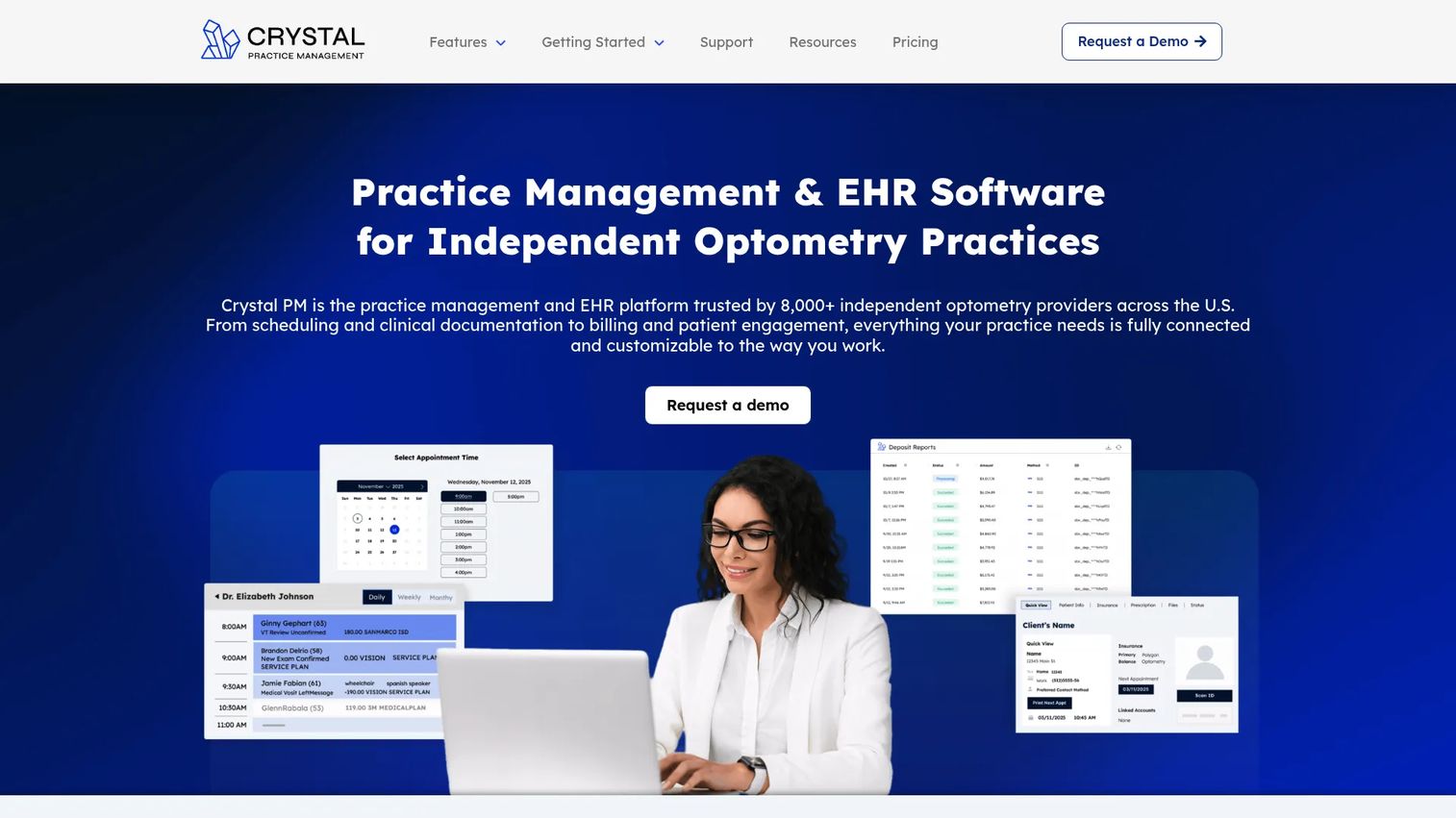
Crystal PM is practice management and EHR software built for independent optometry practices that want a straightforward daily workflow without heavy complexity. It covers custom health records and EHR, scheduling, billing, payments, inventory, reporting, and patient communication, with 55+ integrations and customizable workflows for practices that want to shape the system to their process.
The appeal is focus. Practices that don't need a sprawling feature set often shortlist Crystal PM because it handles the core work cleanly and offers both cloud and in-office deployment. It's a practical option for smaller teams prioritizing simplicity over breadth.
Best for: Independent optometry practices wanting an affordable, no-frills all-in-one practice management and EHR platform.
Key strengths
- Core workflow focus: scheduling, billing, payments, inventory, reporting, and patient communication in one place.
- Customization: 55+ integrations and configurable workflows to match how the practice already runs.
- Deployment flexibility: cloud or in-office options depending on the practice's preference.
Why choose Crystal PM: Choose it when you want less complexity and a system that does the essentials well. Practices that feel over-served by enterprise-grade platforms often find Crystal PM easier to adopt and run day to day.
Crystal PM pricing: The pricing page lists three plans, Crystal Essentials, Crystal Plus, and Crystal Pro, available monthly or annually and as cloud or in-office. Base plan prices are not publicly displayed and show "Contact Us for Pricing," though per-doctor add-on prices are visible on the page. Annual billing saves 10%. There is no free tier. Its G2 rating is 4.3/5.
6. iTRUST
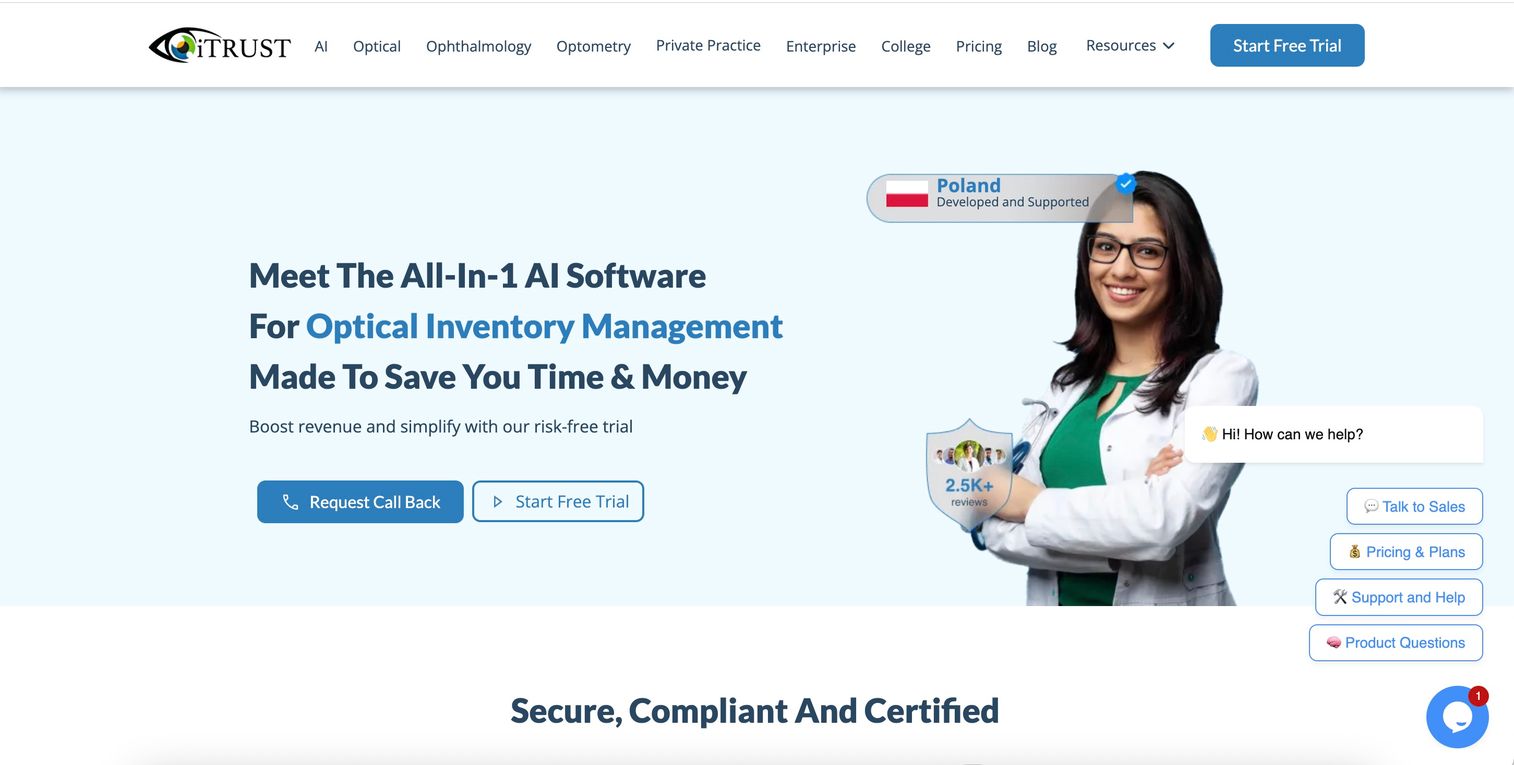
iTRUST is cloud-based optometry software focused on modern practice management for teams looking beyond legacy systems. It fits practices evaluating a cloud-first stack and wanting to move off older on-premise tools toward a browser-based platform. As a less mainstream option, it broadens the shortlist for buyers who want to compare a modern cloud approach against the more established names above.
Because it's cloud-native, the appeal centers on remote access and the general convenience of a browser-based operational stack. Treat it as a candidate to demo when your priority is stepping away from legacy software and testing whether a newer platform fits your workflow.
Best for: Practices moving off legacy systems and evaluating a modern, cloud-first optometry operations platform.
Key strengths
- Cloud-first architecture: browser-based access without maintaining on-site infrastructure.
- Modern stack feel: positioned for practices leaving legacy on-premise software behind.
- Shortlist breadth: a relevant alternative to compare against established all-in-one platforms.
Why choose iTRUST: Choose it when you want to evaluate a modern cloud-first option alongside the established platforms and your main driver is leaving a legacy system. As with any newer platform, run a hands-on demo and confirm workflow fit against your specific clinical and billing needs before committing.
iTRUST pricing: Public pricing was not verifiable at review time, so contact the vendor directly for current plans and terms. A current public G2 rating was not confirmed at review time.
Considerations before you choose
The way a founder pressure-tests a foundational system applies directly to optometry software. Before you sign, work through these criteria, the same discipline you'd bring to evaluating best community management software or any platform your operations depend on.
Cloud vs server-based deployment
Cloud based optometry software gives you remote access, automatic updates, and no on-site server to maintain. Server-based deployment can appeal to practices with specific data-residency preferences or existing hardware. Evaluate uptime commitments, backup and disaster recovery, and how the vendor handles maintenance windows during clinic hours.
EHR depth and charting speed
Clinician adoption lives or dies on charting speed. Test the exam workflow yourself: how many clicks to complete a routine exam, how flexible the templates are, and how image management fits your equipment. A slow chart costs you throughput every single day, so weigh optometry EHR software on real exam time, not feature counts.
Billing, claims, and payment workflows
Validate the full revenue cycle. Check real-time eligibility, claim scrubbing, ERA and remittance posting, and how integrated payments reconcile against the ledger. Ask about the denial rate practices see after switching and how the clearinghouse workflow handles rejections. This is where optometry billing software either saves hours or creates them.
Patient experience tools
Reminders, digital intake forms, portals, and two-way messaging drive no-show reduction and satisfaction. Confirm that patient reminders and intake forms actually sync back to the record instead of creating a separate inbox. Online booking for optometry should write directly into the schedule without staff re-entry.
Multi-location and reporting needs
If you run or plan to run multiple sites, check role-based permissions, cross-location dashboards, and reporting consistency. Owners need practice analytics for optometry that roll up across locations without exporting to spreadsheets. Standardized workflows across sites are what make growth repeatable instead of a per-office scramble.
Conclusion
The right optometry software depends entirely on where your workflow bottleneck sits today. RevolutionEHR is the strongest all-in-one for practices wanting depth and maturity in one connected platform. Eye Cloud Pro fits cloud-first practices where optical retail, POS, and inventory matter as much as the clinical record. Adit is the pick for communication-heavy practices that want front-desk automation and patient engagement. Eyefinity Encompass suits insurance-heavy and multi-location groups built around claims and scheduling. Crystal PM works for smaller practices that want simplicity and customization. iTRUST is worth a demo for teams evaluating a modern cloud-first move off legacy systems.
The best next step is to name your biggest operational drag, whether that's denied claims, no-shows, slow charting, or fragmented tools, then shortlist the two platforms that fix it best. Book demos, ask hard implementation and migration questions, and confirm HIPAA compliant optometry software commitments in writing before you commit. Choose for repeatability and visibility, not for the flashiest demo.
FAQs
Optometry software is an integrated platform that combines EHR, practice management, scheduling, billing, claims, patient communication, payments, and reporting for eye care practices. It replaces disconnected tools with one system where clinical and front-desk work share the same patient record.
At minimum: cloud-based access, exam charting and documentation, appointment scheduling with reminders, integrated billing and claims, real-time eligibility, digital intake forms, a patient portal, integrated payments, and reporting. Multi-location practices should also confirm role-based permissions and cross-location dashboards.
Cloud based optometry software offers remote access, automatic updates, and no on-site server maintenance, which suits most modern and multi-location practices. Server-based options can appeal to practices with specific data-residency or hardware preferences. Evaluate uptime, backup, and support before deciding.
Practices running multiple sites often shortlist Eyefinity Encompass for its multi-location management and standardized operations, and Eye Cloud Pro for cloud-native access with per-location pricing. RevolutionEHR is also a strong all-in-one option. Confirm cross-location reporting and permissions during your demo.
Check data migration scope, how much history transfers, downtime during cutover, staff training and implementation support, and any setup or conversion fees. Confirm the vendor's HIPAA compliant optometry software commitments, backup practices, and how quickly support responds during clinic hours.
They're central to revenue cycle management for optometry. Real-time eligibility prevents surprise denials, and integrated claims plus ERA posting shortens the time from exam to payment. Weak claims handling means rework and delayed revenue, so validate optometry claims management directly during evaluation.
Optometry EHR software manages the clinical record: exam documentation, charting, and image management. Practice management software handles scheduling, billing, claims, and operations. The best cloud based optometry software combines both so one patient record flows from booking to exam to claim without re-entry.
Look past the headline monthly rate. Factor in per-doctor or per-location pricing, one-time setup and data conversion fees, contract length, whether payment processing is required, and what each tier actually includes. For optical retail software needs, confirm POS and inventory are included rather than add-ons.