You opened Amazon, eBay, and a TikTok Shop storefront in the same quarter. Revenue climbed. So did the chaos. A unit sold on Shopify that you already promised on Walmart. A listing went live with the wrong price on Etsy. A customer service rep spent the afternoon hunting for an order that was sitting in a third system nobody checks.
That is the real cost of selling everywhere at once. Reach goes up, but so does the number of places something can break. And the breaks are expensive: a canceled order from an oversell burns the ad spend that won the sale, dents your seller rating, and sends a buyer to a competitor.
The data backs the shift. About 85% of shoppers use at least two channels before making a purchase, according to the National Retail Federation, cited in Business Research Insights (2025). Buyers expect you on every surface. The question is whether your operations can keep up.
The right multichannel ecommerce software answers that question. It keeps inventory in sync, centralizes orders, standardizes listings, and automates fulfillment so adding a channel does not mean adding a full-time person to babysit it. The same shift toward measurable, automated systems is reshaping the rest of the stack, from marketing automation to the customer data platform layer that ties channel revenue back to a single view of the customer.
We picked these eight tools on five criteria: channel coverage, inventory sync, order management, integration quality, and how well each scales as channels multiply. Some are full ecommerce platforms. Some are inventory or shipping specialists. The right pick depends on where your operation hurts most.
What's inside
This guide covers multichannel ecommerce software for brands and retailers selling across marketplaces, branded storefronts, and social commerce channels like Amazon, Walmart, eBay, Etsy, Shopify, and TikTok Shop. It is written for the growth marketer or ecommerce operator who owns revenue and is tired of tool sprawl, manual reconciliation, and reporting blind spots.
We chose tools on five criteria: channel and marketplace coverage, real-time inventory sync, order management depth, integration quality across CRM, ERP, WMS, and shipping, and how cleanly each scales. The list spans full ecommerce platforms, channel managers, inventory systems, ERP, and shipping software, so you can match the tool to the job instead of buying a suite you half-use.
TL;DR
- Best all-in-one platform: BigCommerce, for brands that want a hosted storefront plus native channel expansion in one place.
- Best for channel management: ChannelEngine, for marketplace-heavy sellers who need feed control and listing distribution at scale.
- Best for inventory control: Finale Inventory, for inventory-first teams that need accurate stock across warehouses and channels.
- Best for ERP-connected teams: NetSuite, for larger operations that need finance, orders, and inventory governed in one system.
- Best for shipping workflows: ShipStation, for sellers who want rate shopping, labels, and fulfillment automation across channels.
- Best for lightweight multichannel selling: Sellbrite, for smaller teams that need listing management and inventory sync without heavy ops overhead.
What is multichannel ecommerce software?
Multichannel ecommerce software is a platform that lets a business sell across multiple sales channels, marketplaces, storefronts, and social commerce, while centralizing inventory, orders, listings, and fulfillment in one system.
The distinction matters. Single-channel selling means one storefront and one source of truth. Multichannel selling means several channels, each with its own listings, fees, and order formats, managed from a central hub. Omnichannel goes further, unifying the customer experience across online and physical touchpoints so a buyer can move between them without friction. Most growing brands live in the multichannel stage and use software to keep it from becoming a mess.
A capable multichannel ecommerce platform handles a few jobs at once:
- Channel expansion: list and sell on new marketplaces and social channels without rebuilding everything per channel.
- Inventory synchronization: keep stock counts accurate across every channel in near real time to support overselling prevention.
- Listing management: push consistent titles, images, and attributes so product data consistency holds across platforms.
- Order routing: pull every order into one queue and route it to the right warehouse or fulfillment method.
- Shipping and fulfillment: automate label creation, rate shopping, and fulfillment automation so volume does not create manual work.
These jobs rarely live in one tool. The category breaks into distinct software types, and knowing which is which keeps you from overbuying.
| Software category | What it handles | Example role in the stack |
|---|---|---|
| Sales platforms | Storefront, checkout, catalog, channel integrations | The place customers buy |
| Operations software | Inventory, orders, connected commerce workflows | The control layer across channels |
| PIM / listing tools | Product data, attributes, channel publishing | The source of truth for listings |
| Inventory systems | Stock counts, replenishment, multi-warehouse | Accurate availability everywhere |
| WMS | Picking, packing, warehouse workflows | Physical fulfillment efficiency |
| Shipping software | Rates, labels, carrier selection | Getting orders out the door |
Strong PIM integration and clean marketplace integration sit underneath most of these. The better your product data and channel connections, the less manual cleanup your team does downstream.
When to use multichannel ecommerce software
When you are expanding beyond one storefront
Adding Amazon, Walmart, Etsy, or TikTok Shop to a Shopify store multiplies operational surface area fast. Each channel has its own listing format, fee structure, and order export. Without software, every new channel adds a tab someone has to manage by hand, and every manual step is a place for stock errors to creep in.
Multichannel ecommerce management software collapses that work. You build a listing once, distribute it to every channel, and let the system reconcile orders back into one queue. That is the difference between a launch that scales and one that quietly eats a headcount.
When inventory mismatches are creating oversells
The fastest way to lose money and trust at the same time is to sell a unit you do not have. It happens when channels update on a lag and two buyers grab the last item on two platforms within minutes of each other. Real-time inventory sync closes that gap by pushing a stock change to every channel the moment it happens.
The downstream effect is bigger than one canceled order. An oversell wastes the ad spend that won the sale, triggers a refund, and on marketplaces like Amazon it dings the seller metrics that govern your visibility. Inventory visibility is not a nice-to-have at multichannel scale, it is margin protection.
When fulfillment and shipping are slowing growth
At low volume, a person can pick rates and print labels by hand. At multichannel volume, that breaks. Automated order routing sends each order to the right warehouse, batches similar shipments, and shops carrier rates without anyone touching it. Warehouse management features add picking and packing structure so accuracy holds as orders climb.
The reporting layer matters just as much. When leadership can see revenue, margin, and operational health by channel in one view, channel decisions stop being guesses. The same dashboard logic shows up across modern revenue stacks, from data visualization tools to the AI sales tools teams use to read pipeline signals.
Comparison table
Here is how the eight tools compare at a glance. They are sorted by relevance to multichannel ecommerce software, not alphabetically. Pricing and ratings reflect verified vendor and G2 values at the time of writing; where a vendor publishes only custom pricing, that is noted.
| # | Product | Intent | Key use case | Pricing | G2 rating |
|---|---|---|---|---|---|
| 1 | BigCommerce | All-in-one platform | Hosted storefront plus channel expansion | From $29/mo | 4.2/5 |
| 2 | ChannelEngine | Channel management | Marketplace feed and listing distribution | From €8/mo | 4.3/5 |
| 3 | Cin7 Omni | Operations control | Omni-channel inventory and order management | Custom | 3.8/5 |
| 4 | Finale Inventory | Inventory control | Multichannel and multi-warehouse stock | From $499/mo | 4.8/5 |
| 5 | NetSuite | ERP backbone | Finance, orders, inventory in one system | Custom | - |
| 6 | ShipStation | Shipping workflows | Rate shopping and fulfillment automation | From $14.99/mo | 4.2/5 |
| 7 | Sellbrite | Lightweight selling | Listing management and inventory sync | From $0/mo | 4.7/5 |
| 8 | Linnworks | Operations automation | Order and inventory automation at scale | Custom | 4.3/5 |
Best multichannel ecommerce software for 2026
Each tool below gets its own breakdown: what it does, who it fits, key strengths, the case for choosing it, and pricing. Match the tool to your sharpest pain, whether that is channel expansion, inventory control, or fulfillment.
1. BigCommerce
BigCommerce is an open SaaS ecommerce platform built for brands and merchants that want a hosted storefront they can scale without replatforming every year. It pairs catalog and checkout with native connections to marketplace, social commerce, and advertising channels, so the storefront and channel expansion live under one roof. For a digital marketer who owns both the brand site and the marketplace strategy, that consolidation matters.
The platform leans into flexibility. You get a hosted store with built-in commerce features, embedded payment options, and the ability to publish products out to a wide set of external channels rather than treating each as a separate project.
Best for: Growing ecommerce businesses that want a scalable hosted storefront with built-in channel expansion.
Key strengths
- Multi-tier scaling: plans upgrade automatically based on GMV, so the platform grows with revenue instead of forcing a manual migration.
- Channel integrations: native connections to marketplaces, social commerce, and advertising channels keep listing management in one place.
- Built-in commerce features: embedded payment providers and phone or chat support reduce the number of bolt-ons you need.
Why choose BigCommerce: If your primary pain is channel expansion and you want the storefront and the marketplace strategy in one system, BigCommerce earns its place. It suits teams that prefer an owned, branded storefront as the hub and want to push out to channels from there, rather than running channels as disconnected silos.
BigCommerce pricing: Plans start at $29/month for Core, billed annually, with Growth at $79/month and Scale at $299/month. The Performance tier is custom, starting at $1,499/month. A 15-day free trial is available with no credit card required. There is no permanently free plan.
2. ChannelEngine
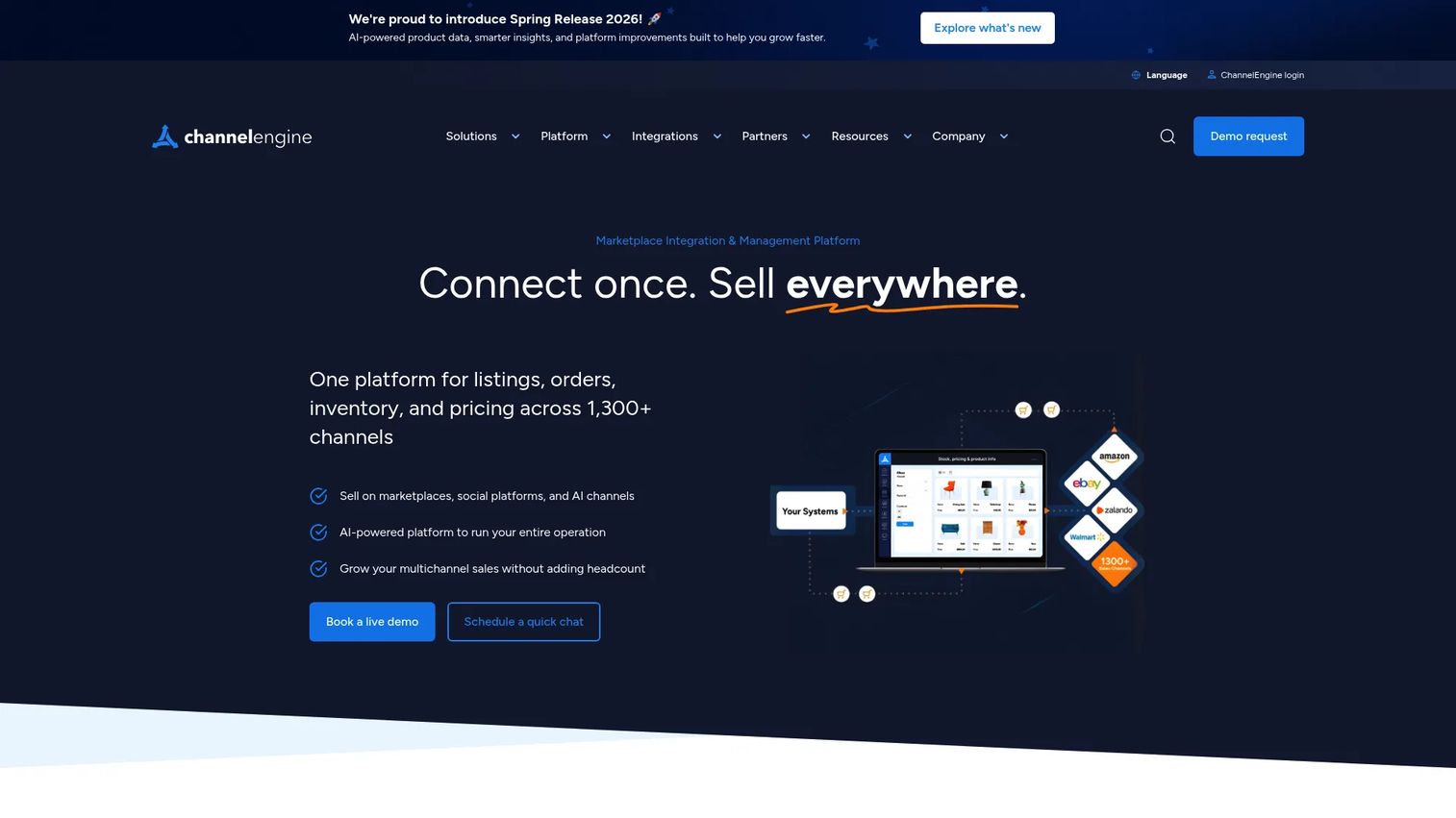
ChannelEngine is marketplace integration and multichannel commerce software built for brands and retailers whose growth is concentrated on marketplaces. Where a general ecommerce platform treats channels as add-ons, ChannelEngine treats them as the main event, giving you feed control, pricing rules, and order management across a large set of marketplaces and online sales channels.
This is ecommerce channel management software in its purest form. It sits between your catalog and the marketplaces, handling product information and syndication so each channel gets accurate, channel-formatted data without manual reformatting.
Best for: Mid-market and enterprise brands selling across multiple marketplaces.
Key strengths
- Product information and syndication: push channel-ready product data out to many marketplaces from one source, protecting product data consistency.
- Pricing and promotion management: set pricing and promotional rules per channel without editing listings one at a time.
- Order management: pull marketplace orders into a central flow so fulfillment does not fragment across logins.
Why choose ChannelEngine: It helps more than a general platform when marketplaces drive the bulk of revenue and the bottleneck is keeping feeds, pricing, and orders aligned across dozens of channels. Brands managing complex marketplace strategies lean on this kind of dedicated channel layer rather than stretching a storefront tool to do work it was not built for.
ChannelEngine pricing: Public pricing shows three tiers, Start at €8/month, Grow at €16/month, and Scale at €149/month, with pricing scaling based on GMV and integration requirements. Tailored pricing is available for larger needs. There is no free tier listed on the official pricing page.
3. Cin7 Omni
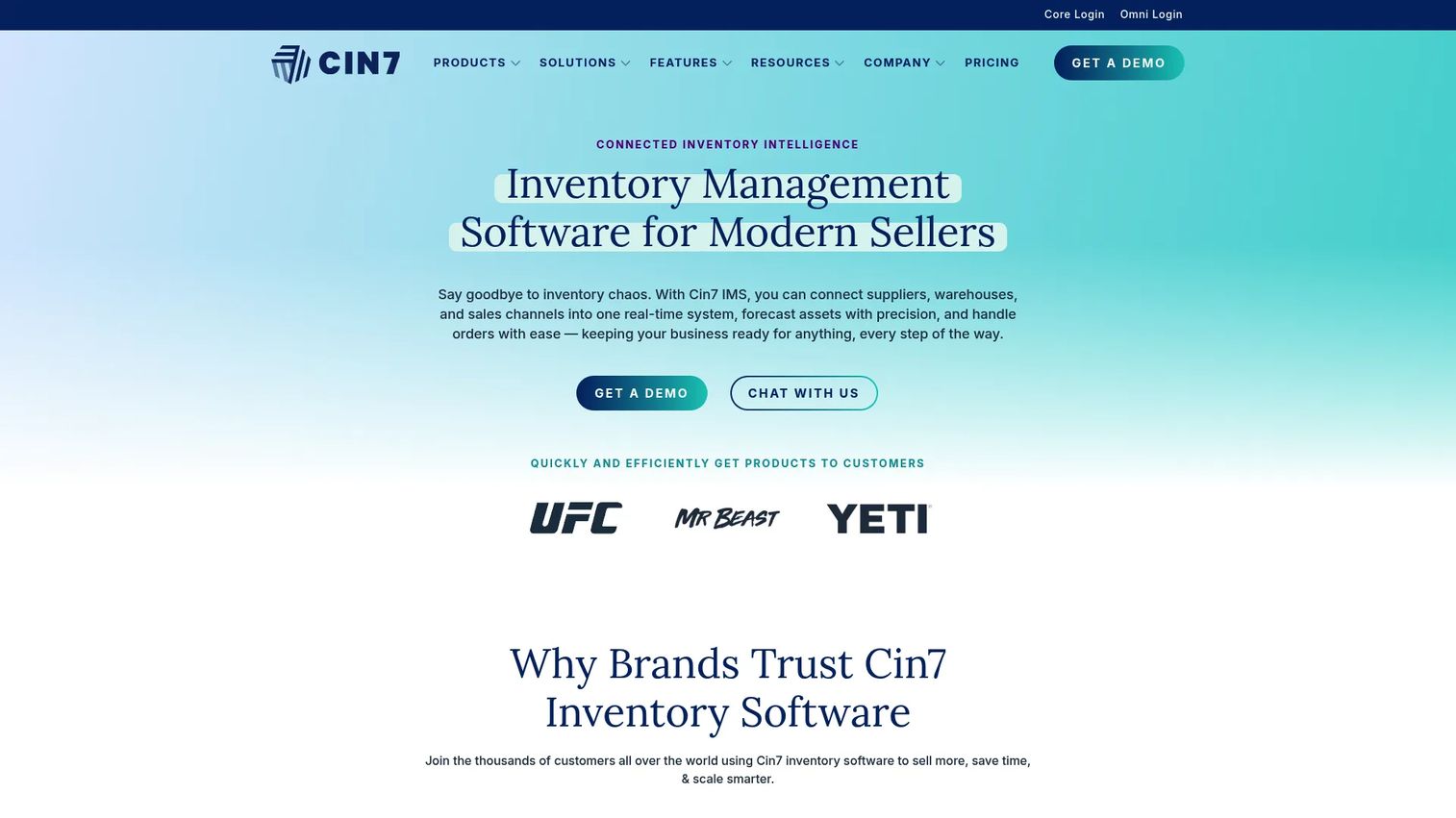
Cin7 Omni is cloud-based omni-channel inventory and order management software for complex, multi-entity product businesses. It is built for operations that have outgrown simple stock tracking and need inventory visibility, order workflows, and connected commerce across retail and ecommerce in one configurable system.
The product is aimed at teams whose complexity is the problem. Multiple entities, EDI trading partners, and third-party logistics all need to talk to each other, and Cin7 Omni is designed to be the layer that orchestrates them.
Best for: Enterprises needing customizable omni-channel inventory and order management.
Key strengths
- Native EDI and 3PL integrations: connect trading partners and logistics providers without bolting on middleware.
- Multi-entity support: manage several business units or regions inside one system for cleaner inventory visibility.
- Customizable workflows: configure order management and fulfillment logic to match how your operation actually runs.
Why choose Cin7 Omni: Pick it when your operation spans retail and ecommerce, multiple entities, and EDI relationships that a lighter tool cannot handle. It suits teams that need broad operational control and are willing to invest in configuration to get a system that matches their workflows.
Cin7 Omni pricing: Cin7 Omni is a custom solution for enterprises needing fully customizable inventory management. Pricing is not publicly listed and is provided on request through a sales consultation.
4. Finale Inventory
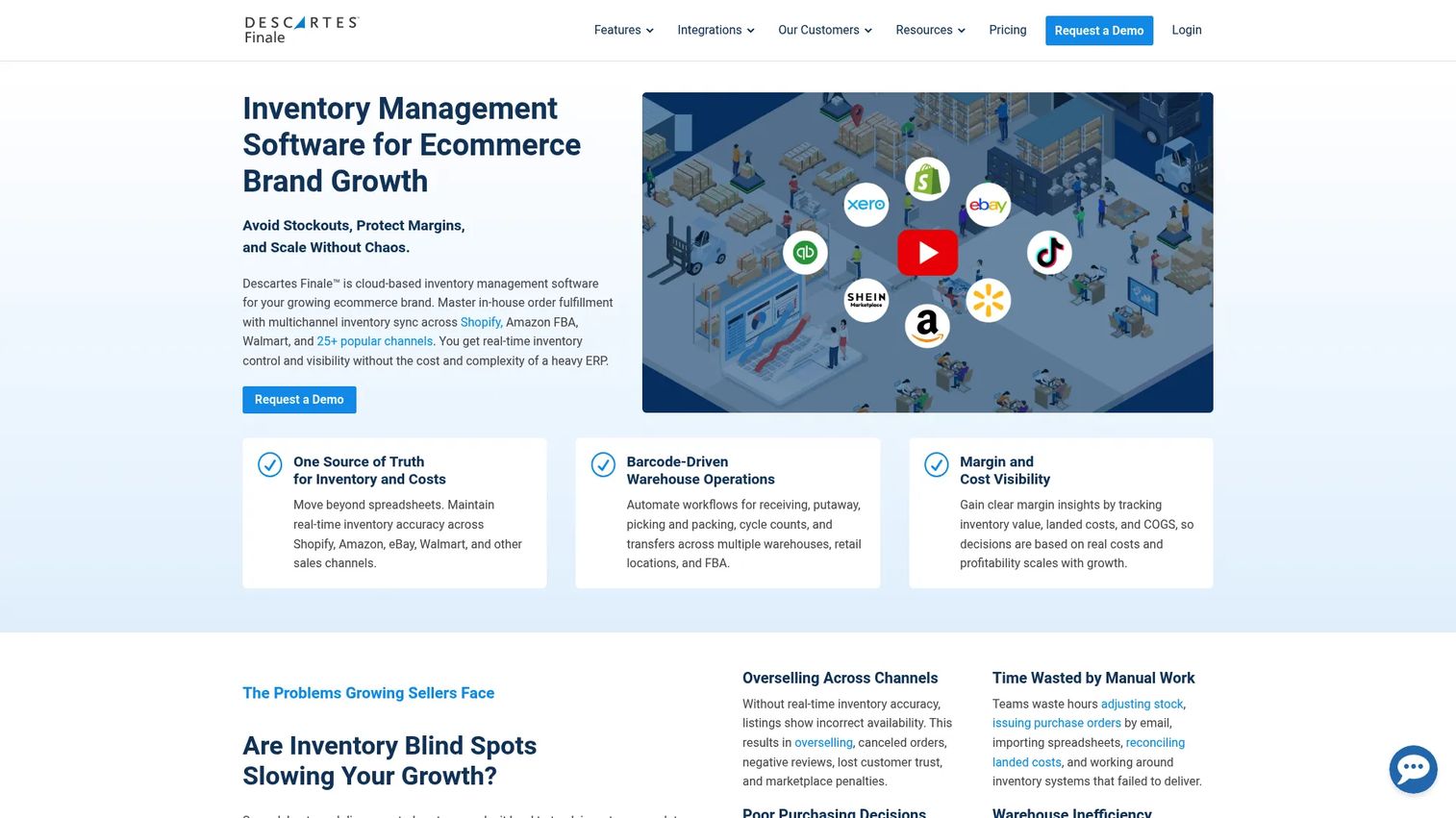
Finale Inventory is cloud-based inventory and warehouse management software for multichannel commerce and multi-location operations. It is an inventory-first tool: the whole product is organized around keeping stock counts accurate across warehouses and channels, which is exactly the foundation overselling prevention rests on.
For teams whose sharpest pain is inventory accuracy rather than storefront features, Finale focuses on the stock layer. Real-time syncing pushes counts across sales channels, and barcode-driven workflows keep the physical warehouse aligned with the system of record.
Best for: Ecommerce and warehouse teams needing centralized multichannel inventory control.
Key strengths
- Multi-warehouse inventory management: track stock across locations with a single accurate view.
- Real-time inventory syncing: push counts across sales channels in near real time to prevent oversells.
- Barcode and warehouse workflows: scanning, picking, and transfer flows keep warehouse management tight as volume grows.
Why choose Finale Inventory: Choose it when inventory accuracy is the thing breaking and you need replenishment, stock control, and multi-warehouse visibility before you need anything else. It fits operators who would rather run a best-in-class inventory layer alongside their storefront than accept the lighter inventory features bundled into a general platform.
Finale Inventory pricing: Plans start from $499/month, with pricing based on users, integrations, order volume, and add-ons. A custom consultation maps the right configuration. There is no free tier.
5. NetSuite
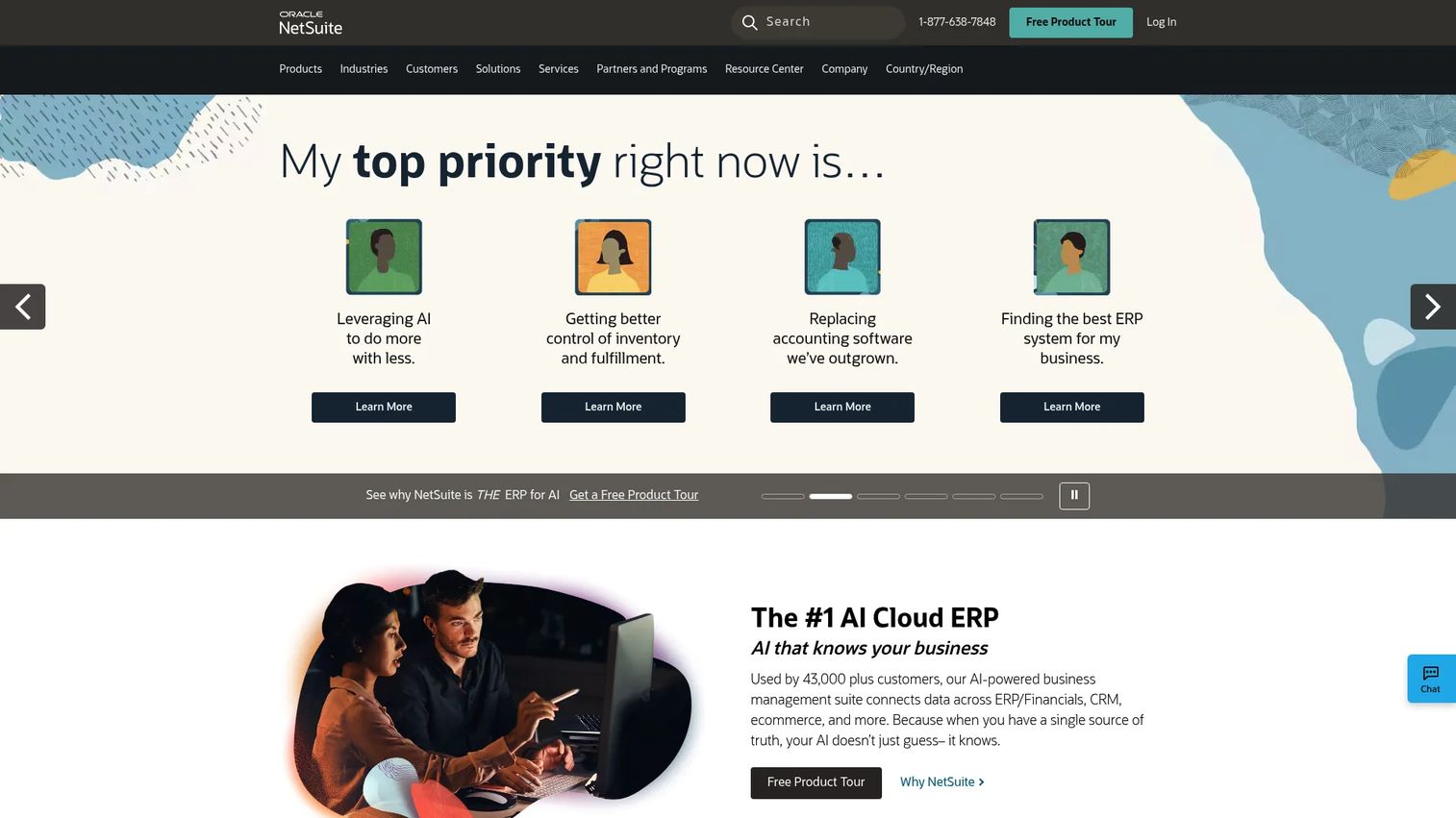
NetSuite is cloud ERP software that centralizes financials, operations, and business management, with order and inventory management built in. For multichannel sellers, it is less a channel tool and more the backbone that ties commerce to finance, governing orders and inventory across the business in one system of record.
It earns its place when complexity outgrows point tools. Larger teams that need accounting, inventory, order management, and reporting unified, with governance and audit trails to match, use NetSuite as the layer everything else reports into.
Best for: Mid-market and enterprise companies needing a unified cloud ERP platform.
Key strengths
- Financial management and accounting: unify commerce revenue with finance so channel performance ties to the books.
- Order and inventory management: centralize orders and stock across channels inside the ERP.
- Real-time dashboards and reporting: give leadership operational and financial visibility by channel without exporting to spreadsheets.
Why choose NetSuite: Pick it when your operation has reached the scale where finance, inventory, and order management belong in one governed system rather than stitched-together tools. The value grows with complexity, multiple entities, larger teams, and the need for enterprise-grade reporting and controls.
NetSuite pricing: NetSuite does not publish public pricing. Plans are quoted based on modules, users, and scope through a sales conversation, which is typical for ERP platforms sized to each organization.
6. ShipStation
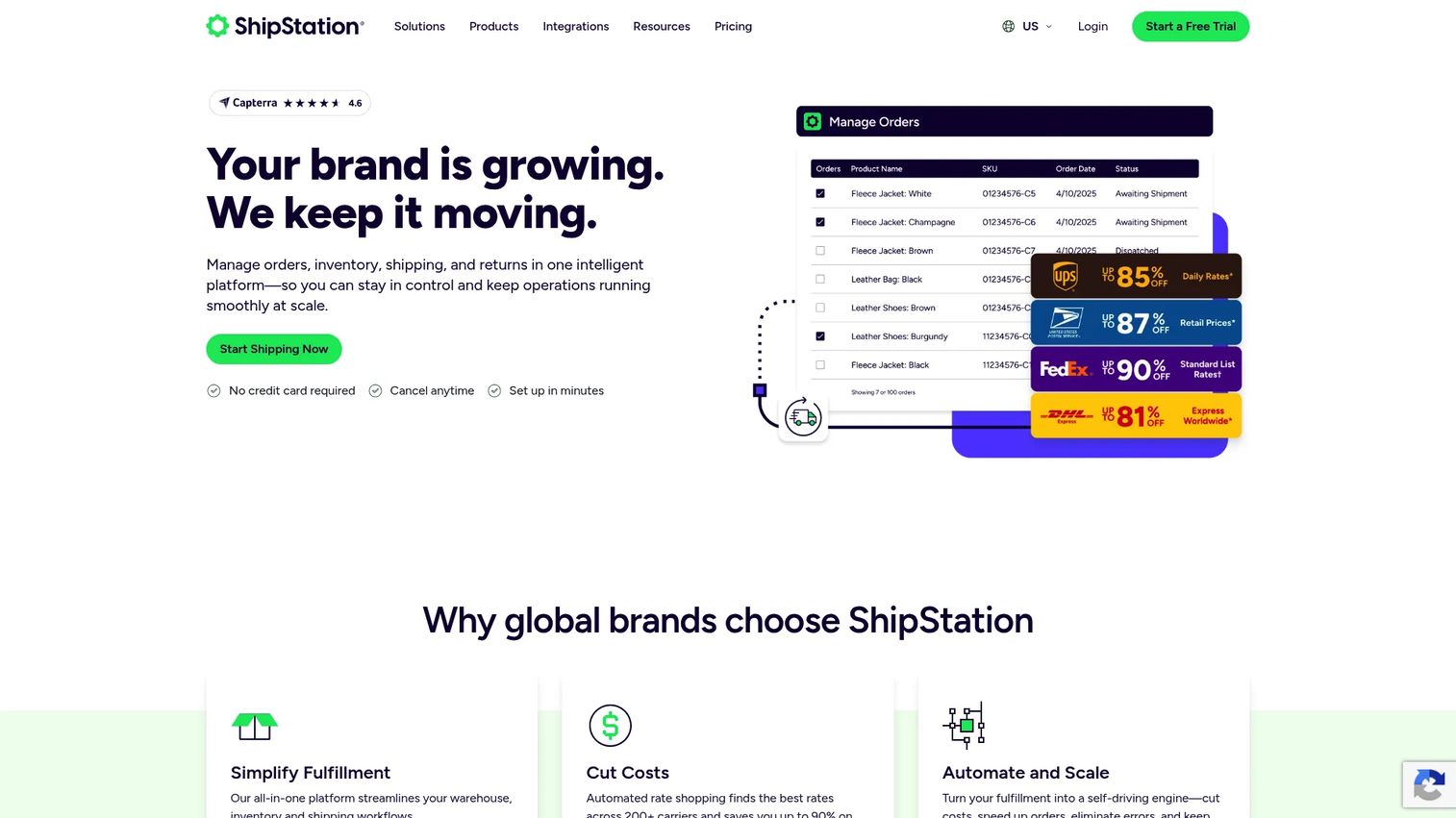
ShipStation is shipping software for ecommerce fulfillment and order management, built to centralize shipping, labels, and carrier rate shopping across every channel you sell on. For multichannel sellers, it is the layer that turns a pile of orders from different platforms into batched, rate-optimized shipments out the door.
It sits downstream of your sales channels and pulls orders in, then automates the fulfillment work that scales painfully by hand. Rate comparison finds the best-value carrier per shipment, and automation rules handle the repetitive decisions so volume does not mean more clicks.
Best for: Ecommerce sellers that need centralized shipping, labels, and carrier rate shopping.
Key strengths
- Multi-carrier shipping and rate comparison: shop carriers per order to cut shipping costs without manual checking.
- Order management and automations: pull orders from every channel and apply rules for fulfillment automation.
- Returns, labels, and warehouse tools: handle returns and labeling in one login alongside warehouse management features.
Why choose ShipStation: Choose it when your sales channels are working but shipping is the bottleneck slowing growth. It is a strong shipping layer that sits on top of whatever platforms and marketplaces you already sell on, with deep integration into common sales channels so orders flow in automatically.
ShipStation pricing: Plans start at $14.99/month for Starter, with Standard at $29.99/month and Premium at $349.99/month. A 30-day free trial is available with no credit card required. There is no permanently free plan.
7. Sellbrite
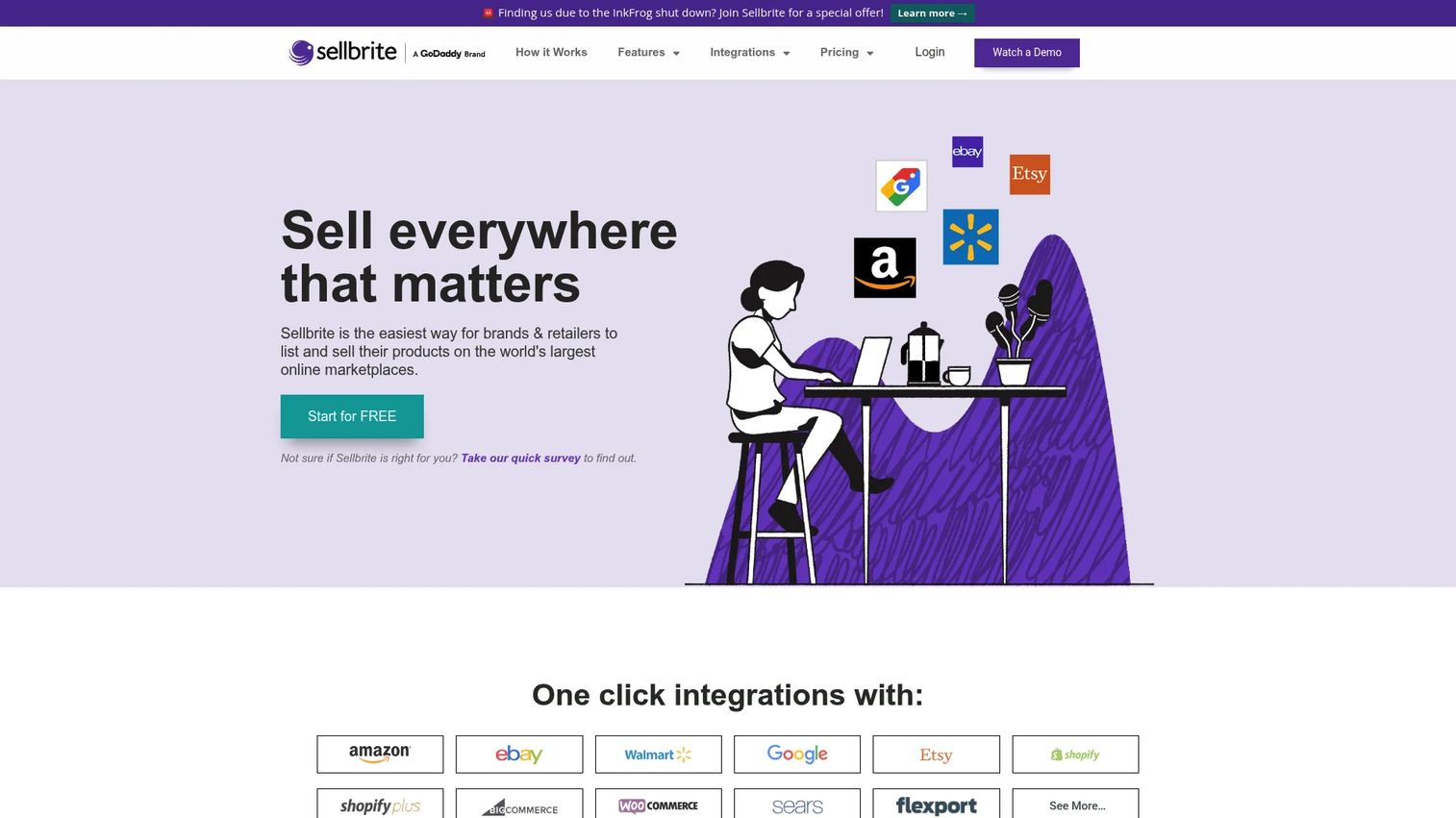
Sellbrite is multi-channel ecommerce management software for listing, inventory sync, order management, and fulfillment across marketplaces, designed to keep the workflow light. It lets smaller teams list products across channels, sync inventory and prices, and manage orders from one dashboard without standing up a heavy operations stack.
For brands and retailers selling across several marketplaces who do not need enterprise tooling, Sellbrite covers the core multichannel jobs in one place. It also imports FBA inventory so you can sell that stock on other channels and auto-route fulfillment back to FBA.
Best for: Brands and retailers selling across multiple online marketplaces.
Key strengths
- List products across channels: publish listings to multiple marketplaces from one dashboard for cleaner listing management.
- Inventory and price sync: keep stock and pricing aligned across marketplaces to support overselling prevention.
- Order management and fulfillment: manage and fulfill orders from a single view, including FBA import and auto-routing.
Why choose Sellbrite: It fits smaller teams or simpler stacks that need real multichannel selling software without the overhead of an ops platform. If your channels are a handful of marketplaces and your priority is clean listings and accurate inventory rather than deep warehouse logic, Sellbrite hits the mark.
Sellbrite pricing: Sellbrite offers a Forever Free plan covering up to 30 orders a month, with paid plans starting at $29/month for Pro 100 and $79/month for Pro 500. Monthly and annual billing are available, plus a 14-day unlimited-access trial.
8. Linnworks
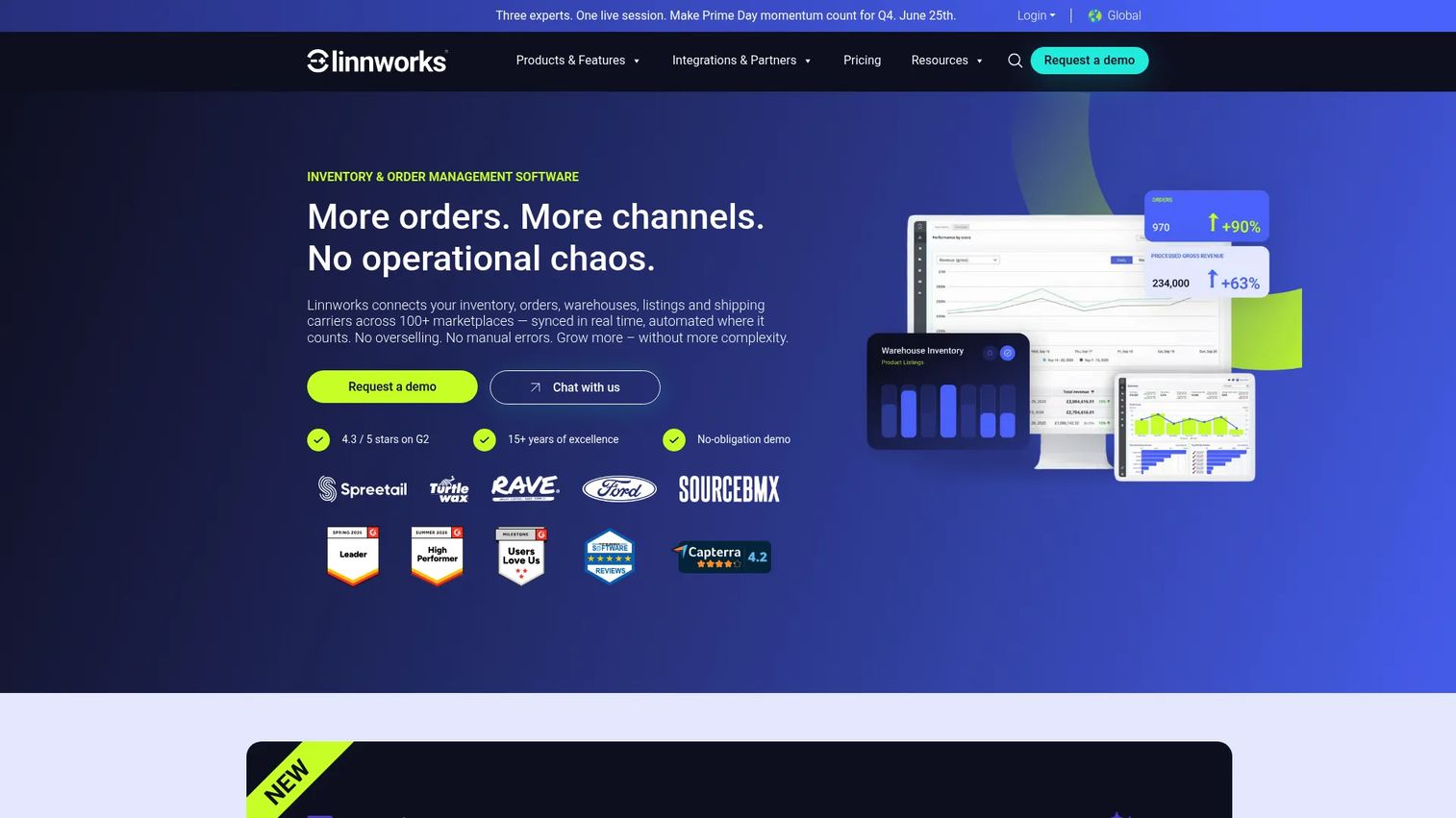
Linnworks is multichannel commerce operations software for inventory, order, warehouse, and shipping management, built for retailers that need stronger automation across channels. It centralizes real-time inventory, order management with automation rules, and warehouse and shipping workflows so growing operations can scale without adding manual labor at every step.
It sits in the operations control layer, syncing inventory across many marketplace integrations and applying rules that route, batch, and process orders automatically. For teams whose channel count is climbing and whose manual workload is climbing with it, that automation is the point.
Best for: Growing multichannel ecommerce retailers that need centralized inventory, orders, and fulfillment.
Key strengths
- Real-time inventory management: sync stock across many marketplaces to keep inventory visibility accurate.
- Order management and automation rules: apply rules that route and process orders for fulfillment automation at scale.
- Warehouse and shipping management: run warehouse management and shipping workflows from one operational hub.
Why choose Linnworks: Pick it when your multichannel operation has enough volume and channels that manual order and inventory work no longer scales. It suits teams that want a single operations platform to automate syncing, routing, and fulfillment across a growing set of channels rather than managing each one separately.
Linnworks pricing: Linnworks uses custom pricing based on monthly order volume. There is no public numeric starting price, and a quote is provided on request.
Considerations
Before you commit, pressure-test each shortlisted tool against the realities of your operation. The right multichannel ecommerce platform is the one that fits your channel mix and stack, not the one with the longest feature list.
Channel coverage
Confirm the platforms your audience actually sells on are supported natively, not through brittle workarounds. A tool that nails Amazon and Shopify but treats TikTok Shop or Walmart as an afterthought will cost you the channels you care about most.
Inventory sync speed
Evaluate how fast stock updates propagate across channels. Near real-time inventory sync is what stands between you and an oversell. Ask how the system handles simultaneous sales on two channels and how quickly counts reconcile.
Order management depth
Check routing, batching, and exception handling. Order management is easy at low volume and brutal at scale. The tool should route orders to the right warehouse, batch similar shipments, and flag exceptions before they become customer complaints.
Integration quality
Verify the connections you depend on, CRM, ERP, marketplace, WMS, and shipping. A multi channel ecommerce integration that breaks under load creates more work than it saves. Confirm the integrations are first-party and maintained, not community plugins.
Scalability
Look for rules, automation, and reporting that survive channel growth. A tool that works for three channels should still work for ten without a rebuild. Automation rules and configurable workflows are what let the system absorb growth.
Reporting and visibility
Make sure leadership can see revenue and operational health by channel. Inventory visibility and channel-level reporting turn channel decisions from guesses into informed bets, the same way modern revenue teams lean on a field sales view or an AI sales assistant to read performance signals.
Conclusion
There is no single best multichannel ecommerce software, only the best fit for your sharpest problem. If channel expansion is the goal and you want storefront plus marketplaces in one place, BigCommerce leads. If marketplaces drive your revenue, ChannelEngine gives you the feed and listing control to scale them. When inventory accuracy is what breaks, Finale Inventory is the inventory-first pick, and Sellbrite covers lighter multichannel selling for smaller teams.
For operations-heavy businesses, Cin7 Omni and Linnworks bring inventory, order, and fulfillment automation across channels, while NetSuite is the ERP backbone for larger teams that need finance, orders, and inventory governed together. When shipping is the bottleneck, ShipStation is the layer that automates fulfillment across every channel you sell on.
The practical next step: name your single biggest pain, channel expansion, inventory control, or fulfillment, then narrow to two or three tools that solve it. Run a trial or a scoped demo against your actual channel mix before you sign. Sales channel expansion is only worth it if the operations underneath hold.
Start your journey with Guideflow today!
FAQs
Multichannel ecommerce software is a platform that lets you sell across several channels, marketplaces, branded storefronts, and social commerce, while centralizing inventory, orders, listings, and fulfillment in one system. It is the difference between managing Amazon, eBay, Etsy, and Shopify in separate tabs and managing them from one hub. The goal is reach without the chaos that usually comes with it.
Five features carry most of the weight: channel coverage, real-time inventory sync, order management depth, integration quality, and reporting. Inventory sync prevents oversells, order management keeps fulfillment from fragmenting, and integrations connect your CRM, ERP, WMS, and shipping. If a tool is weak on any of these, the gap shows up as manual work later.
It keeps a single source of truth for stock and pushes every change to every channel in near real time. When a unit sells on Walmart, the count drops on Amazon, Shopify, and your other channels within seconds, so two buyers cannot claim the last item. Without that sync, channels update on a lag, and the lag is where oversells happen.
At minimum, confirm native support for the marketplaces and storefronts your buyers actually use, commonly Amazon, Walmart, eBay, Etsy, Shopify, and increasingly TikTok Shop. The right answer depends on your audience, not a vendor's logo wall. Verify the channels you care about are first-party integrations, not fragile workarounds.
Shopify runs your storefront well, but it is one channel. The moment you add Amazon, Walmart, or TikTok Shop, you need something to keep inventory, listings, and orders aligned across all of them. A channel manager or operations tool sits alongside Shopify and handles the multi channel ecommerce integration that a single storefront was not built to manage.
A PIM manages product data, the titles, attributes, images, and descriptions that feed your listings, and acts as the source of truth for product content. Multichannel ecommerce software is broader, handling inventory, orders, and fulfillment in addition to listing distribution. Many setups use PIM integration as the data layer feeding the multichannel platform that does the selling and shipping.
It pulls orders from every channel into one queue, routes each to the right warehouse, batches similar shipments, and shops carrier rates automatically. Shipping software like ShipStation specializes in that layer, while operations tools like Linnworks add order automation and warehouse management. The result is fulfillment automation that holds as order volume climbs.
Start with your single biggest pain, channel expansion, inventory control, or fulfillment, and weight the evaluation toward solving it. Then confirm channel coverage, inventory sync speed, integration quality, and whether the reporting gives leadership channel-level visibility. Run a scoped trial against your real channel mix before committing, because a tool that demos well can still break under your actual volume.