You closed a good quarter. Then payroll ran, invoices went out late, and you realized two of your best consultants sat at 40% utilization for three weeks. Nobody caught it, because the data lived in five places.
That is the real problem with running a consulting firm on disconnected tools. Your project plan is in one app, timesheets in another, invoices in your accounting system, and client context in someone's inbox. By the time you stitch it together, the margin is already gone.
The market is not slowing down. The global software consulting market is projected to reach USD 412.17 billion in 2026, up from USD 365.99 billion in 2025, a 12.6% CAGR, according to The Business Research Company (2026). More firms competing means tighter margins, which means visibility into utilization and profitability stops being a nice-to-have.
The fix is not another point tool. It is software for consultants that ties delivery to billing to margin in one system, so you can see what is working without opening five dashboards. This guide breaks down seven platforms and helps you pick the one that fits how you actually run.
What's inside
This guide is for founders and consulting operators choosing a platform to run delivery, resourcing, billing, and reporting. We picked tools built for client-services businesses, not generic project management apps.
We evaluated each platform against four criteria:
- Project and resource management: planning, staffing, and utilization forecasting
- CRM and client workflow coverage: pipeline, proposals, and client context in one place
- Financial management and reporting: billing, project accounting, and profitability tracking
- Integrations and usability: how well it connects to your accounting, CRM, and collaboration stack
TL;DR
- Best for all-in-one PSA: Scoro, if you want project delivery, quoting, and finance in one platform
- Best for consulting operations and delivery: Productive, built around resourcing and profitability
- Best for project accounting and finance-heavy teams: Sage Intacct, strongest on revenue recognition and controls
- Best for enterprise professional services: Deltek Maconomy, full ERP for complex firms
- Best for forecasting and utilization: Projectworks, purpose-built PSA for growing consultancies
- Best for HubSpot-centric teams: PSOhub, PSA that lives next to your CRM
- Best budget-friendly all-in-one: Plutio, consolidation for lean teams
What is consulting software
Consulting software is professional services automation (PSA) and all-in-one operations software that runs the full delivery lifecycle for client-services businesses, from quote to cash. It connects the work you sell, the people who deliver it, and the money it produces in one system.
Most consulting firms run this stack across separate apps. A dedicated platform pulls it together so utilization, margin, and cash collection stay visible in real time, not at month-end.
Core capabilities of consulting software include:
- Project management: tasks, timelines, milestones, and shared client context
- Resource planning: staffing, capacity forecasting, and billable utilization tracking
- CRM: pipeline, contacts, and client history connected to delivery
- Quoting and proposals: estimates and scopes that flow into projects and invoices
- Invoicing and payments: billing models, collections, and cash tracking
- Reporting and dashboards: profitability tracking, capacity, and revenue signals
- Integrations: connections to accounting, CRM, documents, and collaboration tools
The term overlaps heavily with PSA software and consultant management software. In practice, buyers use all three to describe the same job: one operating system for client delivery.
When to use consulting software
Not every team needs a full platform on day one. Here is when the switch pays off.
Run projects with shared accountability
When multiple consultants work the same account, ownership blurs fast. Consulting project management software gives every task an owner, a deadline, and client context in one place. You stop reconstructing who committed to what, and clients stop hearing three different answers.
Track utilization and protect margins
Margin dies quietly. A consultant idles for a week, a project scope creeps, and you find out when the P&L lands. Resource planning software with billable utilization tracking shows staffing and capacity every week, not every quarter. That is the difference between adjusting mid-project and explaining a miss to your board.
Connect delivery to billing and cash collection
Quote-to-cash breaks when proposals, invoices, and payments live in separate systems. Project accounting software keeps them moving together, so a signed scope becomes a project, then an invoice, then collected cash without manual re-entry. Fewer handoffs means fewer billing errors and faster payment.
Comparison table
We ordered the shortlist from broadest all-in-one platforms to more specialized and lean-team tools, so you can scan from full PSA suites down to budget-friendly consolidation. Pricing reflects each vendor's published entry tier at the time of writing.
| # | Product | Best for | Key differentiator | Pricing | G2 rating |
|---|---|---|---|---|---|
| 1 | Scoro | All-in-one PSA for service businesses | Project, quoting, and finance in one platform | From $19.90/user/mo | 4.5/5 |
| 2 | Productive | Consulting operations and delivery | Resourcing and profitability at the core | From $10/mo | Not listed |
| 3 | Sage Intacct | Project accounting and finance-heavy teams | Multi-dimensional financial reporting | Custom pricing | 4.3/5 |
| 4 | Deltek Maconomy | Enterprise professional services | Full ERP for complex firms | Custom pricing | Not listed |
| 5 | Projectworks | Forecasting and utilization | PSA built for growing consultancies | From $17/user/mo | Not listed |
| 6 | PSOhub | HubSpot-centric service teams | PSA connected to your CRM | From €25/user/mo | 4.2/5 |
| 7 | Plutio | Lean, budget-conscious teams | All-in-one client work for freelancers and small agencies | From $19/mo | 4.3/5 |
Best consulting software for 2026
1. Scoro
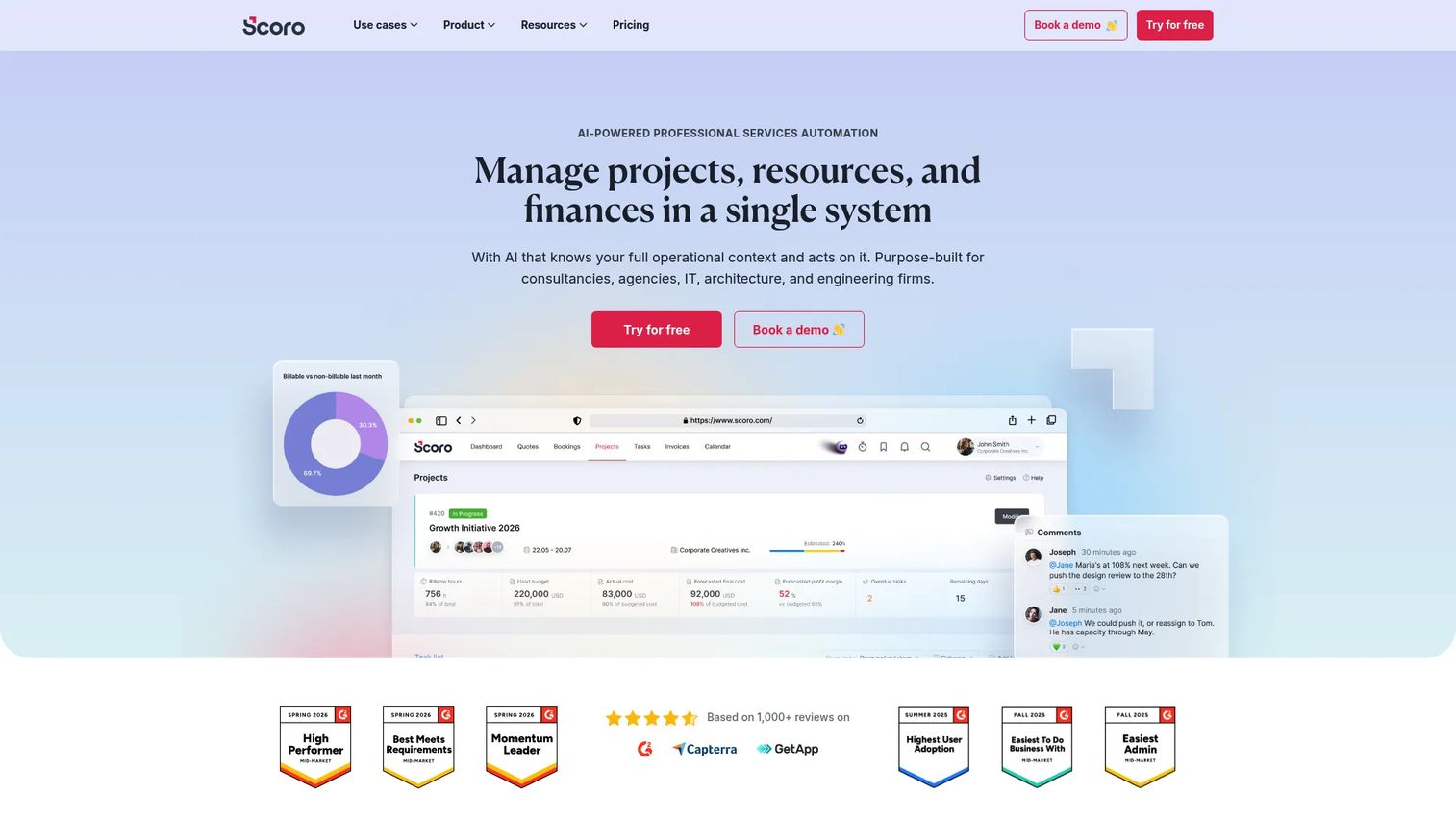
Scoro is an all-in-one PSA platform for service businesses that want project delivery, resource planning, and financial control in one system. It covers the full lifecycle: quoting, project management, resourcing, billing, and reporting. For a founder tired of exporting spreadsheets to answer a simple margin question, that consolidation is the pitch.
Where Scoro earns its place is the connection between the work and the money. A quote becomes a project, time logs against it, and the invoice and profitability report update from the same data. You see project margin and capacity without reconciling three tools.
Best for: Service businesses that need PSA, project delivery, and financial control in one platform.
Key strengths
- Project management with tasks, timelines, and milestones
- Resource planning across teams and capacity
- Reporting and dashboards for profitability tracking
Why choose Scoro: Choose Scoro when you want one platform to own the entire quote-to-cash flow rather than stitching a CRM, PM tool, and billing system together. It fits founders who care most about end-to-end visibility into utilization and margin.
Scoro pricing: Scoro offers tiered plans: Core at $19.90 per user/month, Growth at $32.90, and Performance at $49.90, with a custom Enterprise tier. A 14-day free trial is available, and plans require a minimum of five user seats.
2. Productive
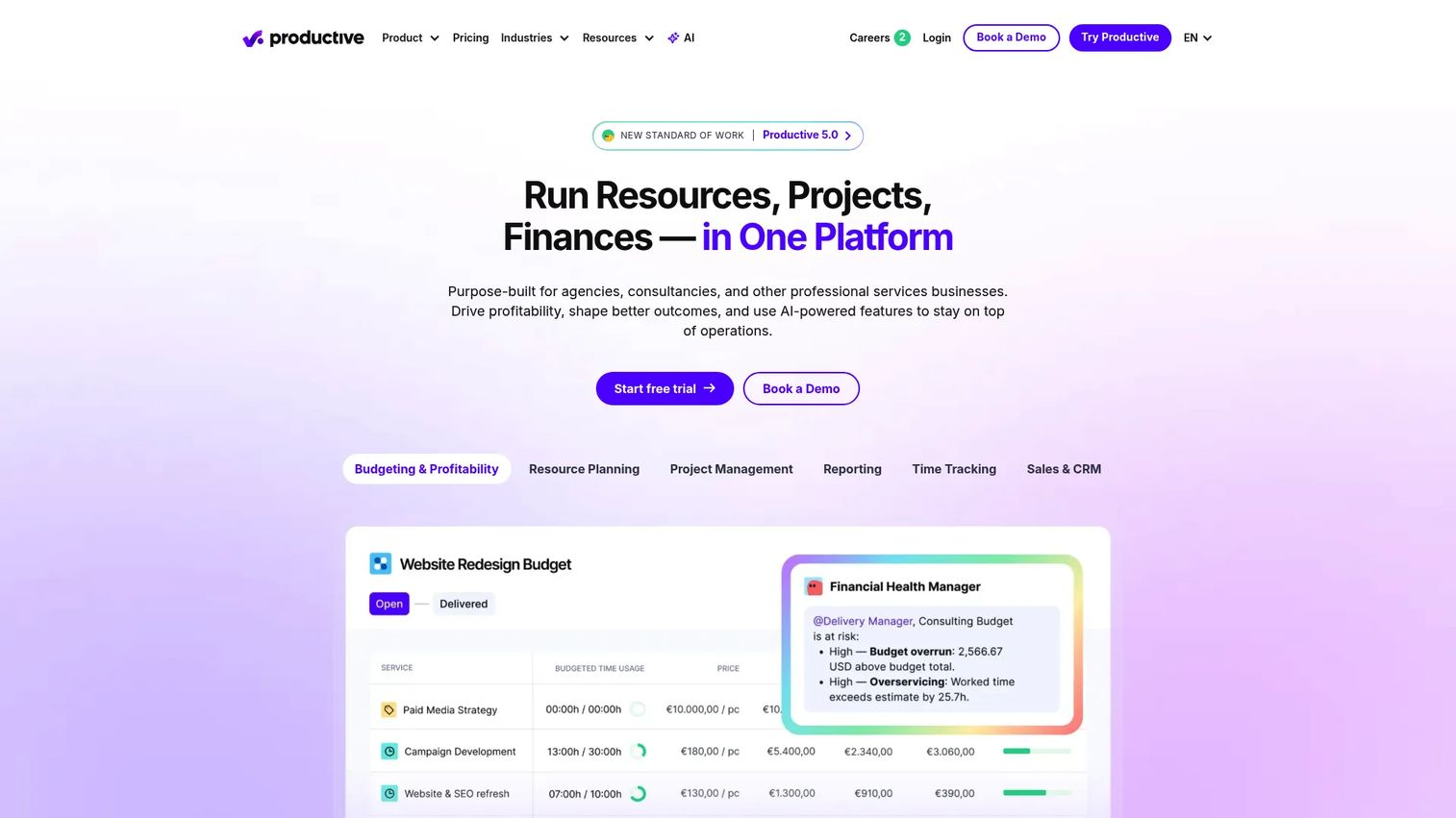
Productive is an operations-first platform for agencies and consultancies that run resources, projects, and finances in one place. Where broader PSA suites lead with quoting or accounting, Productive is built around the daily reality of delivery: who is booked, what is billable, and whether the project is making money.
That focus shows in the budgeting and profitability layer. You set a budget, track time against it, and watch margin move in real time. For a consulting operator who lives in utilization and profitability numbers, that is the core workflow, not a bolt-on report.
Best for: Agencies and consultancies that need one system for project delivery, resource planning, and profitability tracking.
Key strengths
- Budgeting and profitability tracking per project
- Resource planning and project management together
- Time tracking and reporting in one view
Why choose Productive: Choose Productive when resourcing and profitability are your operating heartbeat and you want a system designed around them, rather than a finance suite with project features added. It suits growing services teams that manage margin weekly.
Productive pricing: Productive publishes Essential at $10/month and Professional at $25/month, with an Ultimate tier that requires contacting sales. Monthly and yearly billing options are shown on the pricing page.
3. Sage Intacct
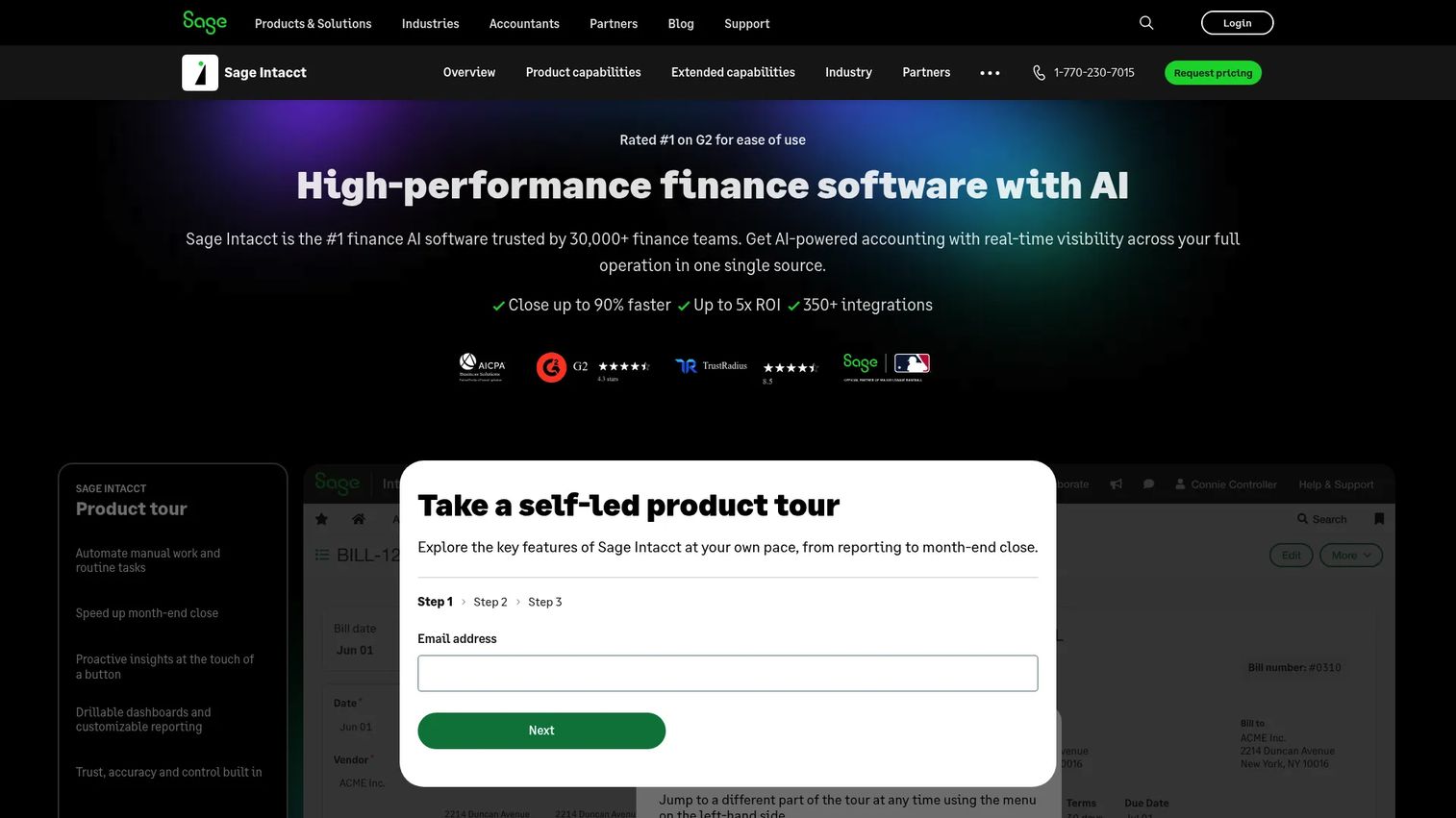
Sage Intacct is cloud financial management software for growing and mid-sized organizations, and it is the finance-heavy pick on this list. Where the other platforms start from project delivery, Sage Intacct starts from the general ledger. That makes it the choice when accounting rigor, not task management, is the constraint.
For consulting firms, its strength is project accounting and multi-dimensional reporting. You track time, cost, and revenue recognition against projects, then slice profitability by client, service line, or region. Finance-minded operators shortlist it for that control and its multi-entity consolidation.
Best for: Mid-sized organizations needing scalable accounting and financial management.
Key strengths
- AI-powered finance automation
- Multi-dimensional profitability reporting
- Multi-entity consolidation
Why choose Sage Intacct: Choose Sage Intacct when financial controls and revenue recognition matter more than an all-in-one delivery experience, and you plan to pair it with a delivery or resourcing tool. It fits firms where the CFO drives the software decision.
Sage Intacct pricing: Sage Intacct uses custom pricing based on modules, company size, and needs. The vendor directs buyers to request a quote rather than publishing public plan prices.
4. Deltek Maconomy
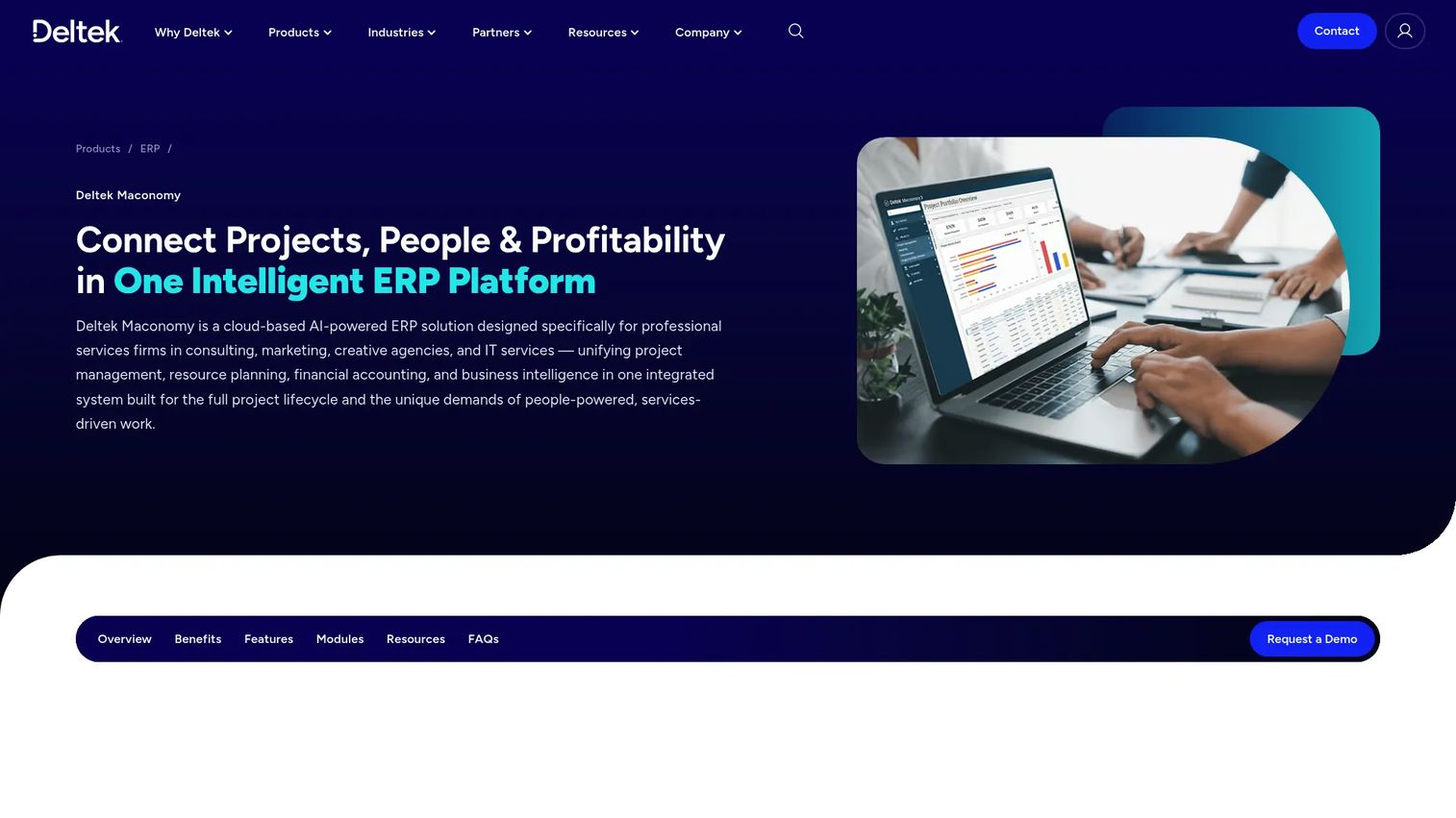
Deltek Maconomy is cloud ERP built specifically for professional services firms. It combines project management and financial accounting in one system, which is what larger consultancies need when spreadsheets and mid-market PSA tools stop scaling. This is the enterprise end of the list.
Maconomy covers the full project lifecycle alongside resource planning, workforce management, and business intelligence. Its AI-powered insights, dashboards, and Smart Summaries give leaders a read on complex, multi-office operations. If your firm runs intricate billing rules, multiple entities, and hundreds of consultants, that depth is the point.
Best for: Large and mid-sized professional services firms needing ERP, project, and financial control.
Key strengths
- Project management and financial accounting unified
- Resource planning with workforce, time, and expense management
- AI-powered insights, dashboards, and Smart Summaries
Why choose Deltek Maconomy: Choose Maconomy when your firm has outgrown lighter PSA tools and needs true ERP depth across finance, resourcing, and reporting. It fits complex, multi-entity consulting organizations, not lean early-stage teams.
Deltek Maconomy pricing: Deltek doesn't list pricing for Maconomy. You'll need to request a demo, and the quote depends on your firm size and requirements.
5. Projectworks
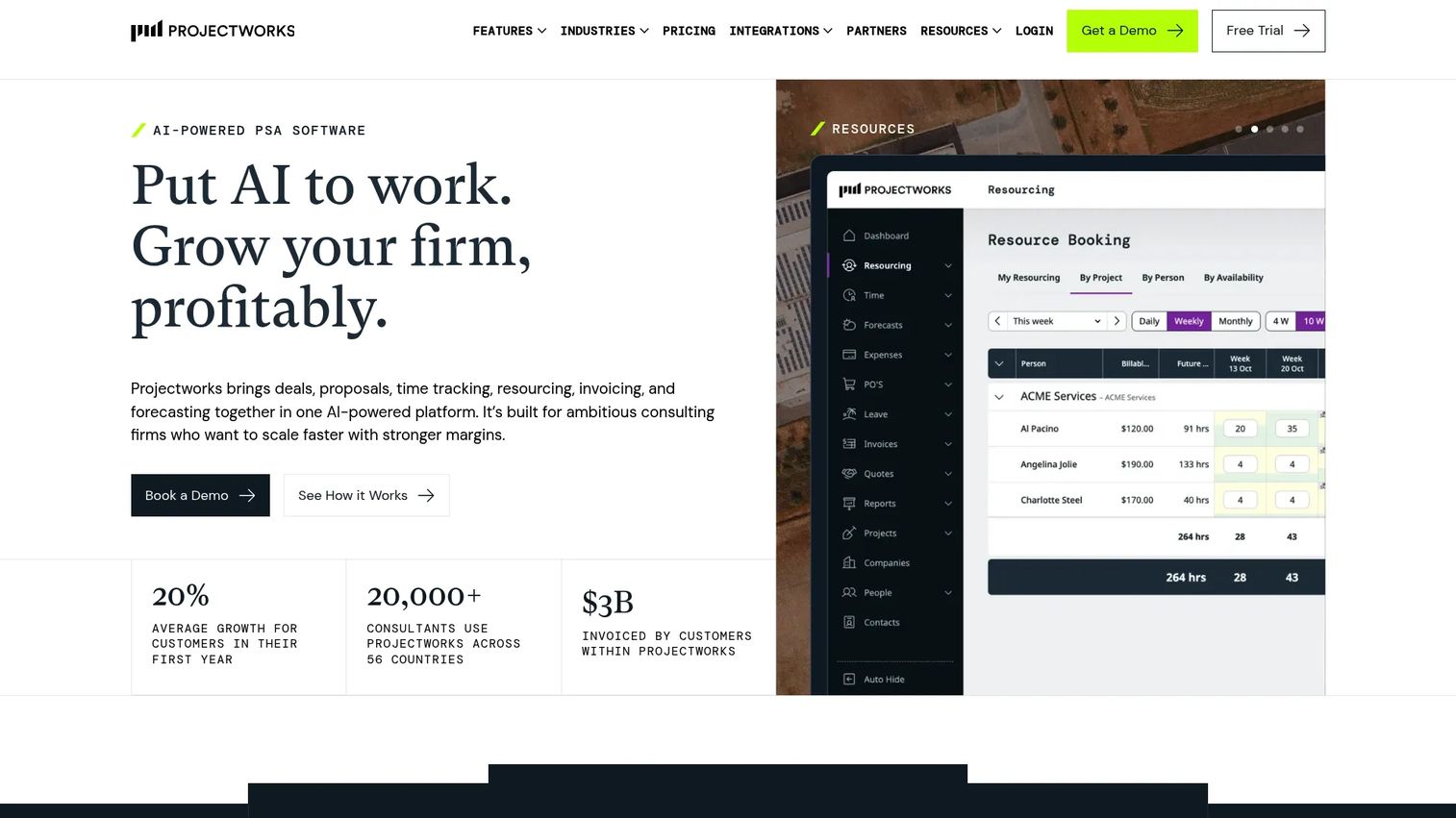
Projectworks is a professional services platform built for consulting firms, covering time tracking, resourcing, invoicing, reporting, and AI-assisted workflows. It sits in the sweet spot for firms that have outgrown spreadsheets but do not need full ERP. The focus is forecastable staffing and billable utilization.
That forecasting depth is why growing firms with limited ops headcount like it. Resource planning and capacity management let you see who is booked weeks out, so you can hire, bench, or sell against real capacity. Invoicing and project financial reporting then tie that utilization straight to revenue.
Best for: Consulting and professional services firms that need PSA-style time, resource, and financial management.
Key strengths
- Time tracking and expense management
- Resource planning and capacity management
- Invoicing and project financial reporting
Why choose Projectworks: Choose Projectworks when utilization forecasting is your priority and you want a focused PSA rather than a sprawling suite. It fits growing consultancies that need to plan staffing without a dedicated operations team.
Projectworks pricing: Projectworks publishes three plans: Build at $17 per user/month, Scale at $24, and Unleash at $41. A 21-day free trial covers all features, and onboarding starts at $1,000.
6. PSOhub
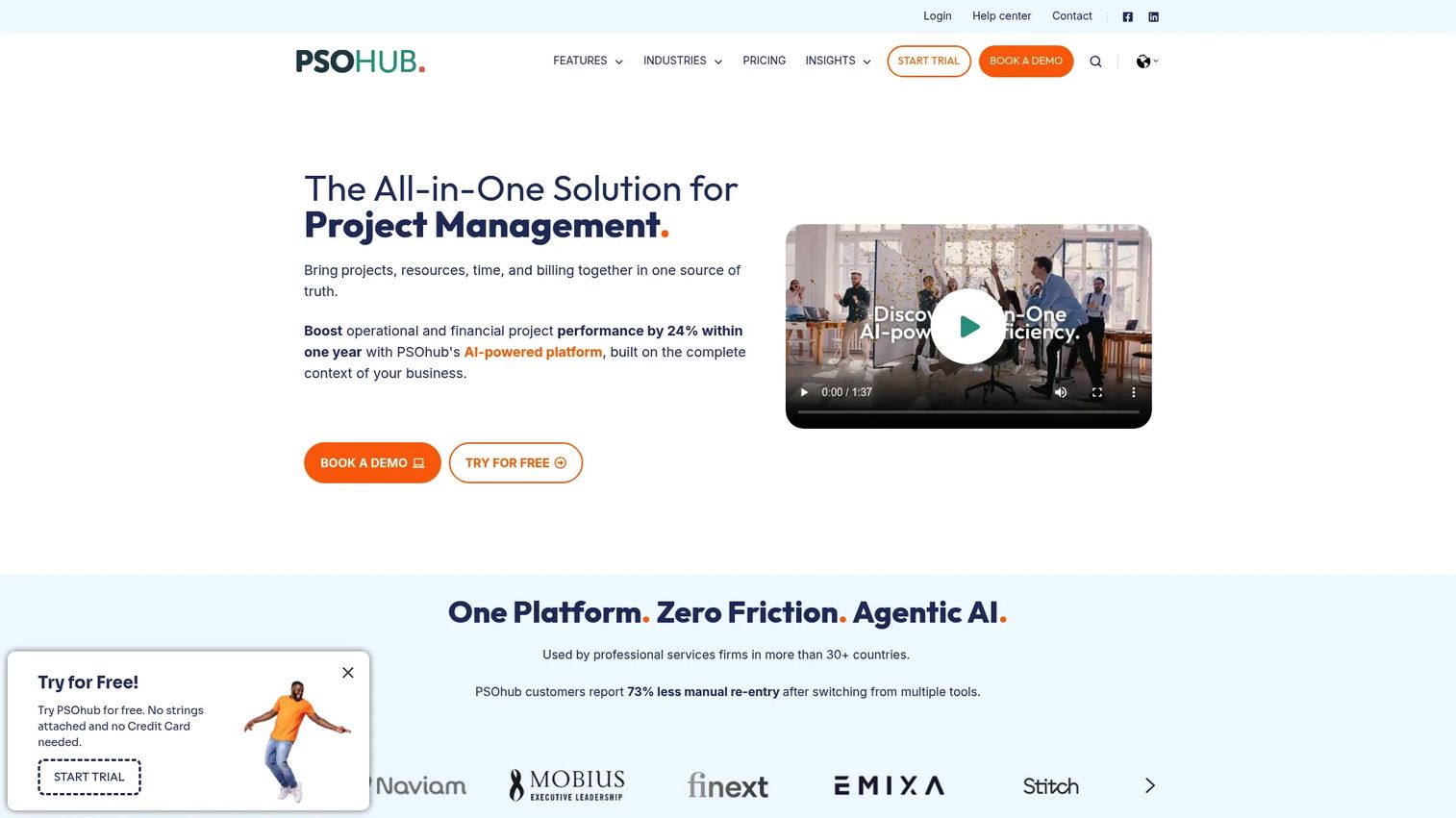
PSOhub is professional services automation software for project management, time tracking, invoicing, and resource management, built to sit close to your CRM. It is the pick for HubSpot-centric service businesses that want delivery and sales data in one connected flow rather than two separate worlds.
For teams that already run sales in HubSpot, PSOhub extends that into delivery: a won deal becomes a project without re-keying. Project planning with Gantt charts and Kanban boards, time and expense tracking with invoicing, and resource and capacity management round out the platform. The value is one system across sales and delivery.
Best for: Professional services teams that need PSA, project delivery, and billing in one system.
Key strengths
- Project planning with Gantt charts and Kanban boards
- Time and expense tracking with invoicing
- Resource and capacity management
Why choose PSOhub: Choose PSOhub when your CRM is the center of gravity and you want PSA that plugs into it, keeping sales and delivery on the same data. It fits teams that value a CRM for consulting firms as much as project delivery.
PSOhub pricing: PSOhub publishes three tiers billed annually: Essentials at €25 per user/month, Professional at €35, and Enterprise at €45. A free tier is available.
7. Plutio
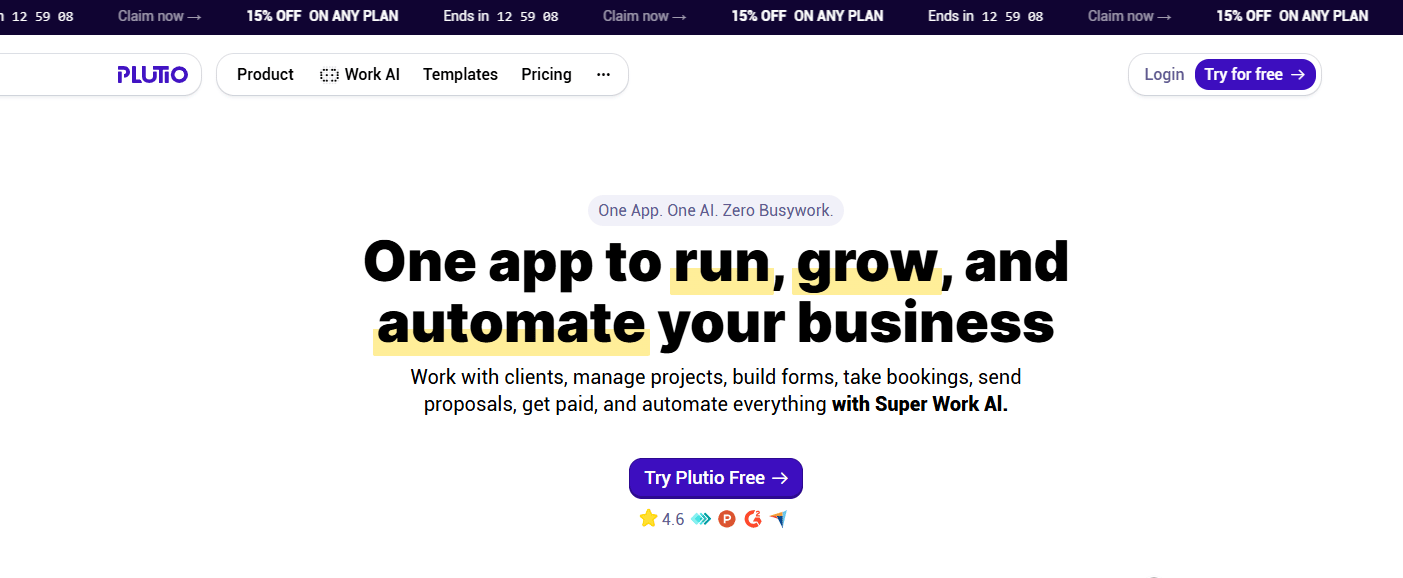
Plutio is an all-in-one business management platform for freelancers, consultants, and small agencies. It is the budget-friendly consolidation pick: proposals, project management, time tracking, scheduling, and invoicing in one workspace, without the price tag or complexity of a full PSA suite.
For a lean team, the appeal is getting off five subscriptions fast. Plutio covers projects, tasks, time tracking, and scheduling alongside proposals, contracts, invoicing, and forms. A client portal, white-label branding, and automations let a small firm look polished while running everything from one place.
Best for: Freelancers and small agencies wanting one workspace for client work and admin.
Key strengths
- Projects, tasks, time tracking, and scheduling
- Proposals, contracts, invoicing, and forms
- Client portal, white-label branding, and automations
Why choose Plutio: Choose Plutio when you are a lean team that wants consolidation and a client portal without enterprise pricing or a long rollout. It fits solo consultants and small agencies more than firms needing deep utilization forecasting.
Plutio pricing: Plutio offers Core at $19/month, Pro at $49/month, and Max at $199/month. Every plan includes the full feature set, and a free trial is available with no payment method required.
Considerations
Before you commit, run the shortlist through these five checks.
Check how much of the stack you want to replace
Decide whether you want an all-in-one system or a best-of-breed setup. All-in-one consulting software cuts tool sprawl and gives one source of truth, but point tools offer more depth in a single area. If your accounting is already strong, a delivery-focused platform that integrates may beat a full suite.
Verify resource planning depth
Task assignment is not resource planning. Confirm the tool forecasts staffing and utilization weeks out, not just who owns today's task. Real resource utilization visibility is what protects margin, so test the forecasting view before you buy.
Check billing and accounting fit
Consulting billing gets messy: retainers, fixed-fee, time-and-materials, milestones. Confirm the platform supports your billing models, tax needs, and existing finance stack. Invoicing software for consultants that cannot handle your mix will create manual work, not remove it.
Review integration coverage
Map the connections you need: CRM, accounting, documents, communication, and automation. A platform that integrates with your general ledger and CRM keeps quote-to-cash intact. Weak integration coverage is where consolidation promises quietly break.
Confirm reporting and profitability visibility
The whole point is seeing margin, capacity, and revenue without manual work. Check that reporting shows profitability by project, client, and service line in a way operators can act on weekly. If the dashboards need an analyst to interpret, they will not get used.
Conclusion
The right consulting firm software depends on your size and operating style. Scoro and Productive suit growing firms that want delivery, resourcing, and finance in one platform. Sage Intacct and Deltek Maconomy fit finance-heavy and enterprise operations that need accounting depth or full ERP. Projectworks is the pick for forecastable utilization, PSOhub for HubSpot-centric teams, and Plutio for lean teams that want fast consolidation.
The decision rule is simple: choose the platform that ties delivery to revenue and margin, so you see what is working without opening five dashboards. That connection between the work you sell and the money it produces is what separates a real operating system from another tool in the stack.
Start with the two or three that match your size, run a trial against a live project, and watch whether utilization and profitability actually become visible. That first week tells you more than any feature list.
FAQs
Consulting software runs the delivery lifecycle for client-services firms: project management, resource planning, time tracking, billing, and profitability reporting. It ties the work you sell to the money it produces, so utilization and margin stay visible in real time instead of surfacing at month-end.
Look for project and resource management, CRM or client workflow coverage, quoting and proposals, invoicing and payments, and reporting with profitability tracking. Strong integrations with your accounting and CRM stack matter just as much, because that is where quote-to-cash either holds together or breaks.
Largely, yes. PSA software (professional services automation) is the category term, and consultant management software and consulting software are common labels for the same job: one platform to run delivery, resourcing, billing, and reporting. Some finance-first tools like Sage Intacct sit adjacent, leading with accounting rather than delivery.
Plutio is the budget-friendly all-in-one for freelancers and small agencies, covering proposals, projects, time tracking, and invoicing in one workspace. Growing small firms that need utilization forecasting often prefer Projectworks, which adds resource planning depth without full ERP complexity.
Sage Intacct leads on project accounting, with multi-dimensional reporting, revenue recognition, and multi-entity consolidation. Deltek Maconomy suits larger firms needing project accounting inside a full ERP. Both fit finance-driven operators who prioritize accounting rigor over an all-in-one delivery experience.
Start with how much of your stack you want to replace, then verify resource planning depth, billing fit, integration coverage, and profitability reporting. Run a trial against a real project and confirm utilization and margin become visible weekly. Choose the platform that ties delivery to revenue.
Yes, that is a core reason to adopt it. By connecting time, cost, and billing against each project, consulting software shows margin by client, service line, and consultant in real time. That visibility lets you fix a slipping project mid-flight instead of discovering the loss after the P&L closes.