
You run a travel business, and your bookings live in five places. A supplier email here. A spreadsheet of allocations there. A phone confirmation nobody logged. Payments reconciled by hand at the end of the week. Every reservation touches a person, and every person is a point where something breaks.
That model holds until it doesn't. Add a location, a new trip type, or a second sales rep, and the cracks widen. Margin leaks. Double bookings happen. Nobody can answer a simple question fast: what did we sell, at what cost, through which channel.
The market is moving toward software that fixes this. The reservation and online booking software market is projected to reach $320.3 billion by 2030, up from $119.76 billion in 2025, growing at a 21.0% CAGR, according to The Business Research Company (2024). That growth is not hype. It reflects travel businesses replacing manual reservation work with systems that centralize inventory, connect suppliers, automate billing, and give founders real visibility.
The right travel booking system does more than take a booking. It becomes the operating layer for how you sell, fulfill, and account for travel at scale. If you have ever evaluated software for business intelligence or wired up analytics that drive ROI, you already know the pattern: consolidate the data, remove the manual steps, and let the system carry the load your team was carrying by hand.
What's inside
This guide covers travel booking software for agencies, tour operators, corporate travel teams, and travel businesses that need booking automation, supplier connectivity, and stronger operational control. It spans consumer marketplaces, business travel platforms, enterprise travel technology, and dedicated tour operator software, so you can match a tool to your business model instead of forcing a generic pick.
We evaluated each option on five criteria that matter to a founder building a repeatable system:
- Booking engine depth and reservation management
- Inventory breadth and supplier connectivity
- Admin automation, billing, and back-office workflow
- Pricing and value relative to your stage
- Implementation fit and time to first value
TL;DR
- Best for broad consumer inventory: Expedia gives agencies and sellers access to a massive marketplace of stays, flights, cars, and packages.
- Best for corporate travel control: Engine centralizes business travel booking with consolidated billing and policy controls, free to join.
- Best for enterprise connectivity and APIs: Amadeus offers deep travel APIs and infrastructure for teams building booking and pricing workflows.
- Best for distribution-heavy retailing: Travelport and Sabre supply GDS-grade infrastructure and modern retailing platforms for agencies and sellers.
- Best for tour and activity operators: Bókun and TrekkSoft handle booking engines, channel management, and operator workflows end to end.
- Best for simple, low-cost booking: Setmore offers free online booking with reminders and payments for smaller, service-oriented travel businesses.
What is travel booking software?
Travel booking software is a system that lets travel businesses search, reserve, manage, and fulfill travel inventory, then handle payments, billing, and reporting from one place. It replaces fragmented email, spreadsheet, and phone workflows with a connected reservation layer.
Depending on the business model, the same category label covers a consumer marketplace, an agency booking tool, a corporate travel platform, or dedicated tour operator software. The core capabilities are consistent across all of them.
- Booking engine and reservation management: search availability, hold, confirm, modify, and cancel bookings with a clean record of every transaction.
- Inventory and supplier connectivity: connect to hotels, airlines, car suppliers, and activity providers so you sell from live, accurate inventory.
- Channel management and distribution: push and sync availability across your own site, marketplaces, OTAs, and resellers through a channel manager.
- Payments, billing, and invoicing: collect payments, support direct billing, reconcile transactions, and generate invoices without manual math.
- Reporting and operational automation: track margin, volume, and channel performance, and automate repetitive back-office steps.
- Integrations and APIs: connect to GDS, third-party inventory, accounting, and CRM systems so bookings flow into the rest of your stack.
That connectivity layer is what separates real travel reservation software from a simple booking page. Mobile is a growing part of it too: mobile app bookings accounted for 52.4% of OTA bookings in 2025, according to Grand View Research (2024). Any modern travel booking system needs to handle mobile as a first-class channel.
When to use travel booking software
Centralize bookings and reduce manual admin
If your team confirms bookings over email, tracks allocations in spreadsheets, and logs payments by hand, you are paying a tax on every reservation. Errors creep in. Double bookings happen. Nobody has a single source of truth. Travel booking software collapses those steps into one system, so a booking is created, confirmed, billed, and recorded without five manual handoffs. This is usually the first reason a founder buys.
Connect suppliers, APIs, and channels
A booking page is fine until inventory breadth becomes the constraint. When you need live availability from multiple hotels, airlines, or activity suppliers, and you want to distribute across your own site plus marketplaces and resellers, connectivity matters more than the checkout. This is where APIs, a channel manager, and GDS access earn their keep. Teams building custom booking flows lean on API-first platforms; teams reselling inventory lean on channel managers and distribution networks.
Scale operations across locations, teams, or trip types
Consistency is the hard part of scale. When you add a location, a new trip category, or more sales reps, you need process consistency, billing controls, and visibility that does not depend on one person's memory. The right travel agency management software enforces the same workflow everywhere, gives finance clean billing and reconciliation, and shows leadership margin and volume by channel in real time. That is what makes the business repeatable instead of founder-dependent.
Comparison table
Here is a side-by-side view of all eight platforms, sorted by relevance to the primary keyword. Pricing and ratings reflect verified public sources at the time of writing. Where a vendor uses sales-led pricing, we note that instead of guessing.
| # | Product | Intent | Key differentiation | Pricing | G2 rating |
|---|---|---|---|---|---|
| 1 | Expedia | Consumer travel inventory and agency access | Massive marketplace of stays, flights, cars, packages | Free to join; consumer deals from ~$83/night | Not verified |
| 2 | Engine | Corporate and business travel | Consolidated billing, policy controls, free to join | Free to join and use | Not verified |
| 3 | Amadeus | Enterprise travel tech and APIs | Deep travel APIs with free monthly request quota | Free API quota, pay-as-you-go | 4.7/5 |
| 4 | Travelport | Agency retailing and distribution | Travelport+ modern retailing, multi-source content | Contact sales | 4.5/5 |
| 5 | Sabre | Airline and agency distribution | Sabre Mosaic platform, AI-powered Sabre IQ | Sales-led pricing | Not verified |
| 6 | Bókun | Tour and activity operators | Booking widgets plus channel manager and marketplace | Free plan; paid from $49/mo | 4.5/5 |
| 7 | Setmore | Small and service-oriented booking | Free online booking with reminders and payments | Free plan; Pro from $5/user/mo | Not verified |
| 8 | TrekkSoft | Tour and activity operations | Booking engine, POS, and free website builder | From €49/mo | 4.4/5 |
1. Expedia
Expedia is an online travel marketplace for booking stays, flights, cars, packages, cruises, and activities. For travel sellers and agencies, its value is inventory breadth: one of the largest consumer travel catalogs in the world, plus partner programs that let agents book on behalf of clients. If your business depends on wide, competitive inventory rather than owning supplier relationships yourself, Expedia is the reach layer.
Best for: Travelers and agencies that need broad consumer travel inventory and bundled trip deals.
Key strengths
- Broad inventory: Stays, flights, cars, packages, things to do, and cruises in one marketplace.
- Loyalty and pricing: Member Prices and the One Key loyalty program create repeat-booking incentives.
- Price tracking: The Expedia app tracks prices, helping agents and travelers time bookings.
Why choose Expedia: Choose Expedia when your model relies on accessing a huge pool of consumer travel inventory rather than building direct supplier contracts. It is the reach and deals engine, strongest for leisure agencies and sellers who compete on breadth and price rather than bespoke itineraries.
Expedia pricing: Expedia is a consumer marketplace with no SaaS subscription tier. It is free to join through the One Key program, and public hotel deals surface from around $83 per night. There is no per-seat software pricing to evaluate; the economics are commission and margin based rather than a monthly license.
2. Engine
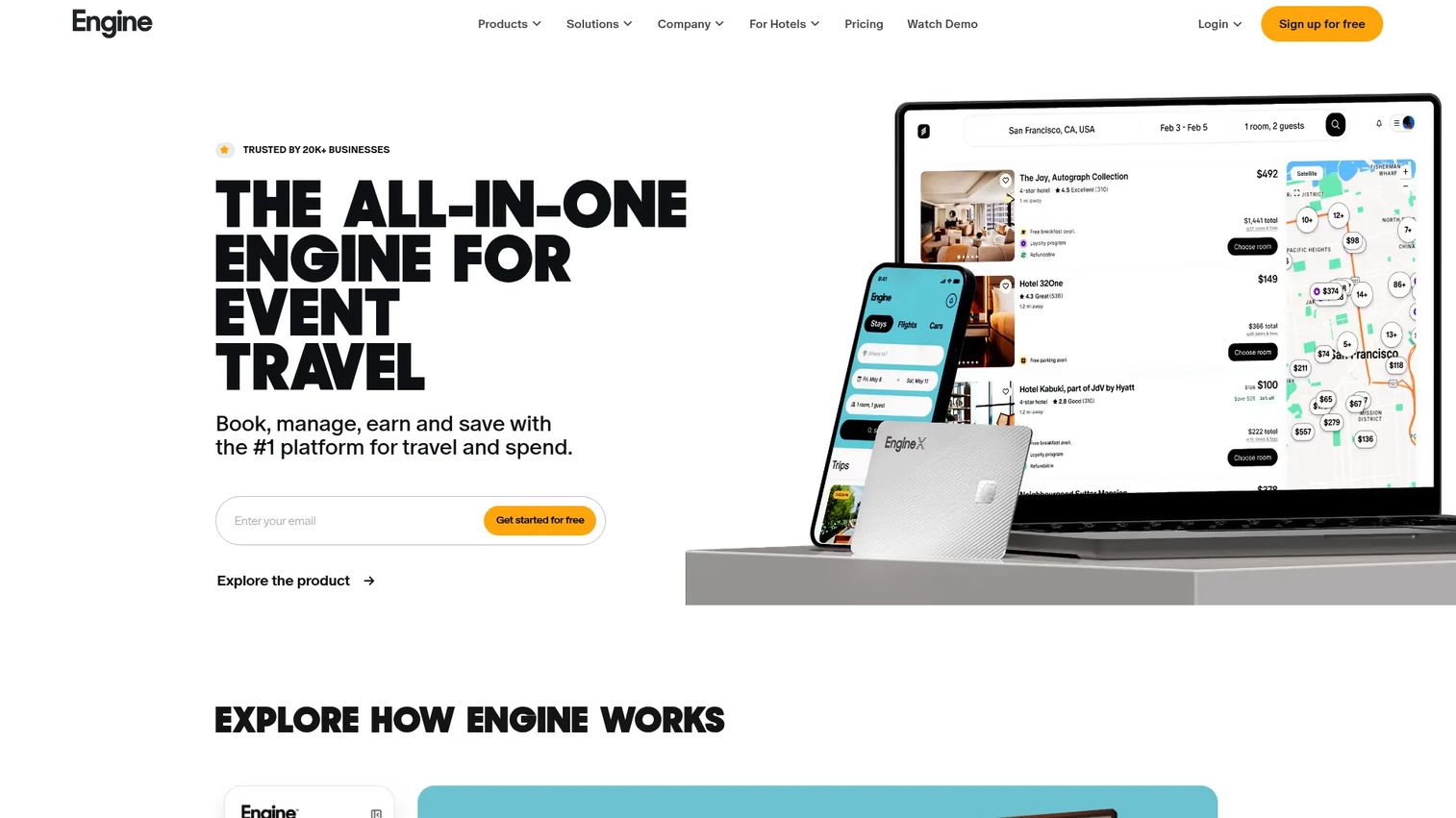
Engine is a business travel management platform for booking and managing hotels, flights, rental cars, and group travel. It is built for teams that want control and savings without the friction of a traditional corporate travel program. The pitch that lands with a founder is simple: centralize business travel, put policy and spend controls in place, and stop reconciling travel expenses by hand.
Best for: Companies that want a free-to-join business travel platform with hotel-heavy booking needs.
Key strengths
- Unified booking: Book flights, hotels, and rental cars in one platform across your team.
- Consolidated billing: Direct Bill removes per-trip expense reconciliation and centralizes spend.
- Policy controls: Travel policy settings and flexible booking options keep bookings compliant.
Why choose Engine: Choose Engine when your priority is controlling and simplifying business travel rather than reselling inventory to clients. It fits corporate travel and group travel use cases, and the consolidated billing model is what removes the most manual admin for finance teams.
Engine pricing: Engine states it is free to join and use, with no membership fees, contracts, or minimum spend. The first-party pricing page shows no paid plan amount; the model is built around booking through the platform rather than a subscription. For a cost-conscious team at Series B scale, a free-to-join travel business software with billing controls is an easy trial.
3. Amadeus
Amadeus is a global travel technology provider offering software and APIs for airlines, travel sellers, and travel operations. For teams building their own booking flows, Amadeus is infrastructure: travel APIs for flights, hotels, cars, and destination content, plus the pricing and booking workflows that power a large share of the industry. If your engineering team wants to build rather than buy a front end, this is where you connect.
Best for: Travel companies and developers building booking, pricing, and travel-data workflows.
Key strengths
- Travel APIs: Flights, hotels, cars, and destination content available through documented APIs.
- Developer-friendly quota: Self-service and production environments with a free monthly request quota.
- Seller tools: Pricing and booking workflows built for travel sellers at scale.
Why choose Amadeus: Choose Amadeus when connectivity depth and API access matter more than an out-of-the-box interface. It is the right foundation for integrations-heavy builds, custom booking engines, and travel operations that need deep data. It rewards teams with developer bandwidth to assemble the experience they want.
Amadeus pricing: Amadeus for Developers publishes self-service APIs with a free monthly request quota in both test and production, then pay-as-you-go billing for additional calls. No fixed numeric price is listed publicly for the broader enterprise products; pricing scales with usage and product line. Amadeus holds a 4.7/5 rating on G2, the strongest verified score in this roundup.
4. Travelport
Travelport provides travel commerce infrastructure and retailing software for agencies and travel sellers. Its flagship is Travelport+, a modern retailing platform that aggregates multi-source content, including NDC, flights, hotels, car, and rail, into one workflow. For a distribution-heavy business, Travelport is the connectivity backbone that keeps agents selling from a single, rich content set.
Best for: Travel agencies and travel sellers needing modern retailing infrastructure.
Key strengths
- Travelport+ platform: Modern retailing workflow that unifies agent booking and servicing.
- Multi-source content: NDC, flights, hotels, car, and rail aggregated in one place.
- Flexible access: Smartpoint and an API Suite let teams choose interface or integration.
Why choose Travelport: Choose Travelport when your business runs on breadth of distribution and you want modern retailing across NDC and legacy content. It suits agencies that need a serious booking engine for travel agents and the connectivity to sell across sources without stitching feeds together manually.
Travelport pricing: Travelport does not publish public pricing. The Travelport+ product page directs buyers to contact sales for a customized proposal, which is standard for GDS-grade infrastructure priced by volume and configuration. Travelport holds a 4.5/5 rating on G2. Expect a sales-led evaluation with implementation scoping rather than a self-serve signup.
5. Sabre
Sabre is a travel technology platform provider for airlines, agencies, and travel suppliers. Its newer stack centers on Sabre Mosaic for airlines and agencies, paired with the AI-powered Sabre IQ layer and modular suites for retail, service, payments, and insights. Like other GDS-scale players, Sabre is infrastructure for businesses that live and die by distribution reach.
Best for: Airlines and travel agencies needing enterprise travel retailing and distribution software.
Key strengths
- Sabre Mosaic: A retailing and distribution platform built for airlines and agencies.
- Sabre IQ: AI-powered layer for insights and decisioning across the workflow.
- Modular suites: Retail, service, payments, and insights modules you can adopt in pieces.
Why choose Sabre: Choose Sabre when you operate at the scale where enterprise travel retailing, deep distribution, and modular adoption matter. It fits agencies and suppliers that want a broad platform they can grow into module by module, rather than a single narrow tool.
Sabre pricing: Sabre uses non-public, sales-led pricing. Product pages confirm the platform and feature positioning, but no public numeric pricing is available on sabre.com, which is typical for enterprise travel distribution contracts. Plan for a scoped commercial conversation rather than a published rate card when you evaluate it.
6. Bókun
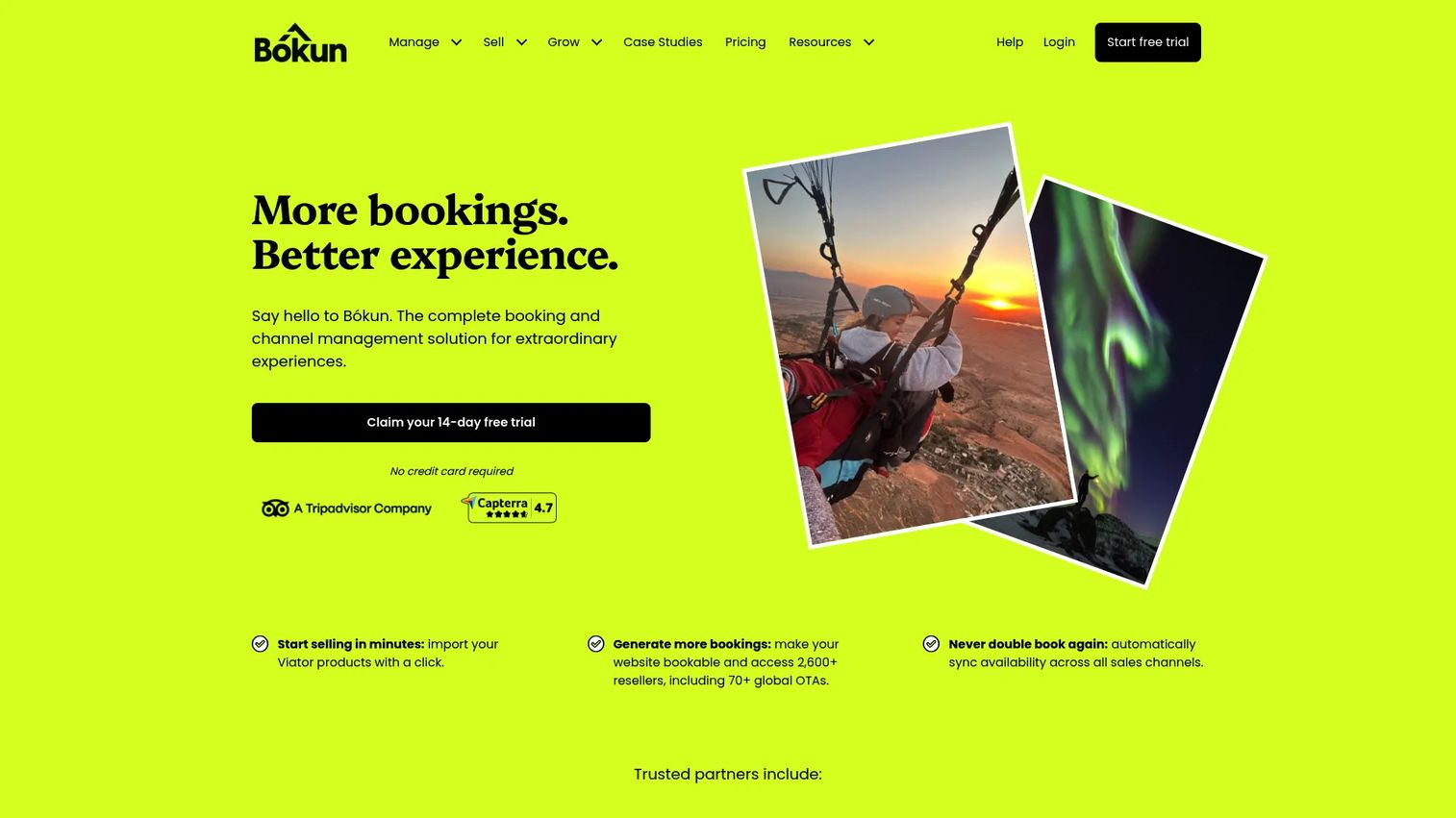
Bókun is booking management and channel management software for tour and activity operators and resellers. Backed by Tripadvisor, it pairs a booking website builder and widgets with a channel manager that plugs operators into major marketplaces. For a tour operator that wants direct bookings and broad distribution from one tool, Bókun is a clean fit.
Best for: Tour and activity businesses needing booking, channel, and distribution management.
Key strengths
- Booking builder: A booking website builder and embeddable widgets for direct sales.
- Channel manager: Marketplace access to distribute inventory across resellers and OTAs.
- Pricing and allocation: Pricing tools and an allocation manager to control capacity.
Why choose Bókun: Choose Bókun when you run tours or activities and want both direct booking and reseller distribution without managing two systems. Its channel manager and marketplace access make it strong online tour booking software for operators focused on filling capacity across every channel.
Bókun pricing: Bókun publishes clear tiers: a FREE plan, START at $49 per month, PLUS at $149 per month, and PREMIUM at $499 per month. Paid plans carry booking fees of 1.5%, 1.25%, and 1% respectively, and there is a 14-day free trial. Bókun holds a 4.5/5 rating on G2. The free plan makes it easy to test before committing to a paid tier.
7. Setmore
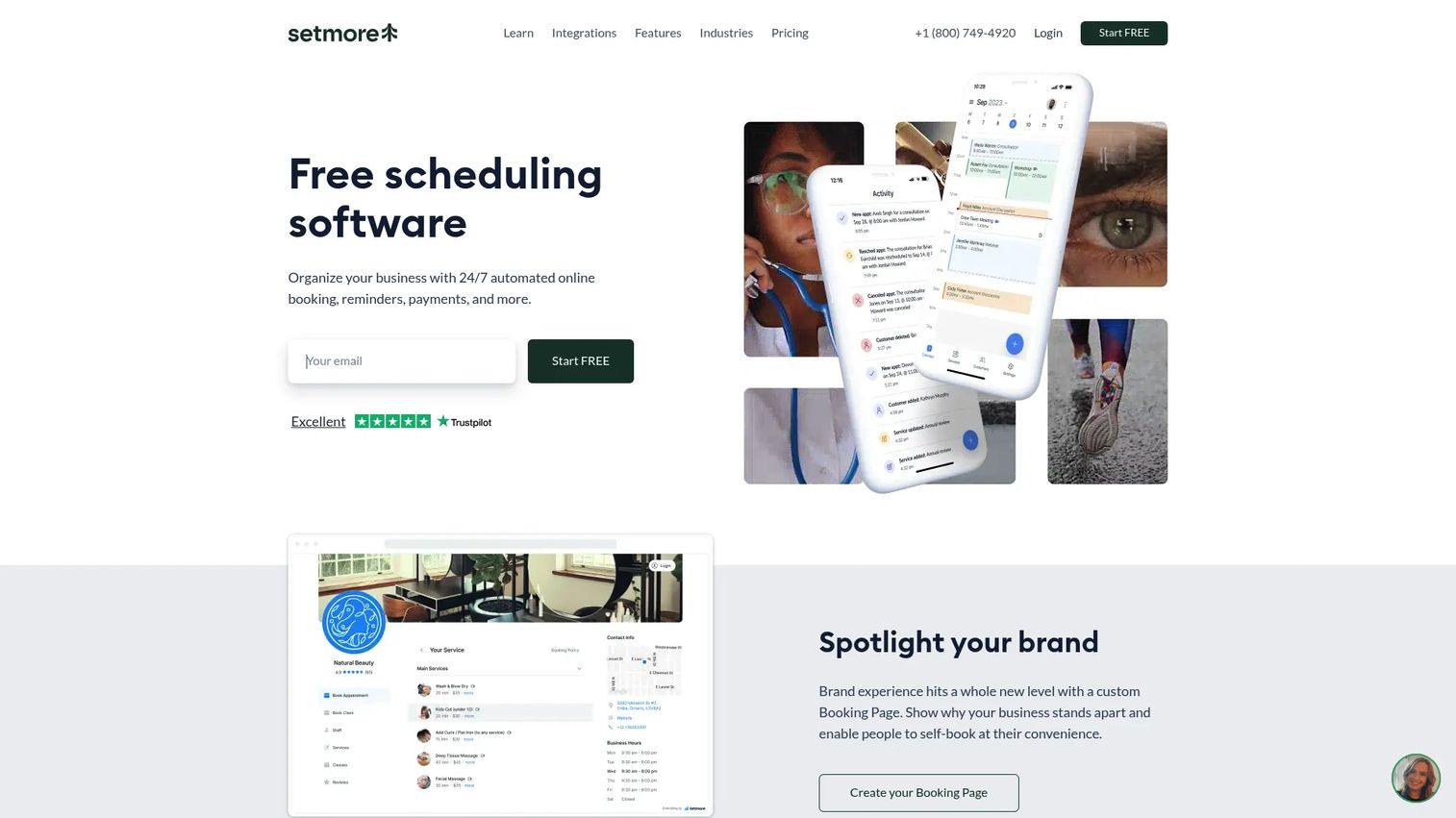
Setmore is online appointment scheduling software for bookings, reminders, payments, and calendar management. It is not a GDS or a channel manager, and that is the point. For smaller, service-oriented travel businesses, single-guide tours, day experiences, or appointment-style bookings, Setmore keeps things simple and cheap while still handling the essentials.
Best for: Small businesses needing simple appointment booking with optional paid scheduling features.
Key strengths
- Online booking page: A branded booking page with 24/7 self-booking for customers.
- Reminders: Automated reminders reduce no-shows without manual follow-up.
- Payments: Take payments via Stripe, Square, or PayPal at the point of booking.
Why choose Setmore: Choose Setmore when your booking needs are appointment-style rather than multi-supplier inventory management. It is the practical booking software tours pick for a solo operator or small team that wants a clean self-booking page, reminders, and payments without enterprise complexity or cost.
Setmore pricing: Setmore offers a Free plan for up to four users. Paid plans start at Pro from $5 per user per month on annual billing, with Premium and Pro+ tiers adding more capability. The free tier alone covers a lot of ground for a small travel business, which makes Setmore one of the lowest-barrier ways to start taking online bookings.
8. TrekkSoft
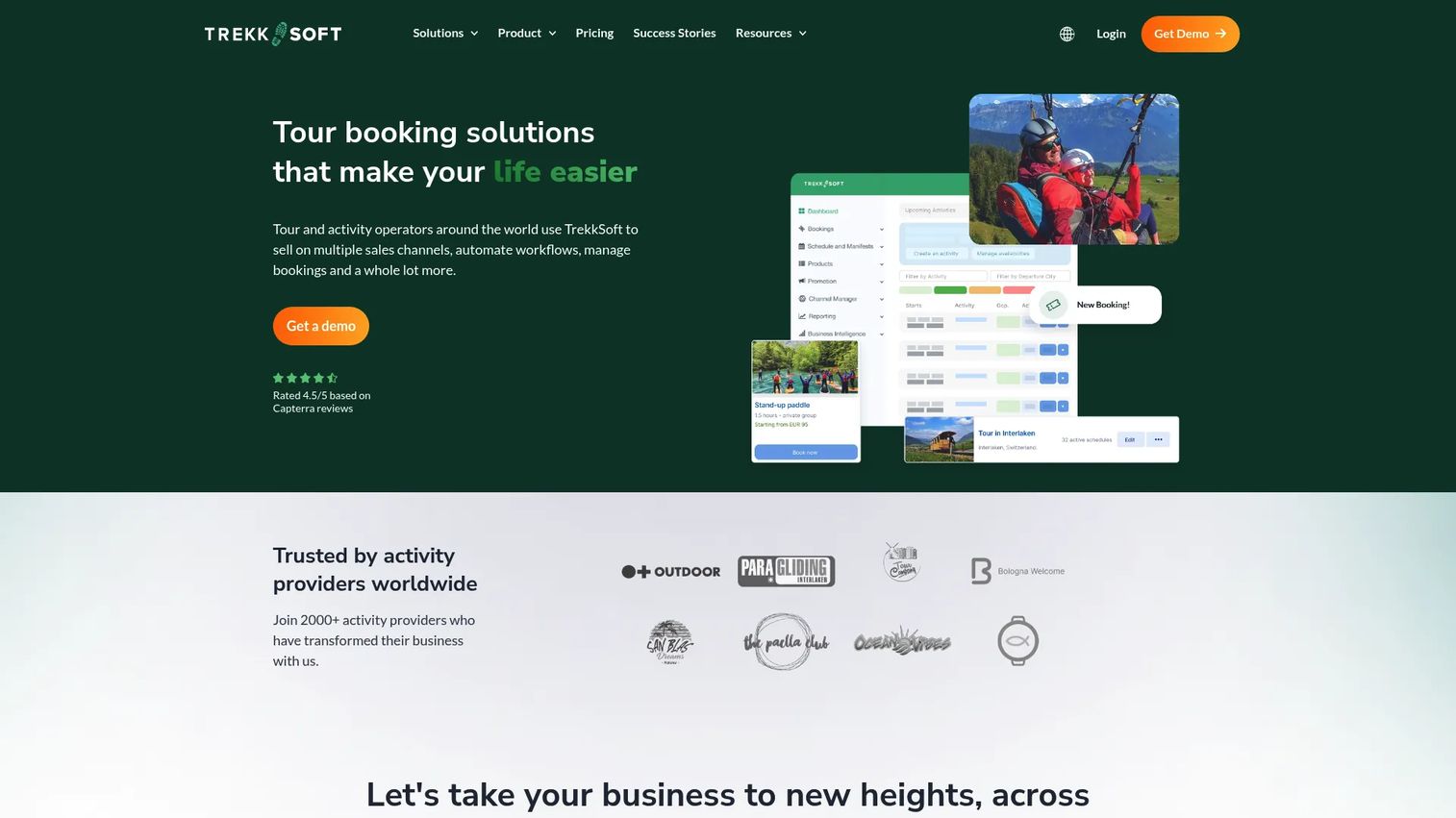
TrekkSoft is booking and reservation software for tour and activity operators. It bundles an online booking widget, a free website builder, and a POS with a mobile app for walk-ins and rentals, so operators can sell online and on-site from one system. For a tour operator that wants operations and booking in a single platform, TrekkSoft covers the full workflow.
Best for: Tour and activity operators that need booking, distribution, and operations tools in one platform.
Key strengths
- Booking widget: An embeddable online booking widget and checkout for direct sales.
- Website builder: A free website builder to launch a booking-ready site quickly.
- POS and mobile: A POS and mobile app to handle walk-ins, rentals, and on-site sales.
Why choose TrekkSoft: Choose TrekkSoft when you want one platform for both online and in-person tour sales, plus channel distribution. It is well-suited tour operator software for operators who sell across a website, a physical desk, and third-party channels and want those threads in one reservation system.
TrekkSoft pricing: TrekkSoft lists three plans: Starter at €49 per month, Accelerate at €149 per month, and Ultimate at €249 per month, with a 14-day free trial across plans. TrekkSoft holds a 4.4/5 rating on G2. The tiered structure lets a growing operator start lean and move up as booking volume and distribution needs increase.
Considerations before you buy
Picking travel booking software is a business-model decision, not a feature checklist. Run each candidate through these criteria before you commit.
Match the tool to your business model
Consumer marketplaces, corporate travel platforms, GDS infrastructure, and tour operator software solve different problems. An agency reselling broad inventory needs different software than a tour operator filling activity slots. Name your model first, then shortlist.
Inventory and connectivity depth
Ask how the platform sources inventory and how it distributes. Does it connect to the suppliers, GDS, and channels you actually sell through? A channel manager and API access matter far more than a pretty checkout if distribution is your growth lever.
Automation and back-office fit
The real ROI is in removed manual work. Look at billing, direct billing, reconciliation, invoicing, and reporting. A platform that automates finance and produces clean margin data by channel is worth more than one with a nicer front end.
Pricing model and stage fit
Free-to-join platforms and low monthly tiers let you test without a big commitment. Sales-led GDS pricing means longer evaluation and scoping. Match the commercial model to your stage and cash position, and confirm what scales with volume.
Implementation and time to value
A booking system you cannot roll out quickly costs you in delayed value. Check setup effort, integrations with your existing stack, and how fast your team hits its first live booking. The same discipline applies to any software purchase, whether it is contract management or event management tooling.
Conclusion
There is no single best travel booking software, only the best fit for how your business sells travel. Sort by model and the shortlist gets clear fast.
- For broad consumer inventory and agency reach, Expedia is the deals and breadth engine.
- For corporate travel control and consolidated billing, Engine gives you spend controls free to join.
- For enterprise connectivity and API-heavy builds, Amadeus, Travelport, and Sabre supply the distribution and retailing infrastructure.
- For tour and activity operators, Bókun and TrekkSoft cover booking, channel management, and operations end to end.
- For simple, low-cost booking, Setmore handles self-booking, reminders, and payments.
Start by naming your business model and your single biggest source of manual work. Then trial the one or two platforms that map to it. Most of these offer a free plan, a free trial, or a free-to-join model, so you can validate fit against your real bookings before you sign anything. Whatever you choose, the goal is the same: a repeatable system that runs without routing every booking through you.
FAQs
Travel booking software is a system that lets travel businesses search, reserve, manage, and fulfill travel inventory, then handle payments, billing, and reporting in one place. It replaces manual email, spreadsheet, and phone workflows with a connected reservation layer. Depending on the model, it can be a consumer marketplace, an agency tool, a corporate travel platform, or tour operator software.
At minimum, look for a booking engine and reservation management, inventory and supplier connectivity, channel management, payments and billing, reporting, and integrations or APIs. The right mix depends on your model. A reselling agency prioritizes inventory breadth and a channel manager, while a corporate team prioritizes policy controls and consolidated billing.
A booking engine is the component that searches availability and processes a reservation. Travel booking software is the broader system around it: inventory connectivity, channel distribution, billing, reporting, and integrations. A booking engine takes the booking; the full travel booking system runs the operation, from supplier connection to invoice to margin report.
For agencies, the answer depends on whether you resell consumer inventory or run distribution at scale. Expedia gives leisure agencies broad marketplace access, while Travelport and Sabre provide GDS-grade retailing and distribution infrastructure. Amadeus fits agencies that want to build custom booking flows on top of travel APIs.
Bókun and TrekkSoft are both built specifically for tour and activity operators. Bókun pairs a booking builder with a channel manager and Tripadvisor-backed marketplace access. TrekkSoft bundles online booking, a website builder, and a POS with a mobile app for walk-ins and rentals, which suits operators selling both online and on-site.
Yes, most serious platforms do. Amadeus, Travelport, and Sabre are built around API access and GDS connectivity for teams building custom workflows. Bókun and TrekkSoft include channel managers that push inventory to marketplaces and resellers. Confirm that the specific suppliers, GDS, and channels you sell through are supported before you commit.
Pricing spans a wide range. Setmore offers a free plan with Pro from $5 per user per month, Bókun starts free with paid tiers from $49 per month, and TrekkSoft starts at €49 per month. Engine and Expedia are free to join, earning on booking economics. Enterprise platforms like Travelport and Sabre use sales-led pricing scoped to volume and configuration.
Start with your business model, then weigh inventory and connectivity depth, back-office automation, pricing fit for your stage, and time to first live booking. The biggest ROI usually comes from removing manual reservation and billing work, not from the flashiest booking page. Trial a free plan or free trial against real bookings before you sign a contract.