You added a 401(k) because a candidate asked about it, or because the board flagged retention. Then the real work started. Payroll deductions have to sync every cycle. Contributions have to hit the right accounts. Compliance testing has to pass. And somehow it all lands on your finance lead, who is already stretched thin closing the month.
That is the actual problem with choosing 401k software. It is not picking a retirement plan that sounds modern. It is picking infrastructure that removes admin work instead of adding a system someone has to babysit every payroll run.
Americans hold $9.9 trillion in 401(k) plan assets, part of $47.6 trillion in total US retirement assets, according to the Investment Company Institute (2026). The stakes for getting the operational layer right keep rising as your headcount grows. A plan that leaks manual work slows down your team the same way a broken onboarding flow slows down activation. If you have shopped for other operational tooling, like audit management software or business intelligence platforms, you already know the pattern: the tool that wins is the one your team stops thinking about.
This guide ranks seven of the top 401k providers by the factors that decide whether the plan runs itself or eats hours: payroll integration depth, compliance support, setup speed, plan flexibility, and how much ongoing management it removes from your team.
What's inside
This list is for founders, finance leads, RevOps operators, and HR teams comparing 401k software and retirement plan providers in 2026. It covers seven platforms across small business 401k needs, midsize plans, and bundled payroll setups.
We ranked each tool on four criteria: payroll integration and automated contributions, compliance and administration support, pricing clarity, and plan flexibility across Traditional 401(k), Safe Harbor 401(k), Solo(k), and 403(b) options. The goal is operational fit, not brand familiarity. If you want less manual work and more reliable execution, this is built for you. For adjacent operational picks, our roundups of best contract lifecycle management software and best event management software follow the same fit-first logic.
TL;DR
- Best overall for integrated payroll plus 401(k): Guideline, now operating as Gusto 401(k), for the cleanest payroll sync and automated administration.
- Best for broad platform flexibility and multiple savings products: Vestwell, for 401(k), 403(b), Solo(k), 529, and more on one platform.
- Best for fast setup and budget-conscious teams: 401GO, for transparent tiers and quick plan setup.
- Best for high-trust, scaled administration: Human Interest, for payroll integrations across 500+ providers and automated compliance.
- Best for advisor-friendly financial wellness: Betterment at Work, for investment guidance plus a clean employee experience.
- Best for bundled payroll buyers: Paychex, when you want payroll, HR, and retirement from one vendor.
- Best for cost-conscious smaller teams: Employee Fiduciary, for transparent flat-fee administration.
What is 401k software?
401k software is the platform layer employers use to set up, administer, and run a retirement plan, syncing payroll, processing employee contributions, handling compliance filings, and giving savers self-serve access.
Modern 401k plan providers usually handle the full operational stack rather than just holding assets. Here is what buyers should expect from a serious platform in 2026:
- Payroll integration and payroll sync: automatic deduction of contributions each pay cycle, with fewer manual uploads and reconciliation errors.
- Automated contributions and contribution management: deferrals, employer matches, and true-ups processed without spreadsheet handoffs.
- Compliance and administration: nondiscrimination testing, Form 5500 filing, and Safe Harbor plan design support.
- Employer portal and plan management: a single online portal to add employees, adjust contributions, and track plan health.
- Saver self-serve access: a mobile app, login flow, and online portal so employees manage their own accounts.
- Multiple plan types: Traditional 401(k), Safe Harbor 401(k), Solo(k), and sometimes 403(b) for nonprofits.
- Advisor ecosystem: white-label, co-branded portals, and partner portals for firms that manage plans on behalf of clients.
The best 401k companies compress all of this into a system your team touches rarely, not one they manage weekly. That distinction, self-running versus high-maintenance, is what this ranking measures. Getting employees to actually use the portal matters too, which is why a strong onboarding flow inside the platform separates good providers from great ones.
When to use 401k software
Streamline payroll-connected retirement administration
You need dedicated 401k software the moment contributions stop being a one-line item and become a recurring reconciliation task. When deferrals, matches, and eligibility changes run through every payroll cycle, manual tracking breaks down fast. Automated deductions and contribution management cut the error rate and free your finance team from chasing mismatches between payroll and the plan record.
Reduce founder or finance team babysitting
If your team is still manually uploading contribution files, answering the same employee questions, and firefighting compliance deadlines, the plan is a drag on time you cannot spare. The right retirement plan providers automate testing, filings, and notices, so the work moves off the founder and finance lead. That is the same handoff logic behind picking any repeatable system: it should run without you in the loop.
Support multiple employee or partner access points
Employers, employees, and advisors all need different views. Employers manage the plan, employees track their own savings, and advisors or partners may need co-branded portals to service accounts. When your setup involves an advisor ecosystem or partner portals, choose software with white-label and self-serve access built in. Teams building broader partner motions often pair this thinking with a partner ecosystem strategy.
Comparison table
The table below ranks the seven platforms by fit for a growing company that wants payroll integration, automation, and less admin overhead. Pricing reflects each vendor's published rates as of mid-2026; verify current figures before you commit, since tiers change.
| # | Product | Intent | Key differentiation | Pricing | G2 rating |
|---|---|---|---|---|---|
| 1 | Guideline | Integrated payroll plus 401(k) | Native Gusto payroll sync, automated compliance | From $39/mo + $4/participant | 4.5/5 |
| 2 | Vestwell | Broad savings platform | 401(k), 403(b), Solo(k), 529, and more | From $45/mo | 3.5/5 |
| 3 | 401GO | Fast, affordable setup | Transparent tiers, quick plan setup | From $19/mo | 4.8/5 |
| 4 | Human Interest | Scaled, automated admin | 500+ payroll integrations | From $80/mo + $5/employee | 4.3/5 |
| 5 | Betterment at Work | Advisor-friendly wellness | Investment guidance plus financial wellness | From $100/mo + $5/participant | 4.3/5 |
| 6 | Paychex | Bundled payroll buyers | Payroll, HR, and retirement in one vendor | Custom quote | 4.1/5 |
| 7 | Employee Fiduciary | Cost-conscious small teams | Transparent flat-fee administration | From $500 setup | 4.3/5 |
1. Guideline
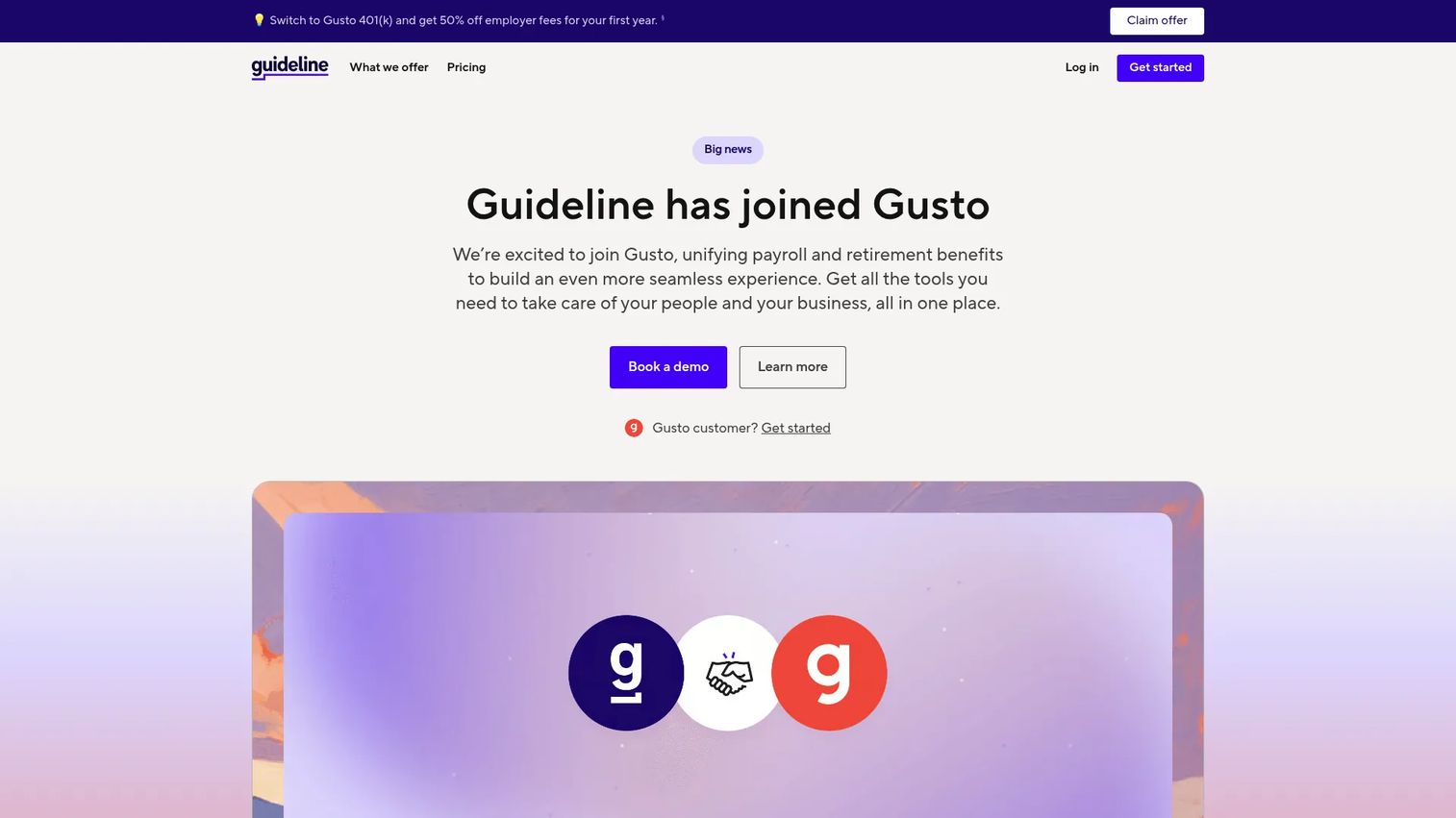
Guideline, now operating as Gusto 401(k), is built for small and midsize businesses that want a managed 401(k) wired directly into payroll. The pitch is simple: contributions sync automatically, compliance filings run in the background, and employees get a mobile app to manage their own accounts. For a founder who wants the plan to run without a standing agenda item, this is the low-friction default.
The strongest part of the story is the payroll connection. When your payroll and retirement plan live in the same system, deferrals and matches flow every cycle with almost no manual touch. That is where most 401(k) admin time disappears, and Guideline removes it.
Best for: Small and midsize teams that want payroll and 401(k) administration handled end to end in one system.
Key strengths
- Seamless Gusto payroll sync: contributions and matches update automatically each pay cycle, cutting reconciliation work.
- Automated administration and compliance filings: nondiscrimination testing and Form 5500 handled for you.
- Participant mobile app and portfolio options: employees enroll, adjust, and track savings through self-serve access.
Why choose Guideline: If your payroll already runs on Gusto or you are open to consolidating, Guideline turns retirement administration into a background process. It fits founders who value fewer systems and a clean founder-to-team handoff over deep customization.
Guideline pricing: Three public tiers, billed monthly. Starter runs $39/month plus $4 per active participant, with limited features and no employer contributions. Core is $89/month plus $8 per active participant and adds Safe Harbor and standard 401(k) design plus employer contributions. Enterprise is $179/month plus $8 per active participant, with flexible pricing options, premium support, and transfer support. No free tier.
2. Vestwell
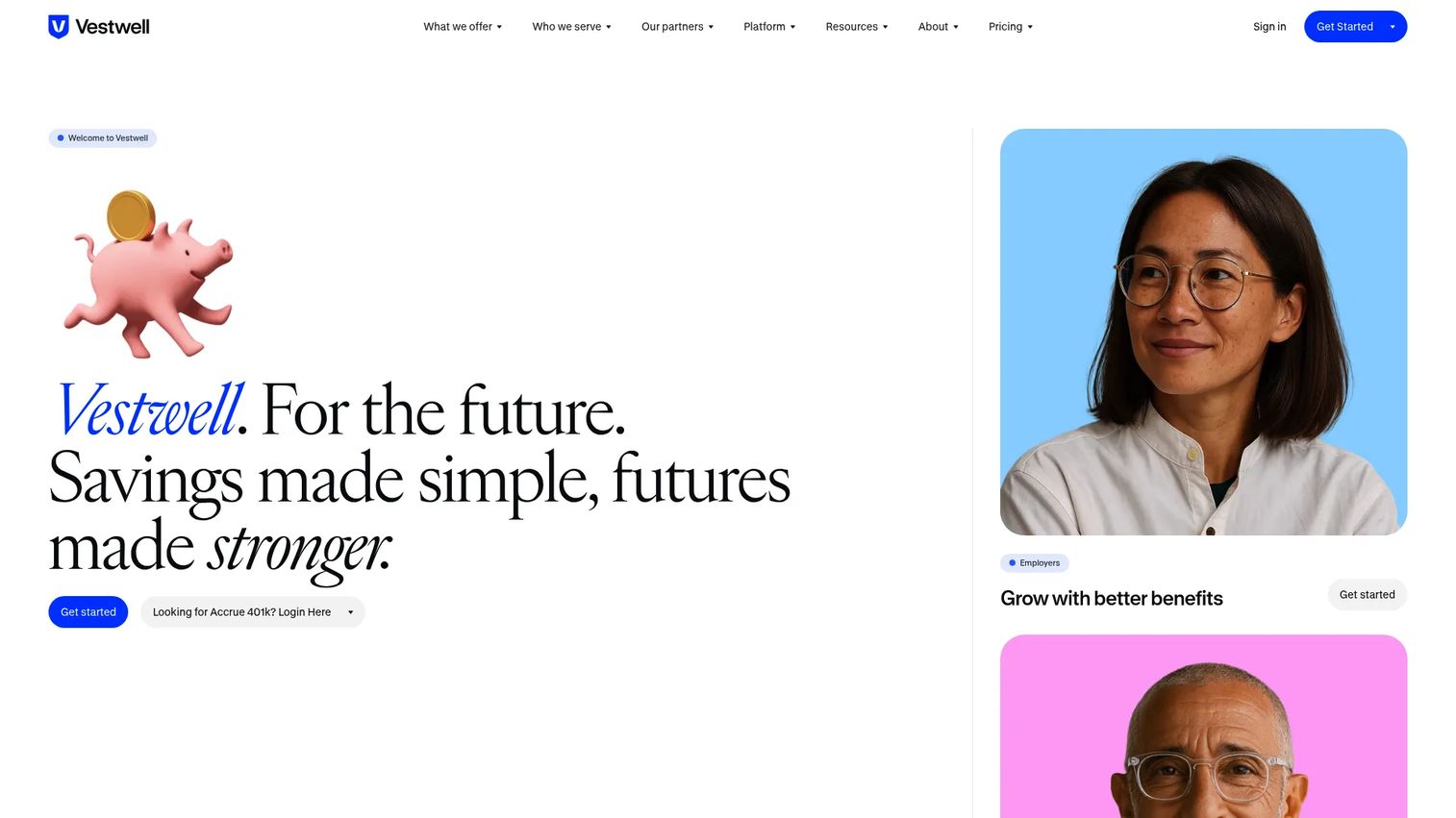
Vestwell positions itself as a modern savings platform rather than a single-plan tool. Alongside 401(k), it supports 403(b), Solo(k), and Starter(k), plus adjacent programs like 529 education savings, emergency savings, and ABLE accounts. For employers who want more than retirement under one roof, that breadth matters.
Vestwell also serves employers, advisors, savers, and partners as distinct audiences, which makes it a strong fit when an advisor ecosystem or partner workflow is part of your plan. Payroll integrations span 190+ providers, so payroll sync usually works with whatever you already run.
Best for: Employers, advisors, and self-employed users who want multiple savings products on one modern platform.
Key strengths
- Multiple plan types: 401(k), 403(b), Solo(k), and Starter(k) options in one place.
- Broad workplace savings: 529, tuition reimbursement, emergency savings, and ABLE accounts beyond retirement.
- Payroll integrations with 190+ providers: flexible payroll sync across most common systems.
Why choose Vestwell: Pick Vestwell when a broad savings platform beats a single-plan setup, or when advisors and partners need to service accounts through a shared system. The multi-product breadth is the differentiator for companies planning benefits beyond a basic 401(k).
Vestwell pricing: Public plan comparison shows Starter(k) at $49/month, Workplace at $125/month, and Plus at $175/month, plus a Solo(k) at $45/month. Fees include participant or asset-based charges, and some plans may carry one-time setup or origination fees. No free tier was verified.
3. 401GO

401GO is a retirement plan provider aimed at small and mid-sized businesses that want a managed plan without complexity or surprise costs. The positioning is affordability plus speed: transparent tiers, quick plan setup, and automation that keeps administration light. For a lean team moving fast, that combination is hard to beat.
Under the hood, 401GO handles plan setup and administration, payroll integration, and automated compliance and reporting. The transparent pricing is a genuine advantage for budget-conscious buyers who are tired of opaque provider quotes.
Best for: Small businesses that want a managed 401(k) with transparent pricing and fast setup.
Key strengths
- 401(k) plan setup and administration: managed end to end so your team is not running the plan manually.
- Payroll integration: automated contributions flow into the plan without repetitive uploads.
- Automated compliance and reporting: testing and filings handled in the background.
Why choose 401GO: Choose 401GO if you are cost-sensitive but still want modern workflows and quick setup. It suits smaller or faster-moving teams that want straightforward retirement plan administration without an enterprise price tag.
401GO pricing: Public tiers, billed monthly. GO-Solo starts at $19/month, GO-Starter at $25/month, and GO-Plus at $139/month. GO-Enterprise is custom and requires a conversation. Participant and asset-based fees apply on top of the base rate. No free tier.
4. Human Interest
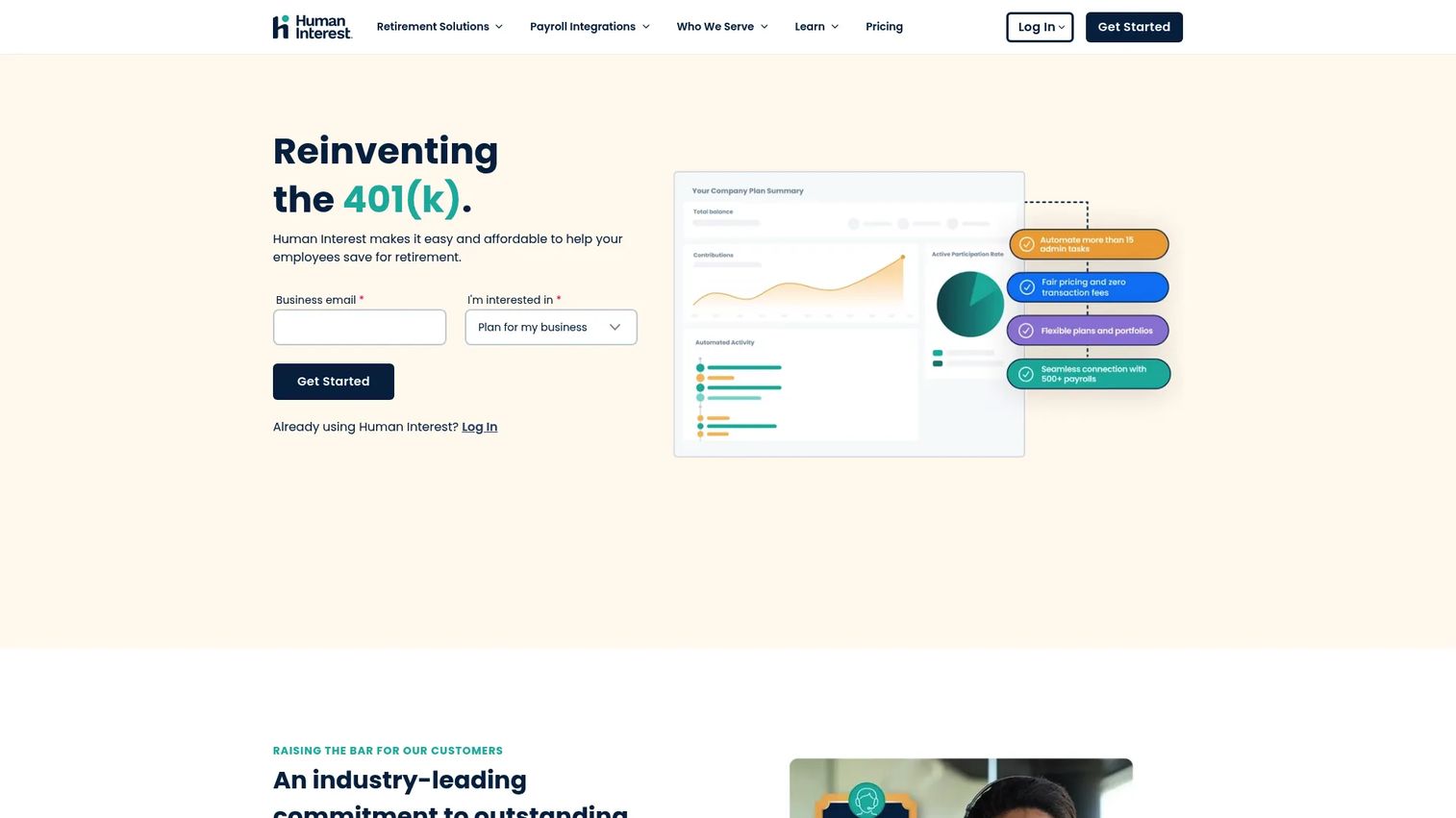
Human Interest is a 401(k) and 403(b) provider for small and midsize businesses, built around automation and an approachable employee experience. Its payroll integrations reach 500+ providers, which is among the broadest on this list, so payroll sync rarely becomes the blocker it can be with narrower platforms.
The platform pairs automated administration and compliance support with built-in investment advice and automatic portfolio rebalancing. That combination makes it a solid outsourced option when you want the plan handled and the employee side kept simple.
Best for: Businesses that want a transparent, outsourced retirement plan with strong compliance and administration support.
Key strengths
- Payroll integrations with 500+ providers: the widest payroll sync coverage among these picks.
- Automated administration and compliance support: testing, filings, and notices handled for you.
- Built-in investment advice and rebalancing: employees get guidance without extra effort.
Why choose Human Interest: Pick Human Interest when broad payroll compatibility matters and you want the retirement plan fully outsourced. It fits a growing company that is adding headcount fast and cannot afford payroll-integration friction.
Human Interest pricing: Three published tiers, billed monthly. Essentials is $80/month base plus $5 per eligible employee. Complete is $180/month base plus $7 per eligible employee. Concierge is $280/month base plus $9 per eligible employee. A one-time $499 setup fee may apply, and asset-based advisory and custody fees are disclosed on the pricing page. No free tier.
5. Betterment at Work
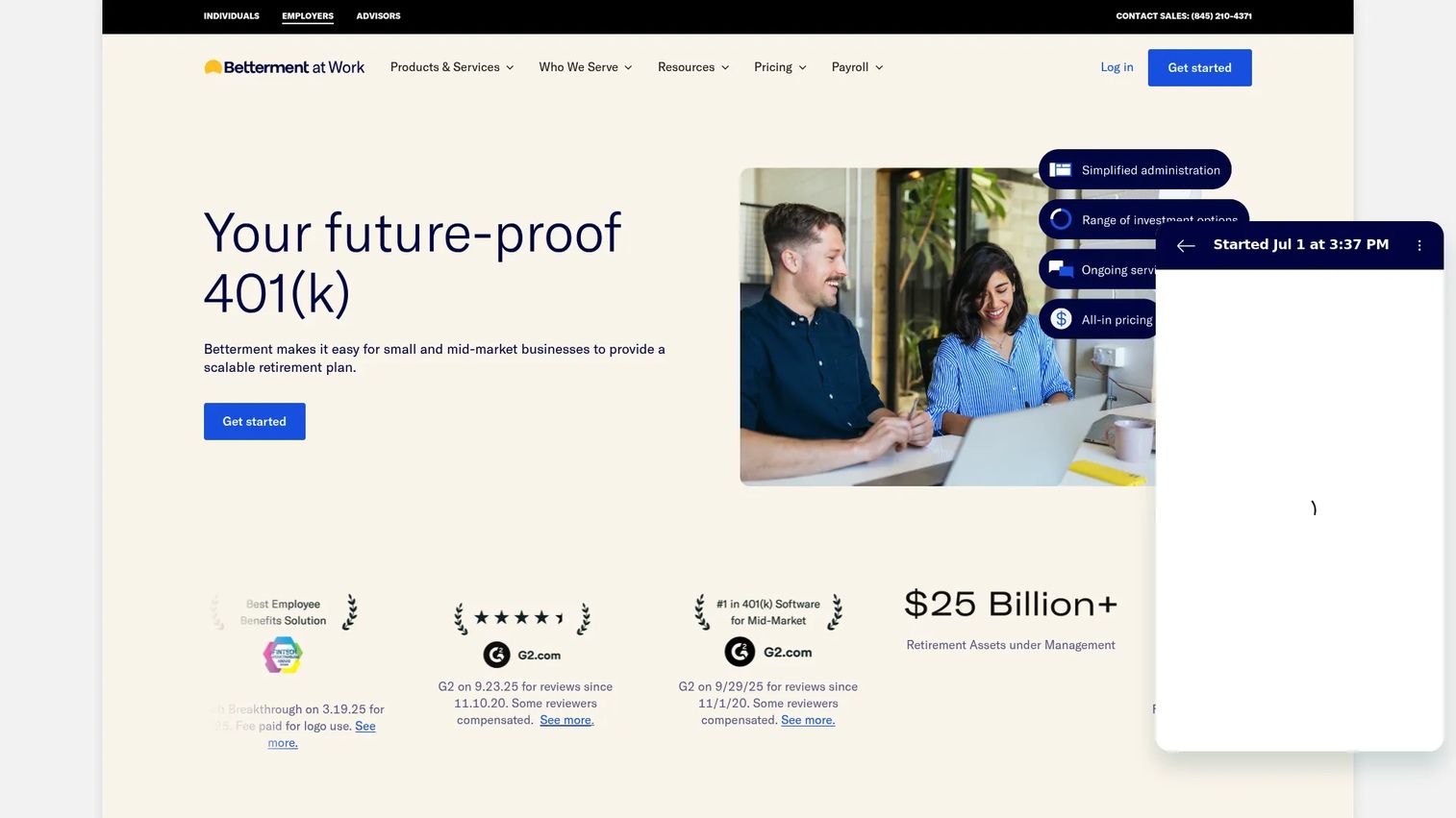
Betterment at Work pairs a managed 401(k) with financial wellness benefits, leaning on Betterment's investment heritage. Beyond plan administration, payroll integrations, and compliance support, it adds employee financial wellness features and optional 529 savings on higher tiers. When investment guidance and a polished employee experience matter, this is a strong fit.
The employee side is where Betterment stands out. Savers get a familiar, guided investing experience rather than a bare portal, which can lift participation and satisfaction. For advisor-friendly setups, the platform supports plan design customization without heavy finance jargon getting in the way.
Best for: Employers who want a managed 401(k) with payroll integration plus optional financial wellness add-ons.
Key strengths
- 401(k) administration with plan design customization: flexible plan structures without complexity for the employer.
- Payroll integrations and compliance support: contributions and filings handled behind the scenes.
- Employee financial wellness: guided investing and coaching options that improve the saver experience.
Why choose Betterment at Work: Choose Betterment when the employee investing experience and financial wellness are priorities, not afterthoughts. It suits companies that see retirement benefits as a retention lever and want savers actually engaging with their accounts.
Betterment at Work pricing: Essential is $100/month plus $5 per active participant plus a 0.25% annual advisory fee. Pro is $150/month plus $7 per active participant plus the 0.25% advisory fee. Flagship is custom. A one-time implementation fee applies ($500 for new plans, $1,000 for conversions). 529 savings are bundled on higher tiers and not available on Essential. No free tier.
6. Paychex
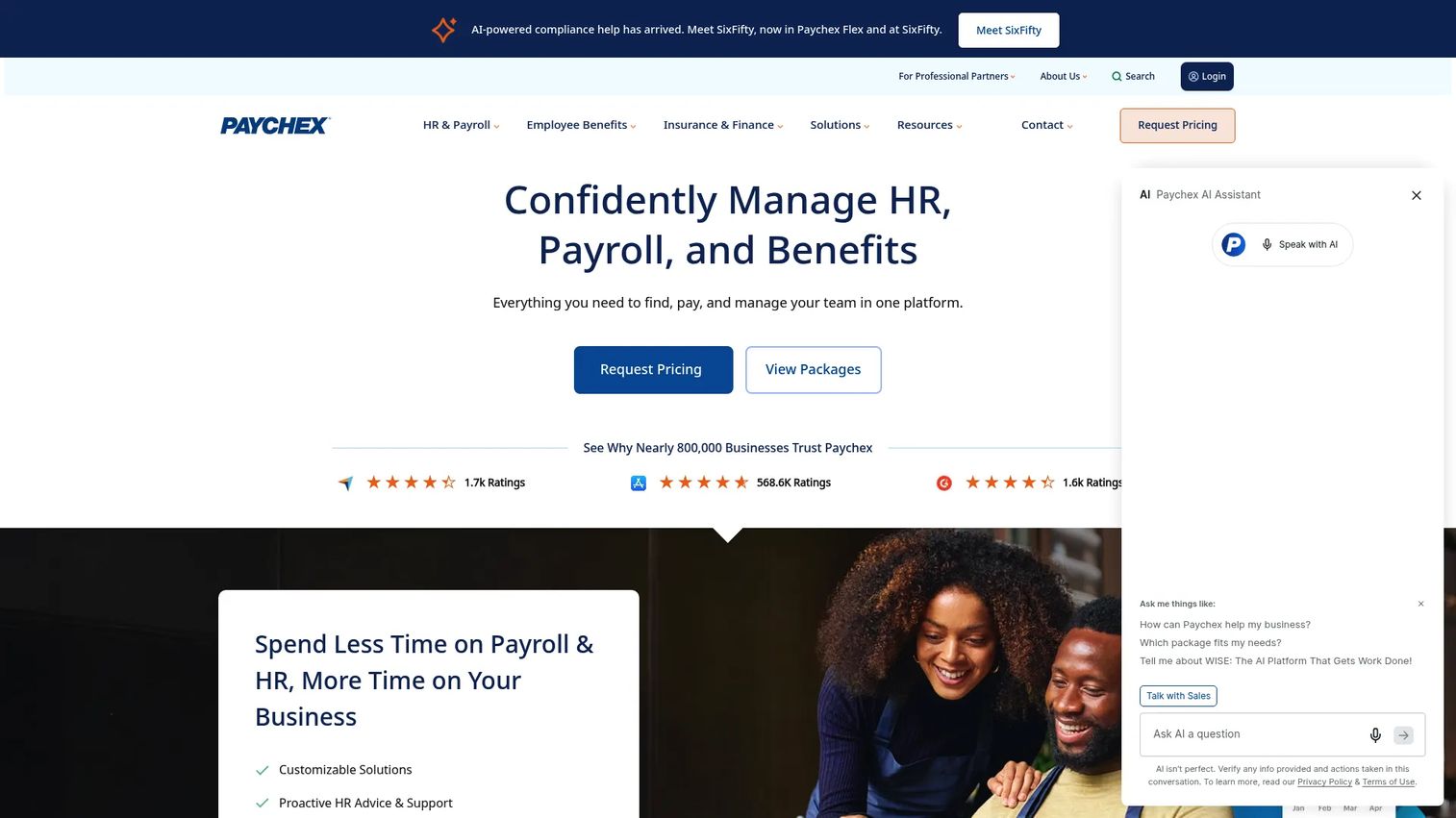
Paychex is a payroll and HR provider that also handles retirement plans, which is exactly why bundled buyers shortlist it. If you want payroll processing, HR services, benefits administration, and 401(k) from a single vendor, Paychex consolidates the stack. The compliance and administration workflows sit inside the same platform your payroll already runs on.
That bundling is the whole argument. For teams that value one vendor, one contract, and one support line over best-of-breed specialization, Paychex reduces the number of systems and relationships you manage.
Best for: Businesses that want payroll, HR, and retirement administration from one provider.
Key strengths
- Payroll processing: retirement contributions flow from the same system that runs payroll.
- HR services and consulting: benefits and compliance support alongside the plan.
- Benefits administration: 401(k) managed within a broader HR platform.
Why choose Paychex: Pick Paychex when consolidation matters more than a specialized retirement-only tool. It is the better fit when you already run Paychex payroll or want to reduce vendor count as you scale, rather than stitching together separate systems.
Paychex pricing: Paychex Flex pricing is custom and quote-based, spanning tiers like Flex Select, Flex Pro, and Flex Enterprise, plus HR Pro and HR PEO options. Paychex says pricing depends on employee count and business needs, so you request a quote rather than see a public rate.
7. Employee Fiduciary
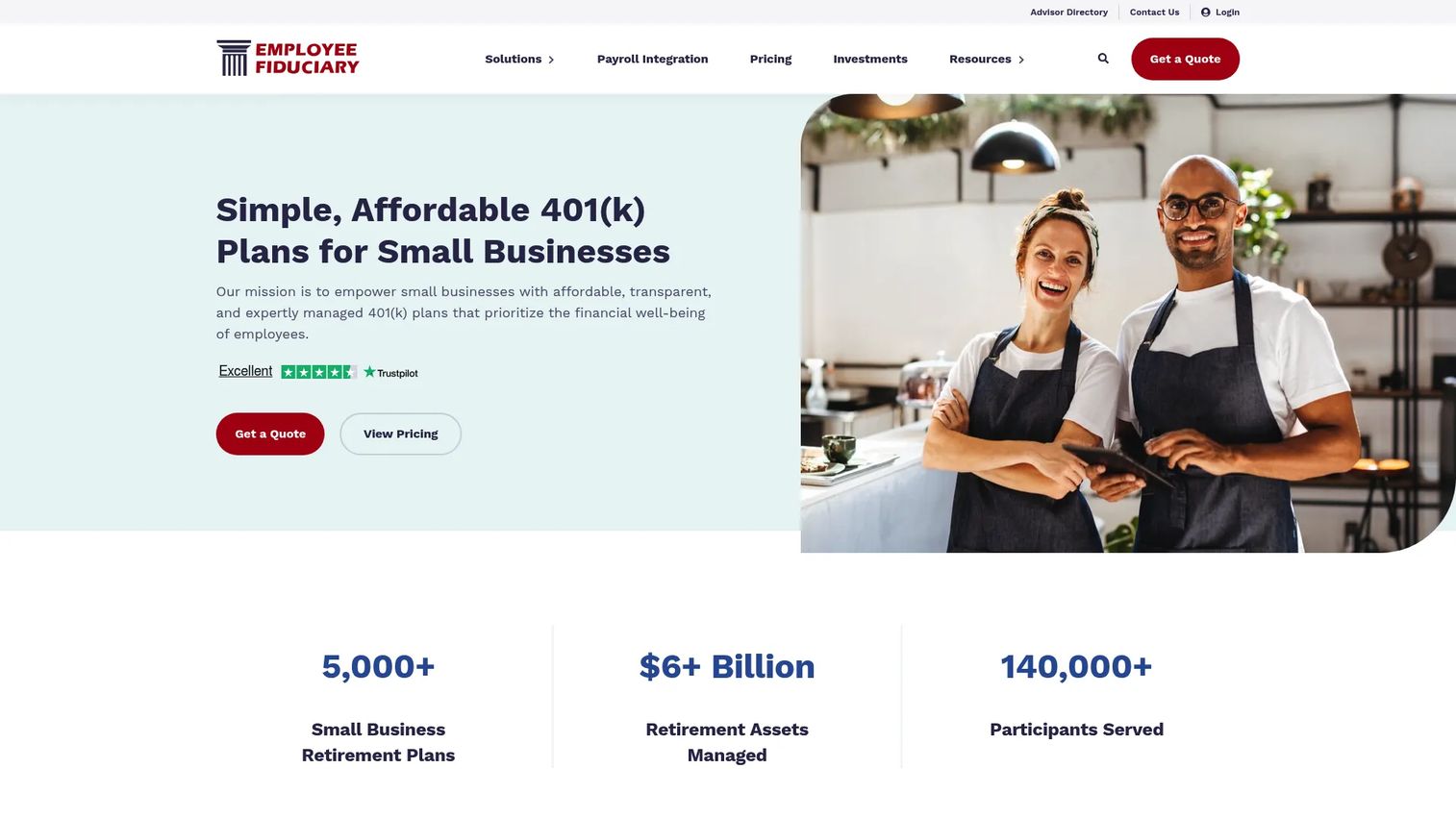
Employee Fiduciary is a full-service 401(k) provider for small businesses, solopreneurs, non-profits, and advisors, built around transparent, flat-fee pricing. Where percentage-of-assets fees quietly grow as your plan grows, Employee Fiduciary keeps costs predictable, which cost-conscious buyers appreciate.
The platform provides a dedicated relationship manager, administration and compliance support, recordkeeping via FIS Global, and asset custody via Matrix Trust Company. It leans toward a simpler, service-oriented model that works well for smaller teams and advisor-facing workflows.
Best for: Small businesses and advisors seeking a transparent, flat-fee 401(k) provider.
Key strengths
- Dedicated relationship manager: a human contact instead of a ticket queue.
- Transparent flat-fee administration: predictable costs that do not scale with asset size.
- Compliance and recordkeeping support: administration handled with established custody partners.
Why choose Employee Fiduciary: Choose Employee Fiduciary when cost transparency and a flat-fee structure matter most, especially for smaller teams. Larger operators should verify that the feature set and integration depth match their payroll and reporting needs before committing.
Employee Fiduciary pricing: A $500 one-time establishment fee for new start-up plans, plus a $1,500 annual base fee covering up to 30 eligible employees ($30 per additional employee), plus a 0.08% custody fee on plan assets. Existing plan conversions carry a $1,000 establishment fee, and Solo 401(k) start-up plans start at $250. No free tier.
Considerations
Before you commit to any 401k provider, run your shortlist through this checklist. These are the factors that decide whether the plan runs itself or becomes a recurring drain.
Payroll integration depth
Confirm the platform integrates natively with your exact payroll system, not just "most providers." Native payroll sync is where the biggest admin savings live. A shallow integration that still requires manual file uploads defeats the purpose.
Compliance and administration coverage
Check what the vendor handles versus what stays on your team. Nondiscrimination testing, Form 5500 filing, and Safe Harbor notices should be automated. If any of that is manual or an add-on, factor the hidden time cost into the decision.
Pricing clarity and total cost
Look past the headline monthly fee. Add participant fees, asset-based fees, setup or conversion charges, and advisory fees. A transparent flat-fee provider can beat a low base rate once your plan grows, so model the real cost at your projected headcount.
Plan flexibility
Verify support for the plan types you need now and later: Traditional 401(k), Safe Harbor 401(k), Solo(k), and 403(b) for nonprofits. Switching providers later is painful, so choose one that covers your likely path.
Employee experience and self-serve access
The plan only works if employees use it. A clean mobile app, simple login flow, and self-serve online portal drive participation and cut the support questions that land on your team.
Conclusion
The strongest fit depends on where your operational drag actually lives. If payroll integration is the priority, Guideline gives you the cleanest sync and hands-off administration. If you want breadth across multiple savings products, Vestwell covers the most ground. For fast, affordable setup, 401GO wins on speed and pricing clarity. Human Interest fits when broad payroll compatibility and full outsourcing matter, Betterment at Work when employee experience and financial wellness lead, Paychex when consolidation beats specialization, and Employee Fiduciary when flat-fee transparency is the deciding factor.
The decision rule is the same one you apply to any system you add: choose based on payroll integration depth, compliance automation, pricing clarity, and how much admin the platform removes from your team. A good 401k plan should run in the background, not sit on your finance lead's weekly to-do list.
Next step: shortlist two platforms that match your payroll setup and plan needs, compare their payroll sync and compliance workflows side by side, then book demos to see the employer portal in action before you sign.
Start your journey with Guideflow today!
FAQs
401k software is the platform employers use to set up and administer a retirement plan. It syncs payroll, processes employee contributions and employer matches, handles compliance filings, and gives savers a self-serve portal to manage their accounts. The best platforms automate most of the recurring work so administration runs in the background.
Prioritize native payroll integration, automated compliance and administration, clear pricing with no hidden fees, and easy self-serve access for employees. Plan flexibility across Traditional 401(k), Safe Harbor 401(k), Solo(k), and 403(b) also matters if your needs may change. The right mix depends on your headcount, payroll system, and how much admin you want to remove.
Yes. Payroll integration is where the biggest time savings and error reduction come from. Native payroll sync means deferrals and matches update automatically each cycle, so your team stops manually uploading contribution files and reconciling mismatches. A shallow integration that still requires manual work erases most of the benefit.
A 401k provider offers the underlying retirement plan service, including recordkeeping, custody, and fiduciary support. 401k software emphasizes the operational platform and workflow layer: payroll sync, contribution management, compliance automation, and self-serve portals. Most modern options on this list combine both, delivering the provider service through a software-first experience.
For small business 401k needs, weigh setup speed, pricing, and plan simplicity. 401GO and Employee Fiduciary suit cost-conscious teams with transparent pricing, while Guideline fits businesses that want tight payroll integration. The best choice depends on your payroll system and how much administration you want handled for you.
Vestwell stands out for advisor and partner workflows, with segmentation for employers, advisors, savers, and partners plus support for co-branded portals. Employee Fiduciary also serves advisor-facing clients. Look for white-label, co-branded portals, and partner portal support when advisors need to service accounts through a shared system.