Your platform choice decides more than how your store looks. It sets your speed to launch, your monthly operating cost, how far you can customize checkout, and how painful a future replatform becomes. Pick wrong and you spend the next two years fighting your own stack instead of selling.
That pressure is rising fast. Statista projects worldwide ecommerce market revenue to reach $3.88 trillion in 2026, growing at a 6.84% CAGR through 2030. More volume means more competition, and the platform you sell on quietly shapes your margins, your conversion rate, and how well your store ranks. The best ecommerce platform for a solo founder shipping a first product is rarely the best platform for a brand pushing eight figures across five channels.
This guide compares the best ecommerce platforms for 2026 the way a buyer actually evaluates them: hosting model, ease of use, SEO control, checkout flexibility, multichannel selling, customization, and total cost of ownership. We tested and weighed each against real business stages so you can defend the recommendation internally, not just skim a feature list. If you're stress-testing a shortlist, our broader ecommerce platform comparisons and store launch guides pair well with everything below, and the ecommerce SEO guide covers the ranking factors that platform choice influences directly.
What's inside
This article covers 10 ecommerce platforms chosen for business fit, feature depth, pricing transparency, and market relevance in 2026. The list spans hosted, open-source, and hybrid models so you can compare across store types and growth stages, from a first product to a complex B2B catalog. We evaluated each on six criteria that decide real outcomes: pricing and total cost of ownership, ease of use, SEO control, checkout flexibility, multichannel selling, and scalability. Every platform here is in active use by real merchants, with verified pricing and current G2 ratings, so the comparison reflects what you'd actually buy today.
TL;DR
- Best all-around and best for scaling brands: Shopify, for its app ecosystem, checkout strength, and multichannel reach.
- Best for built-in commerce depth: BigCommerce, with native B2B and selling features that reduce plugin dependence.
- Best open source ecommerce for content-heavy brands: WooCommerce, for full WordPress control.
- Best for beginners and small business: Wix eCommerce and Square Online, for speed to launch and low entry cost.
- Best for design-led creators: Squarespace Commerce.
- Best for enterprise and developer control: Adobe Commerce.
What is an ecommerce platform?
An ecommerce platform is the software that lets a business build, manage, and operate an online store, handling everything from storefront design to checkout, payments, inventory, and order fulfillment. It is the foundation an online store platform runs on, whether you sell ten products or ten thousand.
Platforms fall into a few models, and understanding them is the fastest way to narrow your shortlist:
- Hosted (SaaS): The vendor manages hosting, security, and updates. You pay a monthly fee and focus on selling. Shopify, BigCommerce, Wix, and Squarespace fit here.
- Open source ecommerce: You own the code and host it yourself, trading developer control for self-managed maintenance. WooCommerce, PrestaShop, and Adobe Commerce (Magento) live in this space.
- Hybrid and enterprise: Platforms that blend hosted convenience with deep customization, often aimed at large or complex catalogs.
- Lightweight add-on storefronts: Tools that bolt ecommerce onto an existing website without rebuilding it, like Ecwid or Square Online.
A capable platform for an ecommerce website should cover a core set of capabilities:
- Storefront design and theming
- Secure checkout and multiple payment gateways
- Inventory and order management
- An app or extension marketplace
- SEO controls (URLs, metadata, structured data)
- Integrations with marketing, shipping, and analytics tools
- Multichannel and marketplace selling
When to use each type of platform
Different business situations call for different platform models. Here is how to pattern-match your own.
Launch a store fast
If speed and low technical overhead matter most, a hosted platform is the right call. You skip server management, security patching, and most maintenance, and you can have a store live in days. This is the typical path for first-time merchants, small business owners, and anyone validating a product before investing heavily. Wix eCommerce, Squarespace Commerce, and Square Online all shine here.
Need deeper customization
When you need custom workflows, unique catalog logic, or a developer-led build, open-source and enterprise platforms make sense. You get full developer control over the codebase, checkout, and data, at the cost of owning hosting and updates. WooCommerce, PrestaShop, and Adobe Commerce serve teams that want to shape the platform around the business rather than the reverse.
Sell across channels
If multichannel selling matters more than a single polished storefront, prioritize platforms with strong marketplace and social integrations. Selling on Amazon, Walmart, Instagram, TikTok, and Google alongside your store changes the math on which platform wins. Shopify, BigCommerce, and Ecwid by Lightspeed are built to push one catalog across many channels.
Ecommerce platforms comparison table
Use this table for a fast side-by-side read before the deep dives. The Intent column tells you the buyer it fits best, Key use case names the scenario each platform handles well, Pricing reflects the entry plan, and G2 rating shows current verified sentiment. Platforms are ordered by overall relevance to most merchants searching for the best ecommerce platforms, not alphabetically. Pricing notes distinguish free plans, starting paid tiers, and custom enterprise pricing.
| # | Product | Intent | Key use case | Pricing | G2 rating |
|---|---|---|---|---|---|
| 1 | Shopify | All-around store builder | Scalable multichannel selling | From $29/mo (3-day trial) | 4.4/5 |
| 2 | BigCommerce | Built-in commerce depth | Mid-market and B2B stores | From $39/mo (15-day trial) | 4.2/5 |
| 3 | WooCommerce | Open-source on WordPress | Content-heavy, custom stores | Free core + hosting | 4.4/5 |
| 4 | Wix eCommerce | Fast all-in-one builder | Small stores and solo sellers | From $29/mo | 4.2/5 |
| 5 | Squarespace Commerce | Design-led commerce | Creator and brand stores | From $16/mo | 4.4/5 |
| 6 | Ecwid by Lightspeed | Add-on storefront | Sell on an existing site | From $5/mo | 4.7/5 |
| 7 | Adobe Commerce | Enterprise and B2B | Complex, large catalogs | Custom pricing | 4.0/5 |
| 8 | Shift4Shop | Built-in feature value | Budget-conscious merchants | Free (US) or from $29/mo | 3.9/5 |
| 9 | PrestaShop | Open-source flexibility | International, custom stores | Free core or from €24/mo | 4.3/5 |
| 10 | Square Online | POS-connected store | Local and brick-and-mortar | Free or from $49/mo | 4.2/5 |
1. Shopify

Shopify is the all-in-one commerce platform most merchants default to, and for good reason. It handles online, in-person, and emerging AI-driven channels from one back office, with a checkout that consistently converts and an app store deep enough to fill almost any gap. It is the rare platform that works for a first-time seller and still holds up at enterprise scale through Shopify Plus.
Best for: Merchants who want a scalable platform with strong multichannel selling and minimal technical overhead.
Key strengths
- Online store builder: Launch a polished, mobile-ready store without touching code.
- Multichannel selling: Push one catalog to social, marketplaces, and in-person POS.
- Payments, shipping, and analytics: Native tools cover the full operating stack.
Why choose Shopify: It tops broad rankings because it balances ease of use against real scalability better than almost anything else. First-time stores get live fast, and the same account grows into a high-volume operation without a replatform. Its SEO controls (clean URLs, editable metadata, fast hosting) make it one of the better choices for organic growth, which matters for any brand chasing the best ecommerce platforms for SEO.
Shopify pricing: Plans start with a 3-day free trial, then $1/month for the first three months. Standard yearly pricing runs Basic at $29/month, Grow at $79/month, and Advanced at $299/month. Shopify Plus starts at roughly $2,300/month for higher-volume and enterprise needs. Factor in app subscriptions and transaction fees if you use a payment provider other than Shopify Payments when calculating total cost of ownership.
2. BigCommerce
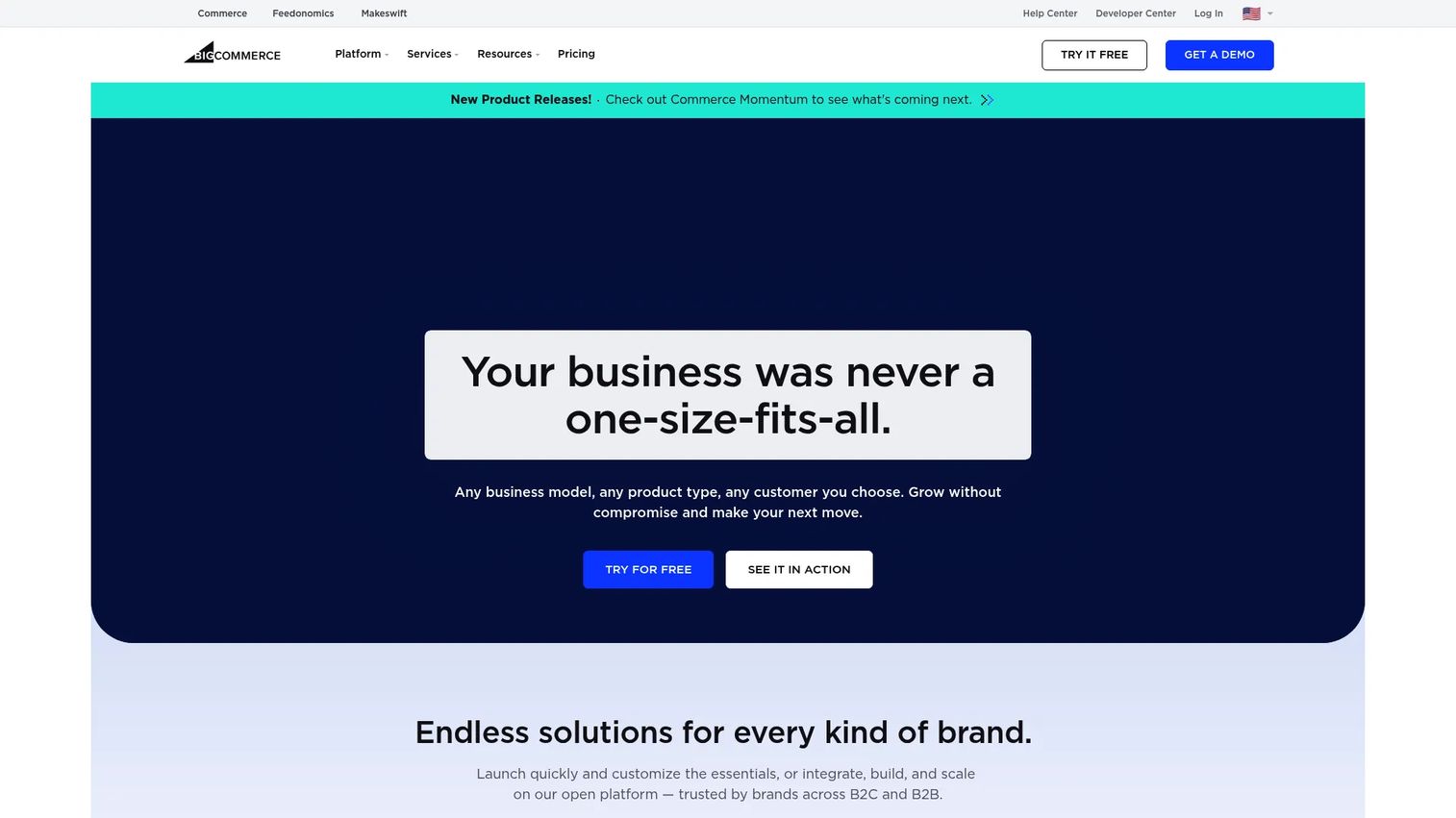
BigCommerce targets merchants who want more native capability and less plugin dependence. It ships with an optimized one-page checkout, multi-channel selling across Google, Meta, TikTok, Amazon, Walmart, and eBay, and a genuinely strong B2B feature set, including account-specific pricing, quotes, reorders, and invoice payments. For mid-market and enterprise stores, that built-in depth means fewer third-party apps to install, pay for, and maintain.
Best for: Mid-market to enterprise merchants needing built-in commerce depth and B2B features.
Key strengths
- Optimized one-page checkout: Digital wallets and BNPL options come standard.
- Multi-channel selling: Native connections to six major marketplaces and social platforms.
- B2B capabilities: Quotes, account pricing, reorders, and workflow approvals built in.
Why choose BigCommerce: It fits better than lighter builders when your catalog is large, your selling motion is complex, or you need B2B and B2C from one platform. Its SEO foundation is well regarded for clean URL structures and page control, putting it among the stronger options for the best ecommerce platforms for SEO. You get scalability without stacking a dozen plugins to reach feature parity.
BigCommerce pricing: Plans are listed in US dollars and start with a 15-day free trial. Core runs $39/month, Growth $105/month, and Scale $399/month, with Performance plans starting at $1,499/month billed annually. BigCommerce does not charge its own transaction fees on top of your payment processor, which keeps total cost of ownership predictable as volume grows.
3. WooCommerce
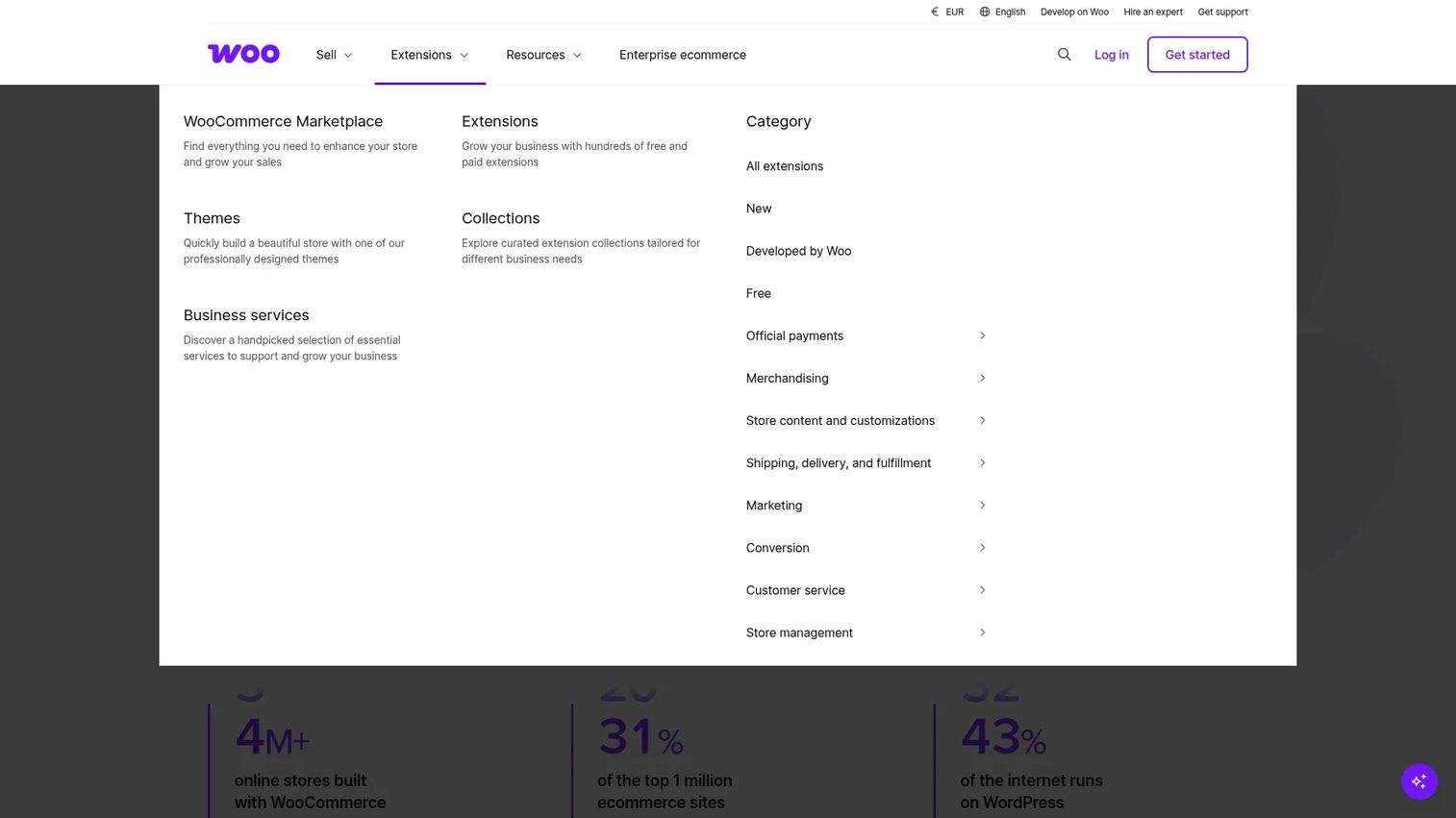
WooCommerce is the free, open-source ecommerce platform built on WordPress, and it remains the top pick for content-heavy brands and teams that want full control. Because it runs on WordPress, your store and your content live in one system, which is a real advantage if blogging, SEO, and publishing drive your traffic. You choose your own payment processor, add extensions à la carte, and own the entire stack.
Best for: WordPress-based merchants who want maximum control and modular add-ons.
Key strengths
- Unlimited products and orders: No platform caps on catalog size or API calls.
- Choose your own payment processor: No forced gateway, no platform transaction fees.
- À la carte extensions: Add only the functionality you need, when you need it.
Why choose WooCommerce: It is the strongest open source ecommerce option for teams that treat content as a growth engine and want developer control over every layer. The WordPress foundation makes it one of the best ecommerce platforms for SEO, since you inherit the most flexible content and URL tooling on the web. The tradeoff is ownership: you manage hosting, updates, and security yourself.
WooCommerce pricing: The core platform is free with no monthly subscription. Real costs come from hosting (roughly $25 to $350/month depending on traffic and provider) and paid extensions ($29 to $299/year each). That à la carte model keeps total cost of ownership low for lean stores and scales with the features you add.
4. Wix eCommerce
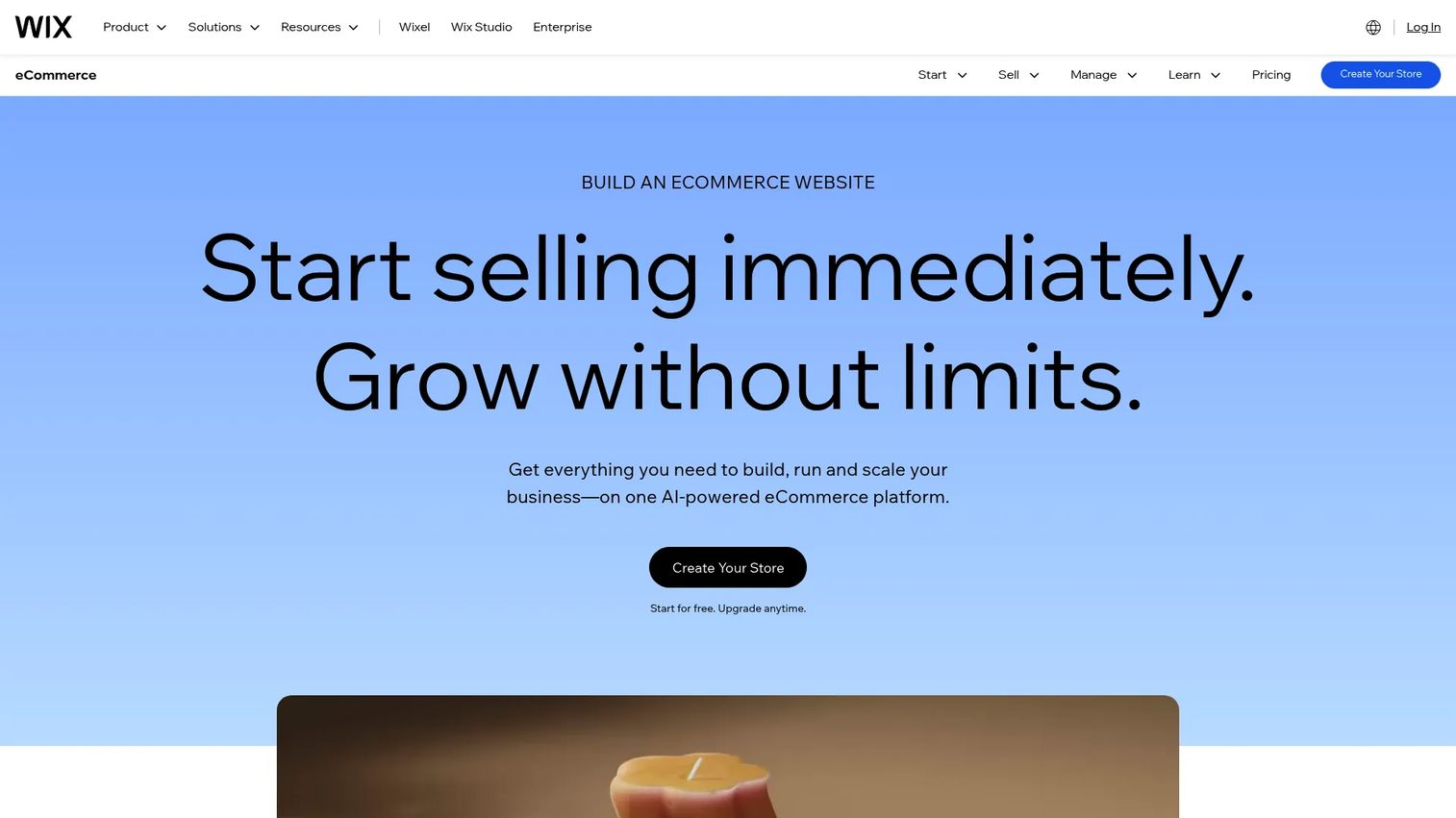
Wix eCommerce is Wix's online store offering, built for businesses that want an all-in-one website builder with commerce baked in. With 500+ templates and a drag-and-drop editor, it is one of the fastest ways for a solo operator or small store to get selling without hiring a designer. It supports multichannel sales and connects to 50+ payment gateways out of the box.
Best for: Businesses wanting an all-in-one website builder with built-in eCommerce tools.
Key strengths
- 500+ professional templates: Launch a designed store without custom development.
- Multichannel sales: Sell across your site, social, and marketplaces from one dashboard.
- 50+ payment gateways: Broad processor support for global selling.
Why choose Wix eCommerce: It is one of the best ecommerce platforms for beginners and small business because the learning curve is gentle and the design tools are genuinely good. It is enough for stores with modest catalogs and straightforward selling. As catalog complexity and order volume climb, larger merchants often move to a platform built for heavier commerce, but for getting to revenue quickly, Wix is hard to beat.
Wix eCommerce pricing: A free plan lets you build a site, but accepting payments requires a paid plan. eCommerce plans start at $29/month for Core, with Business at $39/month and Business Elite at $159/month, all billed annually. The flat monthly fee makes total cost of ownership easy to forecast for a small store.
5. Squarespace Commerce

Squarespace Commerce is the commerce layer inside Squarespace, and it wins on design. For creator-led brands, makers, and visually driven businesses, its templates and editing experience produce stores that look custom-built without the cost. It is fully integrated, supports unlimited products and services, runs checkout on your own domain, and includes abandoned cart recovery and in-person selling through Squarespace POS.
Best for: Businesses that want an all-in-one website builder with built-in ecommerce and strong design.
Key strengths
- Fully integrated ecommerce: Storefront, checkout, and content in one polished system.
- Checkout on your domain: Keep the buyer experience fully branded.
- Abandoned cart recovery: Win back lost sales without a third-party app.
Why choose Squarespace Commerce: Choose it when brand presentation is a competitive edge and your catalog is small to mid-sized. The visual strengths matter most for portfolios, product launches, and creator stores. Businesses with very complex commerce needs (large catalogs, deep B2B logic) sometimes outgrow it, but for design-forward stores it is one of the best online storefront options available.
Squarespace Commerce pricing: There is no free plan, but a 14-day free trial lets you test the platform. Paid plans start at Basic $16/month, Core $23/month, Plus $39/month, and Advanced $99/month, all billed annually, with ecommerce features expanding as you move up tiers.
6. Ecwid by Lightspeed
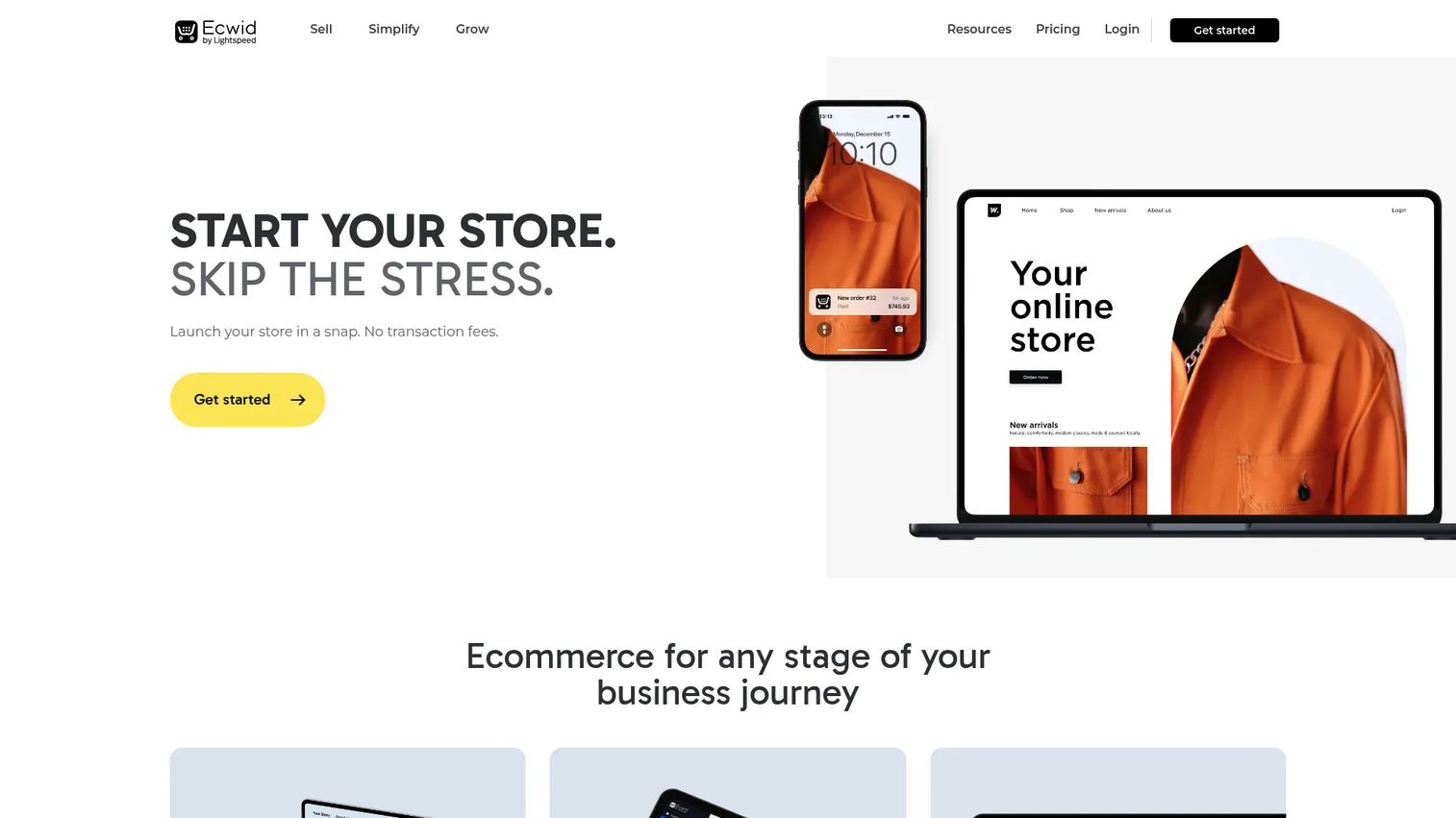
Ecwid by Lightspeed solves a specific problem well: adding ecommerce to a website you already have. Instead of rebuilding your site, you embed Ecwid's store onto your existing pages, then sell across multiple channels from the same catalog. It connects to Lightspeed Retail POS, Facebook, Instagram, Google, and major marketplaces, making it a strong multichannel selling option for small businesses.
Best for: Small businesses that want to add ecommerce to an existing site and sell across channels.
Key strengths
- Add-on store: Embed commerce into any existing website without a rebuild.
- Unlimited bandwidth and storage: No usage caps on the paid plans.
- Multichannel integrations: Lightspeed POS, social, Google, and marketplaces connected.
Why choose Ecwid: It is the right call when your website is fine but it cannot sell, or when you want one catalog syncing across a storefront, social, and in-person POS. Its strong G2 rating reflects how cleanly it handles that add-on use case. For businesses that do not want to migrate their whole web presence, Ecwid is the path of least disruption.
Ecwid pricing: Ecwid lists four paid plans with monthly pricing and annual-billing discounts, and charges no setup or transaction fees. Starter is $5/month, Venture $35/month, Business $65/month, and Unlimited $149/month. The low entry price makes it an accessible way to test selling before committing to a heavier platform.
7. Adobe Commerce

Adobe Commerce, formerly Magento, is the enterprise-grade option for brands with complex catalogs and demanding requirements. It supports multi-site, multi-language, and multi-brand commerce, AI-powered product recommendations, and composable, API-first storefront and merchandising. With strong B2B capability and deep developer control, it is built for organizations that need the platform shaped precisely around their business.
Best for: Large merchants needing complex, customizable B2B/B2C commerce.
Key strengths
- AI-powered recommendations: Personalized merchandising at scale.
- Multi-site and multi-brand: Run many storefronts, languages, and brands from one core.
- Composable, API-first architecture: Build custom storefronts and integrations freely.
Why choose Adobe Commerce: Consider it when your catalog, B2B logic, or global footprint exceeds what hosted platforms handle cleanly, and when you have the engineering resources to match. This is open source ecommerce at the enterprise tier, so ownership expectations and implementation effort are higher than a hosted SaaS plan. The payoff is near-total developer control and customization for stores that need it.
Adobe Commerce pricing: Adobe uses customized, contact-sales pricing rather than public numeric plans. It offers Adobe Commerce as a Cloud Service (SaaS), Adobe Commerce on Cloud (PaaS), and Adobe Commerce Optimizer. Because pricing scales with catalog size and revenue, total cost of ownership is meaningful and best modeled with Adobe directly.
8. Shift4Shop
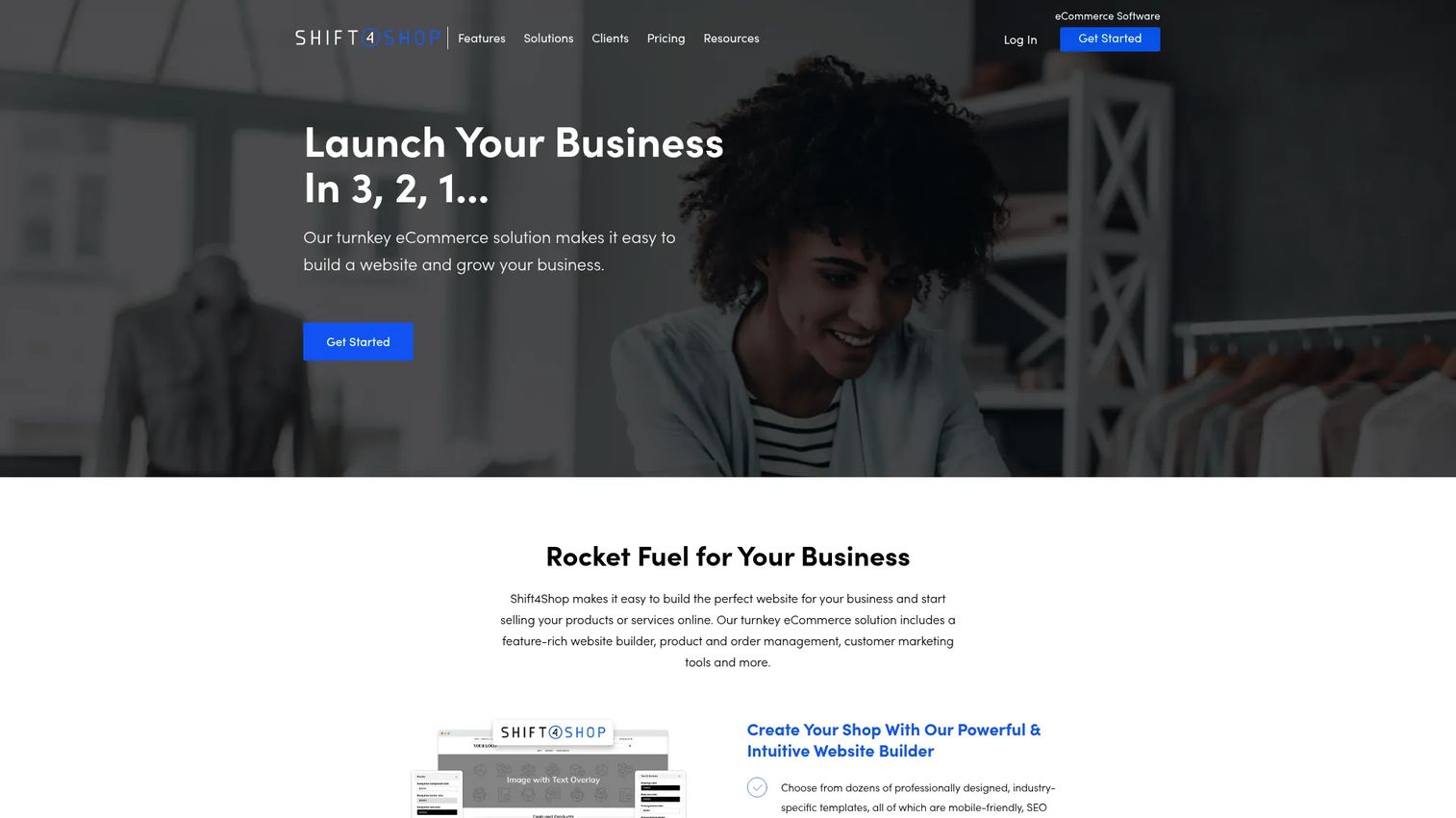
Shift4Shop is a cloud-based ecommerce platform that bundles store management, marketing, and payment tools into one package, with a notable free plan for US merchants. It includes unlimited products and bandwidth, built-in SEO, blog, and email marketing tools, plus shipping, inventory, CRM, and checkout features. For budget-conscious merchants, the feature-to-cost ratio is the headline.
Best for: Merchants wanting an all-in-one hosted eCommerce platform with built-in features and a free US plan.
Key strengths
- Unlimited products and bandwidth: No caps on catalog size or traffic.
- Built-in SEO, blog, and email: Marketing tools included rather than added on.
- Shipping, inventory, and CRM: Operating features bundled in one platform.
Why choose Shift4Shop: It is a smart value play when you want hosted convenience and a broad feature set without a high monthly fee, especially as a US merchant eligible for the free End-to-End plan. It suits stores that process payments through Shift4 and want to keep software costs near zero. For lean operations watching every dollar, that pricing structure is hard to ignore.
Shift4Shop pricing: US merchants can use the End-to-End Ecommerce plan at $0/month (processing payments through Shift4). Standard plans run Basic Store $29/month, Plus Store $79/month, and Pro Store $229/month. The free tier makes it one of the lower total cost of ownership options for qualifying merchants.
9. PrestaShop
PrestaShop is open-source ecommerce software popular with merchants and agencies that want customization without an enterprise suite. It supports self-hosted and hosted deployment, multistore and multilingual setups, and cross-border selling, which makes it a frequent choice for international stores. As an open-source platform, it gives you the developer control to tailor the store while keeping the footprint lighter than a full enterprise system.
Best for: Merchants and agencies wanting a customizable ecommerce platform with self-hosted or hosted deployment options.
Key strengths
- Open-source platform: Full access to the codebase and a large module library.
- Self-hosted or hosted: Choose the Classic free download or a managed subscription.
- Multistore and multilingual: Run several stores and languages for cross-border selling.
Why choose PrestaShop: It belongs on this list for teams that want control and international flexibility without committing to a heavy enterprise platform. The self-hosted Classic offer suits agencies and developer-led builds, while the hosted option lowers the maintenance load. If your roadmap includes multiple markets and languages, PrestaShop handles that natively.
PrestaShop pricing: The Classic offer is a free download, so you supply your own hosting and manage updates. The Hosted offer starts at €24 excl. VAT/month and bundles hosting, support, and ecommerce services. The free download keeps the entry barrier near zero, with total cost of ownership driven by hosting and any paid modules.
10. Square Online

Square Online is Square's online store builder, and its standout strength is the tight connection to Square POS. For brick-and-mortar sellers adding an online channel, inventory and orders sync automatically between the register and the website, which removes a huge amount of manual reconciliation. It supports pickup, local delivery, and shipping, plus subscriptions, bundles, coupons, and social integrations.
Best for: Small businesses that want an integrated Square-powered online store with free-to-start pricing.
Key strengths
- Free store builder: Launch an online store at no monthly cost.
- Square POS sync: Inventory and orders stay aligned between online and in-person.
- Pickup, delivery, and shipping: Fulfillment options built for local commerce.
Why choose Square Online: It is the natural fit for local commerce and businesses already running Square in-store. The POS integration makes omnichannel selling feel effortless for restaurants, retailers, and service businesses with smaller catalogs. If your storefront and your in-person sales need to share one source of truth, Square Online removes the friction.
Square Online pricing: The Free plan has no monthly subscription cost. Plus runs $49/month per location and Premium $149/month per location, both with a 30-day free trial, and Pro uses custom pricing. The free-to-start model makes it one of the most accessible best ecommerce platforms for small business and local sellers.
How to choose the right platform for your ecommerce website
Before you commit, weigh these criteria against your business reality. The best platform for an ecommerce website is the one that fits your stage today and does not box you in tomorrow.
Total cost of ownership
Look past the headline monthly price. Add transaction fees, app or extension subscriptions, hosting (for open-source platforms), payment processing, and any development costs. A free core platform with paid hosting and extensions can cost more than a hosted plan, and vice versa. Model the real number at your expected volume.
Checkout flexibility and payments
Checkout is where conversions live or die. Check which payment gateways a platform supports, whether it charges transaction fees on top of your processor, and how much you can customize the checkout flow. Forced gateways and rigid checkouts quietly cost you sales.
SEO and content control
If organic traffic matters, evaluate URL structure, metadata control, page speed, and content tooling. Platforms built on or near WordPress tend to lead here, but most hosted platforms now offer solid SEO basics. Confirm you can control the elements that affect ranking.
Scalability and business stage
Match the platform to where you are and where you are going. The best ecommerce platforms by business stage differ: hosted builders for launch and small business, open-source for control, enterprise platforms for complex catalogs. Replatforming is expensive, so pick something that can grow a stage or two with you.
Conclusion
There is no single best ecommerce platform, only the best fit for your stage, your technical bandwidth, and your growth model. Shopify remains the safest all-around choice and the strongest pick for scaling brands and multichannel selling. BigCommerce wins when you want built-in commerce depth and B2B without a plugin pile. WooCommerce and PrestaShop lead for open source ecommerce and developer control, while Adobe Commerce serves the enterprise tier. For speed and simplicity, Wix eCommerce, Squarespace Commerce, Ecwid, Shift4Shop, and Square Online get you selling fast at low cost.
A practical path: if you need to launch quickly with minimal overhead, start with a hosted platform and validate demand. If you need deep customization or content-driven SEO, choose an open-source option and budget for the engineering. Either way, model total cost of ownership at your expected volume and confirm the platform for your ecommerce website can scale before you commit. To go deeper, pair this with our ecommerce email marketing guide and explore tools like a best customer data platform or best e signature software as your stack matures.
FAQs
For beginners, the best choice usually comes down to ease of setup, support quality, and total cost. Wix eCommerce and Square Online both let you launch quickly with low or no upfront cost and gentle learning curves. Squarespace Commerce is another strong option if design matters to you from day one.
WooCommerce leads for SEO because it runs on WordPress, which offers the most flexible URL, content, and metadata control on the web. Shopify and BigCommerce are also strong, with clean URL structures, editable metadata, and fast hosting. If organic search is central to your growth, prioritize platforms that give you full page-level control.
It depends on what you value. Shopify offers hosted convenience: managed hosting, security, and updates, plus a polished checkout and app store, in exchange for a monthly fee. WooCommerce offers WordPress flexibility and full developer control with no platform fees, but you manage hosting and maintenance yourself. Pick Shopify for speed and simplicity, WooCommerce for control and content.
The lowest starting price belongs to Ecwid (from $5/month) and platforms with free plans like Square Online, Shift4Shop (free for US merchants), WooCommerce, and PrestaShop. But low starting price is not the same as low total cost. A free core platform still needs hosting, extensions, and payment processing, so model the real monthly cost at your volume before deciding.
For small businesses, the best ecommerce platforms balance speed, simplicity, and room to grow. Wix eCommerce, Square Online, and Ecwid by Lightspeed all launch fast at low cost and handle modest catalogs well. Shopify is worth considering if you expect to scale quickly, since you avoid a future replatform.
For large catalogs, prioritize inventory handling, performance, and scalability. Adobe Commerce is built for complex, high-volume B2B and B2C catalogs with multi-site support. BigCommerce and Shopify also handle large catalogs well, with strong performance and native multichannel selling. The right pick depends on how much customization and developer control you need.
A useful ecommerce platforms comparison covers pricing and total cost of ownership, payment options and transaction fees, app or extension ecosystem, SEO and content control, customization and checkout flexibility, and support. Also weigh multichannel selling and how well the platform scales with your business stage. Matching these to your needs is how you find the best e commerce platforms for your specific store.