Hiring quality becomes a growth constraint faster than most founders expect. You raise a round, the board wants headcount that scales revenue, and suddenly the bottleneck is not capital. It is finding, ranking, and retaining the right people without your recruiting team drowning in manual screening.
The data backs the pressure. The talent intelligence software market was valued at USD 8.98B and is projected to reach USD 27.82B by 2033, a 11.97% CAGR, according to Spherical Insights & Consulting (2023). That growth is not hype. It reflects a real shift: companies are tired of stitching together candidate data, employee skills records, and labor-market signals across five disconnected systems.
The deeper problem is fragmentation. Most hiring decisions still route through resumes, gut feel, and spreadsheets. Skills get ignored. Internal candidates stay invisible. Recruiters spend hours on searches a machine could surface in seconds. The best talent intelligence tools attack that fragmentation directly, turning scattered data into ranked, defensible decisions across recruiting, skills, internal mobility, and workforce planning.
If you spend time evaluating software that shows complex value through interaction rather than slides, our roundups of agentic AI platforms and AI recruiting software cover adjacent ground. This guide stays focused on talent intelligence specifically, and the best ai agents shaping how these platforms work.
What's inside
This guide covers talent intelligence software for recruiting, candidate matching, interview intelligence, skills management, internal mobility, and workforce planning. It is written for founders, HR leaders, and talent acquisition teams who need software that turns data into faster, better hiring decisions.
We selected platforms based on four criteria: category fit (genuine talent intelligence, not a thin AI wrapper), reviewer sentiment on G2, depth of AI or skills intelligence, and workflow coverage across the talent lifecycle. We prioritized tools that earn a place in a lean, high-growth stack rather than enterprise-only suites that demand a year of implementation.
TL;DR
- Best overall for enterprise talent intelligence: Eightfold AI, for AI-driven matching across hiring, internal mobility, and workforce planning.
- Best for interview notes and recruiting signal: Metaview, with AI interview notes, transcription, and ATS-ready summaries.
- Best for pipeline visibility and outbound recruiting: Gem, an all-in-one platform for sourcing, sequencing, and analytics.
- Best for interview transcription and recruiter notes: CoRecruit, built for agencies that want AI notes and ATS sync.
- Best for sourcing and candidate search: hireEZ, an AI sourcing layer on top of your ATS.
- Best for internal mobility and skills intelligence: 365Talents, for skills mapping and internal talent marketplaces.
- Best for all-in-one recruiting workflows: Loxo, unifying sourcing, CRM, ATS, and outreach.
- Best for accessing skilled global talent: Andela, for distributed AI and engineering hiring.
What is talent intelligence software?
Talent intelligence software is a category of HR technology that uses AI and machine learning to analyze candidate, employee, and labor-market data so teams can make better hiring, mobility, and workforce decisions. Unlike an applicant tracking system, which stores and moves candidates through stages, a talent intelligence platform actively scores fit, surfaces skills, and predicts where talent should go next.
The category sits at the intersection of recruiting and talent management. It treats skills, not job titles, as the unit of decision-making. That skills-based framing is what makes these tools different from older recruiting software.
A modern talent intelligence platform typically covers:
- Recruiting and candidate sourcing: AI surfaces qualified candidates from internal databases and the open web, reducing manual search time.
- Interview automation and transcription: AI captures interview notes, generates summaries, and writes ATS-ready records without recruiters typing them by hand.
- Skills-based decisioning: Candidate matching and ranking based on actual skills and adjacencies, which supports skills-based hiring and reduces bias from pedigree signals.
- Internal mobility and career pathing: Skills intelligence maps current employees to open roles, internal projects, and development paths.
- Workforce planning and talent market intelligence: Labor-market data and aggregated skills trends inform headcount, location, and reskilling decisions.
The talent management software market alone reached USD 12.70B in 2025 and is projected to hit USD 41.13B by 2035, per Precedence Research (2025). AI-powered talent intelligence is the layer pulling those formerly separate categories, recruiting and talent management, into one decision engine.
When to use talent intelligence tools
Not every team needs a full platform. These three triggers tell you when the investment earns its place.
When you need faster sourcing
If recruiters spend hours building Boolean searches and still miss strong candidates, sourcing is your bottleneck. Talent intelligence tools index internal applicants, past pipelines, and the open web, then surface ranked matches in seconds. For a Series B team scaling headcount, cutting candidate sourcing time directly shortens time-to-fill and frees recruiters for the conversations that close.
When you need better fit signals
Resumes are a weak proxy for ability. Skills-based matching ranks candidates on demonstrated capability and skill adjacency, not just title history. The better platforms also reduce bias by de-emphasizing pedigree signals and focusing on what the role actually requires. For founders who have watched a great-on-paper hire underperform, this is the difference between a defensible decision and a coin flip.
When you need a clearer view of internal talent
Your next great hire may already work for you. Internal mobility tooling maps employee skills to open roles and projects, surfacing people who would otherwise stay invisible. That visibility supports retention, reduces external hiring spend, and makes reskilling a deliberate strategy instead of an accident.
Comparison table
The eight tools below differ mostly by where they sit in the talent lifecycle. Some lead with sourcing and outbound, others with interview capture, and a few with skills and internal mobility. The table groups them by primary intent so you can match the tool to the workflow, not the marketing label.
| # | Product | Intent | Key differentiation | Pricing | G2 rating |
|---|---|---|---|---|---|
| 1 | Eightfold AI | Enterprise talent intelligence | AI matching across hiring, mobility, and planning | Custom (contact sales) | 4.2/5 |
| 2 | Metaview | Interview notes and signal | AI interview notes and ATS-ready summaries | Free; Pro $60/user/mo | 4.8/5 |
| 3 | Gem | Outbound recruiting and pipeline | All-in-one ATS, CRM, sourcing, sequencing | From $99/user/mo | 4.8/5 |
| 4 | CoRecruit | Interview transcription for agencies | AI notes with ATS sync and submittals | From $50/user/mo | 4.7/5 |
| 5 | hireEZ | AI sourcing and candidate search | AI sourcing layer over your ATS | Contact sales | 4.6/5 |
| 6 | 365Talents | Internal mobility and skills | Skills architecture and talent marketplace | Custom (module-based) | 4.8/5 |
| 7 | Loxo | All-in-one recruiting workflow | Sourcing, CRM, ATS, outreach unified | Contact sales | 4.6/5 |
| 8 | Andela | Global skilled talent access | Vetted AI and engineering talent network | Contact sales | 4.7/5 |
1. Eightfold AI
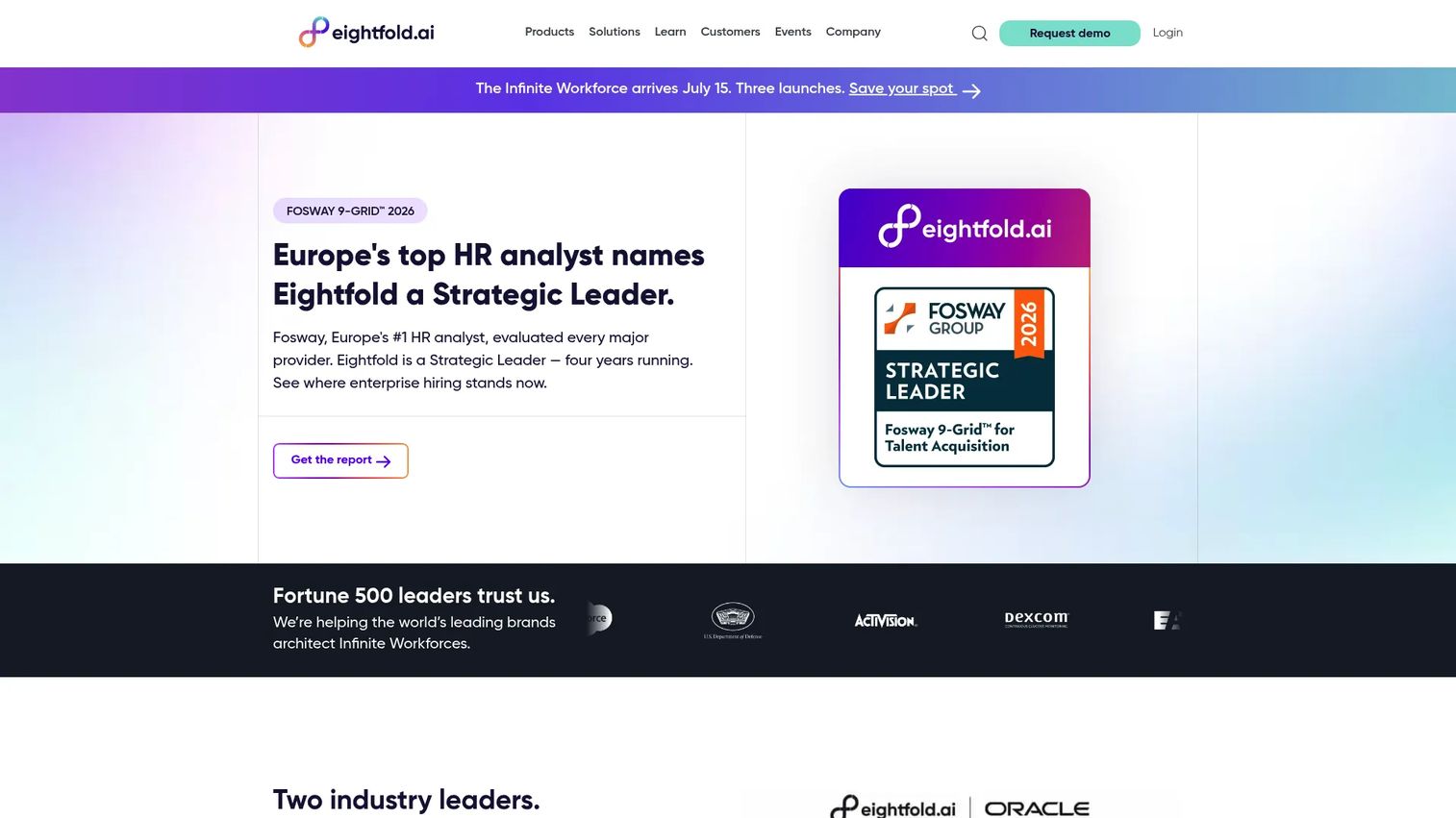
Eightfold AI is an AI-native talent intelligence platform built for enterprise HR teams that need one system across hiring, internal mobility, and workforce planning. It applies deep-learning models to candidate, employee, and labor-market data, then scores fit on skills and potential rather than keywords. The platform is built around the idea that the same talent graph should power recruiting, development, and planning instead of three separate tools.
Best for: Enterprise and multi-stakeholder hiring teams that want AI-powered talent intelligence spanning the full talent lifecycle.
Key strengths
- Skills-based matching: Scores candidates and employees on capability and skill adjacency, surfacing fit that title-based search misses.
- Internal mobility and talent management: Maps existing employees to open roles, projects, and career paths, turning retention into a data-driven motion.
- Workforce planning with labor-market data: Aggregated labor market data informs headcount, location, and reskilling decisions before you commit budget.
Why choose Eightfold AI: Eightfold fits organizations with complex, multi-stakeholder hiring and a real workforce-planning mandate. Its agentic AI and talent-agent direction point toward automating large portions of recruiter work, which matters when headcount scales faster than your recruiting team. For founders, it is the option that treats hiring, mobility, and planning as one connected problem rather than three tools to integrate later.
Eightfold AI pricing: Eightfold does not publish pricing. The site routes prospects to a contact-sales and demo flow, and packaging depends on organization size and selected modules. Plan to engage their sales team for a tailored quote. Eightfold holds a 4.2/5 rating on G2.
2. Metaview
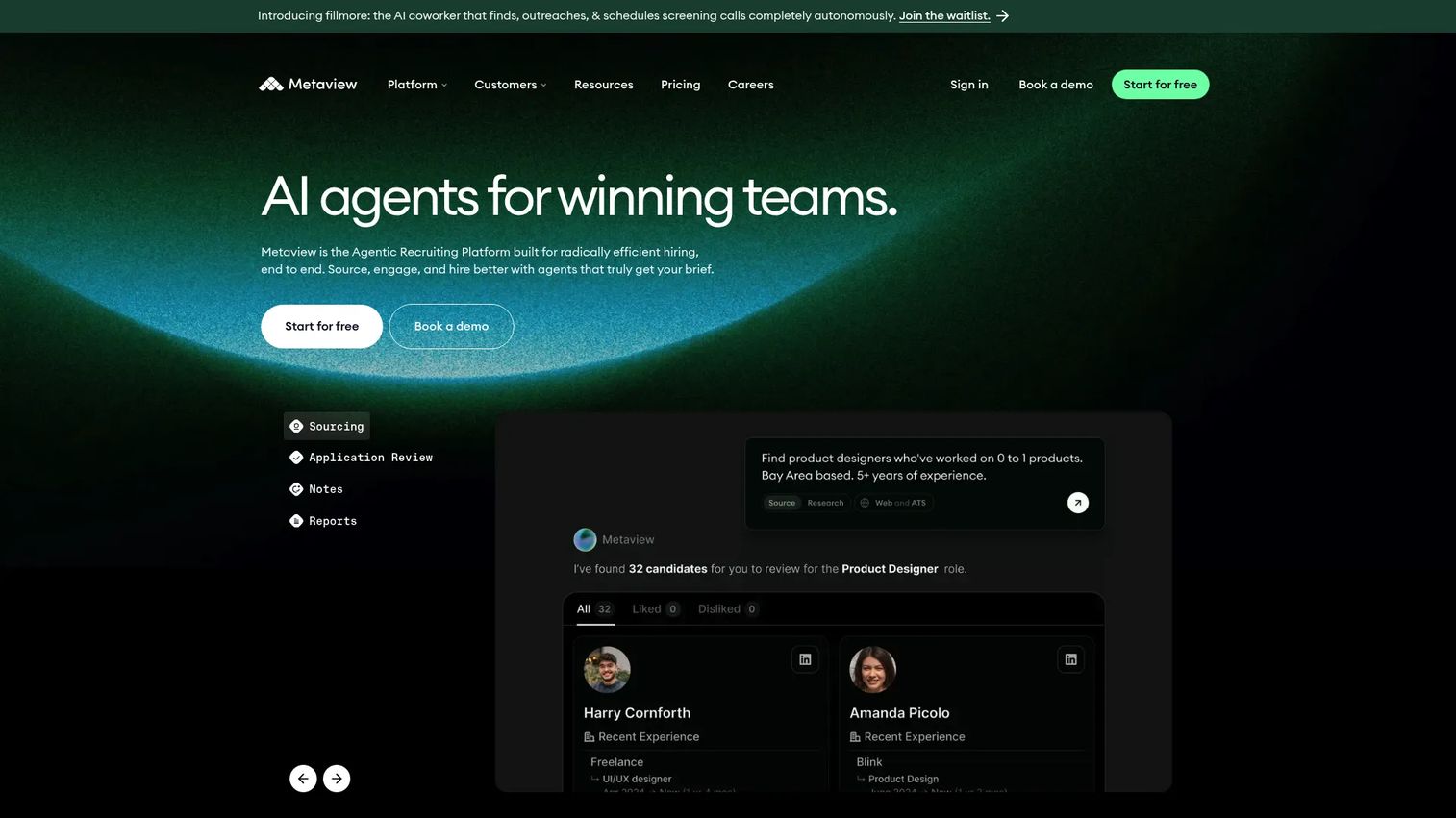
Metaview is an AI recruiting platform focused on interview intelligence: notes, transcription, summaries, and candidate sourcing. It captures what happens in interviews automatically, then turns conversations into structured, ATS-ready records so recruiters stop typing notes and start comparing candidates on consistent signal.
Best for: Recruiting teams that want less manual interview admin and more consistent, comparable interview records.
Key strengths
- AI interview notes: Captures and summarizes interviews automatically, removing the biggest source of recruiter admin.
- ATS-ready summaries: Generates structured notes that drop cleanly into your ATS, keeping records consistent across interviewers.
- Candidate sourcing and review: Adds AI sourcing and application review so interview signal connects to the top of the funnel.
Why choose Metaview: Interview notes are where hiring signal usually leaks. One interviewer writes a paragraph, another writes a sentence, and the hiring decision rests on uneven data. Metaview standardizes that capture with interview automation, which makes interview panels more defensible and faster. Reviewers consistently rate it highly for reducing manual work, and it earns a 4.8/5 on G2.
Metaview pricing: Metaview offers a Free plan at $0/month, a Pro plan at $60/month per user, and Enterprise pricing that is tailored. A custom-priced agentic recruiting platform tier is also available. The free tier makes it easy to test interview capture before committing budget.
3. Gem
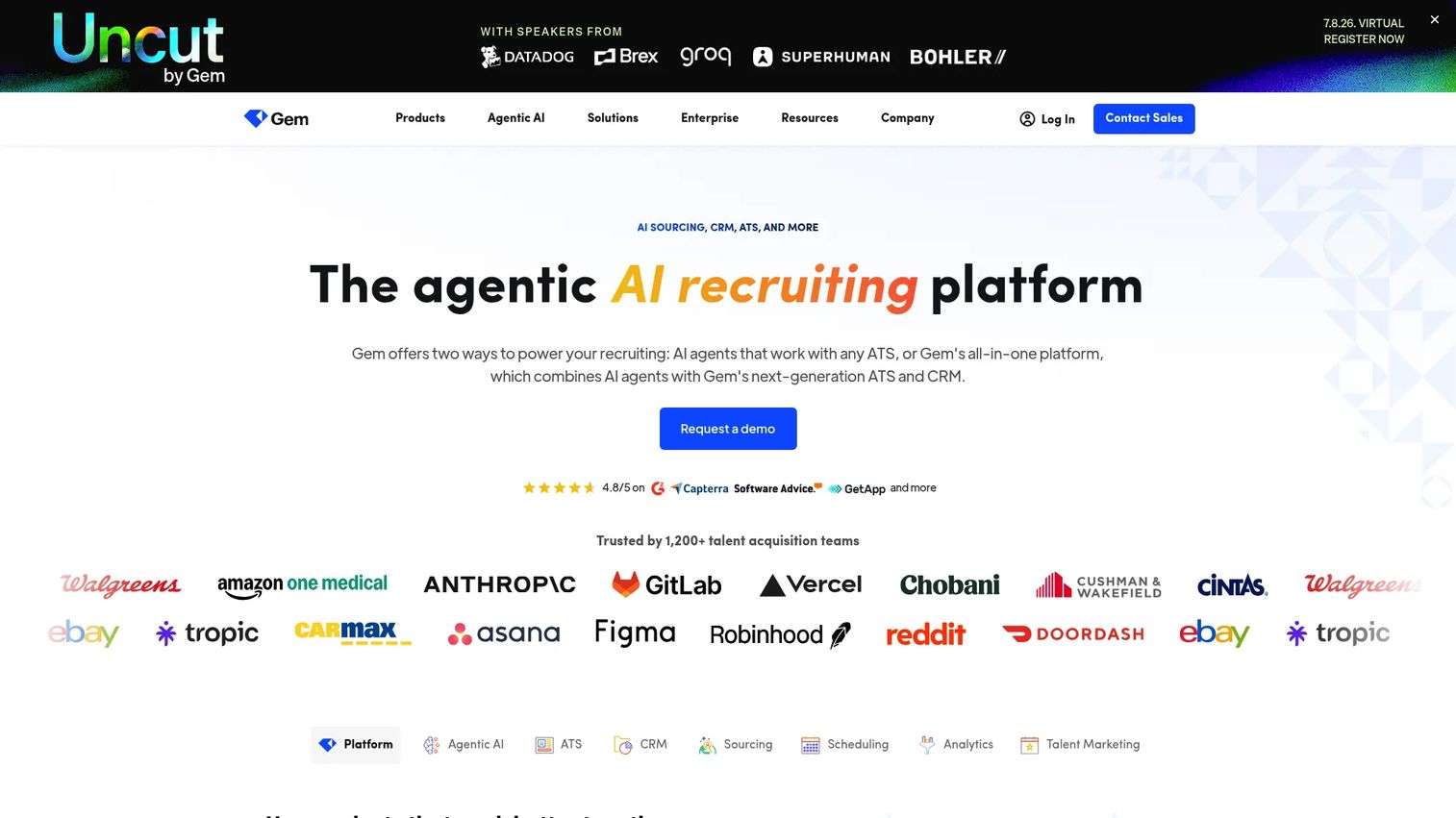
Gem is an AI-first recruiting platform that combines ATS, CRM, sourcing, scheduling, and analytics in one system. It is built for teams running active outbound recruiting programs that care about pipeline health and want every touchpoint and stage visible in one place.
Best for: Recruiting teams and staffing firms that run outbound sourcing and want pipeline visibility without stitching tools together.
Key strengths
- Pipeline visibility: Unifies sourcing, sequencing, and ATS data so you can see pipeline health and conversion at every stage.
- Outbound recruiting and sequencing: Email-finding credits and sequencing automate candidate engagement at scale without losing the personal touch.
- AI application review: Surfaces and ranks inbound applicants so recruiters spend time on the strongest matches first.
Why choose Gem: If your recruiting motion depends on outbound, fragmented tools kill momentum. Gem consolidates sourcing, CRM, scheduling, and analytics so recruiters work in one place and leaders get clean pipeline data. For a founder watching recruiting efficiency as a growth metric, that consolidation is the pitch: fewer tools, more signal. Gem holds a 4.8/5 rating on G2.
Gem pricing: Gem's staffing pricing page lists Essentials at $99 per user/month billed yearly, Professional at $149 per user/month billed yearly, and Enterprise on custom, tailored billing. There is no free tier, but the entry plan is accessible for smaller recruiting teams.
4. CoRecruit (formerly Quil)
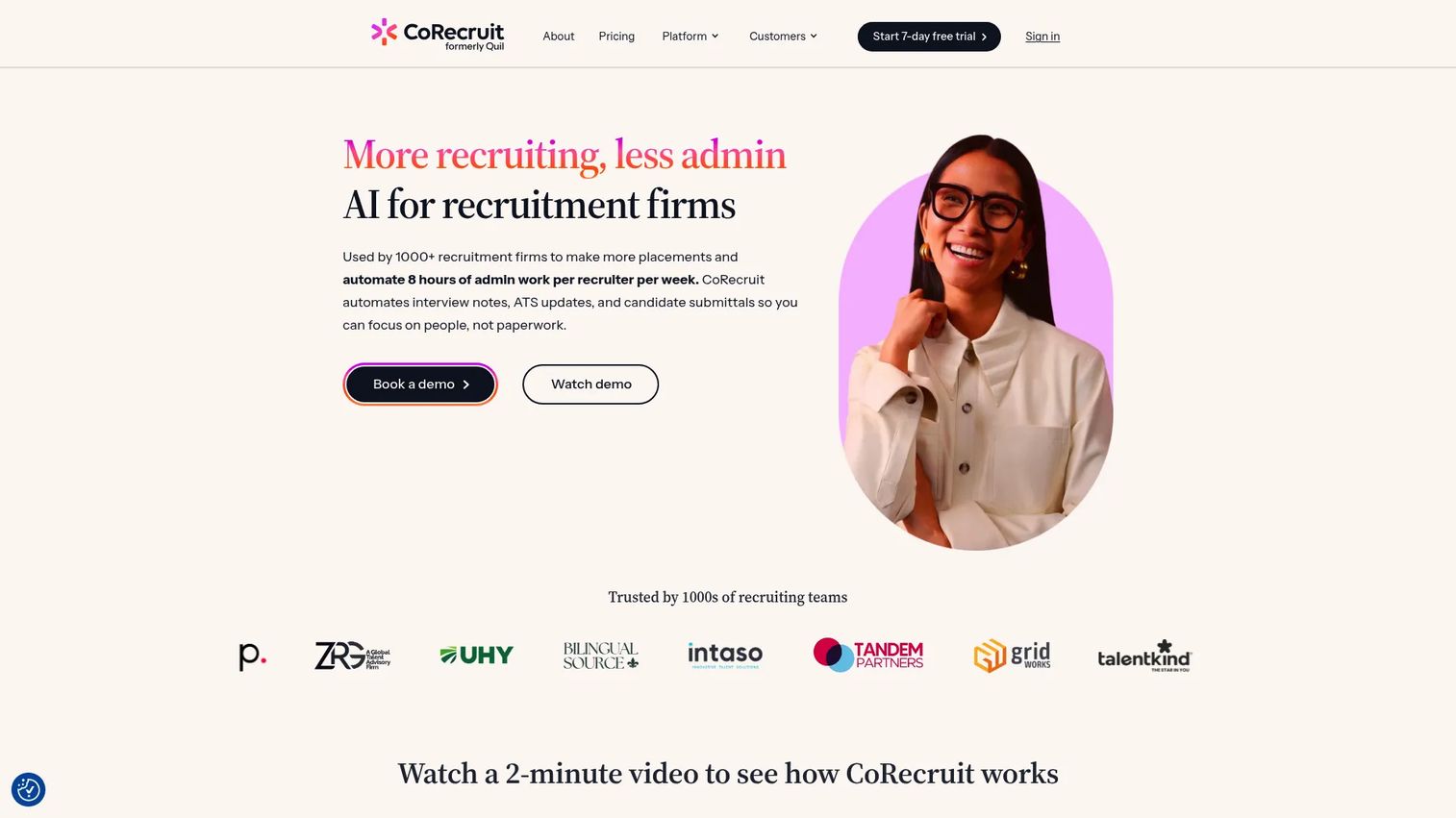
CoRecruit, formerly Quil, is AI recruiting software built for agencies. It automates interview notes, syncs them to your ATS, and generates client-ready candidate submittals. The focus is narrow and practical: take the documentation burden off recruiters so they can run more conversations.
Best for: Recruitment agencies that want AI interview notes, ATS sync, and submittal automation in one tool.
Key strengths
- AI meeting notetaker: Captures interview conversations and turns them into structured notes automatically.
- ATS-integrated notes: Syncs notes directly into your ATS, keeping candidate records current without manual entry.
- Client-ready submittals: Generates polished candidate submittals agencies can send to clients without rewriting.
Why choose CoRecruit: Agency recruiters live and die by speed and the quality of submittals. CoRecruit reduces the interview admin that slows both, standardizing interview notes across a team so quality does not depend on who took the call. The ATS-friendly documentation keeps everything in one record. For lean teams, that is real time back in the day.
CoRecruit pricing: CoRecruit shows pricing in two billing views. Under the annual upfront view, plans start at $50/user/month for Starter, $54 for Growth, and $50 for Professional, with Enterprise on a talk-to-sales basis for 100+ users. All plans carry a 12-month minimum term and include free VoIP with unlimited US and Canada calling. A free trial is available. CoRecruit earns a 4.7/5 on G2.
5. hireEZ
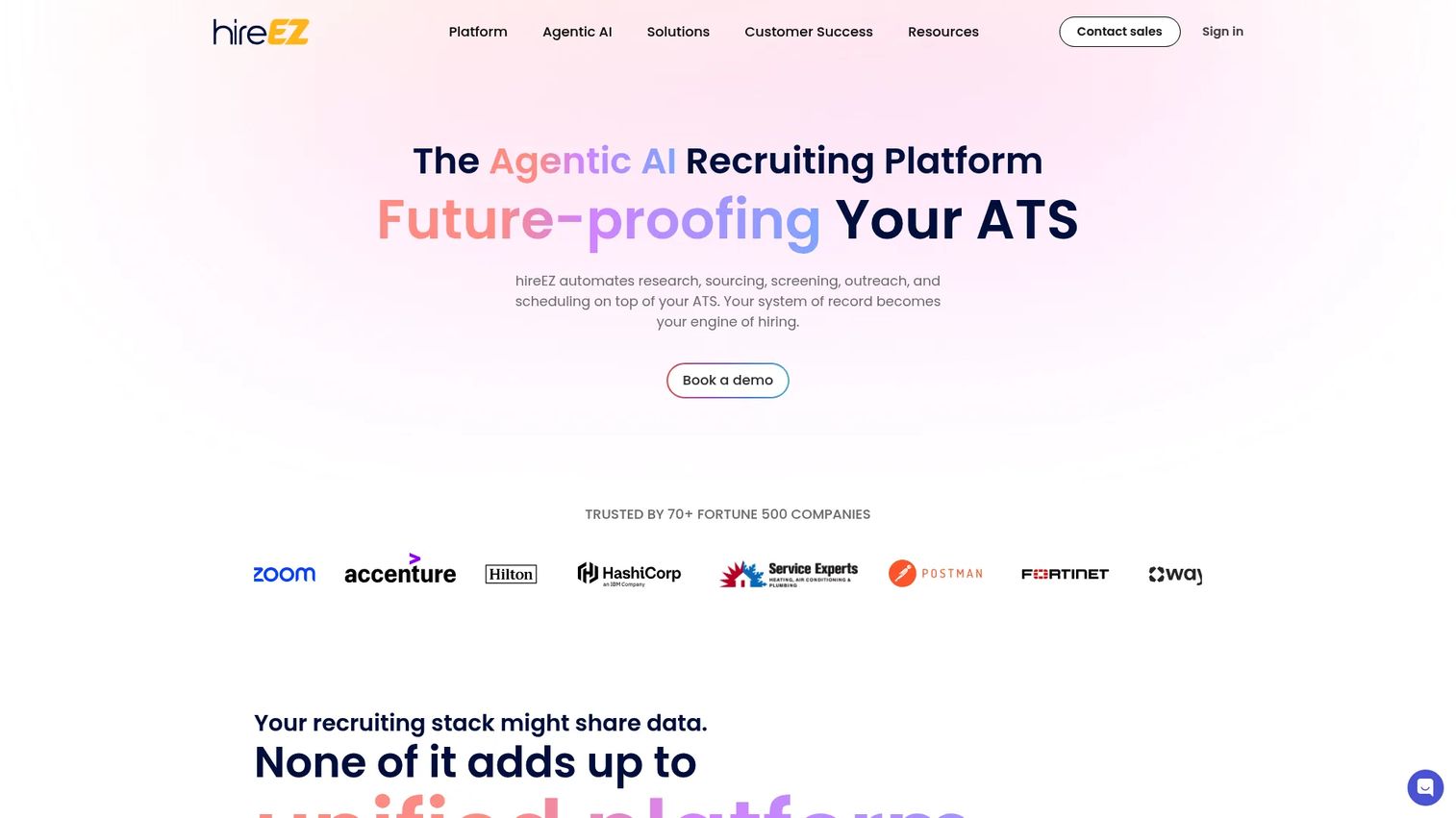
hireEZ is an AI recruiting platform that adds a sourcing, CRM, and screening layer on top of your existing ATS. It searches across the open web and your internal database, enriches contact data, and automates recruiter workflow, positioning itself for mid-market and enterprise talent acquisition teams.
Best for: Talent acquisition teams that want an AI sourcing and matching layer over their current ATS.
Key strengths
- AI sourcing across web and ATS: Surfaces candidates from both the open web and your internal talent pools in one search.
- CRM and talent pools: Organizes candidates into nurturable pools so past pipelines become future hires.
- Applicant review and scheduling: Automates resume screening and scheduling so recruiters move faster on inbound.
Why choose hireEZ: hireEZ fits teams that already have an ATS and want to make it smarter rather than replace it. The AI sourcing and resume screening reduce the manual search and review that eat recruiter hours. G2 sentiment is strong overall, though some reviewers note that contact-data accuracy and cost are worth evaluating against your volume. hireEZ holds a 4.6/5 rating on G2.
hireEZ pricing: hireEZ does not publish pricing on its site, which uses demo and sales-contact CTAs instead of displayed prices. Plan to request a quote based on seats and sourcing volume. Validate contact-enrichment accuracy during a trial before committing.
6. 365Talents
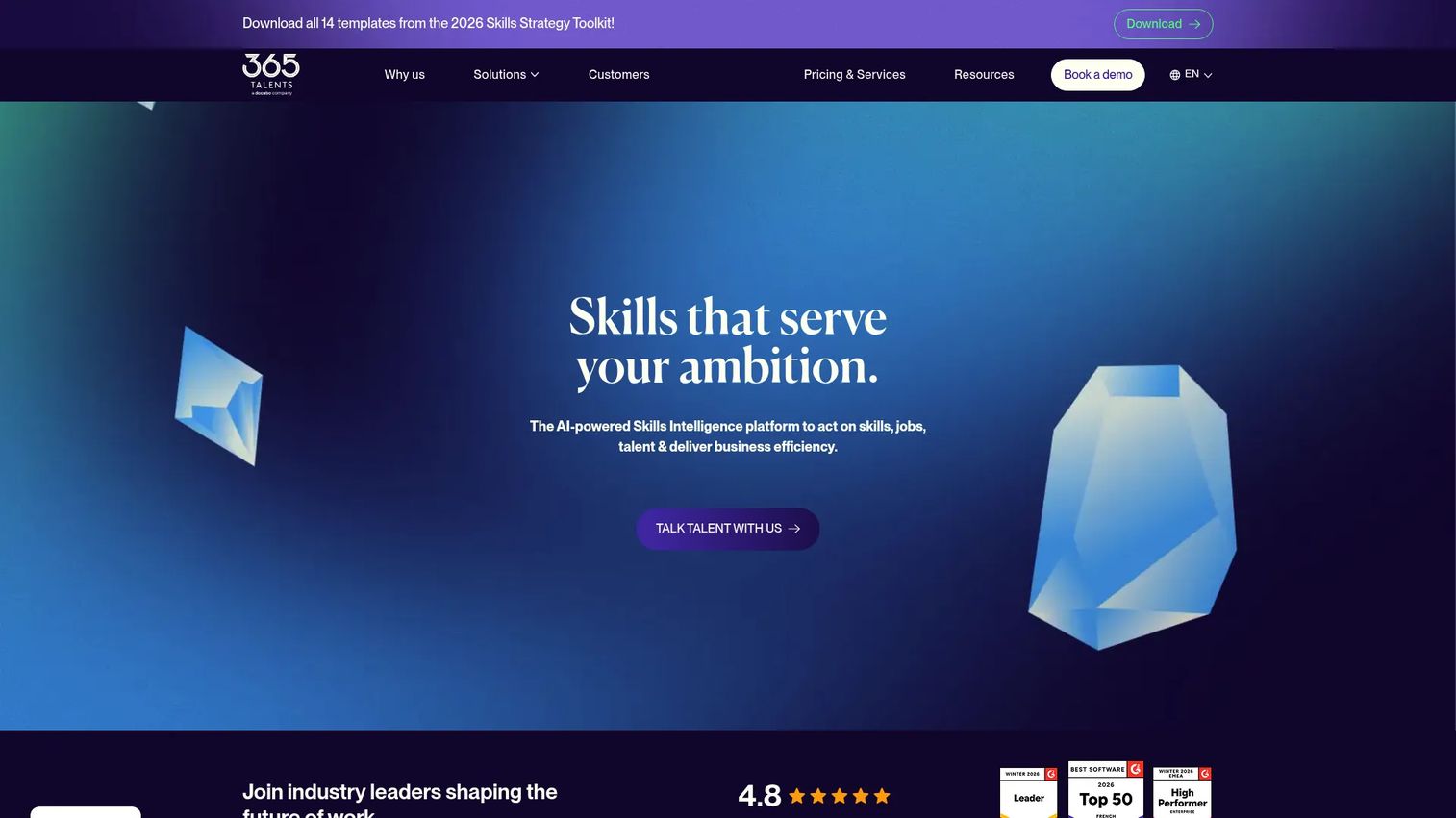
365Talents is an AI-powered skills intelligence and talent management platform built for enterprise workforce planning and internal mobility. It maps skills across your workforce, powers an internal talent marketplace, and supports employee development, helping organizations surface hidden talent and plan reskilling deliberately.
Best for: Large organizations building a skills-based workforce and an internal mobility program.
Key strengths
- Skills and job architecture: Builds a living skills map across the organization, the foundation for any skills-based talent strategy.
- Internal talent marketplace: Connects employees to internal roles, projects, and gigs, making internal mobility a real motion.
- Career developer and workforce intelligence: Guides employee development and feeds workforce planning with current skills data.
Why choose 365Talents: Most companies cannot see their own talent. 365Talents focuses squarely on that problem, turning scattered skills data into a marketplace where employees and managers find each other. For organizations facing retention pressure or large-scale reskilling, the talent marketplace and skills intelligence make internal hiring a strategy rather than an afterthought. It earns a 4.8/5 on G2.
365Talents pricing: Pricing is custom and module-based. The site states there are no public price tags and that proposals depend on organization size, selected modules, integrations, and support tier. Modules include Skills and Job Architecture, Internal Talent Marketplace, Career Developer, and Workforce Intelligence. Contact 365Talents for a tailored quote.
7. Loxo
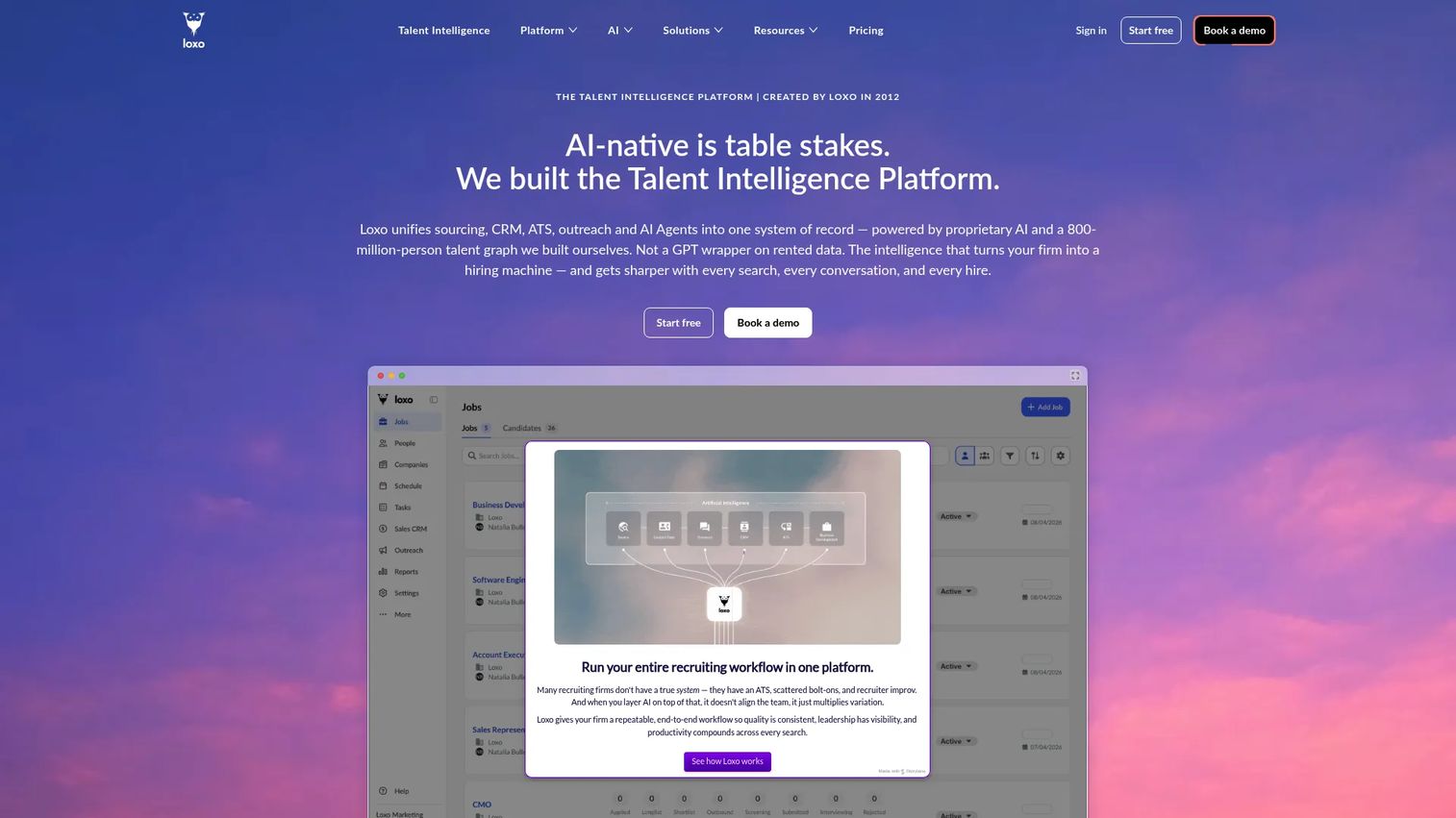
Loxo is an AI recruiting platform that unifies sourcing, CRM, ATS, outreach, and talent intelligence in one system. It is built for recruiting and staffing firms that want to run the full recruiting lifecycle without juggling separate tools for each stage.
Best for: Recruiting and staffing firms that want an all-in-one ATS, CRM, and outreach platform.
Key strengths
- Unified talent intelligence platform: Combines sourcing, CRM, ATS, outreach, people data, and AI agents in one workflow.
- Multi-channel outreach: Engages candidates across email, SMS, phone, and meetings from a single system.
- Recruiting CRM and ATS workflows: Includes a hiring-manager portal and full ATS workflow so the whole team works in one place.
Why choose Loxo: The consolidation angle is the whole point. Instead of paying for a sourcing tool, a CRM, an ATS, and an outreach platform separately, Loxo puts them under one roof with talent intelligence layered in. For lean teams that want one system across the recruiting lifecycle, that reduces both cost and the handoff friction that loses candidates. Loxo holds a 4.6/5 rating on G2.
Loxo pricing: Loxo's pricing page shows pricing annually for new customers and directs prospects to contact sales rather than displaying public prices. Plan to request a quote based on team size and modules. Ask specifically about which AI and people-data features are included at each tier.
8. Andela
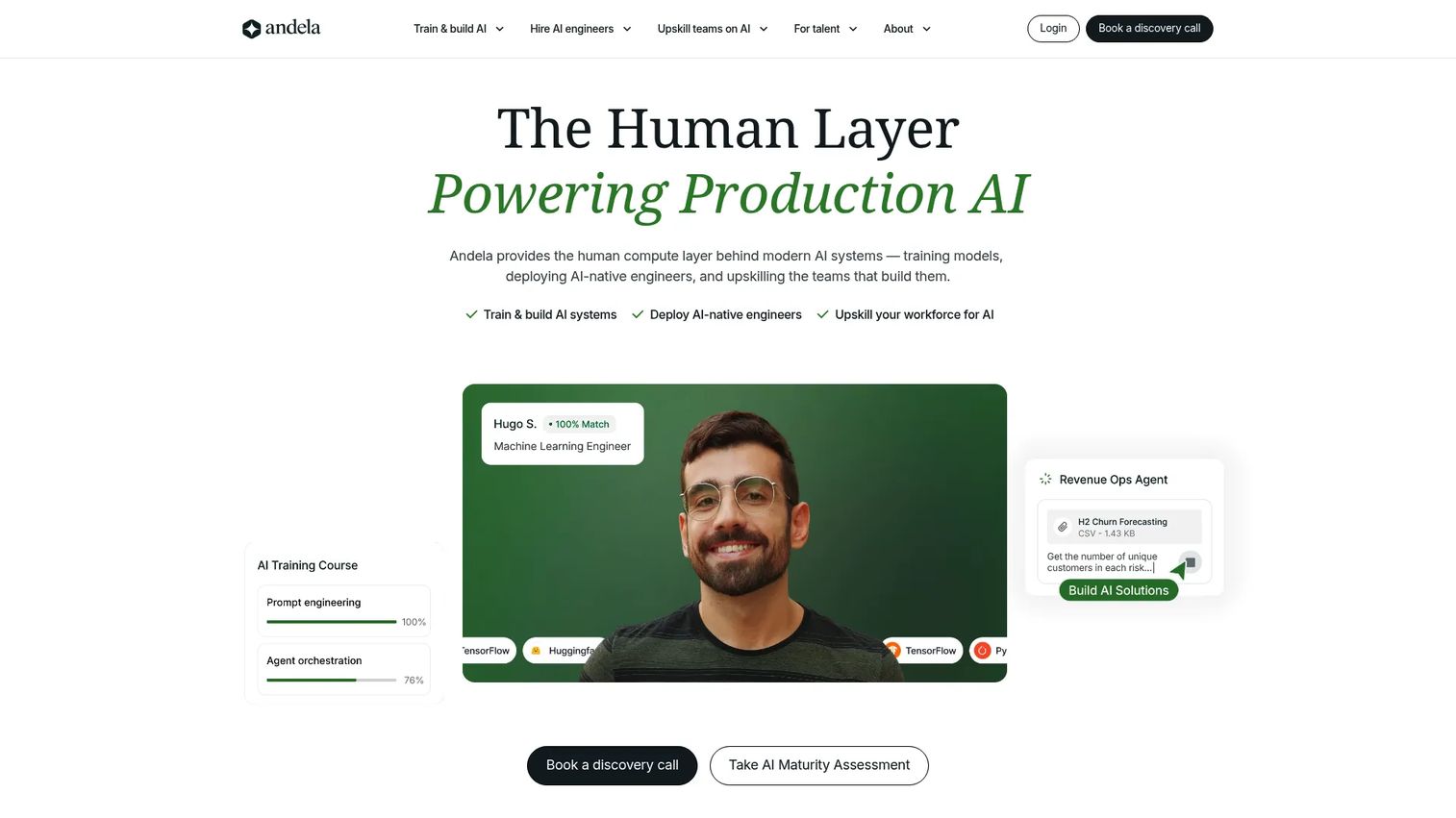
Andela is a different kind of talent intelligence option. Rather than surfacing internal skills, it focuses on supply: connecting enterprises with vetted AI-native engineers and technologists, plus managed teams and upskilling programs for organizations building production AI systems.
Best for: Enterprises that need global AI and engineering talent and managed delivery fast.
Key strengths
- AI-native talent network: Provides access to vetted engineers and technologists for distributed, fast hiring.
- Managed AI solutions: Offers managed teams for building AI systems when you need delivery, not just headcount.
- Upskilling and reskilling programs: Runs AI-skills development so teams keep pace as requirements change.
Why choose Andela: When your constraint is access to scarce technical talent rather than visibility into your own workforce, Andela solves a different problem than the rest of this list. Its vetted, distributed network lets you staff AI and engineering roles quickly across regions. For founders racing to build technical capacity, that supply-side speed is the value. Andela holds a 4.7/5 rating on G2.
Andela pricing: Andela does not publish pricing on its main site, which prompts visitors to book a discovery call. Engagements are scoped to your hiring or delivery needs, so request a tailored quote based on roles, team size, and duration.
Considerations before you buy
The right talent intelligence platform depends on your workflow, not the category badge. Run any shortlist through these criteria.
Where it sits in the talent lifecycle
Decide whether your bottleneck is sourcing, interview signal, internal mobility, or whole-lifecycle planning. A sourcing-heavy team gets more from Gem or hireEZ; a skills-and-mobility focus points to 365Talents or Eightfold. Buying the wrong layer wastes budget and confuses the team.
ATS integration depth
Most of these tools either replace or sit on top of your ATS. Confirm the exact integration: which fields sync, whether it is two-way, and how interview notes and candidate records flow. Shallow ATS integration creates the same fragmentation you are trying to fix.
Quality of AI and skills intelligence
Every vendor claims AI. Test it. Run real roles through the matching engine and judge whether the ranked results are defensible. For skills-based hiring, the depth of the skills graph matters more than the marketing.
Cost relative to your stage
Per-seat pricing scales fast as your recruiting team grows. Model the cost at your projected headcount, not today's. A tool that earns its place at five recruiters may not at fifteen, and the reverse is also true.
Time to first win
A platform that takes six months to implement does not help a team hiring now. Favor tools that produce a usable result in the first week or two, and validate that timeline with the vendor before signing.
Conclusion
Talent intelligence software is the layer that turns scattered hiring and workforce data into decisions you can defend. The right pick depends entirely on where your bottleneck sits.
For enterprise teams that need one system across skills, internal mobility, and workforce planning, Eightfold AI is the most complete option. If interview signal is leaking and notes are inconsistent, Metaview standardizes interview automation with the strongest reviewer sentiment on the list. For sourcing-heavy and outbound recruiting motions, Gem and hireEZ are the clearest fits. Teams focused on surfacing internal talent should look at 365Talents, while Loxo wins on all-in-one consolidation and Andela on global technical supply.
The takeaway is simple: match the tool to the workflow, not the label. A skills-based hiring problem and a global-sourcing problem are not the same, and the best talent intelligence tools solve one of them exceptionally well. Start with your biggest constraint, test the AI on real roles, and confirm the integration before you commit.
If your evaluation also touches how vendors show complex products, building a clear interactive demo of your own workflows can shorten the sales cycle on the buyer's side. Teams that want to test that approach can Start your journey with Guideflow today!
FAQs
Talent intelligence software uses AI and machine learning to analyze candidate, employee, and labor-market data so teams make better hiring, mobility, and workforce decisions. It goes beyond storing applicants by actively scoring fit, mapping skills, and surfacing where talent should move next. The category bridges recruiting and talent management around a skills-based view of people.
An applicant tracking system stores candidates and moves them through hiring stages. A talent intelligence platform adds a decision layer on top: it scores fit on skills, surfaces internal and external candidates, and informs workforce planning. Many talent intelligence tools integrate with or sit on top of an ATS rather than replacing it.
Eightfold AI is the strongest fit for enterprise hiring because it connects recruiting, internal mobility, and workforce planning in one AI-driven platform built around skills and labor-market data. For large organizations focused specifically on internal mobility and skills mapping, 365Talents is a strong alternative. Both serve multi-stakeholder enterprise teams.
365Talents leads on internal mobility and skills intelligence, with skills mapping, an internal talent marketplace, and career development tooling. Eightfold AI also supports internal mobility as part of its broader talent intelligence platform. Both help organizations surface hidden talent and plan reskilling deliberately.
Look for a deep, living skills graph, candidate matching that ranks on capability and skill adjacency rather than titles, and bias reduction that de-emphasizes pedigree. Strong ATS integration and clear analytics matter too, so skills data flows into decisions instead of sitting in a separate system. Test the matching engine on real roles before buying.
AI recruiting tools automate the repetitive parts of hiring: sourcing candidates, screening resumes, capturing interview notes, and writing summaries. Interview automation alone removes hours of typing and standardizes records across interviewers. The result is recruiters spending more time on candidate conversations and less on administrative data entry.
Yes. Most talent intelligence tools are built to integrate with common ATS and HR systems, syncing candidate records, interview notes, and skills data both ways. Integration depth varies, so confirm which fields sync and whether the connection is two-way before committing. Shallow integration recreates the fragmentation these platforms aim to fix.
Start with your biggest constraint. If your bottleneck is sourcing, outbound, or interview signal, a recruiting-first platform like Gem, hireEZ, Metaview, or Loxo fits best. If the constraint is internal mobility, skills visibility, and workforce planning, a talent-management-first platform like 365Talents or Eightfold AI is the better match. Match the tool to the workflow, not the category label.