Your board asked about your AI strategy three times last quarter. Your VP of Sales wants agents that handle pipeline hygiene. Your Head of Support wants tier-1 ticket deflection by Q2. And every vendor email this week claims to be "agentic."
You don't need another explainer. You need a shortlist.
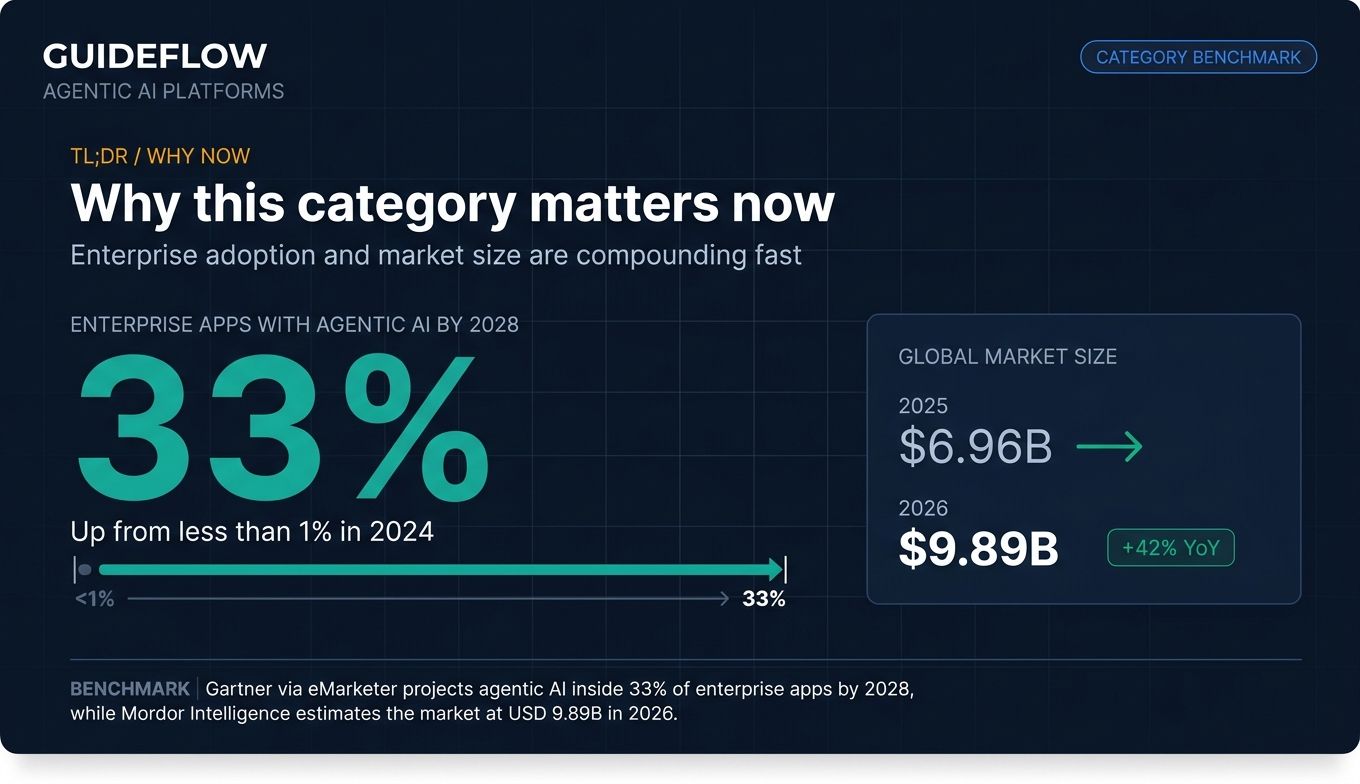
According to an October 2024 Gartner report cited by eMarketer, 33% of enterprise software applications will incorporate agentic AI by 2028, up from less than 1% in 2024. That's the curve you're being asked to position on. The category is also growing fast on its own: Mordor Intelligence values the agentic AI market at USD 6.96 billion in 2025, projected to reach USD 9.89 billion in 2026.
The pressure is real, but the decision is harder than it looks. Most "agentic" tools are wrappers on a frontier model. A smaller set are genuine platforms: they handle orchestration, memory, tool use, governance, and observability so your engineering team isn't rebuilding agent infrastructure from scratch every quarter.
This guide ranks the 10 agentic AI platforms most defensible for a SaaS team in 2026. Each one earned its place through production deployments, public documentation, and integration depth with the modern GTM stack. We weighed them through the lens that actually matters at your stage: what does your VP do with this on day one, and what does it replace?
What's inside
This is a shortlist for SaaS founders, product leaders, and GTM operators evaluating where to place an agentic AI bet. It is not a definition page or a vendor catalog. We selected platforms based on four criteria:
- Production-ready with documented enterprise deployments, not research demos.
- Pricing accessible on the vendor's pricing page or reported on G2.
- Integration depth with the SaaS stack you already run (CRM, knowledge bases, productivity suites).
- Active development and maintained documentation as of 2025.
Every brand in the comparison table appears in the item section below, with pricing verified against the vendor's pricing page at the time of writing.
TL;DR
- Best for non-technical operators building workflows fast: Gumloop
- Best for engineering teams building custom multi-agent systems: CrewAI
- Best for enterprise multi-agent orchestration with governance: Kore.ai
- Best for Salesforce-centric GTM teams: Salesforce Agentforce
- Best for Microsoft 365 environments: Microsoft Copilot Studio
- Best free option to start experimenting: Zapier Agents
Each pick maps to a specific stack profile. The right answer is rarely the most powerful platform. It's the one that survives your security review, fits your existing tools, and ships a usable agent in week one.
Background: What are agentic AI platforms?
An agentic AI platform is software that lets you build, deploy, and orchestrate autonomous AI agents that perceive context, reason through multi-step problems, take actions across tools, and adapt based on outcomes, without a human prompting every step.
That definition matters because the category is often confused with adjacent ones. Generative AI produces an output (text, code, image) in response to a prompt. Agentic AI takes actions: it decides what to do next, calls APIs, updates records, and evaluates whether the result moved it closer to the goal. The distinction is the loop, not the model.
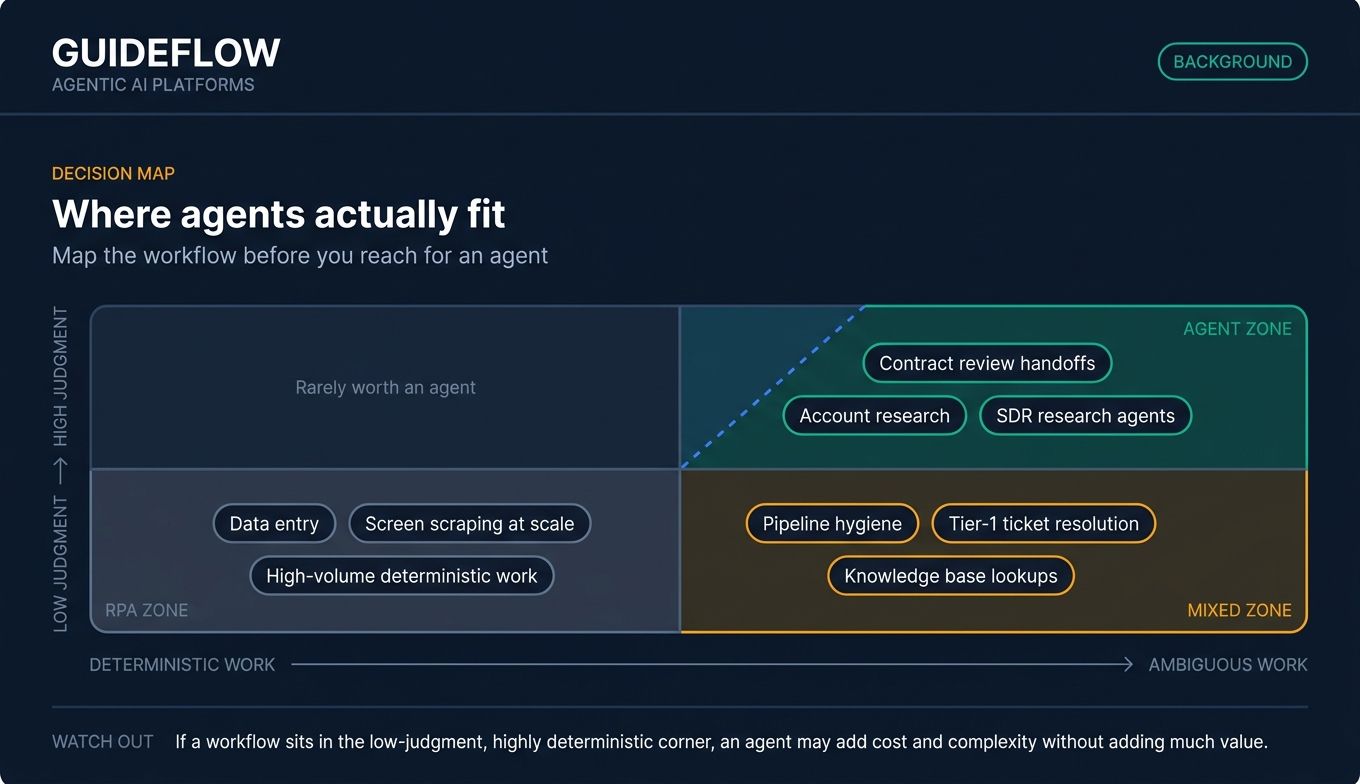
Agentic AI is also not RPA. Robotic process automation follows deterministic rules across screens and forms. Agents reason about exceptions, choose among tools, and handle inputs they have never seen before. RPA is cheaper and more predictable for high-volume deterministic work. Agents earn their keep when the workflow has branches, judgment, or ambiguity.
Most ai agent platforms in 2026 ship the same core capabilities. Use this as your feature baseline:
- Agent reasoning loop: perception, planning, action, and reflection in a continuous cycle.
- Tool use and function calling: agents invoke APIs, query databases, and call internal services.
- Multi-agent orchestration: specialized agents collaborate under a supervisor pattern.
- Memory and context management: short-term scratchpad plus long-term memory across sessions.
- Guardrails and observability: logging, prompt versioning, evaluation, and rollback.
- Enterprise data integration: connectors to your CRM, warehouse, knowledge base, and productivity suite.
- Human-in-the-loop controls: approval gates before high-impact actions.
That capability list is also a useful filter when you compare ai agent software. If a vendor markets itself as agentic but cannot articulate how it handles tool use or memory, it is closer to a chat wrapper than a platform.
The shift matters because agentic AI changes how you scale GTM and ops. IBM frames the agency dimension as the system's ability to act in the world, not just produce content. MIT Sloan researchers note that economic value flows to organizations that redesign workflows around agents rather than bolting them on top.
When SaaS teams use agentic AI platforms
Agentic AI earns budget when it removes a real bottleneck. Three patterns repeat across SaaS teams.
Automate revenue operations workflows
Pipeline hygiene, lead enrichment, forecast prep, contract review handoffs, account research. These are the workflows where your top RevOps person spends Monday morning, every Monday morning. Agents do the gather-and-stage work overnight so your AEs walk into Tuesday with enriched accounts, clean pipeline, and a forecast that already accounts for late-stage risk. The CAC payback math works fast when the alternative is hiring another ops analyst. Teams pairing agents with a strong outbound motion often layer in AI sales tools and AI SDR tools to handle the prospecting layer in parallel.
Scale customer support without scaling headcount
Tier-1 ticket resolution, knowledge base lookups, account-specific responses, status checks. Agentic ai solutions deflect the repetitive 60% of your queue and route the rest to humans with full context. The metric that moves is cost-per-ticket and median time-to-resolution. Most teams see both shift in the first 60 days if the knowledge base is decent.
Power internal employee productivity
Knowledge search across Notion, Drive, and Slack. Meeting prep agents that pull notes, CRM history, and recent emails. SDR research agents that build account briefs. This is where you give your newly hired VP something that works on day one instead of three months. It is also where ROI is hardest to defend, so anchor it to a specific metric like time-to-productivity or hours-per-week reclaimed before deploying.
Comparison table
The table below sorts platforms by relevance to a typical SaaS team buyer. Pricing was verified on each vendor's pricing page at the time of writing. G2 ratings reflect the current public listing.
| # | Product | Intent | Key differentiation | Pricing | G2 rating |
|---|---|---|---|---|---|
| 1 | Gumloop | No-code agent builder for operators | Visual workflow canvas with 100+ pre-built nodes and enterprise governance | Free; Pro from $37/month; Enterprise custom | 4.8/5 |
| 2 | CrewAI | Multi-agent orchestration for engineers | Open framework plus enterprise platform with no-code editor and code export | Free; Enterprise custom | 4.5/5 |
| 3 | Kore.ai | Enterprise agent platform for CX and EX | Reasoning-aware observability and multi-agent orchestration | Essential, Advanced, Enterprise (custom) | 4.6/5 |
| 4 | Salesforce Agentforce | Native CRM-grounded agents | Connects to Salesforce data, Flows, Apex, and MuleSoft for full context | Foundations free; $2 per conversation; add-ons from $125/user/month | 4.3/5 |
| 5 | Microsoft Copilot Studio | Agent platform for Microsoft 365 | Native to SharePoint, Teams, and Dynamics with low-code authoring | Copilot Credit pack $200/pack/month; pay-as-you-go | 4.4/5 |
| 6 | Google Vertex AI Agent Builder | Cloud-native agent platform | Agent Development Kit and managed runtime on Google Cloud | Usage-based: runtime, sessions, memory bank | 4.3/5 |
| 7 | AWS Bedrock Agents | Multi-model agents on AWS | Multi-agent collaboration with RAG and memory retention | Usage-based by model and service tier | 4.3/5 |
| 8 | Zapier Agents | No-code agents on 9,000+ apps | AI teammates that act across the largest integration network in SaaS | Free; Pro $33.33/month (billed annually) | 4.5/5 |
| 9 | Glean | Enterprise search plus agents | Permissioned search and agent layer across company knowledge | Custom pricing | 4.7/5 |
| 10 | Moveworks | Employee-facing AI assistant | Enterprise search and agentic automation across internal systems | Custom pricing | 4.4/5 |
Best agentic AI platforms for SaaS teams in 2026
1. Gumloop
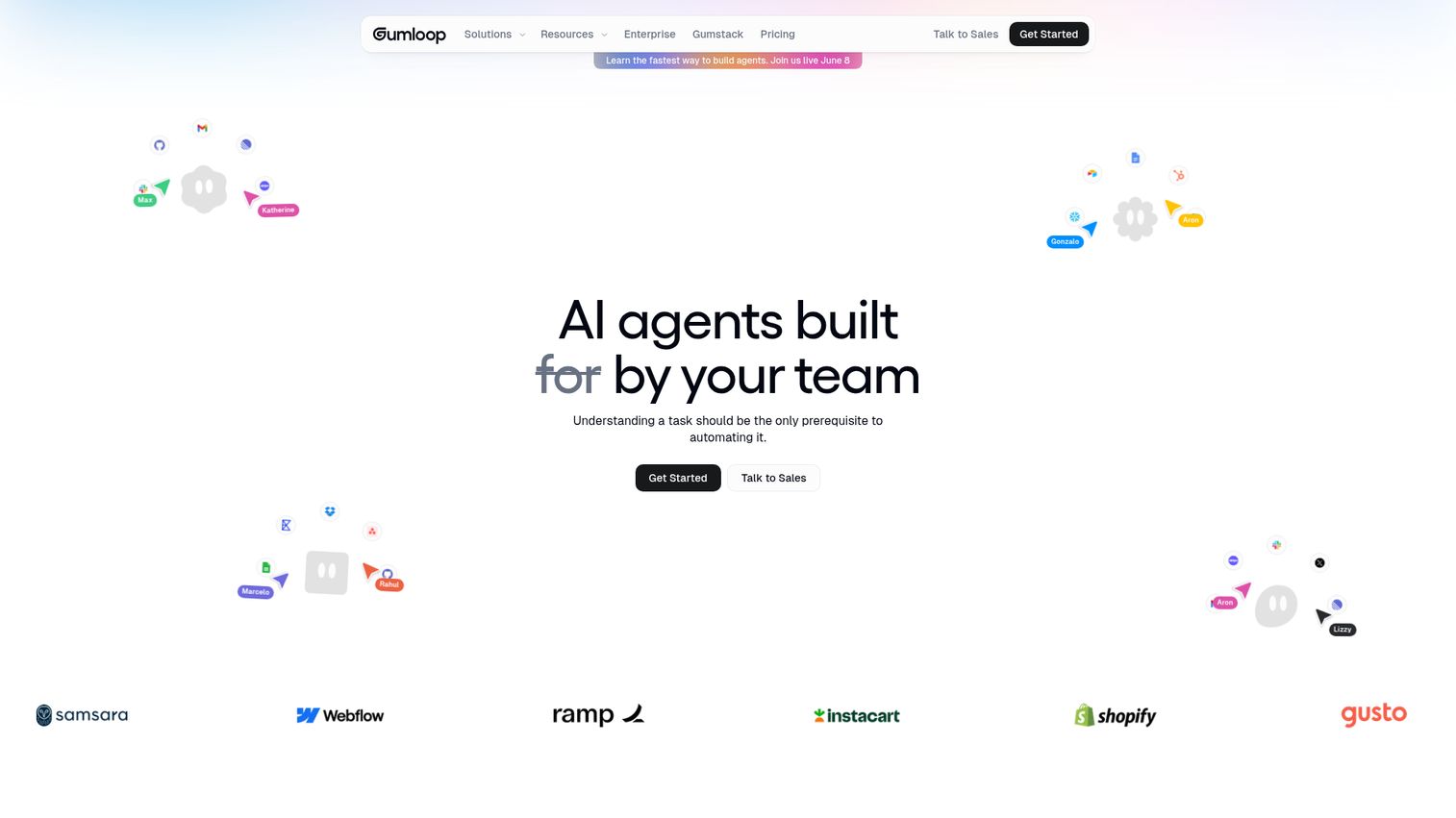
Gumloop is a no-code AI automation framework for building workflows and agents through a visual canvas. The platform sits between Zapier-style automation and code-first agent frameworks, giving operators a way to ship production agents without engineering tickets. It has become a default for SaaS teams that want a RevOps lead, marketer, or PMM to own the agent stack.
Best for: SaaS operators and ops teams who need to build production workflows without engineering bandwidth.
Key strengths
- Visual drag-and-drop builder: 100+ pre-built nodes and integrations cover the common SaaS stack moves (HubSpot, Slack, email, web scraping, document parsing).
- AI agents that orchestrate tools: agents work across Slack, Teams, and email to chain actions across systems your team already uses.
- Enterprise controls: role-based access control, audit logs, SSO/SCIM/SAML, and virtual private cloud deployment for teams with security review obligations.
Why choose Gumloop: Founders who want their RevOps lead or marketing manager to ship a working agent this week, not next quarter, find this the lowest-friction starting point. The visual canvas hits a sweet spot where non-engineers can build real workflows and engineers can review them without learning a new framework.
Gumloop pricing: Verified on gumloop.com/pricing. The Free plan includes 5,000 credits per month, 1 seat, and 2 concurrent runs. Pro starts at $37/month with 20,000+ credits, unlimited seats, and 25 concurrent agent interactions. Enterprise is custom-priced and adds the security and deployment controls listed above.
2. CrewAI
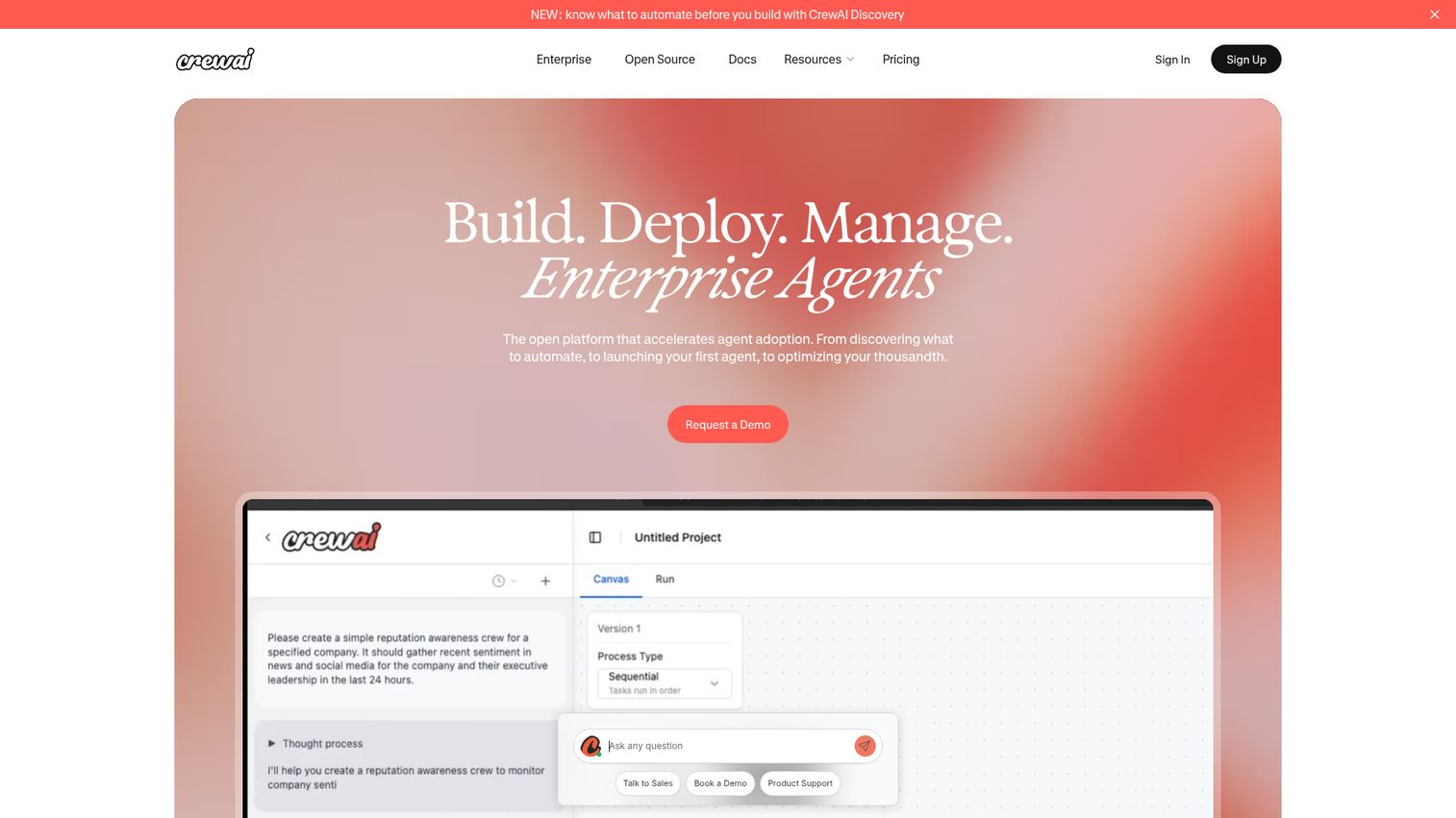
CrewAI is an open platform for discovering, building, deploying, managing, and optimizing multi-agent AI workflows. It started as an open-source Python framework and has matured into a hybrid offering: a code-first API for engineers plus a no-code visual editor that exports to Python. For SaaS engineering teams that want to own their agent architecture, CrewAI has become the most common landing spot. Teams comparing orchestration approaches often benchmark it against other AI orchestration platforms before settling on a primary framework.
Best for: SaaS engineering teams building proprietary multi-agent systems where the agent design itself is a differentiator.
Key strengths
- Dual builder experience: no-code visual editor for fast iteration, with one-click export to Python for engineering review and version control.
- Code-first orchestration API: multi-agent role design (researcher, writer, reviewer patterns) that lives in your existing Python codebase.
- Enterprise observability: real-time tracing, RBAC, audit trails, and human-in-the-loop controls for production deployments.
Why choose CrewAI: When your agent system is part of the product, not part of internal ops, CrewAI gives you the framework most teams converge on without locking you into a proprietary runtime. The visual editor also keeps non-engineers in the loop without forking the codebase.
CrewAI pricing: Verified on crewai.com/pricing. CrewAI offers a Free plan to get started and an Enterprise plan with custom pricing for organizations that need private infrastructure, added support, and services. No public dollar amount is listed for Enterprise.
3. Kore.ai
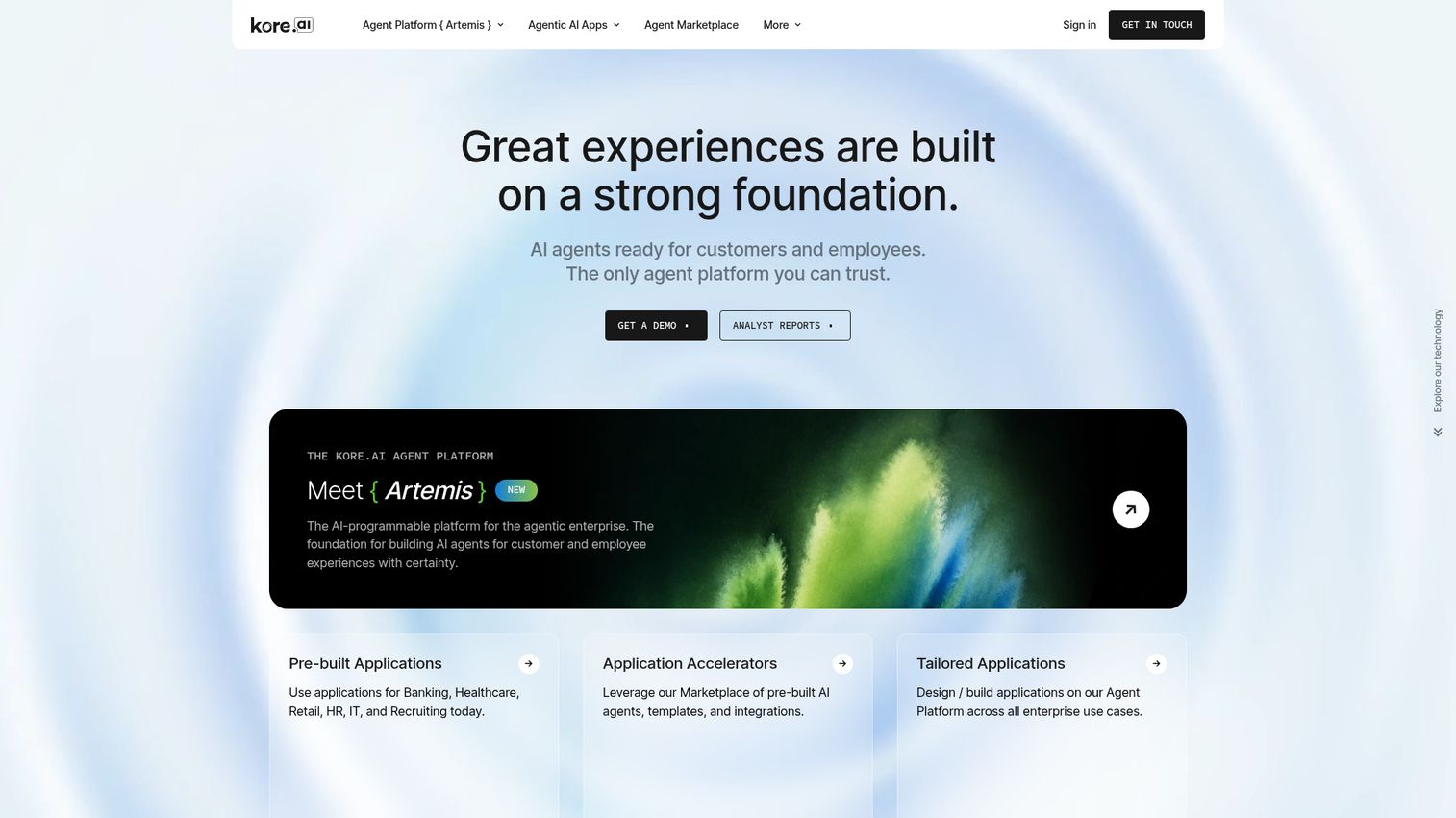
Kore.ai is an AI-native enterprise platform for building, deploying, and governing AI agents across customer service and employee productivity. Among agentic ai companies serving the enterprise, Kore.ai stands out for its observability layer and multi-agent orchestration designed for regulated environments. It is the platform you reach for when "agentic" needs to survive a security review and a compliance audit.
Best for: Mid-market and enterprise SaaS companies that need multi-agent orchestration across CX and EX workflows with governance baked in.
Key strengths
- Multi-agent orchestration: coordinate intelligent agent systems where specialized agents handle discrete steps under a supervising orchestrator.
- Reasoning-aware observability: tracing, diagnostics, and evaluations so you can see why an agent took an action, not just what it did.
- Enterprise governance: SSO, RBAC, audit logging, encryption, and compliance reporting at the platform layer.
Why choose Kore.ai: When you are past 100 employees and the cost of an agent making a wrong decision in production is high, Kore.ai's governance posture matters more than raw model capability. The observability layer is also one of the more mature in the category.
Kore.ai pricing: Verified on Kore.ai's billing documentation. The platform offers three plans: Essential, Advanced, and Enterprise. Billing varies by product (Automation AI is billed per 15-minute session, while Contact Center AI and Agent AI are billed per agent seat). No public dollar amounts are visible on the first-party pricing page. Expect a sales-led conversation.
4. Salesforce Agentforce
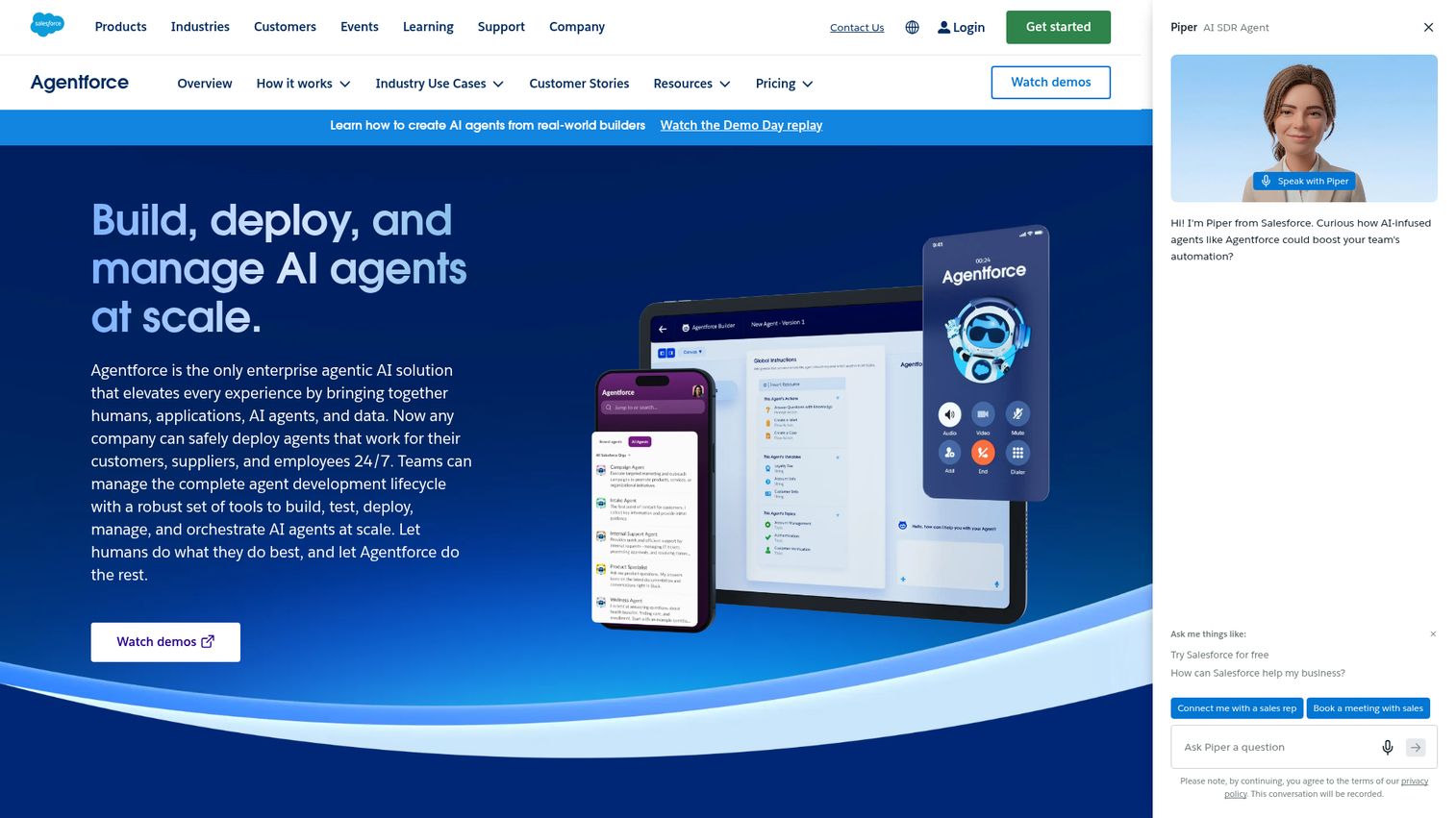
Salesforce Agentforce is Salesforce's enterprise agentic platform for building, deploying, and managing autonomous AI agents that answer questions, take actions, and support employees and customers. It is the path of least resistance for any GTM team already running on Sales Cloud or Service Cloud, because the agents reach Salesforce data, Flows, and Apex without separate integration work. For teams still mapping their CRM foundation, our roundup of the best CRM software is a useful prerequisite read.
Best for: SaaS companies running their GTM motion on Salesforce who want agents that live inside the CRM rather than alongside it.
Key strengths
- Agentforce Builder: create and customize agents with AI guidance, a low-code canvas, and a pro-code script view for advanced configurations.
- Multi-channel deployment: ship the same agent to chat, voice, Slack, apps, and customer portals.
- Native context: connections to Salesforce data, Flows, Apex, MuleSoft APIs, knowledge articles, and external systems for full account context.
Why choose Agentforce: If your team lives in Salesforce, every other agent platform creates a new data silo on day one. Agentforce avoids that and inherits your existing permissions, sharing rules, and territory model. The tradeoff is heavier coupling to a vendor you already depend on.
Salesforce Agentforce pricing: Verified on salesforce.com/agentforce/pricing. Salesforce Foundations is free. Conversations are priced at $2 per conversation. Flex Credits cost $500 per 100,000 credits. The Agentforce User License is $5 per user per month (and requires Flex Credits). Agentforce add-ons start at $125 per user per month, Industries add-ons at $150 per user per month, and Agentforce 1 Editions from $550 per user per month. Salesforce notes pricing is subject to change.
5. Microsoft Copilot Studio
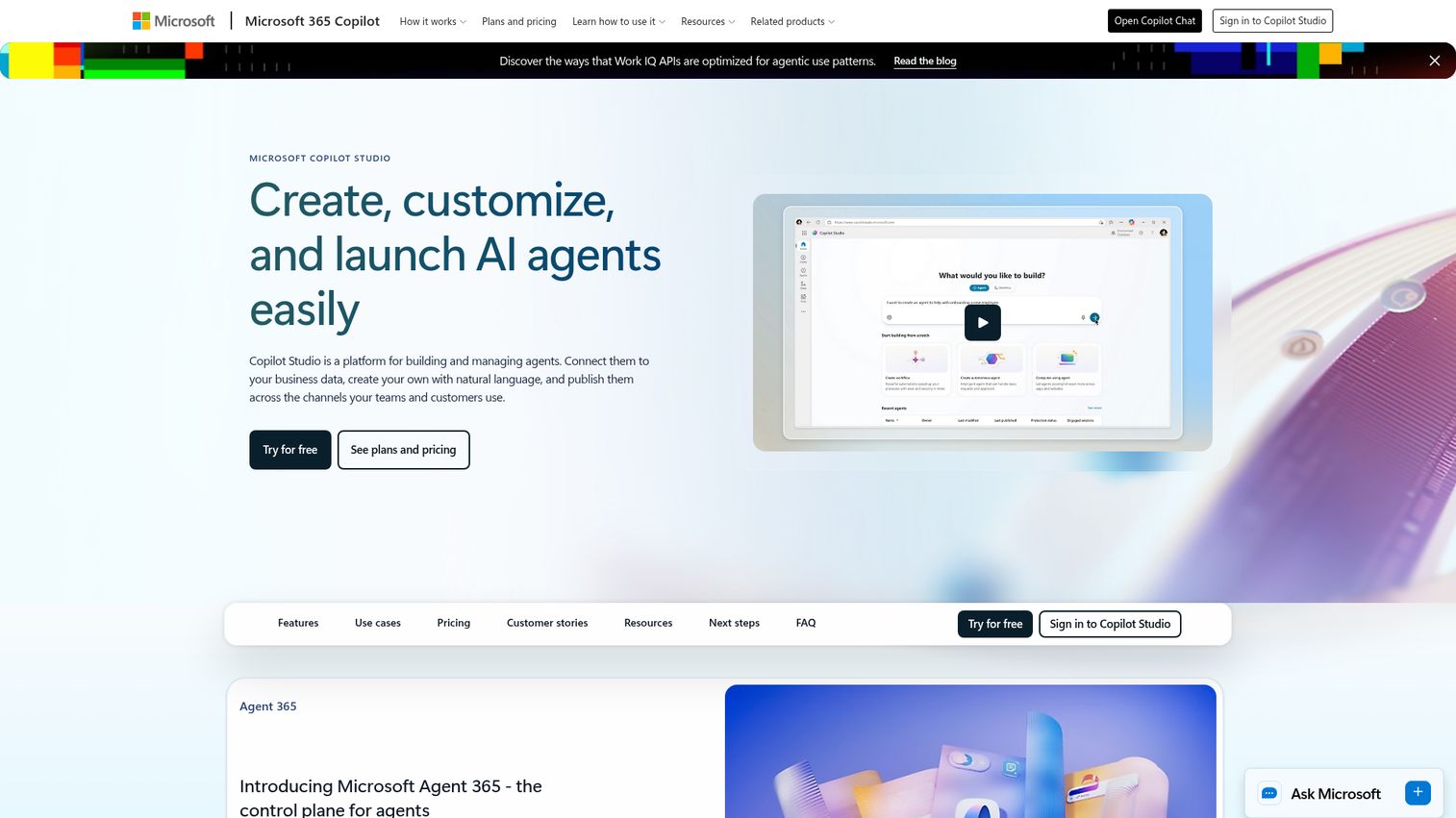
Microsoft Copilot Studio is Microsoft's platform for building and managing AI agents that connect to business data and can be published across Microsoft 365 and external channels. For organizations already paying for E5 licenses, Copilot Studio adds agentic capability to infrastructure you already own.
Best for: SaaS companies running on Microsoft 365 with meaningful SharePoint, Teams, and Dynamics infrastructure.
Key strengths
- Natural language or graphical authoring: build agents through prompts or a visual canvas, with flexibility to drop into more detailed configuration.
- Action-taking agents: complete work via flows, prompts, and APIs connected to your business systems.
- Native distribution: deploy agents to Microsoft 365 apps, websites, and social or messaging channels.
Why choose Copilot Studio: Sunk-cost economics work in your favor. If your stack is Microsoft 365 plus Dynamics, the integration story is done before you start. Microsoft also states licensed Microsoft 365 Copilot users can access Copilot Studio for internal agents at no extra cost, which removes a budget conversation.
Microsoft Copilot Studio pricing: Verified on Microsoft's Copilot Studio product page FAQ. Copilot Studio is available as tenant-wide Copilot Credit packs of 25,000 credits each at $200/pack/month, or as pay-as-you-go with no upfront license commitment. Licensed Microsoft 365 Copilot users can access Copilot Studio for internal agents without an additional license.
6. Google Vertex AI Agent Builder
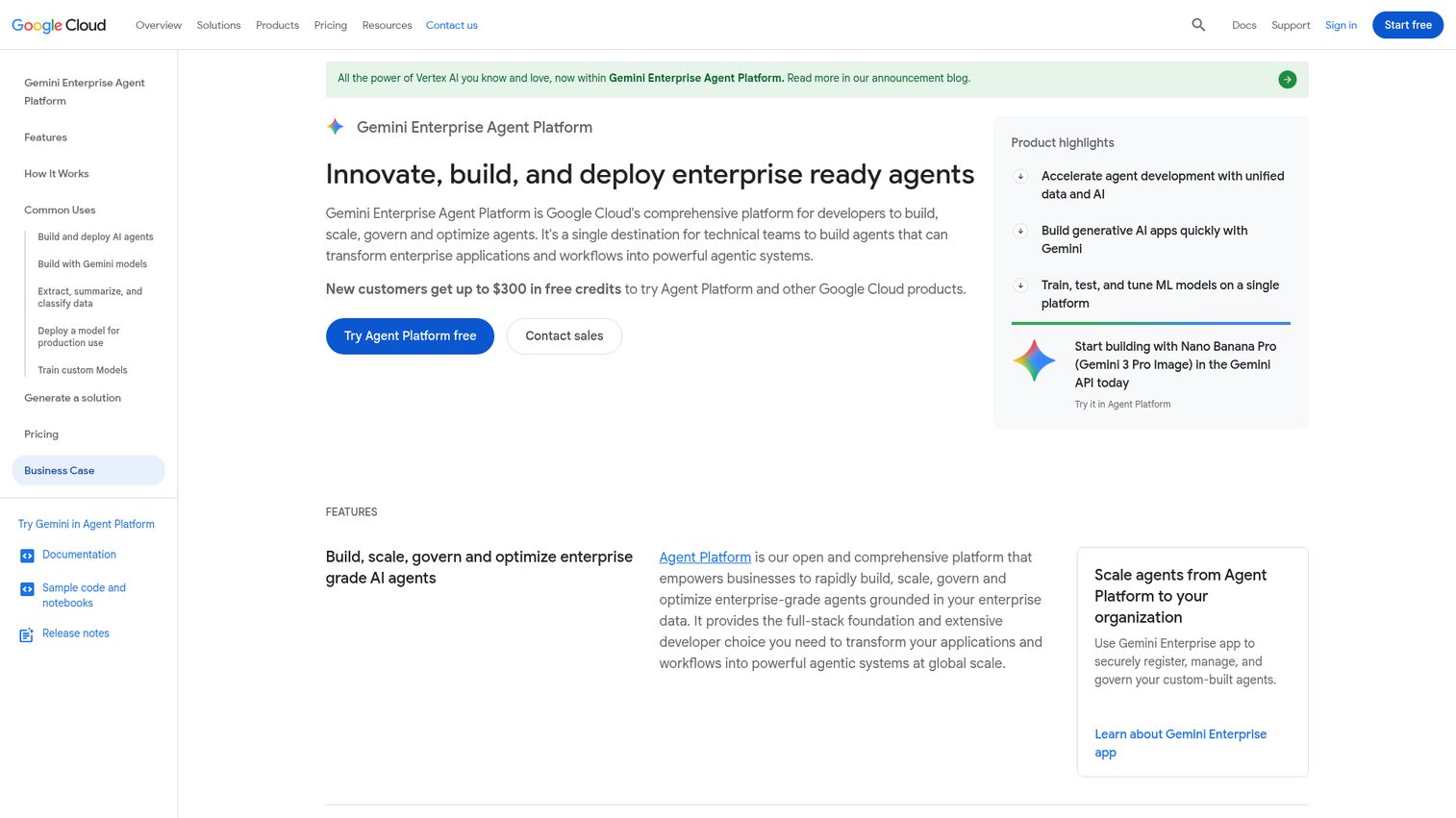
Google Vertex AI Agent Builder is Google Cloud's platform for building, scaling, governing, and optimizing enterprise AI agents. Google has been rebranding parts of this stack as Gemini Enterprise Agent Platform, but the underlying capabilities are the same: an Agent Development Kit, a managed runtime, and the governance layer Google Cloud has built around its enterprise data services.
Best for: SaaS engineering teams on Google Cloud who want to build agents grounded in their own data with Gemini models.
Key strengths
- Agent Development Kit: build complex, model-agnostic AI agents with a code-first SDK.
- Managed agent runtime: sessions, memory bank, and secure code execution handled at the platform layer.
- Enterprise governance: agent identity, agent gateway, registry, observability, and governance policies for production deployments.
Why choose Vertex AI Agent Builder: If your data already lives in BigQuery and your team operates Google Cloud, this is the path of least integration resistance. The model-agnostic SDK also lets you swap underlying models without rewriting the agent.
Google Vertex AI Agent Builder pricing: Verified on cloud.google.com/vertex-ai/pricing. Pricing is usage-based across four meters. Runtime is $0.0864 per vCPU hour and $0.009 per GiB-hour of RAM, with the first 50 vCPU hours and 100 GiB-hours per project per month free. Sessions cost $0.25 per 1,000 events stored. Memory bank storage is $0.25 per 1,000 memories stored per month, with retrieval at $0.50 per 1,000 memories returned. Code execution mirrors runtime pricing.
7. AWS Bedrock Agents
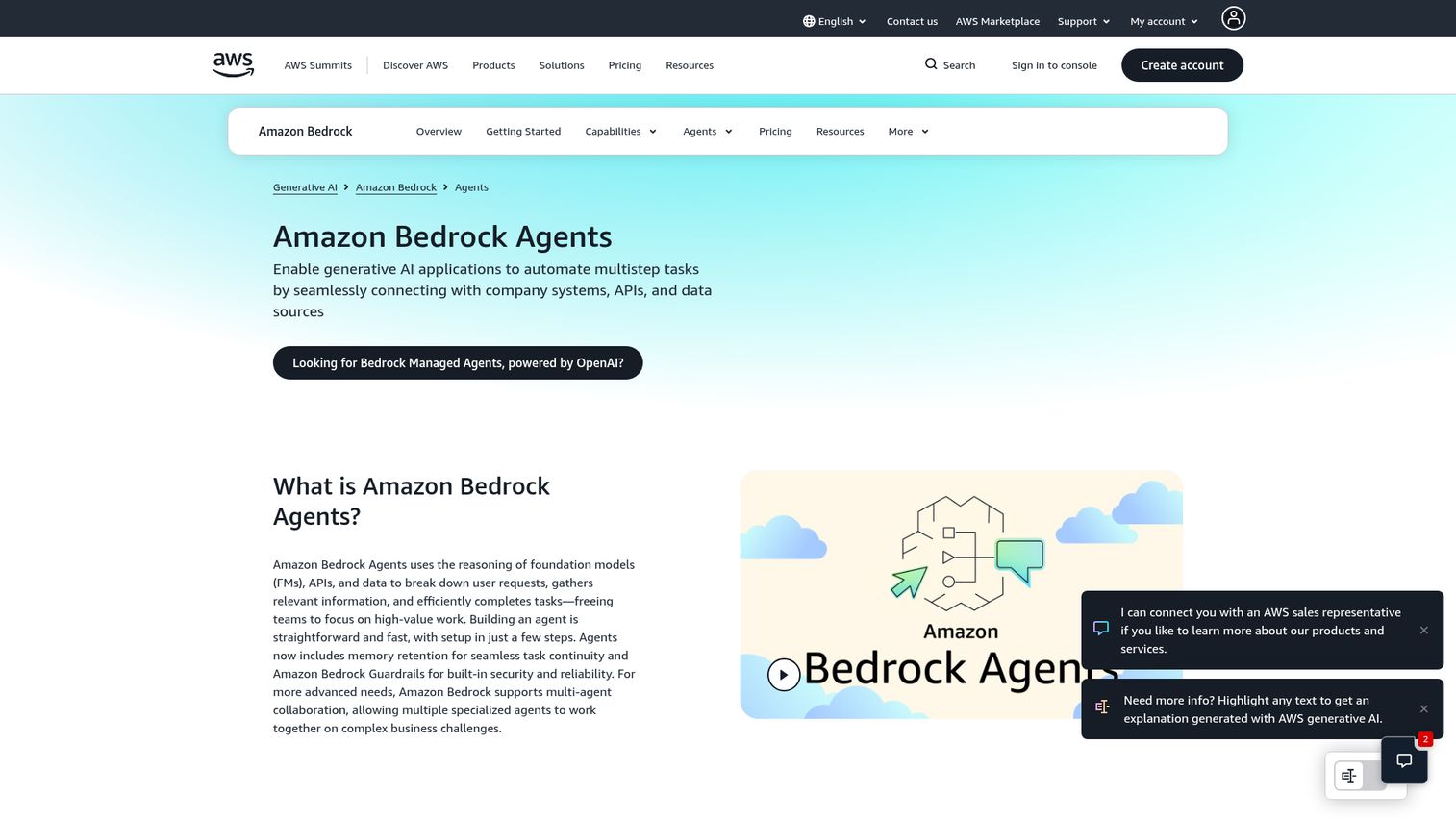
AWS Bedrock Agents helps teams build generative AI applications that automate multistep tasks by connecting foundation models with company systems, APIs, and data sources. For SaaS engineering teams already operating on AWS, Bedrock Agents means no new vendor security review and no new identity model.
Best for: SaaS companies with AWS-native infrastructure who want agents that integrate with their existing AWS services and data.
Key strengths
- Multi-agent collaboration: coordinate specialized agents to tackle multi-step workflows that exceed a single agent's scope.
- Retrieval augmented generation: ground responses in your enterprise data through Bedrock's native RAG capabilities.
- Memory retention: persistent context across interactions, so agents do not start from zero on every call.
Why choose AWS Bedrock Agents: If your engineering team already operates AWS at scale, building agents inside Bedrock keeps everything inside one IAM model and one billing relationship. The multi-model flexibility also matters when frontier model leadership keeps changing.
AWS Bedrock Agents pricing: Verified on aws.amazon.com/bedrock/pricing. AWS lists Bedrock pricing as usage-based and dependent on the model provider, modality, and service tier (Standard, Flex, Priority, and Reserved). No standalone Bedrock Agents starting price is published. Model invocation, knowledge base storage, and retrieval are billed separately.
8. Zapier Agents
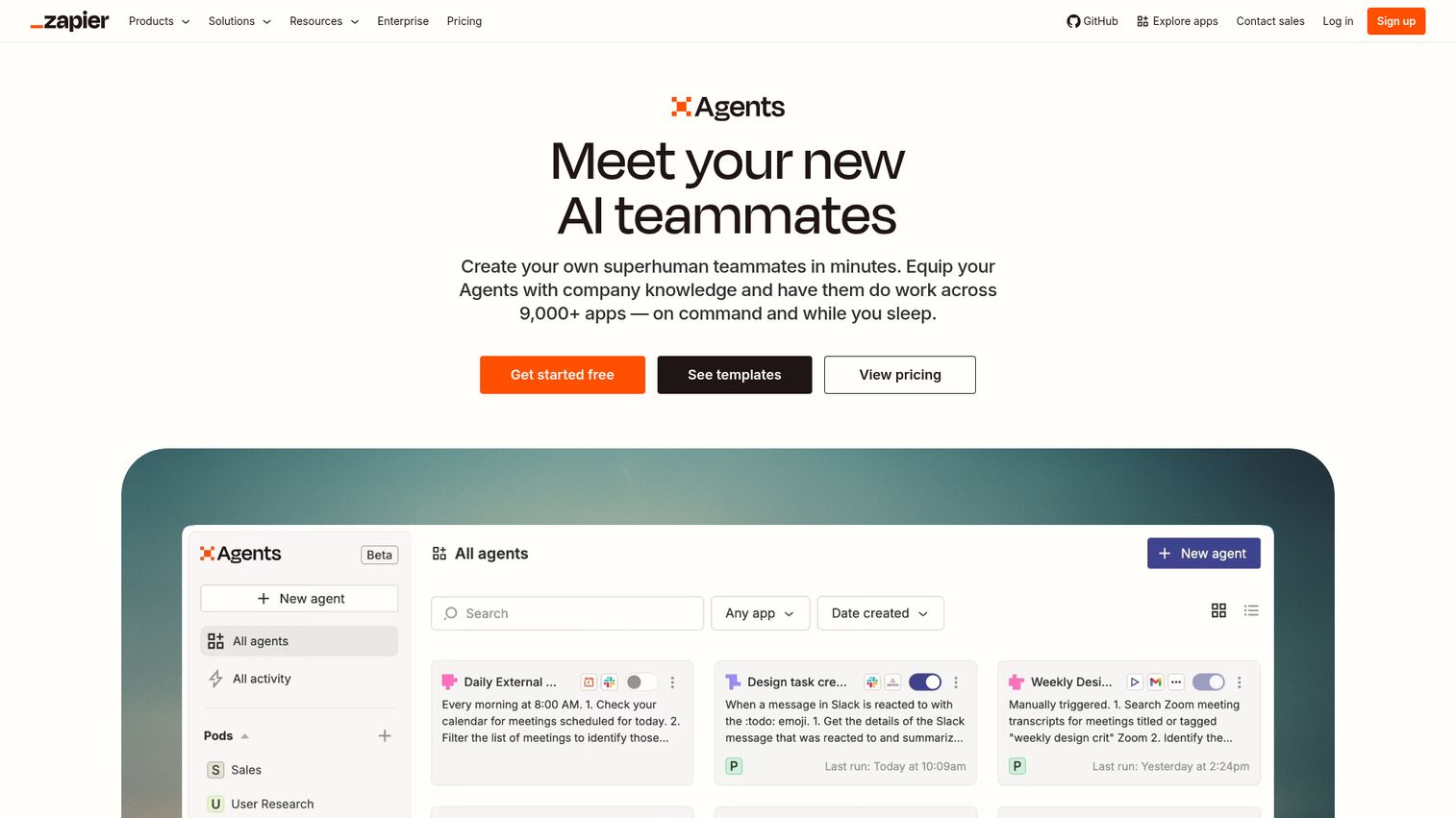
Zapier Agents lets you create AI teammates that use company knowledge and work across 9,000+ apps. Zapier's bet is that the integration network it has built over a decade is the moat for agentic AI: agents that can take action across nearly every SaaS tool your team already uses, without writing connectors.
Best for: SaaS teams that already use Zapier for automation and want to add reasoning agents without leaving the platform.
Key strengths
- 9,000+ app integrations: connect agents to nearly every SaaS tool through Zapier's existing connector network.
- Knowledge grounding: use FAQs, docs, and public links as knowledge sources so agents can answer questions with citations.
- Browser-based action-taking: a Chrome extension lets agents browse the web and interact with applications.
Why choose Zapier Agents: If your reaction to most "AI agent" pitches has been "what if Zapier could think," this fills that gap natively. It also lets you start with a free ai agent and graduate to paid tiers as usage grows, without a migration.
Zapier Agents pricing: Verified on zapier.com/pricing. The Free plan includes 400 activities per month. Pro is $33.33/month billed annually, with 1,500 activities per month. Enterprise is listed as Coming Soon with a custom activity allowance and pricing.
9. Glean
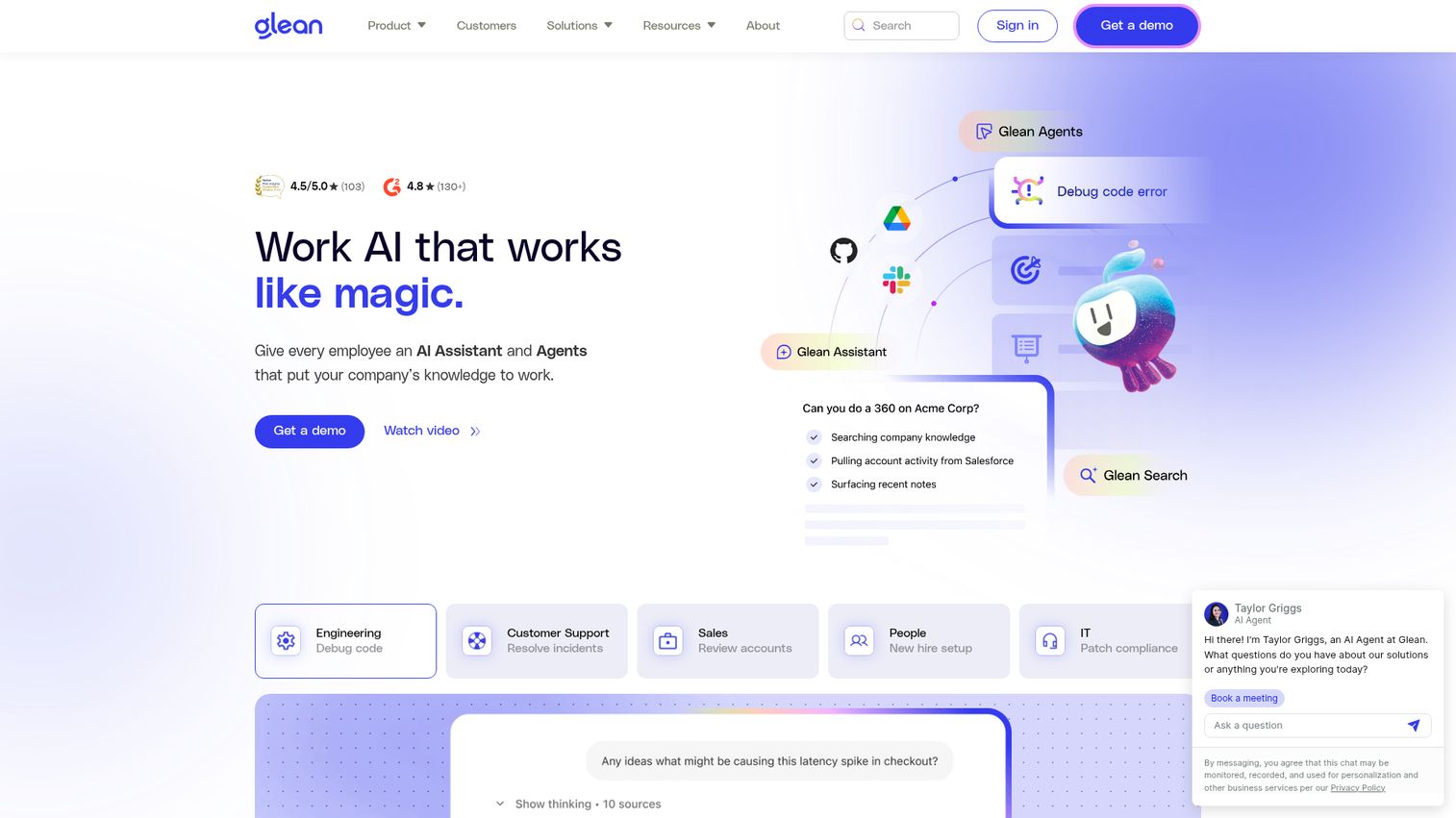
Glean is a full-stack enterprise AI platform that connects with and deeply understands company data to help employees find answers, generate content, and automate work. Glean started as the strongest enterprise search product on the market and expanded into agents as it became clear that grounded data is the real bottleneck for most agentic ai tools, not raw model capability.
Best for: Growing SaaS companies drowning in fragmented knowledge across Notion, Drive, Slack, GitHub, Confluence, and Jira.
Key strengths
- Permissioned enterprise search: search across all your company data, respecting existing access controls in every connected source.
- Personalized AI assistant: adapts to each user's role, projects, and history.
- Agent platform: build and manage AI agents that automate work at scale, grounded in your knowledge graph.
Why choose Glean: When knowledge fragmentation is the bottleneck, not agent capability, the platform that solves data first wins. Glean's connector library and permissions model are the moat. The tradeoff is enterprise pricing and a deployment that assumes a mid-market or larger company.
Glean pricing: Glean's pricing page is gated and no public pricing was confirmed at the time of writing. Pricing is custom and typically requires a sales conversation. Verify with Glean directly before budgeting.
10. Moveworks
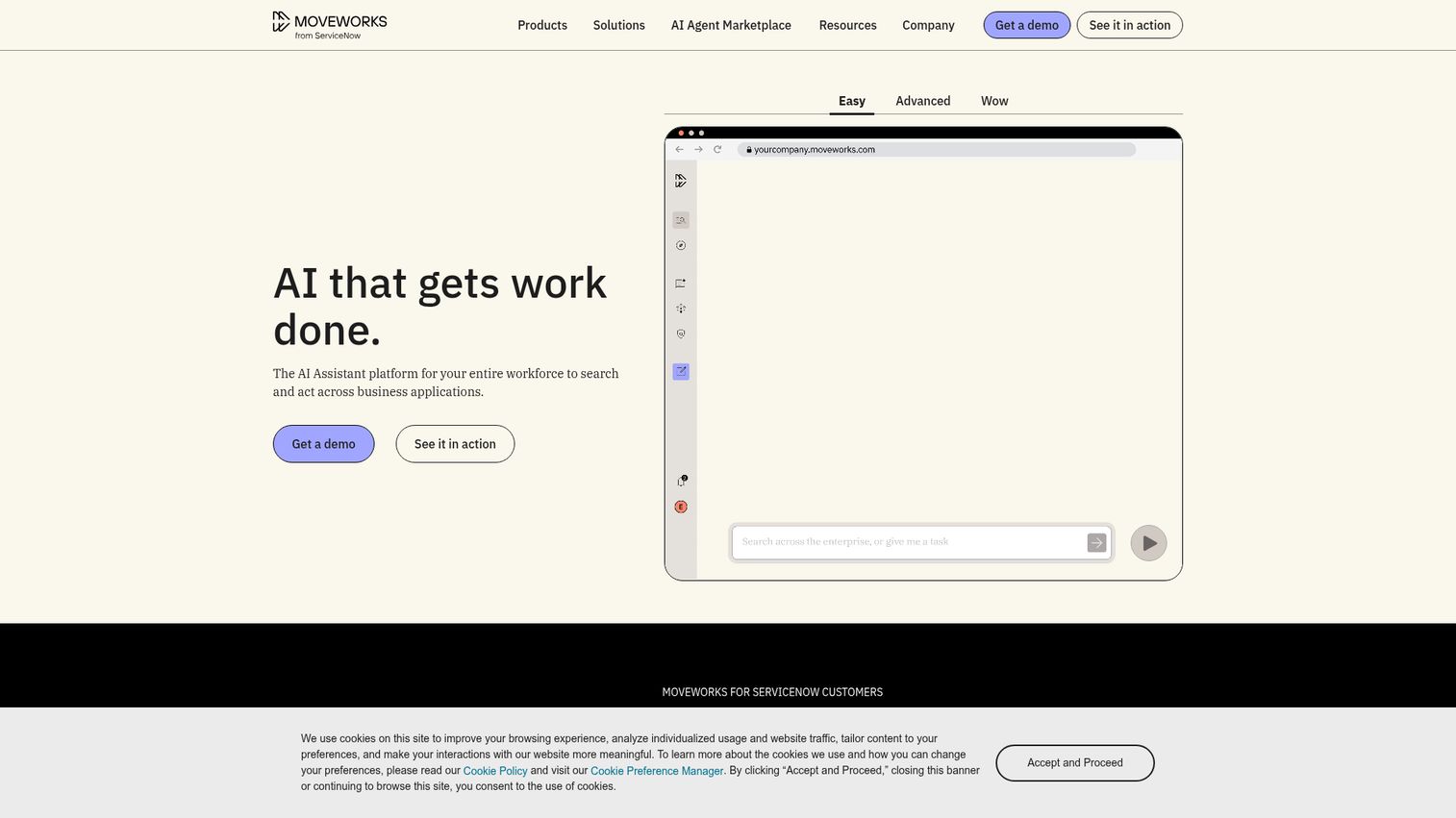
Moveworks is an AI Assistant platform for enterprises that helps employees find information, automate tasks, and get work done across business systems. It has been the category leader in IT and HR support automation for several years, and its Agent Studio layer extends that into broader agentic workflows.
Best for: SaaS companies where internal tickets and employee questions consume meaningful headcount across IT, HR, and finance.
Key strengths
- AI Assistant: context-aware search and end-to-end task automation across existing apps.
- Enterprise Search: instant answers across business apps, tailored by role, region, language, and access level.
- Agent Studio: build and deploy AI agents that plan, reason, and execute actions across enterprise systems.
Why choose Moveworks: When you are scaling IT and people operations and don't want headcount tied to tier-1 ticket volume, Moveworks is the category leader. The platform was built for the employee-facing motion specifically, which shows in the depth of its IT and HR integrations.
Moveworks pricing: Moveworks does not publish numeric pricing. The pricing page offers a custom quote only. Expect enterprise-scale contracts, and validate by talking to their sales team.
Considerations: How to evaluate agentic AI platforms
Five filters separate the platforms that earn their place from the ones that add complexity. Use these as your buyer's checklist before any vendor conversation.
Reasoning quality vs reliability tradeoff
Some platforms use frontier models that reason brilliantly but fail unpredictably. Others constrain agents to narrow models that are reliable but limited. Decide which side of that line your use case sits on before shortlisting. Customer support tier-1 deflection rewards reliability. Internal research agents reward reasoning.
Where the agent runs
Data residency, customer commitments, and SOC 2 boundaries change based on whether the platform processes data on your infrastructure or theirs. Several agentic platforms (Vertex AI, Bedrock, Copilot Studio) run in your cloud account, which simplifies security review. Standalone platforms often process data on their infrastructure, which means a new vendor security review.
Cost predictability
Token-based pricing scales with usage in ways that are hard to forecast. Per-seat pricing is more predictable but caps the upside. Model what each platform costs at 2x your current usage volume before signing. Agent loops that go sideways can produce surprising bills.
Observability and governance
You will get asked, by the board or a customer's security team, what your agents did and why. Pick a platform with audit logs, prompt versioning, evaluation tooling, and rollback as defaults, not paid add-ons.
Integration depth into your existing stack
The platform that gets adopted is the one that connects to Salesforce, HubSpot, Slack, and your warehouse on day one. Map your top 10 required integrations before pricing. A cheap platform with a missing connector becomes an expensive one once you build the integration yourself.
How to choose the right agentic AI platform for your team
The right pick is usually the one that matches your existing stack, not the one with the most powerful underlying model. Here is how to read the list against common SaaS team profiles.
If you're a SaaS team under 50 people: Start with Gumloop or Zapier Agents. Both ship a working agent in week one without engineering bandwidth. Gumloop is stronger for structured RevOps workflows; Zapier Agents is stronger if your team already lives in Zapier.
If your GTM motion runs on Salesforce: Agentforce is the default. Every other choice creates a parallel data layer that someone has to maintain. The pricing model (per conversation plus add-ons) is a bigger question than the technology fit. Sales-led teams often pair it with agentic AI tools for sales to cover the prospecting layer Agentforce doesn't fully own.
If you run on Microsoft 365: Copilot Studio. The pay-as-you-go meter plus the bundled access for Microsoft 365 Copilot users removes most of the budget objection.
If you have engineering bandwidth and a unique agent architecture in mind: Build on CrewAI deployed to Vertex AI Agent Builder or AWS Bedrock Agents, depending on your cloud. CrewAI handles orchestration; the cloud platform handles runtime, governance, and scale.
If your problem is knowledge fragmentation, not agent capability: Glean. Solve the data layer first and the agent layer becomes much simpler.
If internal IT or HR support is consuming headcount: Moveworks. The platform was purpose-built for this motion and the integration depth shows.
If you need enterprise multi-agent orchestration across CX and EX: Kore.ai. The observability and governance layers are the differentiation.
The pattern: pick the platform that earns its place by replacing something or unblocking a specific workflow. If you cannot name what it replaces, you are adding tools, not consolidating them. SaaS teams comparing agentic options also tend to revisit how they showcase their own product to buyers, which is where formats like an interactive demo become the connective tissue between agent-powered workflows and the buyer experience. Many GTM teams now embed these inside a demo center so prospects can self-serve the same workflows your agents automate behind the scenes.
Conclusion
The honest summary for most Series B SaaS founders: three platforms will cover 80% of the use cases you are evaluating right now. If you live in Salesforce, Agentforce is the default. If you live in Microsoft 365, Copilot Studio. For everyone else, the combination of Gumloop for operator-driven workflows and CrewAI for engineering-led agent systems handles most of what teams actually deploy in production.
The category is moving fast. Pricing models will change, vendors will consolidate, and frontier model leadership will shift at least twice in the next 18 months. Revisit your choice annually, not quarterly.
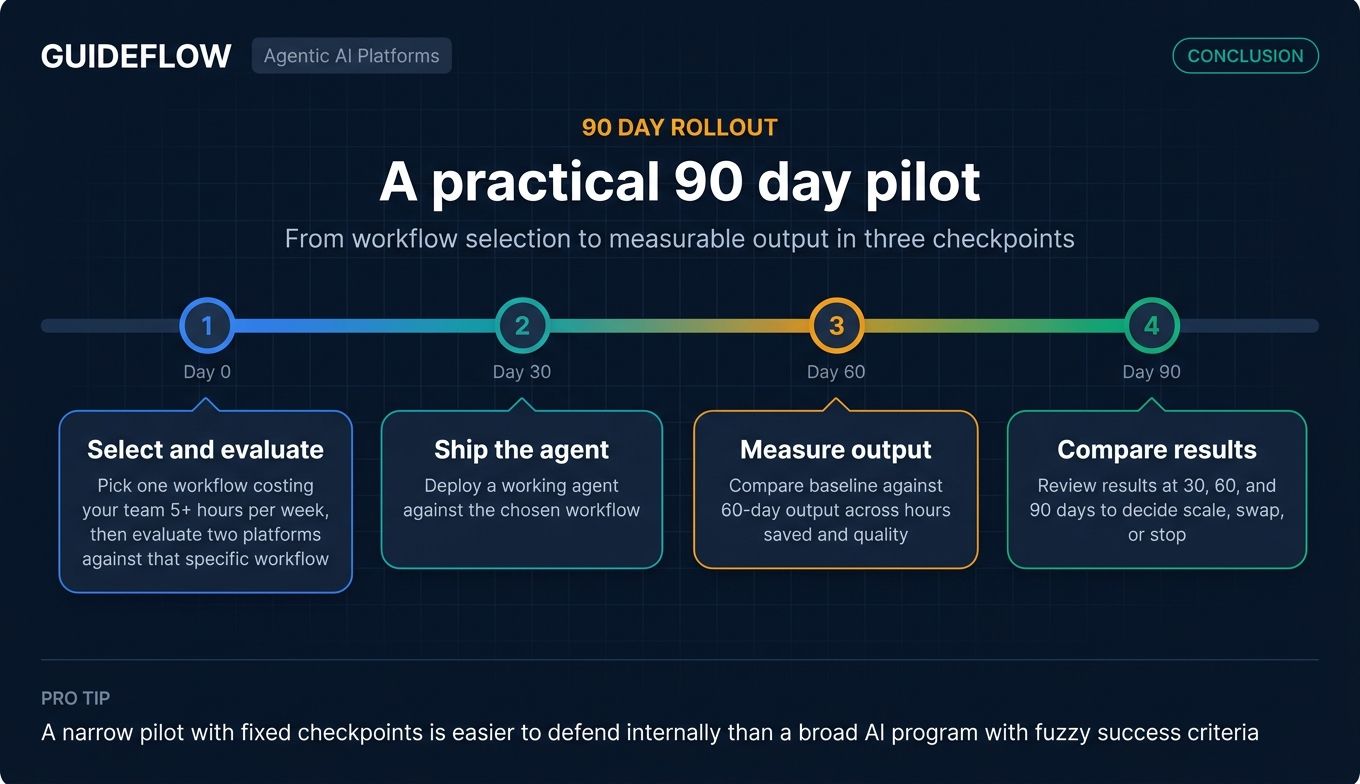
The most useful next step is the smallest one. Pick one workflow that costs your team 5+ hours per week (pipeline hygiene, ticket deflection, meeting prep). Evaluate two platforms against that specific workflow rather than running a broad RFP. Ship a working agent in 30 days, measure baseline against 60-day output, and make the next decision with real data instead of vendor decks. Forward this to the person on your team who would own the deployment, and let them shortlist from there.
FAQs
An AI agent is a single autonomous system that perceives, reasons, and acts on a defined goal. An agentic AI platform is the infrastructure to build, deploy, orchestrate, and monitor many agents at once, with shared memory, governance, observability, and tool integrations. Most production deployments require a platform, not a standalone agent.
Generative AI produces content (text, images, code) in response to a prompt. Agentic AI takes actions in the world: making decisions, calling tools, executing multi-step workflows, and adapting based on outcomes. The distinction is the reasoning loop and the ability to act, not just respond. Most agentic systems use generative models inside the loop.
It depends on the platform. Tools like Gumloop and Zapier Agents are designed for non-technical operators to build production workflows without engineering tickets. CrewAI, Vertex AI Agent Builder, and AWS Bedrock Agents assume an engineering team that can write Python and operate cloud infrastructure. Match the platform to the team that will own it.
Free ai agents are available through Zapier Agents (free tier with 400 activities/month) and Gumloop (free tier with 5,000 credits/month). Paid mid-market platforms range from roughly $20 to $200 per user or per pack per month. Enterprise platforms (Kore.ai, Moveworks, Glean) use custom pricing and typically require sales conversations. Usage-based pricing on cloud platforms (Vertex AI, Bedrock) scales with consumption and is harder to forecast.
The enterprise platforms in this list (Kore.ai, Agentforce, Copilot Studio, Vertex AI, Bedrock, Glean, Moveworks) document SOC 2 attestations, encryption at rest and in transit, and data residency controls at their enterprise tiers. Smaller and open-source platforms vary. Always verify the specific security posture with your security team before connecting production data, and ask whether the platform processes data in your cloud or the vendor's.
For workflows that involve judgment, exceptions, or unstructured inputs, yes. Agentic systems reason about edge cases where RPA scripts break. For deterministic, high-volume, rule-based processes (data entry, screen scraping at scale), RPA is often still cheaper and more predictable. Many enterprises run both in parallel and route work to the right tool based on complexity.
Copilot Studio is Microsoft's agent platform, deeply tied to Microsoft 365, Dynamics, and Azure. Agentforce is Salesforce's, tied to Sales Cloud, Service Cloud, and Data Cloud. The right choice usually follows your existing CRM and productivity suite rather than the underlying agent technology. Trying to use either against the other vendor's stack creates integration overhead that erases the platform's main advantage.
Tie agent deployments to a specific workflow before launch: hours saved per week, tickets deflected, leads enriched, cycle time reduced, or cost per resolved ticket. Measure baseline first, then compare after 30, 60, and 90 days. According to a 2026 agentic AI statistics report, 66% of companies using AI agents report measurable productivity gains, but the teams that document baseline metrics are the ones who can defend the spend in a board meeting.