The demo looked great. The member portal was clean. The mobile app had a nice booking calendar. Then you went live, and the real work showed up: a member cancels a monthly plan mid-cycle, the invoice prorates wrong, the door credential doesn't revoke, and now you're doing manual math in a spreadsheet at 9pm.
That gap between the sales demo and the daily operator reality is where most coworking software gets judged. Anyone can show you a booking screen. The question that actually matters is what happens when billing, access control, and membership changes collide on the same Tuesday.
The category is not small. The coworking space management software market is projected to reach $2.21 billion in 2026, up from $1.94 billion in 2025, growing at a 13.9% CAGR according to Research and Markets (2026). With 8,973 U.S. coworking locations recorded in early 2026, up 15% year over year per SpeakwiseApp (2026), operators have more options and more pressure to run lean.
Most comparison posts focus on the member experience. This one leads with the admin experience: how each platform handles billing and invoicing, access control, the member portal, automation, and analytics and reporting. The member-facing polish matters, but it's the operator workflows that decide whether a coworking management system saves you time or quietly adds a new job to your week.
What's inside
This guide is for coworking operators, flex-space managers, and founders comparing coworking management software before they switch or buy. We evaluated eight platforms on the criteria that actually break day to day: billing and invoicing depth, access control integrations, member portal quality, automation, analytics and reporting, and pricing clarity. Every pricing figure and G2 rating here is pulled from each vendor's own pages or live G2 listing, verified as of mid-2026. We did not rank on feature counts. We ranked on how well each coworking software handles the messy operator work.
TL;DR
- Best for transparent per-desk pricing and workspace booking: Archie, with clear Starter and Pro tiers and a 4.9/5 G2 rating.
- Best for automation-first operators: Optix, built around a workflow builder and a white-label mobile app.
- Best for branded member experience: Spacebring, with a white-label portal, admin mobile app, and automated billing.
- Best for predictable member-based pricing: Cobot, which prices on paying members and includes core features.
- Best for multi-location growth operators: OfficeRnD Flex, with deep billing automation and white-labeled apps.
- Best for access control and operations focus: Proximity, with digital door access, Wi-Fi control, and per-location pricing.
What is coworking space software?
Coworking space software is a coworking management system that runs the operational side of a shared or flexible workspace: memberships, bookings, billing, access control, and member communication in one platform. It replaces the spreadsheet-plus-payment-processor-plus-door-app patchwork that most operators start with.
The category overlaps with broader workspace management software, but coworking software is built specifically around recurring memberships, hot desks, day passes, and community, rather than assigned corporate seating. The best coworking management software connects the parts so a membership change flows automatically into billing, access, and reporting without manual re-entry.
Core capabilities most operators need:
- Membership management: Recurring plans, day passes, contracts, and self-service signup through a member portal.
- Billing and invoicing: Automated recurring billing, proration, credits, taxes, and handling for cancellations, reminders, and payment edge cases.
- Resource booking: Meeting rooms, desks, offices, and equipment with real-time availability and booking rules.
- Access control: Door hardware, Wi-Fi, and credential provisioning tied to active membership status.
- Automation: Workflows that trigger on signup, cancellation, overdue payment, or booking so admins stop doing repetitive tasks by hand.
- Analytics and reporting: Occupancy, revenue, churn, and utilization data for weekly operating decisions.
- Member portal and mobile app: Where members book, pay, and manage their plan, often available as a white-label app.
- Integrations: Accounting, payment processors, access hardware, and communication tools.
The differentiator between platforms is rarely the feature list. It's how cleanly billing, access, and membership stay in sync when a member does something unexpected.
When to use coworking space software
Replace a spreadsheet-and-payments patchwork
If you're tracking members in a spreadsheet, invoicing manually, and toggling door access in a separate app, you're spending hours a week on reconciliation that a coworking management system automates. The trigger is usually the moment manual billing starts producing errors, or when you can't answer basic occupancy questions without exporting three files.
Scale bookings without adding staff
When meeting room and desk bookings outgrow a shared calendar, you need real-time availability, booking rules, and automatic billing for overages. Software here removes the front-desk bottleneck and lets members self-serve through a member portal or mobile app.
Run multiple locations from one system
Multi-location operators need consolidated reporting, per-location billing, and access control that works across sites. This is where a purpose-built coworking software earns its price: one dashboard instead of one spreadsheet per building, and analytics and reporting that roll up cleanly for board or investor conversations.
Comparison table
Here's how the eight platforms compare on intent, key differentiation, pricing, and G2 rating. Pricing reflects each vendor's published starting tier as of mid-2026; several use member-based or location-based models, so read the per-tool pricing sections for the full picture.
| # | Product | Intent | Key differentiation | Pricing | G2 rating |
|---|---|---|---|---|---|
| 1 | Archie | Workspace booking + coworking | Transparent per-desk pricing | From $2.8/desk/mo (min. $159/mo) | 4.9/5 |
| 2 | Optix | Coworking + flex automation | Automation-first, white-label app | From $229/mo | 4.7/5 |
| 3 | Spacebring | All-in-one member service | White-label portal + admin app | From €158/mo | 4.9/5 |
| 4 | Cobot | Coworking + flexible office | Paying-member pricing model | From $69/mo | 4.1/5 |
| 5 | OfficeRnD Flex | Multi-location flex operators | Billing automation + ecosystem depth | From $165/mo | 4.6/5 |
| 6 | Proximity | Operations + access control | Digital door access + Wi-Fi control | From $209/mo per location | 5.0/5 |
| 7 | Nexudus | Large / technical operators | Deep white-label customization | Usage-based (21-day trial) | 4.3/5 |
| 8 | Yardi Kube | Enterprise-grade flex | Connected Yardi ecosystem | From $349/mo | 3.5/5 |
1. Archie
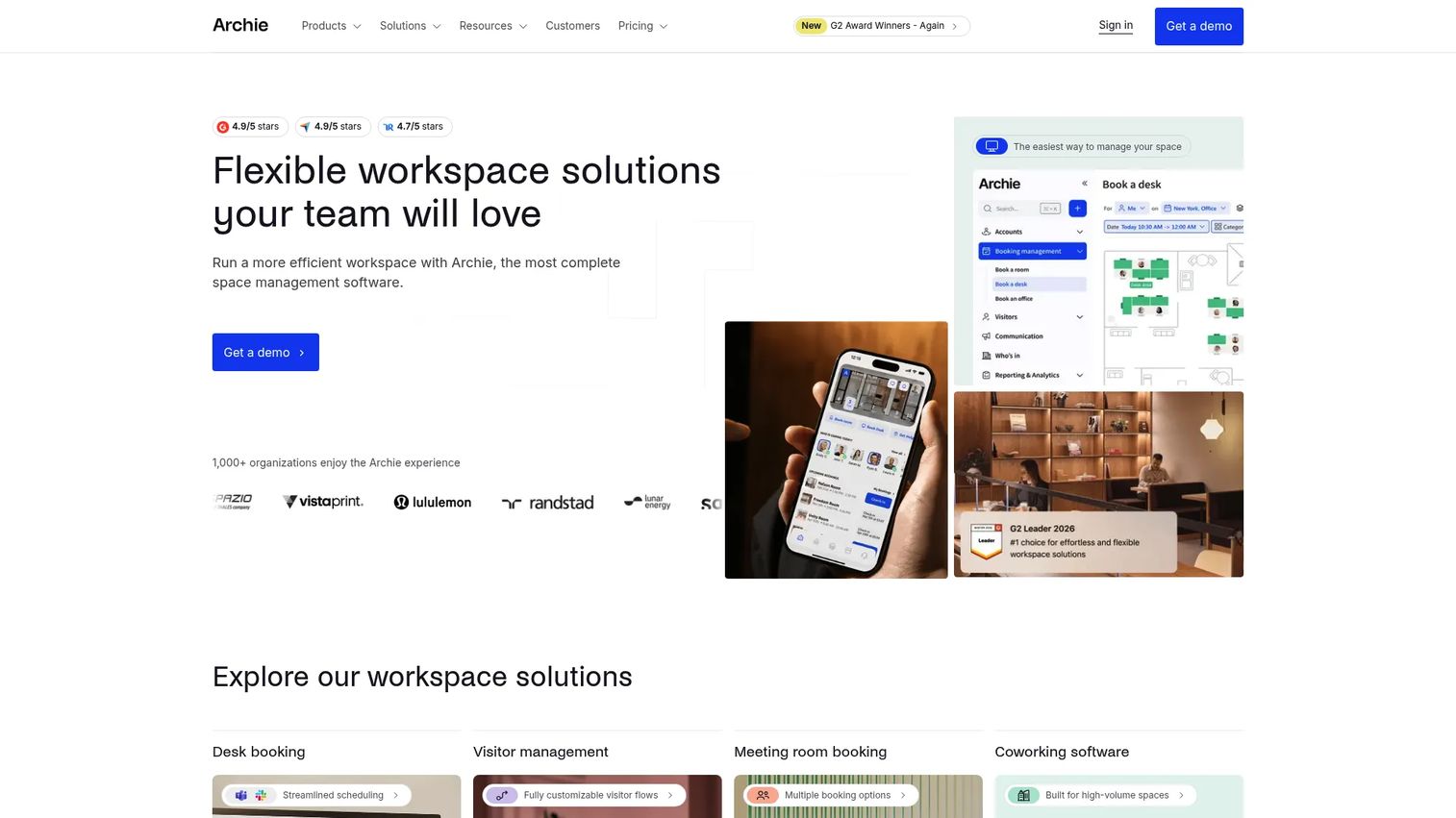
Archie is workplace and coworking management software built around desk booking, meeting room booking, and visitor management, with a clean admin experience and pricing you can read without a sales call. It sits comfortably between hybrid-office use cases and coworking operations, which makes it a strong pick for mixed spaces. The 4.9/5 G2 rating reflects an interface operators find genuinely usable rather than bolted-together.
Best for: Operators and companies that need straightforward workspace booking, visitor management, and transparent pricing without member-count guesswork.
Key strengths
- Transparent per-desk pricing: Published Starter and Pro tiers mean you can budget before you ever talk to sales.
- Desk and room booking: Real-time availability for desks and meeting rooms with rules that keep double-bookings out.
- Visitor management: Front-desk check-in and visitor tracking built in, not sold as a separate add-on.
Why choose Archie: If pricing clarity and daily usability rank above deep configurability, Archie is the easiest platform on this list to evaluate and roll out. The per-desk model rewards spaces with predictable desk counts, and the interface keeps the admin experience simple enough that front-desk staff need little training. It's the strongest fit for operators who want a tool that just works over one they'll spend weeks configuring.
Archie pricing: Starter runs $2.8 per desk per month with a $159 monthly minimum. Pro is $3.5 per desk per month with a $249 monthly minimum. Enterprise is custom pricing through sales. There's no public free tier, but a 14-day test environment is available after a demo.
2. Optix
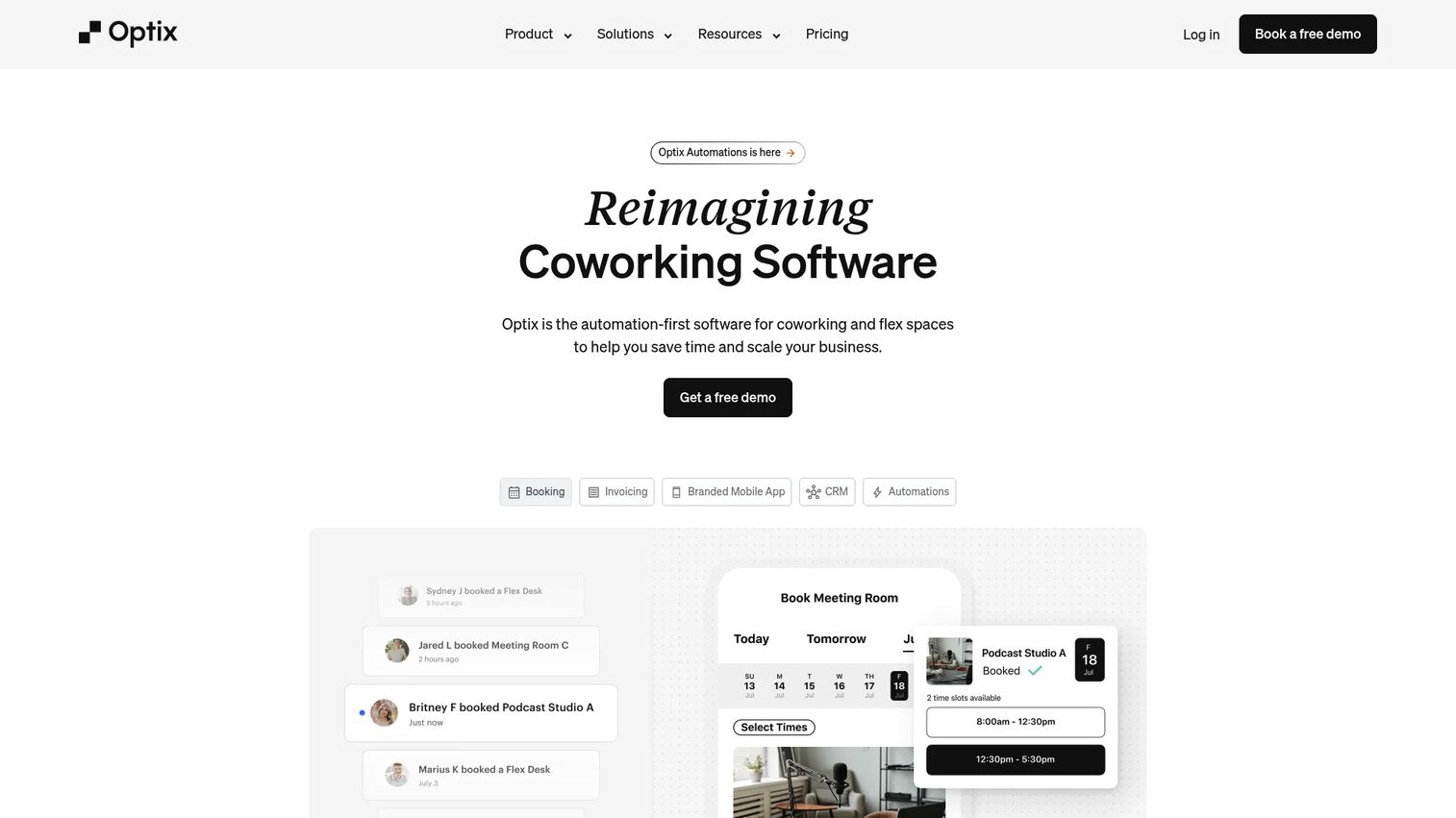
Optix is coworking and flex-space management software built around automation and a mobile-first member experience. Its workflow builder lets operators trigger actions on signup, booking, or billing events, which cuts the repetitive admin that eats front-desk time. With billing, resource booking, a CRM, and a white-label mobile app in one platform, it targets boutique and premium spaces that want polish on both the member and operator sides.
Best for: Boutique and design-forward coworking operators who want automation and a branded mobile app front and center.
Key strengths
- Automation workflows: Trigger emails, invoices, and access changes automatically on member events, reducing manual steps.
- White-label mobile app: Members book, pay, and check in through an app carrying your brand, not the vendor's.
- Multi-location management: Run several sites with consolidated CRM, invoicing, and check-in data.
Why choose Optix: For operators who see automation as the core value of software, not a nice-to-have, Optix is built around exactly that. The workflow builder handles the cancellations, reminders, and payment edge cases that otherwise land on a person's desk. The tradeoff is that the mobile-first, automation-heavy approach performs best when you lean into it; teams that want a bare-bones tool may pay for capability they underuse.
Optix pricing: Essentials starts at $229/month monthly, or $197/month billed yearly. Pro is $349/month, or $299 billed yearly. Grow is $579/month, or $498 billed yearly. Scale is custom. Annual billing saves roughly 14%, and a 14-day free trial is available.
3. Spacebring
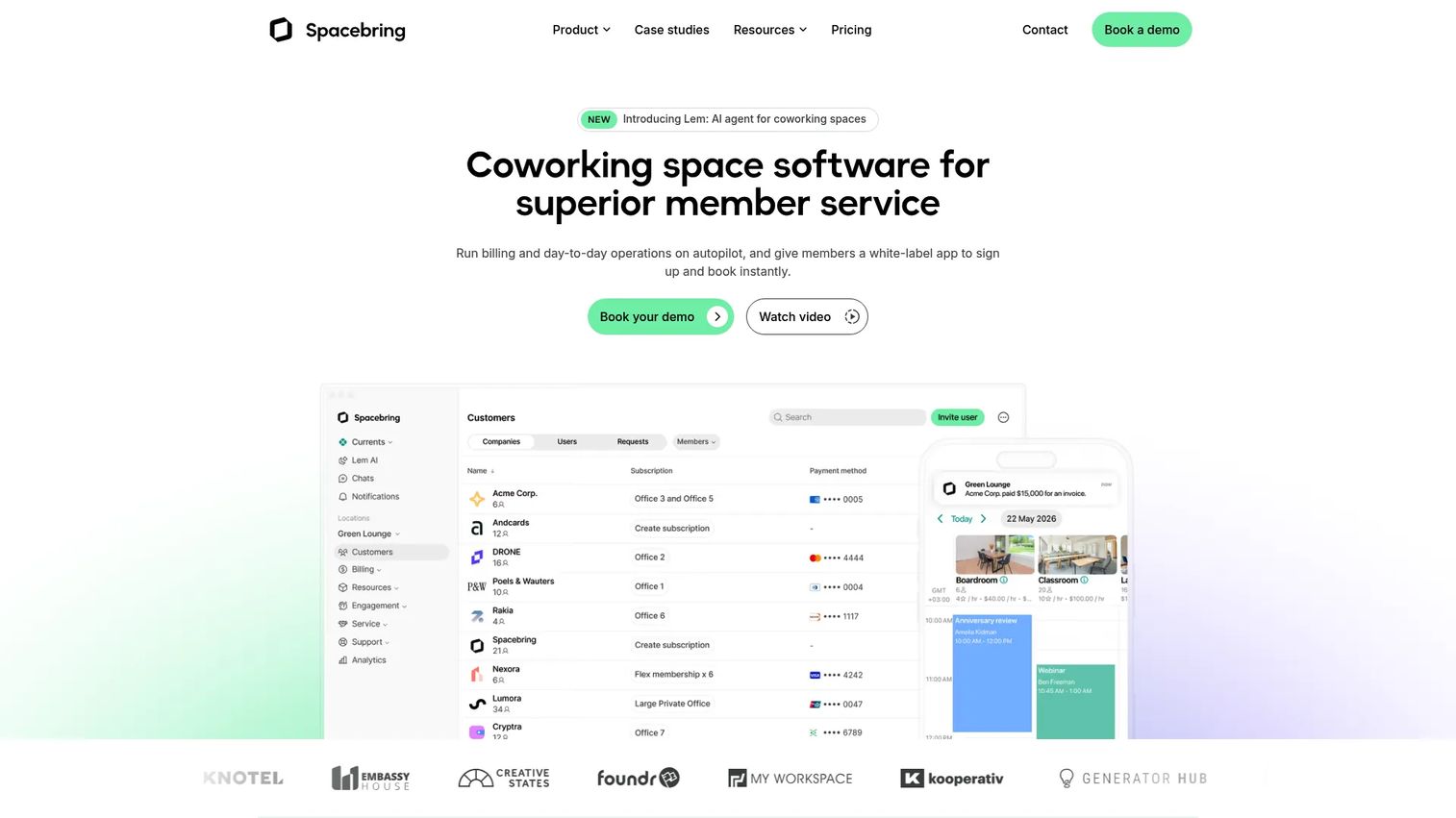
Spacebring is coworking space software focused on an all-in-one member service platform: automated billing, contracts, and payments, self-service booking for rooms, desks, offices, parking, and equipment, plus a white-label member portal and mobile app. It layers in visitor management, floor plans, community tools, and multi-location analytics and reporting. The 4.9/5 G2 rating and support reputation make it a common shortlist pick for branded spaces.
Best for: Operators who want a fully branded member experience across web and mobile without building it themselves.
Key strengths
- White-label member portal and app: Deliver booking, billing, and community under your brand on web and mobile.
- Automated billing and contracts: Recurring invoicing, e-signature contracts, and payment handling in one flow.
- Booking depth: Rooms, desks, offices, parking, and equipment all bookable through self-service.
Why choose Spacebring: If your brand is a selling point, the white-label portal and admin mobile app let you present a polished experience end to end. The billing automation covers the recurring work cleanly, and the community and floor-plan tools round out the member side. Worth noting: several capabilities like the member mobile app, visitors, floor plans, and API access are priced as separate add-ons, so map your must-haves against the add-on list before committing.
Spacebring pricing: The Business plan starts at €158 per month, billed monthly or yearly, with Enterprise as custom pricing. Add-ons are priced per location: the member mobile app is €115 for the first location plus €86 per additional location, visitors €58, floor plans €29 plus setup, and API and webhooks €29. Billing currency is Euro.
4. Cobot
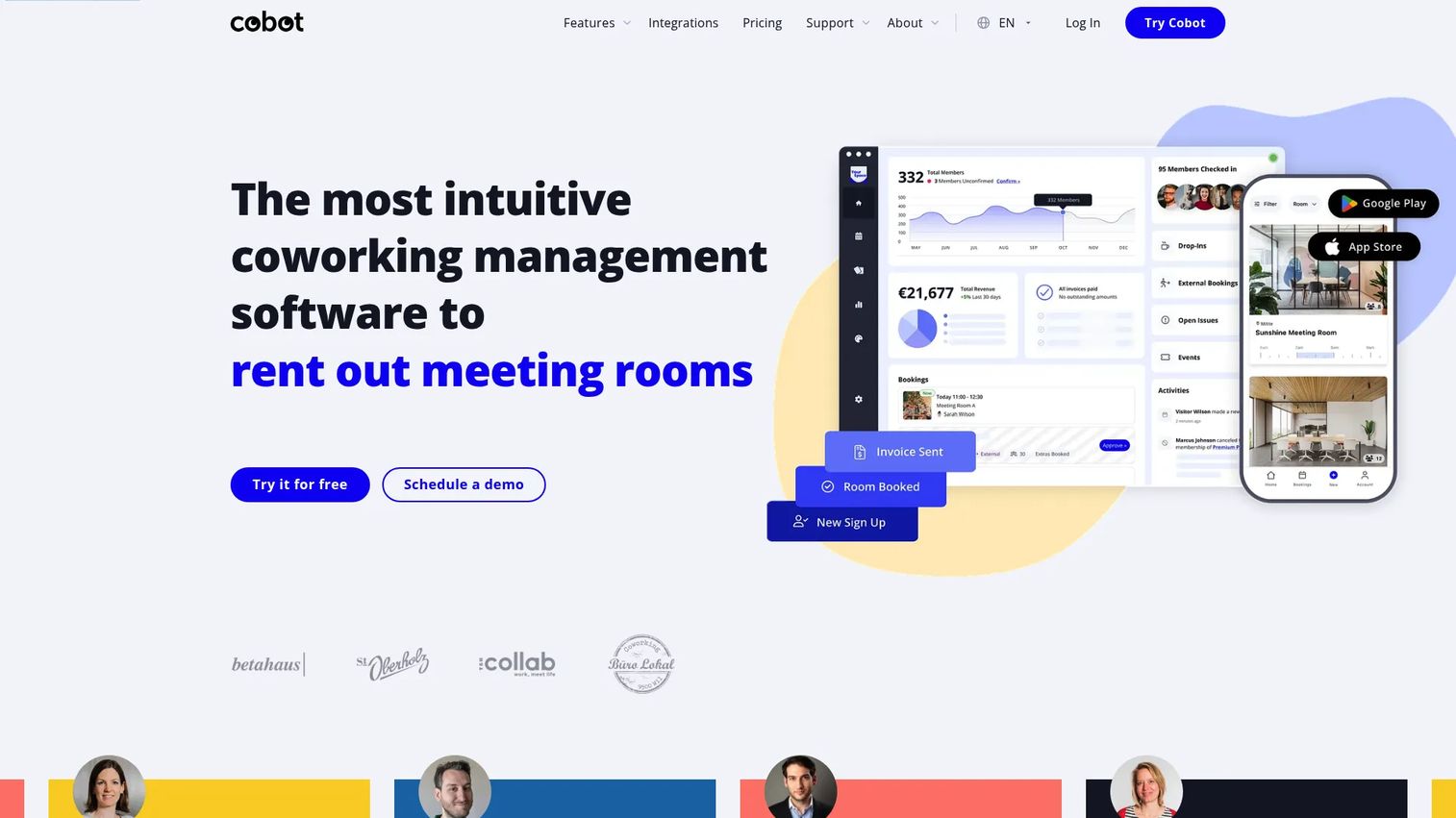
Cobot is coworking and flexible office management software built around member management, bookings and calendars, billing, and automated access control through integrations. Its pricing model is based on paying members, which makes cost track with revenue rather than desk count. For operators who want predictable, member-linked billing and don't want to nickel-and-dime every feature, that model is a real draw.
Best for: Coworking spaces that want member-based pricing and core features included without complex tier math.
Key strengths
- Paying-member pricing: Cost scales with paying members, so software spend follows revenue.
- Access control integrations: Automated door and access provisioning tied to membership status through hardware integrations.
- Bookings and billing: Calendar-based room and resource booking with recurring billing built in.
Why choose Cobot: If you want your software bill to move in step with your member base rather than your floor plan, Cobot's paying-member model fits. The platform covers the operational core, and a 30-day free trial gives you time to test billing and access flows against your real data before paying. Add-ons like external bookings, premium support, and Wi-Fi are available for spaces that need them.
Cobot pricing: Cobot's core plan is member-based with a 30-day free trial. Third-party listings show entry points around $69/month for 15 members and $139/month for 40 members, while the vendor's own page frames the plan as custom based on paying members. Add-ons include external bookings at $19/month, premium support at $129/month, and Radius Wi-Fi from $29/month.
5. OfficeRnD Flex
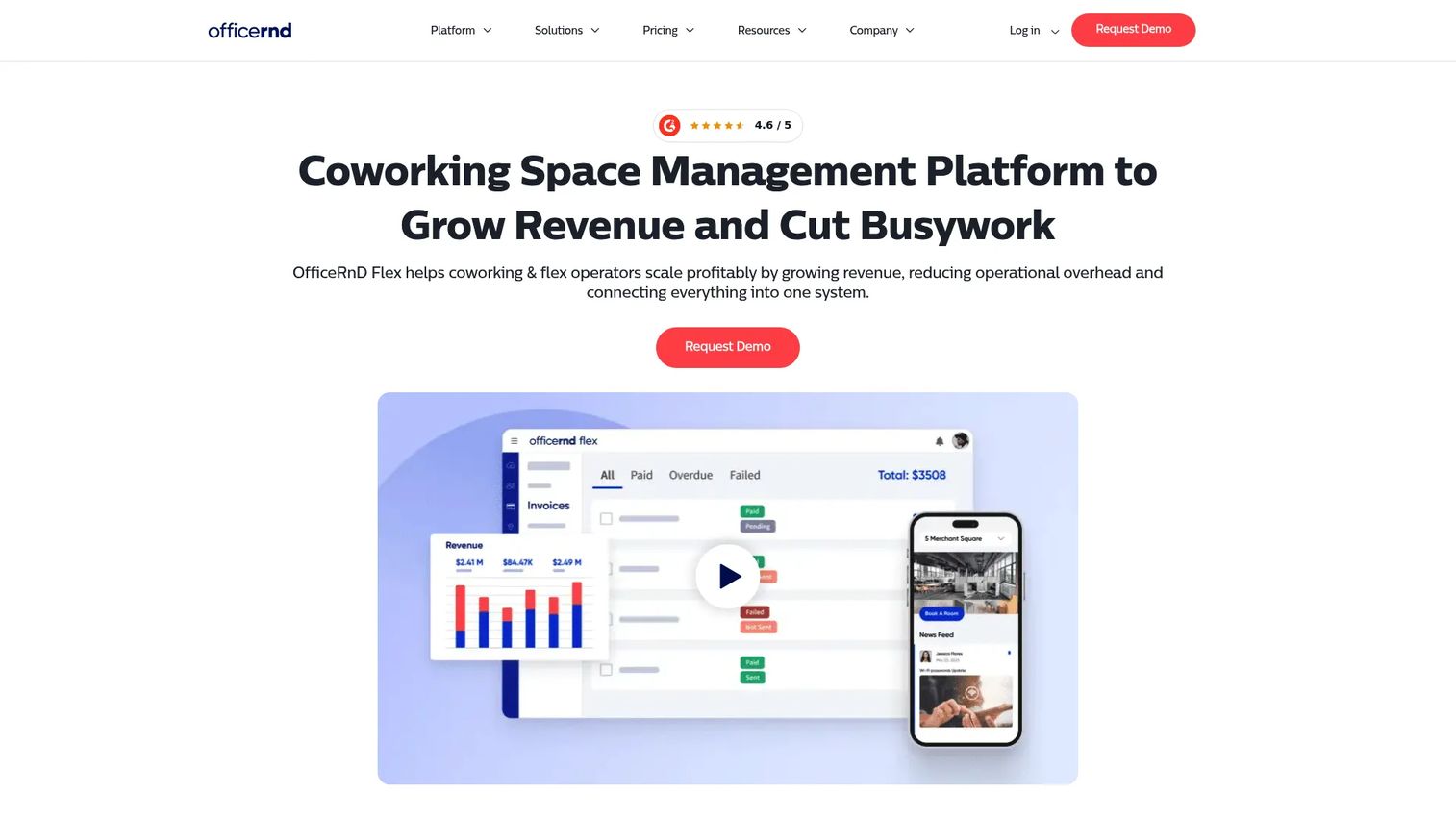
OfficeRnD Flex is coworking and flexible workspace management software aimed at operators who need to scale across locations. It brings meeting room bookings, contracts and memberships, and automated billing and payments together, with white-labeled apps and an ecosystem of integrations that grows with you. The 4.6/5 G2 rating and migration support make it a frequent pick for growth-stage operators moving off a lighter tool.
Best for: Growth-stage and multi-location operators who need billing automation, contracts, and ecosystem depth.
Key strengths
- Automated billing and payments: Recurring invoicing, contracts, and payment handling built for multi-location scale.
- Contracts and memberships: Manage agreements and recurring memberships with automation across sites.
- White-labeled apps and ecosystem: Branded member apps plus a broad integration set for accounting, access, and analytics.
Why choose OfficeRnD Flex: For operators who expect to add locations, the platform's billing automation and integration depth mean you're less likely to outgrow it. The public Start and Grow tiers give budget clarity, and the migration offer lowers the switching cost from a spreadsheet or lighter stack. It's built for spaces that want infrastructure they can grow into, not a tool they'll replace in a year.
OfficeRnD Flex pricing: Start begins at $165/month billed annually, and Grow at $259/month billed annually. Scale is custom pricing through sales. Pricing is shown in USD with EUR, GBP, and AUD options available; there's no public free tier.
6. Proximity
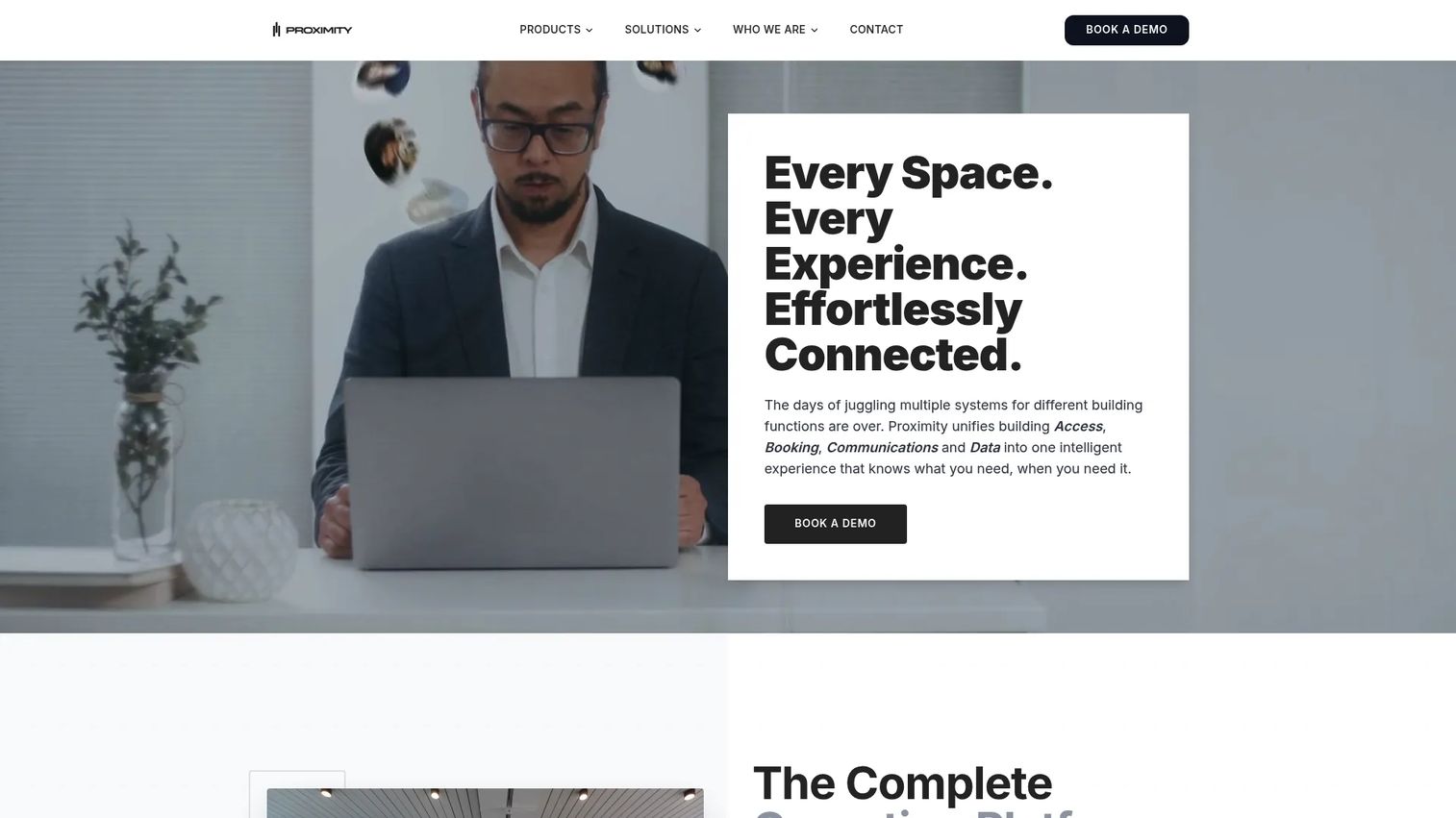
Proximity is a workspace management platform built for operators who put operations and access control first. It covers membership management, reservations, billing and payments, visitor management, plus digital door access, Wi-Fi access control, and even smart occupancy and air-quality monitoring. Pricing is per location and scales by active-member bands, with a transparent table you can read up front. The 5.0/5 G2 rating comes from a small review base but reflects strong operator sentiment.
Best for: Operators who prioritize access control, Wi-Fi, and operational hardware alongside membership and billing.
Key strengths
- Digital door and Wi-Fi access control: Credential and network access tied to membership, provisioned from the platform.
- Active-member band pricing: Per-location pricing that steps up with your active member count.
- Occupancy and air-quality monitoring: Smart building data most coworking software leaves out.
Why choose Proximity: If access control and physical operations are where your headaches live, Proximity treats them as first-class rather than an integration afterthought. The active-member bands make pricing predictable per location, and the transparent table means no guessing. Digital door access is a separate $99/month per-location add-on, so factor that in if door control is a core requirement.
Proximity pricing: Per-location pricing runs $209/month for up to 40 active members, $259 for 41 to 85, $329 for 86 to 150, $449 for 151 to 250, $559 for 251 to 350, and $679+ for Enterprise. Digital door access is a $99/month per-location add-on. There's no free tier.
7. Nexudus
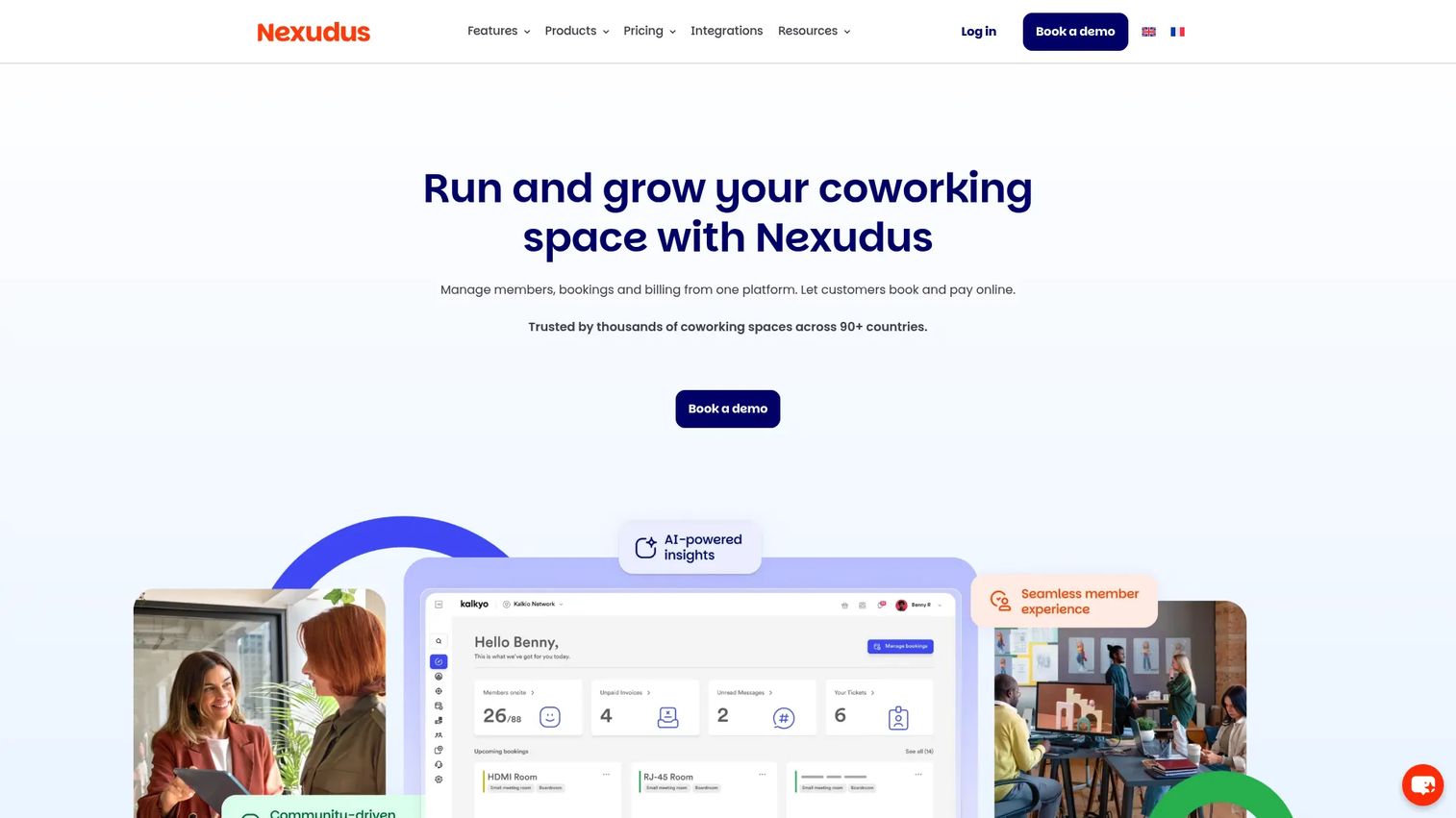
Nexudus is coworking and flexible workspace software built for operators who want deep customization and can handle real configurability. It covers desk and room bookings with real-time availability, automated billing and invoicing, and white-label portals, apps, and communications, with the ability to customize the member portal down to HTML and CSS. That depth suits large or technically capable operators; smaller teams should plan for a configuration period to get the most from it.
Best for: Large or technically capable operators who want deep white-label customization and complex operations support.
Key strengths
- Deep white-label customization: Portals, apps, and communications you can brand and customize down to the code.
- Automated billing and invoicing: Recurring invoicing and payment handling for complex membership structures.
- Real-time booking: Desk and room availability with granular rules for larger, busier spaces.
Why choose Nexudus: If you have complex operations and the appetite to configure a platform to fit them exactly, Nexudus gives you more control than most. The HTML and CSS portal customization is genuinely rare, and the modular pricing means you pay for the apps and features you actually use. It performs best when you have the internal capacity to set it up thoughtfully and grow into its depth.
Nexudus pricing: Nexudus uses modular, usage-based pricing charged monthly on active users, with several apps and features carrying separate monthly fees. Detailed pricing is available in Euro, US Dollar, and British Pound, all excluding VAT, and a 21-day free trial is offered. Several apps like NexBoard and the Passport app are free, while the white-label Passport app runs €/$/£150 per five locations.
8. Yardi Kube
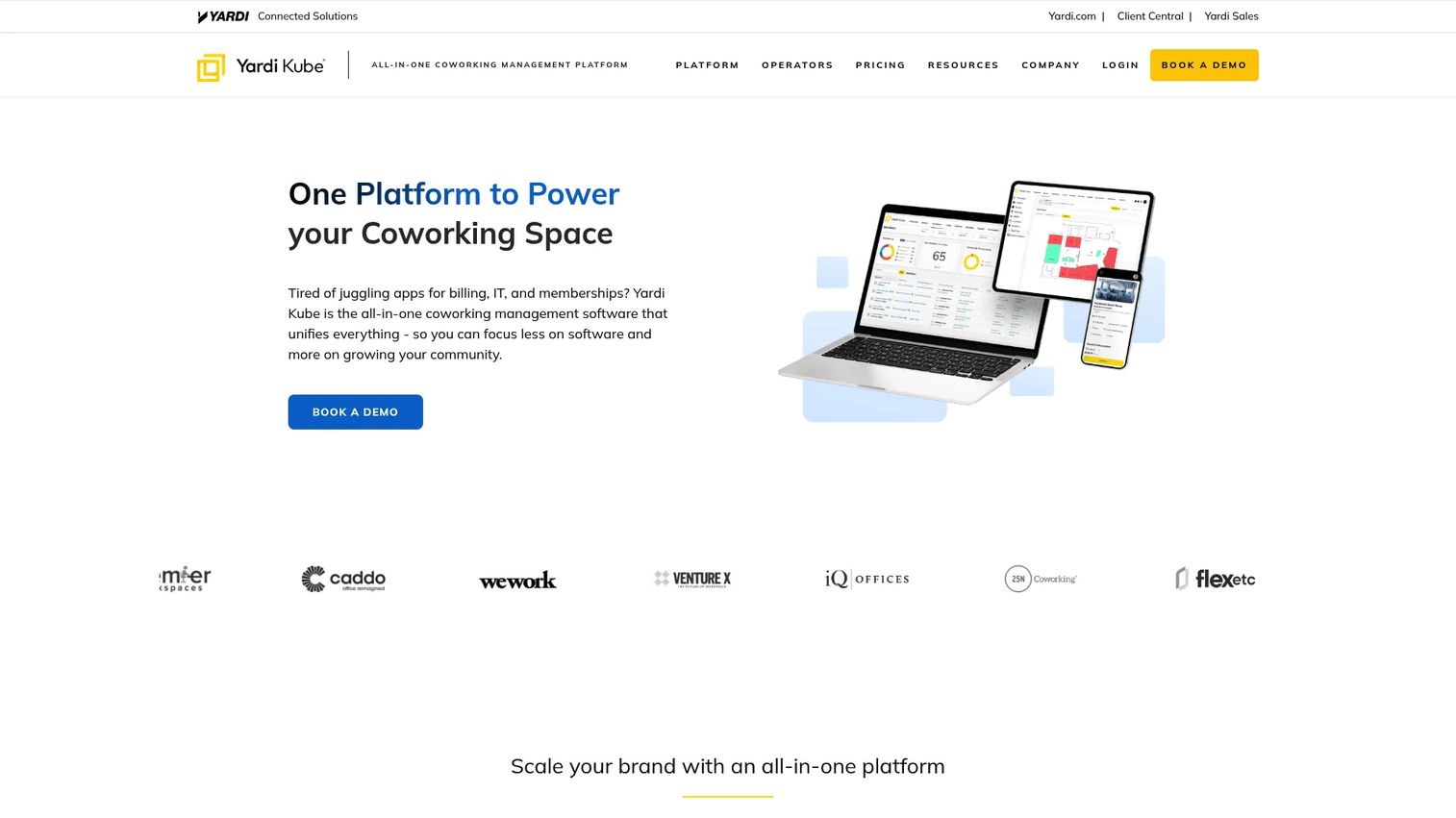
Yardi Kube is all-in-one coworking and flexible workspace management software aimed at operators, landlords, and property managers who want enterprise-grade flexibility. It bundles a member app and self-service bookings, billing and payments automation, IT and Wi-Fi management, interactive floor plans, and reporting, all connected to the broader Yardi property ecosystem. That ecosystem tie is the differentiator for operators already living in Yardi or managing mixed property portfolios.
Best for: Operators, landlords, and property managers who want enterprise-grade flexibility and a connected Yardi ecosystem.
Key strengths
- Connected Yardi ecosystem: Ties coworking operations into broader property management for mixed portfolios.
- Billing and IT management: Automated billing plus built-in IT and Wi-Fi management in one platform.
- Floor plans and reporting: Interactive floor plans and analytics and reporting for space and revenue decisions.
Why choose Yardi Kube: If you already run Yardi for property management or oversee a mixed portfolio, Kube's ecosystem connection removes the integration work of bolting coworking onto your stack. The Start tier gives a public price point, and Core and Pro scale up through quotes. It's the most enterprise-leaning option here, best for operators who value ecosystem fit over the lightest-weight tool.
Yardi Kube pricing: Start is $349 per month and includes quick-start implementation, meeting room bookings, contracts and memberships, automated billing and payments, reporting and analytics, and interactive floor plans. Core and Pro are quote-based custom pricing. There's no public free tier.
Considerations before you buy
The demo screen is the easy part. These are the criteria that decide whether a coworking management system saves time or adds work.
Billing and invoicing edge cases
Recurring billing is table stakes. What separates platforms is how they handle proration on mid-cycle changes, credits, refunds, taxes, failed payments, and dunning. Ask each vendor to walk through a member canceling on day 12 of a 30-day cycle. If the answer involves manual adjustment, that's your future workload.
Access control integrations
Access control is only useful if it revokes as cleanly as it grants. Check which door hardware and Wi-Fi systems each platform integrates with, whether credentials tie to membership status automatically, and what happens the moment a member's plan lapses. Some platforms treat access as native; others as a separate add-on with its own fee.
Pricing model fit
Per-desk, per-member, per-location, and usage-based models each reward different space shapes. A per-desk tool may cost less for a stable office; a per-member tool tracks revenue for a churny community space. Model your actual numbers against each pricing structure, not just the headline starting price.
Member portal and mobile app
The member portal and mobile app are where members self-serve, which directly reduces front-desk load. Check whether the app is white-label, whether it's included or an add-on, and whether members can actually complete booking, payment, and plan changes without emailing you.
Analytics, reporting, and integrations
You can't manage occupancy, churn, or revenue you can't see. Verify the analytics and reporting cover your operating metrics, export cleanly, and roll up across locations. Then confirm the integrations you depend on, accounting, payments, and access hardware, are supported natively rather than through brittle workarounds.
Conclusion
The real difference between these platforms isn't the booking calendar. It's how each one handles the operator work that never shows up in a demo: billing edge cases, access control that revokes on time, automation that removes manual steps, and reporting you can act on.
For transparent pricing and clean workspace booking, Archie is the easiest to evaluate. For automation-first operators, Optix builds its whole platform around it. For a branded member experience, Spacebring delivers white-label web and mobile. Cobot fits spaces wanting member-based pricing, OfficeRnD Flex suits multi-location growth, and Proximity leads on access control and physical operations. Nexudus rewards technical operators who want deep customization, and Yardi Kube fits those already in the Yardi ecosystem.
Don't buy on the demo alone. Shortlist two or three that match your pricing model and operational priorities, then book demos and make each vendor walk through your specific billing and access edge cases with your real numbers. That's where the right choice becomes obvious.
FAQs
For a small space, prioritize automated billing and invoicing, self-service booking through a member portal, and access control that ties to membership status. These three remove the most manual work per member. Deep multi-location analytics and heavy customization matter less until you grow, so avoid paying for capability you won't use yet.
Model your real numbers against each structure rather than comparing headline prices. A per-desk tool favors stable, predictable seat counts; a per-active-member model tracks revenue and suits communities with churn; per-location pricing rewards fewer, larger sites. Calculate cost at your current size and your 12-month target, then compare total cost, not starting price.
Coworking software is built around recurring memberships, hot desks, day passes, and community, the operating model of a shared space. Workspace management software is broader and often centers on assigned corporate seating, desk booking, and visitor management for hybrid offices. Many tools overlap, but coworking-specific platforms handle membership billing and community that generic workspace tools may not.
OfficeRnD Flex and Yardi Kube are built for multi-location scale, with consolidated billing, contracts, and reporting across sites. Optix and Spacebring also support multi-location management well. The deciding factors are how cleanly reporting rolls up across locations and whether per-location billing and access control work without duplicate manual setup.
You need one if your brand is part of your value proposition or you want members interacting with your name rather than the vendor's. Spacebring, Optix, OfficeRnD Flex, and Nexudus all offer white-label member apps. If brand isn't a differentiator for your space, a standard branded portal is usually enough and avoids extra add-on costs.
Very, if you rely on 24/7 access or unstaffed hours. The key is whether door and Wi-Fi access provision and revoke automatically with membership status, so a lapsed member loses access without a manual step. Proximity treats access as native; others integrate with third-party hardware or offer it as a paid add-on. Confirm your specific door system is supported.
Look beyond recurring billing to the edge cases: proration on mid-cycle plan changes, credits and refunds, tax handling, failed-payment retries, and automated reminders. Ask each vendor to demo a mid-cycle cancellation with proration. If it requires manual math, that becomes your recurring workload, so weight billing depth heavily in your decision.
Archie and OfficeRnD Flex are commonly cited as approachable migrations, with Archie's transparent setup and OfficeRnD Flex's migration support lowering the switching cost. When comparing any coworking management software, ask what data the vendor imports for you, whether they migrate member records and active contracts, and how long onboarding typically takes before you're live.