You added a checkout to your site last quarter. Conversion barely moved. Cart abandonment is still high, payment options feel thin, and every change requires a developer who's already booked three sprints out.
That's the real pain behind the search for the best shopping cart software. It isn't about a cart widget. It's about the entire transaction layer: how fast a buyer can pay, how many payment methods you support, whether tax and shipping calculate correctly, and whether you can recover the carts people leave behind.
The market reflects how much this matters. The ecommerce shopping cart software market is expected to grow from USD 1.76 million in 2025 to USD 3.52 million by 2033, roughly doubling over the period, according to Market Reports World (2025). In the United States specifically, the shopping cart software market is projected to grow at an 11.3% compound annual growth rate from 2026 to 2033, per United States Shopping Cart Software Market Trends (2025). More merchants are treating checkout infrastructure as a revenue lever, not a back-office afterthought.
For a marketer, the question is sharper: does this platform improve checkout conversion, does it reduce the engineering tickets you file to launch a campaign, and what does it replace in your current stack? If you're already evaluating tooling across the funnel, our roundups of the best digital adoption platforms and the best mobile marketing software cover adjacent decisions. This guide stays focused on the cart and commerce platform itself. Let's compare the eight that earn a shortlist for 2026.
What's inside
This guide covers eight ecommerce shopping cart software platforms worth considering in 2026. It's written for marketers, founders, and operators who need to launch or migrate a store without creating new operational headaches.
We chose each platform on the criteria that actually decide a purchase:
- Checkout features: guest checkout, single-page flows, mobile-friendly checkout, and digital wallets
- Payment gateway support: breadth of payment gateways and PCI compliance handling
- Security and compliance: how the platform manages PCI compliance and data protection
- Tax and shipping calculations: built-in handling versus reliance on add-ons
- Deployment model: SaaS versus open source shopping cart software
- Ease of use and total cost: speed to launch and ongoing maintenance
TL;DR
Short on time? Here's the quick read on who each pick fits best.
- Best overall and easiest all-around: Shopify. Hosted, fast to launch, deep app ecosystem, strong checkout.
- Best for built-in commerce depth: BigCommerce. More capability out of the box, strong B2B and multichannel.
- Best shopping cart software for WordPress: WooCommerce. Native to WordPress, open source, fully customizable.
- Best for adding commerce to an existing site: Ecwid. Lightweight, embeddable, fast to deploy.
- Best for enterprise and complex catalogs: Adobe Commerce. Deep customization for high-volume B2B and B2C.
- Best open source and self-hosted control: PrestaShop and OpenCart. Modular, international-ready, no SaaS lock-in.
- Best value for small business: Shift4Shop. Built-in features with a free entry plan.
What is shopping cart software?
Shopping cart software is the checkout and transaction layer of an online store. It manages the cart, runs the checkout flow, processes payments through payment gateways, calculates tax and shipping, stores customer and order records, and recovers abandoned carts. In short, it turns browsing into a completed, paid order.
Most modern online shopping cart software bundles far more than a cart. The core functions you should expect include:
- Cart and checkout: add-to-cart, single-page or multi-step checkout, and guest checkout so buyers don't have to create an account
- Payments: integration with multiple payment gateways, digital wallets like Apple Pay and Google Pay, and PCI compliance to handle card data safely
- Tax and shipping calculations: real-time rates by location, product, and carrier
- Customer and order records: profiles, order history, and data that flows into your CRM and analytics
- Abandoned cart recovery: automated emails and reminders to recapture lost checkouts
- Conversion tooling: discount codes, upsells, and mobile-friendly checkout
The other dividing line is the deployment model. SaaS vs open source shopping cart software is the choice most buyers wrestle with. SaaS platforms host everything for you, handle security and updates, and trade some control for speed. Open source ecommerce and self-hosted shopping cart software give you full control over code, data, and hosting, in exchange for managing the stack yourself. Neither is universally better. The right answer depends on your technical resources, budget, and how much you need to customize.
When to use shopping cart software
Different situations point to different platforms. Here's how to pattern-match your own.
Launching a new online store
When you're starting from scratch, a hosted SaaS platform is usually the fastest path to market. You skip server setup, security patching, and PCI compliance scoping because the vendor handles it. For a marketer, that means launching campaigns and testing offers without waiting on engineering. Speed to first sale matters more than deep customization at this stage.
Migrating from a weak checkout setup
If your current checkout drags on conversion, lacks payment options, or has no abandoned cart recovery, that's a clear trigger to switch. The justification is measurable: a smoother, mobile-friendly checkout and digital wallets reduce friction at the exact moment buyers decide to pay. Look for guest checkout, fewer form fields, and built-in cart recovery before you commit.
Scaling beyond a simple storefront
As volume grows, inventory management, multichannel selling, tax and shipping calculations, and integrations become the deciding factors. A storefront that worked at 50 orders a month can buckle at 5,000. This is when operational control, B2B features, and platform stability outweigh raw simplicity. Choose a platform that can handle the catalog complexity and order volume you expect 18 months out.
Shopping cart software comparison
Here's the shortlist at a glance. The table is sorted by relevance to most buyers searching for the best shopping cart software, not alphabetically. Use it to narrow your options, then read the full section on each pick.
| # | Product | Intent | Key use case | Pricing | G2 rating |
|---|---|---|---|---|---|
| 1 | Shopify | Best overall, fast launch | Scalable hosted store for online and in-person sales | From $39/mo | 4.4/5 |
| 2 | BigCommerce | Built-in commerce depth | B2B and multichannel selling out of the box | From $39/mo | 4.2/5 |
| 3 | WooCommerce | WordPress, open source | Self-hosted store on WordPress | Free core platform | 4.4/5 |
| 4 | Ecwid | Add commerce to a site | Embed a store into an existing website | From $5/mo | 4.7/5 |
| 5 | Adobe Commerce | Enterprise | Complex B2B/B2C catalogs at scale | Custom | 4.0/5 |
| 6 | PrestaShop | Open source, international | Customizable self-hosted or hosted store | Free download; hosted from €24/mo | 4.3/5 |
| 7 | OpenCart | Open source, lightweight | Free self-hosted store with extensions | Free, open source | - |
| 8 | Shift4Shop | Small business value | All-in-one hosted store with free plan | From $0/mo | 3.9/5 |
1. Shopify

Shopify is the platform most stores start with, and for good reason. It's a fully hosted ecommerce platform for building, running, and scaling online and in-person stores. You get a store builder with themes and AI-assisted design, plus checkout, payments, shipping, tax, and analytics in one place. It handles the infrastructure so you can focus on selling.
Best for: Merchants that need a scalable, low-maintenance platform to launch fast and grow into retail and international sales.
Key strengths
- Hosted and low-maintenance: Shopify handles hosting, security, and PCI compliance, so you launch without an engineering backlog.
- Deep app ecosystem: Thousands of apps extend abandoned cart recovery, upsells, and integrations without custom code.
- Strong checkout: A high-converting, mobile-friendly checkout with digital wallets and guest checkout built in.
Why choose Shopify: If you want the fastest, most reliable path from idea to first sale, Shopify is the default for a reason. It suits marketers who need to launch landing pages, run promotions, and test offers without filing tickets. The tradeoff is app costs that stack up as you add features, but the time you save on setup and maintenance usually justifies it. It's also a strong shopping cart software for small business owners who don't want to manage servers.
Shopify pricing: Shopify starts at $39 USD/month for the Basic plan. Grow runs $105/month and Advanced is $399/month, with Plus starting around $2,300/month for larger operations. Shopify offers a free 3-day trial, and most plans start at $1 per month for the first three months after the trial. G2 reviewers rate it 4.4 out of 5.
2. BigCommerce

BigCommerce is an ecommerce platform built to scale across both B2C and B2B. Where some platforms lean on apps for core functions, BigCommerce ships more capability out of the box. That means less app dependence and fewer monthly add-on fees as you grow. It's a strong fit for teams that want depth without assembling a dozen plugins.
Best for: Merchants that want a scalable platform with strong B2B and multichannel selling support without heavy app reliance.
Key strengths
- Customizable one-page checkout: Supports digital wallets, one-click checkout, and buy-now-pay-later natively for a smoother mobile-friendly checkout.
- Multichannel selling: Sell across Google, Meta, TikTok, Amazon, Walmart, and eBay from one dashboard.
- B2B features: Account-specific pricing, quotes, reorders, invoice payments, and approval workflows.
Why choose BigCommerce: Pick BigCommerce when you need more built-in commerce depth and want to avoid stacking app costs to get there. It fits marketers and operators selling across many channels or running a hybrid B2C and B2B motion. The platform's checkout flexibility makes it especially appealing if checkout conversion is your priority.
BigCommerce pricing: BigCommerce starts at $39/month for the Core plan, with Growth at $105/month and Scale at $399/month. The Performance tier starts around $1,499/month billed annually. A free trial is available. G2 reviewers give it 4.2 out of 5.
3. WooCommerce
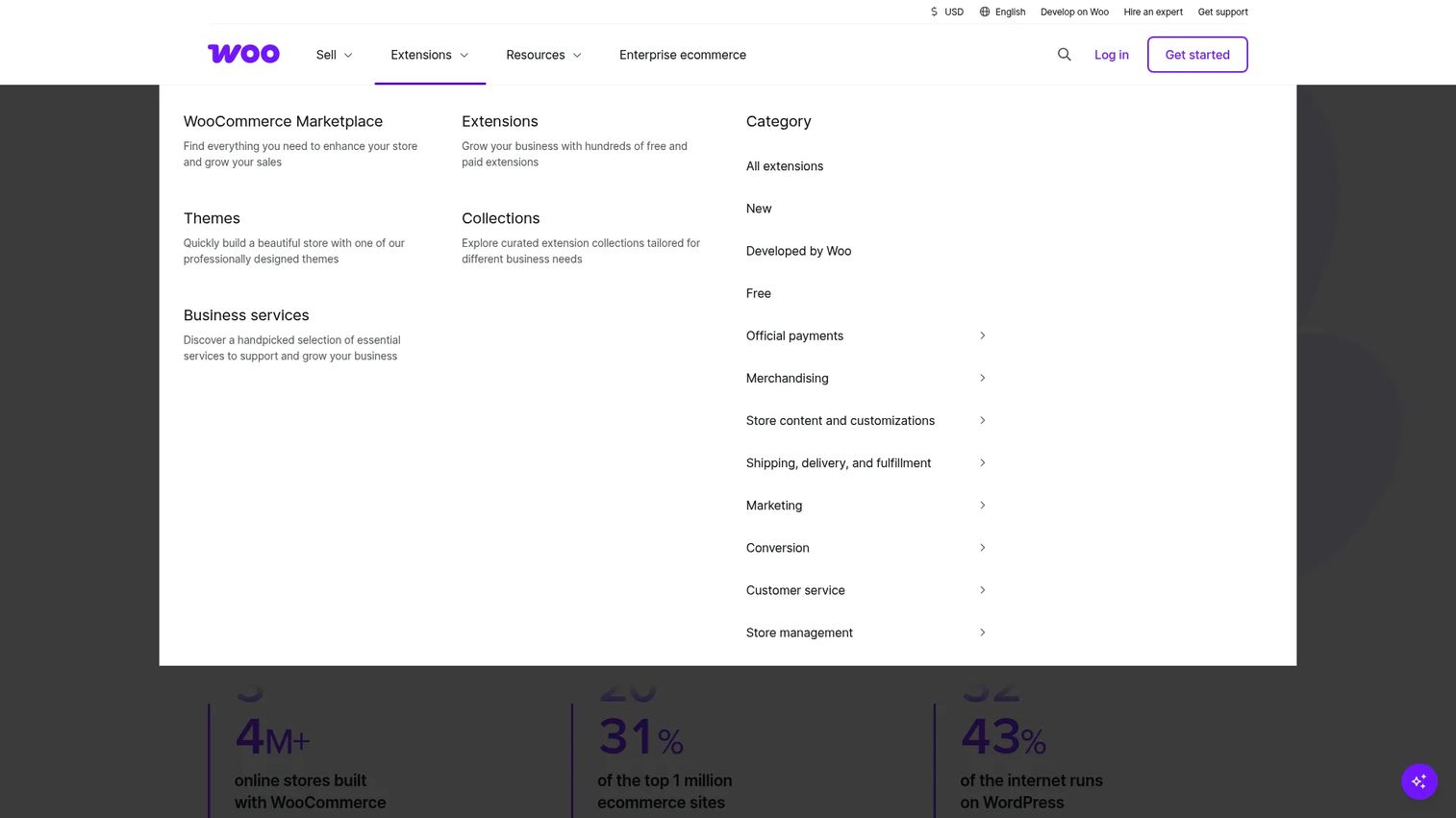
WooCommerce is the answer for shopping cart software for WordPress. It's an open-source plugin that turns any WordPress site into a full online store, with complete control over checkout, data, and costs. If your brand already runs on WordPress, content and commerce live under one roof. That's a meaningful advantage for content-heavy and SEO-driven stores.
Best for: Businesses that want a self-hosted, highly customizable WordPress storefront with full ownership of their data.
Key strengths
- Native WordPress integration: Commerce sits inside the CMS your content team already uses, so blog, landing pages, and store share one system.
- Flexible payments and extensions: A large plugin ecosystem covers payment gateways, abandoned cart recovery, and tax and shipping calculations.
- Sell online and offline: Support for local, global, physical, and digital products with full configurability.
Why choose WooCommerce: WooCommerce wins for content-led brands and marketers already invested in WordPress. As open source ecommerce, it gives you control over code and data that closed SaaS platforms don't. The tradeoff is that you manage hosting, security, and updates yourself, so you'll want development support or a managed host. For teams comfortable with that, the flexibility is hard to beat.
WooCommerce pricing: The core WooCommerce platform is free to download and use, with no monthly subscription. Added costs come from hosting, payment processing, and paid extensions, so your real spend depends on the stack you assemble. G2 reviewers rate it 4.4 out of 5.
4. Ecwid
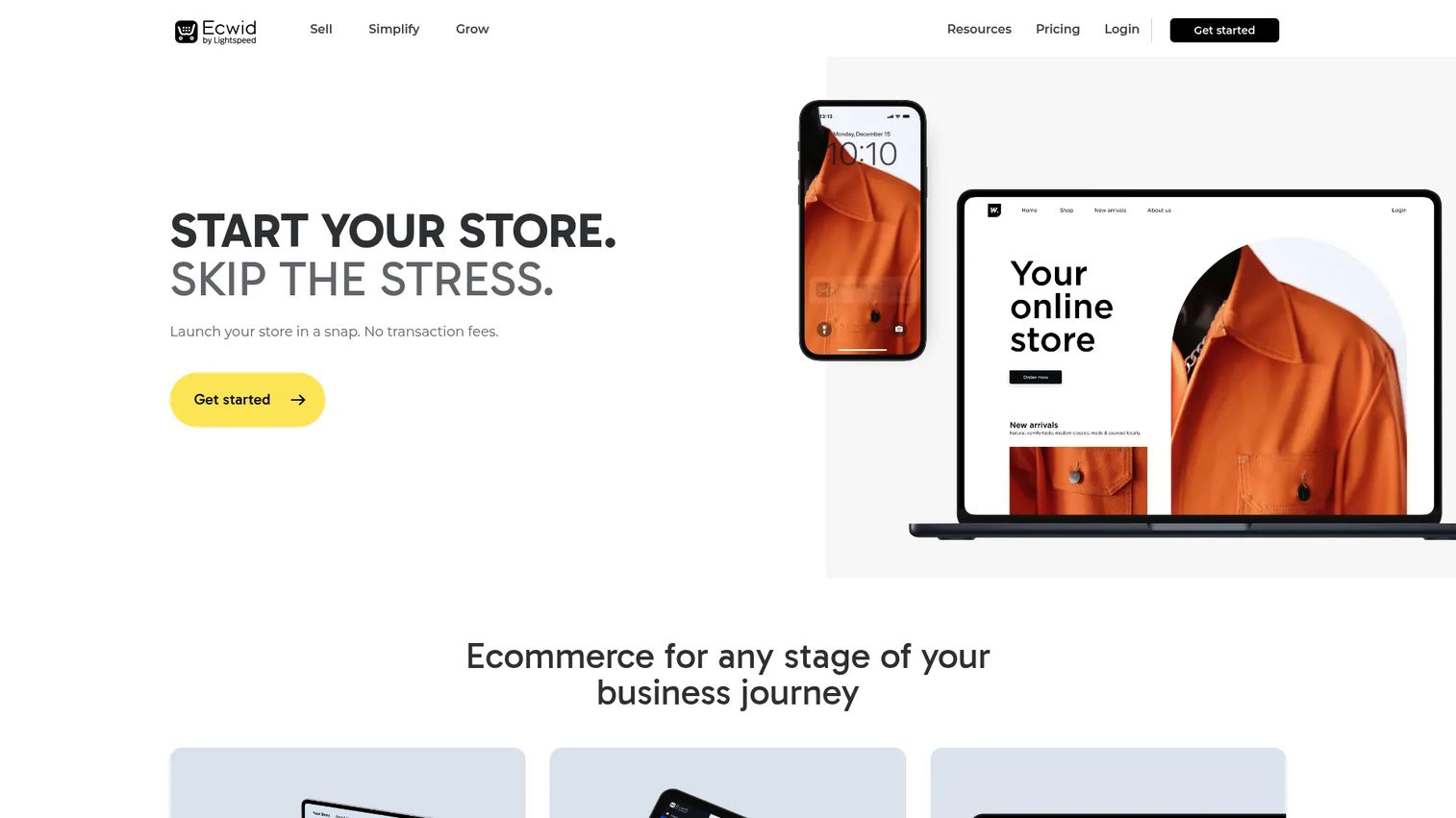
Ecwid is built for one specific job: adding an online store to an existing website without rebuilding it. You drop a store into a site you already have, then sell across social and marketplace channels from one dashboard. For marketers who want commerce live this week, not next quarter, that's the appeal.
Best for: Small and midsize businesses that want to embed ecommerce into an existing site and sell across multiple channels.
Key strengths
- Embeds into any site: Add a store to your current website without a full rebuild or migration.
- Multichannel selling: Sell on social platforms and marketplaces alongside your main site.
- Centralized management: Handle products, shipping, and payments from a single dashboard.
Why choose Ecwid: Choose Ecwid when you have a working site and just need to bolt on commerce fast. It's ideal shopping cart software for small business owners who don't want to migrate to a whole new platform. The lightweight setup means you can test selling without committing to a major rebuild, then scale up plans as orders grow.
Ecwid pricing: Ecwid starts at $5/month for the Starter plan. Venture is $35/month, Business is $65/month, and Unlimited is $149/month. Annual billing prices are also available, and Ecwid states there are no setup or transaction fees on any plan. G2 reviewers rate it 4.7 out of 5, the highest score on this list.
5. Adobe Commerce
Adobe Commerce (formerly Magento Commerce) is the enterprise option on this list. It's built for mid-market to enterprise brands that need complex B2B and B2C commerce, deep customization, and multi-site operations. When catalog size, workflow complexity, or personalization requirements outgrow a standard SaaS platform, Adobe Commerce is where larger teams land.
Best for: Mid-market to enterprise brands needing complex B2B/B2C commerce, large catalogs, and advanced personalization.
Key strengths
- AI-powered discovery: Product discovery and personalization tuned for large, complex catalogs.
- B2B buying workflows: Customer-specific catalogs, account workflows, and negotiated pricing.
- Multi-site and multi-market: Run multiple brands, sites, and markets from one platform, with cloud SaaS and PaaS deployment options.
Why choose Adobe Commerce: Reach for Adobe Commerce when you have the scale and the team to use it. High-volume stores with intricate catalogs, multiple regions, or demanding B2B requirements get a level of control that lighter platforms can't match. It pairs the flexibility of self-hosted shopping cart software with enterprise cloud options, but it expects real development resources.
Adobe Commerce pricing: Adobe lists customized pricing only and directs buyers to request a quote, with no public price shown. Packaging spans Adobe Commerce as a Cloud Service (SaaS), Adobe Commerce on Cloud (PaaS), and Adobe Commerce Optimizer. Buyers should confirm enterprise packaging and total cost directly with Adobe. G2 reviewers rate it 4.0 out of 5.
6. PrestaShop
PrestaShop is open-source ecommerce software with a strong international footprint. It ships with hundreds of built-in features and connects to thousands of marketplace modules and themes. For teams that want control without locking into a closed SaaS stack, it's a flexible, modular foundation. Multi-language and multi-currency support make it a common pick for cross-border sellers.
Best for: Merchants or agencies wanting customizable open-source ecommerce software with the option of a hosted plan.
Key strengths
- Extensive built-in features: Over 600 built-in features and modules cover most store needs without heavy custom work.
- Large module marketplace: More than 5,000 marketplace modules and themes extend payments, shipping, and design.
- International commerce: Native multi-language and multi-currency support for selling across borders.
Why choose PrestaShop: PrestaShop fits teams that value open-source flexibility and international reach but want a middle path between full self-hosting and SaaS. You can run the free download on your own hosting or opt for the hosted plan to offload infrastructure. Either way, you keep more control over customization than a closed platform allows. Plan for hosting and module costs as part of total cost of ownership.
PrestaShop pricing: PrestaShop offers a free Classic download, with hosting and domain costs separate. The Hosted plan starts from €24 excluding VAT per month and bundles hosting, support, and ecommerce services. G2 reviewers rate it 4.3 out of 5.
7. OpenCart
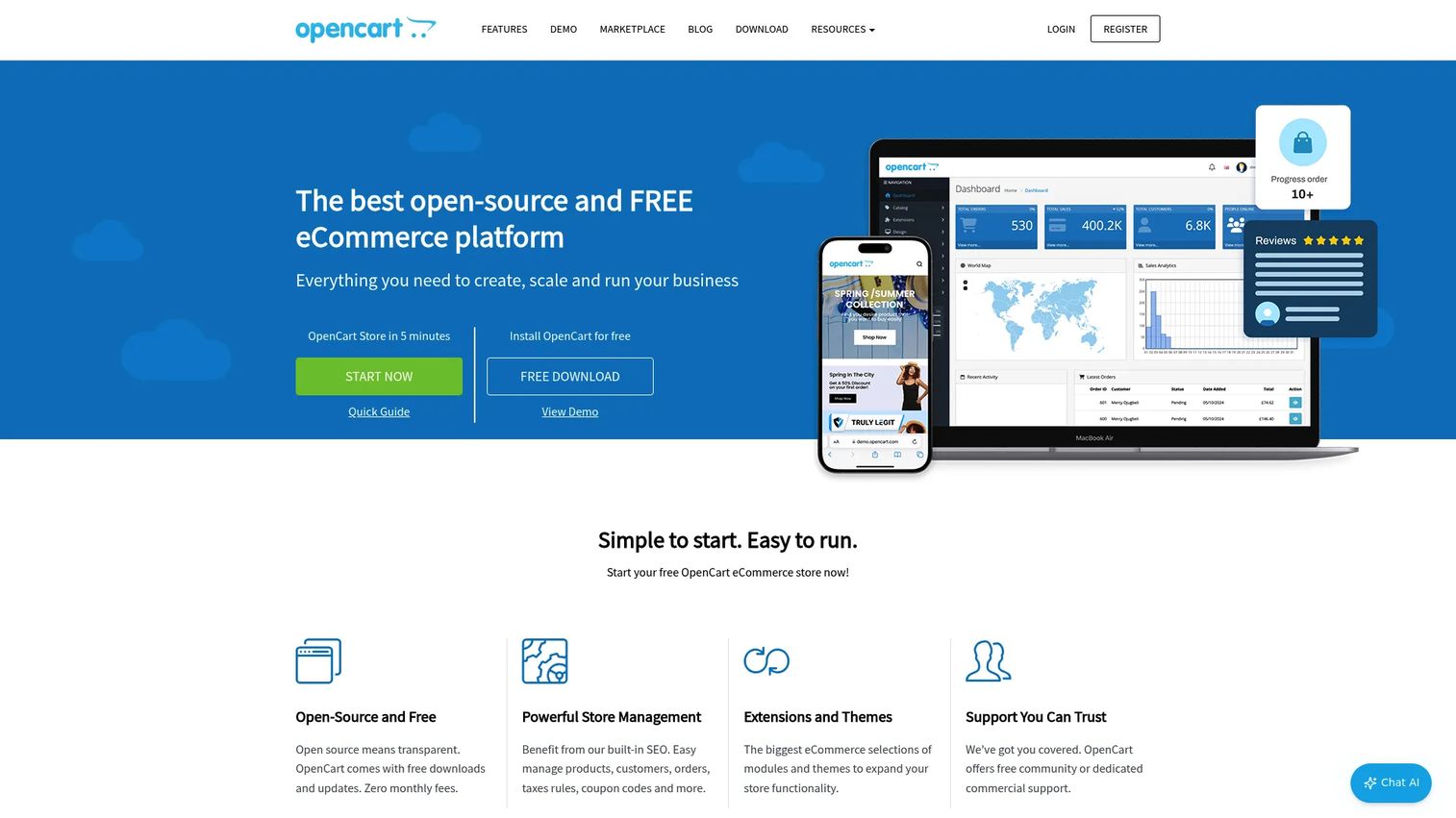
OpenCart is a free, open-source ecommerce platform for building and running online stores. It's lightweight, straightforward to set up for technically comfortable teams, and backed by a large marketplace of extensions. If you want a self-hosted store without subscription fees, OpenCart keeps things simple and inexpensive.
Best for: Merchants that want a free, self-hosted ecommerce platform with strong extensibility.
Key strengths
- Free and open source: Free downloads and updates with zero monthly platform fees.
- Built-in store management: SEO tools plus management for products, customers, orders, taxes, and coupons.
- Large extension marketplace: Over 13,000 modules and themes to extend payments, shipping, and design.
Why choose OpenCart: OpenCart works best for smaller stores or teams that are comfortable managing their own hosting and want to avoid recurring SaaS fees. It's a practical self-hosted shopping cart software choice when budget is tight and you have the technical comfort to maintain it. The tradeoff, as with any open source ecommerce platform, is that you own hosting, security, and updates.
OpenCart pricing: OpenCart is free and open source, with zero monthly fees on the platform itself. Real costs come from hosting, paid extensions, and any development help you bring in. No verified public G2 rating was available at the time of writing.
8. Shift4Shop

Shift4Shop is a hosted ecommerce platform that packs a lot of built-in commerce features into merchant-friendly pricing. It covers unlimited products, built-in SEO tools, real-time shipping, inventory control, single-page checkout, and digital downloads. For cost-sensitive small businesses, the standout is a free entry plan that bundles real functionality.
Best for: Merchants wanting an all-in-one hosted store with built-in tools and a free entry plan.
Key strengths
- Built-in commerce features: Unlimited products, real-time shipping, and inventory control without extra add-ons.
- Single-page checkout: A streamlined, mobile-friendly checkout designed to reduce abandonment.
- Built-in SEO tools: On-platform SEO features to help organic traffic without third-party plugins.
Why choose Shift4Shop: Shift4Shop competes on cost and convenience, making it a strong shopping cart software for small business owners who want hosted simplicity without a monthly bill to start. The free End-to-End plan bundles a lot of functionality, with paid tiers available as you scale. If you're weighing value and built-in features over a sprawling app marketplace, it earns a look.
Shift4Shop pricing: Shift4Shop's End-to-End eCommerce plan is free at $0.00/month. Paid tiers include Basic Store at $29/month, Plus Store at $79/month, and Pro Store at $229/month. G2 reviewers rate it 3.9 out of 5.
Considerations before you choose
A shortlist is a start. Before you commit, run each finalist through this checklist.
Total cost of ownership
Sticker price is rarely the real number. Add app and extension fees, transaction fees, payment processing, hosting (for self-hosted platforms), and any development help. A free open source ecommerce platform can cost more than a SaaS plan once hosting and maintenance are counted. Map the full picture over 12 to 24 months.
Payment and checkout flexibility
Check which payment gateways the platform supports, whether digital wallets and guest checkout are built in, and how the checkout performs on mobile. Checkout conversion lives or dies on these details. Confirm PCI compliance handling, especially if you'd otherwise have to scope it yourself.
Tax, shipping, and operations
Verify how tax and shipping calculations work at the tier you'll buy. Some platforms include real-time rates; others gate them behind higher plans or add-ons. If you sell internationally or across many tax jurisdictions, this is a make-or-break detail.
Maintenance and technical fit
Be honest about your resources. SaaS platforms handle security, updates, and uptime. Self-hosted shopping cart software gives you control but expects you to manage the stack. Match the deployment model to the team you actually have, not the one you wish you had.
Conclusion
The best shopping cart software comes down to fit, not a single winner. The shortlist logic stays the same: weigh checkout performance, payment and PCI compliance handling, tax and shipping calculations, deployment model, and total cost against the team and budget you have.
For most stores, Shopify is the best overall pick because it launches fast, maintains itself, and converts well out of the box. If you need built-in commerce depth and multichannel B2B, BigCommerce is the stronger fit. On WordPress, WooCommerce is the natural choice. To add commerce to an existing site, Ecwid is the quickest route. For enterprise complexity, Adobe Commerce delivers the control. And for open-source flexibility or tight budgets, PrestaShop, OpenCart, and Shift4Shop each earn a place.
Your next step: compare your real checkout needs, required integrations, and total cost of ownership across two or three finalists before you switch. The right platform should improve conversion and remove operational friction, not add new headaches.
FAQs
Shopping cart software is the system that manages the cart, checkout, payment processing, and order capture for an online store. It moves a buyer from selecting products to a completed, paid order. Most platforms also handle customer records, tax and shipping calculations, and abandoned cart recovery.
At a minimum, look for multiple payment gateways, guest checkout, abandoned cart recovery, tax and shipping calculations, PCI compliance, and analytics. A mobile-friendly checkout with digital wallets is increasingly essential for checkout conversion. Strong shopping cart software features reduce friction at the exact moment buyers decide to pay.
Both. Shopify functions as a shopping cart with a hosted checkout, and as a broader ecommerce platform with store building, payments, shipping, tax, and analytics. Many of the top shopping cart software products today are full platforms rather than standalone cart widgets.
WooCommerce is the usual winner for WordPress-based stores. It's a native open-source plugin, so commerce lives inside the same CMS as your content and landing pages. That tight integration and full data ownership make it the default shopping cart software for WordPress.
SaaS platforms host everything for you and handle security, updates, and PCI compliance, in exchange for a subscription and less code-level control. Open-source and self-hosted shopping cart software gives you full control over code, data, and hosting, but you manage the stack yourself. The SaaS vs open source shopping cart software choice comes down to your technical resources and how much you need to customize.
For small business, speed, simplicity, and cost usually matter most. Shopify is the easiest all-around hosted option, Ecwid is ideal for adding a store to an existing site, and Shift4Shop offers strong value with a free entry plan. Each is a solid shopping cart software for small business depending on whether you're starting fresh or building on what you have.
Most do, but the depth varies by tier and integrations. Many platforms include real-time tax and shipping calculations on standard plans, while others gate advanced rules or carrier rates behind higher tiers or add-ons. Always confirm what's included at the plan you intend to buy, especially if you sell across multiple jurisdictions.
Compare total cost of ownership, payment gateway support, checkout flexibility, and maintenance burden across your finalists. Factor in app and transaction fees, hosting for self-hosted options, and how well each platform handles abandoned cart recovery and mobile-friendly checkout. Running a proper shopping cart software comparison on these criteria beats picking on price alone.