


Most ABA clinics do not go shopping for "software." They go shopping for a way to stop the bleeding.
Denied claims that sit in a pile for weeks. Session data trapped in paper binders and half-broken spreadsheets. A clinical director spending Sunday nights reconciling authorizations instead of supervising cases. Schedules that fall apart the moment one RBT calls out. These are the real reasons practices switch, not a feature checklist.
Generic healthcare tools rarely fix this. They were built for primary care visits and simple CPT coding, not for the reality of applied behavior analysis, where a single learner might have hundreds of trial data points per session, layered authorization limits, and multiple staff touching one case in a day. The workflow is different, so the software has to be different.
The category is growing fast to meet that demand. The applied behavior analysis software market sat at roughly USD 0.87 billion in 2026 and is forecast to reach USD 2.22 billion by 2035, according to Business Research Insights (2026). More than 12,800 ABA clinics globally used digital platforms in 2024, up from 4,300 in 2018, per Industry Research.biz.
This guide compares seven ABA therapy software tools for 2026 through the lens of the bottleneck you are actually trying to fix.
What's inside
This guide is for clinic owners, practice managers, BCBAs, and revenue-facing admins who already know they need aba therapy practice management software and are deciding which platform fits their workflow.
We picked and ranked these seven tools based on the operational criteria that decide whether a platform earns its place:
- Billing and claims: authorization management, claim tracking, AR visibility, and revenue cycle support
- Clinical data: real-time behavior data collection software, graphing, and reporting depth
- Scheduling and documentation: calendars, session notes, e-signatures, and reminders
- Compliance and access: HIPAA-compliant ABA software, mobile access, and offline data collection
We favored real clinic operations over feature noise. A long feature list means nothing if it does not fix the thing slowing your practice down today.
TL;DR
- Best for billing-heavy clinics: Aloha ABA pairs practice management with integrated aba billing software so operations, AR, and data collection live in one place.
- Best for all-in-one consolidation: Theralytics covers scheduling, billing, data collection, documentation, and reporting with mobile and offline support.
- Best for automation-first practices: Artemis ABA leans on AI scheduling and billing automation to cut admin drag.
- Best for clinical decision support: Passage Health emphasizes real-time data syncing, automated graphing, and integrated claims.
- Best for larger organizations: Rethink Behavioral Health bundles clinical programming, billing, and training in a broad suite.
- Best for data-first and mobile teams: Motivity focuses on clinical data depth, while Raven Health leads with mobile-first, offline-capable data collection.
What is applied behavior analysis software?
Applied behavior analysis software is a category of healthcare practice management and clinical tools built specifically for ABA therapy providers to run billing, scheduling, documentation, data collection, and reporting in one connected system. It replaces the patchwork of spreadsheets, paper data sheets, and general medical billing tools that break under ABA's high data volume and complex authorization rules.
Most platforms in this category, whether marketed as aba practice management software or aba data collection software, share a core module stack.
Billing and revenue cycle
- Claims management and submission
- Authorization management and tracking
- Accounts receivable and denial follow-up
- Payroll and invoicing support
Scheduling and operations
- Staff and client calendars
- Recurring session scheduling and reminders
- Electronic visit verification where required
- Credentialing and caseload management
Clinical data collection
- Real-time trial and behavior data capture
- Automated graphing and progress tracking
- Treatment plan and program management
- Session notes and documentation
Reporting and compliance
- Reporting dashboards for clinical and operational metrics
- HIPAA-compliant data storage and access controls
- Mobile and offline data collection for field staff
- E-signatures and audit trails
The category matters more now because ABA is scaling and consolidating. Industry Research.biz reports that 78% of ABA providers adopted software platforms for electronic data collection, therapy management, and reporting by 2023, with North America accounting for 57% of global installations. Running a modern practice on disconnected tools is no longer competitive.
When to use aba therapy software
Replace spreadsheets and disconnected systems
Spreadsheets work until they do not. Once you cross a handful of clients and staff, shared drives and manual trackers start losing data, breaking formulas, and eating hours in reconciliation. If your team copies the same information into three places, or a version conflict just cost you a billing cycle, you have outgrown the DIY stack. Dedicated aba therapy practice management software centralizes the record so accuracy stops depending on who updated which file last.
Centralize billing and claims workflows
Billing is where most clinics feel the pain first. Denied claims, missed authorization limits, and a growing AR backlog are not a staffing problem, they are a systems problem. When your biller spends more time chasing payers than posting payments, aba therapy billing software with claim tracking, authorization management, and AR dashboards pays for itself. The goal is fewer manual touches per claim and faster time to payment.
Support field staff and mobile data capture
In-home and community-based ABA runs on mobile. Therapists need to record trial-by-trial data in real time, on a phone or tablet, often in places with no reliable signal. If your RBTs are still filling out paper sheets and transcribing them later, you are losing data quality and clinical hours. Behavior data collection software with mobile access and offline data collection keeps the record accurate at the point of care.
Comparison table
Here is how the seven tools compare on fit, differentiator, pricing, and rating. Pricing reflects each vendor's public pages as of mid-2026; verify current terms before you commit.
| # | Product | Best for | Key differentiator | Pricing | G2 rating |
|---|---|---|---|---|---|
| 1 | Aloha ABA | Billing-heavy practices | Practice management plus integrated data collection | From $29.99/staff/mo | Not available |
| 2 | Theralytics | All-in-one consolidation | Scheduling, billing, data, docs, mobile in one suite | From $20/client/mo | Not rated |
| 3 | Artemis ABA | Automation-first clinics | AI scheduling and billing automation | From $39.99/user/mo | Not available |
| 4 | Passage Health | Clinical decision support | Real-time syncing and automated graphing | Custom quote | 4.6/5 |
| 5 | Rethink Behavioral Health | Larger organizations | Clinical, billing, and training in one suite | From $20/user/mo | 3.0/5 |
| 6 | Motivity | Data-first teams | Clinical data depth and supervision workflows | Custom quote | Not listed |
| 7 | Raven Health | Mobile-first teams | Offline-capable data collection plus billing | From $29/learner/mo | 4.4/5 |
1. Aloha ABA
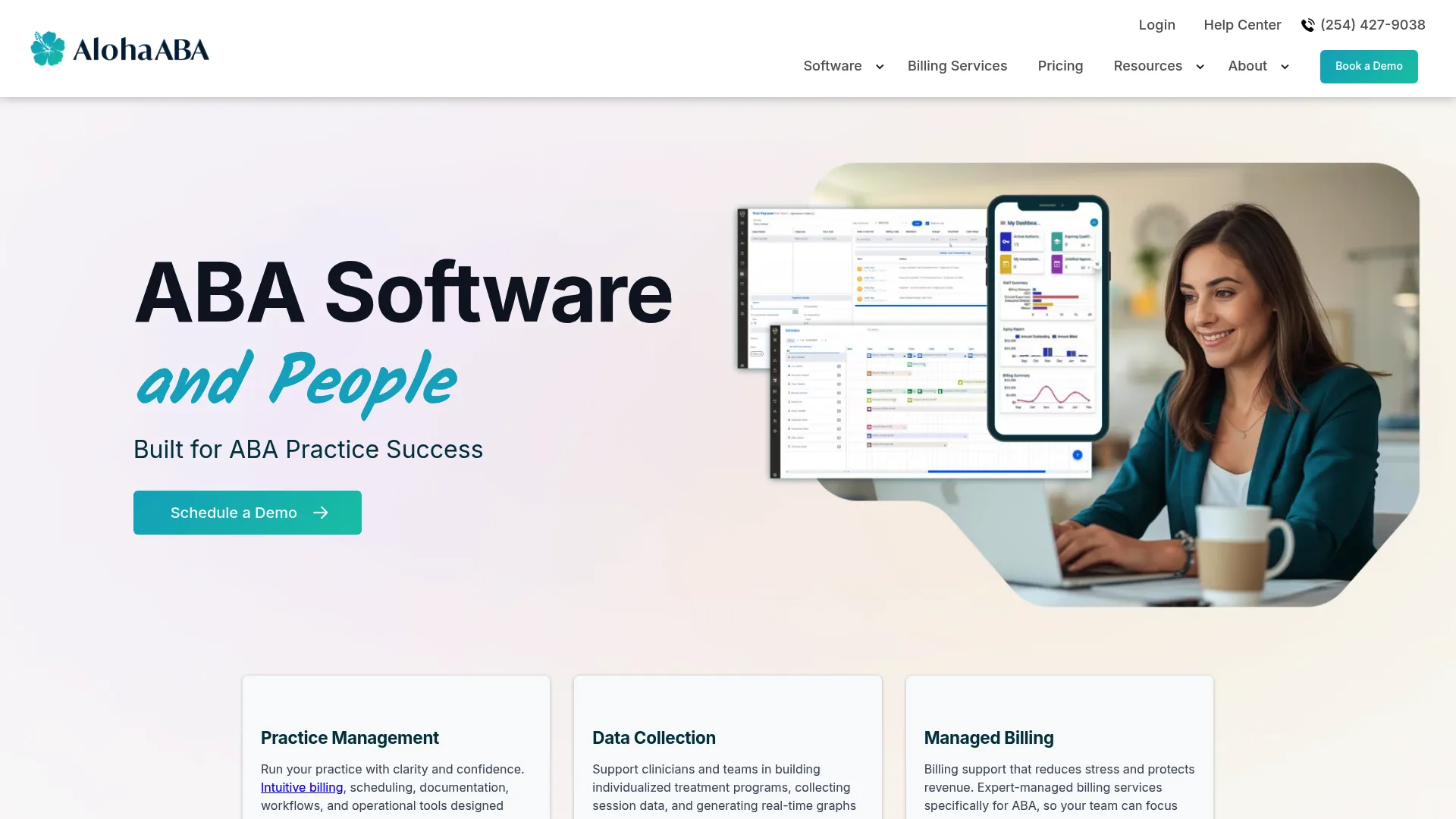
Aloha ABA is built for practices that treat billing and operations as the core problem, not an afterthought. It combines aba practice management software with integrated data collection, so scheduling, billing, payroll, analytics, and accounts receivable live alongside your clinical record instead of in a separate tool. For clinics drowning in denied claims and manual AR follow-up, that consolidation is the whole point.
The platform leans hard into the revenue side. You get claims management, authorization tracking, and accounts receivable visibility, plus payroll support, so the money workflow stays connected to the clinical work that generated it. Real-time data recording and graphing sit inside the same system, which means the data that supports a claim is not stranded in a different app.
Best for: ABA providers that want practice management, billing, and data collection in one HIPAA-compliant platform.
Key strengths
- Practice management: scheduling, billing, payroll, analytics, and accounts receivable
- Integrated data collection with real-time recording and graphing
- Authorization management and claim tracking
- HIPAA-compliant data storage
Why choose Aloha ABA: If billing errors and AR backlog are the reason you are switching, Aloha ABA puts revenue cycle tools and clinical data in the same place, so your biller and your clinicians stop working from separate systems.
Aloha ABA pricing: Practice Management is $29.99 per staff per month. Data Collection is offered at $12 per client per month and $10 per client per month, currently available alongside the Practice Management plan.
2. Theralytics
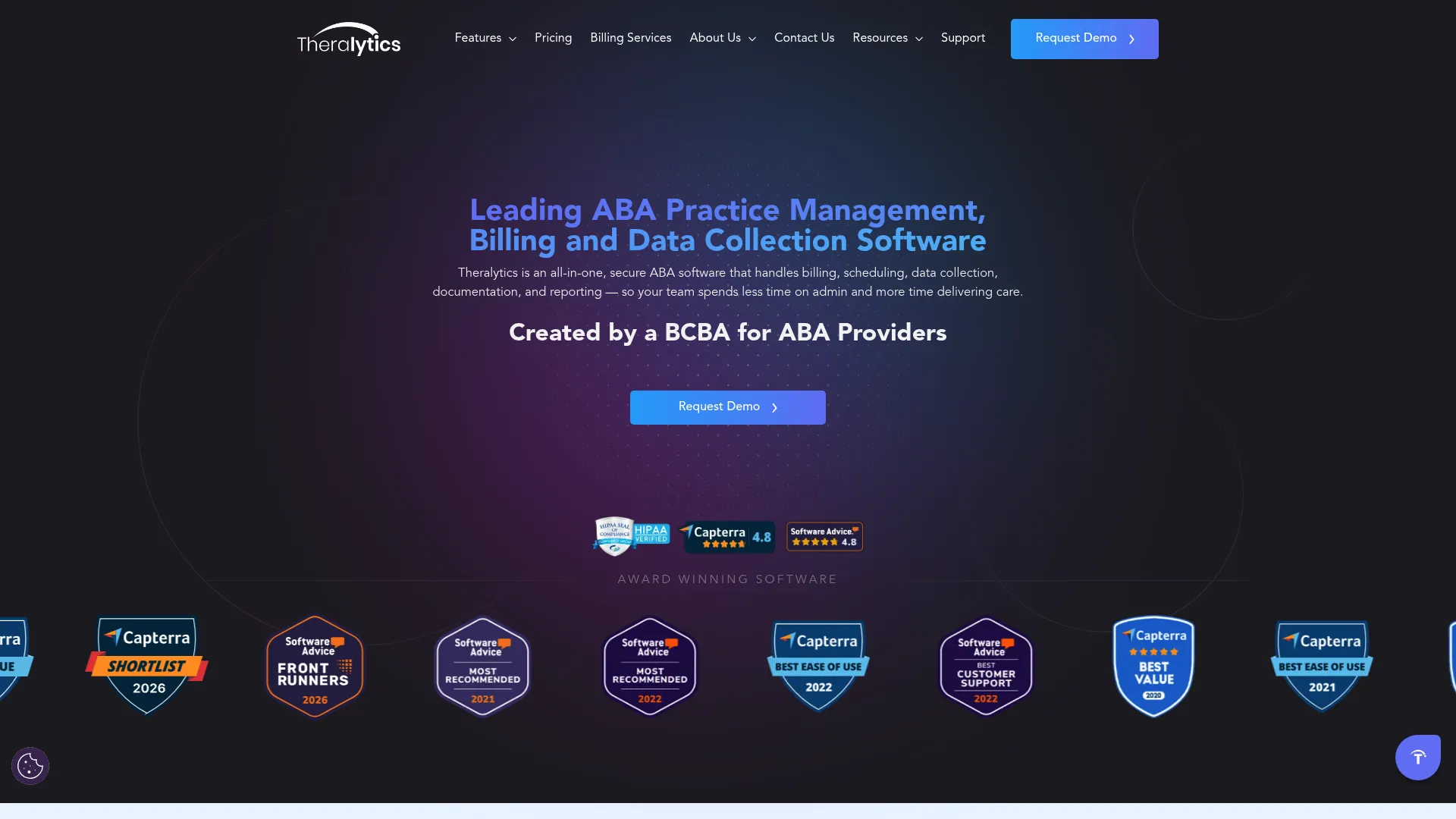
Theralytics is the broad, all-in-one option for practices that want one platform to run the entire operation. It covers scheduling, billing and claims management, data collection, documentation, and reporting, then adds a mobile app and AI-powered narrative summaries on top. For a growing clinic tired of stitching tools together, that breadth is the draw.
The mobile and field story is a strong point here. Therapists can capture data on the app, and the platform's reporting and analytics roll that clinical data into dashboards for clinical and operational review. Documentation management keeps session notes and records organized, and the compliance posture is built for handling protected health information as HIPAA-compliant ABA software.
Best for: Growing ABA practices that want scheduling, billing, data collection, and documentation consolidated in one suite.
Key strengths
- Scheduling, billing, and claims management
- Data collection with mobile app access
- Documentation management and reporting dashboards
- AI-powered narrative summaries
Why choose Theralytics: When your bottleneck is tool sprawl, Theralytics replaces several point tools with one system, and the startup packages make it approachable for newer practices building their first stack.
Theralytics pricing: Practice Management Software and Data Collection Software are each $20 per client per month, and the combined Practice Management and Data Collection plan is $30 per client per month. A BCBA Startup Package is offered free for six months or until you land your first client, and a BCBA Startup Package PRO is listed at $0 per user per month.
3. Artemis ABA
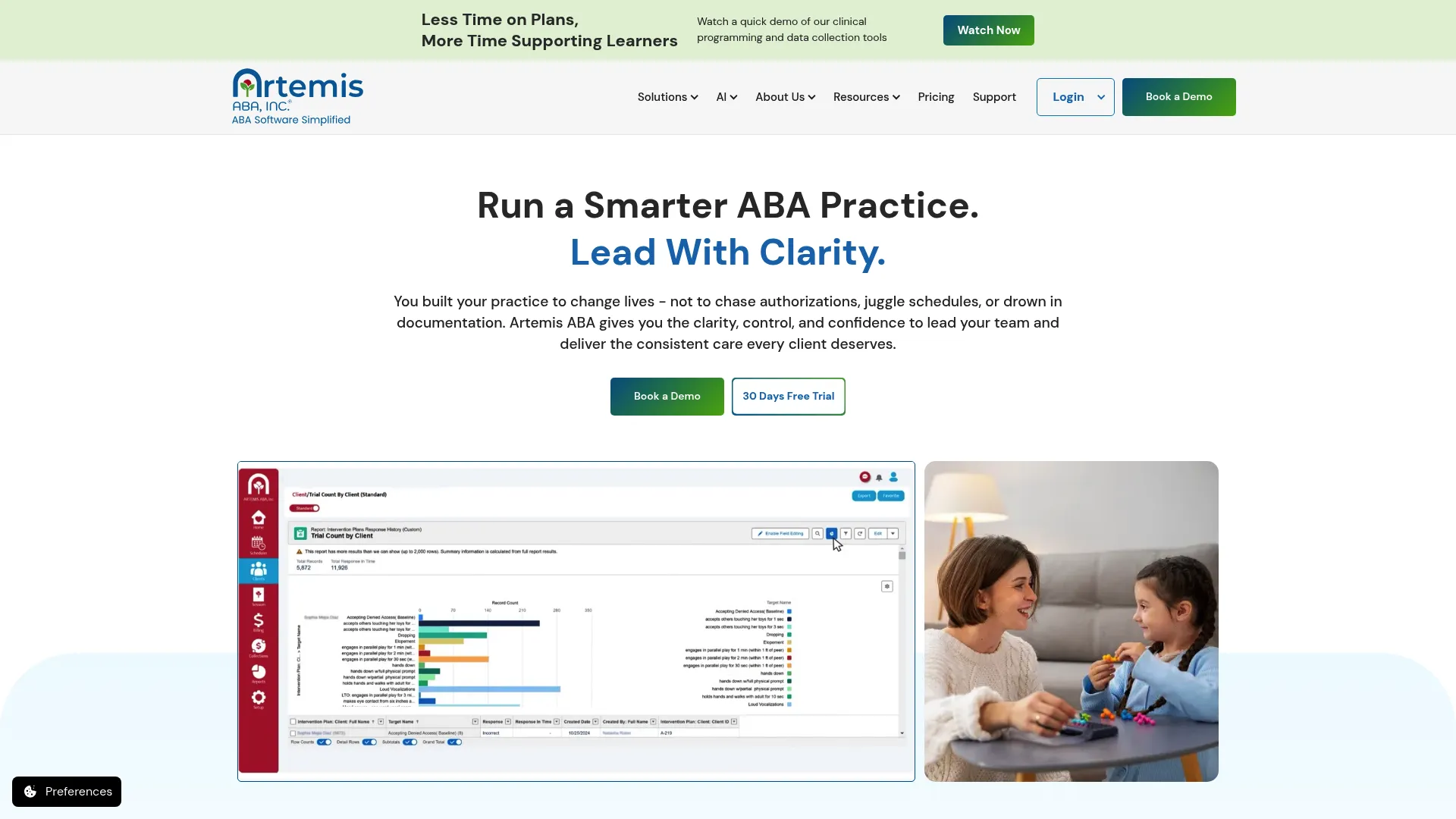
Artemis ABA is the automation-forward pick for clinics that want to cut administrative load rather than just digitize it. It positions itself as ABA practice management and EMR software for autism therapy clinics, with AI-driven scheduling at the center of the workflow. If your admin team burns hours rebuilding schedules and rekeying billing data, the automation angle is what to evaluate.
The platform pairs client management, billing, and documentation with data collection and reporting, so operational and clinical work stay connected. The AI scheduling is the headline capability, aimed at reducing the manual coordination that eats coordinator time. Combined with billing tools, the goal is fewer manual steps between a booked session and a paid claim.
Best for: ABA clinics that want an all-in-one platform with automation reducing scheduling and billing overhead.
Key strengths
- AI-driven scheduling
- Client management, billing, and documentation
- Data collection and reporting
- All-in-one practice management workflow
Why choose Artemis ABA: If manual scheduling and repetitive billing entry are your biggest time sinks, Artemis ABA is built around automating those steps, and the free trial lets you test the workflow before committing.
Artemis ABA pricing: The Emerging plan is $39.99 per user per month after a 30-day free trial. The Enterprise plan is custom pricing.
4. Passage Health

Passage Health is worth a shortlist spot for practices that put clinical data and decision support first. It focuses on real-time data syncing, automated graphing, and integrated claims submission and billing, which is a combination aimed at clinicians who want their data to drive treatment decisions without a separate export step. As aba data collection software with billing built in, it keeps the clinical and revenue sides talking.
Automated graphing is the standout. Instead of manually building progress graphs, clinicians see data render as it syncs, which shortens the loop between session and clinical review. Integrated claims submission means the same platform that holds the clinical record also handles the billing that record supports.
Best for: ABA practices that want strong clinical data collection and graphing paired with integrated billing.
Key strengths
- Real-time data syncing
- Automated graphing
- Integrated claims submission and billing
- All-in-one clinical and practice management
Why choose Passage Health: If your clinical team wants data that graphs itself and feeds directly into billing, Passage Health builds around that clinical-first workflow rather than treating data collection as a bolt-on.
Passage Health pricing: Public pricing is not published. The vendor uses custom, quote-based pricing arranged through a demo. Passage Health holds a 4.6 out of 5 rating on G2.
5. Rethink Behavioral Health
Rethink Behavioral Health fits larger organizations that want ABA workflow support inside a broader behavioral health suite. It combines clinical programming and data collection with scheduling, reminders, electronic visit verification, insurance billing, and authorization tracking. For a multi-site practice or a growing group, that breadth across clinical and operational needs is the appeal.
The suite reaches beyond day-to-day operations into treatment planning and clinical programming, which suits organizations that want their data workflows, billing, and program management under one roof. Authorization tracking and insurance billing keep the revenue side aligned with the clinical side, and EVV support helps practices that deliver in-home or community services stay compliant.
Best for: ABA and pediatric therapy organizations that want clinical, scheduling, billing, and analytics in one broad platform.
Key strengths
- Clinical programming and data collection
- Scheduling, reminders, and electronic visit verification
- Insurance billing and authorization tracking
- Analytics across clinical and operational metrics
Why choose Rethink Behavioral Health: If you run at organizational scale and want treatment planning, data, and billing consolidated, Rethink Behavioral Health covers a wide surface area rather than specializing in a single module.
Rethink Behavioral Health pricing: The vendor publicly notes per-user pricing starting as low as $20 per user per month. A full public tier table is not available. Rethink Behavioral Health carries a 3.0 out of 5 rating on G2.
6. Motivity
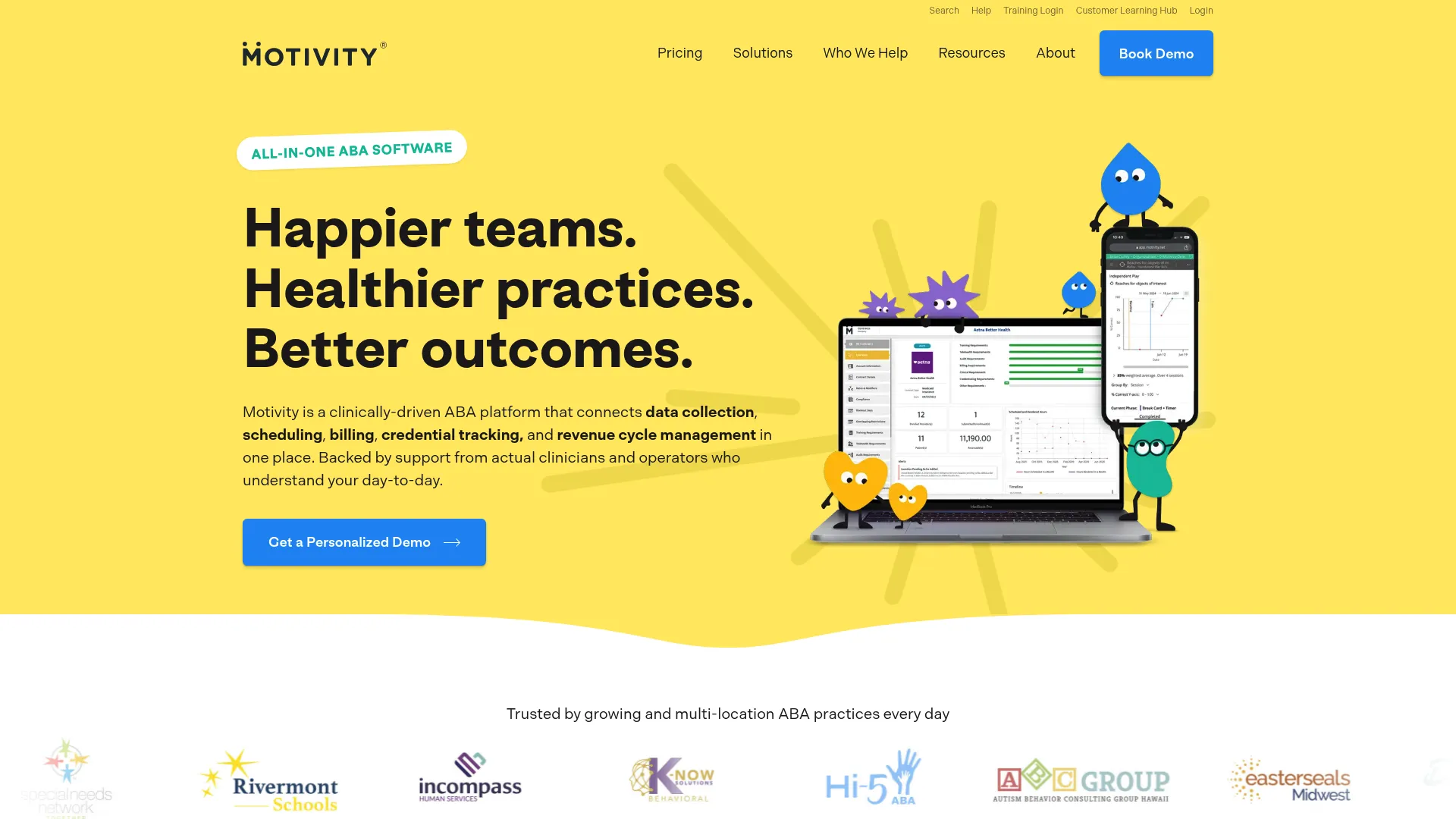
Motivity is the data-first option for teams that prioritize clinical depth, supervision, and oversight. It covers data collection, scheduling, billing, and practice management, but the clinical data workflows are where it earns its place. For behavior teams that live in the data and need serious support for session tracking and clinical review, that focus matters more than a wide feature spread.
The platform is built to support the clinical side of ABA at depth: detailed session tracking, data capture, and analytics that help BCBAs supervise cases and read progress. That makes it a strong fit when your bottleneck is clinical visibility rather than front-office operations. Scheduling, billing, and practice management round out the system so the clinical work stays connected to operations.
Best for: Behavior teams that prioritize clinical data depth, supervision, and oversight over broad front-office tooling.
Key strengths
- Detailed data collection and session tracking
- Analytics for clinical oversight and supervision
- Scheduling and practice management
- Billing workflows
Why choose Motivity: If your clinical leaders need deep visibility into treatment data and supervision, Motivity builds around clinical workflows rather than treating data collection as a secondary feature.
Motivity pricing: Public pricing is not published. Reach out to the vendor for a quote based on your practice size and needs.
7. Raven Health

Raven Health is the practical choice for ABA teams that run on mobile and need data collection to work in the field. It leads with real-time data syncing and offline mode, so RBTs can capture trial data on a phone or tablet even without a signal and sync it later. For in-home and community-based providers, that offline data collection is the difference between clean data and lost hours.
The platform pairs field usability with the operational side. Treatment plans, graphing, and reporting give clinicians what they need to track progress, while managed billing, self-billing, and credentialing cover the revenue and staffing workflows. That combination suits new and growing practices that need behavior data collection software and billing in one system without heavy setup.
Best for: New and growing ABA practices that need mobile, offline-capable data collection paired with billing.
Key strengths
- Real-time data syncing with offline mode
- Treatment plans, graphing, and reporting
- Managed billing, self-billing, and credentialing
- Mobile-first field usability
Why choose Raven Health: If your team works in homes and communities where connectivity is unreliable, Raven Health is built mobile-first with offline capture, so field data quality does not depend on the signal.
Raven Health pricing: The Standalone Software Plan is $29 per learner per month on an annual commitment. The Premium All-In-One Special is priced at 5% of monthly claims paid, month to month, with a $500 implementation fee currently waived. A Self-Billing Package is available at custom pricing. Raven Health holds a 4.4 out of 5 rating on Capterra.
How to choose the right platform
Pick the tool that fixes your loudest bottleneck first. A few criteria to weigh before you commit.
Billing and revenue cycle fit
Look at how the platform handles claims management, authorization tracking, and AR follow-up. If denials and slow payment are your pain, aba billing software with real revenue cycle depth should lead your decision, not a nice-to-have.
Data collection and clinical depth
Evaluate real-time capture, automated graphing, and how well the data feeds reporting and supervision. Clinics that live in the clinical data should weight platforms with serious behavior data collection software capabilities heavily.
Mobile and offline access
If you deliver in-home or community services, test the mobile app and offline mode with your own staff. Field data quality depends on whether therapists can capture data reliably without a connection.
HIPAA compliance and security
Confirm the platform is HIPAA-compliant ABA software with proper data storage, access controls, and audit trails. This is table stakes for protected health information, so verify it directly rather than assuming.
Implementation and scalability
Ask how long onboarding takes and whether the platform grows with added clients, staff, and sites. A tool that fits today but breaks at twice your size costs you a second migration.
Conclusion
The right ABA platform is the one that fixes the workflow bottleneck slowing your practice down right now.
If billing and AR are the problem, Aloha ABA and Passage Health lead with revenue cycle and clinical-to-claims depth. If you want to consolidate a scattered stack, Theralytics covers the full operation in one suite. For automation-first clinics, Artemis ABA is built around cutting scheduling and billing overhead. Larger organizations get broad coverage from Rethink Behavioral Health. Teams that live in clinical data lean toward Motivity, while mobile and field-heavy practices are best served by Raven Health's offline-capable capture.
Start by naming your loudest bottleneck, whether it is claims, data, scheduling, or admin load. Shortlist the two tools that fix it best, run a trial or demo with your own workflow, and let real operations decide. The platform that earns its place is the one your team actually uses without friction.
FAQs
Most ABA therapy software uses subscription pricing, typically billed per staff member, per user, or per client each month. Entry pricing on the tools here ranges from around $20 to $40 per user or client per month, and some vendors use custom quotes. Cost rises with added modules like billing services, larger client counts, and enterprise features.
At minimum, look for billing and claims management, scheduling, data collection, documentation, reporting, and HIPAA compliance. Strong platforms also add authorization tracking, automated graphing, mobile access, and audit trails. The right mix depends on whether your bottleneck is billing, clinical data, or front-office operations.
Smaller practices usually benefit from platforms with simple onboarding, transparent per-client or per-user pricing, and startup-friendly plans. Options with free trials or startup packages let you validate the workflow before committing budget. Prioritize the tool that fixes your biggest pain today rather than the one with the longest feature list.
Yes. Aba therapy billing software handles claims submission and tracking, authorization management, and accounts receivable follow-up. That reduces manual work, cuts denied claims, and shortens time to payment. For clinics where AR backlog is the main pain, this is often the single strongest reason to switch.
Yes. ABA platforms handle protected health information, so HIPAA-compliant ABA software with secure data storage, access controls, and audit trails is required, not optional. Confirm compliance directly with each vendor before storing patient data, and check how they handle mobile and offline records too.
Many platforms offer mobile apps, and some support offline data collection for in-home and community-based care. This matters because therapists often work in locations without reliable signal and need to capture trial data in real time. Test the mobile and offline experience with your own staff before deciding.
Aba practice management software is the broader category covering billing, scheduling, documentation, reporting, and operations. Aba data collection software focuses specifically on capturing clinical session data, such as trial-by-trial behavior data and automated graphing. Many modern platforms combine both, so the clinical record and the operational workflow stay connected.







.avif)