You can hit your ARR plan and still have a cash problem. At Series B, the issue rarely is that customers refuse to pay. The problem is that collections data, payment reminders, escalation rules, credit risk decisions, and payment options live across too many systems.
Finance chases invoices in spreadsheets. Sales has no visibility into which accounts are payment-blocked. The board asks about days sales outstanding and working capital efficiency, and the answer requires pulling numbers from NetSuite, Salesforce, Stripe, and someone's inbox.
According to BillingPlatform's 2025 research, only 3% of companies had fully automated their accounts receivable processes, while 49% were still evaluating automation options. That gap has a direct cost: Slower cash collection, weaker forecast accuracy, and finance teams spending time on manual follow-up that should be handled by workflow automation.
Credit and collections software closes that gap. The right platform automates dunning, prioritizes accounts by risk and cash impact, connects to your ERP, and gives leadership a real-time view of what's owed and when it will arrive.
What's inside
This guide compares 16 credit and collections software options for 2026, covering the full range from AR automation to enterprise order-to-cash and regulated debt recovery.
- Who it's for: SaaS founders, CFOs, controllers, AR managers, and RevOps leaders
- Selection criteria: Collections automation depth, ERP and CRM integrations, payment workflow coverage, analytics quality, and best-fit company stage
- Pricing: Verified against vendor pages at generation time
- G2 ratings: Pulled from live G2 listings
TL;DR
- Best enterprise order-to-cash: HighRadius, for global AR teams needing collections, credit risk, cash application, and AI-driven prioritization in one platform
- Best for B2B billing and payments: Billtrust, for companies that want invoicing, payment acceptance, and AR automation connected
- Best for SaaS cash forecasting: Tesorio, rated 4.7/5 on G2, for finance teams running NetSuite or Salesforce and needing forecast accuracy alongside collections
- Best for modern mid-market AR: Upflow, rated 4.8/5 on G2, for B2B teams that need automated reminders and payment links without a long implementation cycle
- Best credit intelligence add-ons: Creditsafe and D&B Finance Analytics, for teams making credit decisions with external risk data
- Best for regulated financial services recovery: Salesforce Financial Services Cloud and CGI Credit Studio, for banks and lenders managing borrower workflows
What is credit and collections software?
Credit and collections software helps finance teams decide who to extend credit to, monitor payment risk, automate collections workflows, recover overdue invoices, and track cash performance across customer accounts.
The category spans several interconnected capabilities:
- Credit management: Risk scoring, credit limits, and ongoing customer monitoring
- Collections automation: Dunning, reminders, task management, escalation rules, and account segmentation
- Payment recovery: Payment links, customer portals, payment plans, and promise-to-pay tracking
- Cash application: Matching incoming payments to open invoices
- Analytics: Days sales outstanding (DSO), collections effectiveness index (CEI), aging reports, and collector productivity tracking
- ERP integrations: NetSuite, SAP, Microsoft Dynamics, QuickBooks, Xero, Sage, and others
- Compliance and governance: Role-based access controls, audit trails, and data protection
Key capabilities to look for:
- Automated dunning workflows
- Account prioritization by risk and value
- Promise-to-pay tracking
- Customer self-service payment portals
- Cash application and reconciliation
- Collections analytics and aging dashboards
- ERP and CRM integrations
- Audit controls and user permissions
How the category breaks down:
Credit and collections software covers the full lifecycle from credit risk assessment through payment recovery. Debt recovery software tends to focus narrowly on recovering delinquent or overdue balances, often in financial services contexts. Accounts receivable software covers broader invoicing, cash application, and payment workflows alongside collections. Many platforms in this guide overlap across two or all three definitions, so focus on which workflow gaps matter most for your finance team's current stage.
When to use credit and collections software
Replace manual follow-up before adding headcount
Founders often see slow collections as a finance team capacity problem. It's actually a workflow problem. If your AR specialist spends three days a week chasing invoices, adding a second AR specialist doubles the cost but not the process. Automated dunning sends reminders on schedule, escalates overdue accounts without human intervention, and frees your finance team for work that requires judgment.
Prioritize accounts by cash impact and payment risk
Flat aging reports treat every overdue invoice the same. A $90,000 strategic account and a $900 long-overdue invoice need different urgency, different tone, and different escalation paths. Collections prioritization tools score accounts by risk level, days overdue, historical payment behavior, and account value, so your collector works the highest-impact items first.
Give leadership cleaner cash visibility before the board meeting
At Series B, the board expects DSO trends, forecast accuracy, and dispute volume, not a spreadsheet someone compiled the day before. Collections software centralizes aging, payment promises, dispute status, and cash forecasts in one dashboard. That gives your CFO answers before the board asks and reduces the number of escalations that reach the founder.
Credit and collections software comparison
The table below gives a fast shortlist. Verify pricing and G2 ratings directly before making a final call, as vendor details change. Pricing reflects what was verified against live vendor pages at generation time.
| # | Product | Best for | Key differentiator | Pricing | G2 rating |
|---|---|---|---|---|---|
| 1 | HighRadius | Enterprise AR and order-to-cash | Full AR suite: Collections, credit, cash application, and AI prioritization | Custom pricing (outcome-based model) | 4.3/5 |
| 2 | Billtrust | B2B invoicing and payments | B2B payment network plus end-to-end AR automation | Custom pricing | 4.4/5 |
| 3 | Tesorio | SaaS cash forecasting | AR automation tied to cash flow visibility with NetSuite/Salesforce fit | Custom pricing | 4.7/5 |
| 4 | Quadient Accounts Receivable | Analytics-driven collections | AI-assisted prioritization and predictive cash insights | Custom pricing | 4.4/5 |
| 5 | Upflow | Mid-market B2B AR | Payment links, automated reminders, and AR analytics in one workspace | Custom pricing; Payments from $390/mo | 4.8/5 |
| 6 | Esker | Global order-to-cash | Document automation and e-invoicing for global compliance workflows | Custom pricing | 4.4/5 |
| 7 | BlackLine | Enterprise finance automation | Invoice-to-cash connected to accounting close and reconciliations | Custom pricing | 4.5/5 |
| 8 | Serrala | Enterprise AR and payments | Spans AR, AP, payments, and treasury with 500+ analytics KPIs | Custom pricing | 4.4/5 |
| 9 | Versapay | Collaborative AR | Customer payment portal and invoice collaboration driving cash collection | Custom pricing | 4.1/5 |
| 10 | Gaviti | Focused collections automation | Standard, Pro, Expert plans; unlimited users; modular feature selection | Custom pricing | 4.4/5 |
| 11 | Kolleno | AR collections workspace | Business Pay plan from $545/mo per user (annual) | From $545/mo per user | 4.9/5 |
| 12 | Growfin | Collections collaboration | Cross-functional handoffs linking finance, sales, and CS | Custom pricing | 4.5/5 |
| 13 | Creditsafe | Business credit intelligence | Global credit reports and real-time portfolio monitoring | Custom pricing; free business credit report available | 4.5/5 |
| 14 | D&B Finance Analytics | Enterprise credit decisions | Starts at $1,200/year; AI-powered credit scoring and portfolio risk | From $1,200/year | 4.5/5 |
| 15 | CGI Credit Studio | Regulated financial services recovery | Cloud-native default management, loan origination, and recovery workflows | Custom pricing | N/A |
| 16 | Salesforce Financial Services Cloud | Financial institution recovery workflows | Borrower segmentation, AI agents, and Salesforce ecosystem depth | From $325/user/month (billed annually) | 4.2/5 |
Best 16 credit and collections software for 2026
1. HighRadius
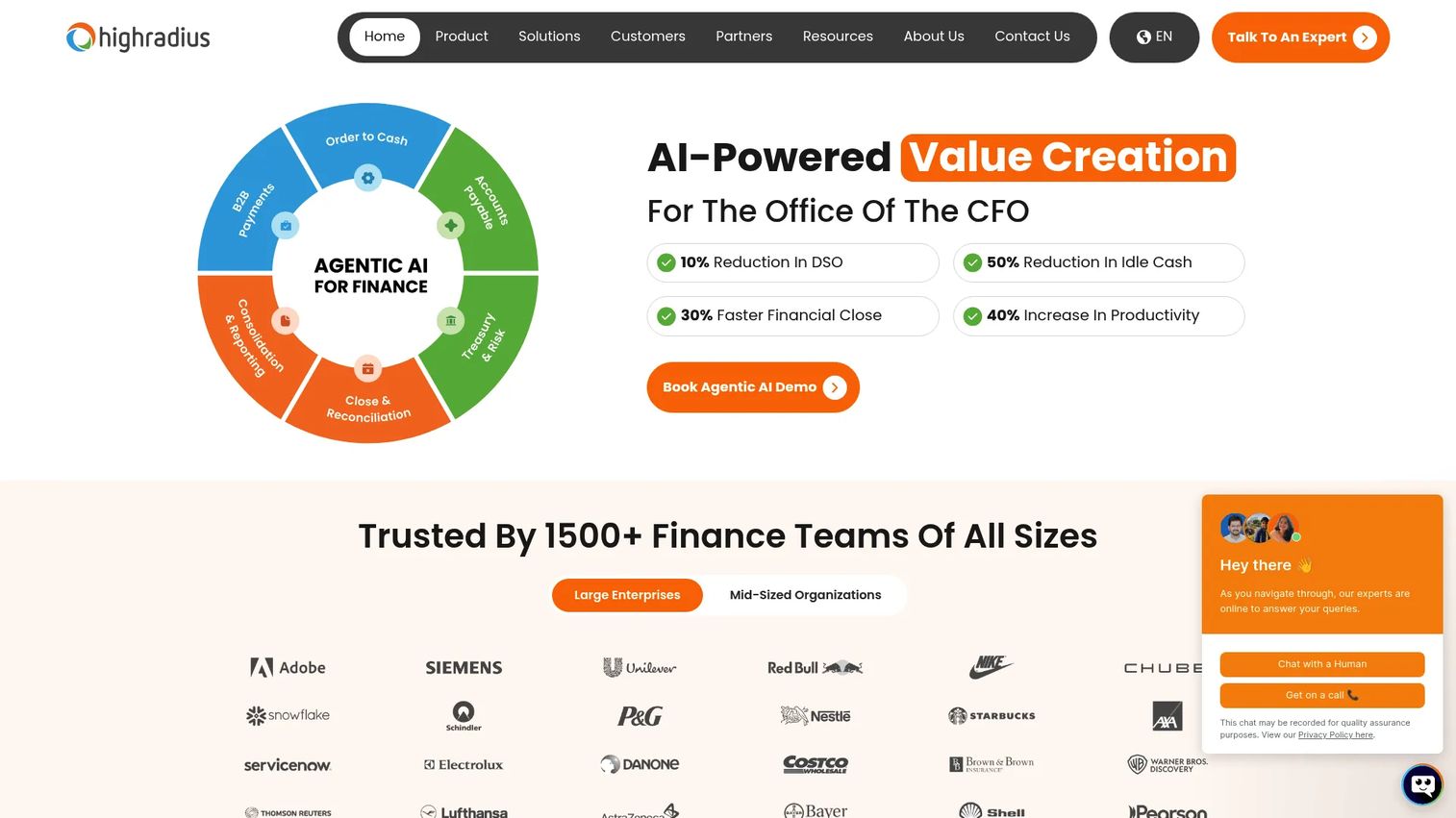
HighRadius is an AI-powered autonomous finance platform covering accounts receivable, accounts payable, treasury, financial close, and reporting. On the AR side, it spans collections management, credit risk, cash application, disputes and deductions, invoicing, and payments. It is one of the most complete order-to-cash platforms in this list.
Best for: Enterprise finance teams managing global AR processes with high invoice volume and complex ERP environments.
Key features
- AI-driven collections worklists and account prioritization
- Credit risk management and credit decisioning
- Automated cash application and payment matching
- Dispute and deduction workflow management
- ERP integrations across SAP, Oracle, NetSuite, and Microsoft Dynamics
Why choose HighRadius: This is a fit for companies that have outgrown point tools and need a full AR operating system. For a Series B founder, it is more of a later-stage choice, worth shortlisting when finance complexity requires a platform that can grow with global operations.
HighRadius pricing: HighRadius uses an outcome-based pricing model. The company publicly states $0 implementation fees and $0 subscription fees until go-live, with post-launch fees tied to realized financial outcomes. Contact HighRadius for a quote specific to your module selection and integration scope.
G2 rating: 4.3/5
2. Billtrust
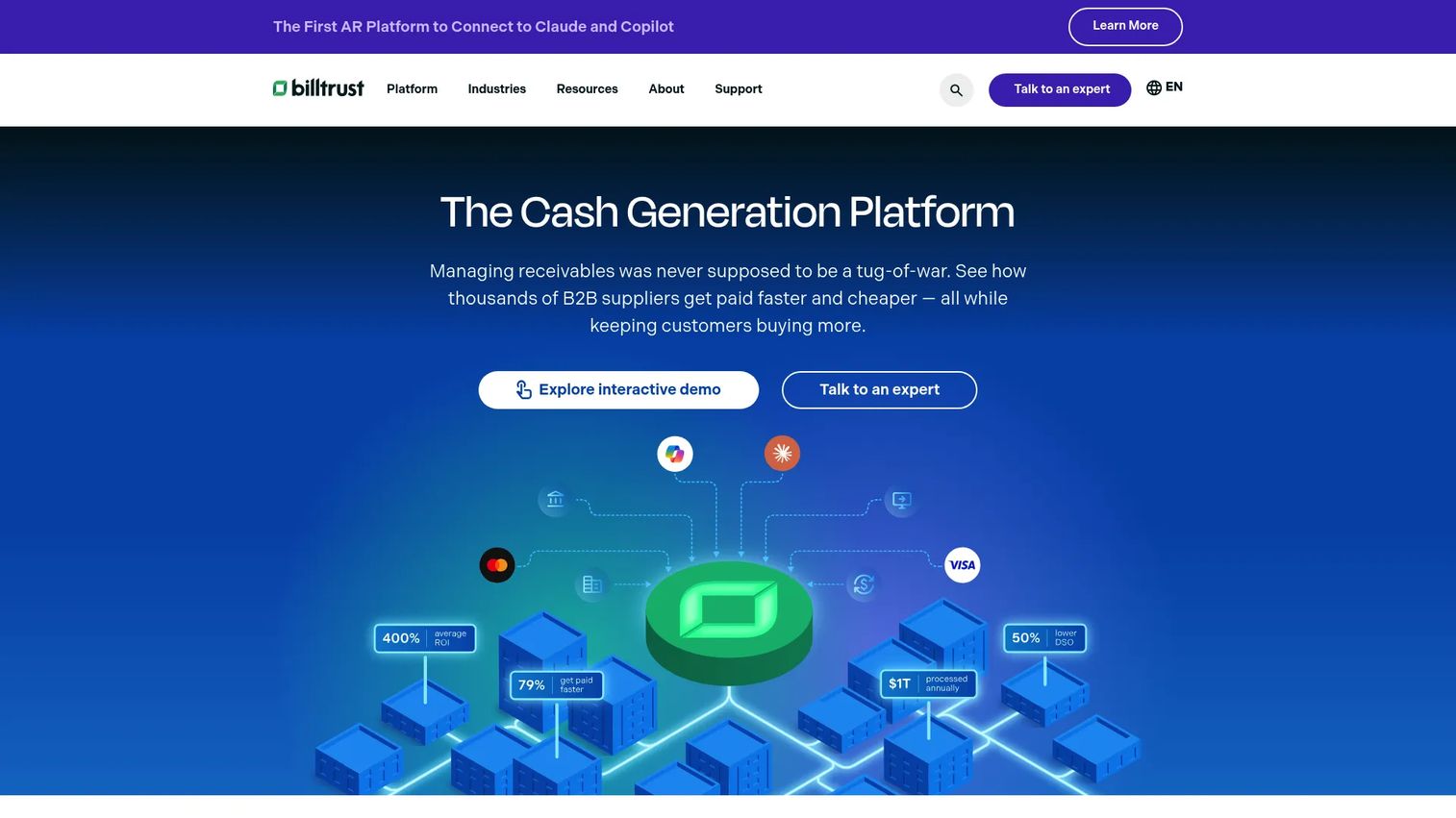
Billtrust is an AI-powered AR platform built around B2B invoicing, payment acceptance, cash application, credit, and collections. Its B2B payment network is a distinctive element: It connects suppliers and buyers across a shared payments infrastructure. The platform targets mid-market and enterprise companies with high-volume billing and payment workflows.
Best for: B2B companies that want invoicing, payment processing, and AR automation connected across one platform rather than multiple point tools.
Key features
- Multi-channel invoice delivery and automated invoicing
- B2B payment network for buyer-supplier payments
- AI-powered cash application and payment-to-invoice matching
- Automated collections workflows and dunning
- Credit decisioning and credit automation
Why choose Billtrust: When payment friction is as much of a problem as collector productivity, Billtrust fits well. The payment network angle gives it an edge for companies where buyers expect multiple payment options and invoice delivery at scale.
Billtrust pricing: Billtrust prices by quote. Contact their team for pricing specific to your invoice volume, payment workflow requirements, and module selection.
G2 rating: 4.4/5
3. Tesorio
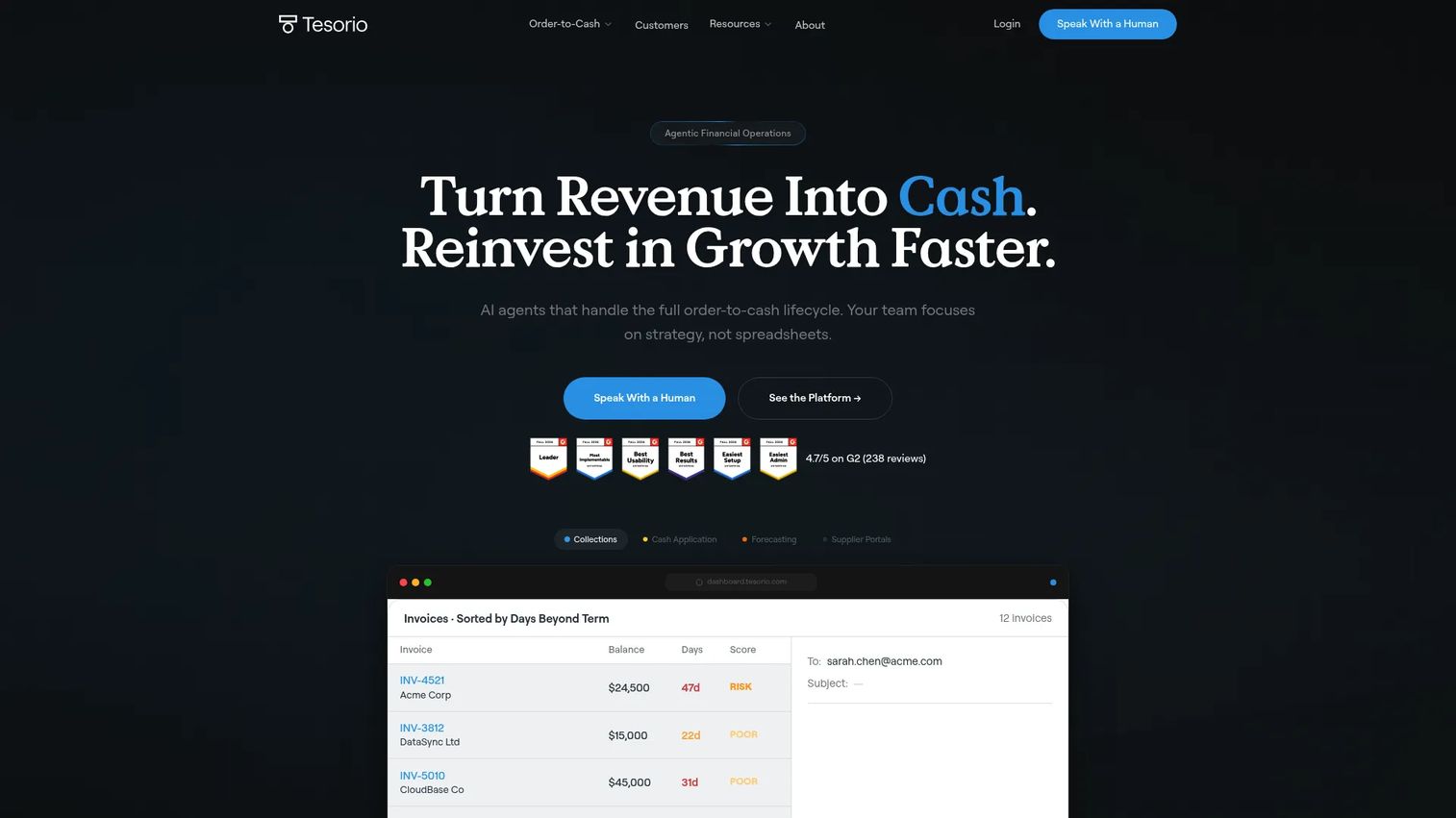
Tesorio is an agentic financial operations platform covering AR automation, cash application, collections workflows, cash flow forecasting, and supplier portals. Its native integrations with NetSuite and Salesforce make it a practical choice for SaaS finance teams that already run those platforms. The cash forecasting layer connects collections activity to working capital visibility in near real time.
Best for: SaaS and B2B finance teams that want collections automation tied directly to cash flow forecasting and ERP data.
Key features
- AI-powered collections workflows and automated dunning
- Cash application with automated payment-to-invoice matching
- AR forecasting and real-time cash flow visibility
- Customer self-service payment portal
- No-code workflow customization and ERP integrations
Why choose Tesorio: The forecast layer is the key differentiator. For a Series B founder who needs to answer "when does that $400K arrive?" before a board meeting, Tesorio connects collections behavior to a cash position view that most AR tools do not provide.
Tesorio pricing: Contact Tesorio for a quote. Pricing drivers include ERP environment, user count, invoice volume, and selected modules.
G2 rating: 4.7/5
4. Quadient Accounts Receivable
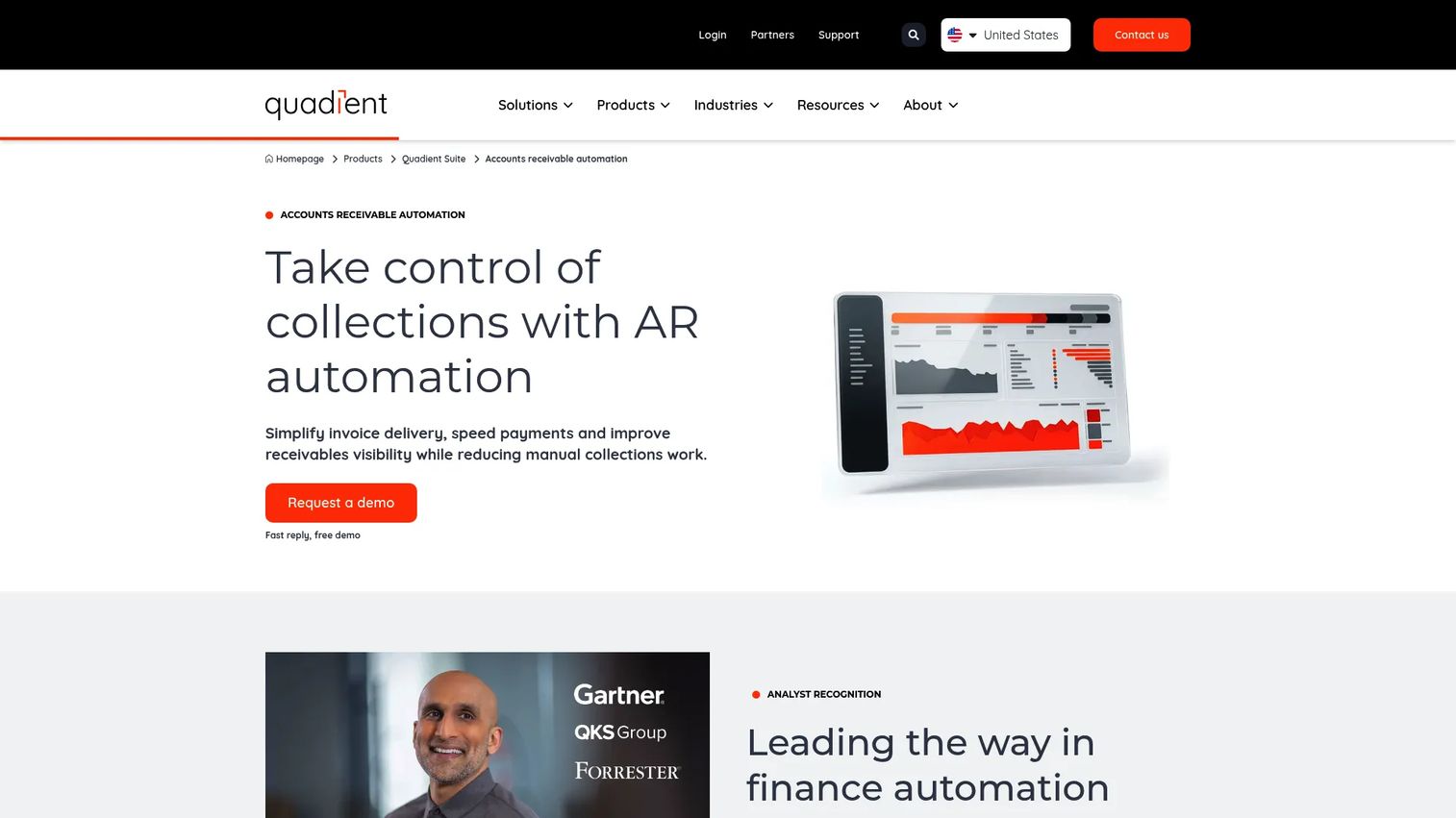
Quadient Accounts Receivable is an AR automation platform offering collections workflows, AI-assisted prioritization, dispute management, payment acceptance, cash application, and receivables dashboards. The platform positions itself around predictive insights and moving finance teams beyond static aging reports.
Best for: Mid-market and enterprise AR teams that want analytics-driven collections management with AI-assisted prioritization.
Key features
- AI-assisted collections prioritization and payment prediction
- Automated reminders and multi-channel follow-up
- Dispute management and centralized dispute tracking
- Customer payment options and self-service payment portal
- Cash application, payment matching, and reconciliation
Why choose Quadient Accounts Receivable: The predictive cash insights and AI-triggered email actions make daily collections work more structured. Finance managers moving from flat aging reports to prioritized, automated queues will find the workflow depth practical.
Quadient Accounts Receivable pricing: Pricing is tailored to your business. Quadient states that packages include unlimited user licenses, unlimited automation rules, and ERP integrations, but specific pricing requires contacting their sales team.
G2 rating: 4.4/5
5. Upflow
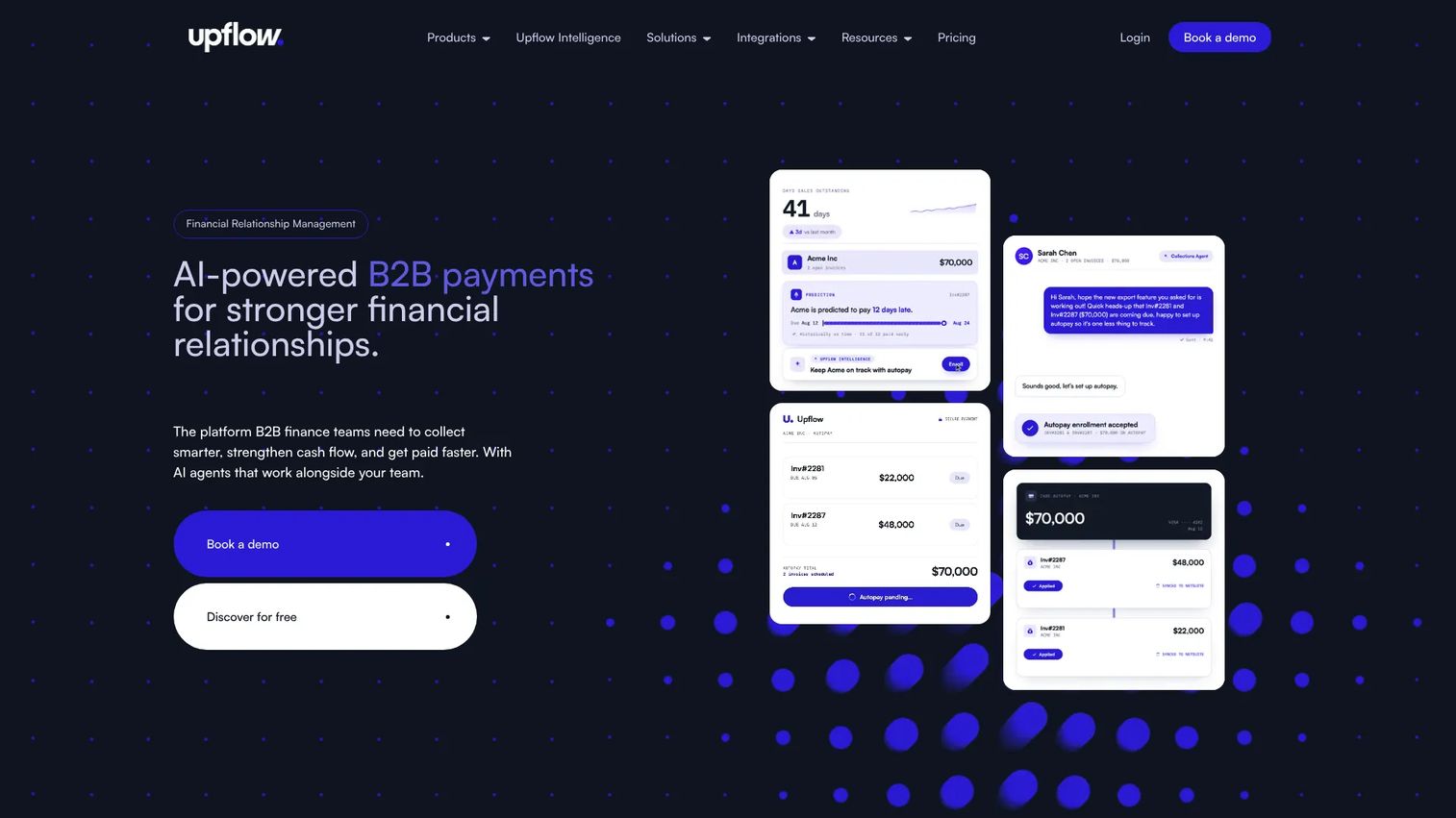
Upflow is a B2B AR and collections platform covering automated reminders, branded payment portals, cash application, real-time AR analytics, and ERP or accounting integrations. It positions itself as a "Financial Relationship Management" platform, reflecting its emphasis on keeping customer communication professional rather than adversarial.
Best for: Mid-market B2B and SaaS finance teams that want automated collections without a long enterprise implementation cycle.
Key features
- Automated multi-channel reminders and dunning workflows
- Branded customer payment portals supporting cards, ACH, SEPA, and wire
- AI-powered cash application and real-time ERP reconciliation
- AR analytics dashboards and customer segmentation
- Integrations with accounting platforms and ERPs
Why choose Upflow: Upflow collects faster without making customers feel like they've been handed to a third-party collections agency. It's well suited for SaaS companies where maintaining customer relationships matters as much as recovering cash.
Upflow pricing: Core subscription pricing is quote-based across Starter, Grow, Scale, Accelerate, and Enterprise plans, based on annual invoiced revenue. Upflow Payments carries a $390/month platform fee plus transaction fees (cards at 3.5% + $0.30, ACH at 0.8% capped at $5). A free Discover plan provides AR visibility without workflow automation.
G2 rating: 4.8/5
6. Esker
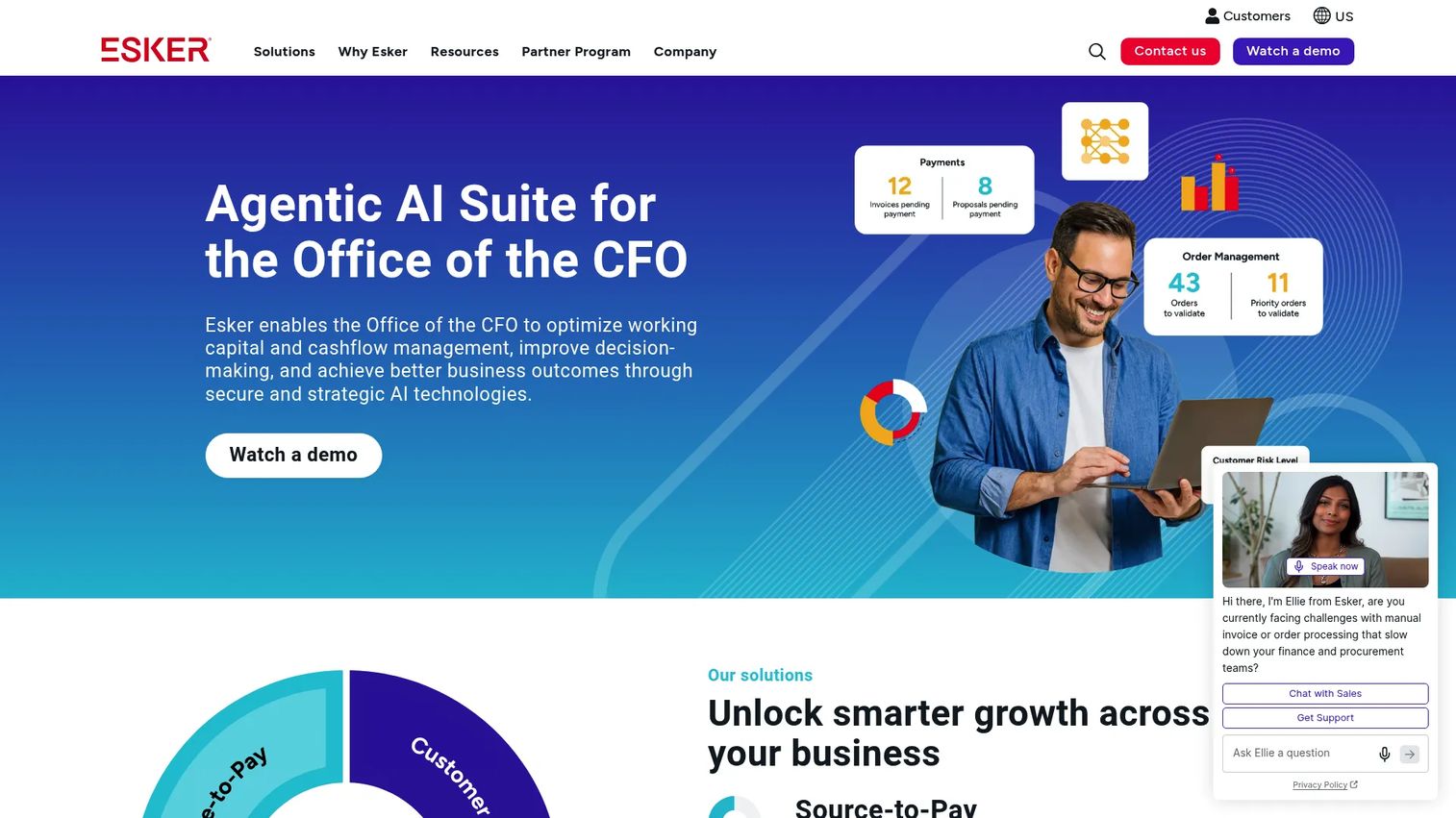
Esker is an AI-powered business process automation platform spanning Source-to-Pay and Order-to-Cash workflows. On the AR side, it covers collections, cash application, document processing, and e-invoicing with built-in global compliance support.
Best for: Global finance teams that need order-to-cash automation with document workflow depth and cross-border compliance coverage.
Key features
- Order-to-cash and Source-to-Pay automation
- Cash application and collections management
- AI-powered document processing and data extraction
- Global e-invoicing and compliance workflows
- ERP-native integration and custom dashboards
Why choose Esker: Esker fits companies where collections is connected to broader document-intensive finance workflows, not just AR reminders. If your finance team handles global invoicing, supplier documents, and purchase orders alongside collections, Esker covers more of that workflow than a focused AR tool.
Esker pricing: Esker prices by quote. No pricing information was available on the first-party website. Contact Esker for a proposal based on your workflow scope and module requirements.
G2 rating: 4.4/5
7. BlackLine
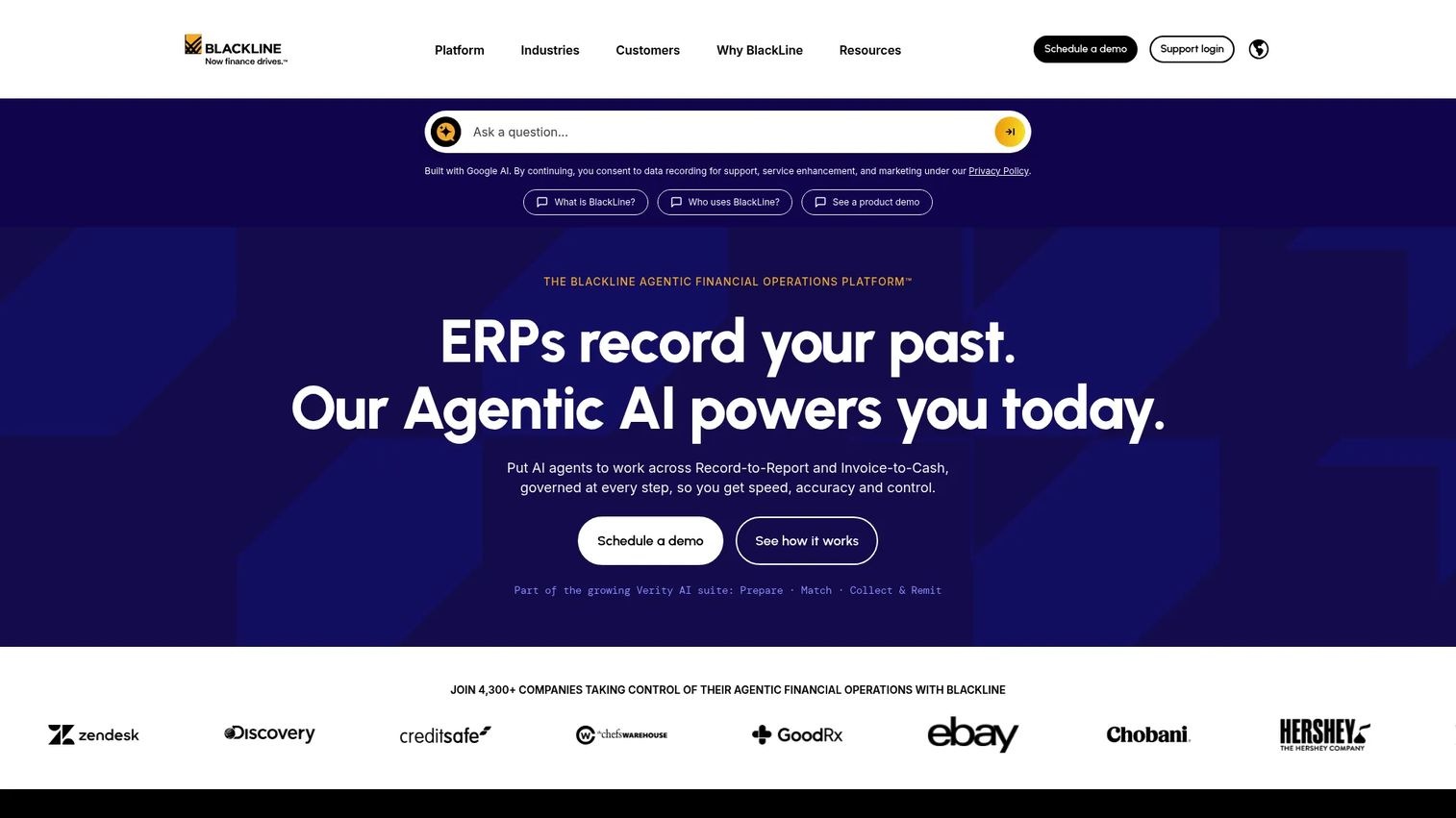
BlackLine is a cloud-based finance and accounting automation platform. Its invoice-to-cash suite covers cash application, account reconciliations, transaction matching, dispute management, and compliance task management. BlackLine's Verity AI layer adds anomaly detection and workflow automation across the finance close cycle.
Best for: Enterprise finance teams that want AR automation connected to accounting operations and month-end close accuracy.
Key features
- Invoice-to-cash workflows and cash application
- Account reconciliation and transaction matching automation
- Dispute management and resolution tracking
- Financial consolidation and compliance task management
- Verity AI for anomaly detection and workflow automation
Why choose BlackLine: The connection between AR performance and month-end close is BlackLine's core strength. For a founder who needs finance infrastructure that connects collections to accounting operations, BlackLine is a serious platform, but expect an enterprise implementation and pricing conversation.
BlackLine pricing: BlackLine prices by quote. No pricing information was displayed on their website. Contact BlackLine for pricing based on user count, modules, and integration requirements.
G2 rating: 4.5/5
8. Serrala
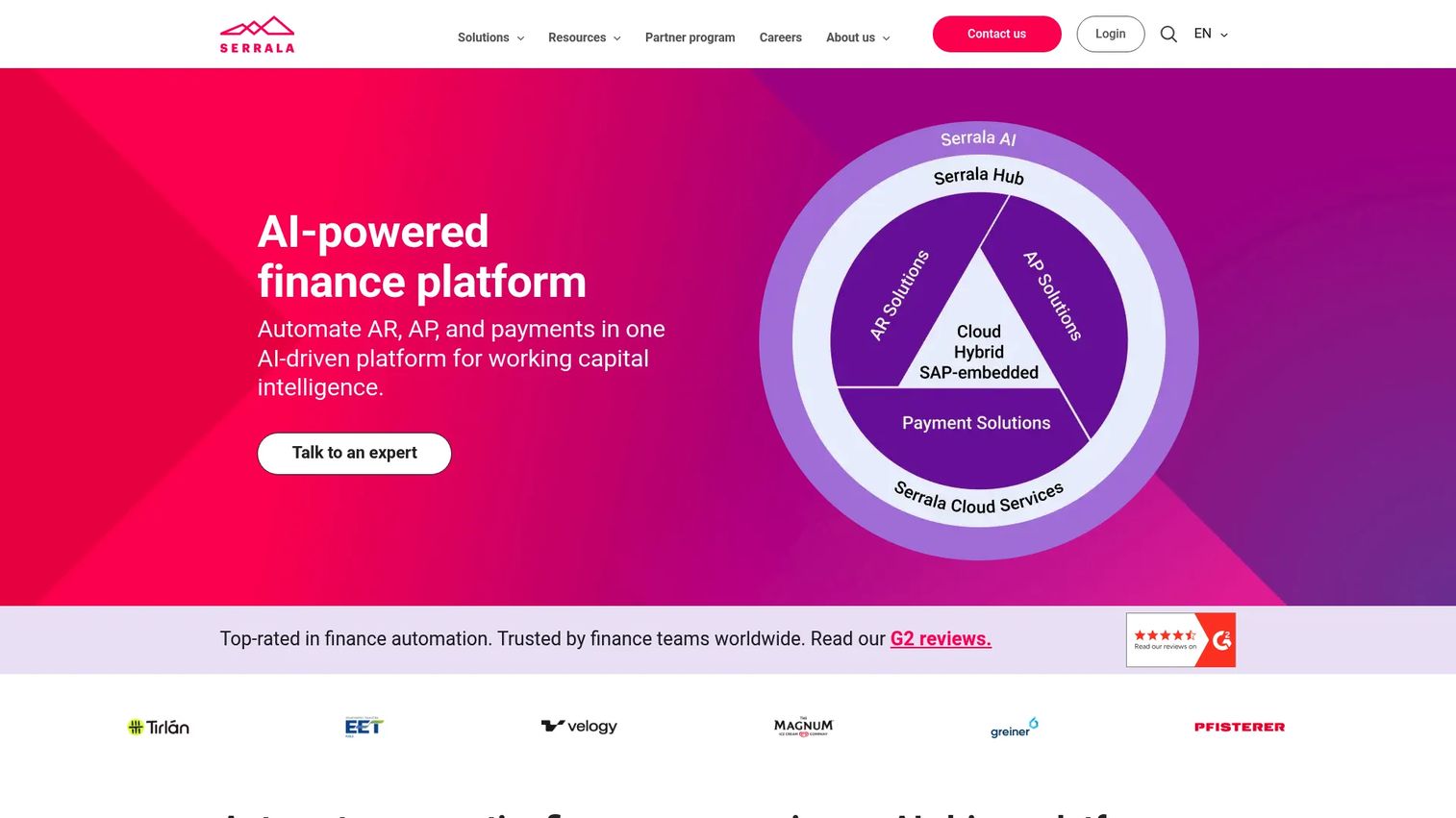
Serrala is an AI-powered finance process automation platform spanning AR, AP, payments, treasury management, and working capital. Its AR suite includes collections, cash application, credit and risk management, bill presentment, customer portals, and payments. The analytics layer covers more than 500 KPIs with interactive dashboards.
Best for: Enterprise finance teams that need collections connected to cash management, AP, and payments in a single platform.
Key features
- AR automation: Collections, cash application, credit risk, and customer portals
- AP automation: Invoice processing, supplier portals, and e-invoicing
- Payments and treasury: Cash management and payment optimization
- 500+ KPIs with self-service analytics dashboards
- Integrations with SAP, Microsoft Dynamics 365, NetSuite, Workday, and others
Why choose Serrala: Serrala fits finance organizations that want to standardize AR and AP alongside payments on one platform. The analytics depth is particularly useful when finance leadership needs performance visibility across multiple regions or entities.
Serrala pricing: Pricing is not available on the first-party website. Contact Serrala for a quote based on your module selection and organizational scope.
G2 rating: 4.4/5
9. Versapay
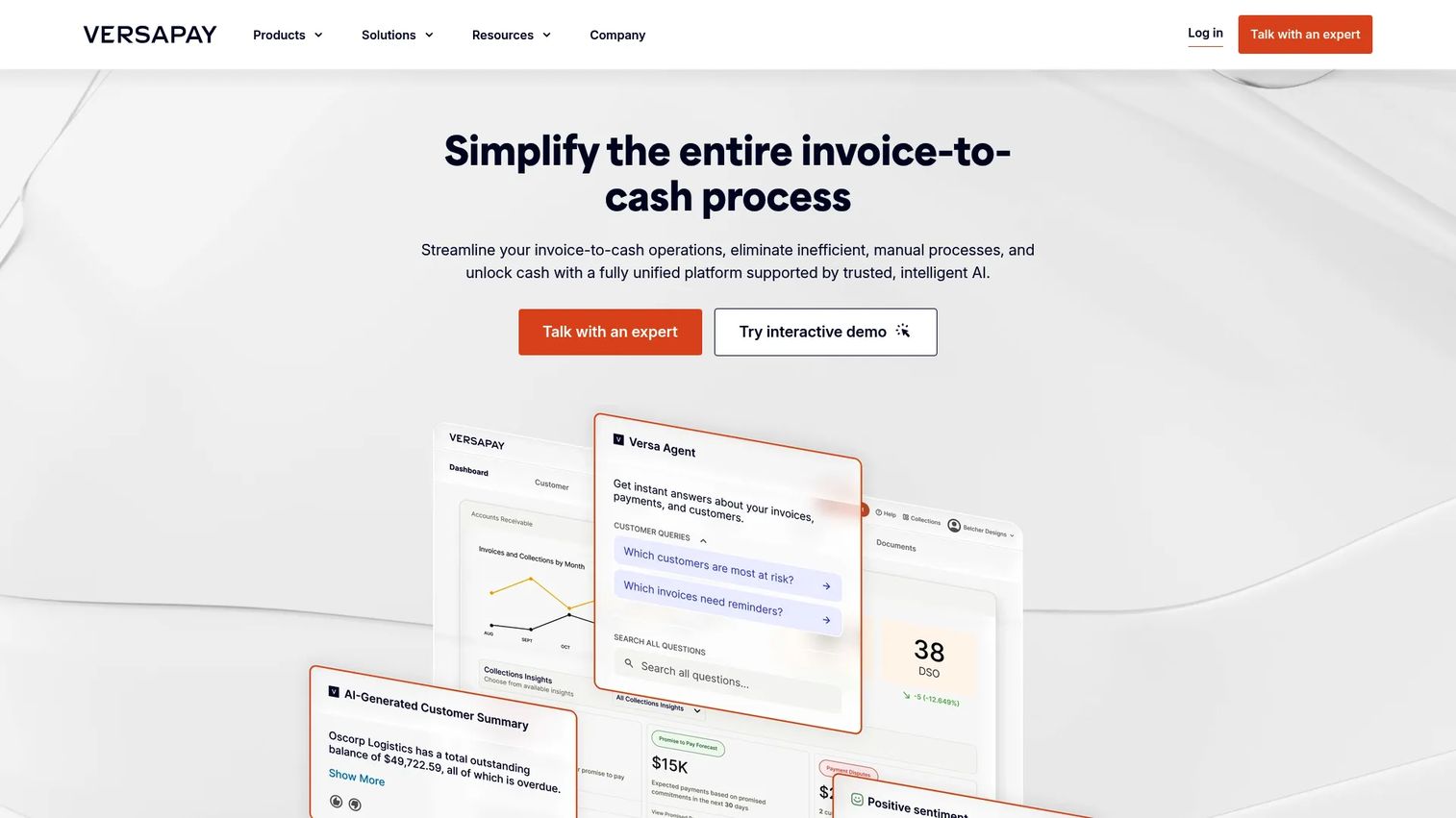
Versapay is a collaborative AR and B2B payments platform. Its model centers on giving buyers and sellers a shared workspace for invoices, payments, disputes, and cash application. The customer-facing payment portal removes friction from the buyer side, while finance teams manage collections activity from a centralized workspace.
Best for: B2B finance teams where payment disputes, invoice questions, and customer communication slow down cash collection.
Key features
- Automated AR collections workflows and reminders
- Customer-facing payment portal with electronic invoice delivery
- AI-powered cash application and payment reconciliation
- Invoice collaboration and dispute resolution tools
- B2B payment processing integration
Why choose Versapay: When the collections bottleneck is buyer confusion about invoices or payment options rather than collector productivity, Versapay's collaborative model reduces back-and-forth. The shared payment portal is especially useful when buyers request invoice clarifications before paying.
Versapay pricing: Versapay prices by quote, with cost driven by invoice volume, customer count, user count, integrations, and operational complexity. Contact Versapay for current pricing.
G2 rating: 4.1/5
10. Gaviti
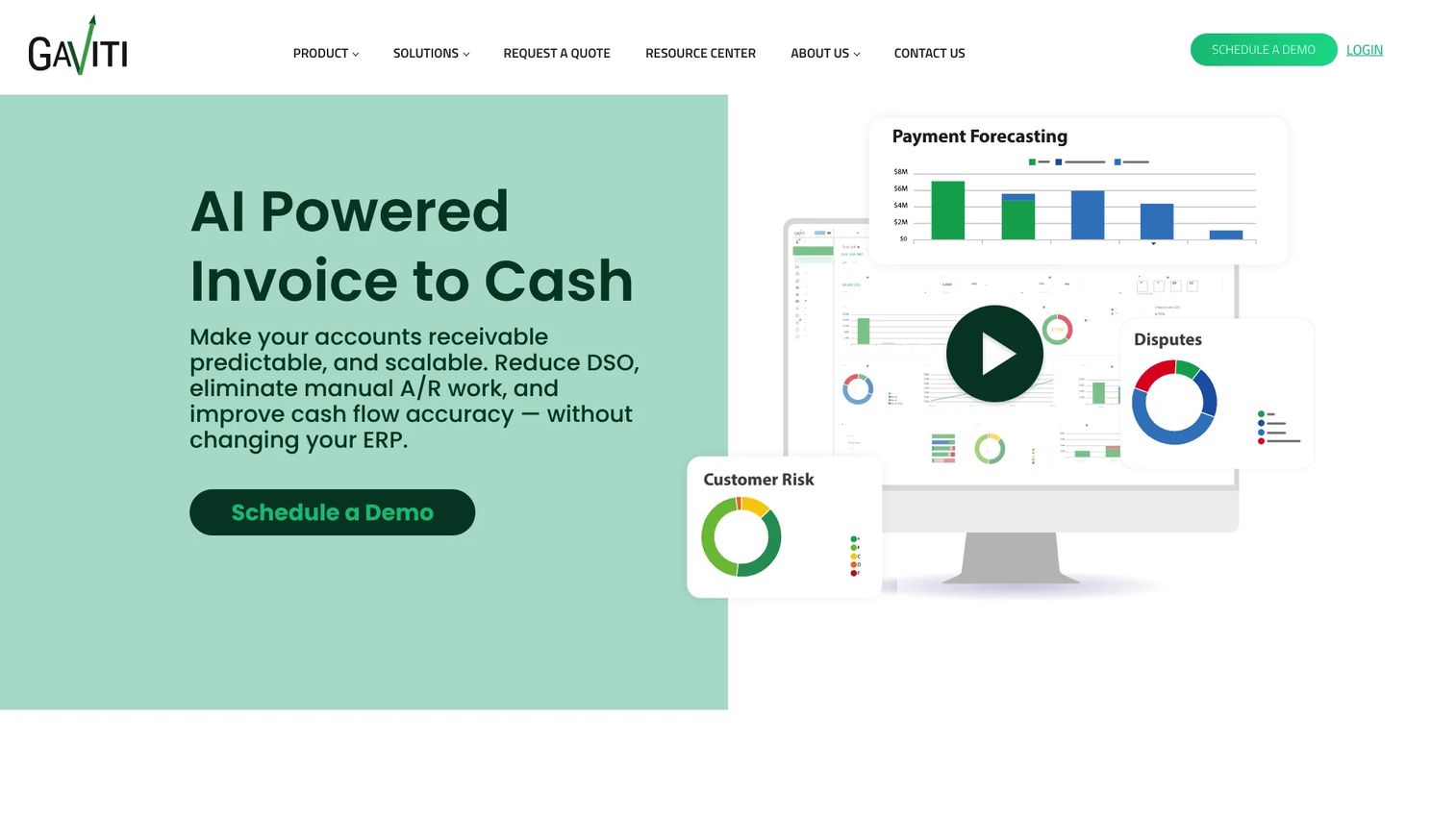
Gaviti is an AI-powered invoice-to-cash and AR automation platform for B2B finance teams. It covers collections automation, credit management, cash application, customer self-service payments, dispute management, and AR analytics. The platform uses a modular structure with unlimited users across all plans, making it practical for growing finance teams.
Best for: Mid-market and enterprise B2B finance teams that need structured collections, credit management, and cash application without heavy enterprise implementation overhead.
Key features
- Automated collections: Personalized reminders, escalations, and task prioritization
- Credit management: AI-powered credit review, monitoring, and credit-limit controls
- AI cash application and invoice-to-payment matching
- Customer self-service portal with ACH, card, autopay, and dispute initiation
- AR analytics, forecasting dashboards, and AI assistant
Why choose Gaviti: The unlimited-user pricing model removes the per-seat cost pressure that slows AR team adoption. Modular plan selection means you pay for the capabilities you need at your current stage, rather than committing to an enterprise suite upfront.
Gaviti pricing: Gaviti offers Standard, Pro, and Expert plans, all billed annually and priced by custom quote based on usage and business requirements. Pricing is not per user. Contact Gaviti for current pricing based on your invoice volume and module requirements.
G2 rating: 4.4/5
11. Kolleno
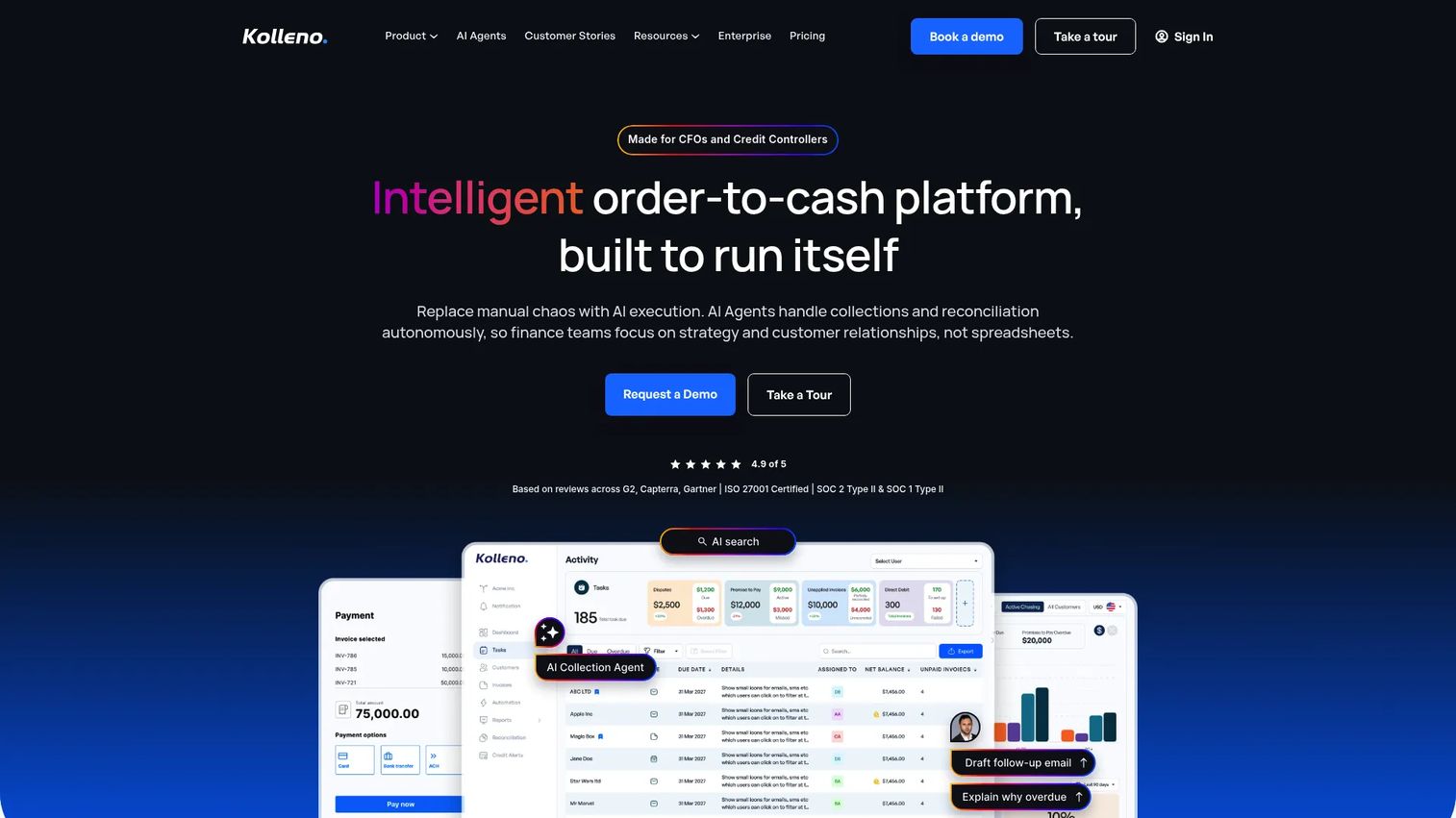
Kolleno is an AI-powered order-to-cash platform designed as a centralized AR workspace. It combines collections management, automated follow-ups, payment acceptance, cash application, dispute handling, credit risk monitoring, and cash flow forecasting. The platform targets finance teams replacing inbox-driven collections with a structured, automated workflow.
Best for: Mid-market and enterprise B2B finance teams managing complex AR and order-to-cash workflows who want a single workspace for all collection activities.
Key features
- Collections management and automated multi-channel follow-ups
- Online payments and customizable customer payment portal
- Cash application and automated reconciliation
- Dispute management and resolution tracking
- Credit risk monitoring, scoring, and cash flow forecasting
Why choose Kolleno: Collectors who currently switch between email, accounting systems, and payment tools will find Kolleno consolidates that work into a single interface. The high G2 rating reflects strong user satisfaction with workflow depth and ease of use.
Kolleno pricing: Business Pay plan starts at $545/month per user (billed annually; $650/month billed monthly). Business Plus is $995/month per user (annually; $1,245 monthly). Enterprise and Enterprise Plus tiers are available by custom quote. Additional charges may apply for integrations and customizations.
G2 rating: 4.9/5
12. Growfin
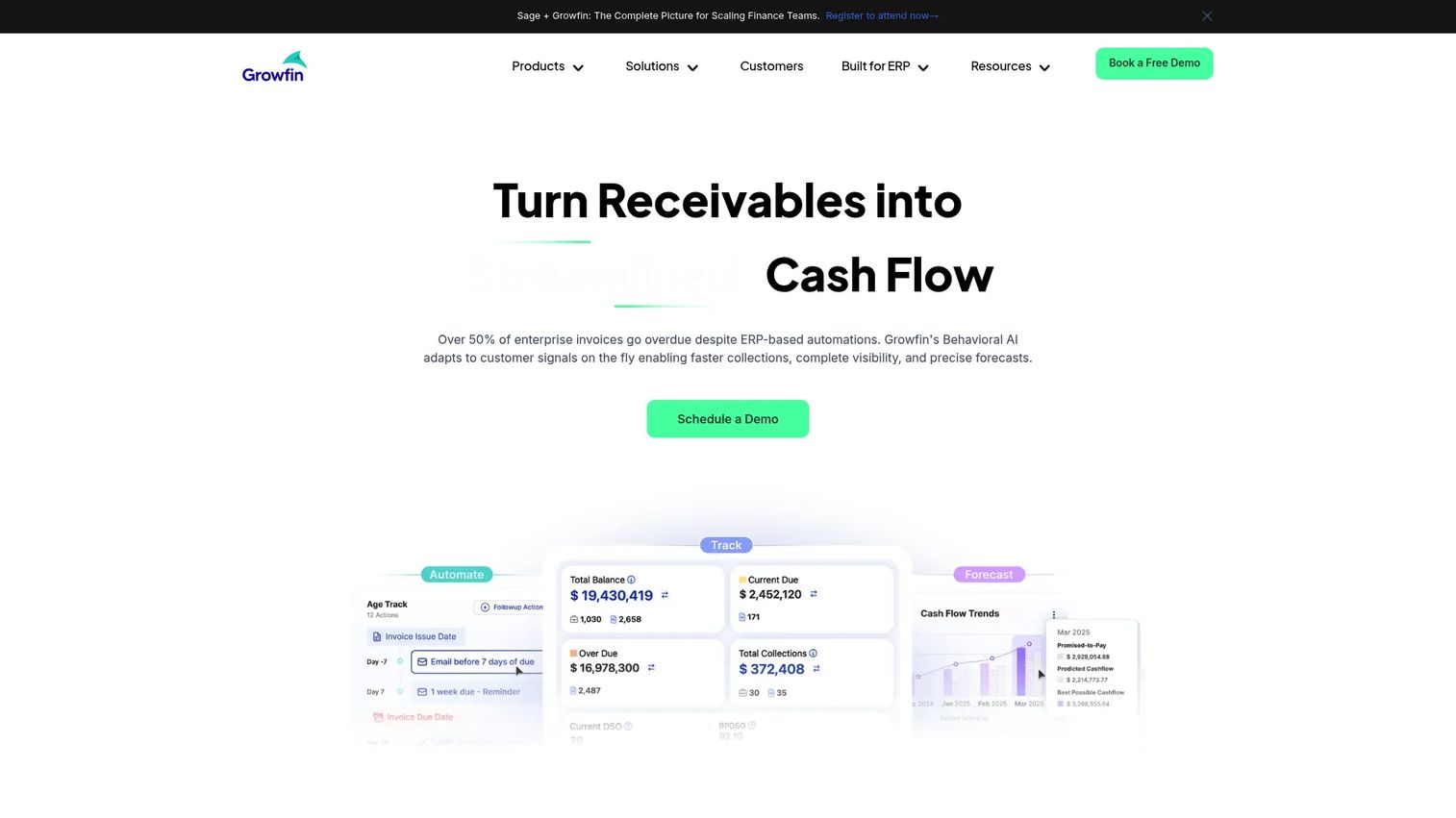
Growfin is an AI-powered AR management platform for B2B companies. It emphasizes collections collaboration across finance, sales, and customer success, with automated follow-ups, dispute and escalation management, promise-to-pay tracking, cash flow forecasting, and a customer self-service portal.
Best for: AR teams where collections stalls because ownership is unclear across finance, sales, and customer success.
Key features
- Real-time AR tracking and automated personalized collection follow-ups
- Cash flow forecasting and payment-date prediction
- Dispute and escalation management with cross-team handoffs
- AI-powered payment matching and reconciliation
- Customer portal for invoice, payment, and dispute self-service
Why choose Growfin: The cross-functional collaboration angle is Growfin's differentiator. If collections slows because sales wants to protect a relationship, CS has a different account view, or escalations sit unresolved in someone's inbox, Growfin creates shared visibility and structured handoffs.
Growfin pricing: Growfin prices by quote. Contact their team for current pricing based on your team size and workflow requirements.
G2 rating: 4.5/5
13. Creditsafe
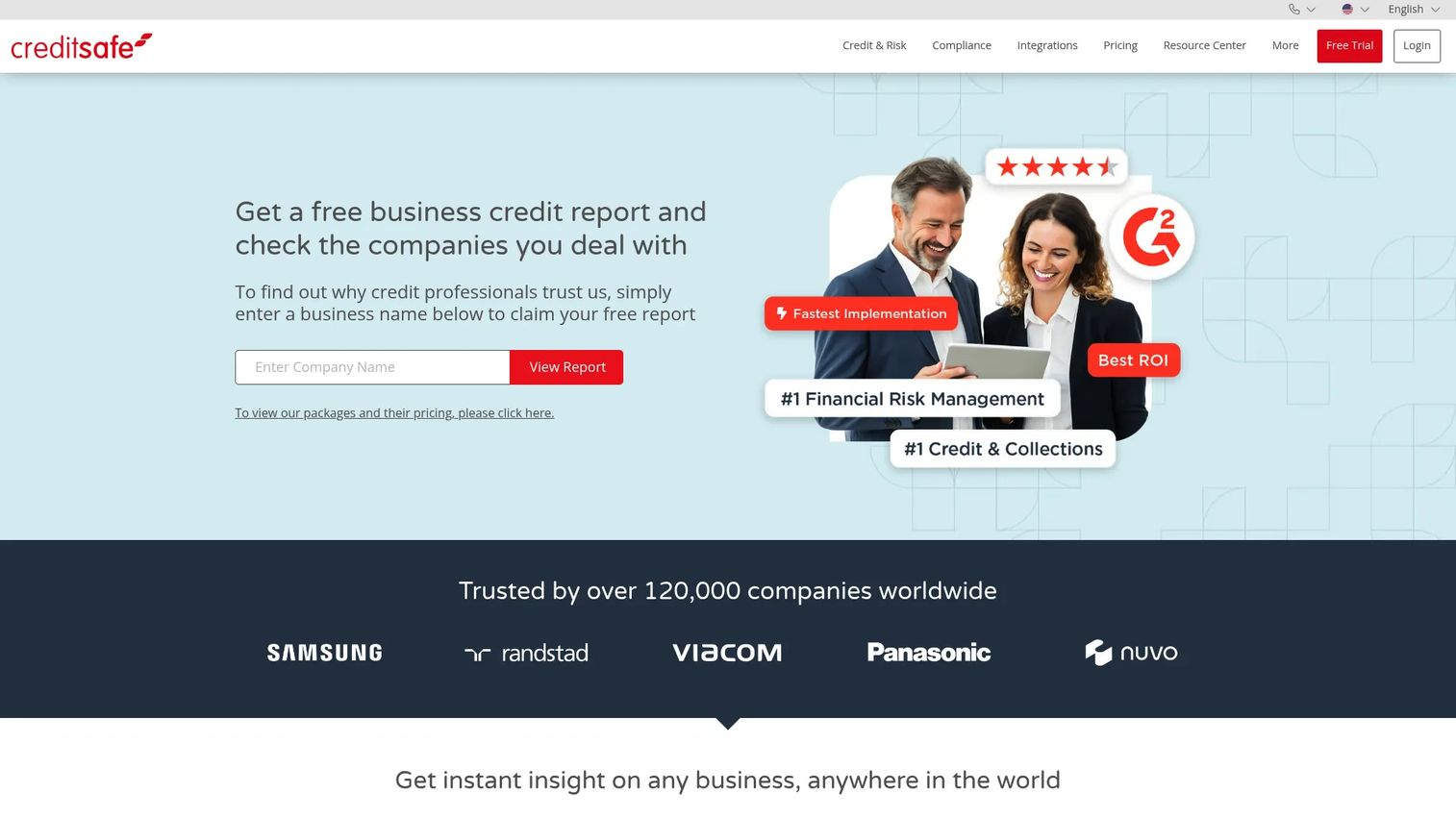
Creditsafe is a business credit data and risk management platform. It provides credit reports with risk scores, recommended credit limits, payment history, legal filings, financial data, and ownership details. Its monitoring layer alerts finance teams to changes in a customer's credit profile before those changes affect your collections exposure.
Best for: Finance and credit teams that need external business credit intelligence to inform credit decisions and monitor customer risk.
Key features
- Business credit reports with scores, limits, and payment history
- Real-time company monitoring with customizable risk alerts
- Global business and compliance data via the Creditsafe Connect API
- AML, KYC, and KYB compliance screening
- Portfolio-level risk monitoring across customer accounts
Why choose Creditsafe: Creditsafe works best alongside an AR or collections platform, not as a replacement. Use it when extending credit to new customers or monitoring an existing portfolio for early warning signals. The API layer connects credit data to your existing workflow tools.
Creditsafe pricing: Creditsafe offers Standard, Plus, and Premier packages, each priced by quote based on report volume, geographic coverage, and selected modules. A free business credit report is available without a subscription. Contact Creditsafe for current package pricing.
G2 rating: 4.5/5
14. D&B Finance Analytics
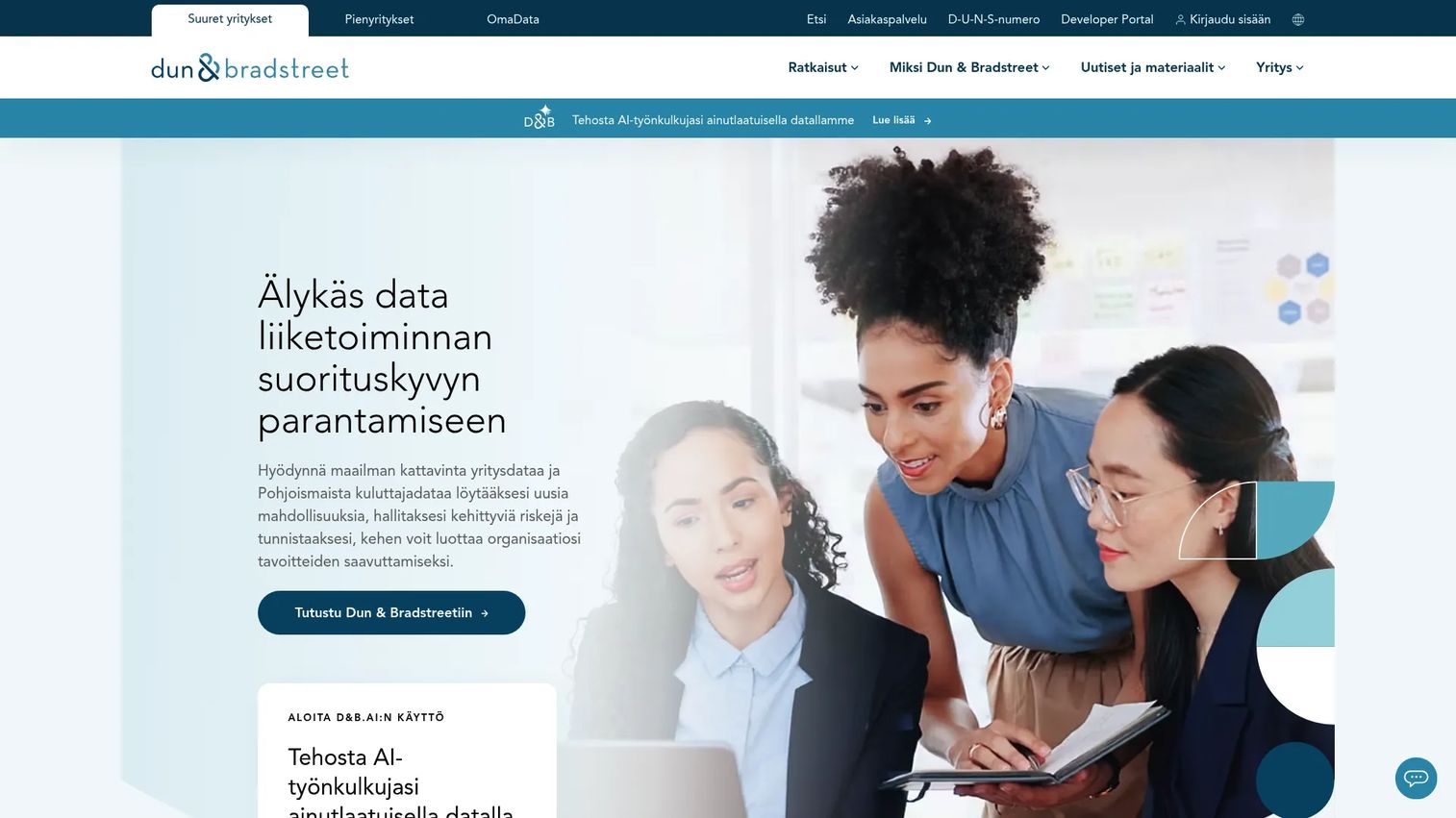
D&B Finance Analytics is an AI-powered credit intelligence and credit-to-cash platform built on Dun & Bradstreet's global data network. It helps finance and credit teams assess customer risk, monitor portfolio exposure, prioritize collections actions, and support credit decisioning with external business data.
Best for: Enterprise credit teams managing material credit exposure who need external business data in credit decisions and portfolio monitoring.
Key features
- AI-powered credit decision guidance and scoring
- Global portfolio monitoring with risk alerts and portfolio-change summaries
- Account visibility with AI-generated summaries and risk guidance
- Payment behavior data and predictive risk indicators
- Integration with ERP and credit workflow systems
Why choose D&B Finance Analytics: D&B's data depth is the primary reason to choose it. When your credit exposure is large enough that a customer's financial deterioration creates real risk, portfolio monitoring with external data matters more than a spreadsheet review.
D&B Finance Analytics pricing: D&B publishes pricing for Tier 1 Finance Analytics plans. Entry-level Starter plans begin at $1,200/year (annual billing), with higher tiers at $2,750, $5,000, $7,500, $11,400, $16,850, $32,600, and $50,000/year depending on data scope, report volume, and features. Enterprise-level pricing is available by quote.
G2 rating: 4.5/5
15. CGI Credit Studio
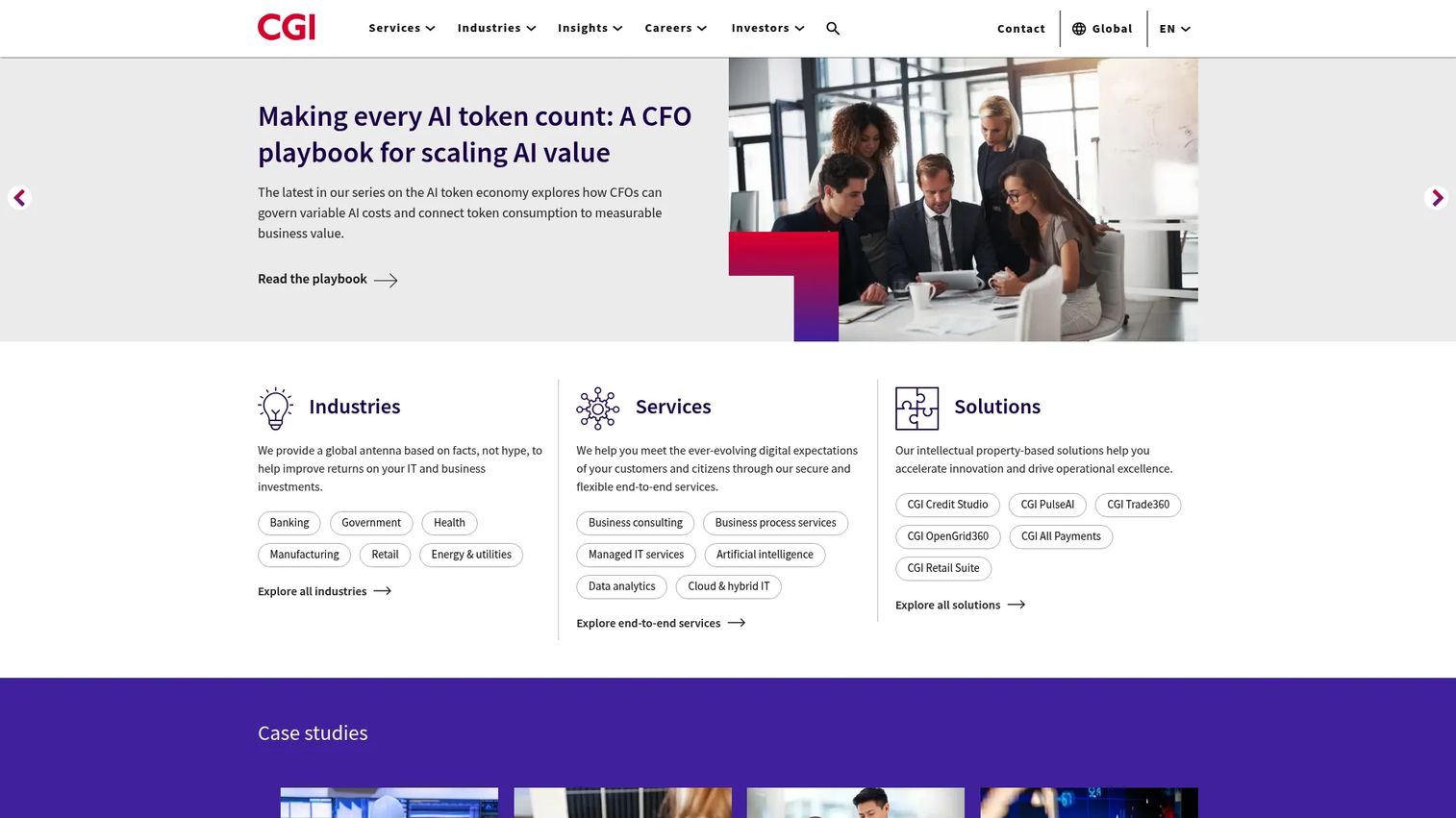
CGI Credit Studio is a cloud-native, event-driven credit management platform for financial institutions. It covers loan origination, real-time credit decisioning, collections, recovery, bankruptcy, and repossession workflows. CGI targets banks, credit unions, lenders, and other organizations managing regulated credit operations at scale.
Best for: Banks, lenders, and financial services organizations managing regulated collections, default management, and recovery workflows.
Key features
- Loan origination, onboarding, and credit application processing
- Real-time credit decisioning with AI and machine learning
- Collections, recovery, bankruptcy, and repossession workflow management
- Omnichannel borrower engagement across digital and traditional channels
- API integrations and compliance controls for regulated environments
Why choose CGI Credit Studio: CGI Credit Studio is purpose-built for financial institutions where borrower treatment, regulatory compliance, and default management are central to operations. It is not an AR collections tool for SaaS companies, and it's the right choice when you need a regulated recovery platform with deep case management.
CGI Credit Studio pricing: CGI prices by enterprise quote. Contact CGI for pricing based on institution size, module requirements, and implementation scope.
16. Salesforce Financial Services Cloud
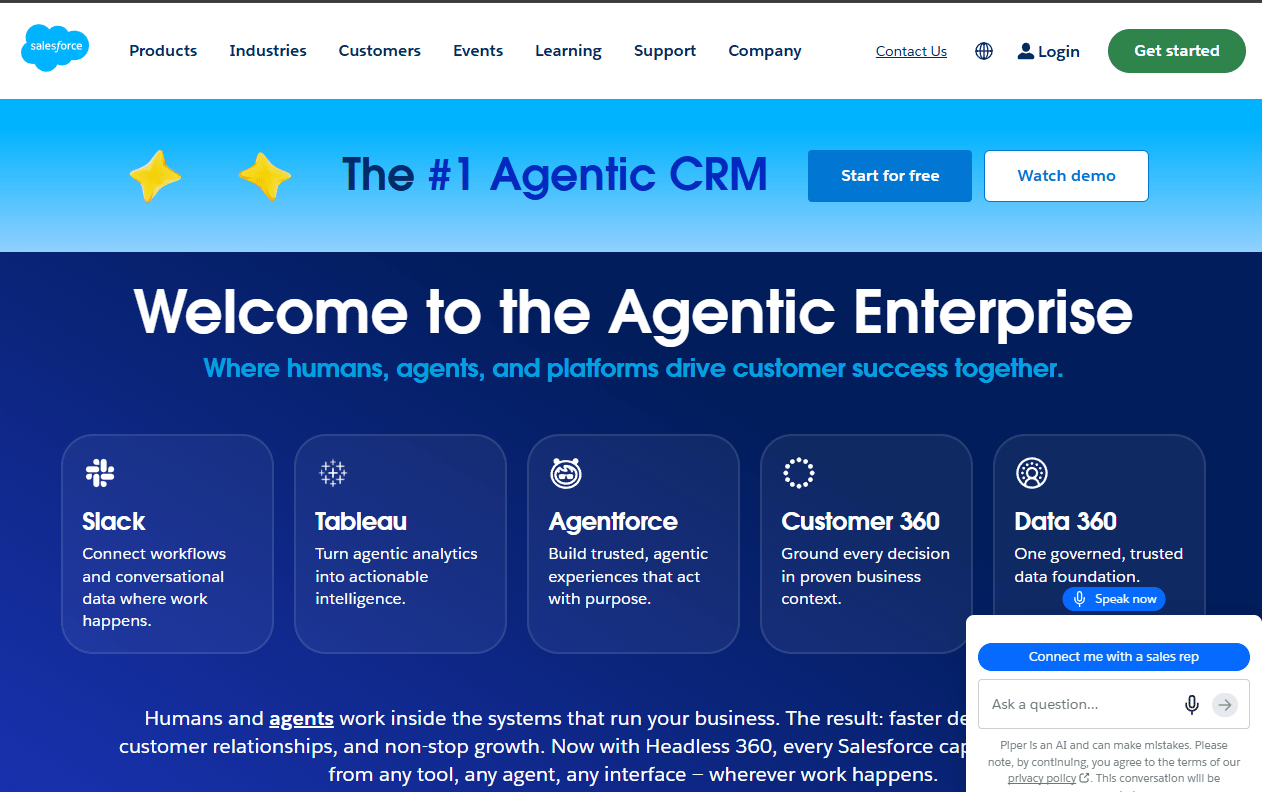
Salesforce Financial Services Cloud is an industry-specific CRM built for banking, wealth management, and insurance. G2 now identifies the product as Agentforce Financial Services. For financial services recovery use cases, it supports borrower segmentation, payment assistance workflows, AI agent automation, case management, and the full Salesforce ecosystem.
Best for: Financial services organizations already running Salesforce and needing borrower servicing, segmentation, and recovery workflows on the same platform.
Key features
- Industry-specific data models and financial services workflows
- Unified customer and financial data view
- Actionable segmentation and financial goals management
- AI agents (Agentforce) for automated borrower engagement
- Salesforce ecosystem: CRM, service, marketing, and analytics integration
Why choose Salesforce Financial Services Cloud: If your recovery and collections workflows depend on customer relationship data that already lives in Salesforce, building on Financial Services Cloud avoids a parallel system. It is not a standalone collections automation tool; its value is the depth of the Salesforce ecosystem beneath it.
Salesforce Financial Services Cloud pricing: Financial Services Cloud for Sales or for Service starts at $325/user/month (billed annually). The Sales and Service combined edition is $350/user/month. Agentforce 1 editions (Sales or Service) are $750/user/month, billed annually. Usage-based and add-on pricing applies to AI features and platform services.
G2 rating: 4.2/5
Considerations when choosing credit and collections software
Match the tool to your collections maturity
A 40-person SaaS company does not need the same platform as a global enterprise with 10,000 open invoices. If the issue is manual reminders and a cluttered inbox, start with a focused AR automation tool. When you need credit risk management, multi-entity AR, and global ERP complexity handled together, enterprise suites make sense. Buying ahead of your maturity creates implementation overhead without corresponding benefit.
Check ERP, CRM, and billing integrations before shortlisting
The value of any collections platform depends on the quality of its data sync with your existing stack. For SaaS, verify integration depth specifically with NetSuite, Salesforce, Stripe, Chargebee, QuickBooks, or Xero, whichever combination your finance team runs. Confirm that invoice status, customer records, and payment write-backs sync in real time rather than nightly batch. A mismatched integration creates reconciliation work that offsets the automation gains.
Separate credit intelligence from collections execution
Creditsafe and D&B Finance Analytics help you decide whether to extend credit and monitor customer risk. Tools like Tesorio, Upflow, Gaviti, and Kolleno manage what happens after invoices exist: Follow-up, payment, and cash application. Some companies need both categories. Most mid-market SaaS teams start with a collections workflow tool and add credit intelligence as their customer portfolio grows.
Evaluate customer experience alongside collector productivity
Collections can damage customer relationships if reminders are blunt, poorly timed, or sent by a system that doesn't know the account's context. Look for customer segmentation, branded payment portals, payment link options, and internal account notes that keep sales and customer success aligned with finance. A customer who feels supported pays faster than one who feels hounded.
Demand reporting your board can understand
DSO trend, aging by bucket, cash forecast, dispute volume, and collector productivity are the metrics boards ask about. Verify whether the platform can segment those reports by customer size, ARR tier, account owner, or region. Generic AR dashboards are fine for the finance team's daily work; board-level visibility requires more configuration flexibility.
Conclusion
The right credit and collections software depends on where your finance team's workflow is breaking down.
For enterprise order-to-cash with AI prioritization, HighRadius covers the full AR lifecycle. Billtrust fits when payment acceptance is as much of a problem as the collections workflow. Tesorio is the strongest choice for SaaS teams that need collections tied to cash flow forecasting on NetSuite or Salesforce. Upflow gives mid-market B2B teams automated reminders and payment links without months of implementation. Kolleno is worth a close look given its strong G2 score and transparent pricing.
On the credit intelligence side, Creditsafe and D&B Finance Analytics feed risk data into credit decisions. For regulated financial services recovery, CGI Credit Studio and Salesforce Financial Services Cloud handle the compliance and borrower engagement requirements that general AR platforms do not.
Before your first vendor call, do three things: Map your current collections workflow and name the exact step where cash stalls, list the integrations your finance team needs on day one, and bring finance, RevOps, and customer success into the evaluation. That shortens the vendor selection process and reduces the chance of buying a tool your team will not actually use.
Start your journey with Guideflow today!
FAQs
The right tool depends on company stage and finance stack. For mid-market SaaS teams, Tesorio, Upflow, Gaviti, and Growfin are strong candidates, with the choice driven by whether NetSuite or Salesforce integration is the priority. For larger SaaS companies or those with enterprise finance complexity, HighRadius, BlackLine, and Quadient Accounts Receivable handle higher volume and more complex AR operations. Check cash flow management software options alongside AR tools if cash forecasting visibility is a board-level requirement.
Credit and collections software covers the full lifecycle from credit risk assessment through collections automation, payment recovery, cash application, and AR analytics. Debt collection software typically focuses more narrowly on recovering overdue or delinquent balances, often in financial services or consumer credit contexts. The distinction matters when evaluating whether you need a complete AR operating system or a specialized recovery tool. Most SaaS companies need the former.
Tesorio, Upflow, Gaviti, and Serrala all list NetSuite integrations. Before committing, verify the specific sync behavior: Does it pull invoice status in real time or via nightly batch? Does it write payment records back to NetSuite automatically? Integration depth varies significantly across platforms even when the integration is listed as supported. Request a technical walkthrough from the vendor using your own NetSuite environment structure.
The core feature set for most B2B finance teams includes automated dunning workflows, account segmentation by risk and value, payment links and customer portals, promise-to-pay tracking, dispute management, cash application, ERP integrations, aging dashboards, and role-based access controls. For teams extending significant credit, add credit risk scoring and portfolio monitoring. For regulated financial services, compliance controls and audit trail completeness become critical buying criteria. See our accounts receivable software guide for a broader view of the AR automation category.
Yes, when it changes specific behaviors rather than just adding automation. Software reduces DSO by prioritizing high-value overdue accounts, sending reminders before invoices become significantly overdue, removing payment friction through portals and payment links, and surfacing disputes early. The actual DSO reduction depends on your current baseline, how consistently the platform is used, and how quickly your team adopts the workflow. Set a baseline DSO measurement before implementation and track it monthly rather than expecting a universal outcome.
Pricing models vary widely. Most enterprise platforms, including HighRadius, Billtrust, Tesorio, Esker, BlackLine, Serrala, and Versapay, price by custom quote based on invoice volume, user count, modules, and integration requirements. Kolleno publishes starting prices from $545/month per user (annual billing). D&B Finance Analytics publishes annual plan pricing starting at $1,200/year. Salesforce Financial Services Cloud starts at $325/user/month billed annually. When building a budget, account for subscription fees, implementation services, payment processing fees where relevant, and integration costs separately. Most vendors separate those line items in the sales process.
Usually not. A two or three-person AR team handling a few hundred invoices per month needs focused reminders, payment links, aging dashboards, and accounting integrations, not multi-entity global AR automation. Enterprise suites justify their implementation complexity when you have multiple legal entities, high invoice volume, complex credit policies, or global operations. Start with a focused AR automation tool and upgrade as invoice volume and workflow complexity grow. The accounts payable software category follows the same maturity curve on the payables side.
Credit intelligence, as provided by Creditsafe and D&B Finance Analytics, helps finance teams assess customer risk before and during a business relationship. It answers questions like: Should we extend this customer a $200,000 credit limit? Is their financial position deteriorating? Collections automation manages what happens after invoices exist, specifically the follow-up, escalation, payment collection, and cash application workflow. Many finance teams use both: Credit intelligence informs the decision to extend or reduce credit limits, while collections automation drives cash recovery on existing AR.