
You know your ARR to the dollar. You can pull NRR from three dashboards. But ask what your cash position will be in 90 days across every account and entity, and the honest answer is a spreadsheet someone updated last Tuesday.
That gap is the problem. Most Series B finance stacks track revenue with precision and treat cash like a monthly guessing game. Bank balances live in one place, accounting data in another, and the forecast that decides whether you can hire two more AEs lives in a model that breaks every time someone touches a formula.
The stakes are not abstract. Over 63% of global businesses had implemented cash flow management software by 2024 to optimize payment cycles and financial efficiency, according to Industry Research Biz. The same research projects the market growing from USD 477.8M in 2026 to USD 1.36B by 2035, a 10.2% CAGR. Cash discipline stopped being a nice-to-have. It became infrastructure.
For a founder heading into a board meeting or a fundraise, runway is the number under the microscope. A defensible view of cash, one that connects your general ledger, bank accounts, and scenario plans without manual reassembly, is what separates a finance function that operates on its own from one that routes every question through you. The right cash flow management tools give you that view. The wrong ones just move the spreadsheet into a slightly nicer interface.
This guide compares seven platforms that actually earn their place in a scaling finance stack.
What's inside
This guide is for founders, CFOs, controllers, and finance leaders evaluating cash flow management software in 2026. We focused on tools that reduce spreadsheet dependence and improve forecast confidence, not accounting suites that happen to show a balance.
We selected and ranked platforms on four criteria that matter for a scaling company: accounting and bank integration quality, forecasting depth including scenario planning and rolling forecasts, multi-entity and multi-currency support, and trust signals like verified reviews. Each entry covers who it fits, where it stands out, and what it costs where pricing is public.
TL;DR
- Best overall for finance teams wanting forecasting plus reporting: Fathom, with three-way forecasting and board-ready reporting in one place.
- Best for accounting-first teams needing cash control inside a broader stack: Sage, especially if you already run Sage Intacct or Sage 50.
- Best for lean SMB teams wanting simple forecasting and a spreadsheet replacement: Cash Flow Frog, with automated forecasts from your accounting data.
- Best for treasury-grade cash visibility and multi-entity planning: Trovata, built on normalized multibank data.
- Best for AR-driven collections tied to cash forecasting: Tesorio, connecting receivables workflows to runway.
- Best for enterprise liquidity and order-to-cash automation: HighRadius.
- Best for research-led buyers comparing vendors before an RFP: Gartner.
What is cash flow management software?
Cash flow management software is a category of finance tools that forecasts, plans, and reports on the money moving in and out of a business, so teams can manage liquidity and runway without living in spreadsheets.
At its core, cash management software connects your accounting system and bank accounts, then turns that data into forward-looking views. Cash forecasting software projects future balances. Cash flow planning software layers in scenarios and assumptions. Cash flow projection software models what happens if a big deal closes late or headcount ramps faster than planned.
Buyers evaluating this category should expect the following capabilities:
- Forecasting, planning, and projection capabilities - rolling forecasts, three-way forecasting (P&L, balance sheet, cash flow), and direct or indirect methods.
- Real-time visibility, dashboards, and reporting - current cash position, board-ready outputs, and drill-downs to source data.
- Accounting integrations and bank sync - clean connections to your general ledger and financial institutions so data stays current without manual imports.
- Scenario planning and what-if analysis - model hiring, spend, fundraise timing, and downside cases side by side.
- Multi-entity and multi-currency support - consolidate subsidiaries, branches, and international balances into one view.
- Auditability and traceability - every number traces back to a source, which matters during due diligence.
Cloud cash management software now dominates the category. Cloud-based solutions account for 68% of deployments versus 32% on-premise, per Industry Research Biz, and around 74% of companies cite automation and real-time analytics as critical adoption drivers.
When to use cash flow management software
Not every finance team needs the same thing. Here is how the use cases break down.
Improve cash visibility without living in spreadsheets
If your cash forecast is a model one person maintains and nobody else fully trusts, that is the trigger. Business cash flow management software replaces manual model upkeep by syncing accounting and bank data automatically. The forecast updates itself, so your team spends time interpreting cash, not rebuilding the sheet before every board call.
Plan for hiring, spend, and runway scenarios
A founder deciding whether to greenlight two hires or hold cash needs to see both outcomes side by side. Scenario planning and what-if analysis let finance model best case, base case, and downside against runway. When the board asks how a slower quarter affects default-alive status, you show them the model instead of promising to follow up.
Consolidate multi-entity or multi-currency operations
Once you have subsidiaries, international branches, or balances across several banks, spreadsheets stop scaling. Multi-entity, multi-currency support rolls every entity into one consolidated cash view. This is where treasury-oriented tools separate from simpler forecasting apps, and where getting it wrong costs you real visibility.
Comparison table
We ranked these tools by fit for a scaling finance team, weighing forecasting depth, integration quality, multi-entity support, and verified reviews. Fathom leads for its balance of forecasting and reporting. The rest are ordered by how cleanly they map to common finance jobs, from lean SMB planning to enterprise treasury. Use the Intent column to match a tool to your actual need before you book a demo.
| # | Product | Intent | Key differentiation | Pricing | G2 rating |
|---|---|---|---|---|---|
| 1 | Fathom | Forecasting plus board-ready reporting | Three-way cash flow forecasting with consolidated reporting | From $65/mo | 4.7/5 |
| 2 | Sage | Accounting-first cash control | Cloud accounting and ERP with multi-entity consolidation | From $128.67/mo (Sage 50) | 4.3/5 |
| 3 | Cash Flow Frog | Simple automated forecasting | Rolling 36-month forecasts from accounting data | From $33/mo (yearly) | 4.8/5 |
| 4 | Trovata | Treasury-grade cash visibility | AI-native multibank data and treasury automation | From $24k/yr | 4.3/5 |
| 5 | Tesorio | AR-driven cash forecasting | Agentic order-to-cash and AR forecasting | Custom | 4.7/5 |
| 6 | HighRadius | Enterprise liquidity automation | Autonomous order-to-cash and treasury workflows | Custom | 4.3/5 |
| 7 | Gartner | Vendor research and comparison | Analyst research, benchmarks, and peer reviews | Custom | 4.0/5 |
1. Fathom
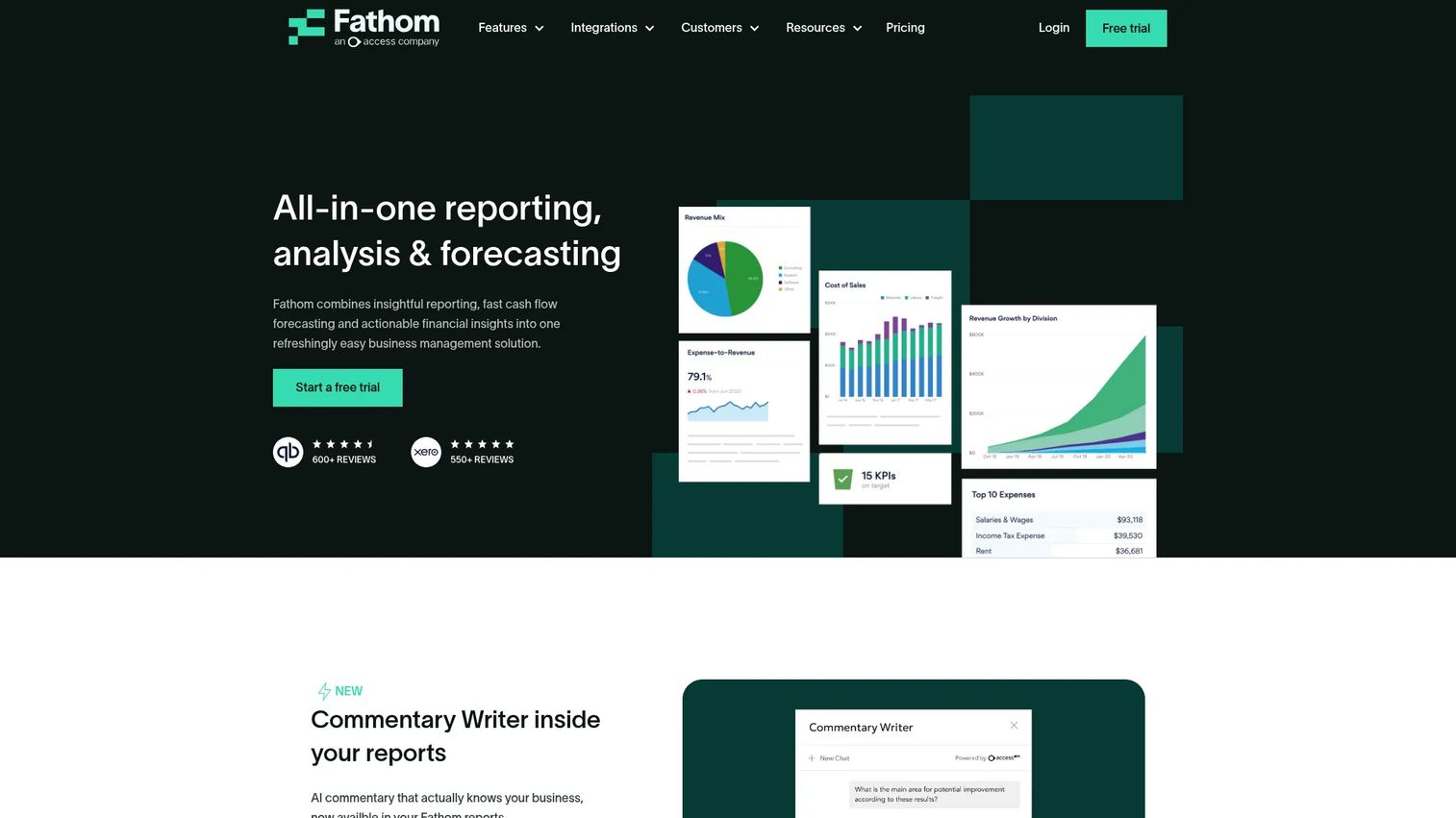
Fathom is business management software that combines reporting, analysis, forecasting, and consolidation in one place. It sits on top of your accounting data and turns it into three-way forecasts, custom management reports, and consolidated financials. For a finance team that wants planning and board reporting without stitching two tools together, this is the balanced pick, which is why it leads the list.
Best for: SMBs, advisors, and accounting firms that need financial reporting and forecasting side by side.
Key strengths
- Three-way cash flow forecasting: Model P&L, balance sheet, and cash flow together, so a hiring or spend decision shows its full impact on runway.
- Custom management reporting: Build board-ready reports with drill-downs, so the numbers in your deck trace back to source data during due diligence.
- Consolidated financial reporting: Roll multiple companies into one view, useful once you have subsidiaries or a portfolio of entities.
Why choose Fathom: It fits the founder who wants one tool that answers both "what is our cash position" and "what will the board see." Fathom connects to common accounting systems and supports scenario planning, so you can build a base case and a downside case without exporting anything to a spreadsheet. The reporting depth is what earns it the top spot for finance teams that live and die by the monthly board pack.
Fathom pricing: Fathom Pro pricing is based on the number of companies connected. The Starter plan begins at $65 per month plus $65 per extra company. Silver is $390 per month, Gold is $540 per month, and Platinum is $860 per month, each with lower per-company add-on costs at higher tiers. Separate Portfolio plans exist for accounting firms. There is no free tier listed on the official pricing page.
2. Sage
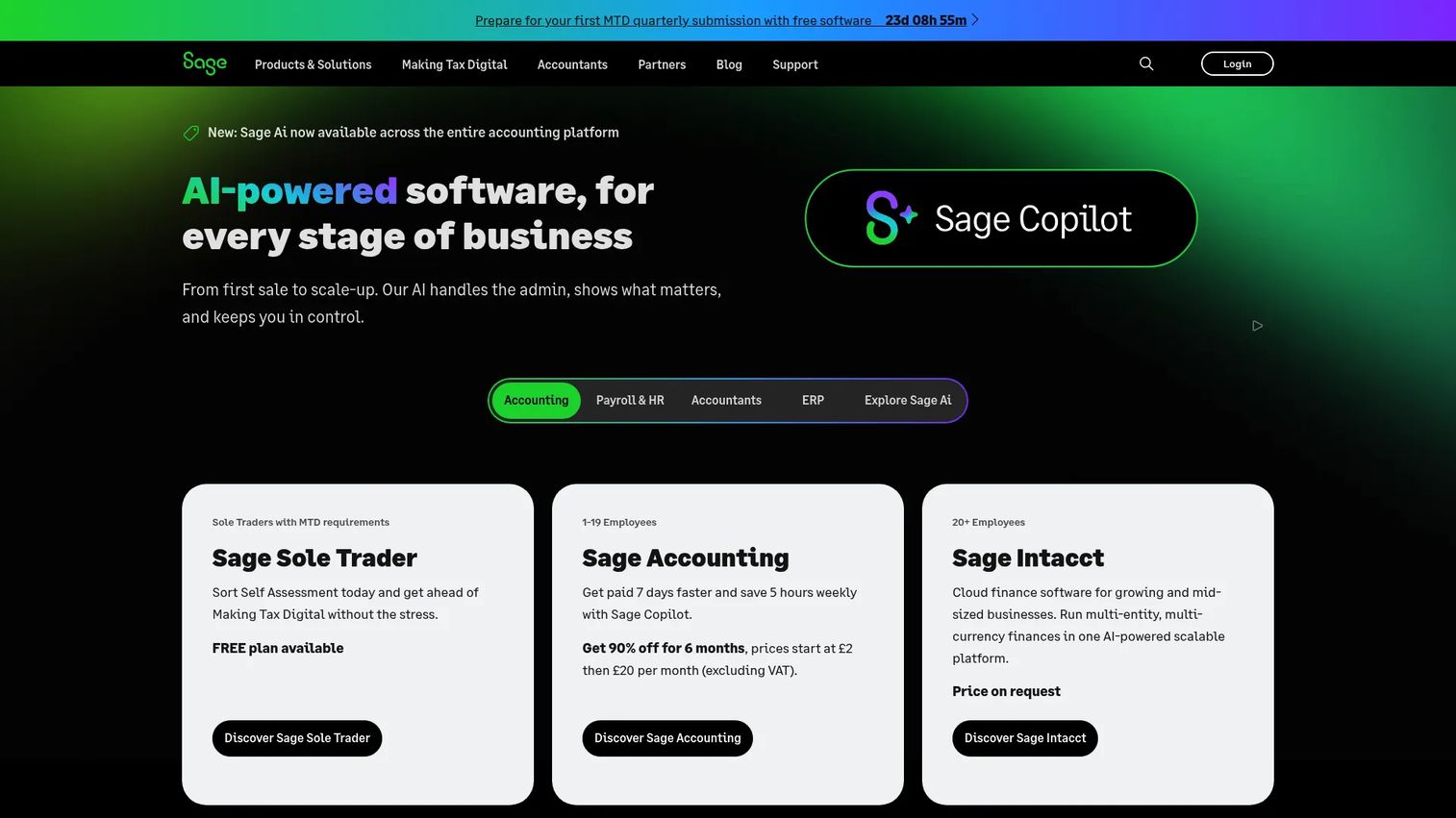
Sage is a business software company whose accounting and finance products, including Sage Intacct and Sage 50, handle cash management inside a broader accounting stack. If your team wants accounting-first cash control rather than a standalone forecasting layer, Sage keeps the ledger and the cash view under one roof. It fits teams that would rather deepen their accounting system than add another tool.
Best for: Small businesses and finance teams wanting accounting software with scalable options as they grow.
Key strengths
- Cloud accounting and ERP: Manage the general ledger, cash, and reporting in one system, so working capital planning starts from the same data that closes the books.
- Multi-entity consolidation: Roll up subsidiaries and branches, which matters once international operations enter the picture.
- Automated billing and reporting: Reduce manual close work and produce financial reports without exporting to spreadsheets.
Why choose Sage: For teams already in the Sage ecosystem, keeping cash management, working capital planning, and process automation inside the same platform reduces the number of systems finance has to reconcile. Sage Intacct scales into more complex multi-entity setups, while Sage 50 covers smaller operations. The tradeoff you accept is a broader accounting footprint rather than a purpose-built forecasting engine.
Sage pricing: Sage 50 offers three subscription plans. Pro Accounting starts at $128.67 per month, Premium Accounting at $182.50 per month, and Quantum Accounting at $271.17 per month. Sage Intacct pricing is customized and requires contacting sales. There is no free tier.
3. Cash Flow Frog
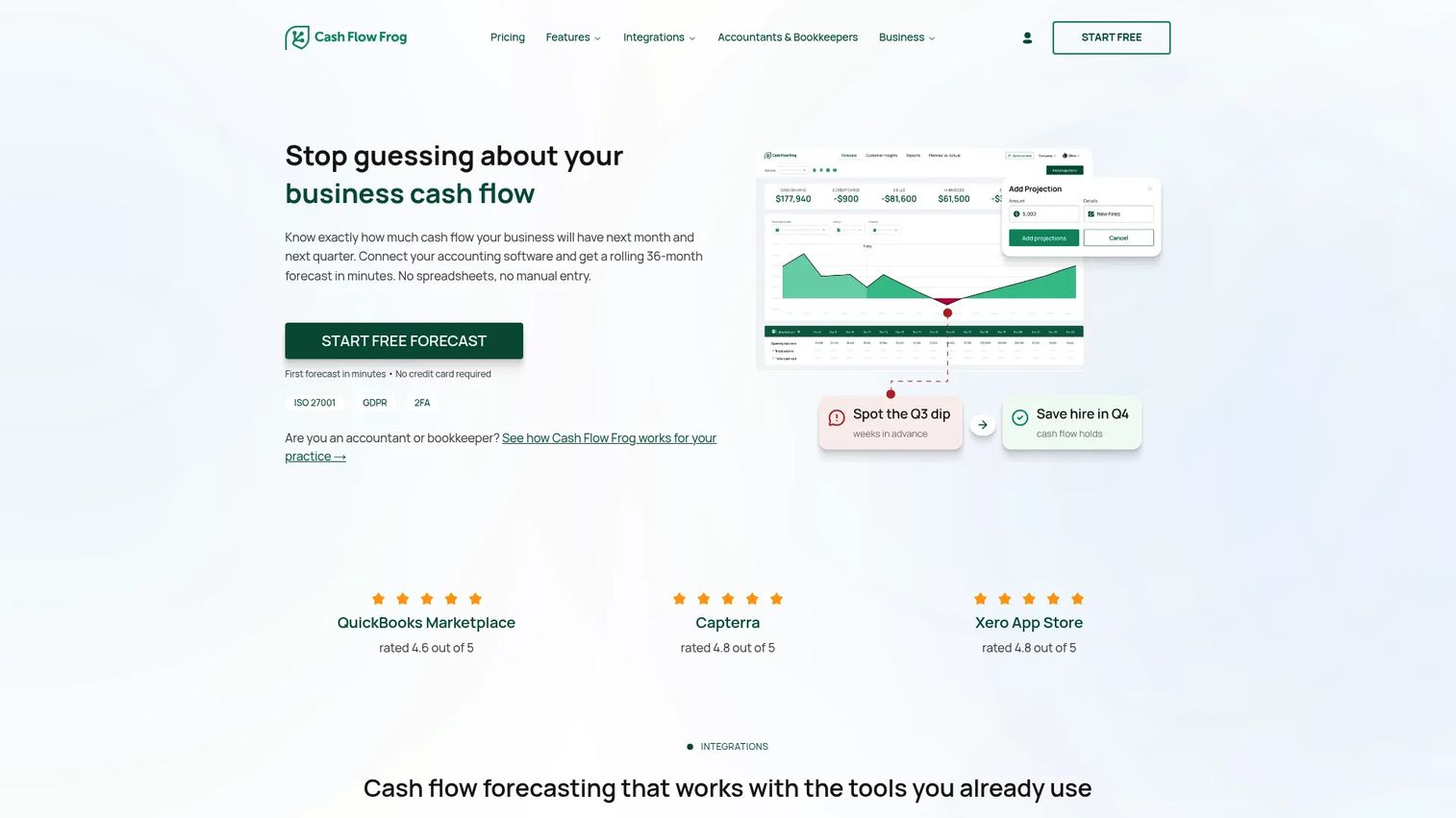
Cash Flow Frog is cash flow forecasting and planning software built for businesses that want automated forecasts without heavy setup. It pulls from your accounting integrations and generates rolling forecasts, then lets you run scenarios on top. For a lean finance team that has outgrown a spreadsheet but does not need a treasury platform, this is the quickest path to a reliable forecast.
Best for: Small and mid-sized businesses that need automated cash flow forecasting straight from accounting data.
Key strengths
- Rolling 36-month cash flow forecasts: Generate long-range projections automatically, so runway planning does not require rebuilding a model each month.
- Scenario planning: Compare what-if cases for hiring, spend, or a delayed receivable against your base forecast.
- Unified forecasts across multiple companies: Combine several entities into one forecast, helpful for founders running more than one business.
Why choose Cash Flow Frog: This is the spreadsheet replacement for teams that want fast setup and a forecast they can trust without a dedicated FP&A hire. It connects to accounting systems, automates the projection, and stays out of the way. The strength here is time-to-value: you can get a working forecast in a day rather than a quarter.
Cash Flow Frog pricing: Pricing scales with annual revenue. The Pro Plan runs $55 per month billed monthly, or $33 per month billed yearly, for businesses up to $1M in annual revenue. There is no free plan, but the site offers a 14-day free trial.
4. Trovata
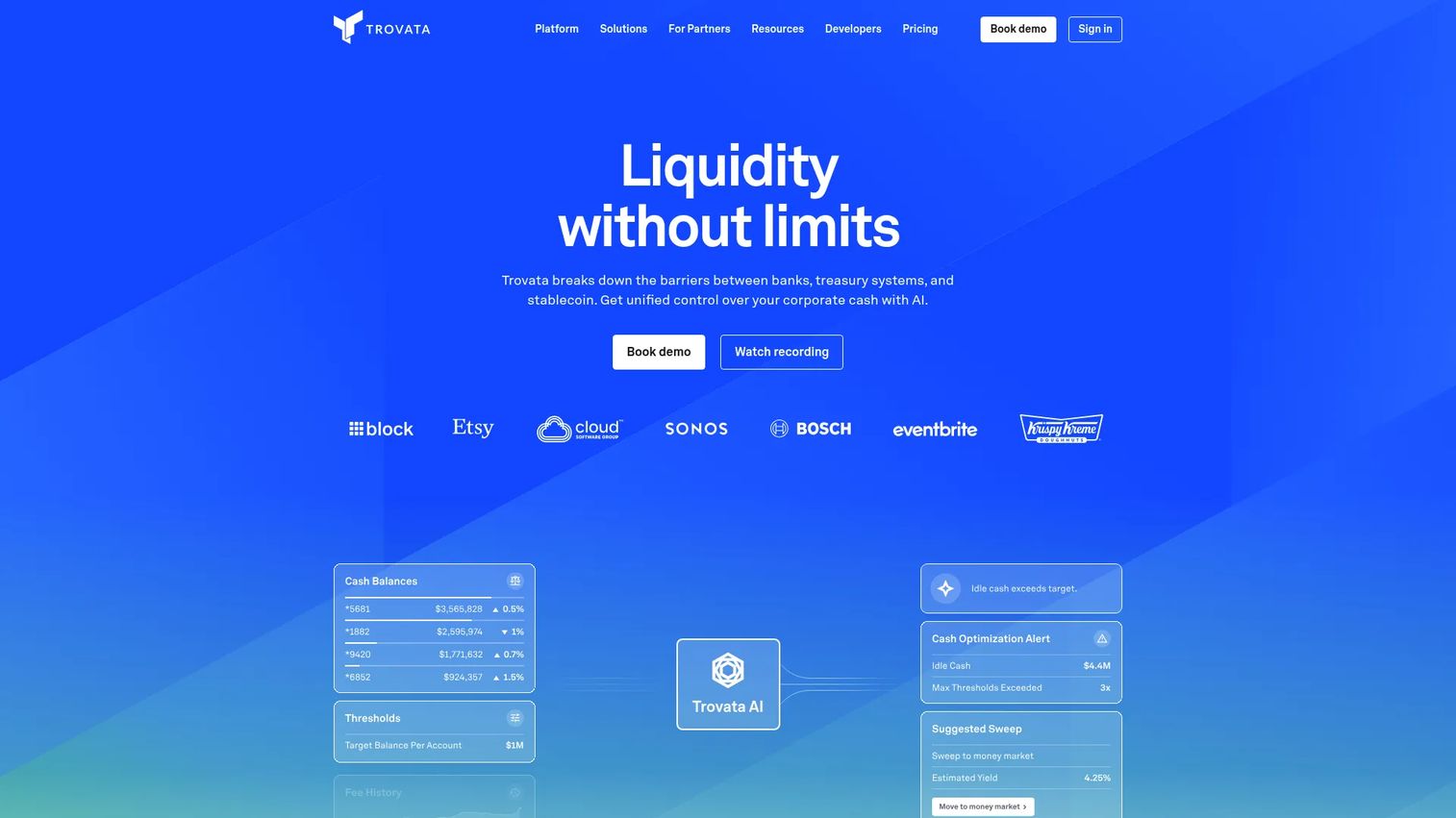
Trovata is an AI-native treasury and finance platform for cash visibility, forecasting, payments, and treasury operations. It aggregates data directly from your banks, normalizes it, and gives finance and treasury teams a real-time view of cash across accounts and entities. When your liquidity picture spans multiple banks and currencies, this is the strongest choice for treasury-grade visibility.
Best for: Treasury and finance teams needing centralized cash visibility and treasury workflow automation.
Key strengths
- Real-time cash visibility and forecasting: See current and projected cash across all connected accounts, so working capital and liquidity planning run on live data.
- Bank connectivity and normalized multibank data: Pull directly from financial institutions into one clean dataset, removing the manual bank-statement stitching.
- Treasury operations: Handle payments, reconciliation, and reporting from the same platform that shows your cash position.
Why choose Trovata: For a company with balances spread across several banks and international entities, Trovata replaces the manual treasury spreadsheet with a system built on live bank data. It supports multi-currency and multi-entity visibility, which is exactly where simpler forecasting tools stop. If treasury automation and liquidity planning are the priority, this is the platform to shortlist first.
Trovata pricing: Public pricing shows a Base Package at $24,000 per year, with additional needs quoted by sales. Trovata also offers a treasury management system with quote-based pricing. There is no free tier.
5. Tesorio
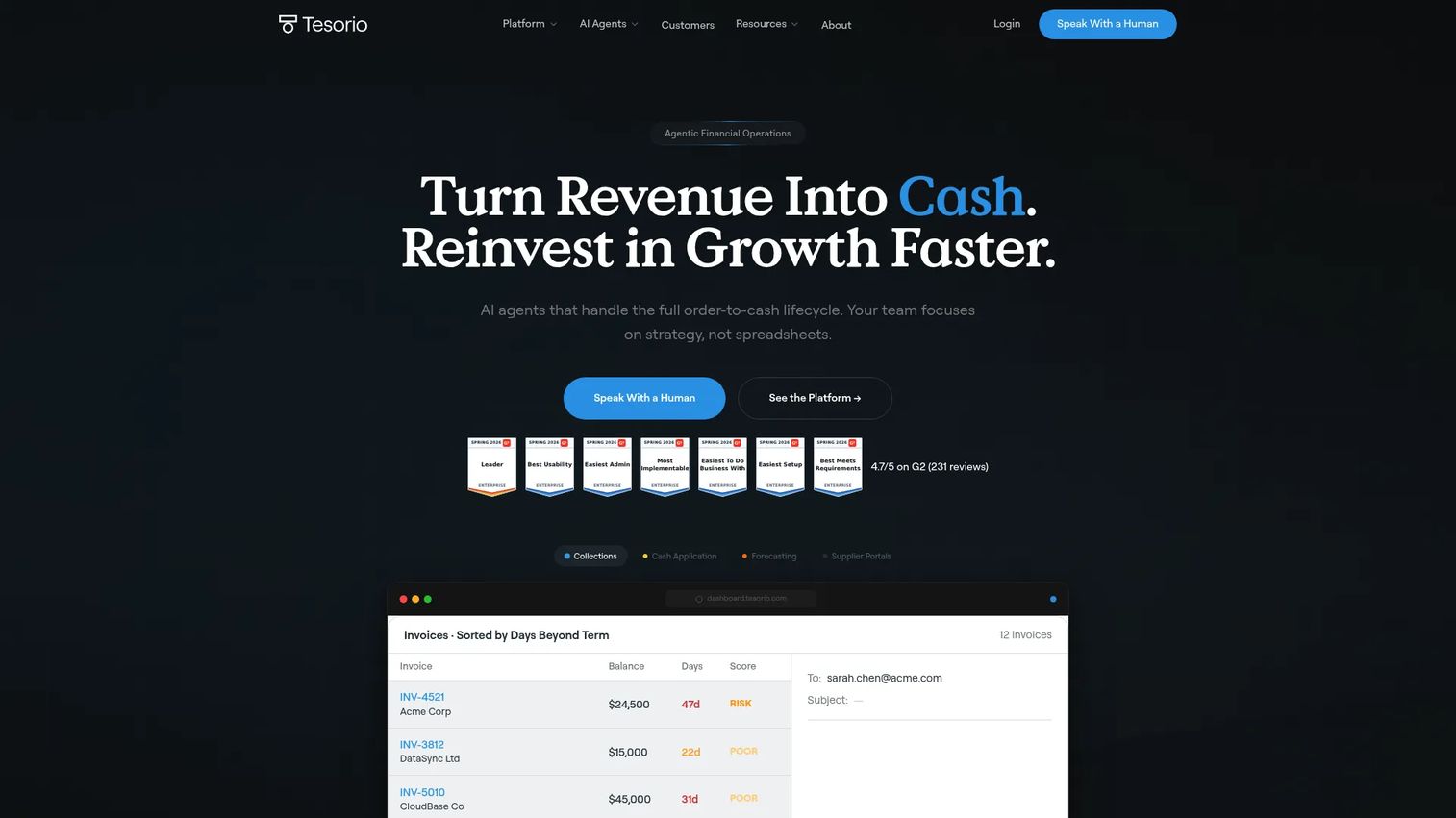
Tesorio is an agentic financial operations platform that automates collections, cash application, and forecasting across the order-to-cash lifecycle. It connects receivables workflows directly to cash forecasting, so the money you are owed feeds the model that projects your runway. For finance teams where collections are the biggest swing factor in cash, this connection matters.
Best for: Mid-market to enterprise finance teams automating order-to-cash workflows.
Key strengths
- Collections and cash application agents: Automate follow-ups and payment matching, so DSO improvements flow straight into the cash forecast.
- AR forecast: Project incoming cash from receivables with more precision than a flat assumption, tightening the overall runway picture.
- Payment and supplier portals: Give customers and suppliers a clean way to transact, reducing the friction that delays cash.
Why choose Tesorio: If your forecast keeps missing because receivables come in late and unpredictably, Tesorio attacks that directly. It ties collections operations to cash intelligence, giving finance decision support grounded in real AR behavior rather than guesses. The operational visibility into who owes what, and when it will likely land, is the differentiator here.
Tesorio pricing: Tesorio does not publish pricing and directs prospects to sales. Pricing is customized based on your needs. There is no public free tier or trial listed.
6. HighRadius
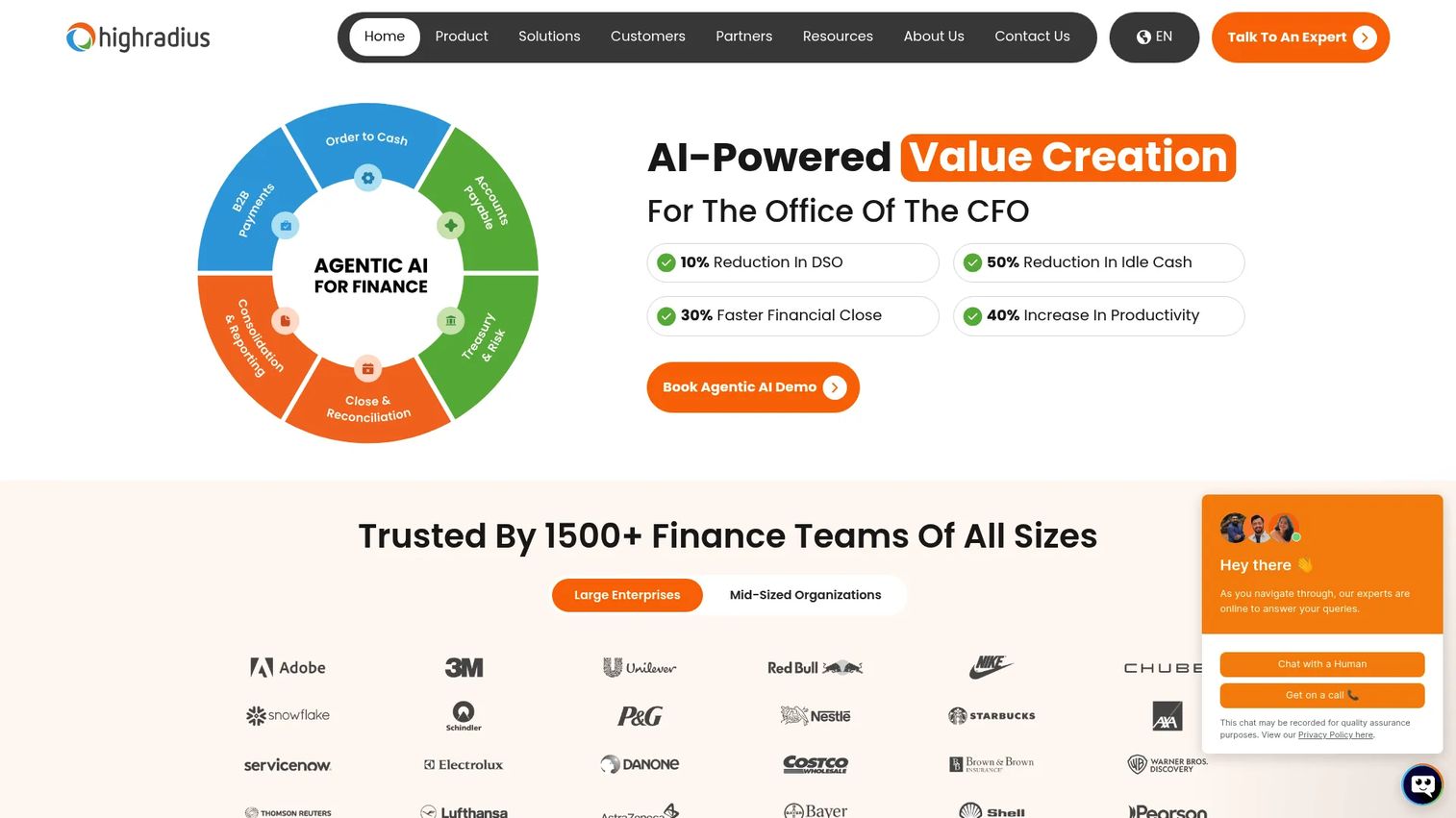
HighRadius is AI-powered autonomous finance software covering order-to-cash, accounts receivable, accounts payable, treasury, and close and reconciliation workflows. It is built for larger finance organizations with complex operations across receivables, payables, and treasury. When your operating footprint is big enough that manual processes break down, this is the enterprise-scale option.
Best for: Enterprises automating receivables and broader office-of-the-CFO finance operations.
Key strengths
- Credit and collections automation: Manage credit risk and automate collections at scale, reducing manual work across a large receivables book.
- Accounts receivable and order-to-cash automation: Handle the full O2C cycle, feeding accurate cash timing into liquidity planning.
- Treasury and financial close automation: Automate treasury operations and reconciliation, tightening both cash visibility and the close.
Why choose HighRadius: This fits the finance team that has outgrown point solutions and needs one platform to automate receivables, treasury, and close across a large operation. The depth and breadth make sense when you have the volume and complexity to justify enterprise setup. For a company operating at that scale, consolidating these workflows is where real efficiency comes from.
HighRadius pricing: HighRadius uses subscription and transaction-based pricing that is customized based on the modules you need and implementation complexity. No public numeric price is listed. Expect a sales-led process.
7. Gartner
Gartner is not a cash flow tool. It is a business and technology insights company that provides research, advice, and peer reviews to help organizations shortlist and compare vendors. For a research-heavy buyer who wants third-party benchmarks before committing to demos or an RFP, Gartner is where the evaluation starts.
Best for: Enterprises seeking vendor research and strategic business and technology insights before a purchase.
Key strengths
- Business and technology insights: Access analyst research on the cash management and treasury software landscape, useful for framing a buying decision.
- Expert guidance and benchmarks: Compare vendors against structured criteria rather than marketing pages alone.
- Conferences and peer reviews: Read verified user reviews and hear how similar companies evaluated the same tools.
Why choose Gartner: When a purchase needs to survive procurement and board scrutiny, third-party validation carries weight. Gartner helps research-led buyers build a defensible shortlist and understand the market before they talk to a single vendor. It is the reference layer, not the software, and it earns its place for buyers who want that rigor.
Gartner pricing: Gartner does not publicly display subscription pricing. Its research and advisory services are covered by separate sales contracts, which points to quote-based pricing. There is no public free tier.
Considerations before you buy
Before you commit to any cash flow management software, run through this checklist.
Accounting integration quality
Verify the tool connects cleanly to your general ledger and bank accounts. A forecast is only as good as the data feeding it. Ask specifically which accounting systems and banks are supported, and how often data syncs, before you sign anything.
Forecasting depth
Check whether the tool does simple projections or full scenario planning with rolling forecasts. A lean team may only need automated forecasts. A founder heading into a fundraise needs three-way forecasting and downside modeling. Match the depth to the decisions you actually make.
Multi-entity and multi-currency support
If you have subsidiaries or international operations, confirm the tool consolidates entities and handles currencies natively. Retrofitting this later is painful. Tools like Trovata and Sage Intacct are built for it, while simpler apps may not scale to that complexity.
Reporting and auditability
Confirm the tool offers drill-downs, source data traceability, and board-ready outputs. During due diligence, every number needs to trace back to a source. Board packs that require manual reassembly defeat the purpose of buying the software.
Setup time and maintenance
Understand how much manual modeling remains after implementation. Some tools generate a forecast in a day. Others need configuration and ongoing upkeep. For a Series B team without a large FP&A function, first-week setup speed is a real factor in whether the tool earns its place.
Conclusion
The right cash flow management tools depend on what you actually need: planning, visibility, collections, or treasury automation.
For most Series B SaaS finance teams, Fathom is the most balanced starting point. It pairs three-way forecasting with board-ready reporting, so you get runway clarity and investor-grade outputs from one tool. If you are accounting-first, Sage keeps cash control inside your ledger. Lean teams that just need a reliable forecast fast should look at Cash Flow Frog. When treasury and multi-entity visibility become the priority, Trovata is the strongest pick, with Tesorio and HighRadius covering AR-driven and enterprise-scale liquidity respectively. Gartner is where research-led buyers should start before any demo.
Pick based on where cash actually breaks down for you today. A tool that gives finance a defensible view of runway, without routing every question through the founder, is the one worth paying for. Start with the most balanced option for your stage, prove it in the first quarter, and expand from there.
FAQs
Cash flow management software forecasts, plans, and reports on money moving in and out of a business, connecting accounting and bank data into forward-looking views. It replaces manual spreadsheets with automated projections, scenario planning, and real-time cash visibility, so finance teams can manage liquidity and runway with confidence.
Cash flow forecasting software focuses on projecting future balances and running scenarios. Cash management software is broader, covering current cash visibility, bank connectivity, payments, and treasury operations alongside forecasting. Many platforms do both, but treasury-oriented tools lean toward management while planning-focused tools lean toward forecasting and projection.
For most SaaS finance teams, Fathom offers the best balance of three-way forecasting and board-ready reporting. If treasury and multi-entity visibility matter more, Trovata is the stronger fit. Lean SaaS teams that just need a fast, reliable forecast often start with Cash Flow Frog.
Yes, that is a core reason to buy one. Cash flow planning software syncs accounting and bank data automatically, so the forecast updates itself instead of relying on a model one person maintains. You still make the assumptions, but you stop rebuilding the sheet before every board call.
Most cash flow management tools integrate with common accounting systems like QuickBooks, Xero, and Sage. Fathom and Cash Flow Frog both pull from these platforms to generate automated forecasts. Always confirm the specific integrations and bank sync options for your stack before buying, since coverage varies by tool.
Prioritize accounting integration quality, forecasting depth with scenario planning, and reporting that survives due diligence. A Series B team needs a defensible runway view and board-ready outputs without routing every question through the founder. Fast setup matters too, since most teams at this stage lack a large FP&A function.
Multi-entity teams use cash flow management software to consolidate subsidiaries, branches, and international balances into one cash view. Cash flow projection software with native multi-currency and multi-entity support, like Trovata or Sage Intacct, rolls every entity into a single forecast, removing the manual reconciliation that spreadsheets require at that scale.
Very. Runway planning is one of the strongest use cases, especially for founders facing board scrutiny or a fundraise. Scenario planning and what-if analysis let you model hiring, spend, and downside cases against cash, giving you decision support grounded in live data rather than a static estimate.