Your property manager forwarded another parking complaint this morning. A resident's guest got towed. A permit spreadsheet is three versions out of date. Nobody knows how many spots are actually free right now, and enforcement runs on a clipboard and good faith.
That is the reality most teams hit as sites scale. Paper permits, scattered approvals, and manual enforcement work fine for one small lot. Add a second location, a visitor program, or a payment requirement, and the whole thing starts leaking time and revenue. The global parking management software market is projected to grow from $2.6 billion in 2026 to $7.8 billion by 2033, a 17.2% CAGR, according to Persistence Market Research (2024). That growth is not hype. It is teams replacing spreadsheets with systems that actually hold up.
Parking management software centralizes permits, access control, payments, occupancy tracking, and enforcement into one platform instead of five disconnected workflows. The hard part is not deciding to buy. It is choosing the right fit for your parking model, because the best tool for a 400-unit apartment community is not the best tool for a hybrid office or a public garage.
This guide fixes that. If you are the kind of operator who also evaluates digital adoption tooling or event management systems, you already know the drill: match the platform to the job, verify the workflows, then commit. We applied the same lens here. For teams building out broader operations stacks, our roundups of community management software and loyalty management software follow the same buyer-first structure.
What's inside
This list covers the best parking management software across five distinct models: paperless digital permits, workplace and hybrid-office parking, access-control-heavy RFID deployments, monetized public parking, and multi-site operations. It is written for evaluators comparing modern parking operations stacks, not for anyone looking for generic feature lists.
We selected platforms based on four criteria that actually predict fit:
- Property fit: Does it match your model (multifamily, workplace, campus, garage, municipality)?
- Automation depth: How much manual admin does it remove from permits, payments, and enforcement?
- Integration strength: Does it connect to gates, LPR cameras, payment processors, and access systems?
- Ease of rollout: How fast can a team stand it up and train admins?
TL;DR
For readers who want the shortlist before the detail:
- Best overall for digital permits and enforcement: ParkingPass, built for multifamily, HOA, and community teams that want paperless registration and LPR.
- Best for workplace and hybrid offices: Parkable, with reservations, visitor parking, EV charging, and access integrations.
- Best for RFID and access control: Fresh USA, for sites that need hardware-linked vehicle access and live occupancy.
- Best for cloud-based operations: CloudEASE, for operators comparing enterprise-listed payment and management platforms.
- Best for workplace coordination beyond parking: WorkInSync and Wayleadr, for offices tying parking into desks, rooms, and arrival flows.
- Best for monetized public parking: JustPark and AirGarage, for operators focused on revenue, payments, and enforcement across garages and lots.
What is parking management software?
Parking management software is a platform that automates and centralizes parking operations, including permit issuance, vehicle access control, payment collection, occupancy tracking, and enforcement across one or more locations.
Modern parking management systems replace the patchwork of paper permits, spreadsheets, and manual gate operation with a single administrative layer. The strongest platforms in this category share a common set of capabilities that buyers should expect as table stakes:
- Access control and authorized vehicle management: Verify which vehicles are permitted, often through LPR camera technology, RFID readers, or gate integrations.
- Permit, pass, and registration workflows: Handle online resident or employee registration, digital permits, guest passes, approvals, and exceptions.
- Fee collection and payment processing: Accept payments for permits, guest parking, hourly stays, or monthly billing.
- Occupancy tracking, reporting, and analytics: Show real-time availability, historical utilization, and location comparisons.
- Integrations: Connect to gates, payment processors, security systems, and building management platforms.
- Multi-location and multi-zone administration: Manage distributed properties, campuses, or garages from one dashboard.
In the broader parking tech stack, this software sits between the physical layer (gates, cameras, sensors) and the operator layer (property managers, HR teams, municipalities, garage owners). It is the coordination brain. Where a point solution handles one task, a full parking management system software ties permits, payments, occupancy, and enforcement together so the data flows in one direction instead of living in five places.
When to use parking management software
Not every site needs a platform. Here is when the switch pays for itself.
Replace manual permits and spreadsheets
When permit volume outgrows a spreadsheet, errors multiply. Approvals stall in email, duplicate permits slip through, and nobody can audit who parked where. Digital permit workflows fix this with online registration, centralized approvals, and searchable records. A 300-unit apartment community running paper hangtags is the classic trigger: the moment a leasing office spends more time reissuing lost permits than leasing units, digital permits earn their keep.
Manage mixed parking access across multiple sites
Multi-location parking breaks manual systems fastest. A company with three offices, or a campus with a dozen lots, cannot run consistent access rules from local spreadsheets. Centralized visibility matters here: one dashboard showing occupancy, permits, and violations across every site. Parking garage management software with multi-zone control lets an admin set different rules per location while reporting rolls up to a single view. This is where parking lot management software stops being a convenience and becomes infrastructure.
Add payment, monetization, or enforcement workflows
When parking becomes a revenue line or a compliance requirement, manual collection falls apart. Guest passes need to be paid for and tracked. Hourly or event parking needs contactless payment. Enforcement needs a defensible record of who violated what and when. A downtown garage adding dynamic pricing, or an HOA charging for a second permit, needs software that ties payment, occupancy, and enforcement together so revenue and violations are both auditable.
Comparison table
Here is a fast scan of the eight parking software platforms in this guide, sorted by relevance to the primary keyword. Pricing and G2 ratings reflect verified public sources where available.
| # | Product | Intent | Key use case | Pricing | G2 rating |
|---|---|---|---|---|---|
| 1 | ParkingPass | Digital permits | Paperless registration, guest parking, and LPR enforcement for communities | From $100/month; resident-funded and property-funded models | Not available |
| 2 | Parkable | Workplace parking | Reservations, visitor parking, EV charging, and access integrations | Quote-based | 4.9/5 |
| 3 | Fresh USA | Access control / RFID | RFID vehicle access, live occupancy, multi-zone tracking | Lifetime license; quote-based | Not rated |
| 4 | CloudEASE | Cloud operations | Cloud payments, access control, and reservations management | From $49/month | 5.0/5 |
| 5 | WorkInSync | Workplace coordination | Parking tied to desks, rooms, and visitor management | From $2.50/user/mo (annual) | 4.6/5 |
| 6 | Wayleadr | Workplace / arrival | Automated parking, EV charging, and desk booking | From $49/month | 4.9/5 |
| 7 | JustPark | Monetized public parking | Reservations, contactless payments, dynamic pricing | Quote-based | 4.3/5 |
| 8 | AirGarage | Revenue operations | Occupancy tracking, dynamic pricing, on-the-ground enforcement | Quote-based | 4.9/5 |
1. ParkingPass
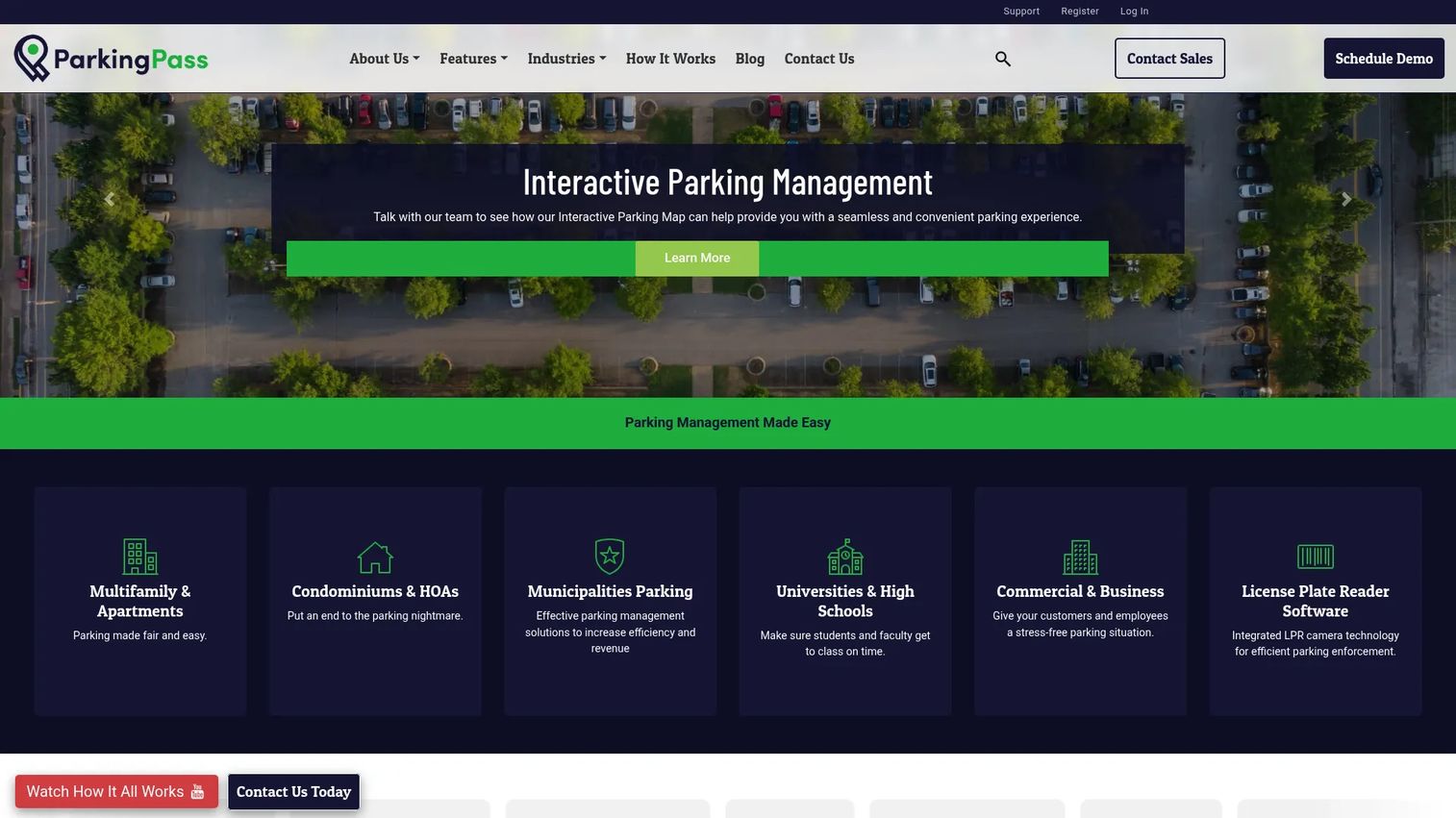
ParkingPass is built for teams that want to kill paper permits entirely. It handles resident registration, guest parking, and enforcement through a single portal, with license plate recognition doing the heavy lifting on verification. For multifamily communities, HOAs, and municipal lots drowning in hangtags and manual logs, it turns permit management into a self-serve workflow that residents run themselves.
The platform's strength is workflow depth for the community model. Residents register their own vehicles through an approval portal, guests get registered and tracked without a leasing-office phone call, and violations are logged against LPR reads instead of a walk-around clipboard. That combination removes most of the repetitive admin that eats leasing-office time.
Best for: Multifamily, HOA, and property teams that need paperless parking registration and enforcement.
Key strengths
- LPR and e-permit management: License plate recognition ties digital permits to real vehicles, so enforcement runs on verified reads instead of manual checks.
- Resident registration portal: Residents self-register and get approved through an online flow, cutting the leasing office out of routine permit issuance.
- Guest parking and reporting: Guest registration is tracked and reportable, so visitor parking stops being a source of towing disputes.
Why choose ParkingPass: If your parking pain is permits and enforcement in a residential or community setting, ParkingPass is the most direct fit on this list. It is not a workplace tool or a garage revenue platform. It is a paperless permit and enforcement system, and it does that job with less admin than a spreadsheet-plus-clipboard workflow ever could.
ParkingPass pricing: ParkingPass publicly lists subscriptions starting as low as $100/month. It also offers a resident-funded model priced at $0 to the property per permit per year, and a property-funded model available as a custom quote based on portfolio unit count. That range lets communities shift cost to residents or absorb it, depending on their model.
2. Parkable
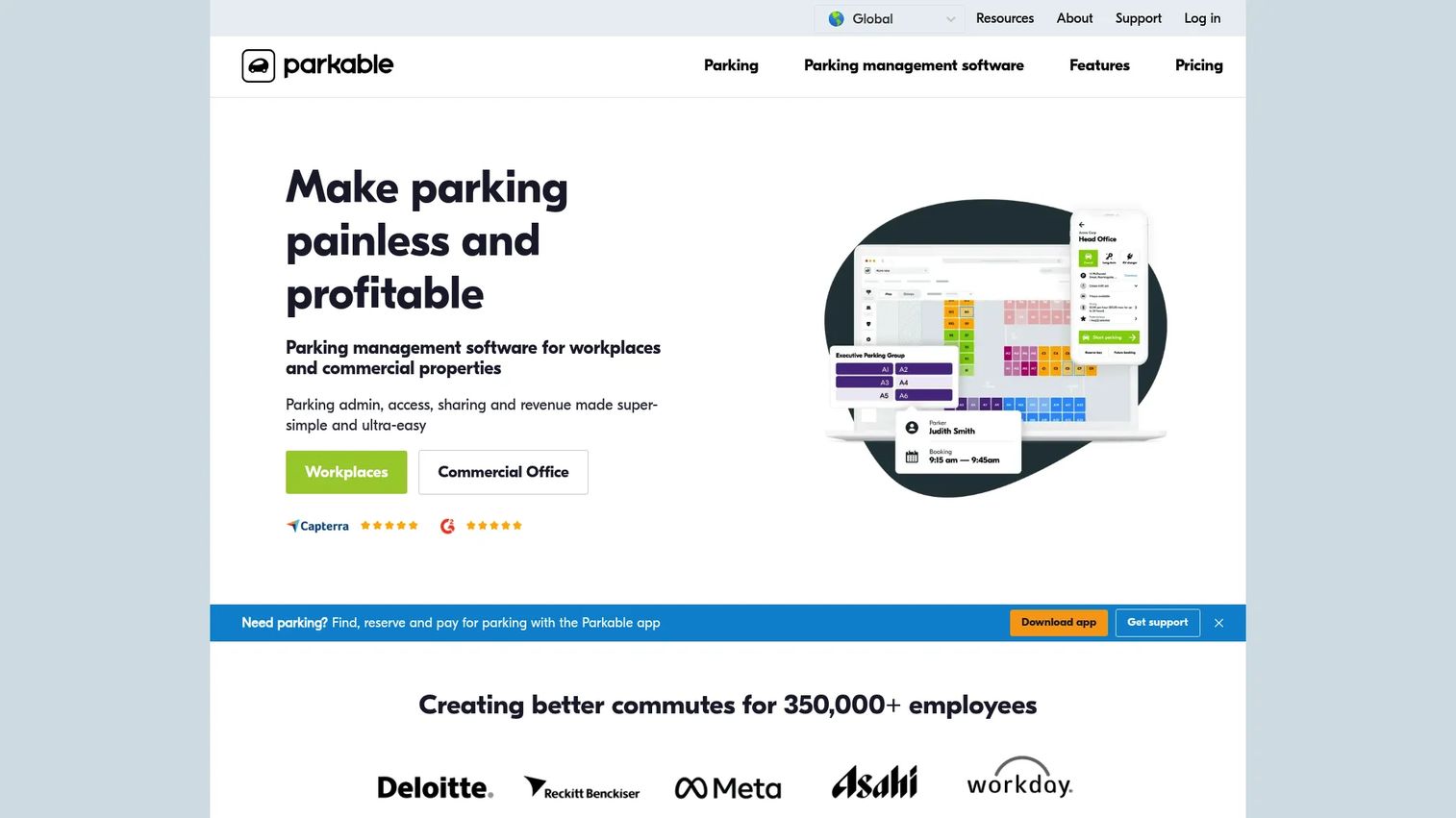
Parkable is the strongest workplace parking option here for hybrid teams. It manages bookings, space sharing, payments, and infringement handling inside one app, and it integrates with access control systems including ANPR/LPR and hardware like Paxton and Brivo. For an office where fewer desks and fewer parking spots serve more people on rotation, Parkable turns a scarce resource into a fair, bookable one.
The platform earns a 4.9/5 rating on G2, and the reason is operational fit. Employees book spaces they will actually use, unused spots get shared back into the pool, and admins get utilization data instead of guesswork. Visitor parking, EV charging, and SSO round out a workplace-grade feature set.
Best for: Commercial buildings and workplaces that need parking allocation and access management for hybrid teams.
Key strengths
- Bookings and space sharing: Employees reserve spots and release unused ones, so a hybrid office runs fewer physical spaces at higher utilization.
- Access control integrations: ANPR/LPR plus Paxton and Brivo support ties bookings to real gate and barrier access.
- Visitor, EV, and reporting tools: Visitor parking, EV charging management, and utilization reporting cover the full workplace mobility picture.
Why choose Parkable: Choose Parkable when parking is a workplace-experience problem, not a residential or public-revenue one. It shines for hybrid offices optimizing occupancy across fewer spaces, and its access-control integrations mean the booking layer and the physical barrier layer actually talk to each other.
Parkable pricing: Parkable uses quote-based pricing. The site runs a request-pricing flow rather than publishing plan tiers, so cost depends on your building count, space volume, and feature needs. Teams should request a quote scoped to their number of locations and users.
3. Fresh USA parking management software
Fresh USA is the access-control-first, RFID-heavy option for sites that need hardware-linked vehicle control. It tracks vehicle access and movement through RFID readers, shows live occupancy and current-inside counts, and supports multi-zone tracking with shared SQL. For technical control environments that want on-prem or shared-database operation, this is the closest fit on the list.
The differentiator is hardware fidelity. Where cloud-first tools abstract the physical layer away, Fresh USA leans into it: RFID identifier registration, real-time entry and exit recording, and zone-level capacity tracking. That makes it a strong pick for operators who treat parking as a controlled-access problem first and a payments problem second.
Best for: Property managers and operators needing RFID-based, on-prem or shared-SQL parking control.
Key strengths
- RFID vehicle access: RFID readers register identifiers and track vehicle movement, giving hardware-verified access control instead of visual checks.
- Live occupancy visibility: Current-inside counts and real-time occupancy tracking show exactly how full each zone is at any moment.
- Multi-zone tracking with shared SQL: Zone-level capacity tracking and shared SQL support suit distributed or technically managed sites.
Why choose Fresh USA: Pick Fresh USA when access control is the primary requirement and you want tight hardware integration on your own infrastructure. It sells on a lifetime software license model with no monthly subscription, which appeals to operators who prefer a one-time cost over recurring fees.
Fresh USA pricing: Fresh USA does not publish numeric pricing. The site uses a "View Pricing" and "Request a Quote" flow and states a lifetime software license with no subscriptions and no monthly fee. Operators should request a quote to scope the license and any hardware requirements.
4. CloudEASE parking management software
CloudEASE, built by Parking BOXX, is a cloud-based parking management platform that shows up in enterprise-style category search on G2. It covers parking access control, occupancy management, and reservations management, making it a fit for operators comparing cloud-listed platforms with broader operational needs. Public product detail is thinner than some competitors, so verification during evaluation matters.
Its relevance comes from category coverage. CloudEASE appears in parking software comparison shortlists because it bundles payments, access, and reservations under one cloud platform, which is exactly what mid-market operators scanning G2 tend to filter for. It carries a 5.0/5 rating on G2, though on a limited review base, so treat that as a signal to validate rather than a guarantee.
Best for: Parking operators needing cloud-based payment and management tools who are comparing G2-listed platforms.
Key strengths
- Parking access control: Cloud-managed access control governs entry and exit without on-prem infrastructure.
- Occupancy management: Occupancy tracking gives operators visibility into utilization across managed lots.
- Reservations management: Reservation workflows let operators pre-allocate spaces for tenants, events, or monthly parkers.
Why choose CloudEASE: Choose CloudEASE if you are shortlisting cloud platforms on G2 and want payments, access, and reservations in one system without running your own hardware stack. Because public detail is limited, book a demo and confirm the exact feature set and integration list against your requirements before committing.
CloudEASE pricing: Public pricing is limited. A G2-listed plan starts at $49 per month, reported through third-party sources rather than a first-party pricing page, so confidence is lower. Confirm current pricing and included features directly with the vendor before purchase.
5. WorkInSync
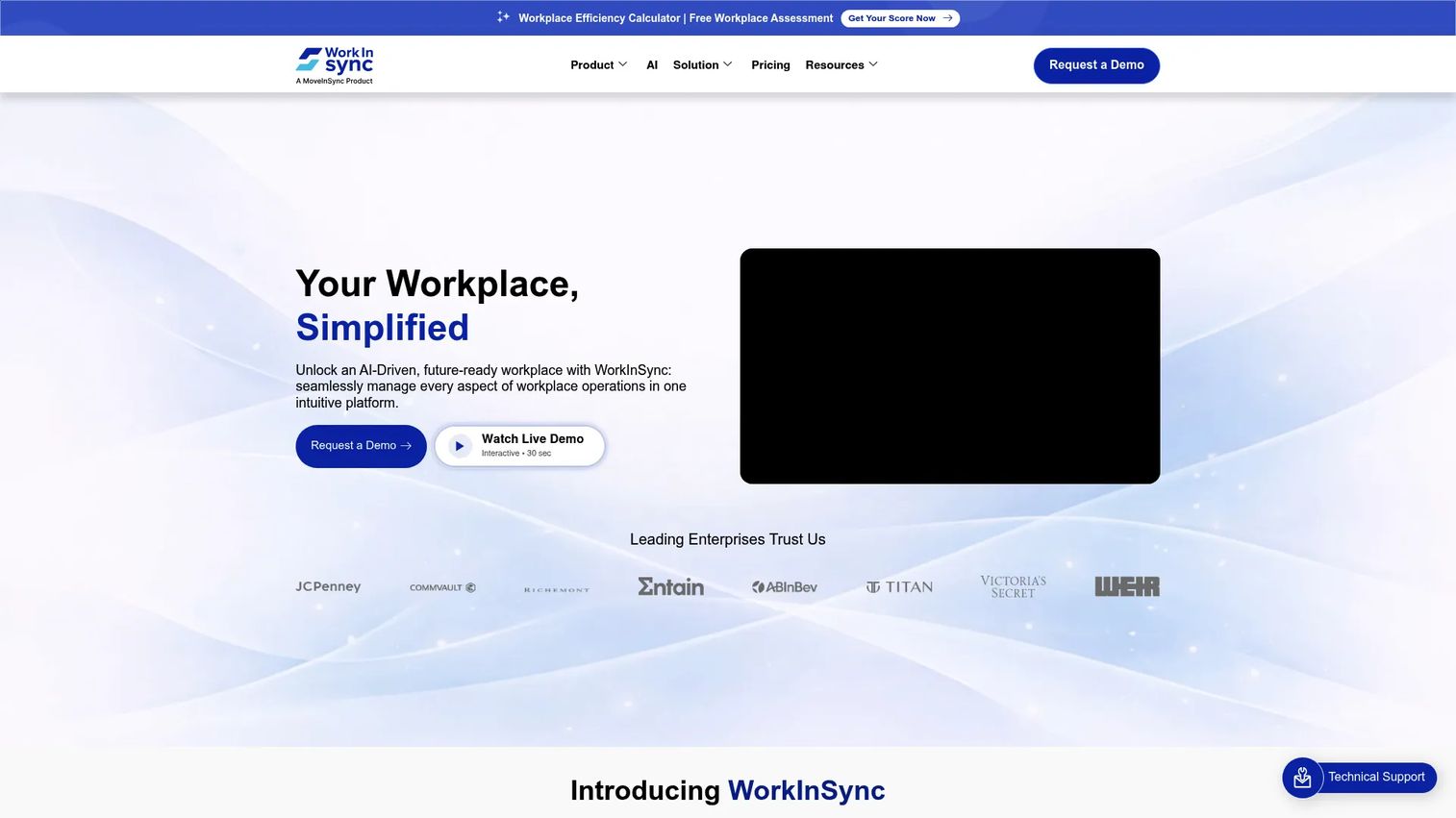
WorkInSync positions parking as one piece of a broader workplace-experience platform. Alongside parking coordination, it handles desk booking, meeting room booking, and visitor management, which makes it a fit for offices that want parking managed inside the same system as the rest of their workspace operations. For hybrid enterprises, that consolidation is the pitch.
The value is coordination, not vehicle access alone. An employee who books a desk can book a parking spot in the same flow, and admins manage both from one console. That reduces the number of disconnected tools an office runs and gives facilities teams a single source of truth for who is on-site and where they parked.
Best for: Enterprises managing hybrid workplace bookings and office operations alongside parking.
Key strengths
- Parking with desk and room booking: Parking sits next to desk and meeting room reservations, so employees coordinate their whole on-site day in one place.
- Visitor management: Visitor workflows tie guest arrivals into the same system that handles employee parking and desks.
- Admin automation: Centralized administration cuts the manual coordination of running parking, desks, and visitors as separate systems.
Why choose WorkInSync: Choose WorkInSync when parking is part of a bigger hybrid-workplace problem and you would rather run one platform than stitch parking onto a separate desk-booking tool. It fits enterprises optimizing the full return-to-office experience, not operators managing public or residential parking.
WorkInSync pricing: WorkInSync publishes three plans. Standard starts at $2.50 per user per month billed annually, Professional at $4.00, and Enterprise at $6.00, with slightly higher quarterly-billing rates ($3.00, $4.50, and $6.75 respectively). There is no free tier. The per-user model scales with headcount, so cost tracks your on-site employee count.
6. Wayleadr
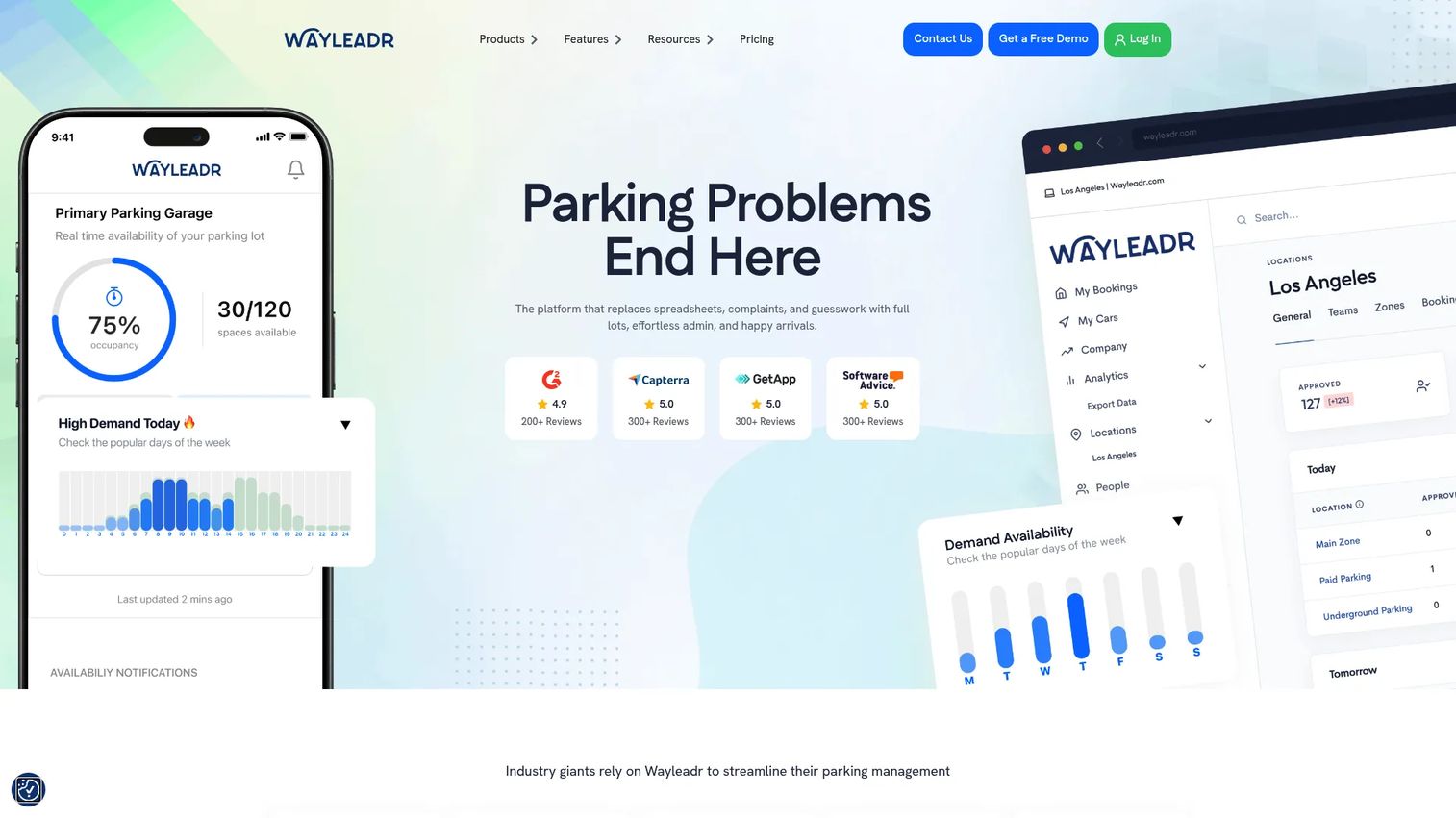
Wayleadr is a workplace and property arrival-management platform with parking at its core. It automates parking allocation, handles desk and meeting room booking, and manages EV charging with rotation logic. For organizations running employee parking at scale across one or several sites, Wayleadr focuses on turning fixed allocation into dynamic, utilization-driven assignment.
The platform holds a 4.9/5 rating on G2, and its strength is allocation intelligence. Instead of assigning permanent spots that sit empty half the week, Wayleadr redistributes spaces based on who is coming in, which lifts utilization on a fixed footprint. EV charging rotation extends the same logic to a scarce charging resource.
Best for: Organizations that need centralized parking and arrival management across workplace or multifamily properties.
Key strengths
- Automated parking allocation: Dynamic assignment redistributes spaces based on demand, lifting utilization without adding physical spots.
- EV charging management: Charging rotation shares a limited number of chargers fairly across employees who need them.
- Desk and room booking: Parking coordinates with desk and meeting room reservations for a full arrival-management view.
Why choose Wayleadr: Pick Wayleadr when employee parking allocation is the core problem and you want automation to squeeze more usage out of a fixed number of spaces. Its multi-site support and arrival-management framing suit distributed offices, and the EV rotation feature is a genuine differentiator for teams adding charging infrastructure.
Wayleadr pricing: Wayleadr publicly lists Wayleadr Flex at $49/month. Two higher tiers, Wayleadr Work and Wayleadr Home, are contact-sales plans priced based on features and employee count. There is no free tier. Smaller teams can start on Flex, while larger deployments move to custom pricing.
7. JustPark
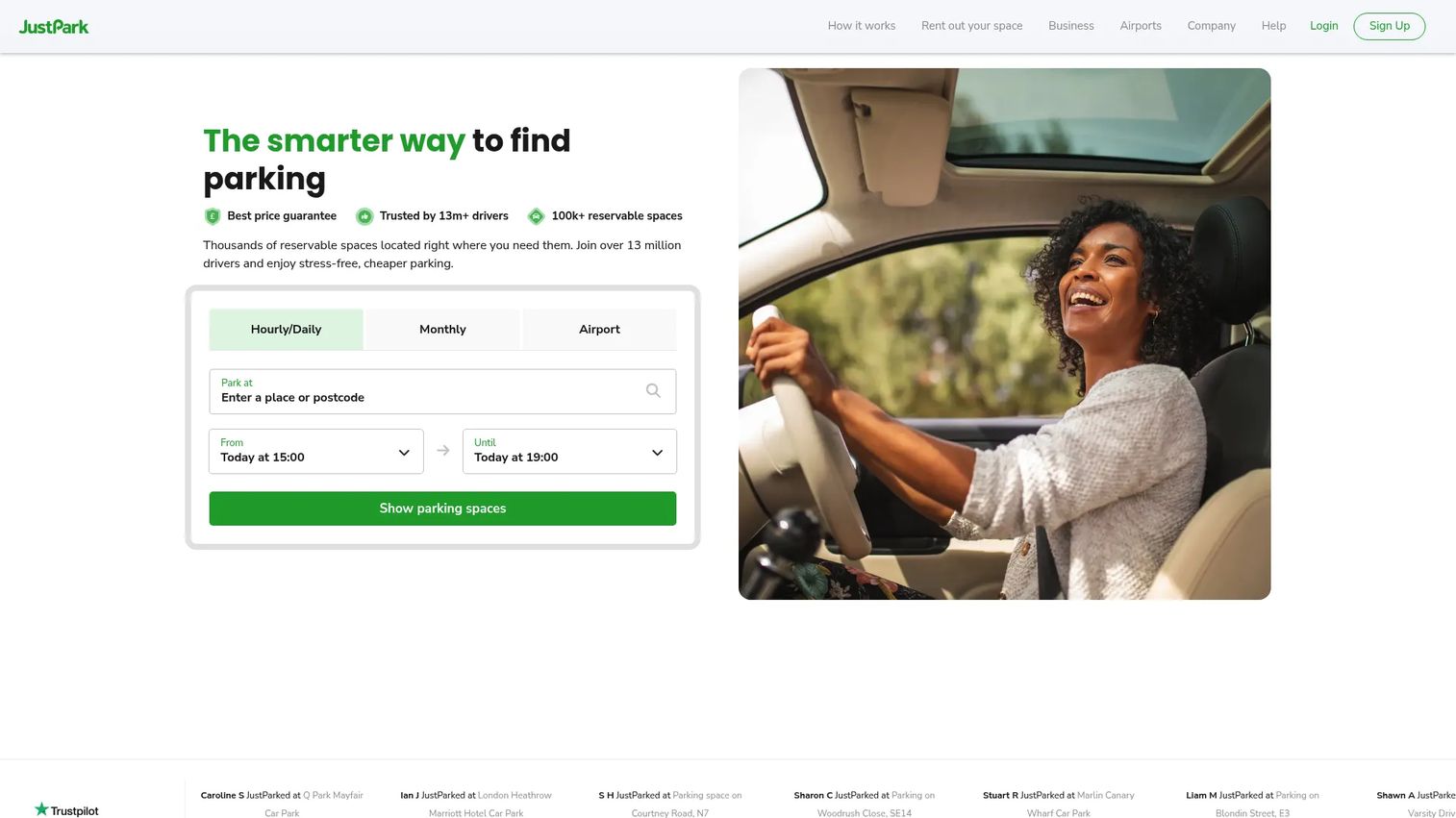
JustPark is a parking marketplace and operator platform aimed at public-facing inventory and monetization. It lets drivers pre-book parking, pay contactlessly via QR code or location ID, and gives operators dynamic pricing and automated yield management. For operators monetizing public or shared parking, JustPark combines demand generation with payment and booking workflows in a way internal permit tools do not.
The distinction matters. Where a permit platform manages who is allowed to park, JustPark manages who wants to park and how much they will pay. Its marketplace side brings drivers to your inventory, and its yield management adjusts pricing to demand, which is the core job for operators treating parking as revenue.
Best for: Drivers and parking operators needing reservation, payment, and event parking tools for public inventory.
Key strengths
- Pre-book reservations: Drivers reserve parking in advance, giving operators demand visibility and reducing turn-away.
- Contactless payments: QR-code and location-ID payments remove cash handling and speed up entry.
- Dynamic pricing: Automated yield management adjusts rates to demand, maximizing revenue per space.
Why choose JustPark: Choose JustPark when your parking is public-facing and revenue is the goal. Its marketplace demand generation is the differentiator: it does not just process payments, it helps fill spaces. That makes it a fit for garages, event venues, and destinations rather than internal employee or resident parking.
JustPark pricing: JustPark does not publish first-party pricing. The site uses demo and contact-sales flows rather than public plan prices, so operators should request a scoped quote. It carries a 4.3/5 rating on G2.
8. AirGarage
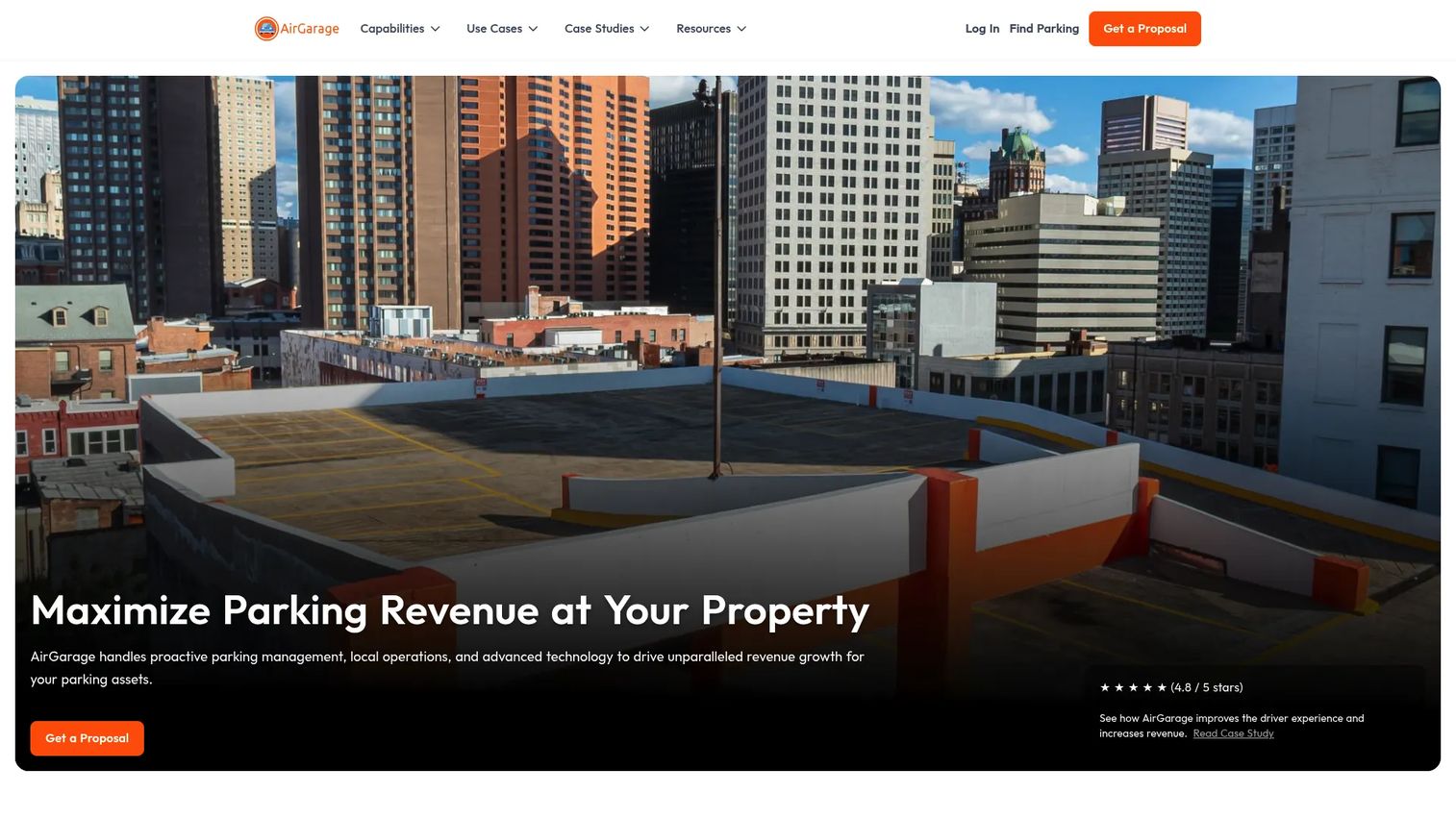
AirGarage is a revenue-focused, full-service parking management platform for property owners. It combines real-time occupancy tracking, dynamic pricing optimization, and on-the-ground enforcement and operations, positioning itself as an outsourced operator that layers technology on top. For garage and lot owners who want modernized payments and enforcement without running the operation themselves, AirGarage handles the whole stack.
The model is the differentiator. AirGarage is not just software you configure; it is a managed service with software underneath. Property owners get revenue optimization, enforcement, and operations as a package, which appeals to owners who want the upside of active parking management without the staffing headache. It holds a 4.9/5 rating on G2.
Best for: Property owners seeking outsourced parking operations with tech-enabled revenue optimization.
Key strengths
- Real-time occupancy tracking: Live occupancy data feeds pricing and operations decisions across managed lots.
- Dynamic pricing optimization: Automated pricing adjusts rates to demand to maximize revenue per space.
- On-the-ground enforcement: Managed enforcement and operations mean owners get compliance without staffing it themselves.
Why choose AirGarage: Pick AirGarage when you own a garage or lot and want revenue and operations handled end to end. It is the most hands-off option here for owners who want modernized payments, dynamic pricing, and enforcement as a managed package rather than software they operate alone.
AirGarage pricing: AirGarage does not publish public pricing. The site asks property owners to request a proposal, reflecting its managed-service model where cost depends on the property and revenue arrangement. Owners should request a proposal scoped to their location.
Considerations before you buy
The positive fit above tells you what each tool does well. This checklist tells you what to verify before you sign.
Match the tool to the parking model
The single biggest mistake is buying for the wrong model. A residential permit tool will frustrate a workplace, and a public-revenue platform is overkill for an HOA. Multifamily and campus buyers need permits and enforcement. Workplaces need reservations and allocation. Public garages need payments and yield management. Name your model first, then shortlist.
Check integration depth early
Software that cannot talk to your hardware creates a second manual workflow. Confirm integrations with gates, access control systems, LPR cameras, payment processors, security systems, and building management platforms before you commit. Ask for the specific vendor list, not a generic "we integrate with everything" claim.
Verify reporting before rollout
Useful reporting is not a single dashboard. It is occupancy, utilization, revenue, violations, visitor trends, and location comparisons that you can actually act on. Ask to see real reports during the demo, and confirm you can export the data. Reporting you cannot filter or export is decoration.
Confirm permit and approval workflows
If permits are your pain, scrutinize the workflow. Online registration, approval routing, guest passes, and exception handling all need to match how your team actually operates. A tool that forces every guest pass through a manager approval will stall a busy leasing office. Map your real workflow and confirm the software supports it.
Validate rollout effort and support
Ask how long implementation takes, what training admins need, and how ongoing support works. A platform that takes a quarter to stand up delays every benefit you bought it for. Get a realistic timeline, confirm what support tier you get, and talk to a reference customer with a similar property type.
Conclusion
The right parking software solution depends less on feature counts and more on your parking model. Match the platform to the job and the decision gets simple.
- For digital permits and enforcement, ParkingPass leads for multifamily and community teams, with Fresh USA the pick for RFID and access-control-first sites.
- For workplace parking, Parkable, Wayleadr, and WorkInSync cover reservations, allocation, and broader office coordination.
- For monetized public parking, JustPark and AirGarage focus on revenue, payments, and enforcement, with CloudEASE a cloud-based option for operators comparing G2-listed platforms.
Shortlist two or three tools that fit your property type, then pressure-test integrations, reporting, and rollout effort before you buy. The market is growing fast because these systems work, but only when the fit is right. Name your model, verify the workflows, and pick the one that removes the most manual admin from your team's day.
FAQs
It centralizes permits, vehicle access control, payments, occupancy tracking, and enforcement into one platform. Instead of running paper permits, spreadsheets, and manual gate operation separately, you manage the whole parking operation from a single dashboard, which cuts admin time and gives you real visibility into utilization and violations.
ParkingPass is the strongest fit for apartments and multifamily communities. It handles resident registration, guest parking, and LPR-based enforcement through a self-serve portal, which removes most of the permit admin from the leasing office. Wayleadr also works for multifamily properties that need centralized arrival and allocation management.
Parkable, Wayleadr, and WorkInSync all target workplace parking. Parkable leads for hybrid offices needing reservations, visitor parking, and access integrations. Wayleadr excels at automated allocation and EV charging rotation. WorkInSync fits enterprises that want parking managed alongside desk and room booking in one system.
Yes. Platforms like ParkingPass use license plate recognition to tie digital permits to real vehicles and run enforcement on verified reads. Fresh USA leans on RFID readers for hardware-linked access, and Parkable integrates with ANPR/LPR systems. Confirm the specific camera hardware each vendor supports during your evaluation.
Yes. Most platforms in this guide manage guest and visitor passes, and several process payments. ParkingPass tracks guest registration, Parkable handles in-app payments and infringements, and JustPark and AirGarage are built around contactless payment and revenue collection for public parking. Match the payment depth to whether parking is a cost recovery or a revenue line for you.
At minimum, verify support for gates and barriers, access control systems, LPR or RFID hardware, payment processors, and, for workplaces, building management or HR systems. Ask each vendor for a named integration list rather than accepting a generic claim, because a missing integration usually means a second manual workflow.
Start with your primary pain. If permit issuance, approvals, and enforcement are the bottleneck, a digital permit platform like ParkingPass fits best. If hardware-verified vehicle access and live occupancy on your own infrastructure matter most, an access-control-first tool like Fresh USA is the better match. Many sites need both, so confirm the platform covers your secondary need too.
Often yes, once manual admin outpaces the cost. A small lot running paper permits and a clipboard may not need software, but the moment reissuing lost permits, chasing guest parking, or resolving towing disputes eats staff time, a platform pays for itself. Tools like ParkingPass and Wayleadr Flex offer entry pricing that keeps smaller deployments affordable.