Good ideas are dying in your inbox right now.
They're buried in Slack threads, forgotten in spreadsheets, or sitting in a suggestion box nobody checks. Your organization generates ideas constantly - from employees, customers, and partners - but without a structured system to capture, evaluate, and act on them, most of those ideas simply disappear.
That's the problem idea management software solves. And in 2026, the innovation management software market size and growth has matured to the point where there's a credible option for every organization size, budget, and use case - from free tools for 50-person teams to enterprise platforms with AI-powered scoring and built-in consulting. Once you've selected the right ideas, showcasing them effectively matters too — tools like interactive demos can help teams communicate product concepts and proposed features to stakeholders in a tangible way.
What's inside
This guide covers the 15 best idea management platforms for 2026, evaluated across six criteria: idea capture channels, evaluation workflows, collaboration features, integrations, AI capabilities, and pricing transparency. Each tool is tagged with a "Best For" use case so you can self-select quickly. We also cover how to choose between platforms, what features actually matter, and where each tool falls short.
TL;DR
- Best for large-scale crowdsourcing: IdeaScale
- Best free option: Viima (free for up to 50 users)
- Best for product teams: Canny
- Best for enterprise innovation programs: HYPE Innovation
- Best for Microsoft 365 shops: Sideways 6
- Best for fast SMB setup: Ideanote
- AI capabilities - duplicate detection, auto-scoring, trend analysis - are now a meaningful differentiator between platforms, not a nice-to-have
What is idea management software?
Idea management software is a platform that captures, organizes, evaluates, and routes ideas from employees, customers, or external partners through a structured workflow - replacing ad-hoc methods like email chains, spreadsheets, and physical suggestion boxes.
Sometimes called an "ideation management software" or "idea management system," these platforms share a common core: a structured pipeline that takes raw submissions and moves them toward a decision. The best ones connect that pipeline directly to execution tools like Jira or project management platforms.
Core capabilities typically include:
- Idea capture: Web portals, email, mobile apps, Slack/Teams integrations, embeddable widgets
- Evaluation and scoring: Stage-gate workflows, weighted scoring matrices for idea evaluation, expert review panels, crowd voting
- Collaboration: Commenting, @mentions, challenge-based campaigns, gamification
- Prioritization: Configurable scoring, AI-assisted ranking, portfolio views
- Implementation handoff: Integration with project management tools, ROI tracking, status updates
According to McKinsey, organizations with formal innovation programs are 2.4 times more likely to report above-average revenue growth than those without structured processes. A dedicated idea management program is often the first step toward building that structure.
Below, we break down the 15 best idea management platforms for 2026 and what makes each one stand out.
Idea management vs. innovation management: what's the difference?
This distinction trips up a lot of buyers. Here's the short version: idea management is a subset of innovation management.
Think of idea management as the front end of the innovation funnel. It covers capturing raw ideas, evaluating them, and identifying which ones are worth pursuing. Innovation management software covers the full lifecycle - from ideation through prototyping, business case development, resource allocation, and market launch.
| Dimension | Idea Management | Innovation Management |
|---|---|---|
| Scope | Front-end ideation and evaluation | Full innovation pipeline |
| Focus | Capturing and prioritizing ideas | Executing ideas through to outcomes |
| Typical users | Employees, customers, innovation managers | R&D teams, product, strategy, C-suite |
| Example tools | Viima, Ideanote, Canny | Brightidea, HYPE, Qmarkets, Planbox |
Many platforms in this list span both categories. Brightidea, HYPE Innovation, and Qmarkets handle the full pipeline. Viima, Ideanote, and Canny are more focused on the ideation stage. Knowing which you need shapes your shortlist significantly. For product marketing teams specifically, the distinction matters because product-focused idea tools often integrate more tightly with roadmap and feature prioritization workflows.
How we evaluated and ranked these tools
These 15 platforms were evaluated across six criteria, with ratings from G2 software review ratings methodology, Capterra, and Gartner Peer Insights for innovation management software used as reference points alongside product research.
- Idea collection and capture channels - how many ways can people submit ideas, and how low is the friction?
- Evaluation and scoring workflows - how configurable are the review stages, scoring models, and approval chains?
- Collaboration and engagement features - commenting, gamification, campaigns, and community tools
- Integrations and ecosystem - Slack, Teams, Jira, Salesforce, and API access
- AI and automation capabilities - duplicate detection, trend analysis, auto-categorization, predictive scoring
- Pricing transparency and value - free tiers, published pricing, and value relative to features
Tools are not ranked in strict order of quality. Each is tagged with a "Best For" use case to help you self-select.
Quick comparison table - 15 best idea management software platforms
| # | Product | Intent | Key Differentiator | Pricing | G2 Rating |
|---|---|---|---|---|---|
| 1 | IdeaScale | Large-scale crowdsourcing | AI trend detection + government/enterprise scale | Custom (free community plan available) | 4.5/5 |
| 2 | Brightidea | End-to-end innovation pipeline | Full suite from idea to project execution | Custom enterprise | 4.3/5 |
| 3 | HYPE Innovation | Enterprise idea and innovation programs | Managed services bundled with software | Custom enterprise | 4.4/5 |
| 4 | Wazoku | Open innovation and external sourcing | External crowd-solving network | Custom | 4.3/5 |
| 5 | Qmarkets | Configurable workflows and governance | Granular stage-gate control + AI trend scouting | Custom enterprise | 4.4/5 |
| 6 | Planview IdeaPlace | Portfolio-level innovation management | Native PPM integration via Planview suite | Custom enterprise | 4.1/5 |
| 7 | Ideanote | Fast setup for SMB teams | Clean UI, quick onboarding, transparent pricing | Free tier; paid from ~$49/mo | 4.6/5 |
| 8 | Viima | Free idea management | Genuinely usable free plan for up to 50 users | Free ≤50 users; paid from ~$6/user/mo | 4.6/5 |
| 9 | Planbox | AI-driven agile innovation | Agile methodology built in + strong AI engine | Custom | 4.2/5 |
| 10 | InnovationCast | Community-driven innovation | Gamification and social engagement mechanics | Custom | 4.3/5 |
| 11 | Sideways 6 | Microsoft 365 and Teams integration | Native Teams/SharePoint capture, no separate login | Custom | 4.5/5 |
| 12 | edison365 | Microsoft-native innovation suite | End-to-end pipeline built on Azure/Power Platform | Per-user subscription | 4.4/5 |
| 13 | Medallia Ideas | Customer experience-driven ideation | Direct integration with Medallia CX data | Enterprise custom | 4.2/5 |
| 14 | ITONICS Innovation OS | Strategic foresight and trend management | Innovation radar + scenario planning layer | Custom enterprise | 4.5/5 |
| 15 | Canny | Product teams and feature request management | Public boards, changelog, roadmap - purpose-built for SaaS | Free tier; paid from $99/mo | 4.6/5 |
The 15 best idea management software platforms for 2026
Each platform below is reviewed for positioning, key strengths, ideal use case, and pricing. Honest trade-offs are included - because a tool that's wrong for your context is wrong, regardless of how good it is for someone else.
1. IdeaScale - best for large-scale crowdsourcing
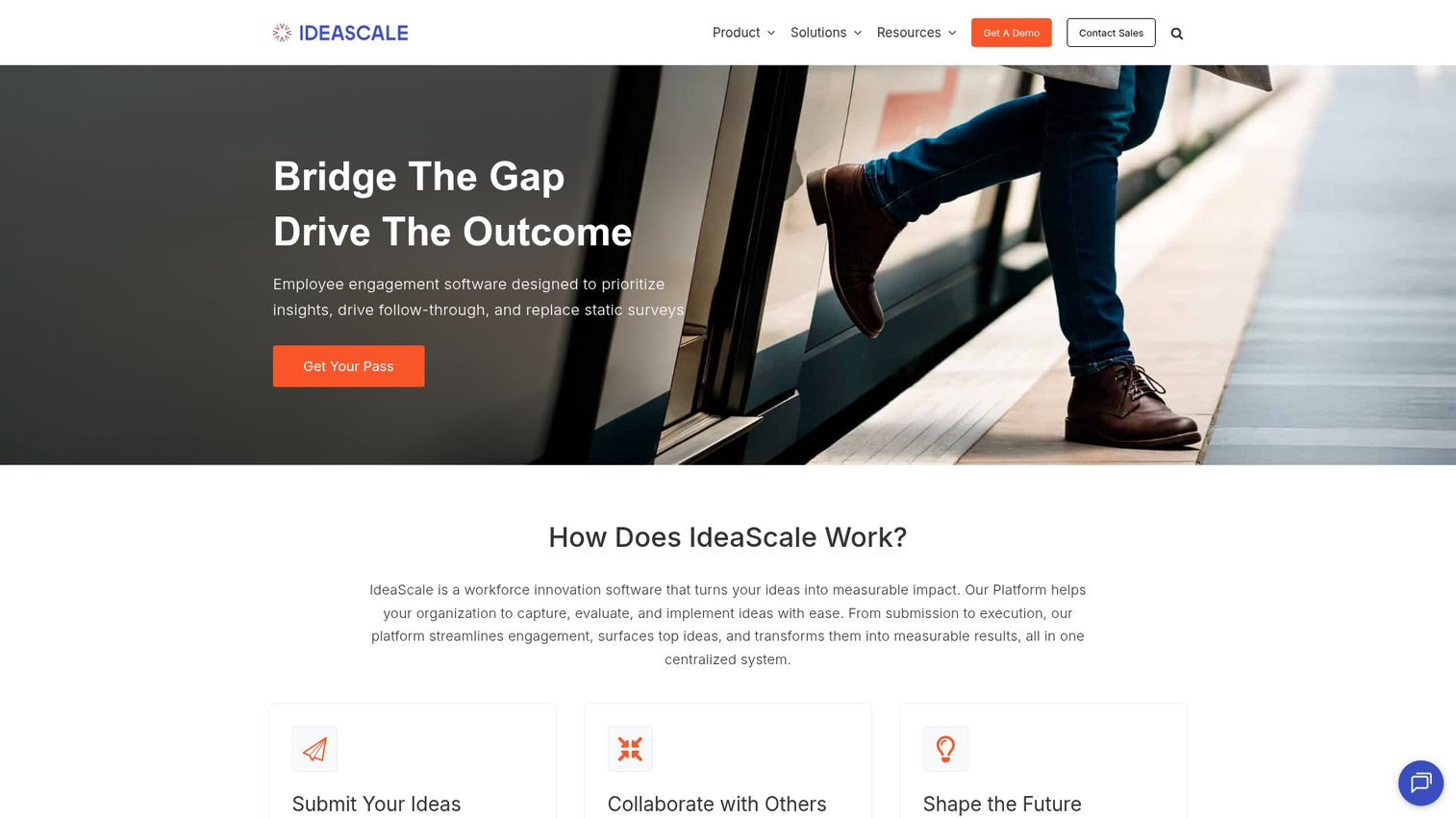
IdeaScale is one of the most established idea management platforms on the market, built specifically for organizations that need to run large-scale idea campaigns across thousands of participants.
Its crowdsourcing model works particularly well for government agencies, large enterprises, and organizations with distributed workforces. Notable customers include NASA uses IdeaScale for crowdsourced innovation and Marriott. The platform's AI engine handles duplicate idea detection, trend identification across submissions, and ROI tracking - capabilities that matter when you're managing thousands of ideas simultaneously rather than dozens.
The trade-off is complexity. IdeaScale's admin interface has a learning curve, and the UI feels dated compared to newer entrants. It's not the right choice for a 50-person team that needs something running by Friday.
Best for: Large enterprises and government organizations running high-volume idea campaigns
Key strengths
- AI-powered duplicate detection and trend analysis across large idea volumes
- Crowdsourced voting and community engagement at scale
- Salesforce, Jira, and Slack integrations
- ROI tracking and implementation reporting dashboards
- Government-grade security and compliance options
Pricing: Custom pricing; free community plan available for smaller programs
2. Brightidea - best for end-to-end innovation pipeline
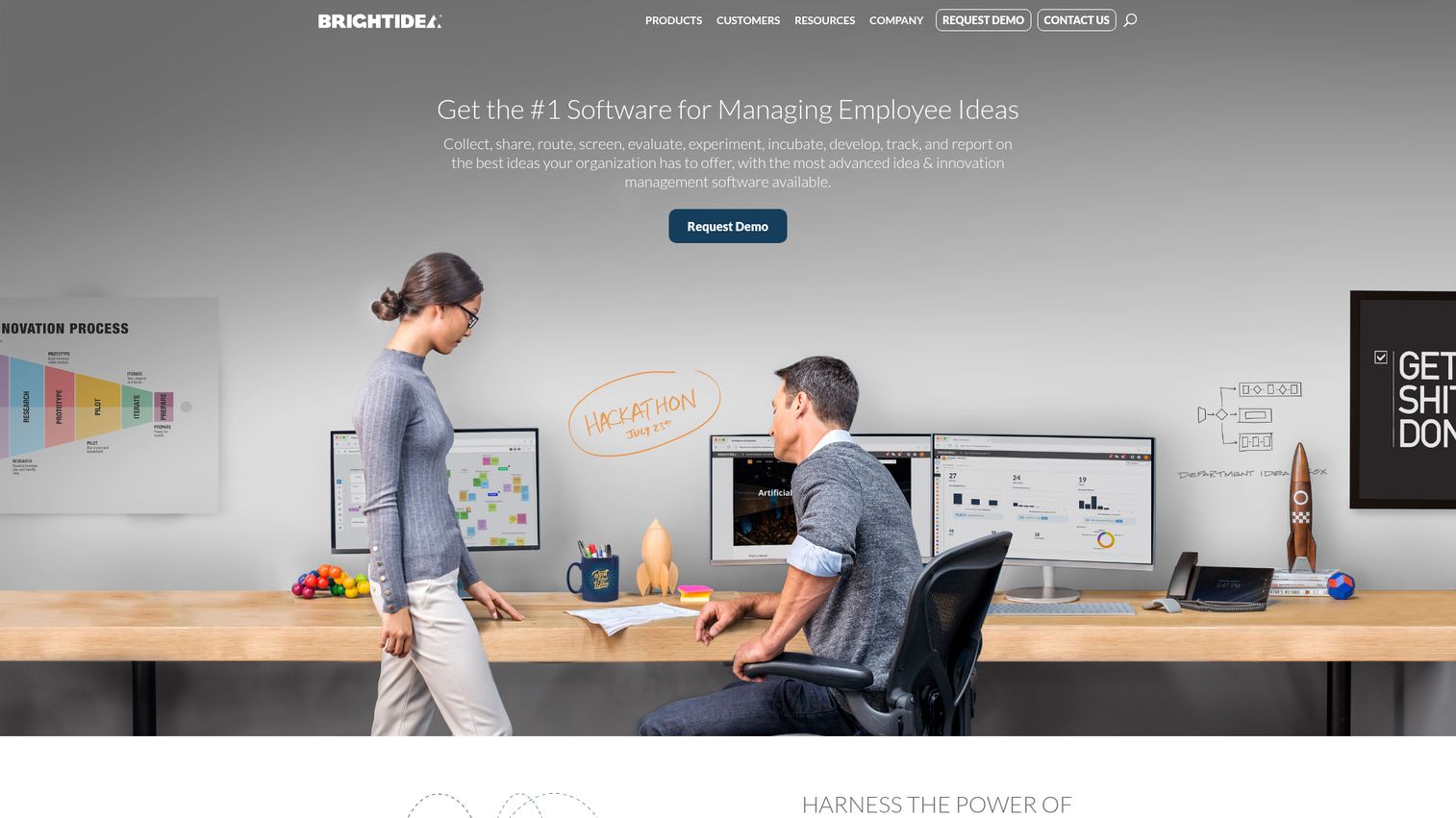
Brightidea positions itself as a full innovation management suite, not just an idea capture tool. It's one of the few platforms that genuinely covers the complete pipeline from initial submission through business case development to project execution.
The platform is built around four modules: Idea Box (capture), Whiteboard (collaborative ideation), Lab (experimentation), and Pipeline (execution tracking). That breadth is its main advantage - and its main limitation. If you only need idea capture and basic evaluation, Brightidea is more platform than you need, and the pricing reflects that.
For organizations that want a single system to manage the full innovation lifecycle without stitching together multiple tools, it's a strong option. The analytics and workflow engine are genuinely robust.
Best for: Mid-to-large enterprises that want one platform covering ideation through project delivery
Key strengths
- Four-module suite covering capture, collaboration, experimentation, and execution
- Robust workflow engine with configurable stage-gate processes
- Strong analytics and innovation funnel reporting
- Integration with project management and PPM tools
- Established customer base across Fortune 500 companies
Pricing: Custom enterprise pricing; contact for quote
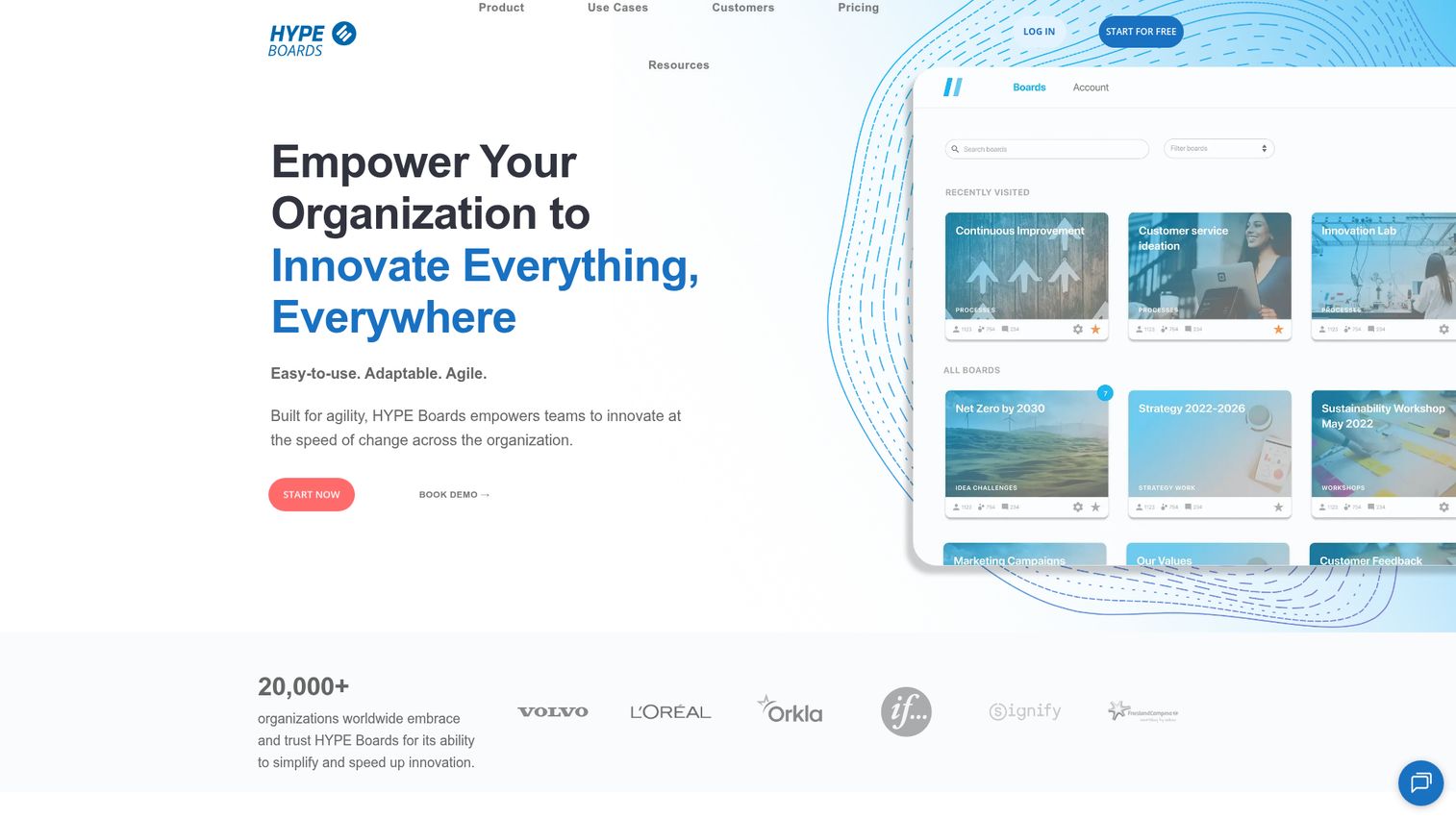
3. HYPE Innovation - best for enterprise idea and innovation programs
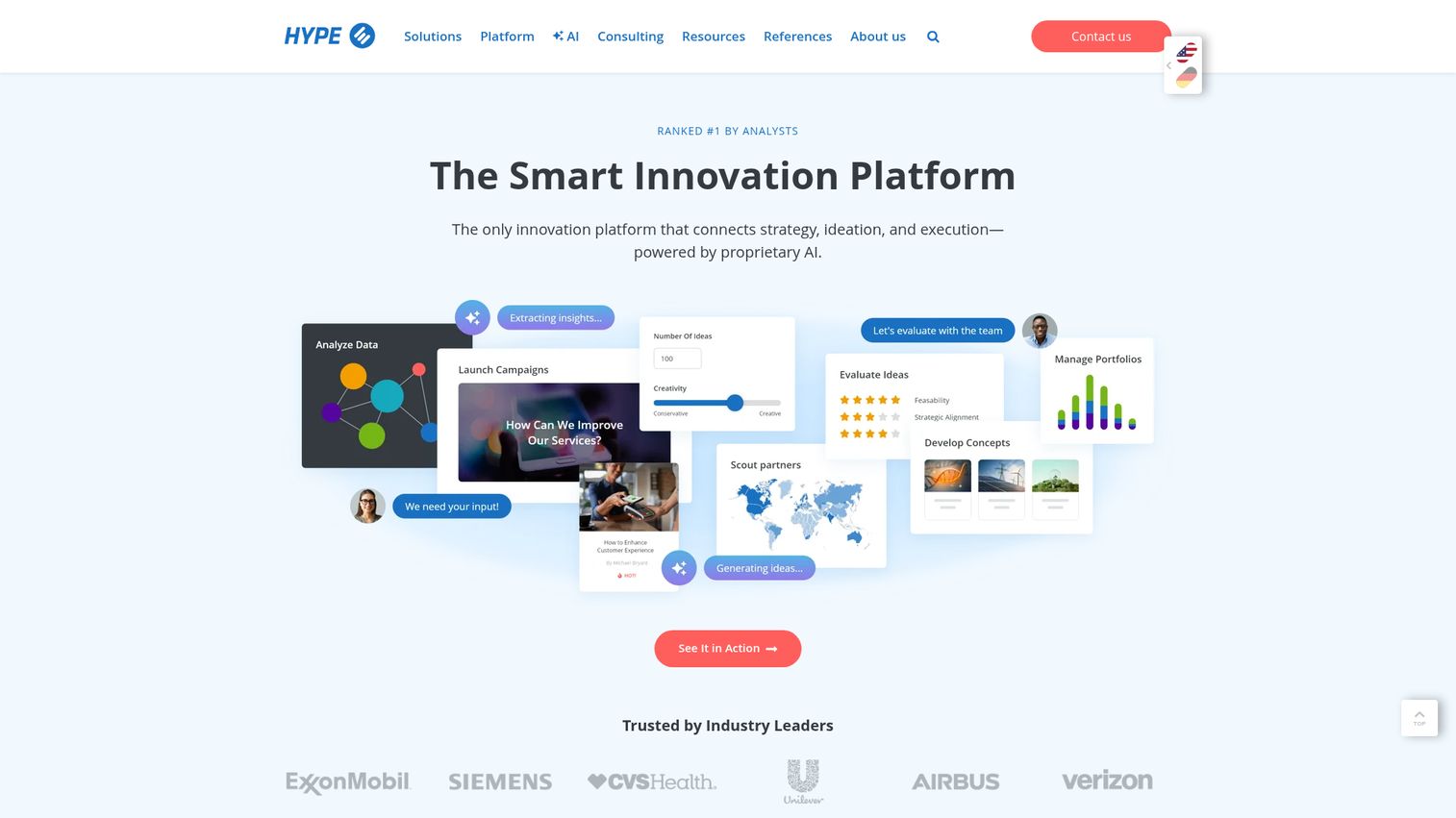
HYPE Innovation has been in the market since 2001, which gives it a depth of methodology that newer platforms can't match. The platform covers idea campaigns, structured evaluation workflows, and AI-assisted idea scoring - but the real differentiator is the managed services layer.
HYPE bundles innovation consultants alongside the software. You're not just buying a platform; you're buying access to practitioners who help you design campaigns, train facilitators, and build the internal processes that make idea management programs actually work. For organizations that have tried and failed with self-serve tools, that consulting layer is often what makes the difference.
The downside is cost and fit. HYPE is not suited for SMBs or teams looking for a quick deployment. If you're a 50-person startup, this is the wrong tool. If you're a 5,000-person enterprise building a formal innovation program, it's worth a serious look.
Best for: Large enterprises that want software plus strategic consulting support
Key strengths
- AI-assisted idea scoring and evaluation workflows
- Innovation consulting services bundled with the platform
- Configurable campaign types for different innovation challenges
- Strong methodology framework built on 20+ years of practice
- Enterprise-grade security and compliance
Pricing: Custom enterprise pricing; contact for quote
4. Wazoku - best for open innovation and external idea sourcing
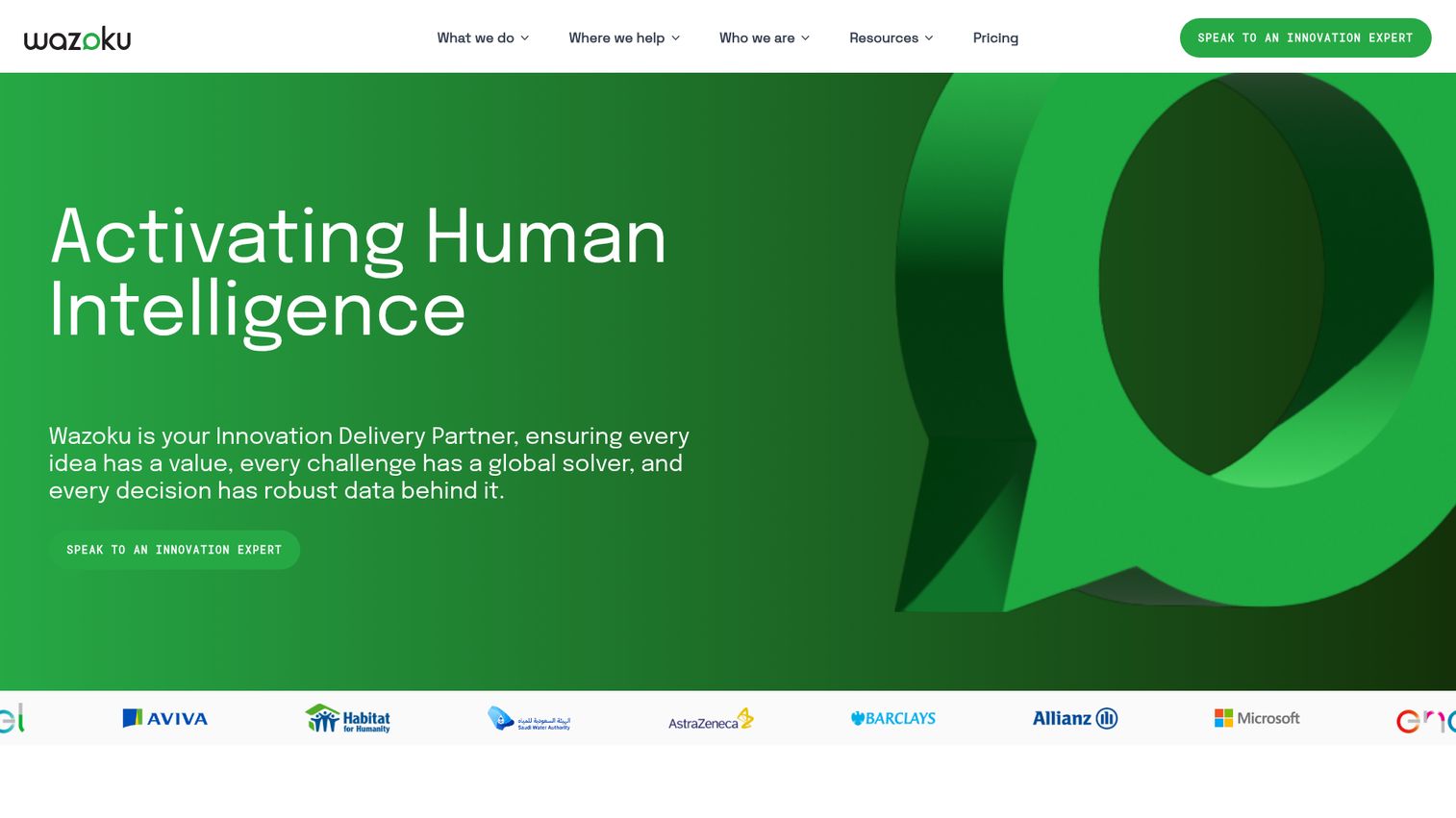
Wazoku occupies a specific niche: organizations that want to source ideas not just from employees but from external solvers, startups, academic institutions, and the broader public. That open innovation model for external idea sourcing is where it genuinely stands out.
The platform combines an internal idea management module (Idea Spotlight) with an external challenge platform that connects organizations to a network of external problem-solvers. If your innovation strategy involves crowdsourcing ideas from outside your organization's walls, Wazoku is one of the few platforms built specifically for that model.
For purely internal use cases, it's less intuitive than purpose-built internal tools. The external network is the differentiator - without it, you're paying for capabilities you can get elsewhere at lower cost.
Best for: Organizations running open innovation challenges with external participants
Key strengths
- Dedicated open innovation module connecting to external solver networks
- Internal idea management via Idea Spotlight module
- Challenge-based campaign model for structured problem-solving
- Collaboration tools for cross-organizational idea development
- Track record with large enterprises and public sector organizations
Pricing: Custom pricing; contact for quote
5. Qmarkets - best for configurable workflows and governance
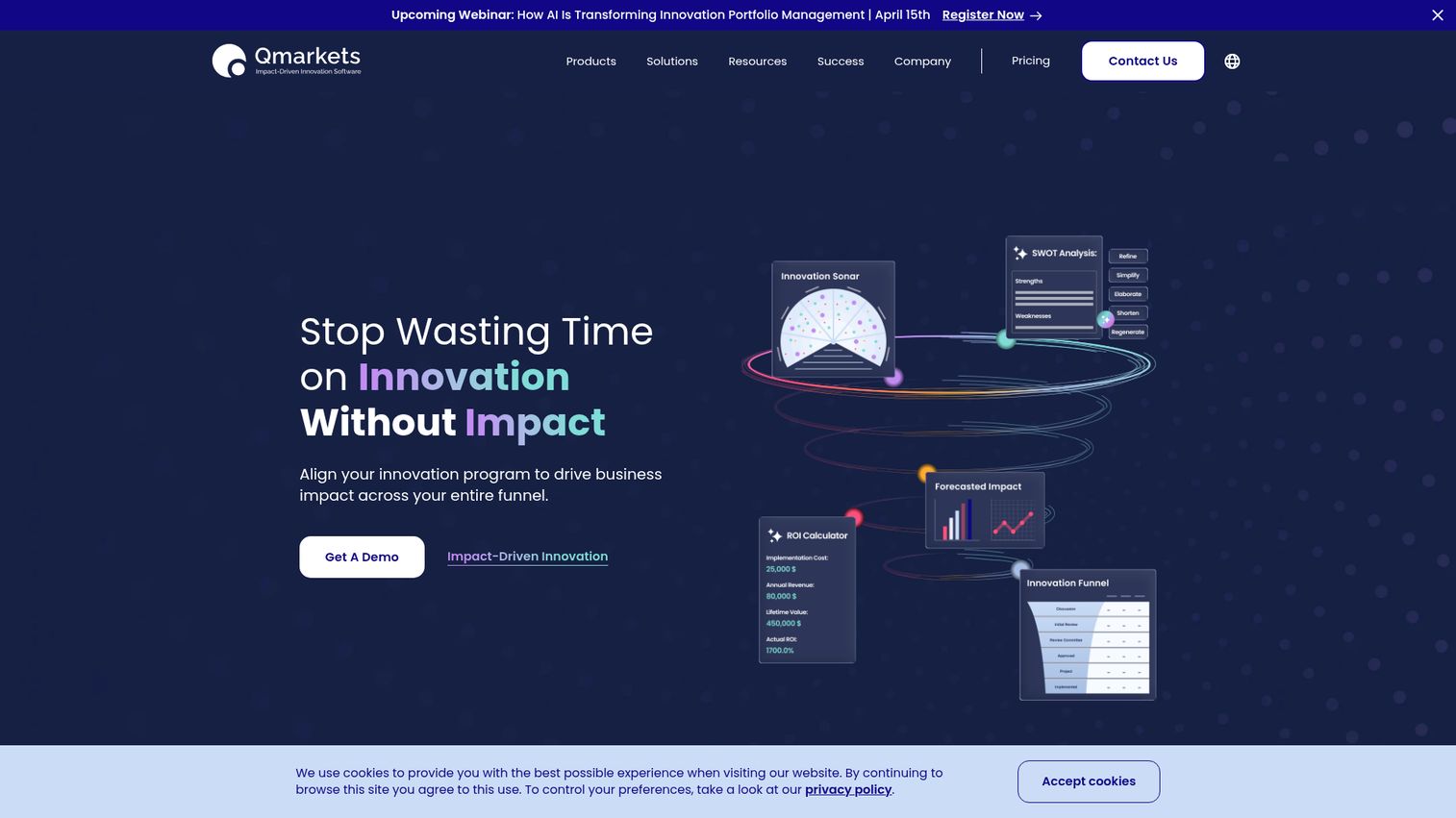
Qmarkets is the right choice when your organization has complex approval chains, compliance requirements, or governance structures that off-the-shelf workflows can't accommodate.
The platform's three core modules - Q-ideate (idea management), Q-trend (technology and trend scouting), and Q-pilot (agile innovation) - can be deployed independently or together. The stage-gate process engine is genuinely granular: you can configure who reviews what, at which stage, under which conditions, with which scoring criteria. That level of control is rare.
The AI trend scouting module is one of the more sophisticated implementations in the market, scanning external sources to surface emerging trends relevant to your innovation priorities. Setup complexity is the honest trade-off - this platform rewards organizations that invest in configuration. Teams evaluating Qmarkets alongside competitive intelligence tools will find its trend scouting module overlaps with some of that category's functionality.
Best for: Enterprises with complex governance requirements and multi-stage approval processes
Key strengths
- Highly configurable stage-gate workflow engine
- AI-powered trend scouting via Q-trend module
- Three deployable modules covering ideation, trends, and agile pilots
- Strong compliance and audit trail features
- Supports both internal and open innovation programs
Pricing: Custom enterprise pricing; contact for quote
6. Planview IdeaPlace - best for portfolio-level innovation management
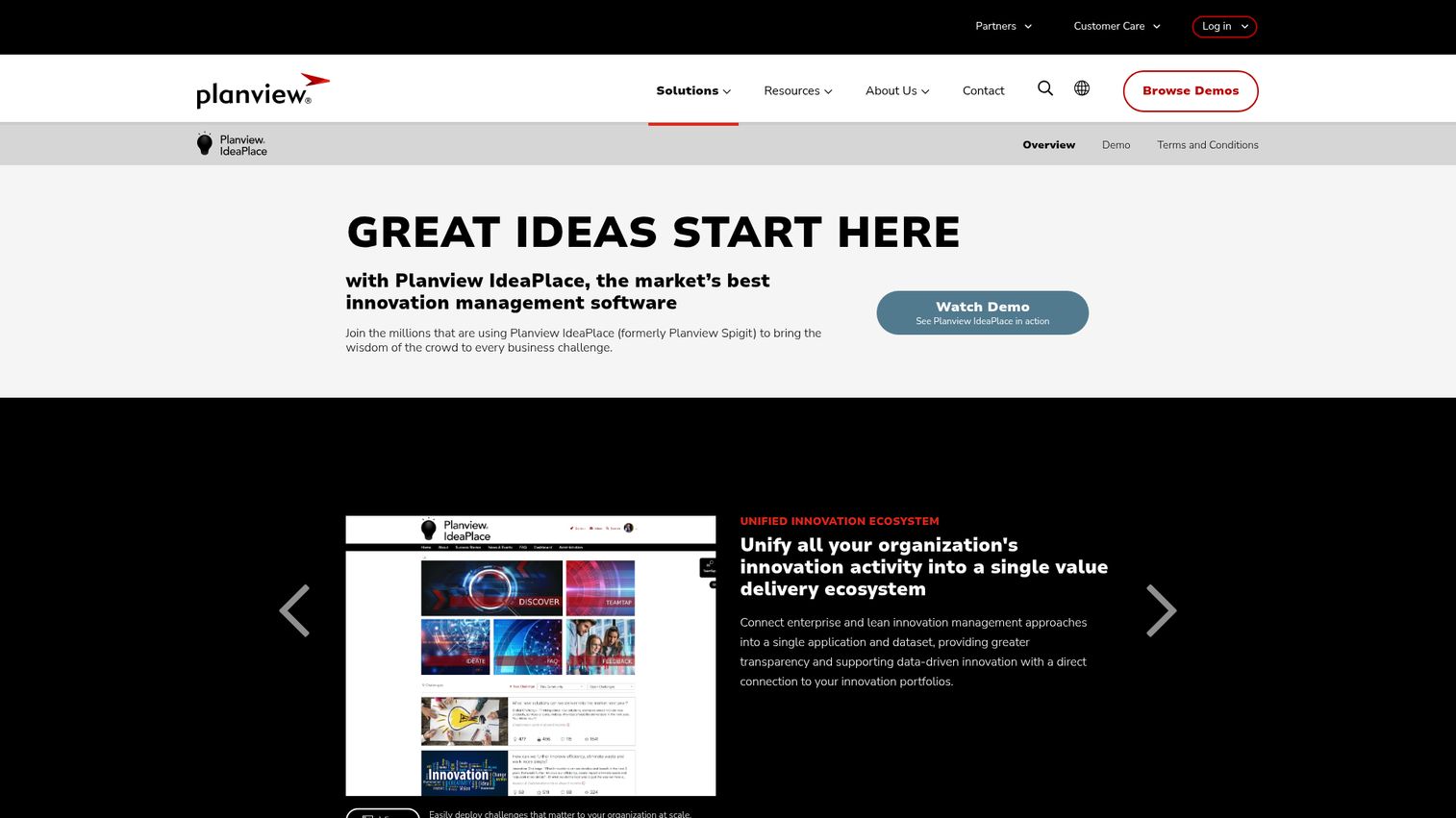
Planview IdeaPlace makes the most sense if your organization already uses Planview's portfolio and project management tools. The integration between IdeaPlace and Planview Portfolios means winning ideas can flow directly into resource planning and project execution without manual handoffs.
The challenge-based ideation model works well for organizations that want to focus idea generation around specific strategic priorities rather than running always-on suggestion programs. The scoring and evaluation tools are solid, and the analytics connect innovation activity to portfolio-level outcomes.
The honest limitation: if you're not already in the Planview ecosystem, the value proposition weakens considerably. You're essentially buying into a suite, not just an idea management tool.
Best for: Organizations already using Planview for portfolio and project management
Key strengths
- Native integration with Planview Portfolios for resource allocation
- Challenge-based ideation model for strategic focus
- Idea scoring and evaluation connected to portfolio metrics
- Enterprise-scale deployment and security
- Reporting that connects innovation activity to business outcomes
Pricing: Custom enterprise pricing; contact for quote
7. Ideanote - best for fast setup and SMB teams
Ideanote is the clearest option for small-to-mid-size teams that need a working idea management program without a six-week implementation project. The UI is clean, the onboarding is fast, and the pricing is transparent - three things that matter when you're not running a dedicated innovation department.
The platform covers idea collection widgets, voting, phase-based workflows, goal tracking, and a solid template library. It's not going to replace a full enterprise innovation suite for a 10,000-person organization, but that's not what it's trying to do.
For teams between 10 and 500 people that want to move from spreadsheets to a structured idea management system quickly, Ideanote is one of the most practical choices on this list. The free tier is limited but functional enough to validate whether the approach works for your team before committing. If you're also evaluating tools for user onboarding, Ideanote's simplicity mirrors the low-friction philosophy that the best onboarding platforms share.
Best for: SMB teams and departments that need a structured idea management tool without enterprise complexity
Key strengths
- Fast setup with pre-built templates and guided onboarding
- Clean, intuitive interface with low training overhead
- Idea collection widgets embeddable in existing tools
- Phase-based workflows for moving ideas through evaluation
- Transparent tiered pricing with a usable free tier
Pricing: Free tier available; paid plans from approximately $49/month
8. Viima - best free idea management tool
Viima offers the most genuinely usable free plan in this category. Up to 50 users can access the full core feature set at no cost - not a crippled trial, but a working idea management system with idea boards, commenting, evaluation, and basic analytics.
The visual innovation funnel is one of the more intuitive interfaces in the market, making it easy for non-technical users to understand where ideas stand in the process. For small teams, pilot programs, or organizations that want to test structured idea management before committing budget, Viima is the obvious starting point.
The limitations are real at scale. Integration depth is thinner than enterprise platforms, the scoring system is less configurable than Qmarkets or Brightidea, and the analytics don't go deep enough for large programs. But for what it costs - nothing, for most small teams - it's hard to argue against starting here.
Best for: Small teams, pilot programs, and any organization that wants to test idea management before investing in an enterprise platform
Key strengths
- Genuinely usable free plan for up to 50 users
- Visual innovation funnel that's easy for non-technical users
- Idea boards, commenting, and evaluation in the free tier
- Low barrier to entry for first-time idea management programs
- Paid plans available as teams grow beyond 50 users
Pricing: Free for up to 50 users; paid plans from approximately $6/user/month
9. Planbox - best for AI-driven agile innovation
Planbox is built around two things that most idea management platforms treat as separate concerns: agile methodology and AI-powered analysis. The platform bakes agile innovation methodology for enterprise teams directly into the workflow, which means ideas don't just get evaluated - they get moved through sprint-style cycles with clear ownership and timelines.
The AI engine handles duplicate detection, idea scoring based on configurable criteria, and trend analysis across submissions. The hackathon module is a practical differentiator for organizations that run time-boxed innovation events alongside always-on programs.
The learning curve is steeper than simpler tools, and the pricing is enterprise-focused. Teams that don't already have some familiarity with agile frameworks may find the methodology layer more friction than value.
Best for: Organizations that want to apply agile principles to their innovation pipeline
Key strengths
- Agile innovation methodology built into the platform workflow
- AI-powered duplicate detection, scoring, and trend analysis
- Challenge-based campaigns and hackathon modules
- Sprint-style execution tracking for approved ideas
- Configurable evaluation criteria and scoring models
Pricing: Custom pricing; contact for quote
10. InnovationCast - best for community-driven innovation
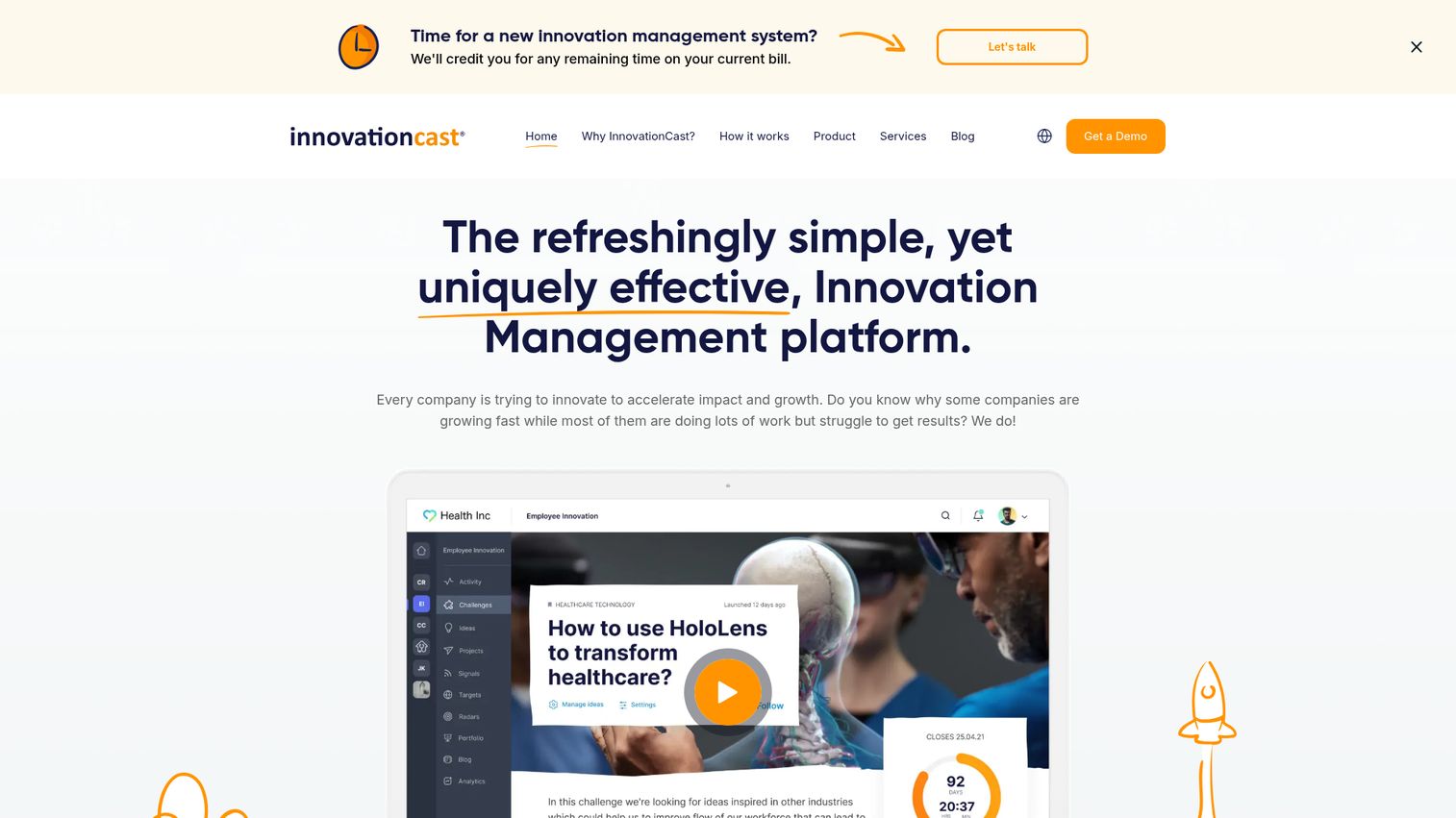
InnovationCast focuses on the engagement problem that kills most idea management programs: participation drops off after the initial launch. The platform's gamification increases employee engagement in innovation programs - points, badges, leaderboards, and social features - are among the most developed in this category.
The community management tools help innovation managers run campaigns, recognize contributors, and maintain momentum over time. Collaborative evaluation features let participants build on each other's ideas rather than just voting up or down. Implementation tracking closes the loop by showing contributors what happened to their ideas. Organizations that also invest in community management software alongside InnovationCast often see higher sustained participation rates.
The trade-off is market presence. InnovationCast is a smaller player than IdeaScale or Brightidea, which means fewer third-party integrations and a smaller community of practice to draw on. For organizations where employee engagement is the primary challenge, that trade-off is worth making.
Best for: Organizations where employee participation and sustained engagement are the primary challenge
Key strengths
- Gamification mechanics including points, badges, and leaderboards
- Social features that encourage collaborative idea development
- Community management tools for campaign facilitation
- Implementation tracking that closes the feedback loop with contributors
- Collaborative evaluation beyond simple voting
Pricing: Custom pricing; contact for quote
11. Sideways 6 - best for Microsoft 365 and Teams integration
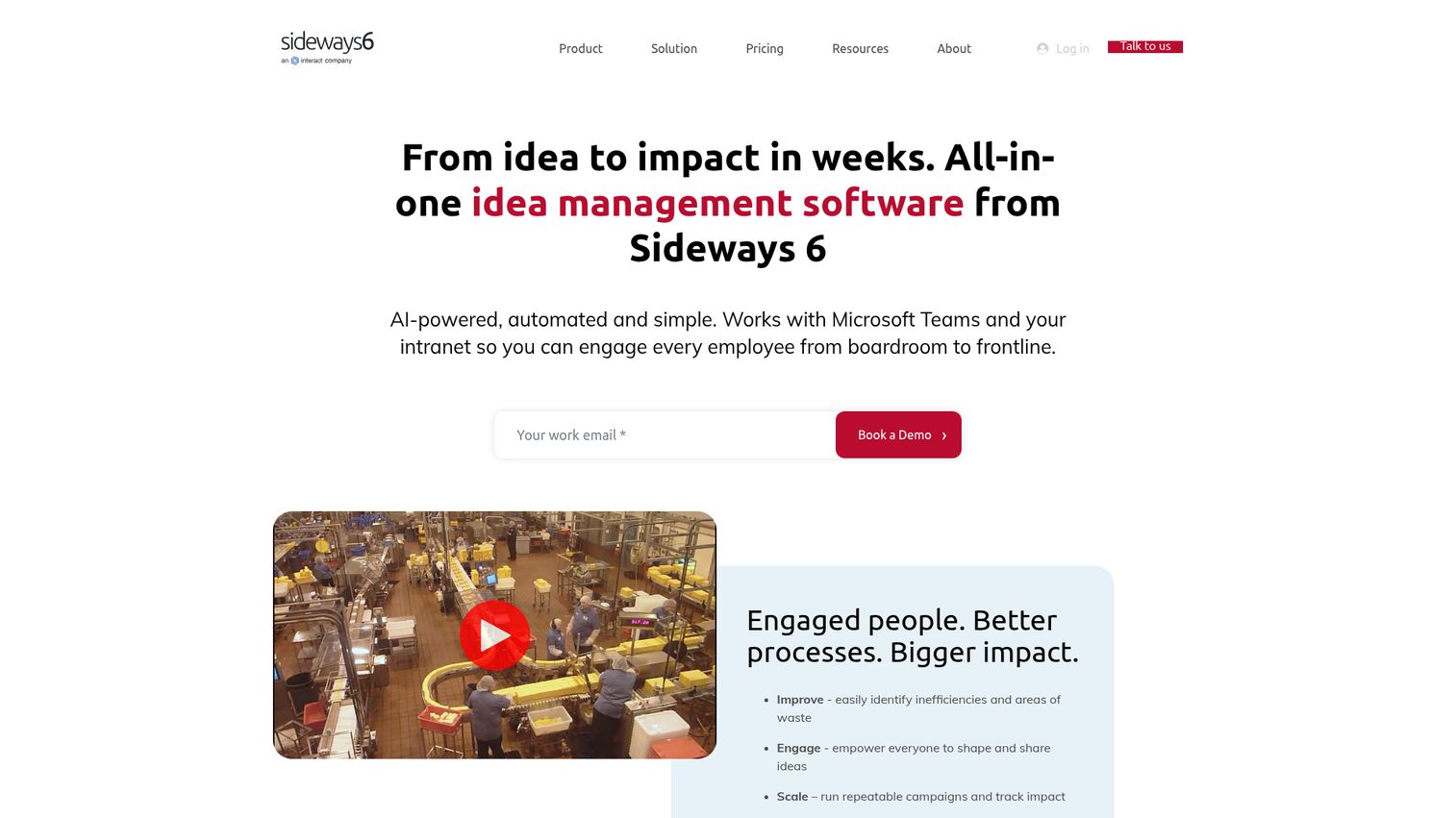
Sideways 6 solves the adoption problem by meeting employees where they already work. The platform integrates natively with Microsoft Teams, SharePoint, and Yammer - meaning employees can submit ideas without logging into a separate system or learning a new interface.
That zero-friction submission model is the core differentiator. Adoption rates for idea programs tend to drop sharply when employees have to context-switch to a dedicated tool. Sideways 6 removes that barrier entirely for Microsoft-heavy organizations.
The limitation is equally clear: if your organization isn't deeply embedded in Microsoft 365, the value proposition largely disappears. It's not a general-purpose idea management platform - it's a Microsoft-native one.
Best for: Organizations running Microsoft 365 and Teams as their primary collaboration infrastructure
Key strengths
- Native integration with Microsoft Teams, SharePoint, and Yammer
- Idea capture within tools employees already use daily
- No separate login required for contributors
- Reduces adoption friction common in standalone idea management tools
- Campaign management and evaluation within the Microsoft environment
Pricing: Custom pricing; contact for quote
12. edison365 - best for Microsoft-native innovation suite
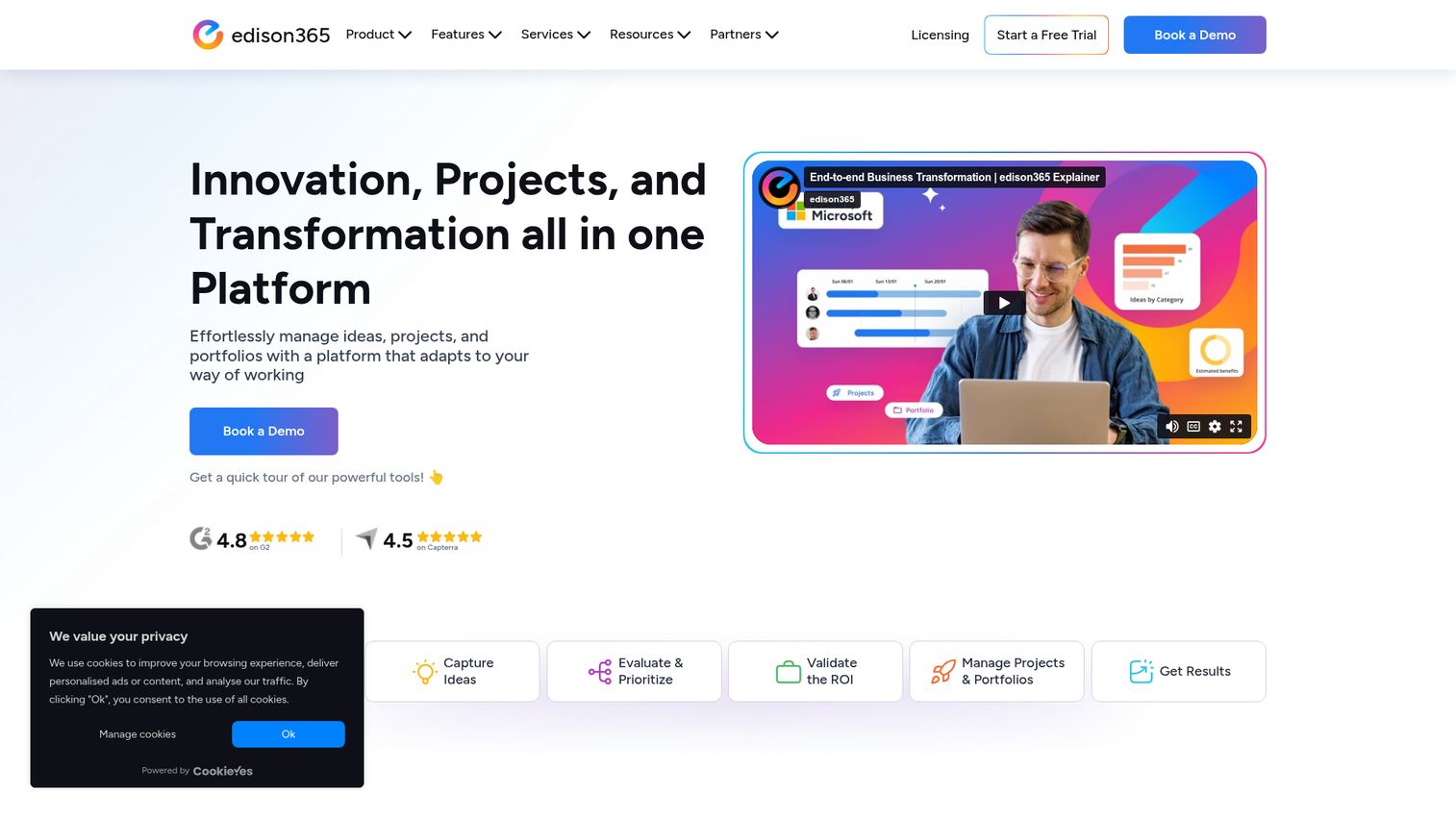
edison365 takes the Microsoft-native approach further than Sideways 6 by covering the full innovation pipeline - not just idea capture. Built on Microsoft Azure and the Power Platform, it connects ideation (edison365ideas), business case development (edison365businesscase), and project delivery (edison365projects) in a single suite.
For organizations that want end-to-end innovation management without leaving the Microsoft ecosystem, this is the most complete option available. The Azure foundation means it fits naturally into existing enterprise security and compliance frameworks.
The requirement for Microsoft 365 is a genuine constraint. Organizations on Google Workspace or with mixed environments will find the integration story significantly weaker.
Best for: Microsoft 365 organizations that want end-to-end innovation management without leaving the Microsoft stack
Key strengths
- Three-module suite covering ideas, business cases, and project delivery
- Built on Microsoft Azure and Power Platform
- Native Microsoft 365 integration across the full pipeline
- Fits existing enterprise security and compliance frameworks
- Per-user subscription model with transparent pricing structure
Pricing: Per-user subscription; contact for current rates
13. Medallia Ideas - best for customer experience-driven ideation
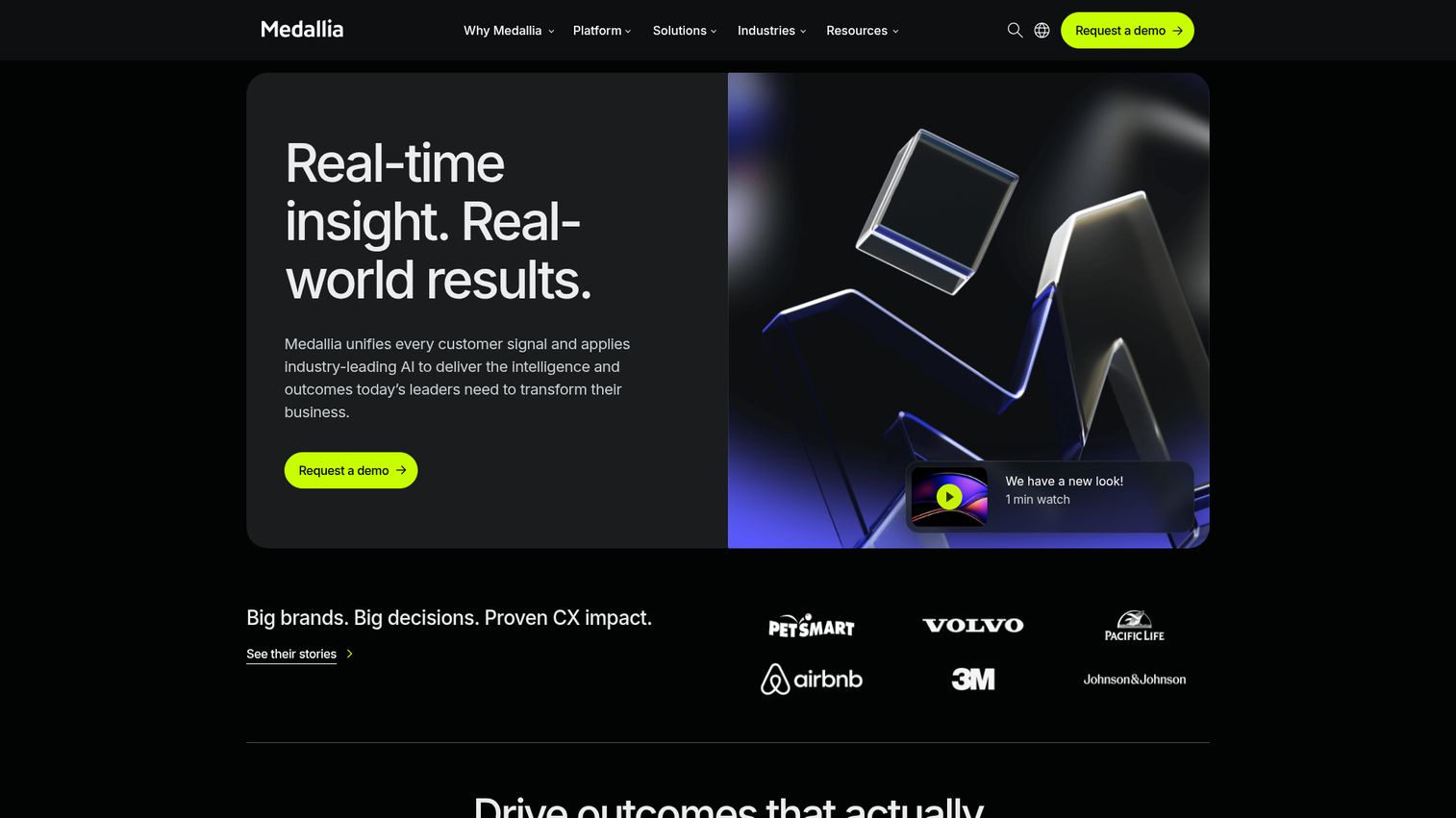
Medallia Ideas makes the most sense for organizations already using Medallia's customer experience platform. The integration between customer feedback signals and internal idea generation is the core differentiator - ideas can be triggered directly by patterns in CX data rather than relying solely on manual submissions.
The AI text analytics layer can surface themes from unstructured customer feedback and route them into the idea pipeline. That connection between what customers are saying and what employees are working on is genuinely valuable for product and service innovation teams. Teams focused on understanding customer behavior may also benefit from pairing this with dedicated customer journey analytics software.
The honest limitation: if you're not using Medallia for CX, this tool is overkill. You'd be buying into a large enterprise suite to access one module. For Medallia customers, it's a natural extension.
Best for: Organizations using Medallia for customer experience management who want to connect CX insights to internal innovation
Key strengths
- Direct integration with Medallia's customer experience data
- AI text analytics for extracting themes from unstructured feedback
- Employee and customer idea capture in a unified system
- Connects CX signals to internal innovation workflows
- Enterprise-grade security and compliance within the Medallia platform
Pricing: Enterprise custom pricing as part of Medallia suite; contact for quote
14. ITONICS Innovation OS - best for strategic foresight and trend management
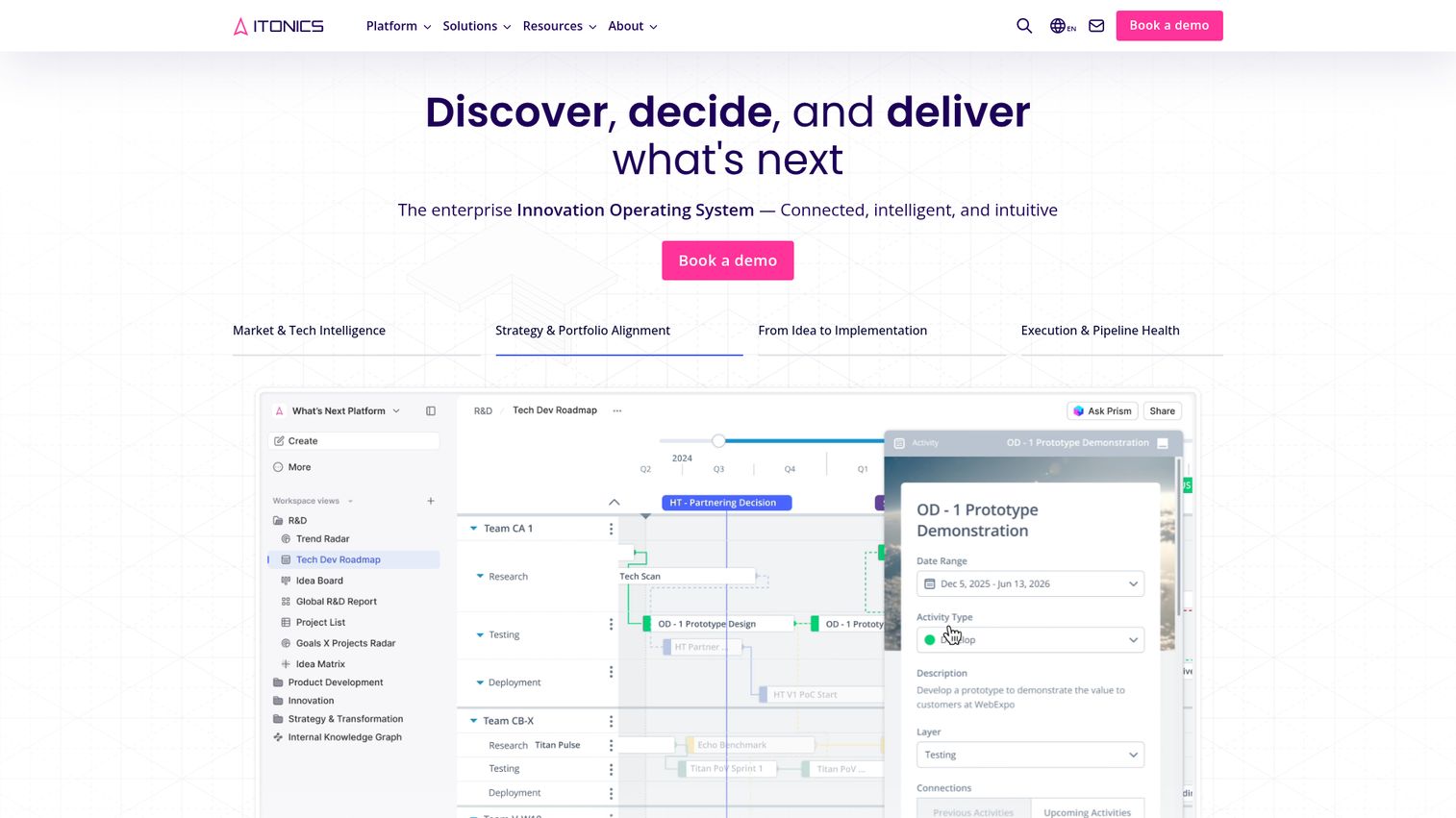
ITONICS Innovation OS is the only platform on this list that combines idea management with strategic foresight tools. The innovation radar, technology scouting module, and scenario planning capabilities go well beyond what most idea management platforms offer.
For R&D teams and strategy functions that need to connect internal ideation to external trend signals, ITONICS provides a layer that pure idea management tools don't have. The portfolio management view lets teams see how their idea pipeline aligns with strategic priorities and emerging market trends simultaneously.
The trade-off is scope. If you just need to capture and evaluate employee ideas, ITONICS is more platform than you need. It's designed for organizations that treat innovation as a strategic function, not just an HR engagement program.
Best for: R&D and strategy teams that need to connect internal ideation to external trend intelligence
Key strengths
- Innovation radar for visualizing technology and market trends
- Technology scouting and trend monitoring capabilities
- Scenario planning tools for strategic alignment
- Idea campaign management connected to strategic priorities
- Portfolio view linking ideas to business strategy
Pricing: Custom enterprise pricing; contact for quote
15. Canny - best for product teams and feature request management
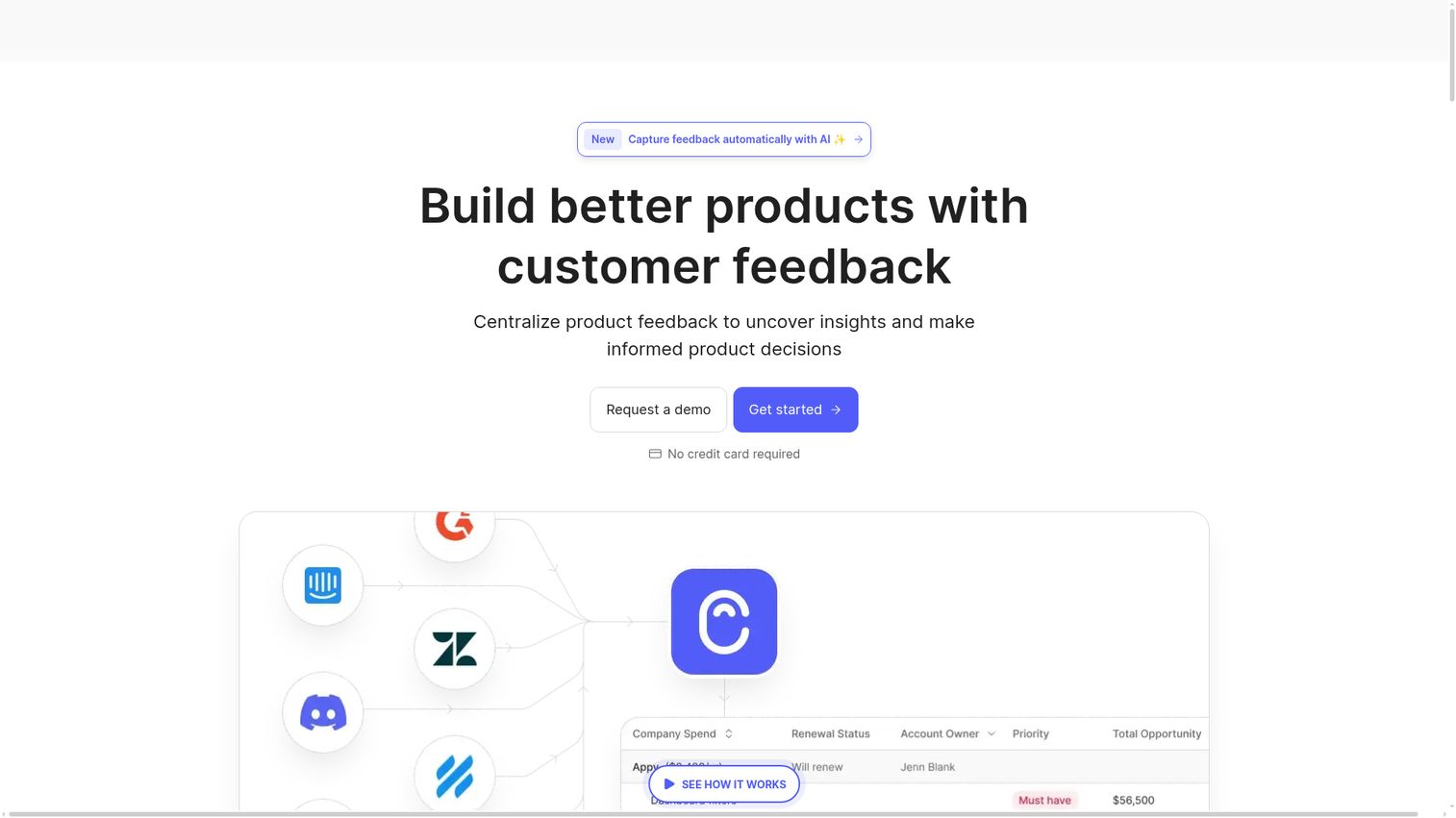
Canny is purpose-built for SaaS product teams managing feature requests from customers. It's not an enterprise innovation platform - and it doesn't try to be. What it does, it does better than most tools in this list: collect, organize, and prioritize product feedback from users in a transparent, structured way.
Public idea boards let customers submit and vote on feature requests. Status updates and a changelog close the feedback loop. Integrations with Jira, Asana, and Linear connect prioritized ideas directly to the development workflow. The public-facing boards also serve as a trust signal to customers - they can see that their feedback is being heard and acted on. Product teams using Canny often pair it with product analytics software to validate which requested features align with actual user behavior data.
The limitation is scope. Canny is a product idea management tool, not an enterprise-wide innovation platform. If you need to run company-wide idea campaigns, manage complex approval chains, or connect ideation to portfolio management, you'll outgrow it quickly.
Best for: SaaS product teams managing customer feature requests and product roadmap prioritization
Key strengths
- Public and private idea boards with customer voting
- Status updates and changelog to close the feedback loop
- Native integrations with Jira, Asana, and Linear
- Transparent roadmap view for customers and internal teams
- Clean, modern UI with low onboarding friction
Pricing: Free tier available; paid plans from $99/month
Honorable mentions - other idea management platforms worth exploring
These platforms didn't make the top 15 but are worth knowing about depending on your specific context.
- AEVO Innovate - Brazilian-market focused platform with strong Portuguese-language support; good fit for Latin American enterprises
- Bloomflow - startup-focused open innovation platform connecting corporates with external startups and scale-ups
- Nosco Idea Platform - Scandinavian platform with a clean interface and strong employee engagement focus
- innosabi - German platform specializing in co-creation and open innovation with external communities
- Ideawake - SMB-friendly platform with transparent pricing and a focus on employee-driven continuous improvement
- Braineet - innovation management platform with strong visual design and a focus on intrapreneurship programs
- Agorize - challenge-based open innovation platform connecting organizations with student and startup communities
- CogniStreamer - Belgian platform focused on structured innovation processes for mid-market organizations
- Rever - continuous improvement platform specifically designed for frontline workers and operational teams
- Exago - Portuguese platform with strong multilingual support and a focus on employee idea programs
- Traction Platform - North American platform with a focus on connecting ideas to strategic business outcomes
- Teams Ideas - Microsoft's native lightweight idea collection feature within Teams; suitable for very basic use cases before investing in a dedicated platform
Key features to look for in idea management software
Knowing which tools exist is one thing. Knowing which features actually matter for your context is what separates a good shortlist from a bad one.
Multi-channel idea capture
The best idea management platforms meet people where they already work. Look for email submission, web portals, mobile apps, Slack and Teams integrations, and embeddable widgets. Every additional step between "I have an idea" and "I submitted an idea" reduces participation rates. This same principle of reducing friction applies across software categories — it's why digital adoption platforms focus so heavily on in-app guidance.
Evaluation and scoring workflows
Raw idea volume is not the goal. You need a structured way to evaluate which ideas are worth pursuing. Look for configurable stage-gate innovation process framework, weighted scoring criteria, expert review panels, and crowd voting mechanisms. The more configurable the workflow, the better it fits complex organizational structures.
AI-powered analysis
In 2026, AI capabilities are a genuine differentiator between platforms. Duplicate idea detection prevents redundant submissions from cluttering the pipeline. Automatic categorization reduces admin overhead. Sentiment analysis and trend identification surface patterns across large idea volumes that humans would miss. Predictive scoring for innovation pipeline management - estimating an idea's likelihood of success based on historical data - is emerging as a premium capability. Tools without meaningful AI features are falling behind. If you're evaluating AI capabilities across your broader sales and marketing stack, our guide to the best AI sales tools covers how AI is reshaping adjacent categories.
Collaboration and engagement tools
Idea program participation rates tend to decline over time after the initial launch. Gamification mechanics (points, badges, leaderboards), social features (commenting, @mentions, idea building), and structured campaigns help sustain engagement over time. Employee engagement tools built into the platform matter as much as the evaluation workflow. Platforms with strong employee advocacy features can amplify this effect by turning engaged contributors into visible champions.
Integration ecosystem
Your idea management platform needs to fit into your existing tech stack. Jira and Asana integrations matter for connecting ideas to development workflows. Salesforce integration matters for customer-sourced ideas. Slack and Teams integrations matter for notification and submission. Always verify integration depth - native integrations behave differently from Zapier-based connections. For a broader look at how platforms connect, see how Guideflow handles integrations across the tools your team already uses.
Reporting, analytics, and ROI tracking
Innovation leaders need data to justify the investment internally. Look for dashboards that show idea submission rates, evaluation funnel metrics, implementation rates, and ROI from implemented ideas. The ability to track an idea from submission to business outcome is what separates idea management programs from suggestion boxes. Teams that want deeper visibility into how users interact with their product or demo experiences can also explore analytics features purpose-built for tracking engagement.
How to choose the right idea management platform for your organization
The right tool depends on four variables. Work through them in order.
Define your scope
Are you capturing ideas from employees only, or also from customers and external partners? Internal-only programs can use simpler, lower-cost tools. Open innovation programs that involve external participants need platforms built for that model - Wazoku and IdeaScale are the clearest options.
Assess your scale
A 50-person team and a 50,000-person enterprise have fundamentally different requirements. Viima, Ideanote, and Canny work well for smaller teams. HYPE, Brightidea, and Qmarkets are built for enterprise scale. Choosing an enterprise platform for a small team means paying for complexity you don't need. Choosing an SMB tool for an enterprise program means hitting walls quickly.
Map your tech stack
If your organization runs on Microsoft 365, Sideways 6 and edison365 have a structural advantage - adoption is higher when employees don't need to learn a new tool. If your development team lives in Jira, IdeaScale and Canny both offer native integrations. If customer data lives in Salesforce, check which platforms offer native Salesforce sync versus basic API access. If your go-to-market team relies on a CRM platform, ensuring your idea management tool syncs with it prevents customer feedback from falling through the cracks.
Budget honestly
Free options exist (Viima for up to 50 users, Canny's free tier, Ideanote's free plan). SMB platforms typically run $5–$15/user/month. Enterprise platforms with AI capabilities, consulting services, and custom integrations tend to run $20,000–$200,000+/year. Budget for the full cost of ownership, not just the license fee - implementation, training, and ongoing administration add up.
Pilot before committing
Most vendors offer free trials or proof-of-concept programs. Run a real challenge with real stakeholders, not a hypothetical test. Measure participation rates, submission quality, and admin overhead during the pilot. A platform that looks good in a demo can feel very different when 500 employees are actually using it.
Finding your idea management software in 2026
The market is mature. There's a credible option at every price point, from free tools for small teams to enterprise suites with AI scoring and embedded consulting. The right choice isn't the most feature-rich platform - it's the one that fits your organization's size, goals, tech stack, and budget.
Shortlist two or three tools from this guide, request demos, and run a pilot with a real innovation challenge. AI capabilities are now a meaningful selection criterion, and the gap between platforms that have invested in AI and those that haven't will widen through 2026 and beyond.
FAQs
Idea management software is used to systematically capture, organize, evaluate, and prioritize ideas from employees, customers, or external stakeholders - replacing ad-hoc methods like email, spreadsheets, and suggestion boxes. Common use cases include product innovation, process improvement, cost reduction initiatives, and employee engagement programs. The structured workflow ensures ideas don't get lost and that contributors can see what happened to their submissions.
Idea management focuses on the front end of innovation - capturing raw ideas, evaluating them, and identifying which ones are worth pursuing. Innovation management software covers the full lifecycle, from ideation through prototyping, business case development, resource allocation, and market launch. Many platforms like Brightidea and HYPE Innovation span both categories, while tools like Viima and Canny focus specifically on the ideation stage.
Yes - Viima offers a genuinely usable free plan for up to 50 users, covering idea boards, commenting, evaluation, and basic analytics. Ideanote and Canny also offer free tiers with limited features. Free plans work well for small teams or pilot programs; enterprise features like AI scoring, advanced analytics, and custom integrations require paid plans.
Pricing ranges widely: free for small teams on platforms like Viima, $5–$15/user/month for SMB tools like Ideanote, and $20,000–$200,000+/year for enterprise platforms with AI capabilities, consulting services, and custom integrations. Most enterprise platforms (HYPE, Brightidea, Qmarkets) use custom pricing based on user count, features, and deployment model. Request quotes from at least three vendors before committing to a budget.
Most modern platforms offer integrations with both. Sideways 6 and edison365 are purpose-built for Microsoft 365 and Teams, with native capture directly inside Teams. IdeaScale, Brightidea, and Canny offer Slack integrations for notifications and submissions. Always verify integration depth - native integrations typically offer more functionality than Zapier-based connections, and the difference matters for adoption.
Track metrics across the full pipeline: number of ideas submitted, percentage of ideas that advance through evaluation, number of ideas implemented, cost savings from implemented process improvements, revenue generated from new products or features, and employee participation rates. Many platforms include built-in ROI dashboards that connect idea submissions to business outcomes. Time-to-implementation is also a useful metric - it shows whether the platform is accelerating decisions or just capturing them.
AI is now central to the most capable platforms, not a peripheral feature. Key applications include duplicate idea detection (preventing redundant submissions from cluttering the pipeline), automatic categorization and tagging, sentiment analysis across large submission volumes, trend identification from unstructured text, and predictive scoring that estimates an idea's likelihood of success based on historical patterns. Planbox, Qmarkets, and IdeaScale are among the platforms with the most developed AI capabilities. Platforms without meaningful AI features are increasingly at a disadvantage when managing high-volume idea programs.