Third-party cookies are dying. Device IDs are fragmenting. And the partner who holds the other half of your customer data won't hand over a raw file, because their legal team would have a coronary if they did.
So you're stuck. You can prove campaigns work, but only with measurement that leaks signal at every join. You can build audiences, but only on data you fully own. The clean attribution your CFO actually believes? It keeps slipping because the underlying match happens in a black box you don't control.
This is the exact problem data clean rooms solve. They let two or more parties run joint analysis on shared data without either side exposing the raw records. According to Intel Market Research, the data clean room software market hit $1.25 billion in 2024 and is projected to reach $2.72 billion by 2032, growing at 13.6% annually. That growth tracks a real shift in how marketing, analytics, and privacy teams handle collaboration when raw data sharing is off the table.
The category moves fast, and the labels blur. Walled gardens, neutral clean rooms, distributed clean rooms, identity-resolution layers, confidential computing platforms. They all promise privacy-safe collaboration, but they solve different jobs. If you're weighing options for measurement, segmentation, or partner activation, the same buyer instincts you'd apply to a customer data platform or a data visualization tool apply here: integration quality, governance, and defensible output matter more than the feature checklist.
Below is a buyer-focused shortlist of the eight platforms worth evaluating in 2026.
What's inside
This guide is for marketing, analytics, RevOps, and privacy stakeholders who need privacy-safe measurement and partner collaboration without exposing raw data. It's late-awareness, early-consideration material: you already know what a clean room is, and now you need to pick one.
We selected platforms on four criteria that matter most for buyers: privacy and governance controls (access controls, query controls, encryption), identity resolution quality, integration and interoperability with existing data stacks, and the depth of analytics and activation workflows each one supports. We prioritized data clean room providers with real adoption across advertising, retail media, and regulated industries.
TL;DR
- Best for cloud-native AWS shops: AWS Clean Rooms for privacy-preserving analysis inside the AWS ecosystem.
- Best for distributed clean room collaboration: Snowflake Data Clean Rooms for teams already on Snowflake.
- Best for marketer-friendly measurement: LiveRamp Clean Room for identity-driven attribution and audience insights.
- Best for privacy-first multi-party collaboration: InfoSum for connecting data without moving raw records.
- Best for regulated industries: Decentriq for confidential-computing-grade governance.
- Best for clean rooms inside data and AI ops: Databricks for lakehouse-native workflows.
- Best for enterprise marketing identity: Epsilon PeopleCloud Clean Room for built-in identity and activation.
- Best for publishers and media owners: Optable for privacy-safe audience activation and monetization.
What is a data clean room?
A data clean room is software that lets two or more parties analyze combined datasets without any party seeing the other's raw, individual-level data.
That single sentence hides a lot of machinery. The whole point of secure collaborative analytics is that you get the answer (overlap size, lift, audience profile) without getting the underlying rows. The data is matched, joined, and aggregated under rules both sides agree to in advance. What comes out the other end is a governed output, never a raw export.
Three architectures dominate the category, and knowing which you're buying matters:
- Walled gardens: Clean rooms run by large platforms (think the big ad and commerce players) where you analyze data inside their environment. Rich data, less portability.
- Neutral clean rooms: Independent, vendor-run environments that sit between collaborators and don't favor any single data owner. Good for brand-to-publisher or brand-to-brand work.
- Distributed clean rooms: Data stays where it lives (in each party's own cloud or warehouse) and the computation travels to the data rather than the data moving to a central location.
The core concepts you'll see across every platform:
- Identity resolution: Matching records across parties using deterministic identity (hashed emails, customer IDs) or probabilistic signals, so the same person is recognized without exposing who they are.
- Cohorting: Grouping matched users into segments large enough that no individual can be re-identified.
- Access controls and query controls: Rules that govern who can run what analysis, on which fields, and how often.
- Encryption and aggregation: Data is encrypted in transit, often in use, and results are aggregated to a minimum threshold before release.
- Governed export and activation: Outputs flow into measurement workflows, dashboards, or activation workflows (audiences pushed to ad platforms) under agreed controls.
How does a data clean room work?
The end-to-end flow is more consistent across vendors than the marketing copy suggests. Here's the sequence:
- Ingest. Each party connects its data, usually from a cloud warehouse, CDP, or direct upload. Raw data stays under each owner's control.
- Match. The platform compares identifiers across parties to find the overlap, using hashed or encrypted keys so no plaintext PII changes hands.
- Resolve identity. Identity resolution stitches matched records into a single view per person, deduplicating across data sources.
- Cohort. Matched users are grouped into segments that meet minimum-size thresholds, which prevents re-identification of any individual.
- Analyze. Approved queries run against the combined dataset: overlap analysis, reach and frequency, conversion lift, audience profiling.
- Govern export. Results clear privacy checks (aggregation thresholds, differential privacy noise, query logging) before anyone sees them or pushes them downstream.
For advertisers and publishers, this workflow powers three jobs that signal loss made painful: attribution (which exposures drove which conversions), segmentation (who to target without sharing customer lists), and ROAS measurement (true return when match happens privately). A retailer and a brand can measure a co-funded campaign without either side handing over its customer file.
What to look for in data clean room software
The category is full of platforms that demo well and stall in procurement. Here's what separates a real fit from a shelf-ware purchase.
Deterministic identity quality. Match rates make or break everything downstream. Ask how the platform handles deterministic identity versus probabilistic matching, and what match rates look like against your actual data, not a vendor benchmark.
Query flexibility. Some platforms only run pre-built templates. Others let analysts write SQL or Python against the combined set. The more bespoke your measurement questions, the more flexibility you need.
Dashboards and output usability. A governed result you can't interpret is worthless. According to Digital Applied (citing Skai, 2025), 39% of clean room users struggle to extract actionable insights. Evaluate how readable and exportable the outputs are.
Export and activation controls. Check how governed export works: can you push audiences to ad platforms, and under what restrictions? Activation is where measurement turns into spend.
Interoperability. Does it connect to your warehouse, your CDP, your ad platforms? Distributed clean rooms that meet your data where it lives reduce migration pain.
Compliance and governance. Privacy regulation (GDPR, CCPA, and sector rules in healthcare and financial services) is the reason clean rooms exist. Confirm certifications, audit logging, and data-residency support match your obligations.
When to use data clean room software
Measure advertising without raw data sharing
When a media partner or publisher won't share their exposure logs and you won't share your conversion file, a clean room is the neutral ground. You get closed-loop attribution and ROAS without either party exporting PII. This is the most common trigger for first-time buyers.
Collaborate on retail media and CPG partnerships
Retail media is exploding, and it runs on shared first-party data. A CPG brand and a retailer can build joint audiences, measure incrementality, and plan media together inside a clean room. Neither hands over its customer base; both get the insight.
Run privacy-safe analytics across regulated industries
Healthcare, financial services, travel, and entertainment all sit under strict data rules. When the business question requires combining sensitive datasets (claims data, transaction data, viewing data), confidential-computing clean rooms let teams analyze together while keeping raw records encrypted and governed.
Comparison table
The table below sorts these data clean room providers by relevance to the most common buyer intent: privacy-safe measurement and partner collaboration. Pricing across this category is overwhelmingly consumption-based or contract-based, so public starting prices are rare. We've noted verified G2 ratings where a product-specific listing exists and left pricing as quote-based where no public figure is published.
| # | Product | Intent | Key differentiation | Pricing | G2 rating |
|---|---|---|---|---|---|
| 1 | AWS Clean Rooms | Cloud-native collaboration in AWS | SQL/PySpark analysis with built-in privacy controls and ML | Usage-based, no free tier | Not listed |
| 2 | Snowflake Data Clean Rooms | Distributed collaboration on Snowflake | Snowflake-native, no-code and SQL workflows | Contract-based | 4.6/5 |
| 3 | LiveRamp Clean Room | Marketer measurement and identity | Identity resolution with ready-to-use measurement templates | Consumption-based, contact sales | 4.2/5 |
| 4 | InfoSum | Privacy-first multi-party collaboration | Data never moves; cross-cloud Beacons | Quote-based | 5.0/5 |
| 5 | Decentriq | Regulated-industry collaboration | Confidential computing with tamper-proof audit logs | Quote-based | 4.5/5 |
| 6 | Databricks Data Intelligence Platform | Clean rooms in data and AI ops | Lakehouse-native governance and collaboration | Free edition available | 4.6/5 |
| 7 | Epsilon PeopleCloud Clean Room | Enterprise marketing identity | Pre-loaded data and identity with activation | Quote-based | Not listed |
| 8 | Optable | Publisher and media collaboration | Identity graph plus audience activation | Quote-based | 5.0/5 |
1. AWS Clean Rooms
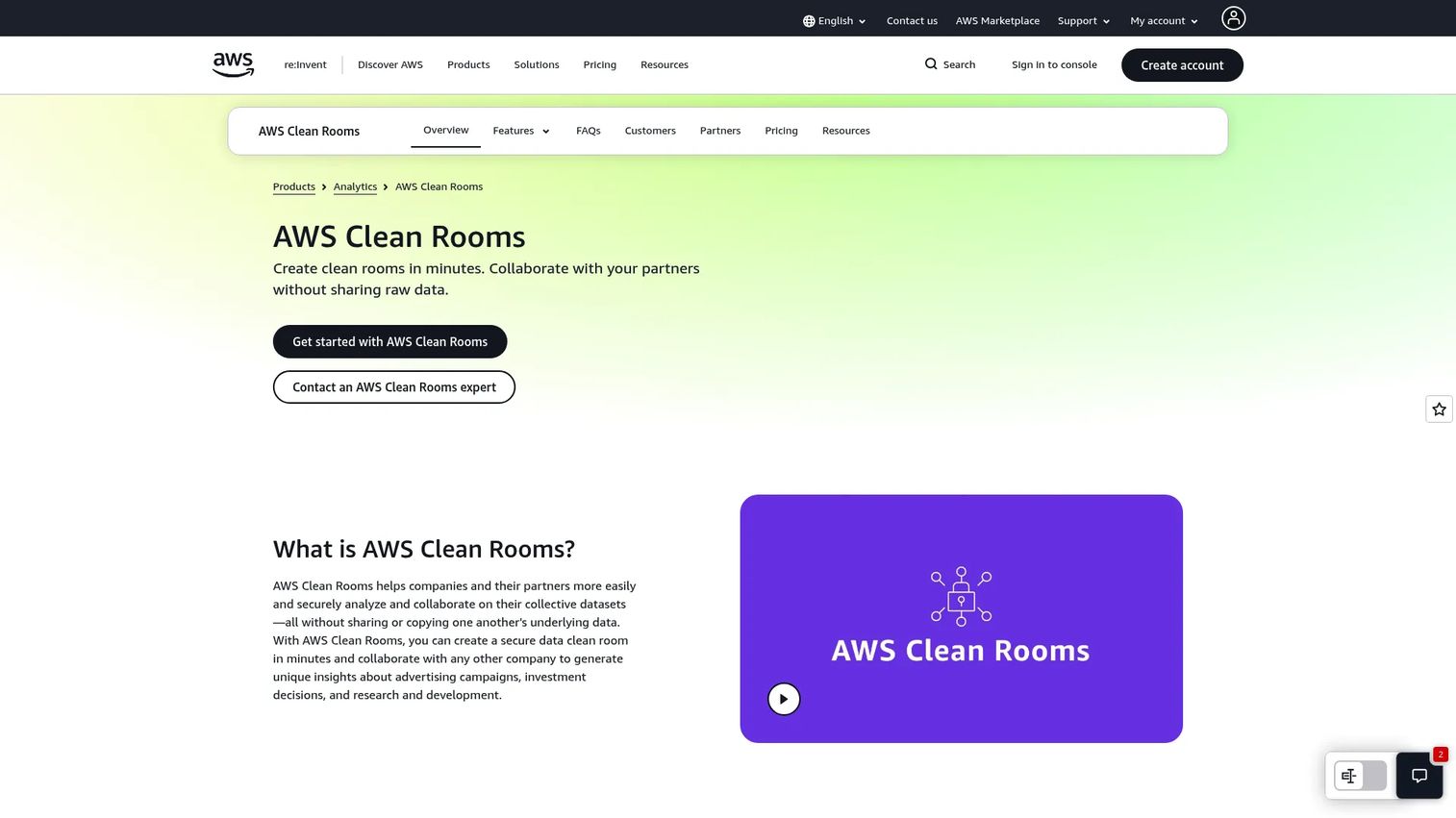
AWS Clean Rooms is Amazon's managed service for privacy-preserving analysis of shared datasets without exposing the underlying data. If your data already lives in AWS, this is the path of least resistance: collaborators bring datasets together, agree on rules, and run analysis without anyone moving raw records out of their own account.
Best for: Companies that need to analyze or model shared data with partners while preserving privacy controls, especially teams already standardized on AWS.
Key strengths
- SQL and PySpark analysis: Run familiar query languages directly inside collaborations, so analysts don't learn a new dialect.
- AWS Clean Rooms ML: Build custom and lookalike models on combined data for segmentation and audience extension.
- Layered privacy controls: Analysis rules, differential privacy, cryptographic computing, and analysis logging govern exactly what runs and what gets released.
Why choose AWS Clean Rooms: The case is ecosystem fit. If your warehouse, your pipelines, and your partners' infrastructure already run on AWS, you skip most of the integration friction that stalls clean room rollouts. The privacy controls are granular enough for marketing measurement, audience modeling, and cross-partner analytics without bolting on a third-party layer.
AWS Clean Rooms pricing: AWS uses usage-based pricing that varies by feature and region, billed through your existing AWS account. There is no free tier, and AWS does not publish a single universal starting price; cost scales with the compute your analyses consume. Review the AWS Clean Rooms pricing page for the rate structure that applies to your region and workload.
2. Snowflake Data Clean Rooms
Snowflake Data Clean Rooms is a Snowflake-native environment for privacy-safe multi-party analysis and activation. Because it runs inside the Snowflake platform, collaborators can work across partners, clouds, and regions without copying data into a separate system, which is the practical appeal of a distributed clean room model.
Best for: Enterprises that need privacy-preserving data collaboration across partners, clouds, or regions, particularly those already running on Snowflake.
Key strengths
- Secure multi-collaborator environment: Multiple parties join the same governed space without exposing raw data to one another.
- No-code and SQL workflows: Analysts and less technical users can both run collaborations, widening who on the team can actually use it.
- Differential privacy and governed query controls: Built-in privacy enforcement keeps outputs aggregated and re-identification-resistant.
Why choose Snowflake Data Clean Rooms: If Snowflake is already your data backbone, the clean room lives where your data and your teams already work. That removes the migration and duplication overhead that makes standalone clean rooms hard to justify. The mix of no-code and SQL access means marketing, analytics, and data engineering can collaborate in one place on segmentation, attribution, and audience work.
Snowflake Data Clean Rooms pricing: Snowflake states that Data Clean Rooms pricing is contract-based, so there's no public per-feature price for the clean room itself. The broader Snowflake platform uses consumption-based pricing across Standard, Enterprise, Business Critical, and Virtual Private Snowflake editions, with storage publicly listed at $23.00/TB/month and compute billed by usage. Snowflake holds a 4.6/5 rating on G2.
3. LiveRamp Clean Room
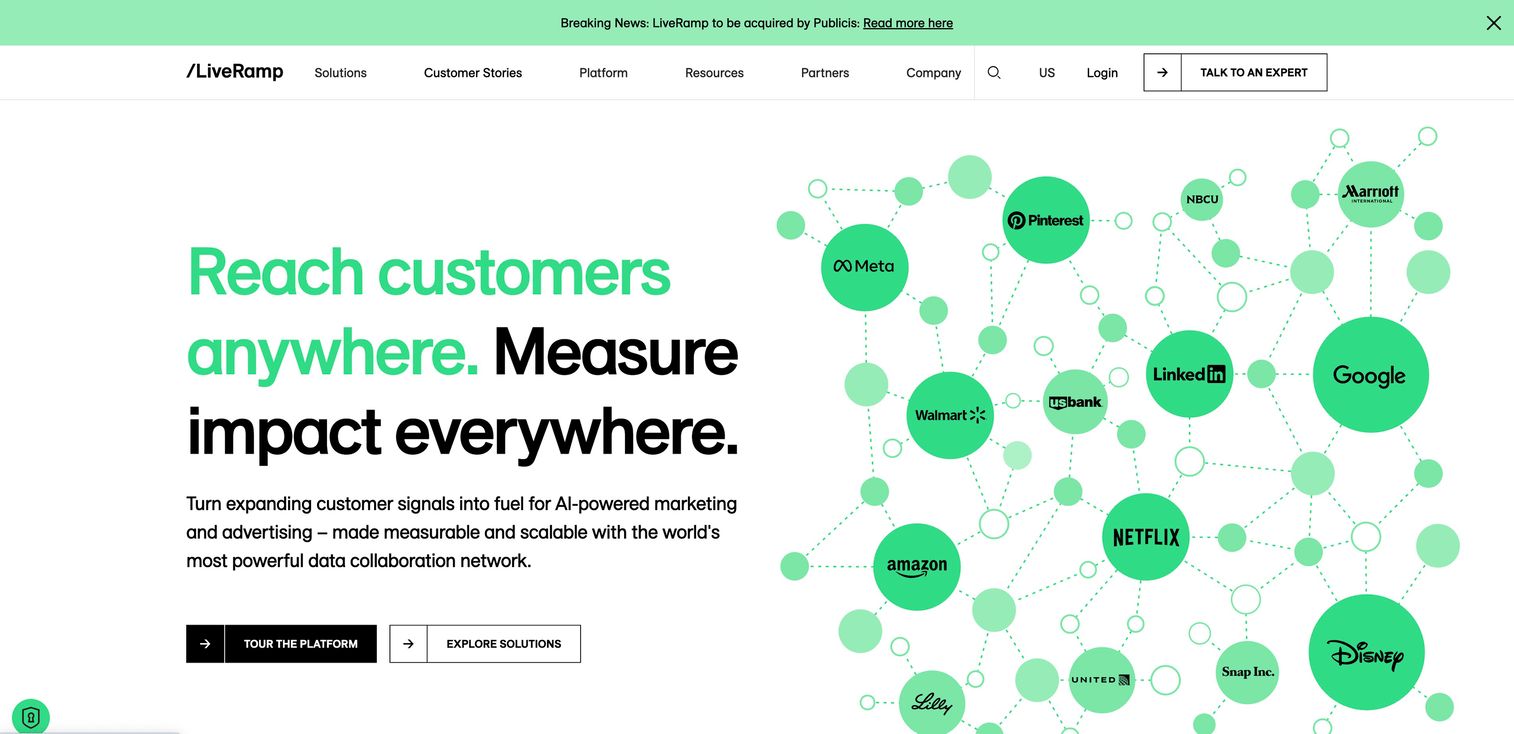
LiveRamp Clean Room is a secure data collaboration and measurement environment built around LiveRamp's identity backbone. For marketers, the draw is the identity layer: LiveRamp's RampID connects records across partners and channels, which is the hard part of any privacy-safe measurement project.
Best for: Enterprises that need privacy-safe clean room collaboration and measurement across partners, with identity resolution as a first-class requirement.
Key strengths
- Identity resolution and cloud interoperability: RampID-based matching connects data across partners and clouds, lifting match rates for measurement.
- Ready-to-use measurement templates: Pre-built queries get marketing teams to attribution and audience insights faster, without building analysis from scratch.
- Privacy and governance controls: Collaboration runs under access and query controls that keep raw data protected.
Why choose LiveRamp Clean Room: This is the marketer's pick when identity is the bottleneck. The pre-built measurement templates mean a growth or demand-gen team can run attribution and audience insights without a data engineering project behind every question. It connects naturally to the broader LiveRamp collaboration network for activation.
LiveRamp Clean Room pricing: LiveRamp uses consumption-based pricing and requires contacting sales for a custom quote; no public starting price is listed. The broader LiveRamp platform holds a 4.2/5 rating on G2. Expect annual, usage-tied agreements rather than self-serve seats.
4. InfoSum
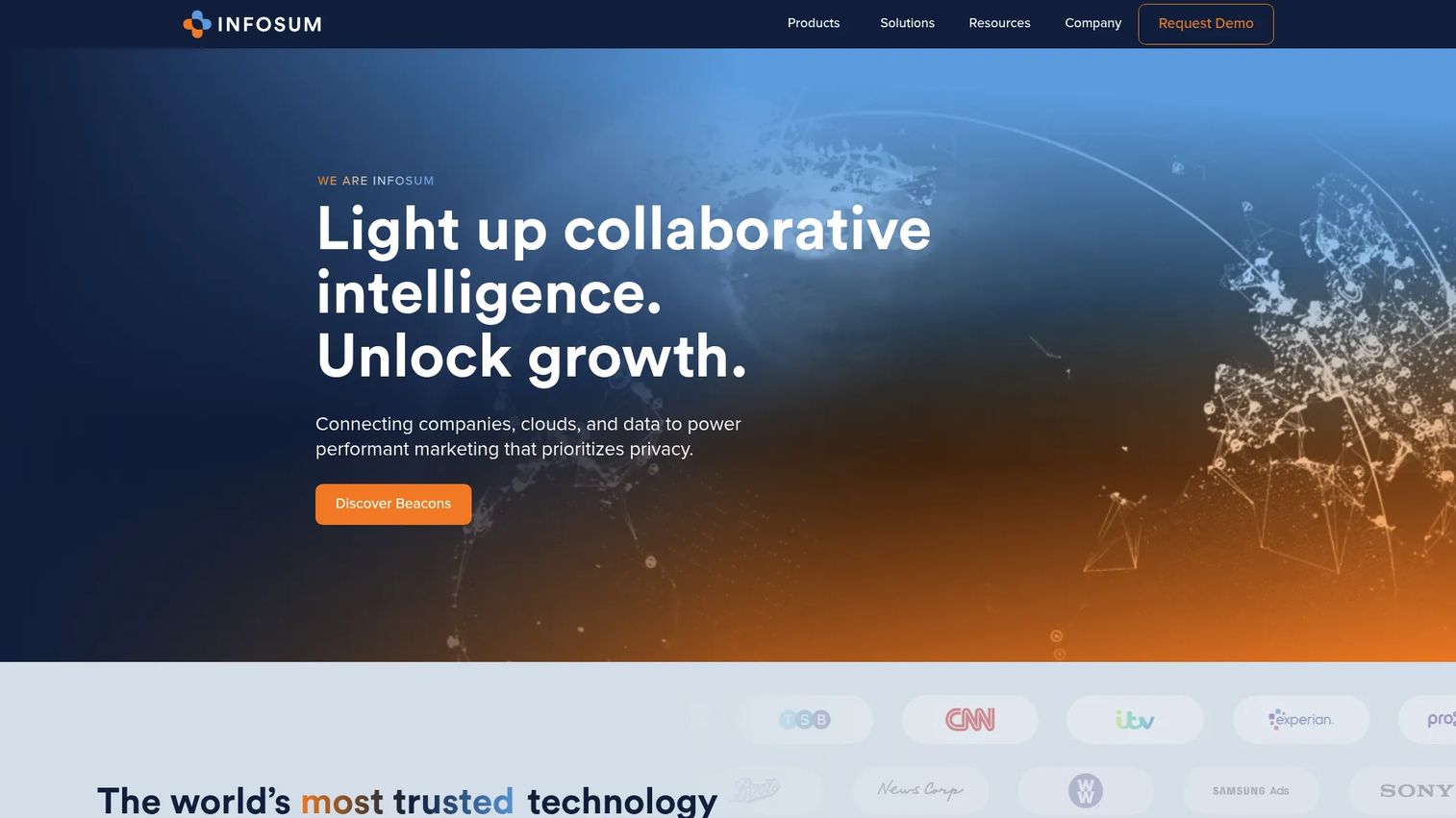
InfoSum is a privacy-first data collaboration platform built on a simple principle: the raw data never moves. Each party keeps its data in its own environment, and InfoSum's architecture lets them connect and analyze across those environments without centralizing anything. That makes it a strong fit for collaborators who can't or won't pool data.
Best for: Enterprises that need secure, privacy-safe data collaboration and measurement where data residency and non-movement are hard requirements.
Key strengths
- Beacons for cross-cloud collaboration: Connect data across separate cloud environments without copying it into a shared location.
- Granular permissions and governance: Fine-grained controls govern exactly what each party can query and see.
- Intuitive query tools: Audience discovery and analysis run through accessible tooling, not just raw SQL.
Why choose InfoSum: Choose InfoSum when "the data cannot leave our environment" is a non-negotiable, whether for legal, competitive, or regulatory reasons. The non-movement architecture sidesteps the trust problem that kills a lot of collaboration deals, since no party ever ships its file anywhere. That's powerful for brand-to-brand, brand-to-publisher, and partnership analytics.
InfoSum pricing: InfoSum does not publish public pricing; engagements are sales-led and tailored to the collaboration. On G2, InfoSum holds a 5.0/5 rating, though based on a small number of reviews. Treat the rating as directional and validate fit through a scoped pilot.
5. Decentriq
Decentriq is a data collaboration platform built on confidential computing, which means data is processed while encrypted in use, not just in transit or at rest. That technical foundation makes it a natural fit for privacy-sensitive enterprises and regulated industries where "trust us" isn't enough and cryptographic guarantees are.
Best for: Enterprises that need privacy-preserving data collaboration and audience activation under strict regulatory or security constraints.
Key strengths
- Confidential computing: Data is encrypted in use, so even the platform operator cannot see the underlying records.
- Collaborative Audience Platform: Build, enrich, and activate audiences inside the governed environment.
- Tamper-proof audit logs: Every action is logged in a way that supports compliance review and dispute resolution.
Why choose Decentriq: When your compliance team needs to see cryptographic proof rather than a policy promise, Decentriq's confidential computing model is the differentiator. It's built for healthcare, financial services, and other sectors where a data leak isn't just embarrassing but a regulatory event. The platform pairs that governance with practical audience building and activation. Decentriq holds a 4.5/5 rating on G2.
Decentriq pricing: Decentriq does not publish public pricing; engagements appear to be sales-led and subscription-based. Pricing will scale with the scope of collaboration and the data volumes involved, so plan for a custom quote rather than a self-serve tier.
6. Databricks Data Intelligence Platform
Databricks Data Intelligence Platform is a unified data and AI platform, and clean room workflows live inside that broader environment rather than as a standalone product. For teams that want privacy-safe collaboration tied directly to their data engineering, analytics, and machine learning operations, that integration is the point.
Best for: Enterprises building governed data, analytics, and AI workloads in one platform, who want clean room collaboration inside the same lakehouse.
Key strengths
- Data engineering and pipeline orchestration: Build and manage the pipelines that feed collaboration, all in one place.
- Analytics, SQL, and dashboards: Run combined analysis and visualize results without exporting to a separate BI layer.
- Governance, security, and collaboration: Platform-wide governance covers clean room work alongside every other workload.
Why choose Databricks: Choose Databricks when clean rooms are one part of a bigger data and AI operation, not the whole job. Keeping collaboration inside the lakehouse means the same governance, lineage, and security model covers everything, and your engineering team isn't maintaining a separate tool. It suits teams doing segmentation, attribution, and modeling at scale alongside their core analytics.
Databricks pricing: Databricks offers a Free Edition to get started, and the platform uses consumption-based pricing thereafter; a single public starting price for the full platform was not listed on the product page. Databricks directs buyers to its pricing overview and calculator to estimate cost by workload. The platform holds a 4.6/5 rating on G2.
7. Epsilon PeopleCloud Clean Room
Epsilon PeopleCloud Clean Room is a privacy-first clean room built inside Epsilon's PeopleCloud, bringing together data, identity, media activation, and measurement in one environment. For enterprise marketing teams, the differentiator is what's already in the room: pre-loaded data and identity, so you're not starting from a blank collaboration.
Best for: Marketers who need a privacy-safe clean room with built-in identity and activation, rather than a neutral analytics-only environment.
Key strengths
- Pre-loaded data and identity: Start with Epsilon's data and identity assets in place, shortening time to first insight.
- High-performance media activation: Move from audience insight to media execution inside the same environment.
- Closed-loop measurement: Connect exposure to outcome for attribution and ROAS without exporting raw data.
Why choose Epsilon PeopleCloud Clean Room: This is the enterprise marketing pick when you want identity and activation bundled with the clean room, not stitched together from separate vendors. The pre-loaded identity layer is the time-saver: teams measuring campaigns and building audiences get a running start. It fits brands that run significant paid media and want measurement and activation in one loop.
Epsilon PeopleCloud Clean Room pricing: Epsilon does not publish public pricing for the PeopleCloud Clean Room; access is sales-led and scoped to the engagement. A product-specific G2 rating was not available at the time of writing. Plan for an enterprise agreement and a scoping conversation with Epsilon's team.
8. Optable
Optable is an audience platform for publishers and media companies, with privacy-first clean rooms and data collaboration at its core. Where many clean rooms are built brand-first, Optable is built for the supply side: publishers and media owners who need to put their audience identity to work for advertisers without exposing it.
Best for: Publishers and media owners that need privacy-safe audience identity, activation, and collaboration tooling to monetize first-party data.
Key strengths
- Identity graph and identity resolution: Build and maintain a publisher-side identity graph for matching and measurement.
- Audience building and activation: Package and activate audiences for advertiser collaborations.
- Privacy-first clean rooms: Collaborate with advertisers on overlap, planning, and measurement without exposing raw audience data.
Why choose Optable: Choose Optable when you sit on the media and publisher side and need to monetize first-party data without giving it away. The platform is shaped around publisher workflows: identity, audience packaging, and advertiser collaboration. That focus makes privacy-safe monetization and measurement feel native rather than retrofitted. Optable holds a 5.0/5 rating on G2 across a small set of reviews.
Optable pricing: Optable does not publish public pricing and operates a request-demo sales motion, so expect a custom quote based on your audience scale and collaboration needs. Validate fit through a scoped engagement before committing to an annual agreement.
Considerations
Before you sign anything, run the shortlist through this checklist.
Identity match quality on your data
Vendor benchmark match rates mean nothing. Run a pilot against your actual records and your actual partner's records. Deterministic identity will out-match probabilistic in most cases, but only your data tells you the real number.
Architecture fit
Decide early whether you need a walled garden, a neutral clean room, or a distributed model. If data residency or non-movement is a hard rule, distributed and confidential-computing platforms move to the top. If your partners live in one cloud, a native option there cuts friction.
Governance and compliance depth
Map the platform's access controls, query controls, encryption, and audit logging against your regulatory obligations. Healthcare and financial services buyers should treat tamper-proof logging and certifications as table stakes, not extras.
Activation, not just analysis
A clean room that only measures leaves value on the table. Confirm how governed export and activation workflows push audiences into your media stack, and under what restrictions, so insight turns into spend.
Total cost and time to value
Most of these are consumption- or contract-based, and the average company spends roughly $879,000 on a clean room according to Digital Applied (citing Funnel.io, 2025). Budget for the platform, the integration work, and the analyst time to interpret outputs, since 48% of non-adopters cite budget as their main barrier.
Conclusion
There's no single best data clean room, only the right fit for your stack, your partners, and your compliance reality.
If your data lives in a cloud you already trust, start there: AWS Clean Rooms for AWS-native shops, Snowflake Data Clean Rooms for Snowflake teams, and Databricks when clean rooms are one piece of a larger data and AI operation. If identity and marketing measurement are the priority, LiveRamp Clean Room and Epsilon PeopleCloud Clean Room give you identity resolution and activation built in. If privacy architecture is the deciding factor, InfoSum's non-movement model and Decentriq's confidential computing lead for regulated and high-sensitivity work. And if you're on the media side, Optable is built for publisher monetization.
The practical next step: shortlist two platforms that match your data stack and compliance needs, then run a scoped pilot on real data before committing. Match rates and output usability are the things that win or lose the deal, and you only learn them by testing. Pricing is almost always quote-based, so bring procurement in early.
FAQs
Data clean room software lets two or more parties analyze combined datasets without any party seeing the other's raw, individual-level data. It matches, joins, and aggregates data under agreed rules, then releases only governed outputs like overlap size or campaign lift. A brand and a retailer, for example, can measure a joint campaign without either exposing its customer file.
Each party ingests its data, the platform matches records using hashed or encrypted identifiers, identity resolution stitches matches into a single view per person, and users run approved queries against the combined set. Results pass through privacy checks like aggregation thresholds before release. Throughout, raw data stays under each owner's control and never gets exported.
A customer data platform unifies and activates the data you own, building a single view of your customers for marketing and analytics. A data clean room enables analysis across data owned by different parties without sharing raw records. In short, a CDP is for your data; a clean room is for shared data with partners. Many teams use both, feeding governed clean room outputs back into their own systems.
Advertisers, publishers, retailers, and CPG brands use it for measurement and audience collaboration, while healthcare, financial services, travel, and entertainment companies use it for privacy-safe analytics on sensitive data. Inside those organizations, marketing, analytics, RevOps, and privacy teams are the typical owners. Anyone who needs to combine data with a partner without handing over raw records is a candidate.
No. Advertising and retail media are the most visible use cases, but clean rooms power privacy-safe analytics across industries. Healthcare organizations combine claims and clinical data, financial services firms run joint risk and fraud analysis, and media companies measure cross-platform reach. The common thread is sensitive data that must be analyzed together but cannot be shared raw.
Prioritize identity match quality on your own data, query flexibility for the measurement questions you actually ask, and governed export so you can activate audiences, not just measure them. Then check interoperability with your warehouse, CDP, and ad platforms, plus compliance depth for your regulatory obligations. A platform that demos well but won't connect to your stack will stall in procurement.
A walled garden is a clean room run by a large platform where you analyze data inside its environment, which gives rich data but limited portability. A neutral clean room is an independent, vendor-run environment that doesn't favor any single data owner, which suits brand-to-publisher and brand-to-brand collaboration. Distributed clean rooms go further, keeping data in each party's own environment and bringing the computation to it.
They enforce privacy by design: data is matched on hashed or encrypted identifiers, results are aggregated above minimum thresholds to prevent re-identification, and access controls and query controls limit what anyone can run. Audit logging creates a record for compliance review, and many platforms add differential privacy or confidential computing. Together these controls help teams meet GDPR, CCPA, and sector-specific rules while still collaborating on data.