Admissions runs in one system. Student records live in another. Finance sits in a spreadsheet somebody exports every Friday. Faculty scheduling happens in email. And when leadership asks for one clean number across campuses, someone spends three days stitching reports together by hand.
That is the real problem campus management software solves. Not "digital transformation." Fewer manual handoffs. Fewer places for data to drift. One readable view of operations that survives an audit.
The market reflects the pressure. The global campus management software market was valued at $7.2 billion in 2025 and is projected to reach $18.8 billion by 2034, a 14.2% CAGR, according to MarketIntelo (2025). Cloud-based deployments already account for 62.3% of that spend. Institutions are not asking whether to consolidate. They are asking which platform to consolidate onto.
This guide compares seven options against the criteria that actually decide the purchase: module breadth, reporting depth, implementation effort, and compliance readiness.
What's inside
This guide is for education operators, IT leaders, and procurement teams evaluating a campus management system for colleges, universities, or multi-campus institutions.
We picked seven platforms and judged each on the factors that matter at shortlist stage:
- Module breadth: how much of admissions, records, faculty, finance, and reporting it covers natively
- Reporting and analytics: whether leadership gets real-time dashboards or waits on manual exports
- Implementation and migration: how heavy the switch is, and what support comes with it
- Compliance readiness: audit trails, records governance, and accreditation support
No forced rankings. Each pick fits a different kind of institution.
TL;DR
- Best for open-source flexibility: OpenEduCat, a configurable education ERP with a free community edition.
- Best for large enterprise higher education: Ellucian, built for complex student lifecycle operations at scale.
- Best for donor, alumni, and private education workflows: Blackbaud, strongest where fundraising meets school administration.
- Best for K-12 and higher-ed operational scale: PowerSchool, a known platform with deep student data roots.
- Best for all-in-one school management workflows: Beams360, with SIS, admissions CRM, and finance in one place.
- Best for facilities and campus operations depth: Planon, an integrated workplace and real estate platform.
- Best for managed e-learning and assessment: Eduflex, focused on digital learning and online testing.
What is campus management software
Campus management software is an integrated campus management system that centralizes admissions, student records, faculty, courses, exams, finance, and reporting inside one platform so an institution can run its operations without stitching together disconnected tools.
Think of it as the operating layer for higher education administration. A strong campus management solution replaces the spreadsheets, point tools, and manual re-keying that create data silos between departments.
Core capabilities most buyers expect from higher education management software:
- Admissions management: application intake, lead tracking, enrollment, and offer workflows
- Student information system: a single source of truth for student records management, transcripts, and status
- Course and faculty management: scheduling, workloads, section planning, and academic assignments
- Exams and assessments: exam management, grading, results, and progression rules
- Finance and accounting: fees, invoicing, financial aid, and finance management controls
- Dashboards and reporting: real-time dashboards and reporting and analytics across departments and campuses
- Compliance and audit readiness: records governance, access controls, and audit trails for accreditation
The label varies. Some vendors call it a campus management system, others say university management software or education ERP. The job is the same: one system, fewer silos, cleaner reporting.
When to use campus management software
Unify fragmented admin systems
Most institutions do not start with a platform. They start with a spreadsheet for admissions, a separate SIS, a finance tool nobody in the registrar's office can see, and email for everything in between.
The move to an all-in-one campus management system happens when those seams start costing real time. A student's record shouldn't get re-typed three times as it passes from admissions to academics to finance. One operating layer means cleaner handoffs and fewer places for a number to go wrong.
Support multi-campus reporting
When leadership needs a single view across locations or departments, manual consolidation stops scaling. Every campus defines "enrolled" slightly differently, and reconciling those definitions eats days.
Centralized reporting fixes the definition problem first. Consistent fields, real-time dashboards, and a shared data model mean the numbers refresh on their own and mean the same thing everywhere. That is the difference between a Friday export and a Monday-morning decision.
Improve compliance and audit readiness
Accreditation reviews, financial aid audits, and records governance all demand the same thing: a clean trail showing who changed what, when, and why.
Institutions lean on campus management software to enforce access controls, log changes, and keep student records management defensible. When an auditor asks how a figure was produced, the system answers instead of a person reconstructing it from memory.
Comparison table
The table below sorts all seven tools by relevance to higher education administration. Pricing and rating fields reflect what each vendor and review source published at the time of writing. Verify current figures on the vendor's pricing page before you commit, since education contracts often shift with module count, user packs, and services.
| # | Product | Best for | Key differentiator | Pricing | G2 rating |
|---|---|---|---|---|---|
| 1 | OpenEduCat | Configurable open-source ERP | Free community edition plus modular enterprise tiers | Free; Enterprise from $69/year per module | 4.6/5 |
| 2 | Ellucian | Enterprise higher education | Deep student lifecycle at institutional scale | Custom | 3.4/5 |
| 3 | Blackbaud | Donor, alumni, private education | Fundraising and fund accounting alongside school admin | Custom | 3.8/5 |
| 4 | PowerSchool | K-12 and higher-ed operations | Broad SIS and operations depth | Custom | 4.2/5 |
| 5 | Beams360 | All-in-one school management | SIS, admissions CRM, and finance in one platform | From $199/month | Not listed |
| 6 | Planon | Facilities and campus operations | Integrated workplace and real estate management | Custom | Not listed |
| 7 | Eduflex | Managed e-learning and assessment | Digital learning and online testing focus | Custom | Not listed |
1. OpenEduCat
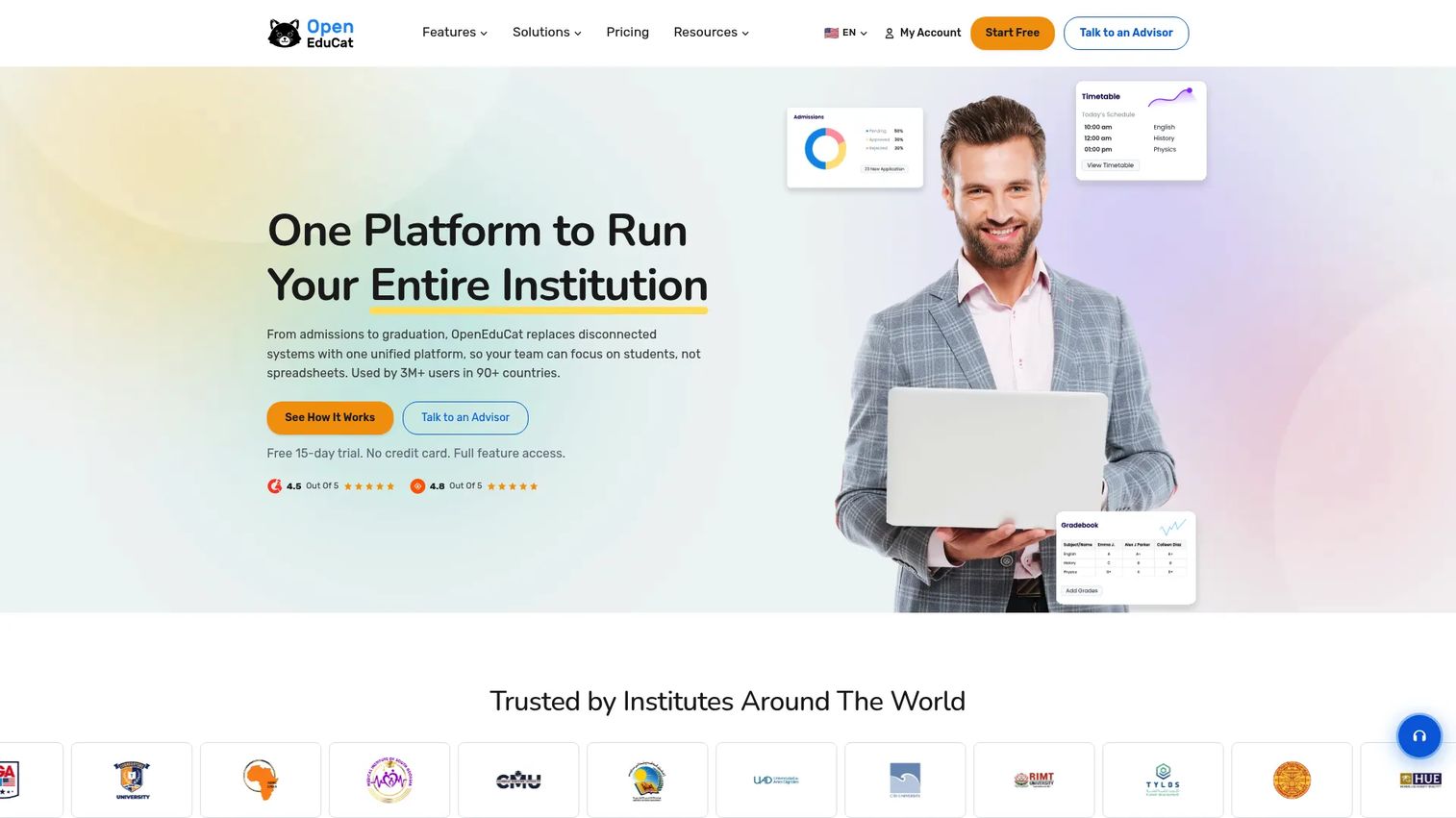
OpenEduCat is an open-source education ERP for schools, colleges, and universities. It covers the full administrative spine, admissions, attendance, exams, fees, and library, inside a modular platform you can host and configure yourself. For institutions that want control over their data and their roadmap, the open-source foundation is the whole appeal.
The community edition is genuinely free, which lowers the barrier to a full evaluation. You spin it up, test the modules against your workflows, and only pay when you need enterprise capabilities. That structure fits IT teams who want to validate fit before signing anything.
Best for: Institutions that want a configurable, open-source education management platform with room to customize.
Key strengths
- Student information system with core student records management
- Admissions, attendance, exams, fees, and library modules
- Modular platform with both community and enterprise editions
Why choose OpenEduCat: If your team has the technical bandwidth to self-host and wants to avoid vendor lock-in, the open-source model gives you flexibility that packaged suites don't. It fits institutions that treat configurability as a requirement, not a nice-to-have.
OpenEduCat pricing: The Community Edition is free and self-hosted. Enterprise modules start at $69/year each. User packs run $299/year for 500 users and $4,369/year for unlimited users. Optional service hours start at $1,199 for a 25-hour block.
2. Ellucian
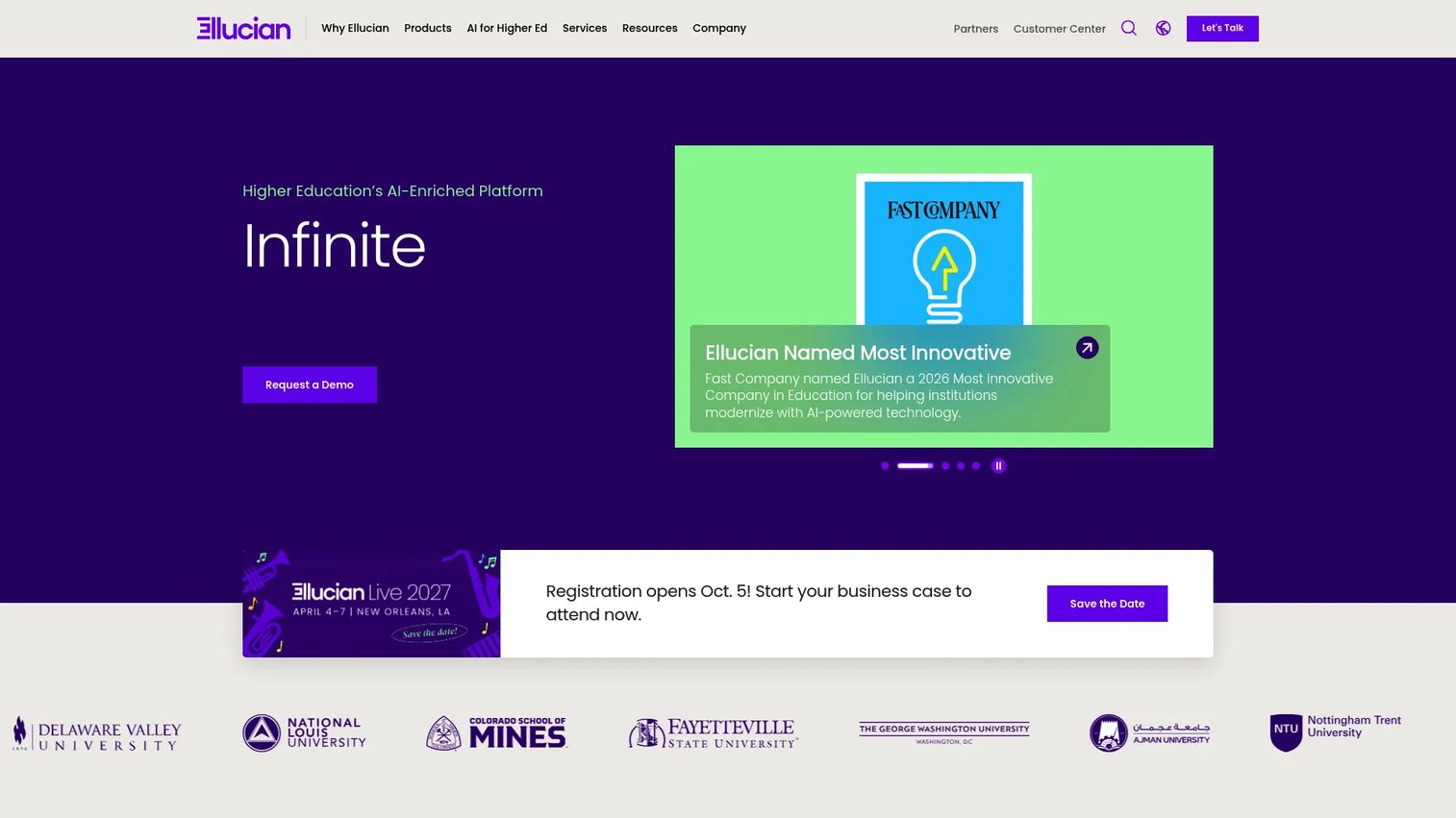
Ellucian is a higher-education software provider built around ERP, student information systems, student success, and finance. It targets colleges and universities that need integrated administration across a complex, high-volume student lifecycle. This is the platform for institutions where scale and depth outrank simplicity.
Where Ellucian earns its place is the breadth of the student lifecycle it manages, from recruitment through graduation and beyond. Its platform approach and AI-powered solutions are aimed at large campuses running many concurrent processes. That depth comes with an implementation footprint, so plan the rollout with a realistic timeline and internal owners.
Best for: Larger universities seeking integrated higher-ed administration software across the full student lifecycle.
Key strengths
- Student information systems built for institutional scale
- The Ellucian Platform for connected campus operations
- AI-powered higher education solutions
Why choose Ellucian: Enterprise institutions with distributed departments and heavy reporting demands get a system designed for exactly that complexity. It fits when you need one vendor to underpin admissions, records, finance, and student success at scale.
Ellucian pricing: Ellucian does not publish public pricing. Plans are quoted per institution based on scope, modules, and student volume. Request a quote through the vendor's contact flow.
3. Blackbaud
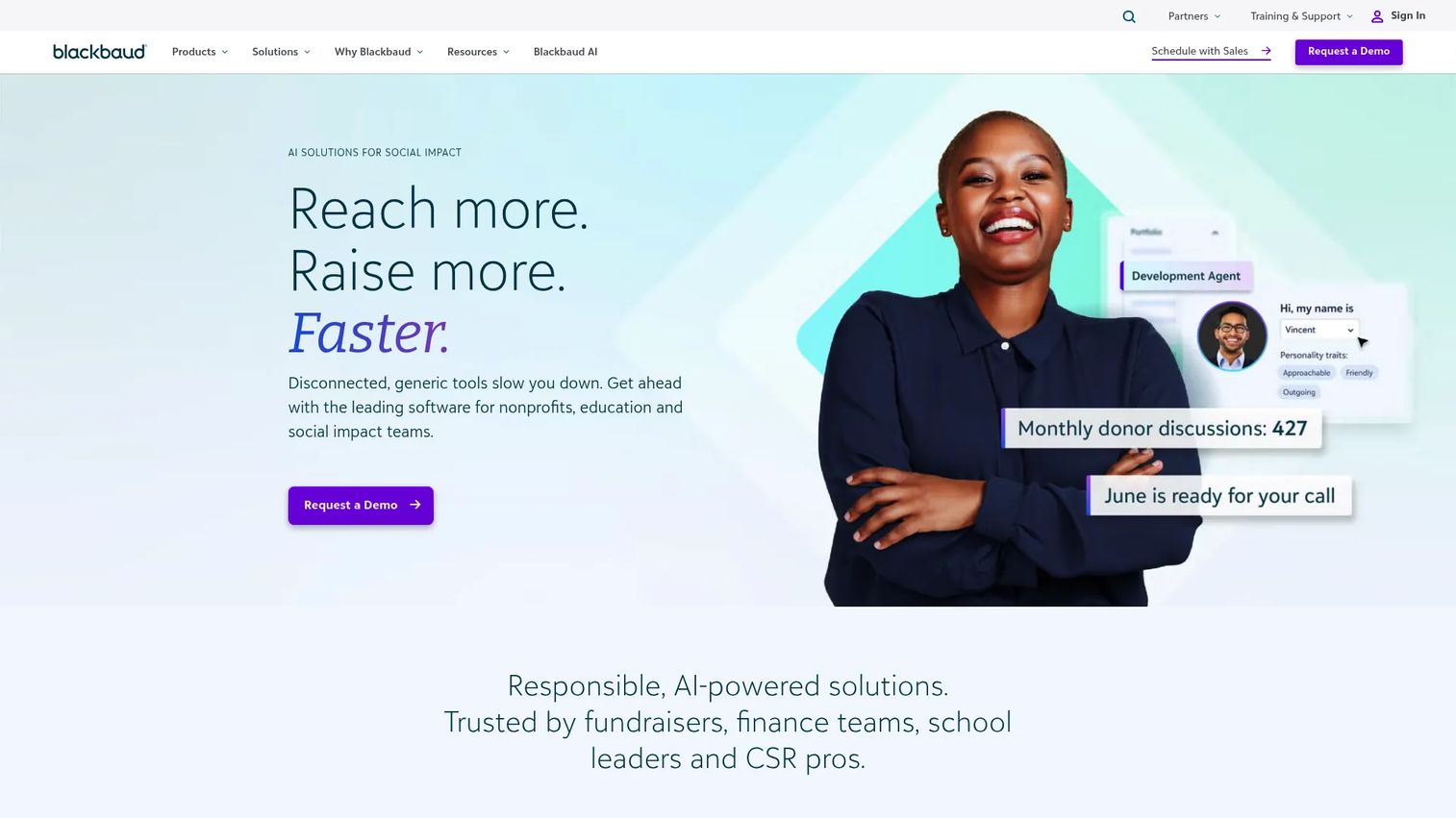
Blackbaud builds software for nonprofits, education, and social-good organizations. Its differentiator in this list is clear: fundraising, donor CRM, and fund accounting sit alongside school administration. For private schools, endowment-driven institutions, and any campus where advancement is central, that combination is hard to replicate with a generic SIS.
Most campus management systems treat finance as fees and invoicing. Blackbaud treats it as donor relationships, fund accounting, and constituent data too. If alumni giving and financial stewardship shape your operations, that native depth reduces the need to bolt on a separate advancement stack.
Best for: Nonprofits and education organizations that need integrated fundraising, finance, and school administration in one place.
Key strengths
- Fundraising and donor CRM
- Fund accounting and financial management
- Education solutions spanning K-12 and higher ed
Why choose Blackbaud: Choose it when constituent data and fundraising are first-class operational needs, not afterthoughts. It fits institutions where advancement and administration have to share one system.
Blackbaud pricing: Blackbaud tailors pricing to each organization and asks prospects to request a quote. No public starting price is listed, so budget for a scoping conversation early in evaluation.
4. PowerSchool
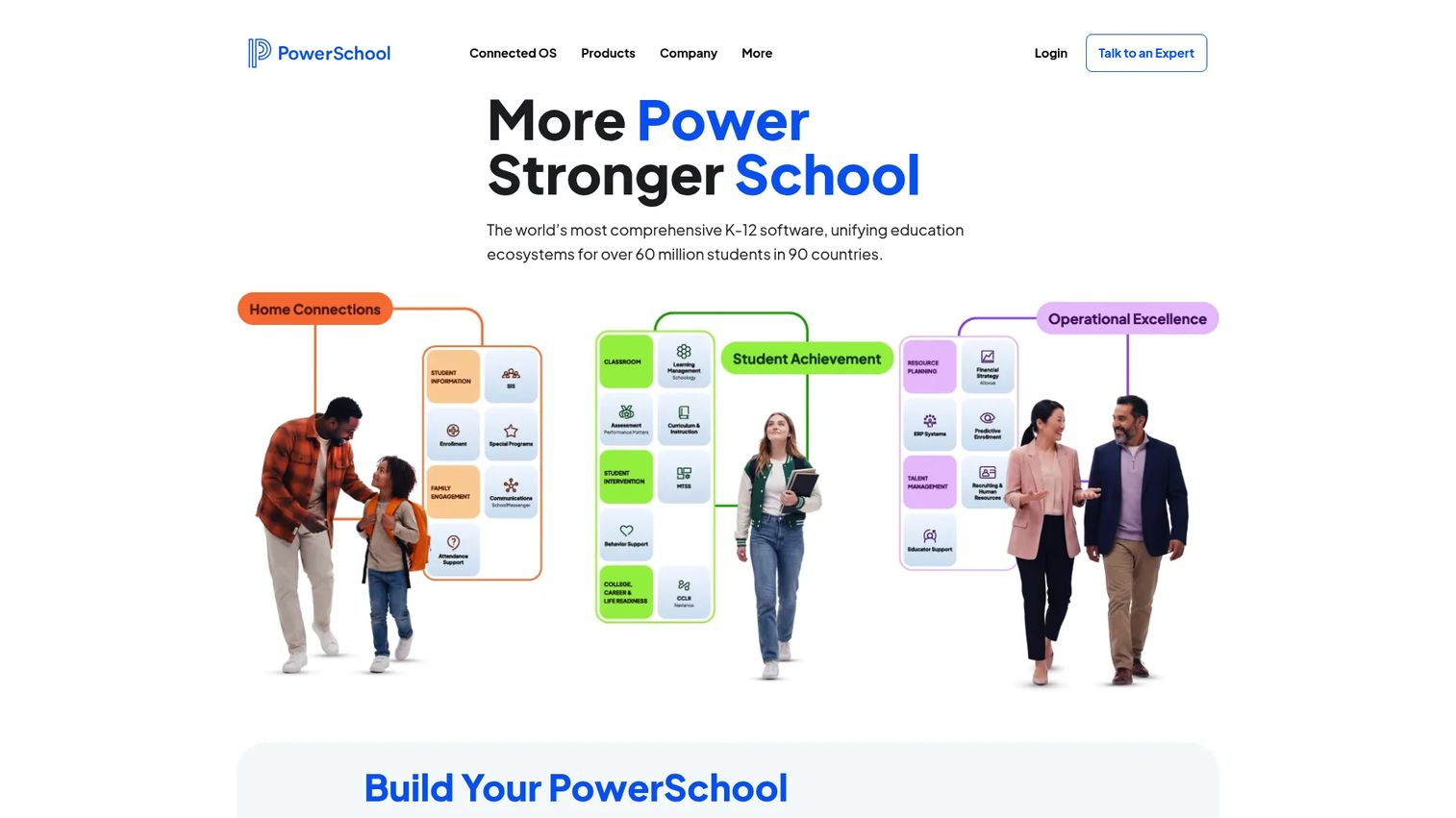
PowerSchool is a cloud platform for school operations, classroom workflows, and student data management. It is deeply rooted in K-12 and carries that operational maturity into broader education settings. For institutions that want a known, widely deployed platform with a long track record in student data, it is a safe shortlist entry.
The strength here is the unified classroom and operations layer, gradebook, assignments, attendance, and assessments in one place, plus talent and operations software for districts. That breadth reduces the number of point tools an operations team has to maintain and reconcile.
Best for: K-12 schools and districts needing integrated SIS and operations software, with reach into higher-ed workflows.
Key strengths
- Student information system as the data backbone
- Unified classroom tools: gradebook, assignments, attendance, assessments
- Talent and operations software for districts
Why choose PowerSchool: If you want a mature, broadly adopted SIS with a wide operational surface, PowerSchool covers a lot of ground natively. It fits teams that value proven scale and a deep student-data foundation.
PowerSchool pricing: PowerSchool does not publish a public pricing table. Pricing is handled through sales based on enrollment, modules, and deployment scope. Expect a custom quote.
5. Beams360
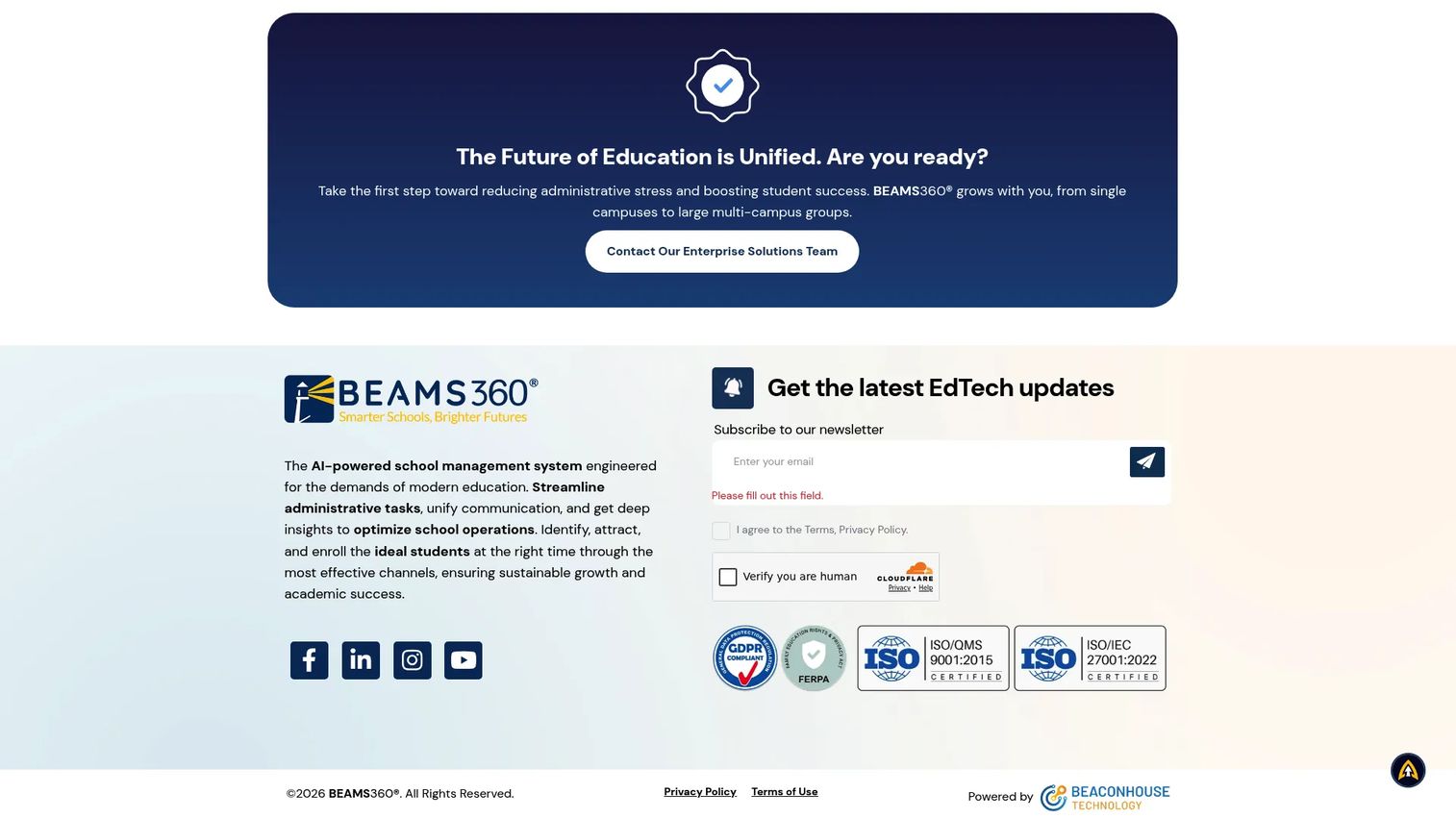
Beams360 is an AI-powered school management platform covering academics, operations, finance, and communication. Its pitch is genuine all-in-one coverage, with a student information system, attendance and biometrics, and an admissions CRM in a single system. For institutions that want lead-to-enrollment and day-to-day operations under one roof, that consolidation is the draw.
The admissions CRM angle matters. Instead of managing prospective students in a separate marketing tool and re-entering them after enrollment, the pipeline lives inside the same platform that runs records and finance. That reduces the handoff friction that creates data silos in the first place.
Best for: Schools needing an all-in-one platform for academic, operational, and financial management.
Key strengths
- Student information system for records and status
- Attendance and biometrics
- CRM and admissions in one pipeline
Why choose Beams360: Choose it when you want breadth without assembling three separate systems, and when a public, predictable price matters at shortlist stage. It fits institutions that value one connected platform over best-of-breed sprawl.
Beams360 pricing: Three public plans. Foundation starts at $199/month, or $299/month billed annually. Premier+ is $399/month, or $549/month billed annually. Advanced is $799/month, or $1,099/month billed annually.
6. Planon
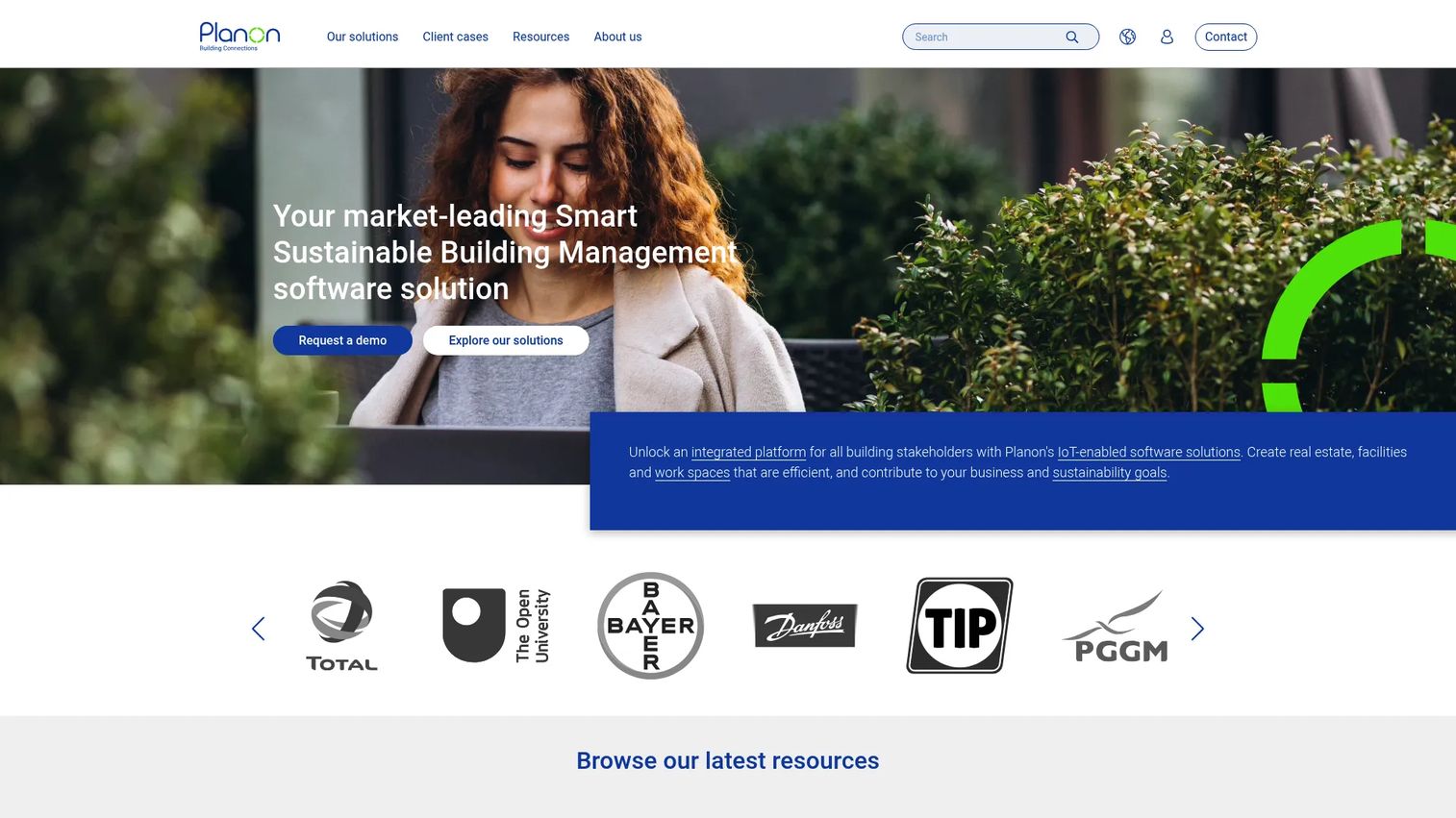
Planon provides smart, sustainable building management software for real estate, facilities, workplace, and service operations. It is the outlier on this list, and deliberately so. When campus operations means buildings, space, assets, and sustainability as much as students, Planon is built for exactly that side of the institution.
This is an integrated workplace management platform, not a student information system. Its strength is real estate, space and workplace management, asset and maintenance, and energy and sustainability, tied together on an open application platform with IoT and analytics. For a facilities-heavy campus, that depth is the point.
Best for: Mid-market to enterprise institutions managing large real estate and facilities portfolios.
Key strengths
- Integrated workplace management (IWMS) capabilities
- Real estate, space, asset, maintenance, and energy management
- Open application platform with IoT, analytics, and integrations
Why choose Planon: Choose it when facilities and campus operations are the primary buying criteria, not the student record. It fits institutions where physical infrastructure and sustainability reporting drive the decision.
Planon pricing: Planon uses quote-based pricing and does not list public figures. Reach out through the vendor's contact flow for a tailored proposal based on portfolio size and modules.
7. Eduflex

Eduflex is a specialist e-learning company offering digital learning, online testing, blended learning, and content development. It sits at the learning-delivery and assessment end of the spectrum rather than full administrative ERP. For institutions whose priority is managed digital learning and testing, it fits a specific, well-defined need.
The assessment tooling is where Eduflex stands out, with VirtualAssessor for online testing, automated marking, and reporting, plus cloud worksheets for senior grades. If your near-term problem is delivering and grading digital learning at scale, that focus keeps the deployment simpler than a full campus suite.
Best for: Organizations seeking managed e-learning and assessment platforms.
Key strengths
- Digital learning platforms for schools, universities, and organizations
- VirtualAssessor online testing with automated marking and reporting
- EasyPass cloud worksheets for senior grades
Why choose Eduflex: Choose it when digital learning delivery and online assessment are the core requirement rather than admissions, finance, or records. It fits institutions that want a specialist learning layer instead of a broad administrative platform.
Eduflex pricing: Eduflex does not publish public pricing. The company states it offers pricing models and invites prospects to make contact for a tailored quote.
Considerations before you buy
Shortlisting is easy. The switch is where institutions get surprised. Run every finalist through these checks before you sign.
Module depth versus platform breadth
Decide what you actually need natively. A broad platform that covers admissions, records, faculty, and finance reduces integration work, but a deep single-module tool may serve a specialized need better. Map each candidate against your real workflows, not a feature list.
Implementation and migration effort
Ask how student records, historical data, and finance records migrate. Get a realistic timeline, named internal owners, and a rollback plan. Education data is messy, and a clean migration is worth more than a long feature sheet.
Reporting and analytics
Confirm whether leadership gets real-time dashboards or waits on manual exports. Check that field definitions stay consistent across campuses so a number means the same thing everywhere. Reporting is where consolidation either pays off or quietly fails.
Compliance and audit readiness
Verify audit trails, access controls, and records governance against your accreditation and financial-aid requirements. Ask the vendor to walk through exactly how the system answers an auditor's "how was this figure produced?" question.
Total cost across the contract
Education pricing shifts with modules, user packs, and services. Model the three-year cost, not the entry price, and confirm what triggers a tier change before you commit.
Conclusion
The right campus management software depends on what your institution is actually solving for. Need broad academic administration with room to configure? OpenEduCat and Beams360 cover a lot of ground. Running enterprise-scale higher ed? Ellucian is built for that depth. Advancement and fundraising central to operations? Blackbaud. Deep student-data roots? PowerSchool. Facilities-heavy campus? Planon. Managed digital learning and assessment? Eduflex.
Do not buy from a comparison table alone. Shortlist two or three, then pressure-test each against your current reporting gaps, migration reality, and compliance requirements. Ask every finalist to show how it produces one cross-department number and how it survives an audit. The platform that answers both cleanly is the one that will actually reduce your silos instead of moving them.
FAQs
A campus management system is software that centralizes admissions, student records, faculty, courses, exams, finance, and reporting inside one platform. It replaces disconnected spreadsheets and point tools so an institution can run operations with fewer manual handoffs and cleaner data across departments.
Look for admissions management, a student information system, course and faculty management, exam management, finance management, and dashboards with reporting and analytics. Compliance and audit-readiness features, such as access controls and audit trails, matter for accreditation and financial-aid reviews.
Not exactly. A student information system manages student records, enrollment, and academic data. Campus management software is broader: it includes the SIS plus admissions, finance, faculty, and reporting. Think of the SIS as one core module inside a full campus management solution.
All-in-one platforms reduce integration work and keep data in one place, which suits teams that want fewer systems to maintain. Modular or specialist tools go deeper on a specific need. Map each option against your actual workflows and internal technical bandwidth before deciding.
Ask how student records, historical data, and finance records migrate, and request a realistic timeline with named internal owners. Confirm there is a rollback plan and clear support during cutover. A clean migration matters more than a long feature list.
They are often the whole reason for consolidating. Real-time dashboards with consistent field definitions let leadership make decisions without manual exports. If reporting is slow or inconsistent across campuses, the platform is not delivering the core benefit.
It depends on scale and priorities. Ellucian suits large, complex universities. OpenEduCat fits institutions wanting open-source flexibility. Blackbaud is strong where fundraising and advancement are central. PowerSchool offers deep student-data roots. Match the platform to your operating model rather than a single ranking.
Verify module coverage against real workflows, migration effort and timeline, reporting depth, compliance and audit-readiness features, and total cost across the full contract. Ask each finalist to demonstrate one cross-department report and walk through how the system holds up in an audit.