A lender asks how a flood on the coast changes your loss projections. A board member wants to know which facilities are exposed to heat by 2050. A regulator wants scenario analysis attached to your next filing. None of these questions have a spreadsheet answer that survives scrutiny.
That is the real problem climate risk software solves. Not proving climate change is real, but turning hazard data into asset, revenue, and operational impact fast enough to answer the people asking.
The category is growing because the pressure is. Verdantix valued the climate risk software market at $550 million in 2023 and projected it to reach $1.16 billion by 2029, a 13% compound annual growth rate. That growth tracks a simple shift: disclosure and lending decisions increasingly demand modeled, defensible climate numbers rather than qualitative statements.
The hard part is choosing a platform that matches your footprint, your hazards, and your reporting obligations without adding consulting drag. This guide compares the eight most relevant tools so you can narrow fast.
What's inside
This guide is a vendor comparison for teams evaluating a climate risk platform in 2026. It covers what the software does, how to evaluate it, and the eight tools worth shortlisting.
- What climate risk software measures and how it works
- When to use it: physical exposure, financial impact, and disclosure
- A side-by-side comparison table of all eight tools
- Detailed breakdowns of each platform with pricing context
- A buyer's checklist for track record, coverage, and fit
We selected tools based on model credibility, hazard and geographic coverage, sector specialization, and support for disclosure and decision-making. This is for founders and operators comparing modeling, analytics, and reporting options.
TL;DR
- Best for enterprise financial impact analysis: Climate X and S&P Global Climanomics translate physical and transition risk into damage and exposure metrics at asset and portfolio scale.
- Best for agriculture: ClimateAi builds localized crop and yield intelligence with adaptation playbooks.
- Best for property-level risk: First Street runs physics-based, deterministic modeling down to individual assets.
- Best for weather and hazard data: Meteomatics delivers hyper-local weather and climate data through an API.
- Best for advisory-led enterprise deployment: EY Climate Analytics Platform pairs on-demand analytics with consulting depth.
- The tradeoff: deep modeling engines demand more interpretation, while packaged platforms trade some depth for faster reporting.
What is climate risk software?
Climate risk software is software that assesses how physical climate hazards and, in some cases, transition risks affect assets, operations, revenue, and compliance obligations. It converts raw climate science into business-relevant risk metrics.
Most platforms in this category do some mix of the following:
- Hazard modeling: quantifies floods, heat, wildfire, drought, wind, and sea-level rise across time horizons
- Climate exposure modeling: maps which assets, facilities, or portfolio holdings sit in the path of each hazard
- Scenario analysis: projects risk under different warming pathways, often IPCC-aligned, out to 2100
- Financial impact analysis: translates hazards into damage estimates, downtime, and value at risk
- Reporting support: produces outputs that feed disclosure and resilience workflows
Physical risk versus transition risk
Physical climate risk covers the direct effects of a changing climate: a warehouse that floods, a plant that overheats, a supply route that a wildfire cuts. Transition risk covers the cost of moving to a low-carbon economy: carbon pricing, policy shifts, and stranded assets.
Some tools specialize in physical risk and asset-level exposure. Others measure both in one platform. Your reporting obligations usually decide which matters more.
Good climate risk analytics does two jobs at once. It supports resilience and adaptation planning by showing where to harden assets, and it supports disclosure by producing modeled inputs that regulators and lenders will accept.
When to use climate risk software
Climate risk software earns its place when a decision or a filing needs a modeled, defensible answer. Three scenarios cover most buyers.
Quantify physical exposure across assets
Use it when you need to know how floods, heat, wildfire, sea-level rise, or storms hit specific facilities, property, supply chains, or portfolios. A real estate owner mapping flood risk across 400 buildings needs asset-level output, not a national average. This is where climate exposure modeling and hazard modeling do the heavy lifting.
Translate hazards into financial impact
Use it when leadership needs risk output tied to dollars: downtime, damages, revenue at risk, insurance exposure, or capex planning. A CFO deciding whether to fortify a distribution hub wants a damage estimate under a 2050 scenario, not a hazard score. Financial impact analysis is the bridge from science to budget.
Support disclosure and resilience planning
Use it when teams need outputs that feed TCFD, CDP, CSRD, ORSA, SB 253, SB 261, or SECR workflows. A company preparing its first CSRD-aligned report needs scenario analysis and portfolio summaries it can hand to auditors. Climate disclosure software packages these outputs, but the risk modeling underneath has to be sound first.
Comparison table
The table below compares all eight tools by best use case, key differentiator, pricing, and rating context. Tools are sorted by relevance to climate risk software buyers, not alphabetically. Pricing across this category is largely quote-based, so many entries route through sales rather than a public number.
| # | Product | Best for | Key differentiator | Pricing | G2 rating |
|---|---|---|---|---|---|
| 1 | ClimateAi | Agriculture and supply-chain resilience | Localized crop and yield intelligence with adaptation playbooks | Demo-based | Not listed |
| 2 | First Street | Property-level physical risk | Physics-based deterministic modeling to individual assets | Free basic report; paid full report | Not listed |
| 3 | EcoAct | Climate strategy and carbon management | Consultancy-led net-zero and carbon accounting | Contact sales | Not listed |
| 4 | Meteomatics | Weather and climate data via API | 1 km resolution EURO1k and US1k models | Contact sales | 4.5/5 |
| 5 | Climate X | Enterprise physical risk analytics | Asset and portfolio risk-to-financial-impact translation | Contact sales | Not listed |
| 6 | EY Climate Analytics Platform | Advisory-led enterprise deployment | On-demand analytics with consulting depth | Contact sales | Not listed |
| 7 | Jupiter Intelligence | Financial-institution risk analytics | Scenario and stress testing through 2100 | Demo-based | Not listed |
| 8 | S&P Global Climanomics | Portfolio-scale financial impact | Physical and transition risk in one platform | Contact sales | Not listed |
Best climate risk software for 2026
Each tool below covers what it does, who it fits, its key strengths, why you would choose it, and what we could verify on pricing. The order runs from strong category fit through niche and enterprise options.
1. ClimateAi
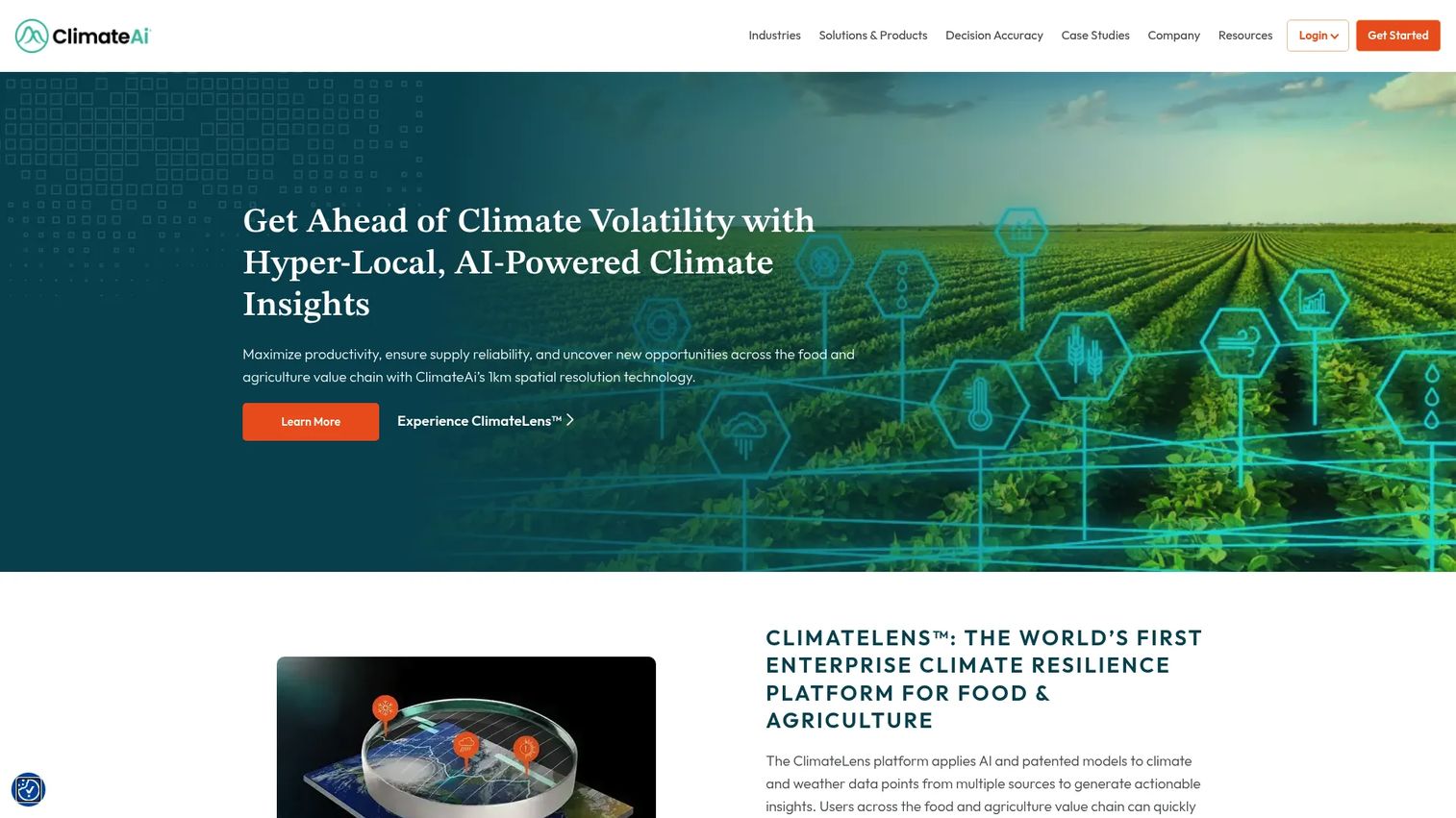
ClimateAi is an AI-powered climate resilience platform built for agriculture, food and beverage, finance, and other industries. It focuses on hyper-local climate and weather insights, pairing seasonal to long-range forecasting with yield outlook and exposure analysis. For teams whose risk lives in crops and supply chains rather than buildings, it speaks the right language.
Best for: enterprise teams needing climate-risk forecasting and supply-chain resilience across agriculture and food.
Key features
- Hyper-local climate and weather insights
- ClimateLens dashboards and alerts
- Seasonal to long-range forecasting
- LensConnect API
- Yield outlook and exposure analysis
Why choose ClimateAi: it wins on sector specificity. If your climate exposure is agricultural, its phenological and yield-driven modeling gives you decision support that a general-purpose physical risk platform cannot match.
ClimateAi does not publish pricing on its site. The platform routes visitors to a discovery and demo flow, and it runs an early-access program with its own pricing. Expect a sales conversation rather than a self-serve checkout.
2. First Street
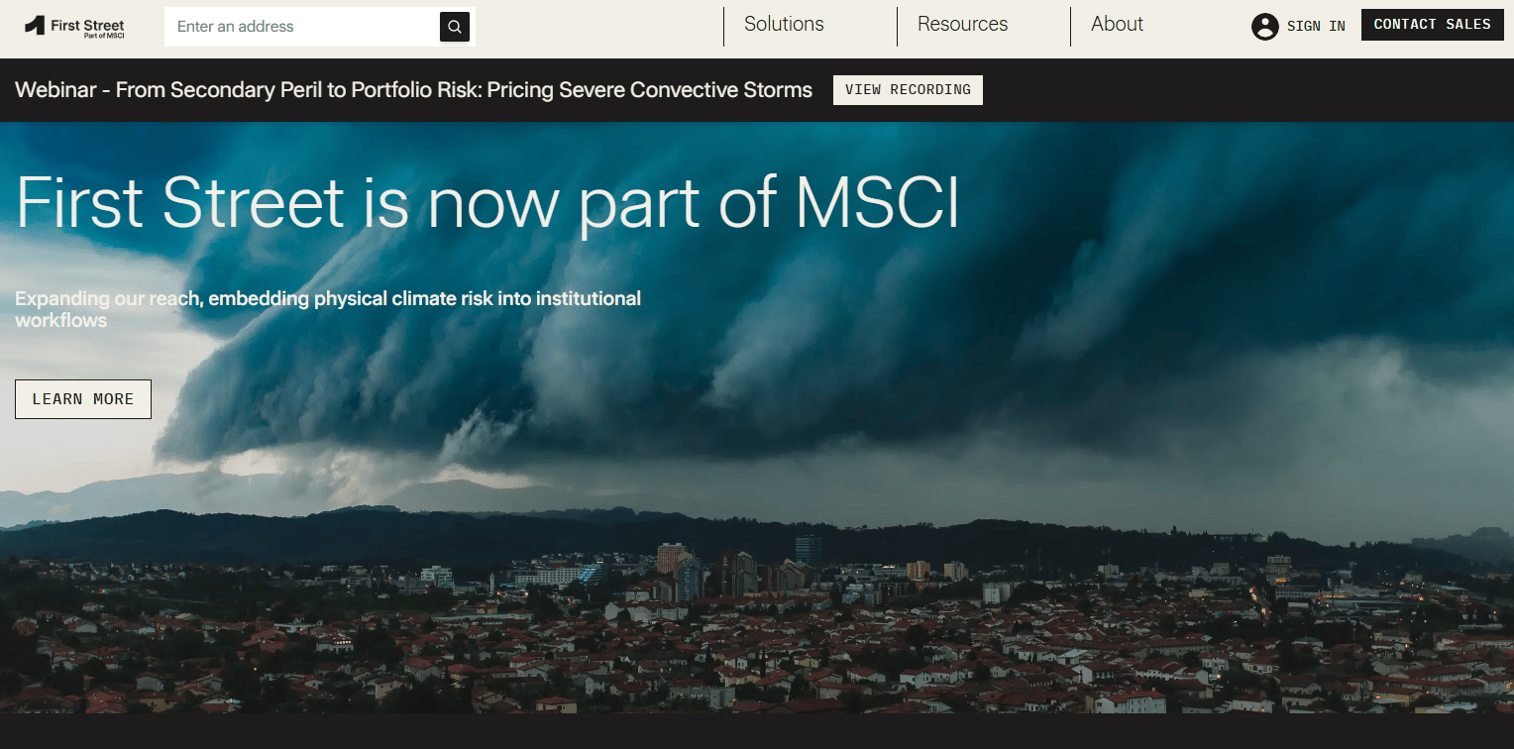
First Street is a climate risk data provider known for property-level assessment across flood, wildfire, wind, heat, and air. Its physics-based, deterministic modeling produces damage estimates and interactive maps down to individual addresses. It powers many of the property risk scores that show up in consumer real estate listings.
Best for: organizations and individuals needing asset-level, property-specific physical climate risk data.
Key features
- Property-level residential and commercial risk reports
- Interactive maps and damage estimates
- Data licensing, API, and enterprise offerings
- Coverage across flood, wildfire, wind, heat, and air
- Support for regulatory stress testing
Why choose First Street: when you need granularity at the individual-asset level, its deterministic approach gives you defensible, address-specific output rather than portfolio averages.
First Street offers a free basic report for residential properties and a paid subscription or full report for deeper risk information. A specific price for the paid tier is not published on the pages we reviewed, so budget for a conversation on data licensing and enterprise access.
3. EcoAct

EcoAct is an international sustainability consultancy and carbon project developer focused on net-zero and climate strategy. It sits at the intersection of climate risk assessment and broader carbon management, offering framework alignment such as TCFD and EU Taxonomy alongside its climate risk tooling. For teams that want strategy and modeling under one roof, the consultancy model fits.
Best for: enterprises seeking climate strategy, carbon management, and project-development support together.
Key features
- Net-zero strategy and transition planning
- Carbon accounting and emissions management
- Carbon project development and offsetting
- Framework alignment including TCFD and EU Taxonomy
- Scenario support across hazards and time horizons
Why choose EcoAct: it fits buyers who want advisory depth, not just software. If your team needs help building the climate strategy that surrounds the risk numbers, the consultancy layer is the draw.
EcoAct doesn't have a pricing page or visible price on its site. Since engagements blend consulting with tooling, pricing gets scoped through a direct conversation with the team.
4. Meteomatics
Meteomatics is an enterprise weather intelligence platform providing high-resolution weather data, forecasts, and visualization through an API. Its proprietary EURO1k and US1k models deliver weather data at 1 km resolution, which matters when acute hazard detection depends on local precision. It is the data engine other risk workflows can plug into.
Best for: businesses needing high-resolution, enterprise weather intelligence and direct API access.
Key features
- Weather API with global weather, ocean, environment, and climate data
- Proprietary EURO1k and US1k models at 1 km resolution
- MetX weather visualization and alerts
- Downscaling for local precision
- Industry parameter support
Why choose Meteomatics: it wins on data granularity. When your climate risk analytics depend on accurate, hyper-local weather and hazard inputs, the 1 km resolution gives downstream models something sharp to work with.
Meteomatics does not publish pricing numbers on its pricing page. The site directs visitors to talk to its experts for a quote based on data volume and access needs.
Meteomatics holds a 4.5 out of 5 rating on G2.
5. Climate X
Climate X is a climate risk data and analytics provider offering Spectra and Adapt for physical climate risk assessment and adaptation planning. It runs asset-level and portfolio-level analysis and translates hazard exposure into financial impact, which is exactly what banks, insurers, and real estate teams need for decisions. Portfolio uploads via CSV and polygon shapes keep it flexible.
Best for: banks, insurers, and real estate teams needing enterprise physical climate risk analytics.
Key features
- SaaS web UI and enterprise API
- Asset-level and portfolio-level climate risk analysis
- CSV portfolio uploads and polygon shape uploads
- Risk-to-financial-impact translation
- Adaptation planning with Adapt
Why choose Climate X: it fits enterprise teams that want physical risk expressed in financial terms without a heavy consulting engagement. The asset-to-portfolio range makes it useful across single buildings and full books.
Climate X does not show public pricing numbers on its site. Access to the Spectra and Adapt products is arranged through a direct conversation, so plan for an enterprise procurement path.
6. EY Climate Analytics Platform
EY Climate Analytics Platform is an online tool for on-demand, granular climate-related risk assessments worldwide. It integrates physical and transition metrics with forward-looking assessments up to 2100, and its advisory-led model means EY's consulting muscle sits behind the analytics. For large organizations facing complex reporting, that combination carries weight.
Best for: organizations needing climate-related risk analysis for strategy, reporting, and compliance at enterprise scale.
Key features
- On-demand integrated physical and transition risk metrics
- Forward-looking assessments up to 2100
- Coverage across all geographies
- Upstream supply chain analysis
- Advisory-led deployment and reporting support
Why choose EY Climate Analytics Platform: it fits enterprises that want analytics backed by a consulting relationship. When disclosure stakes are high and internal capacity is thin, the advisory layer helps translate output into filings.
EY doesn't post pricing for the platform on its site. Given the advisory-led model, costs are worked out directly and reflect the scope of the engagement.
7. Jupiter Intelligence
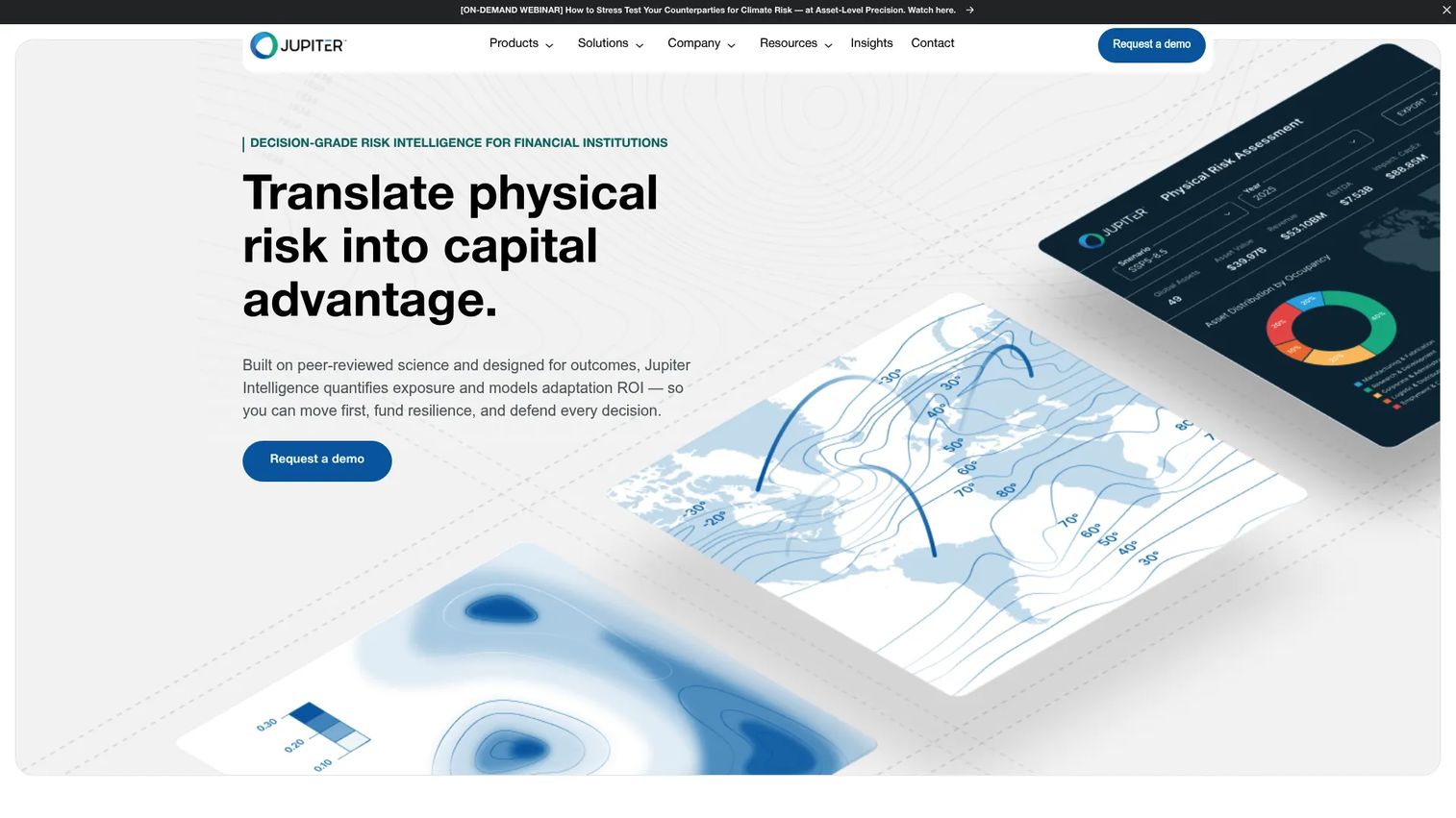
Jupiter Intelligence is climate risk analytics software built for financial institutions and other regulated enterprises. Its ClimateScore Global platform runs portfolio-to-asset physical and extreme weather risk analysis with global coverage, plus scenario and stress testing aligned to IPCC pathways through 2100. It is aimed squarely at decision-grade output for regulated buyers.
Best for: banks, insurers, asset managers, and infrastructure operators needing decision-grade physical climate risk analytics.
Key features
- ClimateScore Global platform with SaaS and enterprise API
- Portfolio-to-asset physical and extreme weather risk analysis
- Global coverage
- Scenario and stress testing with IPCC-aligned scenarios through 2100
- Tailored analytics support
Why choose Jupiter Intelligence: it fits regulated financial institutions that need scenario and stress testing they can defend. The IPCC-aligned scenarios and asset-level depth suit ORSA and stress-testing workflows.
Jupiter doesn't display pricing on its site. The platform routes buyers to request a demo and contact sales, so expect a scoped enterprise quote.
8. S&P Global Climanomics
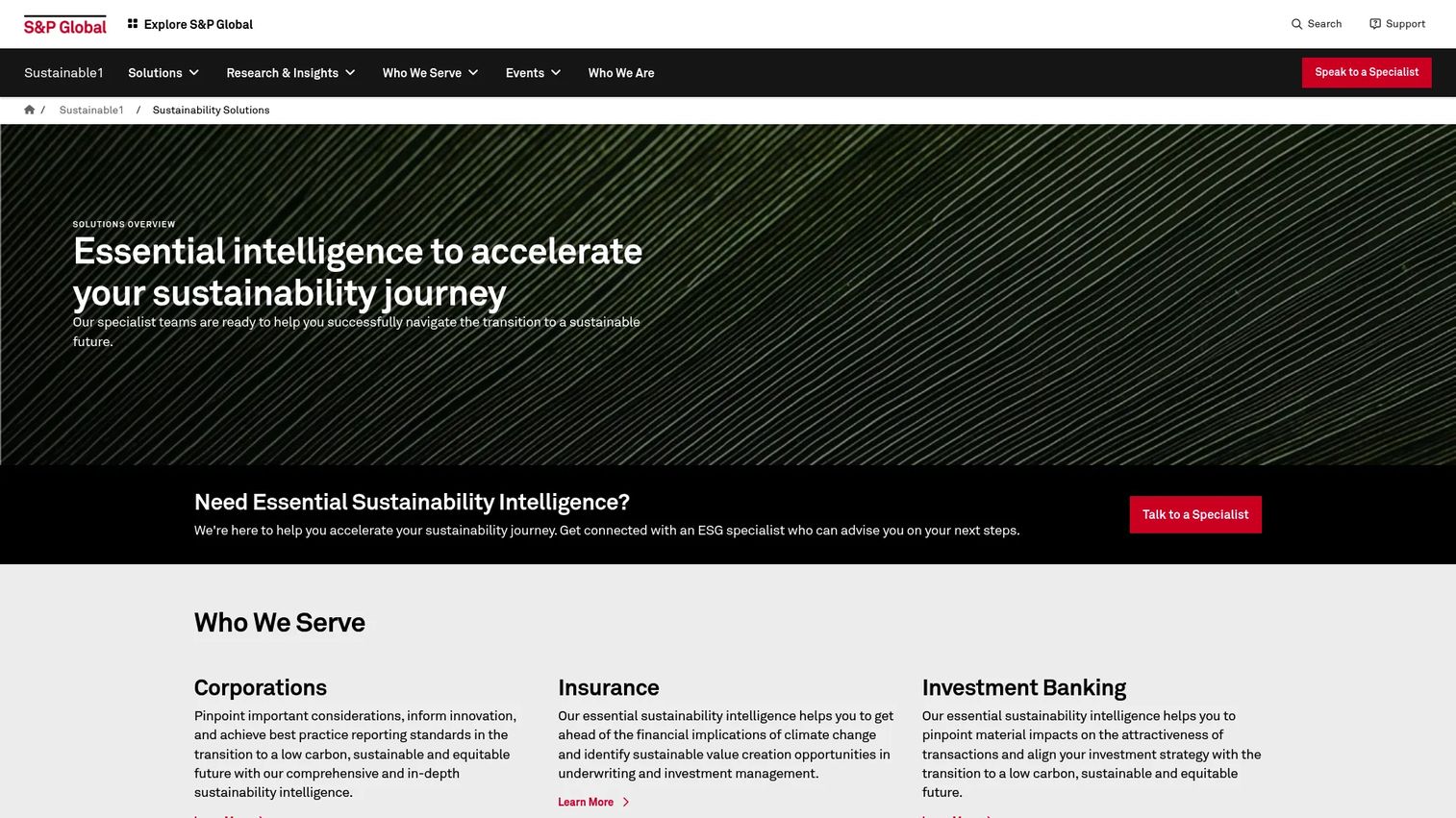
S&P Global Climanomics is a climate risk analytics platform for measuring the financial impact of physical and transition climate risks on assets and portfolios. It handles both risk types in one platform and delivers asset, company, and portfolio-level insights with one-click scenario analysis by decade to 2100. The S&P name carries recognition with lenders and regulators.
Best for: banks, insurers, investors, and corporations assessing climate risk exposure and financial impact at portfolio scale.
Key features
- Physical and transition risk in one platform
- Asset, company, and portfolio-level insights
- One-click climate scenario analysis
- Analysis by decade up to 2100
- Financial impact quantification across industries
Why choose S&P Global Climanomics: it fits large financial and corporate teams that want breadth and a recognized name behind the numbers. Covering both physical and transition risk in one platform simplifies portfolio-scale reporting.
S&P Global doesn't show pricing for Climanomics. The homepage and product brochure direct buyers to contact a specialist, with costs arranged through S&P's enterprise sales process.
Considerations
Before you commit, run each shortlisted tool through this checklist. The right choice depends on your footprint, your hazards, and who reads your output.
Track record and model credibility
Ask how the model was built and validated. A physics-based deterministic engine and a statistical one produce different confidence levels, and regulators care about methodology. Look for published methods, adoption by peers, and evidence the model has been tested against real events.
Geographic and hazard coverage
A tool that models flood beautifully but ignores wildfire is useless if your assets sit in fire country. Match the platform's hazard set and geographic resolution to your actual footprint. Global coverage matters most when your supply chain or portfolio crosses borders.
Sector specificity
Agriculture, property, insurance, infrastructure, and enterprise reporting buyers need different depth. A crop-yield model and an asset-level property model solve different problems. Pick specialization where your risk concentrates, and breadth where it spreads.
Usability and workflow fit
A technically strong model earns nothing if your team cannot act on the output. Check whether results arrive as dashboards, API feeds, or report-ready exports, and whether they fit your existing stack. Consulting support helps when internal capacity is thin; self-serve tooling wins when you want speed.
ROI and decision support
The point is action, not analysis. Verify the tool produces outputs that support a decision: which assets to harden, what to disclose, where to price risk. If the output stops at a hazard score with no financial translation, you will do the hard part yourself.
Conclusion
The best climate risk platform is the one that matches your problem. Agriculture and supply-chain teams should start with ClimateAi. Property-level and asset-specific buyers should look hard at First Street. Financial institutions needing scenario and stress testing should shortlist Jupiter Intelligence, Climate X, and S&P Global Climanomics for their financial impact depth. Teams wanting analytics plus advisory should weigh EY Climate Analytics Platform and EcoAct, and anyone needing raw high-resolution hazard data should evaluate Meteomatics.
Your next step is to narrow by three filters: use case, geography, and reporting need. Map your assets and hazards first, confirm the tool covers your footprint, then check that its output feeds the disclosure frameworks you answer to. Book demos with two or three that clear those filters, and push each vendor on methodology and financial translation. The market is maturing fast, so the tool that fits your 2026 obligations is likely already on this list.
Start your journey with Guideflow today!
If your product is easier to understand by doing than by describing, Guideflow turns it into self-serve interactive demos in minutes. Start your journey with Guideflow today!
FAQs
It typically measures hazard likelihood, exposure, and impact severity. Hazard likelihood is the chance of a flood, heatwave, or wildfire in a location. Exposure maps which assets sit in harm's way, and impact severity estimates the damage. Better tools add financial consequences like damage cost, downtime, and value at risk.
Climate risk software models and interprets risk, running the hazard, exposure, and scenario analysis that produces the numbers. Climate disclosure software packages those numbers into reporting workflows aligned to frameworks like TCFD, CSRD, or CDP. Many buyers need both, but the modeling has to be sound before the reporting is worth anything.
It supplies the modeled inputs these frameworks demand: scenario analysis under different warming pathways, asset-level exposure, and portfolio-level risk summaries. TCFD and CSRD both expect forward-looking, scenario-based disclosure, which is exactly what a scenario-capable platform produces. The software gives you defensible inputs; your team still frames the narrative.
The best tools go down to the asset or property level, modeling risk for a single building or facility. First Street, Climate X, and Jupiter Intelligence all support asset-level analysis. Other platforms stay at portfolio level, which suits high-level exposure views but not decisions about a specific site.
Open-source options like the CLIMADA-App can be useful for smaller teams, public-sector work, or early analysis, and the price is right at zero. For enterprise use, though, most buyers need governance, support, integration, and audit-ready output that open-source tools rarely package. It is a strong starting point, not usually a full replacement.
Look for tools that translate hazard data into damage, downtime, and value-at-risk metrics. Climate X, S&P Global Climanomics, and Jupiter Intelligence all convert physical and transition risk into financial terms at asset and portfolio scale. If a tool stops at a hazard score, it leaves the financial translation to you.
Niche tools win on specificity: a crop-yield model or a property-level engine gives depth where your risk concentrates. Enterprise platforms win on breadth and reporting support, covering multiple hazards, geographies, and disclosure frameworks in one place. Choose niche when your risk is concentrated and enterprise when it spreads across assets and obligations.
Ask about hazard and geographic coverage, model methodology, and how often the data refreshes. Then push on integration, how the outputs are explained, and whether the tool supports your specific disclosure frameworks and use case. A vendor who can walk you through methodology and financial translation without hedging is usually the safer bet.