Your app can have strong activation numbers and still leak revenue if the monetization layer is wrong. Growth marketers running mobile apps face a choice that is deceptively broad: Ad networks, mediation platforms, offerwalls, subscription billing, direct payments, and programmatic demand all compete for the same slot in your stack. Consumer spending on iOS and Android apps reached $166.8 billion in 2025, up 11.1% year over year, according to Business of Apps (2026). The revenue is there. The challenge is picking the right mechanism to capture it without wrecking retention, complicating attribution, or adding another reporting gap your CFO will question.
This guide cuts through the noise. It evaluates 20 platforms by revenue model fit, not by vendor marketing, so you can shortlist the right tools for your specific monetization motion before committing to an SDK or a contract.
What's inside
This guide is for app publishers, growth marketers, and monetization managers comparing platforms across the full app revenue spectrum.
- Who it's for: Mobile app teams, game studios, and growth operators optimizing ARPDAU, LTV, and payback period
- How tools were chosen: Revenue model fit, iOS and Android support, analytics quality, and pricing clarity
- Selection criteria:
- Revenue model match (ads, subscriptions, IAP, offerwalls, direct payments)
- Implementation effort and SDK overhead
- Measurement and attribution quality
- Pricing transparency or payout clarity
TL;DR
- Best for mobile game ad monetization: Unity Ads and AppLovin for gaming-focused demand
- Best for mediation and in-app bidding: AppLovin MAX and Unity LevelPlay
- Best for offerwall monetization: Tapjoy Offerwall, especially for virtual currency economies
- Best for subscription revenue: Recurly (starts at $249/month) or Paddle (5% + 50¢ per transaction)
- Best for direct app payments and web stores: Appcharge for DTC game monetization, FastSpring for global digital commerce
- Best free starting point for ad monetization: Google AdMob and Smaato (free publisher ad server)
What is app monetization software?
App monetization software helps app publishers generate, manage, measure, and optimize revenue from users through ads, in-app purchases, subscriptions, payments, offerwalls, or hybrid models. It is not a single category but a cluster of overlapping tools, each serving a different revenue motion.
Core capabilities to look for:
- Ad serving, mediation, and in-app bidding across demand sources
- In-app purchase infrastructure and subscription billing
- Offerwall and rewarded engagement mechanics
- Direct payment processing and merchant-of-record services
- Revenue analytics covering ARPDAU, eCPM, fill rate, LTV, and cohort revenue
- Privacy and consent management (GDPR, CCPA, COPPA, ATT)
- Cross-platform support for iOS and Android
The category breaks into six distinct types:
- Ad monetization platforms: Serve ads inside your app and generate revenue per impression or click
- Mediation platforms: Manage multiple ad networks through unified auctions and waterfall optimization
- Subscription and billing platforms: Handle recurring payments, revenue recovery, and subscriber lifecycle
- Payment infrastructure and merchant-of-record: Manage global checkout, taxes, and direct-to-consumer sales
- Offerwall platforms: Let users complete actions in exchange for in-app rewards
- Programmatic marketplaces and SSPs: Give publishers access to broader demand through open auctions
Understanding which type fits your revenue model is the first decision. A rewarded-ad platform will not solve subscription churn. A billing platform will not fill ad inventory. Match the tool to the motion before evaluating features.
For mobile marketing software that complements monetization with acquisition, that is a parallel decision worth making at the same time.
When to use app monetization platforms
Increase ad revenue without adding more ad placements
Ad mediation and in-app bidding improve yield before you raise ad load. If your fill rate is below 90% or your eCPM is flat across placements, adding a second or third demand source through a mediation layer typically lifts revenue without increasing interruptions. Tools like AppLovin MAX and Unity LevelPlay run real-time auctions across networks so the highest bid wins each impression.
Add recurring revenue to a freemium app
When you have an engaged user base but ad revenue is volatile, subscription tiers and IAPs give you a more predictable revenue stream. This matters especially for content apps, productivity tools, and games with progression mechanics. Paddle, FastSpring, and Recurly each handle the billing, tax compliance, and payment recovery that makes subscription revenue operationally manageable.
Measure monetization by cohort and acquisition channel
Attribution without cohort revenue data leaves a blind spot in your ROAS calculation. Pairing your mobile attribution platforms with a monetization platform that reports LTV at the user or cohort level closes that gap. Platforms like Appodeal and Liftoff surface LTV and eCPM data alongside acquisition signals, giving growth teams a clearer payback picture.
App monetization platforms comparison
The table below covers all 20 platforms by revenue model fit, key differentiator, pricing, and G2 rating. Pricing reflects verified figures from each vendor's pricing page. Where no price is publicly listed, the entry reflects the pricing model type. Ratings are from G2 listings.
| # | Product | Best for | Key differentiator | Pricing | G2 rating |
|---|---|---|---|---|---|
| 1 | Unity Ads | Mobile game ad monetization | Gaming-native ad formats and ecosystem | Revenue share (contact sales) | N/A |
| 2 | Liftoff | Performance-driven mobile monetization | ML-powered yield and Vungle SDK | Quote-based | 4.5/5 |
| 3 | AppLovin | Mobile game and app growth | Minimum $15/day ad budget; AI optimization | From $15/day | 4.2/5 |
| 4 | ironSource | Mobile app mediation and UA | 25+ ad network mediation via Unity | Quote-based | 3.9/5 |
| 5 | Google AdMob | Developers starting with mobile ads | Free platform with Google demand | Free | 4.3/5 |
| 6 | AppLovin MAX | Multi-network mediation | Real-time in-app bidding; free for publishers | Free for publishers | 4.2/5 |
| 7 | Unity LevelPlay | Game ad mediation and bidding | Unified auction across networks | Quote-based | N/A |
| 8 | Tapjoy Offerwall | Virtual currency and rewarded engagement | Opt-in rewarded marketplace | Revenue share | 3.2/5 |
| 9 | Appcharge | Direct web store monetization | DTC payments and player loyalty tools | Quote-based | N/A |
| 10 | Paddle | Web subscription and payment billing | 5% + 50¢ per transaction; merchant of record | 5% + 50¢/transaction | 4.6/5 |
| 11 | FastSpring | Global digital commerce | Revenue-share pricing; full MOR service | Revenue share (contact sales) | 4.5/5 |
| 12 | Recurly | Subscription billing and recovery | Starts at $249/month + 0.9% billing volume | From $249/month | 4.1/5 |
| 13 | InMobi | Mobile ad demand and consent management | GenAI ad platform; CMP free tier | Free / $20 per domain/month | 4.3/5 |
| 14 | PubMatic | Programmatic sell-side monetization | AI-powered SSP across CTV and mobile | Quote-based | 3.2/5 |
| 15 | Smaato | Omnichannel mobile programmatic | Free publisher ad server and SDX | Free | 4.4/5 |
| 16 | Appodeal | Mediation with growth analytics | 70+ demand sources; LTV and eLTV forecasting | Revenue share | 4.7/5 |
| 17 | Meta Audience Network | Meta demand for eligible apps | Access to Meta advertiser pool | Revenue share | 3.9/5 |
| 18 | Digital Turbine | Distribution plus monetization | On-device app discovery and AI optimization | Quote-based | 4.7/5 |
| 19 | Chartboost | Mobile game-specific ad demand | Gaming inventory specialist with mediation | Revenue share / CPI | 2.5/5 |
| 20 | BIGO Ads | Regional mobile user acquisition | Minimum $20 campaign budget; global reach | From $20/campaign | N/A |
Best 20 app monetization platforms for 2026
1. Unity Ads
Unity Ads is the ad monetization product within Unity's broader game development and growth stack. It offers rewarded video, interstitial, and banner ad formats built around player-first engagement loops. Publishers already using Unity Engine to build games can connect to ad demand without adding an external SDK.
Best for: Mobile game developers who want ad demand that fits gaming engagement patterns and an existing Unity workflow.
Key features
- Rewarded video and interstitial ad formats for games
- A/B testing and placement-level optimization
- Revenue performance reporting and analytics
- User acquisition campaign management alongside monetization
- Unity ecosystem integration for developers
Why choose Unity Ads: Choose it when your game is built on Unity and you want ad demand that fits naturally into the development and analytics workflow you already use.
Unity Ads pricing: Revenue-share terms apply; contact Unity sales for specific rates and minimum thresholds. No self-serve pricing is listed.
2. Liftoff
Liftoff is a mobile growth platform that covers publisher monetization, user acquisition, creative optimization, and mobile intelligence. It runs real-time auctions through the Vungle SDK and applies ML to yield optimization, which helps publishers improve eCPM across iOS and Android inventory. The company serves both the buy and sell side, so its monetization data benefits from broad demand-side exposure.
Best for: App publishers who want performance-focused ad demand with ML-driven yield optimization and cross-platform support.
Key features
- ML-powered yield optimization for publisher inventory
- Vungle SDK for rewarded and interstitial video ads
- Real-time auctions across global advertiser demand
- Cross-platform support for iOS and Android
- Creative development for performance ad formats
Why choose Liftoff: It suits teams that want monetization and acquisition insight from one mobile-first company, reducing the reporting gap between demand-side and supply-side data.
Liftoff pricing: Quote-based. Ask sales about revenue share rates, minimum traffic thresholds, and SDK integration requirements.
G2 rating: 4.5/5.
3. AppLovin

AppLovin provides AI-powered advertising and monetization for mobile apps and games. On the advertiser side, campaigns can start with as little as $15 per day, with AI optimization targeting ROAS, cost per purchase, or in-app events. On the publisher side, AppLovin's ad network feeds into its MAX mediation product. The company covers full-screen video, interactive placements, and dynamic product catalogs.
Best for: Mobile game and app teams that want a mature monetization and growth stack with AI-driven campaign performance.
Key features
- AI campaign optimization targeting ROAS and in-app events
- Full-screen video and interactive ad placements
- Dynamic product and offering catalog ad formats
- MMP integrations and campaign tracking infrastructure
- Publisher demand feeding into MAX mediation
Why choose AppLovin: It suits publishers who want to run monetization and paid acquisition through the same performance infrastructure. Evaluate how its reporting integrates with your existing attribution stack before committing.
AppLovin pricing: Advertising campaigns start from $15 per day. Publisher monetization through MAX is free; bidding network fees apply on ad revenue.
G2 rating: 4.2/5.
4. ironSource
ironSource is now part of Unity, with its products presented under the Unity Grow umbrella. Its mediation layer, Unity LevelPlay, connects to 25+ ad networks and includes A/B testing and real-time transparency reporting. The user acquisition side runs through Unity Ads, powered by Vector AI optimization. Ad Quality tools let publishers review creatives and flag problematic ads.
Best for: Game and app publishers evaluating mature mobile ad mediation infrastructure with transparency reporting.
Key features
- Ad mediation via Unity LevelPlay with 25+ networks
- Real-time transparency reporting on network performance
- Vector AI for user acquisition optimization
- Ad Quality tools for creative review and UX protection
- Rewarded video and interstitial support
Why choose ironSource: Choose it for mediation depth and gaming-specific revenue mechanics. Verify current product naming and packaging before signing, since the Unity consolidation is ongoing.
ironSource pricing: Quote-based through Unity sales. Ask about revenue share rates, managed service options, and mediation fee structure.
G2 rating: 3.9/5.
5. Google AdMob
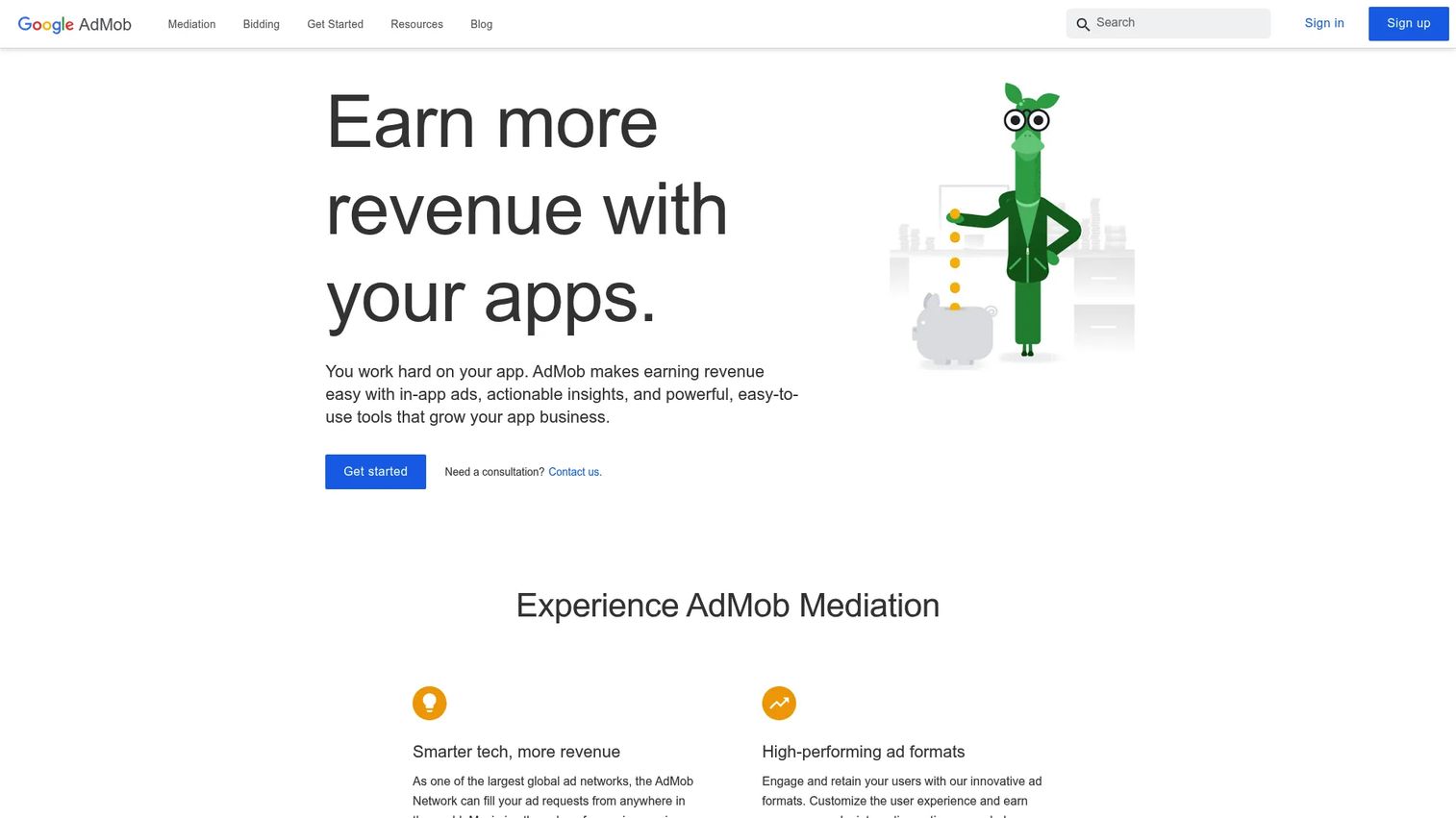
Google AdMob is Google's mobile app monetization platform, free for app developers. It supports banner, interstitial, rewarded, native, and app open ad formats, alongside mediation across Google and third-party networks. Reporting connects to Google Analytics for Firebase, and publishers can block specific advertisers or categories.
Best for: App developers who want an established, free starting point for mobile ad monetization with Google demand access.
Key features
- Banner, interstitial, rewarded, native, and app open ad formats
- Mediation and bidding across Google and third-party networks
- Advertiser blocking and category controls
- Google Analytics for Firebase integration
- Performance dashboards and optimization reports
Why choose Google AdMob: It is the lowest-friction entry point for ad monetization, particularly for teams new to in-app advertising. Advanced publishers may need to compare mediation depth against specialist platforms.
Google AdMob pricing: Free to use. Revenue flows through Google's ad auction; no subscription or platform fee applies.
G2 rating: 4.3/5.
6. AppLovin MAX

AppLovin MAX is a mobile ad mediation and in-app bidding platform that runs real-time auctions across multiple demand sources. It supports rewarded video, interstitial, app open, banner, MREC, and native ad formats. Publishers get impression-level and user-level revenue data, A/B testing for waterfall strategies, and ad quality controls. The mediation layer is free for publishers.
Best for: Publishers who have outgrown single-network monetization and need yield optimization across multiple demand sources.
Key features
- Real-time in-app bidding and mediation across networks
- Impression-level and user-level revenue reporting
- A/B testing for waterfall and bidding strategies
- Ad quality controls and creative review
- Lightweight SDK with MMP integrations
Why choose AppLovin MAX: It fits teams that want to improve eCPM and fill rate by running multiple networks in a unified auction, without paying a mediation subscription. Bidding networks pay a fee on generated revenue.
AppLovin MAX pricing: Free for publishers. AppLovin charges bidding networks a fee on ad revenue generated through the platform.
G2 rating: 4.2/5.
7. Unity LevelPlay
Unity LevelPlay is an ad mediation and in-app bidding platform built for game developers. It runs a unified auction across ad networks and bidders, supports rewarded, interstitial, banner, and native formats, and provides A/B testing for ad strategies. It also includes automated ROAS user-acquisition campaigns and game-growth insights within the Unity ecosystem.
Best for: Game studios that want mediation, auction optimization, and user acquisition in one platform within the Unity stack.
Key features
- Unified auction across ad networks and bidders
- Rewarded, interstitial, banner, and native ad format support
- A/B testing for ad monetization strategies
- Automated ROAS user-acquisition campaigns
- Ad quality controls and real-time reporting
Why choose Unity LevelPlay: It suits publishers already invested in Unity's ecosystem who want mediation without adding a separate platform. Evaluate supported networks and SDK setup requirements before integrating.
Unity LevelPlay pricing: Quote-based through Unity. Contact sales for revenue share terms and mediation fee details.
8. Tapjoy Offerwall
Tapjoy Offerwall is a rewarded marketplace that lets mobile game users complete advertiser actions in exchange for in-app currency or rewards. It operates under Unity after Tapjoy's acquisition. The offerwall format is opt-in, which means users choose to engage rather than being interrupted. It supports Android, iOS, Flutter, React Native, and Unity integrations, alongside mobile measurement partner connections.
Best for: Mobile game publishers with virtual currency economies or rewarded engagement loops who want an additional opt-in revenue stream.
Key features
- Opt-in rewarded ad marketplace for in-app currency
- Per-app bidding on advertiser offers
- Currency sale promotions to boost engagement
- Android, iOS, Flutter, Unity, and React Native integrations
- MMP integrations for attribution
Why choose Tapjoy Offerwall: Offerwalls work when the app economy can support a reward structure and users understand the exchange. Measure retention impact carefully, since heavy offerwall use can affect long-term engagement in some game categories.
Tapjoy Offerwall pricing: Revenue-share model. Contact Unity sales for rates and minimum requirements given the current platform structure.
G2 rating: 3.2/5.
9. Appcharge
Appcharge is a direct-to-consumer payments and monetization platform for mobile game publishers. It helps studios build personalized web stores where players can purchase directly, bypassing app-store-only checkout flows. The platform covers self-optimized checkout, merchant-of-record services, subscriptions, player-level personalization, and 500+ payment methods across 100+ currencies.
Best for: Mobile game publishers exploring direct web stores and app-to-web monetization as a complement to in-app store purchases.
Key features
- Personalized web store builder for direct player purchases
- Self-optimized checkout and in-app payment links
- Merchant-of-record and global payment processing
- Subscription support with player-level personalization
- 500+ payment methods and 100+ currencies
Why choose Appcharge: It fits game teams that want to test direct revenue flows and reduce dependence on app-store-only IAP. Review platform policy, tax, and payment compliance implications with your legal team before launching a web store.
Appcharge pricing: Quote-based. Ask sales about payment processing fees, revenue share terms, and store setup costs.
10. Paddle
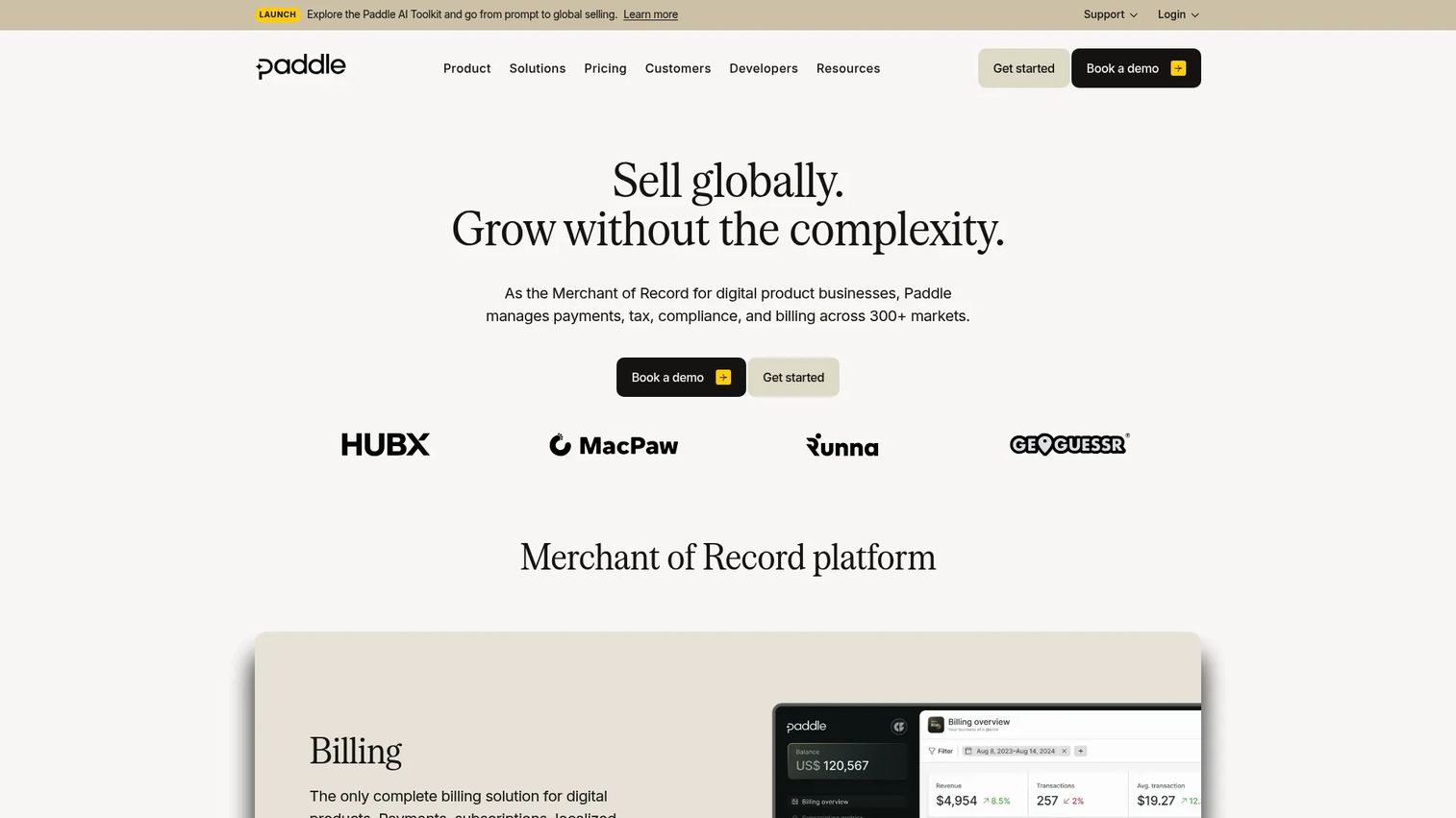
Paddle is a merchant-of-record platform that handles payments, subscription billing, global tax compliance, fraud protection, and chargeback management under one contract. The pay-as-you-go plan charges 5% + 50¢ per checkout transaction with no monthly fee. It is more common among SaaS and digital product businesses, but it applies equally well to app businesses selling subscriptions or digital goods through web checkout.
Best for: App businesses selling subscriptions or digital products through web-based checkout who need global tax handling without internal finance infrastructure.
Key features
- Pay-as-you-go checkout at 5% + 50¢ per transaction
- Subscription billing and revenue recovery
- Global tax and regulatory compliance included
- Fraud protection and chargeback management
- Invoicing and financial reporting
Why choose Paddle: It removes the operational cost of managing tax registrations, VAT, and fraud handling in multiple markets. High-volume or complex businesses can negotiate custom pricing terms.
Paddle pricing: 5% + 50¢ per checkout transaction on the pay-as-you-go plan. Custom pricing available for high-volume businesses.
G2 rating: 4.6/5.
11. FastSpring
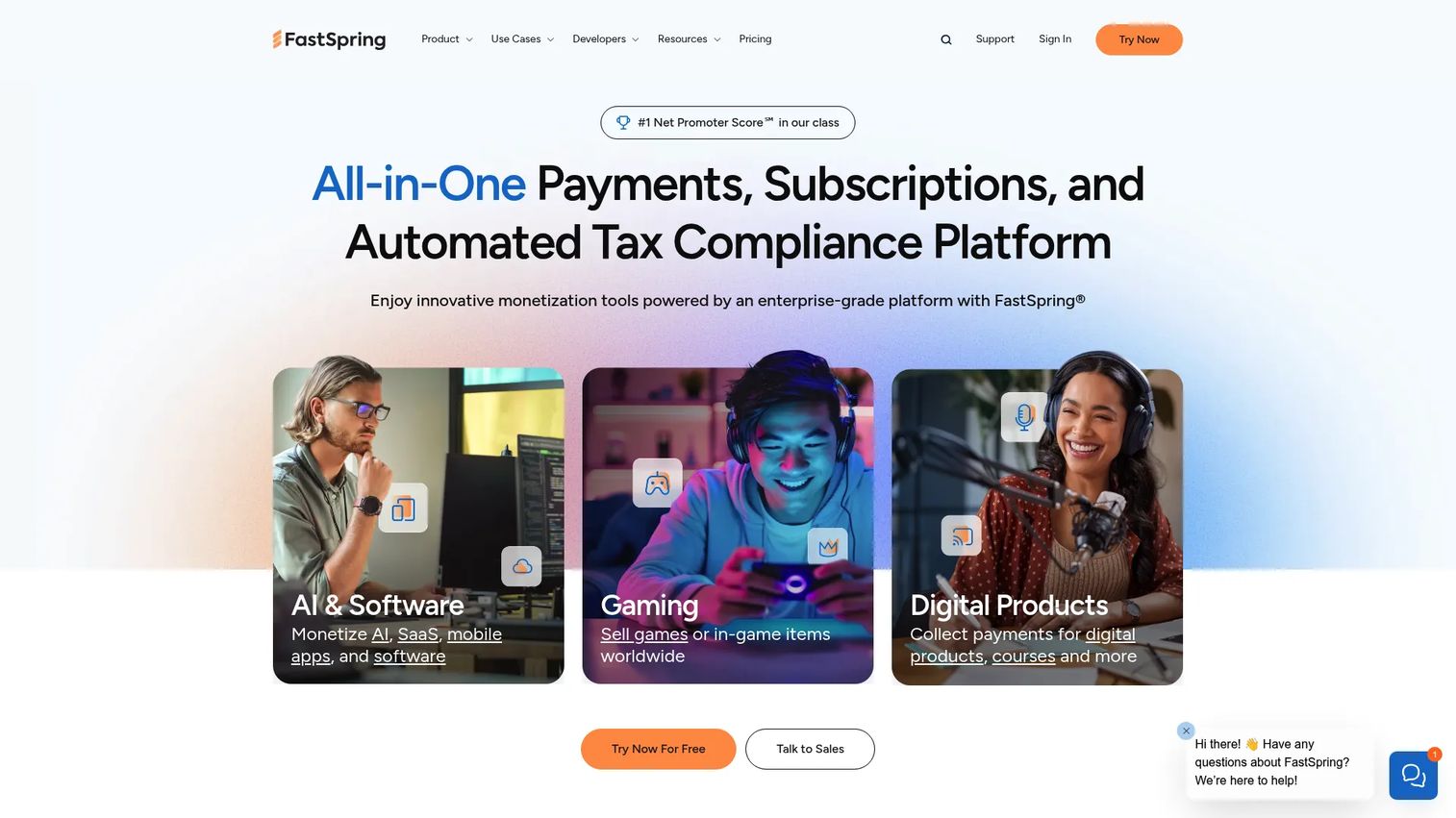
FastSpring is a merchant-of-record and digital commerce platform that handles global payments, subscriptions, tax collection and remittance, fraud prevention, B2B invoicing, and reporting. Its pricing uses a revenue-share model, with rates set by transaction type and sales volume. It serves SaaS, software, games, and digital-product businesses with international buyer bases.
Best for: App and software businesses that need global digital commerce infrastructure with built-in tax compliance across multiple markets.
Key features
- Global payment processing and localized checkout
- Subscription management and recurring billing
- Sales tax and VAT collection and remittance
- Fraud prevention and risk management
- B2B invoicing and interactive quotes
Why choose FastSpring: It suits teams selling digital products internationally who want to offload tax registration, compliance, and payment operations. The revenue-share model means no fixed monthly cost until you are generating revenue.
FastSpring pricing: Revenue-share pricing; contact sales for rates, which vary by transaction type and sales volume.
G2 rating: 4.5/5.
12. Recurly
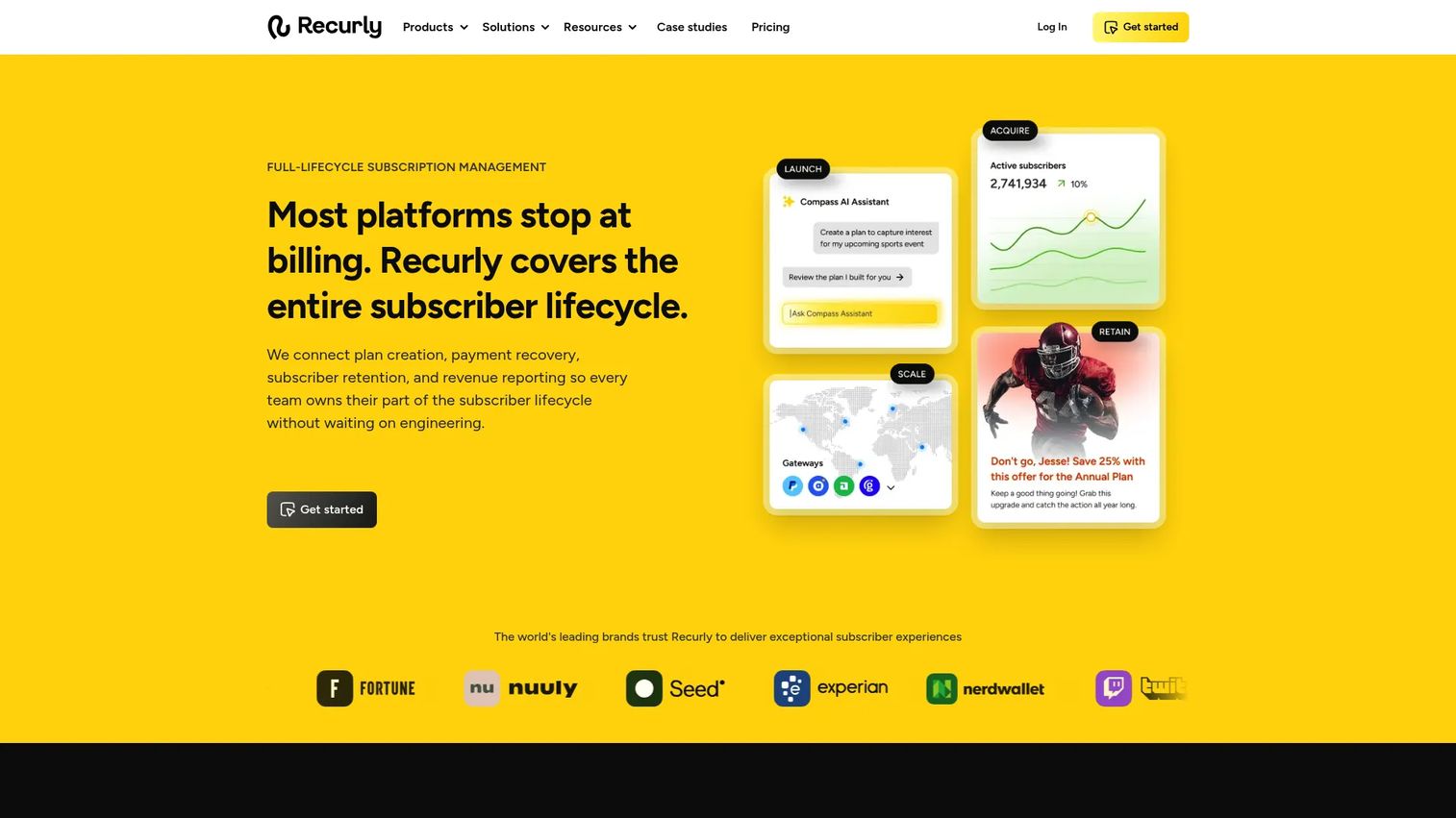
Recurly is a subscription management and recurring billing platform. Its Starter plan is $249 per month plus 0.9% of billing volume, making pricing transparent at the entry level. The platform handles subscription plans, billing operations, failed-payment recovery, subscriber management, and payments orchestration. It includes Compass AI for subscriber analytics and churn prediction.
Best for: Subscription-based app businesses that need billing infrastructure, revenue recovery, and subscriber analytics to improve LTV and reduce churn.
Key features
- Subscription billing and plan management
- Failed-payment recovery (revenue recovery)
- Subscriber management and payments orchestration
- Compass AI for subscriber analytics and churn signals
- Plan promotion and pricing experiment support
Why choose Recurly: Choose it when failed payments and subscription churn are measurable revenue problems. The Starter plan at $249/month suits growing subscription businesses before volume pricing becomes the driver.
Recurly pricing: Starter plan at $249 per month plus 0.9% of billing volume. All-Access plan pricing is volume-based (from under 1% annually). Engage and RevRec add-ons start at $1,600 and $850 per month respectively.
G2 rating: 4.1/5.
13. InMobi
InMobi is a GenAI-powered mobile advertising and publisher monetization platform. On the publisher side, it provides programmatic demand, mobile ad formats including video, native, playable, rich media, and interstitials, alongside a consent management platform. InMobi CMP Essentials is free; the Premium tier costs $20 per domain per month, or free when integrated through InMobi's SSP.
Best for: App publishers seeking mobile ad demand with global marketplace reach and a built-in consent management option.
Key features
- Mobile ad formats: Video, native, playable, rich media, interstitials
- Programmatic buying through InMobi DSP
- CMP Essentials free tier with privacy consent tools
- CMP Premium at $20 per domain per month
- Global demand across regions and devices
Why choose InMobi: It suits publishers who want mobile demand with consent management included, reducing the need for a separate CMP tool. Check reporting granularity and SDK integration fit before committing.
InMobi pricing: CMP Essentials is free. CMP Premium is $20 per domain per month, or free via SSP integration. Publisher ad demand pricing is revenue-share based.
G2 rating: 4.3/5 (seller-level rating).
14. PubMatic
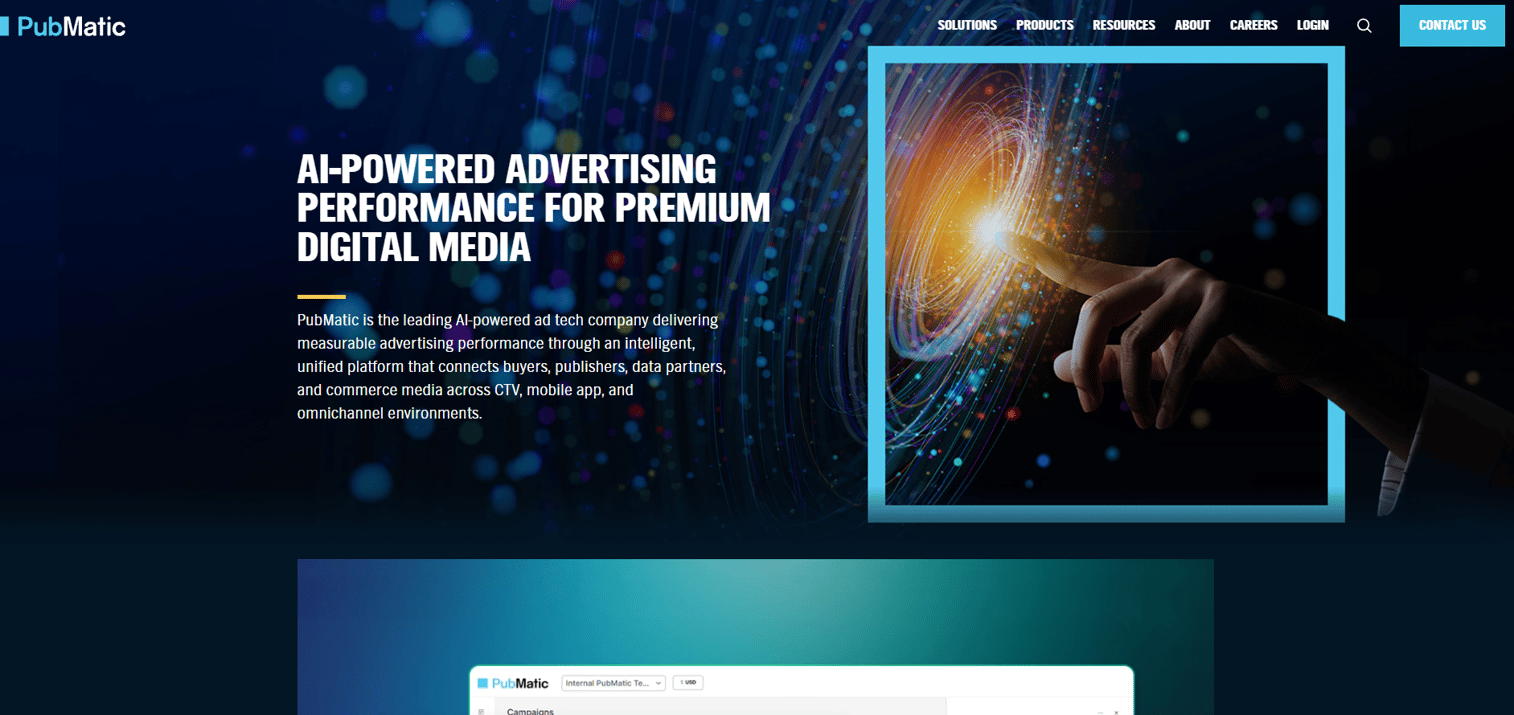
PubMatic is an AI-powered programmatic advertising platform serving publishers across CTV, mobile app, online video, and web environments. It covers inventory discovery, curation, activation, and campaign analytics across buyer types. PubMatic suits larger publishers that need sophisticated sell-side controls and programmatic demand infrastructure.
Best for: Larger app and media publishers that need programmatic demand, inventory curation, and sell-side controls across multiple channels.
Key features
- AI-powered media buying and campaign optimization
- Premium inventory across CTV, online video, mobile app, and web
- Inventory curation and private marketplace support
- Buyer-side analytics and campaign measurement
- Commerce media infrastructure
Why choose PubMatic: It fits publishers with scale who need sophisticated programmatic infrastructure beyond a standard mobile ad network. Smaller app teams will find simpler mobile-first networks easier to integrate.
PubMatic pricing: Quote-based. Contact sales for commercial terms, which vary by inventory volume and deal type.
G2 rating: 3.2/5.
15. Smaato
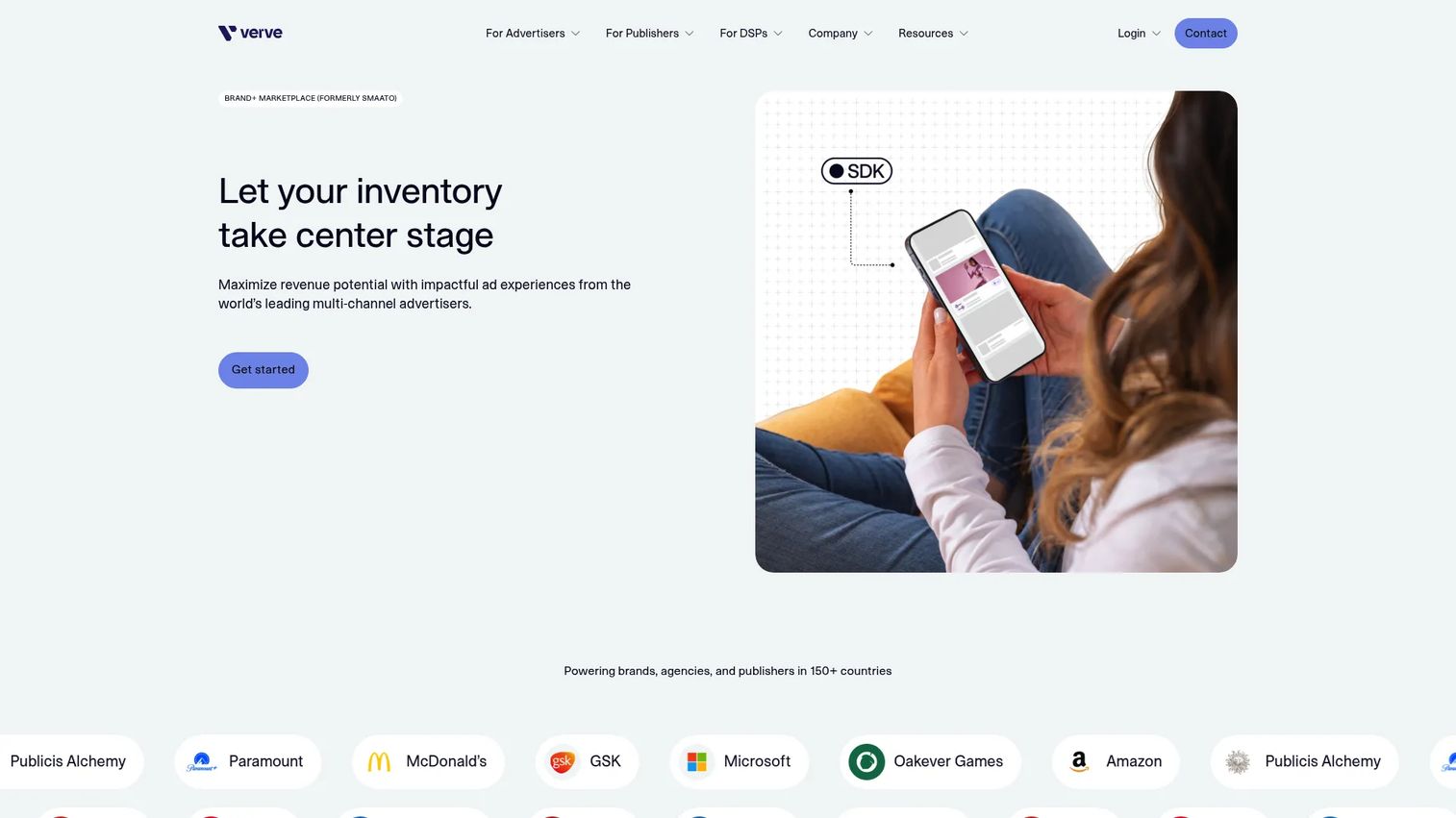
Smaato, now part of Verve Group, is an omnichannel digital advertising platform. Its publisher ad server and SDX optimization platform are both free, with no subscription or ad-serving fees. The platform supports unified bidding, mediation, Prebid, open auction, private exchange, and programmatic direct. Ad formats include banner, interstitial, rewarded, native, video, rich media, and playable.
Best for: Mobile publishers that want exchange-based monetization and programmatic demand without paying a platform fee.
Key features
- Free publisher ad server with no subscription or ad-serving fees
- Omnichannel advertising across mobile, web, OTT, and CTV
- Unified bidding, mediation, Prebid, and programmatic direct support
- NextGen SDK supporting multiple ad formats
- Contextual targeting, consent management, and reporting
Why choose Smaato: The free publisher ad server lowers the cost of entry for teams testing programmatic monetization. Compare fill rate and eCPM performance by region before treating it as a primary demand source.
Smaato pricing: Publisher ad server and SDX are free to use. No subscription or ad-serving fees apply.
G2 rating: 4.4/5.
16. Appodeal
Appodeal is a mobile growth platform combining ad mediation, monetization intelligence, user-acquisition automation, and publishing support. Its open-source SDK connects to 70+ ad demand sources. It reports 200+ metrics, provides LTV and eLTV forecasting, and includes A/B testing, audience segmentation, and ad-quality tracking. The accelerator program adds UA funding and creative production for qualifying publishers.
Best for: Mobile app and game developers who want transparent ad mediation with deep analytics and growth support in one platform.
Key features
- Open-source SDK with 70+ ad demand sources
- Real-time optimization, automated waterfalls, and bidding
- LTV and eLTV forecasting with 200+ metrics
- A/B testing, audience segmentation, and UA automation
- Accelerator program with UA funding and creative production
Why choose Appodeal: The depth of analytics and LTV forecasting suits growth teams that need monetization and acquisition data in one view. Check supported SDK networks and reporting export options against your attribution stack.
Appodeal pricing: Revenue-share model. The Accelerator program runs on an agreed revenue-share with no upfront subscription fee.
G2 rating: 4.7/5.
17. Meta Audience Network
Meta Audience Network is Meta's in-app advertising network, giving eligible app developers and publishers access to Meta's advertiser demand pool. It supports rewarded video, interstitial, rewarded interstitial, native, and banner ad formats, alongside in-app bidding and a Monetization Manager for performance reporting.
Best for: Publishers with eligible app inventory who want to access Meta's advertiser demand within their monetization mix.
Key features
- Rewarded video, interstitial, native, and banner ad formats
- In-app bidding for real-time demand access
- Monetization Manager with performance reporting
- Meta advertiser demand pool integration
- Publisher eligibility controls and ad quality settings
Why choose Meta Audience Network: It makes most sense when you have eligible inventory and want to add Meta's demand alongside other networks. Verify current publisher eligibility requirements before integrating, since network rules have changed over time.
Meta Audience Network pricing: Revenue-share model. Contact Meta for current publisher payout terms and eligibility requirements.
G2 rating: 3.9/5.
18. Digital Turbine
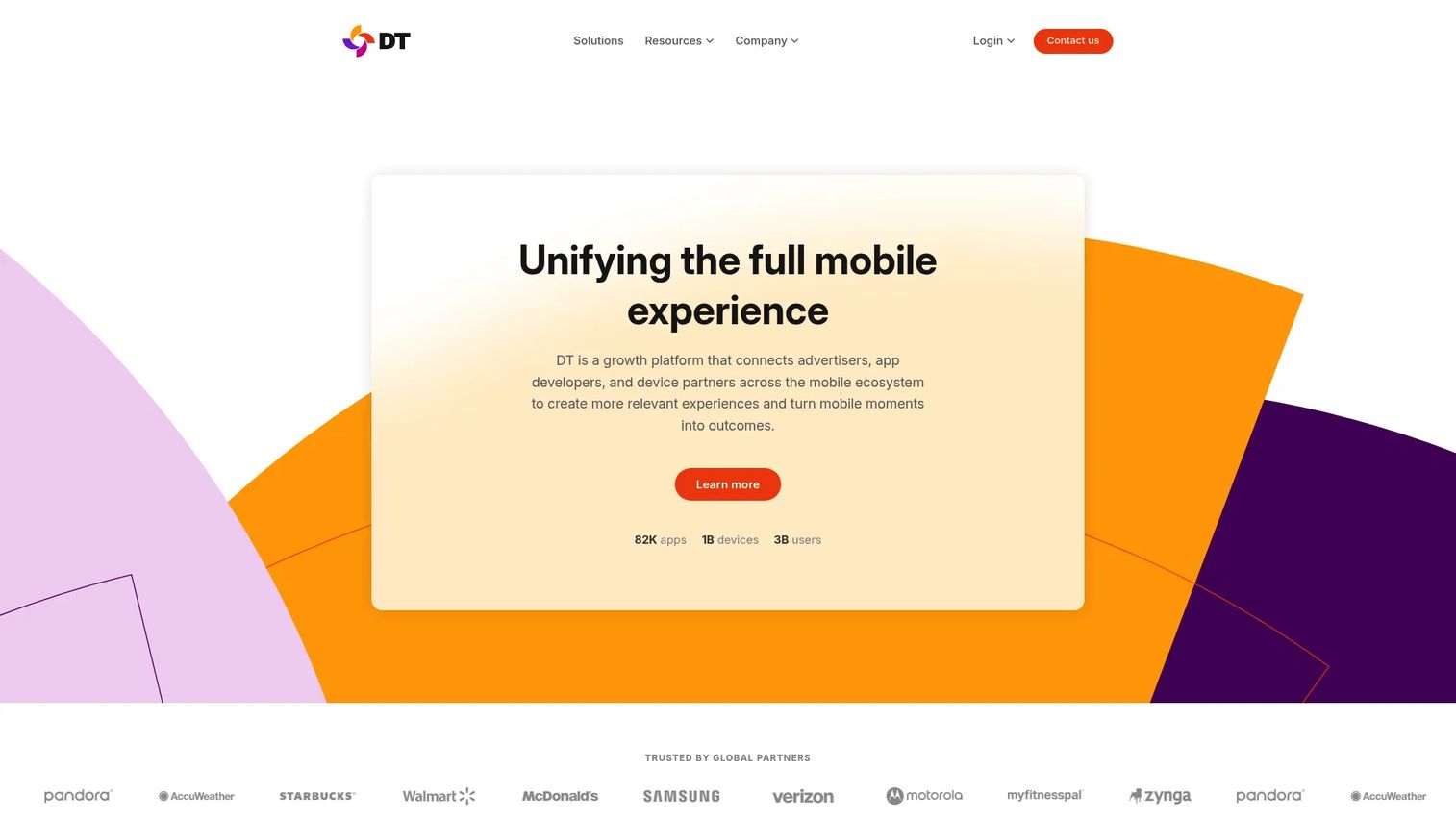
Digital Turbine is a mobile growth and monetization platform that connects advertisers, app developers, and device partners. It covers mobile advertising, app distribution, on-device app discovery, and AI-powered optimization through its DT iQ product. The platform reaches users at the device level, which differentiates it from pure in-app ad networks.
Best for: App businesses combining mobile growth, distribution, and monetization who want device-level reach alongside ad monetization.
Key features
- Mobile advertising and monetization
- App distribution and seamless app installs at the device level
- On-device app discovery and recommendations
- User acquisition and engagement campaigns
- AI-powered optimization through DT iQ
Why choose Digital Turbine: Choose it when distribution reach matters alongside monetization. Separate the acquisition value from the monetization value when evaluating ROI, since the platform serves both goals.
Digital Turbine pricing: Quote-based. Contact sales for campaign, distribution, and revenue-share terms.
G2 rating: 4.7/5.
19. Chartboost
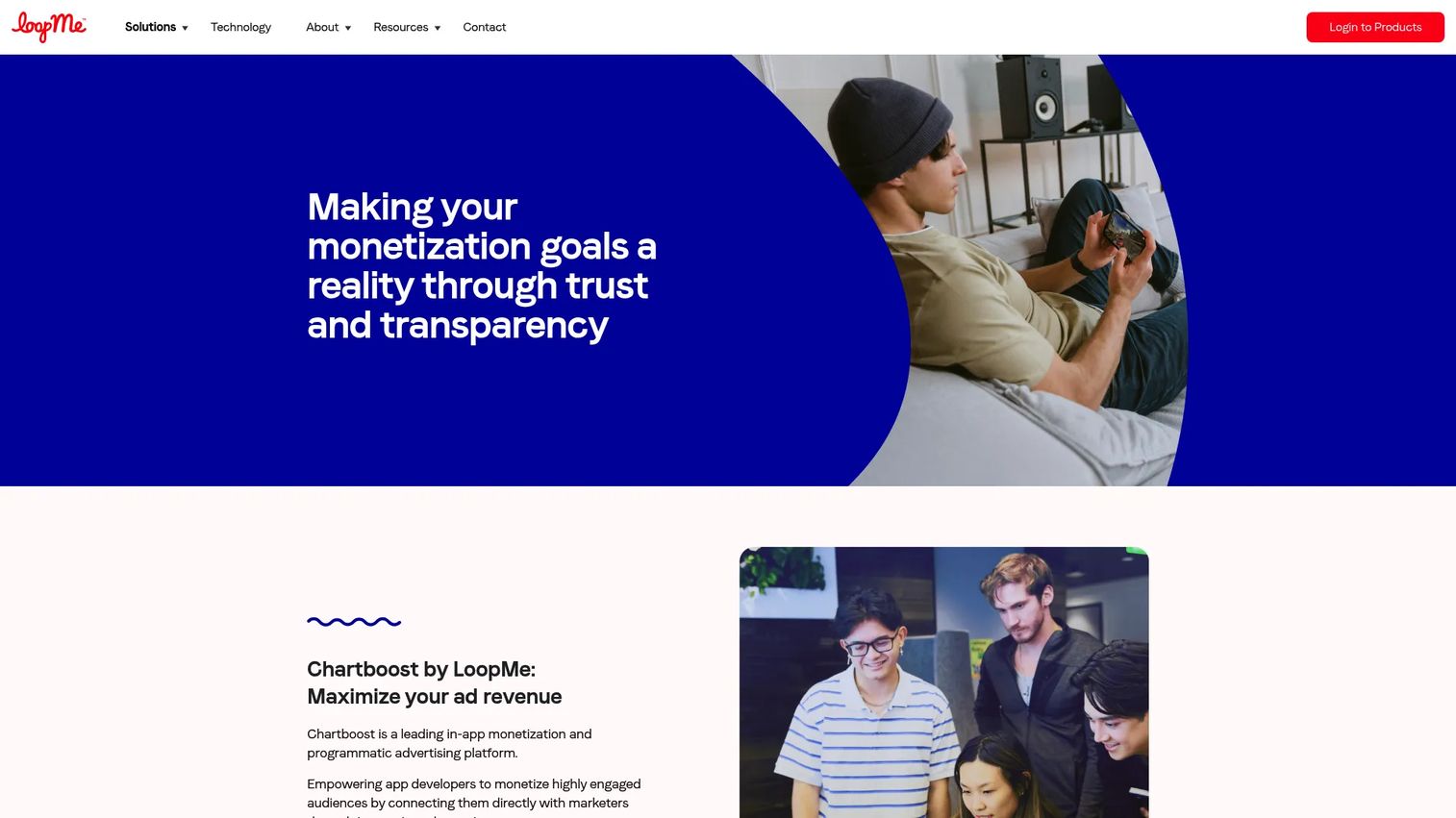
Chartboost is a mobile programmatic advertising platform specializing in game-specific ad demand. It supports user acquisition through CPI and CPM campaigns, in-app monetization with video and interstitial formats, mediation with network bidding and waterfalls, and a programmatic exchange. SDK integration for video ads is free for publishers.
Best for: Mobile game developers and publishers that want game-specific ad demand, mediation, and in-app programmatic advertising.
Key features
- Game-specific ad demand via programmatic exchange
- Interstitial and rewarded video ad formats
- Mediation with network bidding and waterfall support
- CPI and CPM user acquisition campaigns
- Publisher dashboard with campaign analytics
Why choose Chartboost: It suits game studios that want category-specific demand from advertisers targeting gaming audiences. If you run many networks, evaluate whether its mediation layer gives you enough yield improvement to consolidate.
Chartboost pricing: Advertising uses CPI and CPM billing. Publisher earnings depend on dynamic advertiser bids. SDK video ad integration is free for publishers.
G2 rating: 2.5/5.
20. BIGO Ads
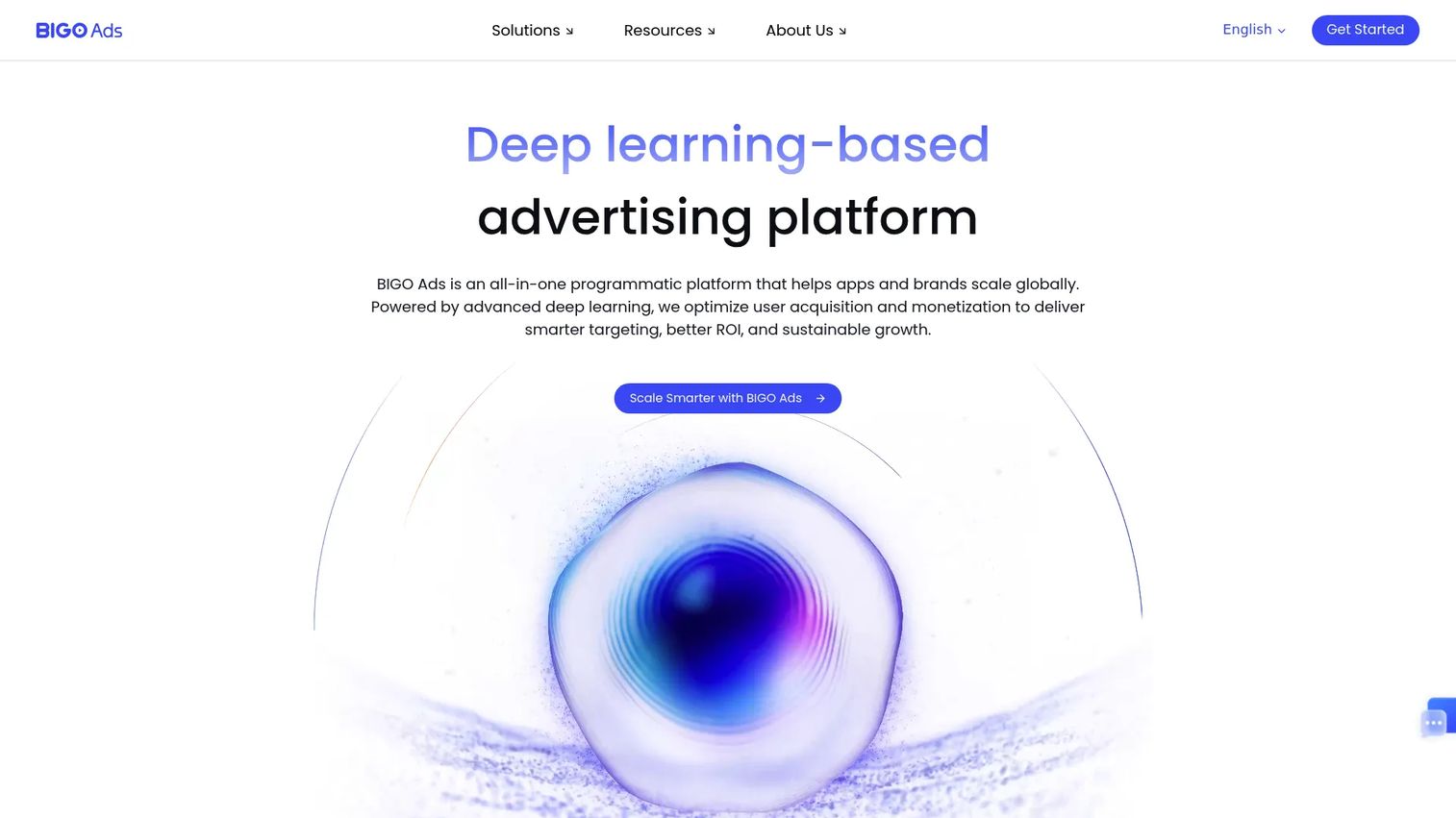
BIGO Ads is a programmatic advertising platform for global user acquisition and app promotion. Campaign budgets start at a minimum of $20 per day or as a total campaign budget. It supports audience targeting by demographics, location, device, operating system, carrier, and connection type, alongside in-app event optimization, lookalike audiences, and campaign reporting.
Best for: App teams seeking mobile ad demand in specific regional markets, particularly where BIGO's inventory has strong reach.
Key features
- Campaign creation for app and web campaigns
- Audience targeting by demographics, location, device, and OS
- In-app event optimization and lookalike audiences
- CPC and oCPC bidding with a minimum bid of $0.01
- Campaign reporting and performance monitoring
Why choose BIGO Ads: Position it as a regional demand option rather than a universal default. Check geographic strength and advertiser demand depth in your target markets before committing to meaningful spend.
BIGO Ads pricing: Minimum daily or total campaign budget of $20. CPC and oCPC bidding available with a minimum bid of $0.01.
Considerations when choosing an app monetization platform
Revenue model fit
Start with the revenue motion, not the feature list. An ad network improves CPM and fill rate; it cannot recover failed subscription payments. A billing platform handles churn mechanics; it cannot serve rewarded video. Map your primary revenue source (ads, subscriptions, IAP, offerwalls, or direct payments) to the category that solves it, then shortlist within that category.
User experience impact
Monetization that hurts retention is a losing trade. Ad load, paywall timing, offerwall placement, and purchase flow friction all affect day-30 and day-90 retention. Test monetization changes against a control cohort and measure retention alongside ARPDAU before rolling out widely.
Measurement and attribution quality
Revenue data that cannot be tied to acquisition channel is a blind spot. ARPDAU, eCPM, and fill rate tell you about supply performance; cohort LTV, payback period, and campaign-level revenue tell you whether monetization is profitable per acquisition source. Look for platforms that expose user-level or cohort-level revenue data, and pair them with your mobile attribution platforms to close the reporting loop. For broader revenue intelligence platforms, that is a parallel stack decision worth making deliberately.
Implementation and SDK overhead
Every SDK adds build complexity, app size, and potential review risk. Mediation platforms combine multiple demand sources into one integration, which is usually more efficient than adding individual network SDKs. Ask vendors about SDK size, maintenance requirements, and what engineering must own after the initial launch.
Privacy, consent, and platform rules
GDPR, CCPA, COPPA, Apple's App Tracking Transparency framework, and app-store payment policies all affect which monetization mechanics are permissible and how data can flow. Some platforms, like InMobi, include a consent management platform. Others require you to bring your own CMP. This article is not legal advice; involve your legal or privacy team for interpretation before launch. For ad network software evaluation that covers compliance considerations in depth, that guide covers the demand-side angle.
Conclusion
App monetization is not one decision. It is a set of decisions by revenue model.
If your primary revenue comes from ads, start with Google AdMob as a free baseline, then evaluate mediation through AppLovin MAX or Unity LevelPlay once you have more than one network worth optimizing. For gaming-specific demand, Unity Ads and AppLovin serve different gaming inventory profiles worth comparing side by side.
If you sell subscriptions or premium access, Recurly and Paddle both handle the billing infrastructure, with Recurly pricing starting at $249 per month and Paddle charging 5% + 50¢ per transaction. The right choice turns on whether you prefer a flat billing model or a revenue-share one.
For game economies with virtual currency, Tapjoy Offerwall adds an opt-in revenue layer without increasing ad load. For direct web store revenue, Appcharge is built for game publishers testing DTC checkout outside the app stores.
For best-in-class display advertising software that complements these platforms on the acquisition side, that evaluation belongs in parallel with monetization planning.
Shortlist three platforms by revenue model, test them against one cohort, and compare revenue lift against retention before rolling out widely.
FAQs
App monetization platforms are tools that help app publishers generate and manage revenue from users. They span ad networks, mediation platforms, subscription billing, payment infrastructure, offerwalls, and programmatic demand marketplaces. The right platform depends on the revenue model: Advertising, IAP, subscriptions, or direct payments.
For game-specific ad demand, Unity Ads and AppLovin both serve gaming inventory at scale. For mediation across multiple networks, AppLovin MAX and Unity LevelPlay run unified auctions that improve yield. For rewarded engagement, Tapjoy Offerwall adds an opt-in layer suited to games with virtual currency. The best choice depends on your ad mix, game economy, and mediation needs.
An ad network provides advertiser demand for your app inventory. Ad mediation manages multiple networks simultaneously, running auctions or waterfalls to pick the highest-paying bid for each impression. Mediation platforms like AppLovin MAX and Unity LevelPlay sit above individual networks and optimize across them, improving eCPM and fill rate without increasing ad placements.
Ad networks and mediation platforms typically take a percentage of publisher revenue through revenue share. Subscription billing platforms like Recurly charge a monthly fee plus a percentage of billing volume. Merchant-of-record platforms like Paddle charge per transaction (5% + 50¢). Some platforms use quote-based commercial terms that combine minimum spend, revenue share, and managed service fees.
Hybrid models are common, particularly in mobile gaming. Games often combine rewarded video ads, IAP, and offerwalls to serve different player segments. Non-game apps increasingly layer subscription revenue on top of a free tier. Subscription revenue reached $79.5 billion globally in 2025, according to Business of Apps (2026), suggesting that recurring billing is a viable monetization layer for content and utility apps alongside or instead of ads.
Track ARPDAU and ARPU for daily revenue health. Use LTV and payback period to evaluate whether monetization is profitable by acquisition channel. eCPM and fill rate measure ad supply efficiency. Cohort revenue shows how monetization evolves over 30, 60, and 90 days. Attribution at the user or session level ties revenue back to campaigns, which is the number your CFO will ask for.
Most platforms support both iOS and Android, but implementation differs. iOS monetization involves ATT consent prompts, SKAdNetwork attribution, and App Store payment policy constraints. Android has different consent mechanics and Google Play billing requirements. Check SDK availability, ad format support, and consent management compatibility for both platforms before integrating a new tool.
GDPR governs data handling for EU users, requiring consent before tracking or serving personalized ads. CCPA gives California users opt-out rights. COPPA restricts data collection for users under 13, which affects games popular with younger audiences. Apple's ATT framework requires opt-in consent before tracking iOS users across apps. Each rule shapes what data you can collect, how you can target ads, and what consent mechanisms you need. Involve legal or privacy counsel for interpretation specific to your app and markets.