A card expires. The retry fails. The invoice goes out with the wrong proration. A customer churns over a billing error nobody caught. Then finance asks why recognized revenue does not match what the billing system says.
That is the reality of running recurring revenue at scale. Subscription billing is rarely one problem. It is pricing changes, failed payment recovery, tax handling, multi-currency billing, renewals, and revenue recognition all stacking up at once. Most teams start with a homegrown script or a basic invoicing tool, then hit a wall the moment they add usage-based billing or expand into a new region.
The stakes are not small. The global subscription billing software market is projected to grow from $9.04 billion in 2025 to $19.66 billion in 2030, a 16.2% CAGR, according to The Business Research Company (2026). That growth reflects how much recurring revenue management now depends on getting billing automation right.
For sales enablement and RevOps teams, this is not just a finance purchase. The billing platform you pick shapes how packaging works, how renewals get handled, and how cleanly deals hand off from sales to finance. A brittle billing system creates late-stage surprises that kill momentum. A solid recurring billing platform removes friction across the revenue stack. If you are already mapping adjacent tools, our roundups of the best CRM software and best marketing automation software tools cover the systems billing usually plugs into.
What's inside
This guide compares 8 subscription billing software tools for teams that need recurring billing, invoicing, payment recovery, and accounting alignment in one workflow. It is written for finance, RevOps, and enablement leaders evaluating a subscription billing platform mid to late in their search.
We selected and ranked tools based on five criteria: billing flexibility across pricing models, revenue recovery and dunning depth, compliance and revenue recognition support, integration breadth with CRM and ERP systems, and scalability from mid-market to enterprise. Each entry includes what it does well, who it fits, and verified pricing where public.
TL;DR
- Best overall for recurring revenue: Recurly, for its lifecycle coverage across billing, retention, and payment recovery.
- Best for complex and usage-based billing: Stripe Billing, for metered billing, invoicing, tax, and revenue recognition in one ecosystem.
- Best for developer-led teams: Stripe Billing, with deep API and webhook control.
- Best for finance and ERP-heavy orgs: Zuora Billing and BillingPlatform, for layered catalogs and enterprise revenue workflows.
- Best for fast-growing SaaS: Chargebee and Maxio, for monetization flexibility plus SaaS finance reporting.
- Best for simpler workflows: Stax Bill and Zoho Billing, for lean teams that want billing automation without enterprise overhead.
What is subscription billing software?
Subscription billing software is a platform that automates recurring charges, invoicing, payment collection, and revenue tracking for businesses that bill customers on a repeating schedule.
The core workflow runs in a predictable loop. You define pricing and packaging, create a subscription tied to a customer, generate invoices, collect payments, recover failed payments through dunning, recognize revenue, and report on the results. A good recurring billing platform handles every step without manual intervention, so finance is not chasing card declines in a spreadsheet.
Here is what separates a real subscription billing platform from basic subscription invoicing software:
- Recurring billing automation: Generate, prorate, and send invoices on schedule across flat-rate, tiered, seat-based, usage-based, and hybrid billing models.
- Failed payment recovery: Built-in dunning, payment retries, and card updater logic to recover failed payments before they become churn.
- Global payments and multi-currency billing: Charge customers in their currency, support local payment methods, and handle tax across regions.
- Customer portal and self-service portal: Let subscribers update cards, change plans, and view invoices without a support ticket.
- Compliance and revenue recognition: Automate revenue recognition under ASC 606 and IFRS 15 so recognized revenue stays defensible.
- Integrations with CRM, ERP, APIs, and webhooks: Connect billing to the rest of the revenue stack through native connectors and developer hooks.
These capabilities are what make subscription management software more than a glorified invoice generator. They tie billing to retention, finance operations, and the subscriber experience.
When to use subscription billing software
Not every team needs a full subscription billing platform on day one. Here is where it earns its place.
Scale recurring revenue without manual invoicing
Manual billing works until it does not. A few dozen subscriptions are manageable in a spreadsheet. A few thousand, with mid-cycle upgrades, proration, and multiple currencies, is where errors compound. A recurring billing platform automates invoice generation, applies the right proration, and keeps billing accurate as volume grows. The goal is repeatability: the same correct outcome every cycle, without a person in the loop.
Recover failed payments and reduce churn
A meaningful slice of subscription churn is involuntary. Cards expire, banks decline transactions, and nobody notices until the customer is gone. Failed payment recovery features fix this. Dunning sequences retry charges on a smart schedule, card updater logic refreshes expired card details, and automated emails prompt customers to act. Recovering even a fraction of those payment failures directly protects ARR and improves churn rate. This is the highest-ROI feature in most billing platforms.
Support complex pricing models and global expansion
Pricing rarely stays simple. You start flat-rate, then add tiers, seats, usage-based billing, and eventually hybrid billing that blends a base fee with metered overages. A capable platform supports all of these without custom code. Layer in multi-currency billing, local payment methods, and tax compliance, and the same system supports global payments as you expand into new markets. Sales enablement teams feel this directly: cleaner packaging means fewer quoting errors and smoother handoffs.
Comparison table
Compare these tools by billing model support, integration depth, revenue recovery, and finance fit. The right choice depends less on feature count and more on how the platform matches your pricing complexity and your accounting requirements.
| # | Product | Intent | Key differentiation | Pricing | G2 rating |
|---|---|---|---|---|---|
| 1 | Recurly | Recurring revenue lifecycle | Retention and payment recovery automation | From $249/mo + 0.9% of billing volume | NA |
| 2 | Stripe Billing | Broad billing stack | Usage-based billing, tax, RevRec in one ecosystem | From 0.7% of billing volume | NA |
| 3 | Chargebee | SaaS monetization | Subscription billing plus checkout and RevRec | Free Starter tier, then usage-based | 4.4/5 |
| 4 | BillingPlatform | Enterprise revenue lifecycle | Configurable billing for complex models | From ~$50,000 (Capterra-reported) | 4.8/5 |
| 5 | Maxio | SaaS finance operations | Billing plus SaaS metrics and RevRec | From $599/mo | 4.3/5 |
| 6 | Zuora Billing | Enterprise subscriptions | Layered pricing catalogs and order management | Custom | 3.9/5 |
| 7 | Stax Bill | Mid-market recurring billing | Simpler billing and revenue automation | From $499/mo | 4.2/5 |
| 8 | Zoho Billing | Zoho-native billing | Invoicing plus recurring billing in one suite | From $39/org/mo | 4.4/5 |
1. Recurly
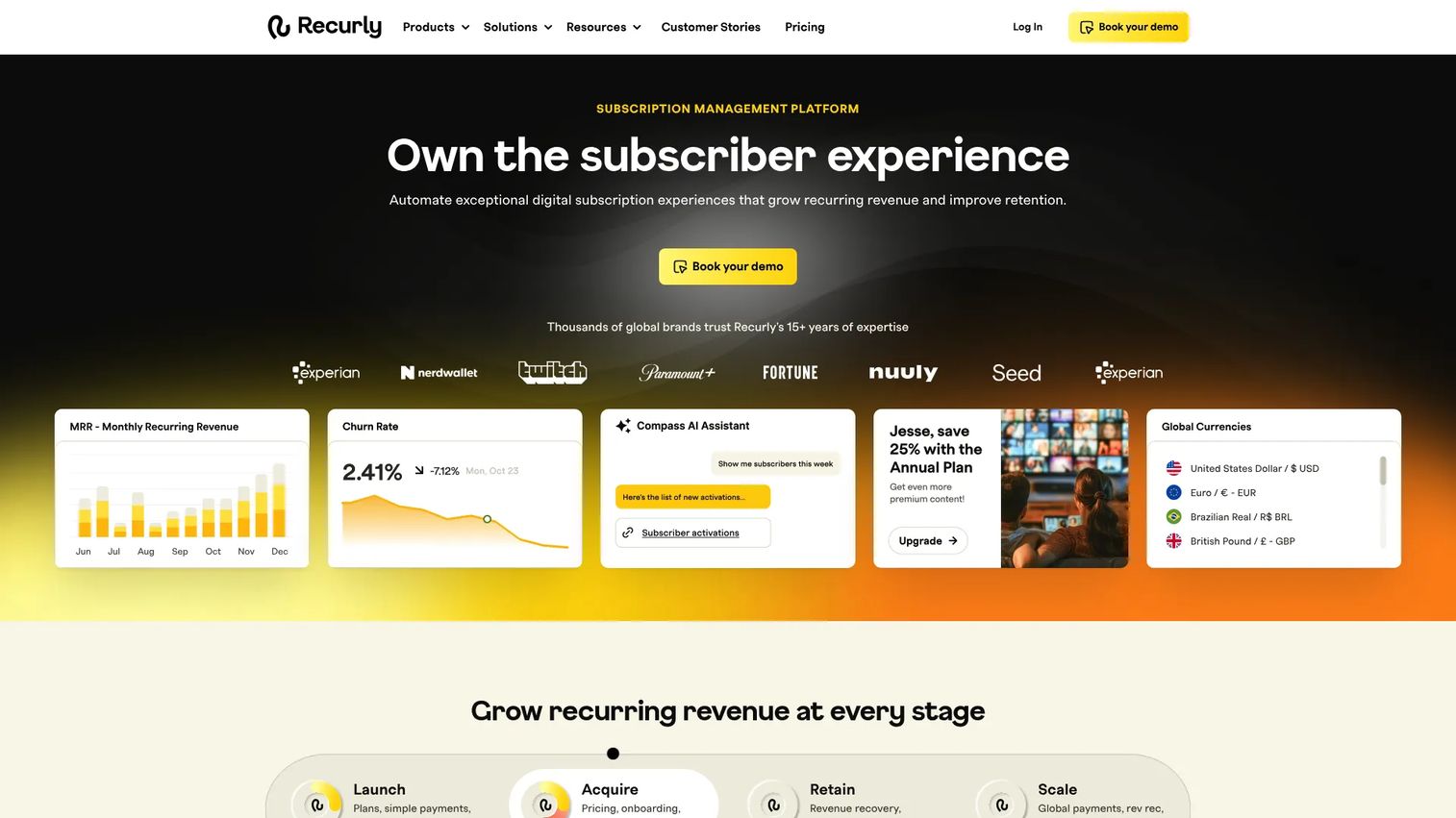
Recurly is a subscription management and recurring billing platform built for growing and enterprise subscription businesses. It covers the full recurring revenue lifecycle: subscription management, billing orchestration, retention automation, and payment recovery. The platform leans hard into reducing churn, which is where most subscription businesses leak revenue. Its commerce integrations and revenue recognition support round out a system that finance and RevOps teams can rely on.
Best for: Subscription businesses that prioritize retention and revenue recovery alongside flexible billing.
Key strengths
- Recurring billing orchestration: Automates recurring charges and payments across multiple gateways without manual handling.
- Dunning and payment retries: Smart retry logic and card updater features recover failed payments before they turn into involuntary churn.
- Subscription management: Handles plan changes, proration, upgrades, and downgrades cleanly across the customer lifecycle.
Why choose Recurly: If churn reduction and failed payment recovery are your top priorities, Recurly is purpose-built for that fight. Its retention tooling goes deeper than billing platforms that treat recovery as an afterthought. Teams that care about the subscriber experience and protecting ARR get a system designed around keeping revenue, not just collecting it.
Recurly pricing: Recurly publishes pricing across several plans. The Starter plan begins at $249 per month plus 0.9% of billing volume. All-Access plans scale to as low as under 1% of billing volume on annual billing, with an All-Access for Shopify variant. The Engage plan starts as low as $1,600 per month, and the RevRec add-on starts as low as $850 per month, both billed annually. There is no free tier. Verify current volume thresholds with Recurly before committing.
2. Stripe Billing
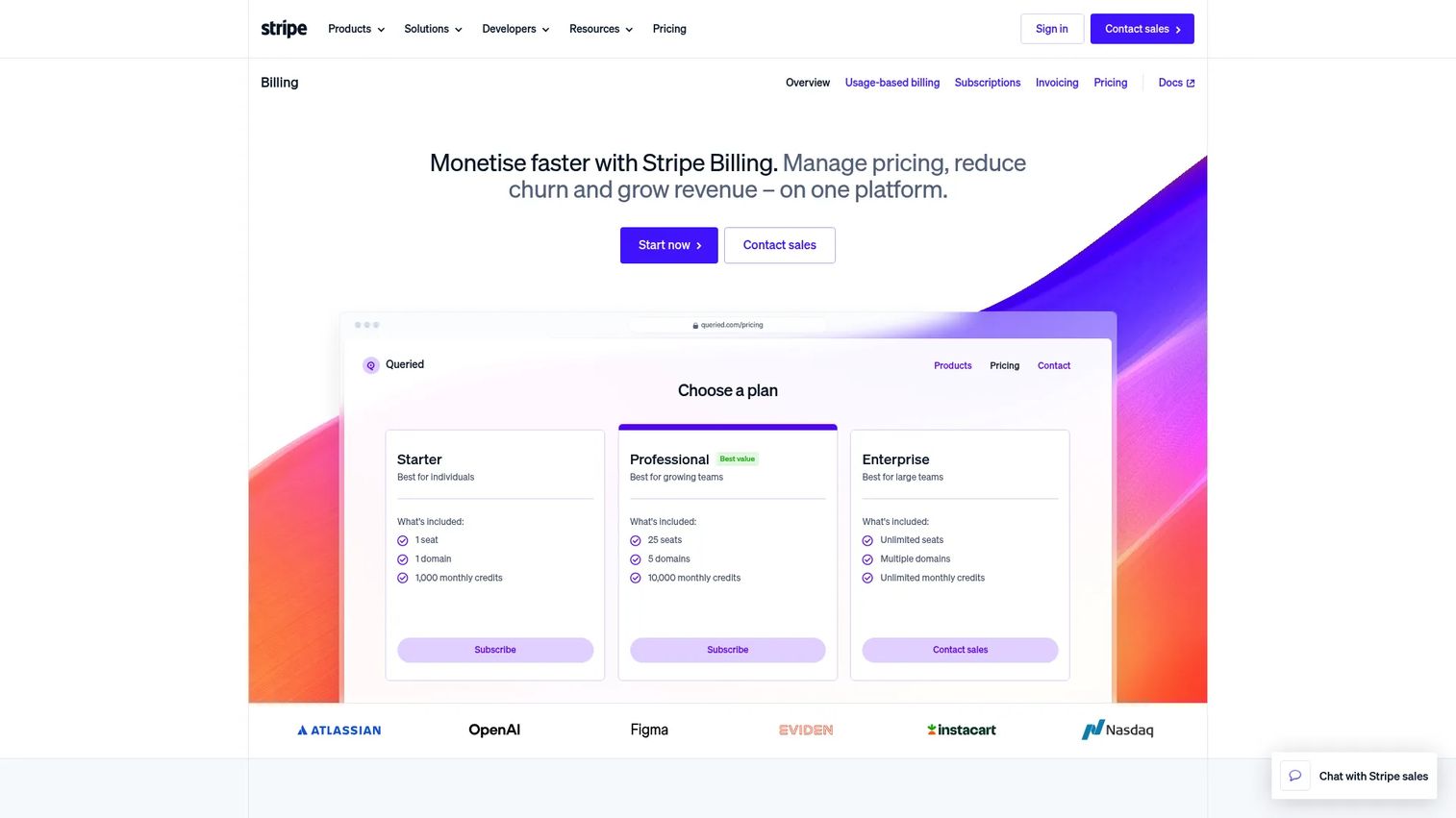
Stripe Billing is Stripe's subscription billing product for recurring, usage-based, and invoice-based revenue workflows. It sits inside the broader Stripe ecosystem, which means billing, invoicing, tax, and revenue recognition can live in one place. That consolidation is the main draw: teams already running payments through Stripe can add subscription management software without bolting on a separate vendor.
Best for: Teams that want subscription billing with usage-based pricing, invoicing, and customer self-service in one ecosystem.
Key strengths
- Usage-based billing: The Meters API supports metered billing and hybrid billing models without custom infrastructure.
- Customer portal: A built-in self-service portal lets subscribers manage plans, update payment methods, and view invoices.
- Recurring billing and subscriptions: Handles standard recurring billing alongside invoice-based and one-time charges in the same system.
Why choose Stripe Billing: Stripe Billing fits developer-led teams that want API and webhook control over their billing logic. If your engineers already work in Stripe, extending into subscriptions, tax, and revenue recognition is a natural step. Verify implementation fit for your pricing model, since the depth that helps developers can require engineering time to configure well.
Stripe Billing pricing: Stripe Billing offers pay-as-you-go pricing at 0.7% of billing volume. A pay-monthly option runs on an annual contract paid monthly, with volume tiers starting at $620 per month and scaling through $1,500, $2,950, and $5,750 per month. Custom pricing is available for large volume or unique business models. There is no free tier, though the customer portal with a custom domain is offered as a low-cost add-on.
3. Chargebee
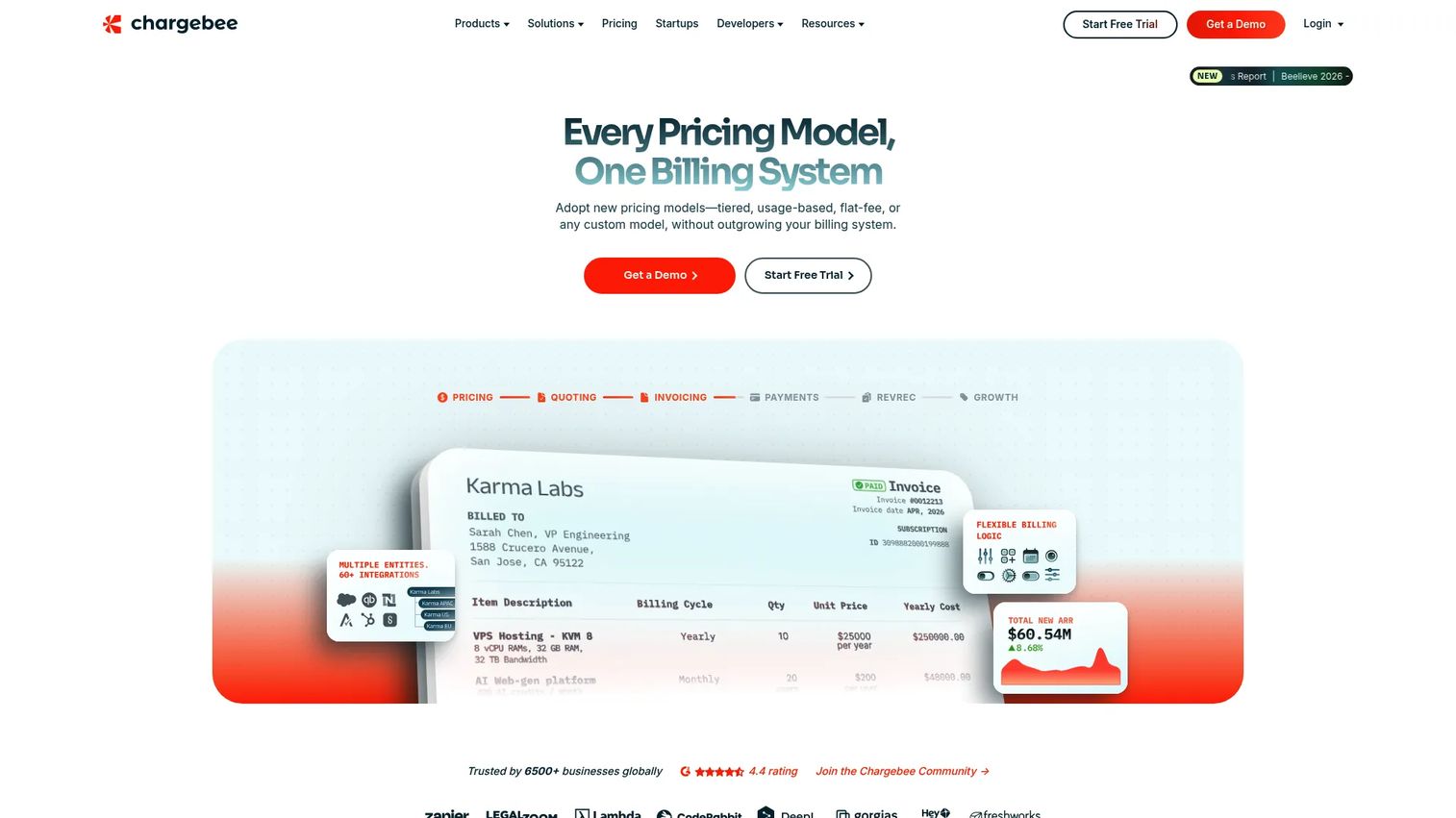
Chargebee is a subscription billing and monetization platform for recurring, usage-based, and revenue-recognition workflows. It is popular with B2B SaaS and AI companies that need more than basic invoicing. Beyond billing, Chargebee adds self-serve checkout, a customer portal, and tooling for expansion revenue, which makes it a fit for growth teams running pricing experiments.
Best for: Teams that need subscription billing plus checkout and revenue recognition flexibility.
Key strengths
- Subscription management: Manages plans, add-ons, coupons, and lifecycle changes across complex packaging.
- Recurring and usage-based billing: Supports flat, tiered, metered billing, and hybrid models without engineering rebuilds.
- Self-serve checkout and customer portal: A hosted checkout and self-service portal reduce support load and speed up conversion.
Why choose Chargebee: Chargebee fits growth-stage SaaS teams that want to experiment with packaging and monetization without re-architecting billing each time. Its expansion and checkout tooling support the kind of pricing flexibility that drives MRR and ARR growth. For enablement teams, that flexibility translates into cleaner packaging and fewer quoting surprises.
Chargebee pricing: Chargebee's Starter plan is free for the first $250,000 of cumulative billing, then charges 0.75% on monthly billing overage. CPQ Lite is free for the first 50 quotes for existing Chargebee Billing customers. The Performance plan is quote-based and requires a sales conversation, and the Enterprise plan uses custom pricing based on active subscriber count. It carries a 4.4/5 rating on G2.
4. BillingPlatform
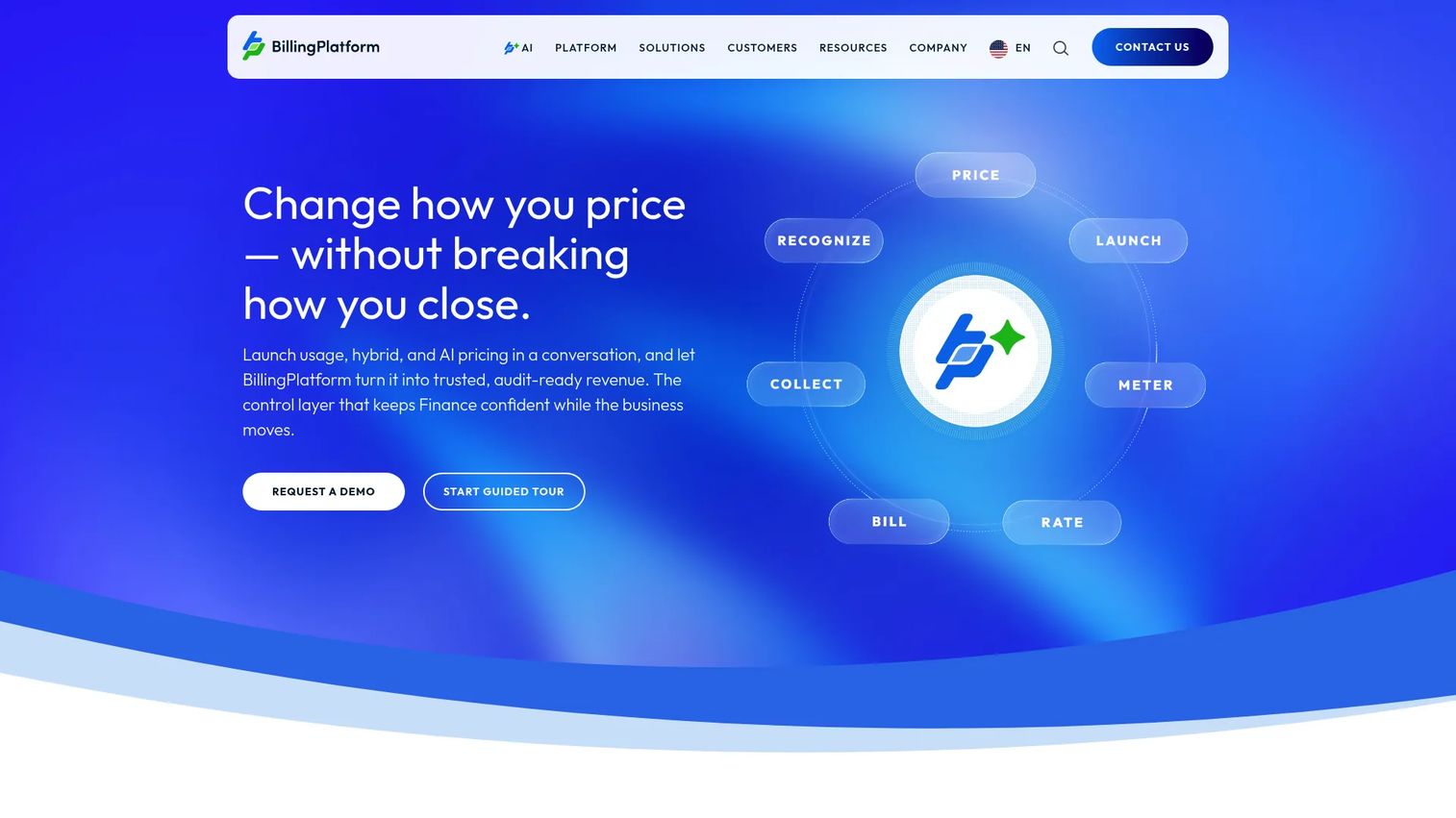
BillingPlatform is an enterprise revenue lifecycle and billing platform built for quote-to-cash, pricing, invoicing, accounts receivable, and revenue recognition. It targets organizations with genuinely complex finance workflows: companies that need configurable billing across subscription, usage, and hybrid monetization models. The platform also includes a customer portal and business intelligence for teams that want billing data feeding directly into reporting.
Best for: Enterprises that need highly configurable billing for complex subscription, usage, and hybrid models.
Key strengths
- Product catalog and rating: Models complex pricing and rating logic across products without hard-coded constraints.
- Usage-based and metered billing: Handles high-volume metered billing for usage-heavy business models.
- Accounts receivable and revenue recognition: Combines AR, payments, and RevRec so finance operations run on one system.
Why choose BillingPlatform: BillingPlatform suits enterprise finance teams whose pricing and revenue workflows have outgrown standard tools. Its configurability is the selling point, but it comes with the governance and integration expectations of an enterprise system. Expect a sales-led evaluation and a meaningful implementation. It holds a 4.8/5 rating on G2.
BillingPlatform pricing: BillingPlatform does not publish list pricing on its own site, and the product is demo-led. Capterra reports a figure around $50,000, though this is third-party and not confirmed on the vendor's site. Treat any number as directional and request a formal quote tied to your volume and module needs.
5. Maxio
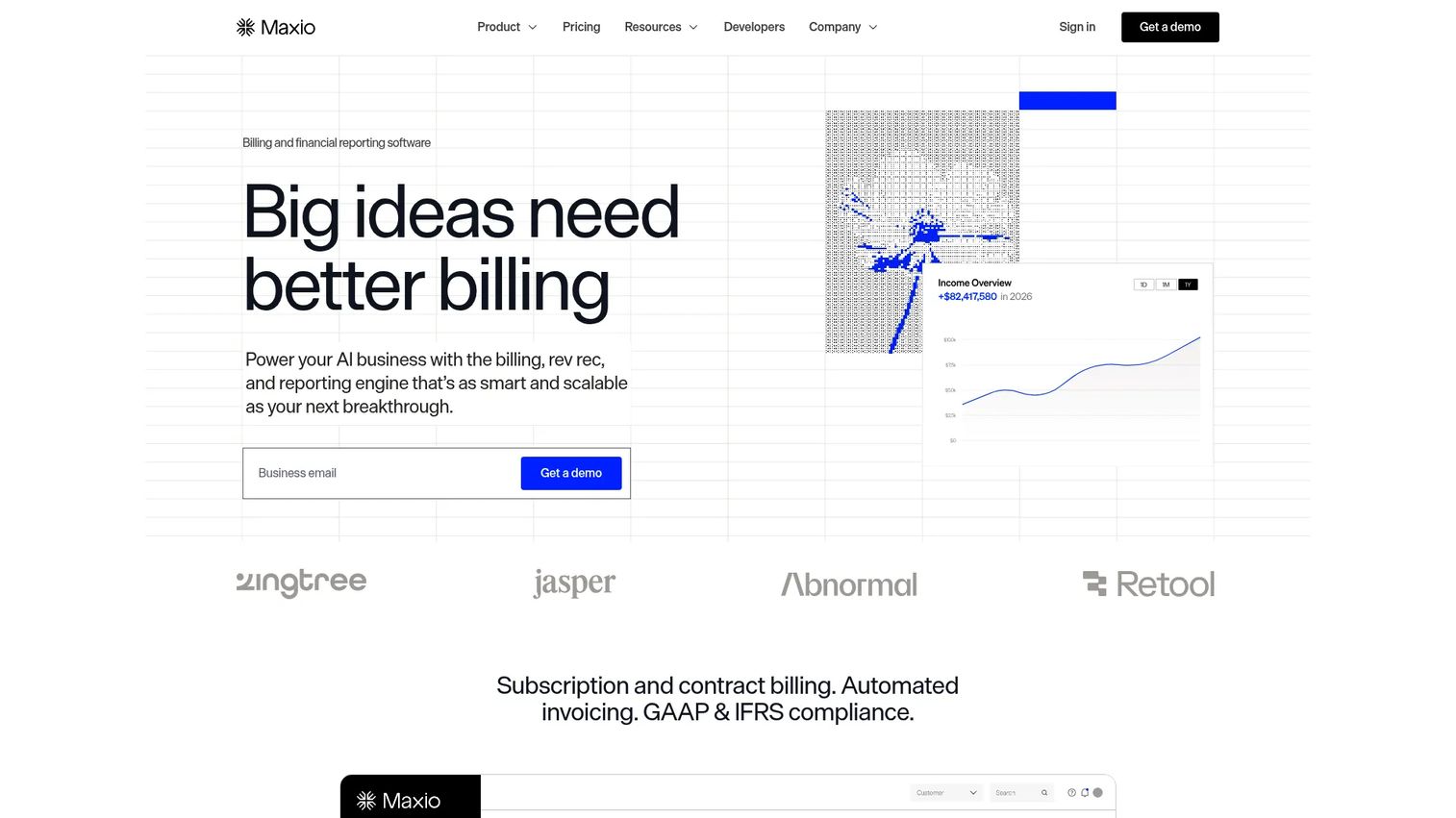
Maxio is a B2B SaaS financial operations platform that combines billing, subscription management, revenue recognition, and analytics. It is built for SaaS finance teams that need operational control alongside billing automation. Where Maxio stands out is reporting: it surfaces SaaS metrics like MRR, ARR, and churn rate directly, so finance is not exporting data into a separate analytics tool.
Best for: B2B SaaS companies that need scalable billing plus finance automation and SaaS metrics in one place.
Key strengths
- Recurring and usage-based billing: Supports subscription, recurring, and usage-based billing across 20+ payment gateways.
- Revenue recognition: Automates RevRec so recognized revenue stays compliant and audit-ready.
- Metrics and analytics: Tracks SaaS metrics natively, giving finance and RevOps a real-time view of recurring revenue health.
Why choose Maxio: Maxio shines for SaaS finance teams that want billing and reporting unified. The native metrics layer means leadership gets MRR and churn visibility without stitching tools together. For RevOps, that single source of truth reduces reconciliation work and the late-month scramble.
Maxio pricing: Maxio's Grow plan is $599 per month for businesses with up to $100,000 in monthly billings. The Scale plan is quote-based for higher volumes, and a Build plan is free to try. All plans include usage-based billing, subscription management, recurring billing, collections and dunning, and 20+ payment gateways. It carries a 4.3/5 rating on G2.
6. Zuora Billing
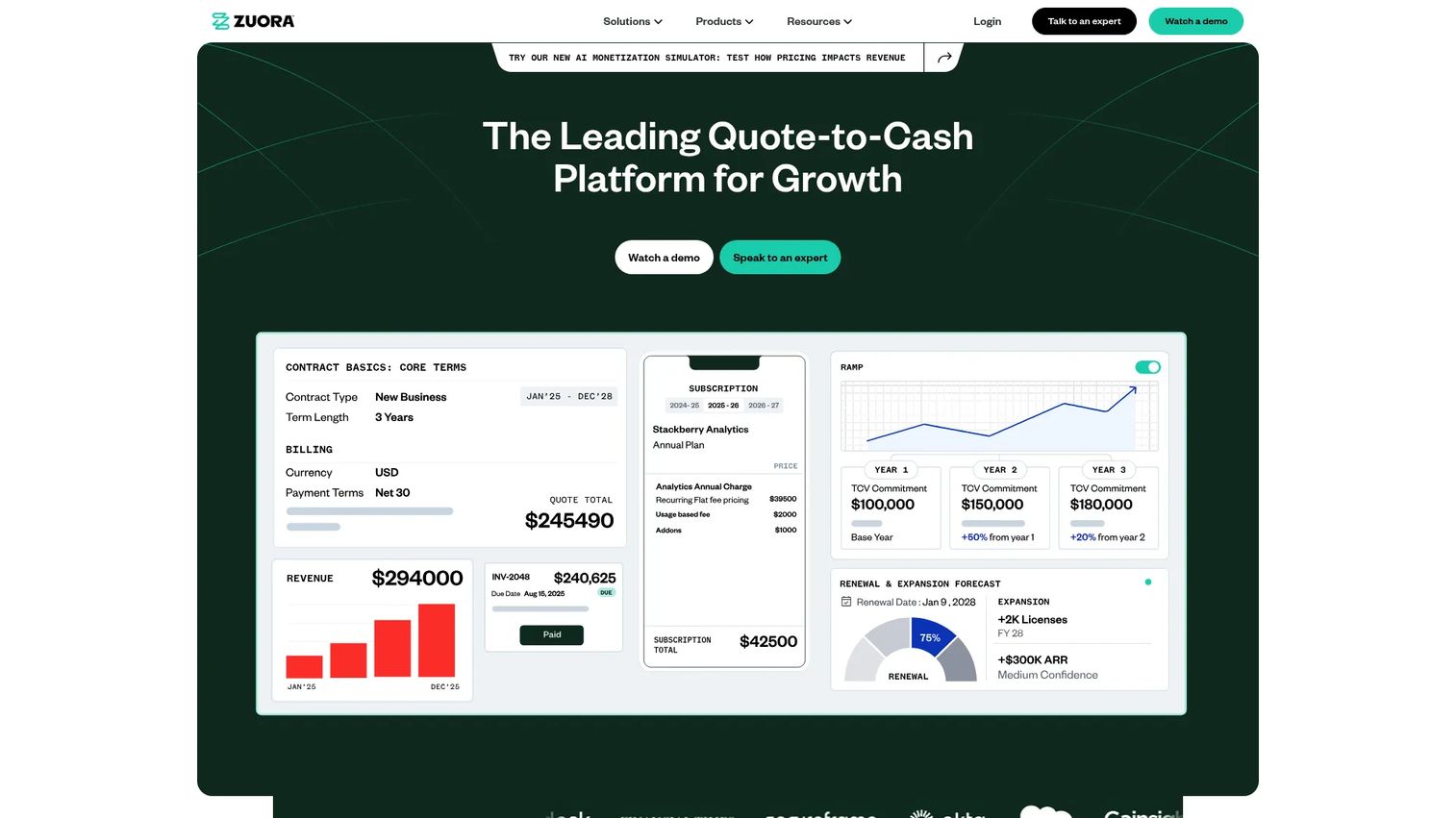
Zuora Billing is enterprise recurring billing and monetization software for subscriptions and usage-based pricing. It is built for large organizations with layered billing processes: complex pricing catalogs, subscription order management, collections, and revenue workflows that span multiple teams. Zuora's depth in pricing and packaging is its calling card, and it sits adjacent to CPQ and ERP systems in most enterprise stacks.
Best for: Large enterprises with complex subscription, usage, and hybrid billing across multiple business units.
Key strengths
- Flexible pricing and packaging: Models intricate pricing catalogs and packaging combinations at enterprise scale.
- Subscription order management and hybrid billing: Handles complex order flows and blended billing models in one system.
- Usage-based metering and billing: Meters and bills high-volume usage for consumption-based revenue.
Why choose Zuora Billing: Zuora fits enterprises whose billing complexity justifies a dedicated platform and a structured implementation. Its revenue recognition and ERP alignment matter for organizations with strict compliance and reporting requirements. Expect an enterprise buying motion with sales-led pricing and a longer rollout. It holds a 3.9/5 rating on G2.
Zuora Billing pricing: Zuora does not publish public pricing. Pricing is contact-sales and scoped to your volume, modules, and complexity. Plan for a formal evaluation with a tailored quote rather than a self-serve signup.
7. Stax Bill
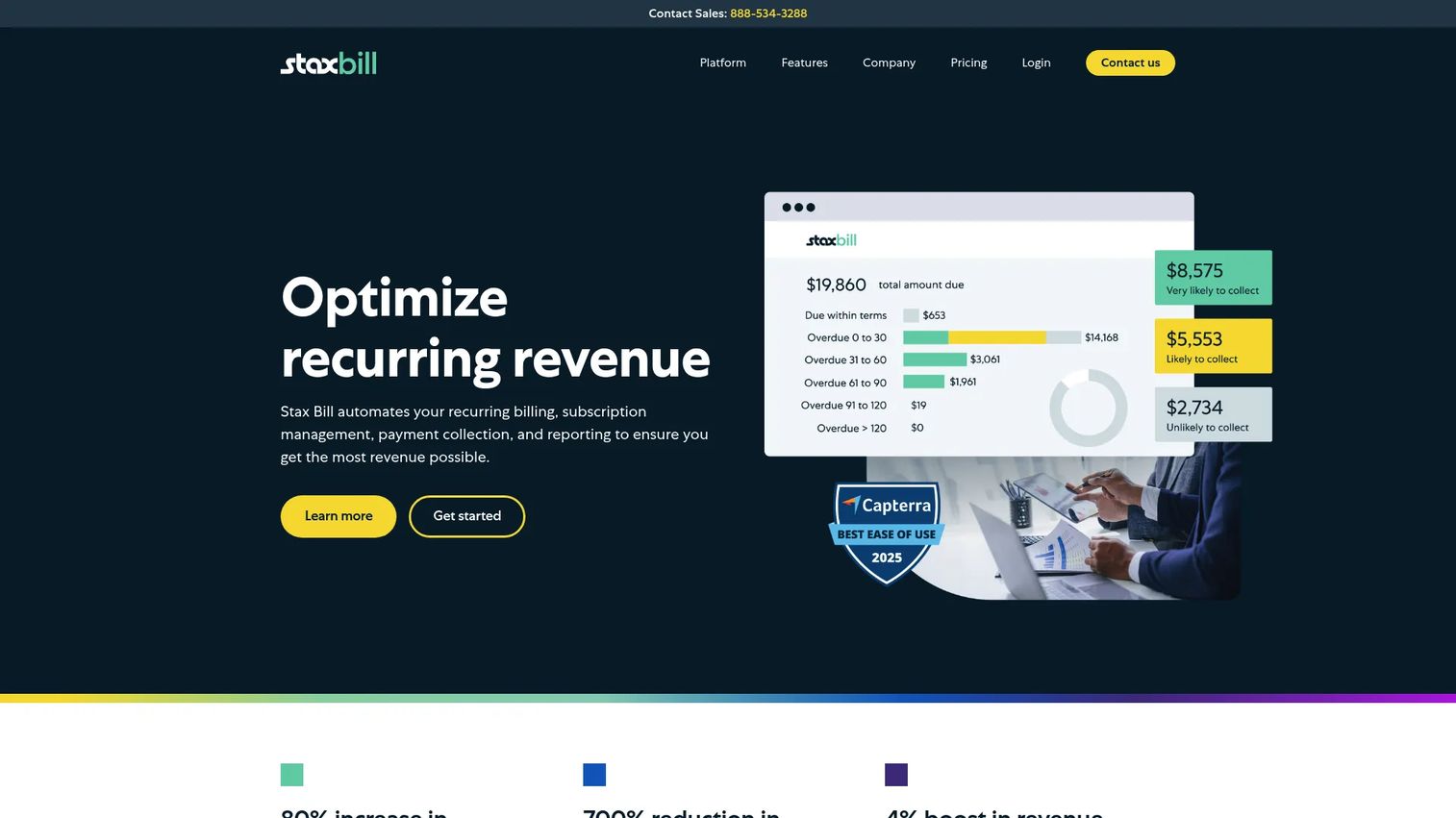
Stax Bill is subscription billing and revenue automation software for recurring-revenue businesses. Formerly Fusebill, it focuses on recurring billing, invoicing, payment processing, and automation without the weight of an enterprise system. That makes it appealing to small and mid-market teams that want a clean billing workflow they can stand up quickly.
Best for: Small and mid-market teams that want straightforward recurring billing without enterprise complexity.
Key strengths
- Subscription billing: Automates recurring charges, proration, and plan changes across the subscription lifecycle.
- Dunning management: Built-in dunning and payment retries recover failed payments to protect recurring revenue.
- Revenue recognition: Automates RevRec so finance stays compliant without manual journal entries.
Why choose Stax Bill: Stax Bill is the pick when speed and simplicity matter more than enterprise configurability. Mid-market teams that have outgrown manual invoicing but do not need a Zuora-scale platform get a focused billing automation system. It covers the core jobs, dunning, invoicing, and RevRec, without a heavy implementation.
Stax Bill pricing: Stax Bill's Growth plan starts at $499 per month for businesses with up to $85,000 in monthly billings, billed annually. The Enterprise plan is a custom quote. There is no free tier. It carries a 4.2/5 rating on G2.
8. Zoho Billing
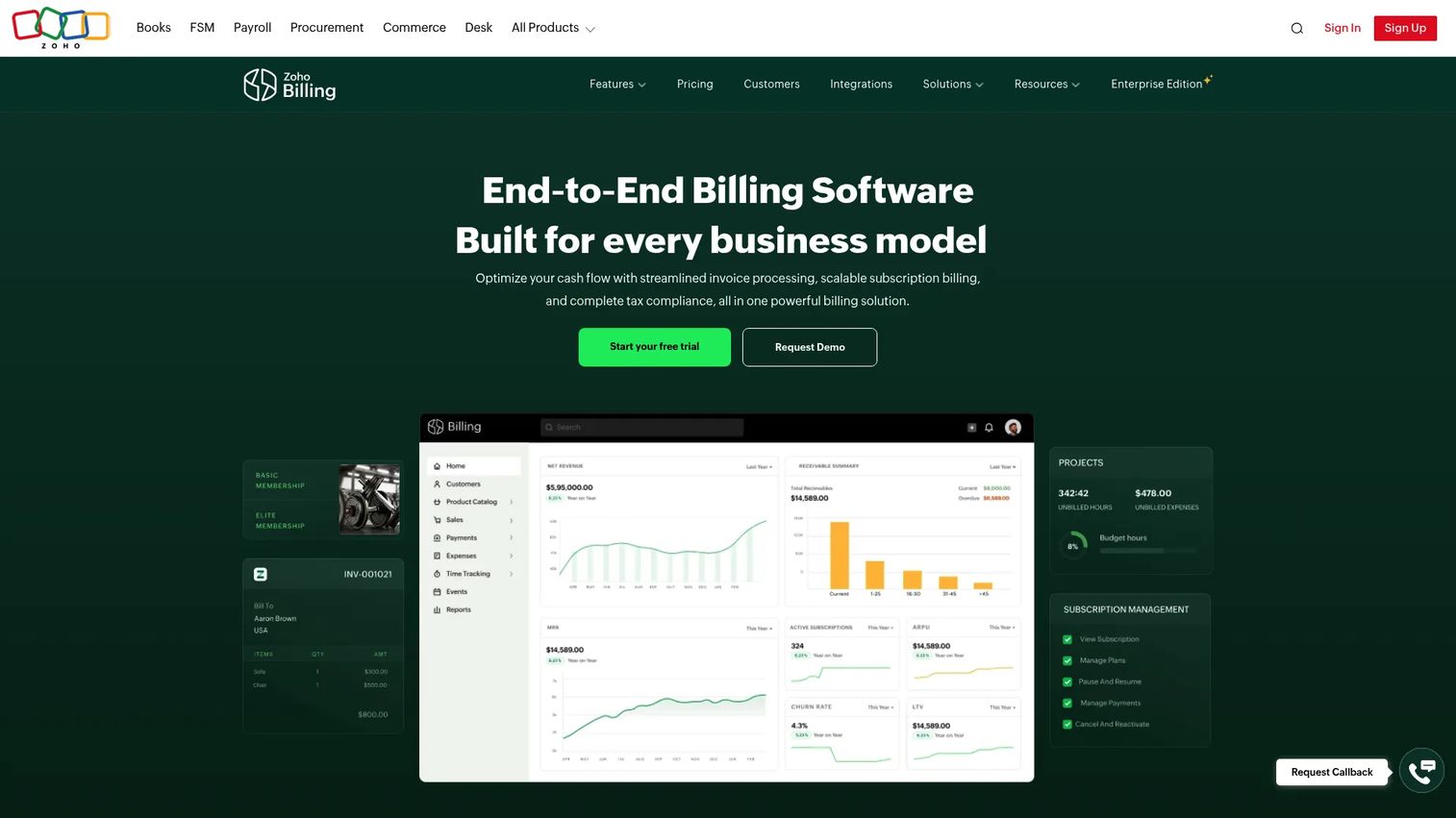
Zoho Billing is cloud billing and invoicing software for one-time, recurring, and subscription billing. Its biggest advantage is the Zoho ecosystem: teams already running Zoho CRM, Books, or other Zoho apps get billing that integrates natively. It pairs invoicing and quotes with recurring billing and a customer portal, making it a practical fit for businesses that want billing without leaving their existing suite.
Best for: Businesses already inside the Zoho stack that need invoicing plus recurring billing.
Key strengths
- Invoicing and quotes: Handles one-time invoicing and quotes alongside recurring charges.
- Recurring and subscription billing: Automates recurring billing with a self-service customer portal for subscribers.
- Project and time-based billing: Supports project and time-based billing for service-oriented revenue.
Why choose Zoho Billing: Zoho Billing is the value pick for teams already invested in Zoho. The native integration removes the data sync headaches that come with mixing vendors, and the entry price is well below enterprise platforms. It fits best for smaller and growing businesses rather than enterprises with layered billing complexity.
Zoho Billing pricing: Zoho Billing's Standard plan is $39 per organization per month, billed annually. The Premium plan is $79 per organization per month, billed annually. An Enterprise edition is available without public pricing. It carries a 4.4/5 rating on G2.
Considerations before you buy
The right billing platform depends on your pricing complexity, your finance requirements, and the systems it has to connect to. Run every shortlisted tool through this checklist.
Billing model fit
Map your current and planned pricing models before you shortlist. Flat-rate is easy. Usage-based billing, metered billing, and hybrid billing are where tools differ sharply. Pick a platform that supports the model you will run in 18 months, not just today, so you avoid a painful migration after expansion.
Revenue recovery depth
Failed payment recovery is the feature with the clearest ROI. Evaluate dunning logic, payment retries, and card updater support specifically. Ask vendors for recovery benchmarks. A platform that recovers a few extra percent of payment failures pays for itself in retained ARR.
Compliance and revenue recognition
If finance needs ASC 606 or IFRS 15 support, confirm it is native, not a manual workaround. Automated revenue recognition keeps recognized revenue defensible during audits and reduces month-end reconciliation. This matters more the closer you get to a fundraise or audit.
Integration and ERP fit
Billing does not live alone. Confirm ERP integration, CRM integration, and API and webhook access so billing connects to quote-to-cash and reporting. For RevOps and sales enablement, clean integration is what keeps deal handoffs and renewal data accurate. Our guides to the best contract management software tools and best customer data platform cover adjacent systems worth aligning.
Conclusion
Subscription billing is not a single decision. It is a system that touches revenue recovery, finance operations, and the subscriber experience all at once. The right platform lowers churn, cleans up revenue operations, and removes the late-stage billing surprises that stall deals.
Sort the shortlist by your real need. Recurly leads for retention and payment recovery. Stripe Billing fits developer-led teams that want a broad billing stack. Chargebee and Maxio serve fast-growing SaaS that need monetization flexibility and finance reporting. Zuora Billing and BillingPlatform handle deep enterprise complexity. Stax Bill and Zoho Billing keep things lean for smaller teams.
Do not buy on feature count. Pick the platform that matches your billing model, your compliance needs, and your existing revenue stack. Shortlist two or three, run them against your actual pricing scenarios, and weigh integration fit as heavily as billing features. The goal is fewer manual billing headaches and a cleaner connection between sales, finance, and RevOps.
FAQs
Subscription billing software automates recurring charges, invoicing, and payment collection for businesses that bill customers on a repeating schedule. It generates invoices, collects payments, recovers failed payments, and tracks recurring revenue without manual work. Most SaaS billing platforms also handle proration, plan changes, and revenue reporting.
The features that move the needle are billing automation, failed payment recovery through dunning, integrations with your CRM and ERP, and compliance support for revenue recognition. Flexible pricing model support matters too, especially if you run usage-based or hybrid billing. Prioritize the features tied to your actual revenue leaks, usually recovery and accurate invoicing.
You need it if finance reports under ASC 606 or IFRS 15, which most SaaS companies do as they scale. Automated revenue recognition keeps recognized revenue defensible during audits and removes manual journal entries at month-end. Smaller teams can sometimes defer this, but it becomes essential before a fundraise or audit.
Invoicing software generates and sends bills, often for one-time or manual charges. Subscription billing automates the full recurring cycle: scheduled charges, proration, dunning, payment retries, and revenue tracking. For SaaS, the distinction matters because recurring revenue depends on automation and recovery that general invoicing tools do not provide.
For metered, hybrid, and variable pricing, Stripe Billing, Chargebee, Maxio, and Zuora Billing all support usage-based billing without custom code. The best fit depends on your volume and finance needs. High-volume enterprises lean toward Zuora or BillingPlatform, while growth-stage SaaS often pick Chargebee or Stripe Billing.
They are critical, because billing does not live alone. ERP integration keeps recognized revenue and accounting in sync, while CRM integration ties billing to quote-to-cash and renewal workflows. For RevOps and sales teams, these integrations are what keep deal handoffs and reporting accurate instead of fragmented across systems.
A large share of subscription churn is involuntary, caused by expired cards and bank declines rather than customer intent. Dunning sequences retry charges on a smart schedule, card updater logic refreshes expired card details, and automated emails prompt customers to act. Recovering even a small percentage of payment failures directly protects ARR and lowers churn rate.
Yes, but fit depends on complexity and growth plans. Lean teams often start with lower-cost options like Zoho Billing or Stax Bill that cover core recurring billing without enterprise overhead. The risk is overbuying: pick a platform that matches your current pricing models and scales into the ones you plan to run, not the most feature-heavy tool available.