You're in a forecast call. Your VP asks about win rate. You pull up a number, but halfway through explaining it, you realize you've been reporting close rate. Or maybe it's the other way around.
The two terms sound interchangeable. They're not. And conflating them leads to bad pipeline math, misleading forecasts, and improvement strategies aimed at the wrong problem.
According RAIN Group research on B2B win rates, average B2B win rates sit around 47% across industries. That number sounds healthy until you realize it hides enormous variation by segment, deal source, and how each org defines "qualified." The metric you choose to track, and the denominator you put beneath it, shapes every decision downstream - from how you manage your CRM software to how you coach your reps.
This guide gives you clear definitions, honest formulas, and a framework for knowing which metric to prioritize based on your role and situation.
What you'll learn
- How close rate and win rate differ (and why the denominator is the whole story)
- How to calculate each metric with formulas that match how your CRM works
- Which metric to prioritize based on your role, segment, and pipeline stage
- Five common measurement mistakes that make both metrics unreliable
- Specific tactics to improve close rate and win rate independently
- How both metrics feed your forecast math (and where most AEs get it wrong)
TL;DR
- Close rate measures all leads to closed-won. Win rate measures qualified opportunities to closed-won. The entire difference is the denominator.
- Use close rate to evaluate full-funnel efficiency. Use win rate to evaluate deal execution after qualification.
- A high close rate with a low win rate usually means your pipeline is too small, not that you're good at closing.
- For enterprise AEs with 10 to 15 deals per quarter, win rate is the metric that matters most. For SMB AEs running high volume, close rate gives a clearer picture.
- Your forecast is only as accurate as the metric you apply to each pipeline stage.
What is close rate?
Close rate is the percentage of all leads or prospects that become closed-won deals. The denominator includes everything: inbound leads, outbound prospects, unqualified contacts, disqualified opportunities, and people who never made it past the first call.
This is the broadest conversion metric in your sales funnel. It captures the full journey from first touch to signed contract, which means it reflects far more than your closing ability.
Here's what it actually reflects: lead quality, qualification speed, marketing-sales alignment, timing, and yes, some closing skill. It's a full-funnel metric dressed up as a sales metric.
Formula: Close Rate = (Closed-Won Deals ÷ Total Leads or Prospects) × 100
Let's use realistic numbers. You had 200 inbound leads last quarter. Your SDR team also sourced 50 outbound prospects. Out of those 250 total prospects, 18 became customers.
Your sales close rate: 7.2%.
That number doesn't mean you're bad at closing. It means that out of every 100 people who entered your funnel, roughly 7 made it all the way through. The other 93 dropped off at various stages, many of them before you ever ran a discovery call.
Here's the common misconception: close rate does NOT measure "how good you are at closing." It measures how well your entire funnel converts, from lead source quality to qualification criteria to deal execution. Treating it as a pure sales performance metric leads to the wrong improvement strategies.
How to calculate close rate
The formula is straightforward. The hard part is defining what goes in the denominator.
Formula: Close Rate = (Closed-Won Deals ÷ Total Leads or Prospects) × 100
Watch what happens when you change the denominator:
| Scenario | Closed-Won | Denominator | Close Rate |
|---|---|---|---|
| Inbound leads only | 18 | 200 inbound leads | 9.0% |
| All prospects (inbound + outbound) | 18 | 250 total prospects | 7.2% |
Same 18 wins. Different story. The inbound-only calculation makes your funnel look more efficient. The blended number gives a more honest picture of total pipeline conversion.
Most CRMs default to counting all contacts or all opportunities, which can inflate or deflate the number depending on how your team logs leads. If your SDRs create contact records for every cold call attempt, your denominator balloons and your close rate shrinks, even if nothing about your actual performance changed.
Before you calculate: define your denominator. Document what counts as a "lead" in your org. Get alignment from RevOps. Write it down. Otherwise the number is meaningless.
What is win rate?
Win rate is the percentage of qualified opportunities that become closed-won deals. The denominator only includes deals that made it past your qualification threshold. Disqualified leads, junk meetings, and early-stage drop-offs are excluded.
This is the metric that measures what happens after you've done your job of qualifying. It reflects deal execution, competitive positioning, stakeholder management, and your ability to navigate a buying process.
Formula: Win Rate = (Closed-Won Deals ÷ Qualified Opportunities) × 100
Let's use the same 18 wins from the close rate example. Out of your 250 total prospects, 45 made it past qualification and became real opportunities. 18 of those closed.
Your sales win rate: 40%.
Same 18 wins that produced a 7.2% close rate now produce a 40% win rate. Same outcomes, different story entirely.
Now, here's where win rate gets uncomfortable: "no decision" outcomes. A deal that stalls and never closes, does that count as a loss? In most organizations, yes. If a qualified opportunity doesn't result in a closed-won deal, it counts against your win rate.
This feels harsh. It's also the point. No-decision deals are the silent killer of pipeline health. They consumed your time, your SE's time, and your leadership's attention. Win rate is the only metric that surfaces them.
Win rate tells you how well you compete. Close rate tells you how well your funnel works.
How to calculate win rate
Formula: Win Rate = (Closed-Won Deals ÷ Qualified Opportunities) × 100
The definition of "qualified" changes everything. Watch what happens when you adjust the threshold:
| Qualification Framework | Qualified Opps | Closed-Won | Win Rate |
|---|---|---|---|
| Loose (any meeting booked) | 80 | 18 | 22.5% |
| BANT (budget, authority, need, timeline confirmed) | 45 | 18 | 40.0% |
| MEDDIC (full criteria validated) | 30 | 18 | 60.0% |
Stricter qualification produces a higher win rate. Fewer opportunities enter the denominator, but the same number of deals close. Looser qualification produces a lower win rate. Neither is "right" without context.
The practical move: align your definition of "qualified" with your CRM stage definitions. If Stage 2 means "qualified," then your denominator is all opportunities that reached Stage 2 or beyond. Document this. Share it with the team.
Your win rate is only as honest as your qualification criteria.
Close rate vs win rate: key differences
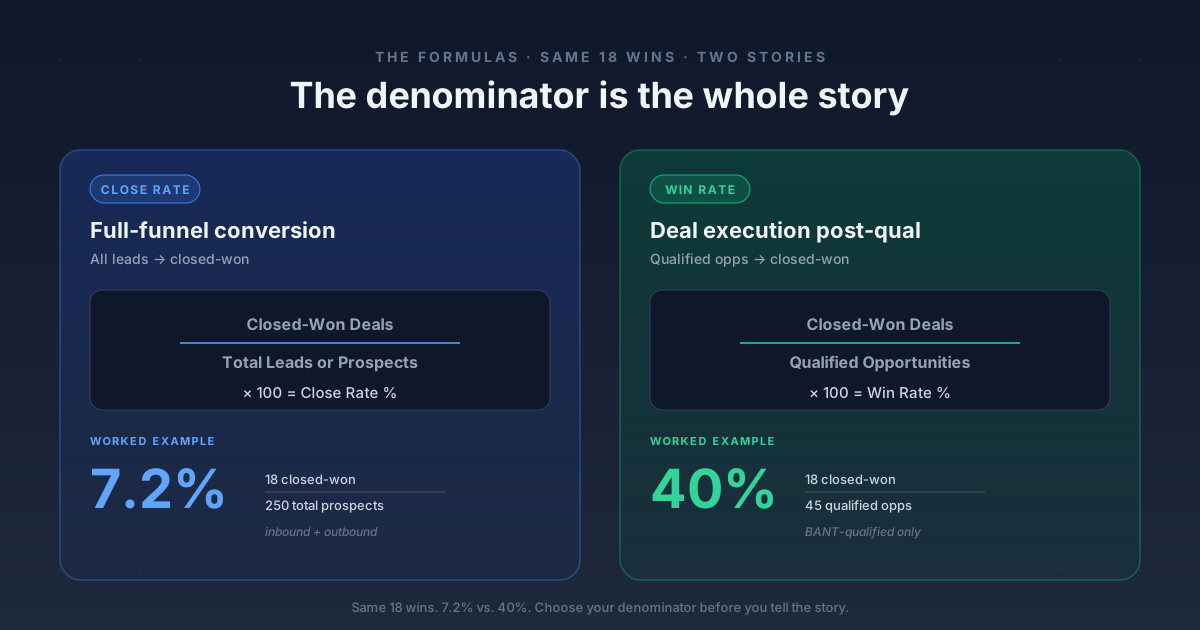
The entire difference between these two sales metrics comes down to one thing: what you put in the denominator. That choice is not neutral. It shapes the story you tell leadership, the actions you take, and the improvement strategies you pursue.
| Dimension | Close Rate | Win Rate |
|---|---|---|
| Denominator | All leads or prospects | Qualified opportunities only |
| What it measures | Full-funnel conversion efficiency | Deal execution after qualification |
| Most useful for | SDR managers, marketing-sales alignment | AEs, sales managers, deal coaching |
| When to use | Evaluating lead quality and funnel health | Evaluating competitive positioning and deal skills |
| Common pitfall | Blaming sales for low numbers when lead quality is the issue | Inflating the number by keeping stalled deals “open” |
| “Good” range (SaaS) | 5% to 15% depending on segment | 25% to 45% depending on segment |
| No-decision impact | Minimal (most no-decisions never became leads) | Significant (every stalled opp counts against you) |
Here's the segment-specific angle that most guides miss. The metric that matters more depends on your motion:
SMB AEs running 30 to 60 deals per month should pay close attention to close rate. The funnel is wide, speed is the lever, and small improvements in pipeline conversion compound fast across high volume.
Mid-market AEs need both metrics. Close rate reveals whether marketing and SDRs are sending quality. Win rate reveals whether you're executing against 3 to 7 stakeholder buying committees.
Enterprise AEs with 10 to 15 deals per quarter should focus on win rate. Every qualified opportunity is expensive to pursue. Losing a deal you spent 4 months on costs more than just the revenue.
The metric you choose shapes the story you tell. Choose deliberately.
Which metric should you track?
Both. But for different purposes and with different weight depending on your role.
| Your role | Primary metric | Why |
|---|---|---|
| SDR manager evaluating lead quality | Close rate | Shows whether leads are converting through the full funnel |
| AE improving deal execution | Win rate | Measures what happens after you’ve qualified |
| RevOps building a forecast model | Both, weighted by pipeline stage | Close rate for top-of-funnel, win rate for Stage 2+ |
| VP of Sales reporting to the board | Win rate (with close rate as diagnostic) | Board cares about conversion of real pipeline, not raw leads |
If you can only pick one, win rate is more actionable for AEs. It isolates the part of the process you control.
Common mistakes when measuring close rate and win rate
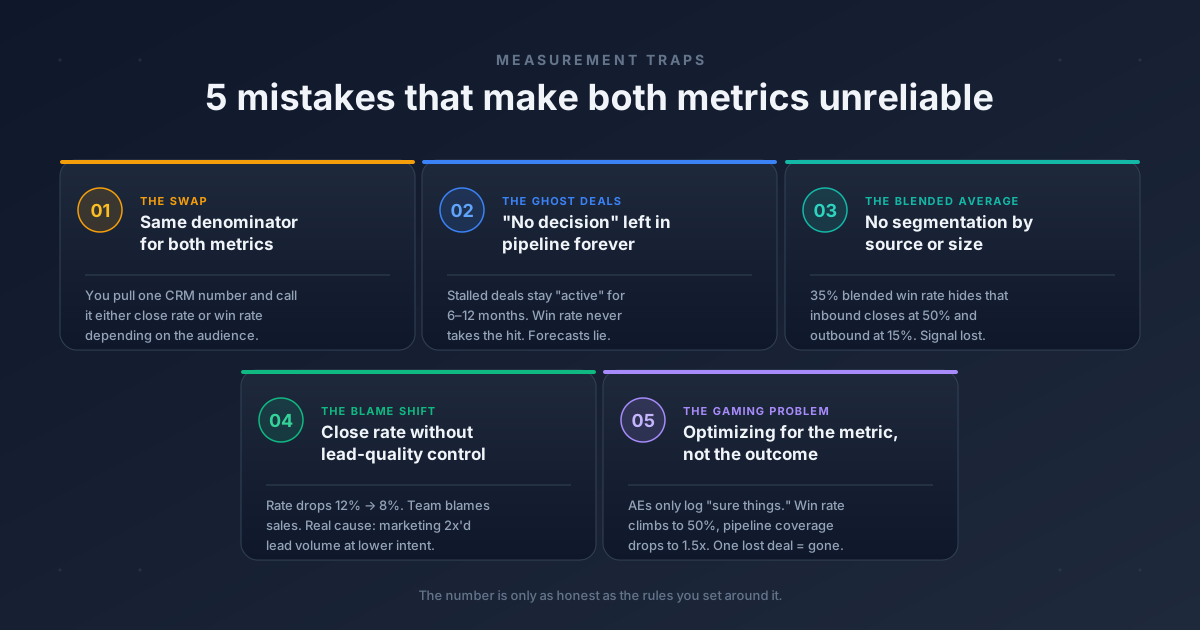
1. Using the same denominator for both metrics
What it looks like: Treating "all leads" and "qualified opportunities" as interchangeable. You pull one number from your CRM and call it either close rate or win rate depending on the audience.
What works instead: Define your denominator explicitly for each metric. Document it so the whole team uses the same definition. Close rate uses all leads. Win rate uses qualified opportunities. No exceptions.
2. Counting "no decision" as something other than a loss
What it looks like: Leaving stalled deals in "open" status indefinitely. They sit in your pipeline for 6, 9, 12 months. They never close. But they also never count against your win rate because they're technically still "active."
What works instead: Set a time-based rule. If a deal has been open for 2x your average sales cycle without meaningful progression, mark it closed-lost. This will lower your win rate. That's the point. It makes the number honest.
3. Not segmenting by deal source, size, or segment
What it looks like: A blended win rate of 35% that hides the fact that inbound deals close at 50% and outbound deals close at 15%. You optimize for the blended number and miss the signal.
What works instead: Break both sales performance metrics down by source, segment, and deal size. The blended number is almost always misleading. You're looking for patterns, not averages. The right sales analytics software can automate this segmentation for you.
4. Measuring close rate without controlling for lead quality
What it looks like: Close rate drops from 12% to 8%. The team blames sales execution. But marketing doubled lead volume with lower-intent sources last quarter. More leads entered the denominator. The same number of deals closed.
What works instead: Track close rate by lead source and quality tier separately. If your close rate on high-intent inbound leads stayed at 12% while your blended rate dropped, the problem isn't sales. It's lead mix. Tools like lead scoring software can help you tier leads automatically.
5. Optimizing for the metric instead of the outcome
What it looks like: AEs stop creating opportunities unless they're confident they'll close. This inflates win rate but shrinks pipeline. Leadership sees a 50% win rate and thinks the team is crushing it. Pipeline coverage is 1.5x. One lost deal and the quarter is gone.
What works instead: Pair win rate with pipeline coverage ratio best practices. A high win rate with low pipeline coverage is a warning sign, not a success story. Track both together.
How to improve your close rate
Tighten lead qualification before opportunities are created
Most close rate problems are qualification problems in disguise. If unqualified leads enter your pipeline and eventually drop off, they drag down your close rate without ever being real opportunities.
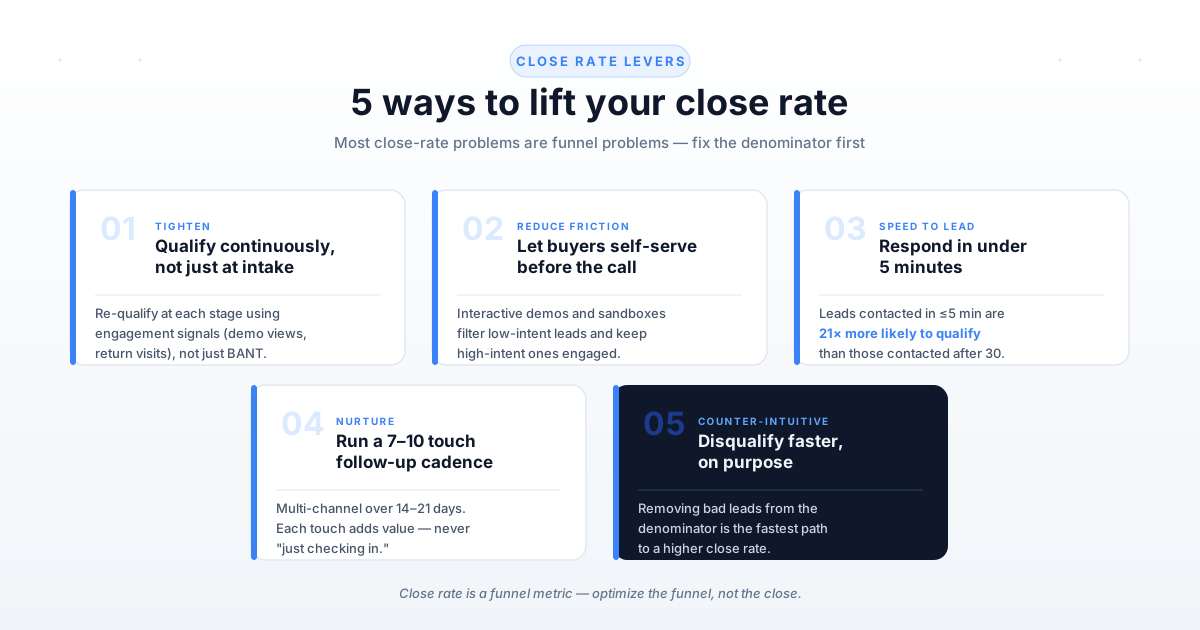
Use continuous qualification, not a one-time BANT qualification framework check at the top. Re-qualify at each stage. Implement a scoring model that accounts for engagement signals (demo views, content downloads, return visits), not just firmographic fit.
Reduce evaluation friction for early-stage prospects
Most prospects drop off because evaluating your product requires too much commitment. Schedule a call. Sit through a 45-minute demo. Wait for a follow-up. The cognitive cost is high, and most early-stage prospects aren't ready to pay it.
Give prospects a way to experience your product before they commit to a meeting. Interactive demos, product tours, and sandbox environments let buyers self-qualify on their own terms. Guideflow is one platform that lets you capture and create these experiences in minutes, so prospects can explore your product without scheduling a call. This tends to improve close rate by filtering out low-intent leads early and keeping high-intent ones engaged.
Accelerate speed-to-lead for inbound prospects
Research from InsideSales.com shows that leads contacted within 5 minutes are 21x more likely to qualify than leads contacted after 30 minutes. Five minutes. Not five hours.
Automate routing. Use round-robin assignment. Set SLAs for first response. If your average response time to an inbound lead is measured in hours, you're losing deals before they start.
Build a structured follow-up sequence
Most deals die from neglect, not rejection. A repeatable follow-up cadence with value-add touchpoints keeps prospects engaged through the evaluation process.
Build a 7 to 10 touch sequence across email, phone, and social over 14 to 21 days. Each touch should add value (a relevant case study, a benchmark, a short video), not just ask "checking in?" The right sales engagement tools can help you systematize this process.
Disqualify faster
Counter-intuitive: the fastest way to improve close rate is to remove bad leads from the denominator before they become opportunities. Define explicit disqualification criteria and empower SDRs and AEs to use them without penalty.
If a prospect doesn't have budget, authority, or a clear timeline, don't create the opportunity. Your close rate will thank you.
How to improve your win rate
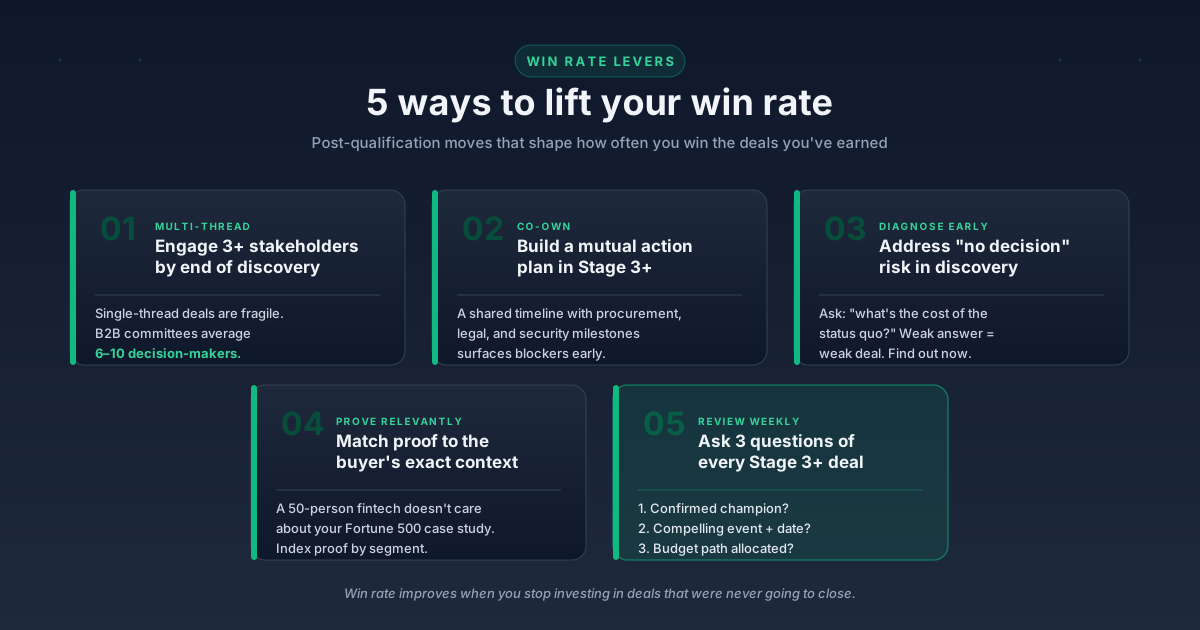
Win rate measures what happens after qualification. These strategies focus on deal execution, not funnel optimization.
Multi-thread every deal with 3+ stakeholders
Deals with a single thread are fragile. If your champion leaves, gets reassigned, or loses internal influence, the deal dies. According to Gartner, the average B2B buying group involves 6 to 10 decision-makers.
Identify and engage at least 3 stakeholders by the end of discovery using a multi-threading strategy in enterprise sales. Map the buying committee early. Ask your champion: "Who else needs to be comfortable with this decision before it moves forward?"
Build a mutual action plan for every deal in Stage 3+
Deals stall when next steps are unclear. A mutual action plan for B2B sales (a shared timeline with milestones for both sides) creates accountability and surfaces blockers before they become deal-killers.
Use a shared document or deal room. Include procurement, legal, and security milestones, not just "demo" and "proposal." The best mutual action plans look like project plans, because that's what complex B2B purchases are. Presales software can help you structure these deal rooms effectively.
Address "no decision" risk early, not late
The biggest competitor isn't another vendor. It's inaction. Deals lost to "no decision" consume full resources with zero return, representing the cost of no decision in B2B sales. They're the most expensive losses in your pipeline.
During discovery, ask explicitly: "What happens if you do nothing? What's the cost of the status quo?" If the answer is weak, the deal is weak. Better to know now than after 3 months of multi-threading.
Use proof points that match the buyer's context
Generic case studies don't close deals. Proof that matches the buyer's industry, company size, and use case does. A 50-person fintech startup doesn't care about your Fortune 500 case study.
Build a library of proof points indexed by segment, use case, and objection. Surface them at the right moment in the deal cycle, not in a 40-page deck during the first meeting. Pairing proof points with a demo center where prospects can explore relevant use cases on their own can accelerate deal velocity significantly.
Run a deal review process that catches risk before the forecast call
Win rate improves when you stop investing in deals that were never going to close. A weekly 15-minute deal review focused on three questions does more than any training program:
- Is there a confirmed champion?
- Is there a defined timeline with a compelling event?
- Is there budget allocated (or a clear path to allocation)?
If any answer is "no" in Stage 3+, the deal needs intervention or downgrade. Don't wait for the forecast call to discover this. Investing in sales coaching software can formalize this review cadence across your team.
How close rate and win rate connect to your forecast
This is where most AEs get the math wrong, and it's why forecast calls feel like guesswork.
The basic pipeline math looks simple:
Expected Revenue = Pipeline Value × Conversion Rate
The problem is which conversion rate you use and where you apply it.
If you use close rate (say, 7%) against your total pipeline, you'll underestimate revenue. Total pipeline includes unqualified leads that will never become deals. Applying a full-funnel conversion rate to raw pipeline gives you a pessimistic (but sometimes useful) floor.
If you use win rate (say, 40%) against your total pipeline, you'll overestimate revenue. You're applying a qualified-opportunity conversion rate to a pipeline that includes unqualified leads. The math breaks.
The fix: use the right metric at the right pipeline stage.
| Pipeline Stage | Metric to Apply | Why |
|---|---|---|
| Stage 1 (raw leads, early prospects) | Close rate | These haven’t been qualified yet |
| Stage 2 (qualified, discovery complete) | Win rate | These have passed qualification criteria |
| Stage 3+ (proposal, negotiation) | Stage-specific conversion rate | Even more precise than blended win rate |
Layer your metrics. Apply close rate to top-of-funnel pipeline. Apply win rate to Stage 2+ pipeline. Use stage-specific conversion rates for late-stage deals. Revenue intelligence platforms can automate this layered forecasting approach.
Your forecast is only as accurate as the metric you apply to each pipeline stage.
Benchmarks: what "good" looks like
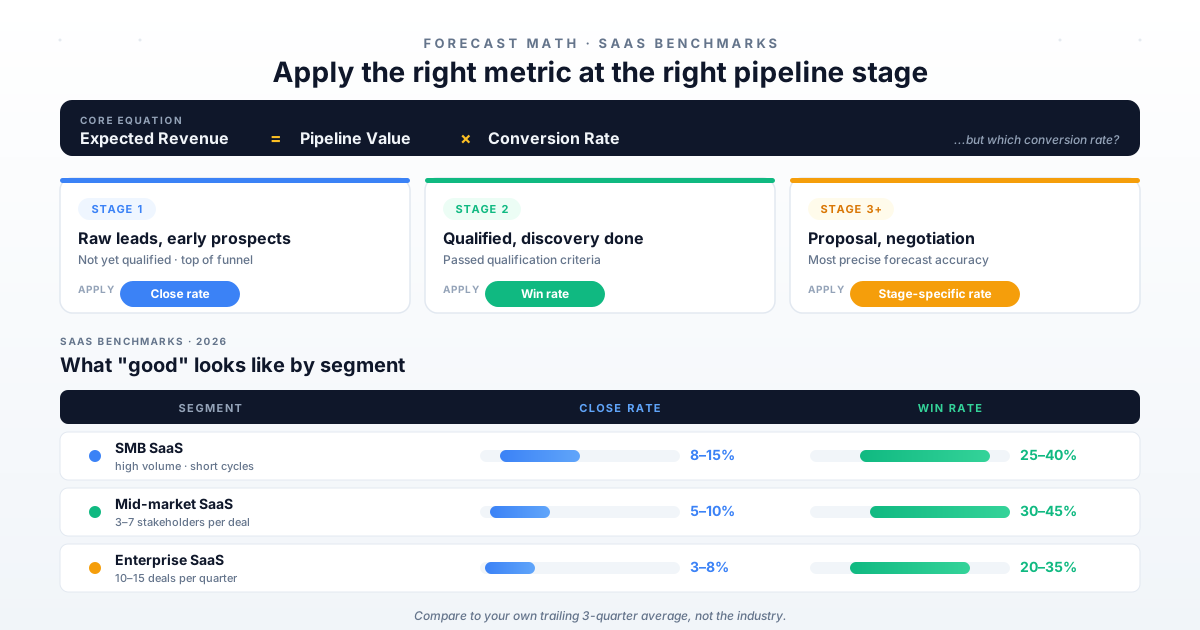
Benchmarks are directional, not prescriptive. Your numbers depend on deal size, sales cycle length, qualification criteria, competitive intensity, and a dozen other variables - reviewing SaaS sales cycle benchmarks by segment can provide useful context.
That said, here are realistic ranges for SaaS in 2026:
| Segment | Close Rate | Win Rate |
|---|---|---|
| SMB SaaS | 8% to 15% | 25% to 40% |
| Mid-market SaaS | 5% to 10% | 30% to 45% |
| Enterprise SaaS | 3% to 8% | 20% to 35% |
RAIN Group research puts the cross-industry average win rate around 47%, but that number includes industries with very different sales motions. SaaS tends to run lower because of competitive density and longer evaluation cycles.
Context matters more than the number itself. A 25% win rate in a 4-vendor competitive bake-off is strong. A 25% win rate on inbound-only deals where you're the only vendor evaluated is a problem.
Don't compare your win rate to a benchmark. Compare it to your own trailing 3-quarter average. That trend line tells you more than any industry number.
Step-by-step: audit your close rate and win rate
Step 1: Define your denominators
Document what counts as a "lead" and what counts as a "qualified opportunity" in your CRM. Get alignment from RevOps and sales leadership. Write it down in a shared document that everyone references.
This step produces: a written definition of both denominators, agreed upon by sales and RevOps.
Step 2: Clean your CRM data
Close out stalled opportunities. Anything open beyond 2x your average sales cycle without meaningful progression gets marked closed-lost. Reclassify mistagged leads. Remove duplicates.
This will change your numbers. That's the point. You're replacing a comfortable fiction with an honest baseline.
This step produces: a clean dataset with accurate opportunity statuses and lead classifications.
Step 3: Calculate both metrics for the last 4 quarters
Pull the data. Calculate close rate and win rate separately for each of the last 4 quarters. Don't look at the snapshot. Look at the trend.
Is win rate improving, declining, or flat? Is close rate moving in the same direction, or diverging? Divergence tells you something important about where the problem lives.
This step produces: a 4-quarter trend view of both metrics.
Step 4: Segment by source, deal size, and sales cycle
Break the numbers down. Calculate win rate for inbound vs. outbound deals. Calculate close rate by lead source. Segment by deal size (SMB, mid-market, enterprise).
The blended rate hides the signal. You're looking for patterns: which segments have the highest win rate? Which sources have the lowest close rate? Where is the gap between the two metrics widest?
This step produces: a segmented view that reveals where your funnel and deal execution are strongest and weakest.
Step 5: Set improvement targets and measure monthly
Pick one metric to improve. Set a realistic target based on your trailing average, not an industry benchmark. "Increase win rate from 32% to 38% over 2 quarters" is specific and measurable.
Identify the 2 to 3 tactics from this guide that address the gap you've identified. Review monthly. Adjust quarterly.
This step produces: a written improvement plan with a specific target, timeline, and tactics.
Conclusion
Close rate and win rate measure different things, and the distinction matters for how you forecast, where you invest your time, and what you optimize. The denominator you choose shapes the story you tell. Getting it wrong means optimizing the wrong lever.
Start with the audit. Define your denominators, clean your data, and calculate both metrics for the last 4 quarters. The trend will tell you where to focus.
Start your journey with Guideflow today!
FAQs
Close rate measures the percentage of all leads or prospects that become customers. Win rate measures the percentage of qualified opportunities that become customers. The key difference is the denominator: close rate includes everything that enters your funnel, while win rate only includes deals that passed your qualification criteria.
It depends on your segment. SMB SaaS teams typically see 25% to 40%. Mid-market runs 30% to 45%. Enterprise ranges from 20% to 35%. RAIN Group research puts the cross-industry average around 47%, but the most useful benchmark is your own trailing 3-quarter average, not an industry number.
Close Rate = (Closed-Won Deals ÷ Total Leads or Prospects) × 100. The critical step is defining what “total leads” means in your organization before calculating. If your team doesn’t agree on the denominator, the number is meaningless.
Win Rate = (Closed-Won Deals ÷ Qualified Opportunities) × 100. Define “qualified” using your CRM stage definitions and qualification framework (BANT, MEDDIC sales qualification methodology, or your org’s custom criteria). Stricter qualification produces a higher win rate with fewer opportunities in the denominator.
In most organizations, yes. If a qualified opportunity does not result in a closed-won deal, it counts against your win rate. Leaving stalled deals in “open” status indefinitely inflates win rate artificially and hides pipeline problems. Set a time-based rule (2x your average cycle) to close out stalled deals.
Track both, but for different purposes. Use close rate to evaluate full-funnel efficiency (lead quality, qualification, marketing-sales alignment). Use win rate to evaluate deal execution (competitive positioning, stakeholder management, sales process). If you can only pick one, win rate is more actionable for AEs because it isolates the part of the process you control.
Both metrics feed pipeline math. Apply close rate to top-of-funnel pipeline (Stage 1, raw leads) and win rate to qualified pipeline (Stage 2+). Using the wrong metric at the wrong pipeline stage produces unreliable forecasts. Layering both metrics by stage gives you the most accurate projection.
Yes, and it usually means your pipeline is small but well-qualified. You’re converting a high percentage of a narrow funnel. This is common in enterprise sales with low volume and long cycles. The risk is pipeline concentration: if one deal falls through, the impact on your quarter is outsized. Pair this pattern with pipeline coverage ratio to assess whether you have enough opportunities to absorb losses.