You're prepping for a renewal call. The account looked healthy in your CRM. But the support ticket history tells a different story: 14 tickets in the last 60 days, all variations of the same question. By the time you see it, the customer's already talking to your competitor.
This is the failure mode customer success software exists to prevent. Not just tracking accounts, but surfacing the signals that tell you an account is slipping before the renewal conversation turns defensive. The problem is the category is crowded, features overlap across tools, and most comparison articles are written by vendors listing themselves first.
This guide takes a different approach. We evaluated 15 customer success tools based on G2 and Gartner data, real pricing transparency, integration depth, and how well each platform maps to the KPIs CSMs actually report on: GRR, NRR, churn rate, time-to-value, and CSAT.
What's inside
This guide covers the 15 best customer success software tools for 2026, evaluated on health scoring, churn prediction, onboarding automation, integrations, pricing, and real-world CSM fit. Selection criteria included G2 ratings, Gartner reviews, pricing transparency, and relevance to the metrics CS teams report on daily.
It's built for CSMs, CS leaders, and ops teams who are building or upgrading their CS stack and need to narrow a shortlist they can trial and champion internally.
TL;DR
- Customer success software helps B2B companies monitor customer health, predict churn, and drive retention and expansion revenue across their customer base.
- Top pick for enterprise CS teams: Gainsight, with the deepest feature set and broadest journey orchestration in the category.
- Top pick for mid-market and fast-growing teams: ChurnZero or Vitally, depending on whether you prioritize usage-based health scoring or modern UX.
- Top pick for budget-conscious teams: Custify or HubSpot Service Hub, both of which deliver solid CS automation without requiring board-level budget approval.
- The biggest differentiator between customer success tools is whether they're built for reactive support or proactive success. Know which you need before you evaluate.
- Interactive product education tools like Guideflow complement CS platforms by reducing repetitive onboarding and driving adoption at scale.
What is customer success software
Customer success software is a category of B2B tools that help companies monitor customer health, predict churn, manage onboarding, and drive retention and expansion revenue across their customer base. The term is used interchangeably with "customer success platform," "customer success management software," and "csm software." They all point to the same core function.
Here's the distinction that matters: support software reacts to problems (tickets). CRM tracks relationships (contacts, deals, pipeline). Customer success software sits between them. It proactively identifies risk and opportunity using product usage data, health scores, and lifecycle signals.
Core components typically include:
- Health scoring: Composite scores combining usage, support, engagement, and sentiment data
- Churn prediction: AI or rule-based models that flag at-risk accounts before renewal
- Customer journey management: Lifecycle stages, playbooks, and automated touchpoints
- Onboarding automation: Task tracking, milestone management, and time-to-value measurement
- Reporting and analytics: NRR, GRR, churn rate, CSAT/NPS dashboards
- Integrations: CRM (Salesforce, HubSpot), support (Zendesk, Intercom), product analytics (Mixpanel, Amplitude)
The customer success metrics these platforms track are the same ones your leadership team asks about in board meetings. The right platform puts them in a single view instead of scattered across five tabs.
When to use customer success software
You're managing 20+ accounts per CSM
Manual tracking in spreadsheets breaks down around this threshold. Health scores and automated playbooks become necessary when you can't hold every account's status in your head. Customer onboarding software features start earning their cost here.
Churn is rising but you can't explain why
If your churn post-mortems consistently reveal "we didn't see it coming," you need proactive health monitoring. Customer retention software gives you the early warning signals that Slack threads and gut feelings miss.
Your CS team is growing beyond 3 people
Consistency requires playbooks, not tribal knowledge. A customer success platform enforces process without requiring every CSM to reinvent the workflow from scratch.
Leadership is asking for CS ROI metrics
If you can't produce retention, NRR, and expansion data in a single view, you're flying blind in board conversations. Customer success management tools consolidate the data that proves your team's impact on revenue.
Best customer success software comparison table
Here's how all 15 tools compare across intent, key use case, pricing, and G2 rating.
| # | Product | Intent | Key Use Case | Pricing | G2 Rating |
|---|---|---|---|---|---|
| 1 | Gainsight | Full-lifecycle CS platform | Enterprise CS teams needing playbooks, health scoring, and journey orchestration | Contact sales | 4.5/5 |
| 2 | ChurnZero | Real-time churn prevention | Mid-market teams that need usage-based health scores and automated plays | From $12,000/yr | 4.7/5 |
| 3 | Totango | Modular CS platform | Teams that want to start small and add modules as they scale | Free tier; paid from contact sales | 4.3/5 |
| 4 | Vitally | Modern CS workspace | Fast-growing SaaS teams that want speed and flexibility | From $15,000/yr | 4.5/5 |
| 5 | Planhat | Data-first CS platform | Teams with complex data environments needing unified customer views | Contact sales | 4.6/5 |
| 6 | Custify | Affordable CS automation | SMB and mid-market teams on a budget | From $999/mo | 4.7/5 |
| 7 | ClientSuccess | Simple lifecycle management | Mid-market teams that value ease of use over feature depth | Contact sales | 4.4/5 |
| 8 | Catalyst | CRM-native CS | Teams deeply embedded in Salesforce wanting CS workflows inside CRM | Contact sales | 4.6/5 |
| 9 | Velaris | AI-powered CS operations | Teams wanting AI to automate CS tasks and surface insights | Contact sales | 4.6/5 |
| 10 | Intercom | Conversational customer engagement | Teams that blur the line between support and success | From $29/seat/mo | 4.5/5 |
| 11 | HubSpot Service Hub | CRM-integrated customer service | Teams already on HubSpot wanting CS capabilities without a new tool | Free tier; paid from $15/mo | 4.4/5 |
| 12 | Freshdesk Customer Success | Budget-friendly CS add-on | Teams using Freshworks who need basic CS functionality | Contact sales | 4.5/5 |
| 13 | Staircase AI | AI-driven sentiment analysis | Teams wanting to detect churn risk from communication patterns | Contact sales | 4.8/5 |
| 14 | Zendesk | Support-first with CS capabilities | Large support teams adding proactive CS layers | From $55/agent/mo | 4.3/5 |
| 15 | Pylon | B2B support for Slack/Teams | Companies managing customer relationships inside messaging channels | Contact sales | 4.9/5 |
1. Gainsight
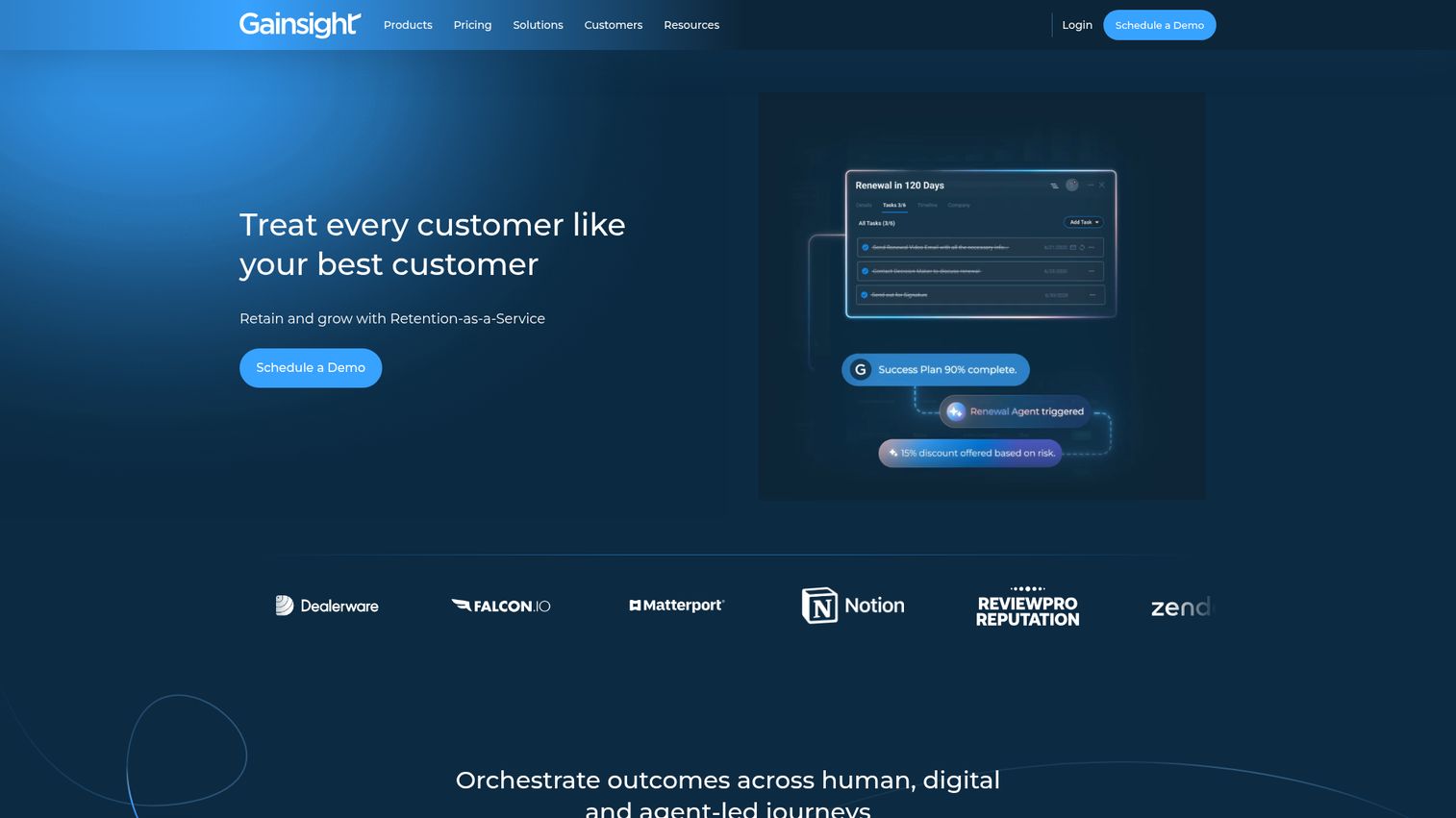
Gainsight is the customer success platform most enterprise CS teams evaluate first, and for good reason. It offers the broadest feature set in the category: health scoring, journey orchestration, playbooks, revenue intelligence, and product experience analytics via Gainsight PX.
The "CustomerOS" platform connects CS, product, and community data into a single view. For teams managing hundreds of enterprise accounts across multiple CSMs, the depth of configuration is a genuine advantage. You can build health scores weighted to your specific business, automate multi-step playbooks triggered by usage changes, and track customer journeys from onboarding through expansion.
Best for: Enterprise CS teams (50M+ ARR) with dedicated CS Ops resources and budget for a 3 to 6 month implementation.
Key strengths
- Configurable health scores with custom weightings
- Journey orchestration across the full customer lifecycle
- Deep Salesforce integration and bi-directional data sync
- Product analytics via Gainsight PX module
- AI-powered risk detection and next-best-action recommendations
Pricing: Contact sales. Typically $30,000 to $100,000+/year depending on seats and modules.
Worth noting: implementation is measured in months, not days. You'll need a CS Ops or admin resource to configure and maintain the platform. For teams under 10 CSMs, Gainsight is often overkill in both cost and complexity.
2. ChurnZero
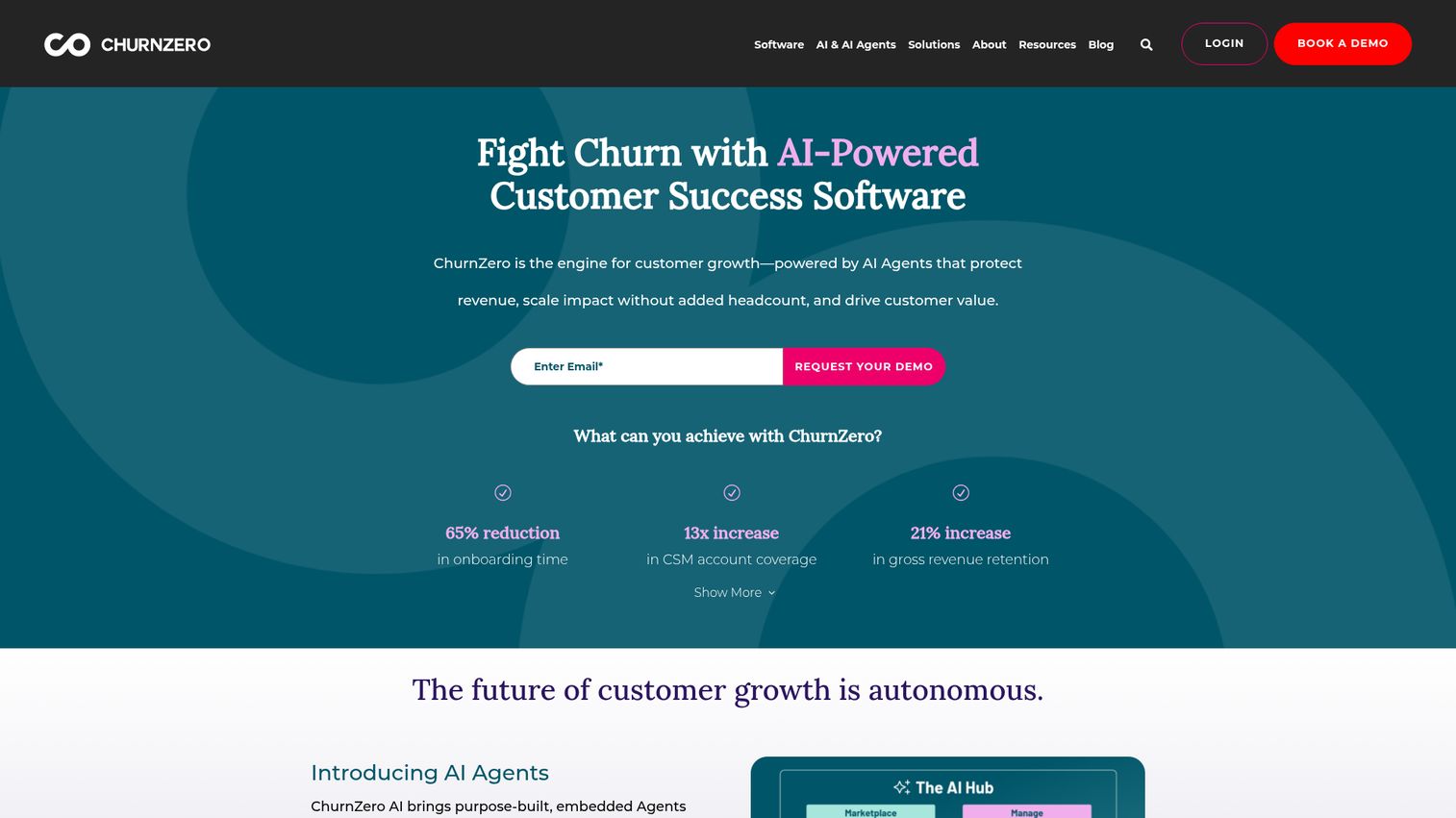
ChurnZero is built specifically for subscription businesses that need real-time visibility into customer health. It tracks product usage at the feature level and triggers automated plays based on behavior changes. The platform is designed to be used by CSMs directly, not just CS Ops.
Where ChurnZero stands out is the command center approach. CSMs get a daily workflow view that surfaces which accounts need attention, which playbooks are running, and which health scores have shifted. This customer onboarding software also handles in-app communication, so you can reach users inside the product without switching tools.
Best for: Mid-market SaaS teams (20 to 100 CSMs) that need usage-based health scoring and automated engagement without enterprise-level complexity.
Key strengths
- Real-time product usage tracking at the feature level
- Automated playbooks and task management for CSMs
- In-app communication and walkthroughs
- Customer journey mapping with lifecycle stages
- Strong reporting on NRR, churn rate, and expansion
Pricing: From ~$12,000/year. Contact sales for exact pricing.
3. Totango
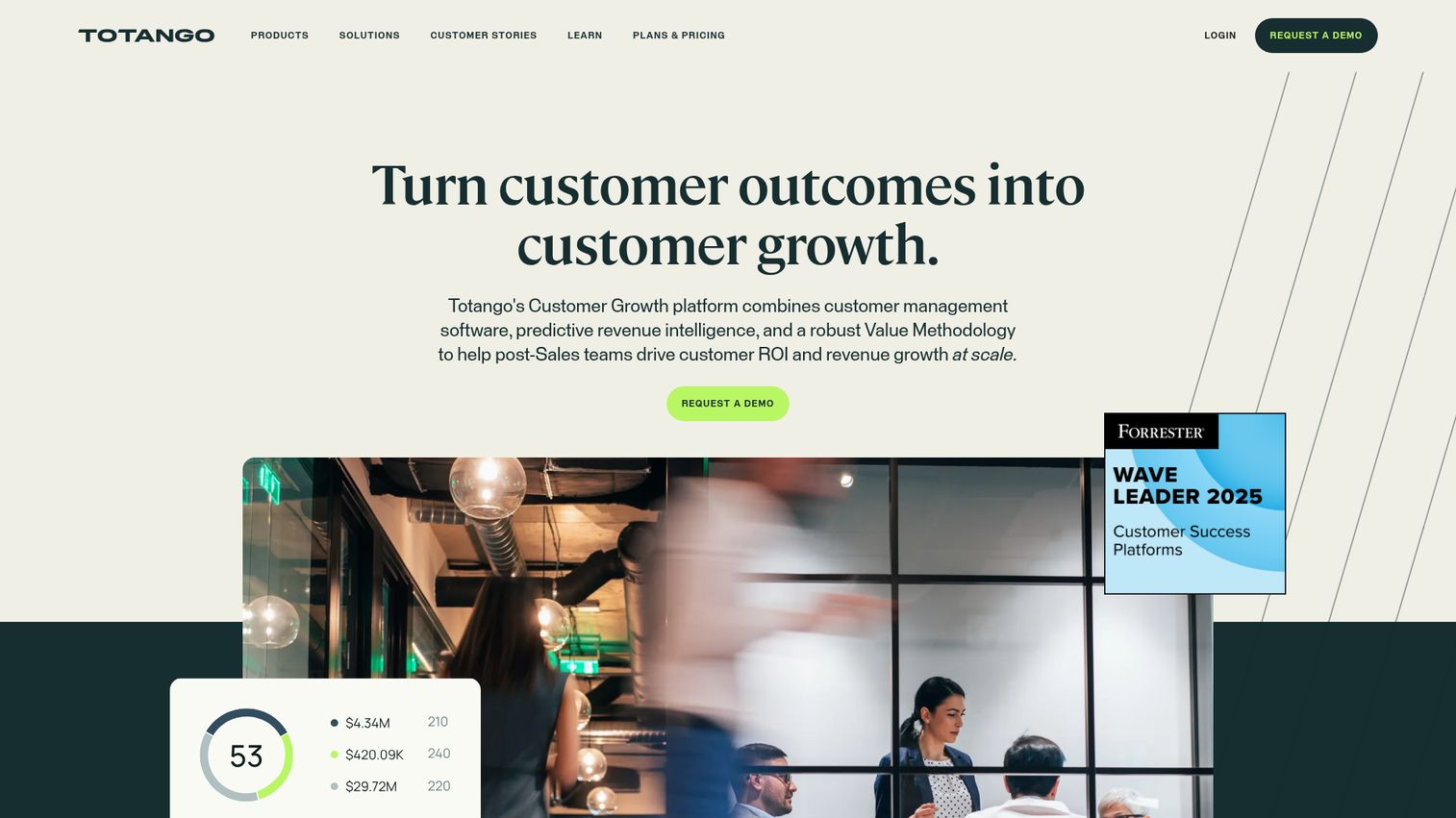
Totango takes a modular approach to customer success, letting teams start with a free tier and add capabilities as they scale. The platform offers pre-built "SuccessBLOCs," which are modular packages for onboarding, adoption, renewal, and expansion that provide playbooks and automations out of the box.
The free tier is a real differentiator for teams that need to prove the value of a CS platform before committing budget. You get core health scoring and customer segmentation without a contract.
Best for: Growing CS teams that want to start with a free plan and expand functionality incrementally.
Key strengths
- Free tier with core health scoring functionality
- Modular SuccessBLOCs for specific CS motions
- Customer journey builder with automated triggers
- Integration marketplace with 30+ connectors
- Spark AI for automated insights and recommendations
Pricing: Free tier available. Paid plans require contacting sales.
The modular approach is a double-edged sword. Flexibility is high, but assembling the right combination of modules can feel fragmented compared to an all-in-one platform. Teams that want everything configured out of the box may find the assembly process frustrating.
4. Vitally
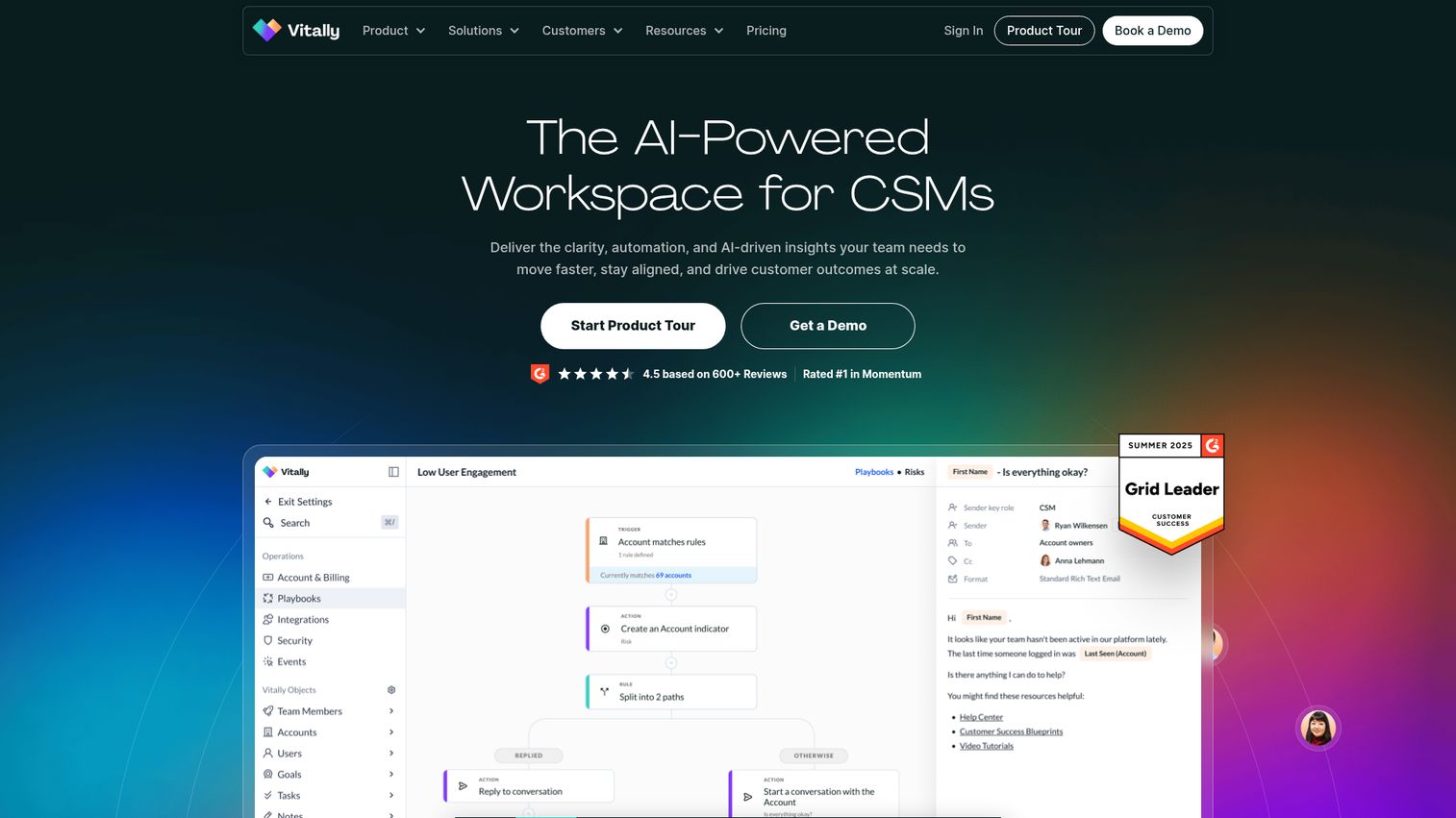
Vitally is the CS platform that product-led growth companies tend to gravitate toward. The interface is noticeably faster and more modern than legacy CS tools. The platform is built around the idea that CSMs should spend time on strategy, not on navigating dashboards.
What makes Vitally different is the workspace concept. Instead of switching between separate modules for health scores, tasks, notes, and analytics, everything lives in a unified view tied to each account. For fast-moving teams, this reduces the daily friction of "where did I put that note?" and "which dashboard has the health score?"
Best for: Fast-growing SaaS teams (Series A to C) that prioritize speed, modern UX, and tight product analytics integration.
Key strengths
- Real-time customer 360 views in a single workspace
- Configurable health scores with flexible data inputs
- Project management for onboarding milestones
- Automation hubs for scaled CS motions
- Strong API and integration with product analytics tools
Pricing: From ~$15,000/year. Contact sales.
5. Planhat
Planhat positions itself as the "customer platform" rather than just CS software. Its strength is unifying data from multiple sources, including CRM, product analytics, support, and billing, into a single customer view. Teams with complex data environments and multiple product lines find it particularly useful.
The flexible data model handles complex customer hierarchies that other platforms struggle with. If you're managing parent-child account relationships, multiple subscriptions per customer, or regional segmentation, Planhat's architecture is built for that complexity.
Best for: CS teams in data-heavy environments with multiple products, segments, or complex integrations that need a unified customer data platform layer.
Key strengths
- Flexible data model for complex customer hierarchies
- Revenue tracking and forecasting tied to CS data
- Health scoring with custom weightings per segment
- Collaboration workspaces for cross-functional teams
- API-first architecture with strong European data compliance
Pricing: Contact sales.
6. Custify
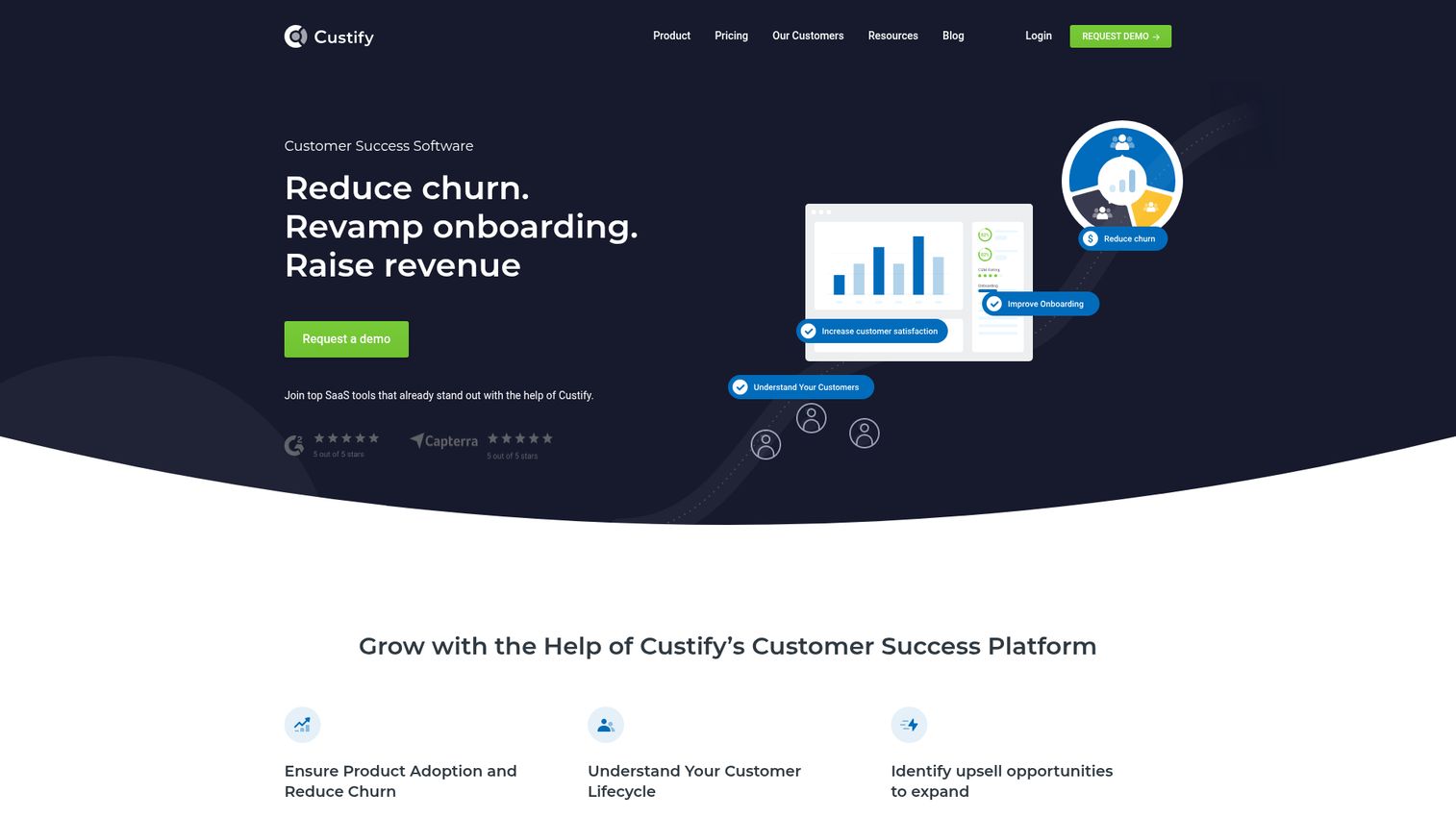
Custify is built for B2B SaaS companies that need customer success automation without enterprise pricing. The platform covers health scoring, lifecycle management, and task automation, with a focus on making CS workflows accessible to smaller teams.
The implementation timeline is the standout here. Where enterprise platforms take months, Custify can be configured and live in days. For teams that need to show results to leadership quickly, that speed matters.
Best for: SMB and mid-market SaaS companies that need solid CS automation at a price point that doesn't require board approval.
Key strengths
- Automated health scoring based on product usage data
- Lifecycle management with pre-built playbooks
- Task and alert automation for proactive outreach
- Customer 360 views with consolidated data
- Quick implementation timeline measured in days
Pricing: From ~$999/month.
Feature depth doesn't match Gainsight or ChurnZero at the enterprise level. But for teams with 5 to 15 CSMs managing SMB and mid-market accounts, the price-to-value ratio is strong.
7. ClientSuccess
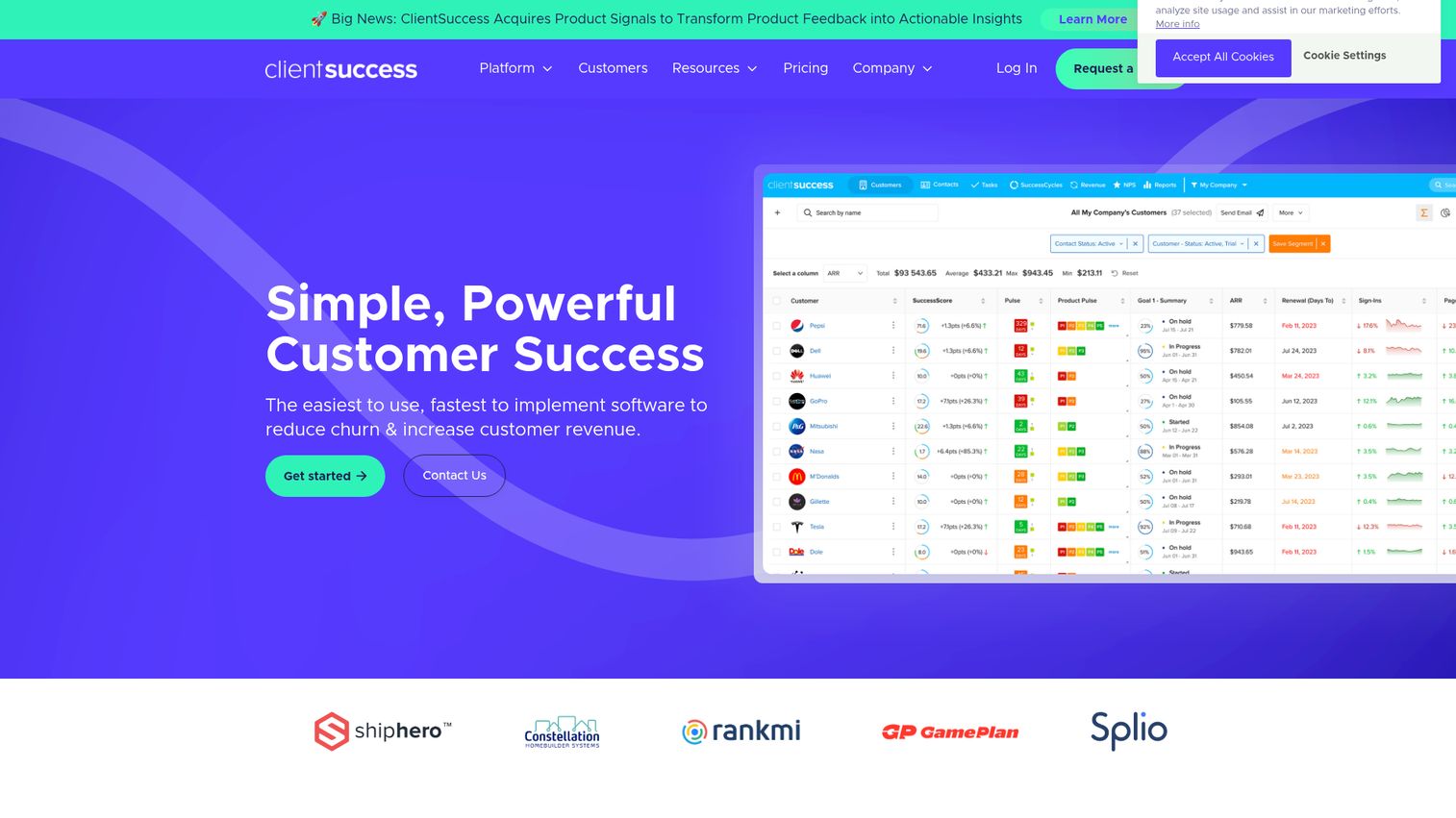
ClientSuccess is the CS platform that leads with simplicity. While other tools compete on feature breadth, ClientSuccess competes on ease of use and fast time-to-value. The platform covers the core CS workflow: health scoring (SuccessScore), pulse checks, NPS analysis, and lifecycle management.
The Pulse system is a useful differentiator. It gives CSMs a quick, standardized way to log qualitative account health alongside the quantitative data. This matters because health scores alone miss the nuance that a CSM picks up in a conversation.
Best for: Mid-market CS teams that value ease of implementation and daily usability over advanced customization.
Key strengths
- SuccessScore health metric with configurable inputs
- Pulse check-in system for qualitative health tracking
- NPS Analyzer for sentiment trending
- SmartCS AI assistant for account insights
- Clean interface with fast onboarding for new CSMs
Pricing: Contact sales.
8. Catalyst

Catalyst takes a different approach to CS software: instead of building another standalone platform, it layers CS workflows directly on top of your CRM. For teams deeply embedded in Salesforce, this means CSMs work where they already live rather than switching between tools.
The CRM-native approach solves a real adoption problem. CS platforms fail when CSMs don't use them daily. If your team already lives in Salesforce, Catalyst removes the "another tab to check" friction that kills adoption of standalone tools.
Best for: CS teams that use Salesforce as their primary system of record and want CS capabilities without adding another platform to the stack.
Key strengths
- Native CRM integration, especially deep Salesforce sync
- Revenue-focused CS workflows tied to CRM data
- Health scoring built on existing CRM data sources
- Playbook automation triggered by CRM events
- Expansion signal detection from usage patterns
Pricing: Contact sales.
9. Velaris
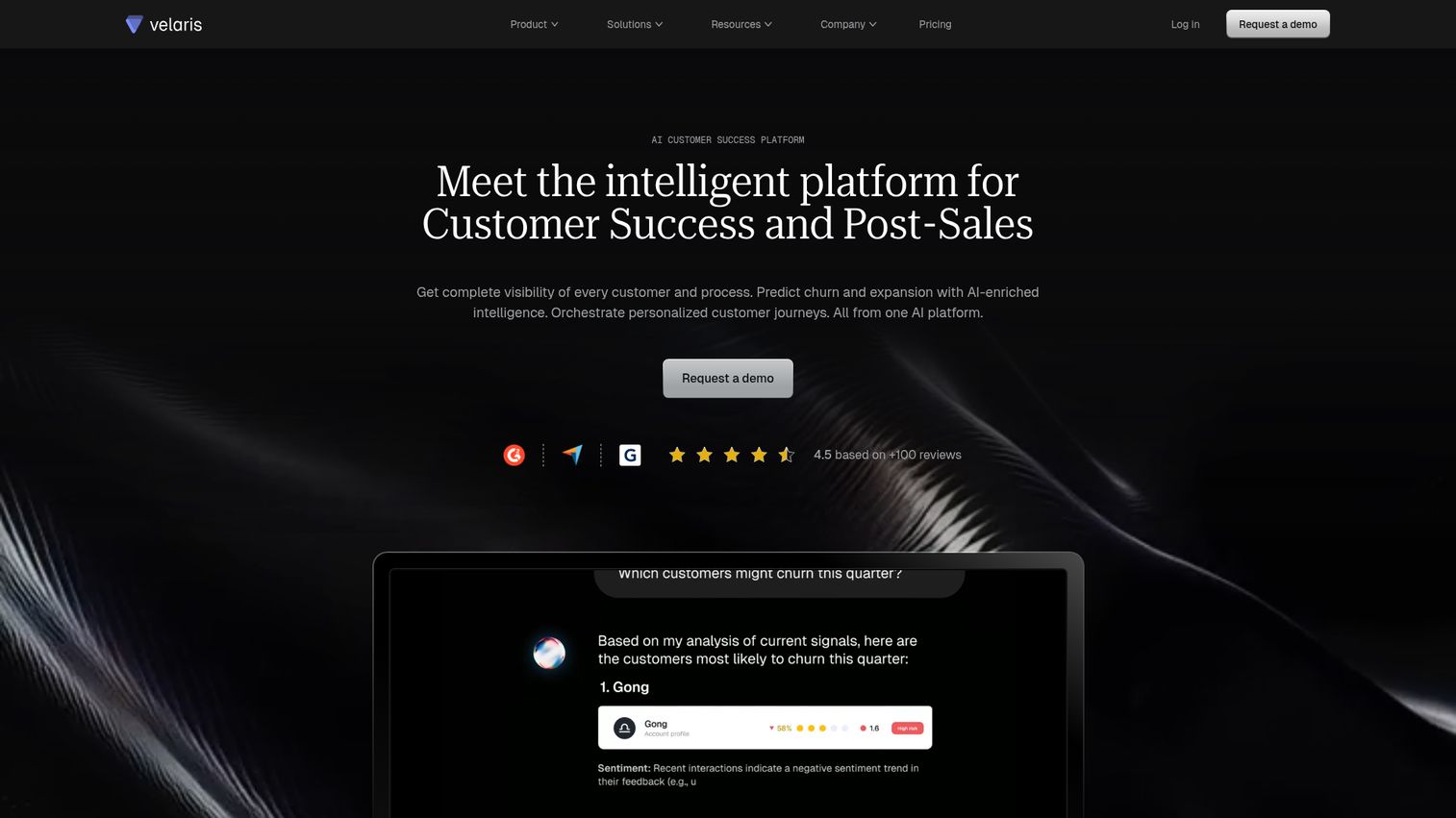
Velaris is a newer entrant in the CS platform space, built with AI at the core rather than bolted on after the fact. The platform uses AI to automate routine CS tasks, surface insights from customer data, and generate action recommendations for CSMs.
The AI-generated account summaries are the feature that tends to get attention. Instead of a CSM spending 15 minutes reviewing an account before a call, Velaris produces a summary of recent activity, health changes, and recommended talking points. That's time back in the day for strategic work.
Best for: CS teams that want AI to handle operational overhead (data entry, account summaries, risk detection) so CSMs can focus on strategic relationships.
Key strengths
- AI-generated account summaries and action items
- Automated data enrichment from connected sources
- Health scoring with AI-driven churn predictions
- Collaboration tools for cross-functional CS work
- Modern interface with intuitive daily workflows
Pricing: Contact sales.
As a newer platform, the integration list is still maturing. Teams with highly custom tech stacks should verify specific integrations before committing.
10. Intercom
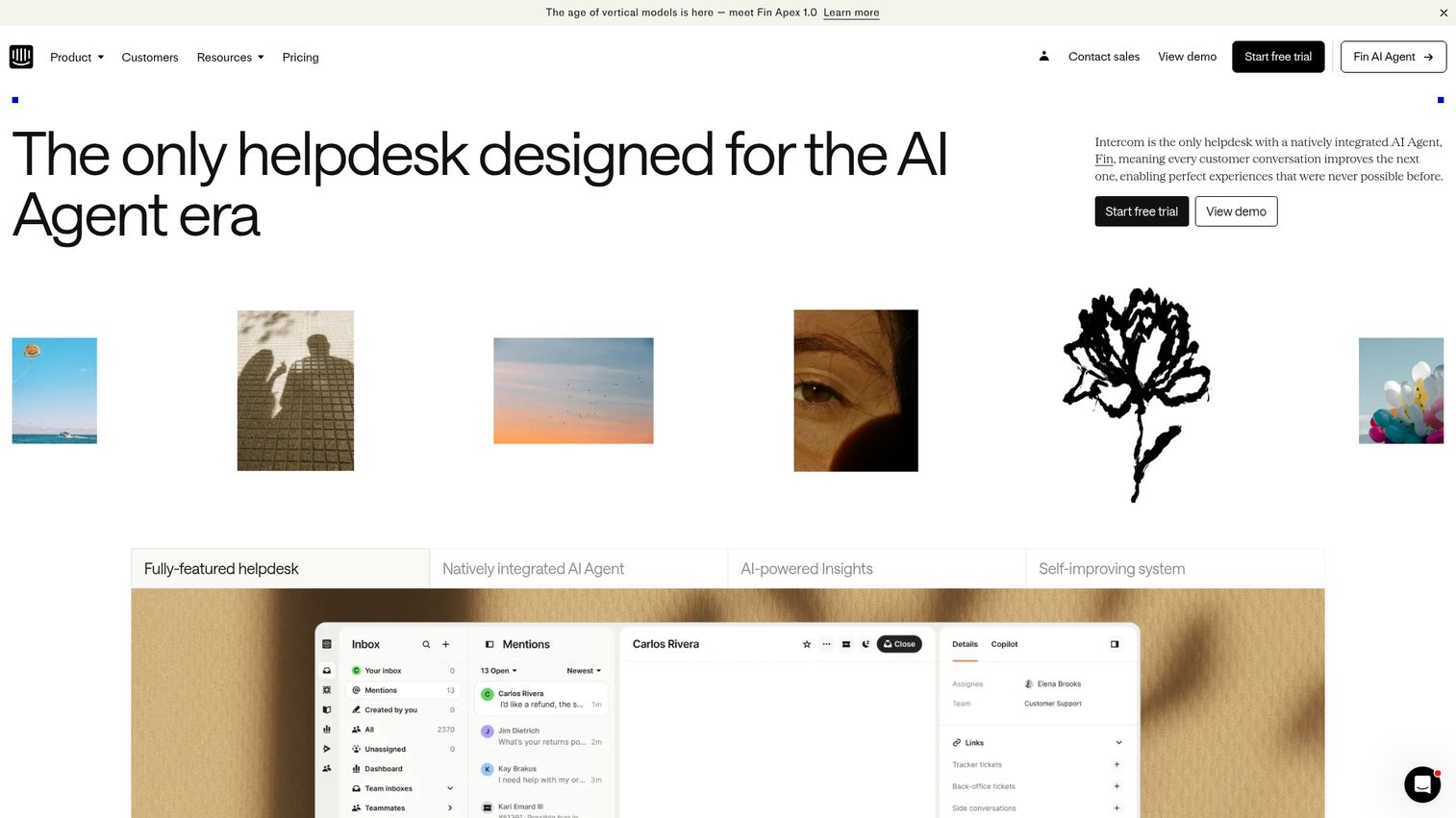
Intercom is not a traditional customer success platform, but many CS teams use it as their primary customer engagement layer. Its strength is conversational: in-app messaging, chatbots, help center, and proactive outreach all live in one place. For teams where the line between support and success is blurry, Intercom often fills both roles.
The AI-powered chatbot Fin handles a significant portion of customer inquiries before they reach a CSM. For teams drowning in "how do I...?" tickets, this is a meaningful time saver. The proactive messaging based on user behavior also gives CS teams a way to reach customers at the right moment without manual outreach. Teams looking for a broader view of conversational marketing software should consider how Intercom fits alongside dedicated CS tools.
Best for: Product-led SaaS companies where CS teams need in-app engagement, proactive messaging, and conversational support in a single tool.
Key strengths
- In-app messaging and guided product tours
- AI-powered chatbot (Fin) for automated support
- Help center and knowledge base built in
- Proactive outreach triggered by user behavior
- Strong API and integration with CS and CRM tools
Pricing: From $29/seat/month. Higher tiers for advanced features.
Intercom is not a dedicated CS platform. It lacks native health scoring, playbook automation, and renewal management. Teams that need those capabilities will use Intercom alongside a CS platform, not instead of one.
11. HubSpot Service Hub
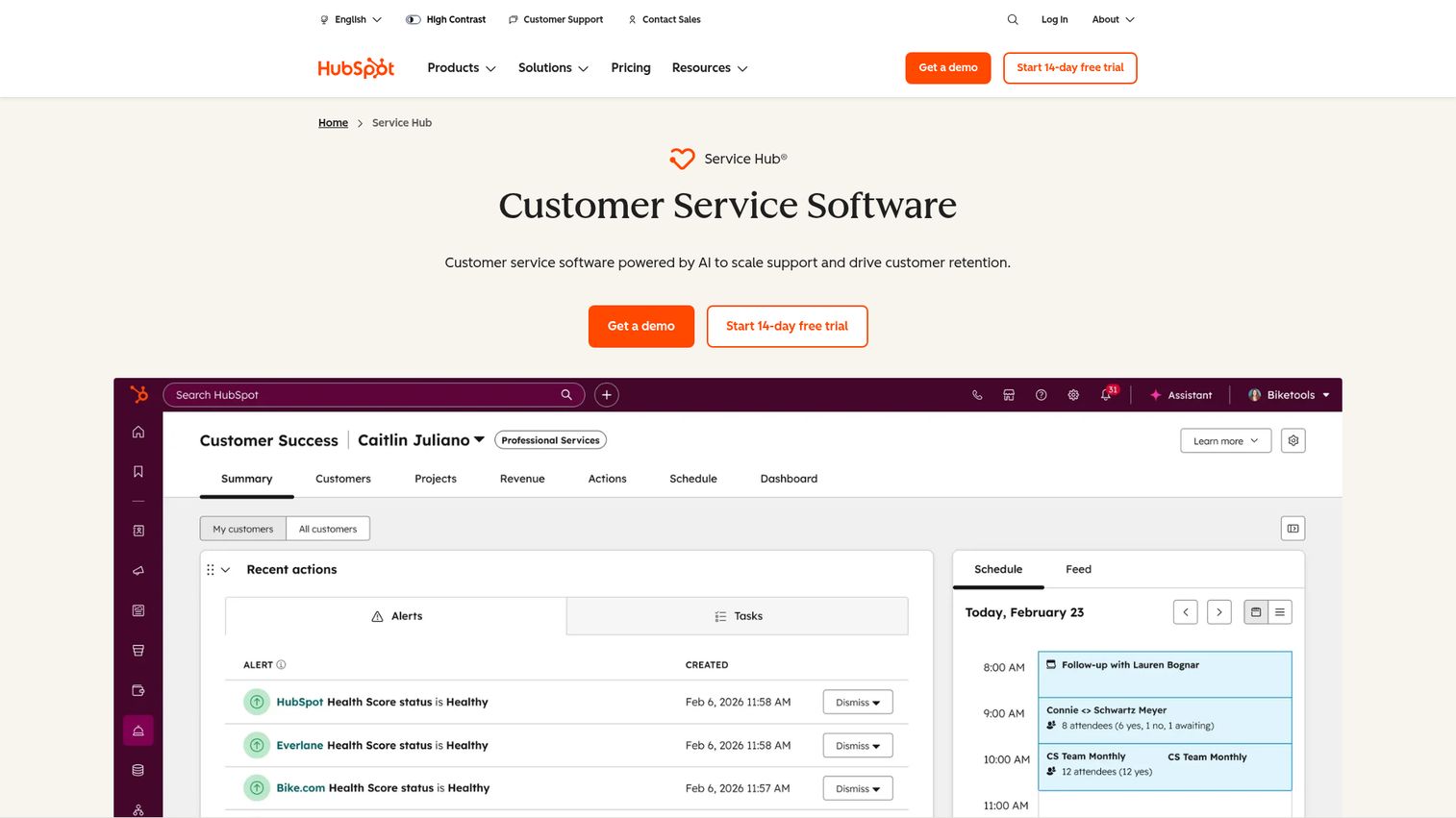
HubSpot Service Hub adds customer service and success capabilities to the HubSpot CRM platform. For teams already using HubSpot for marketing and sales, adding Service Hub means customer data flows across the entire lifecycle without integration headaches.
The integration advantage is the real story here. When your marketing, sales, and CS data all live in one CRM, you get a customer view that standalone CS platforms need multiple integrations to replicate. Customer experience software works best when it has full context, and HubSpot provides that natively for teams in its CRM.
Best for: Teams already on HubSpot CRM that want to add CS capabilities without introducing a new platform.
Key strengths
- Native HubSpot CRM integration across the full lifecycle
- Customer portal and knowledge base included
- Ticketing, feedback surveys, and NPS tracking
- Customer health scoring via custom properties
- Automation workflows for proactive CS motions
Pricing: Free tier available. Paid plans from $15/month.
HubSpot Service Hub is a generalist tool. Dedicated CS platforms like Gainsight or ChurnZero offer deeper health scoring, playbook automation, and CS-specific workflows. But if your entire GTM stack is HubSpot, the integration advantage is real.
12. Freshdesk Customer Success
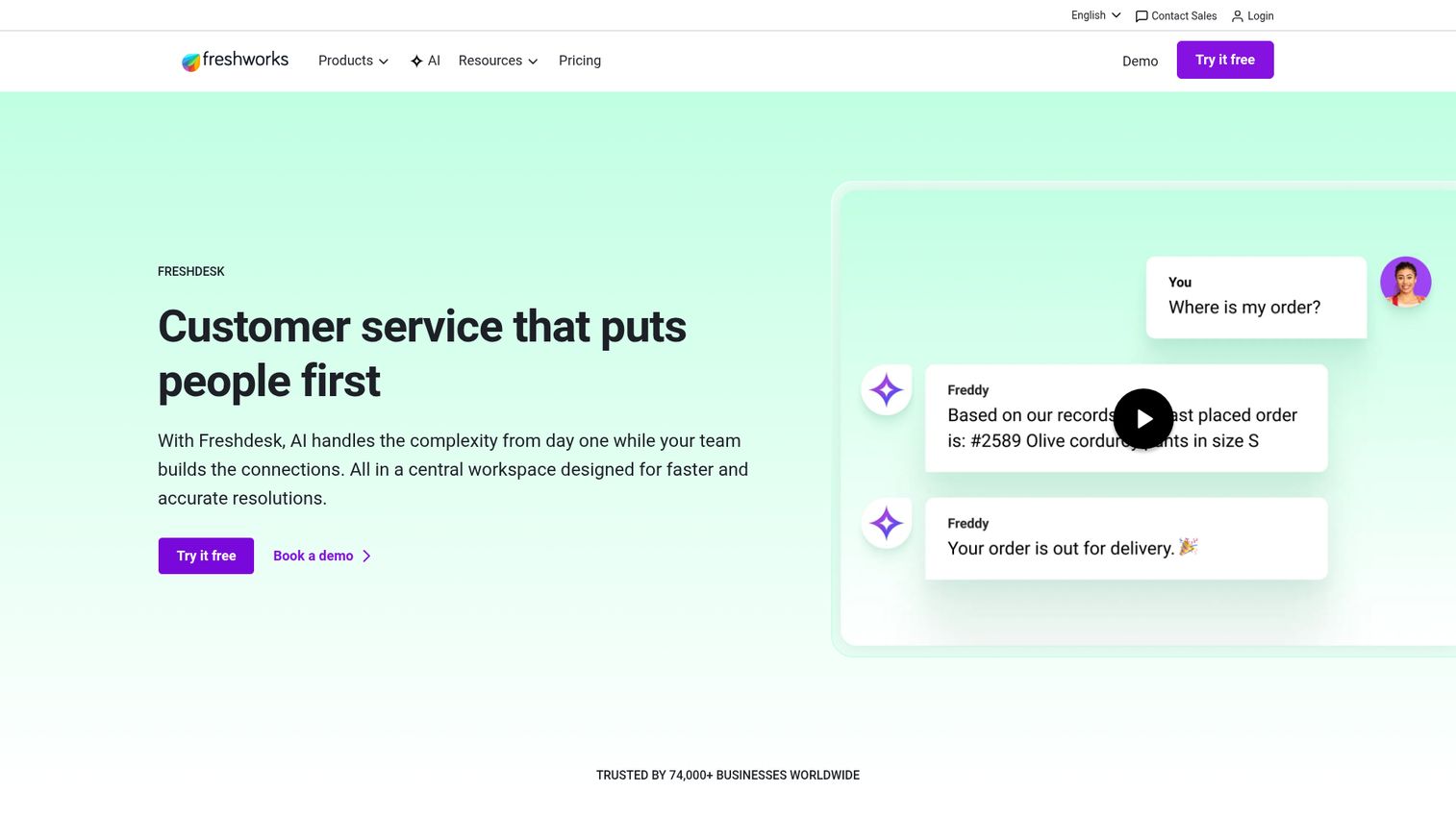
Freshdesk Customer Success is Freshworks' entry into the CS platform category. It provides health scoring, lifecycle management, and proactive alerts as part of the broader Freshworks suite. For teams already using Freshdesk for support or Freshsales for CRM, the unified data flow is the primary draw.
The pricing tends to be more accessible than standalone CS platforms, making it a reasonable option for teams that need basic CS functionality without a major budget commitment.
Best for: Teams already using Freshdesk, Freshsales, or other Freshworks products who want CS capabilities within the same suite.
Key strengths
- Unified Freshworks suite integration across support and CRM
- Customer health scoring with automated alerts
- Lifecycle and workflow automation for CS motions
- Proactive task management and risk flagging
- Revenue analytics tied to customer health data
Pricing: Contact sales. Typically more affordable than standalone CS platforms.
The product has gone through several rebrandings and transitions within Freshworks. Feature depth is lighter than dedicated CS platforms. It's best suited as an add-on for existing Freshworks customers rather than a standalone choice.
13. Staircase AI
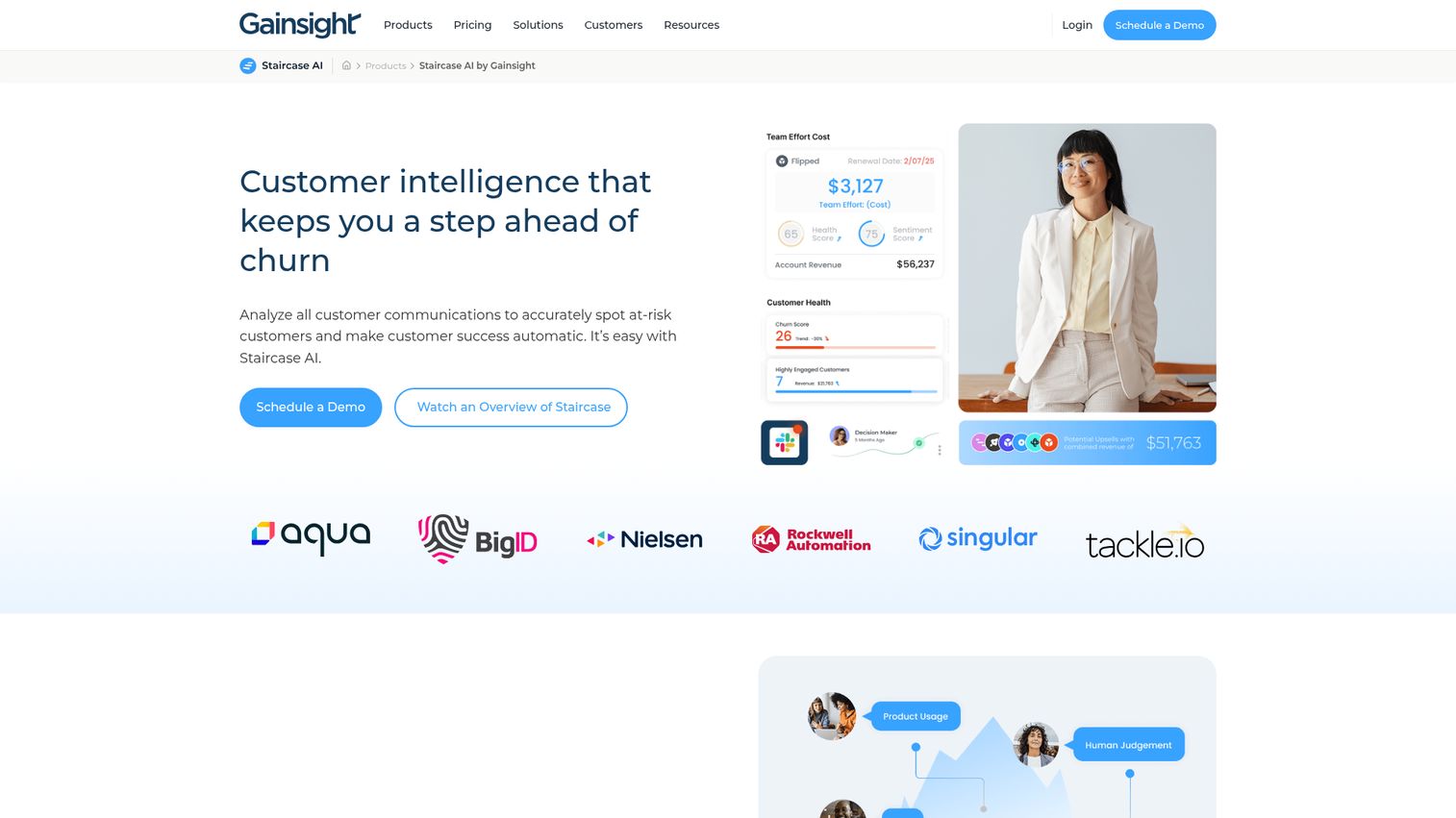
Staircase AI takes a fundamentally different approach to customer health. Instead of relying on product usage data and manual inputs, it analyzes the sentiment and patterns in customer communications (emails, tickets, calls, Slack messages) to detect churn risk and relationship health.
This matters because some of the strongest churn signals aren't in your product analytics. They're in the tone of an email, the frequency of executive engagement, or the shift from enthusiastic responses to one-word replies. Staircase AI reads those signals automatically.
Best for: CS teams that want early churn warning signals based on how customers communicate, not just how they use the product.
Key strengths
- AI sentiment analysis across email, calls, and tickets
- Relationship strength mapping across stakeholders
- Early churn risk detection from communication patterns
- Integration with CRM and existing CS platforms
- Minimal setup with no manual health score configuration
Pricing: Contact sales.
Staircase AI is best used as a layer on top of an existing CS platform, not as a replacement. It excels at the "invisible churn risk" problem but doesn't handle playbooks, onboarding, or lifecycle management.
14. Zendesk
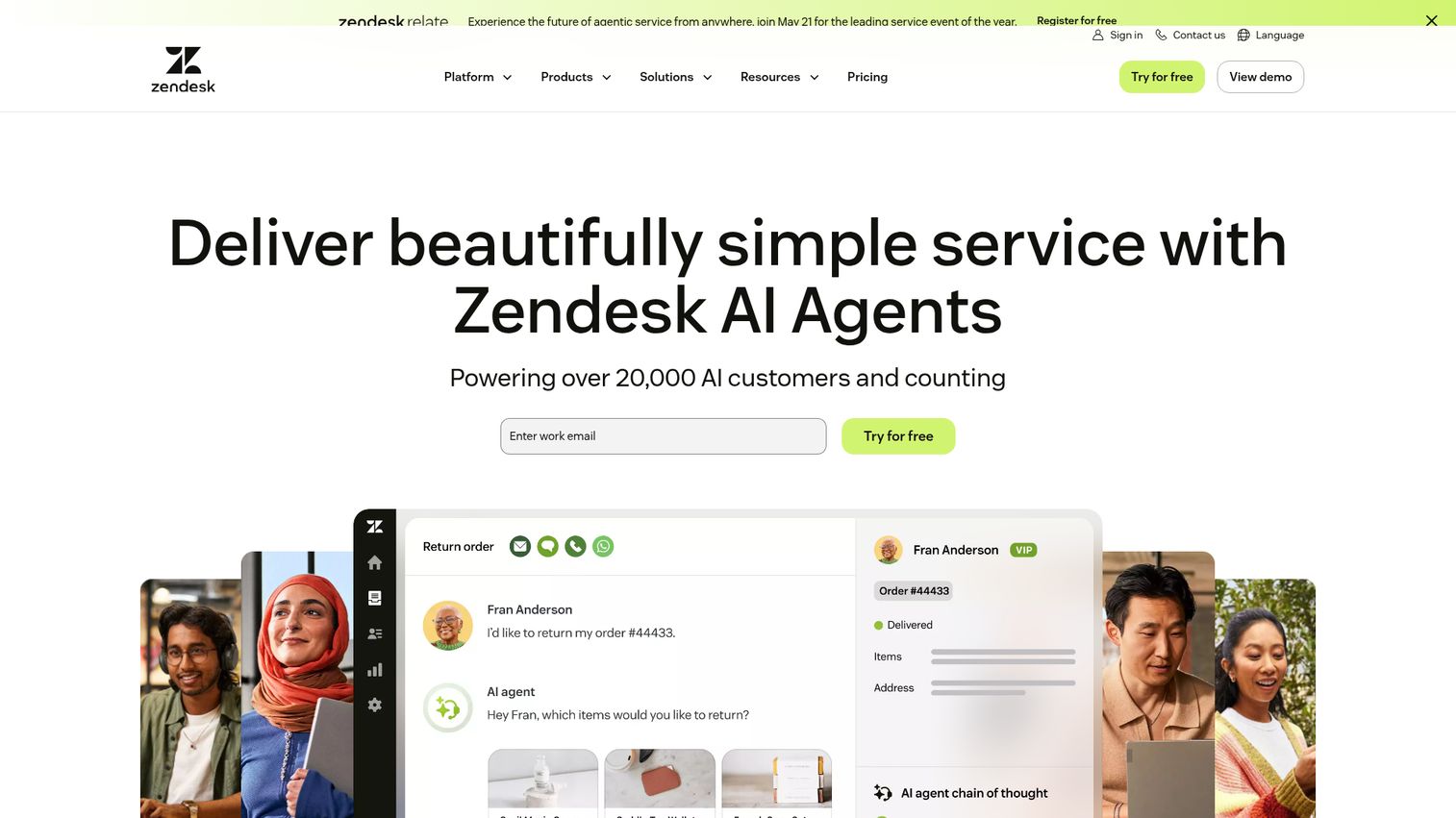
Zendesk is primarily a customer support platform, but its growing suite of proactive engagement tools, customer analytics, and AI capabilities make it relevant for CS teams. This is especially true where support and success are tightly integrated and ticket data is the strongest signal of customer health.
The support infrastructure is where Zendesk's depth shows. If your CS team's primary health signal comes from support ticket patterns (volume, severity, resolution time, repeat issues), Zendesk gives you the richest dataset to work with.
Best for: Large support-heavy organizations that want to layer proactive CS capabilities on top of an existing Zendesk support infrastructure.
Key strengths
- Comprehensive ticketing and support infrastructure
- AI-powered answer bots and content suggestions
- Customer analytics and satisfaction tracking
- Help center and knowledge base with community forums
- Extensive integration marketplace with 1,000+ apps
Pricing: From $55/agent/month.
Zendesk is not a CS platform. It doesn't offer native health scoring, playbook automation, or renewal management. But for organizations where support ticket data is the strongest signal of customer health, Zendesk provides the foundation that a CS platform can build on.
15. Pylon
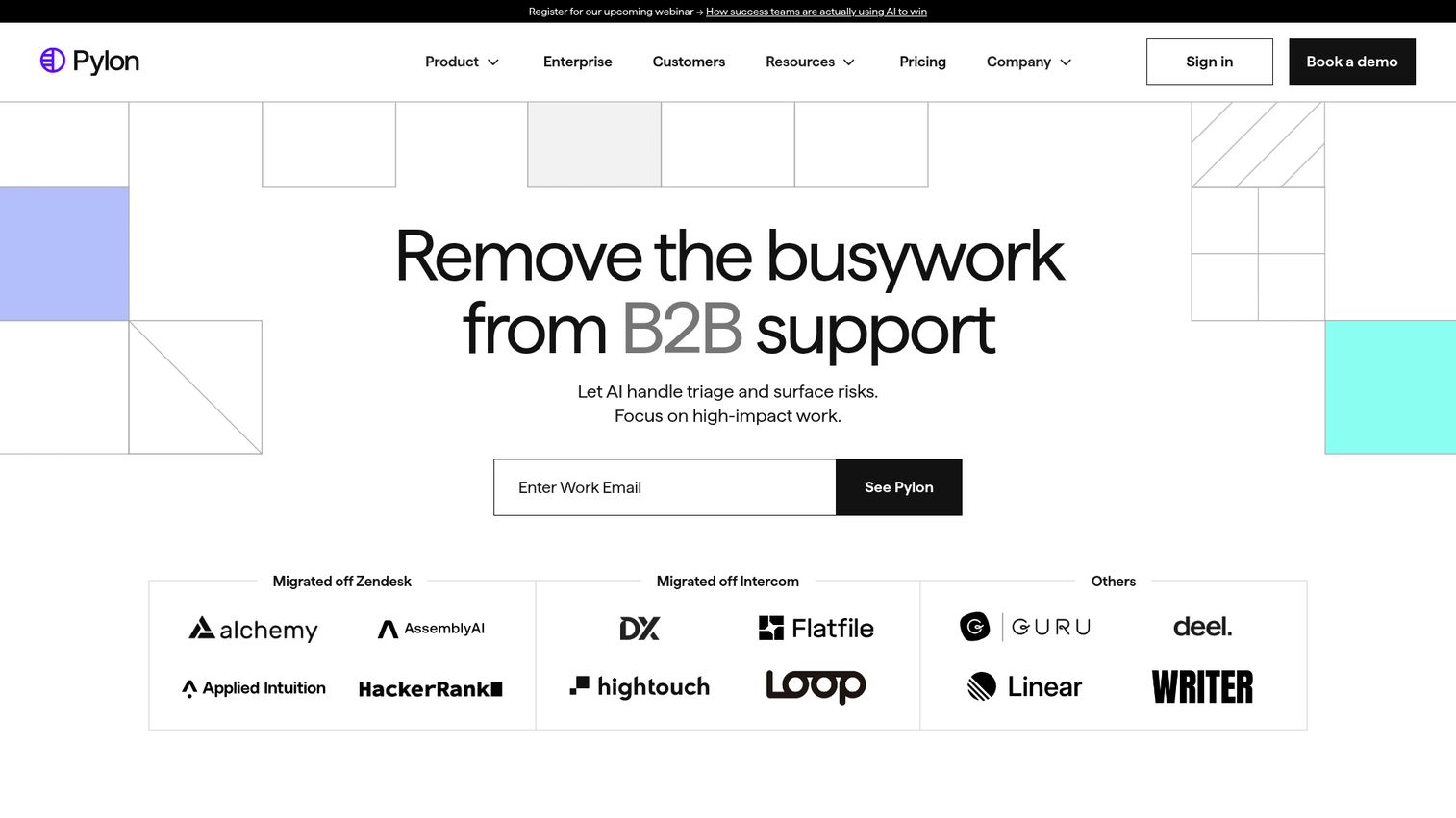
Pylon is built for B2B companies that manage customer relationships inside shared Slack or Microsoft Teams channels. It turns these conversations into structured support workflows with ticketing, SLAs, and analytics, without forcing customers out of the messaging tools they already use.
For companies where Slack channels ARE the customer relationship, Pylon fills a gap nothing else does. The 4.9/5 G2 rating reflects how well it solves this specific problem.
Best for: B2B SaaS companies that use shared Slack or Teams channels for customer communication and need to add structure without changing the customer experience.
Key strengths
- Native Slack and Microsoft Teams integration
- Conversation-to-ticket workflows with SLA tracking
- Customer analytics extracted from messaging data
- Integrations with CRM and CS platforms
- Modern interface with fast setup and low friction
Pricing: Contact sales.
Pylon is niche. It solves a specific problem (Slack/Teams-based customer management) very well. It won't replace Gainsight or ChurnZero. But for companies where shared channels are the primary customer touchpoint, it adds structure that spreadsheets and manual tracking can't match.
How interactive demos improve customer success outcomes
The tools above help you monitor health, predict churn, and automate workflows. But none of them solve the root cause of most CS friction: customers who don't understand the product well enough to succeed with it.
Static documentation goes unread. Live training calls don't scale. Loom videos get watched once and forgotten. The result is repetitive education consuming 30 to 40% of a CSM's week, answering the same "how do I...?" questions across dozens of accounts.
Interactive demos let customers learn by doing. Instead of reading a help article or watching a video, they click through a guided simulation of the actual product workflow. This connects directly to the CS metrics that matter:
- Time-to-value: Interactive onboarding guides get customers to first value faster than static docs
- Ticket volume: Self-serve product education reduces "how do I...?" tickets
- Product adoption: Guided feature walkthroughs drive deeper usage of capabilities customers are paying for
- Scaling: One interactive demo serves 500 accounts the same way a CSM would serve 5
Tools like Guideflow let CS teams capture product flows in a few clicks, then embed interactive guides in onboarding emails, help centers, and QBR materials. Analytics track which steps customers complete and where they drop off, giving CSMs a signal they can act on.
Interactive demos don't replace CS platforms. They complement them by addressing the education and adoption layer that health scores alone can't fix.
Key considerations when choosing customer success software
- Match the tool to your team's maturity. A 3-person CS team doesn't need Gainsight. A 30-person enterprise team will outgrow Custify in a quarter. Start with your current team size and 12-month growth plan.
- Prioritize integration depth over integration count. Every tool claims 100+ integrations. What matters is how deeply it connects to your CRM (Salesforce, HubSpot) and your product analytics (Mixpanel, Amplitude, Segment). Shallow integrations create more work, not less.
- Test the daily workflow, not the demo. CS platforms look great in sales demos. The real test is whether a CSM can complete their daily workflow (check health scores, run playbooks, prep for a call) in under 10 minutes.
- Ask about implementation honestly. "How long does implementation take?" is the wrong question. Ask: "How long until my team is using this daily without help from your team?"
- Calculate the real cost. Sticker price is one number. Add implementation, training, admin time, and the opportunity cost of the 2 to 3 months before the tool delivers value.
- Check the exit strategy. Ask how data export works before you sign. Vendor lock-in is real in CS platforms.
Choosing the right customer success tool for your team
If you're enterprise with CS Ops resources, start with Gainsight or Planhat. If you're mid-market and growing fast, ChurnZero, Vitally, or Custify will cover you. If you're already deep in a CRM, look at Catalyst (Salesforce), HubSpot Service Hub, or Freshdesk Customer Success. If you need AI-driven insights layered on top, Staircase AI or Velaris. And if your biggest gap is customer education and adoption, not health scoring, add interactive demos to whatever platform you choose.
The best CS software is the one your team actually uses daily. Trial before you commit, check integrations before you sign, and remember that no platform fixes a broken onboarding experience on its own.
Start your journey with Guideflow today!
FAQs
Customer success software helps B2B companies monitor customer health, predict churn, automate onboarding and retention workflows, and drive expansion revenue. It differs from support software (reactive ticket handling) and CRM (relationship and pipeline tracking) by focusing on proactive customer outcomes and lifecycle management.
CRM tracks contacts, deals, and pipeline. CS software tracks customer health, product usage, and lifecycle stage. CRM is sales-focused; CS software is retention-focused. Many teams use both: CRM as the system of record, CS platform as the action layer for everything post-sale.
Health scoring, churn prediction, playbook automation, customer journey management, product usage tracking, reporting (NRR, GRR, churn rate), and CRM integration. Prioritize based on your team's biggest gap. If churn is the problem, health scoring matters most. If onboarding is the bottleneck, lifecycle management and task automation matter more. These are the customer success best practices that separate reactive teams from proactive ones.
The range is wide. Free tiers exist (Totango, HubSpot). Mid-market tools run $10,000 to $30,000/year. Enterprise platforms (Gainsight, Planhat) typically start at $30,000/year and scale to $100,000+ depending on seats and modules. Implementation costs and ongoing admin overhead should be factored into the total.
Yes, but choose accordingly. Custify, Totango (free tier), and HubSpot Service Hub are designed for smaller teams. Avoid enterprise platforms that require dedicated CS Ops to configure and maintain. The tool should reduce your workload on day one, not create a new project that takes three months to deliver value.
It depends on the platform. Lightweight tools (Custify, Vitally, ClientSuccess) can be live in 1 to 4 weeks. Enterprise platforms (Gainsight, Planhat) typically take 2 to 6 months for full implementation including data migration, health score configuration, and team training. Ask vendors for median implementation time, not best-case.
Core metrics: Gross Revenue Retention (GRR), Net Revenue Retention (NRR), churn rate (monthly and annual), customer health score distribution, time-to-value for new accounts, NPS/CSAT, and support ticket volume. The best platforms let you build custom dashboards combining these into a single view your leadership team can read without a walkthrough.
Interactive demos address the education and adoption layer that CS platforms don't cover. They let customers learn product workflows by clicking through guided simulations rather than reading documentation or waiting for a training call. CS teams use them for onboarding, feature adoption, and self-serve support. They complement health scoring and playbook tools by reducing the ticket volume and adoption gaps that those tools detect. Guideflow is one option for building these interactive experiences without engineering resources.