You spent $5,000 driving traffic to your landing page last month. 94 out of every 100 visitors left without doing anything.
That's not a traffic problem. That's a conversion problem.
While demand generation tools can bring visitors to your page, converting them requires different tactics.
Most landing pages fail because they ask visitors to imagine how the product works instead of showing them. This guide covers the 12 tactics that separate high converting pages from expensive traffic sinks. It includes how to structure your page, what to test first, and how to measure whether your changes are working.
TL;DR
- A high converting landing page focuses on one goal, one CTA, and one clear value proposition. Remove everything that competes for attention.
- Average landing pages convert 4-6% of visitors, but top performers reach 10%+ by matching message to traffic source and reducing friction.
- Static screenshots and explainer videos underperform compared to interactive demos that let visitors experience your product before committing.
- Form length directly impacts completion rates. Start with name and email only, then collect more information after the initial conversion.
- Test headlines before anything else. Headlines have the highest impact on conversion and take the least effort to change.
What is a good landing page conversion rate
Landing page conversion rate measures the percentage of visitors who complete your desired action. To calculate it, divide the number of conversions by total visitors, then multiply by 100. A page with 1,000 visitors and 50 signups has a 5% conversion rate.
What counts as "good" depends on your industry, traffic source, and what you're asking visitors to do. A free newsletter signup converts differently than a $10,000 software purchase.
How conversion rates vary by industry
Different industries see different benchmarks because the commitment level varies. Ecommerce pages asking for a purchase typically convert lower than lead generation pages asking for an email.
| Industry | Typical conversion range |
|---|---|
| Ecommerce | 2-4% |
| SaaS / B2B | 3-7% |
| Education | 5-12% |
| Finance | 4-8% |
Keep in mind that paid search traffic from high-intent keywords converts better than cold social traffic. The same page can perform very differently depending on where visitors come from.
What separates high converting pages from average ones
Top performers share a few traits. They maintain "conversion scent," which means the landing page delivers exactly what the ad or link promised. When someone clicks an ad about free trials and lands on a pricing page, they bounce.
High converting pages also share common characteristics:
- Single goal: One action you want visitors to take, not three competing options
- Message match: The headline mirrors the ad or link that brought them
- Reduced friction: Fewer form fields, faster load time, clearer next steps
When to benchmark against your own data
Industry averages can mislead you. A 3% conversion rate might be excellent for cold paid social traffic but terrible for warm email traffic from existing customers.
Track your own baseline first. Measure conversion by traffic source, then focus on improving each channel against its own history. A 20% lift from 3% to 3.6% matters more than chasing an arbitrary benchmark.
What makes a high converting landing page
The essential elements work together: a compelling headline, a clear single offer, trust signals, a concise form, and benefit-driven copy. Miss one, and the others work harder to compensate.
Clarity over cleverness in your headline
Your headline answers one question: "What do I get?" Visitors decide within three seconds whether to stay or leave. Clever wordplay often confuses.
Write the outcome in plain language to reach 11.1% median conversion. If your product saves time on reporting, say that. The headline carries more weight than any other element on the page.
Single focused goal and one primary CTA
A CTA (call-to-action) tells visitors what to do next. When you offer multiple CTAs, you split attention. "Sign up," "Learn more," "Contact us," and "Follow us" competing on the same page dilutes focus.
Pick one primary action to reach a 13.5% conversion rate. Remove navigation menus on dedicated landing pages. Every link that isn't your CTA is an exit opportunity.
Friction reduction through form design
Friction is anything that slows or discourages the visitor from completing the action. Every additional form field creates friction.
- Name and email only: Start minimal, ask for more later
- Smart defaults: Pre-fill where possible
- Progress indicators: Show how close they are to finishing
You can collect company size, job title, and phone number after the initial conversion. The first goal is getting them through the door.
Trust signals that build credibility
Trust signals include testimonials, customer logos, security badges, and reviews. Place them near decision points, especially close to the CTA and form.
- Customer logos: Recognizable brands carry weight
- Testimonials: Specific outcomes beat vague praise ("Saved us 10 hours per week" vs. "Great product")
- Security badges: Payment trust and data privacy indicators
Message match from ad to page
Visitors who click an ad expect the landing page to deliver exactly what was promised. If your ad says "Free 14-day trial," your headline better mention the free trial.
Mismatch causes immediate bounces. The headline and hero image should echo the ad creative and copy.
Optimal landing page structure and layout
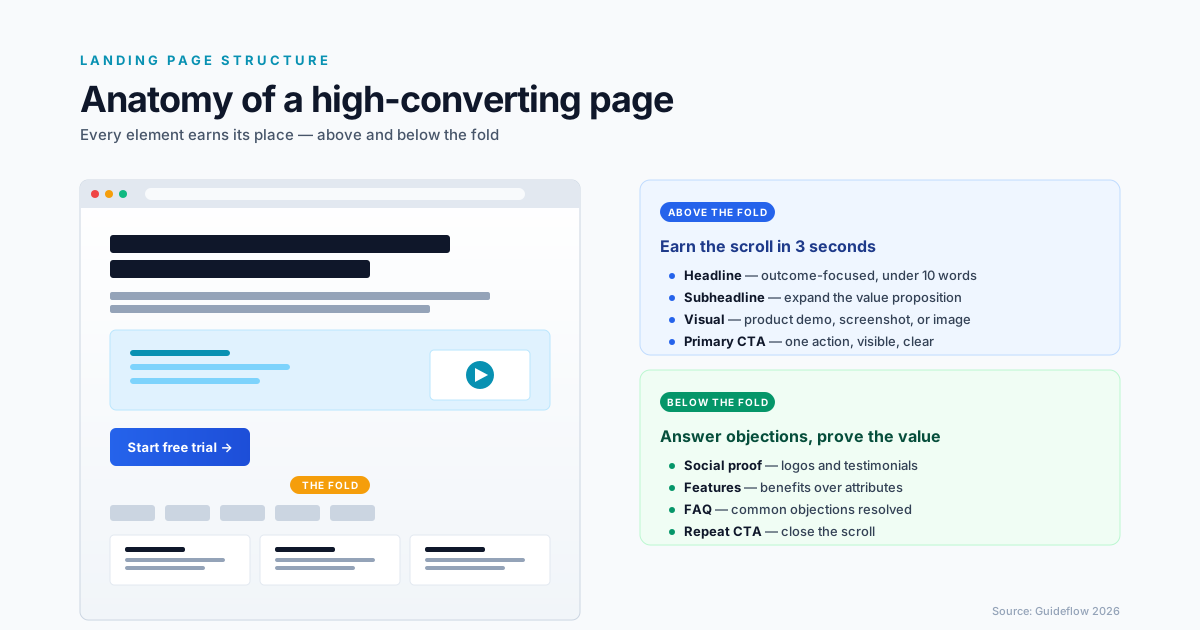
Structure guides visitors from curiosity to action. A clear layout reduces cognitive load and keeps attention focused.
Above the fold essentials
"Above the fold" means visible without scrolling. This is prime real estate.
- Headline: Outcome-focused, under 10 words
- Subheadline: Expand on the value proposition
- CTA button: Visible, action-oriented text
- Visual: Product screenshot, demo, or relevant image
Everything above the fold earns the scroll. If visitors don't understand the value immediately, they leave.
Supporting content below the fold
Content below the fold answers objections and provides proof for visitors who need more before converting. Include features, benefits, social proof, and FAQ sections.
Not everyone converts on the first screen. Some visitors want to see how the product works, read testimonials, or understand pricing before they commit.
Visual hierarchy and directional cues
Visual hierarchy guides the eye through design. Whitespace, contrast, and directional cues (arrows, eye gaze, color) direct attention toward the CTA.
Cluttered pages overwhelm. When everything competes for attention, nothing wins.
How to create a landing page that converts
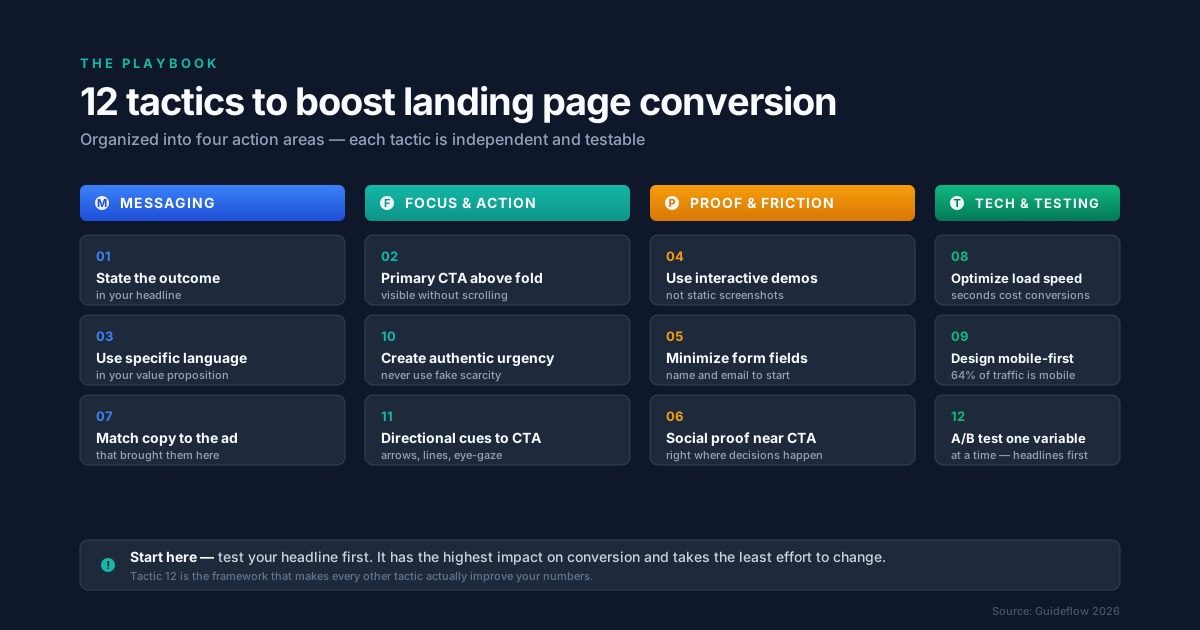
The following twelve tactics address the specific reasons landing page conversion fails. Each one is actionable and distinct.
1. Write headlines that state the outcome
Use the formula: [Desired outcome] + [Timeframe or ease]. The headline makes the benefit immediately obvious.
Avoid vague claims. "Better marketing" means nothing. "Generate 50% more leads in 30 days" means something.
2. Place your primary CTA above the fold
Visitors shouldn't scroll to find the action. Repeat the CTA lower on the page for visitors who want more information first, but the first CTA appears before any scrolling.
3. Use specific language in your value proposition
Avoid "better," "faster," and "easier." Use concrete descriptions of what the visitor gets.
Specificity builds credibility. "Reduce reporting time by 4 hours per week" beats "Save time on reports."
4. Add interactive product demos instead of static screenshots
Static images require imagination. Visitors see a screenshot and wonder, "But how does it actually work?"
Interactive demos let visitors experience the product before committing. This reduces the perceived risk of signing up or buying.
Tools like Guideflow let you embed a clickable product walkthrough directly on your landing page, so visitors can explore before they convert. Get started now.
5. Reduce form fields to the minimum required
Every additional field creates friction. Ask only for what you need to deliver the next step.
You can collect more information later in the relationship. The first goal is conversion, not data collection.
6. Include social proof near decision points
Place testimonials, logos, and reviews close to the CTA. Visitors are most skeptical at the moment of action.
Proof at that moment reduces hesitation. A testimonial next to the signup button works harder than one buried at the bottom.
7. Match your landing page copy to your ad
Reinforce message match throughout. If your ad says "Free trial," your landing page headline says "Start your free trial."
Consistency builds trust and reduces bounce. For even better results, consider how interactive demos in your ad campaigns can boost conversions from the first touchpoint.
8. Optimize page load speed
Slow pages cause abandonment before the content even loads. Compress images and minimize scripts.
A few seconds of delay can cost you 7% of conversions.
Speed is a conversion factor.
9. Design for mobile first
More than half of traffic comes from mobile devices. Mobile-first design means starting with the smallest screen, not adapting desktop.
CTA buttons need to be thumb-friendly. Text needs to be readable without zooming.
10. Create urgency without false scarcity
Urgency works when it's authentic. Event deadlines, cohort starts, and limited-time offers perform well.
Fake countdown timers that reset destroy trust. Visitors notice, and they remember.
11. Use directional cues to guide attention
Arrows, lines, and images of people looking toward the CTA draw the eye. Subtle but effective.
The human gaze naturally follows where others look. Use that to your advantage.
12. Test one variable at a time
A/B testing compares two versions of a page to see which performs better. Change multiple elements at once, and you won't know what worked.
Start with the headline, then CTA, then form. Test the highest-impact elements first.
Common landing page conversion mistakes to avoid
Knowing what fails helps you diagnose existing pages.
Sending paid traffic to your homepage
Homepages serve multiple audiences with multiple goals. They have navigation, competing CTAs, and no single focus.
Dedicated landing pages convert better because they match the specific promise of your ad.
Competing CTAs that dilute focus
Multiple CTAs (sign up, learn more, contact us, follow on social) split attention. Pick one primary action per page.
Generic headlines that could belong to any competitor
If your headline would work on a competitor's page, it's not specific enough. Differentiation starts with the headline.
Hiding the product behind a mandatory form
Gating everything behind a form increases friction. Let visitors see value before asking for information.
Interactive demos and ungated content build trust first. The form comes after they understand what they're getting.
Ignoring mobile page performance
Testing only on desktop misses 64.35% of website traffic. Mobile-specific issues (tiny buttons, slow load, unreadable text) kill conversions.
How to measure landing page conversion rate
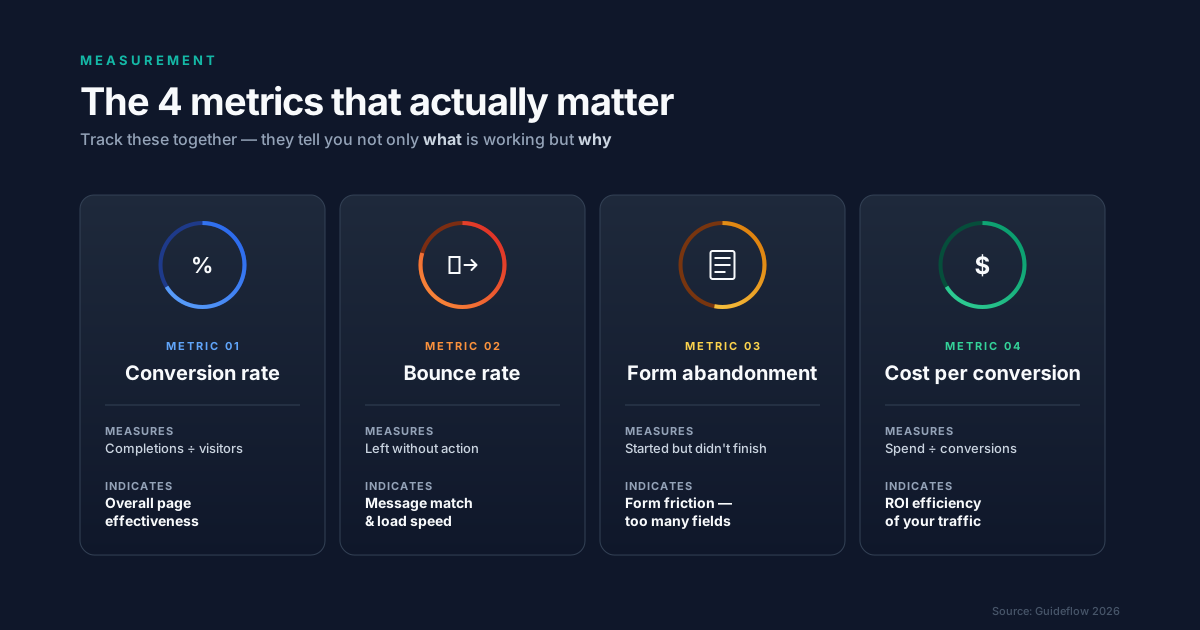
Tracking landing page conversion data tells you if your changes are working.
Conversion rate by traffic source
Paid, organic, email, and social traffic convert at different rates. Segment your data.
A blended number can hide problems or wins. A 5% overall rate might mask 2% from paid and 12% from email.
Bounce rate and exit rate
Bounce rate measures visitors who left without interacting. High bounce on a landing page signals message mismatch or slow load.
Exit rate measures visitors who left from a specific page but may have interacted elsewhere first.
Form abandonment rate
Form abandonment tracks visitors who started the form but didn't finish. High abandonment suggests too many fields or confusing form design.
| Metric | What it measures | What it indicates |
|---|---|---|
| Conversion rate | Completions / visitors | Overall page effectiveness |
| Bounce rate | Left without action | Message match, load speed |
| Form abandonment | Started but didn’t finish | Form friction |
| Cost per conversion | Spend / conversions | ROI efficiency |
Best practices for landing page conversion optimization
The following habits maintain and improve landing page conversion rates over time.
Keep copy scannable with short paragraphs
Most visitors scan, not read. Use short paragraphs (1-3 sentences), bullet points, and bold key phrases.
Walls of text reduce conversions.
Use white space to direct attention
White space (empty areas) is not wasted space. It creates focus and reduces cognitive load.
Crowded pages feel overwhelming.
Test headlines before anything else
Headlines have the highest impact on conversion. Test headline variations first before testing images, button colors, or form length.
Update landing pages when your product changes
Stale screenshots and outdated copy erode trust. When the product evolves, update the landing page to match.
Interactive demos stay current automatically when connected to the live product, reducing maintenance overhead.
Build landing pages that convert starting today
The core principle is simple: show, don't tell. Static content requires imagination. Interactive experiences let visitors prove value to themselves.
Audit one existing page using the checklist from this article to improve landing page conversion. Identify the single highest-friction element and fix it first.
Replace your static screenshots with an interactive demo that lets visitors experience your product before they convert. Get started now.
FAQs about landing page conversion
Divide the number of visitors who completed the desired action by the total number of visitors, then multiply by 100 to get a percentage.
Ecommerce landing pages typically convert at a lower rate than lead generation pages. They ask for a purchase, which is a higher commitment than an email signup.
Length depends on the complexity of the offer and the awareness level of the visitor. Simple offers work with short pages, while high-commitment decisions require more information.
Landing pages for paid traffic often don't need SEO optimization, but organic landing pages benefit from keyword-rich headlines, meta descriptions, and fast load times.
Update landing pages whenever your product, offer, or messaging changes. Review performance data monthly to identify pages that need optimization.
A homepage serves multiple audiences and goals with navigation to other pages. A landing page focuses on a single goal with minimal distractions.
A landing page works best with one primary CTA repeated in multiple locations. Adding competing CTAs splits attention and typically reduces overall conversions.