
You launched a 360 cycle. Three weeks later, half the raters still haven't responded. The reports that did come back read like template fillers. Nobody built a development plan from them.
If that sounds familiar, you are not alone. Most 360 programs stall not because of bad questions, but because of low participation and weak follow-through. The tool you pick either fixes that or quietly makes it worse.
Feedback frequency is tied directly to engagement. Among employees who get feedback and recognition from their manager at least once a week, 61% are highly engaged, according to Gallup and Workhuman research on feedback frequency. The gap is stark: 43% of highly engaged employees receive feedback at least once per week, compared to just 18% of disengaged employees, per a 2026 Borderless roundup of employee feedback data.
Adoption of multi-rater feedback is no longer niche. 85% of Fortune 500 companies have integrated 360-degree feedback into their leadership development programs, according to Market.us 360-degree feedback adoption data. The category is growing too. The 360-degree feedback software market is projected to reach USD 1.35 billion in 2026, up from USD 1.23 billion in 2025, per Mordor Intelligence 360-degree feedback market forecast.
So the question is not whether to run 360s. It is which 360 feedback software actually drives participation, protects anonymity, and turns raw responses into growth. That is what this guide is built to answer.
What's inside
This guide is for HR leaders, People Ops managers, L&D managers, and team leads who own feedback cycles. It compares 12 genuine 360 feedback tools, not generic survey platforms wearing a 360 badge.
We evaluated each tool on four criteria that decide whether a program works:
- Anonymity and confidentiality controls: rater-group thresholds that keep feedback honest.
- Ease of administration and participation: setup, reminders, and completion rates.
- Analytics and reporting depth: competency dashboards, sentiment, and trend tracking.
- Integration with your HR stack: HRIS, LMS, and Slack or Teams.
Pricing and G2 ratings were verified against live sources at the time of writing.
TL;DR
Short on time? Here are the decision shortcuts:
- Best for enterprise people teams wanting engagement plus development: Culture Amp.
- Best for unifying reviews, goals, and 360s: Lattice.
- Best dedicated, no-nonsense 360 tool: Spidergap.
- Best for continuous performance plus manager coaching: 15Five.
- Best for deeply customizable 360 assessments: EchoSpan.
- Best low-barrier start for first-time 360 programs: SurveyMonkey.
If you only pilot one this quarter, start with a dedicated tool like Spidergap or an all-in-one like Lattice, depending on whether you want focus or consolidation.
What is 360 feedback software?
360 feedback software is a platform that collects multi-rater feedback on an employee from managers, peers, direct reports, and self-assessment, then aggregates it into development-focused reports.
Unlike a one-directional appraisal, a 360 degree feedback software platform gathers input from multiple perspectives at once. The goal is a fuller, less biased picture of how someone shows up at work, mapped against competency framework best practices you define.
Most 360 review software shares a common core feature set:
- Multi-rater workflows: full 360 and lighter 180 configurations across rater groups.
- Anonymous feedback collection: rater-group thresholds that protect confidentiality so feedback stays candid.
- Customizable questionnaires: competencies, rating scales, and open-ended questions tailored to roles.
- Automated reminders and participation tracking: nudges that lift completion rates without manual chasing.
- Analytics and dashboards: competency scoring, gap analysis, and sentiment or qualitative analysis of comments.
- Integrations: HRIS, LMS, CRM, Slack, and Teams to avoid yet another disconnected system.
The strongest 360 assessment tools go beyond collection. They turn responses into a structured development plan, so a cycle ends with action rather than a PDF nobody opens. That distinction separates a real 360 feedback platform from a generic 360 survey tool.
Vocabulary varies by buyer. Some teams call it 360 evaluation software, others 360 appraisal software or a 360 degree evaluation system. The underlying job is the same: collect multi-source input, protect anonymity, and produce reports that drive growth. When you see 360 survey software, 360 assessment software, or 360 degree review software in vendor marketing, they are describing the same category with different framing.
360 feedback vs. traditional performance reviews
People confuse the two constantly. They solve different problems.
A traditional review is usually a manager evaluating a direct report against goals and ratings. It is evaluative, top-down, and often tied to compensation. 360 feedback is multi-rater, development-focused, and frequently anonymous. It answers "how does this person work with others" rather than "did they hit their number," an approach supported by research on multi-rater feedback bias.
The two are complementary, not interchangeable. Many teams run 360 feedback ahead of a formal review to surface blind spots, then use the review for accountability and decisions.
Here is the core distinction:
| Dimension | Traditional review | 360 feedback |
|---|---|---|
| Feedback source | Manager only | Manager, peers, direct reports, self |
| Primary purpose | Evaluation and rating | Development and self-awareness |
| Anonymity | Rarely anonymous | Often anonymous by rater group |
| Tied to pay | Frequently | Usually not |
| Cadence | Annual or biannual | Cycle-based or continuous |
Using 360 performance review software well means pairing both. The 360 informs growth; the review handles decisions. Treating a 360 as a stealth performance rating is the fastest way to kill rater honesty.
When to use 360 feedback software
Not every team needs a 360 program. These three situations are where it earns its cost.
Run development-focused feedback cycles at scale
360s shine when growth is the goal. You want managers and individual contributors to understand how peers and reports actually experience them, then act on it. A good 360 review software platform standardizes the questions, collects multi-source input, and routes results into a development plan. The output is the science of self-awareness at work that drives behavior change, not just a score.
Standardize feedback across many teams
When feedback quality varies wildly by manager, a 360 platform creates consistency. Every team runs the same competencies, scales, and anonymity rules. That removes the manual admin of building surveys per department and stops feedback from drifting into vague praise. For people teams scaling across dozens of groups, this consistency is the difference between a repeatable program and a one-off scramble.
Surface blind spots before performance reviews
Pairing 360 feedback with review cycles works well. Run the 360 first to expose patterns a manager alone would miss, then bring that context into the formal review. 360 performance review software that connects both flows saves you from manual data wrangling. The blind spots surface early, the employee has time to reflect, and the review becomes a conversation grounded in multiple perspectives rather than one opinion. Many people teams pair structured rollout with interactive user onboarding software to ensure every rater knows how to navigate the cycle.
Comparison table
The list below covers 12 genuine 360 feedback tools, ranked by relevance to a development-focused multi-rater program. Some are dedicated 360 platforms; others bundle 360 feedback into a broader performance suite. Pricing and G2 ratings were verified at the time of writing. Use this table to shortlist, then read the full sections for fit.
| # | Product | Intent | Key use case | Pricing | G2 rating |
|---|---|---|---|---|---|
| 1 | Culture Amp | Enterprise engagement + performance | Development plus engagement in one platform | Custom, billed annually | 4.5/5 |
| 2 | Lattice | Performance management suite | Reviews, goals, and 360s unified | From $4 seat/month | 4.7/5 |
| 3 | Leapsome | All-in-one people enablement | 360s plus learning and engagement | Custom (modular) | 4.8/5 |
| 4 | Spidergap | Dedicated 360 feedback | No-nonsense, customizable 360s | From $1,099/year | 4.8/5 |
| 5 | 15Five | Continuous performance | Manager coaching plus 360s | From $4/user/month | 4.6/5 |
| 6 | PerformYard | Configurable performance mgmt | Flexible reviews with hands-on support | From $5-10/person/month | 4.7/5 |
| 7 | Primalogik | Focused, budget-friendly 360 | SMB 360 plus performance | Quote-based | 4.7/5 |
| 8 | EchoSpan | Deeply customizable 360 assessments | Granular, white-label 360s | Quote-based | Not listed |
| 9 | SurveySparrow | Conversational 360 surveys | Engaging survey-style feedback | Free plan available | 4.4/5 |
| 10 | Qualtrics Employee Experience | Enterprise analytics | Sophisticated analytics at scale | Request pricing | 4.4/5 |
| 11 | Synergita | Performance plus recognition | Mid-market 360 plus OKRs | From $2/user/month | 4.6/5 |
| 12 | SurveyMonkey | Accessible survey platform | Low-barrier first 360 program | Free plan available | 4.4/5 |
The 12 best 360 feedback software tools for 2026
1. Culture Amp
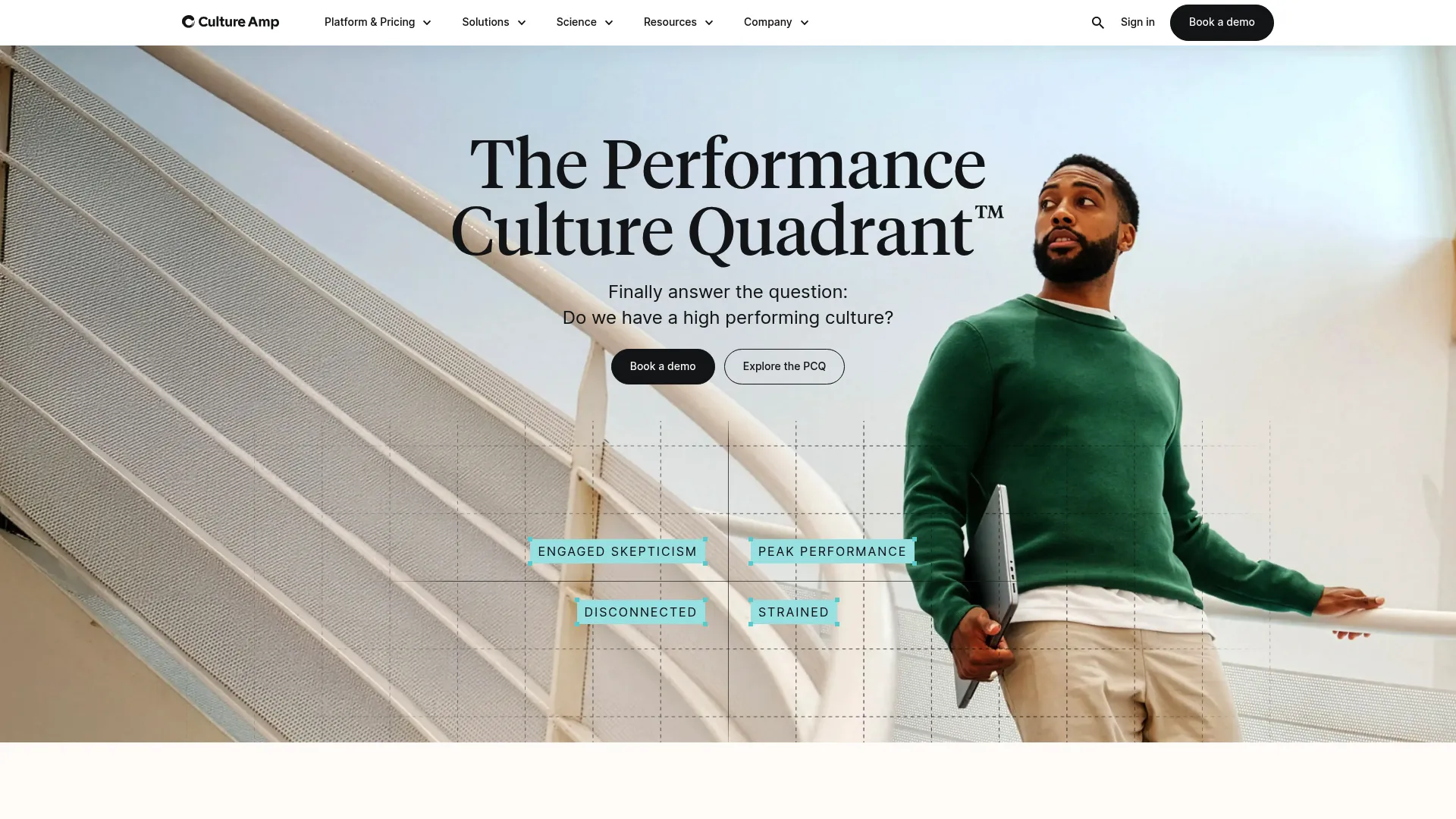
Culture Amp is an employee experience platform that combines engagement, performance management, and development in one place. Its 360 feedback sits inside a broader system, so multi-rater input connects to engagement data and growth plans rather than living in isolation. For people teams that want one platform instead of three, it is a strong anchor.
Best for: Mid-market and enterprise people teams that want development and engagement together.
Key strengths
- Performance management with 360s: goal and OKR tracking, continuous feedback, self reflections, and calibrations alongside 360 reviews.
- Engagement surveys with science-backed templates: 40-plus templates, benchmarks, text analytics, and AI comment summaries.
- Employee development tooling: career paths, growth goals, competency libraries, and personalized development plans.
Why choose Culture Amp: Choose it when engagement and development matter as much as the 360 itself. The trade-off is that a dedicated 360 tool may offer faster, more granular questionnaire control. But if you want feedback to feed directly into growth plans and engagement trends, the integrated approach is hard to beat.
Culture Amp pricing: Culture Amp lists Engage, Perform, and Develop plans, with Develop offered as an add-on to Engage or Perform. Pricing depends on employee count, product chosen, and service tier, and all products are billed annually. The pricing page uses request-a-quote pricing rather than public figures. Culture Amp holds a 4.5/5 rating on G2.
2. Lattice
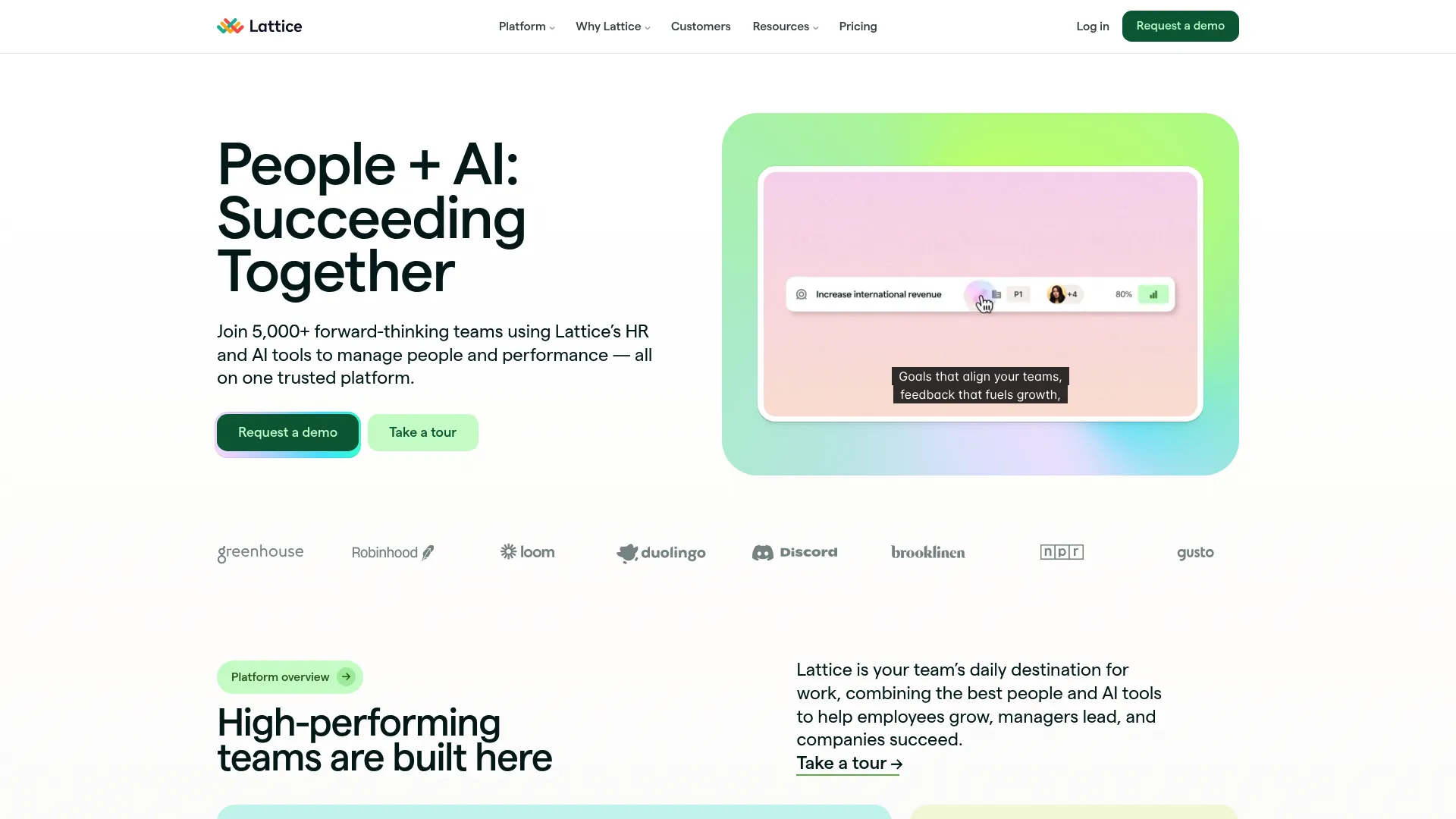
Lattice is an HR and AI platform that unifies performance, goals, engagement, and development. Its 360 reviews sit alongside OKRs, 1-on-1s, and growth plans, so feedback connects to the rest of the performance picture. Teams tired of stitching tools together gravitate to it for that consolidation.
Best for: Companies that want reviews, 360s, and goals in one connected platform.
Key strengths
- Performance reviews and talent reviews: succession planning, promotions, PIPs, calibration, and 360 review templates.
- Goals and OKRs: cascading goals, progress updates, reminders, plus Salesforce and Jira integrations.
- Engagement surveys: pulse, onboarding, and exit surveys with action planning, eNPS, and AI analysis.
Why choose Lattice: Pick Lattice when you want 360 feedback embedded in a full performance system rather than a standalone tool. The trade-off is that you are buying a suite, so it suits teams ready to manage performance broadly, not just run a 360. For unified reviews plus goals plus feedback, it is one of the cleanest options.
Lattice pricing: Lattice starts at $4 per seat per month for Engagement, with Performance and Goals & OKRs at $8 per seat per month each, all billed annually. The Foundations bundle is $11 per seat per month. There is no free tier, billing is USD only, and a $4,000 minimum annual agreement applies. Lattice holds a 4.7/5 rating on G2.
3. Leapsome
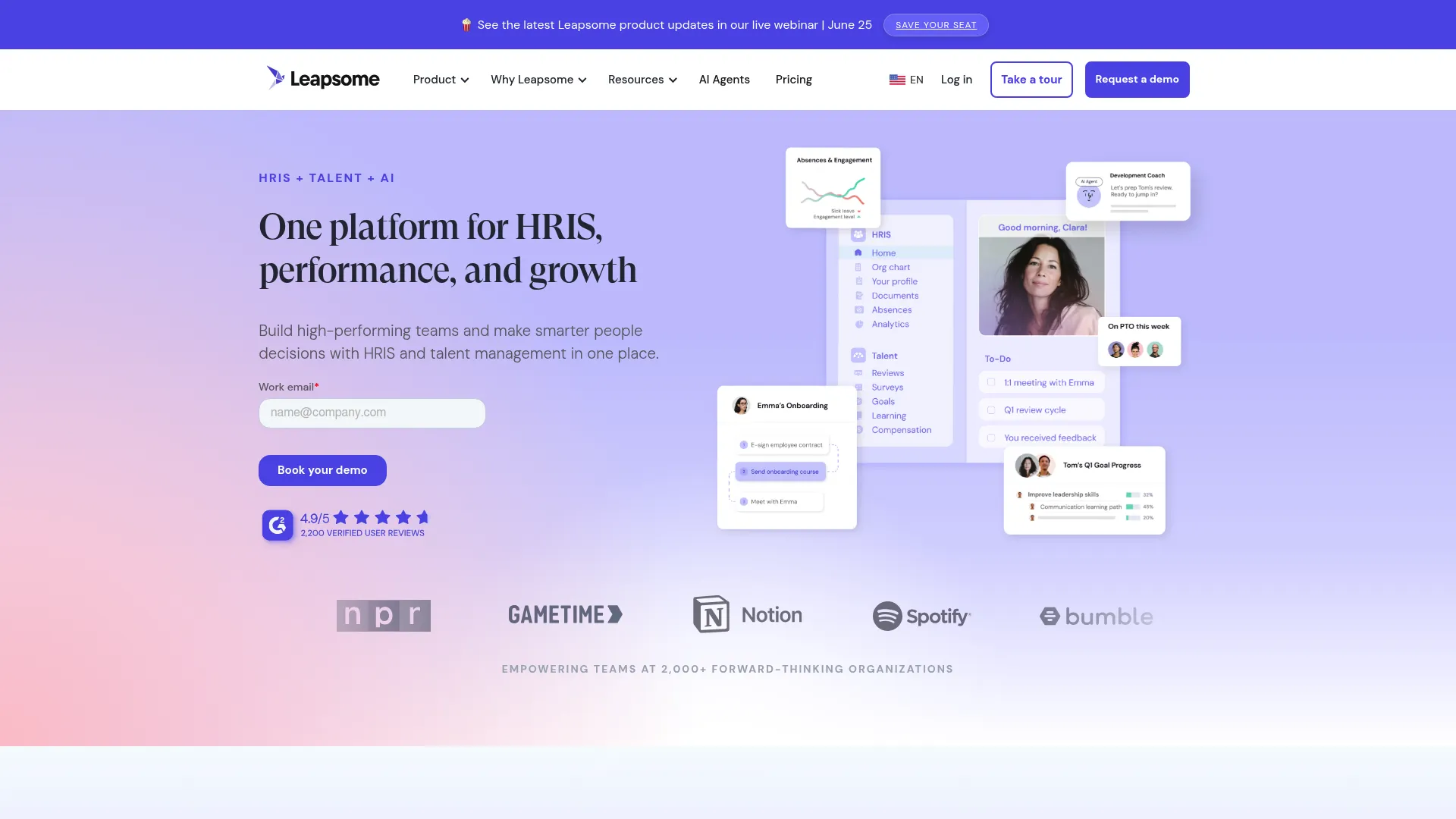
Leapsome is a modular HR platform covering HRIS, performance, engagement, learning, and compensation. Its 360 feedback pairs with learning and engagement modules, so feedback can trigger development rather than ending at a report. The modular model lets you buy only what you need.
Best for: Growing companies that want an all-in-one people enablement platform.
Key strengths
- Performance reviews with automation: best-practice questions, review automations, cross-cycle analytics, calibration, and external reviewer support.
- Engagement surveys: science-backed question libraries, action plans, benchmarking, and DEI analytics.
- HRIS plus learning: centralized employee data, onboarding, and learning paths that tie feedback to growth.
Why choose Leapsome: Choose Leapsome when you want flexibility to combine modules as you scale. The trade-off is that pricing is quote-based and modular, so cost depends on what you assemble. For teams that want learning and engagement wrapped around their 360s, the all-in-one design fits well.
Leapsome pricing: Leapsome modules can be purchased individually or combined, with multi-module discounts available. Pricing depends on employee count, contract length, and modules chosen, and requires a quote. A 14-day free trial is available. Leapsome holds a 4.8/5 rating on G2, among the highest in this list.
4. Spidergap
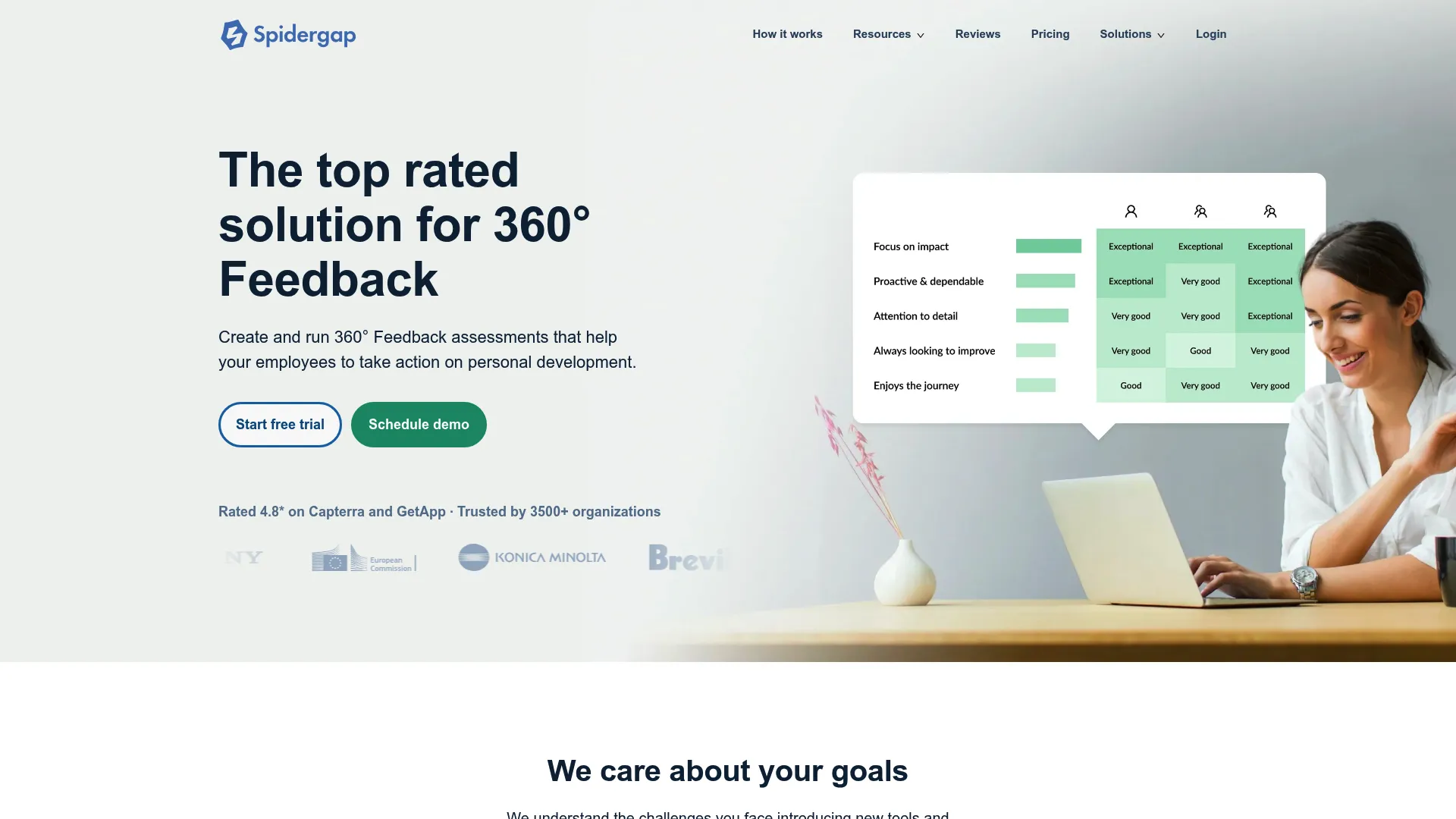
Spidergap is dedicated 360 feedback software built around personal development. It does one thing and does it thoroughly: highly customizable questionnaires and clear, employee-friendly reports. When you want a focused 360 tool rather than a full HR suite, Spidergap is the obvious candidate.
Best for: Teams that want a dedicated, no-nonsense 360 assessment tool.
Key strengths
- Fully customizable questionnaires: build competencies and questions that match your roles exactly.
- Employee-friendly feedback reports: clear, development-focused output people actually read and act on.
- Anonymized feedback collection: confidentiality controls that keep rater input candid.
Why choose Spidergap: Choose Spidergap when 360 feedback is the job and you do not need an HRIS or engagement suite bolted on. Its flat-rate pricing and development focus make it predictable and easy to defend internally. The trade-off is that you will pair it with other tools for goals or engagement, since it stays in its lane by design.
Spidergap pricing: Spidergap starts at $1,099 per year for the Starter plan, which includes 10 feedback recipients, with additional recipients at $89 per year. The Pro plan is $2,199 per year and adds self-enrollment, SSO, and report controls. Enterprise pricing is custom. There is no ongoing free tier, but a free trial assessment is available. Spidergap holds a 4.8/5 rating on Capterra.
5. 15Five
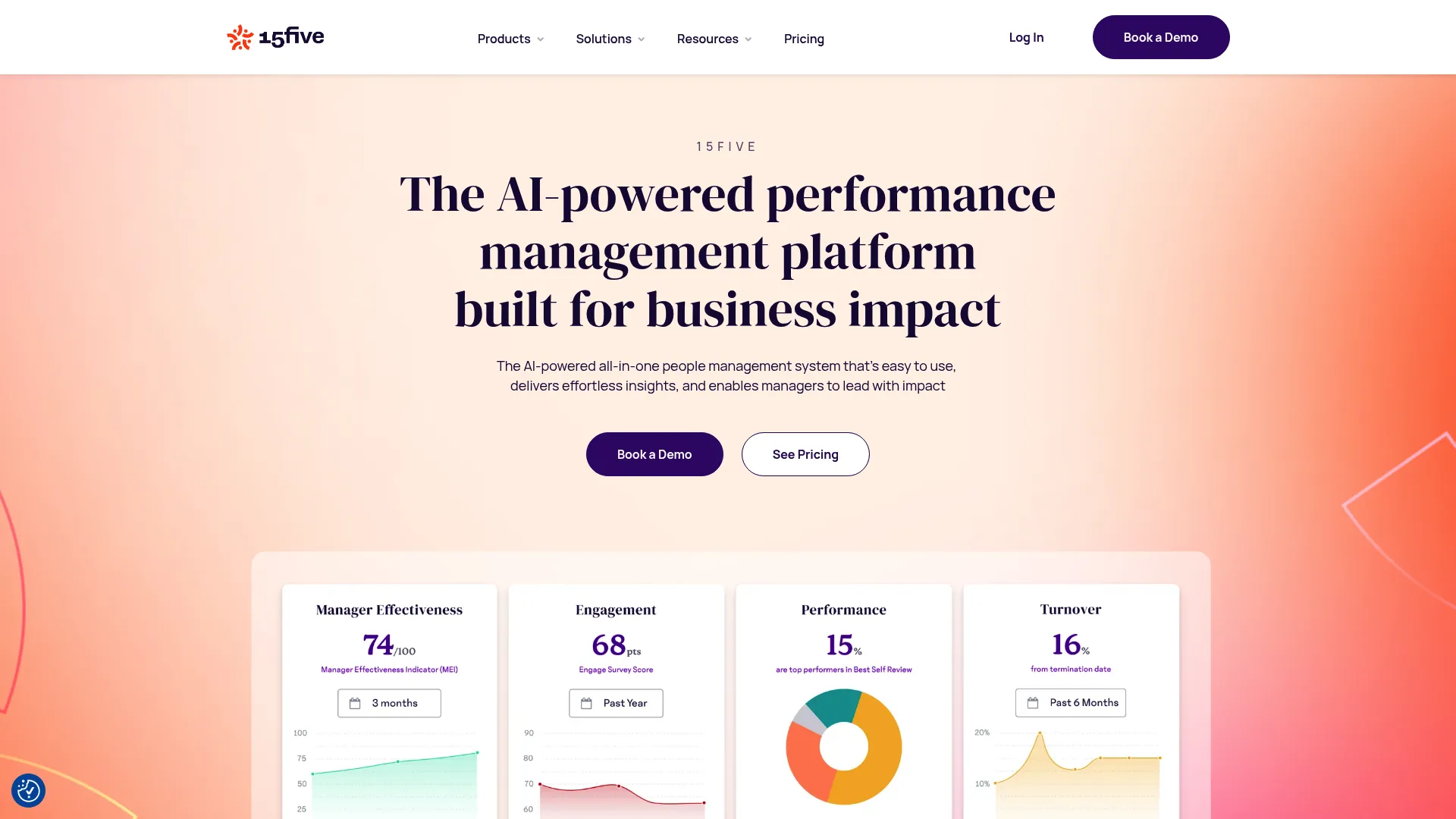
15Five is a performance management and engagement platform focused on manager effectiveness. Its 360 feedback sits inside a continuous performance model with check-ins, 1-on-1s, and coaching. Teams that believe better managers drive better outcomes find it a natural fit. You can also explore an interactive 15Five demo to see the workflow before committing.
Best for: Teams prioritizing continuous performance and manager coaching.
Key strengths
- AI-assisted performance reviews and 360 feedback: structured multi-rater input alongside OKRs and goal management.
- Engagement surveys and eNPS: targeted assessments, action planning, heat maps, and benchmarking.
- Manager enablement: 1-on-1 agendas, check-ins, talent matrix, and career development tools.
Why choose 15Five: Choose 15Five when manager coaching and continuous feedback matter as much as the annual 360. It bundles engagement, reviews, and development with a strong manager-enablement layer. The trade-off is that 360 feedback is one feature in a broader platform, so a dedicated tool may offer deeper questionnaire customization.
15Five pricing: 15Five starts at $4 per user per month for Engage, billed annually. The Perform tier is $11 per user per month and adds AI-assisted reviews, OKRs, 360 feedback, and career paths. The Total Platform tier is $16 per user per month and adds manager training microlearnings. 15Five holds a 4.6/5 rating on G2.
6. PerformYard
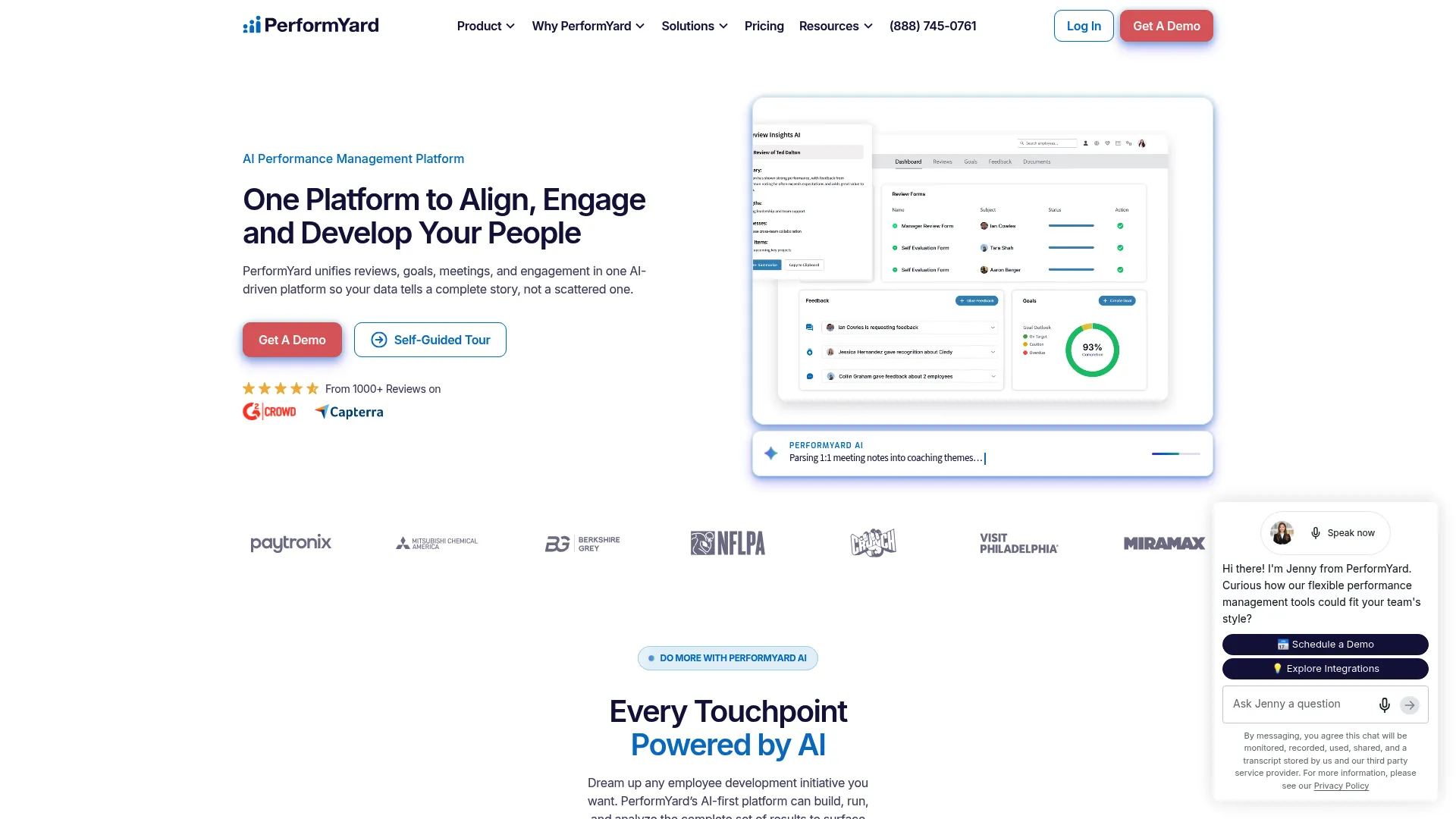
PerformYard is an AI-driven performance management platform built around flexibility. It handles reviews, goals, feedback, and 360 peer reviews, with a reputation for hands-on customer support. Teams that want configurable cycles plus a real human to help set them up tend to choose it.
Best for: Companies wanting configurable performance and 360 feedback with strong support.
Key strengths
- Performance reviews and check-ins: customizable forms, automated notifications, sign-off workflows, and 360 peer reviews.
- Goal management and reporting: continuous feedback plus reporting and analytics including the 9-box talent grid model.
- Integrations and security: HRIS, Slack, Microsoft Teams, SSO, SAML, and IP whitelisting.
Why choose PerformYard: Choose PerformYard when you want to configure review and 360 cycles your way and value dedicated support during setup. Onboarding, training, and a dedicated success manager are included. The trade-off is that maximum flexibility means more configuration decisions upfront, which the included support helps you navigate.
PerformYard pricing: PerformYard's Performance Management plan runs $5 to $10 per person per month, billed annually, with minimum pricing and enterprise discounts. Add-ons include PerformYard AI, Employee Engagement, Meetings, and Surveys at additional per-person rates. Onboarding, HRIS integrations, and SSO are included. PerformYard holds a 4.7/5 rating on G2.
7. Primalogik
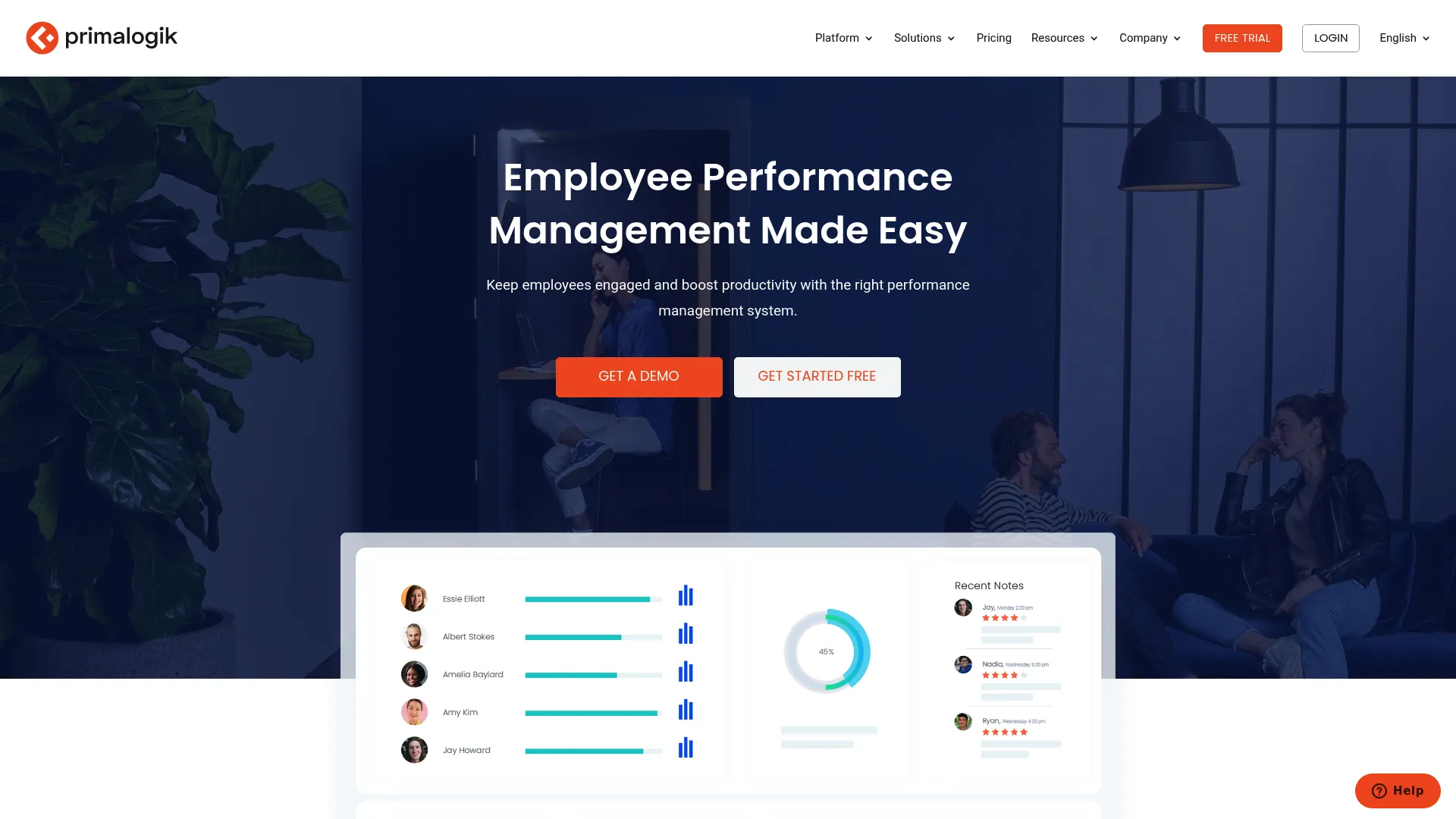
Primalogik is an employee performance management platform with a strong, dedicated 360 feedback module. It combines 360s, reviews, goals, and surveys in a focused, affordable package. For smaller teams that want a real 360 platform without enterprise overhead, it hits the mark.
Best for: SMBs wanting a focused, budget-friendly 360 platform.
Key strengths
- 360-degree feedback with anonymity controls: multi-rater input designed to keep responses candid.
- Performance reviews and goals: reviews, goals, and OKRs in one place with real-time feedback.
- Surveys and people analytics: employee surveys plus reporting that surfaces trends.
Why choose Primalogik: Choose Primalogik when you want dedicated 360 and performance features at a price that suits a smaller organization. It balances focus and breadth without forcing you into a full enterprise suite. The trade-off is that very large enterprises with complex analytics needs may eventually want a heavier platform.
Primalogik pricing: Primalogik lists Feedback and Performance plans with a 25-user minimum bundle and monthly or annual billing. Annual subscriptions include two months free, and a 30-day free trial is available. The pricing page uses request-pricing rather than public figures. Primalogik holds a 4.7/5 rating on G2.
8. EchoSpan
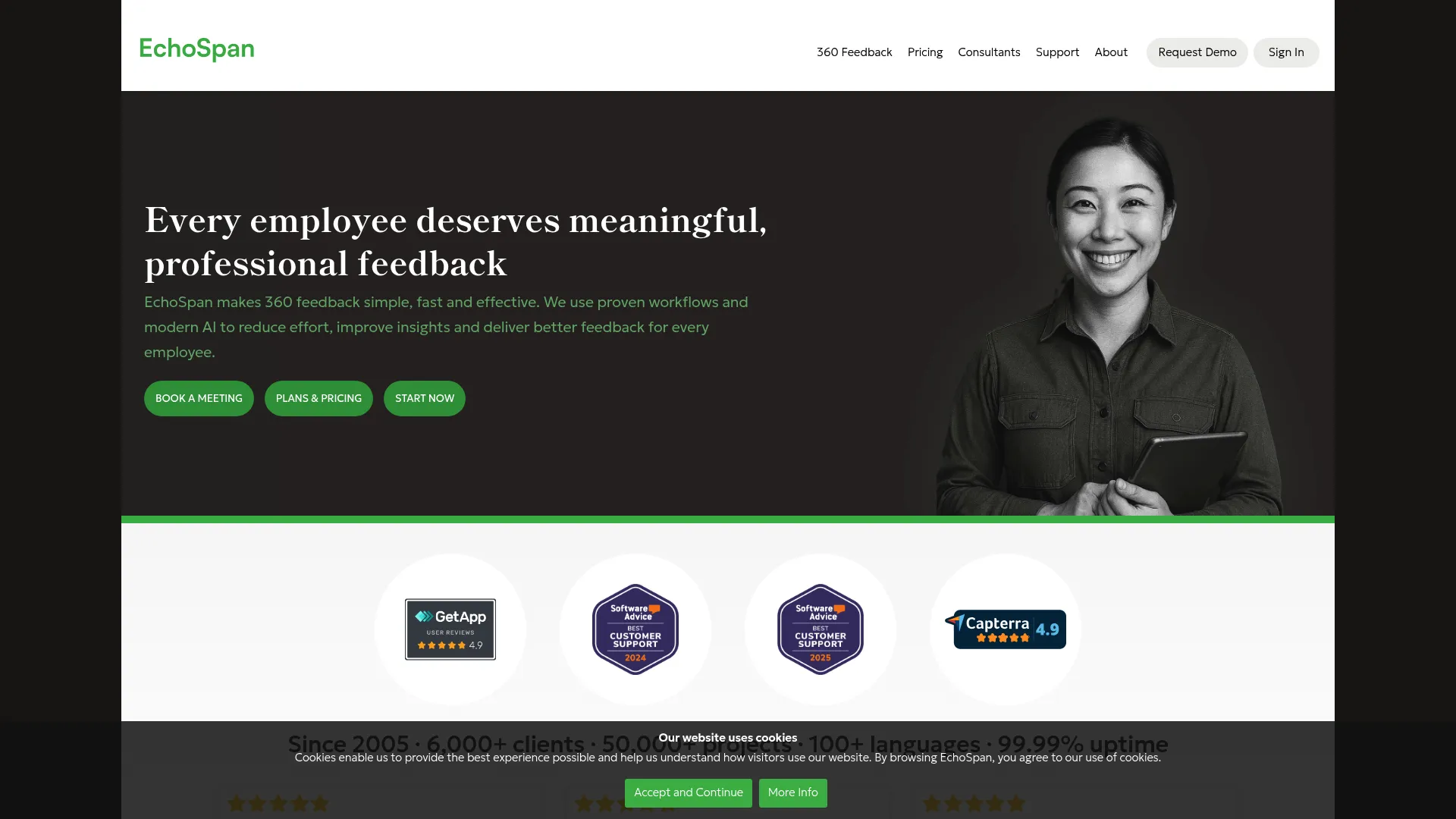
EchoSpan is web-based 360 assessment software built for deep customization. It lets you assemble surveys from your own questions or its competency library, then white-label the experience. HR teams, consultants, and coaches who need granular control over every cycle detail reach for it.
Best for: HR teams and consultants needing granular, customizable 360 assessment software.
Key strengths
- Customizable 360 surveys: build from your own questions or the EchoSpan competency library.
- Automated scheduling: Project Autopilot handles scheduling and reminders to drive completion.
- Flexible reporting and white-label: customizable PDF reports, group reporting, development planning, and data exports.
Why choose EchoSpan: Choose EchoSpan when you run complex, repeatable 360 programs and need control over competencies, branding, and reporting. Consultants who deliver 360s to clients especially value the white-label and configuration depth. The trade-off is that all that flexibility means more setup, which suits teams that want precision over simplicity.
EchoSpan pricing: EchoSpan lists three plans: 360 Essentials, 360 Professional, and 360 Professional Plus, priced by feedback recipient count and selected features. Add-ons include the Insights Toolkit, multi-language surveys, and support tiers. A free 360 tool and a 14-day free trial are available. EchoSpan Flexible 360 holds a 4.9/5 rating on Capterra.
9. SurveySparrow
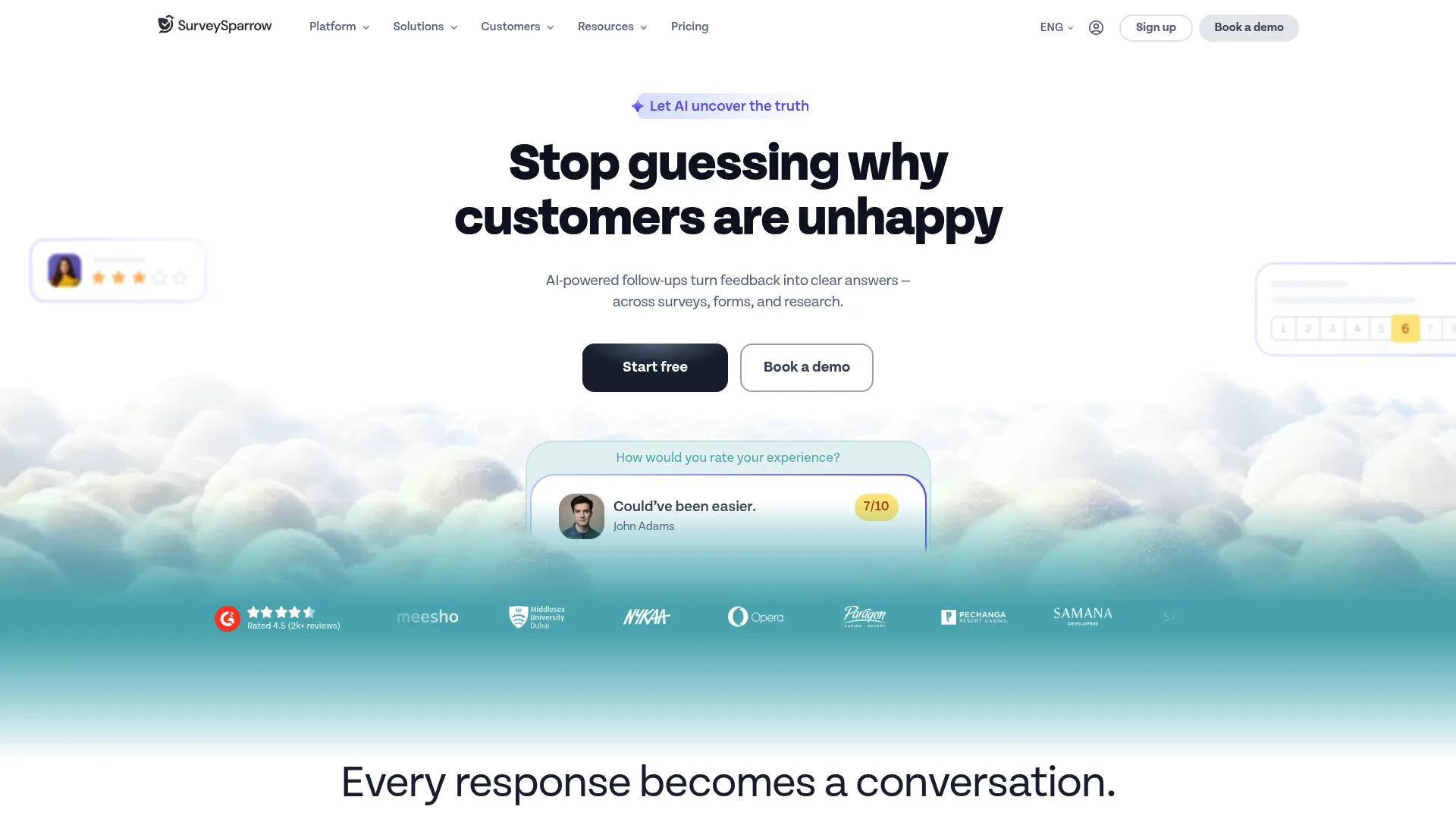
SurveySparrow is an AI-powered feedback platform known for conversational, engaging surveys. Its 360 feedback module brings the same chat-style experience to multi-rater reviews, which can lift completion rates. Teams that struggle with survey fatigue often see better participation here. Preview the tool through this SurveySparrow interactive demo to gauge fit.
Best for: Teams wanting engaging, survey-style 360 feedback.
Key strengths
- Conversational 360 surveys: chat-style formats plus NPS, offline, and 360 feedback surveys.
- Omnichannel collection: email, web links, embeds, QR codes, Slack, and kiosk or offline mode.
- Real-time reporting: dashboards, filters, cross-tabulation, scheduled reports, and exports.
Why choose SurveySparrow: Choose SurveySparrow when survey experience and response rates are your main concern. The conversational format reduces fatigue and can pull more raters through to completion. The trade-off is that it is a broader feedback platform, so dedicated 360 tools may offer deeper competency frameworks and development planning.
SurveySparrow pricing: SurveySparrow offers a forever-free plan plus Basic, Starter, Business, and Enterprise tiers, billed yearly. Paid plans add higher response limits and capabilities, with Enterprise priced on request. SurveySparrow holds a 4.4/5 rating on G2.
10. Qualtrics Employee Experience
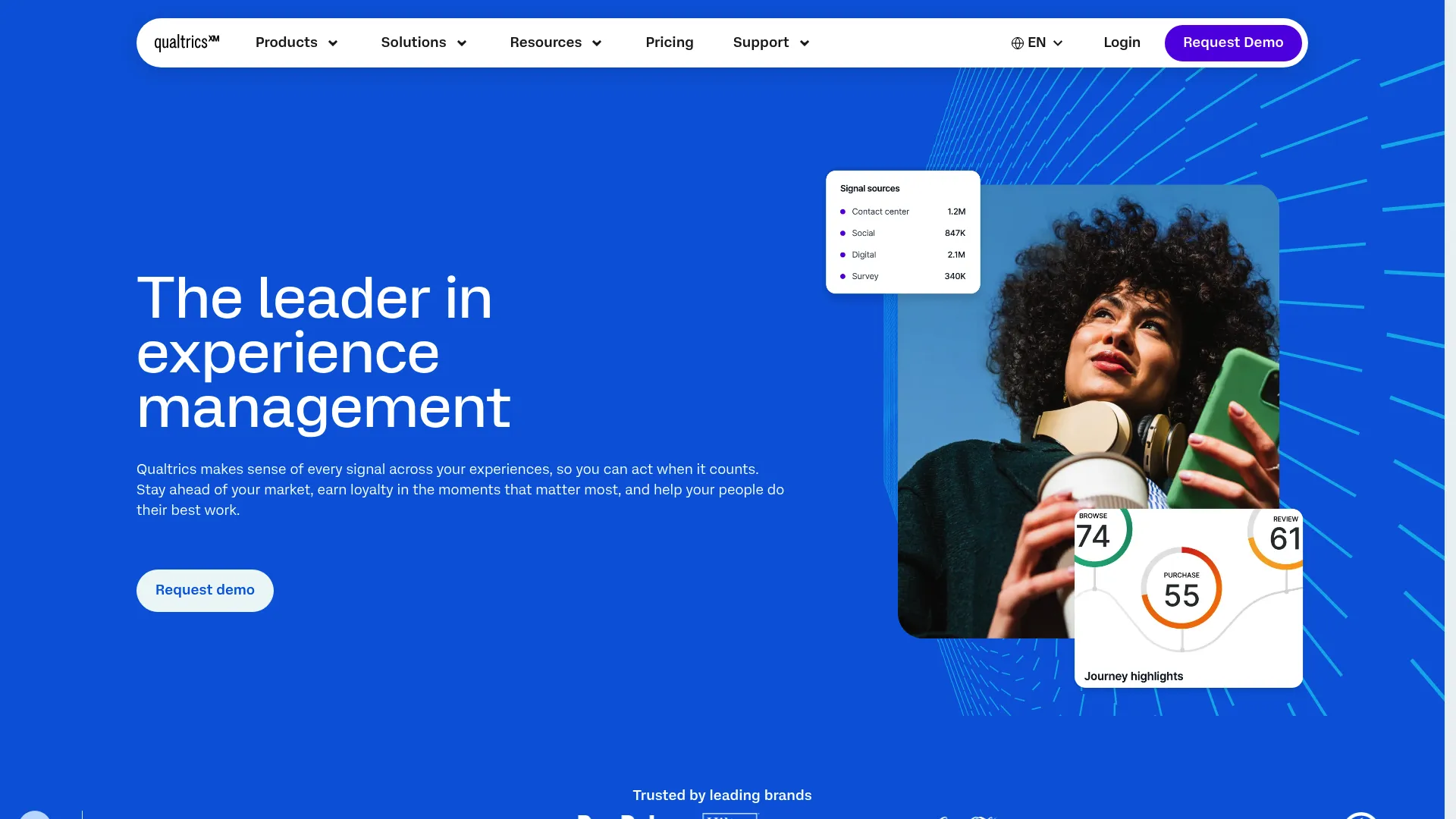
Qualtrics Employee Experience is enterprise employee experience software for collecting workforce feedback at scale. Its 360 development feedback sits alongside engagement, pulse, and lifecycle programs, backed by advanced analytics. Large enterprises with sophisticated analytics needs are its core audience.
Best for: Large enterprises with advanced analytics requirements.
Key strengths
- 360 development feedback: multi-rater feedback inside a wider employee experience program.
- Engagement and pulse surveys: continuous listening across the employee lifecycle.
- Lifecycle management: onboarding, exit, and milestone feedback with enterprise analytics.
Why choose Qualtrics Employee Experience: Choose Qualtrics when you need enterprise-grade analytics, AI, and customization across many feedback programs, not just 360s. It scales to complex global organizations. The trade-off is that smaller teams may find it more platform than they need, and pricing is enterprise-oriented.
Qualtrics Employee Experience pricing: Qualtrics lists XM for Employee Experience with suite pricing available on request, plus People Engage and People Lifecycle packages priced by employee count. No public numeric pricing is displayed. Qualtrics Employee Experience holds a 4.4/5 rating on G2.
11. Synergita
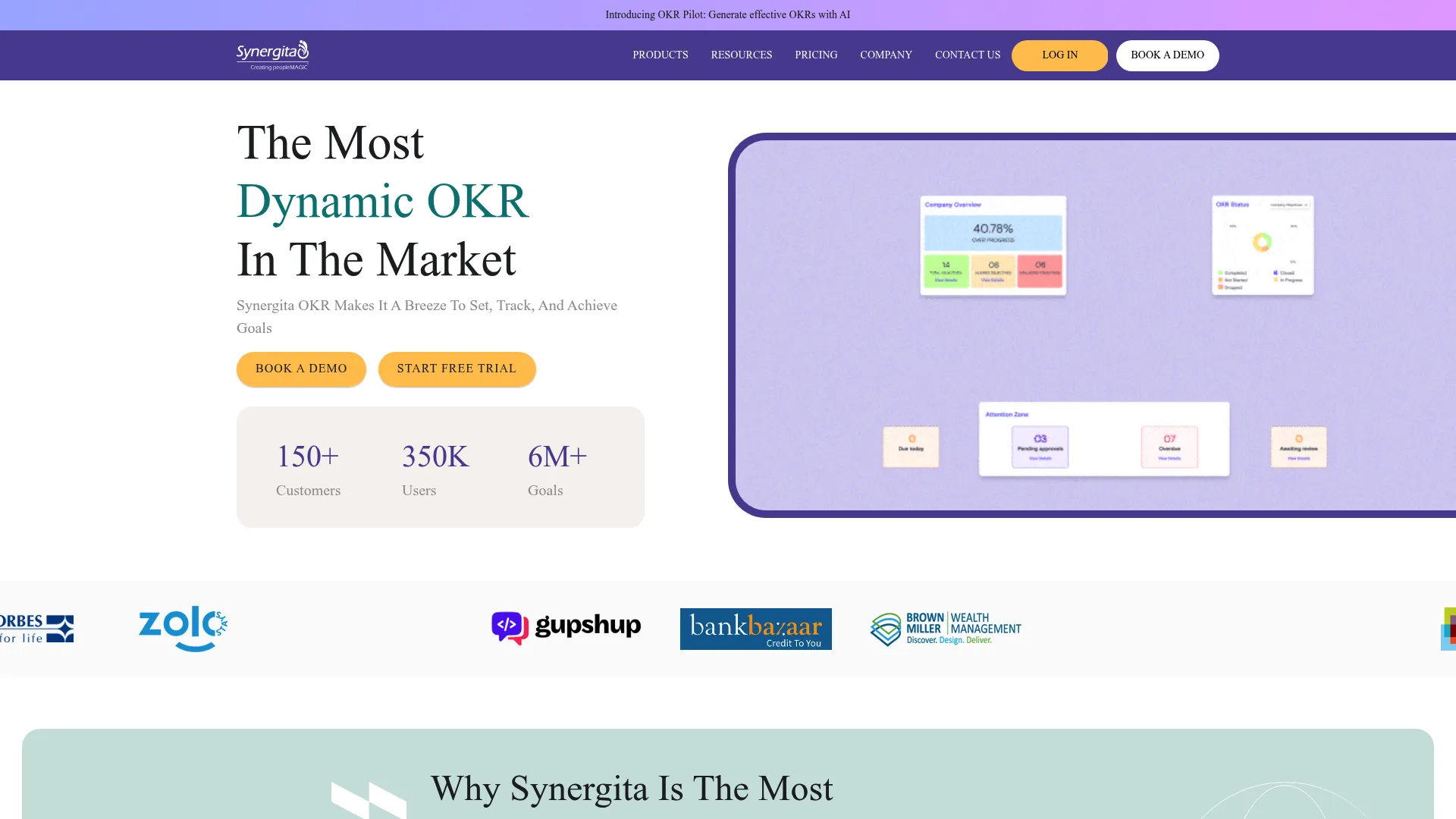
Synergita is a SaaS platform spanning OKR management, performance reviews, continuous feedback, and recognition. Its 360-degree feedback sits within a broader, affordable performance suite. Mid-market teams that want performance, OKRs, and recognition together find strong value here.
Best for: Mid-market teams wanting performance, 360s, and recognition in one place.
Key strengths
- OKR and goals management: alignment, hierarchy trees, dashboards, and reporting.
- Performance reviews and 360 feedback: smart goals, custom workflows, normalization, and 9-box analysis.
- Feedback, recognition, and integrations: continuous feedback, rewards, and integrations with HRIS, Teams, Slack, and Jira.
Why choose Synergita: Choose Synergita when you want affordable per-user performance management with 360 feedback, OKRs, and recognition combined. The pricing is among the most accessible in this list. The trade-off is that 360 feedback lives in the higher Perform Plus tier, so confirm your plan covers it.
Synergita pricing: Synergita starts at $2 per user per month for Engage, billed annually. Perform is $4 per user per month, and Perform Plus, which adds 360-degree feedback, PIPs, and employee development, is $7 per user per month. A free-forever OKR Starter plan supports up to three users. Synergita holds a 4.6/5 rating on G2.
12. SurveyMonkey
SurveyMonkey is a widely used survey platform with ready-made 360-degree evaluation templates. It is not a dedicated performance system, but its familiarity and low barrier make it a practical starting point. Teams running their first 360, or testing the concept, often begin here. See it in action via this SurveyMonkey interactive demo.
Best for: Smaller teams or first-time 360 programs wanting a low-barrier start.
Key strengths
- 360 templates and easy setup: ready-made multi-rater evaluation templates you can launch fast.
- Logic and analysis: skip logic, AI-assisted analysis, and data exports.
- Broad familiarity and integrations: a tool many people already know, with 200-plus integrations.
Why choose SurveyMonkey: Choose SurveyMonkey when you want to run a simple 360 quickly without committing to a full performance platform. The familiarity reduces setup friction and rater confusion. The trade-off is that it lacks dedicated competency frameworks and development planning, so you will manage analysis and follow-through manually as the program matures.
SurveyMonkey pricing: SurveyMonkey offers a free Basic plan for simple surveys. Paid individual plans include Advantage Annual at $39 per month billed annually, Standard Monthly at $99 per month, and Premier Annual at $139 per month. Higher tiers add advanced logic, white-label branding, and crosstabs. SurveyMonkey holds a 4.4/5 rating on G2.
Considerations: how to choose the right 360 feedback software
Feature lists are easy to compare. What actually decides whether your program works is harder. Here is the checklist that matters when you pick from the best 360 feedback tools.
Anonymity and confidentiality controls
Check the rater-group thresholds. The best 360 review software hides individual responses until a minimum number of raters reply, usually three to five per group. Verify how peer and direct-report feedback is aggregated, and whether managers can ever see individual comments. Weak anonymity kills candor, and candor is the entire point of a 360.
Participation and response-rate features
This is where most programs live or die. Look for automated reminders, mobile-friendly completion, and short, well-structured questionnaires. The gap between a stalled cycle and a useful one often comes down to completion rates. Reminders, easy access, and a clear sense of purpose are what move a program from low participation to strong, usable input. A well-designed onboarding flow can also lift completion by guiding raters through their first cycle without confusion.
Reporting and analytics depth
A pile of scores is not insight. Evaluate competency dashboards, sentiment or qualitative analysis of open comments, trend tracking across cycles, and exportability. You want gap identification that points to specific development areas, not a generic average. The faster a tool turns responses into a clear picture, the more likely managers act on it. If broader people analytics matter, compare options with a dedicated digital adoption platform roundup.
Integration with your HR stack
Another disconnected system is another data silo. Confirm integrations with your HRIS, LMS, and Slack or Teams, plus SSO and SAML authentication standards for access. When 360 data flows into your existing tools, you avoid manual exports and keep the program low-maintenance. Onboarding employees onto any new tool is also smoother when it connects to what they already use, and teams often pair structured rollout with interactive user onboarding to drive adoption.
Link to development plans
A 360 that ends in a report is a 360 that failed. Check whether feedback flows into growth plans, goals, and review cycles. The strongest platforms turn each cycle into action, so the employee leaves with concrete next steps rather than a static PDF. Follow-through is what makes the program worth repeating. Building a reusable library of interactive demos for each tool helps employees adopt the next steps faster.
Conclusion
The right pick depends on your job, not a feature count. For enterprise people teams wanting engagement plus development, Culture Amp is the strong anchor. To unify reviews, goals, and 360s, Lattice and Leapsome lead, with Leapsome's modular design giving you flexibility as you grow. When 360 feedback is the whole job, Spidergap and EchoSpan offer focus and deep customization. For continuous performance and manager coaching, 15Five fits. On budget, Synergita and SurveyMonkey lower the barrier to a first cycle.
Whatever you shortlist, do not over-buy. Pick two or three tools, then run a pilot cycle with one team before committing across the company. Start a trial or demo of your top candidate and watch the two things that decide success: participation and follow-through. A 360 program lives or dies on whether people complete it and whether the feedback turns into a development plan. Get those right, and the tool choice becomes far less risky.
FAQs
360-degree feedback is multi-source feedback collected on an employee from their manager, peers, direct reports, and themselves. It is used primarily for development, giving a fuller and less biased view of how someone works than a single manager's perspective. Most programs run it anonymously to keep responses honest.
You set up competencies and questions, select raters across groups (manager, peers, reports, self), then collect anonymous responses. The software aggregates that input into a development-focused report with competency scores and qualitative comments. You then share the report with the employee and use it to build a growth plan.
360 feedback is multi-rater, development-focused, and usually anonymous. A traditional performance review is typically manager-to-employee, evaluative, and often tied to compensation. Many teams run a 360 first to surface blind spots, then use the formal review for accountability and decisions.
In most 360 software, yes, with safeguards. Good tools use rater-group thresholds, hiding individual responses until a minimum number of raters (often three to five per group) reply. That aggregation protects confidentiality, which keeps feedback candid. Always confirm a tool's anonymity settings before launch, since weak controls discourage honest input.
Start by defining the competencies and questions tied to your roles. Select raters, then communicate the purpose clearly so people know it is for development, not punishment. Run the cycle with automated reminders, then debrief each report into a concrete development plan. The debrief is where most value is created.
Pricing ranges widely. Survey-tool tiers like SurveyMonkey offer free plans, while dedicated 360 tools like Spidergap start around $1,099 per year. Performance suites often charge per user per month, from a few dollars to enterprise rates billed annually. Always verify current pricing directly with the vendor, since many use quote-based models.
Most tools provide competency dashboards, gap identification, and trend tracking across cycles. Stronger platforms add sentiment or qualitative analysis of open-ended comments, plus exportable reports. The goal is to turn raw responses into a clear development picture, not just an average score, so managers can act on specifics.
Communicate the purpose clearly so raters understand the program drives development, not punishment. Keep surveys short and focused to reduce fatigue. Use automated reminders and mobile-friendly access so completion is easy. And protect anonymity visibly, since people respond more honestly and more often when they trust their input stays confidential.