You sold your first customer in Germany. Then one in Brazil, then Japan. Now your finance team is staring at VAT thresholds, local invoicing rules, sales tax nexus, and a chargeback dispute in a currency nobody recognizes. Each new country added revenue. It also added a compliance obligation you did not plan for.
This is the quiet tax on global selling. The Merchant of Record software market sat at roughly USD 11.61B in 2024 and grew to USD 13.20B in 2025, with a forecast CAGR of 14.96% through 2032, according to Research and Markets (2025). That growth is not random. It tracks how many software and digital businesses are deciding they would rather not become tax experts in 40 jurisdictions.
That is the job a merchant of record handles. Instead of you being the legal seller in every market, an MoR becomes the reseller of record. They own the transaction, collect and remit tax, manage fraud and chargebacks, and take on the compliance liability that would otherwise sit on your balance sheet. For sales and revenue teams, that means international payments and recurring revenue stop being a legal project and start being a line item.
This guide ranks 8 merchant of record providers and shows where each one fits. If your team is also building out the broader go-to-market stack, you can compare adjacent categories like contract management software and audit management software once your payment infrastructure is settled.
What's inside
This guide is for founders, finance leaders, and revenue teams choosing a merchant of record provider to support global expansion. We compare 8 tools across four criteria that actually decide fit: global tax and compliance coverage, subscription billing depth, fraud and dispute handling, and business model match (SaaS, digital products, apps, creator-led sales, and gaming).
Each entry includes verified pricing where it is public, a G2 rating where one exists, and clear guidance on when to choose that provider over another. The goal is a decision, not a feature list. By the end you should have a shortlist of two or three finalists to compare directly.
TL;DR
- Best for SaaS and digital billing all-in-one: Paddle, with merchant of record coverage across 300+ markets and recurring billing built in.
- Best for enterprise software complexity: Cleverbridge, for quote-based deals, subscription lifecycle, and compliance at scale.
- Best G2-rated MoR for SaaS: PayPro Global, with strong reviews and a single all-inclusive price.
- Best for digital goods and software: FastSpring, with global checkout and revenue-share pricing.
- Best for broad global payment reach: 2Checkout, covering 190+ countries with public per-transaction pricing.
- Best for creators and indie sellers: Lemon Squeezy, with no monthly fee and fast launch.
- Best for gaming and virtual goods: Xsolla, purpose-built for game studios and in-game commerce.
What is merchant of record software?
Merchant of record software is a platform that makes a third party the legal seller of your products, so that provider, not you, owns the payment, collects and remits tax, and absorbs compliance and fraud liability on every transaction.
In practice, the flow has two halves. Your customer buys from the merchant of record, which appears as the seller on the receipt and bank statement. The MoR then pays you, net of fees and tax, as the underlying business. You keep the product and the customer relationship. The provider keeps the regulatory burden.
That is the core of the merchant of record model. Because the provider is the seller in each market, it handles tax compliance across jurisdictions, including registration, calculation, collection, and tax remittance. It manages PCI compliance, fraud prevention, refunds, and chargeback management. It also typically runs subscription billing, multi-currency support, payment routing, and checkout localization so buyers pay in their own currency and method.
What merchant of record software typically handles
- Tax compliance and remittance: sales tax, VAT, GST calculation, collection, filing, and registration across jurisdictions.
- Payment processing: card, wallet, and local payment methods with multi-currency support and payment routing.
- Compliance and security: PCI compliance, regulatory liability, and local entities so you avoid setting up your own.
- Fraud and disputes: fraud prevention, chargeback management, and refund handling.
- Subscription billing: recurring revenue, proration, dunning, invoicing, and lifecycle management.
Merchant of record vs payment service provider vs reseller
These three get confused constantly. The difference comes down to who carries liability.
| Model | Who is the legal seller | Who owns tax and compliance | Who carries chargeback liability |
|---|---|---|---|
| Merchant of record | The MoR provider | The MoR provider | The MoR provider |
| Payment service provider (PSP) | You | You | You |
| Reseller | The reseller | The reseller | The reseller |
The merchant of record vs payment service provider question is the one most teams get wrong. A PSP like a standard gateway moves money and may help with reporting, but you stay the seller of record. You register for tax, you file, you eat the chargebacks. An MoR absorbs all of that. A reseller is closer to an MoR in liability but usually involves a deeper commercial relationship and markup model. Pick the MoR model when compliance burden is the thing slowing you down.
When to use merchant of record software
Merchant of record services are not for everyone. They make the most sense in three situations.
Expand into new countries without local entities
If your roadmap involves selling into the EU, LATAM, or APAC, tax registration and remittance can stall a launch for months. Each market may require a local entity, a tax ID, and ongoing filings. A merchant of record removes that. Because the provider is the seller, it handles registration, collection, and tax remittance in every market it covers. International SaaS and digital product teams use this to enter a dozen countries on day one instead of one country per quarter.
Sell subscriptions without building billing infrastructure
Recurring revenue looks simple until you build it. Proration, mid-cycle upgrades, failed-payment dunning, invoicing, currency handling, and renewal logic add up to a real engineering project. Merchant of record providers ship subscription billing as a managed layer. For SaaS teams, that means launching plans, trials, and seat-based pricing without diverting engineers from the core product.
Reduce payment risk and operational overhead
Chargebacks, fraud, refunds, and compliance exposure all land on finance and RevOps when you are the merchant. An MoR shifts that liability to the provider. Fraud screening, dispute handling, PCI compliance, and refund workflows become the provider's problem. For finance leaders, that turns an unpredictable risk into a known fee.
Merchant of record software comparison
Read this table top to bottom by relevance to a typical SaaS or digital-product buyer. Intent tells you the primary use case. Key differentiation shows what sets each provider apart. Pricing and G2 ratings reflect verified, current values where they are public; some providers quote custom pricing only.
| # | Product | Intent | Key differentiation | Pricing | G2 rating |
|---|---|---|---|---|---|
| 1 | Paddle | SaaS and digital billing | All-in-one MoR across 300+ markets | 5% + 50¢ per checkout transaction | 4.5/5 |
| 2 | Cleverbridge | Enterprise software | Quote-based deals and subscription lifecycle | Custom | 4.4/5 |
| 3 | PayPro Global | SaaS and software | High G2 rating, single all-inclusive price | Custom (quote) | 4.9/5 |
| 4 | FastSpring | Digital goods and SaaS | Global checkout with revenue-share pricing | Custom (revenue share) | 4.5/5 |
| 5 | 2Checkout | Global digital commerce | 190+ countries, public per-transaction pricing | 3.5% + $0.35 per sale | 3.9/5 |
| 6 | BlueSnap | Payment orchestration | Global gateway plus billing and invoicing | 2.9% + $0.30 per transaction | 4.1/5 |
| 7 | Lemon Squeezy | Creators and indie | No monthly fee, fast launch | 5% + 50¢ per transaction | Not rated |
| 8 | Xsolla | Gaming commerce | Built for game studios and in-game stores | 5% of transactions | 4.4/5 |
1. Paddle
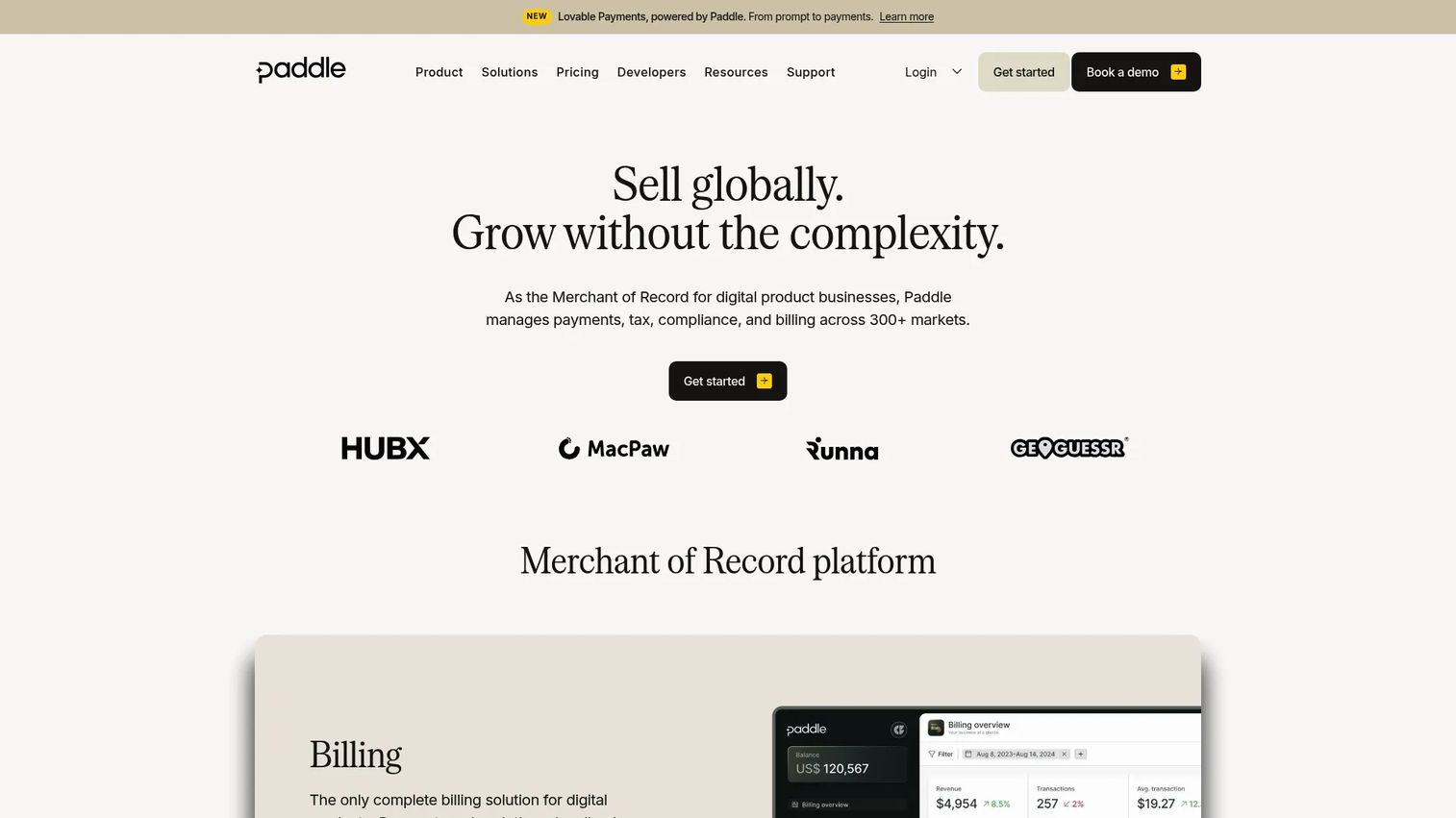
Paddle is a merchant of record platform built for SaaS and digital product companies that want billing, payments, tax, and compliance handled in one place. It acts as the reseller of record, so Paddle owns the transaction, remits tax, and absorbs compliance liability while you keep the customer relationship. The product covers global checkout and payments across 300+ markets.
Best for: SaaS and digital businesses that want an all-in-one merchant of record for global billing and tax handling.
Key strengths
- Merchant of record coverage: Paddle handles payments, tax, compliance, fraud protection, and financial reconciliation as the legal seller.
- Recurring billing: proration, credits, seat management, and one-time purchases for full subscription billing.
- Global reach: checkout and payments across 300+ markets with localized currencies and methods.
Why choose Paddle: Teams pick Paddle for speed to market. Instead of stitching together a gateway, a tax engine, and a billing system, you get one layer that owns tax remittance and chargeback management. That matters when you want to launch internationally without adding finance headcount or setting up local entities. It is a clean fit for product-led SaaS that sells globally and wants engineering focused on the product.
Paddle pricing: Paddle uses public pay-as-you-go pricing of 5% + 50¢ per checkout transaction, with no monthly fees or migration fees shown. Larger businesses, products under $10, and invoicing move to custom pricing. There is no free tier.
2. Cleverbridge
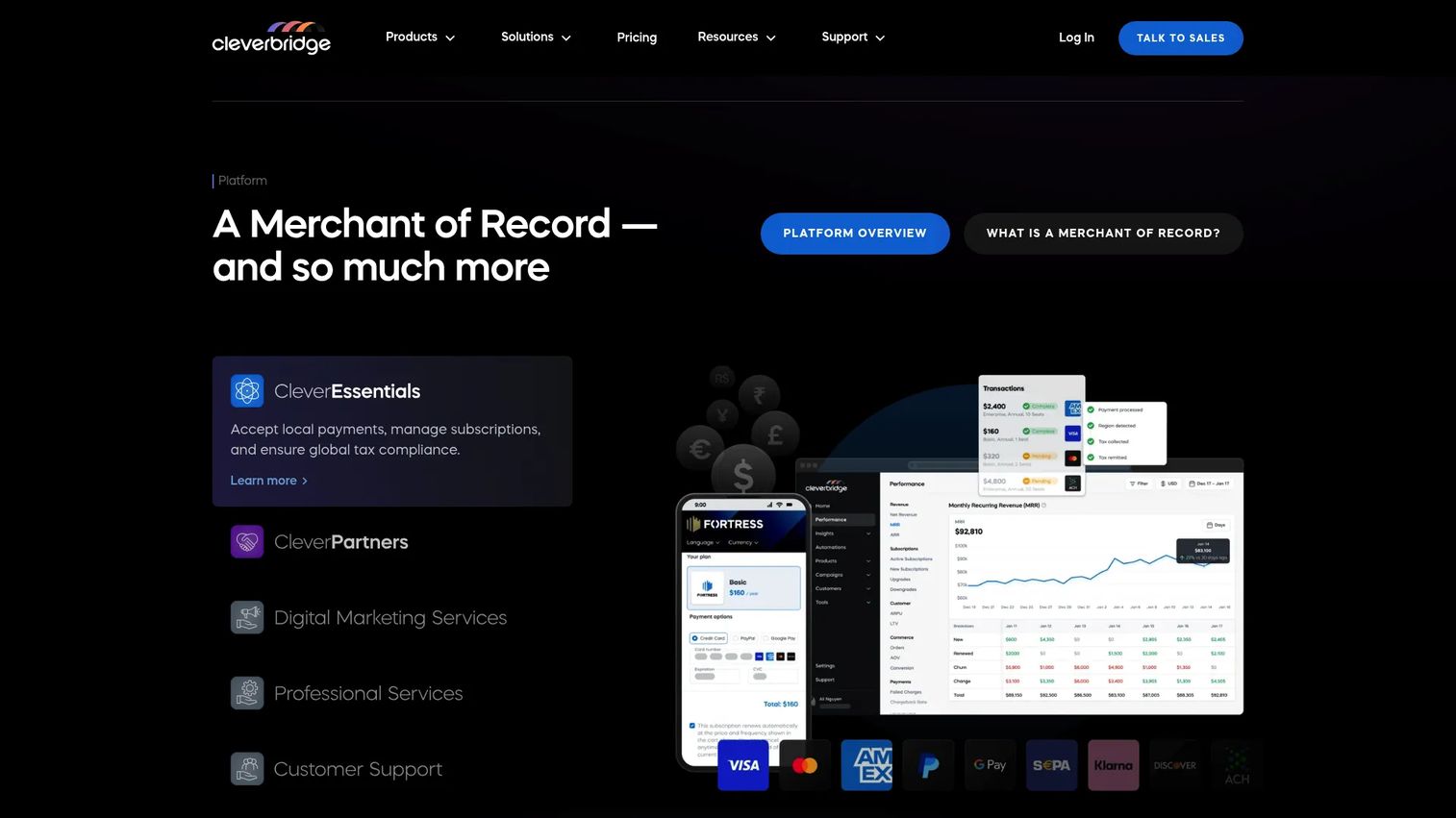
Cleverbridge is an enterprise merchant of record and ecommerce platform for software companies selling globally. It pairs global payments with subscription management and built-in tax and compliance handling, aimed at businesses with more complex monetization motions than a simple self-serve checkout.
Best for: software companies needing a global merchant of record solution with subscriptions and compliance built in.
Key strengths
- Global payments: broad payment method and currency coverage for international payments at scale.
- Subscription management: full subscription lifecycle support for recurring revenue businesses.
- Tax and compliance handling: managed tax compliance and remittance across markets.
Why choose Cleverbridge: Cleverbridge fits companies whose deals are not always one-click. If you sell through a mix of self-serve checkout, quotes, invoicing, and renewals, and you need services support alongside the platform, it suits that complexity. Enterprise software vendors with multi-currency support needs and structured subscription lifecycles tend to land here rather than on a creator-first tool.
Cleverbridge pricing: Cleverbridge uses custom, quote-based pricing. It offers transaction-based pricing tailored to factors like volume, payment mix, currencies, and customer locations. No public price is displayed, so request a quote for figures specific to your business.
3. PayPro Global
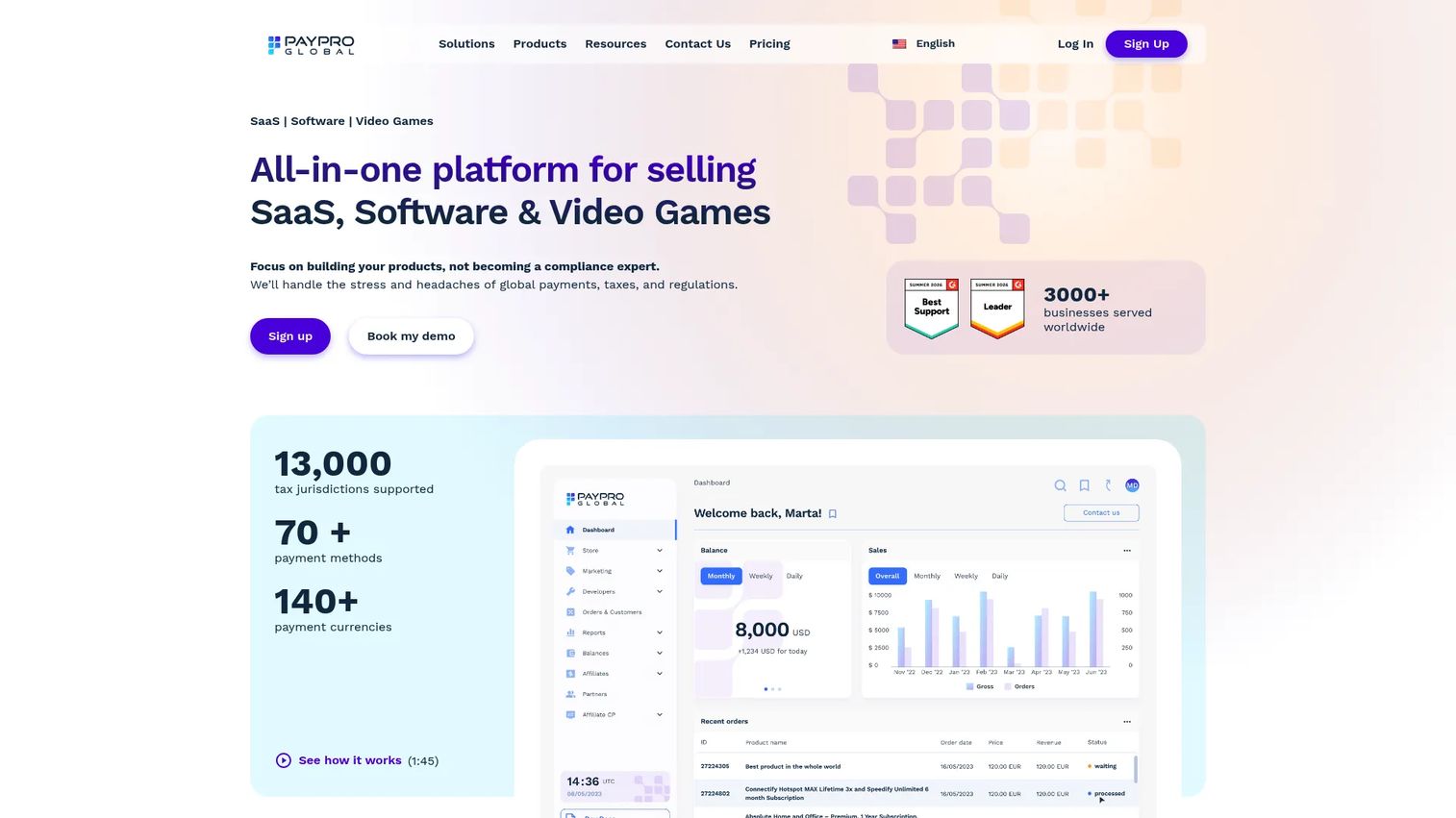
PayPro Global is a merchant of record platform for SaaS, software, and digital businesses. It combines global payments and local payment methods with merchant of record tax and compliance handling, plus subscription billing and revenue recovery. It carries one of the strongest G2 ratings in this comparison at 4.9/5.
Best for: SaaS and software companies needing a merchant of record for global selling.
Key strengths
- Global and local payments: broad payment method coverage with checkout localization for international payments.
- Merchant of record: managed tax compliance, remittance, and regulatory liability as the seller of record.
- Subscription billing and revenue recovery: recurring revenue support plus dunning and recovery to reduce involuntary churn.
Why choose PayPro Global: The high review score reflects teams that want global selling handled without surprises. PayPro Global leans on localized checkout and expansion support, which helps when conversion in non-English, non-USD markets matters. Software companies that care about both compliance coverage and recovering failed payments find the combination useful.
PayPro Global pricing: PayPro Global uses quote-based pricing with no public numeric price shown. The site states there is one fair price with all features included, so figures come through a direct quote rather than a published tier.
4. FastSpring
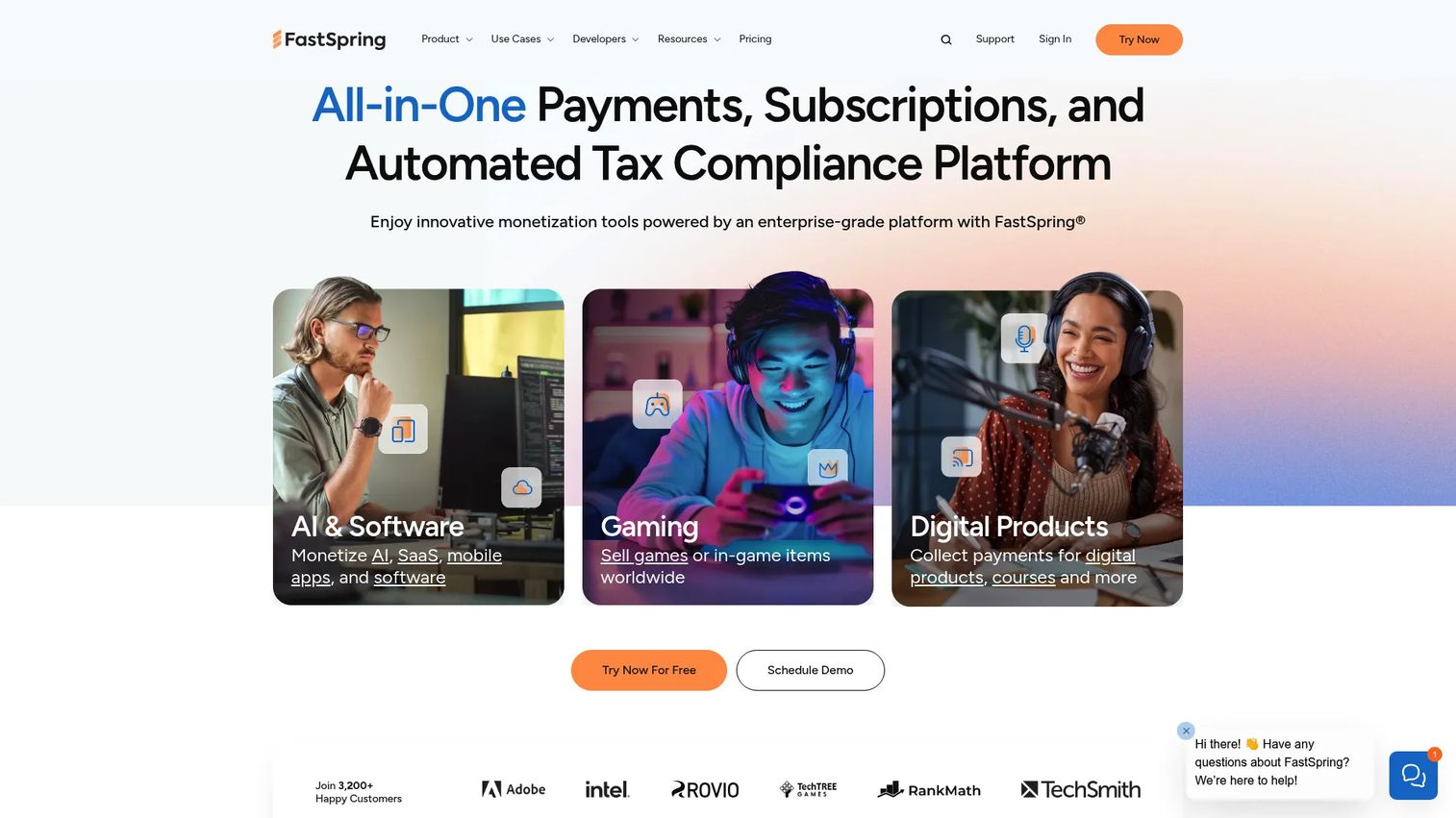
FastSpring is a merchant of record platform for selling software, SaaS, and digital goods globally. It handles the seller-of-record role, global payments, and subscription management, so digital businesses can sell internationally without owning tax and compliance directly.
Best for: software and SaaS companies selling globally with tax and subscription complexity.
Key strengths
- Merchant of record: FastSpring owns tax compliance, remittance, and liability as the legal seller.
- Global payments: international payment acceptance with multi-currency support and localized checkout.
- Subscription management: recurring billing for SaaS billing and digital product subscriptions.
Why choose FastSpring: FastSpring is a strong match for digital goods and downloadable software, alongside SaaS. If your catalog mixes one-time digital purchases with subscriptions, it handles both under one merchant of record umbrella. The revenue-share model means fees scale with volume rather than a flat monthly commitment, which suits businesses that want costs tied to sales.
FastSpring pricing: FastSpring uses custom, revenue-share-based pricing. Fees vary by transaction volume, and the company states there is no minimum transaction volume. No public numeric price is shown, so pricing comes through a quote.
5. 2Checkout
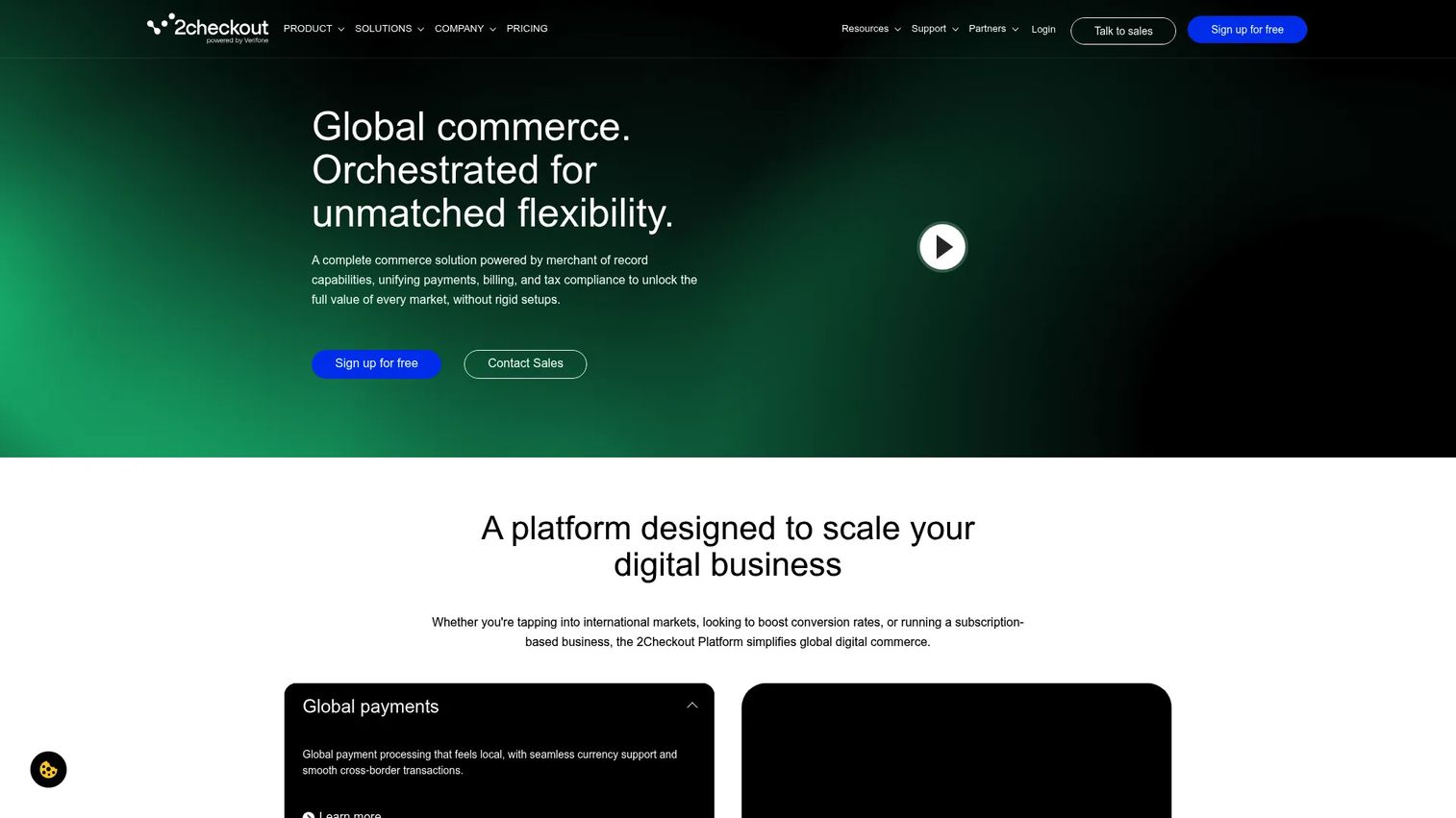
2Checkout is a global digital commerce and payments platform with merchant of record services, subscription billing, and checkout tools. It supports global payments across 190+ countries and territories, making it a broad option for businesses selling digital products or subscriptions worldwide.
Best for: businesses selling digital products or subscriptions globally.
Key strengths
- Global reach: payments across 190+ countries and territories with multi-currency support.
- Subscription billing: full subscription lifecycle management for recurring revenue.
- Merchant of record services: tax compliance and remittance handling under the MoR model.
Why choose 2Checkout: 2Checkout makes sense when payment method breadth and country coverage are the priority, and when you want public per-transaction pricing rather than a quote process. Its tiered products let you start with simple selling and add subscriptions as you grow. Choose it over a SaaS-specific tool when your reach spans many markets and payment types more than it leans on deep SaaS billing features.
2Checkout pricing: the 2Sell plan is 3.5% + $0.35 per successful sale, and 2Subscribe is 4.5% + $0.45 per successful sale, both public. The 2Monetize plan does not show a public number and is contact-sales. A free entry option is available to start.
6. BlueSnap
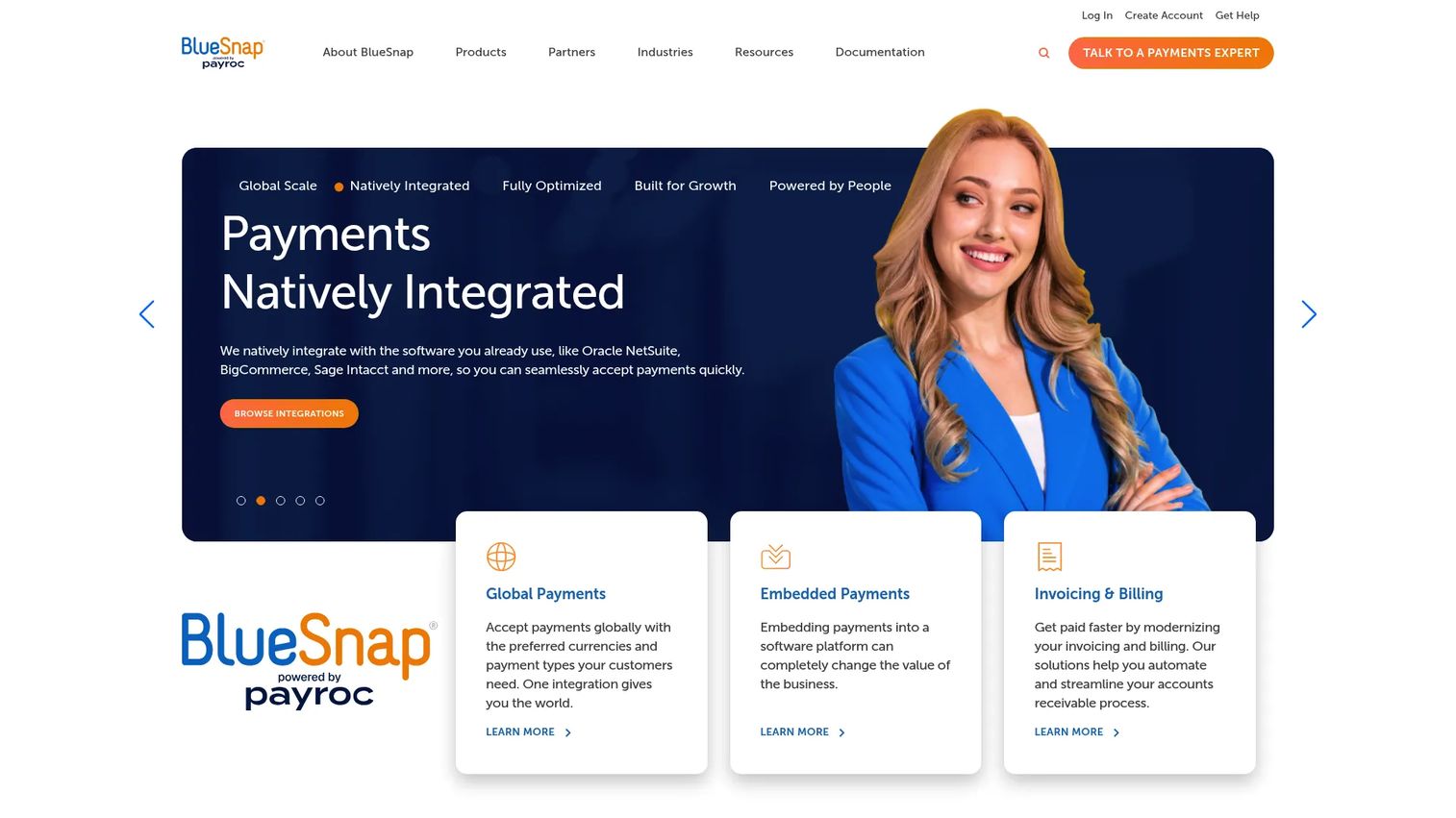
BlueSnap is a global payment orchestration platform for accepting and managing payments across channels and regions. It combines a global gateway with hosted checkout, embedded payments, and recurring billing, positioning it as a payment-first option with merchant of record relevance depending on configuration.
Best for: businesses needing global payment processing with checkout, billing, and invoicing in one platform.
Key strengths
- Payment orchestration: a global gateway with payment routing across channels and regions.
- Flexible checkout: hosted checkout and embedded payments for different integration needs.
- Billing: subscriptions, invoicing, and recurring billing in one platform.
Why choose BlueSnap: BlueSnap fits teams whose primary need is global payment acceptance and orchestration, with billing and invoicing alongside. If your strongest requirement is cross-border payment flexibility and routing across many regions, it is a strong match. Where your need is purely the full merchant of record liability transfer for software, the SaaS-first providers above may map more directly, so confirm the MoR scope for your model.
BlueSnap pricing: BlueSnap shows Quick Start Pricing at 2.9% + $0.30 per successful card transaction, pay-as-you-go. Custom pricing is available by consultation, and pricing pages display multiple regional currency views. There is no free tier.
7. Lemon Squeezy
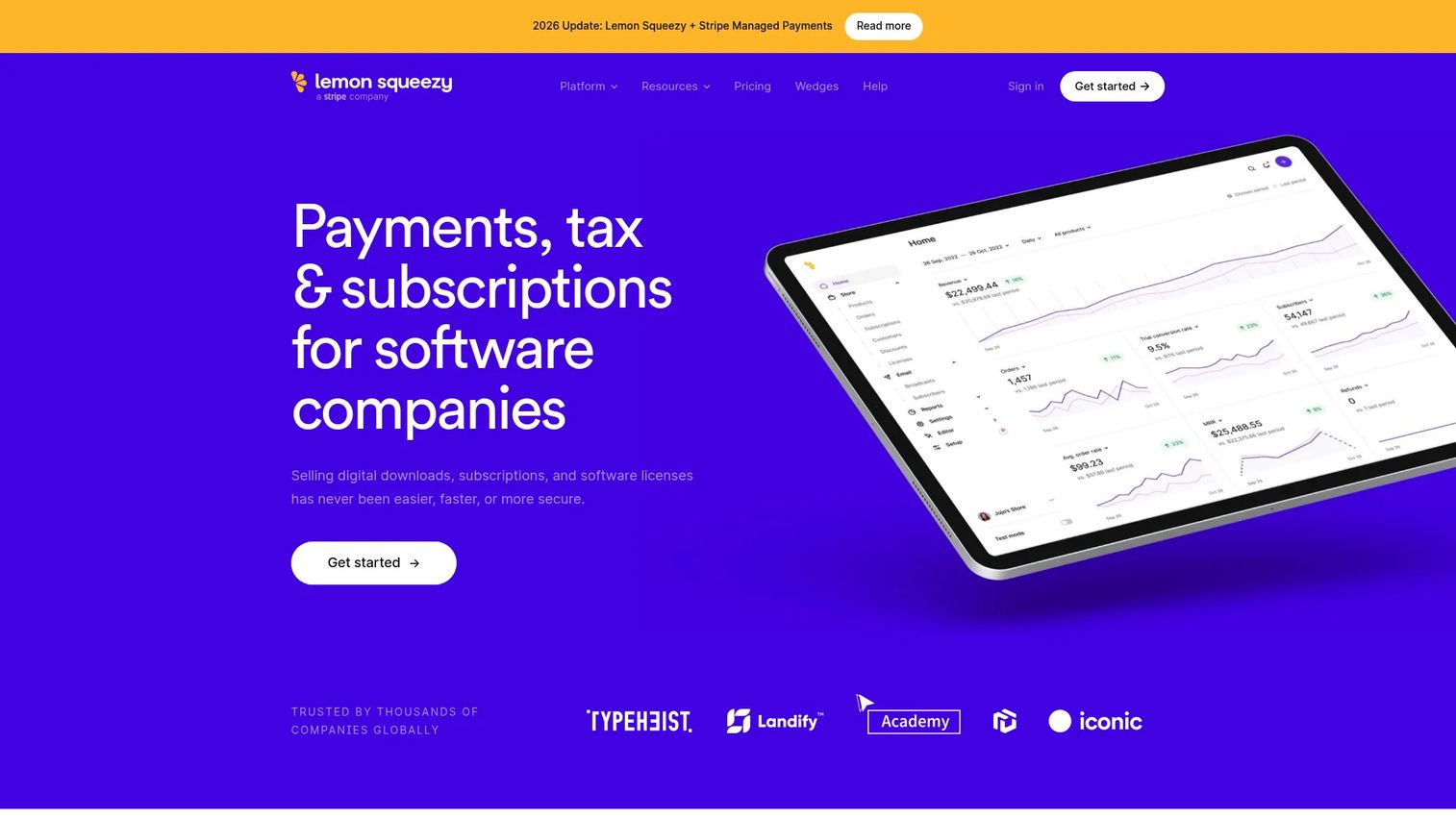
Lemon Squeezy is a merchant of record platform for selling digital products, subscriptions, and software licenses. It is built for creators and smaller software businesses that want to launch fast, with the seller-of-record role, sales tax and VAT handling, and a no-code checkout included.
Best for: creators and software businesses selling digital products globally.
Key strengths
- Merchant of record: sales tax and VAT handling with the provider as legal seller.
- Recurring and licensing: subscriptions, recurring billing, and license key management.
- Fast launch: digital downloads, no-code checkout, coupon codes, and email marketing.
Why choose Lemon Squeezy: Lemon Squeezy suits simple, fast-to-launch monetization. For a creator or indie developer selling templates, courses, or a small software product, it removes the tax and checkout overhead without a heavy setup. It is narrower than the SaaS-first providers above, so a company with complex enterprise billing and multi-stakeholder deals will likely outgrow it, but for the creator-led use case it is a clean fit.
Lemon Squeezy pricing: ecommerce features carry no monthly charge and use a 5% + 50¢ per-transaction fee. Email marketing is $0/month free up to 500 subscribers, with subscriber-based charges above that. A free option to start is available.
8. Xsolla

Xsolla is a global video game commerce platform for payments, monetization, subscriptions, and direct-to-consumer game sales. It serves game studios that need global payments and monetization infrastructure, with merchant of record relevance for publishers selling across many geographies.
Best for: game studios needing global payments and monetization infrastructure.
Key strengths
- Massive payment reach: 1,000+ payment methods across 200+ geographies for international payments.
- Fraud controls: fraud monitoring and prevention built for high-volume game commerce.
- Monetization tooling: subscriptions, web shop, and in-game store tooling for direct-to-consumer sales.
Why choose Xsolla: Xsolla is the specialist pick. If you publish games and need in-game stores, virtual goods, and web shops alongside global payments, it is built for exactly that. For non-gaming SaaS, the providers earlier in this list map more directly to standard software billing, but for game publishers and digital commerce in gaming, Xsolla covers the niche better than a general MoR.
Xsolla pricing: Xsolla shows public pricing of 5% of transactions plus the cost of channel, with no integration cost or upfront payments. The pricing is presented as one price for all products and solutions, and there is no free tier.
Considerations
Before you shortlist finalists, pressure-test each provider against the criteria that actually move risk and revenue.
Global tax and compliance coverage
Confirm coverage by region and product type. Ask which markets the provider acts as merchant of record in, how it handles tax registration, calculation, collection, and tax remittance, and who owns the reporting. Coverage that looks complete on a map can have gaps for specific product categories or jurisdictions.
Billing model depth
If you sell subscriptions, verify recurring billing depth. Check proration, mid-cycle changes, invoicing, pricing flexibility, and dunning for failed payments. SaaS and subscription businesses live or die on these details, so a thin billing layer becomes a problem fast as you scale recurring revenue.
Fraud, disputes, and refunds
Clarify liability. Under a true merchant of record model, the provider absorbs chargeback liability and runs fraud prevention. Confirm how disputes are handled, what support you get, and how refunds flow back. This directly affects finance workload, so do not assume it.
Business model fit
Match the platform to the monetization motion. SaaS, apps, digital downloads, creator-led sales, and gaming each have a best-fit provider in this list. A creator tool and an enterprise software MoR are not interchangeable, so start from your model, not the feature grid.
Integrations and reporting
Check integrations with your CRM, ERP, accounting, and analytics stack. Operational visibility matters: you want clean revenue reporting, reconciliation, and data flowing into the systems your finance and RevOps teams already use. Thin reporting creates manual work that erodes the time an MoR is supposed to save.
Conclusion
The right merchant of record software comes down to your monetization complexity and where your compliance burden hurts most. For all-in-one SaaS and digital billing, Paddle and FastSpring are strong starting points. For enterprise software with quote-based deals and a full subscription lifecycle, Cleverbridge fits. PayPro Global pairs high reviews with broad global selling support, while 2Checkout and BlueSnap lead on payment reach and orchestration. Lemon Squeezy is the clean pick for creators, and Xsolla owns gaming.
Do not try to compare all eight at once. Start by matching the merchant of record model to your business type, then pull two or three finalists based on compliance coverage and billing depth. Run a real product catalog and tax scenario through each, confirm chargeback management and refund flows, and check pricing against your actual volume. That direct comparison, not a feature list, is what tells you which provider will carry the operational weight as you scale global expansion and recurring revenue.
FAQs
Merchant of record software makes a third-party provider the legal seller of your products. That provider owns each transaction, collects and remits tax, manages fraud and disputes, and absorbs compliance liability, while you keep your product and customer relationship. It is how many SaaS and digital businesses sell globally without becoming tax experts in every market.
The merchant of record vs payment service provider difference is liability. A payment service provider moves money but leaves you as the legal seller, so you register for tax, file returns, and carry chargeback risk. A merchant of record becomes the seller of record, so tax compliance, remittance, and dispute liability shift to the provider.
The merchant of record handles sales tax. Because it is the legal seller, it calculates, collects, and remits sales tax, VAT, and GST across jurisdictions, and manages registration and filing. That removes the need for you to set up local entities or track tax thresholds market by market.
No. SaaS is a common use case, but merchant of record providers also serve digital downloads, software licenses, mobile apps, creator products, and gaming. The model fits any business selling digital goods or subscriptions across borders where tax and compliance would otherwise be a heavy lift.
Under a merchant of record model, the provider carries chargeback liability and runs fraud prevention as the seller of record. It handles disputes, processes refunds, and absorbs the risk that would otherwise land on your finance team. That turns an unpredictable cost into a known fee inside the provider's pricing.
Yes. Most merchant of record providers include subscription billing with recurring charges, proration, invoicing, and dunning for failed payments. This lets SaaS and recurring revenue businesses launch and manage plans without building billing infrastructure in-house.
Choose a merchant of record when tax compliance, international payments, and chargeback management are slowing your global expansion more than they are core to your product. If you would need local entities, tax registrations, and a billing team to expand, an MoR is usually faster and cheaper. Build your own stack when payments are central to your differentiation and you have the engineering and compliance resources to own the liability.
Merchant of record services benefit businesses selling digital products and subscriptions across borders: SaaS, downloadable software, mobile apps, creator-led digital sales, and gaming. The common thread is global selling plus tax and compliance complexity that the business would rather not own. Models with heavy physical logistics or purely domestic sales tend to benefit less.