You know the account is slipping. Logins dropped last month. Two support tickets went unanswered longer than they should have. The champion who used to reply in an hour now takes three days. And then, six weeks before renewal, they email: "We've decided to explore other options."
You had the data. You just never turned it into a decision in time.
That is the core problem churn prediction software exists to solve. Churn is rarely one signal. It is a pattern across product usage, support history, sentiment, and engagement that no human can watch across hundreds of accounts at once. According to Gartner's 2025 Customer Success Technology Survey, 65% of large enterprises with 1,000+ customers now use ML-based churn prediction models, up from 38% in 2023. The market moved because the manual approach stopped scaling.
This guide compares seven customer churn prediction software tools for 2026. Each one promises to surface risk early. The real question is which ones explain why an account is at risk and push your team into the right next step, instead of adding one more dashboard nobody opens.
What's inside
This guide is for customer success leaders, RevOps, CS ops, and SaaS founders who care about retention, renewals, and forecast accuracy. We picked tools based on four criteria that separate useful software from expensive reporting:
- Prediction quality: how well the churn prediction model turns raw signals into reliable risk scores
- Explainability: whether the tool tells you why an account is at risk, not just that it is
- Workflow activation: whether it triggers alerts and plays inside Slack, Salesforce, and your CS motion
- Customer success fit: how well it maps to renewals, health scoring, and expansion in real teams
We name pricing where vendors publish it and flag where they gate it behind sales. We also tell you when a simpler tool beats a heavier platform.
TL;DR
- Best overall for CS teams: ChurnZero. Health scoring, renewal forecasting, and AI-assisted plays in one place.
- Best for predictions inside your product stack: Pendo Predict. Churn signals with explanations, delivered in Salesforce and Slack.
- Best for enterprise customer intelligence: Gainsight. Deep customer success operating model with broad data inputs.
- Best for marketing-led retention: Optimove. Churn prediction models tied to next-best action and micro-segmentation.
- Best for practical CS operations: Totango. Health scoring and success plays without heavy overhead.
- Best for SMB and mid-market speed: Custify. Fast time to value with automated alerts and retention workflows.
AI churn prediction is now table stakes. The differentiator is whether the tool moves your team to act.
What is churn prediction software
Churn prediction software is a category of tools that use machine learning to score which customers are likely to cancel, downgrade, or not renew, so teams can intervene before revenue is lost.
It works by ingesting signals from across the customer relationship, then running them through a churn prediction model that outputs a risk score per account. The best predictive churn software does not stop at the score. It explains the drivers and routes the account into a retention workflow.
Core ingredients most platforms use:
- Product usage data: login frequency, feature adoption, active seats, session depth
- Engagement data: email opens, QBR attendance, in-app activity, response times
- Support data: ticket volume, severity, resolution time, escalations
- Sentiment data: NPS, CSAT, survey responses, support tone
- Renewal and billing history: contract dates, payment issues, past downgrades
- Machine learning models: trained on historical churn to weight signals and predict risk
Prediction and prevention are different jobs. Prediction tells you which accounts are at risk and why. Prevention is the action you take next, the outreach, the play, the executive alignment. Customer churn prediction and prevention only work together when the score triggers a workflow. A risk score sitting in a report changes nothing.
Most customer churn prediction platforms also layer in customer health scoring, account risk scoring, and renewal forecasting, so leaders can see aggregate revenue risk, not just single-account signals.
When to use churn prediction software
Predict renewals before the CSM is surprised
If your CSMs learn about churn risk during the renewal call, you are already late. Churn prediction software with alerts surfaces declining accounts weeks or months ahead, so the renewal conversation starts from a position of preparation, not damage control.
Prioritize accounts when the team is overloaded
A CSM covering 80 accounts cannot watch all of them equally. Risk scoring tells the team where attention actually matters this week. That triage is the difference between a proactive motion and a reactive one.
Trigger plays when risk crosses a threshold
The value shows up when a risk score fires a workflow automatically. A score crossing red should open a task, ping an owner in Slack, and kick off a retention play. Churn prediction software with real-time alerts closes the gap between signal and action.
Align CS, Sales, and RevOps around the same risk signal
When everyone reads different dashboards, nobody agrees on which accounts are at risk. A shared account risk score gives CS, Sales, and RevOps one source of truth for retention, renewals, and forecast.
Comparison table
Here are the seven customer churn prediction platforms compared on best fit, key differentiator, pricing, and retention analytics strength. Pricing for most enterprise CS tools is quote-based, so we note where vendors publish figures.
| # | Product | Best for | Key differentiator | Pricing | G2 rating |
|---|---|---|---|---|---|
| 1 | ChurnZero | CS teams needing proactive retention | Health scores plus AI agents and renewal forecasting | Quote-based | 4.7/5 |
| 2 | Pendo Predict | Predictions inside the product stack | Explainable churn signals in Salesforce and Slack | Free tier; paid by MAU | 4.4/5 |
| 3 | Gainsight | Enterprise customer intelligence | Broad data inputs and mature CS operating model | Quote-based | Not listed |
| 4 | Optimove | Marketing-led retention | Churn models tied to next-best action | Quote-based | 4.6/5 |
| 5 | Totango | Practical CS operations | Multidimensional health scoring and workflows | Quote-based | 4.4/5 |
| 6 | Custify | SMB and mid-market speed | Customer 360 with fast automation | Flexible, quote-based | 4.7/5 |
| 7 | Churn360 | Reference only | 360 view and health scoring | Not available | Not listed |
The pattern is clear. The strongest tools pair a reliable churn prediction model with workflow activation. Below, we break down where each one fits.
1. ChurnZero
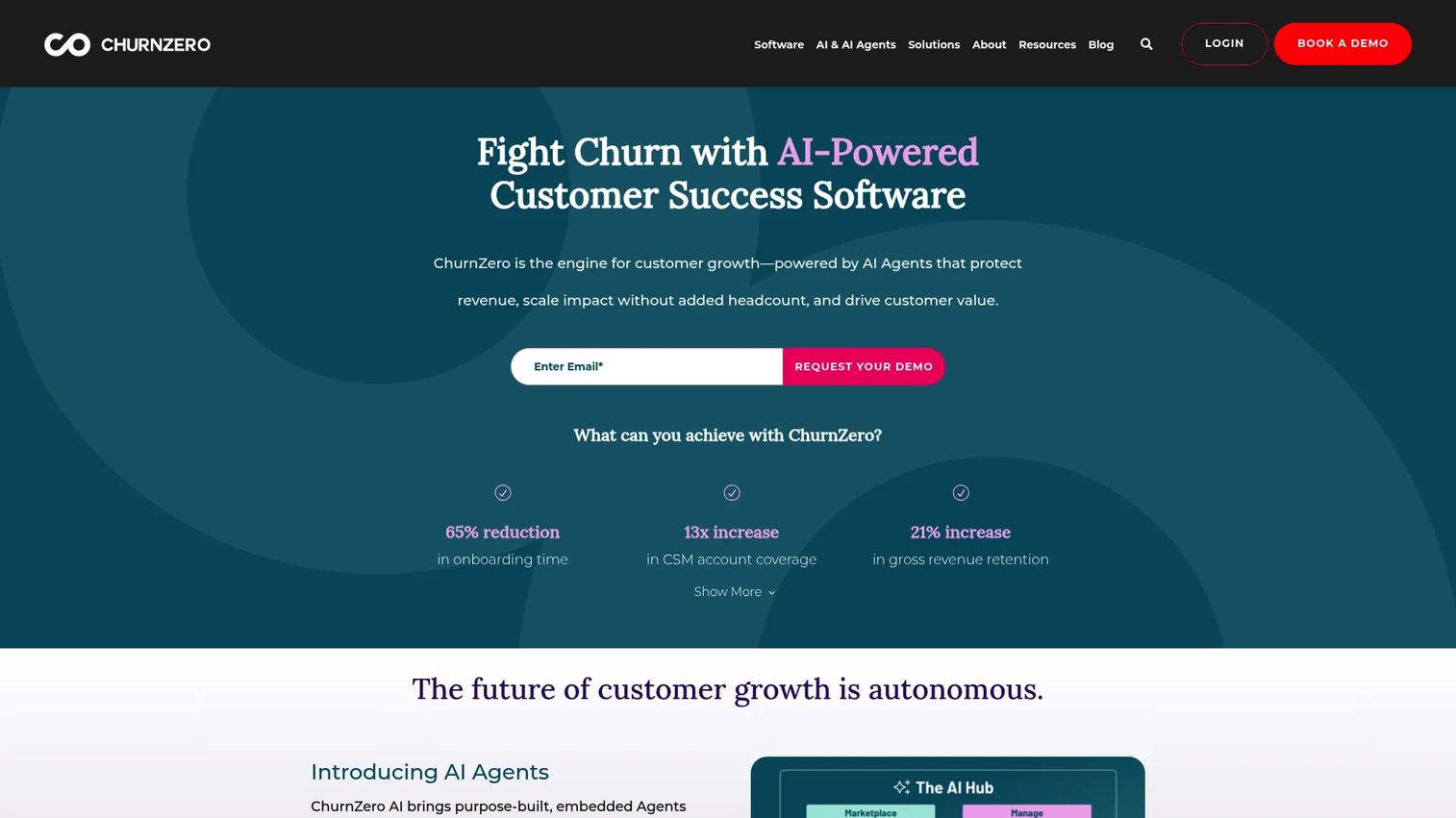
ChurnZero is AI-powered customer success software built for revenue retention and customer growth. It combines health scoring, renewal forecasting, and automation into a single system, so CS teams can predict risk and act on it in the same place. The platform leans hard into operationalizing follow-up, which is where a lot of churn prediction tools stop short.
The standout is how ChurnScores, renewal forecasting, and plays connect. A declining health score does not just sit in a report. It can trigger a journey, launch a play, and route the account to the right owner. That closes the loop between prediction and prevention that most teams struggle to build manually.
Best for: B2B SaaS customer success teams that need proactive churn reduction and expansion workflows in one platform.
Key strengths
- AI agents for surfacing risk and next steps
- Customer health scoring with ChurnScores
- Renewal forecasting and revenue visibility
- Journeys, plays, and automation for retention
- In-app communications and surveys
- 70+ native integrations
Why choose ChurnZero: If your team wants prediction and the retention motion in one tool, ChurnZero fits. It is purpose-built for CS teams that want to move from watching risk to acting on it, without stitching together a separate workflow layer.
ChurnZero pricing: ChurnZero does not publish public pricing. The site directs buyers to request a demo for a custom quote based on team size and needs.
2. Pendo Predict
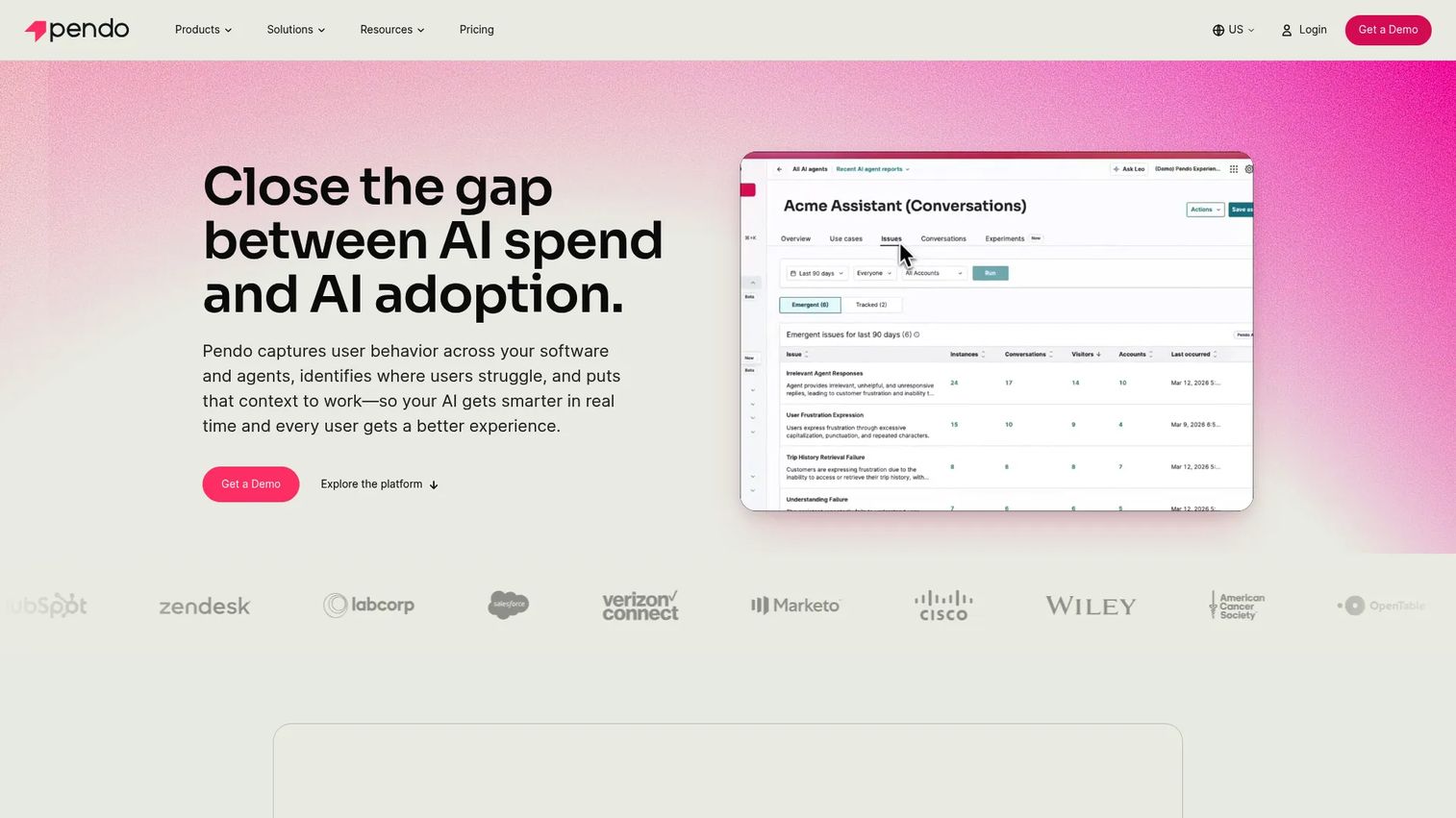
Pendo Predict delivers AI-powered churn predictions inside the broader Pendo platform. Its strength is explainability. Instead of handing you a score with no context, it provides data-backed reasons an account is at risk and suggests next-best actions. For teams that live in Pendo's product analytics, prediction arrives in the flow of work rather than a separate tab.
Where Pendo Predict earns its place is distribution. It alerts teams directly in Salesforce and Slack, so a churn signal reaches the CSM or AE where they already work. That matters. A prediction nobody sees is a prediction wasted. Pairing explainable churn prediction with real-time alerts keeps the score connected to action.
Best for: Teams that want predictive churn and expansion signals inside the Pendo platform they already use.
Key strengths
- Predicts churn risk and expansion opportunities
- Explainable predictions with data-backed reasons
- Alerts in Salesforce and Slack
- Next-best action recommendations
- Built on Pendo's product usage data
Why choose Pendo Predict: If you already run Pendo for product analytics, Predict adds churn prediction software with real-time alerts without a new vendor relationship. The explainability angle is genuinely useful for teams that need to justify why they are prioritizing an account.
Pendo Predict pricing: Pendo offers a free tier. Paid plans (Base, Core, and Ultimate) are priced by monthly active users and selected functionality, with pricing available on request from Pendo.
3. Gainsight
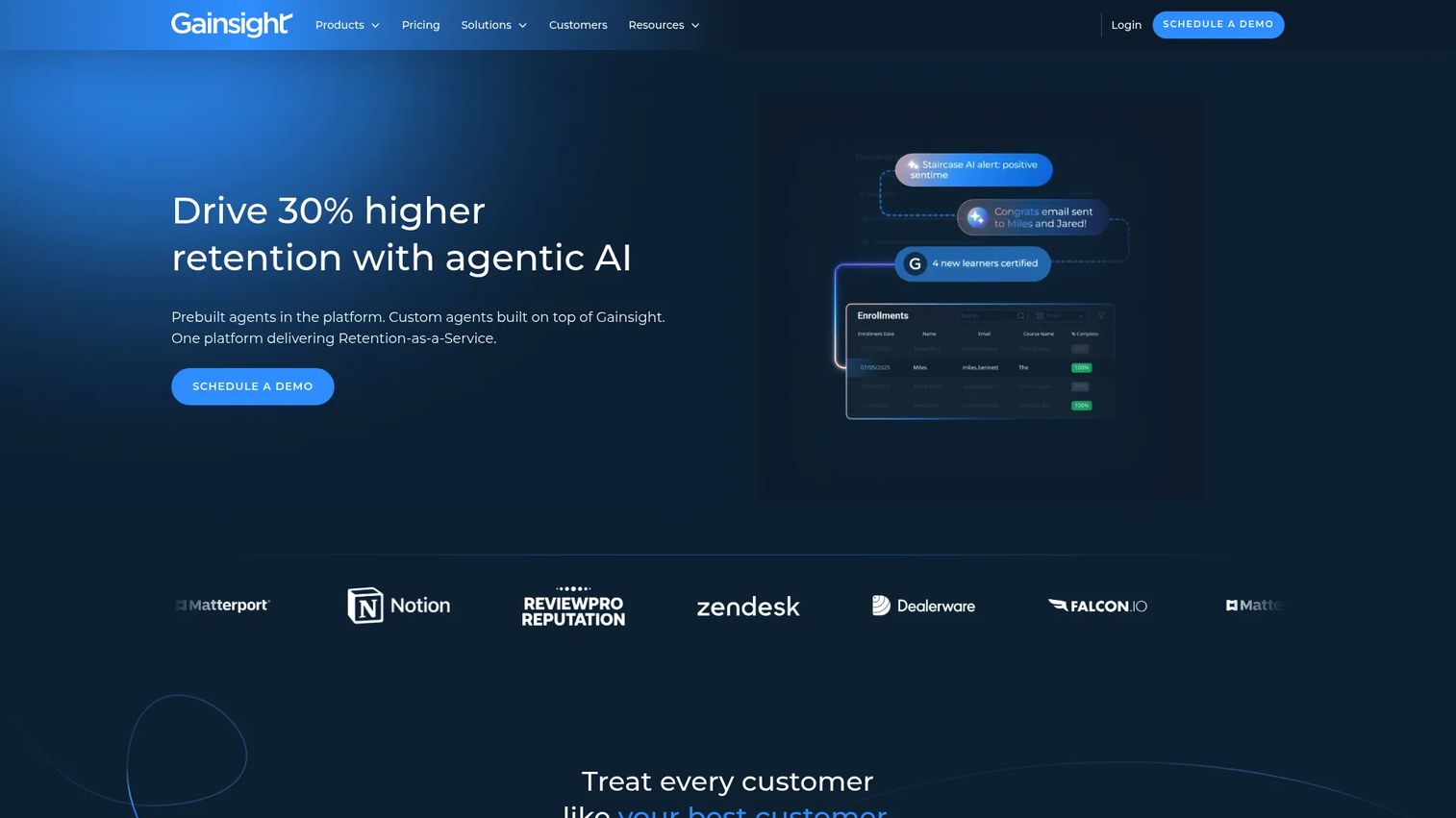
Gainsight is a customer success and customer experience platform built for retention, expansion, product adoption, communities, and education. Its AI focuses on predicting and preventing churn using broad customer intelligence, behavioral signals, and sentiment. For organizations that treat customer success as a formal operating model, Gainsight is the deep end of the category.
The strength is breadth of inputs. Gainsight pulls behavioral signals, sentiment, product usage, and support data into a customer intelligence layer that feeds proactive retention actions. This suits teams with the scale and headcount to run a mature CS motion across many segments.
Best for: B2B SaaS teams needing an enterprise customer success platform with deep data inputs and mature retention workflows.
Key strengths
- AI-driven churn prediction and prevention
- Customer intelligence across usage and sentiment
- Product Experience for adoption insight
- Customer Communities for engagement
- Proactive retention playbooks
Why choose Gainsight: If you are running customer success at enterprise scale and want a platform that models the entire lifecycle, Gainsight goes deeper than most. It rewards teams that have the operational maturity to use it fully.
Gainsight pricing: Gainsight does not display public pricing. The Essentials and Enterprise plans are quote-based, and a free trial is available for its Product Experience module.
4. Optimove
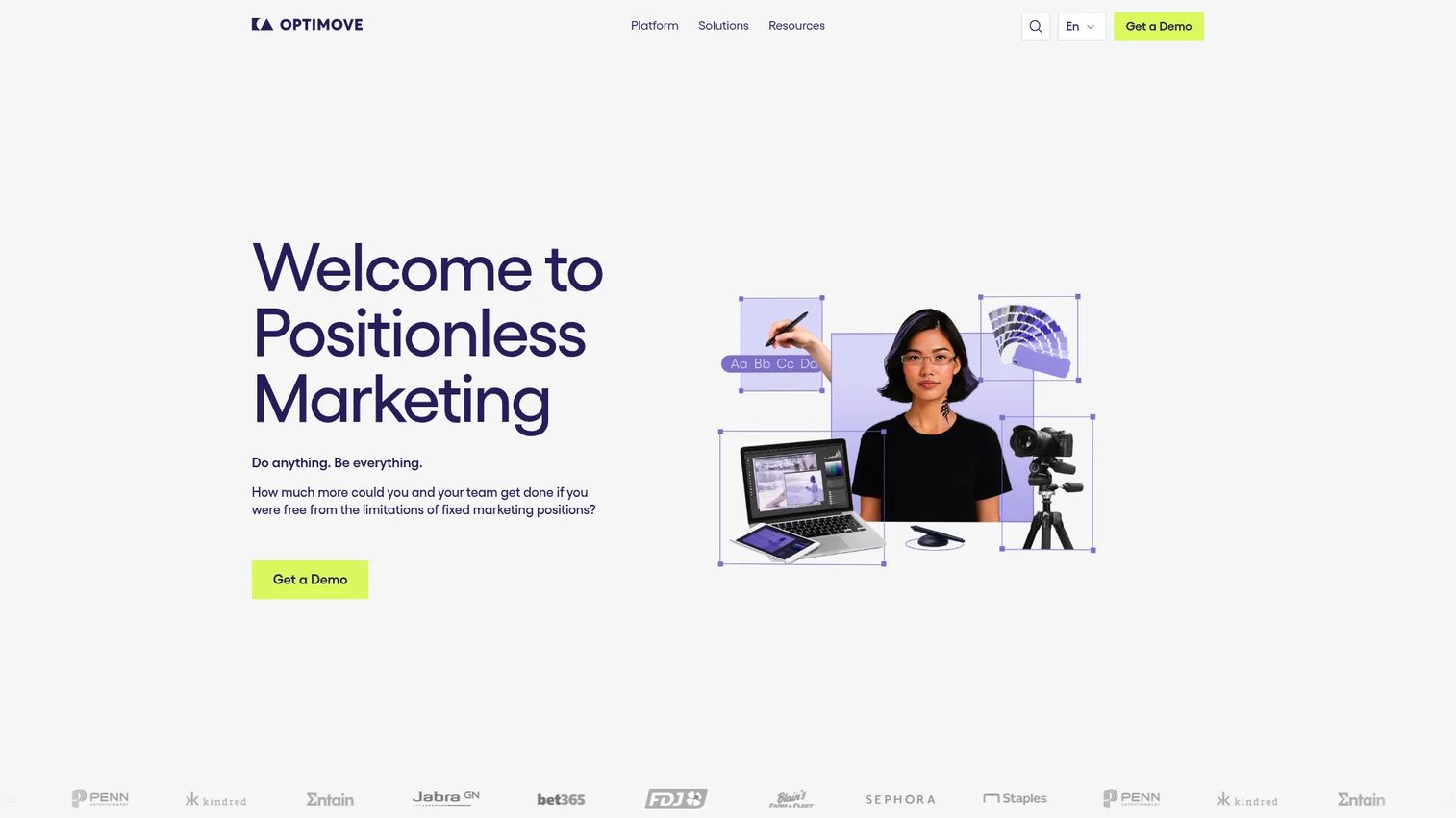
Optimove is a customer marketing and personalization platform that approaches churn from the retention marketing angle. It builds churn prediction models, identifies churn factors, and ties predictions to next-best action across channels. This is the tool for teams where retention is a marketing motion, not only a CS one.
Its strength is what happens after the prediction. Optimove connects churn risk to dynamic micro-segmentation and multichannel campaign execution across email, web, SMS, mobile, and more. A predicted at-risk segment can flow straight into a targeted retention campaign. That closes the loop between churn modeling and marketing action.
Best for: Mid-market to enterprise teams that run customer-led marketing orchestration and want retention tied to campaigns.
Key strengths
- Churn prediction models and churn factor analysis
- AI journey decisioning and orchestration
- Dynamic micro-segmentation
- Multichannel campaign execution
- Real-time personalization and AI agents
Why choose Optimove: If your retention strategy runs through marketing rather than a CSM-led motion, Optimove fits the workflow. It excels when the next-best action is a campaign, not a call.
Optimove pricing: Optimove does not publish public pricing. The site directs prospective buyers to request a demo and contact sales for a custom quote.
5. Totango
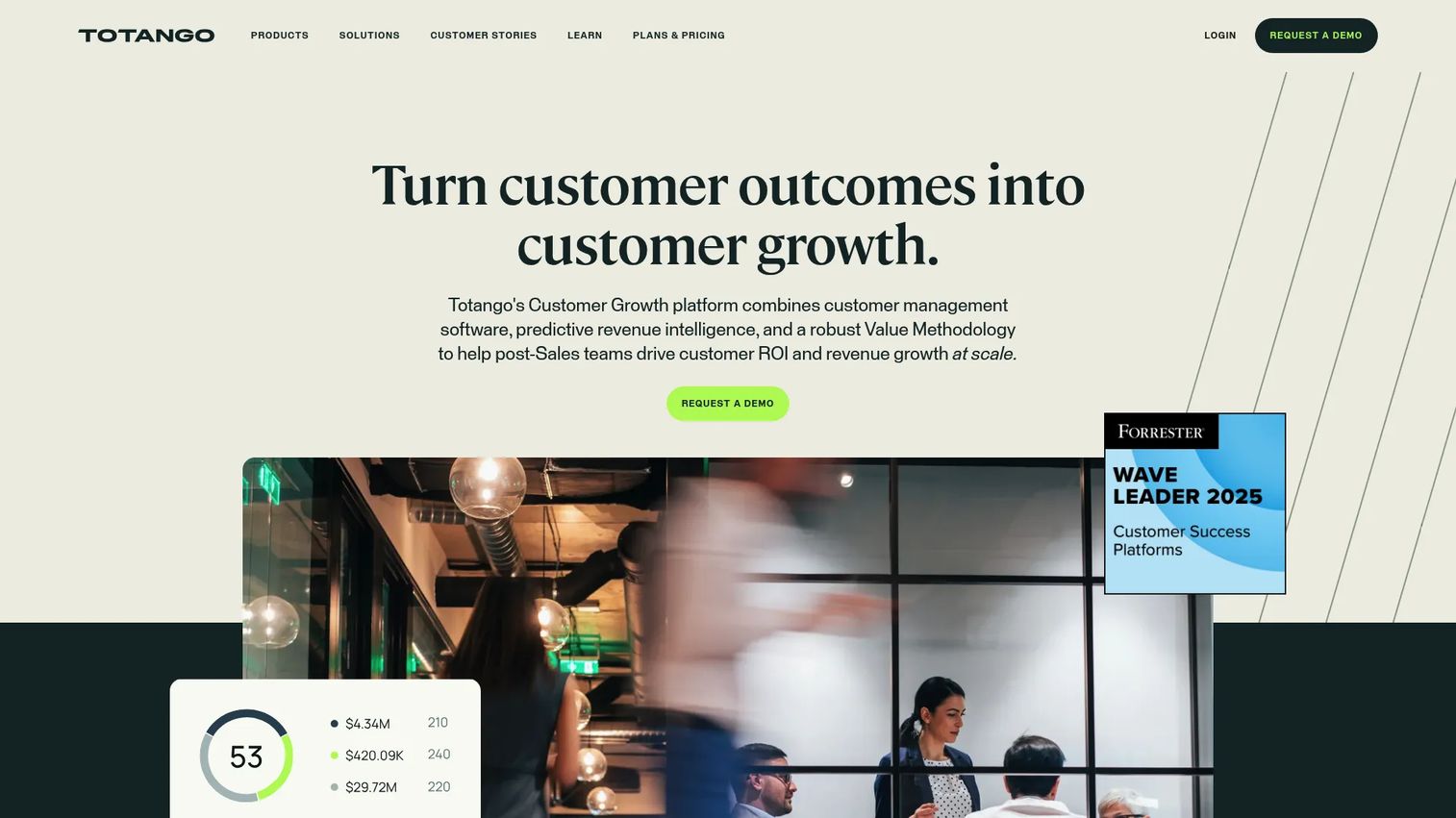
Totango is customer success and customer growth software focused on retention, expansion, and renewals. It leans toward practical actionability over complexity, which makes it a fit for teams that want to run health scoring and success plays without a long rollout. The multidimensional health scoring is the core of how it surfaces account risk.
Where Totango earns its spot is operational simplicity paired with real depth. Health scoring, segmentation, and workflows let CS teams monitor account risk and trigger success plays without over-engineering the setup. Teams that want to get to a working motion quickly tend to like it.
Best for: Enterprise teams needing customer success, health scoring, and expansion workflows they can operationalize fast.
Key strengths
- Multidimensional customer health scoring
- Customer segmentation
- Success plays and workflows
- Account risk monitoring
- Retention and expansion tracking
Why choose Totango: If you want a CS platform that prioritizes getting a working retention motion live over exhaustive configuration, Totango fits. It balances health scoring depth with practical workflow design.
Totango pricing: Totango does not display public pricing. Its plans (including Growth, Enterprise, and Premier tiers) are quote-based, with pricing available by contacting sales.
6. Custify
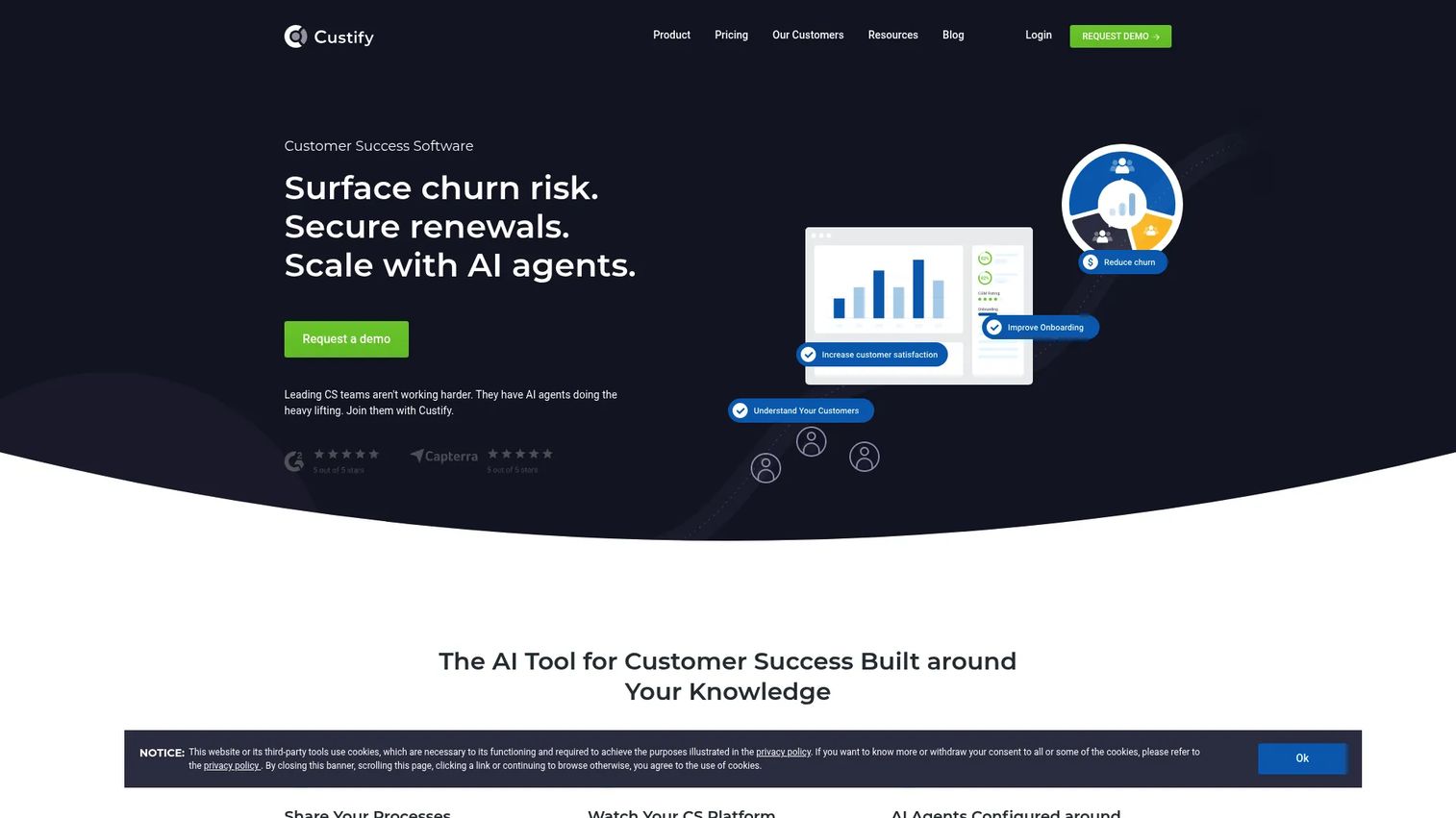
Custify is customer success software built for B2B SaaS teams that want to centralize customer data and automate their retention motion. Its focus is fast time to value and simpler adoption, which makes it a strong fit for SMB and mid-market teams that do not want an enterprise implementation project. Customer health monitoring and risk detection sit at the center.
The strength is how quickly a team can go from data to action. Custify's Customer 360, health scores, and automated playbooks let smaller CS teams detect risk and trigger retention workflows without heavy setup. For teams that need results in weeks, not quarters, that speed matters.
Best for: B2B SaaS teams that want to centralize customer data and automate customer success workflows without a long rollout.
Key strengths
- Customer 360 unified view
- Health scores for risk detection
- Automation and playbooks
- Automated alerts on account risk
- Retention workflows for SMB and mid-market
Why choose Custify: If your team is SMB or mid-market and wants churn prediction software with alerts that ships fast, Custify fits. It trades enterprise-scale configuration for speed and simpler adoption.
Custify pricing: Custify presents pricing as flexible and does not publish fixed numeric tiers on its site. Pricing is available by contacting the Custify team.
7. Churn360
Churn360 was an AI-powered customer success platform built for SaaS retention and churn reduction, covering a 360 view of customers, health scoring, customer journey insight, and retention plays. We include it here for completeness because it still appears in many churn prediction software searches and comparison lists.
Important context for 2026 buyers: Churn360's own site states the product ceased operations in May 2024. That means it is no longer a viable option for new buyers, and its features and pricing are historical rather than current.
Best for: Reference only. Churn360 is not suitable for new buyers because the product was shut down.
Key strengths
- 360 view of customers
- Health scoring
- Customer journey insight
- Segments, plays, and campaigns
- Push notifications and workspace
Why choose Churn360: For new evaluations, you should not. If you previously used Churn360, this list gives you six active alternatives to migrate toward, with ChurnZero, Custify, and Totango being the closest functional replacements depending on team size.
Churn360 pricing: Not available. Churn360's pricing page confirms the product ceased operations and no longer offers plans.
Considerations
Before you buy, run the shortlist through this checklist. It is easy to get impressed by a slick dashboard and miss the operational realities that decide whether the tool actually reduces churn.
Data inputs and signal quality
A churn prediction model is only as good as what feeds it. Confirm the tool ingests your real signals: product usage, support tickets, sentiment, and billing history. If the integrations are shallow, the predictions will be too. Ask how the model handles sparse data on newer accounts.
Explainability and trust
A risk score your team does not trust is a score your team ignores. Prioritize explainable churn prediction that shows why an account is flagged. CSMs act on reasons, not black boxes. If the vendor cannot explain the drivers, treat the prediction with skepticism.
Workflow activation
Prediction without action is a report. Check that risk scores can trigger tasks, plays, and owner assignments inside your existing CS motion. The tools that reduce churn are the ones that turn a signal into a next step automatically.
Alerts and playbooks
Look for churn prediction software with real-time alerts that reach people where they work, in Slack and your CRM. Then confirm those alerts connect to playbooks, so a red account does not just notify someone, it starts a defined response.
Reporting and forecasting value
Beyond single accounts, leadership needs aggregate revenue risk and renewal forecasting. Strong retention analytics and forecast accuracy let RevOps and CS leaders plan, not just react.
Conclusion
Churn is a pattern, not a single event, and the right software turns that pattern into action before renewal. For most CS teams, ChurnZero is the strongest all-around pick because it pairs health scoring with retention plays in one place. Teams already invested in Pendo should look at Pendo Predict for explainable signals inside their stack. Enterprises running a mature CS operating model will get the most from Gainsight, while marketing-led retention teams fit Optimove. If you want practical speed, Totango and Custify both get you to a working motion quickly.
Start with your workflow, not the feature list. Pick the tool that surfaces risk, explains it, and pushes your team into the next step where they already work. That is what separates customer churn prevention that actually happens from another dashboard nobody opens.
Want to see how interactive product experiences can support customer education and onboarding across your success motion? Start your journey with Guideflow today!
FAQs
Churn prediction software uses machine learning to score which customers are likely to cancel, downgrade, or not renew. It analyzes usage, support, sentiment, and renewal data to flag at-risk accounts early, so teams can act before revenue is lost. The best tools also explain why an account is at risk.
It ingests signals from across the customer relationship, then runs them through a churn prediction model that outputs a risk score per account. The model is trained on historical churn to weight which signals matter most. Strong platforms surface the drivers behind each score and route at-risk accounts into a retention workflow.
Most platforms use product usage data (logins, feature adoption, active seats), engagement data (email opens, QBR attendance), support data (ticket volume and severity), sentiment data (NPS, CSAT), and renewal and billing history. The more of these signals a tool can ingest cleanly, the more reliable its predictions.
They overlap but are not identical. Customer health scoring aggregates signals into a current health snapshot, often rule-based. Churn prediction uses machine learning to forecast future churn risk. Many platforms combine both, using health scores as inputs to a predictive model.
Customer success, RevOps, CS ops, and SaaS founders benefit most. CS teams use it to prioritize accounts and prepare for renewals. RevOps uses it for forecast accuracy. Marketing-led retention teams use it to trigger campaigns. Any team responsible for retention, renewals, or expansion gains from earlier risk visibility.
Accuracy depends heavily on data quality and how much historical churn the model has to learn from. Newer accounts with sparse data are harder to predict than mature ones. Treat the score as a prioritization signal, not a guarantee, and pair it with human judgment and explainable drivers.
Yes. Leading churn prediction software with real-time alerts pushes notifications into Slack and CRMs like Salesforce when a risk score crosses a threshold. The strongest tools connect those alerts to playbooks, so a flagged account automatically kicks off a defined retention response rather than just notifying someone.
Prediction identifies which accounts are at risk and why. Prevention is the action you take next: the outreach, the play, the executive alignment. Customer churn prediction and prevention only work together when the prediction triggers a workflow. A risk score that no one acts on changes nothing.