A subscription renewal fails silently at 2 a.m. The card on file expired last week. Nobody caught it. Three days later, a customer emails asking why they lost access, and now a support agent, a billing admin, and an account manager are all untangling a problem that a retry rule should have solved on its own.
That is the daily reality when renewals, invoices, and failed payments run on spreadsheets or a payment processor that was never built for subscriptions. Every missed retry is churn you did not choose. Every manual invoice is a chance for a pricing error that pollutes your CRM and confuses the next sales handoff.
The stakes are getting bigger. The global subscription billing software market is projected to grow from $10.77 billion in 2026 to $19.66 billion by 2030, a 16.2% compound annual growth rate, according to ResearchAndMarkets (2024). More businesses are moving to recurring revenue, which means more billing complexity, more revenue recognition rules, and more pressure to get quote-to-cash right the first time.
Sales enablement and revenue teams feel this indirectly but constantly. Billing accuracy shapes pricing consistency, clean CRM data, and smooth handoffs between sales and finance. If you are evaluating the operational tools that keep a go-to-market motion honest, the same discipline that goes into picking a marketing automation platform or a customer data platform applies to billing. It is worth doing right, and it is worth documenting the way you would evaluate any contract lifecycle management decision.
What's inside
This guide compares seven recurring billing and subscription management platforms built for 2026. We selected each tool based on four criteria that matter most to finance, RevOps, and revenue teams: billing automation depth (renewals, retries, invoicing), pricing flexibility across subscription, usage-based, and hybrid billing, compliance and revenue recognition support, and the strength of integrations into your CRM, ERP, and payment stack. Every pricing figure and rating below reflects verified public sources. Use it as a shortlist, not a final answer, and pressure-test the top two against your own quote-to-cash workflow before you commit.
TL;DR
- Best for built-in payments and billing infrastructure: Stripe Billing pairs subscription billing with native payment collection and recovery in one stack.
- Best for subscription lifecycle and retention: Recurly leads on dunning management, revenue recovery, and lifecycle analytics for subscription businesses.
- Best for pricing flexibility: Chargebee gives SaaS teams room to package, meter, and adjust plans without re-plumbing billing.
- Best for enterprise complexity: Zuora Billing handles intricate monetization rules and governance at scale.
- Best for finance-led SaaS teams: Maxio combines subscription billing with SaaS revenue analytics.
- Best for accounting-heavy buyers: Sage Intacct anchors recurring billing inside strong multi-entity accounting and revenue automation.
What is recurring billing software?
Recurring billing software automates the process of charging customers on a repeating schedule, managing subscriptions, invoices, renewals, and failed payment recovery without manual intervention. It sits at the center of any subscription or recurring payments business, connecting the pricing you sell to the money you collect and the revenue you report.
A capable platform does more than send an invoice on the first of the month. It manages the full subscription lifecycle: sign-up, upgrades, downgrades, pauses, cancellations, and renewals. It retries failed charges intelligently. It recognizes revenue in line with accounting standards. And it feeds clean data back into the systems your sales and finance teams already rely on.
Core capabilities to expect from subscription management software:
- Subscription management: Create and manage plans, add-ons, trials, upgrades, downgrades, and cancellations across the customer lifecycle.
- Automated invoicing and renewals: Generate invoices and process renewals on schedule without manual work.
- Dunning management and failed payment recovery: Retry declined cards, send reminders, and recover revenue that would otherwise churn.
- Flexible pricing models: Support flat-rate subscription billing, usage-based billing, tiered, and hybrid billing in one system.
- Revenue recognition: Automate ASC 606 and IFRS 15 compliance and produce audit-ready records.
- Customer portal and invoice management: Give customers a self-service billing portal to update payment methods and view invoices.
- Reporting and analytics: Track MRR, churn, expansion, and forecast revenue with real-time visibility.
- Integrations: Sync with CRM, ERP, accounting, and payment gateways to keep quote-to-cash consistent.
The distinction that matters most: a payment processor moves money, but recurring billing software manages the entire subscription and revenue operation around that money.
When to use recurring billing software
Not every business needs a dedicated billing platform on day one. These three situations are the clearest signals that you have outgrown spreadsheets or a bare payment processor.
Automate renewals and reduce failed payments
If a person has to remember to charge a customer, revenue leaks. Failed payments are the quiet killer of recurring revenue: cards expire, banks decline, and networks time out. Dunning management automates retries on a smart schedule and prompts customers to fix their payment details before access lapses. Strong failed payment recovery can recover a meaningful share of would-be involuntary churn, which is why it is often the first feature buyers evaluate.
Support subscription, usage-based, and hybrid pricing
Pricing rarely stays simple. You launch a flat monthly plan, then add a usage-based tier, then a hybrid billing model that combines a base fee with metered overages. Doing this in spreadsheets breaks fast. Recurring billing software lets you model, meter, and change pricing without rebuilding your billing logic every time product marketing ships a new package.
Improve revenue visibility and accounting alignment
Finance needs revenue recognition that holds up under audit, and leadership needs real-time revenue visibility. A billing platform that automates ASC 606 and IFRS 15 and syncs cleanly to your ERP removes the month-end scramble. It also keeps pricing and contract data consistent across sales, finance, and success, which reduces the handoff errors that slow deals down. The same governance mindset applies whether you are evaluating billing or contract management software.
Comparison table
The table below summarizes each platform by primary intent, its strongest use case, verified public pricing, and current G2 rating. Pricing models differ widely, some charge a percentage of billing volume, others a flat monthly fee, so read the individual sections for the full picture before comparing sticker prices.
| # | Product | Intent | Key use case | Pricing | G2 rating |
|---|---|---|---|---|---|
| 1 | Stripe Billing | Payments plus billing in one stack | Subscription billing with integrated payment recovery | From 0.7% of billing volume; monthly tiers from $620/mo | 4.4/5 |
| 2 | Recurly | Subscription lifecycle and retention | Dunning and revenue recovery at scale | From $249/mo + 0.9% of billing volume | 4.0/5 |
| 3 | Chargebee | Flexible subscription monetization | Packaging and pricing flexibility for SaaS | Free tier; Performance $7,188/yr | 4.4/5 |
| 4 | Zuora Billing | Enterprise monetization and governance | Complex billing rules at scale | Custom pricing | 3.9/5 |
| 5 | Maxio | Finance-led SaaS billing and analytics | Billing plus SaaS revenue metrics | From $599/mo | 4.3/5 |
| 6 | Sage Intacct | Accounting-first billing | Revenue automation inside accounting | Custom pricing | 4.3/5 |
| 7 | Billsby | Lightweight recurring billing | Quick launch for lean teams | Free tier; Core $45/mo | 4.8/5 |
1. Stripe Billing
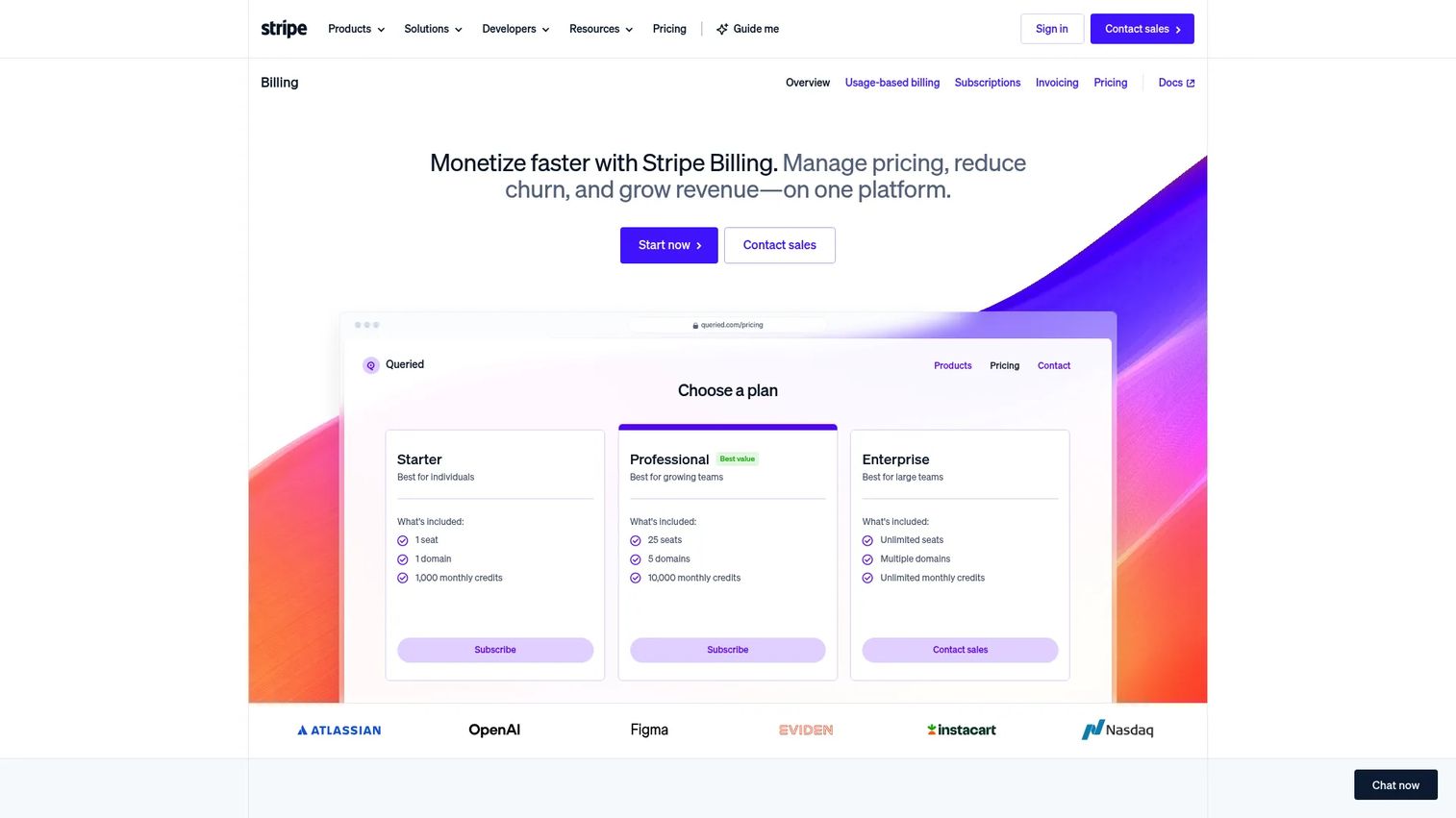
Stripe Billing is Stripe's subscription and recurring billing layer, and its defining advantage is that billing and payments live in the same stack. You manage subscriptions, invoices, and payment recovery without stitching a billing tool to a separate processor. That single-stack design cuts reconciliation headaches and keeps your payment data and billing data in lockstep, which matters when finance and sales both pull from the same source.
Stripe supports recurring billing, usage-based billing, and hybrid pricing, so you can start with a flat subscription and layer in metered charges as your model matures. Smart Retries uses machine learning to time failed payment recovery attempts, and hosted invoice pages plus a customer portal let subscribers manage their own billing without a support ticket. Its global payments footprint makes it a natural fit for businesses selling across currencies and regions.
Best for: Teams that want subscription billing with integrated payment collection and recovery in a single platform.
Key strengths
- Payments and billing unified: One stack for charging, invoicing, and recovery, no processor-to-billing handoff.
- Smart Retries: Machine-learning-timed retries to recover more failed payments automatically.
- Customer portal and hosted invoices: Self-service billing portal and hosted invoice pages reduce support load.
Why choose Stripe Billing: It is the strongest choice for product-led, usage-based, or globally scaled businesses that are already running on Stripe payments or want to consolidate. If your team values one system of record for money movement and subscription state, the unified model is hard to beat.
Stripe Billing pricing: Stripe Billing offers pay-as-you-go pricing at 0.7% of billing volume, with monthly subscription tiers starting at $620 per month on a one-year contract and rising through $1,500, $2,950, and $5,750 tiers. Custom pricing is available for larger needs. A custom domain for the customer portal costs $10 per month. There is no free tier.
2. Recurly
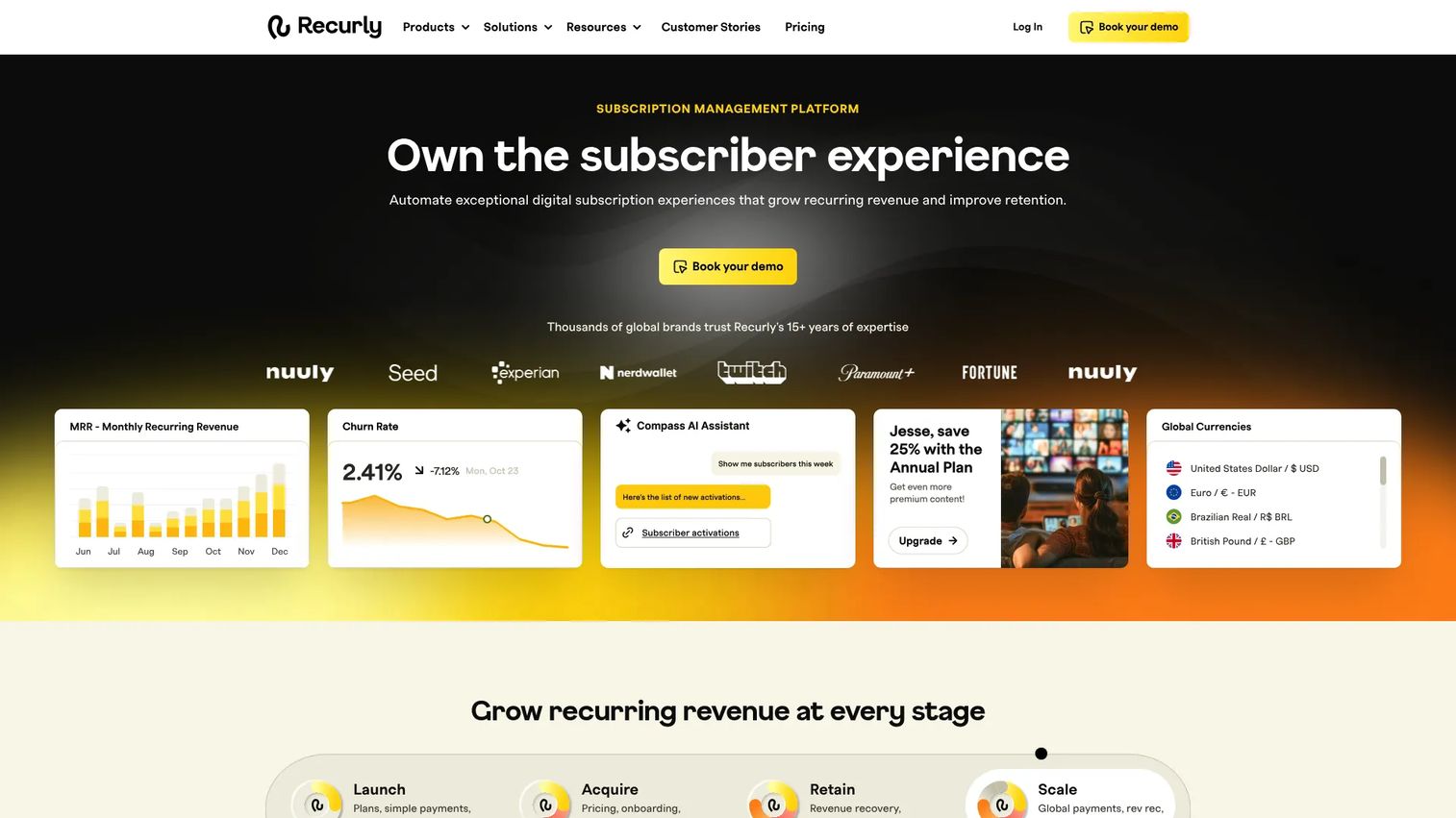
Recurly is a subscription management and recurring billing platform built for businesses that treat retention as a growth lever. Where some tools stop at invoicing, Recurly leans hard into keeping subscribers and recovering revenue that would otherwise slip away. That makes it a favorite for finance and growth teams who watch churn as closely as new bookings.
The platform supports fixed recurring, usage-based, tiered, volume, stairstep, and hybrid pricing, so pricing changes rarely require re-architecture. Its dunning management and revenue recovery tooling automate retries and reminders to reduce involuntary churn, and Recurly Compass surfaces subscription analytics that help teams understand lifecycle behavior. With support for more than 140 currencies, it scales across global subscriber bases.
Best for: Subscription businesses that need recurring billing and subscription management at scale, with a strong retention motion.
Key strengths
- Revenue recovery and dunning: Automated retries and reminders that reduce involuntary churn.
- Flexible pricing models: Fixed, usage-based, tiered, volume, stairstep, and hybrid billing in one system.
- Recurly Compass analytics: Subscription lifecycle insights for finance and growth teams.
Why choose Recurly: If retention and failed payment recovery are your top priorities, Recurly's lifecycle focus pays off. Finance teams get the revenue visibility they need, and growth teams get levers to reduce churn without engineering work.
Recurly pricing: The Starter plan runs $249 per month plus 0.9% of billing volume, and includes the first $40,000 of billings each month at no charge. The All-Access plan is billed annually at as low as under 1% of billing volume and requires a $1 million billing volume minimum. Custom and talk-terms commercial options are available. There is no free tier.
3. Chargebee
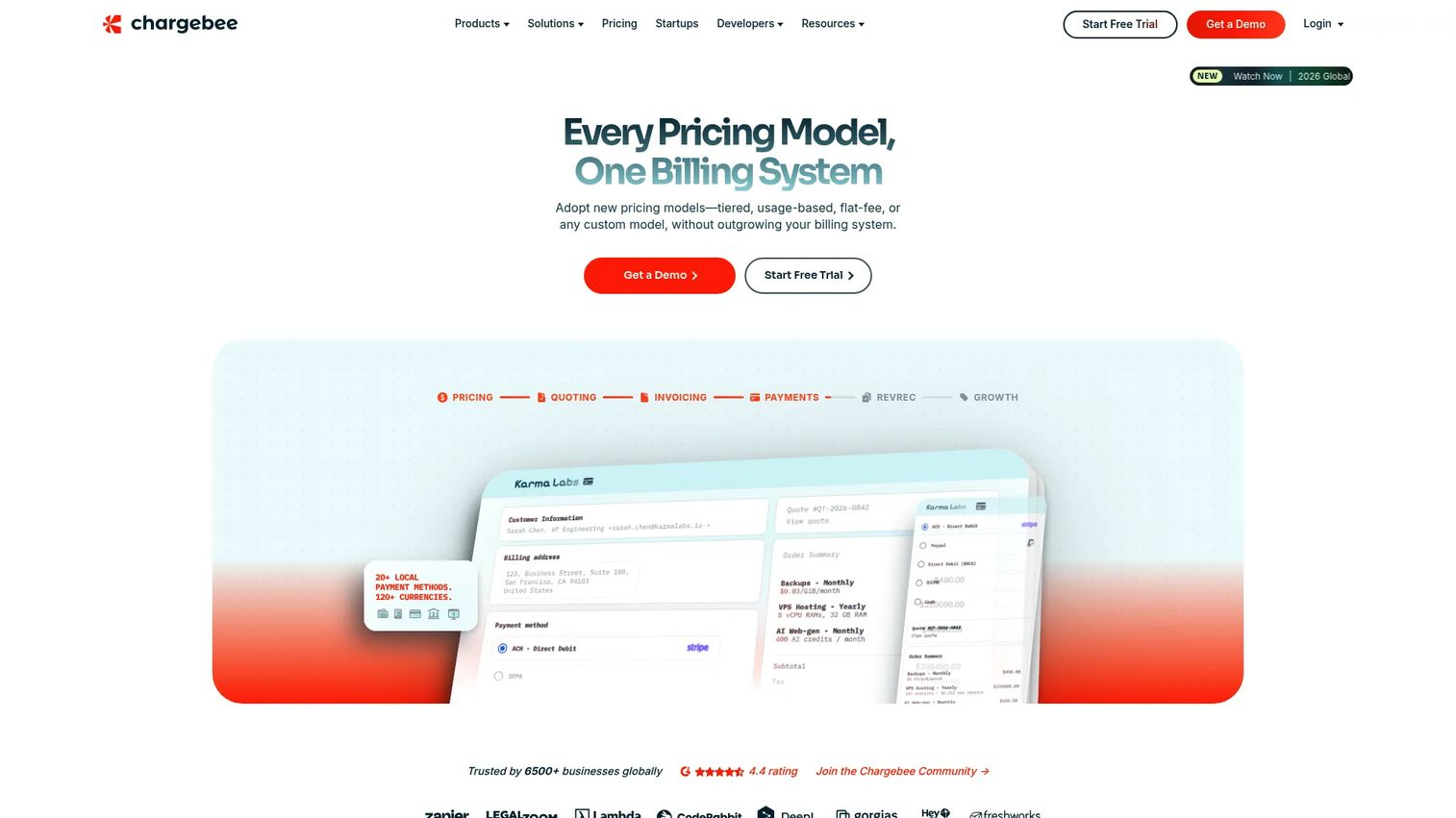
Chargebee is a subscription billing and monetization platform for recurring revenue businesses, and its calling card is pricing flexibility. When product marketing wants to test a new package, add a usage tier, or run a promotion, Chargebee is built to absorb that change without a billing rebuild. That freedom is why it appeals to SaaS and digital businesses iterating on how they charge.
The platform automates subscription billing, supports usage-based and hybrid pricing, and handles revenue recognition and reporting so finance stays audit-ready. Its revenue operations tooling and broad integration catalog connect billing to the rest of the stack, keeping quote-to-cash consistent across CRM and accounting. For teams that value packaging agility, that combination is the draw.
Best for: SaaS and subscription businesses balancing pricing flexibility with dependable billing automation.
Key strengths
- Subscription billing automation: Hands-off renewals, invoicing, and proration.
- Usage-based and hybrid pricing: Meter and combine pricing models without re-plumbing billing.
- Revenue recognition and reporting: Audit-ready records plus subscription analytics.
Why choose Chargebee: Choose it when your pricing is a moving target. Teams that expect to package, meter, and re-price frequently get a platform designed to keep up, without dragging engineering into every change.
Chargebee pricing: The Starter plan is free up to $250,000 in cumulative billing, then charges 0.75% on billing. The Performance plan is $7,188 per year, billed monthly, for up to $100,000 in billing per month. Enterprise pricing is quote-based. A free tier is available.
4. Zuora Billing
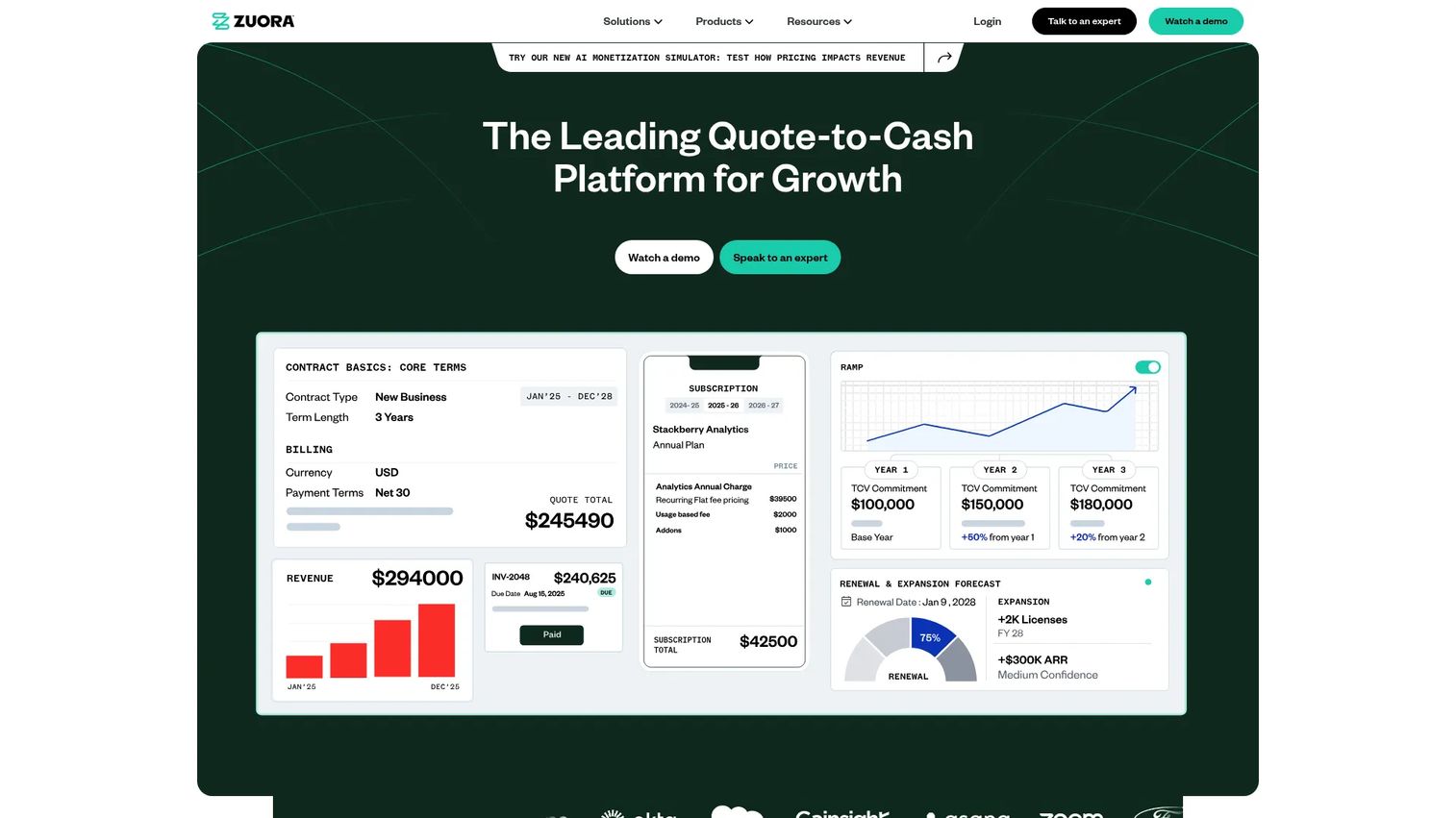
Zuora Billing is enterprise recurring billing and monetization software built for organizations with genuinely complex billing rules. When you have thousands of pricing permutations, multi-entity structures, and strict governance requirements, Zuora is engineered to handle the intricacy that lighter tools are not built for. It is a platform for scale and process control.
The system offers flexible pricing and packaging across recurring, usage-based, and hybrid billing, with usage metering, invoicing, tax, and global payments orchestration in one place. Its revenue recognition capabilities and enterprise integration depth make it a fit for large finance and RevOps organizations that need billing to slot into a wider, tightly governed quote-to-cash architecture.
Best for: Large enterprises with complex subscription and usage billing rules and strong governance needs.
Key strengths
- Flexible pricing and packaging: Model intricate pricing across recurring, usage, and hybrid billing.
- Usage metering and orchestration: Metering, invoicing, tax, and global payments in one system.
- Enterprise integration depth: Built to connect into complex ERP and finance stacks.
Why choose Zuora Billing: When billing complexity and governance are the constraint, Zuora's depth earns its place. It is the platform for organizations whose monetization rules would overwhelm a lighter tool.
Zuora Billing pricing: Zuora does not publish public pricing; plans are quote-based and tailored to enterprise requirements. Contact their sales team for a quote scoped to your billing volume and complexity.
5. Maxio
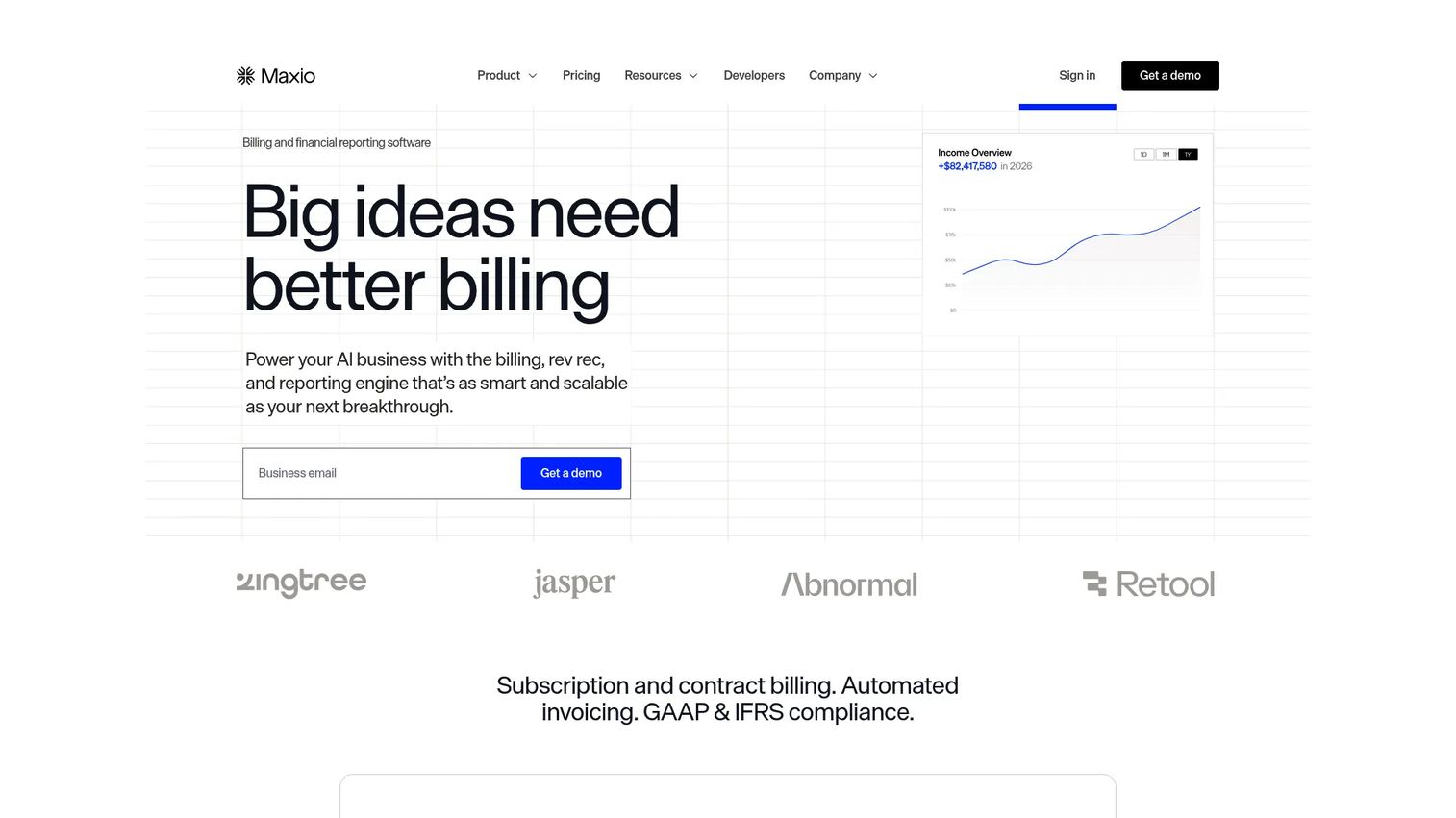
Maxio is a financial operations platform for B2B SaaS that pairs recurring billing with the revenue analytics finance teams actually need. Instead of treating billing and reporting as separate tools, Maxio brings subscription management and SaaS metrics under one roof, which is why finance-led teams gravitate toward it.
The platform covers offer management, recurring billing, subscription management, and revenue retention, plus the metrics and analytics that drive board decks and forecasts. It supports the accounting workflows SaaS finance teams live in, from revenue recognition to churn and expansion reporting, so month-end and investor reporting draw from the same clean source.
Best for: B2B SaaS companies that want subscription billing plus financial operations and SaaS revenue analytics in one place.
Key strengths
- Offer and subscription management: Manage plans, offers, and the full subscription lifecycle.
- Revenue retention tooling: Reduce churn and support expansion motions.
- SaaS metrics and analytics: Board-ready reporting on MRR, churn, and expansion.
Why choose Maxio: If your finance team wants billing and SaaS analytics unified rather than bolted together, Maxio fits. It is built for the recurring-revenue metrics that B2B SaaS leadership tracks every quarter.
Maxio pricing: The Grow plan starts at $599 per month. The Scale plan is quote-based. Agreements default to annual terms, with monthly and quarterly payment options available. There is no free tier.
6. Sage Intacct
Sage Intacct is cloud accounting and financial management software that approaches recurring billing from an accounting-first angle. Rather than being a billing tool that adds reporting, it is a finance platform where subscription billing and revenue automation live inside strong core accounting. For finance teams that prioritize accuracy and consolidation, that ordering matters.
The platform brings accounts payable and receivable automation, real-time dashboards and reporting, and multi-entity and multi-currency capabilities. That makes it a strong fit for organizations that need revenue accuracy, multi-entity reporting, and tight ERP-style synchronization across the quote-to-cash stack. Billing becomes one clean input into a rigorous financial system rather than a standalone process.
Best for: Mid-sized finance teams already using Sage Intacct or needing strong accounting alignment for subscription revenue.
Key strengths
- AP and AR automation: Automate receivables and payables alongside subscription revenue.
- Real-time dashboards: Live financial reporting for close and forecasting.
- Multi-entity and multi-currency: Consolidate revenue across entities and regions.
Why choose Sage Intacct: When accounting accuracy and consolidation drive the decision, Sage Intacct fits best. It is the pick for finance teams that want billing to serve a rigorous accounting system rather than sit outside it.
Sage Intacct pricing: Sage does not publish a public starting price. Pricing is custom and quote-based, tailored by module, industry, size, and needs. Contact Sage for a scoped quote.
7. Billsby

Billsby is subscription billing software aimed at teams that want to launch recurring revenue quickly without heavy setup. For startups and lean teams, its appeal is getting billing live fast with a clear pricing structure and the essentials in place, rather than configuring an enterprise platform they will not fully use.
The platform covers products, plans, and cycles with multiple pricing models, usage and metered billing plus add-ons and allowances, and an integrated checkout with multiple payment gateways, tax compliance, and reporting. That combination gives smaller teams a functional recurring billing setup and a customer portal without a long implementation.
Best for: Startups and lean teams that need a quick launch and simpler recurring billing workflows.
Key strengths
- Products, plans, and cycles: Multiple pricing models with straightforward configuration.
- Usage and metered billing: Add-ons and allowances alongside recurring plans.
- Integrated checkout: Multiple gateways, tax compliance, and reporting built in.
Why choose Billsby: When speed to launch and simplicity matter more than enterprise depth, Billsby delivers. It is well suited to smaller businesses that want dependable recurring billing without a heavy rollout.
Billsby pricing: The Free plan is $0 per month. Core is $45 per month and adds 0.4% on revenue exceeding $15,000 per month. Pro is $135 per month and adds 0.5% on revenue exceeding $30,000 per month. Custom pricing is available. A free tier and free plan are available.
Considerations before you buy
The right platform depends less on feature checklists and more on how billing fits your operation. Work through these criteria before you commit.
Billing model fit
Map your current and near-future pricing. If you sell flat subscriptions today but plan usage-based or hybrid billing next year, choose a platform that supports all three now. Re-platforming billing mid-growth is painful, so buy for where you are heading.
Failed payment recovery
Ask each vendor how their dunning management works: retry logic, timing, customer messaging, and reported recovery rates. Involuntary churn is often the largest, cheapest revenue to save, so weight this heavily in your evaluation.
Revenue recognition and compliance
If finance needs ASC 606 or IFRS 15 compliance, confirm the platform automates it and produces audit-ready records. Manual revenue recognition on top of a billing tool defeats the purpose and reintroduces the month-end scramble.
Integrations and quote-to-cash
Check how the platform syncs with your CRM, ERP, accounting, and payment gateways. Clean integration keeps pricing and contract data consistent across sales, finance, and success, which reduces handoff errors. Treat integration depth the way you would when comparing an account-based marketing platform or a loyalty management system, because the stack only works if the data flows.
Total cost as you scale
Percentage-of-volume pricing and flat monthly fees behave very differently as you grow. Model your billing volume 12 to 24 months out and compare projected cost, not just the entry price.
Conclusion
The best recurring billing software is the one that matches your billing complexity to the right depth of platform. Buy too light and you outgrow it in a year. Buy too heavy and you pay for governance you will not use.
For most businesses that want payments and billing unified in one stack, Stripe Billing is the strongest starting point, especially for product-led, usage-based, or global models. If retention and failed payment recovery drive your strategy, Recurly's lifecycle focus is hard to beat. Teams that expect frequent pricing changes should look hard at Chargebee, while large enterprises with complex governance needs will find their fit in Zuora Billing. Finance-led SaaS teams get billing and analytics together in Maxio, accounting-first buyers are best served by Sage Intacct, and lean teams that need a fast launch should start with Billsby.
Your next step is simple: shortlist two platforms that match your pricing model and revenue recognition needs, then run your real quote-to-cash workflow through each before signing. The demo that survives your actual billing edge cases is the one to buy.
Start your journey with Guideflow today!
FAQs
Recurring billing software automates charging customers on a repeating schedule and manages the full subscription lifecycle, including invoices, renewals, upgrades, cancellations, and failed payment recovery. It connects the pricing you sell to the money you collect and the revenue you report. Unlike a plain payment processor, it manages the entire subscription and revenue operation around each transaction.
It uses dunning management to recover revenue automatically. When a charge fails, the platform retries on an optimized schedule, prompts the customer to update their payment method, and sends reminders before access lapses. Smart retry logic times these attempts to maximize recovery, which reduces involuntary churn that would otherwise go uncaught.
Subscription billing charges a fixed amount on a repeating cycle, such as $50 per month regardless of usage. Usage-based billing charges according to consumption, such as per API call, seat, or gigabyte. Hybrid billing combines both, pairing a base subscription fee with metered overages. Most modern platforms support all three so pricing can evolve without re-platforming.
It depends on your priority. SaaS teams that want billing and payments unified often choose Stripe Billing, those focused on retention lean toward Recurly, and teams needing pricing flexibility favor Chargebee. Finance-led B2B SaaS companies that want billing plus revenue analytics gravitate to Maxio. Match the tool to your dominant need rather than a generic label.
If you report under ASC 606 or IFRS 15, or expect an audit, built-in revenue recognition saves significant manual work. It automates how and when revenue is recognized across contracts and produces audit-ready records. Smaller pre-audit businesses may defer this, but any company approaching a raise, audit, or scale event should prioritize it.
CRM, ERP, accounting, and payment gateway integrations matter most. These connections keep pricing, contract, and revenue data consistent across sales, finance, and customer success, which reduces the handoff errors that slow deals and pollute reporting. Before buying, confirm the platform supports your specific systems rather than assuming a generic connector exists.
Move when manual billing starts causing errors, missed renewals, or uncaught failed payments, usually as subscriber count and pricing complexity grow. Clear signals include spending real time each month on invoicing, losing revenue to expired cards, or struggling to produce accurate revenue reports. If billing mistakes are reaching customers or finance, you have already waited too long.