


Tracking affiliate referrals in spreadsheets works until it doesn't. One missed commission, one disputed payout, and your best partners start looking elsewhere.
Affiliate marketing software automates the tedious parts of running a partner program: link tracking, commission calculations, and payment processing. This guide compares 15 platforms across SaaS, e-commerce, and enterprise use cases, with honest takes on pricing, integrations, and which tools actually fit different business models.
What's inside
This guide covers 15 affiliate marketing software platforms that track referrals, manage partner commissions, and automate payouts. We selected tools based on how well they integrate with common payment processors and e-commerce platforms, the flexibility of their commission structures, and the quality of their partner portals. You'll find options for SaaS companies using Stripe, e-commerce brands on Shopify, and agencies managing multiple client programs.
TL;DR
Best for SaaS: Rewardful and FirstPromoter offer native Stripe integration and handle recurring commissions automatically
Best for e-commerce: Refersion and LeadDyno connect directly to Shopify and BigCommerce with product-level tracking
Best for high-volume programs: Everflow and impact.com provide enterprise-grade analytics and multi-client management
Key decision factors: Match software to your payment processor, evaluate the partner portal experience, and confirm fraud prevention capabilities
Price range: Free tiers exist for startups, mid-market tools run $50-200/month, enterprise platforms start at $500+/month
What is affiliate marketing software
Affiliate marketing software automates the core functions of running a partner program: tracking referral links, calculating commissions, and processing payments. Top solutions for 2025 include Rewardful for SaaS businesses, Refersion for e-commerce, and impact.com for enterprise networks. Prices range from free tiers to $750+ monthly depending on your affiliate volume and feature requirements.
How affiliate tracking and attribution works
Every affiliate program relies on a few technical mechanisms to connect sales back to the partner who drove them.
Unique tracking links: Each affiliate receives a distinct URL containing their identifier, and when a prospect clicks that link, the software logs the referral source
Cookie-based attribution: A small file stored in the visitor's browser tracks their journey from initial click to purchase, with cookie duration (typically 30-90 days) determining how long affiliates receive credit
Coupon code tracking: Some affiliates prefer sharing discount codes instead of links, and the software attributes sales when customers enter the affiliate's unique code at checkout
Multi-touch attribution: Advanced platforms can credit multiple touchpoints in the buyer journey, giving partial credit to affiliates who influenced the sale even if they weren't the last click
Types of affiliate software programs
The affiliate software market splits into two main categories. Standalone software means you manage your own program, recruit affiliates directly, and control all terms. Affiliate networks are marketplaces that connect you with existing affiliates who join through the network. Hybrid platforms combine both approaches.
Type | How it works | Best for |
|---|---|---|
Standalone software | You manage your own program and recruit affiliates directly | Brands wanting full ownership of partner relationships and data |
Affiliate networks | A marketplace connects you with existing affiliates | New programs needing quick access to a large pool of partners |
Hybrid platforms | Software that includes optional network access | Programs that want to combine direct recruitment with network scale |
Standalone software gives you more control and typically lower fees, while networks offer faster partner acquisition at the cost of shared data and commission percentages.
When to use affiliate management platforms
With U.S. affiliate marketing spend projected to exceed $13 billion in 2026, affiliate software becomes worth the investment when your partner channel grows beyond what spreadsheets can handle. If you're manually tracking referrals, calculating commissions in Excel, or chasing down payment details, you're likely losing both time and money.
SaaS and subscription businesses
Subscription companies face a unique challenge: commissions often recur with each renewal. Your affiliate software needs direct integration with payment processors like Stripe, Paddle, or Chargebee to track the full customer lifecycle. Look for platforms that automatically adjust commissions when customers upgrade, downgrade, or churn.
E-commerce and DTC brands
With over 90% of e-commerce businesses expected to leverage affiliate marketing by 2026, online stores require tight integration with platforms like Shopify, WooCommerce, or BigCommerce. Product-level commission tracking lets you offer different rates for high-margin items versus loss leaders. Order-based tracking ensures affiliates get credit for the exact products they promoted.
Agencies managing client programs
If you run affiliate programs for multiple clients, you'll want white-label capabilities, multi-client dashboards, and volume-based pricing. The partner portal can display your client's branding instead of the software vendor's logo.
Affiliate marketing software comparison table
No. | Product | Best for | Key differentiation | Pricing tier | G2 rating |
|---|---|---|---|---|---|
1 | Rewardful | Stripe-based SaaS | Native Stripe integration, simple setup | Mid-tier | 4.7 |
2 | Tapfiliate | Multi-program management | Supports affiliate, referral, and influencer programs | Mid-tier | 4.5 |
3 | impact.com | Enterprise partnerships | Full lifecycle management with marketplace | Enterprise | 4.6 |
4 | Trackdesk | Budget-conscious startups | Generous free tier with core features | Freemium | 4.8 |
5 | PartnerStack | B2B SaaS channels | B2B-focused marketplace and automated payouts | Mid-tier | 4.7 |
6 | Refersion | E-commerce brands | Deep Shopify/BigCommerce integration | Mid-tier | 4.3 |
7 | Post Affiliate Pro | Complex program needs | 200+ configurable features | Mid-tier | 4.5 |
8 | Everflow | High-volume agencies | Real-time analytics and API-first architecture | Enterprise | 4.8 |
9 | Affise | Performance networks | Smartlinks and advanced targeting | Enterprise | 4.5 |
10 | LeadDyno | Beginners | Simple onboarding and email integrations | Low-tier | 4.3 |
11 | FirstPromoter | SaaS with multiple processors | Stripe, Paddle, Chargebee support | Mid-tier | 4.6 |
12 | Reditus | B2B SaaS discovery | SaaS-specific affiliate marketplace | Mid-tier | 4.7 |
13 | Tune | Mobile and enterprise | Advanced mobile tracking and fraud prevention | Enterprise | 4.3 |
14 | Voluum | Media buyers | AI-powered campaign optimization | Mid-tier | 4.6 |
15 | Partnerize | Global enterprises | Flexible commissioning and multi-currency | Enterprise | 4.4 |
15 best affiliate tracking and management tools
1. Rewardful
Rewardful is built specifically for SaaS companies using Stripe. The platform's native integration means you can launch an affiliate program in minutes without complex technical setup. It automatically tracks recurring commissions, handling upgrades, downgrades, and cancellations without manual intervention.
Best for: Stripe-based SaaS businesses that want simple, reliable affiliate tracking for subscription revenue.
Key strengths
Direct Stripe integration with automatic subscription tracking
Handles recurring commissions across the entire customer lifecycle
Clean, self-serve affiliate portal for partner management
Quick setup with minimal technical requirements
Pricing tier: Mid-tier, starting around $29/month
2. Tapfiliate
Tapfiliate positions itself as a flexible platform for marketers who run multiple types of partner programs. You can manage traditional affiliates, customer referrals, and influencer campaigns from a single dashboard. The white-label portal lets you maintain brand consistency across all partner touchpoints.
Best for: Marketing teams managing affiliate, referral, and influencer programs simultaneously.
Key strengths
Supports multiple program types in one platform
White-label customization for branded partner experiences
Tiered commission structures to reward top performers
30-minute average setup time
Pricing tier: Mid-tier, starting around $89/month
3. Impact.com
impact.com goes beyond basic tracking to manage the entire partnership lifecycle. The platform includes partner discovery through its marketplace of vetted affiliates, influencers, and strategic partners across multiple verticals. Automated contracting eliminates back-and-forth negotiations with templated agreements and digital signatures. The cross-device tracking engine uses deterministic and probabilistic matching to follow customer journeys across mobile, desktop, and tablet - crediting affiliates even when purchases happen on different devices. Workflow automation handles repetitive tasks like partner approvals, payment scheduling, and performance alerts for programs managing hundreds or thousands of active relationships.
Best for: Enterprise brands and high-volume programs needing comprehensive partnership automation.
Key strengths
Full lifecycle management from discovery to optimization
Large marketplace for finding new partners
Cross-device tracking and advanced attribution
Automated workflows for contracting and payments
Pricing tier: Enterprise, custom pricing
4. Trackdesk
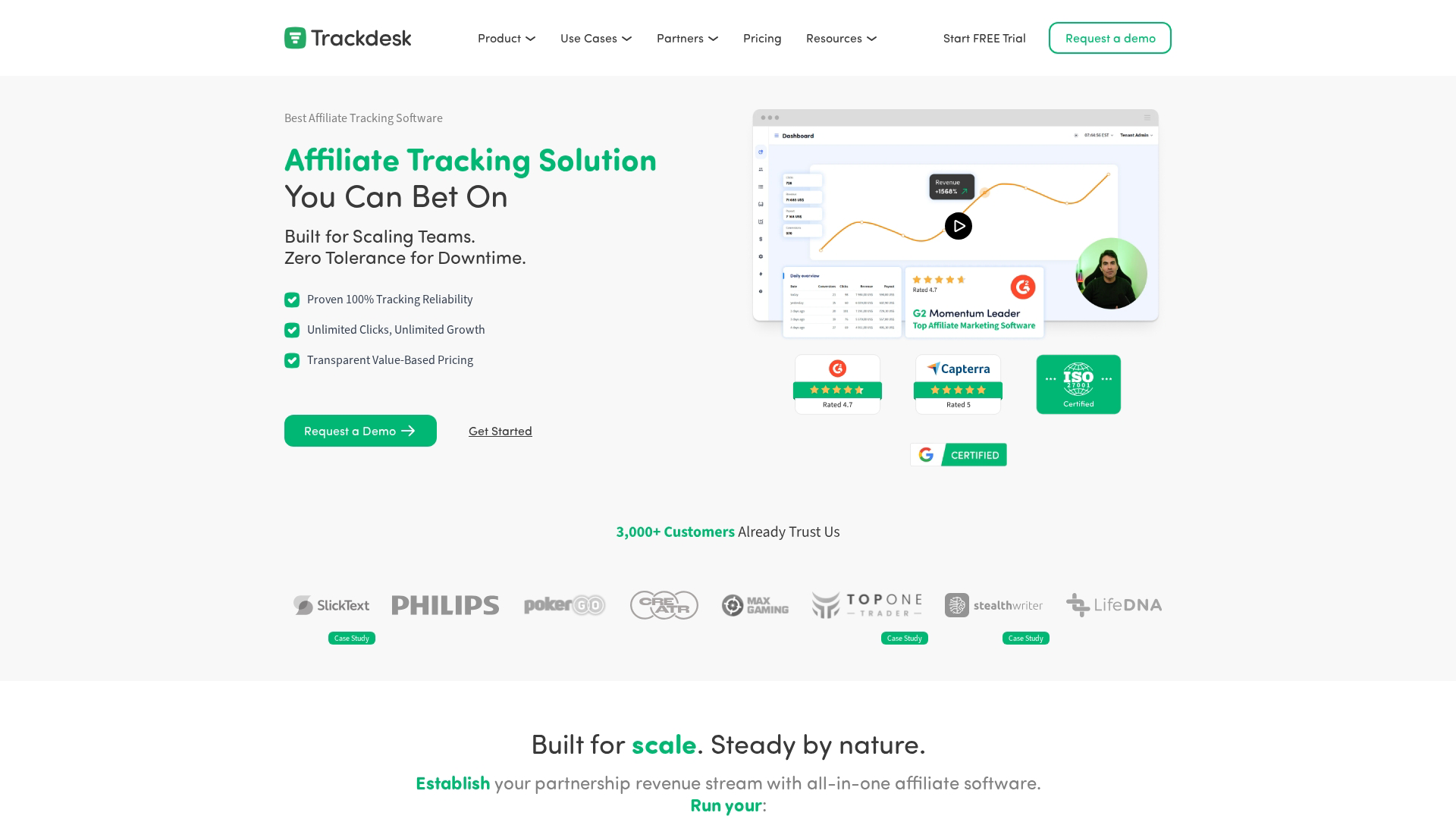
Trackdesk offers a generous free tier that includes essential tracking features - unlimited clicks, basic conversion tracking, and up to 10 active affiliates - making it accessible for startups testing affiliate marketing without upfront investment. The platform focuses on reliability and core functionality: accurate link tracking, straightforward commission calculations, and clean reporting dashboards. You won't find advanced features like multi-touch attribution or AI-powered optimization, but you also won't spend hours configuring settings you don't need. The interface prioritizes speed and stability over feature bloat, which means faster load times and fewer technical issues when you're just getting started.
Best for: Growing teams and startups looking for affordable, reliable affiliate tracking.
Key strengths
Free tier with meaningful functionality
Focus on tracking reliability over feature bloat
Simple interface for partnership basics
Cost-effective scaling as programs grow
Pricing tier: Freemium, paid plans from $67/month
5. PartnerStack
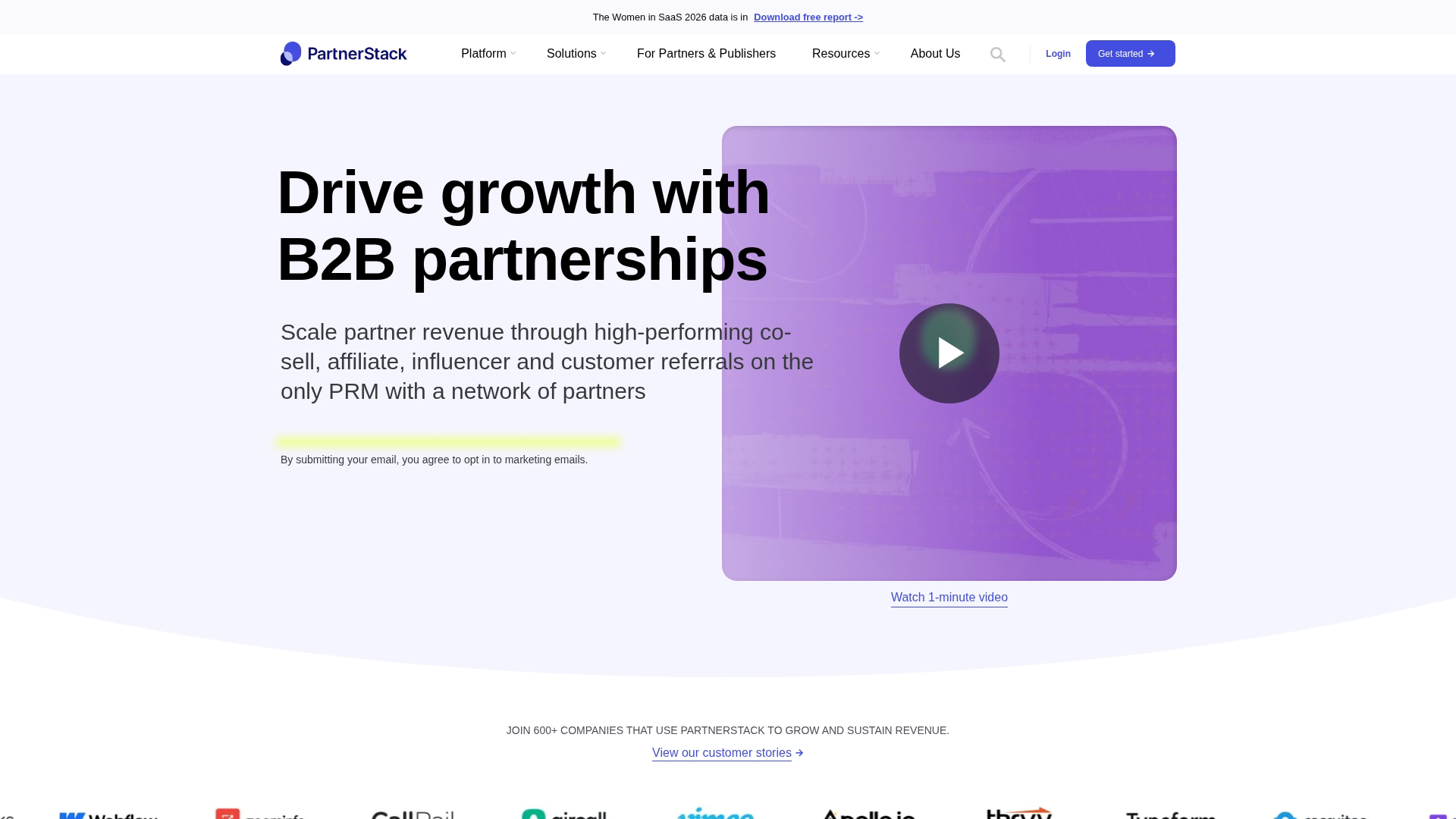
PartnerStack combines program management with a network of B2B-focused partners. The marketplace helps SaaS companies find affiliates who already understand software sales. Automated payouts and compliance features reduce operational overhead for growing programs.
Best for: B2B SaaS companies building channel partnerships.
Key strengths
B2B-focused partner marketplace
Automated payouts with tax compliance
Partner engagement and activation tools
Clear revenue attribution for channel sales
Pricing tier: Mid-tier to enterprise, custom pricing
6. Refersion
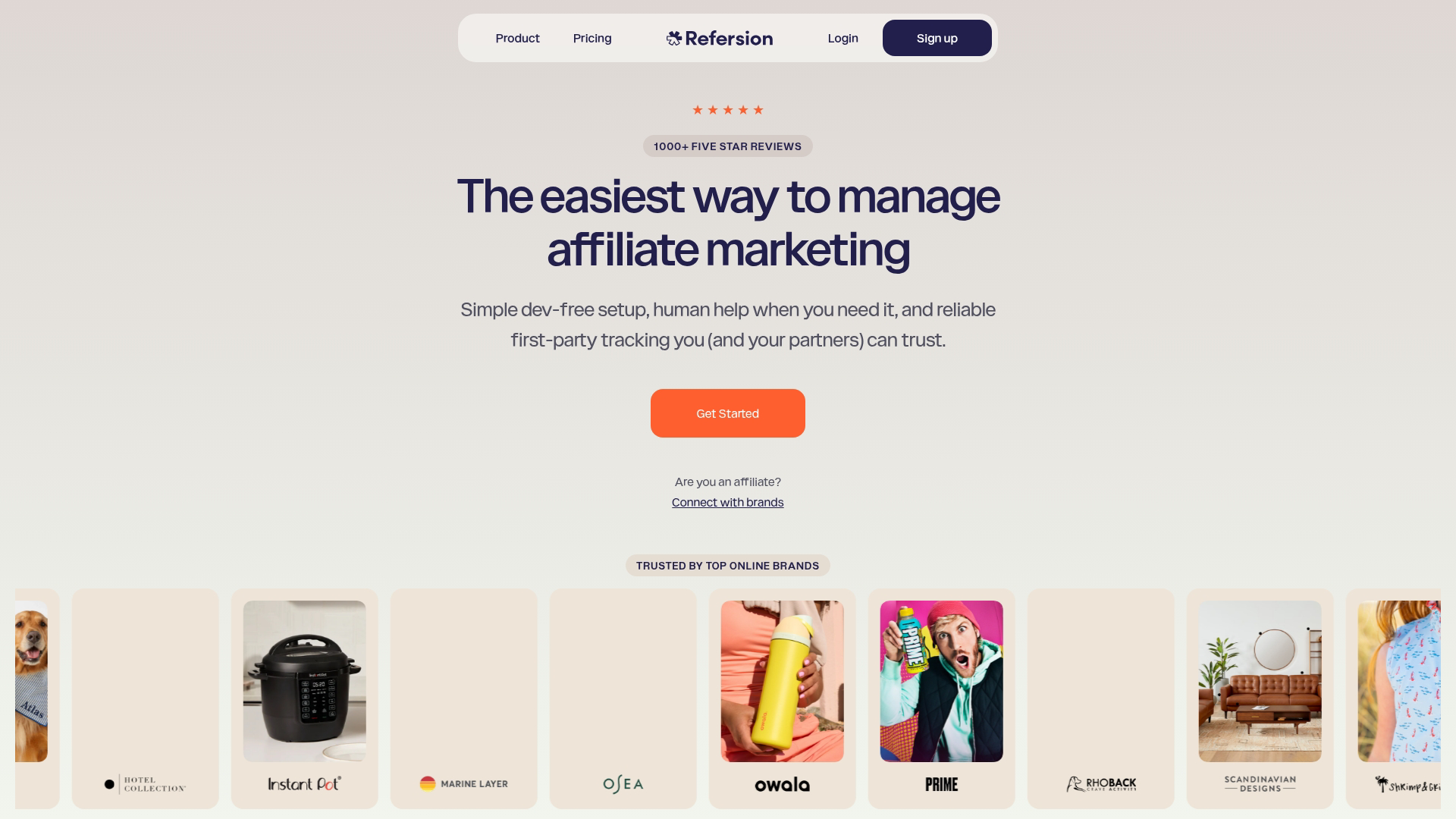
Refersion is built for e-commerce, with deep integrations for Shopify and BigCommerce that sync order data, customer information, and product catalogs automatically. The platform handles influencer management alongside traditional affiliates, letting you track both link-based referrals and social media campaigns from a single dashboard. Product-level commission tracking means you can set different rates for specific SKUs or collections—useful when you want to push high-margin items or clear seasonal inventory through your affiliate channel.
Best for: E-commerce and DTC brands on Shopify or BigCommerce.
Key strengths
Native Shopify and BigCommerce integrations
Influencer relationship management
Product-level commission tracking
Customizable branded affiliate portal
Pricing tier: Mid-tier, starting around $99/month
7. Post Affiliate Pro
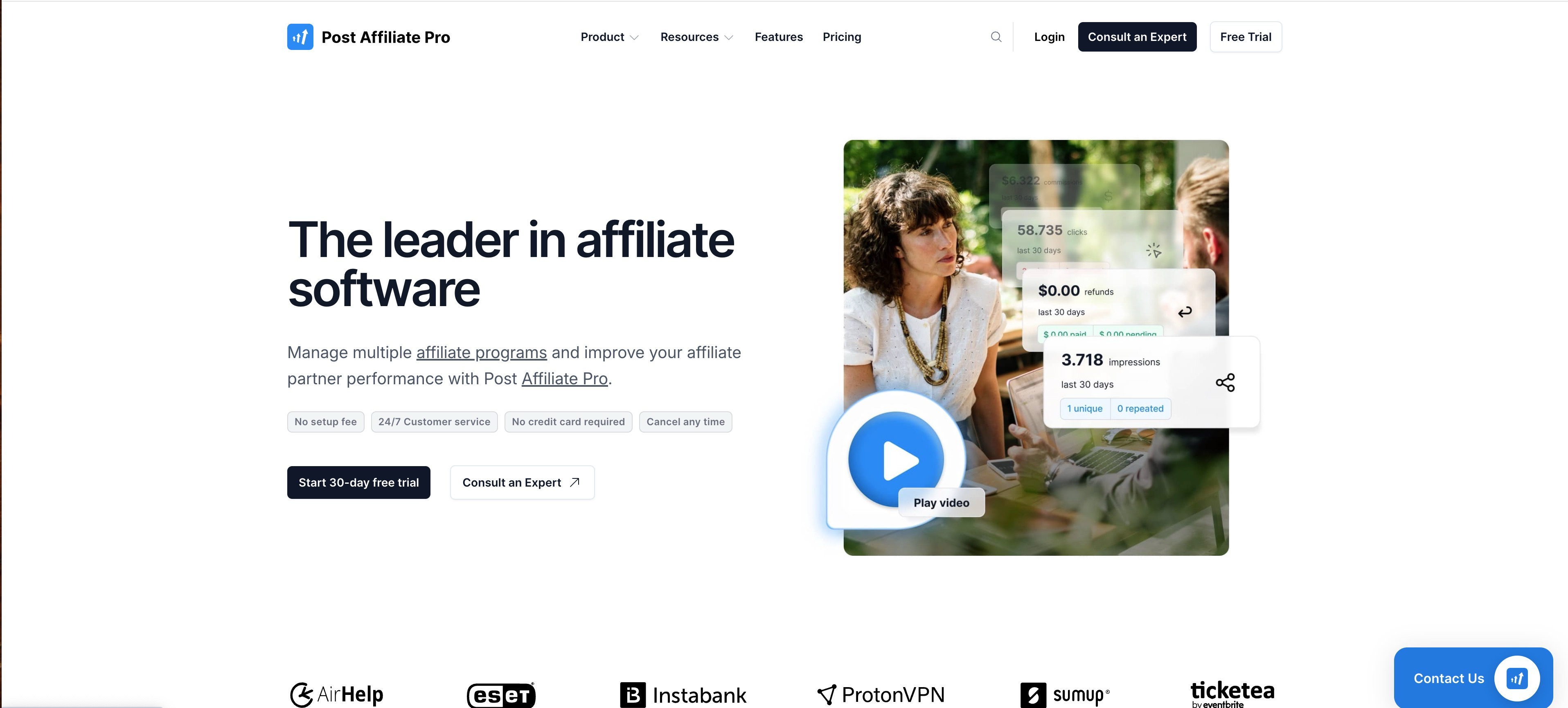
Post Affiliate Pro packs over 200 features into one platform. If you have complex program requirements like multiple tracking methods, advanced fraud protection, or highly customized commission structures, this tool offers the configurability to match. The tradeoff is a steeper learning curve.
Best for: Businesses with complex program requirements that demand extensive customization.
Key strengths
200+ configurable features
Multiple tracking methods (links, coupons, QR codes)
Advanced fraud protection suite
Highly customizable commission structures
Pricing tier: Mid-tier, starting around $129/month
8. Everflow
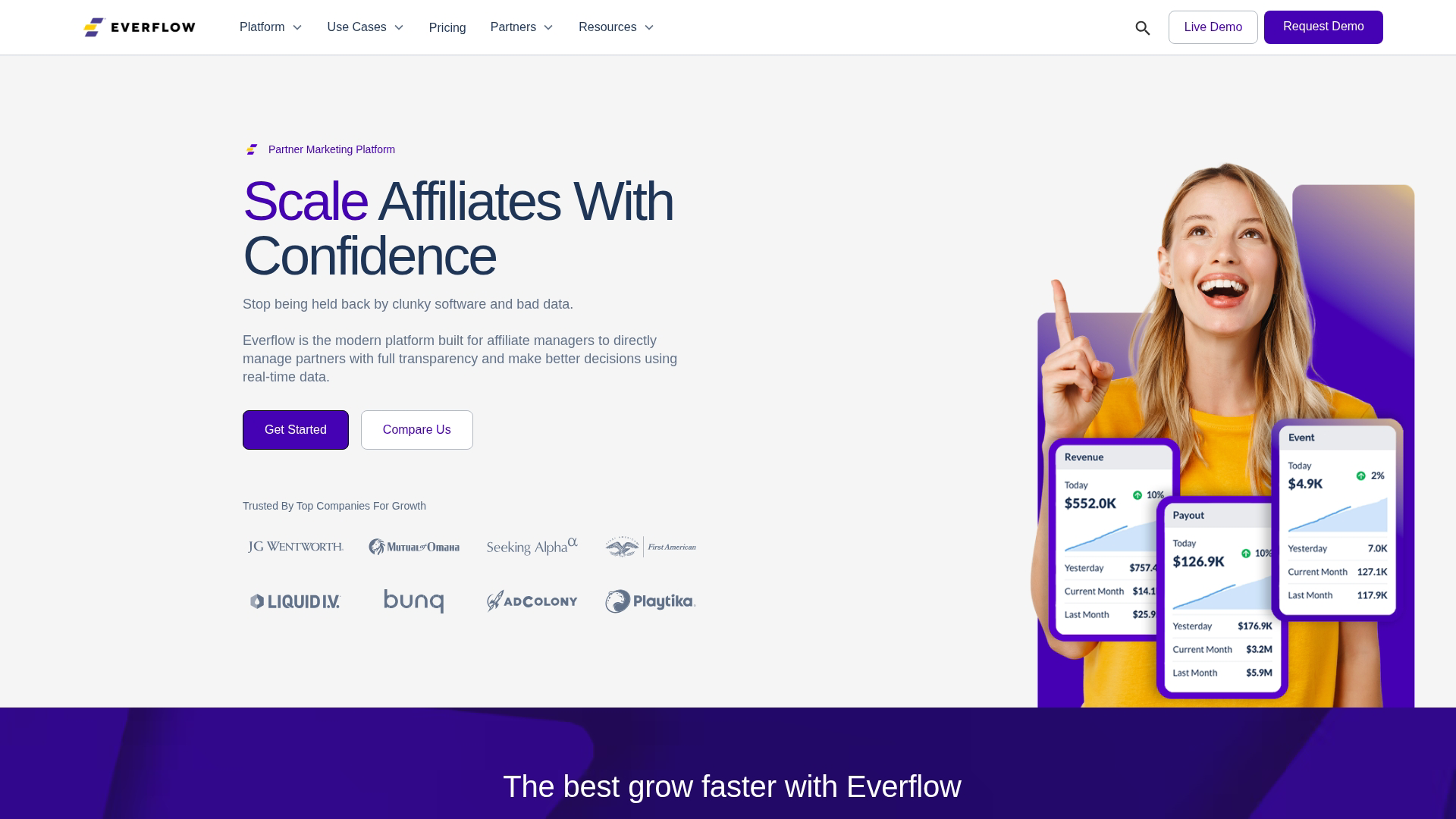
Everflow is designed for performance marketers and agencies managing high-volume campaigns. Real-time analytics and granular attribution data let you optimize campaigns on the fly. The API-first architecture supports custom integrations, and multi-client management features serve agencies well.
Best for: Performance marketers, networks, and agencies with high-volume campaigns.
Key strengths
Real-time analytics and reporting
Granular attribution and deep data insights
API-first architecture for custom integrations
Multi-client management for agencies
Pricing tier: Enterprise, starting around $750/month
9. Affise
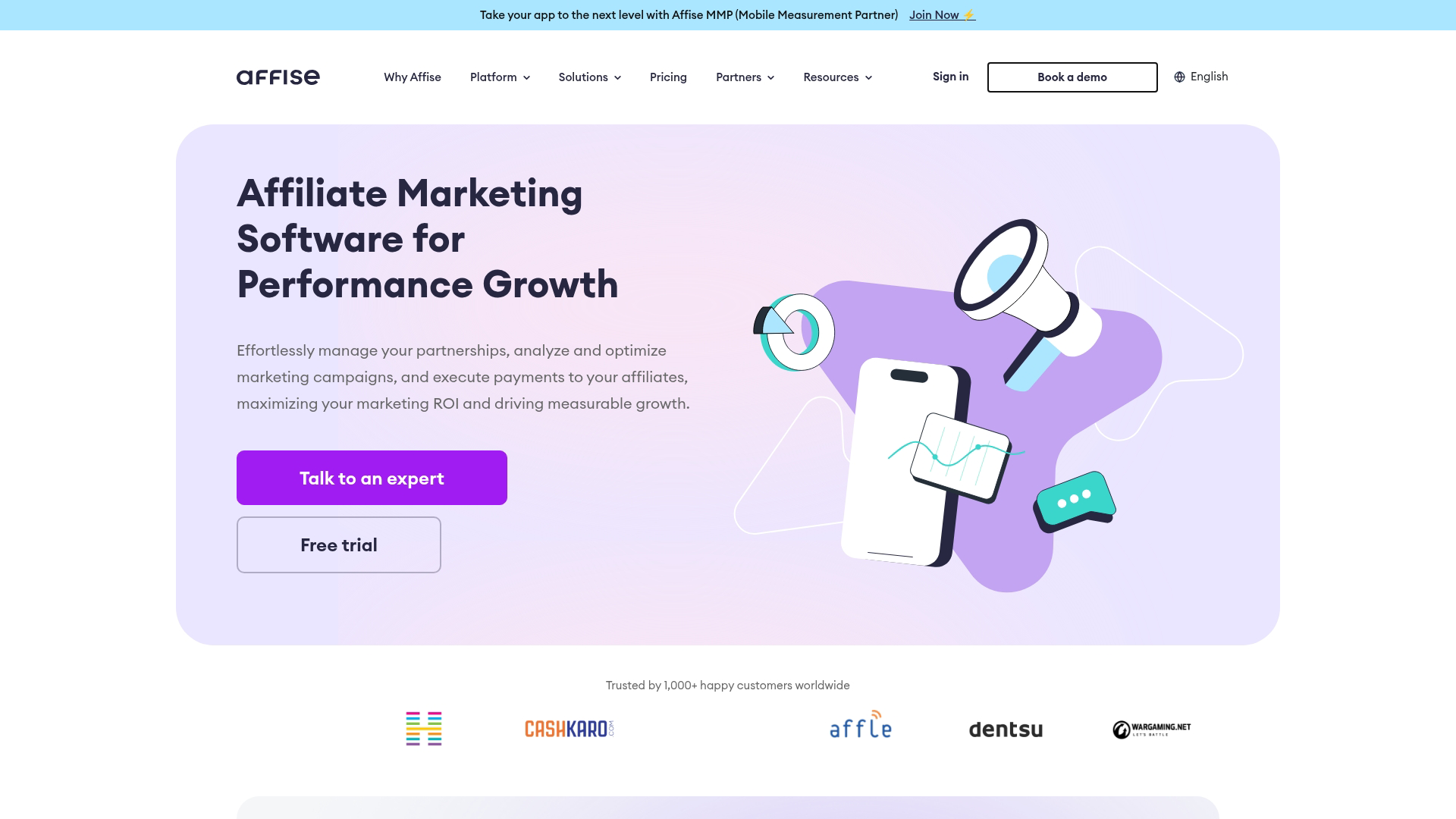
Affise serves both advertisers and affiliate networks with tools for managing offers, partners, and campaigns at scale. The platform's smartlinks analyze visitor data in real-time - device type, geographic location, operating system, and browsing behavior - then automatically route each click to whichever offer is converting best for that specific profile. Advanced targeting options let you segment traffic by country, carrier, browser, or custom parameters, ensuring affiliates promote the right offers to the right audiences. The offer management system supports multiple payout models (CPA, CPL, CPS, RevShare) within a single campaign, giving you flexibility to test different commission structures with different partner segments.
Best for: Affiliate networks and advertisers focused on performance marketing.
Key strengths
Tools for both advertisers and networks
Smartlinks for automated traffic routing
Advanced audience targeting
Robust automation capabilities
Pricing tier: Enterprise, starting around $500/month
10. LeadDyno
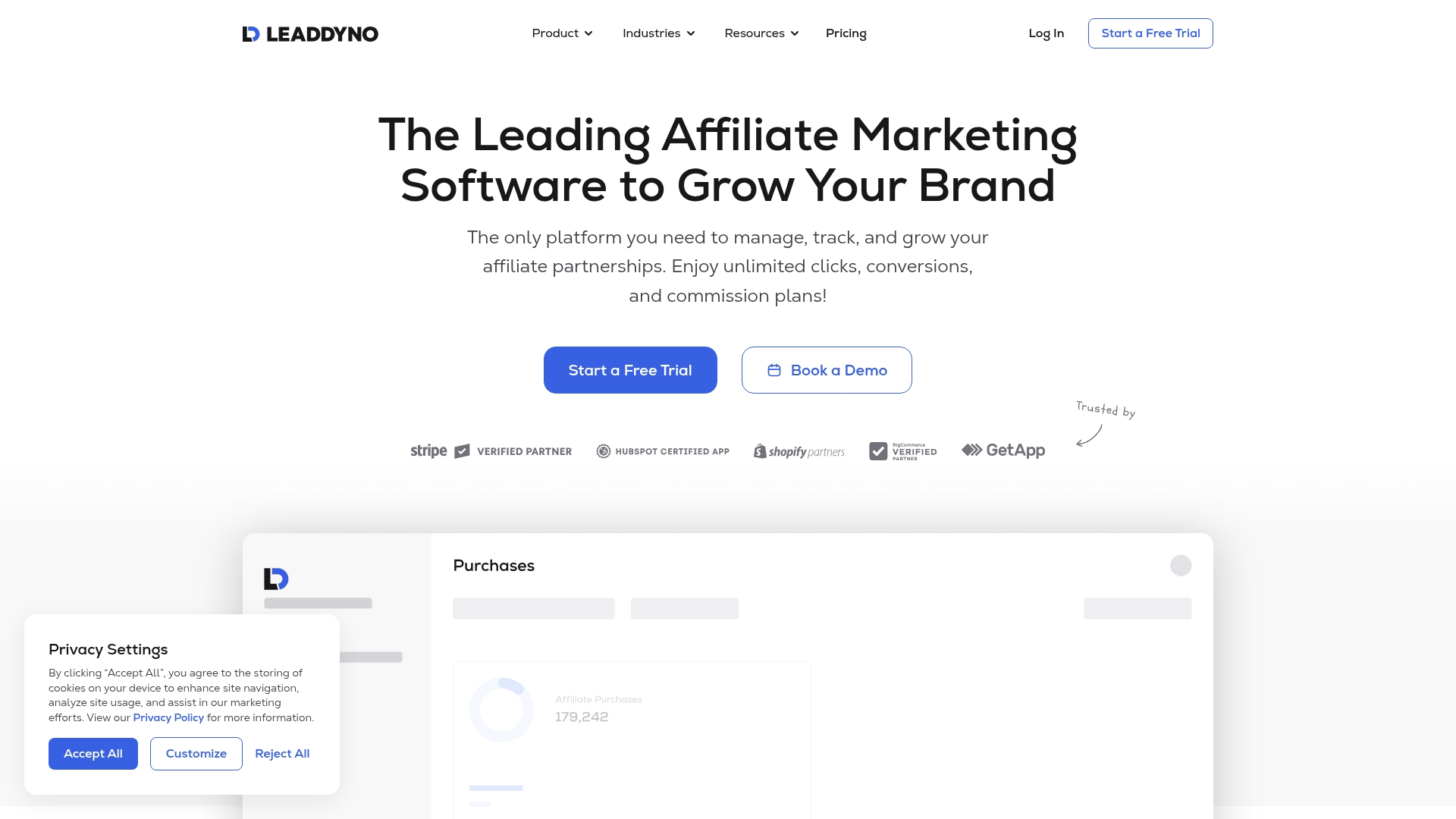
LeadDyno prioritizes simplicity for teams launching their first affiliate program. The onboarding process walks you through setup in under an hour, with pre-built templates for commission structures and partner agreements. Email marketing integrations with platforms like Mailchimp and Constant Contact let you automate partner communications - welcome sequences, performance updates, and promotional announcements - without leaving the dashboard. The interface avoids feature bloat, focusing instead on the essentials: tracking links, basic reporting, and straightforward commission management.
Best for: Beginners and small businesses wanting simple, easy-to-use affiliate software.
Key strengths
Simple and fast onboarding
Email marketing integrations
Built-in affiliate recruitment tools
User-friendly interface
Pricing tier: Low-tier, starting around $49/month
11. FirstPromoter
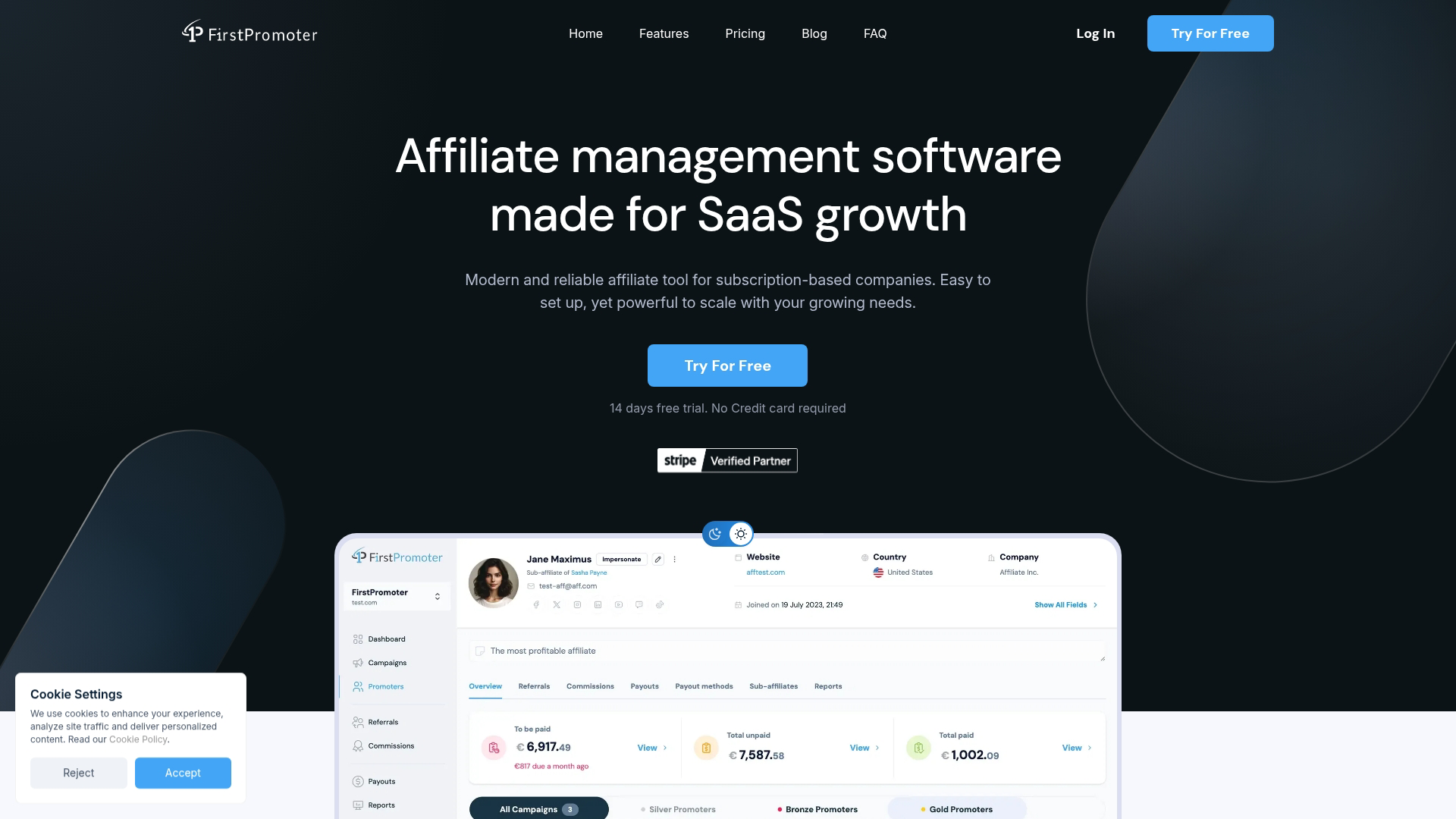
FirstPromoter supports multiple payment processors including Stripe, Paddle, and Chargebee, with native integrations that automatically sync subscription data and track recurring commissions across each platform. This flexibility makes it a strong choice for SaaS companies that might switch processors as they scale, use different processors for different markets (like Paddle for international sales and Stripe for domestic), or run multiple products with separate billing systems. The platform handles the complexity of tracking customer lifecycle events - upgrades, downgrades, refunds, and cancellations - across whichever processor you're using, without requiring you to rebuild your affiliate tracking infrastructure when your payment stack changes.
Best for: SaaS businesses using Stripe, Paddle, or Chargebee.
Key strengths
Integrations with multiple payment processors
Reliable recurring revenue tracking
Customizable reward structures
Developer-friendly API
Pricing tier: Mid-tier, starting around $49/month
12. Reditus
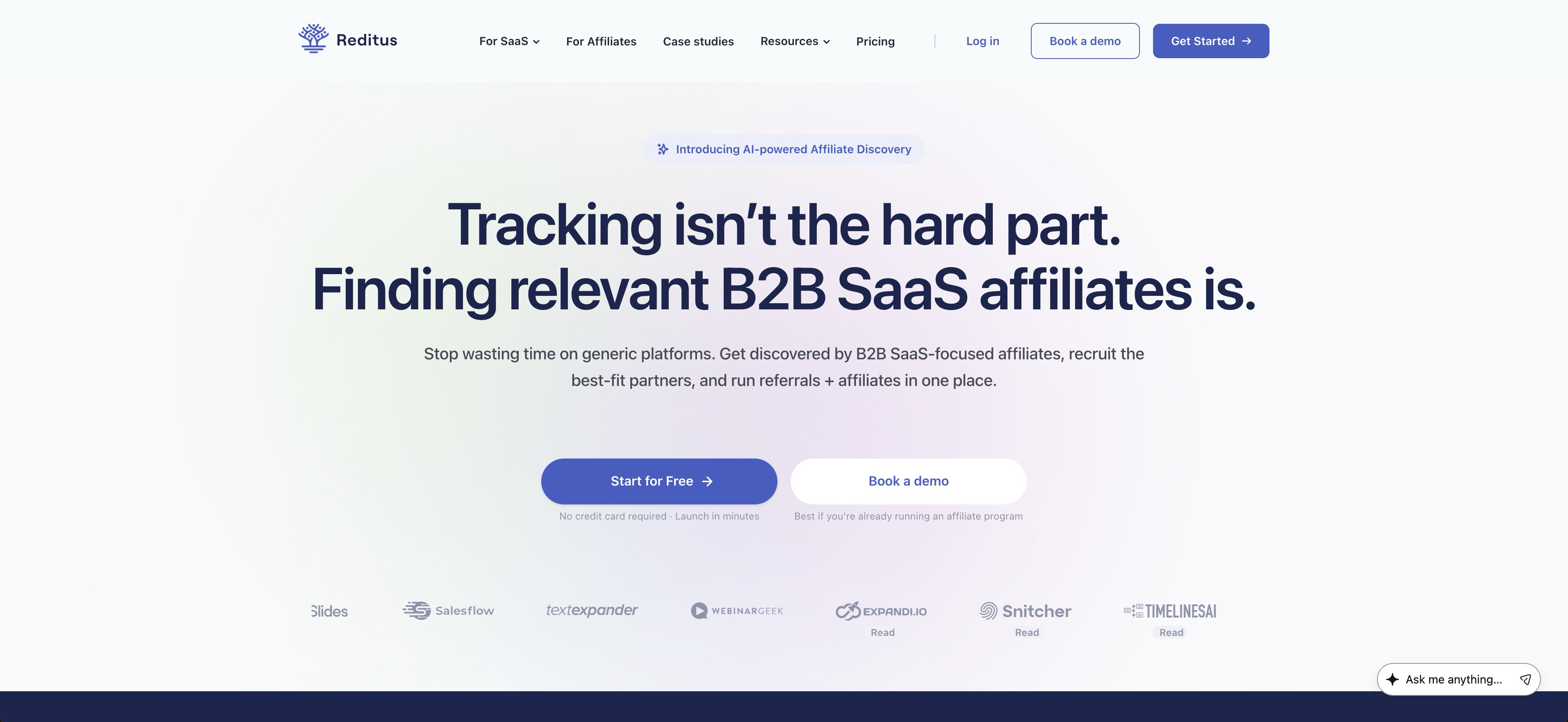
Reditus combines program management with a marketplace specifically for B2B SaaS. The network includes verified affiliates who specialize in promoting software products - think SaaS reviewers, comparison sites, and B2B content creators who already understand subscription business models. This pre-vetted pool can accelerate partner recruitment for new programs, letting you skip the cold outreach phase and connect with affiliates who have existing audiences in your category.
Best for: B2B SaaS companies looking for a marketplace to discover relevant affiliates.
Key strengths
SaaS-specific affiliate marketplace
Pool of verified B2B affiliates
Simple commission setup
Focus on quality partner discovery
Pricing tier: Mid-tier, starting around $69/month
13. Tune

Tune (formerly HasOffers) handles enterprise-scale tracking with particular strength in mobile app attribution. The platform uses postback URLs for server-to-server tracking, which means conversions are recorded even when cookies fail or users switch devices. The fraud prevention suite includes click spam detection, install validation, and duplicate conversion blocking to protect against common abuse patterns. Tune's mobile measurement partner (MMP) capabilities track in-app events and attribute installs across iOS and Android, making it a strong choice for companies with mobile-first affiliate strategies.
Best for: Enterprise brands and networks with mobile and performance tracking requirements.
Key strengths
Advanced mobile app tracking
Robust postback URL and API support
Real-time reporting and analytics
Comprehensive fraud prevention
Pricing tier: Enterprise, starting around $599/month
14. Voluum

Voluum is designed for media buyers who want to optimize ad campaigns through affiliate channels. AI-powered traffic distribution automatically sends visitors to the best-performing offers and landing pages based on conversion data. The platform excels at split-testing multiple variations simultaneously and provides granular cost tracking across traffic sources.
Best for: Media buyers and performance marketers who want advanced ad tracking.
Key strengths
Strong focus on ad tracking and analytics
AI-powered campaign optimization
Automated traffic distribution
Landing page rotation and testing
Pricing tier: Mid-tier, starting around $199/month
15. Partnerize
 Partnerize serves global enterprise brands with complex partnership requirements across multiple markets and currencies. The commissioning engine supports custom rules based on product categories, partner tiers, geographic regions, and performance thresholds. Multi-currency support handles international programs with automatic currency conversion and localized payment methods, while the platform's brand safety controls let you set approval workflows and monitor partner compliance across different regions.
Best for: Global enterprise brands that require flexible partnership automation.
Key strengths
Advanced partnership automation
Highly flexible commissioning engine
Strong brand safety controls
Multi-currency and international support
Pricing tier: Enterprise, custom pricing
Key features to evaluate in affiliate program software
Choosing the right platform depends on matching features to your specific program requirements.
Conversion tracking and multi-touch attribution
Reliable tracking is the foundation of any affiliate program. Look for software supporting multiple tracking methods: pixels for web, postbacks for server-to-server, and coupon codes for offline attribution. Attribution models determine how affiliates receive credit for sales.
First-click attribution: Credits the affiliate who first introduced the customer
Last-click attribution: Credits the final touchpoint before purchase
Linear attribution: Distributes credit evenly across all touchpoints
Time-decay attribution: Weights recent touchpoints more heavily
Commission structures and payout automation
Your ability to create motivating commission structures directly affects partner recruitment and retention. The software can support percentage-based, fixed-rate, tiered, and recurring commissions. Automated payouts through PayPal, Wise, or ACH reduce manual work and keep partners happy.
Partner portal and recruitment tools
The affiliate dashboard is where partners spend their time. A quality portal includes an asset library with banners and links, real-time performance metrics, easy link generators, and smooth onboarding. When partners can self-serve, your team spends less time on support.
White-label customization
White-labeling lets you customize the portal with your branding: custom domain, logos, and color schemes. This matters especially for agencies managing client programs and brands wanting a seamless partner experience.
Fraud prevention and compliance
Protecting program profitability requires fraud detection features, with global digital ad fraud losses projected to reach $172 billion by 2028. Look for self-referral detection, click fraud identification, and chargeback handling. Effective fraud prevention ensures you only pay for legitimate referrals.
Integrations with your marketing stack
Your affiliate software works best when connected to your other tools. Critical integrations include e-commerce platforms (Shopify, WooCommerce, BigCommerce), payment processors (Stripe, PayPal, Paddle), CRM systems (Salesforce, HubSpot), and marketing automation software.
Affiliate software vs affiliate networks
Many people confuse standalone software with networks. Standalone affiliate software is a tool you own to manage your program independently. Affiliate networks are marketplaces connecting you with affiliates, handling tracking and payments for a percentage of commissions.
Factor | Standalone software | Affiliate networks |
|---|---|---|
Partner discovery | You recruit affiliates yourself | Network provides access to existing affiliates |
Control | Full ownership of program terms | Follow network policies |
Fees | Monthly SaaS fee | Percentage of commissions |
Data ownership | You own all data | Data often shared with network |
Best for | Direct partner relationships | Quick access to partner volume |
How to choose the right affiliate management system
This framework helps you narrow 15 options to a shortlist that fits your situation.
1. Match software to your business model
Start by identifying your core requirements. Are you SaaS, e-commerce, or an agency? Which payment processor do you use? What technical resources can you dedicate to implementation?
2. Assess integration requirements
List your must-have integrations based on your existing stack. A missing critical integration creates significant manual work. Teams using product marketing tools can verify compatibility for seamless campaign tracking.
3. Evaluate scalability and automation
Consider how your program might grow. A system that works for 10 affiliates may struggle with 1,000. Look for automated partner approvals, tiered commissions that trigger automatically, bulk payout capabilities, and partner segmentation.
4. Test partner experience and onboarding
Always evaluate software from the affiliate's perspective. Request a demo or trial to see the partner portal firsthand. A confusing interface deters quality partners.
5. Review analytics and reporting depth
Your ability to optimize depends on accessible data. Confirm the software provides conversion reports, affiliate leaderboards, cohort analysis for subscriptions, and clear revenue attribution.
How to launch your affiliate program
Once you've selected your software, follow this sequence to get started.
1. Connect your platform and payment processor
Begin with technical setup: integrate with your e-commerce platform or payment processor, install tracking code, and run test conversions to verify everything works.
2. Configure commission structures and terms
Define your program rules: commission rates, cookie duration, payout schedules, and terms and conditions. Attractive terms help with partner recruitment.
3. Build your affiliate recruitment strategy
Identify where to find partners: existing customers, industry influencers, content creators, and review sites. Develop outreach templates with a clear value proposition.
4. Equip partners with promotional assets
Provide high-quality materials: banners, email templates, social copy, and product descriptions. Giving affiliates engaging content like interactive demos can boost their conversion rates by letting prospects experience your product before purchasing.
5. Monitor performance and iterate
Launching is just the beginning. Review metrics regularly, optimize commission structures, remove underperformers, and find ways to support your best affiliates.
Build a high-performing affiliate program
The right software removes manual overhead from tracking and payments, freeing you to focus on what actually grows programs: recruiting great partners, enabling their success, and building relationships that compound over time.
Start your journey with Guideflow today!
FAQs about affiliate marketing software
How much does affiliate tracking software typically cost?
Affiliate management software ranges from free tiers with limited features to enterprise plans at several hundred dollars monthly. Most mid-market options fall between $50-200/month based on affiliate volume and feature requirements.
What is the difference between affiliate software and affiliate networks?
Affiliate management software is a tool you own to manage your program independently. Affiliate networks are marketplaces connecting you with affiliates, handling tracking and payments for a percentage of commissions.
Can one affiliate management platform handle affiliates, referrals, and influencers?
Yes, many modern platforms like Tapfiliate support multiple partner types including traditional affiliates, customer referrals, and influencer relationships within a single dashboard.
How do I migrate from an affiliate network to standalone affiliate software?
Migration typically involves exporting your affiliate list from the network, importing contacts into your new platform, and running both systems simultaneously during a transition period to ensure no commissions are lost.
What integrations are essential for affiliate management software?
Essential integrations include your e-commerce platform or payment processor, CRM system, email marketing tools, and communication apps like Slack for real-time notifications.
How do affiliate programs prevent fraud and coupon abuse?
Affiliate software uses self-referral detection, IP tracking, conversion velocity limits, and coupon code restrictions to identify suspicious activity before commissions are paid.
Do I need technical skills to set up affiliate program software?
Most modern platforms offer no-code setup with guided installation. Custom integrations or API implementations may require developer assistance, but basic programs can launch without technical help.
How long does it take for an affiliate program to generate meaningful revenue?
Affiliate programs typically require three to six months to build momentum as you recruit partners, optimize commission structures, and allow affiliates time to create content and drive traffic.