Your engineering team ships regularly. Security findings arrive after the fact. And every quarter, the same vulnerability categories show up in the same codebases because the compliance course developers completed 18 months ago did nothing to change how they write, review, or design software.
According to Checkmarx's Future of Application Security Report (2025), 40% of organizations do not mandate regular secure coding training for developers, even as 67% of UK companies reported at least one cybersecurity incident caused by insecure coding practices, per SecureFlag's own 2025 survey. The gap between training completion and actual secure development behavior is where most programs fail.
This guide cuts through that gap. The focus is not awareness training. It's hands-on application security training that changes how developers recognize, prevent, and fix vulnerabilities in the code they ship every sprint.
What's inside
- Eight application security training platforms, courses, and secure coding programs evaluated for 2026
- Selection criteria weighted toward hands-on labs, language relevance, and evidence beyond completion rates
- A side-by-side comparison of pricing and G2 ratings
- Guidance for product managers choosing a program that supports secure releases without adding operational overhead
TL;DR
- Best overall for enterprise AppSec programs: AppSecEngineer. Role-based journeys, cloud sandboxes, compliance reporting, and SSO/SCIM all in one platform
- Best for targeted developer secure coding practice: Secure Code Warrior. Language-specific missions built to shift coding habits, with 75+ frameworks covered
- Best for narrative, code-to-exploit learning: Kontra. Connects user-facing behavior to source-level vulnerabilities before asking developers to fix them
- Best for training tied to AppSec testing workflows: Veracode Security Labs. Exploit-and-fix labs that reinforce remediation work happening in the same security program
- Best instructor-led option: SANS SEC522. Advanced web, API, and microservices curriculum for practitioners who need deep applied skills, not a catalog
- Best for individual learners or foundational teams: Coursera. Self-paced paths with shareable certificates, a low cost of entry, and broad SDLC coverage
What is application security training?
Application security training teaches developers, DevOps practitioners, security engineers, and product teams how to identify, prevent, test for, and remediate security weaknesses in software.
Strong appsec training covers:
- Secure coding principles tied to real languages and frameworks, not abstract theory
- OWASP Top 10 risks: injection, cross-site scripting, broken access control, insecure secrets handling, and more
- Hands-on labs that require learners to find vulnerabilities in working code and implement fixes
- Secure SDLC and DevSecOps practices covering planning, code review, dependency management, and release gates
- Security testing literacy across static analysis (SAST), dynamic analysis, and software composition analysis
- Progress measurement through assessments, skill scoring, and assigned learning paths
- Stack-relevant content matched to the languages, cloud environments, and frameworks your teams use
What application security training is not:
| Format | Primary purpose | Best fit |
|---|---|---|
| Security awareness training | Broad employee behavior and phishing reduction | Whole-company baseline |
| Application security training | Secure design, coding, testing, and remediation | Developers, DevOps, security champions |
| Application security testing software | Finding vulnerabilities in applications and dependencies | Dev and security workflows |
| Instructor-led security course | Deep skill building in a defined technical domain | Practitioners and advanced teams |
Training supports better decisions and faster remediation. It does not replace architecture review, code review tools, testing pipelines, or security governance.
When to use application security training
Build security into product delivery
Teams launching new services, APIs, or integrations can use training to improve security conversations before engineering begins, not after. When developers understand OWASP risks and secure design patterns in their own language, requirement quality and acceptance criteria improve. The result is fewer rework cycles later in the release cadence.
Reduce recurring vulnerability patterns
When the same defect classes, injection flaws, access control mistakes, or insecure dependency patterns, show up across multiple releases, targeted training that maps directly to those categories and your team's technology stack addresses the root cause. Completion rates do not tell you this is working. Repeat finding rates do.
Scale a security champion program
Organizations with a small central AppSec team supporting many engineering squads need role-based paths, reporting by squad or product area, and practical labs that help champions support secure decisions locally. A platform with governance controls and assignment capabilities is what makes a champion program scale without a manual coordination overhead for every cohort.
Application security training platform comparison
Pricing models across this category vary significantly. Some platforms use annual per-user subscriptions, some bundle training inside a broader AppSec toolchain, and others price individual courses or require a sales conversation. The table below reflects verified figures from vendor pricing pages and live G2 listings (October 2026).
| # | Product | Best for | Key differentiator | Pricing | G2 rating |
|---|---|---|---|---|---|
| 1 | AppSecEngineer | Enterprise hands-on AppSec programs | Broad labs, cloud sandboxes, role-based journeys, compliance reporting | Pro Plus from $499/year | 4.3/5 |
| 2 | Secure Code Warrior | Developer secure coding programs | Language-specific missions across 75+ frameworks | Custom pricing | 4.5/5 |
| 3 | Kontra | Vulnerability-to-code narrative learning | Interactive stories connecting exploit paths to remediation | Squad from $400 | 3.3/5 |
| 4 | Veracode Security Labs | Training connected to AppSec testing | Exploit-and-fix labs in containerized real applications | Custom pricing | N/A |
| 5 | Checkmarx Codebashing | Checkmarx One customers | Training linked to scan findings and developer remediation | Custom pricing | 4.5/5 |
| 6 | SANS SEC522 | Advanced practitioner education | Instructor-led web, API, and microservices security | $8,260 per course | 4.6/5 |
| 7 | Coursera | Individual and foundational learning | Self-paced paths with certificate options | Free to $59/month | 4.5/5 |
| 8 | SecureFlag | Hands-on developer practice | Secure coding labs across 75+ technologies plus threat modeling | From $525/user/year | 4.8/5 |
Best 8 application security training platforms for 2026
1. AppSecEngineer
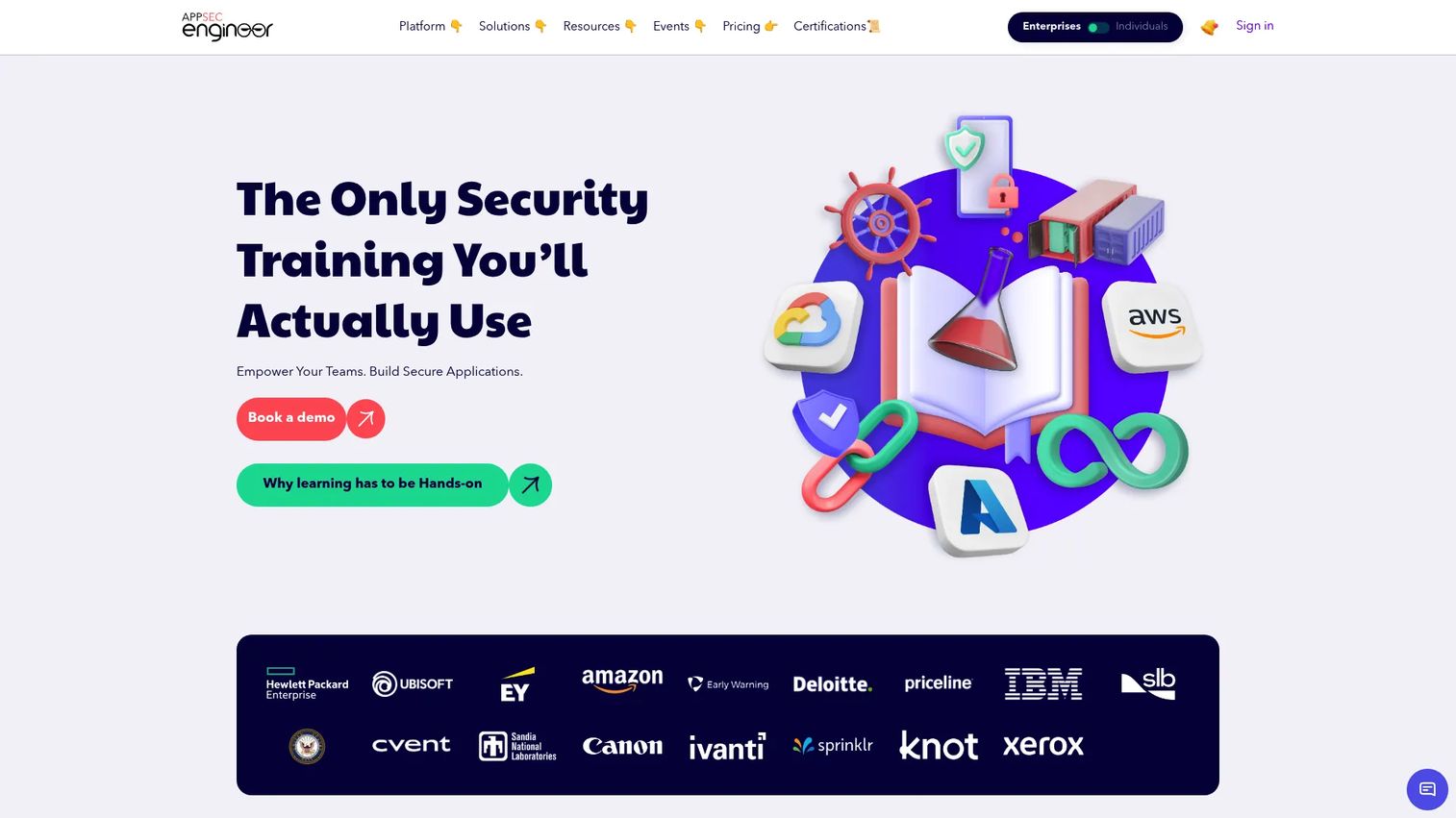
AppSecEngineer is an enterprise-oriented hands-on training platform covering application security, DevSecOps, cloud security, and secure coding. Learners work through interactive labs, cloud sandboxes, and capture-the-flag challenges rather than watching video content. The platform supports role-based learning journeys and offers compliance-oriented reporting for teams that need evidence of developer security education.
Best for: Product and engineering organizations that need a governed appsec training program across multiple roles, languages, and cloud environments.
Key features
- Role-based AppSec learning journeys and roadmaps
- Hands-on labs and AWS, Azure, GCP cloud sandboxes (Pro Plus)
- Compliance mapping, reporting, and analytics
- SSO, SCIM, and LMS/LTI integrations
- Challenges, CTFs, and secure coding playgrounds
Why choose AppSecEngineer: This is the right platform when training must function as a program, not a course catalog. Role-specific paths, squad-level reporting, and compliance evidence make it easier for product leaders to demonstrate that secure development education is happening and to identify which teams need additional support before repeat findings slow a release.
AppSecEngineer pricing: Individual Pro plans start at $399/year ($33.25/month billed annually), with Pro Plus at $499/year ($41.58/month billed annually), which adds cloud sandboxes. Enterprise pricing requires a sales conversation.
G2 rating: 4.3/5 (verified October 2026).
2. Secure Code Warrior
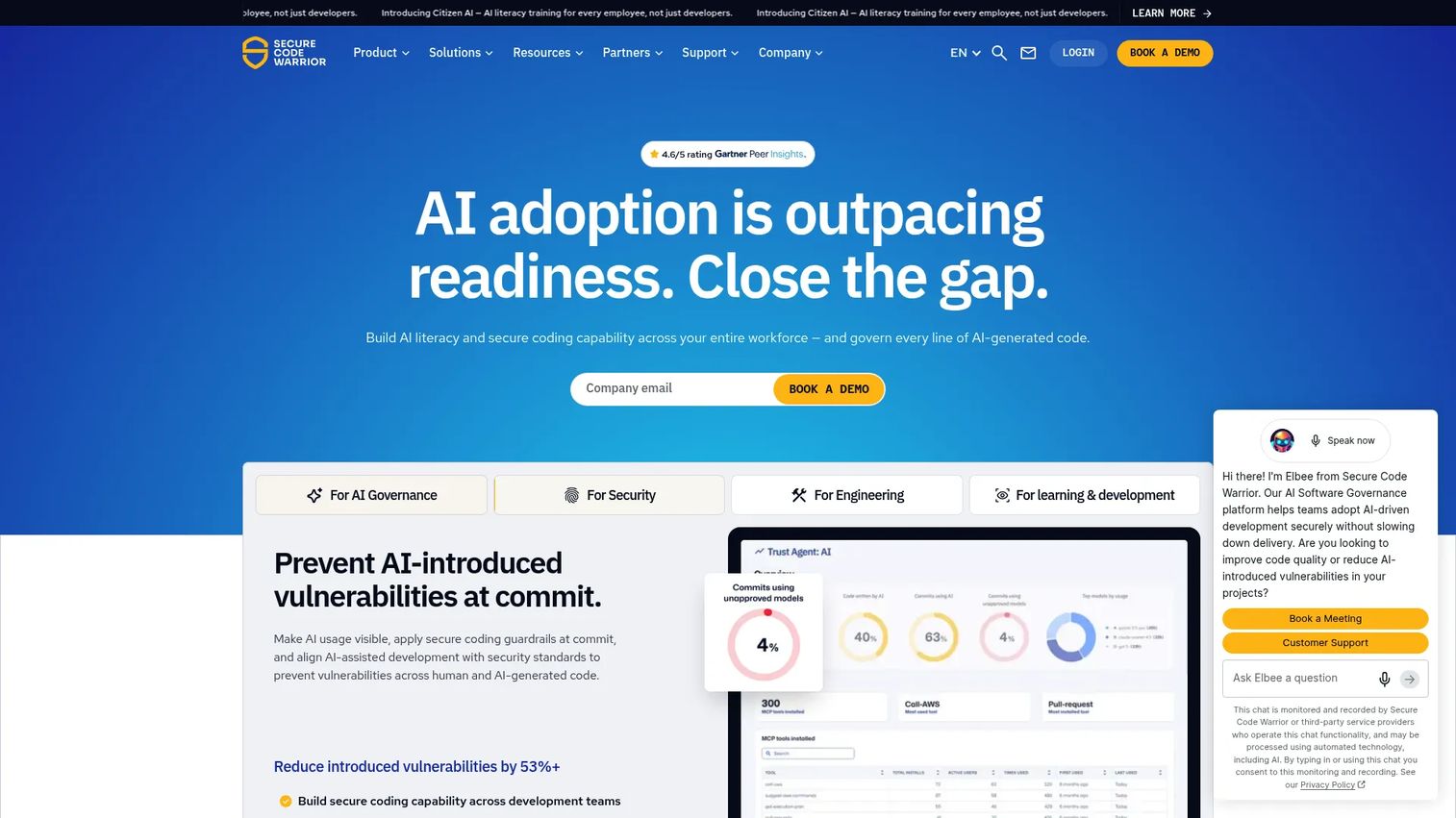
Secure Code Warrior is a developer-first secure coding platform built around language-specific missions and adaptive learning paths. It covers 75+ programming languages and frameworks, making it one of the broadest catalogs for teams with varied stacks. The platform recently added AI-assisted development governance features, including commit-level risk correlation and policy controls for teams managing AI-generated code.
Best for: Teams that need focused developer secure coding practice tied to specific languages, frameworks, and OWASP vulnerability categories.
Key features
- Language-specific secure coding labs and gamified missions
- Adaptive learning paths with SCW Trust Score benchmarking
- OWASP-aligned curriculum across 75+ languages and frameworks
- GitHub, Jira, Azure Boards, SCIM, and SCORM integrations
- AI development governance with commit-level risk visibility
Why choose Secure Code Warrior: When the core objective is shifting coding behavior, not just completing a course, this platform's combination of repeated practice, role-relevant scenarios, and skills benchmarking makes progress measurable. Product managers evaluating this tool should verify language coverage for their team's actual stack and validate whether the reporting maps to their engineering structure.
Secure Code Warrior pricing: All plans (Basic, Business, Enterprise) require booking a demo. No figures are shown on the pricing page.
G2 rating: 4.5/5 (verified October 2026).
3. Kontra
Kontra takes a narrative-first approach to application security training. Instead of presenting a vulnerability in isolation, each lesson traces how user-facing behavior leads through application logic to a code-level flaw, and then asks the developer to apply the fix. This context-first structure is particularly useful for developers who disengage from abstract security content but respond to seeing how a mistake they might make creates an exploitable condition in a product they recognize.
Best for: Product teams whose developers need to understand why a vulnerability matters before being asked to remediate it.
Key features
- Interactive vulnerability storylines connecting behavior to code
- Hands-on secure coding exercises with remediation guidance
- OWASP Top 10 coverage
- SCORM-compliant content for LMS integration
- Developer-focused content library
Why choose Kontra: The contextual framing helps cross-functional teams connect security issues to customer-facing abuse paths, which can make security conversations in sprint planning less abstract. Buyers should verify current language and framework coverage and confirm enterprise administration capabilities before committing to a large rollout.
Kontra pricing: Squad plans (5 to 15 developers) start at $400. Brigade plans (16 or more developers) require contacting sales. Billing period for Squad is not specified on the pricing page.
G2 rating: 3.3/5 (verified October 2026).
4. Veracode Security Labs
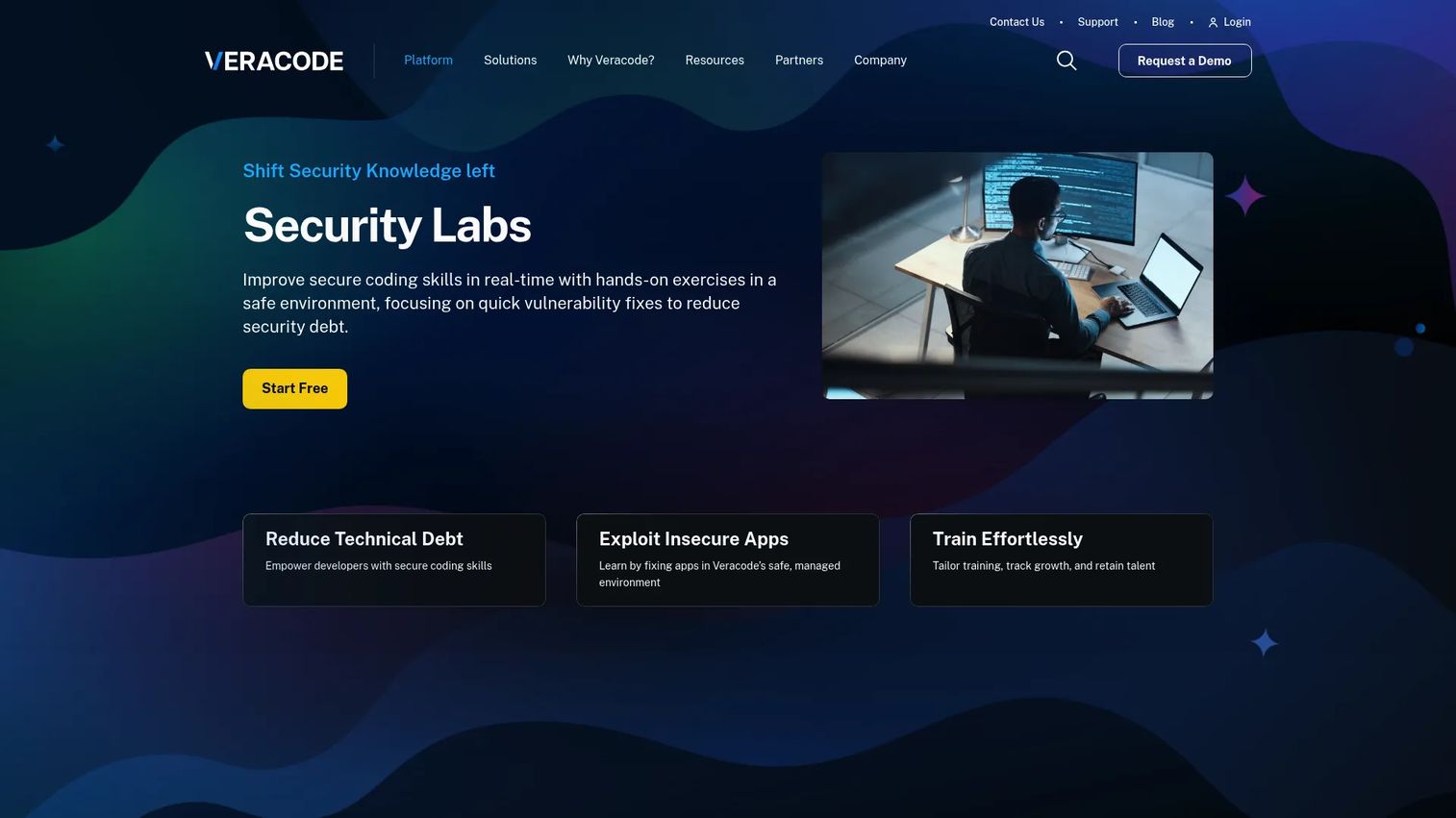
Veracode Security Labs provides hands-on secure coding training through exploit-and-fix labs running in Veracode-managed containerized environments. Developers interact with live web and mobile applications, find vulnerabilities through active exploitation, and implement fixes in the same environment. Progress tracking, leaderboards, campaigns, and compliance-oriented reporting are built into the platform. The former Community Edition was deprecated in July 2026.
Best for: Organizations already running Veracode application security testing that want training integrated with their existing remediation program.
Key features
- Exploit-and-fix labs in live, containerized web and mobile applications
- Compliance-oriented labs covering SOC 2, HITRUST, and PCI contexts
- Progress tracking, campaigns, and deadline management
- Gamification with leaderboards and certification badges
- Developer guidance by language
Why choose Veracode Security Labs: The strongest use case is connecting recurring test findings to targeted training assignments so developers remediate the specific weakness categories their own scans surface. Product managers evaluating this option should factor in whether their team already uses Veracode's testing stack, since the training value compounds when learning data and test findings live in the same program.
Veracode Security Labs pricing: Veracode documents a 14-day free trial and a subscription model. Specific pricing figures require a sales conversation.
5. Checkmarx Codebashing
Checkmarx Codebashing is developer security education built into the broader Checkmarx One application security platform. Its standout capability is assigning training based on vulnerabilities Checkmarx One actually finds in a team's codebase, which shortens the distance between detection and understanding. The Security Champion learning path includes 85 lessons covering the full SDLC, and the hands-on coding environment provides immediate feedback across more than 14 languages.
Best for: Engineering organizations standardizing on Checkmarx One that want training assignments tied directly to scan results.
Key features
- Application-specific course assignments based on Checkmarx One findings
- Security Champion path with 85 SDLC lessons
- Hands-on interactive coding environment with immediate feedback
- Role-specific learning paths
- Support for Java, Python, .NET, Go, PHP, and 10+ additional languages
Why choose Checkmarx Codebashing: Findings-linked education shortens the delay between a developer seeing a vulnerability flagged and understanding how to fix it, which reduces the rework cycle that often slows release readiness. Before committing, verify which training features are included in your existing Checkmarx package and how assignment automation connects to your scan workflow.
Checkmarx Codebashing pricing: Custom pricing only. Checkmarx directs buyers to request a demo or quote. Broader platform pricing is seat- and usage-based.
G2 rating: 4.5/5 (verified October 2026 from the Checkmarx Codebashing listing).
6. SANS SEC522
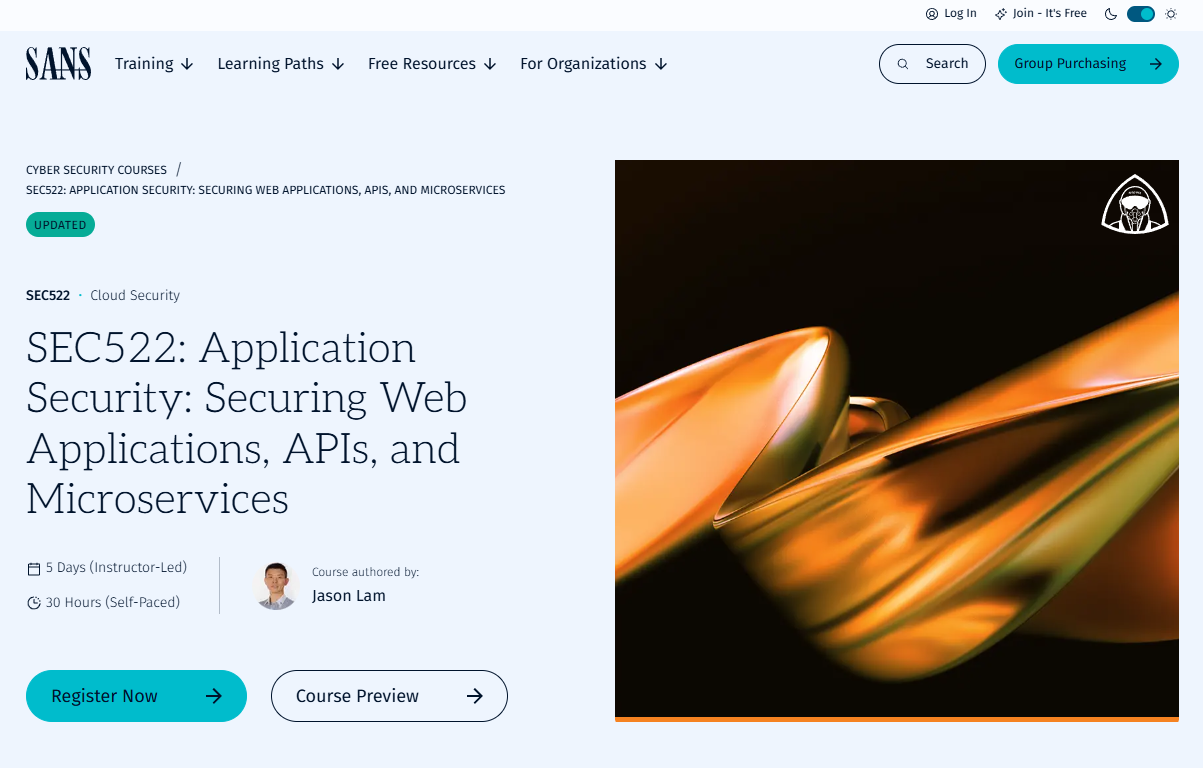
SANS SEC522 is an advanced, instructor-led course for practitioners securing web applications, APIs, microservices, and AI-powered systems. The curriculum covers OWASP Top 10 defenses, REST and GraphQL API security, authentication and authorization patterns including OAuth, JWT, and SAML, and prompt-injection defenses for AI applications. Seventeen hands-on labs and a Defend the Flag capstone round out the applied component.
Best for: Security engineers, senior developers, and technical leads who need concentrated depth in modern application attack surfaces, not a continuous developer assignment platform.
Key features
- OWASP Top 10 defense including SQL injection, XSS, and CSRF
- REST and GraphQL API security and microservices patterns
- Authentication with passkeys, MFA, OAuth, JWT, and SAML
- AI and LLM application security with prompt-injection defenses
- 17 hands-on labs and a Defend the Flag capstone
Why choose SANS SEC522: This is the right choice when a smaller group of senior practitioners needs deep, applied instruction in web application, API, and microservices security. It is less suited to a large-scale developer assignment program. For product managers, the appropriate use is targeted upskilling for technical leads working on high-risk product areas such as API authentication flows, service-to-service architecture, or AI-integrated features.
SANS SEC522 pricing: The verified U.S. event price is $8,260 per course. Pricing varies by event location and delivery format.
G2 rating: 4.6/5 (rating is for SANS Workforce Security and Risk Training, not specifically SEC522; verified October 2026).
7. Coursera
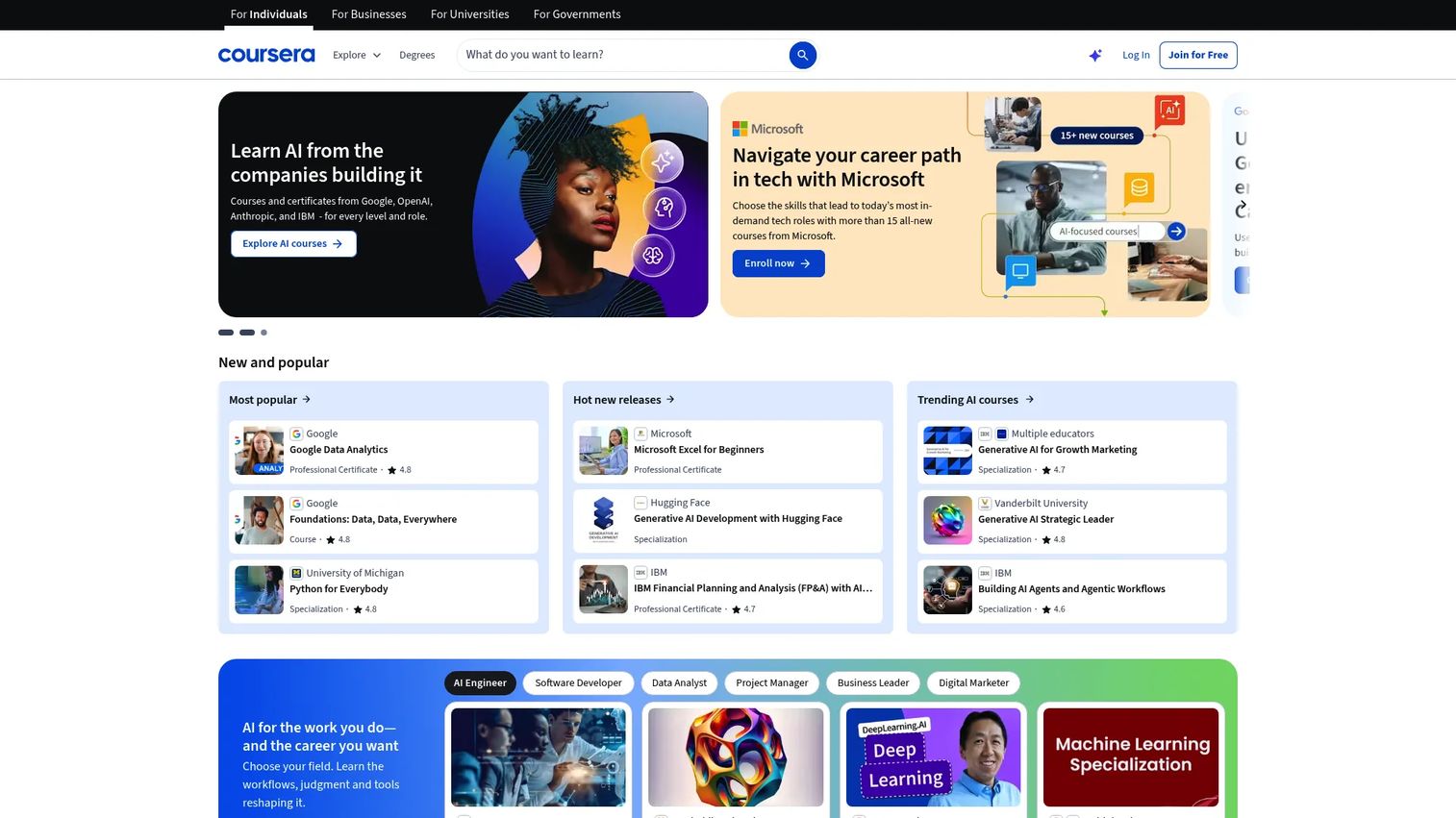
Coursera is a broad online learning platform offering courses, Specializations, Professional Certificates, and Guided Projects from universities and companies. For application security topics, it covers secure SDLC fundamentals, DevSecOps practices, security testing concepts including SAST and dynamic analysis, and hands-on labs. Learners can earn shareable certificates. For teams already investing in best-sales-training-software and looking to add technical security literacy at lower upfront cost, Coursera offers a low-commitment starting point.
Best for: Individual contributors, smaller product teams, or organizations building baseline appsec literacy before committing to a dedicated platform.
Key features
- Self-paced courses, Specializations, and Professional Certificates in AppSec topics
- Secure SDLC and DevSecOps fundamentals
- Security testing concepts including SAST and software composition analysis
- Hands-on projects and guided labs
- Shareable certificates for career documentation
Why choose Coursera: The low entry cost and self-paced format make this a practical way to build shared vocabulary across product, engineering, and DevOps before rolling out a more structured program. Teams requiring role-based assignments, squad-level reporting, and targeted secure coding practice in production-relevant languages will need a purpose-built appsec training platform for the next stage.
Coursera pricing: Individual courses start free, with some available for a fee. Specializations and Professional Certificates run $49/month. Coursera Plus costs $59/month or $399/year for access to most content.
G2 rating: 4.5/5 (marketplace-level rating; verified October 2026).
8. SecureFlag
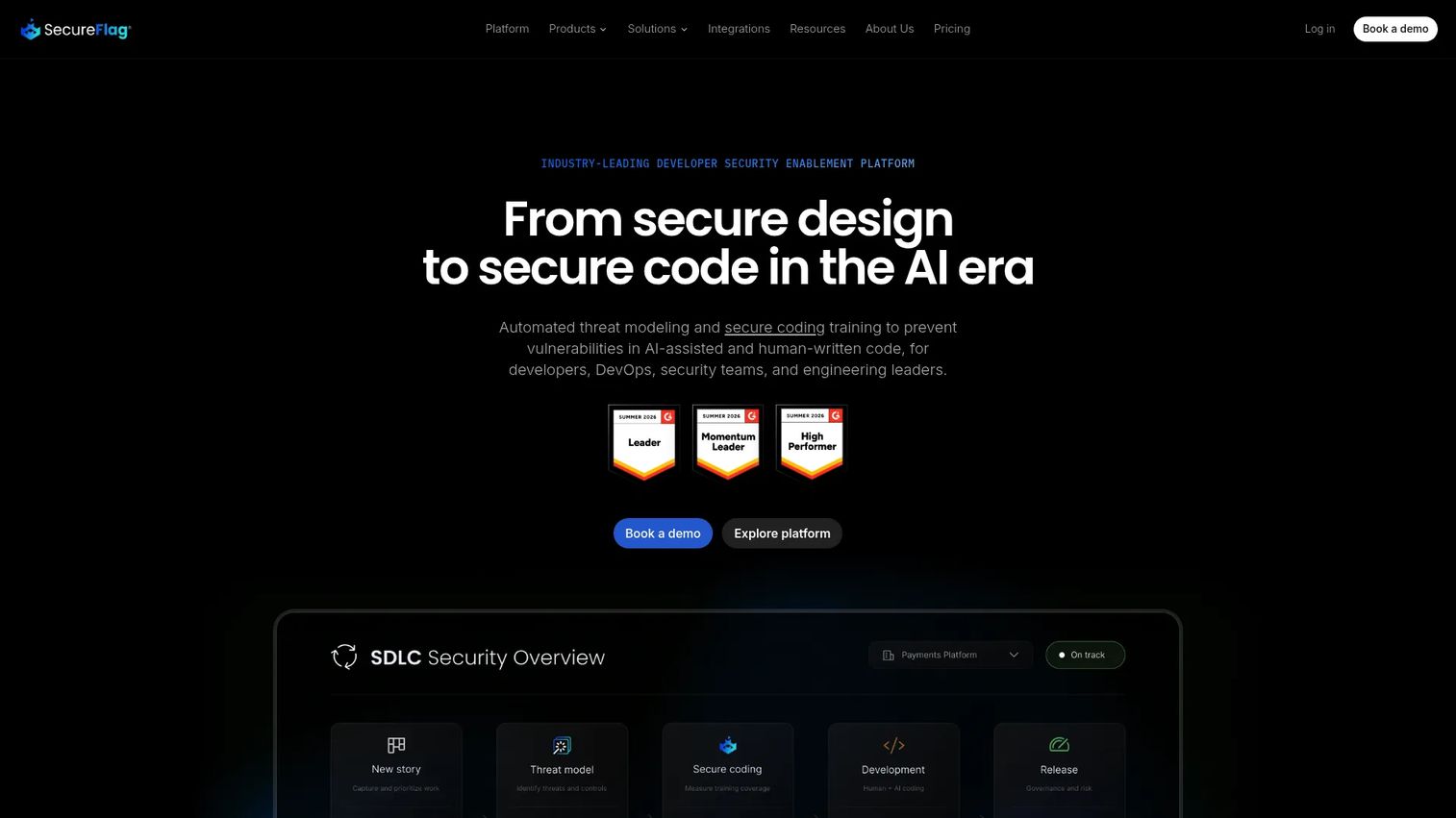
SecureFlag combines hands-on secure coding labs with automated AI-powered threat modeling, covering 75+ technologies including frameworks and cloud platforms. On the training side, developers work through practical vulnerability remediation exercises. The threat modeling product, ThreatCanvas, can be purchased separately or bundled. SDLC integrations include Jira, Azure DevOps, GitHub, GitLab, and an MCP integration, making SecureFlag one of the more workflow-connected options in this category. Its API testing tools context is relevant for teams securing modern service boundaries.
Best for: Enterprise security, AppSec, and engineering teams that want practical labs and automated threat modeling from a single platform.
Key features
- Hands-on secure coding labs across 75+ technologies
- Automated AI-powered threat modeling with ThreatCanvas
- Learning paths, assessments, and compliance evidence reporting
- SDLC integrations: Jira, Azure DevOps, GitHub, GitLab, MCP
- Individual and enterprise subscription options
Why choose SecureFlag: For teams where developers disengage from passive content, the practical lab format addresses the adoption problem directly. The threat modeling capability also provides earlier-stage instrumentation, which is relevant when a product manager wants security decisions improving during planning, not only after a scan. Check language and framework coverage against your team's actual stack before signing.
SecureFlag pricing: Enterprise training licenses run $525/user/year. Individual Training plans cost $450/year. The Threat Modeling-only plan is $405/user/year, and the combined Training plus Threat Modeling plan is $670/user/year. A 7-day free trial is available.
G2 rating: 4.8/5 (verified October 2026).
Considerations when choosing application security training
Hands-on remediation quality
Ask whether learners complete exercises that identify and fix real vulnerabilities, or whether the format is primarily passive. Platforms that show the vulnerable pattern, the exploit path, and a correct implementation in the learner's own language produce different outcomes than video-based awareness content. Test the lab environment yourself before rollout.
Relevance to your product stack
Broad language coverage is useful only when it includes the frameworks, cloud services, and API documentation tools your teams use in production. Ask each vendor for specific coverage of your top five languages and your primary cloud and API patterns. A program that does not map to the code your team ships generates completion metrics without engineering impact.
Program measurement beyond completion rates
Assess whether the platform provides skill progression scores, assignment completion by squad, and remediation rate trends. Connect those metrics to repeat findings from your application security testing software, remediation time, and release review outcomes. Completion dashboards tell you who sat through training; defect category trends across sprints tell you whether it changed anything.
Workflow integration and governance
For enterprise rollout, verify SSO, SCIM, and LMS or SCORM support, along with permissions and reporting by team. Product managers should also confirm integration with source control and issue tracking so training assignments can connect to real development workflows. Manual cohort management at scale becomes an overhead problem quickly.
Content maintenance and release cadence
Security patterns and framework defaults change. Ask how often a vendor updates curriculum and who owns content refresh when your architecture shifts. Short, targeted labs are cheaper to maintain than long course paths. Centralizing assignments means one update propagates, which matters when your own release cadence is fast.
Conclusion
The right platform depends on what you're trying to change and at what scale.
AppSecEngineer suits organizations running enterprise-wide programs that need governance, compliance reporting, and multi-environment coverage. Secure Code Warrior and SecureFlag both focus on practical secure coding habit change, with SecureFlag adding threat modeling for teams that want earlier-stage instrumentation. Kontra adds context-rich vulnerability education for developers who learn better through narrative. Veracode Security Labs and Checkmarx Codebashing fit organizations where training needs to sit near existing AppSec testing workflows. SANS SEC522 serves practitioners who need concentrated depth in web and API security. Coursera offers an accessible foundation when the goal is building baseline literacy before a larger rollout.
A practical next step: Shortlist two platforms that match your technology stack, then run a pilot around one recurring vulnerability category. Measure completion, assessment results, and developer feedback together, then compare repeat findings in your next release cycle against the baseline. That comparison tells you whether the training is working.
Start your journey with Guideflow today!
FAQs
Application security training teaches software teams how to prevent, identify, test for, and remediate vulnerabilities in applications. It includes secure coding practice, secure design principles, security testing literacy, and hands-on exercises in realistic code environments. Strong programs go beyond awareness content to require learners to find and fix actual vulnerabilities in their own languages and frameworks.
Start with secure coding fundamentals for the languages and frameworks the team ships daily, covering common web risks such as injection, broken access control, and insecure secrets handling. Add secure code review patterns and dependency risk. Then move to language-specific remediation labs and, where relevant, DevSecOps practices for CI/CD and cloud environments.
OWASP Top 10 is a useful starting framework, but coverage alone is not enough. Effective programs pair the framework with hands-on remediation in the team's specific stack, including the APIs, cloud services, and authentication patterns they use in production. OWASP Top 10 tells developers what matters; labs in their own language show them how to fix it.
Secure coding training builds developer judgment and remediation skill. Application security testing finds potential weaknesses in running applications, code, dependencies, and configurations. Mature teams use both: Testing identifies what is broken, and training builds the skills to prevent the same pattern from reappearing in the next release.
Track assessment scores and skill progression, then connect those signals to repeat findings by vulnerability category, average remediation time after a scan, and security review delays before a release. A drop in repeat injection or access control findings across two consecutive release cycles is more meaningful than a 90% completion rate on an awareness module.
Most mature platforms cover secure development, CI/CD practices, cloud security, dependency risk, and testing concepts relevant to DevSecOps workflows. When evaluating, confirm that course content aligns with the specific tools and pipeline stages your DevSecOps team operates, including the cloud platforms and container environments in scope. Generic coverage is not the same as context-specific instruction.
Choose a continuous platform when the goal is role-based training across many developers and teams, with assignments, progress tracking, and recurring learning over time. Choose an instructor-led course, such as SANS SEC522, when a smaller group of senior practitioners needs concentrated depth in web application, API, microservices, or AI security engineering. Both approaches can coexist in a mature appsec program.
Training platforms can provide learning records, role-based assignment evidence, and documentation that secure development practices are being taught. This supports compliance conversations around frameworks like NIST SSDF. Training does not replace your organization's security controls, architecture reviews, audit preparation, or legal review, and should not be presented to auditors as a substitute for those controls.