Your team sits on more data than it can read. Sales numbers, support metrics, product usage, financial close, survey responses. Someone still has to turn all of it into a paragraph a human will actually read. That someone is usually an analyst working late, or a marketer rewriting the same product description for the 400th time.
Natural language generation software exists to close that gap. It takes structured or unstructured data and produces readable text: a quarterly summary, a personalized email, a product blurb, a chatbot reply. The category is growing fast for a reason. The global NLG market is projected to grow from USD 1.19 billion in 2026 to USD 5.91 billion by 2034, a 22.18% CAGR, according to Fortune Business Insights (2025). Software-based solutions already account for 68% of that market by type, which tells you where buyers are putting their money.
This guide ranks the best natural language generation software for 2026 and explains how to choose between them. If your day job touches reporting, content, or automation, you may also want our breakdowns of the best AI code generation tools and the best LinkedIn lead generation tools, since modern GTM stacks rarely stop at one AI category. Teams that pair text automation with strong interactive product demos tend to move faster across the whole funnel.
What's inside
This is a buyer-focused comparison of natural language generation software for 2026, written for product teams, marketing teams, analysts, and operations buyers. It covers what NLG is, how it differs from NLP and NLU, how the technology works, and where it fits in real workflows.
We selected tools on four criteria: category fit (genuine NLG capability), breadth of use cases, usability for non-technical teams, and verified pricing and ratings. The list mixes dedicated NLG platforms built for structured-data narratives with broader language models used for natural-language output. Each entry includes pricing, a G2 rating where available, and a clear sense of who it fits.
TL;DR
- Best for enterprise reporting from structured data: Arria NLG and Automated Insights Wordsmith both turn metrics into governed narratives at scale.
- Best for marketing content automation: Anyword leads on on-brand copy with predictive performance scoring.
- Best for regulated industries: Yseop for life sciences and Persado for compliant marketing messaging.
- Best for flexible, build-your-own NLG: OpenAI for LLM-based generation and IBM watsonx.ai for governed custom systems.
- Best for multilingual commerce content: AX Semantics and Retresco for high-volume product and editorial output.
- Best free or low-cost entry: OpenAI's free ChatGPT tier and IBM watsonx.ai's free playground both let you test generation before committing.
What natural language generation software is
Natural language generation (NLG) software is technology that turns structured or unstructured data into human-readable language. Instead of a person writing a report by hand, the software reads the underlying data and produces a paragraph, a summary, or a full document automatically.
NLG sits on the output side of artificial intelligence. It is used for automated reporting, data summaries, customer messaging, narrative generation, and content automation. A finance team might use it to draft a written commentary on a monthly close. A retailer might use it to generate thousands of product descriptions. A support team might use it to draft chatbot responses.
Core capabilities to expect from NLG software:
- Data ingestion: connects to spreadsheets, databases, BI tools, or APIs.
- Narrative logic: rules, templates, or models that decide what to say and how.
- Tone and brand control: the ability to match a house style across outputs.
- Multilingual output: generating the same content across languages.
- Integration: plugging into CRM, CMS, BI, and analytics stacks.
- Governance: approval workflows, audit trails, and data handling controls.
How NLG differs from NLP and NLU
These three acronyms get used interchangeably, and they should not be. Here is the clean separation.
| Term | What it does | Example |
|---|---|---|
| NLP (natural language processing) | The broad field covering all machine interaction with human language | Powers search, translation, and voice assistants |
| NLU (natural language understanding) | The input side: interpreting and extracting meaning from language | Reads a support ticket and detects intent |
| NLG (natural language generation) | The output side: producing readable language from data | Writes the summary or the reply |
Put simply: natural language processing is the umbrella, natural language understanding handles comprehension, and natural language generation handles production. Most modern AI systems combine understanding and generation, but they are distinct jobs.
How NLG works
Generating natural language usually follows a pipeline. The exact stages vary by vendor, but the shape is consistent.
- Data analysis: the system reads the input data and identifies what matters.
- Data interpretation: it spots patterns, trends, and notable points worth mentioning.
- Document planning: it decides the structure, order, and which facts to include.
- Sentence planning: it groups facts into sentences and chooses phrasing.
- Realization: it produces grammatically correct, fluent text as the final output.
Older systems run this pipeline with explicit rules. Modern systems lean on large language models that compress several of these stages into a single generation step.
Modern approaches and model families
NLG has moved through several generations of technology, and most platforms today blend more than one.
- Templates: fill-in-the-blank structures with variables. Fast and predictable.
- Rule-based systems: deterministic logic that guarantees consistent, auditable output.
- Statistical machine learning: models that learn phrasing patterns from data.
- Deep learning and RNNs: neural networks that handle more fluid language.
- Transformers and large language models: the architecture behind GPT-style systems, now the default for flexible, fluent generation.
The split matters for buyers. Rule-based and template approaches give you control and auditability, which regulated teams need. Transformer-based language models give you fluency and flexibility, which content teams want. Many enterprise platforms now offer a hybrid: deterministic structure plus generative phrasing.
When to use natural language generation software
NLG earns its place when the same writing job repeats often enough that automating it saves real hours. Three patterns come up again and again.
Automating reports and dashboards
Business intelligence tools show you charts. They do not tell you what the charts mean. NLG fills that gap by turning metrics into written summaries: a sentence explaining why revenue dipped, a paragraph flagging the three accounts driving churn.
This is where dedicated NLG shines. Finance, operations, and analytics teams use it to attach narrative commentary to dashboards automatically, so every stakeholder reads the same explanation instead of interpreting raw numbers alone. The output scales with the data, not with headcount.
Generating customer-facing copy at scale
Product descriptions, marketing emails, ad variations, response drafts, and personalized messaging all follow repeatable patterns. NLG produces them in volume while keeping tone consistent.
An ecommerce catalog with 50,000 SKUs is the textbook case. Writing each description by hand is impossible; generating them from product attributes is routine. The same logic applies to localized variants, seasonal refreshes, and persona-specific messaging. The focus stays on repeatable production, not one-off creative.
Improving chatbots, assistants, and service responses
Conversational AI needs to produce replies, not just understand questions. NLG generates the response side: chatbot answers, voice assistant output, and drafted support replies that an agent can approve and send.
For support teams drowning in repetitive tickets, this scales response generation without scaling headcount. The understanding layer figures out what the customer asked; the generation layer writes a clear, on-brand answer back.
Comparison table
All ten tools, ranked by relevance to buyers evaluating natural language generation software in 2026. Pricing and G2 ratings reflect verified, current values where vendors publish them. Several enterprise NLG vendors quote custom pricing only, which is normal for this category.
| # | Product | Intent | Key use case | Pricing | G2 rating |
|---|---|---|---|---|---|
| 1 | Anyword | Marketing content automation | On-brand copy with performance scoring | From $39/mo (billed yearly) | 4.8/5 |
| 2 | Automated Insights Wordsmith | Enterprise data-to-narrative | Automated sports and data storytelling | Custom | 4.5/5 |
| 3 | Arria NLG | Enterprise reporting | Governed narratives from BI data | Free trial; custom | 4.0/5 |
| 4 | AX Semantics | Multilingual content automation | High-volume ecommerce content | Value-based; custom | 4.3/5 |
| 5 | Yseop | Regulated-industry NLG | Compliant life sciences documents | License + setup; custom | 4.1/5 |
| 6 | Retresco | Media and commerce content | Automated text and Q&A at scale | Contract-based | 4.4/5 |
| 7 | Persado | Marketing language optimization | AI-generated, compliant messaging | Custom | 4.3/5 |
| 8 | OpenAI | Flexible LLM generation | General-purpose language generation | Free; Plus $20/mo | 4.6/5 |
| 9 | IBM watsonx.ai | Enterprise AI studio | Custom governed generation systems | Free tier; from $1,110/mo | 4.4/5 |
1. Anyword
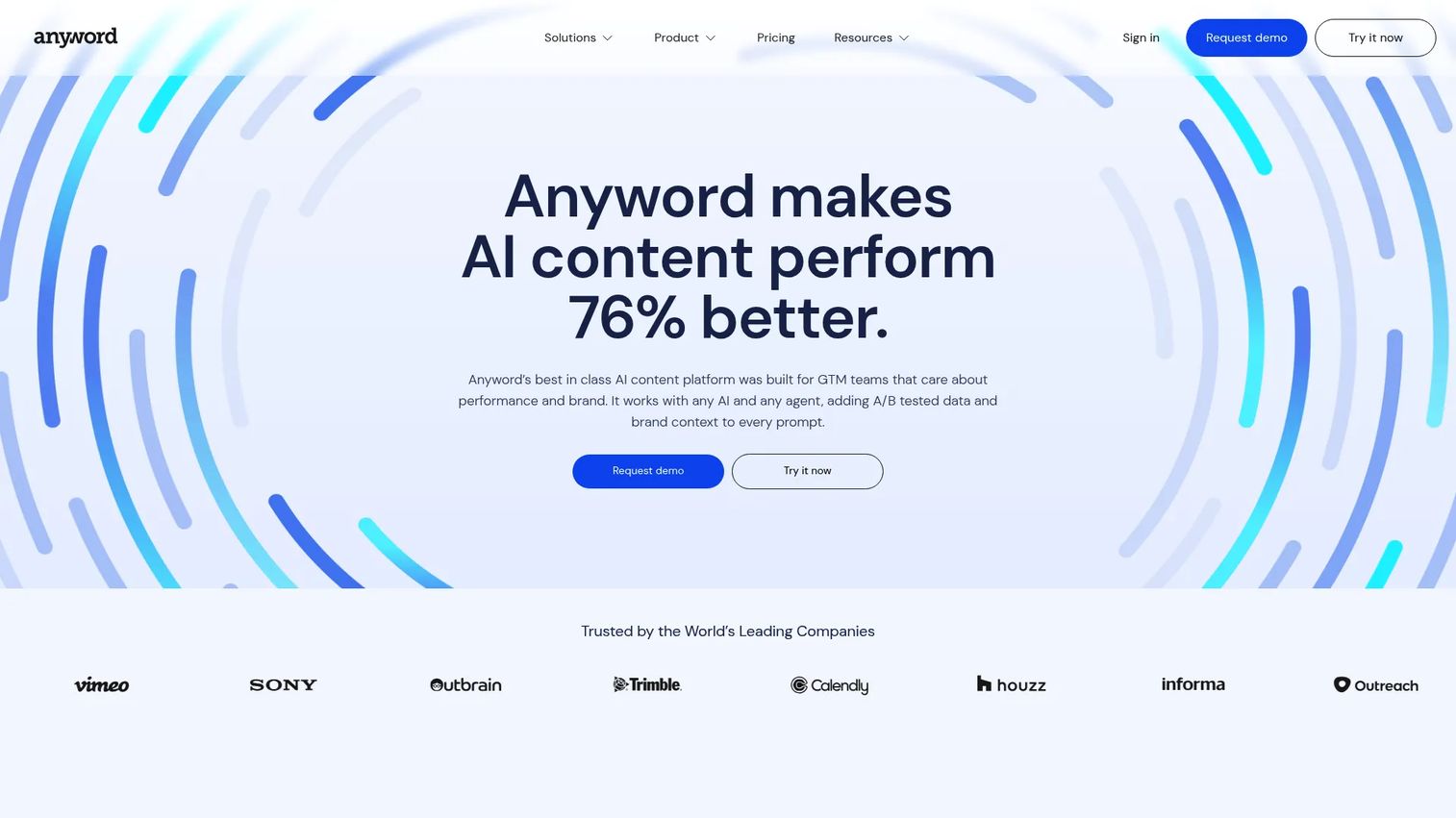
Anyword is an AI copywriting and marketing content platform built for teams that produce a high volume of customer-facing copy. It generates short-form and long-form content, then scores each variation with a predictive performance model so marketers can pick the version most likely to convert. The standout is that scoring layer: it moves NLG from "generate text" to "generate text and tell me which one works."
Best for: Marketing teams producing on-brand ad, landing page, social, and email copy who want performance signals built in.
Key strengths
- Predictive Performance Score: Ranks copy variations before you publish, so you ship the version most likely to convert.
- Brand voice control: Audience-targeted copy that stays consistent across channels and campaigns.
- Short and long-form generation: Handles everything from one-line ad headlines to full landing page sections.
Why choose Anyword: If your NLG job is marketing copy rather than data narratives, Anyword is the natural fit. The performance scoring gives marketing teams a defensible reason to trust the output instead of guessing, and the brand-voice controls keep a large content operation on message.
Anyword pricing: The Starter plan starts at $39/mo billed yearly. Data-Driven is $79/mo billed yearly. Business and Enterprise are custom-priced and routed through sales. A 7-day free trial is available, so you can test the generation and scoring before committing.
2. Automated Insights Wordsmith
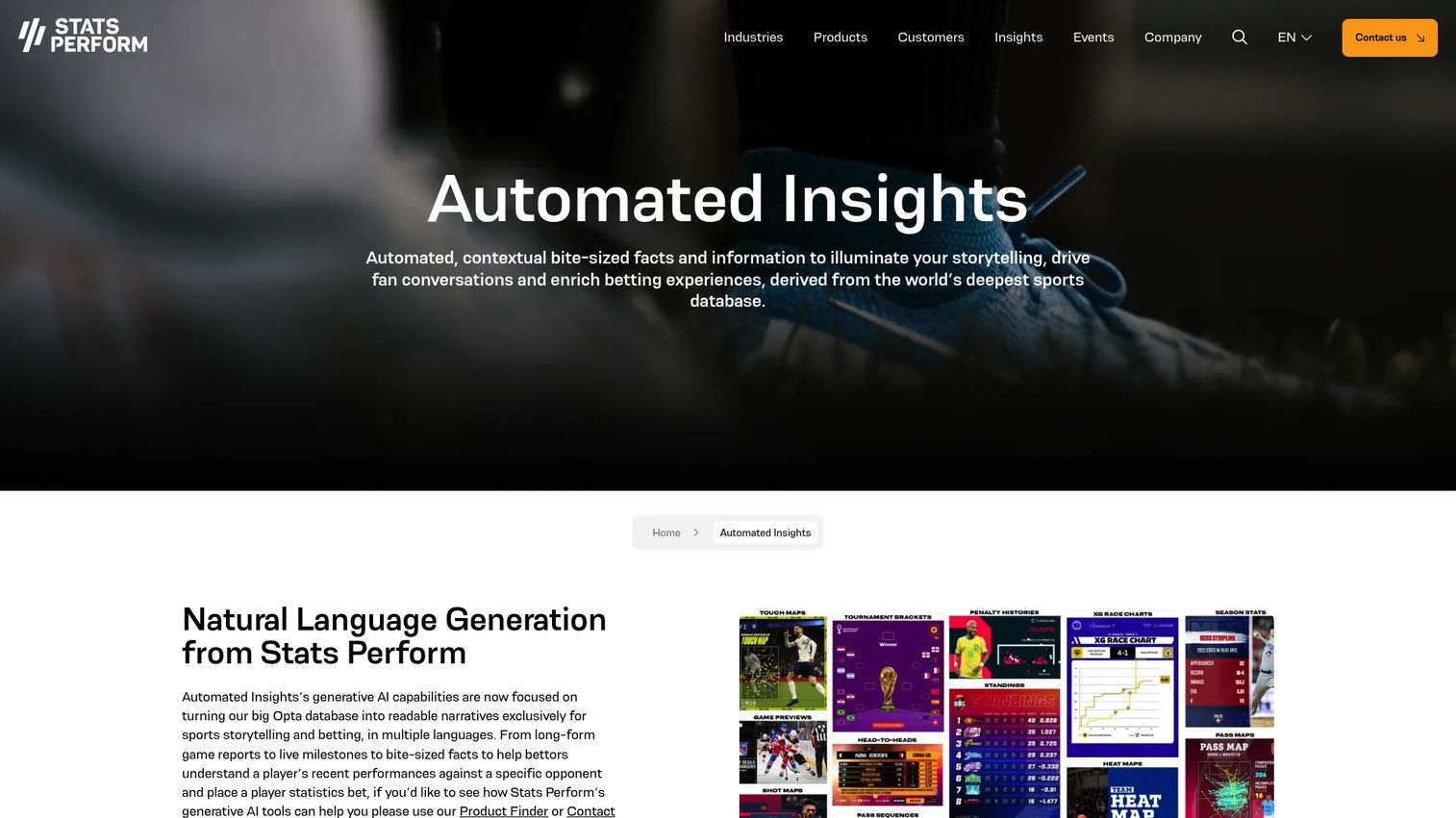
Automated Insights Wordsmith, now part of Stats Perform, is one of the original data-to-narrative engines. It turns structured data into fluent storytelling at scale, and its most visible use is sports: automated pre-game previews, live in-game insights, and post-game recaps generated in multiple languages. The same engine generalizes to any structured dataset that needs a written narrative.
Best for: Sports media, betting, and data-heavy teams needing automated narrative generation across large volumes.
Key strengths
- Multilingual previews: Generates pre-game and pre-event narratives across several languages automatically.
- Live and post-event insights: Produces pre-, live-, and post-game commentary as data updates.
- Player and entity bios: Auto-generates recaps and profiles from structured records.
Why choose Automated Insights Wordsmith: If you generate large volumes of narrative from structured records and need consistency across thousands of outputs, Wordsmith is purpose-built for that scale. Its sports-media pedigree is a strong signal for any team automating data storytelling.
Automated Insights Wordsmith pricing: Pricing is not publicly listed. Stats Perform tailors pricing for enterprise needs and routes inquiries through sales, which is standard for high-volume NLG deployments. Expect a scoping conversation rather than a published price.
3. Arria NLG
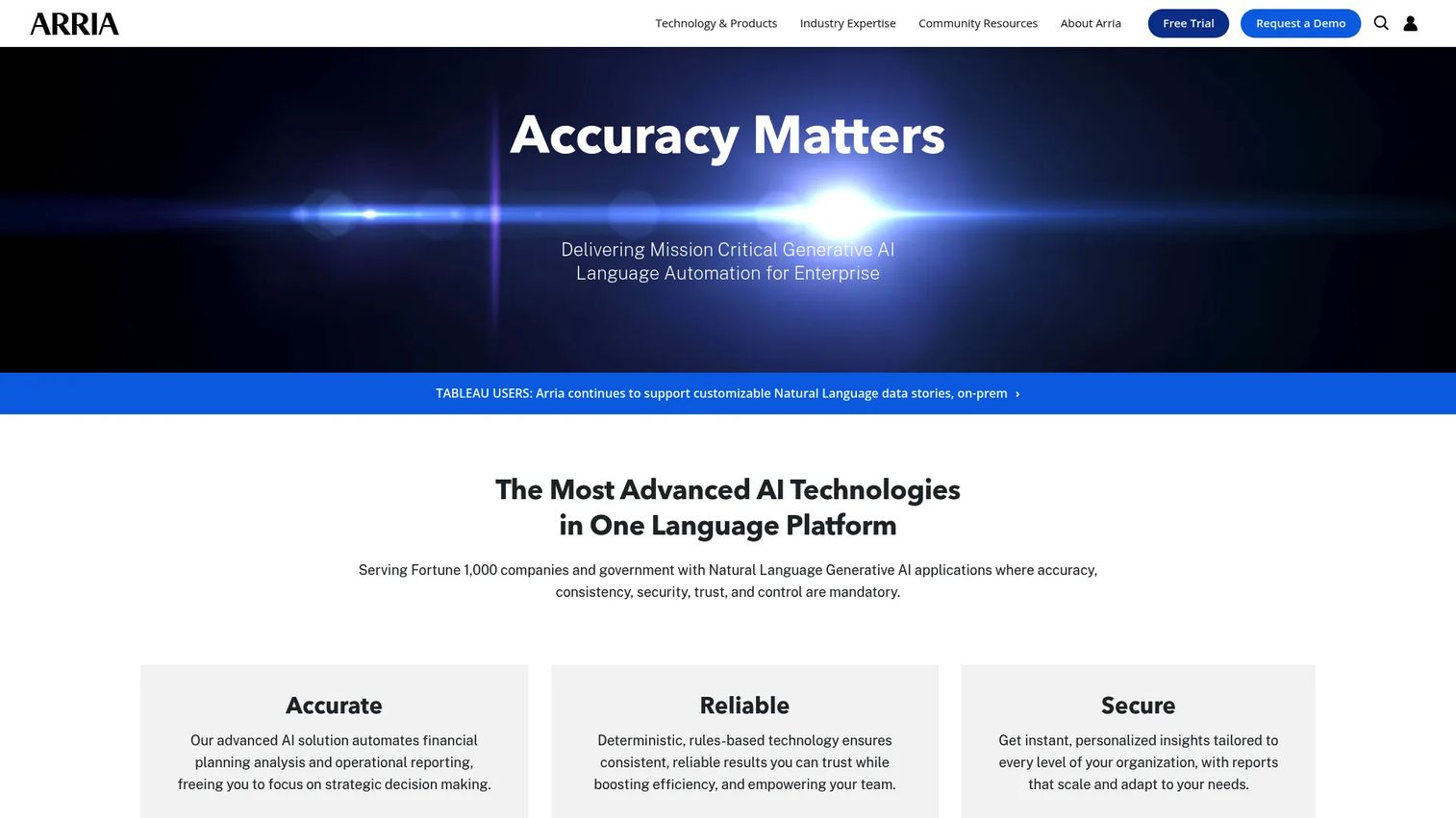
Arria NLG is enterprise natural language generation software that turns structured data into automated narratives and reports. It uses a deterministic, rules-based engine, which means the output is consistent and auditable: the same data always produces the same narrative. That governance makes it a strong fit for finance, BI, and operations teams where output has to be defensible.
Best for: Enterprises that need governed, automated narrative generation from operational or BI data.
Key strengths
- Deterministic generation: Rules-based output that is consistent and auditable, which regulated teams require.
- RESTful API: Accepts JSON or CSV inputs, so it slots into existing data pipelines.
- Flexible deployment: Cloud, dedicated private cloud, and on-premises options for security-conscious buyers.
Why choose Arria NLG: When you need narrative automation you can trust in front of auditors, regulators, or executives, Arria's deterministic approach is the differentiator. It pairs BI dashboards with written commentary without the unpredictability of a pure generative model.
Arria NLG pricing: Arria does not publish numeric pricing on its site. It offers a free trial and a demo request, with pricing handled through sales conversations. The free trial lets technical teams validate the API and output quality before a commercial discussion.
4. AX Semantics
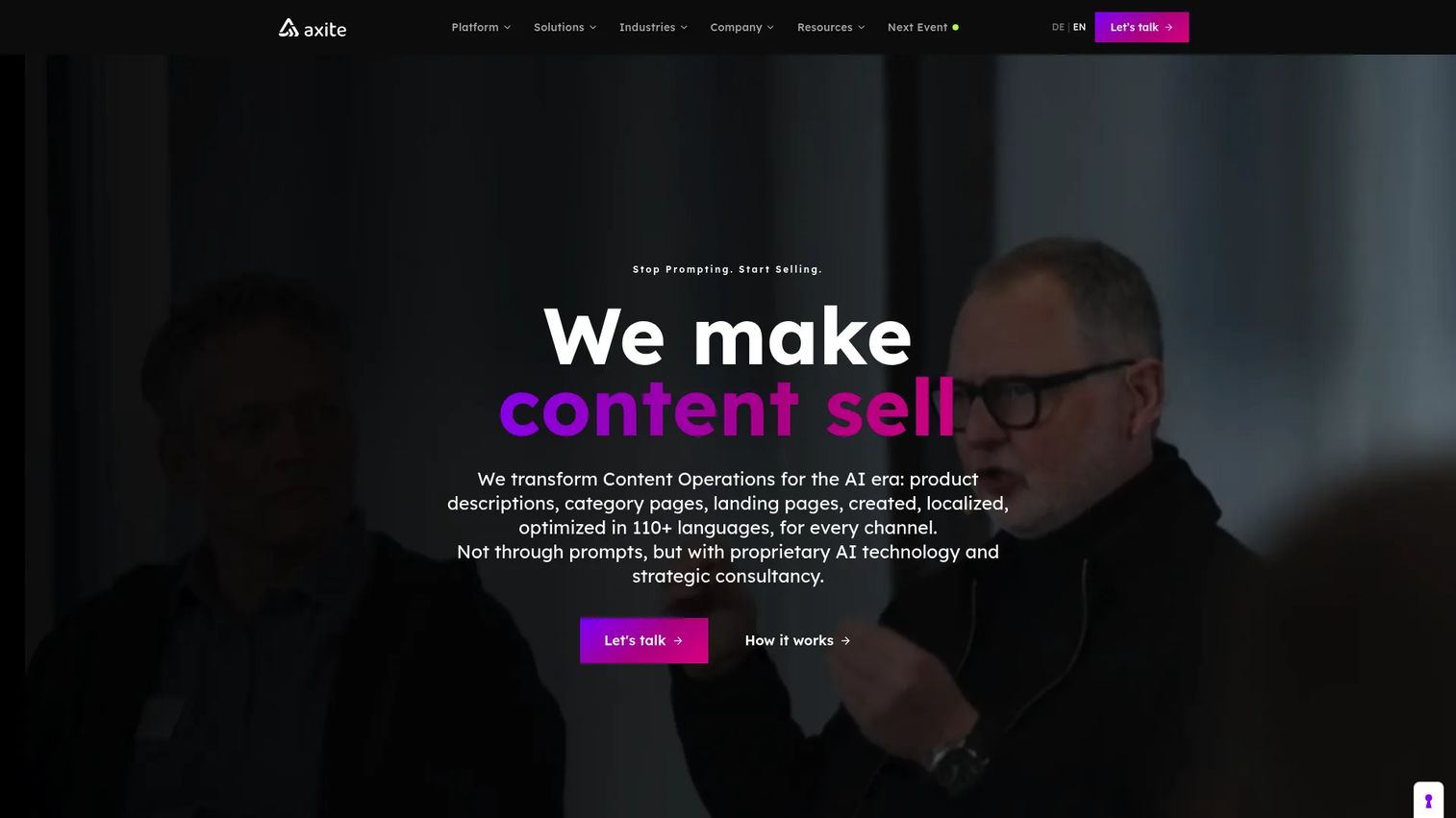
AX Semantics, now operating as axite, is an AI-native content automation and consulting platform built for ecommerce content operations. It automates large-scale product content and layers in QA workflows and a performance feedback loop that ties output to SEO, conversion, and returns data. The result is a system that not only generates content but learns which content performs.
Best for: Enterprises and mid-market teams automating and optimizing product content at scale across multiple languages.
Key strengths
- Automated content generation: Produces high-volume product and catalog content from structured attributes.
- AI-assisted QA workflow: Built-in quality checks before content ships, reducing manual review.
- Performance feedback loop: Connects output to SEO, conversion, and returns metrics so content improves over time.
Why choose AX Semantics: For commerce and editorial teams managing thousands of items across markets, AX Semantics combines generation, quality control, and optimization in one place. The feedback loop is the differentiator: it treats content as something to measure and improve, not just produce.
AX Semantics pricing: AX Semantics uses a value-based model with three plans. axite Catalyst is a fixed project fee, while Professional and Enterprise+ are custom offers. Numeric pricing is not published, so expect a scoping conversation tied to your content volume and goals.
5. Yseop
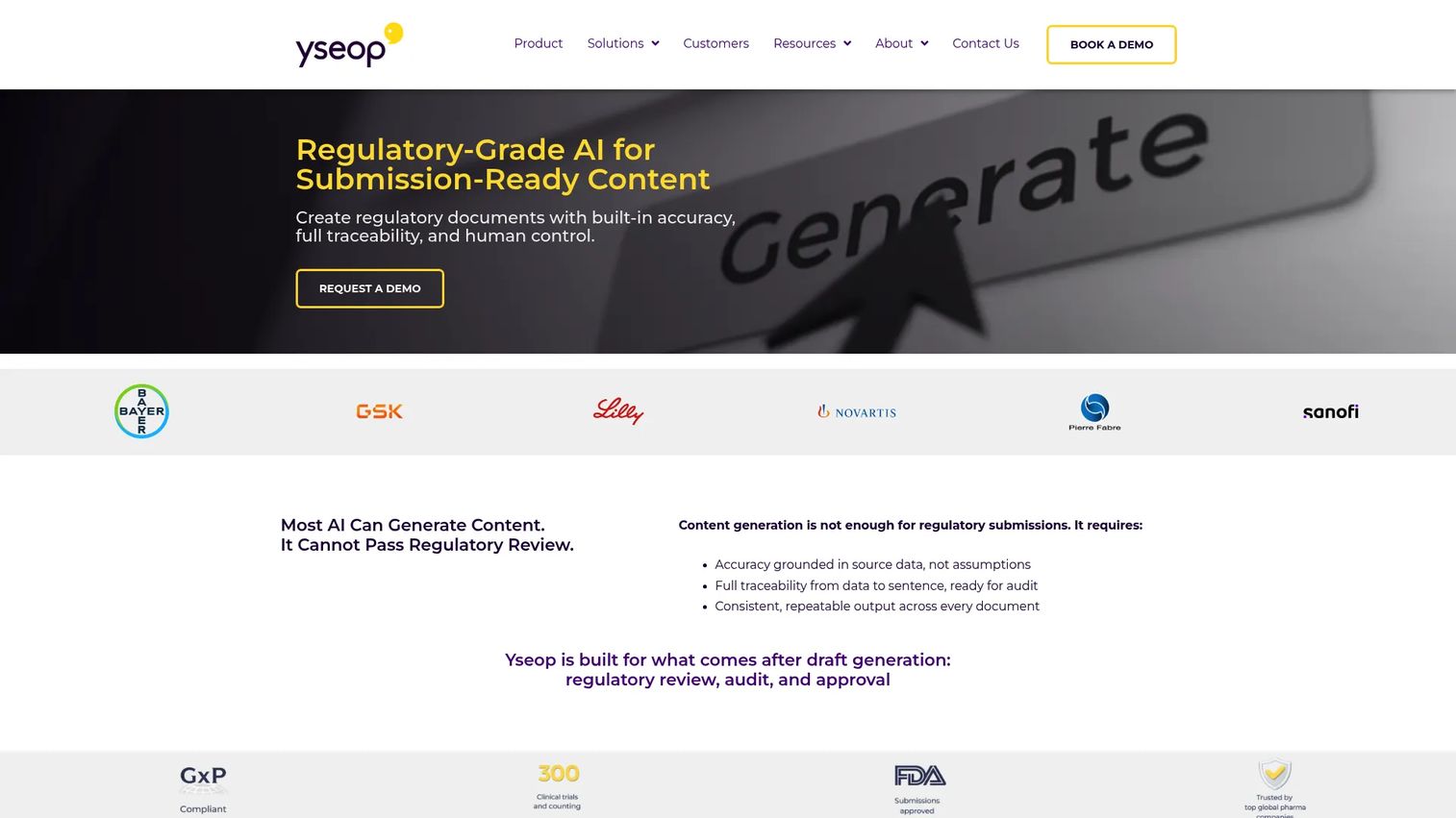
Yseop is regulatory-grade AI software for life sciences that automates the creation of submission-ready documents. It is built for environments where every sentence has to be traceable: clinical, safety, and regulatory writing where auditability is non-negotiable. Yseop works inside Microsoft Word and integrates with Veeva Vault, meeting medical writers where they already work.
Best for: Life sciences teams needing compliant, auditable regulatory and medical writing automation.
Key strengths
- Traceable document generation: Regulatory output with a full audit trail, built for submission-ready work.
- Native Word and Veeva Vault integration: Fits into existing medical writing and document-management workflows.
- Specialized workflows: Supports clinical, safety, and CMC/regulatory document types out of the box.
Why choose Yseop: In regulated life sciences, generic NLG does not clear compliance. Yseop is purpose-built for traceability and submission readiness, which is why medical and regulatory affairs teams choose it over general-purpose tools.
Yseop pricing: Yseop does not publish numeric pricing. Its model is license-per-year plus setup costs, based on the number of users, with details handled through sales. For regulated buyers, the scoping process typically includes compliance and integration requirements.
6. Retresco
Retresco is an AI-based language technology company focused on content automation, question answering, and conversational analytics. It generates automated text from structured data and adds agentic AI question answering, making it useful beyond pure generation. Media, commerce, and enterprise teams use it for custom content and Q&A solutions at scale.
Best for: Media, commerce, and enterprise teams needing custom AI content and question-answering solutions.
Key strengths
- Automated text generation: Produces content from structured data for high-volume publishing and catalogs.
- Agentic AI question answering: Goes beyond generation to answer queries from your content base.
- Conversational analytics: Surfaces insight from how users interact with generated content.
Why choose Retresco: If your needs span both content generation and intelligent question answering, Retresco covers more of the language stack than a single-purpose tool. Its strength is custom solutions for teams that want generation and retrieval together.
Retresco pricing: Retresco does not publish public pricing. Its terms state that pricing is agreed in separate written contracts, so expect a custom quote scoped to your content volume and use case. A demo conversation is the entry point.
7. Persado
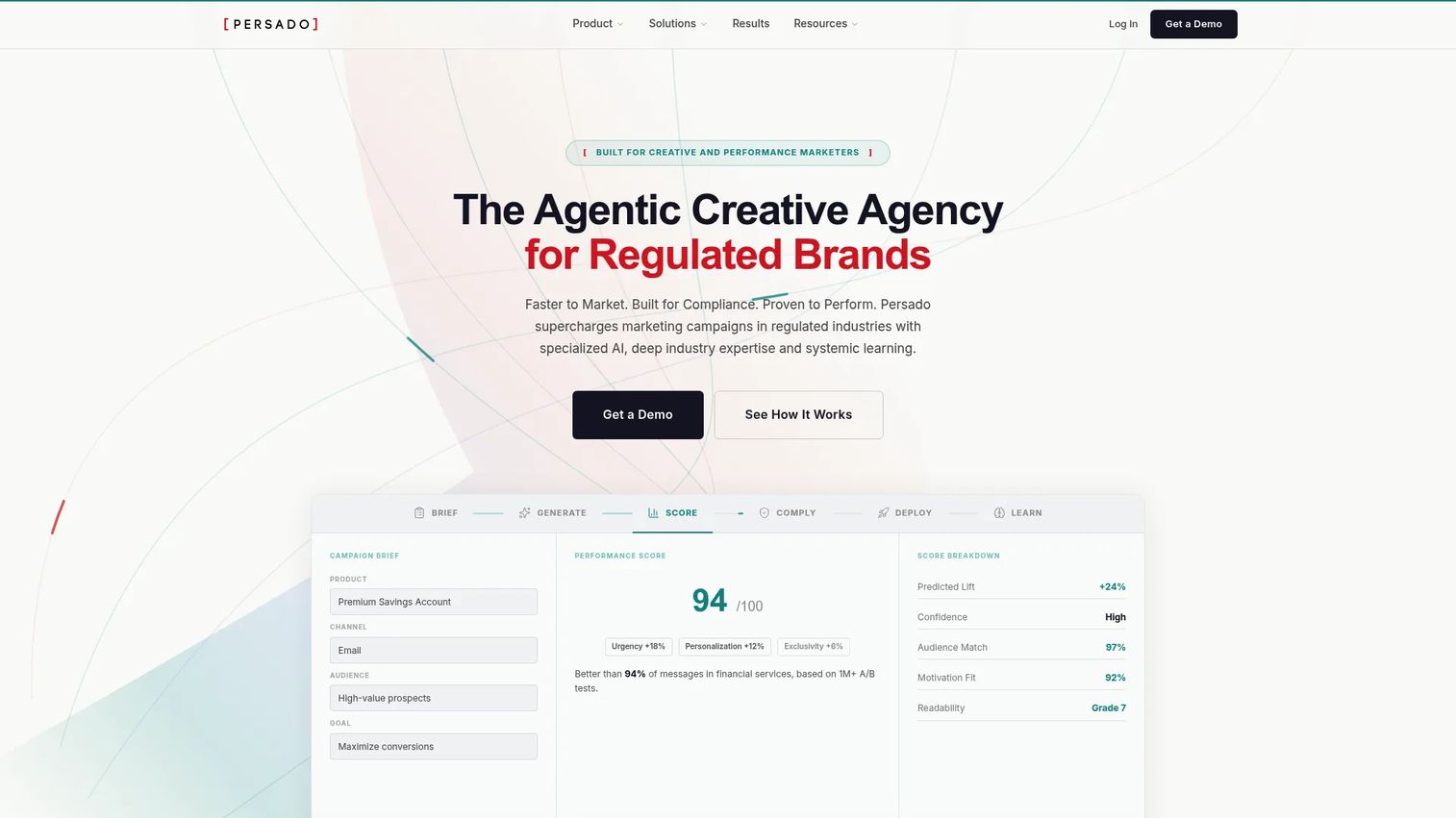
Persado is an AI marketing platform that generates, tests, personalizes, and analyzes language to improve performance and compliance. It is built for enterprise marketing teams, especially in regulated industries, where messaging has to perform and stay within brand and legal rules. Persado treats copy as something to test and optimize, not just write.
Best for: Enterprise marketing teams in regulated industries needing compliant, performance-optimized messaging.
Key strengths
- Generate and predict: Produces content and predicts how language will perform before launch.
- Machine-learning experimentation: Runs tests to find the highest-performing message variants.
- Compliance controls: Keeps generated language within brand and regulatory guidelines.
Why choose Persado: For large brands where every message goes through legal and brand review, Persado combines performance optimization with built-in compliance. Marketing teams that live and die by conversion lift get a tool engineered for exactly that.
Persado pricing: Persado does not publish public pricing. Fees are set in an order form per its terms, so pricing is custom and routed through sales. This is typical for enterprise marketing platforms with heavy personalization and compliance features.
8. OpenAI
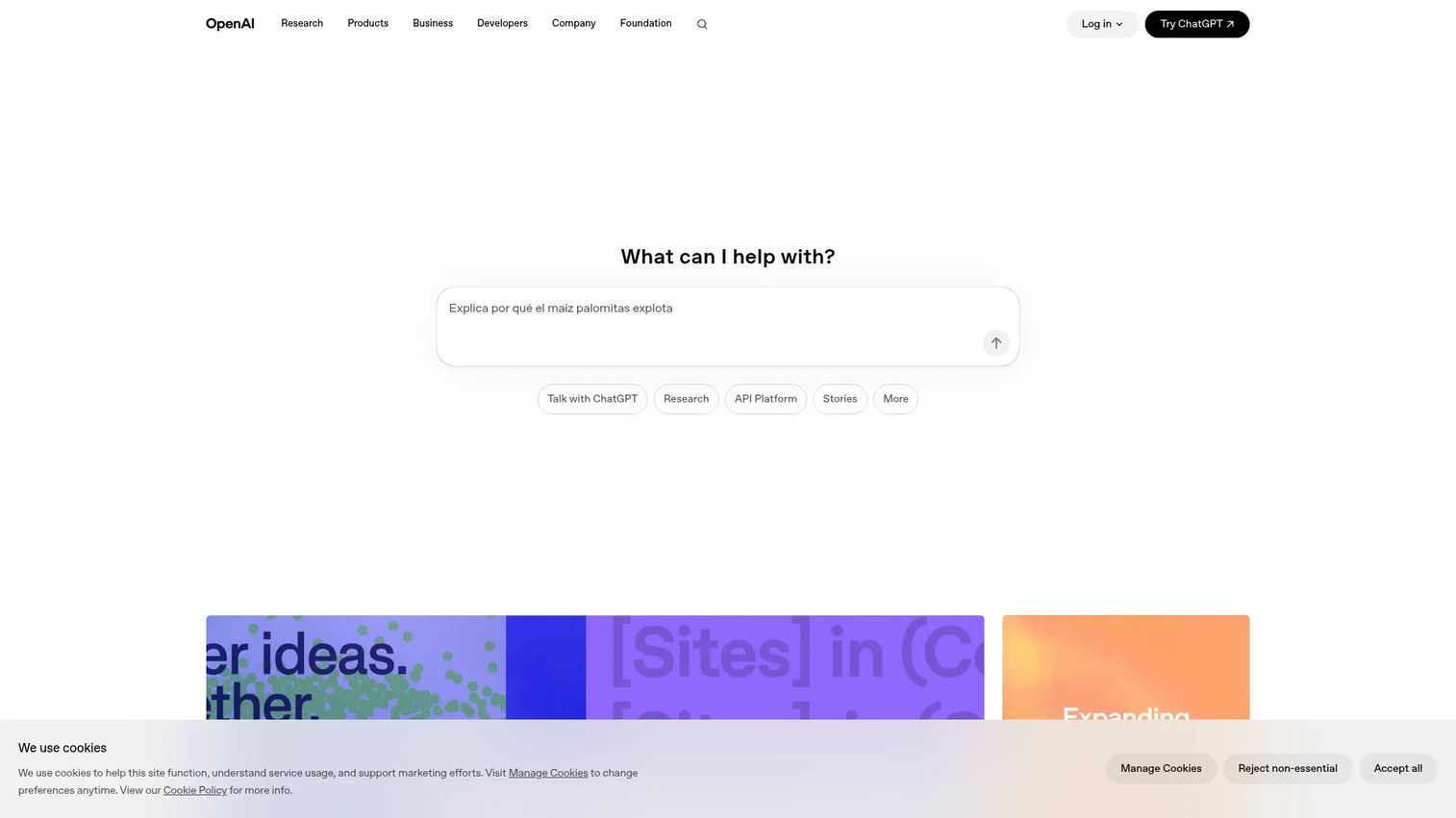
OpenAI is the AI research and product company behind ChatGPT and the OpenAI API. Rather than a narrow vertical NLG product, it is flexible infrastructure: teams build their own generation workflows on top of frontier language models. If your generation needs do not fit a packaged tool, OpenAI gives you the raw capability to assemble exactly what you want.
Best for: Teams and developers needing flexible, general-purpose language generation and API access.
Key strengths
- ChatGPT assistant: Conversational generation for drafting, summarizing, and rewriting at speed.
- OpenAI API: Model access and developer tools for building custom generation systems.
- Web search and research tools: Pulls in current information to ground generated output.
Why choose OpenAI: When you need a general-purpose language model instead of a vertical NLG product, OpenAI is the most flexible option on this list. It suits teams with developer bandwidth who want to build generation into their own products and workflows.
OpenAI pricing: ChatGPT has a free tier at $0/month. Plus is $20/month and Pro starts at $200/month. Business is priced per user per month and Enterprise is custom. API usage is billed separately based on consumption, which matters if you are building generation at scale.
9. IBM watsonx.ai
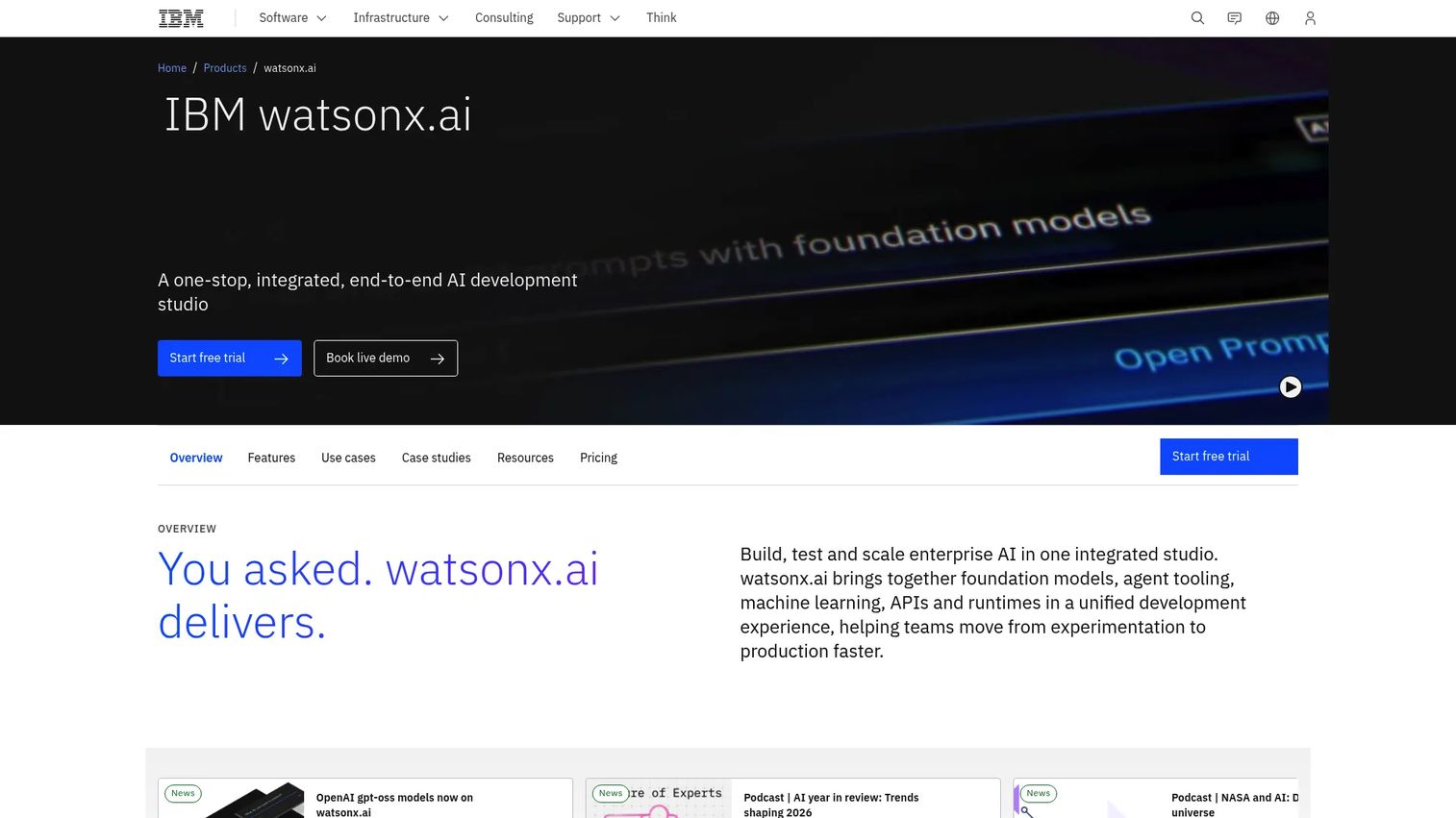
IBM watsonx.ai is IBM's enterprise AI studio for building, training, tuning, and deploying generative AI and machine learning applications. For NLG, it gives teams the foundation models, tooling, and governance to build custom language-generation systems rather than buying a fixed product. It is the choice when you need generation built into governed enterprise applications.
Best for: Enterprises building and deploying governed AI apps, models, and language-generation assistants.
Key strengths
- Playground and inferencing: A UI to test prompts and models before building.
- RAG and agents: PromptLab and AgentLab for retrieval-augmented and agentic generation.
- Foundation and open-source models: Model hosting and deploy-on-demand for custom systems.
Why choose IBM watsonx.ai: When governance, model choice, and enterprise deployment matter more than an off-the-shelf interface, watsonx.ai gives you the studio to build exactly what you need. It fits organizations that want to own their generation stack with IBM-grade controls.
IBM watsonx.ai pricing: IBM offers a free Toolbox playground at USD 0/month. The Essentials plan is pay-as-you-go starting at USD 0/month, and Standard is pay-as-you-go starting at USD 1,110/month. Pricing varies by country and some capabilities are billed separately, so model your expected consumption before committing.
Considerations before you buy
The output quality of any NLG tool depends on more than the model. Run your shortlist through these checks before you sign.
Data structure and source quality
NLG output is only as good as the data feeding it. Garbage in, garbage out applies literally here. Before evaluating any tool, audit your input: is your data structured, clean, and consistently tagged? Check your taxonomy and governance, because a tool that generates fluent text from messy data just produces fluent nonsense faster.
Output control and brand voice
A platform that writes well but off-brand creates more editing work than it saves. Assess tone control, template flexibility, and editing controls. Can you lock house style across teams and channels? Can a human reviewer catch and correct before publish? Consistency across every output is what separates a usable tool from a liability.
Integration and workflow fit
The best output is useless if it lives outside your stack. Check how the tool connects to your BI, CRM, CMS, and analytics tools. Test the operational fit, not just a sample paragraph: does it trigger from your data pipeline, route to the right place, and fit how your team already works? A tool nobody can connect is a tool nobody uses.
Multilingual and localization needs
If you operate across markets, multilingual support is not optional. Verify the tool generates natively in your target languages rather than machine-translating after the fact. For global commerce and content teams, localization at scale, including local tone and conventions, is a core requirement, not a nice-to-have.
Security, governance, and compliance
For enterprise use, verify how the tool handles your data, where it processes it, and whether it supports approval workflows and audit trails. Regulated teams need traceability on every output. Confirm data handling, retention, and access controls match your compliance requirements before output ever reaches a customer or regulator.
Conclusion
Natural language generation software has matured from a niche reporting trick into a core layer of how teams turn data into language. The right pick depends entirely on the job.
For governed enterprise reporting from structured data, Arria NLG and Automated Insights Wordsmith lead. For marketing content automation with performance signals, Anyword stands out. For regulated work, Yseop owns life sciences and Persado owns compliant marketing messaging. For multilingual commerce content, AX Semantics and Retresco scale cleanly. And when you want flexible, build-your-own generation, OpenAI gives you raw LLM power while IBM watsonx.ai gives you a governed enterprise studio.
The biggest selection takeaway: match the tool to your data type, your output volume, and your integration stack, not to the longest feature list. Shortlist two or three based on reporting needs, content scale, and how cleanly each plugs into the systems you already run. Then test with your real data before you commit, because that is where output quality actually shows itself.
FAQs
Natural language generation software turns structured or unstructured data into human-readable text automatically. Instead of a person writing a report by hand, the software reads the data and produces a summary, narrative, or message. A common example is generating written commentary on a sales dashboard so every stakeholder reads the same explanation.
Natural language processing (NLP) is the broad field covering all machine interaction with human language. NLG is the output side of that field: it produces language. NLP also includes natural language understanding (NLU), which interprets and extracts meaning from input. In short, NLU reads, NLG writes, and NLP is the umbrella over both.
The strongest use cases are automated reporting, data summaries, customer-facing copy at scale, and chatbot or assistant responses. NLG works best where the same writing job repeats often, like product descriptions, financial commentary, or support replies. The more repetitive and data-driven the writing, the bigger the time saving.
Prioritize data connectivity to your existing sources, customization and brand-voice control, language quality, multilingual support if you operate across markets, governance and audit controls, and integrations with your BI, CRM, and CMS. The right balance depends on whether you need auditable reporting or high-volume content. Test output quality on your own data, not a vendor demo.
They overlap but are not identical. Generative AI writing tools, often built on large language models and transformers, focus on flexible content creation. Dedicated NLG platforms focus on structured-data narratives like reports and summaries, often with deterministic, auditable output. For enterprise reporting where consistency matters, a purpose-built NLG platform is usually the better fit.
Finance, healthcare and life sciences, customer service, media, ecommerce, and analytics-heavy teams use NLG most. Finance automates reporting commentary, life sciences automates regulatory documents, ecommerce generates product content, and media produces data-driven stories. Any industry with high volumes of repeatable, data-backed writing is a strong fit.
Start with your primary use case: reporting, content, or conversational output. Then map your data sources, your required output volume, your compliance needs, and your integration stack. Regulated teams should prioritize auditability and governance; content teams should prioritize brand control and scale. Shortlist two or three tools and test each with your real data before deciding.