A financial aid office runs on deadlines it does not control. FAFSA cycles shift. Verification queues pile up. A single misread ISIR field can cascade into an overaward, a clawback, and a note in the next program review. Meanwhile students keep asking the same question in a dozen channels: "Where's my aid?"
Most teams answer that question with spreadsheets, email threads, and a portal that shows status but does nothing to move the work forward. The manual layer is where mistakes hide. Recalculations get missed. R2T4 gets calculated late. A scholarship fund sits unspent because no one matched it to the right applicants in time.
The stakes keep climbing. The global financial aid management software market reached about USD 857.79 million in 2025 and is projected to hit USD 1.38 billion by 2033, growing at a 6.1% CAGR, according to Congruence Market Insights (2025). More than 60% of newly procured implementations are now cloud-native. And 54% of financial aid administrators told NASFAA (2024) they had used AI for aid work in the past six months. The category is professionalizing fast, which makes 2026 buying decisions harder: there are more capable financial aid management software vendors, more overlap between platforms, and more ways to buy the wrong fit.
This guide compares the software worth shortlisting, from end-to-end campus financial aid automation to scholarship management software and financial aid compliance software built for audit readiness.
What's inside
This guide is for aid directors, student services leaders, and finance and IT stakeholders comparing financial aid software for higher education. It covers core aid platforms, enterprise student systems, and scholarship-focused tools where they fit real institutional needs.
We chose vendors based on four criteria:
- Automation depth across packaging, verification, disbursement, recalculation, and R2T4
- Compliance and reporting strength for federal checks and audit readiness
- Integrations with your SIS, CRM, and finance systems
- Student experience, including self-service, communication, and status visibility
We weighed fit across institution types, from single-campus career schools to large multi-campus universities.
TL;DR
- Best for end-to-end aid automation: Regent Education, built for complex and non-term enrollment models.
- Best for enterprise-scale student aid operations: Workday Student, for institutions unifying aid inside one student system.
- Best for combined software plus services: FAME Financial Aid, especially career and multi-campus schools.
- Best for campus-wide financial aid visibility: Ellucian Banner Financial Aid, for Banner-centric institutions.
- Best for the student financial aid experience: CampusLogic, for document collection and communication.
- Best for scholarship administration: Blackbaud Award Management Software or AwardSpring, depending on donor complexity.
- Best for leaner, configurable scholarship workflows: Zengine by WizeHive.
What is financial aid software?
Financial aid software is a platform that automates how colleges and universities determine eligibility, package awards, verify documents, disburse funds, and stay compliant with federal and institutional rules across the full aid lifecycle.
At its core, student aid software replaces manual checks and disconnected spreadsheets with a system of record that connects to the student information system and finance ledger. Good student financial aid management software handles the entire cycle, not just one slice of it.
Key capabilities to expect:
- Eligibility verification and ISIR processing
- Aid packaging automation for need-based and merit-based awards
- Award letters and student-facing communication
- Disbursement automation to the finance and student accounts system
- Recalculation when enrollment or eligibility changes
- R2T4 automation for return of Title IV funds
- Financial aid compliance software features for reporting and program review
- Student self-service for documents, status, and awards
- Analytics on volume, bottlenecks, and processing time
- SIS integration and often CRM integration for enrollment and outreach
The best financial aid software vendors treat these as one connected workflow. That is what separates a real platform from a portal that only shows status.
When to use financial aid software
Streamline high-volume aid processing
Use it when your team is buried in verification and packaging. If aid counselors spend hours reconciling ISIRs by hand or re-keying awards between systems, campus financial aid automation removes the repetitive work. Aid packaging automation and disbursement automation cut the manual steps where overawards and late disbursements originate.
Improve student-facing visibility
Use it when students can't tell what they owe, what's missing, or what they've been awarded. Student self-service turns "Where's my aid?" into a status page students actually check. Clear document requests, award letters, and next steps reduce inbound calls and keep students moving toward enrollment.
Reduce audit and compliance stress
Use it when policy changes, federal checks, and reporting create real institutional risk. Financial aid compliance software enforces rules at the point of packaging, logs every action, and automates R2T4 so returns happen on time. When a program review lands, audit readiness is the difference between a clean file and a scramble.
Financial aid software comparison
The table below is meant to help you narrow shortlist candidates quickly. Most of these vendors do not publish public pricing and route buyers to a sales conversation, so treat pricing as directional and confirm against your enrollment size and configuration.
| # | Product | Best for | Key differentiator | Pricing | G2 rating |
|---|---|---|---|---|---|
| 1 | Regent Education | End-to-end aid automation for complex models | Non-term and BBAY support | Custom quote | 1.5/5 |
| 2 | Workday Student | Enterprise student aid operations | Aid inside a unified student system | Custom quote | Not listed |
| 3 | FAME Financial Aid | Career and multi-campus schools | Software plus full-service processing | Custom quote | 3.8/5 |
| 4 | Ellucian Banner Financial Aid | Banner-centric institutions | Native Banner and SIS alignment | Custom quote | Not listed |
| 5 | CampusLogic | Student financial aid experience | Document automation and communication | Custom quote | 4.3/5 |
| 6 | Blackbaud Award Management | Scholarship and donor stewardship | SIS-matched awards plus donor tracking | Custom quote | 4.2/5 |
| 7 | AwardSpring | Scholarship application workflows | AI-assisted review, public entry plan | $99/month | 4.7/5 |
| 8 | Zengine by WizeHive | Configurable scholarship and aid workflows | Flexible forms and routing | Custom quote | Not listed |
Best 8 financial aid software vendors for 2026
1. Regent Education
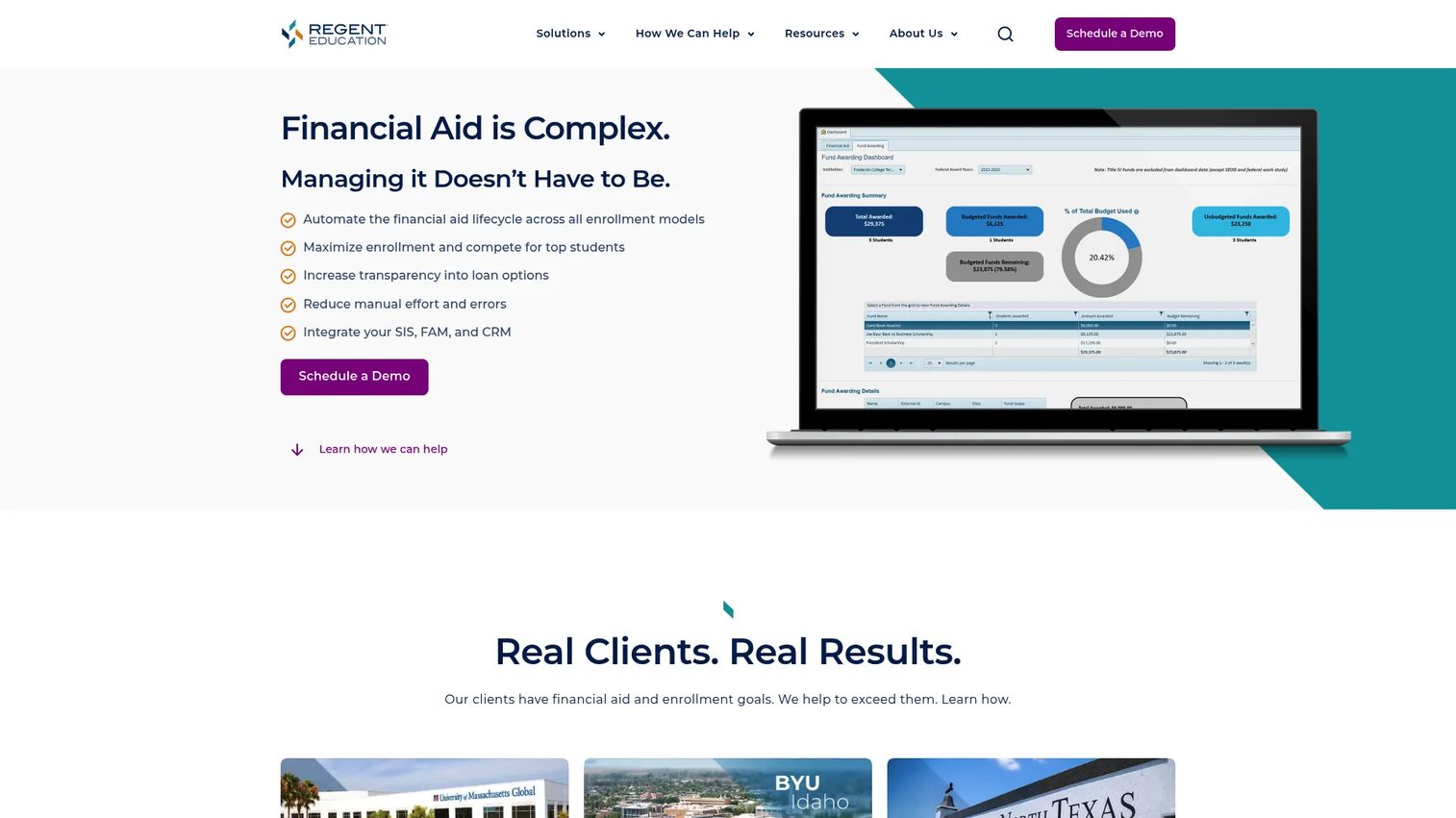
Regent Education is cloud-based financial aid management software for higher education institutions, and it leans hard into automation for the enrollment models most tools handle poorly. If your institution runs non-standard terms, borrower-based academic years, or continuous enrollment, this is where Regent earns its place. It automates packaging, repackaging, disbursement, and R2T4 across all of those models rather than forcing everything into a standard-term box.
Best for: Colleges and universities that need aid automation for complex, non-term, or continuous enrollment.
Key strengths
- Automates aid across all enrollment models
- Non-term and BBAY (borrower-based academic year) support
- Integrates SIS, FAM, and CRM systems
- Packaging, repackaging, disbursement, and R2T4 in one workflow
Why choose Regent Education: If your enrollment model breaks conventional financial aid software, Regent is built for exactly that friction. It fits institutions whose calendars and program structures create the manual workarounds other systems can't automate away.
Regent Education pricing: Regent does not publish public pricing. The site routes visitors to schedule a demo and request a customized quote based on institution needs.
2. Workday Student
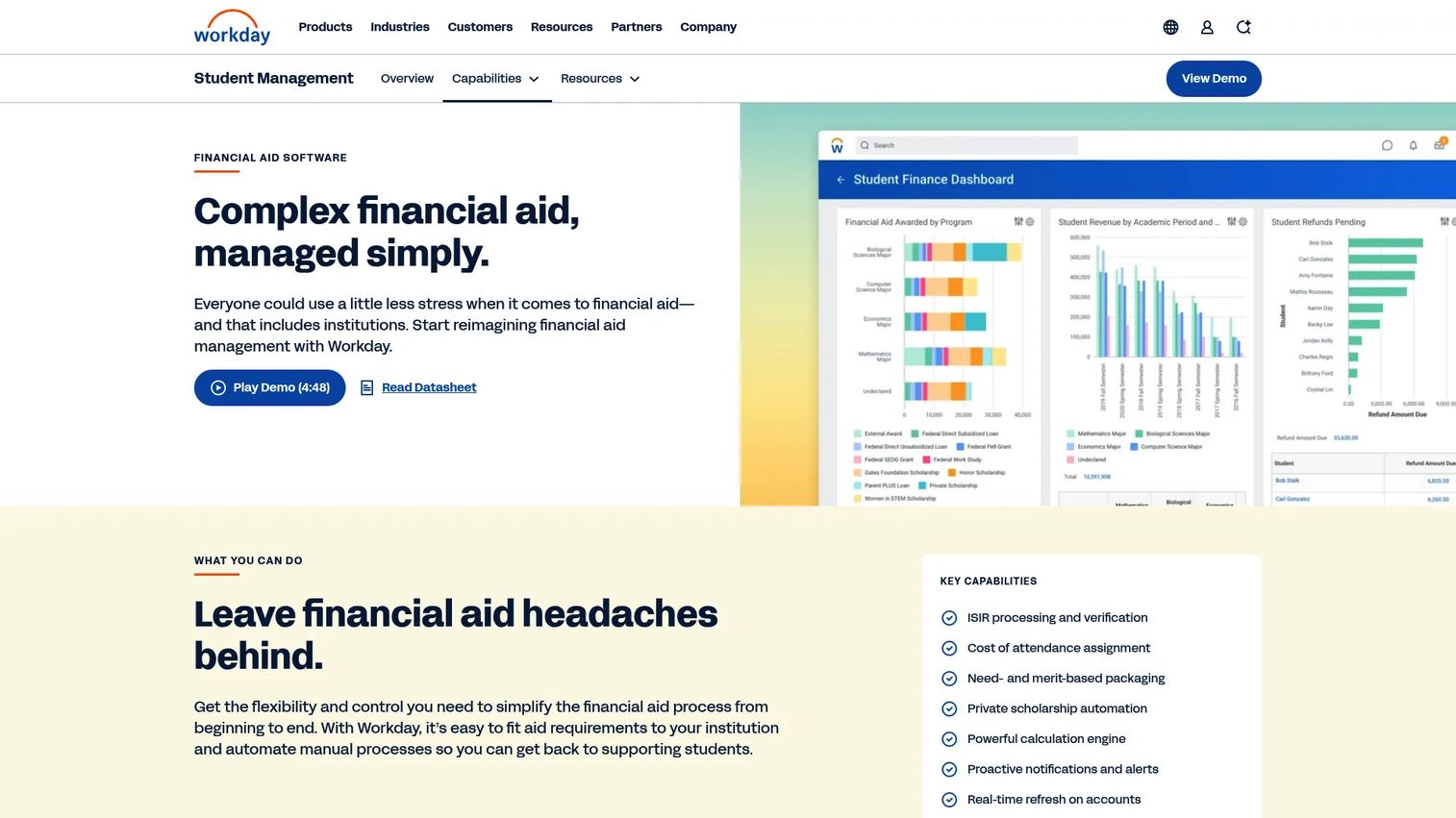
Workday Student approaches financial aid as one part of a unified student and institutional system. The pitch is consolidation: aid, records, finance, and HCM live in the same data model, so a change in one place updates everywhere in real time. For institutions already running Workday, or planning a full student-system move, that continuity is the draw.
Best for: Colleges and universities managing financial aid inside a single unified student system.
Key strengths
- ISIR processing and verification
- Need- and merit-based packaging
- Real-time refresh on student accounts
- Aid connected to finance and HCM data
Why choose Workday Student: If you're consolidating fragmented student systems and want aid to share one record with finance and records, Workday's unified model reduces the handoffs where data drifts. It's an enterprise commitment, not a point solution.
Workday Student pricing: Workday does not publish public pricing for its student financial aid product. The site directs institutions to contact sales for a quote based on scope.
3. FAME Financial Aid

FAME Financial Aid pairs software with hands-on services, which is what sets it apart on this list. Career schools and post-secondary institutions with lean aid teams don't just need a platform, they need help running compliant processing. FAME offers full-service and virtual financial aid processing alongside a student information system, an admissions CRM, and a student mobile app.
Best for: Post-secondary career schools needing compliant financial aid software backed by processing services.
Key strengths
- Financial aid processing (full-service and virtual)
- Student information system
- Admissions CRM and student mobile app
- Compliance support built for career schools
Why choose FAME Financial Aid: If your team is small and compliance exposure is high, buying software plus a services layer reduces internal workload more than software alone. It fits schools that would rather offload processing than staff up for it.
FAME Financial Aid pricing: FAME customizes pricing to enrollment size and configuration. No public numeric price is published; the site directs schools to request a tailored quote.
4. Ellucian Banner Financial Aid
Ellucian Banner Financial Aid is financial aid administration built to live inside the Banner ecosystem. For the large number of institutions already running Banner as their SIS, that native alignment matters: aid, records, and institutional finance share the same backbone, and workflow visibility spans the systems your team already uses daily. It administers, tracks, and reports on aid across eligibility, awarding, and disbursement.
Best for: Higher education institutions needing integrated financial aid processing within Banner.
Key strengths
- Administer, track, and report on financial aid
- Manage eligibility, awarding, and disbursement
- Native Banner and SIS alignment
- Compliance and reporting across aid processes
Why choose Ellucian Banner Financial Aid: If Banner is already your system of record, keeping aid inside that ecosystem avoids the integration overhead of bolting on a separate platform. It fits large higher-ed environments where SIS alignment outweighs a standalone tool.
Ellucian Banner Financial Aid pricing: Ellucian does not publish public pricing for Banner Financial Aid. Pricing is handled through a contact-sales process tied to your institution's footprint.
5. CampusLogic
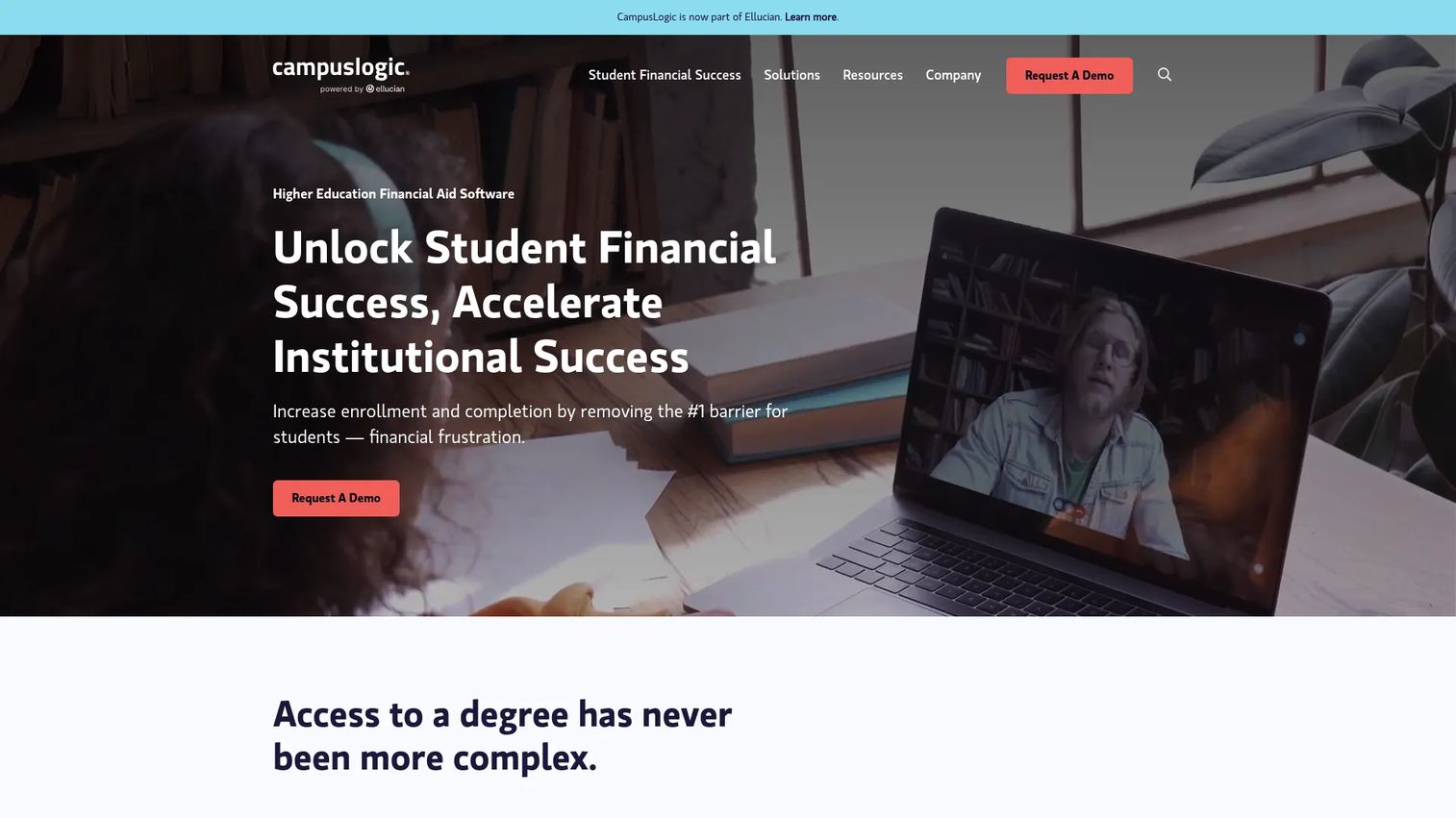
CampusLogic, now branded as Ellucian Student Financial Success, focuses on the student side of the aid process. Where core aid engines handle the back-office math, CampusLogic handles the experience: collecting paperwork, communicating status, and guiding students through the financial aid journey. StudentForms automates the verification paperwork that usually clogs the queue.
Best for: Colleges and universities improving the student financial aid experience and document workflow.
Key strengths
- StudentForms for financial aid paperwork and automation
- ScholarshipUniverse for scholarship management
- CampusCommunicator for student engagement
- VirtualAdvisor for advising and self-service
Why choose CampusLogic: If document collection and student communication are where your process stalls, CampusLogic attacks that bottleneck directly. It pairs well with a core aid engine rather than replacing one, and its scholarship module extends into scholarship management software territory.
CampusLogic pricing: CampusLogic does not display public pricing. The official site routes visitors to contact sales for a quote based on institutional needs.
6. Blackbaud Award Management Software
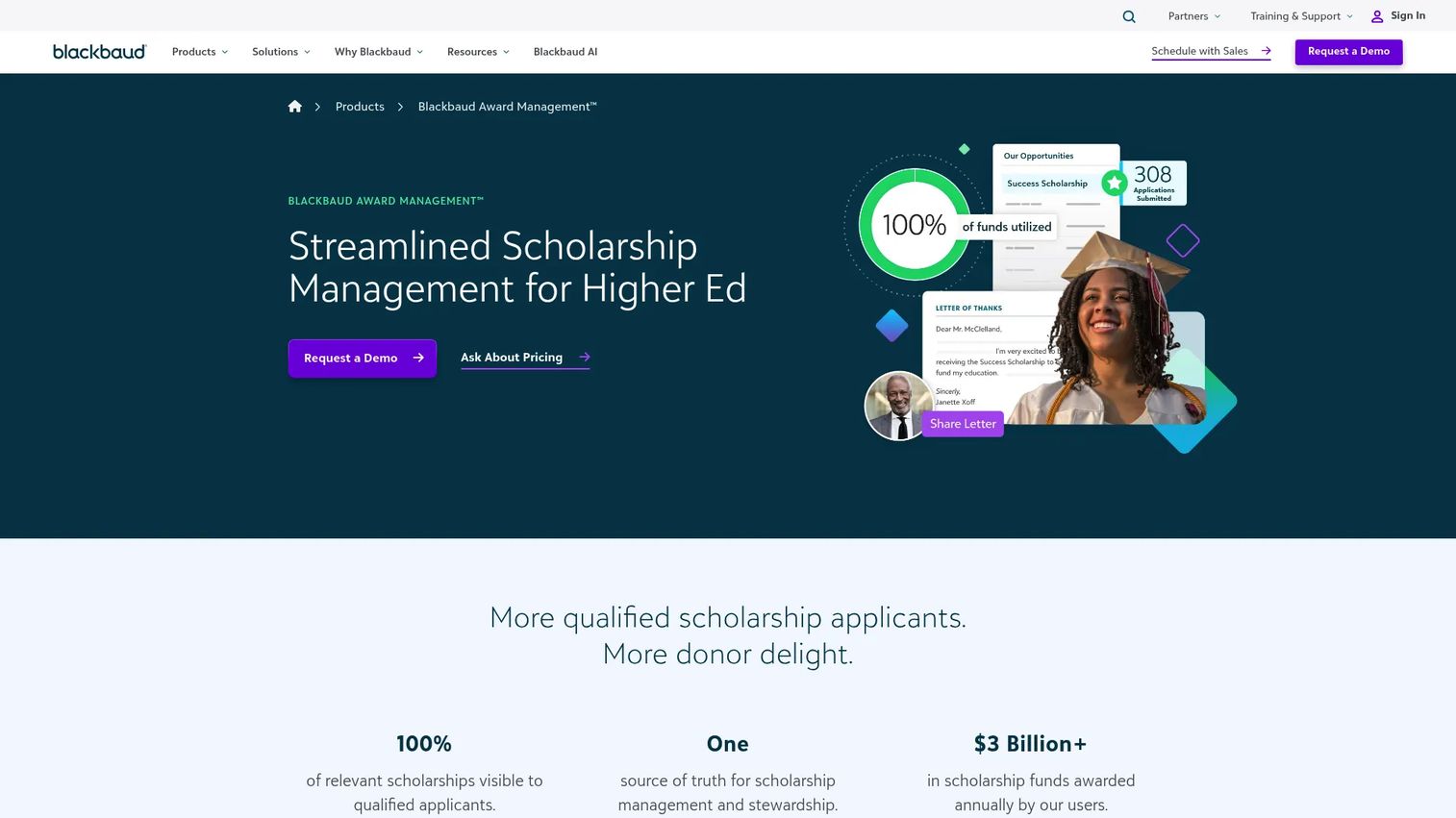
Blackbaud Award Management Software is scholarship and award management built for institutions where donor stewardship matters as much as distribution. It gives students one portal to view and apply for awards, then uses SIS integration to dynamically match applicants to scholarships they qualify for. On the back end, it tracks awards and supports the donor stewardship reporting that keeps funds flowing.
Best for: Higher-ed teams managing scholarship applications, matching, and donor stewardship in one system.
Key strengths
- One portal for students to view and apply for awards
- SIS integration to dynamically match students with scholarships
- Donor stewardship and award tracking
- Reporting that supports fund compliance
Why choose Blackbaud Award Management Software: If your scholarship program is donor-driven and stewardship reporting is a real obligation, Blackbaud connects application, matching, and donor accountability in one system. It fits institutions where the fund relationship matters as much as the award.
Blackbaud Award Management Software pricing: Blackbaud provides pricing through a personalized quote. No public price is shown for this product on the pricing page.
7. AwardSpring
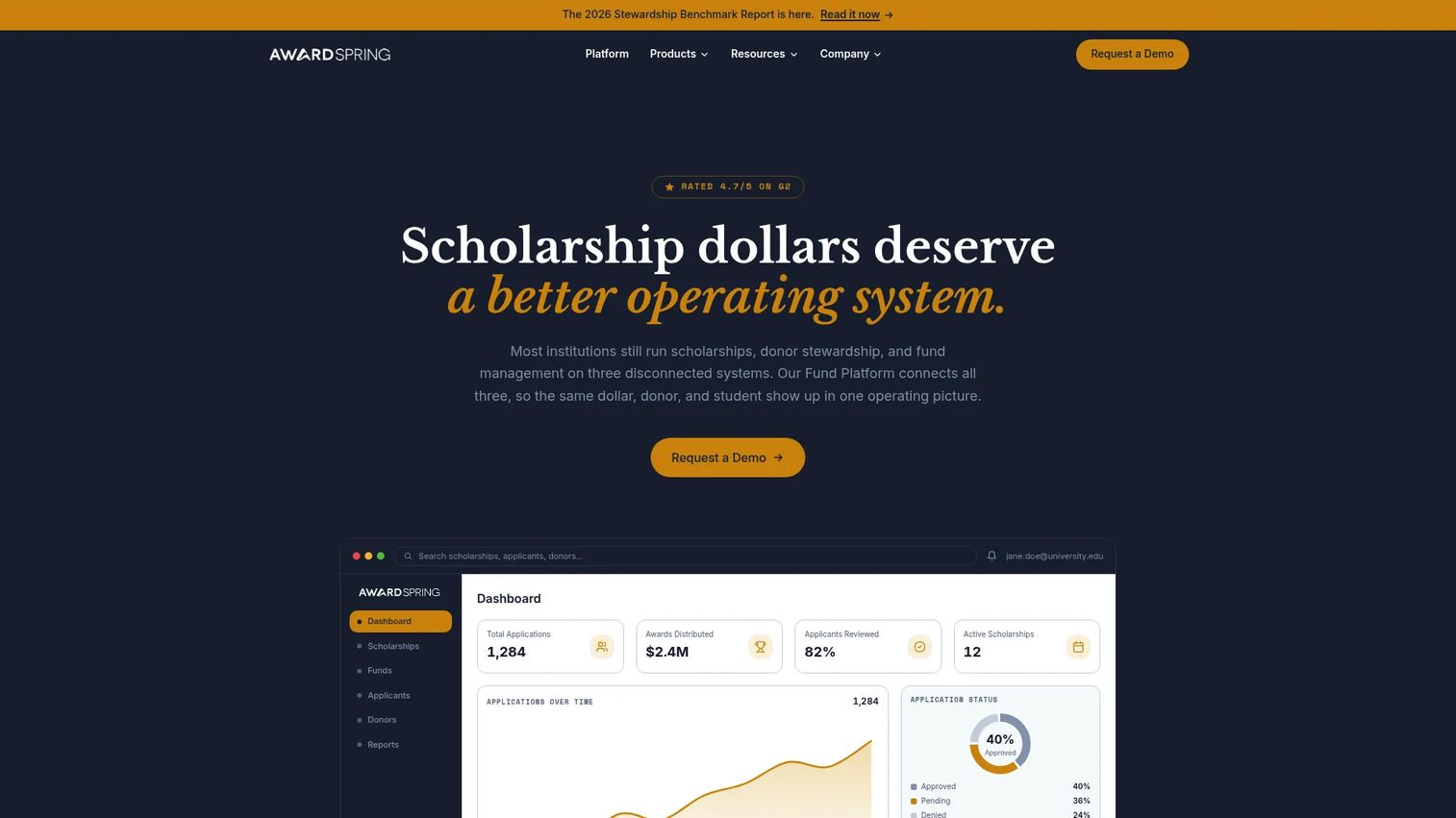
AwardSpring handles scholarship, donor, and fund management in one platform, and it's one of the few vendors on this list with a public entry price. The workflow runs application to review to award, with AI-assisted review to speed up committee evaluation and integrations to connect the surrounding stack. For teams drowning in scholarship applications each cycle, that structure keeps award committees moving.
Best for: Higher-education and scholarship teams managing applications, reviews, and awards in one system.
Key strengths
- Scholarship management workflow: application, review, award
- AI-assisted review to accelerate committee decisions
- Donor management with stewardship and communications
- Fund management with balance tracking and compliance support
Why choose AwardSpring: If you want scholarship management software with a transparent starting price and a workflow built around review committees, AwardSpring is the most accessible entry point here. It fits teams that want to stand up scholarship operations without a long sales cycle.
AwardSpring pricing: AwardSpring's Now plan is $99 per month, billed as a flat monthly rate. No free version is shown on the brand site.
8. Zengine by WizeHive
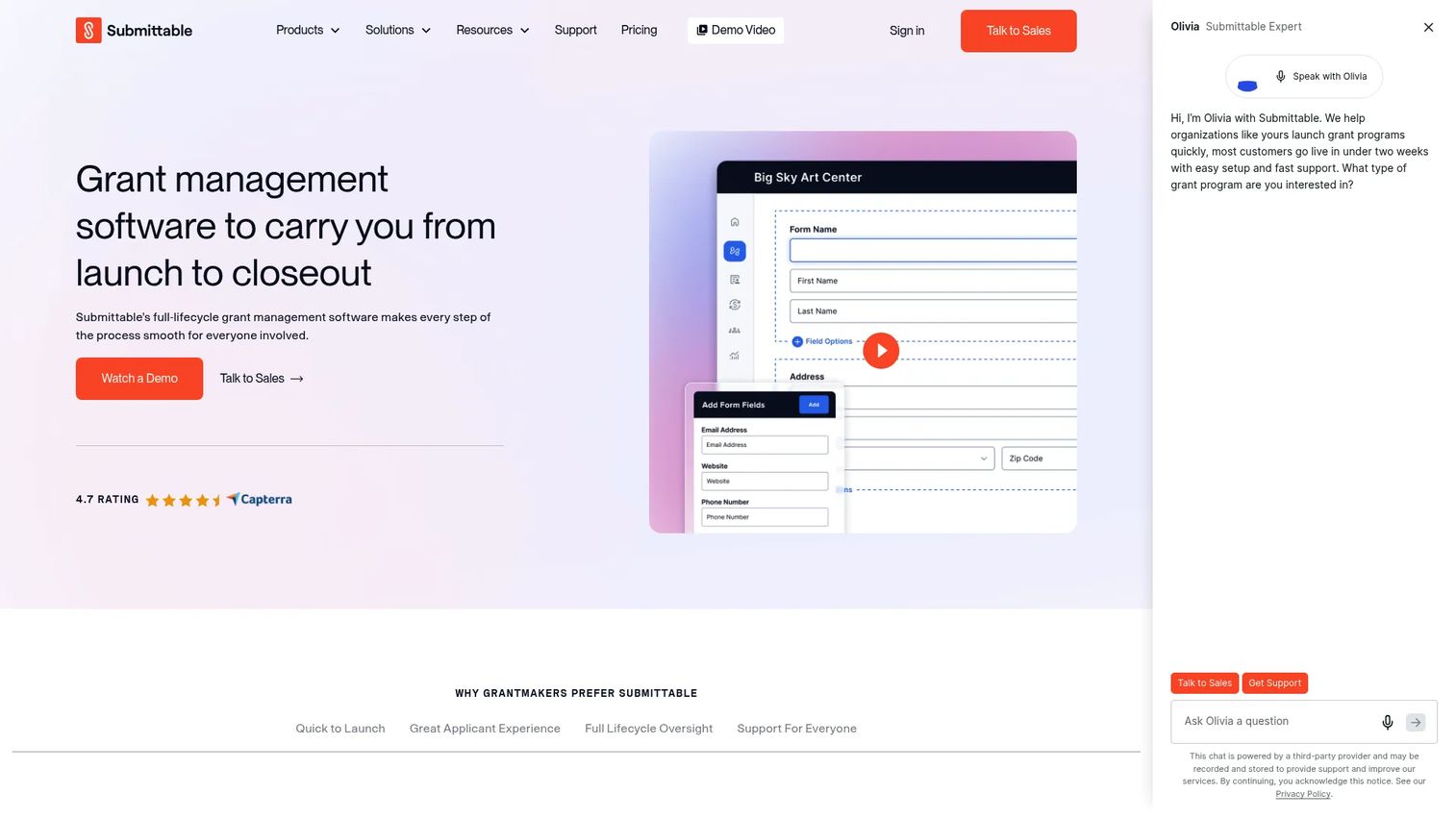
Zengine is WizeHive's configurable platform for scholarship and aid programs that don't fit a rigid template. The appeal is flexibility: build the forms, routing, and reporting your program actually needs rather than bending your process to fit fixed software. For teams running unusual application flows or lighter-weight scholarship operations, that configurability is the draw.
Best for: Organizations that need configurable scholarship and aid workflows with flexible forms and routing.
Key strengths
- Configurable forms and application flows
- Custom routing and review workflows
- Reporting built around your program structure
- Flexible, lighter-weight deployment
Why choose Zengine: If your program logic is unusual and off-the-shelf scholarship tools force awkward workarounds, Zengine's configurability lets you shape the workflow instead. It fits teams that value flexibility over a fixed feature set.
Zengine pricing: WizeHive does not publish public pricing for Zengine. The site directs prospects to contact sales for a quote based on program needs.
Considerations before you buy
Match automation depth to your aid volume
Count where the manual hours actually go. If verification and packaging eat your team's week, prioritize aid packaging automation, eligibility verification, and disbursement automation over lighter tools. High-volume offices need a real engine; a status portal alone won't move the work.
Confirm SIS and CRM integration up front
Your financial aid software is only as strong as its connection to the SIS and finance ledger. Ask exactly how it handles SIS integration and, where relevant, CRM integration for enrollment and outreach. A weak integration recreates the manual re-keying you're trying to eliminate.
Weigh compliance and audit readiness
Federal rules change, and program reviews don't wait. Evaluate how each platform enforces policy at packaging, logs actions, and automates R2T4. Financial aid compliance software should make audit readiness a byproduct of daily work, not a separate project.
Decide how much you need scholarship and work-study coverage
If scholarships and work-study management are core to your operation, a dedicated scholarship management tool or a suite that includes it may matter more than the deepest core aid engine. Map your actual programs before you choose.
Factor in services versus software
Some vendors sell software; others pair it with processing services. If your team is small and compliance exposure is high, a services layer may reduce workload more than any feature list. Be honest about internal capacity.
Conclusion
The right financial aid software depends on what's actually breaking. If your enrollment models defeat conventional tools, Regent Education is built for that complexity. If you're consolidating student systems, Workday Student unifies aid with finance and records. If your team is small and compliance-heavy, FAME Financial Aid adds a services layer. If Banner is your backbone, Ellucian Banner Financial Aid keeps aid native to the SIS.
On the student side, CampusLogic attacks document collection and communication. For scholarships, Blackbaud Award Management Software leads on donor stewardship, AwardSpring offers the most accessible entry point, and Zengine by WizeHive wins on configurability.
Next step: pull your last cycle's numbers. Where did the manual hours go? Where did compliance risk concentrate? Which systems already hold your data? Shortlist two or three vendors against real aid volume, compliance exposure, and integration needs, then run demos against those specifics rather than a generic feature checklist.
FAQs
Financial aid software automates the full aid lifecycle: determining eligibility, packaging awards, verifying documents, disbursing funds, and reporting for compliance. It replaces spreadsheets and manual handoffs with a system of record that connects to the SIS and finance ledger, so student financial aid management runs with fewer errors and less repetitive work.
Look for eligibility verification, aid packaging automation, award letters, disbursement automation, recalculation, and R2T4 automation. Strong platforms also include financial aid compliance software features, student self-service, analytics, and SIS integration. The point is one connected workflow rather than a portal that only displays status.
It enforces federal and institutional rules at the moment of packaging, logs every action for a clean audit trail, and automates return of Title IV funds so R2T4 happens on time. When a program review arrives, that logged, rule-enforced history is what makes audit readiness routine instead of a last-minute scramble.
Some platforms do. Dedicated scholarship management software like AwardSpring, Blackbaud Award Management Software, and Zengine handle applications, review, matching, and donor stewardship. Suites like CampusLogic include a scholarship module alongside core aid. If scholarships and work-study management are central to your operation, prioritize a tool built for that job.
At minimum, your student information system and finance or student accounts ledger, so awards, disbursements, and enrollment changes stay in sync. Many institutions also want CRM integration to connect aid status with admissions and outreach. Weak integration recreates the manual re-keying you're trying to remove, so confirm the depth before buying.
The core jobs are the same, but fit varies by model. Career and post-secondary schools often value software paired with processing services, like FAME. Large universities lean toward SIS-native platforms such as Ellucian Banner Financial Aid or a unified system like Workday Student. Institutions with non-standard terms need aid packaging automation built for those models, which is Regent Education's focus.
Student self-service turns "Where's my aid?" into a status page students can check anytime. Clear document requests, award letters, and next-step guidance reduce inbound calls and keep students moving toward enrollment. Tools like CampusLogic focus specifically on this communication and document layer of student financial aid management.
Compare automation depth against your real aid volume, SIS and CRM integration, compliance and audit readiness features, and scholarship or work-study coverage if you need it. Also weigh software-only versus software-plus-services, since a services layer can reduce workload for lean teams more than any single feature. Run demos against your actual numbers, not a generic checklist.