Your activation dashboard says onboarding improved. Support tickets say the opposite. Finance sees a different cohort breakdown. Somewhere between your event tracking, CRM, billing, and BI tool, the truth got split across systems, and every team is defending their own numbers.
That gap is an instrumentation problem, but it's also a warehouse problem. When product events, subscription data, and support volumes live in separate silos, PMs can't answer the questions that actually drive roadmap decisions: Which onboarding steps predict D7 retention, which features correlate with expansion, which release changed support volume.
Data warehouse adoption is accelerating fast. According to Flexera's State of the Cloud Report (2025), 76% of enterprises used data warehouse services in 2025, up from 67% the year before. Meanwhile, the global data warehousing market is projected to grow from $37.42 billion in 2025 to $79.15 billion by 2030, according to The Business Research Company (2026).
The challenge is picking the right platform. Cloud-native, lakehouse, serverless, enterprise-managed: Each model fits a different workload, team skill set, and governance requirement. This guide helps you cut through that complexity.
What's inside
This guide compares 14 data warehouse solutions for 2026, covering cloud warehouse, lakehouse, serverless query, and enterprise warehouse options. It's written for product managers, data leads, and engineering decision-makers who need reliable analytics infrastructure for activation, retention, segmentation, and experimentation.
Selection criteria used:
- Workload fit: SQL analytics, ML, real-time event streams, or compliance reporting
- Scalability and governance controls
- Pricing model and cost predictability
- Integration with modern data stack tools (ETL, BI, product analytics, orchestration)
Pricing and G2 ratings were verified against live vendor pages and G2 listings.
TL;DR
- Best overall cloud data warehouse: Snowflake for multicloud, governed enterprise analytics
- Best for Google Cloud teams: Google BigQuery with serverless SQL and free-tier access
- Best for AWS-first teams: Amazon Redshift, tightly integrated with AWS services
- Best for Microsoft ecosystem: Microsoft Fabric for unified SaaS analytics with Power BI
- Best for lakehouse and ML: Databricks for data engineering and AI workloads
- Best for enterprise legacy modernization: Teradata or IBM Db2 Warehouse for hybrid and mission-critical deployments
- Final choice depends on your existing cloud investment, workload shape, governance maturity, and team ownership model
What are data warehouse solutions?
Data warehouse solutions are platforms that collect, store, model, and query structured business data from multiple source systems, so teams can run analytics, reporting, forecasting, and decision support from a trusted source.
The four classic characteristics of a data warehouse system, still relevant today:
- Subject-oriented: Organized around business domains like customers, products, revenue, feature usage, or support volume
- Integrated: Combines data from product analytics, CRM, billing, marketing automation, and operational systems
- Time-variant: Preserves historical snapshots so you can track cohorts, trends, and before-and-after release comparisons
- Nonvolatile: Stores stable analytical records rather than overwriting data with every transaction
Key capabilities to look for in data warehouse platforms:
- Data ingestion through ETL or ELT pipelines
- Columnar storage and query optimization for analytical workloads
- Independent scaling of compute and storage
- SQL analytics with role-based access controls
- Data quality enforcement and governance tooling
- BI and dashboard integrations
- ML and AI readiness
- Backup, replication, and compliance controls
How warehouses differ from adjacent architectures:
Operational databases handle day-to-day transactions. Data lakes store raw or semi-structured data at scale without enforced schemas. Lakehouses blend lake-style storage flexibility with warehouse-style governance and SQL analytics. Understanding which architecture fits your workload matters before you choose a vendor.
Why this matters for product managers specifically: A well-structured warehouse lets you answer questions like which onboarding steps predict activation, which features retain new accounts past week one, which segment has the fastest time to first value, and which release changed support ticket volume. Without it, those answers come from five different tools telling five different stories.
When to use data warehouse solutions
Consolidate product and business data into one source
Teams outgrow isolated dashboards when product events live in one tool, billing lives in another, and CRM data never connects to either. A data warehouse pulls those streams together so you can compare activation, retention, revenue, and support impact without manual reconciliation. For PMs, this creates a single cohort definition that engineering, CS, and growth can all trust.
Build reliable reporting across teams
When every team defends their own metric definition, roadmap debates stop being about direction and start being about whose numbers are right. Governed datasets, a semantic layer, and role-based access give cross-functional teams a shared source, so cohort data drives decisions rather than opinion. This matters most when product, finance, and sales need to align on the same segmentation model.
Support AI, forecasting, and advanced analytics
When your team wants predictive models, churn signals, personalization engines, or real-time feature flagging, the warehouse becomes the governed data foundation those systems depend on. The warehouse itself is not the entire AI stack, but it often determines whether downstream ML models train on clean, consistent data or on whatever exports the data team managed to stitch together last week.
Data warehouse solutions comparison
The table below covers 14 data warehouse platforms, ranked by relevance to product and analytics teams. Pricing reflects the vendor's current starting point or billing model. G2 ratings were verified at publication.
| # | Product | Best for | Key differentiator | Pricing | G2 rating |
|---|---|---|---|---|---|
| 1 | Snowflake | Multicloud enterprise analytics | Storage-compute separation and cross-cloud data sharing | Consumption-based (credits) | 4.6/5 |
| 2 | Google BigQuery | Google Cloud serverless analytics | Serverless SQL with free monthly tier | From $6.25/TiB scanned | 4.5/5 |
| 3 | Amazon Redshift | AWS-first analytics teams | Managed warehouse integrated with AWS services | From $1.50/hour (serverless) | 4.3/5 |
| 4 | Microsoft Azure Synapse Analytics | Azure SQL and Spark workloads | Unified analytics across SQL pools, Spark, and pipelines | From $4,700 (SCU tier 1) | 4.4/5 |
| 5 | Oracle Autonomous Data Warehouse | Oracle-centric enterprise teams | Autonomous tuning with no DBA required | Contact Oracle for pricing | 4.3/5 |
| 6 | Microsoft Fabric | Microsoft-standardized analytics teams | Unified SaaS platform with Power BI alignment | Capacity-based (60-day free trial) | 4.6/5 |
| 7 | Databricks | Lakehouse, ML, and data engineering | Delta Lake with notebooks, Spark, and MLflow | From $0.07/DBU | 4.6/5 |
| 8 | Dremio | Open lakehouse query acceleration | Apache Iceberg native SQL without data movement | From $0.20/DCU (cloud) | 4.6/5 |
| 9 | Amazon Athena | Serverless S3 ad hoc queries | Pay-per-query with no warehouse provisioning | $5/TiB scanned | 4.4/5 |
| 10 | NetSuite Analytics Warehouse | NetSuite business reporting | Prebuilt analytics for ERP and CRM data | Contact NetSuite for pricing | 4.3/5 |
| 11 | SAP Data Warehouse Cloud | SAP-centric business data | Semantic modeling and data virtualization for SAP environments | Contact SAP for pricing | 4.2/5 |
| 12 | Teradata Integrated Data Warehouse | Large enterprise workloads | Massively parallel processing for complex analytics | From $0.22/min (Sovereign tier) | N/A on G2 |
| 13 | IBM Db2 Warehouse | IBM and hybrid cloud teams | Db2 compatibility with cloud and containerized options | From $1,373/month (SaaS) | 4.1/5 |
| 14 | Domo | BI-led data activation | Combines connectors, ETL, warehousing, and dashboards | Custom pricing (30-day trial) | 4.3/5 |
Best 14 data warehouse solutions for 2026
1. Snowflake
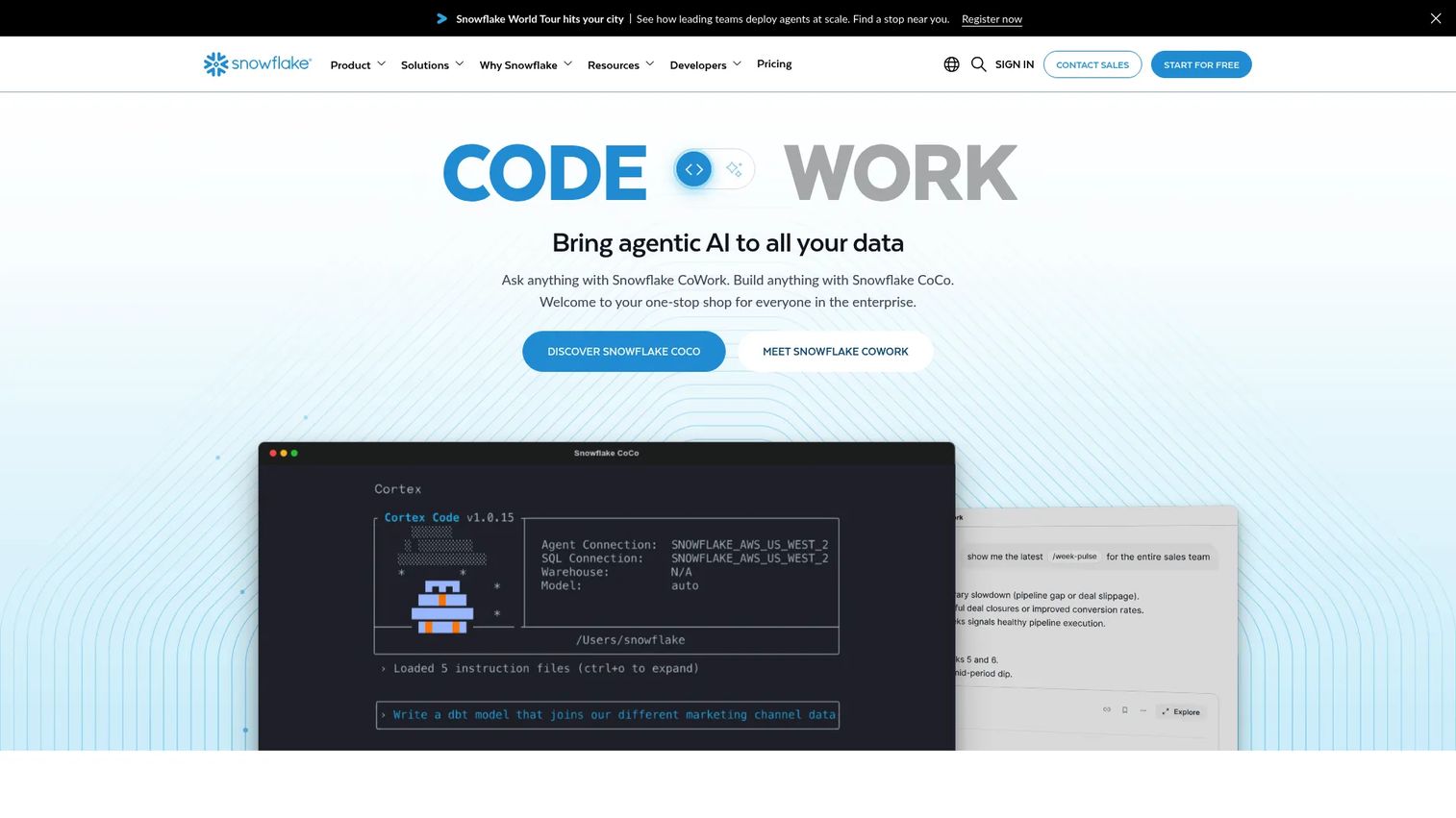
Snowflake is a fully managed, cross-cloud data and AI platform built for data engineering, analytics, AI workloads, and data collaboration. Its architecture separates storage from compute, so teams can scale each independently without paying for idle resources. Snowflake runs across AWS, Azure, and Google Cloud, making it a strong default when your organization spans multiple cloud providers or needs to share data securely across business units.
Best for: Enterprise and mid-market teams that need scalable SQL analytics across departments and clouds.
Key features
- Separate storage and compute with independent scaling
- Multicloud deployment across AWS, Azure, and Google Cloud
- Secure data sharing and Snowflake Marketplace access
- Snowpark developer framework for Python, Java, and Scala workloads
- Cortex AI and ML capabilities built into the platform
Why choose Snowflake: Snowflake performs well when product, data, and finance teams need governed access to the same source with fine-grained role-based controls. It's a mature warehouse choice for SaaS teams consolidating product events, billing, and GTM data into a single analytical layer.
Snowflake pricing: Snowflake uses consumption-based pricing tied to compute credits, storage volume, and cloud region. A 30-day trial with $400 in free credits is available. Paid plans span Standard, Enterprise, Business Critical, and Virtual Private Snowflake tiers, with pricing calculated from your credit consumption rather than a flat monthly rate.
G2 rating: 4.6/5
2. Google BigQuery
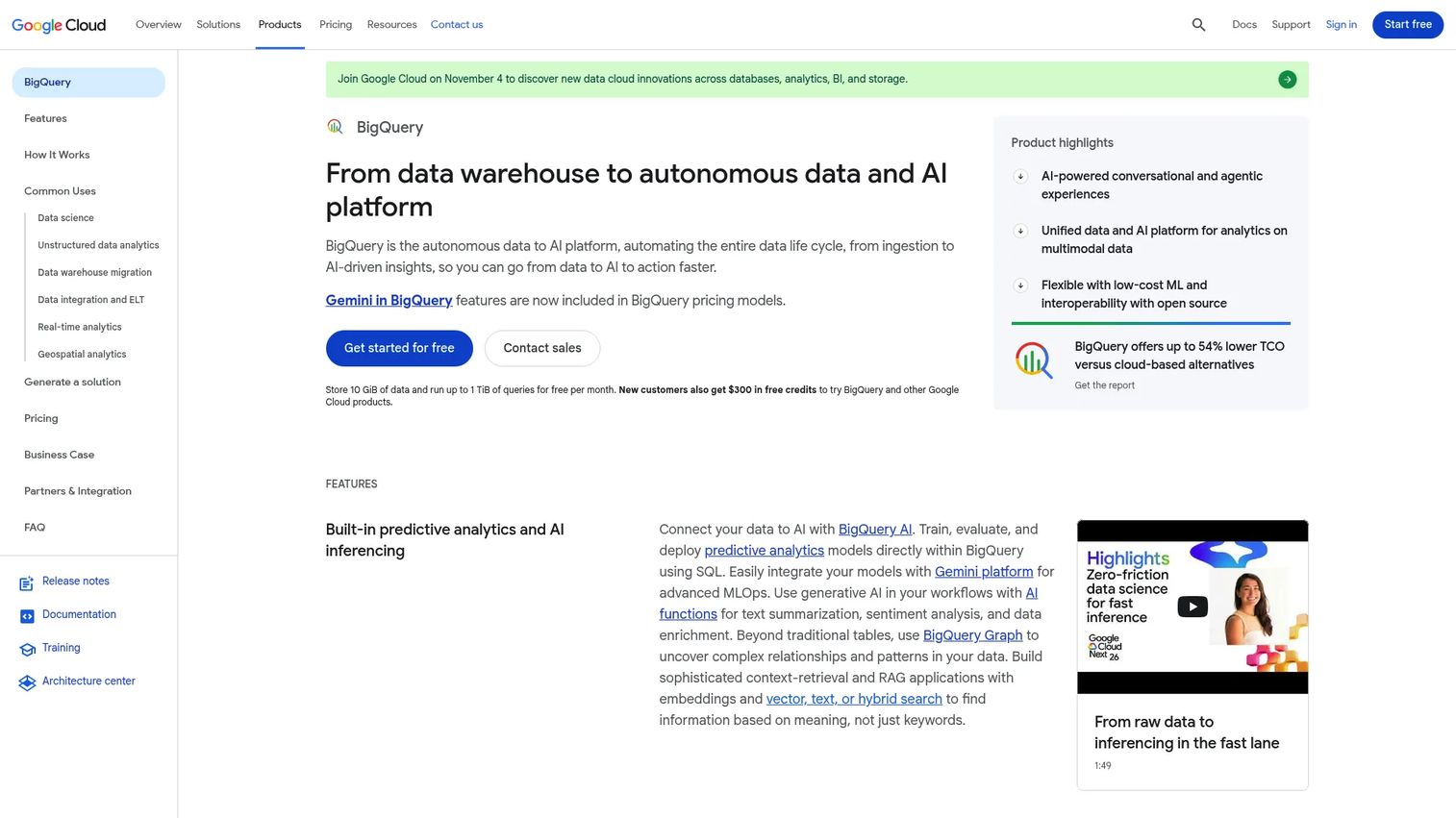
Google BigQuery is Google Cloud's fully managed, serverless data warehouse for large-scale SQL analytics and AI. It removes infrastructure management entirely, so teams can run queries without provisioning or resizing clusters. BigQuery integrates tightly with Looker, Vertex AI, Google Analytics, and BigLake, which makes it a natural fit for organizations already building on Google Cloud.
Best for: Teams that want serverless SQL analytics with minimal operational overhead inside the Google ecosystem.
Key features
- Serverless query engine with no cluster management
- Built-in ML through BigQuery ML
- BigLake integration for unified analytics across data lakes
- Streaming data ingestion for near-real-time analytics
- Gemini AI assistance and vector search capabilities
Why choose Google BigQuery: BigQuery suits PMs who need to analyze large volumes of product event data without asking engineering to maintain warehouse infrastructure. Its serverless model means queries scale automatically, and the free monthly tier (10 GiB storage, 1 TiB queries) makes it accessible for experimentation before committing to full production workloads.
Google BigQuery pricing: On-demand queries start at $6.25 per TiB scanned, with the first 1 TiB per month free. Capacity-based Editions pricing starts at $0.04 per slot hour. Storage and data ingestion costs apply separately.
G2 rating: 4.5/5
3. Amazon Redshift
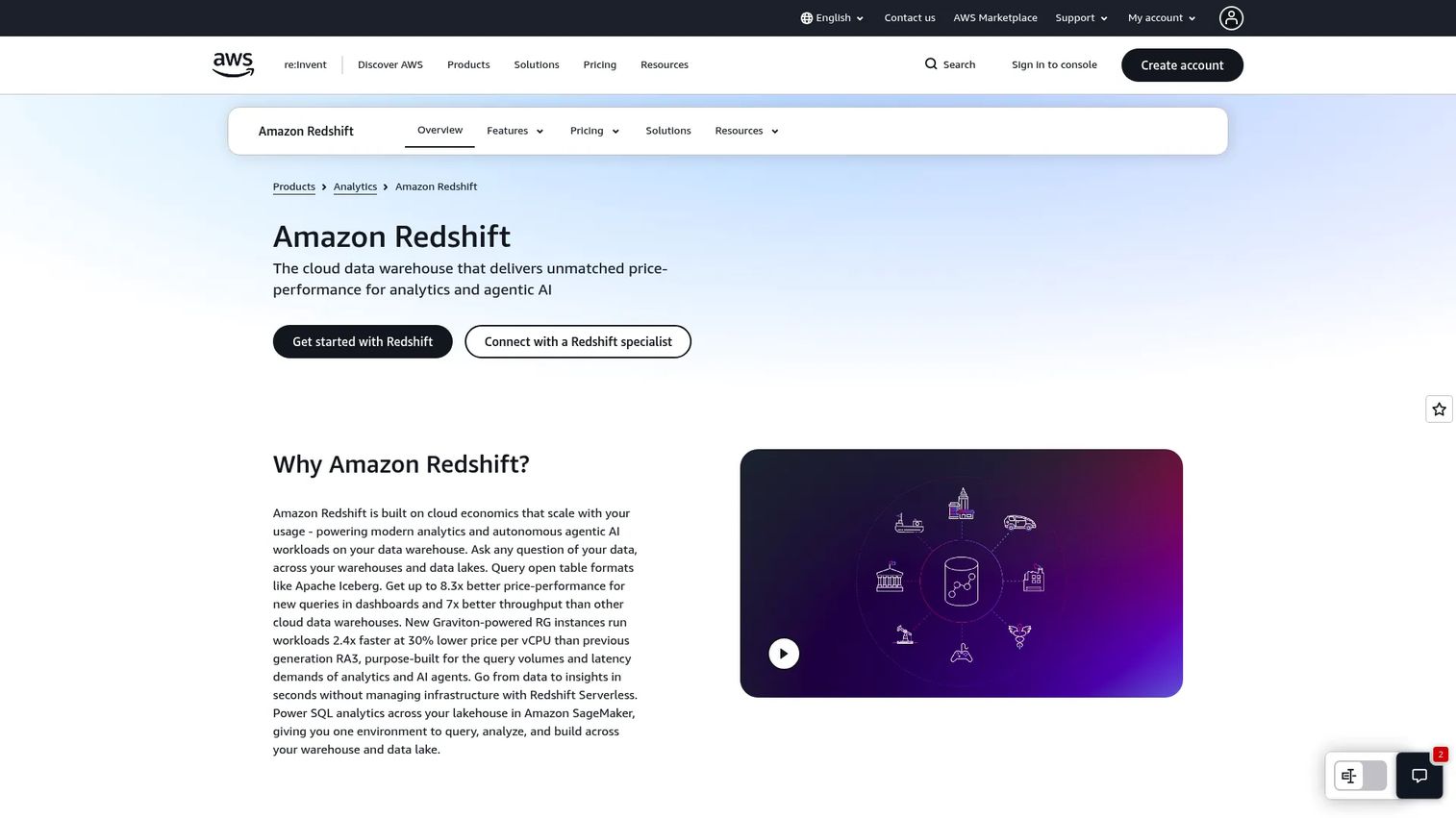
Amazon Redshift is AWS's managed cloud data warehouse for SQL analytics across data warehouses, data lakes, and operational sources. It connects natively to S3, Glue, Kinesis, SageMaker, Aurora, and DynamoDB through zero-ETL integrations, which reduces pipeline complexity for teams running AWS-centric stacks. Redshift Serverless removes cluster management for teams that want automatic scaling without provisioning decisions.
Best for: AWS-first teams that want a managed warehouse inside their existing cloud environment.
Key features
- Redshift Serverless with automatic scaling
- RA3 nodes with managed storage separation
- Spectrum for external queries on S3 data
- Zero-ETL integrations with Aurora, RDS, and DynamoDB
- ML model development and deployment using SQL
Why choose Amazon Redshift: Redshift is practical when AWS already anchors your data stack. It reduces vendor sprawl for teams with strong AWS skills and makes it straightforward to join warehouse data with S3 lake data using Spectrum. For PMs, the benefit is cleaner instrumentation pipelines without maintaining a separate integration layer.
Amazon Redshift pricing: Redshift Serverless starts at $1.50 per hour (billed per second, 60-second minimum). A $300 credit free trial runs for 90 days. Provisioned clusters also offer a two-month free trial in eligible regions. Storage and concurrency scaling are priced separately.
G2 rating: 4.3/5
4. Microsoft Azure Synapse Analytics
Microsoft Azure Synapse Analytics combines data warehousing, Apache Spark, data integration pipelines, and workspace-based analytics in one platform. It gives Azure teams a broad analytics workspace rather than a pure warehouse, covering everything from batch SQL to big-data Spark jobs and streaming analytics through Data Explorer. Power BI integrates directly, which matters for organizations where business users rely on Microsoft reporting tools.
Best for: Azure teams that need SQL analytics, Spark workloads, and data pipeline orchestration in one environment.
Key features
- Dedicated SQL pools for provisioned warehouse workloads
- Serverless SQL pools for on-demand query execution
- Apache Spark for large-scale data processing
- Data pipeline orchestration and data flows
- Native Power BI integration
Why choose Microsoft Azure Synapse Analytics: Synapse suits teams that want a broad analytics platform rather than a warehouse alone. For PMs who need cross-functional metric visibility, the Power BI alignment makes it straightforward for business stakeholders to consume the same data engineers are modeling.
Microsoft Azure Synapse Analytics pricing: Pricing uses Synapse Commit Units (SCUs), starting at $4,700 for 5,000 SCUs. Additional charges apply for dedicated SQL pools, serverless SQL queries, Spark, pipelines, and data flows. Costs vary by region and workload mix.
G2 rating: 4.4/5
5. Oracle Autonomous Data Warehouse
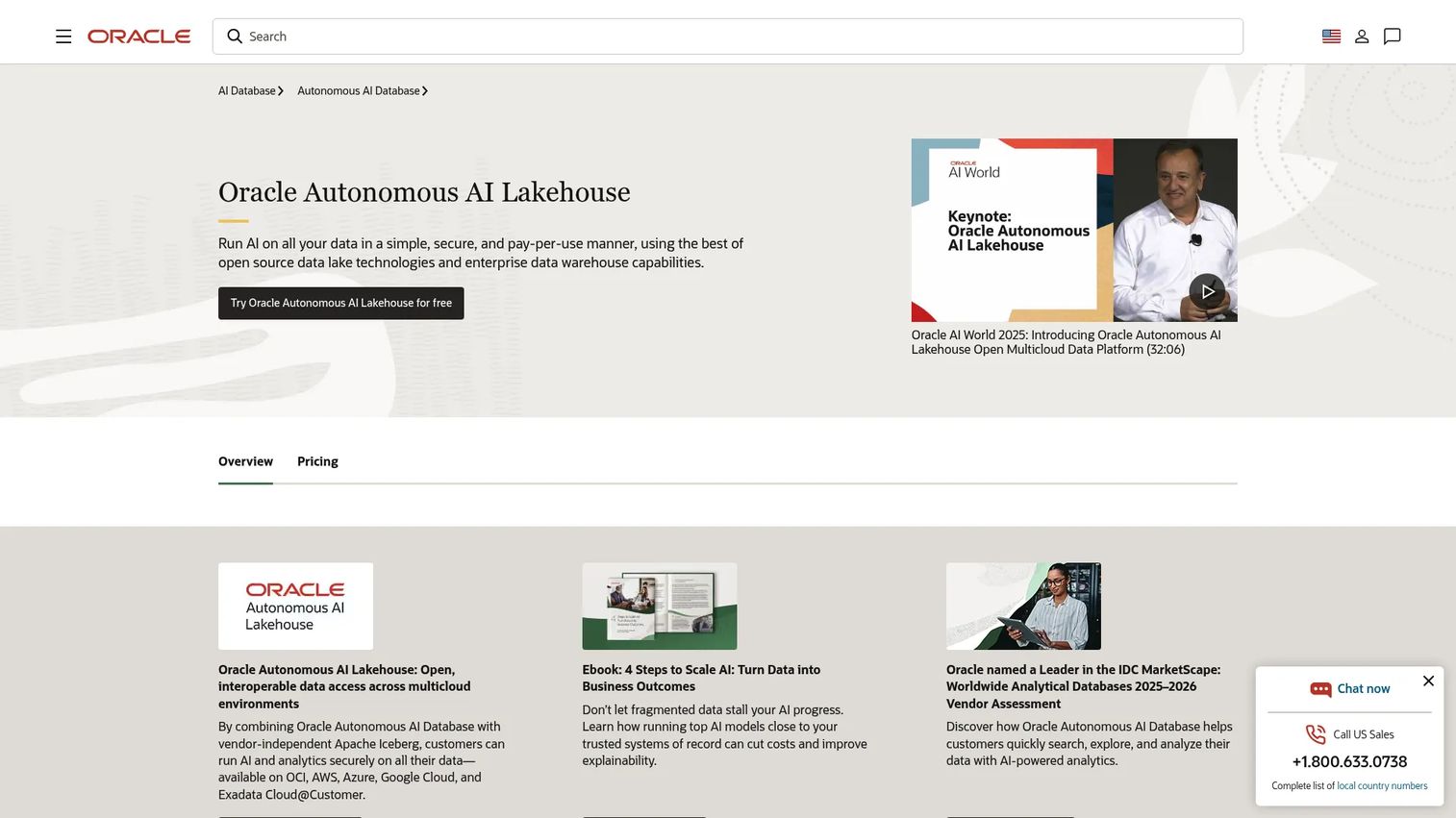
Oracle Autonomous Data Warehouse is a fully managed cloud warehouse that handles provisioning, patching, backups, security, tuning, and scaling without DBA intervention. It has evolved to cover AI Lakehouse capabilities alongside traditional warehouse workloads, and it integrates deeply with Oracle Analytics, Oracle Cloud Infrastructure, and Oracle's broader enterprise application portfolio including NetSuite.
Best for: Oracle-centered enterprises that want automated warehouse operations and strong Oracle ecosystem integration.
Key features
- Autonomous provisioning, patching, tuning, and scaling
- Data Studio tools for loading, transforming, cataloging, and sharing
- Built-in ML, graph analytics, spatial analytics, and AI capabilities
- JSON and spatial data support
- Integration with Oracle Analytics and Oracle Cloud
Why choose Oracle Autonomous Data Warehouse: Oracle ADW is the right call when migration risk outweighs the appeal of a newer stack. If your organization already runs Oracle Database, NetSuite, or Oracle Cloud Infrastructure, this warehouse removes integration overhead and keeps operational complexity inside a familiar governance model.
Oracle Autonomous Data Warehouse pricing: Oracle provides a free-start option and usage-based pricing by ECPU or instance hour. Contact Oracle for specific rates, as numeric prices were not displayed on the public pricing page at publication.
G2 rating: 4.3/5
6. Microsoft Fabric
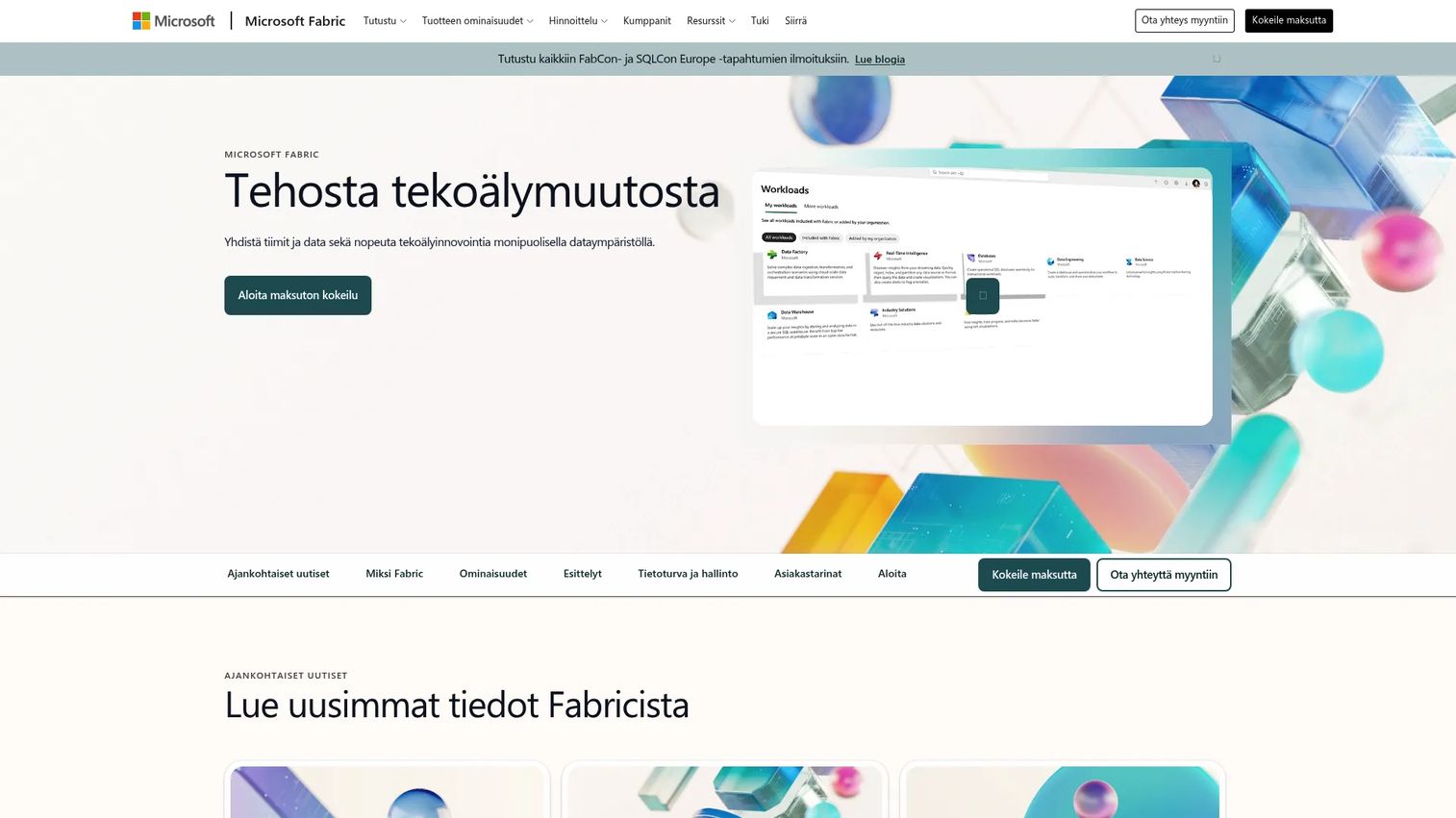
Microsoft Fabric is Microsoft's end-to-end SaaS analytics platform that unifies data integration, engineering, warehousing, data science, real-time intelligence, and Power BI in one workspace. Unlike Azure Synapse, which requires more configuration, Fabric is positioned as the simpler Microsoft analytics path, particularly for teams standardizing around Power BI and Microsoft 365. OneLake provides a unified storage layer across all Fabric workloads.
Best for: Teams consolidating analytics, BI, and data pipelines inside the Microsoft stack.
Key features
- OneLake unified data lake across all Fabric workloads
- Fabric Data Warehouse with full SQL support
- Power BI as a first-class component
- Real-time intelligence and streaming analytics
- 170-plus data connectors through Data Factory
Why choose Microsoft Fabric: Fabric reduces the number of disconnected Microsoft analytics tools teams have to manage. For PMs, the Power BI alignment means product and business metrics can flow into shared dashboards without a separate data engineering project. A 60-day free trial is available.
Microsoft Fabric pricing: Capacity-based pricing uses Fabric SKUs (F2 through F64 and above). Microsoft displayed capacity unit tiers on its pricing page without publishing numeric rates at time of publication. Contact Microsoft for current figures.
G2 rating: 4.6/5
7. Databricks
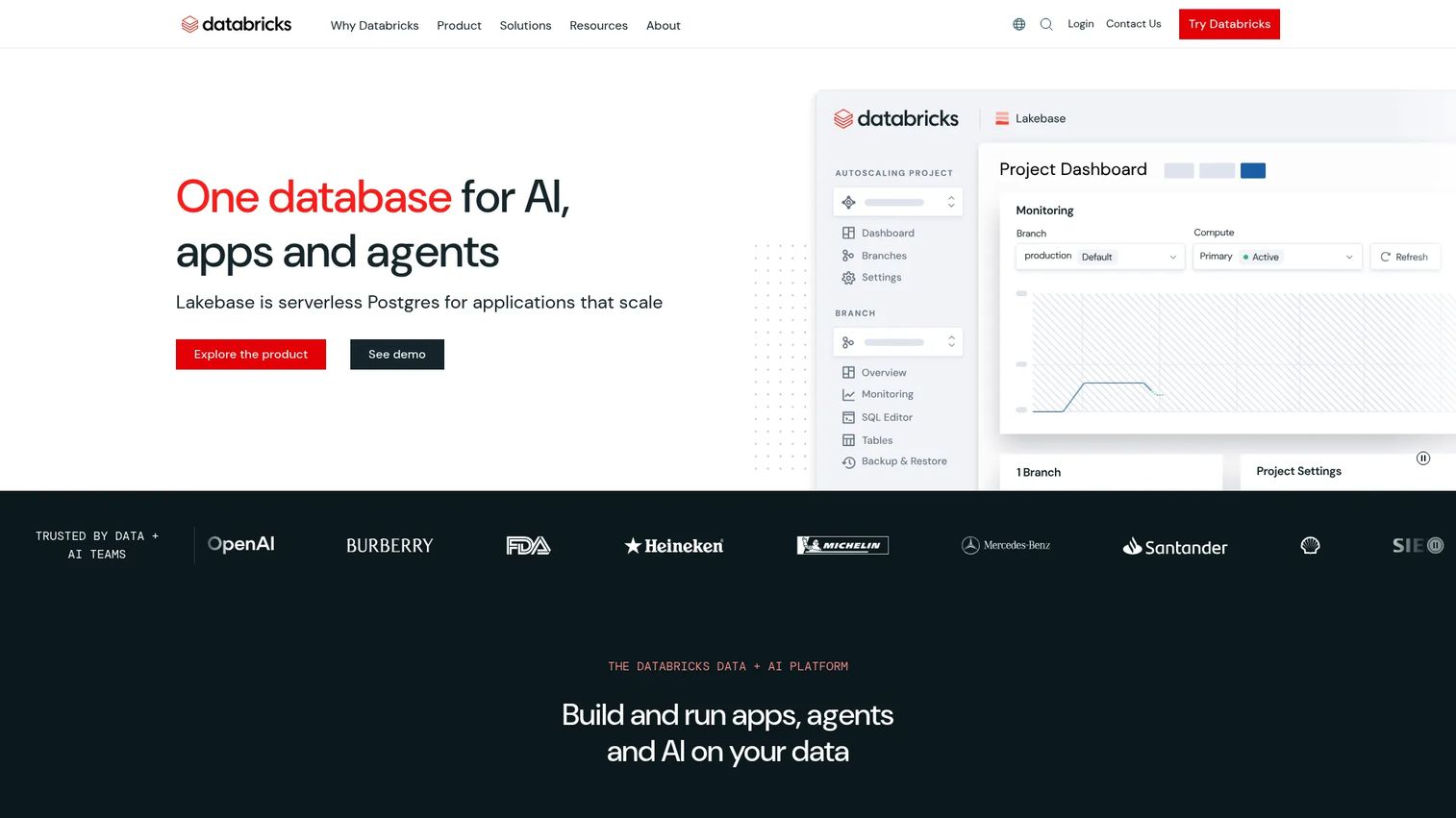
Databricks is a unified Data and AI platform built around Apache Spark, Delta Lake, collaborative notebooks, and SQL analytics. It covers data engineering, analytics engineering, ML model training and serving, and AI application development from one workspace. Unity Catalog provides governance, access controls, and lineage across all Databricks workloads, which matters when product and data teams share the same lakehouse layer.
Best for: Data teams combining analytics engineering, ML workflows, and lakehouse architecture.
Key features
- Delta Lake for reliable, open-format lakehouse storage
- Databricks SQL for governed warehouse-style analytics
- Collaborative notebooks for data science and ML
- MLflow support for experiment tracking and model management
- Unity Catalog for data governance and lineage
Why choose Databricks: Databricks is the strongest fit when your team has data engineering depth and needs ML alongside SQL analytics. It requires more operational ownership than simpler BI-led tools, but it pays off when feature engineering, model training, and activation analysis need to share the same governed data layer.
Databricks pricing: Usage-based billing across workload types. Data warehousing starts at $0.22/DBU, data engineering at $0.15/DBU, and AI workloads at $0.07/DBU. A free trial and Community Edition are available. Cloud provider costs and region affect total spend.
G2 rating: 4.6/5
8. Dremio
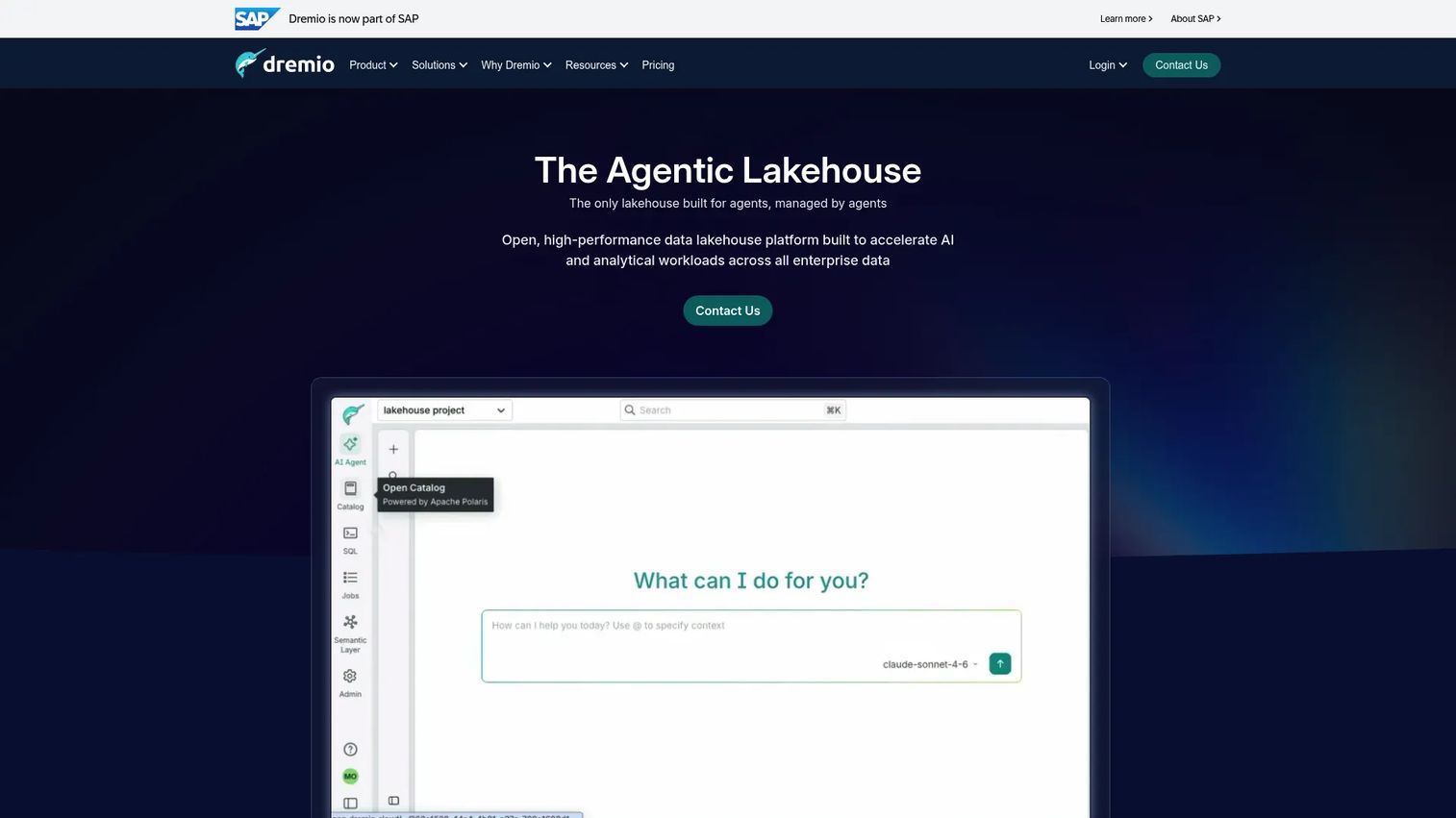
Dremio is an Iceberg-native SQL lakehouse platform that lets teams query data directly in open lake formats without first moving it into a proprietary warehouse. Its Reflections engine accelerates queries on Apache Iceberg, Parquet, and other open table formats, and its semantic layer makes governed self-service analytics accessible to SQL users without requiring full data copies.
Best for: Teams that want high-performance SQL on open lakehouse formats while avoiding proprietary warehouse lock-in.
Key features
- SQL queries directly on Apache Iceberg and open lake formats
- Reflections for automatic query acceleration
- AI Semantic Layer for governed self-service analytics
- Zero-ETL data federation across sources
- Open Catalog for metadata management
Why choose Dremio: Dremio fits when architecture teams want to keep data in open storage while still delivering SQL performance for BI and analytics users. It's a good option when the team is already invested in Iceberg or object storage and wants to avoid copying data into another proprietary system.
Dremio pricing: Dremio Cloud starts at $0.20 per DCU (pay-as-you-go), with a 30-day free trial including $400 in credits. Dremio Enterprise is self-managed with sales-led pricing.
G2 rating: 4.6/5
9. Amazon Athena
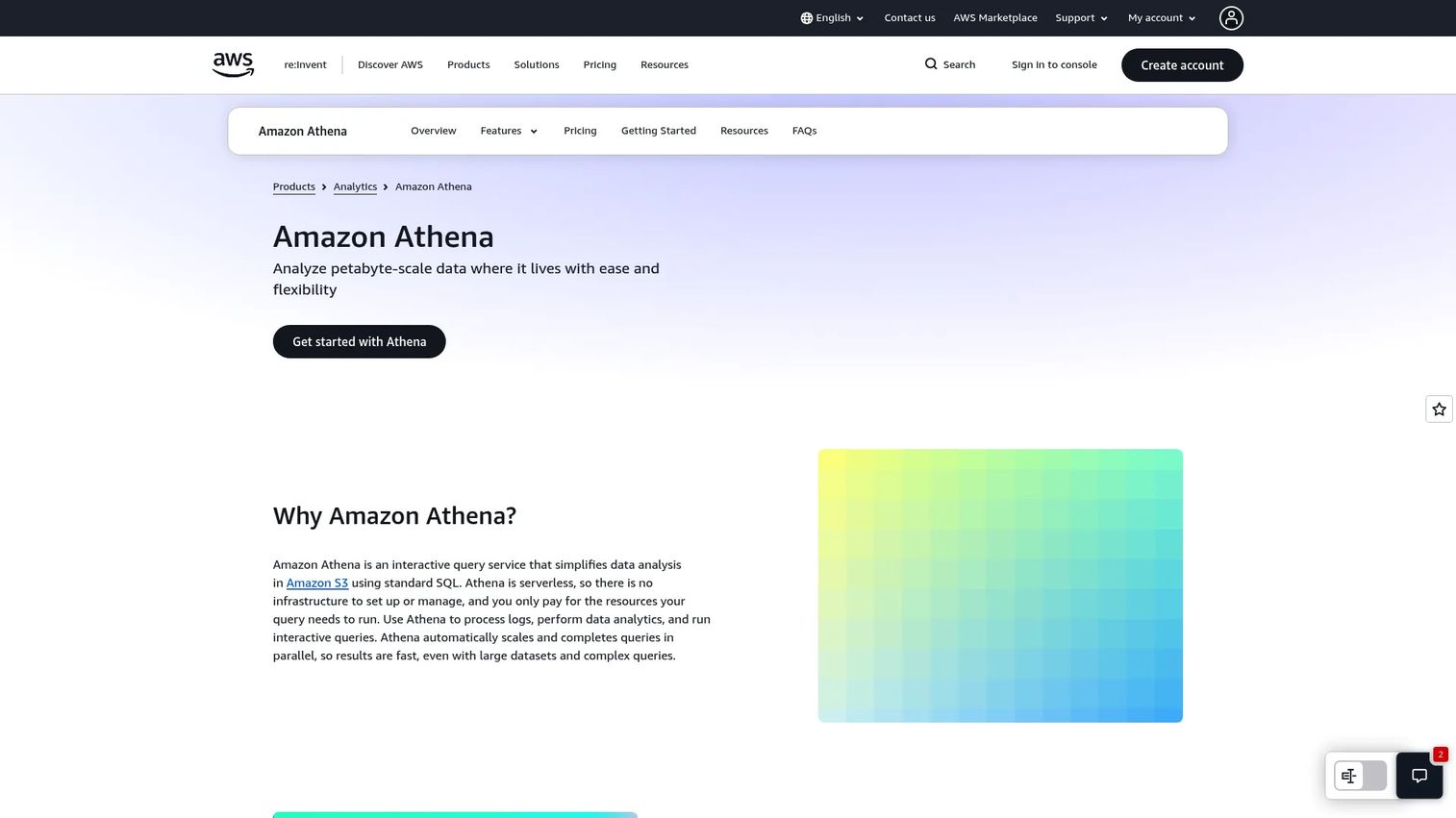
Amazon Athena is a serverless interactive query service for analyzing data in Amazon S3 and connected data sources using SQL or Apache Spark. It belongs in this list for AWS teams that need ad hoc or exploratory analytics on lake data without provisioning warehouse infrastructure. Athena connects to AWS Glue Data Catalog for schema management and supports federated queries across multiple data sources.
Best for: AWS teams that need lightweight, ad hoc SQL over S3 without managing warehouse clusters.
Key features
- Serverless SQL queries with no infrastructure to manage
- S3 data analysis using standard SQL
- Apache Spark analytics
- AWS Glue Data Catalog integration
- Pay-per-query billing model
Why choose Amazon Athena: Athena works best for controlled query patterns on well-partitioned data. It suits exploratory analysis, log analytics, and scenarios where query frequency doesn't justify a full warehouse. Cost scales directly with data scanned, so well-structured partitions significantly reduce spend.
Amazon Athena pricing: SQL queries cost $5 per TiB of data scanned. Capacity Reservations run $0.30 per DPU-hour, and Apache Spark workloads cost $0.35 per DPU-hour. Optimizing partitions and file formats reduces the amount of data scanned per query.
G2 rating: 4.4/5
10. NetSuite Analytics Warehouse
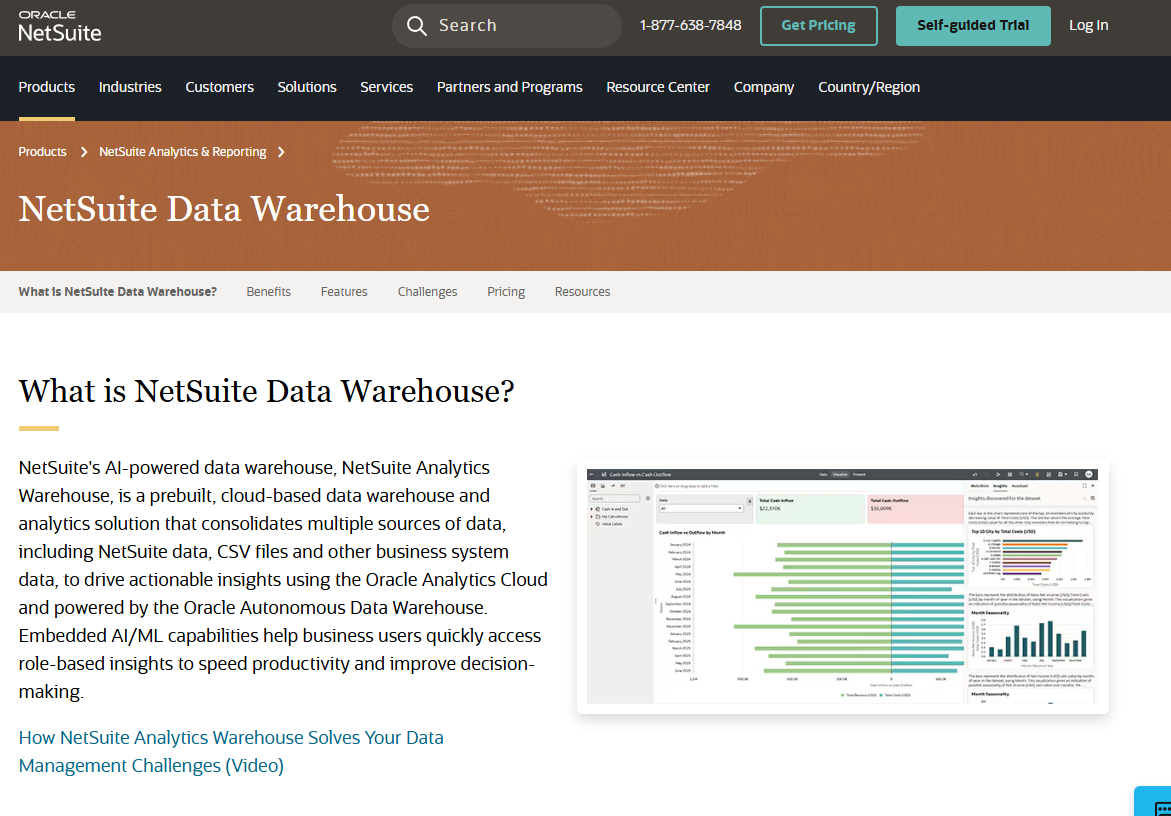
NetSuite Analytics Warehouse is an AI-powered, cloud-based analytics warehouse built for NetSuite data. It consolidates ERP, CRM, and third-party data into a governed warehouse with prebuilt semantic models, automated pipelines, and Oracle Analytics dashboards. For finance, operations, and business teams running NetSuite as their core system, this removes the need to build a warehouse from scratch.
Best for: Organizations using NetSuite as a primary business system who need governed analytics without custom data engineering.
Key features
- Prebuilt NetSuite data pipeline and semantic layer
- Connectors for NetSuite, Salesforce, REST API, and CSV
- Oracle Analytics dashboards with 40-plus visualization types
- Embedded AI and ML for anomaly detection, forecasting, and trends
- Conversational analytics through Oracle Analytics AI Assistant
Why choose NetSuite Analytics Warehouse: This is less a general-purpose warehouse and more a packaged path for NetSuite-heavy organizations. If your analytics problem starts with NetSuite reporting, this shortens time to insight significantly compared to building a custom pipeline. It becomes the right choice when business semantics matter more than raw warehouse flexibility.
NetSuite Analytics Warehouse pricing: Available as an add-on module with annual licensing. Pricing depends on the core NetSuite platform, optional modules, user count, and implementation scope. Contact NetSuite directly for a quote.
G2 rating: 4.3/5
11. SAP Data Warehouse Cloud
SAP Data Warehouse Cloud, now represented through SAP Datasphere within SAP Business Data Cloud, is SAP's platform for governed integration, semantic modeling, and virtualization of SAP and third-party data. It supports batch, streaming, replication, and federation patterns and provides data product creation and sharing for cross-system analytical use cases inside SAP environments.
Best for: SAP-centric organizations that need governed semantic modeling and data virtualization across complex enterprise data.
Key features
- Unified data integration across batch, streaming, and federation
- Analytical and semantic modeling for SAP data
- Data product creation and zero-copy sharing
- Governed self-service data access
- Integration with SAP analytics and AI tools
Why choose SAP Data Warehouse Cloud: When SAP systems drive the business, managing complex semantic relationships and data virtualization in a non-SAP warehouse adds friction. This platform keeps modeling and governance inside the SAP environment, reducing integration overhead for teams where business semantics and SAP connectivity outweigh warehouse flexibility.
SAP Data Warehouse Cloud pricing: Priced through SAP Business Data Cloud using Capacity Units. Contract durations run 3 to 36 months. Contact SAP for a quote, as numeric pricing is not shown on the public pricing page.
G2 rating: 4.2/5
12. Teradata Integrated Data Warehouse
Teradata is an enterprise data warehouse platform built around massively parallel processing for complex, mixed analytical workloads. Its modern portfolio supports cloud, customer-cloud, software-only, and factory deployment models. Teradata suits large enterprises with demanding performance requirements, significant historical data estates, and mature data engineering teams that need workload management and governance at scale.
Best for: Large enterprises with complex analytical workloads, strict performance requirements, and existing Teradata environments.
Key features
- High-performance SQL and massively parallel processing
- Elastic scalability across workload types
- Advanced workload management and query optimization
- Enterprise-grade security and governance
- Hybrid and multicloud deployment support
Why choose Teradata: Teradata earns its place when an organization has a large historical estate, complex mixed workloads, and the data engineering team to match. It's a serious option for modernizing existing Teradata environments rather than migrating away from them entirely.
Teradata pricing: The Sovereign tier starts at $0.22 per minute (usage-based), with storage starting at $23/TB per month. The Assured tier uses contact-sales pricing. Costs vary by cloud provider and deployment model.
13. IBM Db2 Warehouse
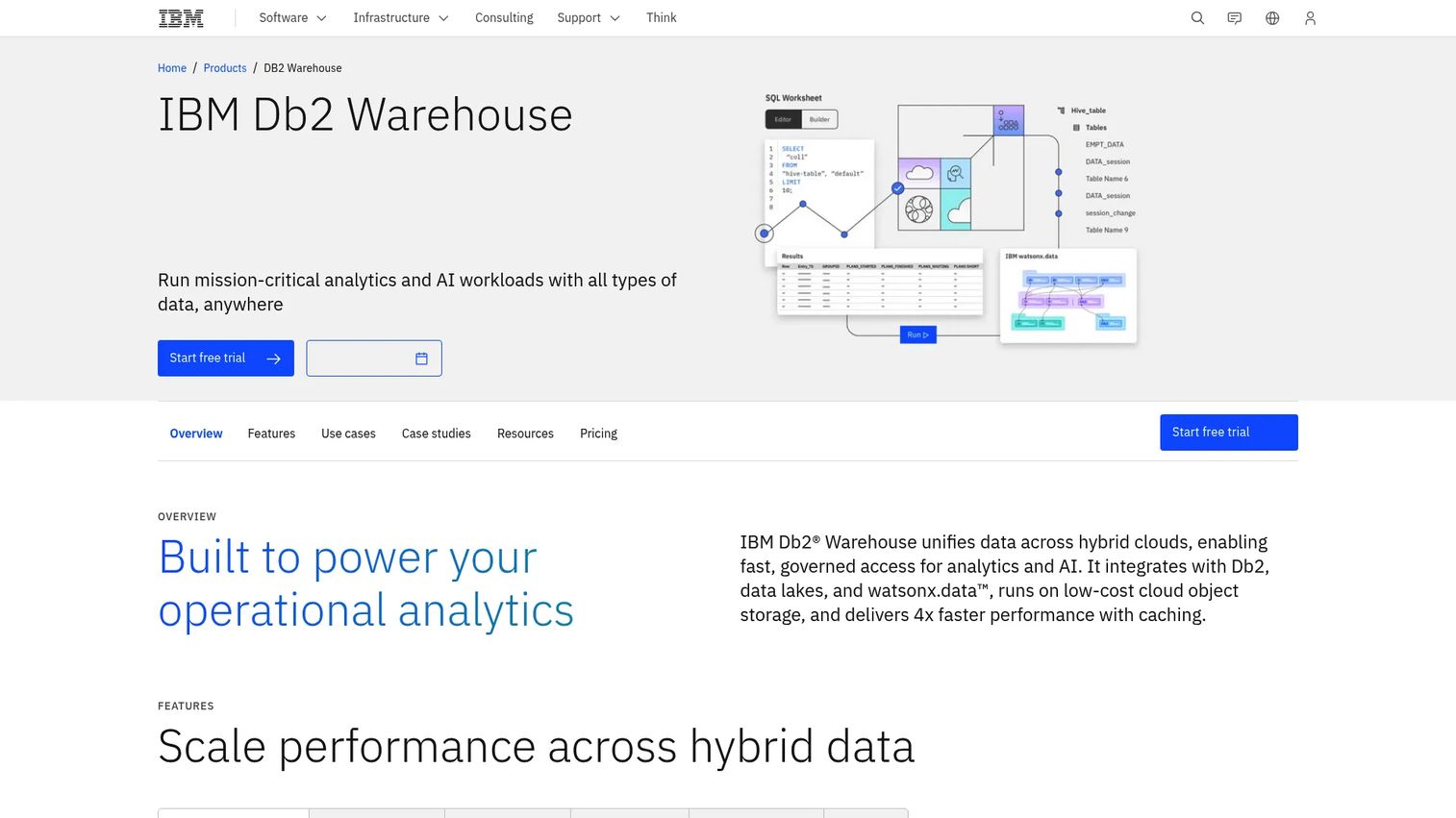
IBM Db2 Warehouse is a fully managed, elastic cloud data warehouse built on the Db2 engine, available on IBM Cloud and AWS for SaaS deployment, and also available as software for containerized environments. It combines in-memory, columnar processing with open-format support for Apache Iceberg, Parquet, ORC, and CSV, and includes built-in ML using SQL, Python, and R.
Best for: Teams with IBM database skills, hybrid deployment requirements, or mission-critical workloads requiring Db2 compatibility.
Key features
- In-memory columnar processing with data skipping
- Independent compute and storage scaling
- Open-format support including Apache Iceberg and Parquet
- Built-in ML using SQL, Python, and R
- Continuous availability, backups, and disaster recovery
Why choose IBM Db2 Warehouse: IBM Db2 Warehouse fits when migration simplicity and Db2 compatibility carry more weight than choosing the newest cloud-native stack. It's particularly relevant for regulated environments where IBM governance tooling and hybrid deployment flexibility reduce compliance overhead.
IBM Db2 Warehouse pricing: Db2 Warehouse SaaS starts at $1,373 per month (billed hourly) on IBM Cloud and AWS. Software deployment pricing is not shown on the public pricing page; contact IBM for those figures.
G2 rating: 4.1/5
14. Domo
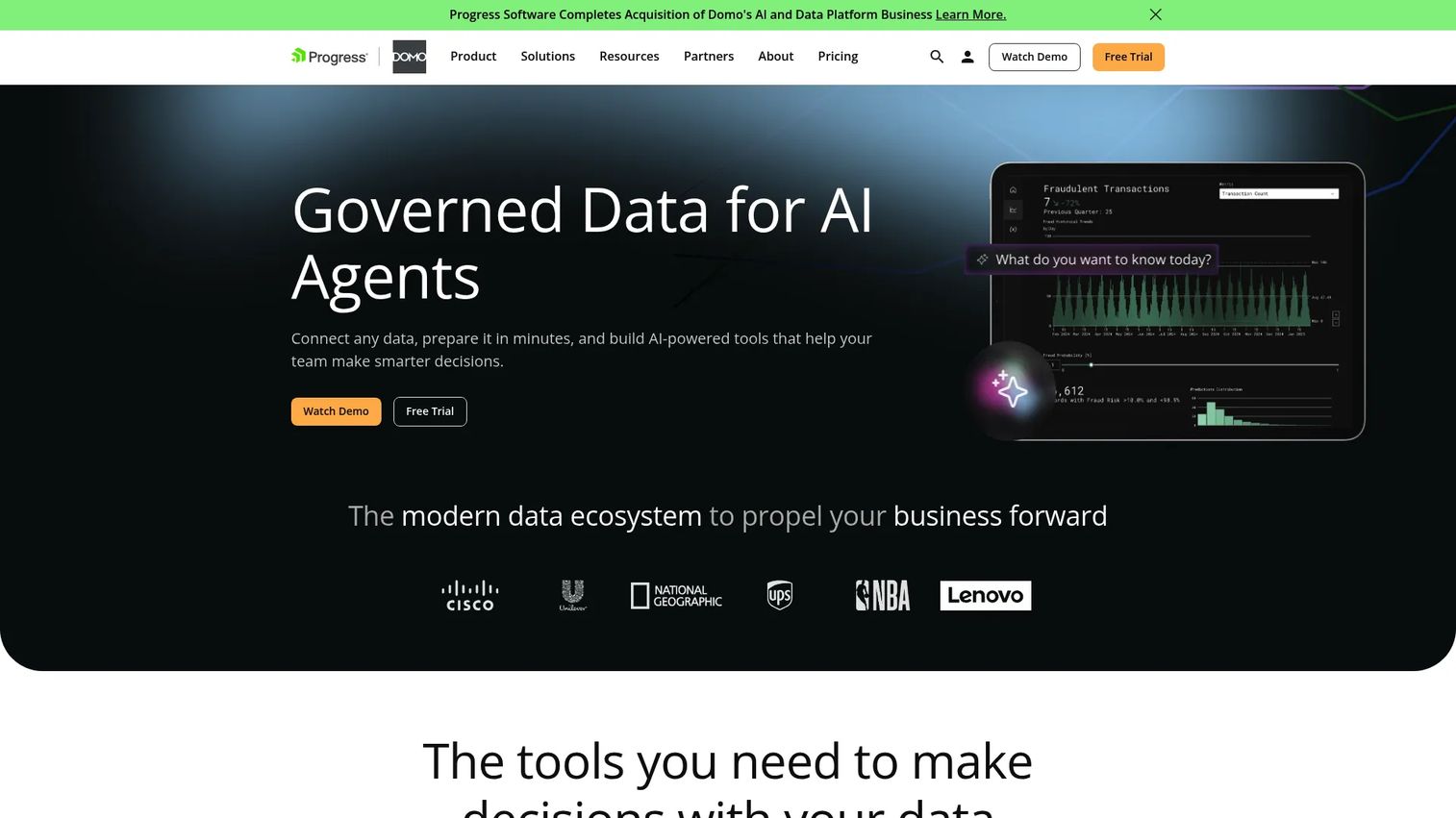
Domo is a cloud data and AI platform that combines 1,000-plus pre-built connectors, ETL workflows, warehousing, interactive dashboards, embedded analytics, and AI in one environment. It differs from traditional warehouse platforms by keeping data activation close to business users, which suits product and operations teams that want governed analytics without building a custom BI front end.
Best for: Business teams that want integrated data connectors, warehousing, and dashboards without separate BI tooling.
Key features
- 1,000-plus pre-built data connectors
- ETL and data transformation workflows
- Interactive BI dashboards and embedded analytics
- Domo AI, ML agents, and predictive insights
- Alerts, workflow automation, and data governance
Why choose Domo: Domo suits teams where the bigger blocker is turning data into decisions, not just storing it. For PMs who need fast, governed dashboards across product and operational data without running a full analytics engineering practice, Domo compresses the stack.
Domo pricing: Domo uses consumption-based, credit-driven pricing with unlimited users. The pricing page does not show a numeric paid rate; reach out to Domo's sales team for a custom quote. A 30-day free trial is available.
G2 rating: 4.3/5
Considerations when choosing data warehouse solutions
Workload type
The workload shape matters more than any single feature comparison. A warehouse optimized for nightly BI batch jobs may struggle with streaming product events or concurrent ML feature pipelines. Before shortlisting, map your highest-volume and most latency-sensitive workloads, then match them to the architecture each platform supports best.
Pricing predictability
Consumption-based pricing is common across cloud warehouses, but "starting at $X" rarely reflects production costs. Storage, compute, concurrency scaling, data transfer, and idle resource charges accumulate differently across platforms. Model your highest-volume query days before committing, not just average usage.
Governance and security
Role-based access, column-level masking, audit logs, lineage tracking, and data catalog integration are table stakes for any team handling product usage data that includes account or user behavior signals. PMs should understand how governance controls affect segment definitions and cohort access, particularly if different teams pull from the same warehouse with different permissions.
Team skills and ownership
The best platform on paper stalls when nobody owns modeling, pipeline maintenance, and cost management. A powerful lakehouse platform requires data engineering depth. A BI-led platform like Domo requires less infrastructure ownership but limits analytical flexibility. Match the platform to the team you actually have, not the team you plan to hire.
Integration with the modern data stack
Your warehouse should reduce metric fragmentation, not create another silo. Evaluate how each platform connects to your ETL or ELT tool, BI layer, product analytics system, reverse ETL destination, data catalog, ML platform, and CRM. Gaps in any of these integrations translate directly into inconsistent cohorts, delayed dashboards, and manual data joins.
Conclusion
Choosing a data warehouse is an architecture decision, not just a vendor selection. Your cloud commitment, workload shape, governance requirements, and team ownership model all determine which platform actually works in production.
For most SaaS teams: Snowflake for multicloud enterprise analytics, BigQuery for Google Cloud, Redshift for AWS. Microsoft Fabric suits teams standardizing on the Microsoft stack. Databricks or Dremio fits when lakehouse and ML workloads are central. Teradata, IBM, Oracle, SAP, and NetSuite each serve specific enterprise ecosystem and migration contexts.
For product managers, the right warehouse means activation, retention, feature adoption, and experiment results come from a single governed source, not from reconciling five exports. Build your shortlist around your existing cloud stack, workload, data governance needs, and the team that will own it long-term.
For more context on the broader analytics and AI infrastructure landscape, see our guides on big data analytics software, best customer data platforms, and analytics platforms that drive ROI.
Once your data stack surfaces where users stall, the next step is helping them experience value faster. Guideflow lets product and marketing teams create interactive product experiences that explain workflows, support onboarding at scale, and give teams measurable engagement signals without engineering involvement.
Start your journey with Guideflow today!
FAQs
A data warehouse solution is a platform that stores integrated, historical business data from multiple source systems, organized for analytics and reporting rather than day-to-day transactions. It provides a trusted source for metrics across product usage, revenue, customer behavior, and operations. Unlike an operational database, it's optimized for reads across large datasets, not for high-frequency writes.
A data warehouse stores structured, modeled data with enforced schemas, ready for SQL analytics and BI. A data lake stores raw or semi-structured data at scale without requiring upfront schema definitions. Lakehouse platforms like Databricks and Dremio combine elements of both: Open storage formats with warehouse-style governance and SQL query performance.
ETL (extract, transform, load) transforms data before loading it into the warehouse. ELT (extract, load, transform) loads raw data first and transforms it inside the warehouse using its own compute. Most cloud warehouses favor ELT because scalable warehouse compute handles in-warehouse transformation efficiently, reducing dependency on separate transformation infrastructure.
The answer depends on your cloud stack and data maturity. BigQuery fits Google Cloud teams analyzing large event volumes with minimal infrastructure overhead. Redshift fits AWS-first teams that want tight integration with S3 and native AWS services. Snowflake fits multicloud environments where product, finance, and CS need governed access to shared data. Databricks fits teams where ML and feature engineering run alongside SQL analytics. Evaluate event volume, schema change frequency, BI requirements, and governance needs before choosing.
Costs depend on storage volume, compute usage, query frequency, concurrency, data transfer, region, and support level. Entry-tier figures from vendor pricing pages rarely reflect production workloads. BigQuery charges per TiB scanned. Redshift Serverless charges per RPU-hour. Snowflake bills by credit consumption. Databricks bills by DBU across workload type. Always model your peak query days, not average usage, before signing a contract.
Yes, at a practical level. PMs don't need to administer the warehouse, but they should understand how event schemas, data refresh cadence, and segmentation definitions affect the metrics they rely on for roadmap decisions. When activation numbers change unexpectedly, knowing whether it's a pipeline delay, a schema change, or a genuine product shift matters for diagnosing the root cause quickly.
Common triggers: Conflicting dashboard numbers across teams, manual data joins that take hours each week, growing event volume that exceeds BI tool query limits, compliance requirements that need audit logs and role-based access, and roadmap debates where every stakeholder has a different cohort definition. The move becomes urgent when decisions depend on historical, integrated data across product, revenue, and support systems simultaneously. See also our guide on best business intelligence software for the BI layer that often sits on top of a warehouse.
Cost surprises from unbounded query consumption, weak governance that lets inconsistent definitions spread across teams, under-modeled data that makes cohort analysis unreliable, poor ingestion reliability that creates data gaps, vendor lock-in from proprietary formats, and low team adoption when the platform requires skills the current team doesn't have. Run a pilot using your actual highest-volume workloads before signing a long-term contract. Our coverage of agentic AI platforms and AI governance tools covers adjacent infrastructure decisions that often follow warehouse selection.