A call comes in. The dispatcher writes it on a sticky note, texts a driver, waits for a photo that never arrives, then re-keys the whole thing into an invoice two days later. The customer disputes the storage fee because nobody logged the intake time. Cash sits uncollected for a week. Multiply that by 40 calls a day and the cost of fragmentation stops being an annoyance and becomes the business problem.
Towing companies rarely lose money on the tow itself. They lose it in the gaps between dispatch, driver updates, billing, and impound records that live in different places. The global towing software market reached USD 471.25M in 2023 and is forecast to hit USD 763M by 2032 at a 5.5% CAGR, according to Zion Market Research (2024). That growth is not vanity. Cloud-enabled towing software now accounts for roughly 67% of installations, and about 90% of tow operators use smartphones to access their platforms, per Market Growth Reports (2026). The industry is moving off paper because paper does not scale.
Towing management software solves the coordination tax. It puts dispatch, driver status, invoicing, and impound inventory into one system so the office and the trucks see the same job at the same time. The right tool depends less on feature count and more on where your operation bleeds time. If you run mostly private property and impound work, your bottleneck is lot management and lien processing. If you run roadside and motor club calls, it is dispatch speed and motor club integrations. This guide sorts the shortlist by that logic, so a towing company software buyer can match a tool to the workflow that is actually slowing them down.
What's inside
This guide compares 5 towing software tools built for dispatching, scheduling, billing, mobile driver access, impound management, reporting, and support. We selected them on five criteria that matter to operators: workflow coverage across dispatch to collections, pricing transparency, mobile usability in the field, integration depth including QuickBooks, and fit for small to mid-sized towing businesses.
This is a practical shortlist, not a directory dump. Each entry explains the bottleneck the tool clears, who it fits, and where the pricing lands when it is public. You will get enough to narrow to two or three vendors before you ever book a demo.
TL;DR
- Best overall for small and mid-sized towing businesses: Towbook combines clear public pricing, cloud dispatch, mobile apps, impound management, and a QuickBooks integration with a 30-day free trial.
- Best for complex suite depth and impound: Autura bundles dispatch, embedded payments, lien search, and fleet tracking for operators running towing, impound, and unclaimed vehicle workflows together.
- Best for broader field-service automation: OctopusPro adds CRM, online booking, scheduling, and fieldworker management for operators who also run adjacent service work.
- Best tow truck software for fleet-first operations: Omadi focuses on dispatch, fleet management, and GPS tracking for tow and recovery businesses that manage vehicles closely.
- Best for specialized impound and multi-location: TOPS handles call taking, accounting, and customer-specific service configuration for storage-heavy and municipal operators.
- Best for budget-sensitive or parking-adjacent operators: Beacon Software and Ranger SST round out the list for teams weighing lighter packaging or parking-management needs.
What is towing software?
Towing software is cloud-based or hybrid software used to manage dispatch, invoices, drivers, impound inventory, payments, and reporting for towing and recovery businesses. It replaces the mix of paper tickets, spreadsheets, and disconnected apps that most operators start with, and it keeps job status visible across the office and the field in real time.
Core capabilities usually include:
- Dispatch and job assignment: create calls, assign trucks, and track status from request to release.
- Mobile driver updates: drivers accept jobs, capture photos, log arrival and completion times, and collect signatures from the truck.
- Billing and QuickBooks sync: generate invoices and receipts, send digital payment links, and push financial data into accounting.
- Impound and lien workflows: track stored vehicles, storage fees, hold times, lien notices, and auction or release.
- Reporting and audit trails: pull revenue, driver, and call reports, with a defensible record of who did what and when.
- Motor club and partner integrations: receive and bill motor club calls without rekeying between systems.
Adoption patterns tell you where the category is heading. Market Growth Reports (2026) found that mobile-first platforms are used by 88% of towing software users, digital payments by 61%, AI-assisted dispatch by 33%, and telematics analytics by 42%. The best fit for your company depends on your mix of private property, police rotation, roadside, transport, and impound work. A rotation-heavy shop weights dispatch and reporting; an impound-heavy shop weights lot management and lien processing.
When to use towing software
When dispatch and driver coordination are the bottleneck
If your dispatcher is juggling a whiteboard, a phone, and a group text, you are the bottleneck. Towing dispatch software puts active jobs, truck location, ETA, and driver status on one screen. Automatic or one-tap assignment cuts the back-and-forth, workload visibility keeps trucks balanced, and time stamps mean response times stop being guesses. Faster assignment is the difference between winning and losing the next motor club call.
When billing and collections are slowing cash flow
Money you earned last week that you have not collected is a cash flow problem disguised as an admin problem. Tow truck dispatch software with built-in invoicing generates receipts at job close, sends digital pay links, and automates reminders so follow-up stops eating your afternoons. A QuickBooks integration removes double entry between operations and accounting. For operators running motor club work, clean motor club billing workflows keep those receivables from aging out.
When impound and lot operations are becoming messy
Stored vehicles are a compliance and revenue surface at the same time. When intake times, storage fees, and hold windows live on paper, disputes and missed lien deadlines follow. Software here should track lot inventory, calculate storage fees automatically, generate lien notices on schedule, and support auction or release workflows. This matters most for operators handling private property tows and municipal or police impound work, where searchable inventory and audit trails protect you.
Comparison table
This table is optimized for one decision: matching a towing software tool to your primary operational bottleneck and your appetite for public pricing. Towbook leads for pricing clarity and all-in-one fit; the suite and specialized options follow.
| # | Product | Intent | Key differentiation | Pricing | G2 rating |
|---|---|---|---|---|---|
| 1 | Towbook | All-in-one for small to mid-sized shops | Public monthly plans, cloud dispatch, impound, QuickBooks | From $109/mo | 4.8/5 |
| 2 | Autura | Suite depth for complex operations | Dispatch, TowPay payments, TowLien, fleet tracking | TraxeroGo free; Dispatch Anywhere and TOPS custom quote | 4.1/5 |
| 3 | OctopusPro | Broader field-service automation | CRM, online booking, scheduling, fieldworker app | From $36.25/mo | 5.0/5 |
| 4 | Omadi | Fleet-first tow operations | Dispatch, fleet management, GPS tracking | Not public | 5.0/5 |
| 5 | Ranger SST | Towing plus parking management | Dispatching, GPS mapping, storage lot management | Custom | Not rated |
The 7 best towing software tools for 2026
1. Towbook
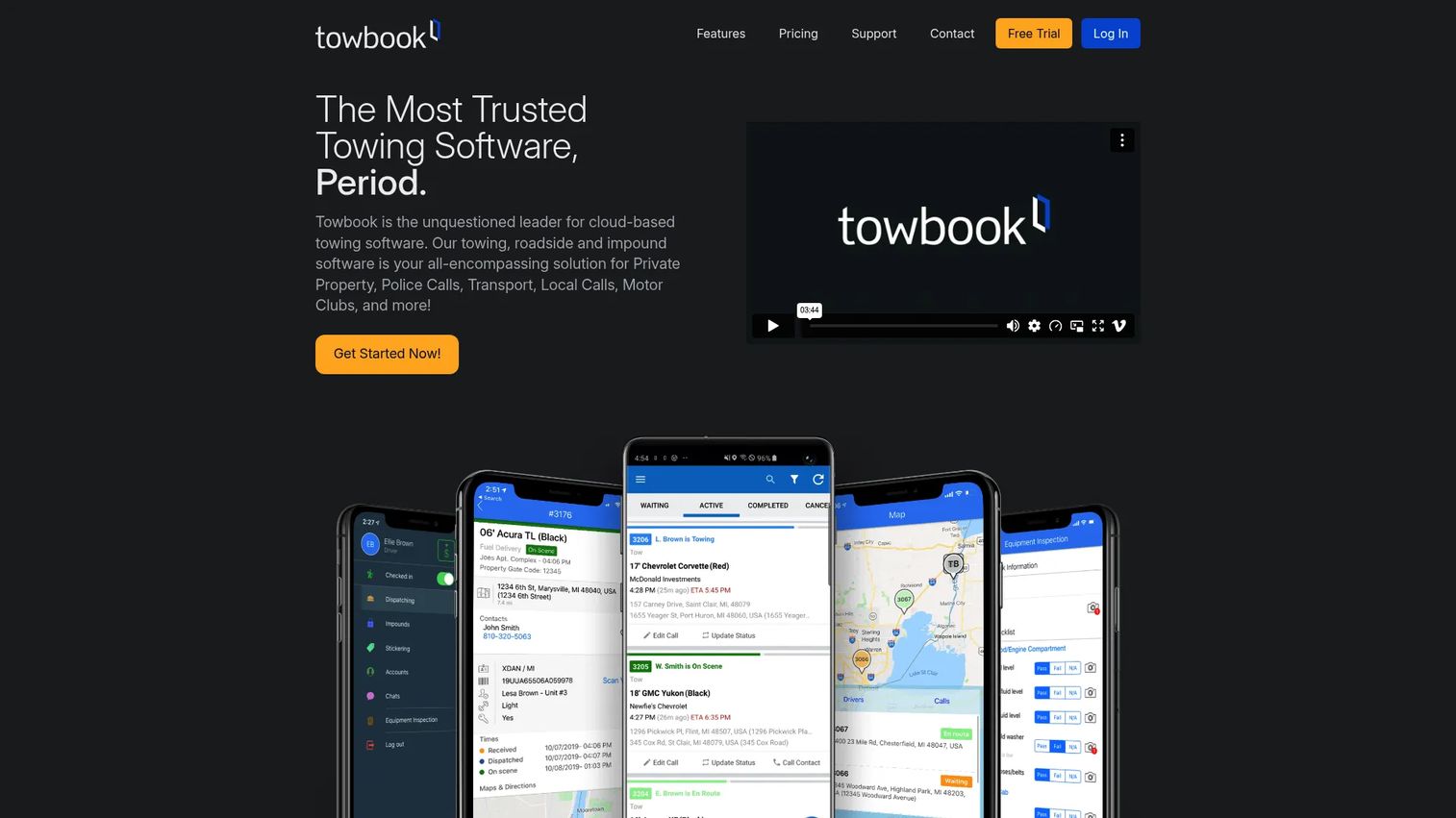
Towbook is cloud-based towing software for dispatching, impounds, billing, and reporting, and it is the cleanest starting point for most small and mid-sized towing companies. It handles dispatching and email processing, ships mobile apps for iPhone and Android so drivers work from the truck, and manages vehicle inventory and impound in the same system. The public pricing page and QuickBooks integration remove two of the biggest friction points buyers hit when comparing towing management software.
Best for: Tow companies that want dispatching, impound management, and billing in one system with pricing they can read before a sales call.
Key strengths
- Transparent monthly pricing: Public plans mean you can budget without chasing a quote, a rarity in this category.
- Field-ready mobile apps: Drivers accept calls, capture photos, and log times on iPhone or Android, keeping the office current.
- Impound plus billing in one place: Vehicle inventory, storage tracking, and QuickBooks-connected invoicing live together, not in separate tools.
Why choose Towbook: If your operation is stuck stitching a whiteboard to a spreadsheet to an accounting file, Towbook collapses that into one system fast. There are no setup fees, the pricing is public, and a 30-day free trial lets you test real dispatch and billing before committing. It is the low-friction pick for teams that want to be running this quarter, not next.
Towbook pricing: Public monthly plans start at $109/mo for Basic, $209/mo for Professional, $319/mo for Ultimate+, and $429/mo for Enterprise, all billed monthly in USD and cancellable at any time. An Enterprise+ tier is available by contacting sales. A 30-day free trial is offered, and plans carry monthly call limits that scale with the tier. Its G2 rating is 4.8/5, though based on limited review volume.
2. Autura
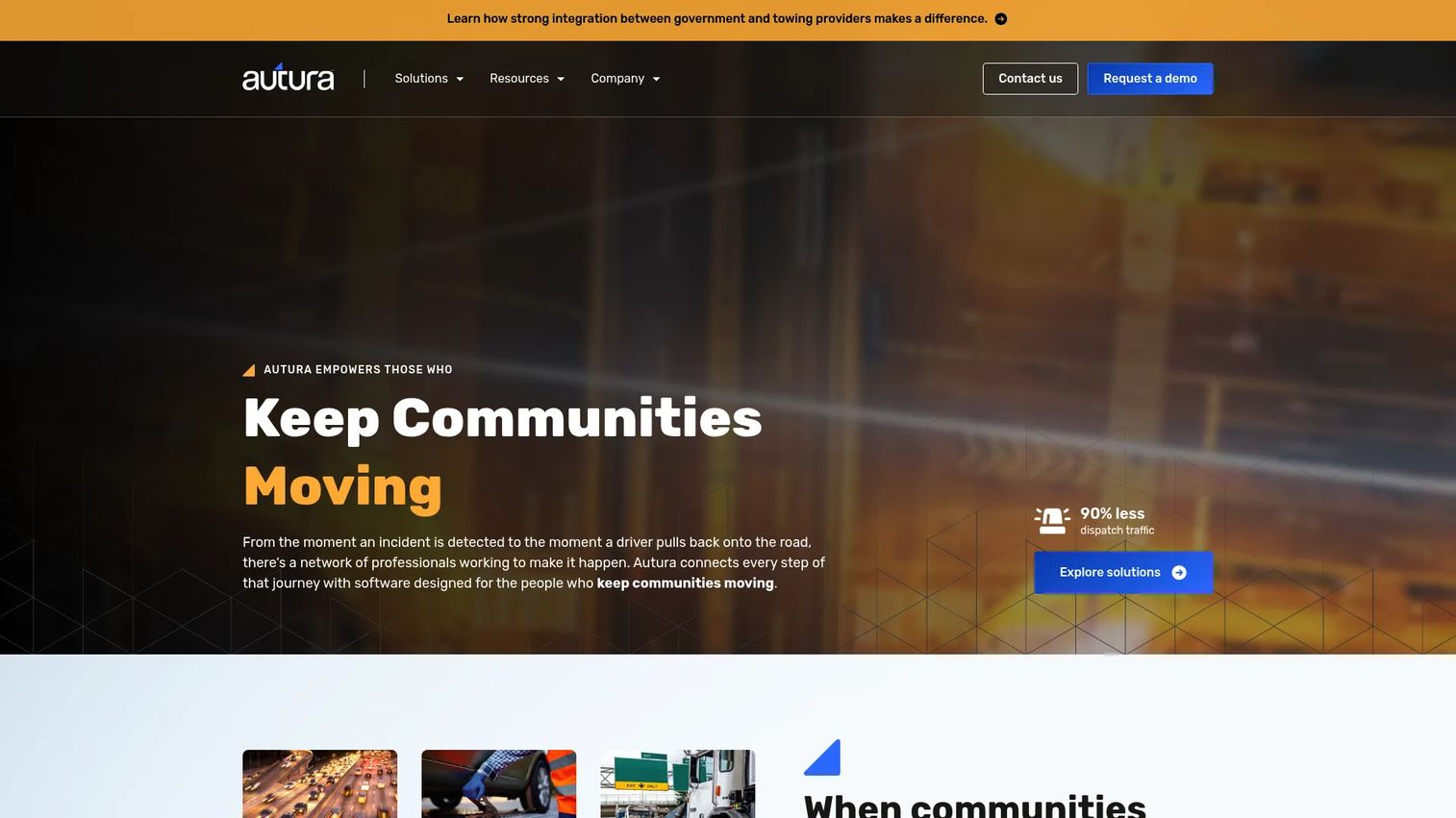
Autura is software for towing, impound, dispatch, and unclaimed vehicle operations, and it is the strongest fit when your operation is complex enough to need several workflows under one umbrella. Its towing management software covers dispatch, invoicing, reporting, and driver apps, TowPay adds embedded card-present and text-to-pay payments, and TowLien handles lien search and notification alongside the Autura Marketplace for unclaimed vehicle sales. Products like Dispatch Anywhere, TOPS, and BudgetGPS extend the suite into fleet tracking and specialized impound.
Best for: Towing and recovery businesses, public safety agencies, and impound operators that need an integrated workflow platform.
Key strengths
- End-to-end suite: Dispatch, payments, lien processing, and fleet tracking connect instead of forcing exports between tools.
- Embedded payments with TowPay: Card-present and text-to-pay options shorten the gap between service and collection.
- Lien and unclaimed vehicle depth: TowLien and the Autura Marketplace handle the compliance-heavy end of impound work.
Why choose Autura: When one system has to run roadside, impound, payments, and unclaimed vehicle sales, a bundled suite beats a stack of point tools. Autura fits operators whose complexity has outgrown a single-purpose dispatch app and who want billing, payments, and lien workflows sharing one data layer.
Autura pricing: TraxeroGo is free with no contracts, which gives smaller operators an entry point. Dispatch Anywhere and TOPS use custom pricing that scales by operation size and feature needs, so expect a quote rather than a public plan for the fuller suite. TowPay payment pricing is handled separately at the product level. Autura holds a 4.1/5 rating on its G2 seller page.
3. OctopusPro
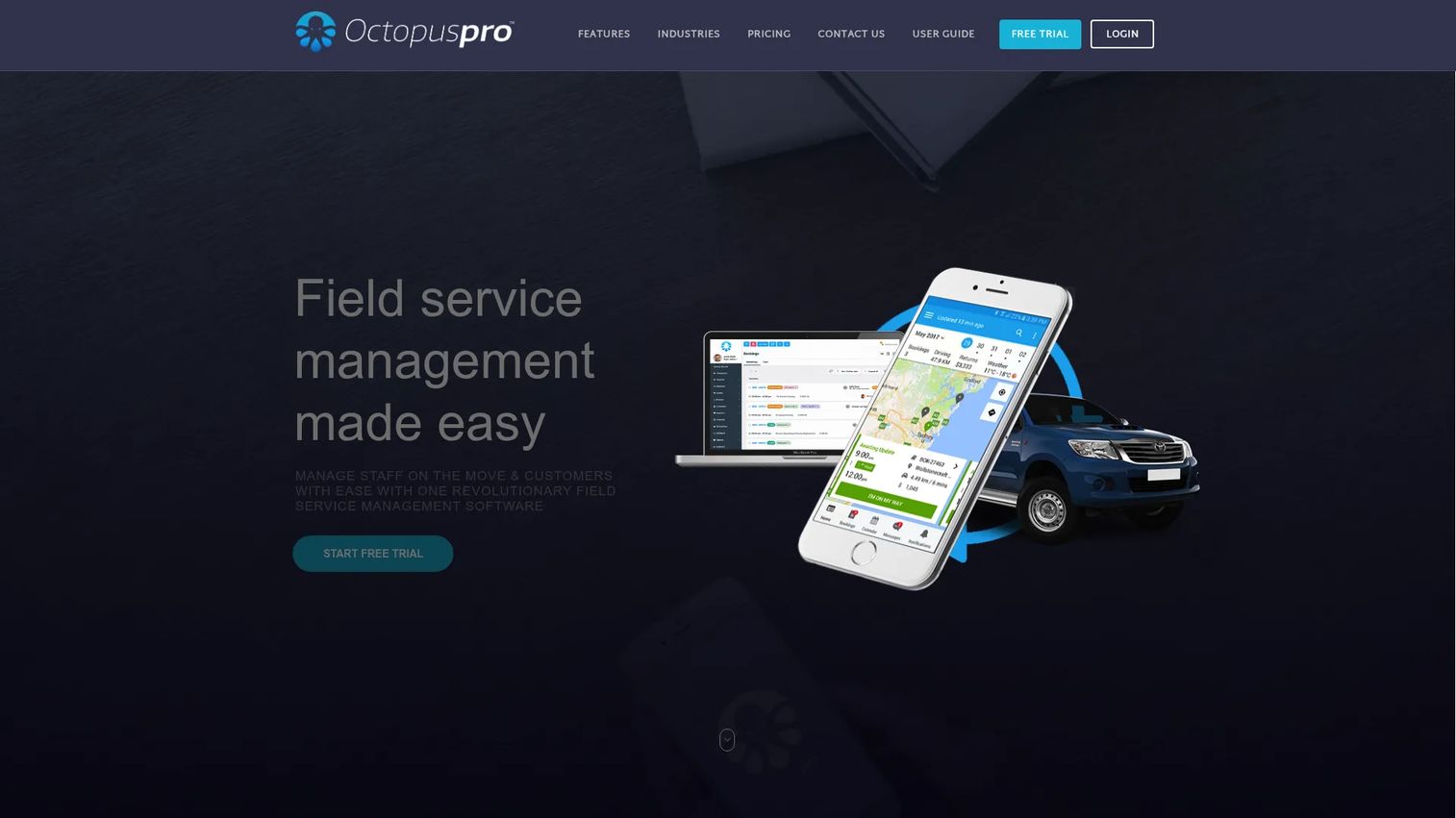
OctopusPro is cloud-based service management and field service management software with towing use cases, built for operators who run more than towing alone. It brings CRM and lead management, online quotes and bookings, job scheduling and dispatch, invoice and payment management, a customer portal, and a fieldworker mobile app into one platform. If your business also handles roadside assistance, transport, or adjacent service work, the broader automation earns its place.
Best for: Service businesses needing all-in-one booking, dispatch, invoicing, and fieldworker management under one roof.
Key strengths
- Booking-to-invoice automation: Online quotes, scheduling, and payment management reduce manual steps across the job lifecycle.
- CRM and customer portal: Lead management and a self-serve portal support repeat and commercial customers, not just one-off tows.
- Flexible fieldworker seats: The mobile app and per-seat model scale with crews that grow and shrink seasonally.
Why choose OctopusPro: OctopusPro appeals to operators who want general field-service operations software with towing use cases rather than a towing-only tool. If dispatch is one of several service types you coordinate, its breadth consolidates work that would otherwise span multiple apps.
OctopusPro pricing: Public plans start at $36.25 per month for Starter, $60 USD per admin seat per month plus $6 USD per fieldworker seat per month for Established, and a $99 USD platform fee per month for Unlimited Users. Annual billing discounts are shown, and a 14-day trial is listed with platform and usage fees waived at $0. OctopusPro carries a 5.0/5 rating on G2.
4. TOPS
TOPS is towing management and dispatch software for towing, impound, billing, and related operations, and it earns its spot as a specialized option for complex impound and multi-location shops. Its strengths sit in call taking and dispatch, accounting with QuickBooks integration, and customer-specific pricing and service configuration. That configurability matters when you bill different rates and terms across police rotation, commercial accounts, and municipal contracts.
Best for: Towing companies needing dispatch, accounting, and impound workflow software with account-specific configuration.
Key strengths
- Call taking and dispatch: Structured intake and assignment built for high call volume.
- QuickBooks integration: Accounting sync keeps billing aligned with your books.
- Customer-specific configuration: Set pricing and service rules per account for varied contract terms.
Why choose TOPS: A team running storage-heavy, municipal, or multi-location operations often needs more configuration than a lightweight dispatch tool offers. TOPS fits when per-account pricing, accounting depth, and impound workflows have to coexist in one system.
TOPS pricing: Public pricing was not visible on the brand site; support documentation indicates pricing is configured through services and onboarding, with some items requiring a conversation with TOPS Support. Plan for a scoped quote rather than a published plan. Its G2 rating is 3.8/5, and Capterra reviewers report 5.0/5 on a small sample, so read recent reviews and run a trial against your own impound and billing workflows.
5. Ranger SST
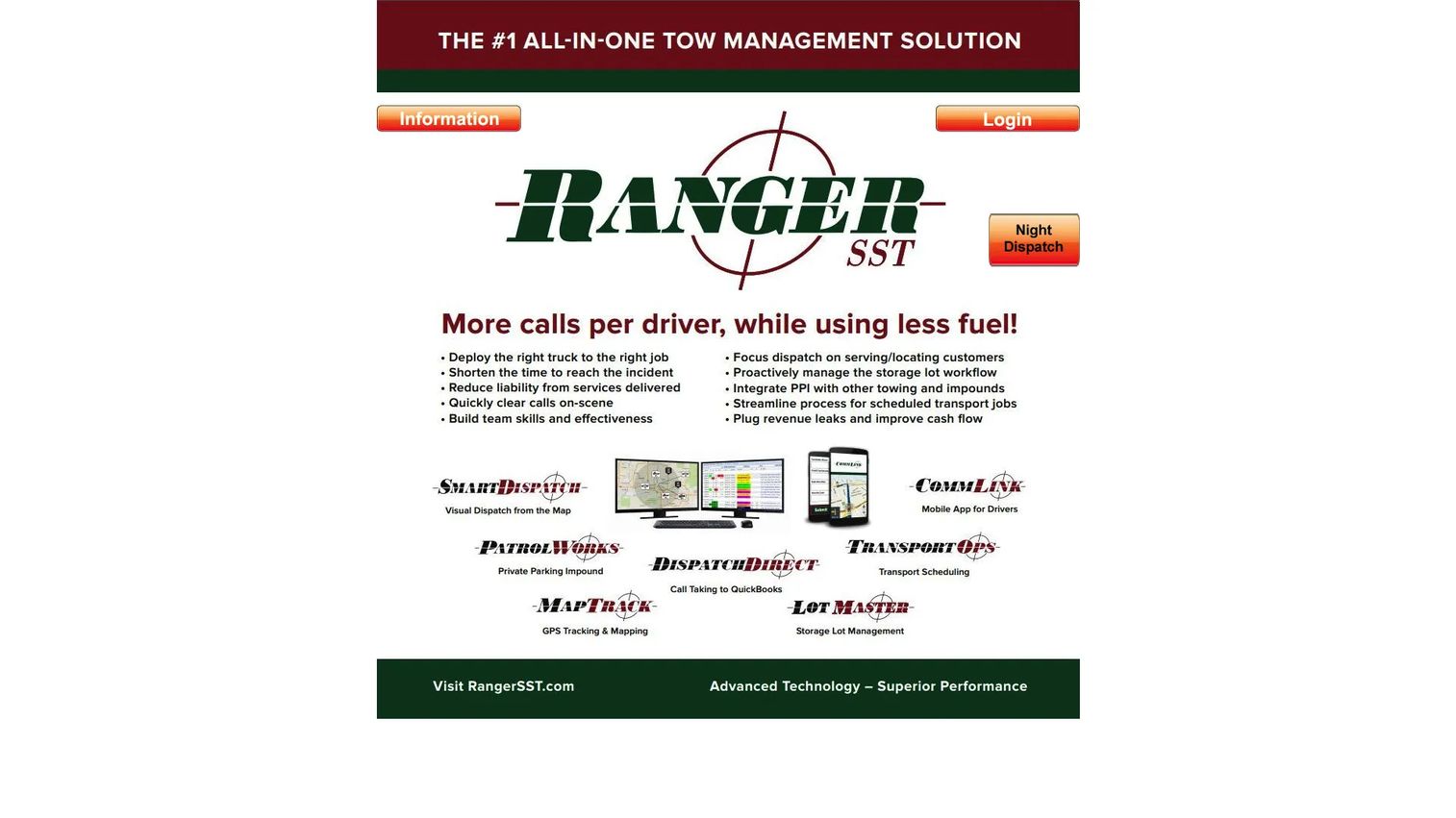
Ranger SST is tow management software and related operational tools for towing and parking-management businesses. It rounds out the list for operators evaluating dispatch, storage, and workflow management, especially those with a parking-management angle alongside towing. Its capabilities span dispatching and mapping, GPS tracking and mapping, and storage lot management, which lines up with operators who run retained-vehicle and parking work together.
Best for: Towing and parking operators needing an integrated dispatch, mapping, and operational management platform.
Key strengths
- Dispatching and mapping: Assign and route jobs with mapping built into the dispatch view.
- GPS tracking and mapping: Live vehicle location supports routing and accountability.
- Storage lot management: Track retained vehicles and lot activity in one workflow.
Why choose Ranger SST: Ranger SST fits operators whose business blends towing with parking management, where lot and storage workflows are as important as roadside dispatch. If that combination describes your operation, the integrated dispatch-and-storage model maps to how you actually work.
Ranger SST pricing: Pricing is customized per customer, with towing management priced to individual needs and parking-management arrangements negotiated market by market, so expect a tailored quote. Public review volume on G2 is insufficient to produce a robust rating, so lean on vendor references and a hands-on evaluation. Test dispatch, GPS mapping, and lot management against your daily workload before signing.
Considerations before you buy
Pricing structure
Check whether pricing is public, monthly, annual, usage-based, or quote-based before you shortlist. Towing tools often meter by call volume, seats, or divisions, so a low headline price can climb as you add trucks or locations. Towbook and OctopusPro publish plans; Autura's fuller suite, Omadi, TOPS, and Ranger SST run on custom quotes. Match the pricing model to how your business actually scales.
Dispatch and mobile usability
The dispatcher screen and the driver app matter more than the length of any feature list. Test real job assignment, live ETA updates, photo capture at the scene, and how the app behaves with a weak signal or offline. If the driver experience is clunky, adoption stalls and you are back to phone calls and texts. Put the mobile app in a driver's hands during the trial, not just in a sales demo.
Billing and accounting fit
Treat QuickBooks compatibility as a checkpoint, not a footnote. Confirm that invoicing, receipts, motor club billing, and digital payment links map to your current accounting workflow. Then verify exactly which objects sync, invoices, payments, customers, and account codes, because "QuickBooks integration" means different things across vendors.
Impound and lien depth
If you hold vehicles, verify that the software supports storage fee calculation, lien notice workflows, auction or release support, and searchable inventory. Generic dispatch tools often treat impound as an afterthought, while specialized options handle the compliance detail. For municipal and private property operators, this depth protects revenue and keeps you out of disputes.
Support and onboarding
For a towing operation, downtime hits dispatch and cash flow directly, so human support and fast onboarding are not luxuries. Ask about training, data migration help, and how quickly a new team gets live. A tool that takes a quarter to implement costs you real jobs in the meantime.
Conclusion
Sort the shortlist by your biggest bottleneck, not by feature count. Towbook is the cleanest starting point for most small and mid-sized towing businesses, with public pricing, cloud dispatch, impound management, a QuickBooks integration, and a 30-day trial that lets you prove it before you pay. Autura is the stronger suite when your operation runs dispatch, payments, lien processing, and unclaimed vehicle sales together and you want them on one data layer. OctopusPro is worth a look when towing is one of several field-service workflows you coordinate.
Omadi, Beacon Software, TOPS, and Ranger SST fill the specialized lanes, from fleet-first dispatch to storage-heavy impound and parking-adjacent operations. The next step is concrete: map your current dispatch, billing, and impound workflow, find where jobs stall or cash sits uncollected, and run a trial of the one tool that most directly clears that gap. The best towing software for small business operators is the one that removes your worst bottleneck in week one, not the one with the longest feature list.
FAQs
Towing software centralizes dispatch, job updates, billing, mobile field communication, and impound records so the office and drivers work from the same live data. It replaces paper tickets and disconnected spreadsheets with one system. Many tools also handle lien notices and auction or release workflows for retained vehicles.
Prioritize dispatch speed, mobile app quality, billing with QuickBooks sync, reporting, impound depth, and support quality. Pricing structure matters too, since tools often meter by calls, seats, or divisions. Weight the criteria toward your biggest bottleneck rather than chasing the longest feature list.
Yes, many vendors support some level of QuickBooks integration, but the depth varies widely. Verify exactly what syncs, invoices, payments, customers, and account codes, before you commit. A vendor that documents specific synced objects is a safer bet than one that only claims "QuickBooks integration."
Yes, and it is often the best place to start for teams with fewer trucks or simpler operations. Smaller operators usually want fast setup, simple public pricing, and reliable mobile dispatch. Towbook is a common starting point for exactly this profile.
Costs vary widely by plan, number of calls, seats, divisions, and feature depth. Some vendors publish monthly plans, such as Towbook starting at $109/mo and OctopusPro starting at $36.25 per month, while others like Omadi, TOPS, and Ranger SST quote by operation. Map your call volume and truck count before comparing prices.
Look for lot inventory, storage fee tracking, lien notice workflows, and auction support in one place. More specialized products often handle this compliance detail better than generic dispatch tools. Autura and TOPS are worth evaluating when impound and lien depth are your priority.
Shortlist vendors that explicitly document QuickBooks syncing, then test the specific objects that matter to you. Focus on invoices, receipts, and payment reconciliation during the trial rather than trusting a feature checkbox. Towbook and TOPS both cite QuickBooks integration, so confirm the sync depth against your accounting workflow.
Choose dispatch-first tools like Omadi when job routing and driver coordination are your main bottleneck and you want that done exceptionally well. Choose suite-first platforms like Autura when you also need billing, payments, fleet tracking, and impound management on one data layer. The decision comes down to whether your pain is concentrated in dispatch or spread across the whole operation.