


You have 340 open requests. Sales forwarded 12 more this week. Two came from the same account, phrased three different ways. Your CEO wants the thing they saw at a conference. A churned customer wanted something else entirely.
Most product managers treat this as a triage problem. Better tags, they think. A tidier backlog. They are solving the wrong problem.
The problem is signal. Scattered requests across Slack threads, spreadsheets, and forwarded emails do not tell you what to build. They tell you who shouted loudest. A feature voting tool changes that by turning raw requests into a structured, deduplicated, weighted demand signal you can defend to stakeholders.
The category is growing fast. The feedback and feature voting sub-segment of product management software was estimated at over $800M in 2024, growing faster than the broader product management software market at a 12.4% CAGR, according to MicroGaps citing Allied Market Research. Teams are buying because manual feedback triage stops scaling somewhere around the second growth stage.
This guide compares four tools for feature request management, product feedback management, and roadmap prioritization. It focuses on signal quality, board management, and whether a tool actually helps you close the feedback loop, not just collect votes.
What's inside
This guide is for product managers, PMMs, and product leaders who have outgrown spreadsheets and Slack for collecting requests.
We picked and evaluated tools against four criteria that matter to a PM:
- Request intake and deduplication: how cleanly the tool captures requests and merges duplicates
- Voting controls: anonymous voting, duplicate vote protection, and vote on behalf workflows
- Roadmap and closed-loop communication: public roadmap, status updates, and changelog
- Integrations and maintainability: Jira, Slack, help desk, and how much upkeep the tool demands
We used verified pricing and current feature sets, and we call out where a tool fits a narrow use case.
TL;DR
- Best for simplicity-first teams: Feature Upvote. A white-label feedback board with voting, minimal setup, and no accounts required to vote.
- Best for evidence-based prioritization: ProdPad. Voting sits inside a full product management workflow, so votes become one input, not the verdict.
- Best for public roadmap workflows: Frill. Idea board, roadmap, and changelog in one place for teams that want visible customer engagement.
- Best for online voting outside product feedback: Polyas. Secure online and live voting built for elections and ballots, not SaaS roadmaps.
- Bottom line: the best feature voting tool improves signal quality without adding process debt. Match the tool to your intake workflow, not the other way around.
What is feature voting software
Feature voting software is a tool that lets users submit product ideas, browse existing requests, vote on the ones they want, and track the status of those requests over time. It turns unstructured feedback into a ranked, deduplicated demand signal that product teams use for roadmap prioritization.
The category sits inside the broader product feedback management space. Most tools combine a customer feedback board, voting mechanics, and some form of roadmap visibility. The good ones close the feedback loop by telling requesters what happened to their idea.
Core capabilities to expect:
- Submission and request intake: users submit ideas through a board, widget, or portal
- Browsing and voting: users find existing requests and add their vote instead of creating a duplicate
- Duplicate detection and moderation: merge similar requests and filter spam to protect signal quality
- Public and private boards: a public board invites open input, a private board keeps feedback internal
- Roadmap visibility and status updates: planned, in progress, and shipped states that keep requesters informed
- Integrations with your stack: Jira, Slack, help desk, and CRM connections so feedback flows into your existing workflow
The distinction that matters: feature voting is a signal, not a roadmap. Votes tell you what people ask for. They do not tell you what drives retention, revenue, or activation. The tool collects the input. You still own the judgment.
When to use feature voting software
When requests are piling up faster than you can triage them
You know the state. Requests land in five places and none of them talk to each other. A feature voting tool centralizes intake into one board. Instead of you tracking demand, users tell you by voting. Duplicates get merged into a single request with a combined vote count, so ten variations of the same ask become one clear signal.
When customers keep asking for roadmap transparency
Buyers and existing customers increasingly want to see where the product is heading. A public roadmap answers that without a meeting. When you move a request from planned to shipped, the tool notifies everyone who voted. That is how you close the feedback loop at scale, instead of manually emailing 40 people who asked for the same thing.
When support, sales, and product all hear different versions of the same request
Support hears it in tickets. Sales hears it in deals. Product hears it secondhand. A vote on behalf workflow lets support and sales log requests and cast votes for customers who will never visit a board. That pulls all three channels into one deduplicated signal, so you prioritize with context rather than whoever escalated last.
Comparison table
Here is how the four tools compare on fit, differentiator, verified pricing, and current G2 rating. Pricing reflects each vendor's live pricing page as of July 2026.
| # | Product | Best for | Key differentiator | Pricing | G2 rating |
|---|---|---|---|---|---|
| 1 | Feature Upvote | Simplicity-first teams wanting a clean board | White-label board, no voter accounts required | From $49/board/month | Not enough reviews |
| 2 | ProdPad | Evidence-based prioritization inside a PM workflow | Voting is one input in a full product management system | Modular, editor-based | 4.2/5 |
| 3 | Frill | Public roadmap and customer engagement | Ideas, roadmap, changelog, and surveys in one place | From $25/month | 4.9/5 |
| 4 | Polyas | Secure online and live voting for elections | Verifiable ballots and voter authentication | Free up to 50 voters | Not listed |
Best feature voting software for 2026
1. Feature Upvote

Feature Upvote is a product feedback board built around one job: collect feature requests, let users vote, and keep the board clean. It strips out the heavier product management layers and focuses on a simple, white-label customer feedback board that you can stand up quickly and point customers to.
Best for: Teams that want a straightforward, branded feature request board with voting and minimal overhead.
Key strengths
- Built-in voting on feedback boards
- Merge, organize, and sort feature requests
- White-label boards with custom domain and CSS
- Public or private board options
- No account required for users to vote
Why choose Feature Upvote: If your priority is a clean intake board without asking users to create an account, this fits. The no-login voting lowers friction, which usually means more input from customers who would otherwise skip a signup wall. It suits PM teams that want signal collection without adopting a full product management platform.
Feature Upvote pricing: Plans start at $49 per board per month on the Bootstrapper tier. The Standard tier is $99 per board per month, and Enterprise pricing is available on request. There is no free tier, but a 30-day free trial is offered, and annual billing saves 20%.
2. ProdPad
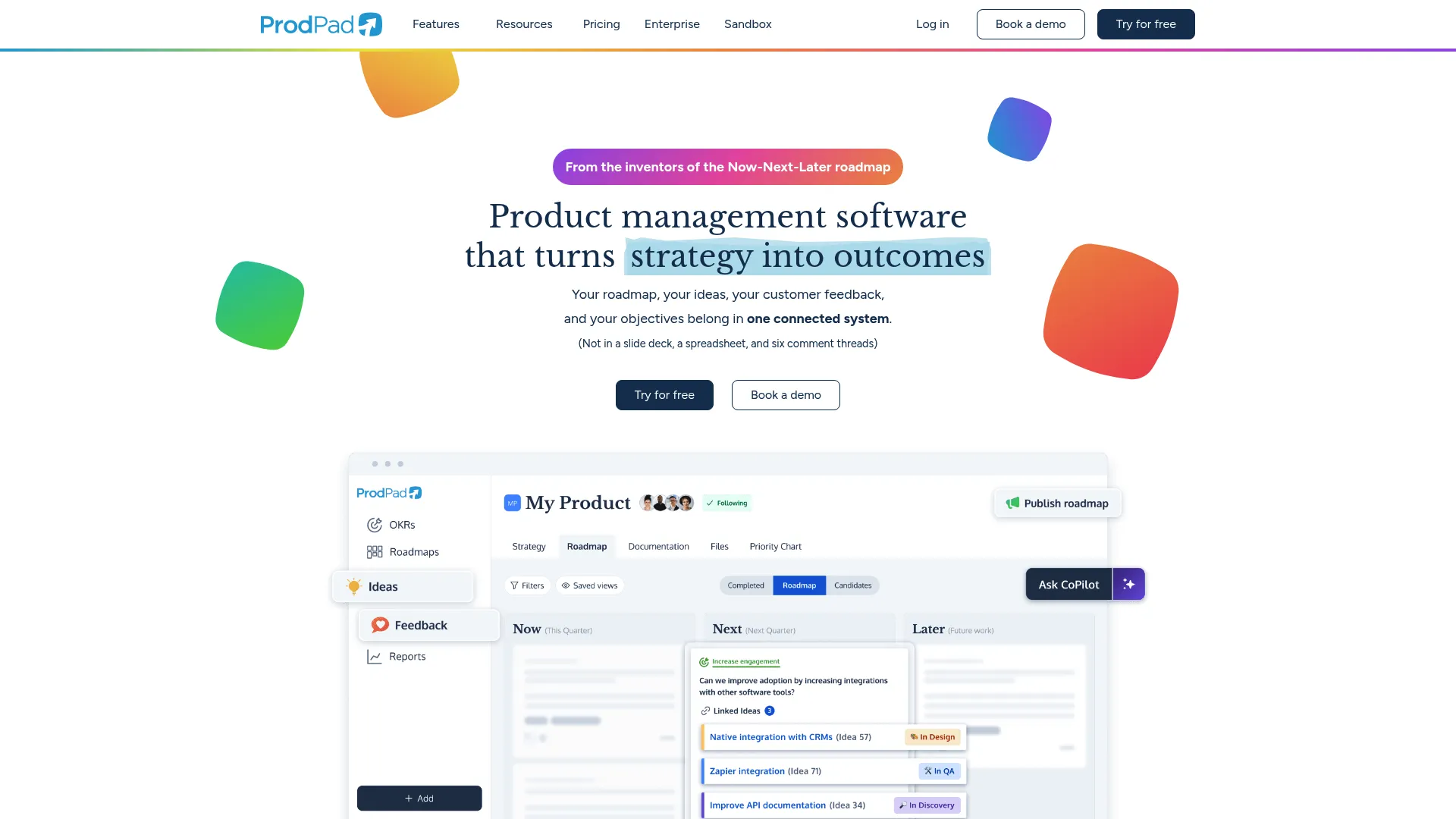
ProdPad is a full product management platform where feedback and voting live alongside roadmaps, ideas, and objectives. Voting is not the whole product here. It is one signal feeding a wider prioritization system, which is exactly the point for teams worried about popularity bias.
Best for: Product teams that want a modular system connecting feedback, roadmaps, and prioritization in one place.
Key strengths
- Roadmaps tied to product objectives
- Idea management and prioritization
- Customer feedback management
- Feedback linked directly to ideas and roadmap items
- Modular pricing by the capabilities you use
Why choose ProdPad: ProdPad's philosophy is that votes inform decisions but do not make them. Because feedback connects to ideas and objectives, you can weigh a request against strategy instead of just its raw vote count. That is the core of evidence-based prioritization, and it helps teams avoid building whatever gets the loudest crowd. The trade-off is a heavier tool than a standalone board, which fits teams ready to run their whole product process in one system.
ProdPad pricing: ProdPad uses a modular model where you pay for the modules and editor licenses you select. Reviewers are free, and a free trial is available. The pricing page does not list a public starting number, so confirm current pricing with ProdPad directly.
3. Frill
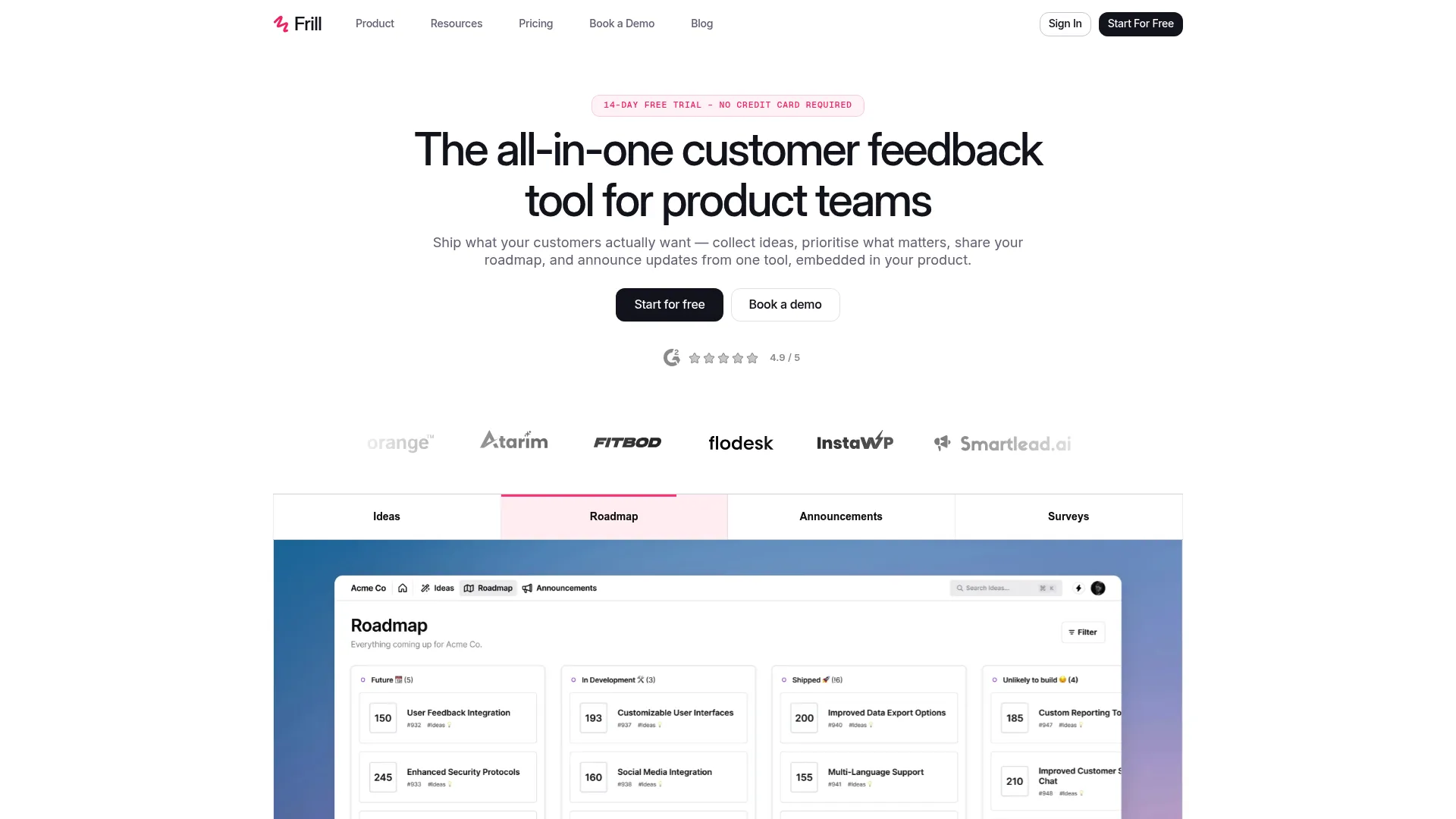
Frill bundles a feedback board, public roadmap, changelog, and in-app surveys into one lightweight tool. It is built for product teams that want visible customer engagement without a heavy setup. Users submit ideas, vote, and then see progress reflected on a public roadmap and changelog.
Best for: Teams that want an all-in-one customer feedback and product communication tool with a public roadmap front and center.
Key strengths
- Ideas board with voting
- Public roadmap with status columns
- Changelog and announcements to close the feedback loop
- In-app surveys and embeddable widget
- Unlimited admins and widgets on paid tiers
Why choose Frill: Frill's strength is the full loop in one place. A customer votes on an idea, watches it move across the roadmap, and reads the changelog when it ships. That visible cycle is what keeps customers submitting instead of going quiet. It is lighter than a full PM platform, which suits teams that want engagement and communication over deep prioritization tooling.
Frill pricing: Frill starts at $25 per month on the Startup plan. Business is $49 per month, Growth is $149 per month, and Enterprise is $349 per month. There is no free tier, but a 14-day free trial is available, and paid tiers include unlimited admins and widgets.
4. Polyas
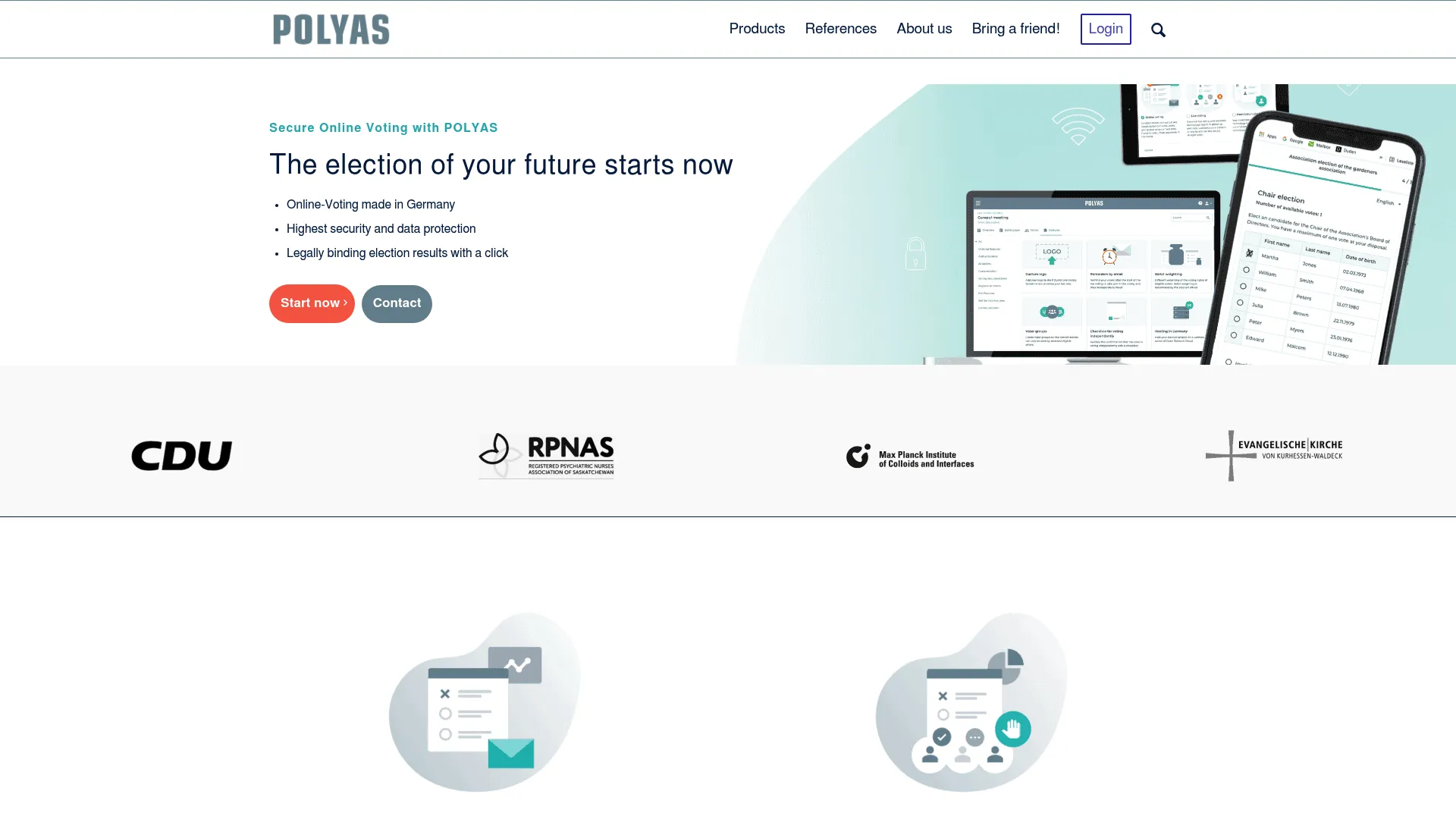
Polyas is an online and live voting system built for secure elections and ballots, not SaaS product feedback. It shows up in broader feature voting searches because of the word "voting," but its core job is verifiable, authenticated voting for organizations running formal elections and general meetings.
Best for: Organizations that need secure online or live voting for elections, boards, and formal ballots.
Key strengths
- Online voting for elections and ballots
- Live voting for meetings
- Ballot creation and voter authentication
- Security and verifiability features
- Turnout visibility during a vote
Why choose Polyas: Choose Polyas when your need is a legitimate, auditable election rather than product roadmap prioritization. Its authentication and verifiability features matter for governance votes, association elections, and works council ballots. For SaaS product teams collecting and prioritizing feature requests, its fit is narrower than the other three tools here, so weigh it only if formal voting is your actual use case.
Polyas pricing: Polyas offers a Standard package free of charge for up to 50 voters. The Verifiable package starts from a 50 euro base price, and total cost is calculated per project through a pricing calculator that scales with voter count.
Considerations
Before you commit, run your shortlist through this checklist.
Public versus private board model
Decide who sees the board before you buy. A public board invites open customer input and doubles as roadmap transparency. A private board keeps feedback internal, which suits competitive-sensitive teams or early-stage products. Verify the tool supports the model you need, and ideally lets you run both.
Duplicate votes and spam protection
Signal quality dies without moderation. Check for duplicate vote protection, so one person cannot stack votes, and anonymous voting controls that still prevent gaming. Confirm you can merge duplicate requests into a single item with a combined count. Without this, your board becomes noise, not signal.
Roadmap communication and status updates
Collecting votes is half the job. The other half is telling requesters what happened. Verify the tool sends status updates when a request moves to planned, in progress, or shipped. A changelog and public roadmap are how you close the feedback loop without manual email chains.
Integrations and workflow fit
Your feedback tool should feed your existing stack. Check for Jira integration so requests become tickets, Slack integration so new votes surface in channels, and CRM or help desk connections so support and sales can log feedback. A tool that lives in isolation adds process debt.
Governance and enterprise controls
If you are past early stage, verify SSO, a custom domain, and white-label feedback board options. Confirm how the vendor handles data, whether boards support multiple languages if you serve global customers, and what admin and permission controls exist. These are the details that decide whether the tool scales with you.
Conclusion
Feature voting software earns its place when it improves signal quality without adding maintenance you cannot afford.
For simplicity-first teams, Feature Upvote gives you a clean, white-label board with no-login voting. For evidence-based prioritization, ProdPad keeps votes as one input inside a full product management workflow, which is the right call if popularity bias worries you. For a visible public roadmap and customer engagement, Frill packages ideas, roadmap, and changelog in one lightweight tool. Polyas fits a narrower need: secure, verifiable voting for formal elections rather than product feedback.
Your next step is simple. Shortlist two of these tools and map each against your current intake workflow. Where do requests come from today, who needs to vote on behalf of customers, and how will you communicate status back? Run a two-week trial with real requests, not test data. The tool that reduces your triage load while keeping signal clean is the one to keep.
FAQs
Feature voting software lets users submit product ideas, browse existing requests, vote on the ones they want, and track status over time. It converts scattered feedback into a ranked, deduplicated demand signal that product teams use for roadmap prioritization. Most tools pair a customer feedback board with voting and some form of public roadmap.
It depends on your goals. A public board invites open customer input and doubles as roadmap transparency, which builds trust with buyers and users. A private board keeps feedback internal, which suits competitive-sensitive teams or early-stage products. Many tools support both, so pick the model that fits your customer relationship and run the other where needed.
They centralize intake into one board, merge duplicate requests into single items with combined vote counts, and moderate for spam. Then they layer prioritization on top, weighing votes against strategy, revenue, and retention rather than raw counts. Feature request management works when the tool reduces triage load and feeds your existing stack through Jira and Slack integration.
Feature voting gives you a demand signal, not a finished roadmap. Votes tell you what people ask for, which is useful input, but they do not tell you what drives activation, retention, or expansion. Evidence-based prioritization uses votes as one factor alongside business goals and customer segment, so you avoid building whatever the loudest crowd requests.
Tell requesters what happened to their idea. When a request moves to planned, in progress, or shipped, notify everyone who voted through status updates, a changelog, or a public roadmap. Closing the loop this way keeps customers submitting feedback instead of going silent, because they see their input actually moves the roadmap.
Yes, with tools that support a vote on behalf workflow. Support logs requests from tickets and sales logs them from deals, casting votes for customers who will never visit a board directly. This pulls support, sales, and product into one deduplicated signal, so you prioritize with full context rather than whoever escalated most recently.
Look for duplicate vote protection that stops one person from stacking votes, plus moderation tools to merge similar requests into a single item with a combined count. Anonymous voting can lower submission friction, but confirm the tool still guards against gaming. Without duplicate detection and spam controls, your board fills with noise instead of a clean signal.
Jira integration matters most, so accepted requests become development tickets without manual copying. Slack integration surfaces new votes and requests where your team already works. CRM and help desk connections let support and sales log feedback from tickets and deals. Together these keep feedback flowing into your existing workflow instead of creating another isolated system.





.avif)