You want to launch a checking account, a debit card, or a lending feature inside your product. You do not want to become a chartered bank to do it.
That is the whole promise of banking as a service. Someone else holds the license, the sponsor bank relationship, and the regulatory weight. You get accounts, cards, payments, and lending through API banking, and you ship a financial product in months instead of years.
The problem is that the promise hides the real work. Compliance does not disappear. It shifts. You still own KYC decisions, AML monitoring, and how FDIC insurance gets communicated to your users. You inherit third-party risk through your provider and their sponsor bank. Pick the wrong banking as a service platform and you spend the next two years fighting your own infrastructure instead of building product.
The market is not slowing down. Global Market Insights projects the banking as a service market to grow from USD 28.9 billion in 2026 to USD 126.6 billion by 2035, a 17.8% CAGR. That growth means more providers, more feature overlap, and a harder buying decision for anyone comparing a BaaS provider today.
This guide is written for that decision.
What's inside
This is a practical comparison for product, strategy, and platform leaders choosing a banking as a service provider. It is not a glossary. It is a decision-support guide built around how product teams actually evaluate infrastructure.
We selected the seven providers below on:
- Product coverage across accounts, cards, payments, and lending
- API maturity and developer experience
- Compliance model, including KYC, AML, and sponsor bank structure
- Geographic reach and regulatory scope
- Total cost of ownership and long-term maintainability
Each provider gets an honest read on where it fits, where it does not, and who should shortlist it.
TL;DR
- Best for banks modernizing their own experience: Backbase, a banking OS layer rather than a pure BaaS provider.
- Best for teams already inside Stripe: Stripe Treasury, for embedded treasury and money movement.
- Best for API-first embedded finance in the US: Treasury Prime, built around bank-partner coordination.
- Best for full-stack embedded finance: Unit, covering accounts, cards, payments, and lending in one platform.
- Best for European reach: Solaris, a regulated BaaS platform with EU banking infrastructure.
- Best for regulated payments infrastructure: ClearBank, focused on modern banking rails and clearing.
- Best for a tight bank-partner model: Synctera, pairing BaaS infrastructure with compliance tooling.
Your right answer depends on your roadmap, your regulatory scope, and how much of the backend you want to own.
Background: what is banking as a service software
Banking as a service software is infrastructure that lets a non-bank company offer regulated financial products through a licensed bank's charter, delivered over APIs.
The model has three parties. A licensed bank holds the charter and takes on the regulatory relationship. A BaaS platform sits in the middle, translating banking capabilities into developer-friendly API banking. A non-bank company, often a fintech or software platform, uses those APIs to embed financial features into its own product.
That middle layer is what most people mean by a banking as a service platform. It handles the plumbing so you do not have to build core banking from scratch.
What BaaS software typically enables:
- Accounts: demand deposit accounts, virtual and physical account structures, ledgers
- Cards: debit and credit card issuing, virtual cards, spend controls
- Payments: ACH, wire, real-time rails, card acquiring, money movement
- Lending: credit products, loan origination, and servicing where supported
- Compliance tooling: KYC and KYB identity flows, AML transaction monitoring, sanctions screening
- Program operations: dashboards, reconciliation, dispute handling, and reporting
A few terms matter for evaluation. The sponsor bank is the licensed institution behind your program. KYC (know your customer) and AML (anti money laundering) are the compliance obligations you share with that bank. FDIC insurance is the deposit protection passed through the sponsor bank to your end users, and how you communicate it is regulated. Open banking, by contrast, is about sharing data across institutions, and it is adjacent to but distinct from embedded finance.
The distinction that trips teams up: BaaS is about embedding regulated financial products into your product. Open banking is about accessing account data. Different problems, different providers.
When to use banking as a service software
Not every roadmap needs a BaaS platform. Here is where it earns its place.
Launch financial products without becoming a bank
You have a product with an audience, and financial features would deepen engagement or open a revenue line. A payroll tool adding pay cards. A vertical SaaS adding embedded accounts. A marketplace adding seller payouts. BaaS lets you ship those without a charter, without a decade of regulatory groundwork, and without a core banking build. The provider brings the sponsor bank; you bring the product and the distribution.
Expand into accounts, cards, or payments faster
You already move money in some form and now want to add regulated financial products. Maybe you handle payments and want to add accounts. Maybe you issue cards and want lending. A banking as a service provider compresses time to market for each new product because the underlying rails and compliance scaffolding already exist. You are configuring, not constructing.
Reduce build and maintenance overhead
For a product team, the real cost is not the launch. It is the maintenance. Every payment rail, every compliance update, every card network rule change is ongoing engineering. BaaS platforms absorb much of that. When the team values shipping product over owning every backend layer, platform leverage beats a custom build on total cost of ownership.
Comparison table
The seven providers below are ranked by relevance to product teams evaluating banking as a service companies in 2026. Coverage, API maturity, and compliance model matter more than any single feature.
| # | Product | Best for | Key differentiator | Pricing | G2 rating |
|---|---|---|---|---|---|
| 1 | Backbase | Banks modernizing digital channels | AI-native banking OS layer | From €15,000/year | 4.3/5 |
| 2 | Stripe Treasury | Teams already using Stripe | Embedded treasury inside Stripe | Usage-based, included | Not available |
| 3 | Treasury Prime | API-first US embedded finance | Bank-partner network model | Custom (usage-based) | Not available |
| 4 | Unit | Full-stack embedded finance | Accounts, cards, payments, lending | Custom | 3.5/5 |
| 5 | Solaris | European banking programs | Regulated EU infrastructure | Custom | 5.0/5 |
| 6 | ClearBank | Regulated payments infrastructure | Direct payment scheme access | Custom | Not available |
| 7 | Synctera | Tight bank-partner operating model | Platform plus compliance tooling | Custom (usage-based) | 3.0/5 |
Pricing across this category is mostly custom and usage-based, so treat starting prices as a signal, not a quote. Ratings come from limited review volumes for several of these providers, which is common for infrastructure sold through sales-led motions.
1. Backbase
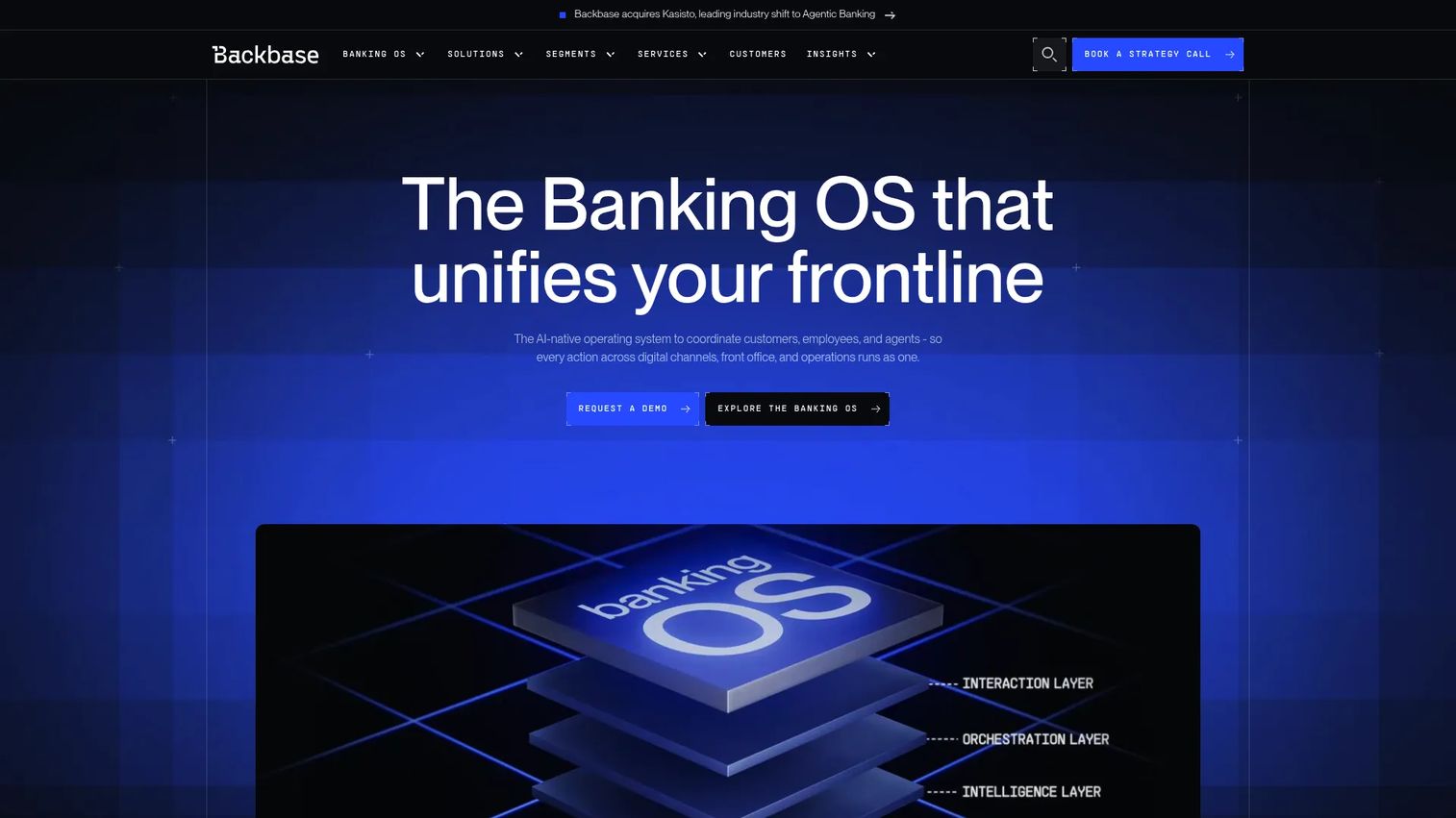
Backbase is an AI-native banking OS built for banks and financial institutions that want to unify their digital channels, employees, and AI agents on one platform. It sits closer to the experience and orchestration layer than to a pure BaaS provider. If your organization already holds a license and wants to modernize how customers and staff interact with your products, Backbase is the platform layer that ties those journeys together.
That positioning matters for how you evaluate it. Backbase excels at composable journeys, workspaces, and pre-built connectors that reduce the coordination cost of a broad digital transformation. It is less about handing a non-bank company a sponsor bank and more about giving an established institution a modern frontline.
Best for: Banks and financial institutions modernizing customer and operational experiences on a unified banking platform.
Key strengths
- Unified frontline banking OS across channels
- Composable journeys and workspaces
- Pre-built connectors and marketplace integrations
Why choose Backbase: Choose Backbase when you already have the banking license and the real problem is experience and orchestration, not obtaining a charter. Teams looking for a fast, API-only way to embed accounts into a non-bank product will find a broader platform transformation here, which is the point for larger institutions.
Backbase pricing: Publicly listed team subscription pricing starts at €15,000 (about $18,000) per year for the Basic tier, with Business at €35,000, Enterprise at €65,000, and Unlimited at €150,000 per year. Core platform pricing is quoted directly through sales.
2. Stripe Treasury
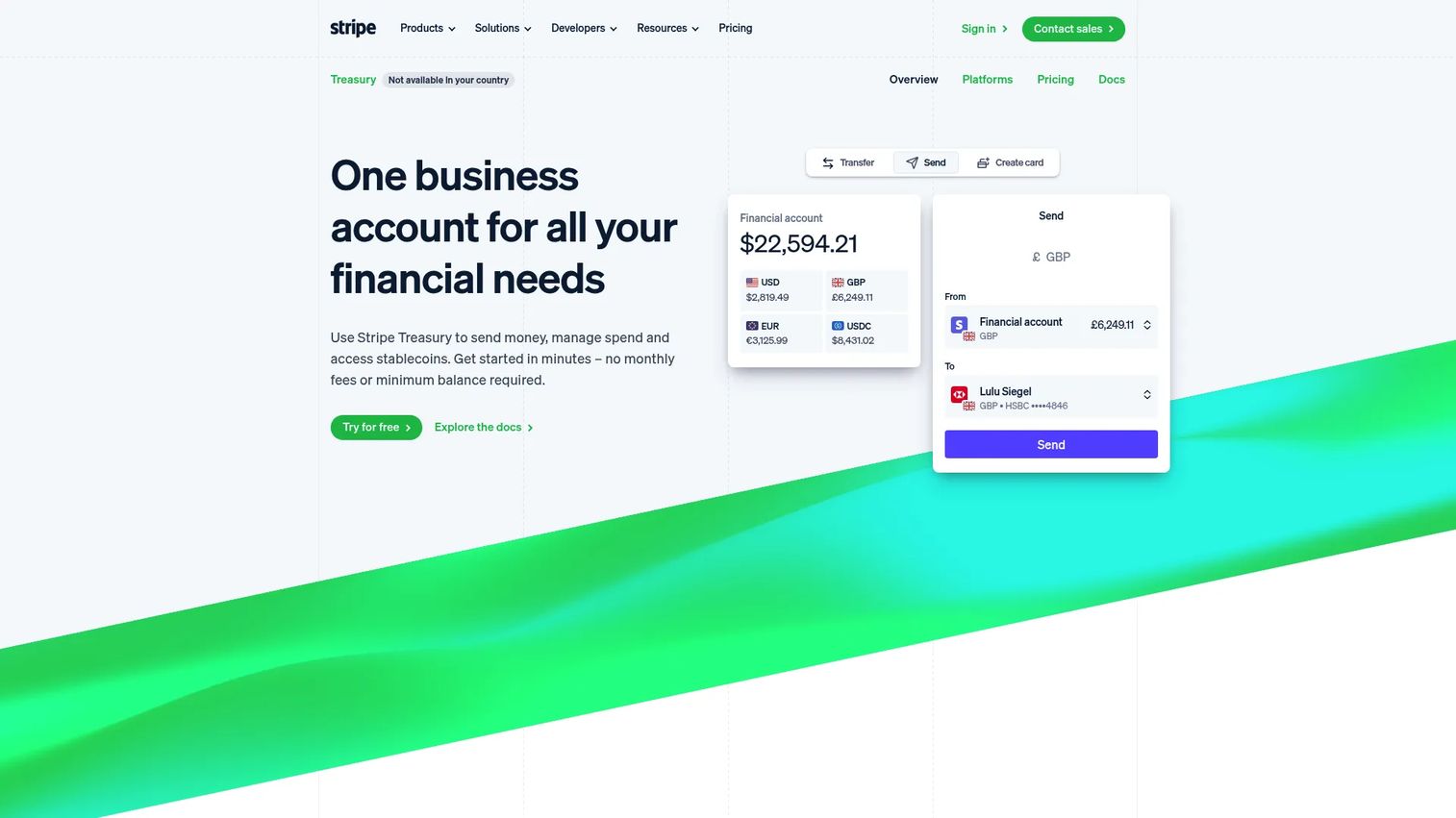
Stripe Treasury is a business finance product for managing accounts, payouts, cards, and multicurrency funds in one place. For product teams already building on Stripe, it extends the same developer experience into treasury and money movement. That continuity is the draw: if your payments, billing, and now banking features live behind one set of APIs, you cut integration surface and vendor sprawl.
Stripe Treasury fits companies that want embedded balances, storage, and payout capabilities without adopting a separate BaaS stack. The breadth of Stripe's platform, from global payouts to card issuing to multicurrency accounts, means many money-movement needs stay inside one relationship.
Best for: Businesses that want embedded treasury and money-management capabilities inside the Stripe platform.
Key strengths
- Business financial account management
- Virtual and physical cards
- Multicurrency accounts and global payouts to 160 countries
Why choose Stripe Treasury: Choose Stripe Treasury when you are already committed to Stripe and want treasury features without a new integration. It performs best as an extension of an existing Stripe footprint rather than as a standalone banking as a service platform for teams outside that ecosystem.
Stripe Treasury pricing: Stripe states there are no monthly fees or minimum balance for Treasury. ACH funding is included, wire funding is $2.00, and instant currency conversion starts at 0.5%. A single entry-level plan price is not published; costs are usage-based across these fee components.
3. Treasury Prime
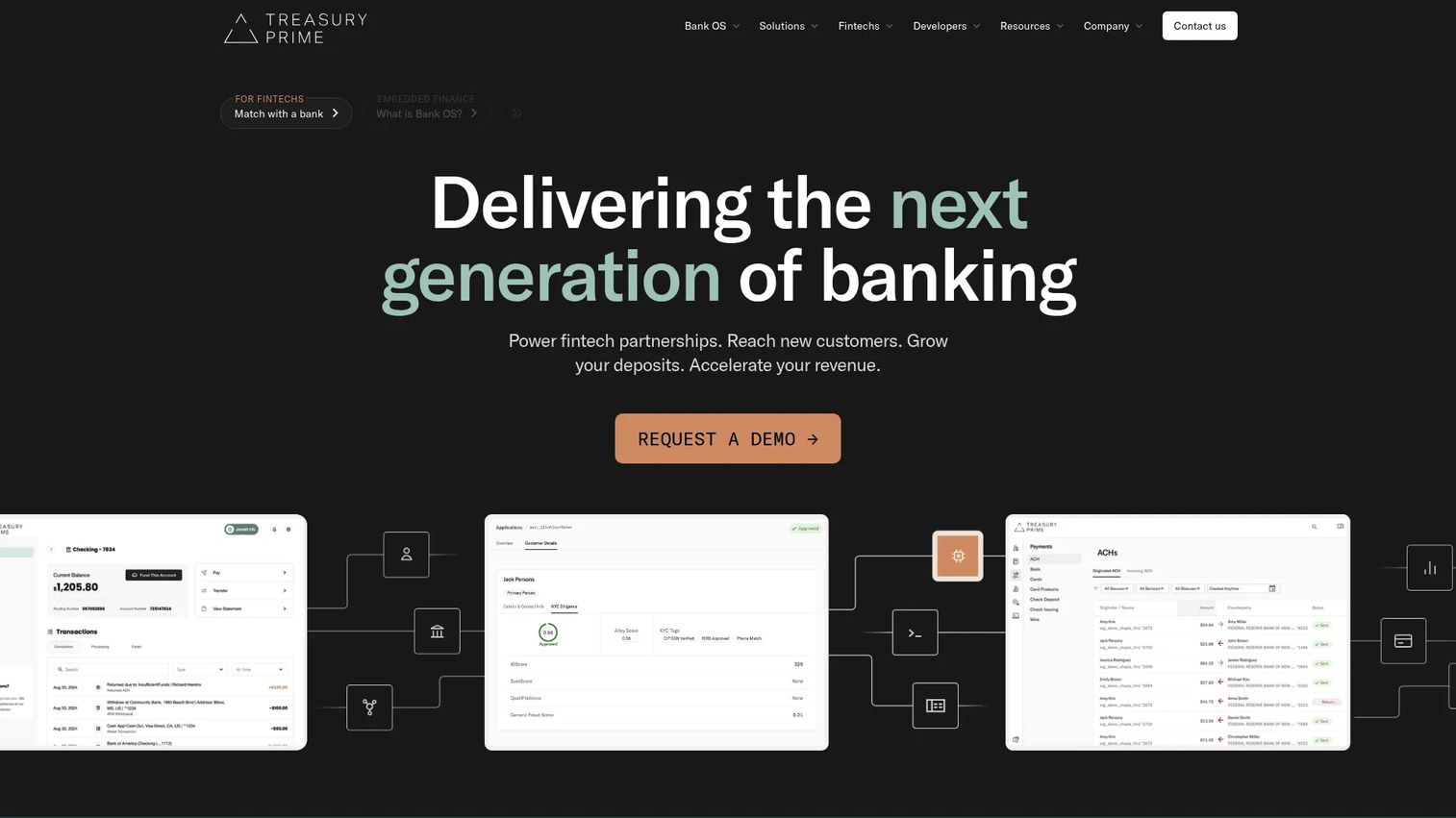
Treasury Prime is an embedded banking software platform for banks and fintechs, built around a network of bank partners. Its distinguishing move is bank-partner coordination: rather than locking you to a single sponsor bank, Treasury Prime helps non-bank companies connect with the right banking partner for their program. That flexibility can matter for redundancy, capacity, and negotiating leverage over time.
The platform covers the core embedded finance surface: accounts, cards, and money movement, with payments capabilities spanning ACH, wire, card, and remote deposit capture. A partner marketplace and API integrations round out the banking program tooling.
Best for: Banks and fintechs building embedded banking and modern payments programs in the US.
Key strengths
- Bank OS for embedded, digital, and open banking
- Payments including ACH, wire, card, and remote deposit capture
- Partner marketplace and API integrations
Why choose Treasury Prime: Choose Treasury Prime when the bank relationship itself is a first-class concern and you want a network model rather than a single-sponsor lock-in. It suits teams that treat sponsor bank flexibility as risk management, not just a feature.
Treasury Prime pricing: Treasury Prime does not disclose public pricing. It describes a usage-based model and directs prospects to sales for pricing and contract terms.
4. Unit
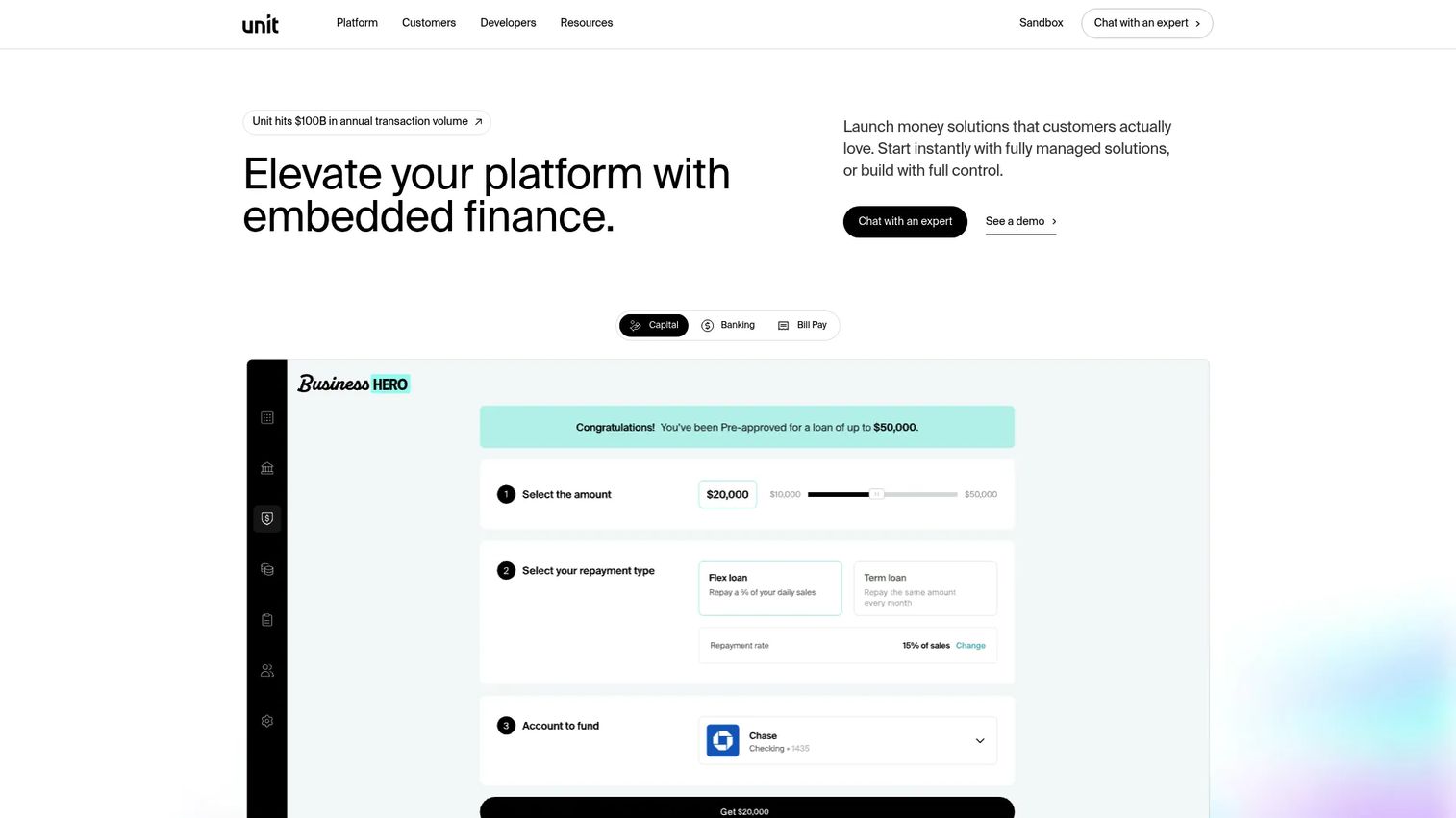
Unit is an embedded finance platform that lets software companies offer banking, cards, payments, and lending features inside their own app. Its appeal for product teams is breadth in one place: accounts and wallets, card issuing, money movement, and lending under a single integration. When your roadmap includes several financial products over time, consolidating them behind one platform reduces the coordination overhead of stitching together multiple vendors.
Unit is built for non-bank brands with a clear embedded finance roadmap. The launch and lifecycle tooling helps teams get a program live and then expand product coverage without rebuilding the foundation each time.
Best for: Software companies embedding regulated financial products into their own app.
Key strengths
- Accounts and wallets
- Card issuing
- Money movement and lending
Why choose Unit: Choose Unit when you want the widest product coverage from a single embedded finance platform and expect to add products over time. It excels for fintechs and software platforms treating financial features as a core roadmap pillar rather than a one-off.
Unit pricing: Unit does not publish pricing on its site. Its documentation directs customers to their Unit contact or Customer Success Manager for pricing details.
5. Solaris
Solaris is a European embedded finance and banking as a service platform for companies building banking products across the EU. Its strength is regional: regulated banking infrastructure, local and virtual IBANs, and SEPA transfers built for European distribution. For teams whose customers sit in Europe, working with a provider that already holds the regulatory posture for that market removes a major barrier to entry.
Solaris covers KYC and KYB identification flows alongside cards, payments, and lending products. That combination makes it a strong candidate when compliance for European operations is the deciding factor rather than an afterthought.
Best for: Companies needing a regulated embedded finance partner for banking products in Europe.
Key strengths
- Digital banking APIs with local and virtual IBANs and SEPA transfers
- KYC and KYB identification flows
- Cards, payments, and lending products
Why choose Solaris: Choose Solaris when European regulatory scope and geographic reach are central to your plan. It fits teams with EU distribution that want a regulated banking partner native to that market rather than a US-first provider extending outward.
Solaris pricing: Solaris does not publish public pricing. Pricing is arranged through direct contact with their sales team.
6. ClearBank
ClearBank is cloud-based, API-first banking and payments infrastructure for businesses and financial institutions. Its differentiator is direct access to UK and EU payment schemes, which puts your program closer to the rails rather than several hops removed. For teams that treat reliable, regulated payments infrastructure as the foundation, that proximity matters for both performance and control.
ClearBank supports multi-currency accounts and FX, plus real-time APIs for payments, balances, and reconciliation. Product and operations teams evaluating it should weigh the value of a regulated infrastructure partner with direct scheme access against providers that layer further from the underlying rails.
Best for: Banks, fintechs, and businesses needing regulated real-time payments infrastructure.
Key strengths
- Direct access to UK and EU payment schemes
- Multi-currency accounts and FX
- Real-time APIs for payments, balances, and reconciliation
Why choose ClearBank: Choose ClearBank when payments infrastructure and regulated scheme access are the core requirement, not a secondary capability. It suits teams prioritizing reliable rails and direct access over the broadest possible product catalog.
ClearBank pricing: ClearBank does not list public pricing. The site uses an enquiry-based, contact-sales model for commercial terms.
7. Synctera
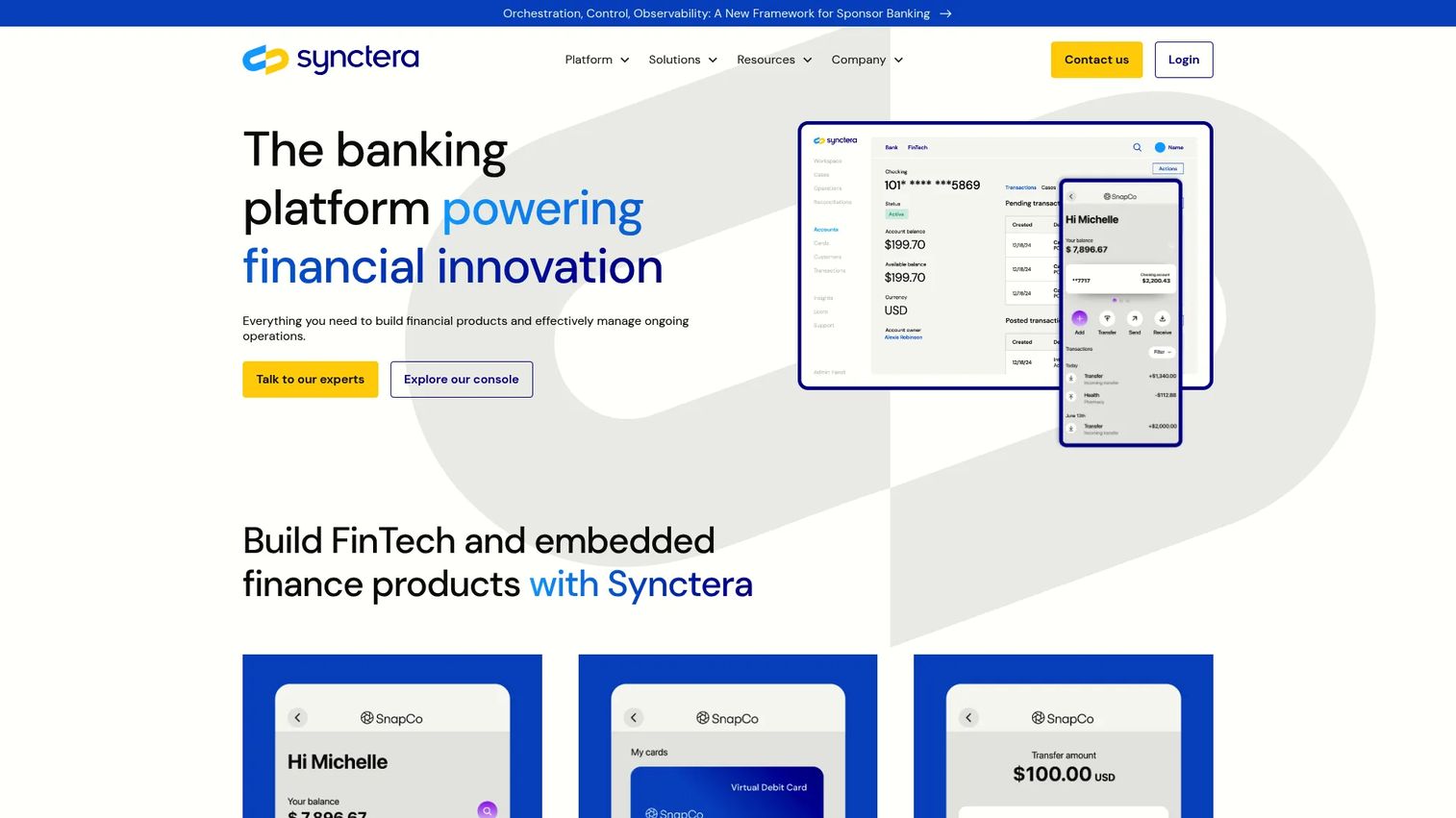
Synctera is banking as a service infrastructure for fintechs and banks, pairing a build platform with operations and compliance tooling. Its model leans into a tight bank-partner operating relationship, with a Console for operations, compliance, and oversight sitting alongside the Platform for building products. For teams that want compliance and program operations tooling built into the same system they build on, that integration reduces the number of moving parts.
Synctera's stack includes a Ledger for customer, account, and transaction data, money movement and payments capabilities, and risk and compliance tools. That makes it a fit for teams that want the bank relationship and the compliance workflow closely coupled.
Best for: Banks and fintechs building embedded banking or BaaS products with tightly coupled compliance.
Key strengths
- Synctera Platform and Console for building and operating
- Ledger for customer, account, and transaction data
- Money movement, payments, and risk and compliance tools
Why choose Synctera: Choose Synctera when you want compliance and oversight tooling integrated with your build platform rather than bolted on. It fits teams that value a tight bank-partner operating model and want fewer separate systems to coordinate.
Synctera pricing: Synctera describes usage-based pricing and states there are currently no fees for use of the platform, with detailed commercial terms handled through sales. Public pricing is not listed on the site.
Considerations: how to evaluate a banking as a service provider
Feature checklists miss what actually determines success. Here is what to weigh before committing to any BaaS platform.
API maturity and developer experience
Read the documentation before you read the pitch deck. Consistent, well-versioned APIs with real SDKs and clear error handling decide how much engineering effort integration will take. Inconsistent endpoints and thin docs turn a three-month integration into a nine-month one. Have your engineers build a small proof of concept during evaluation, not after signing.
Compliance and sponsor-bank oversight
You share KYC, AML, and reporting obligations with the sponsor bank behind your program. Ask who owns which compliance decisions, how audits work, and how FDIC insurance is passed through and communicated. Understand the bank relationship structure, because sponsor bank health is now a material part of third-party risk.
Product coverage and roadmap fit
Map the provider's capabilities against the financial products your roadmap actually requires, not just today's launch. Adding lending after you build on an accounts-only platform can mean re-platforming. Confirm coverage across accounts, cards, payments, and lending matches where you plan to be in two years.
Total cost of ownership
Look past the headline pricing. Total cost of ownership includes setup, launch time, compliance overhead, bank-partner coordination, and ongoing maintenance across every product and rail. Usage-based pricing scales with your program, so model your expected volumes before comparing quotes.
Geographic reach and regulatory scope
Confirm the provider supports the markets you need now and the ones on your roadmap. US-first and EU-first providers carry different regulatory postures. Expanding into a new region on a provider that does not support it means starting the vendor search over.
Conclusion
The best banking as a service software depends entirely on your context, not on a single winner.
If you already hold a banking license and need to modernize the experience, Backbase is the platform layer. If you live inside Stripe, Stripe Treasury extends what you already run. For API-first embedded finance in the US, Treasury Prime and its bank-partner network stand out, while Unit offers the widest full-stack coverage for teams with a long embedded finance roadmap. For European reach, Solaris is built for that market. For regulated payments infrastructure with direct scheme access, ClearBank leads. And for a tight bank-partner model with integrated compliance, Synctera fits.
Start with the platform that best matches your launch scope, your regulatory scope, and how much of the backend you want to own. Then pressure-test it with a real integration proof of concept and a hard look at the sponsor bank behind it. The right banking as a service provider reduces coordination overhead for years. The wrong one becomes the thing your team fights instead of ships.
Start your journey with Guideflow today!
Choosing infrastructure is one problem. Showing your product to buyers is another. If your team needs to communicate a complex product without a live environment, Guideflow turns your product into self-serve interactive experiences in minutes. You can capture your app in a few clicks, personalize the story for each audience, share it anywhere, and analyze engagement in real time.
Interactive demos let prospects experience your product at their own pace, sandboxes give technical buyers full freedom to explore and validate workflows, and demo centers give your team a single branded hub to organize and distribute everything. Use AI to polish demos fast, collaborate across teams, and integrate engagement data into your existing stack.
Start your journey with Guideflow today!
FAQs
Banking as a service software is infrastructure that lets a non-bank company offer regulated financial products through a licensed bank's charter, delivered over APIs. It sits between the sponsor bank and your product, translating banking capabilities into API banking you can embed. That lets you launch accounts, cards, payments, and lending without becoming a bank.
A BaaS provider connects three parties: a licensed sponsor bank, the BaaS platform itself, and your non-bank company. The bank holds the charter and regulatory relationship. The platform exposes banking functions as APIs. You build financial features into your product on top of those APIs, sharing compliance obligations with the bank.
Most banking as a service platforms support accounts, cards, and payments as a baseline. That includes demand deposit accounts, debit and credit card issuing, and money movement over ACH, wire, and real-time rails. Many also support lending, multicurrency accounts, and white-label financial products, though coverage varies by provider and region.
KYC and AML are compliance obligations you share with the sponsor bank behind your program. The BaaS platform usually provides identity verification and transaction monitoring tooling, but you still own decisions and program-level responsibility. Clarifying who owns which compliance step is one of the most important parts of evaluating any banking as a service provider.
Weigh API maturity and developer experience, product coverage against your two-year roadmap, and the compliance and sponsor bank structure. Then look at total cost of ownership, including setup, maintenance, and bank-partner coordination, plus geographic reach. The goal is a platform that reduces coordination overhead rather than adding it.
They overlap but are not identical. Embedded finance is the broader outcome: financial products delivered inside a non-financial product. Banking as a service is the infrastructure model that often makes embedded finance possible, connecting your product to a licensed bank through APIs. Most embedded banking programs run on a BaaS platform underneath.
The main risks are third-party risk and sponsor bank exposure. Your program depends on both the platform and the bank behind it, so their compliance posture and financial health become yours. Plan for compliance ownership, potential provider or bank changes, and how FDIC insurance is communicated to end users. Redundancy in bank partners can reduce concentration risk.
Compare banking as a service companies on product coverage, API maturity, compliance model, geographic reach, and total cost of ownership. Build a small integration proof of concept during evaluation to test the developer experience directly. Then assess the sponsor bank relationship as carefully as the software, because it is now a core part of the risk picture.