Your team ships a new product region. Engineering picks a cloud provider, allocates compute, and writes the deployment scripts. Then someone asks who owns the network routing between the new VPC, the data center, and the customer-facing services. The answer is usually a hardware appliance sitting in a rack that nobody wants to touch.
Virtual routers remove that bottleneck. A virtual router is software that performs Layer 3 routing on virtual machines, cloud infrastructure, containers, or network-functions-virtualization (NFV) platforms instead of on a dedicated hardware appliance. According to Cisco's Catalyst 8000V documentation, a single virtual cloud router can combine routing, SD-WAN, VPN, NAT, QoS, and next-generation firewall functions in one deployable image.
The virtual router market reflects that shift. Research and Markets estimated the market at $407.65 million in 2025, forecasting 20.72% compound annual growth through 2030. For a product manager evaluating cloud architecture, tenant isolation, or deployment reliability, understanding this category is now a prerequisite for informed infrastructure conversations.
What's inside
This guide is for product managers and infrastructure leaders who influence cloud architecture, security reviews, or engineering prioritization. Items were selected based on four criteria:
- Routing depth: Protocol support across BGP, OSPF, and static routes
- Deployment flexibility: Compatibility with VMs, cloud marketplaces, containers, and bare-metal servers
- Security posture: Whether routing is primary or bundled inside a firewall appliance
- Operational ownership: Licensing model, automation support, and maintenance burden
The list spans routing-first, virtual firewall, SD-WAN, and carrier-grade categories because the query covers several overlapping deployment needs.
TL;DR
- Best for flexible software-defined routing: VyOS Universal Router suits teams that need broad protocol coverage across cloud, VM, and bare-metal environments with automation-friendly configuration
- Best for Cisco-led hybrid WANs: Cisco Catalyst 8000V Edge fits organizations already standardizing on IOS XE and Cisco SD-WAN
- Best for carrier-grade edge routing: Juniper vMX is built for service providers and large-scale BGP or MPLS deployments
- Best for security-first virtual routing: Juniper vSRX, FortiGate-VM, and Palo Alto Networks VM-Series each combine routing with firewall inspection and policy controls
- Best for SD-WAN and service chaining: Versa FlexVNF and Nokia Virtualized Service Router serve distributed enterprises and telecom operators respectively
What are virtual routers?
A virtual router is software that performs Layer 3 IP routing on a virtual machine, cloud instance, container, server, or NFV platform instead of on a dedicated hardware router.
Hardware routers run a purpose-built operating system on proprietary ASICs. A virtual router runs the same routing logic on commodity x86 compute, which means you can deploy it wherever your workloads live, rather than where a rack exists.
How virtual routers work
Virtual routers maintain routing tables, exchange routes with neighboring devices using protocols, apply routing policies, and forward packets using software resources. Core functions include:
- Route packets between IP networks using static routes or dynamic protocols
- Run BGP, OSPF, IS-IS, or policy-based routing depending on the product
- Connect cloud VPCs, branch sites, data centers, and tenant networks
- Apply VPN, NAT, QoS, firewall, or SD-WAN functions in products that bundle them
Virtual routers vs. hardware routers
| Dimension | Virtual router | Hardware router |
|---|---|---|
| Deployment | VM, cloud, container, server, or NFV platform | Dedicated physical appliance |
| Capacity changes | Adjusted through compute, licensing, or instance size | Requires hardware upgrade or replacement |
| Placement | Runs close to cloud workloads or edge services | Requires physical installation |
| Operations | Managed through software images, orchestration, and automation | Managed as network appliances |
| Best fit | Cloud, hybrid, multi-tenant, NFV, and distributed environments | Fixed sites and high-throughput physical edge needs |
Four categories you'll see in this list
Routing-first virtual routers are built primarily for BGP, OSPF, route policy, VPN, and cloud routing. VyOS and Juniper vMX fall here.
Security-first virtual routers combine routing with firewall inspection, segmentation, NAT, and threat prevention. Juniper vSRX, FortiGate-VM, and Palo Alto Networks VM-Series work this way.
SD-WAN virtual routers handle application-aware WAN routing, branch connectivity, and centralized policy. Cisco Catalyst 8000V and Versa FlexVNF are examples.
Carrier-grade service routers target large-scale service providers, NFV, MPLS, and multi-tenant delivery. Nokia Virtualized Service Router and 6WIND Virtual Service Router sit in this category.
When to use virtual routers
Extend routing into public cloud environments
When your product expands into a new cloud region, you need routing between workloads, data centers, branch networks, and third-party services. Virtual routers let you apply consistent network policies across AWS, Azure, Google Cloud, and sovereign clouds without waiting for a hardware procurement cycle. For a PM, this matters when cloud expansion is blocked by inconsistent connectivity patterns across deployment regions.
Isolate tenants, environments, or business units
Shared infrastructure often needs to separate customer traffic, production, staging, partner, or regulated workloads. Virtual routing and forwarding (VRF) and VRF-Lite create separate routing tables without requiring MPLS. Route leaking then selectively shares prefixes between those tables. This becomes relevant when your product's release cadence requires reliable staging isolation or when a compliance review demands that customer data paths never overlap.
Modernize WAN and edge services
SD-WAN, MPLS interworking, IPsec VPN, internet breakout, and application-aware traffic steering are all virtual router use cases. For a PM, this is the conversation to have when reliability, latency, or branch-to-cloud access is affecting customer-facing workflows or onboarding completion rates.
Virtual router comparison
No single product wins across every deployment. A routing-first platform may be the right fit for BGP-heavy cloud networking. A virtual firewall fits better when segmentation and threat inspection drive the architecture. SD-WAN products address distributed enterprise traffic management. Choose by operating model first, license price second.
| # | Product | Best for | Key differentiator | Pricing | G2 rating |
|---|---|---|---|---|---|
| 1 | VyOS Universal Router | Cloud, VM, and bare-metal routing with automation | Open NOS with broad protocol and API support | From $10,000/year (Annual Corporate) | 4.5/5 |
| 2 | Cisco Catalyst 8000V Edge | Cisco-led hybrid cloud and SD-WAN environments | IOS XE cloud router with SD-WAN, VPN, NAT, and QoS | Quote-based subscription | 4.7/5 |
| 3 | Juniper vMX | Carrier-grade edge routing and NFV | Virtual MX routing stack with Junos depth | Quote-based, BYOL/marketplace | N/A |
| 4 | Juniper vSRX Virtual Firewall | Cloud routing with next-generation firewall controls | NGFW, routing, VPN, and cloud workload protection | Quote-based subscription | 4.5/5 |
| 5 | FortiGate-VM | Security-led virtual routing across hybrid environments | Routing, SD-WAN, VPN, and firewall in one appliance | Quote-based, BYOL/marketplace | 4.6/5 |
| 6 | Palo Alto Networks VM-Series | Enterprise cloud segmentation and security controls | Consistent NGFW policies across cloud and on-premises | Quote-based via NGFW Credits | 4.3/5 |
| 7 | Nokia Virtualized Service Router | Telco and high-scale service edge deployments | SR OS-based virtualized routing for NFV and providers | Quote-based | N/A |
| 8 | Versa FlexVNF | SD-WAN, SASE, and multi-service edge deployments | Routing, SD-WAN, security, and service chaining combined | Quote-based | N/A |
| 9 | 6WIND Virtual Service Router | High-performance NFV, cloud, and white-box routing | High-throughput software router on commodity hardware | Quote-based | N/A |
Pricing and ratings verified October 2026 from each vendor's pricing page and G2 listing.
Best 9 virtual routers for 2026
1. VyOS Universal Router
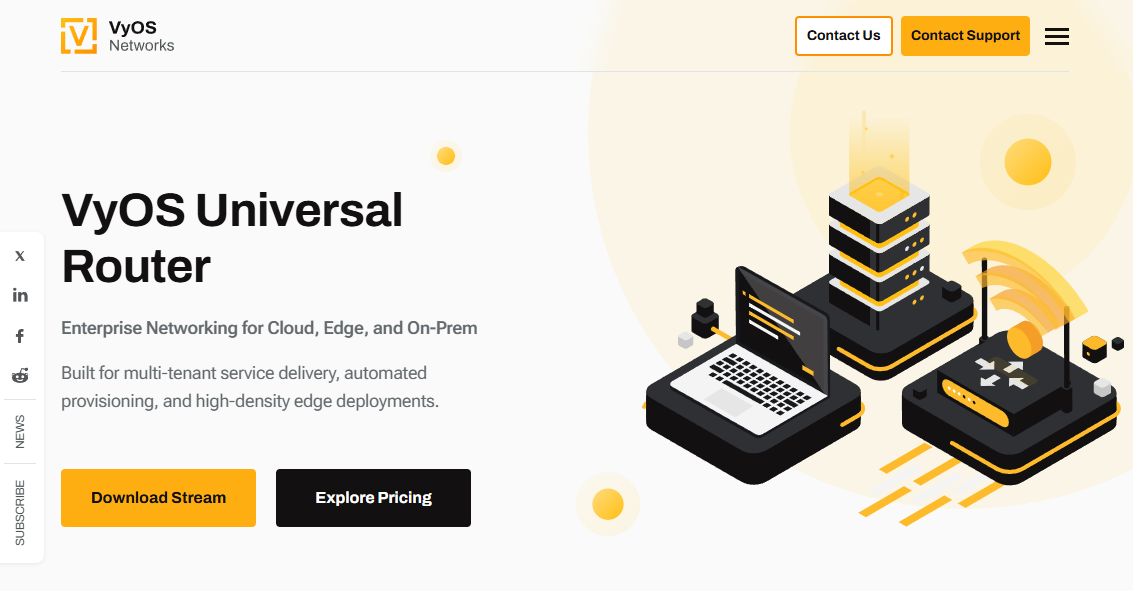
VyOS Universal Router is a software-based network operating system for routing, firewalling, VPN, QoS, and network automation. It runs on bare-metal servers, hypervisors, public cloud instances, and edge platforms, making it one of the more portable options in this list. Teams use it to standardize network patterns across product environments without anchoring the architecture to a proprietary appliance family. For cloud migration projects or multi-cloud deployments, VyOS's API-first configuration model supports Terraform, Ansible, and cloud-init workflows out of the box.
Best for: MSPs, CSPs, ISPs, and enterprises that need broad protocol support with automation-friendly configuration across cloud, VM, and bare-metal environments.
Key features
- BGP, OSPF, IS-IS, MPLS, EVPN-VXLAN, multicast, and RPKI validation
- IPsec and WireGuard VPN, firewall zones, NAT, CGNAT, and QoS
- Deployment on hypervisors, bare metal, and public cloud platforms
- Automation via Terraform, Ansible, REST/GraphQL APIs, and Netmiko
- High availability with VRRP, ECMP, and connection-state synchronization
Why choose VyOS: It fits teams that want routing control without proprietary appliance lock-in. The operational trade-off is that VyOS requires network engineering ownership for upgrades, configuration review, and incident response.
VyOS Universal Router pricing: Corporate plan starts at $10,000/year (annual) with discounts to $8,000/year on a five-year commitment. The Global plan covers multiple entities and starts at $16,000/year annually. An Alliance tier for IT service providers starts at $25,000/year. VyOS for Good provides free access for eligible educational, nonprofit, emergency-service, startup, and recycling organizations.
G2 rating: 4.5/5
2. Cisco Catalyst 8000V Edge
Cisco Catalyst 8000V Edge is a VM-form-factor cloud router built on IOS XE, Cisco's routing operating system used across its physical WAN portfolio. Cisco's product documentation confirms that Catalyst 8000V supports routing, SD-WAN, VPN, next-generation firewall capabilities, NAT, QoS, and application visibility in virtualized and cloud environments. For teams already running Cisco WAN infrastructure, deploying Catalyst 8000V extends existing operational patterns into cloud and virtualized deployments without retraining. A 30-day free trial is available through AWS and Azure marketplaces.
Best for: Organizations that have existing Cisco WAN or SD-WAN infrastructure and need to extend those policies into cloud and virtualized environments.
Key features
- Cisco IOS XE routing with BGP, OSPF, and policy-based routing
- Cisco Catalyst SD-WAN integration and Cloud OnRamp for multicloud
- IPsec VPN, DMVPN, FlexVPN, and GetVPN support
- NAT, QoS, application visibility, and WAN optimization
- Next-generation firewall and access control capabilities
Why choose Cisco Catalyst 8000V Edge: The strongest case is operational continuity. If your team already manages Cisco physical routers, adding Catalyst 8000V keeps the management toolchain, skillset, and governance model consistent.
Cisco Catalyst 8000V Edge pricing: Cisco uses subscription-based licensing for SD-WAN and routing, with pricing by feature package, throughput tier, and term length (3-year, 5-year, or 7-year options). Numeric prices require a quote from Cisco or a reseller. A 30-day trial is available through cloud marketplaces.
G2 rating: 4.7/5
3. Juniper vMX
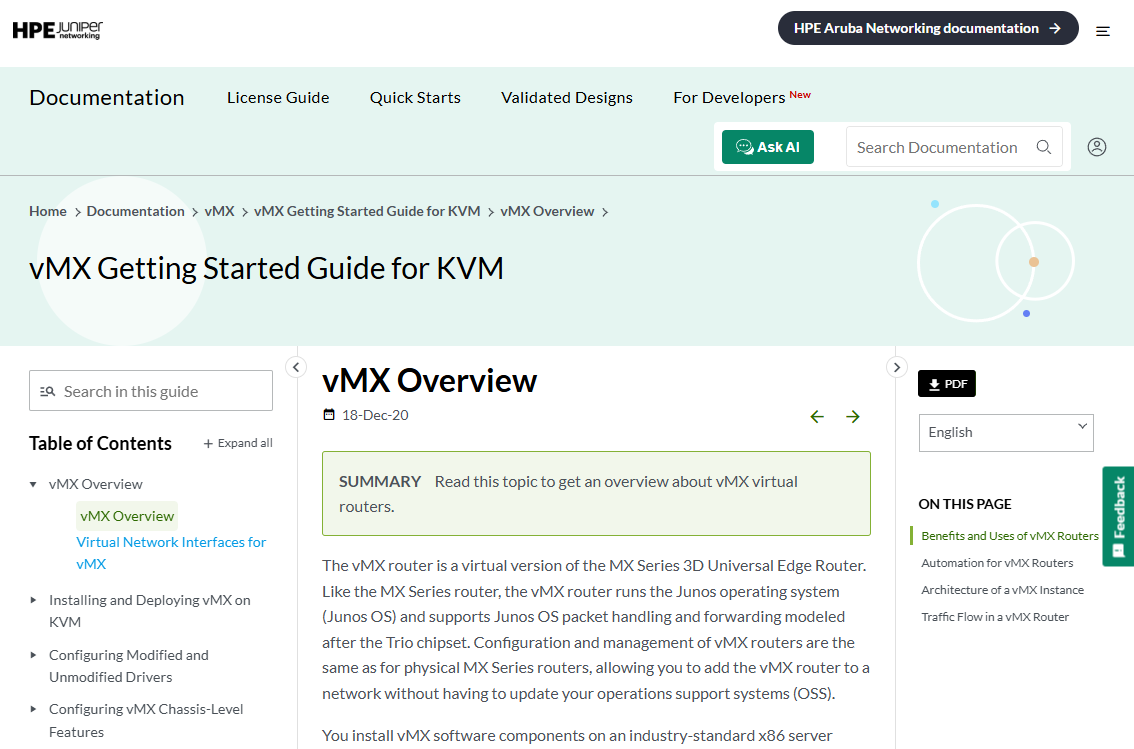
Juniper vMX is Juniper's virtualized MX Series router, running the same Junos OS that powers physical MX routers used by major service providers. It covers advanced IPv4/IPv6 routing, Layer 3 VPN, multicast, QoS, and broadband network gateway capabilities including PPPoE, DHCPv4/v6, and RADIUS subscriber interfaces. Deployment targets include x86 servers, AWS, AWS GovCloud, and Azure. For teams needing Junos automation, vMX supports NETCONF, REST APIs, OpenConfig/YANG, gRPC, and Python scripting. A free 60-day trial is available for current Juniper customers.
Best for: Service providers, cloud operators, and large enterprises that need carrier-grade routing depth and Junos consistency in virtual form.
Key features
- Advanced BGP, MPLS, Layer 3 VPN, and multicast routing
- Broadband gateway: L2TP/LNS, PPPoE, DHCPv4/v6, and RADIUS subscriber interfaces
- Deployment on x86 servers, AWS, AWS GovCloud, and Azure
- Junos automation via NETCONF, gRPC, OpenConfig/YANG, and Python
- Virtualized control and forwarding planes on commodity hardware
Why choose Juniper vMX: Choose it when routing scale, BGP policy depth, MPLS, and carrier-grade architecture are the core requirements. It is likely excessive for a small SaaS team that only needs a VPN gateway or basic cloud connectivity.
Juniper vMX pricing: Pricing uses bandwidth-based perpetual license SKUs and supports BYOL or usage-based AWS Marketplace licensing. Contact Juniper sales for a quote. A 60-day free trial is available for existing Juniper customers.
4. Juniper vSRX Virtual Firewall
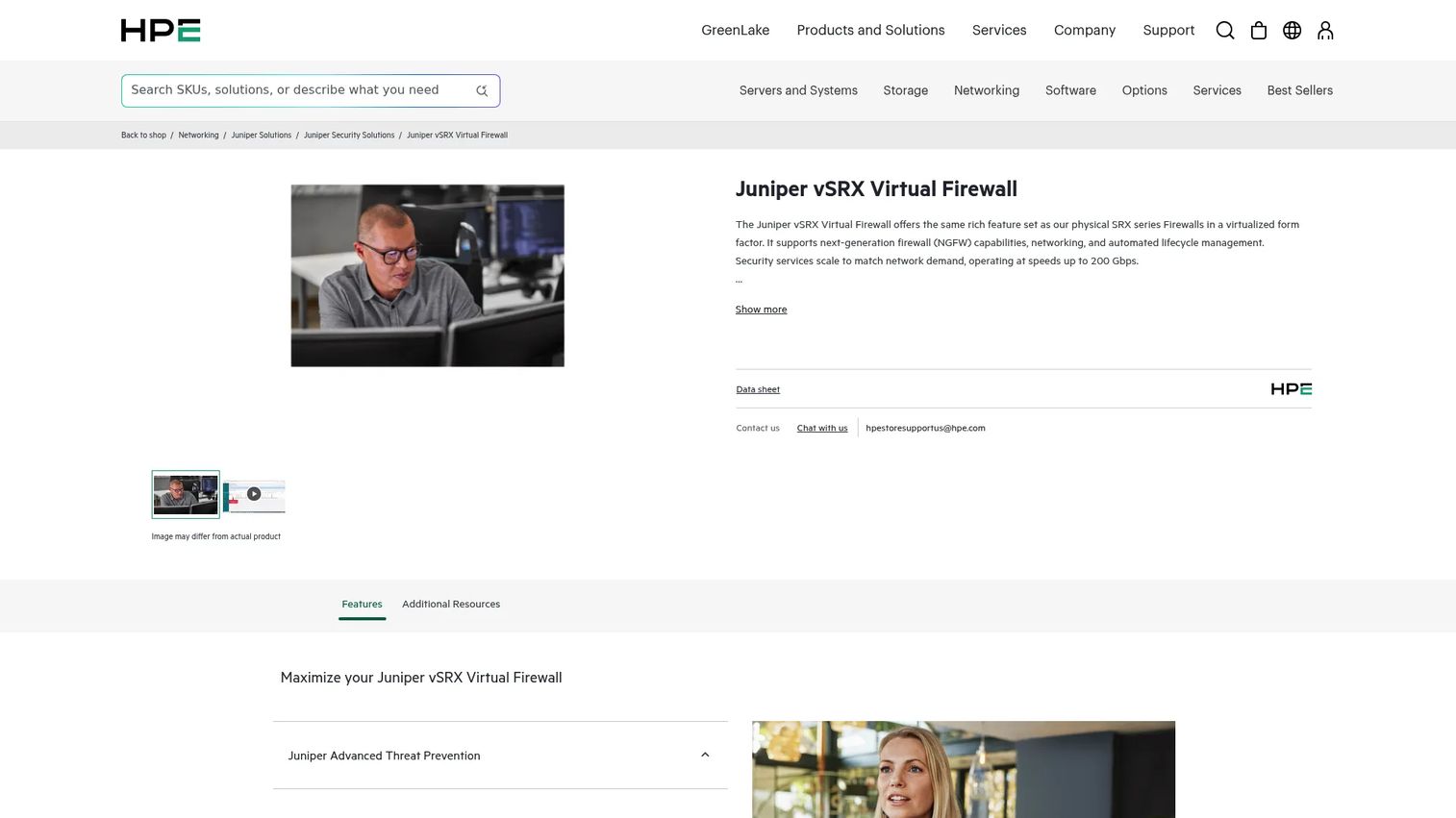
Juniper vSRX Virtual Firewall is Juniper's virtual next-generation firewall that combines routing, VPN, and cloud workload protection under the Junos OS. Juniper describes vSRX as delivering NGFW capabilities, routing, automated lifecycle management, and support across public and private cloud deployments. It scales to up to 200 Gbps firewall performance and deploys on VMware ESXi, NSX, KVM, OpenStack, AWS, Azure, and Google Cloud. For product teams navigating security reviews, vSRX's consistent SRX feature set across physical and virtual environments simplifies policy audits.
Best for: Security and cloud networking teams that need routing controls embedded within a broader firewall and policy-management workflow.
Key features
- NGFW with IPS, AppSecure, user identity services, and RBAC
- IPsec and SSL VPN, NAT, and routing
- Content security: Antivirus, antispam, web filtering, and content filtering
- VMware ESXi, NSX, KVM, OpenStack, AWS, Azure, and Google Cloud support
- EVPN-VXLAN security and up to 200 Gbps firewall performance
Why choose Juniper vSRX: Position it for organizations that want consistent SRX capabilities across physical and virtual infrastructure. The decision driver is security policy and workload protection, not routing depth alone.
Juniper vSRX Virtual Firewall pricing: Juniper documents subscription-based licensing with multiple vCPU sizes and terms. Numeric prices are not shown on Juniper's pages and require a sales quote. Core count, feature bundle, and support tier affect cost.
G2 rating: 4.5/5
5. FortiGate-VM
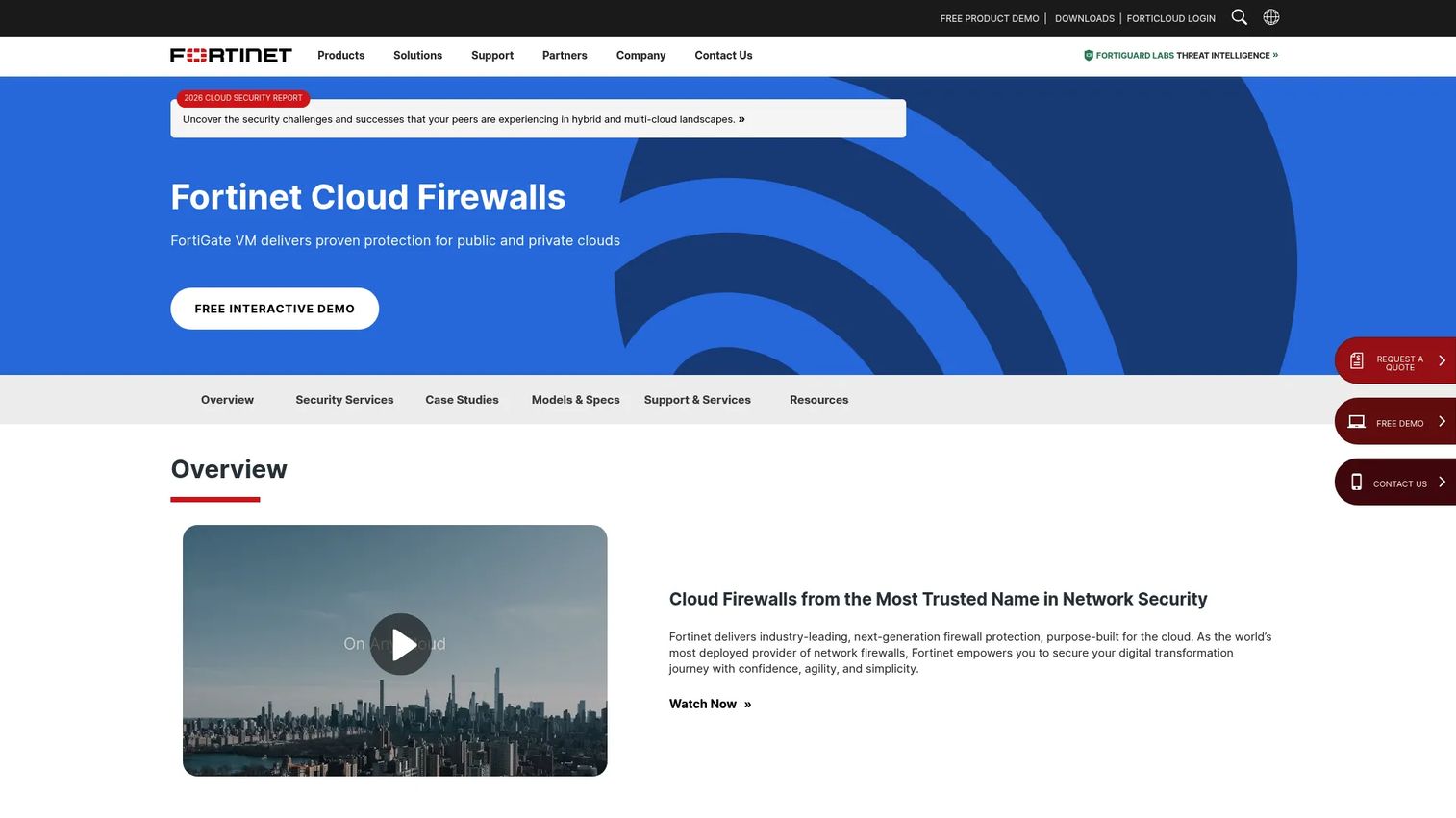
FortiGate-VM is Fortinet's virtual next-generation firewall, combining routing, SD-WAN, VPN, and firewall policies in one virtual appliance. It deploys across major public clouds and supported hypervisors, and Fortinet's vSPU technology accelerates virtual firewall performance. Centralized management runs through FortiManager, and automation support includes REST API, JSON-RPC, and zero-touch provisioning. For mid-market and enterprise teams that want routing and security controls under a single management pane, FortiGate-VM consolidates what would otherwise require two separate products.
Best for: Mid-market and enterprise teams that need routing and security controls in one virtual appliance across data centers and cloud environments.
Key features
- NGFW with IPS, application control, antivirus, and URL/DNS filtering
- SD-WAN traffic controls with SLA-based path selection
- IPsec VPN and dynamic routing support
- Cloud-agnostic deployment via BYOL and marketplace licensing
- FortiManager centralized management with API and zero-touch provisioning
Why choose FortiGate-VM: It works well when the architecture calls for routing and inspection in the same control plane. Ask whether security licensing, throughput requirements, and operations fit the company's cloud growth trajectory before committing.
FortiGate-VM pricing: Fortinet offers perpetual, annual subscription, BYOL, and marketplace-based licensing. Numeric prices are not shown on Fortinet's product pages and require a quote. Throughput tier, feature bundle, and support SLA all affect cost.
G2 rating: 4.6/5
6. Palo Alto Networks VM-Series
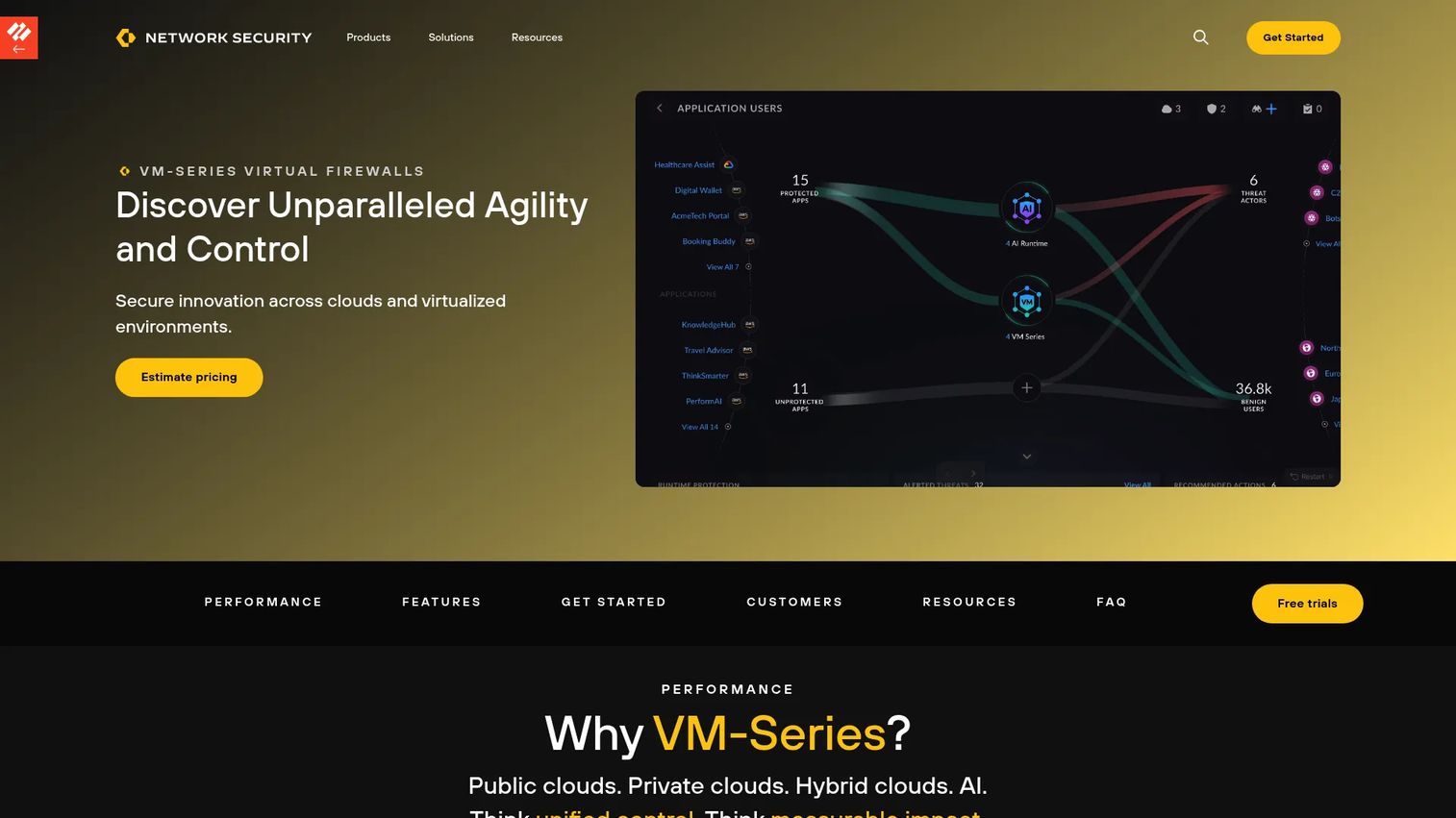
Palo Alto Networks VM-Series is a virtualized next-generation firewall that delivers security and routing functionality across cloud and on-premises virtual environments. Layer 7 inspection, centralized security management, and Terraform integration make it a fit for organizations standardizing policy enforcement across hybrid infrastructure. Licensing runs on Palo Alto's Software NGFW Credits model, with BYOL and pay-as-you-go options through cloud marketplaces. For teams where cloud network security is the primary driver, VM-Series fits inside a broader zero-trust or firewall-policy architecture.
Best for: Enterprise security teams that prioritize standardized firewall policy enforcement and advanced inspection across hybrid infrastructure.
Key features
- Layer 7 inspection and workload protection
- Dynamic routing and static routes
- VPN and NAT capabilities
- Cloud workload segmentation across hybrid environments
- Automated multicloud security with Terraform integration
Why choose Palo Alto Networks VM-Series: Choose it when cloud security architecture drives the project and routing lives within a larger policy framework. Total cost typically includes the appliance plus security subscriptions, support, and compute, so involve finance and cloud operations early.
Palo Alto Networks VM-Series pricing: Palo Alto uses Software NGFW Credits for licensing. An online estimator is available, but formal quotes require contacting sales. Pricing varies by model, throughput, and security subscription requirements.
G2 rating: 4.3/5
7. Nokia Virtualized Service Router
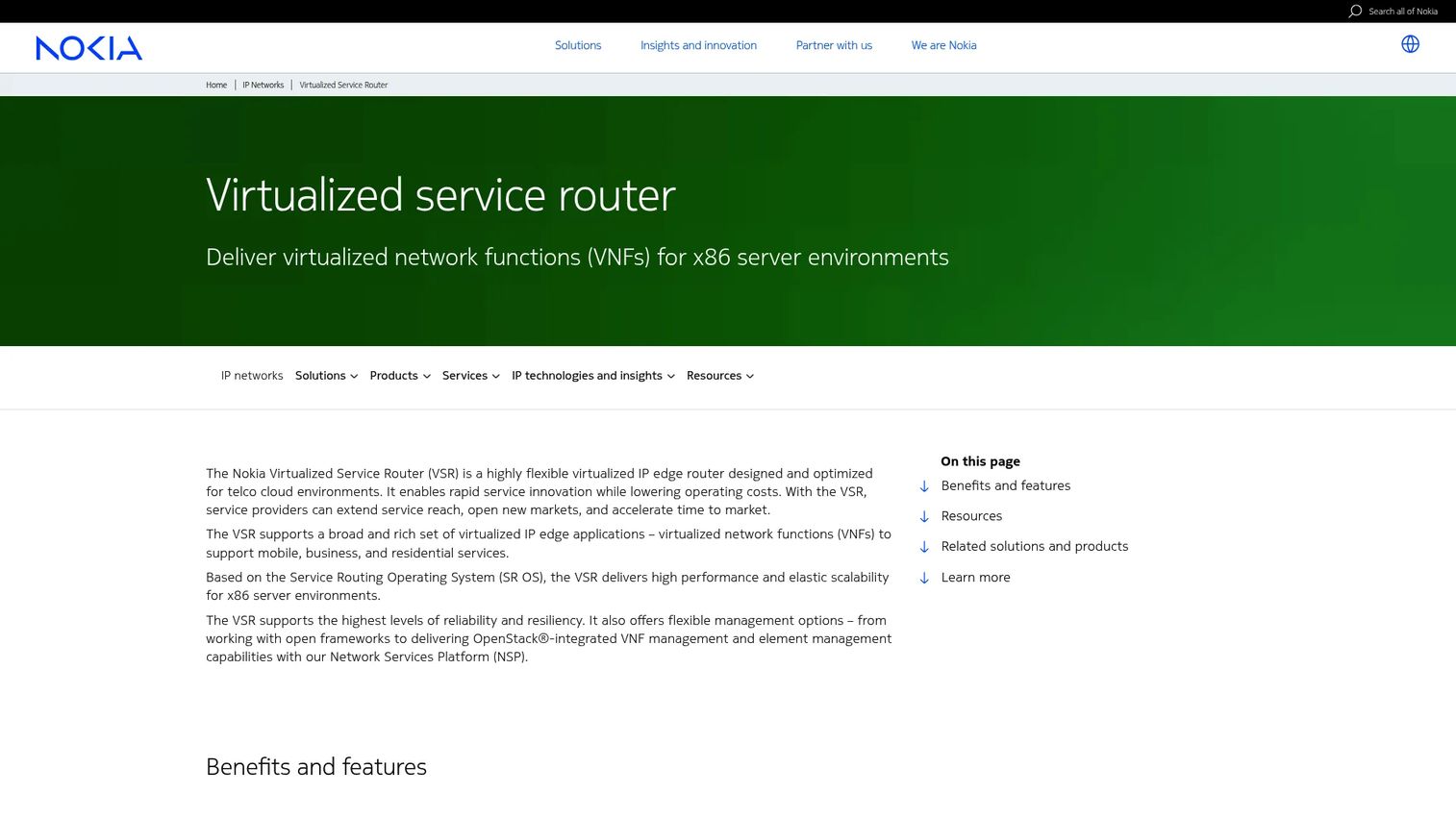
Nokia Virtualized Service Router brings Nokia's SR OS-based routing stack to x86 server deployments and telco cloud environments. It supports IP/MPLS edge services for business, residential, and mobile applications, with elastic scaling of processing and memory resources. Multi-node resiliency uses MC-LAG, synchronized NAT/BNG sessions, and stateful IPsec redundancy. Management integrates with Nokia NSP and open frameworks including OpenStack-integrated VNF management. Service providers and large-scale managed-network operators are the intended audience, not general-purpose enterprise teams.
Best for: Telecom, managed service, and cloud-provider networking teams that need service-router capabilities in virtualized NFV infrastructure.
Key features
- IP/MPLS edge services for business, residential, and mobile applications
- High-performance packet processing using multi-core SMP
- Elastic scaling of processing and memory resources
- Multi-node resiliency: MC-LAG, synchronized NAT/BNG, and stateful IPsec
- Nokia NSP integration with OpenStack-compatible VNF management
Why choose Nokia Virtualized Service Router: The key question is whether your product or managed network requires carrier-grade routing controls and multi-tenant service delivery at scale. It is not a lightweight option for a team that only needs a VPN gateway or basic cloud connectivity.
Nokia Virtualized Service Router pricing: Contact Nokia sales for a quote. Pricing is not shown on Nokia's product pages. Licensing varies by throughput, feature set, and service capacity.
8. Versa FlexVNF
Versa FlexVNF is a multi-tenant edge networking and security platform for SD-WAN, routing, and branch services. It combines carrier-grade routing (BGP, OSPF, MP-BGP, ECMP, and BFD) with integrated security services including NGFW, IPS, antivirus, URL filtering, and IPsec VPN. QoS traffic classification and service chaining for third-party VNFs are also supported. Centralized policy orchestration covers distributed branches, virtual CPE deployments, and SASE programs. For teams evaluating cloud compliance tools alongside WAN modernization, Versa's integrated security posture is worth examining in parallel.
Best for: Distributed enterprises and service providers that need application-aware SD-WAN, converged edge security, and centralized policy management.
Key features
- SD-WAN with application-aware steering and SLA-based path selection
- BGP, OSPF, MP-BGP, ECMP, and BFD routing support
- Integrated NGFW, IPS, antivirus, URL filtering, and IPsec VPN
- QoS traffic classification, rate limiting, and shaping
- Service chaining with third-party VNF support
Why choose Versa FlexVNF: It fits companies with distributed branches, hybrid WAN environments, and SASE programs. Evaluate it alongside operating-model questions: Who owns policy changes, how branch updates deploy, and what telemetry feeds the operations team.
Versa FlexVNF pricing: Contact Versa sales for a quote. No pricing is shown on Versa's product pages.
9. 6WIND Virtual Service Router
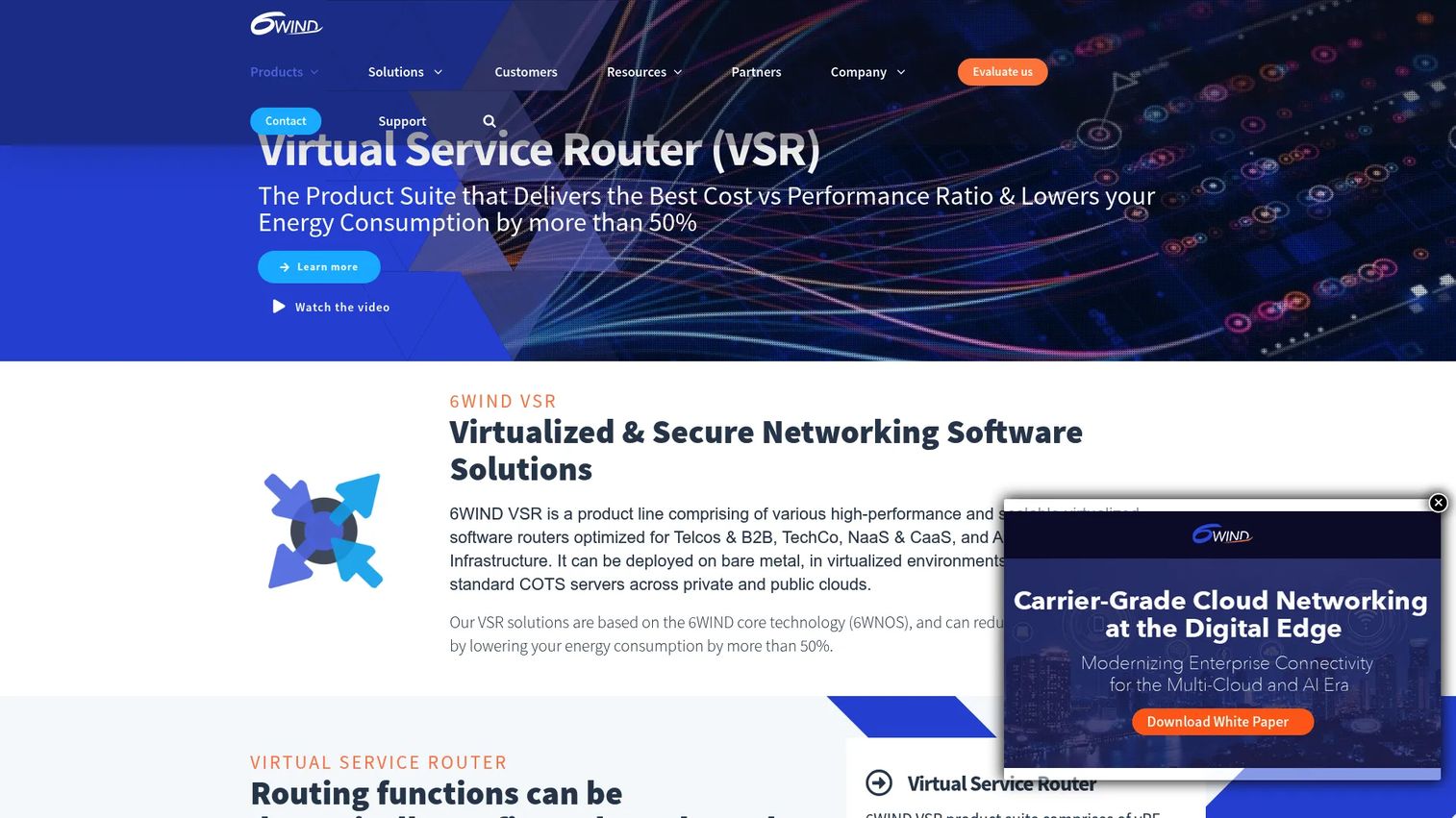
6WIND Virtual Service Router is a high-performance software router product suite for service providers, enterprises, and AI infrastructure operators. It supports routing, security, VPN, firewall, CGNAT, broadband, and edge-router use cases on bare-metal, virtualized, and containerized deployments using commodity x86 servers and public or private clouds. 6WIND's differentiation is in throughput efficiency on standard hardware, which matters for NFV operators who need to maximize packets-per-second without proprietary silicon. A 30-day evaluation is available through a registration portal on the 6WIND site. For teams evaluating cloud data security software as part of a broader infrastructure overhaul, 6WIND's VPN and firewall capabilities are part of the same evaluation conversation.
Best for: Communication service providers, network-as-a-service operators, and enterprises that need high-throughput software routing on commodity or white-box hardware.
Key features
- High-performance software routing, security, VPN, and CGNAT
- BGP, OSPF, and MPLS support across routing use cases
- Bare-metal, virtualized, and containerized deployment
- White-box and commodity x86 hardware compatibility
- 30-day evaluation available via registration portal
Why choose 6WIND Virtual Service Router: The decision hinges on whether disaggregated infrastructure and throughput control justify the specialized network operations work. It is most relevant for operators who want to own the hardware layer, not teams looking for a managed cloud router.
6WIND Virtual Service Router pricing: Contact 6WIND for a quote. Pricing varies by product, throughput tier, application capacity, and configured capabilities.
Considerations when choosing virtual routers
Routing protocol and policy requirements
Verify which protocols your network actually needs before evaluating products. Static routes cover simple topologies. As the network grows to span multiple cloud regions, branches, or tenants, BGP, OSPF, ECMP, route policy, MPLS, and route leaking become relevant. Ask your network engineering team to specify the protocol requirements before the product shortlist narrows.
Security architecture and segmentation
Decide whether routing and security belong in separate services or should come from one virtual appliance. This determines whether a routing-first product or a virtual firewall is the right starting point. Check requirements for firewall inspection, NAT, VPN, threat prevention, and overlapping address spaces. Product managers should also ask who owns policy changes and how security review timelines affect release cadence.
Deployment model and performance
Compare VM, container, bare-metal, white-box, marketplace, and NFV deployment models against your cloud provider requirements. Check CPU, memory, NIC acceleration, throughput, session count, and high-availability design for the intended feature set including encryption, logging, and routing convergence together. Theoretical throughput numbers rarely reflect production performance under full feature load.
Management, automation, and observability
Evaluate APIs, configuration-as-code support, centralized management, telemetry, route visibility, change approval, backup, and rollback against your team's release cadence. For cloud cost optimization efforts, operational overhead is often a larger ongoing cost than the license itself. Tools with poor observability create engineering toil that competes with feature work.
Licensing and total production cost
Separate entry-level pricing from what you'll actually pay in production. Virtual router cost typically changes with throughput tier, virtual core count, advanced security subscriptions, support SLA, and HA requirements. Cloud marketplace consumption charges add another variable. Build the full production scenario before comparing headline prices across vendors.
Conclusion
The right virtual router depends on the operating model you need to support, not on the fact that it runs virtually.
VyOS Universal Router suits teams that want routing control with automation-first configuration and no appliance lock-in. Cisco Catalyst 8000V Edge is the lower-risk choice for established Cisco WAN environments. Juniper vMX belongs on the shortlist for carrier-grade routing depth and BGP scale.
For security-led architectures, Juniper vSRX, FortiGate-VM, and Palo Alto Networks VM-Series each combine routing with firewall controls, with different licensing models and cloud coverage to weigh. Nokia Virtualized Service Router and 6WIND Virtual Service Router serve specialized telco and high-performance NFV deployments. Versa FlexVNF addresses SD-WAN programs with converged edge security.
Map each product to your routing model, security posture, cloud deployment plan, and operational ownership before comparing license prices. The platform that costs more upfront often costs less when engineering maintenance, support incidents, and missed release cycles are accounted for.
Start your journey with Guideflow today!
FAQs
A virtual router is software that routes traffic between IP networks without requiring a dedicated hardware router. It runs on a VM, server, cloud instance, container platform, or NFV environment, maintaining routing tables and forwarding packets using compute resources rather than purpose-built silicon.
A virtual router focuses on Layer 3 forwarding and routing protocols like BGP and OSPF. A virtual firewall typically includes routing but adds policy enforcement, inspection, NAT, VPN, and threat prevention capabilities. Several products in this list bundle both, making the distinction a matter of which function leads the architecture decision.
Yes, depending on the product. BGP is commonly used for cloud routing, WAN connectivity, and multi-network peering. OSPF appears frequently in internal enterprise routing domains. Products like VyOS, Juniper vMX, and Versa FlexVNF support both protocols. Security-first products like FortiGate-VM and Palo Alto Networks VM-Series also support dynamic routing, though it sits alongside firewall capabilities rather than leading the feature set.
Yes, when sized, licensed, monitored, and deployed with redundancy appropriate to the workload. Production readiness depends on throughput, encryption performance, routing convergence time, high-availability design, and who owns operational response when something fails. The virtual router market reached $407.65 million in 2025, according to Research and Markets, reflecting broad enterprise and provider adoption.
Common patterns include IPsec VPN tunnels, SD-WAN overlays, cloud marketplace images, transit routing, and BGP-based hybrid connectivity. The best approach depends on cloud provider, existing network stack, latency requirements, and security controls. Most products in this list deploy directly from cloud marketplaces for AWS, Azure, or Google Cloud.
They can replace or supplement hardware routers in cloud, hybrid, multi-tenant, and NFV scenarios. Hardware routers still make sense for environments that need dedicated physical interfaces, fixed-site deployments, or appliance-based performance guarantees at the edge. The Linux Foundation reported in 2025 that 73% of organizations have workloads on cloud-native networking, suggesting virtual and hardware deployments commonly coexist.
Four questions worth bringing to engineering and security: Which customer or operational problem does this solve? Who owns configuration, upgrades, and incident response? What protocols, security controls, and cloud platforms are required? What is the full production cost including licenses, support, compute overhead, and observability tooling?
VRF-Lite creates separate routing tables on a device without requiring MPLS. It allows traffic isolation between tenants, environments, or business units on shared infrastructure. The design still requires careful planning around route leaking, security policies, and monitoring, because separating routing tables does not automatically separate security policies or observability pipelines.