

You added three new prescribers this quarter. Documentation still routes through you. Billing denials pile up because the general EHR you started with never understood a psychiatric progress note, a controlled-substance script, or a 90837 with an add-on code. Every workaround you built to make it fit is now a tax on everyone who joins.
That is the real cost of the wrong psychiatry software. Not the license fee. The founder-level intervention it demands to keep running.
The behavioral and mental health software market is projected to grow from USD 6.29 billion in 2024 to USD 34.71 billion by 2035, a 16.8% CAGR, according to Spherical Insights (2024). Growth that fast means the gap between a generic clinical platform and a purpose-built psychiatry EHR keeps widening. Specialty workflows, controlled-substance e-prescribing, measurement-based care, and behavioral health billing rules are not edge cases. They are the job.
This guide compares the strongest psychiatry software options for 2026, ranked for how well each one turns a growing practice into a repeatable operating system rather than a founder-dependent one.
What's inside
This is a buyer's guide for founders and operators choosing psychiatry EHR, EMR, and practice management software in 2026. Not a feature dump. A decision framework.
We selected and ranked the 8 tools below on four criteria that actually predict whether the software scales with you:
- Specialty workflow depth: psychiatry-specific charting, templates, and medication management, not a general EHR with a mental health label bolted on
- Billing and RCM: claims accuracy, coding support, and revenue cycle depth for behavioral health payer rules
- Telehealth and patient engagement: built-in psychiatry telehealth software, portal, scheduling, and intake
- Implementation and support: onboarding speed, and whether the practice runs without founder-level intervention
TL;DR
- Best for specialty charting depth: ICANotes, built around menu-driven psychiatric documentation and controlled-substance workflows.
- Best psychiatry-specific all-in-one: Psychiatry-Cloud, purpose-built EHR plus practice management with managed billing.
- Best for simplified, integrated operations: RXNT, one cloud suite covering EHR, e-prescribing, billing, and scheduling.
- Best for measurement-based behavioral health care: Valant, outcomes tracking baked into the clinical workflow.
- Best for larger or multi-site groups: NextGen Healthcare and eClinicalWorks, broader platforms with enterprise RCM and interoperability.
- Best for smaller therapy-forward practices: TheraNest, a lighter operational stack with transparent entry pricing.
What psychiatry software is
Psychiatry software is specialty EHR and EMR software built for behavioral health workflows: psychiatric documentation, medication management, scheduling, billing, telehealth, patient engagement, and compliance. It differs from a general-purpose EHR by encoding how psychiatrists actually work, from mental status exams to controlled-substance e-prescribing.
A general EHR treats a psychiatric visit like any other encounter. A psychiatry EHR knows the visit is different.
Core capabilities most buyers evaluate:
- Specialty documentation: psychiatric intake, progress notes, mental status exams, and templates that match how clinicians chart
- **Medication management:** e-prescribing with EPCS for controlled substances and PDMP checks
- Behavioral health billing: coding support, claims, and revenue cycle management tuned to psychiatry and payer rules
- Scheduling and intake: recurring appointments, waitlists, and digital intake forms
- Telehealth: integrated video visits for psychiatry telehealth software workflows
- Patient engagement: secure portal, messaging, and appointment reminders
- Compliance: HIPAA-compliant psychiatry software with audit trails and access controls
Why specialty workflows matter: psychiatry runs on longitudinal medication history, controlled-substance rules, and time-based coding that a generic template set fights instead of supports. A psychiatric EMR built for the specialty removes the workarounds. That is the difference between software that documents care and software that slows it down.
When to use psychiatry software
Streamline psychiatric documentation
Documentation is where clinician time leaks. A psychiatrist re-typing the same mental status exam structure across a generic note is losing minutes per visit and hours per week. Purpose-built psychiatry EHR templates, quick charting, and increasingly AI-assisted scribing cut that drag. The operational win: more visits per clinician without more burnout, and notes that hold up to audit.
Manage medication and controlled-substance workflows
Psychiatry lives on medication management. That means e-prescribing with EPCS for controlled substances, PDMP integration, and a clean medication history across the patient's timeline. When this works, refills, dose adjustments, and interaction checks happen inside one flow. When it does not, you get faxes, phone tag, and compliance risk. Controlled-substance e-prescribing is not a nice-to-have in psychiatry. It is table stakes.
Run scheduling, billing, portal, and telehealth in one place
The scaling problem is fragmentation. A separate scheduler, a separate billing vendor, a bolt-on video tool, and a portal nobody logs into. Consolidating scheduling, psychiatry software for billing, patient portal, and telehealth into one platform is what lets a practice add clinicians without adding operational chaos. Fewer systems, fewer handoffs, fewer places for revenue to fall through.
Comparison table
Here is how the 8 tools compare on fit, primary use case, verified pricing, and rating. Pricing reflects each vendor's public information as of mid-2026; several psychiatry platforms use quote-based pricing, noted below.
| # | Product | Best for | Key use case | Pricing | G2 rating |
|---|---|---|---|---|---|
| 1 | Psychiatry-Cloud | Psychiatry-specific practice with managed billing | Specialty EHR plus RCM | Billing services from 2.9% of collections | Not listed |
| 2 | ICANotes | Specialty psychiatric charting | Menu-driven documentation and e-prescribing | From $35/mo; prescriber plans from $138/mo | Not listed |
| 3 | RXNT | Simplified all-in-one operations | Integrated EHR, e-prescribing, PM, billing | EHR from $118/mo; full suite $335/mo | 4.2/5 |
| 4 | PrognoCIS Psychiatry EHR | Customizable psychiatry workflows | Templates, telepsychiatry, billing | Quote-based | 4.1/5 |
| 5 | eClinicalWorks | Broader clinical platform fit | EHR, PM, and RCM at scale | EHR from $449/mo per provider | 3.7/5 |
| 6 | NextGen Healthcare | Larger, multi-site groups | Enterprise EHR, PM, interoperability | Quote-based | 3.7/5 |
| 7 | Valant | Measurement-based behavioral health | Outcomes tracking and documentation | Quote-based | Not listed |
| 8 | TheraNest | Smaller behavioral health practices | Practice management and scheduling | From $29/mo | 4.2/5 |
The pattern: specialized psychiatry vendors sit near the top for workflow fit, while broader platforms earn their place when scale and interoperability outweigh specialty depth.
Best psychiatry software for 2026
1. Psychiatry-Cloud
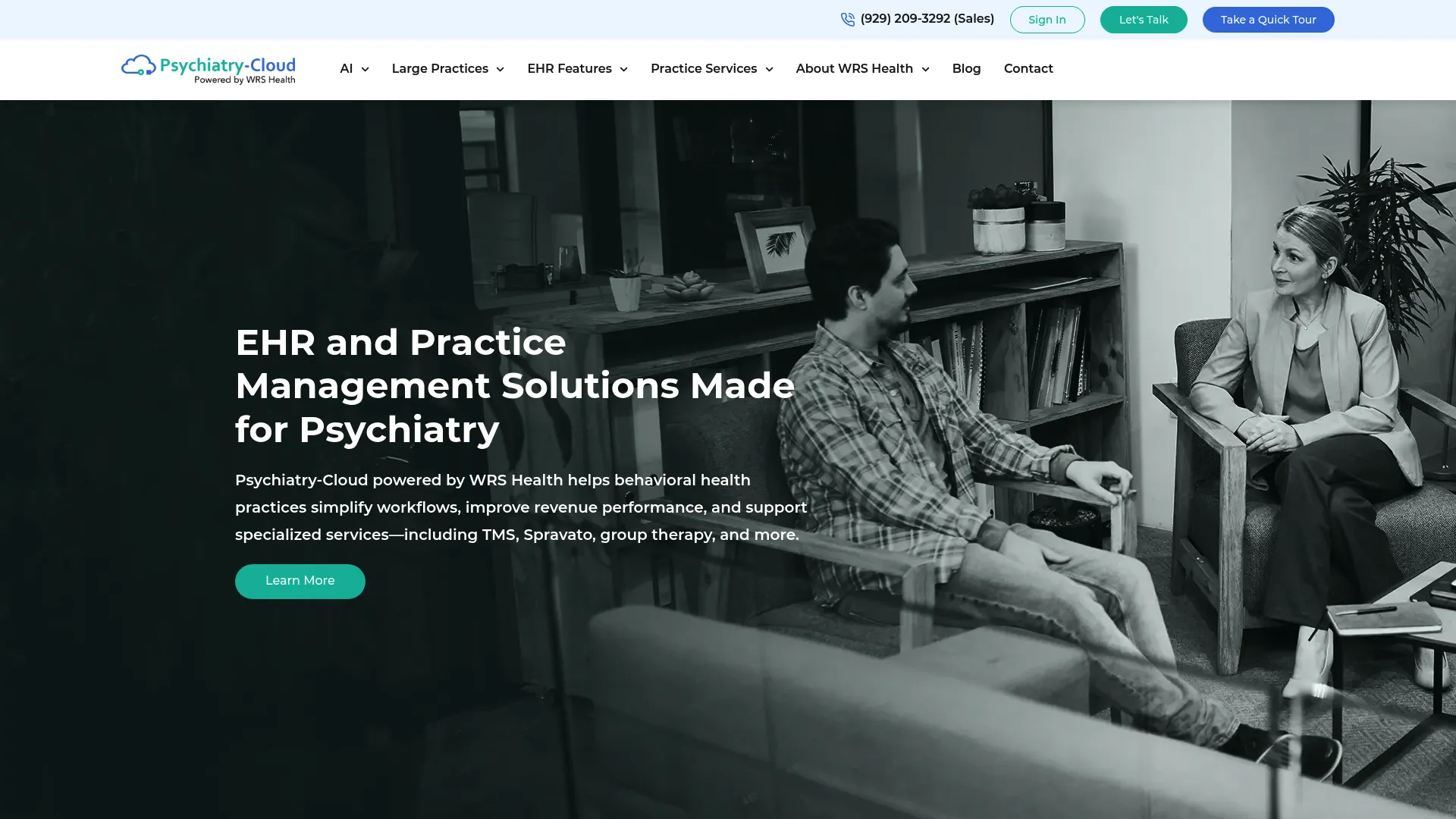
Psychiatry-Cloud is a psychiatry-focused EHR and practice management platform built specifically for behavioral health workflows. It pairs specialty templates and quick charting with medication management, telehealth, integrated billing, and a managed revenue cycle option, so a practice can run clinical and financial operations from one system rather than stitching vendors together.
Best for: Psychiatric and behavioral health practices that want a specialty-specific EHR with managed billing support baked in.
Key strengths
- Psychiatry-specific templates and quick charting
- Medication management and e-prescribing
- Telehealth with an ambient AI scribe
- Integrated billing and revenue cycle workflows
- Patient portal, scheduling, and intake
Why choose Psychiatry-Cloud: If you want the software to reflect psychiatric workflows out of the box and would rather offload billing to a managed service than staff an in-house RCM team, this fits. The managed billing model appeals to founders who want revenue handled without hiring for it.
Pricing: Psychiatry-Cloud publicly lists billing services starting at 2.9% of collections. Core EHR plan pricing is not published on the site and is provided on request.
2. ICANotes
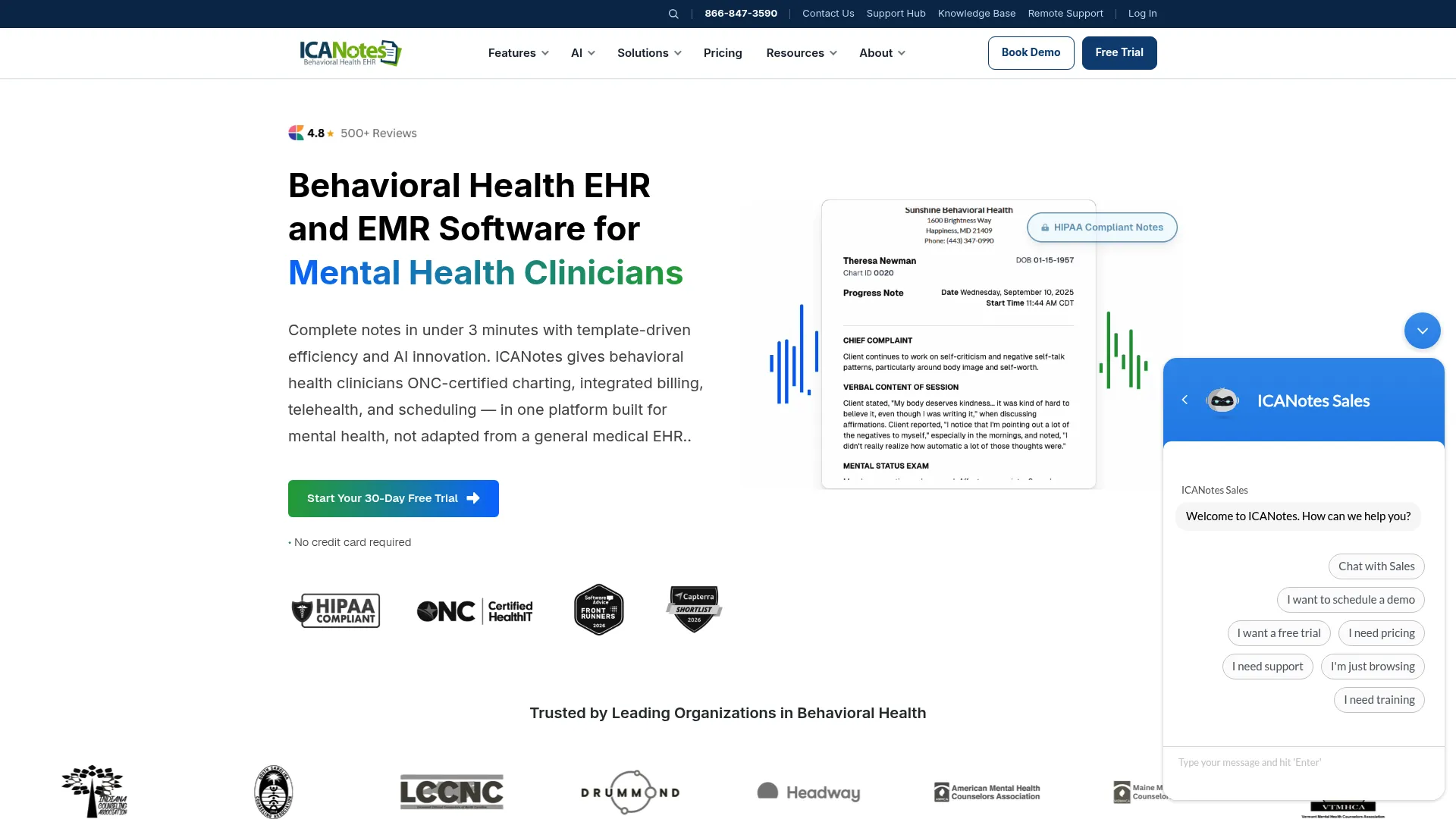
ICANotes is a behavioral health EHR and EMR built for mental health clinicians, and its signature is menu-driven charting that generates structured psychiatric narratives fast. It layers AI-powered documentation on top of telehealth, scheduling, billing, and a patient portal, making it a strong pick for teams that live in the note and need controlled-substance workflows.
Best for: Mental health practices that need deep specialty charting and structured psychiatric documentation as the core of the operation.
Key strengths
- Menu-driven charting and AI-powered documentation
- Integrated telehealth, scheduling, billing, and patient portal
- E-prescribing with EPCS and PDMP checks
Why choose ICANotes: This is the emr for psychiatrists who value documentation speed and structure above all. The menu-driven approach produces defensible, audit-ready notes without free-typing every field, which pays off across a growing prescriber roster.
Pricing: ICANotes+ lists monthly plans by role. Non-prescriber plans start at $35/month, and prescribing clinician plans start at $138/month plus a $99 activation fee. Additional non-clinical and intern users are priced separately, and telehealth is an optional add-on.
3. RXNT
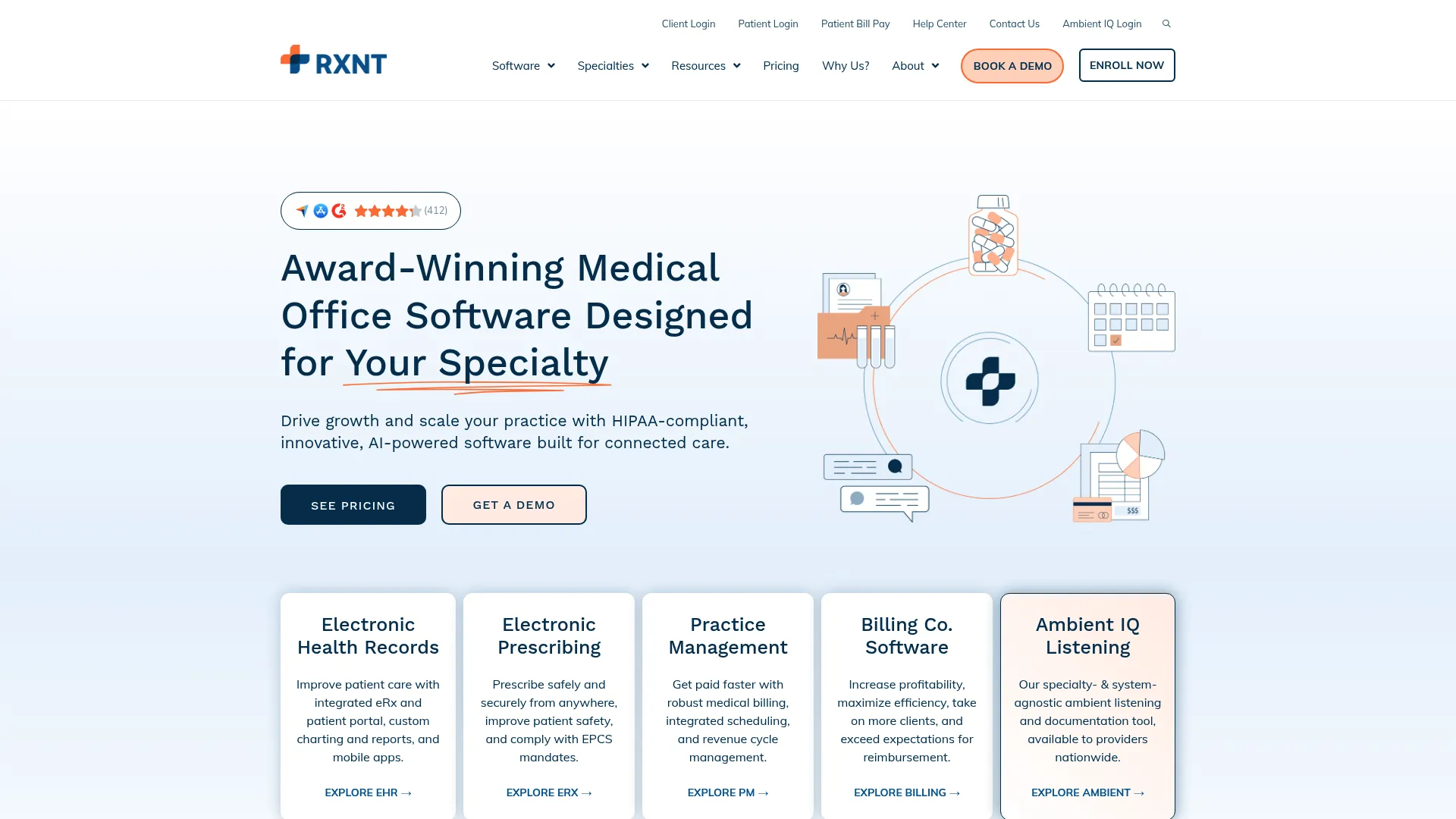
RXNT is a cloud-based healthcare suite that bundles EHR, e-prescribing, practice management, billing, scheduling, and a patient portal into one integrated system. For a psychiatry practice that wants fewer moving parts, RXNT's appeal is consolidation: one vendor, one login, free mobile apps, and 24/7 US-based support.
Best for: Growing practices that want a simplified, all-in-one platform instead of managing several point tools.
Key strengths
- Integrated EHR, e-prescribing, practice management, billing, scheduling, and patient portal
- Free iOS and Android mobile apps
- 24/7 cloud-based access and US-based support
Why choose RXNT: If your priority is operational simplicity and predictable, transparent pricing, RXNT reduces the surface area you have to manage. It is a practical psychiatry practice management software choice for teams that value integration over deep specialty customization.
Pricing: RXNT publishes public pricing. The EHR subscription starts at $118/month or $1,275/year, the PM bundle is $213/month, the EHR bundle is $126/month, and the full suite is $335/month. Standalone e-prescribing is $665/year. There is no free tier.
4. PrognoCIS Psychiatry EHR
PrognoCIS Psychiatry EHR is a cloud-based psychiatry and behavioral health EHR built around customizable templates, e-prescribing with controlled-substance support, a secure patient portal, and telepsychiatry. It targets practices that want specialty depth but also the flexibility to shape documentation and workflows to how they actually operate.
Best for: Behavioral health and psychiatry practices that need a customizable EHR with billing and patient engagement workflows.
Key strengths
- Customizable psychiatry templates
- E-prescribing including controlled substances (EPCS)
- Secure patient portal and telepsychiatry capabilities
Why choose PrognoCIS Psychiatry EHR: The pitch is balance. You get psychiatry-specific templates plus room to configure them, alongside integrated telepsychiatry and billing. That makes it a fit for practices that outgrew rigid systems but do not want to build everything from scratch.
Pricing: PrognoCIS does not publish pricing on its psychiatry EHR page. Pricing is quote-based, provided after a sales conversation.
5. eClinicalWorks
eClinicalWorks is a broad cloud EHR, practice management, patient engagement, and revenue cycle platform used across ambulatory care. For psychiatry, it is the comparison point when you are weighing a specialized behavioral health tool against a larger clinical platform that can absorb multiple specialties and scale.
Best for: Ambulatory and multi-specialty practices that want one integrated cloud EHR, PM, and RCM platform rather than a psychiatry-only tool.
Key strengths
- EHR and practice management
- Patient self-scheduling, check-in, telehealth, and secure messaging
- Revenue cycle management
Why choose eClinicalWorks: If your practice spans more than psychiatry, or you expect to, a broader platform can consolidate the whole organization. The tradeoff is that specialty psychiatry depth may require more configuration than a purpose-built psychiatric EMR.
Pricing: eClinicalWorks publishes public pricing with no start-up costs. EHR Only is $449/month per provider, EHR with Practice Management is $599/month per provider, and RCM as a Service runs 2.9% of practice collections.
6. NextGen Healthcare

NextGen Healthcare is an enterprise-grade healthcare platform offering integrated EHR, practice management, patient experience, revenue cycle, interoperability, and AI-assisted workflows. It is built for larger and more complex organizations that need broader healthcare infrastructure, not just a behavioral health EHR.
Best for: Larger ambulatory groups and multi-site behavioral health organizations that need enterprise EHR, PM, and interoperability.
Key strengths
- Integrated EHR and practice management platform
- Patient experience and engagement workflows
- AI-assisted clinical and workflow automation
Why choose NextGen Healthcare: When you are running multiple sites, complex payer mixes, and interoperability requirements, an enterprise platform earns its keep. NextGen fits groups that have scaled past what a single-specialty tool comfortably handles.
Pricing: NextGen does not publish public pricing. Access is routed through sales and demo flows, and pricing is quote-based.
7. Valant

Valant is a behavioral health EHR built for outpatient, IOP, and PHP practices, with a distinct emphasis on measurement-based care. It combines clinical documentation, e-prescribing, and telehealth with outcomes tracking, so clinicians can quantify progress rather than rely on narrative alone.
Best for: Behavioral health practices that want measurement-based care and outcomes tracking built into the clinical workflow.
Key strengths
- Clinical documentation
- E-prescribing
- Telehealth
Why choose Valant: If measurement-based care is a priority, whether for clinical quality or payer requirements, Valant makes outcomes a first-class part of documentation. That specialization sets it apart from general behavioral health EHR tools that treat measurement as an afterthought.
Pricing: Valant states pricing is customized and quote-based. No public numeric price is shown; a quote follows a sales conversation.
8. TheraNest

TheraNest is a cloud-based EHR and practice management platform for behavioral health providers, covering scheduling, notes, billing, a client portal, and telehealth. It leans lighter and more therapy-forward than heavy psychiatric systems, which makes it approachable for smaller practices that want a simpler operational stack.
Best for: Smaller behavioral health and therapy-forward practices that want EHR, billing, scheduling, and client portal workflows without heavy overhead.
Key strengths
- Practice management
- Appointment scheduling
- Client portal
Why choose TheraNest: For a small group that values transparent entry pricing and quick setup over deep psychiatric customization, TheraNest is a straightforward fit. Practices with heavy controlled-substance or complex prescribing needs should verify those specific workflows before committing.
Pricing: TheraNest offers three editions starting at $29/month for Essentials, $59/month for Advanced, and $89/month for Premier, per third-party listings. A free trial is available.
Considerations
Before you sign anything, pressure-test the software against how your practice actually runs. Here is the checklist that matters for a growing operation.
Documentation speed
Documentation is your clinicians' single biggest time sink. Test the note workflow with a real psychiatric encounter, not a demo script. Time how long a progress note and a mental status exam take. If AI-assisted or menu-driven charting is offered, confirm it produces audit-ready output, not fluff you have to rewrite.
Controlled-substance and medication workflows
For any prescribing practice, verify EPCS certification, PDMP integration, and how medication history carries across visits. Ask specifically how refills, dose changes, and interaction checks flow. Controlled-substance e-prescribing that adds clicks or falls outside the main flow will cost you every single day.
Billing and claims depth
Whether you run billing in-house or use managed RCM, look at behavioral health coding support, claim scrubbing, and denial handling. Psychiatry software for billing lives or dies on payer-rule accuracy. Ask for first-pass acceptance rates and how the system handles time-based codes and add-ons.
Telehealth and patient engagement
Confirm telehealth is native, not a bolted-on redirect, and that it is HIPAA-compliant psychiatry software end to end. Check the patient portal, intake forms, scheduling, and reminders. Low-friction engagement drives show rates, and show rates drive revenue.
Implementation, onboarding, and support
Ask for realistic go-live timelines, data migration scope, and what support looks like after launch. The goal is software that runs without founder-level intervention. If onboarding requires you personally for months, that is a scaling problem disguised as a setup problem.
Conclusion
The right psychiatry software depends on where your practice sits and where it is headed.
For specialty charting depth and structured psychiatric documentation, ICANotes leads. For a psychiatry-specific all-in-one with managed billing, Psychiatry-Cloud fits. If you want simplified, integrated operations with transparent pricing, RXNT is the pragmatic pick, and PrognoCIS Psychiatry EHR adds customization on top of specialty templates. For measurement-based behavioral health care, Valant stands out. When scale, multi-site complexity, or interoperability outweigh specialty depth, eClinicalWorks and NextGen Healthcare are the broader-platform options. And for smaller therapy-forward practices, TheraNest keeps the stack light.
Next step: narrow to two or three tools that match your practice size and workflow priorities, then schedule demos. Run each one through a real psychiatric encounter, a controlled-substance script, and a claim. The software that removes founder-level intervention, not just paperwork, is the one worth buying.
FAQs
Psychiatry software is specialty EHR and EMR software built for behavioral health workflows, including psychiatric documentation, medication management, scheduling, billing, telehealth, patient engagement, and compliance. Unlike generic clinical software, it encodes how psychiatrists actually work, from mental status exams to controlled-substance e-prescribing.
A general EHR treats a psychiatric visit like any other encounter, which forces workarounds for medication history, time-based coding, and structured psychiatric notes. A psychiatry EHR builds those workflows in, so charting, billing, and prescribing match specialty reality instead of fighting it. That difference compounds as you add clinicians.
Look for specialty documentation and templates, medication management with EPCS and PDMP checks, behavioral health billing and coding support, integrated telehealth, scheduling and intake, a patient portal, and HIPAA-compliant safeguards. The best emr for psychiatry ties these together in one flow rather than across bolted-on tools.
Most specialty psychiatry platforms support controlled-substance e-prescribing through EPCS certification and PDMP integration. Confirm it directly during evaluation, since prescribing is central to psychiatry. Test how refills, dose changes, and interaction checks flow inside the main documentation workflow, not as a separate step.
Start with documentation speed, medication management for psychiatry software for medication management needs, transparent pricing, and fast onboarding. Smaller practices benefit from an integrated system that avoids juggling separate scheduling, billing, and telehealth vendors. TheraNest and RXNT are common starting points for lighter stacks.
Billing depth is often the difference between a profitable practice and one leaking revenue to denials. Psychiatry billing software has to handle behavioral health payer rules, time-based codes, and add-ons accurately. Whether you run billing in-house or use managed RCM, ask for first-pass acceptance rates during your psychiatry software comparison.
Telehealth is now standard in most psychiatry EHR and EMR platforms, and demand for psychiatry telehealth software remains high. Verify it is native and HIPAA-compliant end to end, not a redirect to a third-party video tool. Native telehealth keeps documentation, scheduling, and billing connected to the same patient record.
Ask to chart a real psychiatric encounter and time it, send a test controlled-substance script, and process a sample claim with a time-based code. Push on data migration, go-live timeline, and post-launch support. Reading psychiatry software reviews helps, but a hands-on demo against your actual workflow tells you far more than any feature list.