You pulled the CMDB last week. It said 1,200 servers. The cloud console says 1,640. Nobody knows which number to trust.
That gap is where security incidents hide, where license spend leaks, and where audits stall. Every asset you cannot see is one you cannot patch, cost, or govern.
The problem is not that teams do not care about inventory. It is that assets now live everywhere at once: on-prem racks, three cloud accounts, laptops in home offices, SaaS apps bought on a credit card, and OT and IoT devices that never phone home to IT. Manual spreadsheets cannot keep up with that churn.
The market reflects the pressure. The global asset discovery software market was valued at $3.2B in 2025 and is projected to reach $9.1B by 2034 at a 13.4% CAGR, according to MarketIntelo (2025). Cloud deployment already held 58.2% of that revenue in the same year.
Picking a tool is a technical decision, not a shopping trip. Discovery method, refresh cadence, and reconciliation quality decide whether your inventory becomes a single source of truth or another stale export.
What's inside
This guide is for IT admins, ITAM managers, security teams, and the presales and solutions engineers who evaluate these tools before a demo or RFP. We looked at where each tool fits, not which brand shouts loudest.
We ranked the 8 tools below against four criteria:
- Discovery coverage: how much of cloud, on-prem, endpoints, SaaS, and OT/IoT the tool actually sees
- Discovery method: agent-based, agentless, API-based, network scanning, or a mix
- Reconciliation and freshness: how often data refreshes and how cleanly it deduplicates
- Integrations: CMDB, ITSM, and security workflow handoff
TL;DR
- Best for multi-cloud CMDB operations: Cloudaware pairs deep cloud and hybrid discovery with a native CMDB, so reconciliation happens where your data already lives.
- Best for software discovery and license optimization: Flexera dominates software inventory, ITAM, and spend governance across large estates.
- Best for dependency mapping: Device42 does agentless hybrid discovery and application dependency mapping without touching endpoints.
- Best for ITSM-tied discovery: ServiceDesk Plus by ManageEngine feeds discovery straight into service desk and asset workflows.
- Best for security-first visibility: Armis Centrix covers unmanaged IT, OT, IoT, and IoMT assets for attack surface reduction.
- Best for SaaS discovery: Zluri surfaces shadow SaaS, app usage, and identity sprawl.
What is asset discovery software?
Asset discovery software is a tool that automatically identifies and catalogs the hardware and software assets running across your environment, then keeps that inventory current as things change.
It answers one question at scale: what do we actually have, and where? Instead of a hand-built spreadsheet, you get a live inventory that feeds CMDB discovery, security, and ITAM workflows.
Most IT asset discovery software uses one or more of these methods:
- Agent-based discovery: a lightweight agent runs on each device and reports detailed hardware, software, and usage data back to a central console. Deep visibility, especially for endpoint discovery.
- Agentless discovery: the tool queries devices remotely over protocols like SNMP, WMI, and SSH with no software installed on the target. Fast to roll out across servers and network gear.
- API-based discovery: the tool connects to cloud providers, SaaS platforms, and identity systems through their APIs to pull inventory directly. This is how modern SaaS discovery and hybrid environment discovery work.
- Network scanning: the tool sweeps IP ranges and subnets to find devices that respond, useful for catching anything unmanaged.
- Protocol-driven discovery: passive monitoring of network traffic to fingerprint devices that never announce themselves, common for OT and IoT visibility.
Core capabilities to expect from automated asset discovery:
- Continuous refresh so inventory reflects reality, not last quarter
- Asset reconciliation and deduplication across sources
- CMDB updates and drift detection
- Software inventory and version tracking
- Dependency mapping between apps and infrastructure
- ITSM integration for handoff to service and change workflows
When to use asset discovery software
Map assets across hybrid environments
You run workloads in AWS, a data center, and a stack of employee laptops. No single console shows all three. Hybrid environment discovery stitches cloud APIs, agentless server queries, and endpoint agents into one inventory. That is the difference between guessing your footprint and knowing it.
Reduce shadow IT and security blind spots
Every unknown device is an unpatched risk. Network scanning and passive discovery surface the printer, the rogue VM, and the IoT sensor nobody registered. Security teams use this to shrink the attack surface and feed vulnerability prioritization with real asset context.
Feed CMDB and ITAM workflows with current data
A CMDB is only as good as its freshness. Automated asset discovery pushes reconciled records into your CMDB and ITSM tools, so change management, incident response, and license optimization all run on data that matches production.
Comparison table
We sorted these tools by how directly they solve asset discovery for the target buyer, then weighed discovery breadth, method mix, and workflow handoff. Pricing and ratings below reflect each vendor's public pages and current G2 listings at the time of writing. Verify both before you commit, since vendors update tiers often.
| # | Product | Best for | Key differentiator | Pricing | G2 rating |
|---|---|---|---|---|---|
| 1 | Cloudaware | Multi-cloud and hybrid CMDB operations | Native CMDB with cloud, cost, and security in one platform | From $200/month | 3.9/5 |
| 2 | Flexera | Software discovery and license optimization | Deep ITAM, SaaS management, and FinOps at enterprise scale | Custom pricing | 4.3/5 |
| 3 | Device42 | Agentless hybrid discovery and dependency mapping | Agentless discovery with application dependency mapping | Custom pricing | 4.7/5 |
| 4 | ServiceDesk Plus | ITSM-tied asset discovery | Discovery feeding an ITIL-aligned service desk | From $13/technician/month | 4.2/5 |
| 5 | SolarWinds | Hybrid IT operations and monitoring | Discovery inside observability and infrastructure monitoring | From $8/node/month | 4.3/5 |
| 6 | Ivanti | Endpoint-driven discovery and UEM | Unified endpoint management with AI automation | Custom pricing | 4.2/5 |
| 7 | Armis Centrix | Security-first IT/OT/IoT visibility | Agentless coverage of unmanaged and OT/IoT assets | Custom pricing | 4.4/5 |
| 8 | Zluri | SaaS discovery and identity governance | SaaS and identity discovery with access controls | Custom pricing | 4.6/5 |
Best asset discovery software for 2026
1. Cloudaware
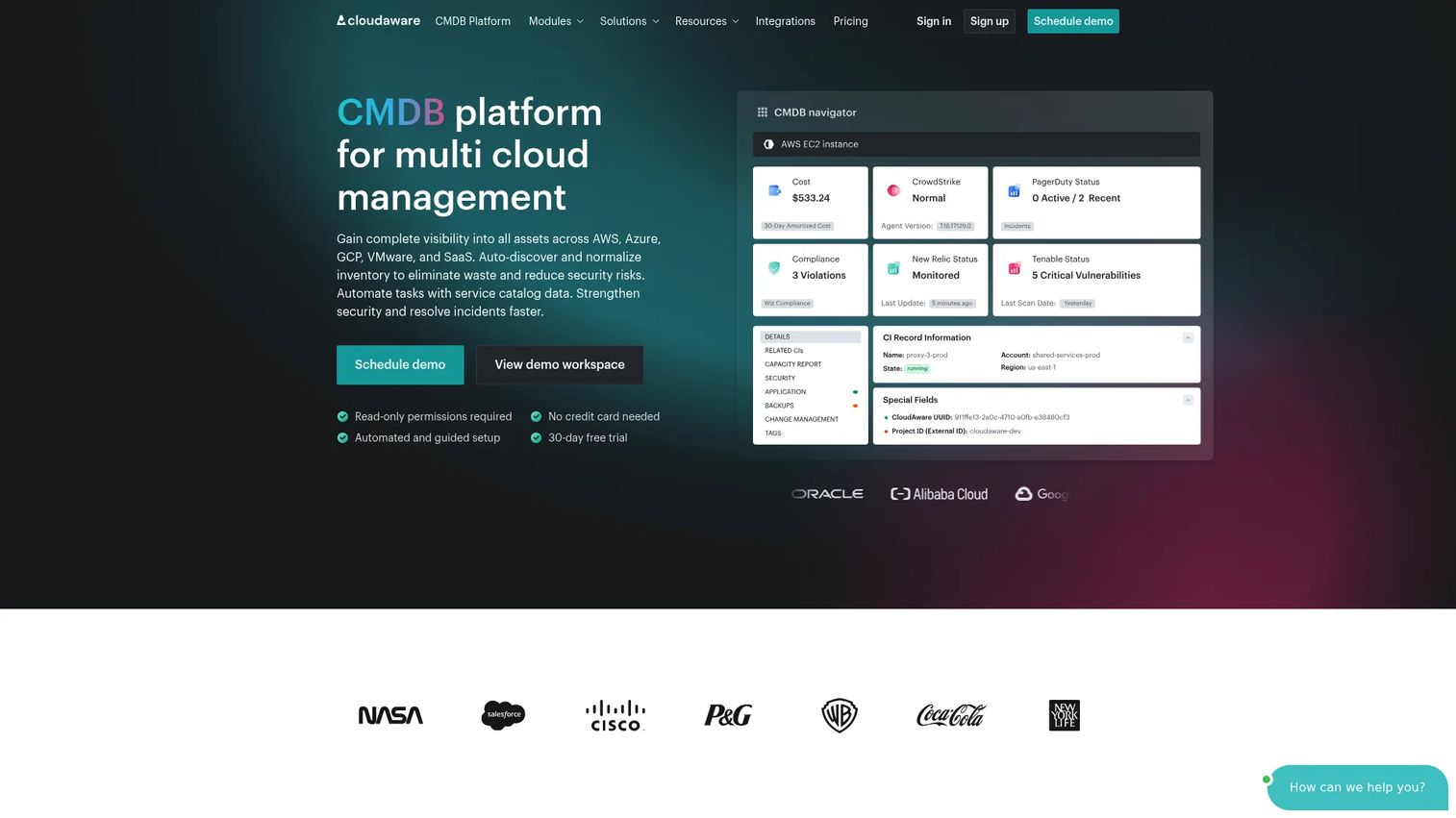
Cloudaware is a multi-cloud CMDB and cloud management platform that pulls inventory, cost, security, and compliance data into one place. Its API-based discovery reaches across AWS, Azure, Google Cloud, and on-prem infrastructure, then reconciles everything into a native CMDB. If your inventory problem is really a "cloud sprawl plus stale CMDB" problem, this is built for that.
The pitch for hybrid teams is reconciliation. Instead of exporting cloud data into a separate CMDB and hoping the mapping holds, Cloudaware makes the CMDB the operating layer. FinOps, vulnerability management, CSPM, and IT compliance all read from the same reconciled inventory.
Best for: enterprises running multi-cloud and hybrid infrastructure that want CMDB-led operations.
Key features
- CMDB with multi-cloud and on-prem visibility
- FinOps and cloud cost management
- Vulnerability management, CSPM, SIEM, and IT compliance
Why choose Cloudaware: pick it when the CMDB is the center of gravity and you want discovery, cost, and security reading from one reconciled source rather than three disconnected tools.
Cloudaware pricing: the public CMDB calculator starts at $200/month, covering up to 25,000 configuration items and estimates beginning at 50 servers. A 30-day free trial is available; other modules may be quoted separately.
Cloudaware holds a 3.9/5 rating on G2.
2. Flexera
Flexera is enterprise software for IT asset management, SaaS management, and FinOps. Where many tools stop at hardware inventory, Flexera goes deep on software discovery: what is installed, what is entitled, and what is actually used. That combination is why large estates lean on it for license optimization and audit defense.
Flexera turns software inventory into governance. It normalizes messy install data into recognized products and versions, then maps that against entitlements to expose over-licensing and compliance gaps. For teams facing a vendor audit or a bloated SaaS bill, that mapping is the whole point.
Best for: large enterprises that need visibility and control across hybrid IT spend and risk.
Key features
- IT asset management
- SaaS management
- FinOps and cloud cost optimization
Why choose Flexera: choose it when software licensing and spend governance matter as much as hardware inventory, and you have the estate size to justify an enterprise platform.
Flexera pricing: Flexera uses subscription pricing based on term length and usage metrics, quoted per customer rather than listed publicly. Contact their team for a scoped quote.
Flexera holds a 4.3/5 rating on G2.
3. Device42
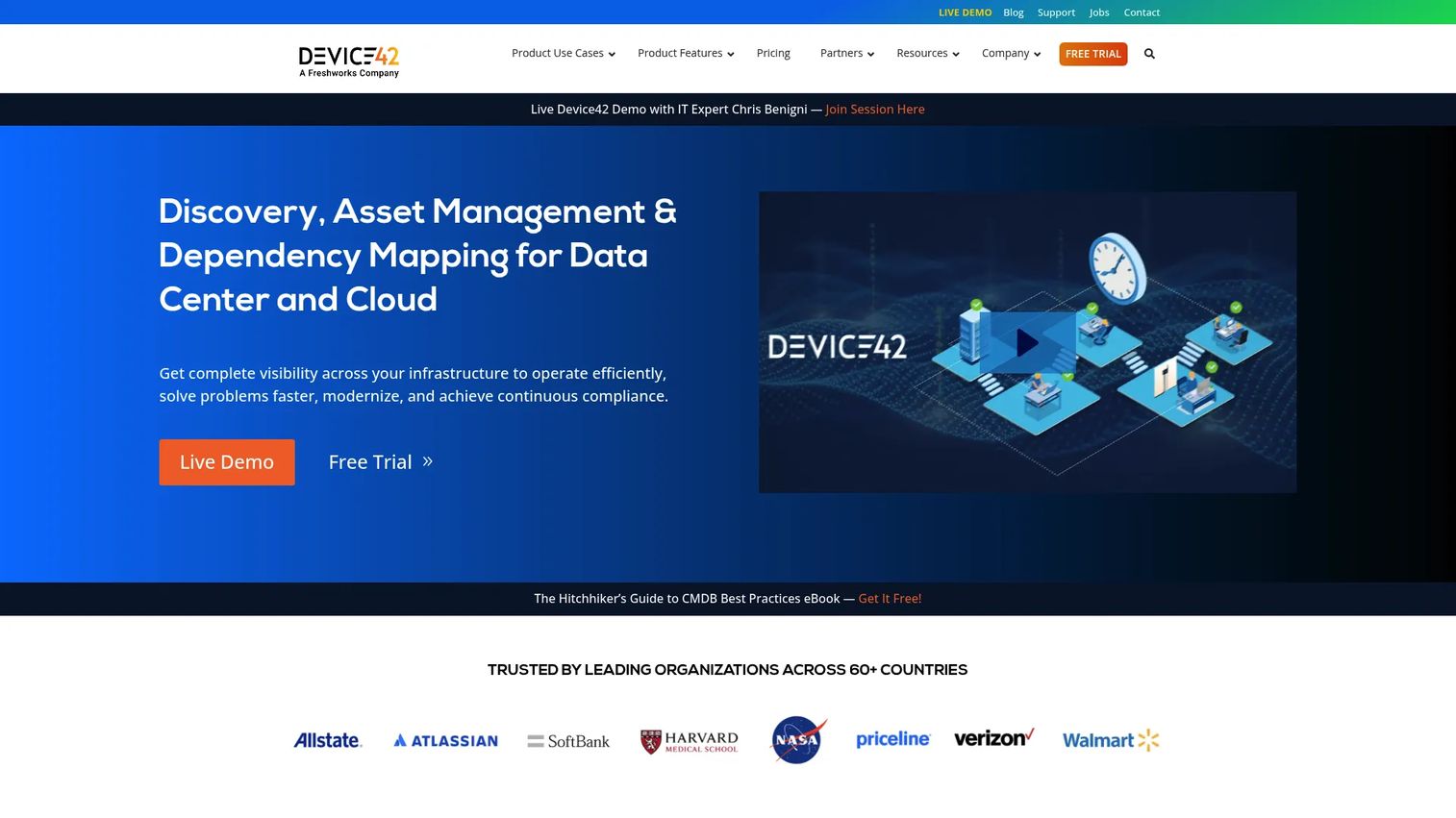
Device42 is agentless hybrid IT discovery, CMDB, and asset management software. It maps servers, network gear, and cloud resources without installing anything on the targets, then draws the dependencies between applications and the infrastructure underneath them. That dependency layer is what makes it useful for migrations and impact analysis.
Agentless discovery is the headline here. You point Device42 at your environment, it queries devices over standard protocols, and it builds an inventory plus a dependency map. For teams planning a data center move or cloud migration, seeing which apps depend on which hosts removes a lot of guesswork.
Best for: IT teams that need agentless discovery, CMDB, and asset visibility across hybrid environments.
Key features
- Agentless hybrid cloud discovery
- Application dependency mapping
- IT asset and software inventory management
Why choose Device42: reach for it when you want broad discovery without deploying endpoint agents, and dependency mapping is a first-class requirement rather than a nice-to-have.
Device42 pricing: Device42 uses an annual subscription model priced by the number of devices, quoted directly rather than posted publicly. A trial is available on request.
Device42 holds a 4.7/5 rating on G2.
4. ServiceDesk Plus by ManageEngine
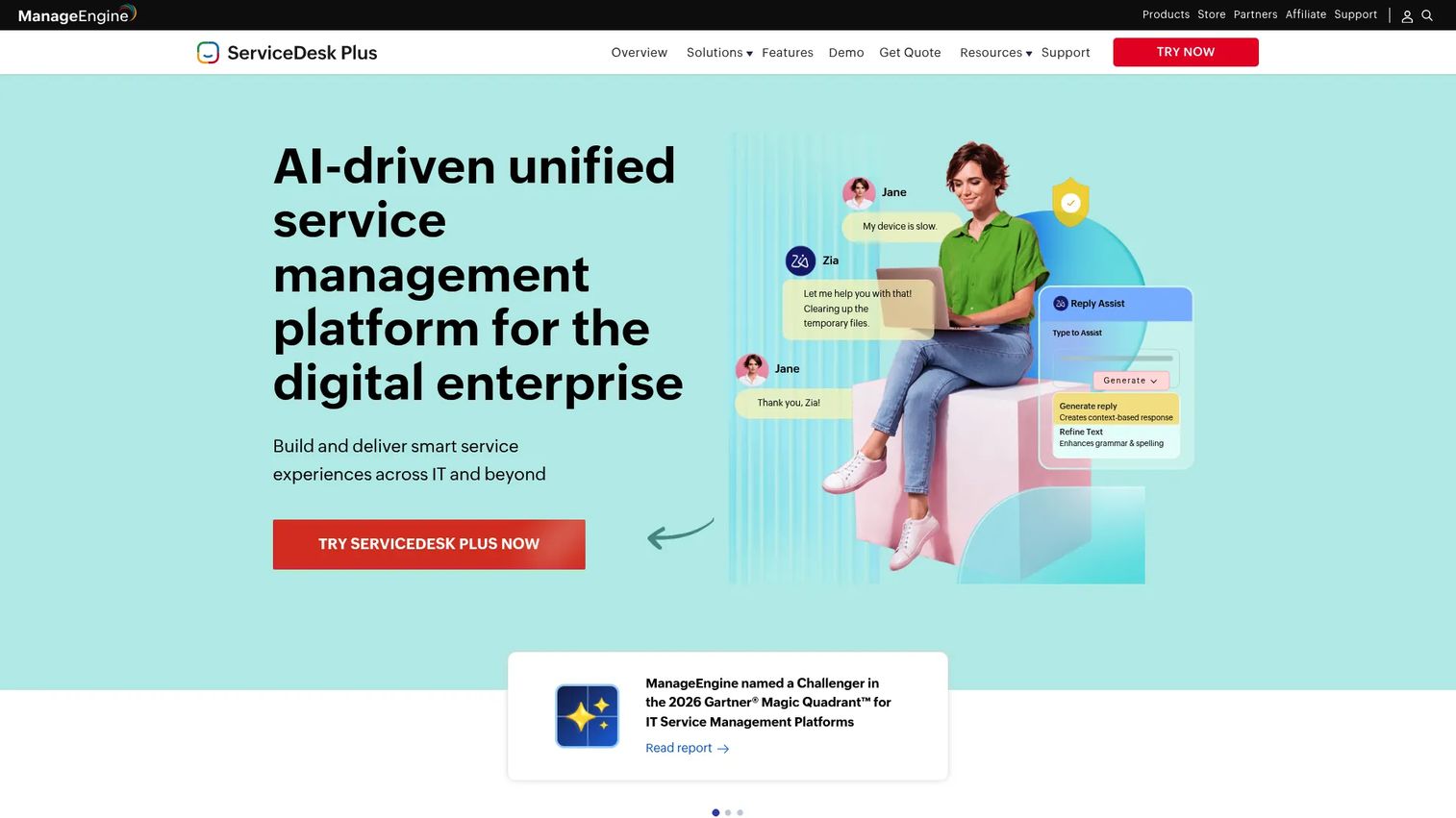
ServiceDesk Plus by ManageEngine is an ITSM platform where asset discovery feeds directly into service desk and asset workflows. Discovery is not a standalone module bolted on; it flows into incidents, requests, and change so the asset record and the ticket live in the same system. For teams that want inventory tied to daily service operations, that alignment matters.
The value is the handoff. When discovery updates an asset, that context is right there in the ticket queue. Technicians see what hardware and software a user runs before they start troubleshooting, and asset lifecycle changes route through the same ITIL-aligned workflows.
Best for: IT teams that want an ITIL-aligned help desk with asset management and automation built in.
Key features
- Self-service portal
- Live chat and knowledge base
- Business rules and ticket auto-assignment
Why choose ServiceDesk Plus: choose it when service management is your center and you want discovery feeding tickets, assets, and change from one console rather than syncing across tools.
ServiceDesk Plus pricing: the Standard edition offers a free option for up to 5 technicians and 250 IT assets. Paid tiers start at $13/technician/month for Standard, $27/technician/month for Professional, and $67/technician/month for Enterprise, billed monthly or yearly.
ServiceDesk Plus holds a 4.2/5 rating on G2.
5. SolarWinds
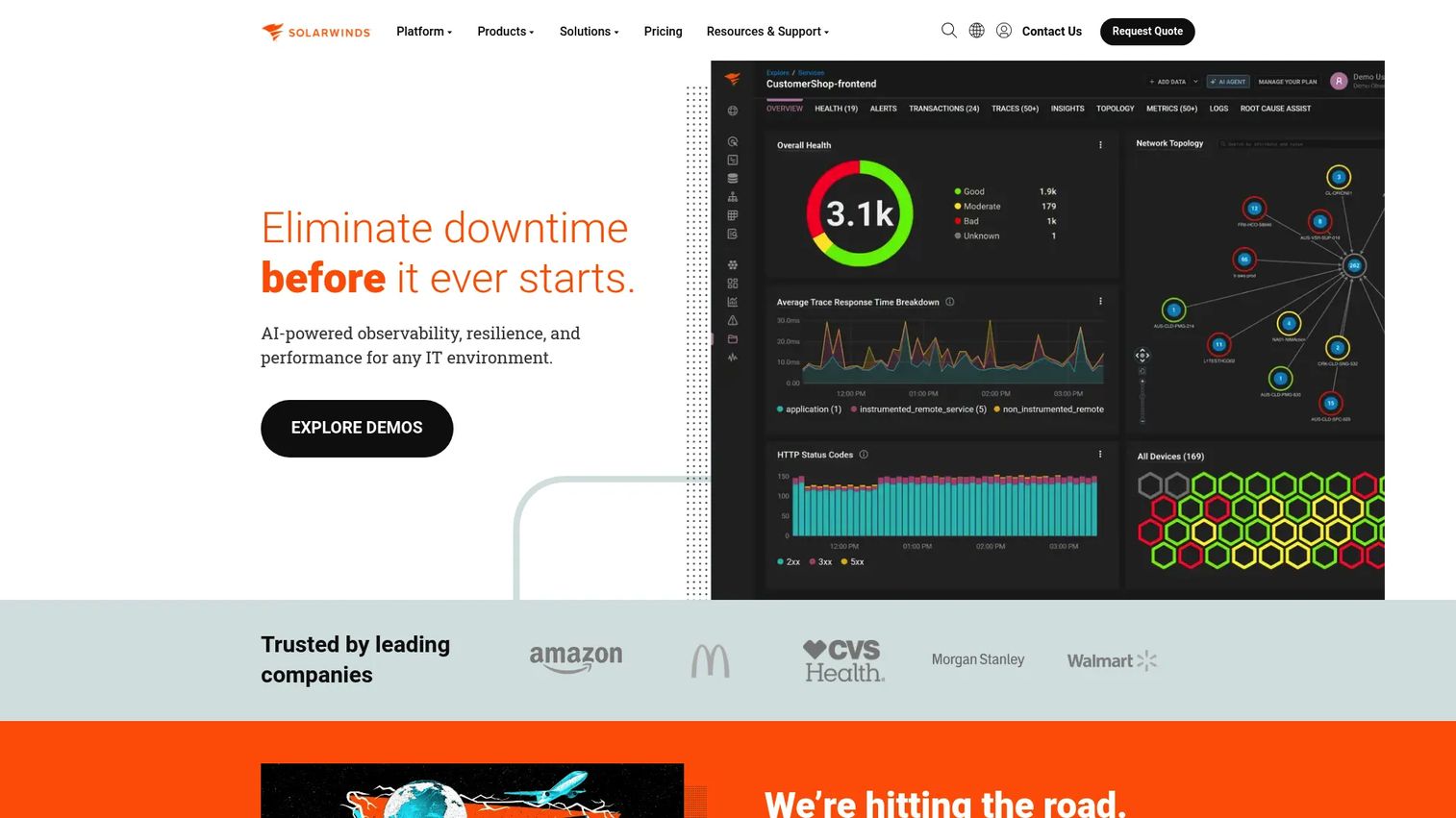
SolarWinds is IT infrastructure management and observability software for hybrid and on-prem environments. Discovery here lives inside monitoring: as SolarWinds scans and maps your network and infrastructure, it builds an asset picture alongside performance data. If you already run SolarWinds for monitoring, discovery comes as part of the operational view.
The angle is pragmatic. Rather than a dedicated ITAM suite, SolarWinds gives IT operations teams discovery in the context they already work in, monitoring dashboards and service management. Network scanning and node-level visibility make it a fit for teams that think in terms of infrastructure health first.
Best for: IT teams needing observability, monitoring, and service management across hybrid infrastructure.
Key features
- Hybrid IT observability
- Network and infrastructure monitoring
- Service management and incident response
Why choose SolarWinds: pick it when discovery should sit next to monitoring and you want one operations tool covering infrastructure health, incidents, and asset visibility.
SolarWinds pricing: SolarWinds Observability Self-Hosted starts at $8 per node/month, the SaaS version at $27.50 per service, and Service Desk at $39 per technician/month. Web Help Desk is a $533 annual license. Some products require a quote.
SolarWinds holds a 4.3/5 rating on G2.
6. Ivanti
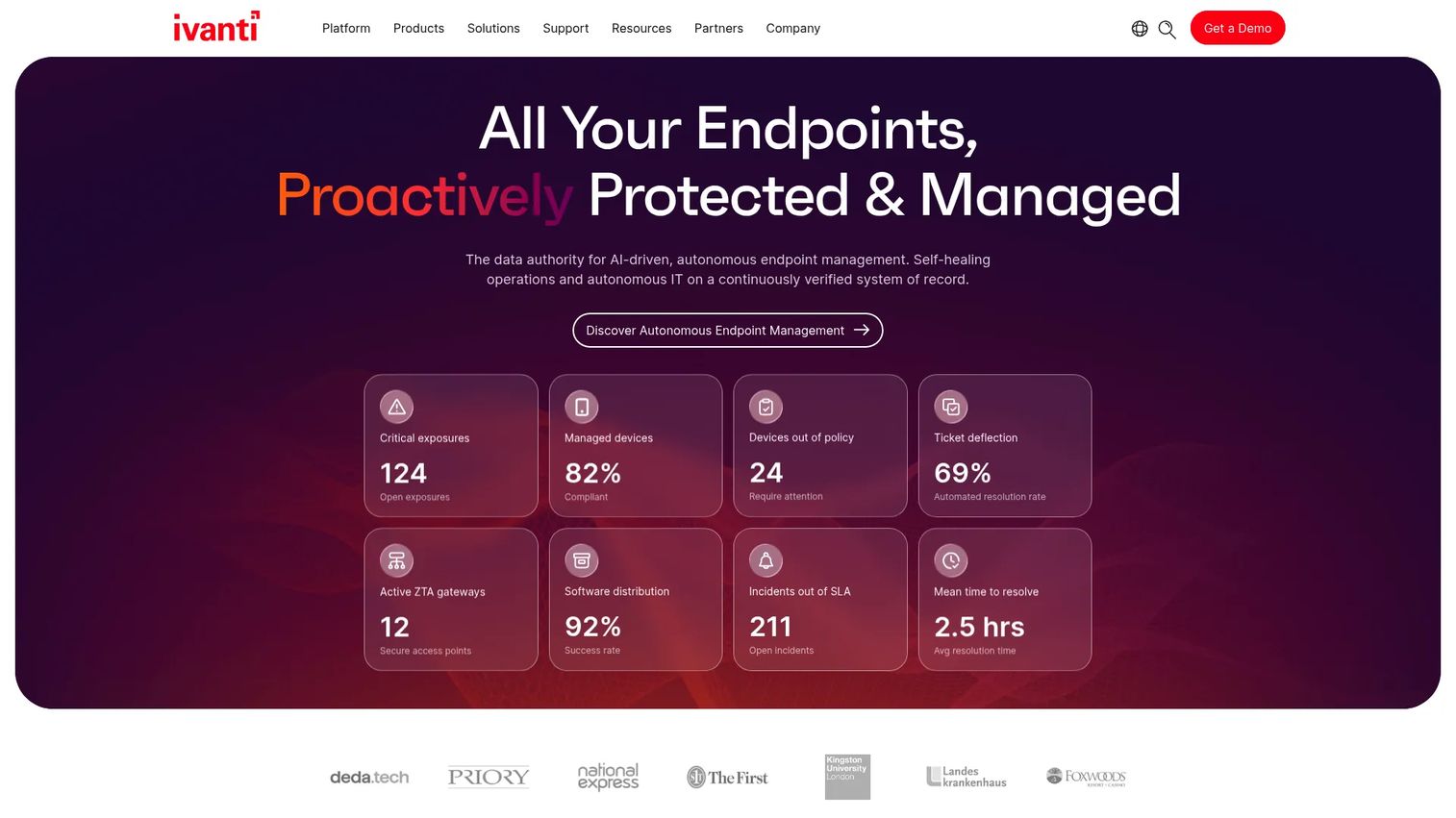
Ivanti provides AI-powered IT and security software spanning unified endpoint management, service management, and exposure management. Its discovery strength is endpoint-driven: Ivanti sees devices across mobile, desktop, and IoT, then ties that visibility to lifecycle provisioning and security controls. For teams where the endpoint is the asset that matters most, that focus pays off.
Ivanti frames discovery as the front end of endpoint management. Once a device is discovered, the same platform handles provisioning, patching, and self-healing workflows. Asset awareness feeds directly into security and service management rather than sitting in a separate inventory.
Best for: enterprises that need unified endpoint and IT/security automation at scale.
Key features
- Unified endpoint management across mobile, desktop, and IoT devices
- AI-powered automation and self-healing workflows
- Cross-platform lifecycle provisioning and security controls
Why choose Ivanti: reach for it when endpoints dominate your estate and you want discovery, management, and security automation in one platform rather than stitched together.
Ivanti pricing: Ivanti prices by quote through a request form rather than publishing tiers. Contact their team to scope pricing for your device count and modules.
Ivanti holds a 4.2/5 rating on G2 for its Neurons for Unified Endpoint Management product.
7. Armis Centrix
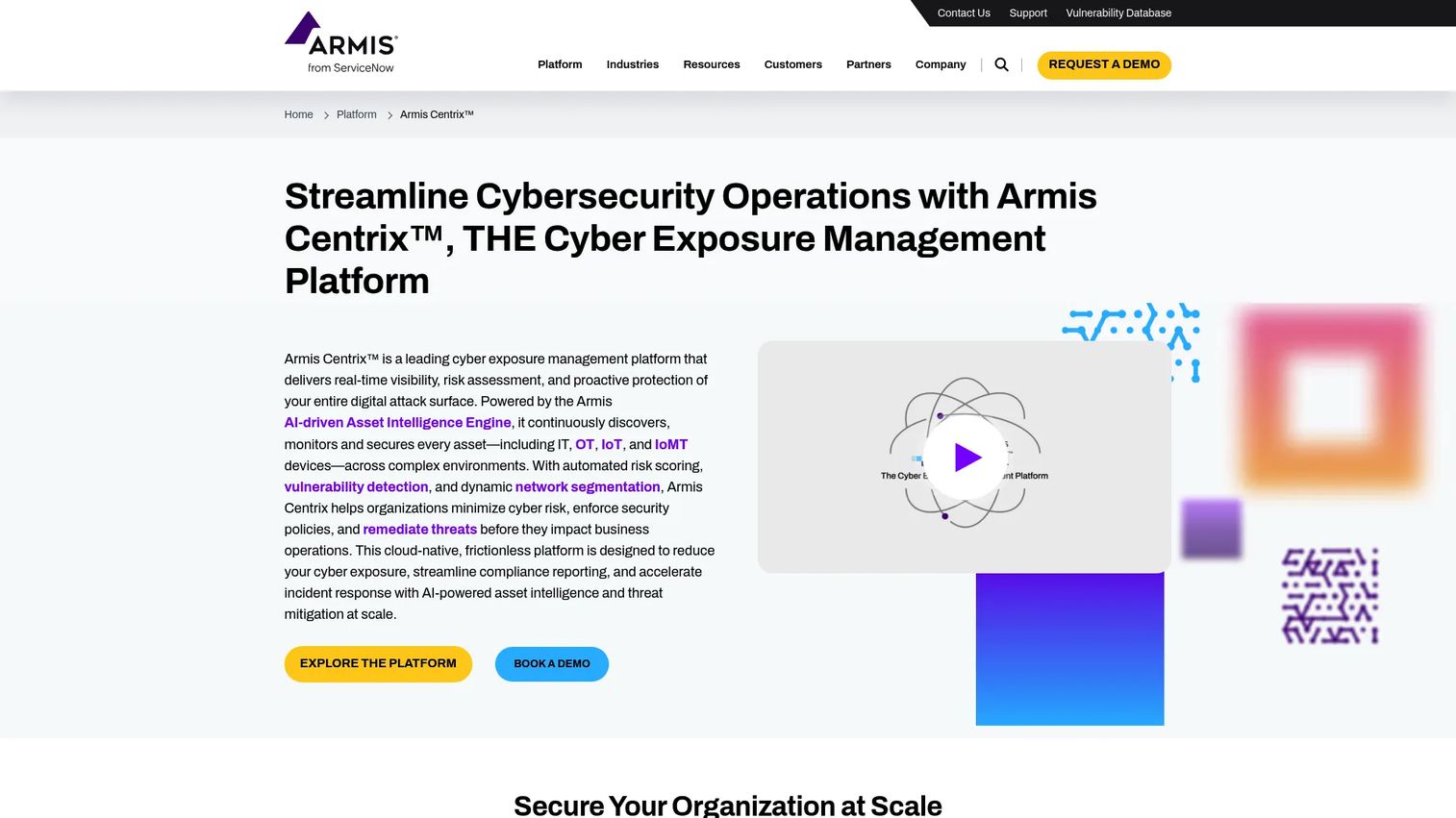
Armis Centrix is a cyber exposure management platform built to discover and secure IT, OT, IoT, and IoMT assets. Its edge is the unmanaged and unagentable: the devices that never run an agent and never register with IT. Armis uses passive, agentless techniques to see them in real time, which is exactly what security teams need for attack surface reduction.
The security framing runs through everything. Discovery is not the end goal, risk reduction is. Armis scores assets for risk, flags vulnerabilities, and can drive segmentation and remediation. For environments where OT and IoT visibility is a genuine gap, this is a purpose-built answer.
Best for: enterprises needing unified cyber exposure management across mixed IT/OT/IoT environments.
Key features
- Real-time asset visibility across IT, OT, IoT, and IoMT
- Automated risk scoring and vulnerability detection
- Dynamic network segmentation and remediation workflows
Why choose Armis Centrix: choose it when security and OT/IoT coverage drive the decision, and you need to see and score assets that traditional agent-based discovery never touches.
Armis Centrix pricing: Armis prices through demo and sales conversations rather than public tiers. Request a demo to get pricing scoped to your environment.
Armis holds a 4.4/5 rating on G2.
8. Zluri
Zluri is an identity security and SaaS management platform for discovering and governing the apps and identities across your organization. Where hardware-focused tools miss the credit-card SaaS purchase and the orphaned account, Zluri's SaaS discovery surfaces both. It maps who has access to what, and which apps are actually in use.
Zluri treats SaaS and identity as the modern asset problem. It discovers applications, tracks usage, and layers access management, access reviews, and risk remediation on top. For IT and security teams fighting app sprawl and identity risk, it fills a gap that traditional asset discovery leaves wide open.
Best for: mid-market and enterprise IT and security teams managing identity governance and SaaS sprawl.
Key features
- Identity discovery and visibility
- Access management and access requests
- Access reviews and risk remediation
Why choose Zluri: pick it when SaaS and identity sprawl is your real inventory gap, and you want discovery paired with access governance rather than just an app list.
Zluri pricing: Zluri routes pricing through a demo request rather than listing plans publicly. Reach out to their team for a quote scoped to your app and identity footprint.
Zluri holds a 4.6/5 rating on G2.
Considerations
Discovery coverage across your whole estate
Map your environment before you map tools. If you run cloud, on-prem, endpoints, SaaS, and OT/IoT, one method rarely covers all five. Confirm the tool sees the asset classes you actually own, not just the ones it markets best.
Agent-based vs agentless discovery
Agent-based discovery gives deep endpoint detail but means deploying and maintaining agents. Agentless discovery rolls out fast across servers and network gear with nothing installed. Most mature environments end up using both, so ask how the tool blends them and where each method applies.
CMDB and ITSM integration depth
A discovery tool that cannot cleanly write to your CMDB and ITSM just creates a second silo. Check how records reconcile, whether the integration is native or bolted on, and how change and incident workflows consume the data. Shallow integration is where inventory accuracy quietly dies.
Refresh frequency and reconciliation quality
Stale inventory is worse than none because people trust it. Ask how often discovery refreshes, how the tool deduplicates records across sources, and how it handles drift. Reconciliation quality separates a real single source of truth from a messy export.
Security, permissions, and governance
Discovery tools need broad access to your environment, so scrutinize how they authenticate, store credentials, and scope permissions. For ITAM and security teams, that governance review is not optional. Confirm role-based access and audit trails before you grant the keys.
Conclusion
The right pick depends on where your inventory gap actually lives. For CMDB-led multi-cloud operations, Cloudaware puts discovery, cost, and security on one reconciled layer. For software discovery and license optimization at scale, Flexera is the depth play. Device42 wins on agentless hybrid discovery and dependency mapping, while ServiceDesk Plus ties discovery to service operations.
If the driver is infrastructure monitoring, SolarWinds folds discovery into observability. Ivanti fits endpoint-heavy estates, Armis Centrix owns security-first IT/OT/IoT visibility, and Zluri closes the SaaS and identity gap the others miss.
Do not buy on a feature grid alone. Shortlist two or three tools that match your discovery methods and environment complexity, then validate coverage against a real slice of your estate. Run each against the assets you know are hard to see, the OT sensor, the shadow SaaS app, the unmanaged VM. Whichever finds them accurately, and keeps finding them on refresh, is the one worth your budget.
FAQs
Asset discovery software automatically identifies and catalogs the hardware and software assets across your environment, then keeps that inventory current. It replaces manual spreadsheets with a live record that feeds CMDB, security, and ITAM workflows. The goal is a single source of truth for what you own and where it runs.
It uses one or more discovery methods to detect assets: agents on devices, agentless queries over SNMP, WMI, or SSH, API calls to cloud and SaaS platforms, and network scans. It then normalizes and reconciles the results into a deduplicated inventory. Continuous refresh keeps that inventory aligned with reality as devices come and go.
Agent-based discovery installs a small program on each device that reports detailed data back, which gives deep endpoint visibility. Agentless discovery queries devices remotely with nothing installed, which rolls out fast across servers and network gear. Many teams use both, agents for endpoints and agentless for infrastructure.
CMDB discovery feeds reconciled asset records straight into your configuration management database and flags drift when reality diverges from the record. Because discovery runs continuously, the CMDB reflects current state rather than a quarterly snapshot. That accuracy is what makes change management and incident response reliable.
Yes. SaaS discovery uses API-based discovery and identity data to surface applications, including shadow SaaS bought outside IT. Tools focused on this area also track usage and access, so you see not just which apps exist but who uses them. That closes a blind spot hardware-focused tools leave open.
It removes blind spots. Every unknown device is an unpatched risk, and network scanning plus passive discovery surface unmanaged endpoints, rogue VMs, and OT or IoT devices. Feeding accurate asset context into vulnerability prioritization lets security teams focus remediation where it matters and shrink the attack surface.
Check discovery coverage across cloud, on-prem, endpoints, SaaS, and OT/IoT, then confirm the method mix fits your estate. Evaluate refresh frequency, reconciliation quality, and how cleanly the tool integrates with your CMDB and ITSM. Finally, review security, permissions, and governance, since these tools need broad access to your environment.
No. Asset discovery is the data engine that finds and catalogs assets, while ITAM is the broader practice of managing those assets across their lifecycle, including licensing, cost, and compliance. Discovery feeds ITAM with accurate inventory, but ITAM adds the governance, contracts, and optimization on top.