A driver skips a pickup. The customer calls in angry. Your dispatcher has no proof the truck was there, no photo, no timestamp, no way to close the dispute without a credit. Multiply that by a few hundred stops a day and you see where the friction lives: not in the driving, but in everything around it. Missed pickups, invoices that don't match service, routes built in a spreadsheet, and a support queue full of "did you come to my house?" calls.
The market has noticed. The global waste management software market is projected to reach $11.97 billion in 2026, up from $11.04 billion in 2025, according to The Business Research Company (2026). Global Growth Insights (2025) reports that 62% of waste service providers are now adopting digital waste platforms, and 54% of municipalities are implementing automated monitoring tools for collection scheduling and reporting. The manual era is ending.
Here is the plain-English version: waste collection software is the operational layer that runs a hauling business. It plans routes, dispatches drivers, proves service happened, bills the customer, and gives that customer a place to self-serve. Some tools are full waste management software solutions that touch every part of the operation. Others solve one bottleneck well. The trick is matching the tool to how your operation actually runs, not to a feature list.
This guide compares seven platforms so you can shortlist the right two and test them against real workflows.
What's inside
This is a buyer's guide for teams evaluating waste hauler software and broader waste management software across routing, dispatch, billing, verification, and customer experience. It is written with a product and operations lens: what each tool replaces, where complexity comes from, and which segment it fits.
We selected the seven platforms on four criteria:
- Operational breadth: how much of the routing-to-billing workflow the tool covers in one place.
- Field workflow fit: support for mixed fleets, in-cab tools, live tracking, and changing schedules.
- Billing and verification depth: invoicing, payments, and service proof built in versus bolted on.
- Customer self-service and credibility: portals, sign-up flows, and verifiable track record.
TL;DR
- Best for full-stack hauler operations: WIS, which ties routing, camera and RFID verification, billing, and customer onboarding into one modular platform.
- Best for municipalities and large fleets: Routeware, with route optimization, dispatch, in-cab tools, and citizen-facing customer service.
- Best lean all-in-one for haulers: Trash Flow, with module-based billing, dispatch, and container tracking priced per module.
- Best for verification-heavy fleets: WIS again, thanks to camera, weighing, and RFID service proof at the point of collection.
- Best for inspections and compliance: SafetyCulture, for teams that need audits, checklists, and reporting around waste handling.
- Best for recycling and sustainability reporting: Resourcify and Recykal, for operators managing circularity, EPR compliance, and material tracking.
What is waste collection software?
Waste collection software is a category of operational software that helps waste haulers and operators plan routes, dispatch drivers, prove service was delivered, bill customers, and manage customer communication from a single system.
It sits under the wider umbrella of waste management software, which can also include compliance, sustainability, and landfill workflows. Where waste management software describes the whole category, waste collection software is the operational subset focused on hauling and service execution.
Most platforms in this category share a common set of modules:
- Route management software: planning, sequencing, and daily optimization of collection routes across residential, commercial, and roll-off lines.
- Dispatch software: assigning work orders, live tracking, and in-cab driver tools that adapt to schedule changes.
- Billing and invoicing software: recurring invoicing, customer statements, payments, and adjustments for service changes.
- Service verification: camera proof, RFID, weighing, or photo evidence captured at the point of collection.
- Customer self-service portal: online sign-up, bill pay, service requests, and account visibility.
- Waste tracking software: container tracking, material volumes, and lifecycle reporting for compliance and sustainability.
The strongest waste management software solutions connect these modules so a service event in the cab updates the customer's account and invoice without a manual handoff. That connection is where the real operational savings live, and where Global Growth Insights (2025) found 48% of environmental service operators are integrating real-time data analytics for waste lifecycle monitoring.
When to use waste collection software
Not every operation needs a full platform on day one. Here is how to pattern-match your situation to the category.
Reduce missed pickups and service disputes
When a customer says the truck never came, you need an answer that isn't a guess. Route tools plus service verification close that gap. The driver's route confirms the stop was on the plan, and camera, photo, or RFID evidence confirms it was serviced.
The workflow looks like this: the truck arrives, the in-cab app logs the stop, a camera or RFID reader captures proof, and the customer account updates in real time. When the call comes in, dispatch pulls the timestamp and image in seconds. Fewer credits, fewer callbacks, more trust.
Streamline billing and payments
Manual billing breaks down fast once service changes stack up. Billing and invoicing software built into the platform justifies adoption when you are managing:
- Recurring invoices across residential and commercial accounts.
- Service change adjustments (extra pickups, container swaps, temporary holds).
- Custom pricing per account or contract.
- Customer statements and payment collection.
- Roll-off orders that price by haul, tonnage, and rental days.
When the service event and the invoice share the same system, billing automation removes the reconciliation work that eats dispatcher time.
Support multiple lines of business
A hauler running residential curbside, commercial front-load, and roll-off software in the same fleet needs a system that flexes. A modular platform lets you run roll-off dispatching and online ordering alongside recurring residential billing without three separate tools. Municipal operators add citizen self-service and compliance reporting on top. Mixed fleets are exactly where a broad platform earns its keep, and where a single-line tool starts to strain.
Comparison table
The list is ranked by relevance to waste collection buyers who need routing, billing, and verification in one operational stack. Pricing and ratings reflect verified public sources at publication; where a vendor quotes custom pricing, that is noted.
| # | Product | Intent | Key use case | Pricing | G2 rating |
|---|---|---|---|---|---|
| 1 | WIS | Full-stack hauler operations | Routing, verification, billing, and customer onboarding for mixed fleets | Custom quote | Not available |
| 2 | Routeware | Municipal and large-fleet operations | Route optimization, dispatch, in-cab tools, billing, and customer service | Custom quote | 4.0/5 |
| 3 | Trash Flow | Lean all-in-one for haulers | Module-based billing, dispatch, and container tracking | From $550 one-time (per module) | 4.8/5 |
| 4 | SafetyCulture | Inspections and compliance | Audits, checklists, training, and reporting around waste handling | Free plan; from $5/seat/mo | 4.6/5 |
| 5 | Haulvana | Dispatch-to-billing for small and mid haulers | Drag-and-drop dispatch, tracking, automated billing, self-service | Free plan; from $199.99/mo | Not available |
| 6 | Recykal | Circular economy and compliance | Marketplace trading, EPR compliance, DRS, and traceability | Custom quote | Not available |
| 7 | Resourcify | Recycling and sustainability reporting | Waste tracking, disposal management, and circularity reporting | Monthly + per-pickup model | 5.0/5 |
1. WIS
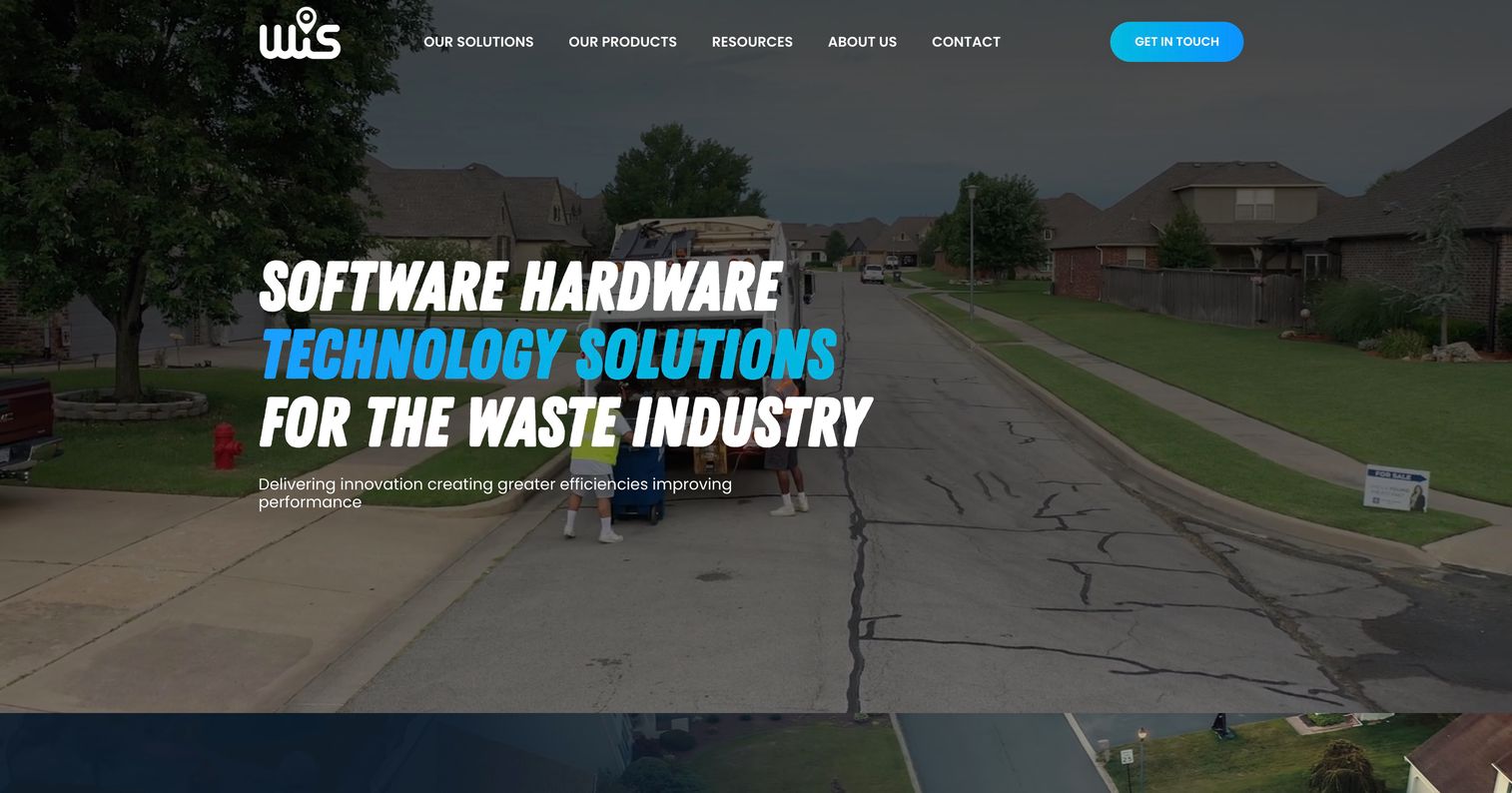
WIS is a waste management platform that pairs software with hardware to run collection, routing, billing, verification, and customer self-service in one place. It is built for haulers that operate mixed fleets and want service proof captured at the point of collection rather than reconstructed after a dispute.
Best for: waste haulers that need integrated routing, billing, service verification, and customer onboarding under one modular system.
Key strengths
- Any Driver/Any Route navigation: any driver can run any route with in-cab guidance, so coverage does not depend on route memory or a single experienced driver.
- Camera, weighing, and RFID verification: service proof is captured at the stop, which turns "did you come?" disputes into a two-second lookup.
- Roll-off and mixed-fleet operations: residential and commercial management sits alongside roll-off dispatching, online ordering, and pricing in the same platform.
Why choose WIS: For a PM or operations lead who wants one system of record rather than a stitched-together stack, WIS covers routing, verification, billing, and a customer app with automated sign-up. The hardware-plus-software approach fits operations where service disputes and route reliability are the expensive problems. It is the strongest full-stack fit on this list for verification-heavy fleets.
WIS pricing: WIS does not publish a public price. Pricing is quoted based on your operation, so plan to scope fleet size, service lines, and hardware needs in a sales conversation. There is no advertised free tier, which is typical for platform deployments at this depth.
2. Routeware
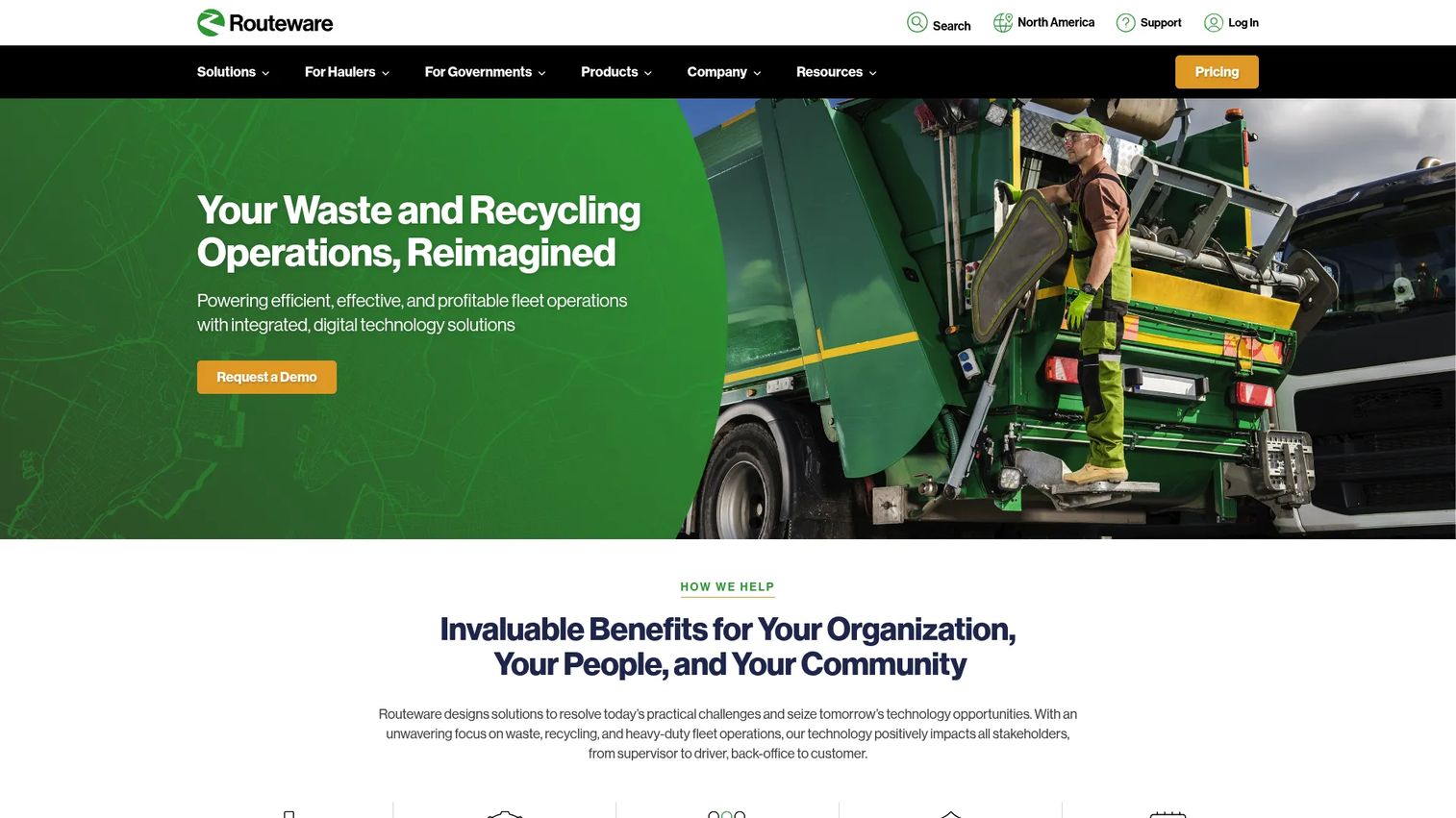
Routeware is an integrated operations platform for waste and recycling fleets, spanning route optimization, dispatch, in-cab driver tools, fleet reporting, billing, and customer service. Its breadth makes it a common choice for municipal programs and larger haulers that need both operational depth and citizen-facing tools.
Best for: waste and recycling fleets, including municipal operators, that need an integrated operations platform across routing, billing, and customer service.
Key strengths
- Route optimization and dispatch: plan and sequence routes, then adapt in real time as service schedules change across residential and commercial lines.
- In-cab and fleet reporting: driver tools and equipment reporting give dispatch live visibility into what is happening in the field.
- Billing, payments, and self-service: customer service and self-service tools reduce inbound call volume while billing and payments run in the same platform.
Why choose Routeware: If you run a municipal waste software program or a large fleet with mixed lines of business, Routeware's combination of route optimization, dispatch, compliance-friendly reporting, and customer service tools fits the scale. Its customer operations and business operations modules mean routing is not the only thing living in the system. It suits teams that value breadth over a single sharp feature.
Routeware pricing: Routeware quotes pricing custom, based on fleet size, services, and operational needs, and points buyers to a pricing request form. On G2, it holds a 4.0/5 rating, though from a small review count, so weigh that against your own evaluation. There is no public free tier.
3. Trash Flow
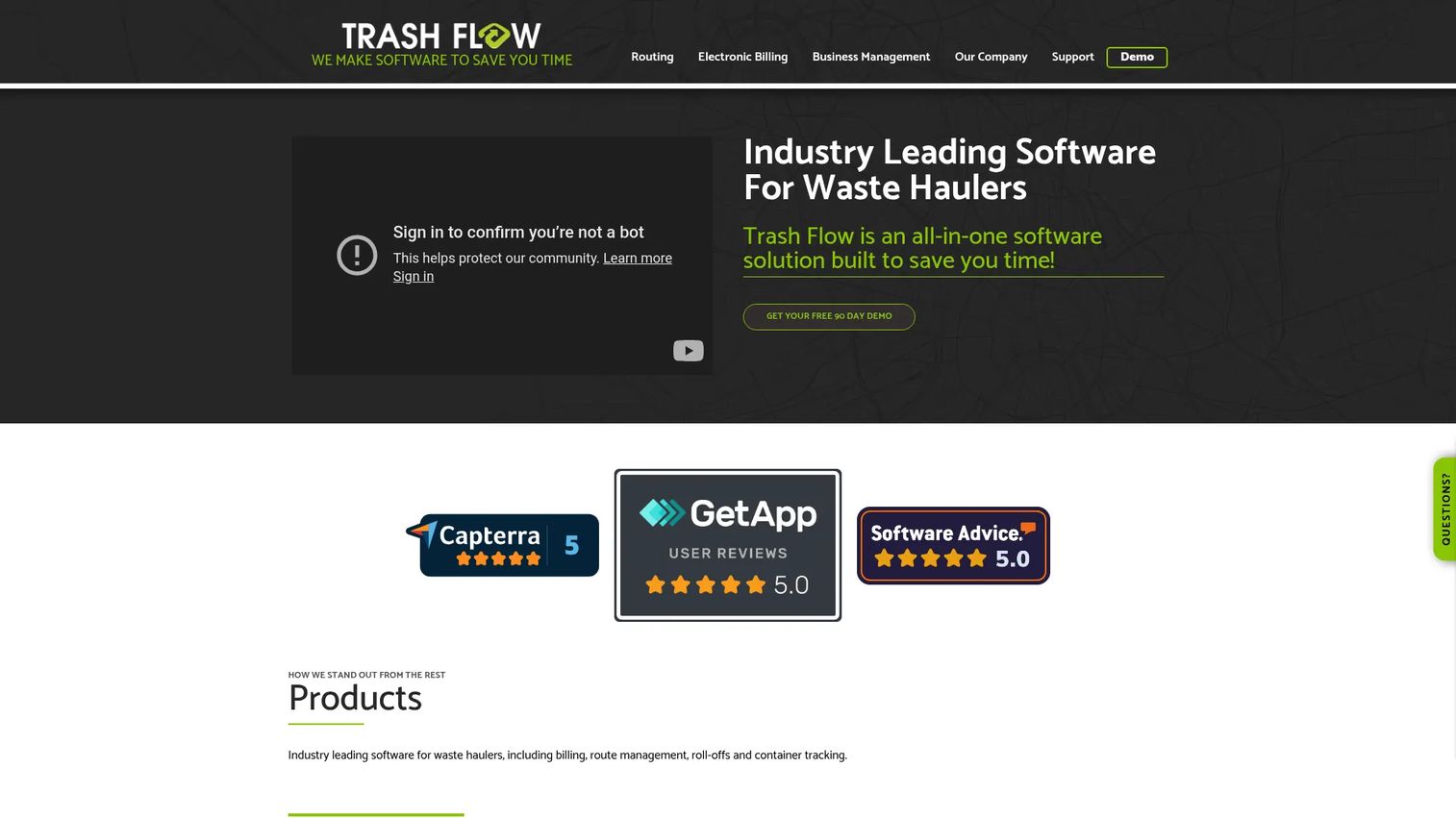
Trash Flow is a modular waste management platform for haulers, built around billing with route management and container tracking layered on. Its module-based pricing makes it a practical entry point for operators that want the operational basics in one place without committing to a full enterprise deployment.
Best for: waste hauling businesses that want modular billing and dispatch software they can buy in pieces.
Key strengths
- Module-based billing packages: buy the billing depth you need, from a lite package up to a fuller suite, so the tool scales with the operation.
- Dispatch and work order management: assign and track work orders alongside route management for residential, commercial, and roll-off lines.
- Container tracking: a dedicated container tracking module keeps asset location and status inside the same system as billing and routing.
Why choose Trash Flow: Trash Flow fits haulers that want a leaner all-in-one option and prefer clear, one-time module pricing over a custom enterprise quote. Because billing, dispatch, roll-off, landfill management, and container tracking are packaged separately, you pay for what your operation actually runs. It is the pragmatic pick when you want to replace spreadsheets and a separate billing tool without a long implementation.
Trash Flow pricing: Trash Flow prices by module with public, one-time figures. The Container Tracking Module starts at $550, Trash Flow Lite at $900, the core Trash Flow package at $2,350, and Trash Flow Plus at $3,050. There is no free tier. On G2, it holds a 4.8/5 rating.
4. SafetyCulture
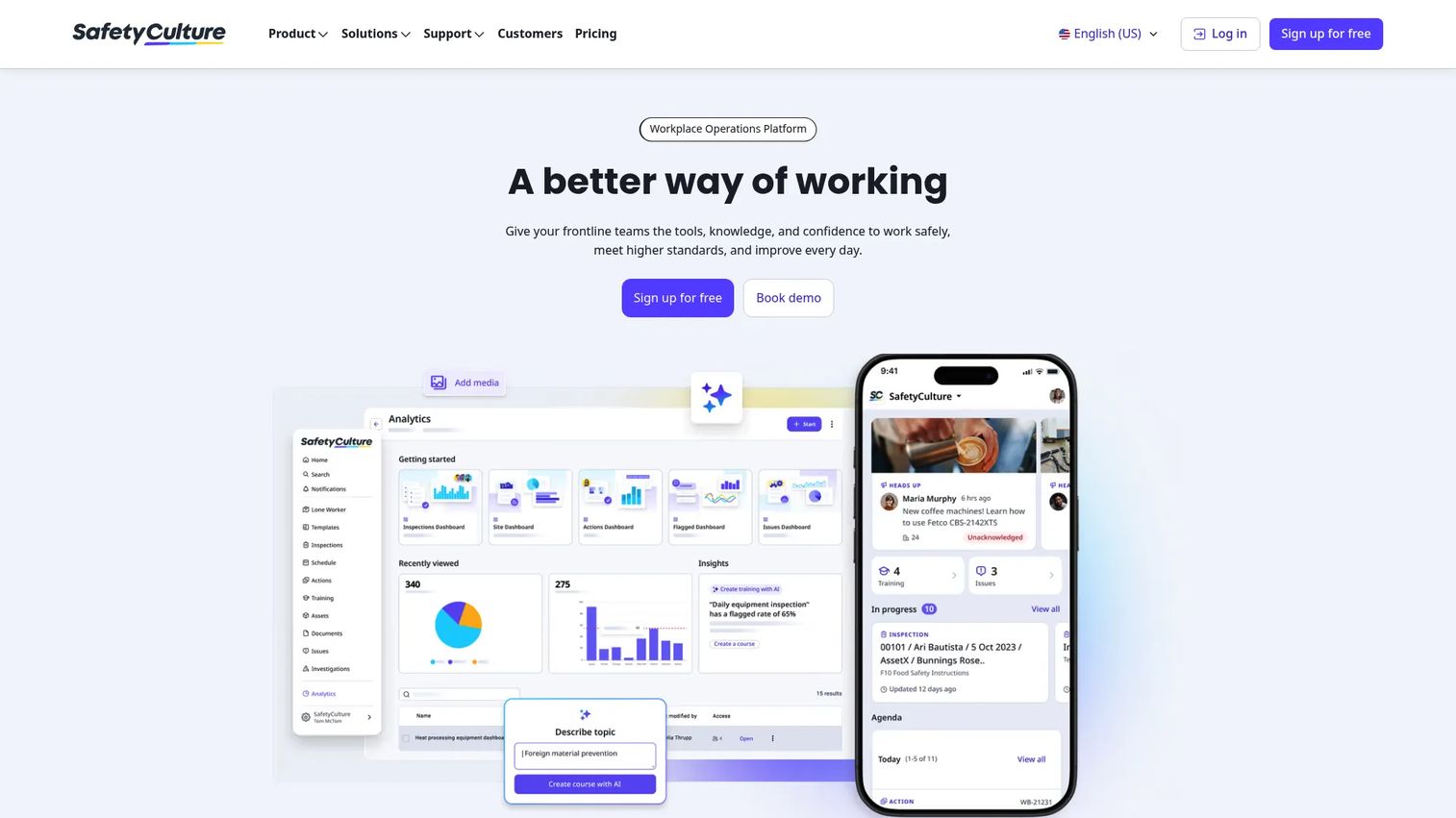
SafetyCulture is a workplace operations platform for inspections, training, asset management, and task workflows, with AI-enabled reporting. It is the most compliance and inspection-oriented option in this set, and it is broader than hauler-only software.
Best for: frontline waste operations teams that need mobile-first inspections, audits, and operational process control around waste handling.
Key strengths
- Inspections, audits, and checklists: standardize how crews document safety, equipment, and site conditions in the field on mobile.
- Training and task management: onboard and certify staff, then assign and track corrective tasks tied to issues and investigations.
- Analytics and integrations: reporting and asset management give operations leaders visibility into recurring problems and compliance gaps.
Why choose SafetyCulture: SafetyCulture is not a routing or billing system, and it does not pretend to be. It fits waste operations teams that need inspections, reporting, and process control around waste handling, whether that is landfill site checks, equipment audits, or crew safety. Use it alongside a routing and billing platform, not instead of one. Its recycling and sustainability use cases also make it useful for operators tracking compliance across sites.
SafetyCulture pricing: SafetyCulture offers a free plan plus paid seat types. The Lite seat starts at $5/seat/month billed annually, and the Full seat runs $24/seat/month billed annually, with Enterprise priced by custom quote. A 30-day free trial is available. On G2, it holds a 4.6/5 rating.
5. Haulvana
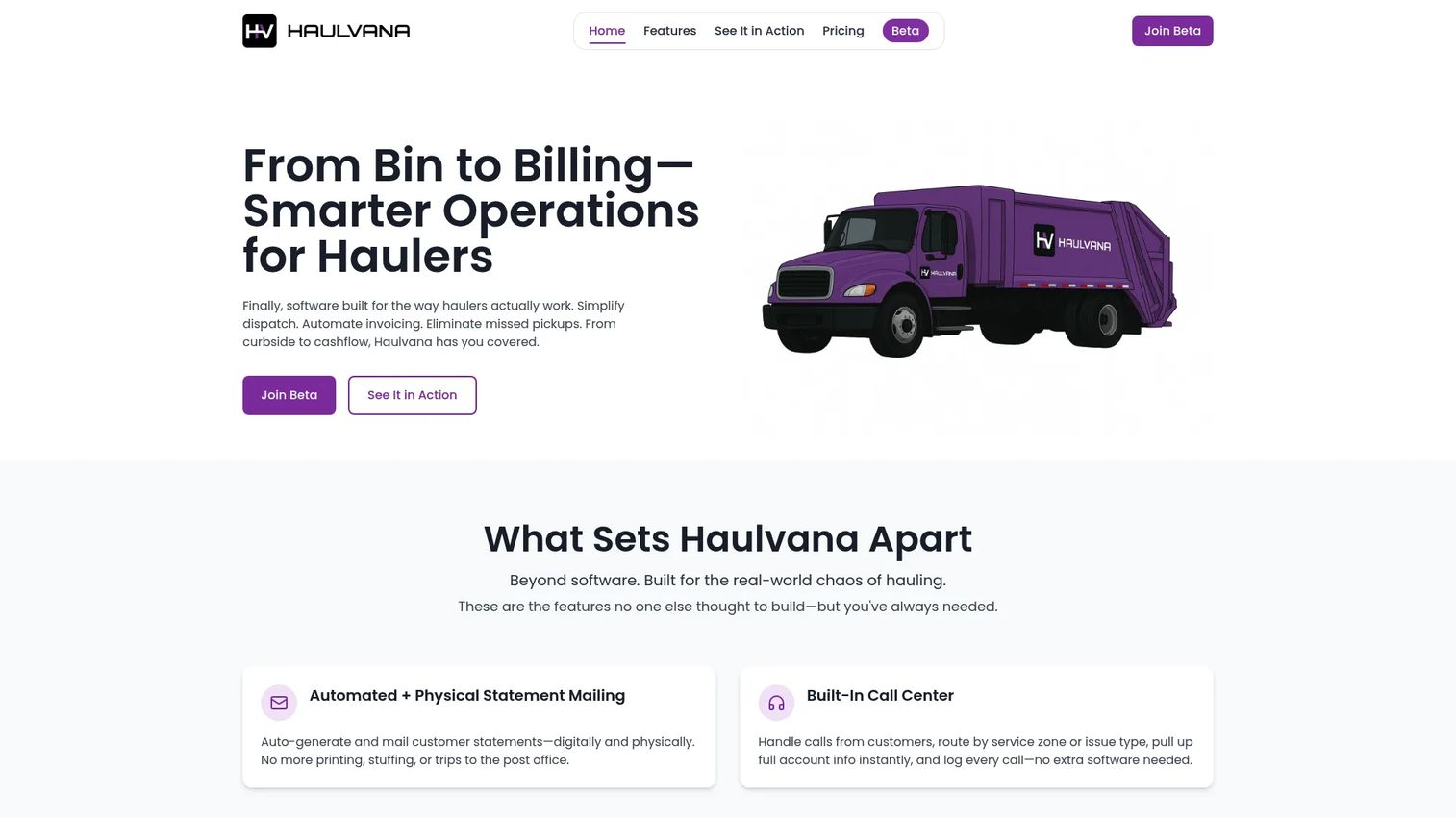
Haulvana is an all-in-one cloud platform for waste haulers, covering dispatch, billing, driver communications, and customer self-service. It is built for small to mid-sized operators that want modern operational coordination without an enterprise footprint.
Best for: small to mid-sized residential, commercial, or roll-off haulers that need integrated dispatch-to-billing software.
Key strengths
- Drag-and-drop dispatch and live tracking: build and adjust routes visually, then watch assets move in real time through the day.
- Automated billing and AR: invoicing and accounts receivable run automatically, with pay-by-phone IVR and a customer self-service portal reducing manual collection.
- Offline driver app and built-in call center: drivers keep working without signal, while push-to-talk communications and a built-in call center keep dispatch connected.
Why choose Haulvana: Haulvana fits haulers that want dispatch, tracking, billing, and customer self-service in one modern tool without a heavy rollout. The offline driver app and built-in call center address the real field conditions smaller operators face. It is a practical route-and-dispatch focused option that still closes the loop through to billing and the customer portal.
Haulvana pricing: Haulvana publishes monthly plans. Kickstart is $0/month, Essentials is $199.99/month, Growth is $399.99/month, and Command is $699.99/month, with Command+ Enterprise priced custom. All plans include tailored onboarding at no cost, which lowers the barrier to getting started.
6. Recykal
Recykal is a B2B circular economy and waste management platform built around marketplace trading, EPR and compliance workflows, deposit refund systems, and traceability. It leans toward enterprises and institutions managing recyclables and compliance rather than curbside hauling routes.
Best for: enterprises that need circular-economy workflows and compliance-focused management of waste and recyclables.
Key strengths
- Managed recyclables marketplace: trade recyclables with traceability and compliance support built into the transaction.
- EPR compliance platform: manage extended producer responsibility from registration through fulfilment across material categories.
- DRS and digital refunds: deposit refund system workflows with unit-level tracking and reporting.
Why choose Recykal: Recykal fits operators whose core problem is material tracking, compliance, and circularity rather than daily route dispatch. If your operation manages institutional disposal, recyclables trading, and EPR reporting, its digitized waste center operations and traceability tools address that directly. It is a specialist choice, not a general-purpose hauler platform.
Recykal pricing: Recykal does not publish a public price. The platform indicates marketplace-driven pricing, and product pages route buyers to a contact form rather than listed plans, so scope your needs in a direct conversation.
7. Resourcify
Resourcify is circularity software for waste management, recycling operations, and ESG reporting. It centralizes service provider management, disposal scheduling, and sustainability metrics for enterprises running waste across multiple locations.
Best for: enterprises managing waste, recycling, and circularity reporting across multiple sites.
Key strengths
- Centralized provider management: keep service providers, prices, contracts, and disposal certificates in one place.
- QR-code disposal requests: request container disposal via QR code and schedule pickups without manual coordination.
- Sustainability reporting: track waste volumes, costs, revenues, recycling rates, and CO2 impact for ESG and circularity reporting.
Why choose Resourcify: Resourcify is the strongest fit on this list for recycling and sustainability-minded operators. If your priority is digitizing recycling operations, tracking material and CO2 across locations, and reporting on circularity, it is purpose-built for that job. Like the other specialist tools here, it complements rather than replaces a routing and billing platform for a curbside hauler.
Resourcify pricing: Resourcify shows a pricing model rather than a fixed number. Its Platform Starter is priced as a monthly cost plus a per-pickup charge, with optional consulting, setup, and operations hosting, and modular add-ons for operations, accounting, sustainability, hazardous waste, and circularity programs. On G2, it holds a 5.0/5 rating.
Considerations
Feature lists look similar on paper. These are the criteria that separate a good fit from a costly mistake.
Routing and dispatch depth
Check whether the platform handles route optimization, live tracking, and in-cab workflows the way your operation actually runs. A residential curbside route and a roll-off haul are different problems. Confirm support across mixed fleets and changing service schedules before you commit, because retrofitting a single-line tool onto a mixed operation is where complexity hides.
Billing and payments
Confirm whether invoicing, customer statements, and payment workflows are built in or dependent on integrations. The important question is how easily the system adjusts for custom pricing, service changes, and account exceptions. Billing automation only pays off when the service event and the invoice share one source of truth.
Verification and accountability
For operations with frequent service disputes, inspect what proof the platform captures: camera images, RFID reads, weighing data, or manual photo evidence. Then validate how quickly a service event updates the customer account. Proof that takes an hour to retrieve does not deflect a live phone call.
Customer self-service and communication
Review whether the platform supports online sign-up, bill pay, portal access, and proactive communication. A working customer self-service portal is the single biggest lever for lowering call center load, because it moves routine "when is my pickup?" and "pay my bill" traffic off your team.
Modular fit versus full-suite fit
Decide whether you need a broad platform or a narrower tool that solves one bottleneck well. A PM reader should ask where complexity is coming from and what is actually being replaced. A full suite reduces integration overhead but demands a bigger rollout; a focused tool ships faster but leaves gaps you fill elsewhere.
Conclusion
The strongest overall option for a mixed-fleet hauler is WIS, which ties routing, camera and RFID verification, billing, and customer onboarding into one system where service proof lives at the point of collection. For municipalities and large fleets, Routeware brings route optimization, dispatch, and citizen-facing customer service at scale. For leaner operators, Trash Flow offers modular billing and dispatch with clear pricing, and Haulvana packages dispatch through billing for small and mid-sized haulers.
Specialists round out the list. SafetyCulture owns inspections and compliance around waste handling, while Recykal and Resourcify lead on recycling, traceability, and sustainability reporting.
The right choice depends on your route complexity, billing needs, and verification requirements, not on which feature grid looks longest. Shortlist your top two, then test them against real workflows: a real route, a real disputed pickup, a real billing exception. The tool that handles your messiest day is the one to buy.
FAQs
Waste collection software manages the operational side of a hauling business: planning and optimizing routes, dispatching drivers, proving service was delivered, billing customers, and handling customer communication. The strongest platforms connect these so a service event in the field updates the customer's account and invoice automatically, without manual reconciliation.
Prioritize route management and dispatch, billing and invoicing, service verification, and a customer self-service portal. Routing and dispatch keep trucks efficient, billing keeps revenue clean, verification settles disputes, and portals cut call center load. Everything else is secondary until those four run well together.
Not exactly. Waste collection software is the operational subset focused on hauling and service execution: routes, dispatch, billing, and verification. Waste management software is the broader category that can also include compliance, landfill, and sustainability workflows. Many buyers use the terms interchangeably, but the collection-focused tools center on getting trucks to stops and money into accounts.
Route optimization reduces fuel use, cuts missed pickups, and makes daily planning faster by sequencing stops efficiently across the fleet. It matters most when paired with live updates, so dispatch can re-route around a breakdown, a new order, or a schedule change without rebuilding the day from scratch. Better routing also produces the service data that feeds verification and billing.
Some do and some are residential-first. Platforms like WIS, Routeware, Trash Flow, and Haulvana support roll-off software workflows such as dispatching, online ordering, and haul-based pricing alongside residential and commercial lines. If you run a mixed fleet, look for a modular architecture so you can add roll-off and commercial lines without adopting a separate system.
Focus on scalability across service lines, maintenance overhead as the product changes, integration depth with your existing stack, and data visibility into field operations. Ask what the tool actually replaces and where new complexity comes from. The goal is fewer manual handoffs and clearer operational data, not a longer feature list.
A customer self-service portal moves routine work off your team: sign-ups, bill pay, service requests, and account visibility all happen without a phone call. That deflects the highest-volume, lowest-value tickets, such as "when is my pickup?" and "pay my bill," so agents spend time on real exceptions. For most haulers, the portal is the single biggest lever on call center volume.