A single mispick cascades. The order ships short, the customer reorders, a rep spends 20 minutes tracing where the inventory count went wrong, and the cycle count next week reveals a location that has been off by 40 units for a month. Multiply that across thousands of SKUs and a peak season, and the cost is no longer a rounding error. It is margin, labor hours, and customer trust bleeding out through inaccurate inventory and slow fulfillment.
The category built to stop that bleeding is growing fast. The global warehouse management system market is estimated at USD 4.0 to 4.8 billion in 2026, with forecasts reaching USD 16.0 billion by 2033, according to Mordor Intelligence (2026) and Grand View Research (2025). Cloud-based platforms already account for 55 to 62 percent of market revenue and are expanding faster than on-premise deployments. That shift matters because the deployment model you pick shapes how much process change your team absorbs, how quickly you get real-time inventory visibility, and how the system connects to the rest of your stack.
The hard part is not knowing you need warehouse management software. It is choosing a platform that matches your warehouse complexity, your existing ERP, and the amount of change your operations team can handle without breaking throughput. A tier-1 suite built for automated distribution centers is the wrong fit for a growing manufacturer, and a lightweight tool tied to accounting software will not orchestrate a multi-node fulfillment network. This guide walks through eight platforms and where each one earns its place. If you evaluate adjacent operational systems too, our roundups of contract management software and audit management software cover the same buyer-fit lens for related back-office decisions.
What's inside
This guide is a practical shortlist for operations leaders, product managers, and systems buyers evaluating a warehouse management system in 2026. We selected platforms based on four criteria that decide real-world fit: inventory accuracy and real-time visibility, execution depth across receive, put-away, pick, pack, and ship, integration strength with ERP, TMS, and SCM systems, and how well the tool scales from small operations to complex distribution. Each entry includes verified pricing where public, a G2 rating, best-fit guidance, and the operational profile the platform serves best. We excluded feature dumps and marketing gloss in favor of who each tool actually fits.
TL;DR
- Best for large SAP-native operations: SAP Extended Warehouse Management, for high-volume warehouses with automation and deep ERP integration.
- Best for cloud-native network orchestration: Manhattan Active Warehouse Management, built to unify distribution, planning, and execution.
- Best for cloud WMS inside an Oracle stack: Oracle Fusion Cloud Warehouse Management, with transparent transaction-based pricing.
- Best for distribution and 3PL depth: Infor WMS, for bin-level inventory and 3PL billing.
- Best for supply chain orchestration at scale: Blue Yonder Warehouse Management.
- Best for configurable, complex operations: Softeon Warehouse Management System.
- Best for small manufacturers: MRPeasy, at $49 per user per month.
- Best for QuickBooks-connected SMBs: Fishbowl WMS, starting at $229 per month.
What is warehouse management software?
Warehouse management software (WMS) is a system that plans, directs, and tracks the movement and storage of inventory inside a warehouse, from the moment goods arrive to the moment they ship. It replaces spreadsheets, paper pick tickets, and guesswork with real-time inventory visibility, directed workflows, and a single record of what is where.
A warehouse management system coordinates the core execution loop that every fulfillment operation runs on:
- Receiving and put-away: Validate inbound shipments against purchase orders, then direct stock to the right storage locations using system logic rather than operator memory.
- Inventory control: Track quantity, location, lot, and status at the bin level to maintain fulfillment accuracy and prevent stock-outs and overstock.
- Picking and packing: Generate optimized pick paths, batch and wave orders, and confirm packing against order lines.
- Shipping: Produce labels, packing slips, and shipping documents, then hand off to carriers and transportation systems.
- Cycle counting: Run continuous or scheduled counts to keep recorded inventory aligned with physical reality without full shutdowns.
- Labor management: Measure labor productivity, assign tasks, and balance workload across the floor.
- Barcode scanning and RFID: Capture movement at every touch so the record updates in real time instead of after the fact.
- ERP, TMS, and SCM integration: Sync inventory, orders, and fulfillment status with finance, transportation, and broader supply chain systems.
The recurring value theme across every serious warehouse inventory management system is the same: accurate inventory, faster fulfillment, and higher labor productivity, all backed by data you can trust. The differences between platforms come down to scale, deployment model, and how much of that execution loop the tool handles natively versus through integration.
When to use warehouse management software
Not every operation needs a tier-1 suite, and not every growing business can wait to adopt one. Here is how to pattern-match your situation.
Scale past what spreadsheets can hold
When SKU count, order volume, or location count outgrows manual tracking, inventory accuracy drops and mispicks climb. A warehouse management system replaces error-prone spreadsheets with directed workflows and real-time counts. If your team spends hours reconciling stock or chasing lost inventory, that is the signal.
Add locations, channels, or a fulfillment network
Multi-warehouse operations and omnichannel fulfillment create orchestration problems that a single-site tool cannot solve. When you need to allocate inventory across nodes, route orders intelligently, and keep visibility consistent everywhere, warehouse management solutions built for network control earn their cost.
Introduce automation or higher throughput
Conveyors, robotics, AGVs, and voice picking only pay off when a system directs them. If you are investing in warehouse automation or pushing throughput past what manual processes support, you need software that controls equipment and optimizes labor in the same loop.
Comparison table
Each platform below is scored on public pricing and its current G2 rating. Enterprise WMS vendors typically use contact-sales pricing, so we note transaction-based or per-seat figures only where the vendor publishes them.
| # | Product | Intent | Key use case | Pricing | G2 rating |
|---|---|---|---|---|---|
| 1 | SAP Extended Warehouse Management | Enterprise, SAP-native | High-volume, automation-enabled warehouses | Price upon request | 4.4/5 |
| 2 | Manhattan Active Warehouse Management | Enterprise, cloud-native | Unified distribution and network orchestration | Contact sales | 4.0/5 |
| 3 | Oracle Fusion Cloud Warehouse Management | Enterprise, Oracle stack | Cloud WMS with automation and AI | From $50 per 1,000 transactions/mo | 4.0/5 |
| 4 | Infor WMS | Enterprise, distribution/3PL | Bin-level inventory and 3PL billing | Contact sales | 5.0/5 |
| 5 | Blue Yonder Warehouse Management | Enterprise, supply chain | Inventory, labor, and fulfillment orchestration | Contact sales | 4.2/5 |
| 6 | Softeon Warehouse Management System | Enterprise, configurable | Complex distribution and wave management | Contact sales | 4.3/5 |
| 7 | MRPeasy | SMB, manufacturing | MRP/ERP with inventory and production control | From $49/user/mo | 4.6/5 |
| 8 | Fishbowl WMS | SMB, inventory-driven | Warehouse control tied to QuickBooks | From $229/mo | 4.0/5 |
1. SAP Extended Warehouse Management
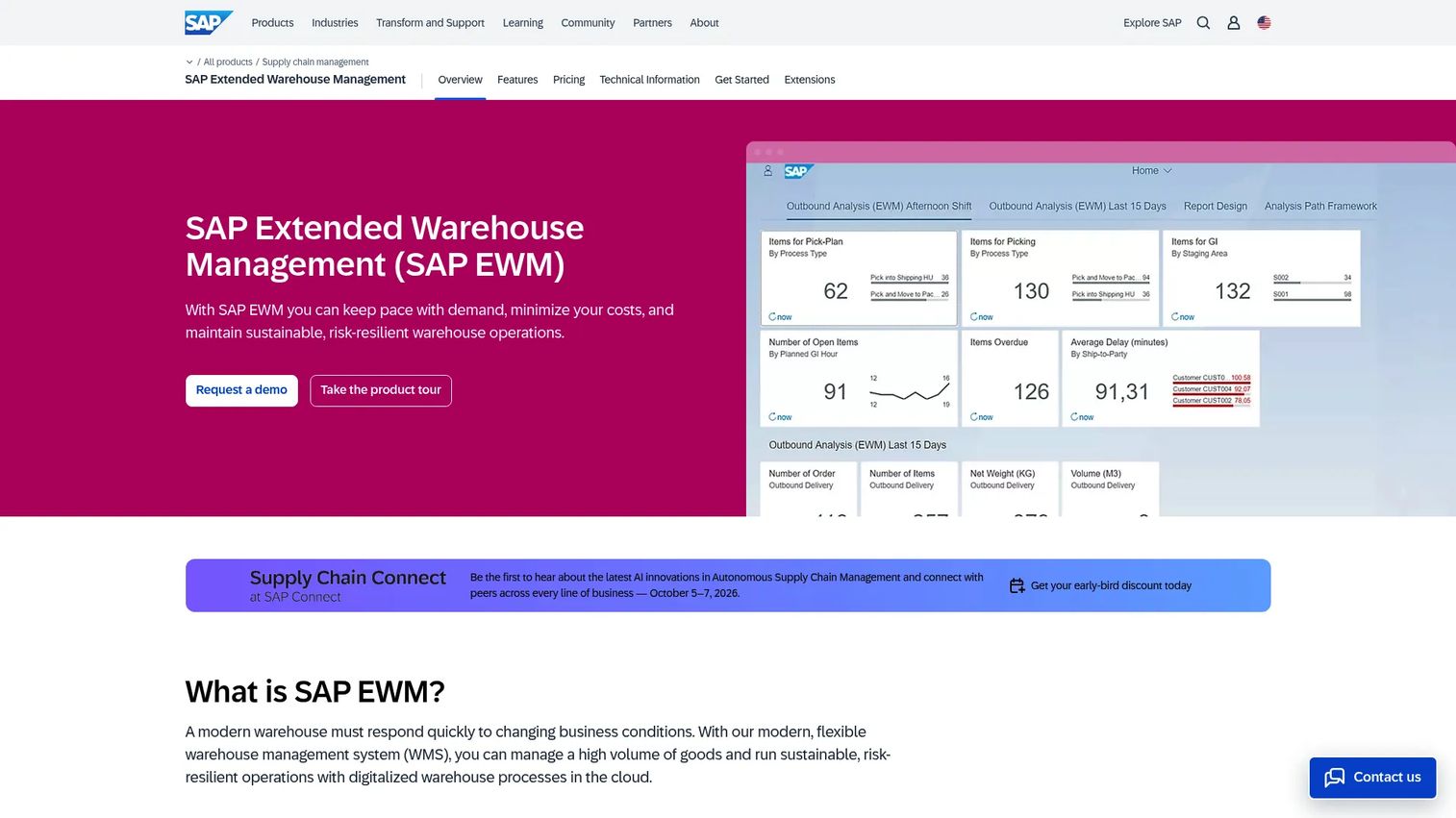
SAP Extended Warehouse Management is warehouse management software built for high-volume, complex, and automation-enabled warehouse operations. It manages large-scale execution with deep visibility and control, and it ties warehouse processes directly into quality, production, and track-and-trace workflows. For organizations already running SAP, the integration depth is the whole point: inventory, finance, and supply chain data live in one system rather than being stitched together across vendors.
Best for: Large enterprises that need advanced warehouse management tightly integrated with SAP supply chain processes.
Key strengths
- High-volume execution: Manages complex, high-throughput warehouse operations with real-time inventory visibility and granular control.
- Automation control: Directly controls warehouse automation equipment and robotics inside the same execution loop.
- Process integration: Connects warehouse work to quality, production, and track-and-trace so inventory data stays consistent across the business.
Why choose SAP Extended Warehouse Management: If your organization already runs SAP for finance and supply chain, the case is straightforward. The ERP integration eliminates the reconciliation gaps that plague multi-vendor stacks, and the platform supports both basic and advanced warehouse management, including labor management and cross-docking. It rewards teams ready to commit to structured, standardized warehouse processes at enterprise scale.
SAP Extended Warehouse Management pricing: SAP publishes pricing as price upon request. The listed offerings, including SAP S/4HANA Supply Chain for extended warehouse management and the private edition extra stack, are sold in blocks of 600,000 documents per year with contract terms available on request and auto-renewal. No public numeric starting price is displayed, so plan for a procurement-driven evaluation. The platform holds a 4.4/5 rating on G2.
2. Manhattan Active Warehouse Management
Manhattan Active Warehouse Management is a cloud-native warehouse management system built to unify and optimize warehouse operations across a network. It is organized around unified distribution control, unified planning, and unified execution, which means the same platform coordinates what happens inside each building and how work flows across the network. For enterprises running complex distribution, that orchestration is the differentiator.
Best for: Large enterprises that need cloud-native warehouse management with automation and real-time visibility.
Key strengths
- Unified distribution control: Coordinates inventory, labor, and fulfillment across multiple warehouses from one platform.
- Cloud-native architecture: Delivers continuous updates and real-time inventory visibility without heavy on-premise maintenance.
- Automation support: Directs high-volume, automated distribution workflows across the network.
Why choose Manhattan Active Warehouse Management: Choose it when you run a distribution network rather than a single site, and orchestration across warehouses matters as much as execution inside them. The cloud-native model suits teams that want to avoid the upgrade cycles of legacy on-premise systems while still handling high-volume, automated operations.
Manhattan Active Warehouse Management pricing: Manhattan does not publish public pricing, and the platform uses a contact-sales model. Expect an enterprise procurement process scoped to your network size and complexity. The platform holds a 4.0/5 rating on G2.
3. Oracle Fusion Cloud Warehouse Management
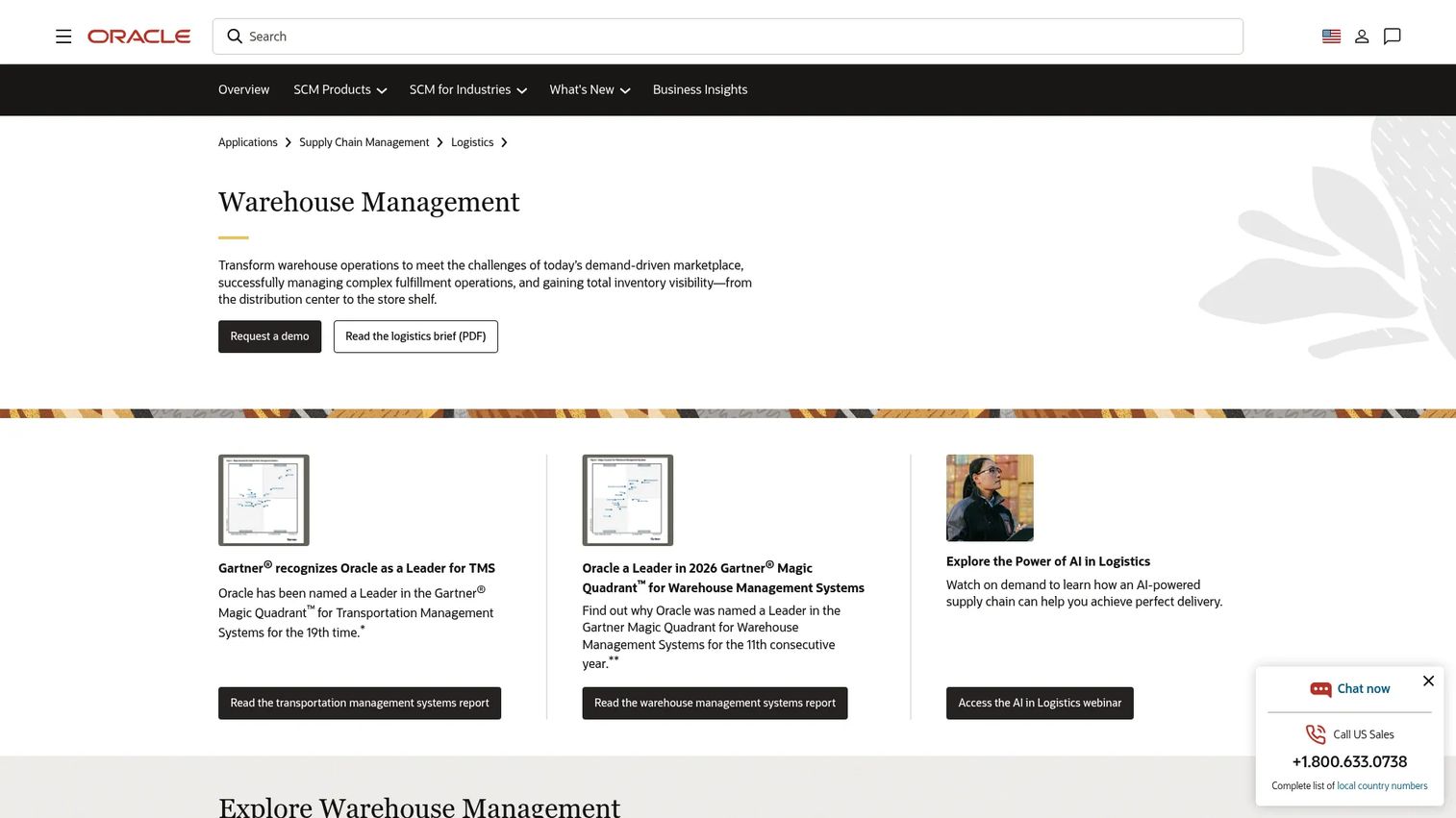
Oracle Fusion Cloud Warehouse Management is Oracle's cloud warehouse management product for managing complex fulfillment operations with end-to-end inventory visibility. It unifies automation, AI, and real-time data across receiving, picking, packing, and shipping, and it fits naturally for buyers who want cloud-native WMS inside a broader Oracle supply chain and ERP environment.
Best for: Enterprises that need cloud WMS with automation, AI, and end-to-end inventory visibility.
Key strengths
- Unified execution: Combines automation, AI, and real-time data across the full receive, pick, pack, and ship loop.
- Advanced optimization: Handles wave management, inventory tracking, and labor optimization in one system.
- Automation integrations: Connects to material handling equipment including robots, AGVs, conveyors, sortation systems, carousels, and scales.
Why choose Oracle Fusion Cloud Warehouse Management: It is the logical WMS for organizations standardizing on Oracle Fusion Cloud for the rest of their supply chain and finance stack. The transparent, transaction-based pricing is also unusual among enterprise vendors and helps buyers model costs before committing.
Oracle Fusion Cloud Warehouse Management pricing: Oracle's public price list shows the Warehouse Management Cloud Service starting at $50 per hosted 1,000 warehouse transactions, billed monthly. Warehouse Workforce Management runs $10 per hosted 1,000 transactions monthly, and an additional test environment is listed at $75,000 per year. There is no free tier. The platform holds a 4.0/5 rating on G2.
4. Infor WMS
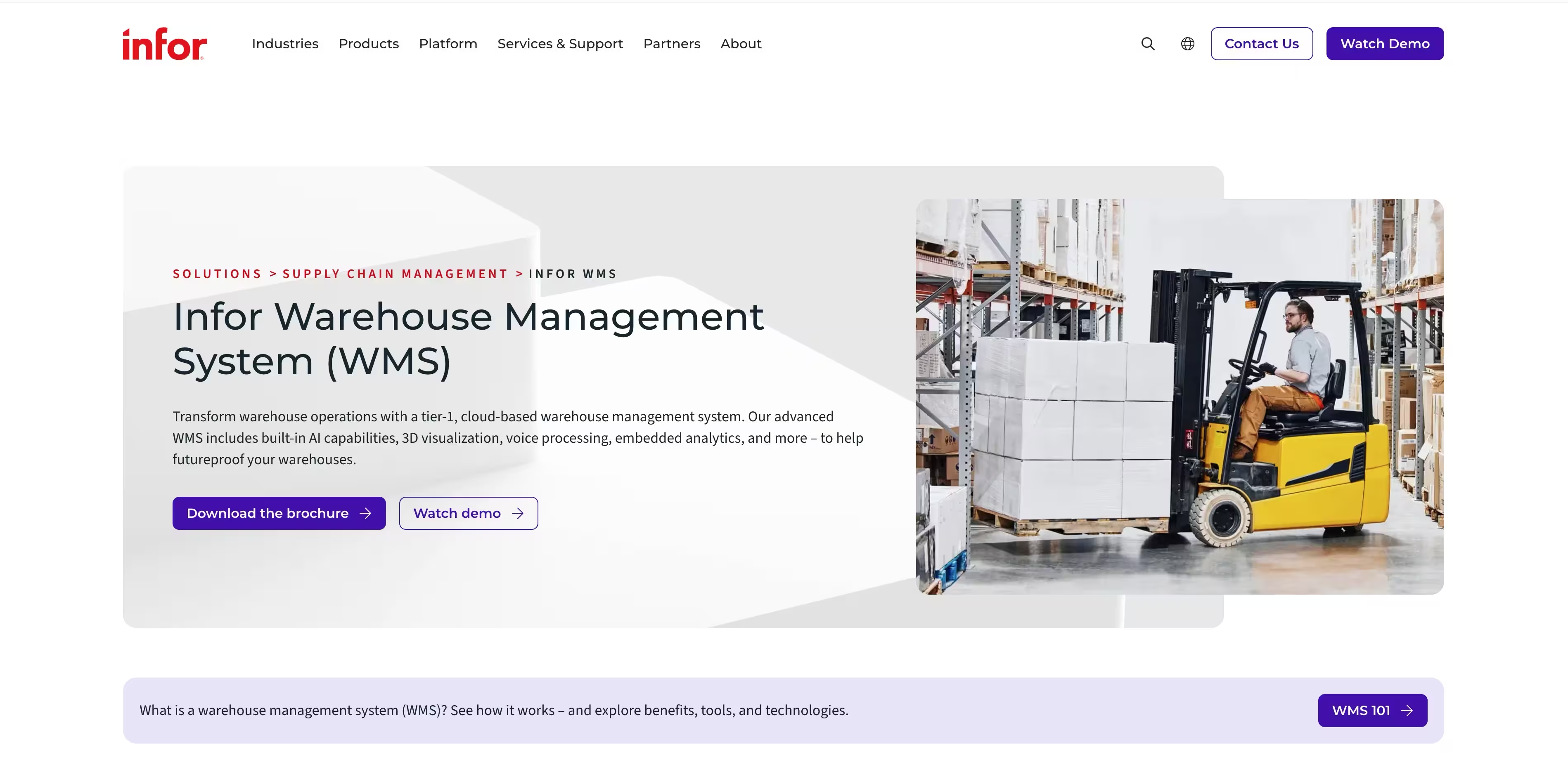
Infor WMS is a cloud-based warehouse management system built for distributors, third-party logistics providers, and manufacturers. It brings tier-1 execution depth to complex warehouse and 3PL operations, with strong support for the environments where inventory ownership, billing, and multi-site tracking get complicated.
Best for: Enterprises that need a tier-1 WMS for complex warehouse and 3PL operations.
Key strengths
- Bin-level inventory: Manages inventory at the bin level across multiple sites and multiple inventory owners.
- Visual warehouse and analytics: Offers a 3D visual warehouse with embedded analytics and AI for operational insight.
- Full execution and 3PL billing: Handles receiving, put-away, picking, and replenishment, plus 3PL billing for logistics providers.
Why choose Infor WMS: It fits distribution-heavy and 3PL environments where you manage inventory for multiple owners and need billing tied to warehouse activity. The bin-level control and multi-site visibility suit operations with complex inventory that a lighter tool cannot track accurately.
Infor WMS pricing: Infor does not publish public pricing and uses a contact-sales model, so pricing is scoped through a sales conversation. On G2, Infor WMS shows a 5.0/5 rating, though that reflects a small number of reviews, so weight it accordingly against your own evaluation.
5. Blue Yonder Warehouse Management
Blue Yonder Warehouse Management is cloud-based warehouse management software for orchestrating inventory, labor, and fulfillment across warehouse operations. It sits inside a broader supply chain planning and execution portfolio, which makes it a strong fit for large organizations that care about coordinating warehouse work with upstream planning.
Best for: Enterprises that need a tier-1 WMS for complex, high-volume warehouse operations.
Key strengths
- Intelligent inbound processing: Streamlines receiving and put-away for high-volume inbound flows.
- Optimized inventory management: Maintains real-time inventory visibility and accuracy across the operation.
- Enhanced resource management: Balances labor and warehouse resources to protect throughput.
Why choose Blue Yonder Warehouse Management: Choose it when warehouse execution is one part of a larger supply chain orchestration strategy, and you value tying fulfillment tightly to planning. It suits large, high-volume operations that want inventory, labor, and fulfillment coordinated within a single supply chain platform.
Blue Yonder Warehouse Management pricing: Blue Yonder does not expose public pricing; the pages emphasize capabilities and contact paths rather than a visible price. Expect an enterprise sales process. The platform holds a 4.2/5 rating on G2.
6. Softeon Warehouse Management System

Softeon Warehouse Management System is enterprise warehouse management software built for complex warehouse and fulfillment operations. It emphasizes configurability, which appeals to operations teams that want to shape workflows around their specific processes rather than bend their processes to fit the software.
Best for: Large or complex distribution operations that need configurable WMS capabilities.
Key strengths
- Inventory and order processing: Manages inventory control and order processing across complex operations.
- Wave management and automation: Runs wave management and automated workflows to keep high-volume fulfillment moving.
- Automation integration: Connects with robotics and material handling equipment for automated distribution.
Why choose Softeon Warehouse Management System: It attracts operations teams that want precision and process control over out-of-the-box rigidity. The configurable workflows and wave management depth suit complex distribution operations that have specific requirements a standardized suite would force them to work around.
Softeon Warehouse Management System pricing: Softeon does not publish a public price and directs buyers to contact sales, so pricing is scoped per engagement. The platform holds a 4.3/5 rating on G2.
7. MRPeasy
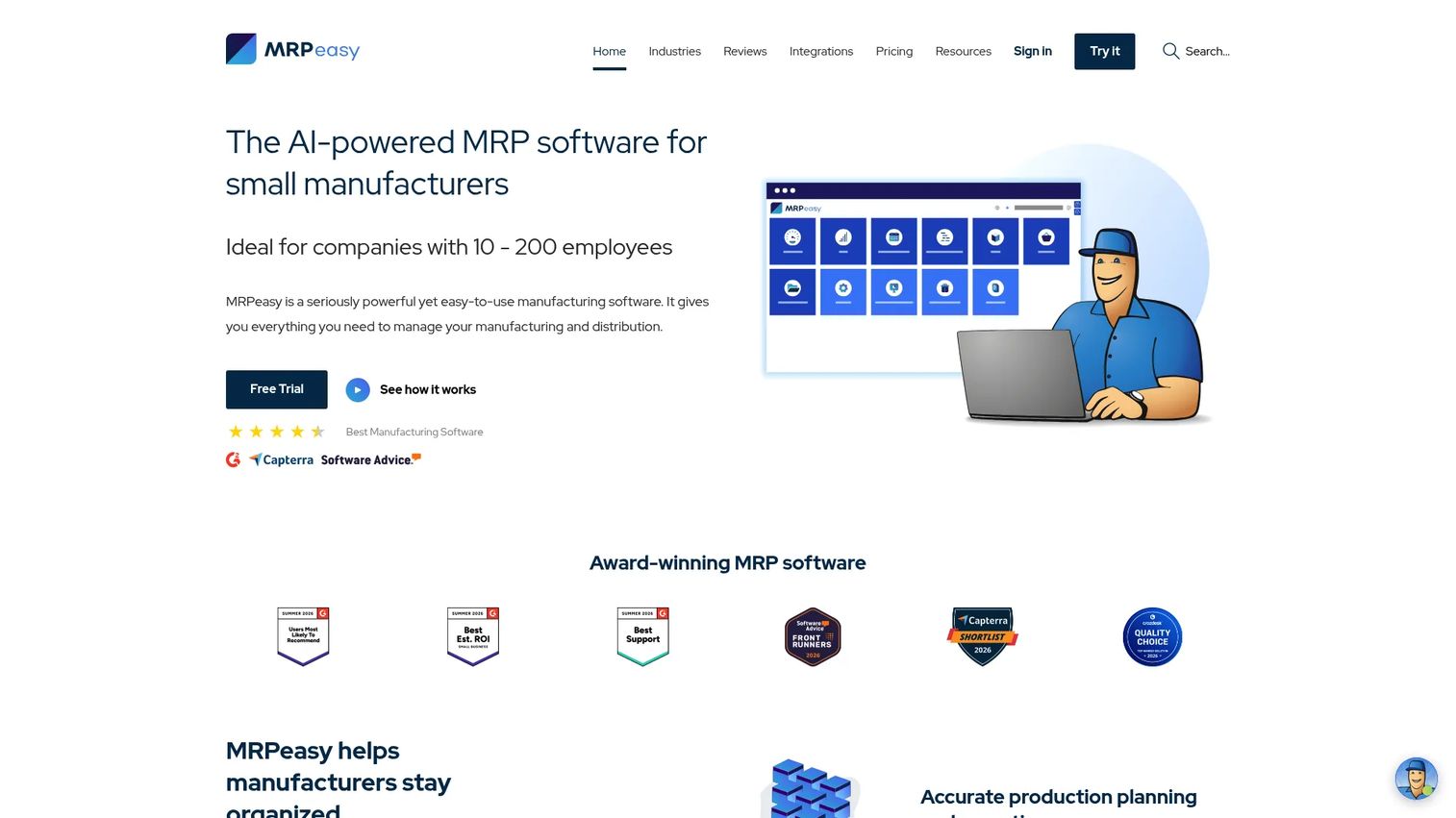
MRPeasy is cloud-based manufacturing ERP and MRP software for small and midsize manufacturers, with warehouse and inventory management built in. It gives smaller teams warehouse control tied to production, procurement, and finance without the weight or cost of an enterprise suite. For a growing manufacturer, that combination of production planning and inventory control in one affordable system is the draw.
Best for: Small manufacturers that need an easy-to-use MRP/ERP system with production and inventory control.
Key strengths
- Production planning and reporting: Plans and tracks production alongside inventory in one system.
- BOM management: Manages bills of materials so inventory consumption stays accurate as you build.
- Inventory and warehouse management: Supports multi-warehouse inventory control connected to procurement and finance.
Why choose MRPeasy: It works for smaller manufacturers and growing businesses that need real warehouse and inventory control without buying an oversized enterprise platform. The tight link between production, procurement, and inventory keeps stock accurate as you manufacture, which is exactly where spreadsheets break down.
MRPeasy pricing: MRPeasy publishes transparent per-user pricing with four paid plans and a free trial. Starter is $49 per user per month, Professional is $69, Enterprise is $99, and Unlimited is $149, all billed monthly with bulk pricing available for 11 or more users. There is no free tier, but the trial lets you evaluate before committing. The platform holds a 4.6/5 rating on G2, the highest in this list.
8. Fishbowl WMS

Fishbowl WMS is warehouse and inventory management software for small and mid-size businesses, best known for its QuickBooks integration. It delivers practical warehouse management, real-time inventory tracking, automated order management, and barcode scanning, for teams that want straightforward control tied to their accounting system.
Best for: Small and mid-size businesses that need warehouse control tied to QuickBooks.
Key strengths
- Real-time inventory tracking: Keeps stock counts accurate across locations in real time.
- Automated order management: Streamlines the order-to-ship workflow for inventory-driven businesses.
- Barcode scanning and printing: Captures inventory movement and generates labels to keep records current.
Why choose Fishbowl WMS: It is a practical choice for smaller operations and inventory-driven businesses that run QuickBooks and want warehouse management without enterprise complexity. The barcode-driven tracking, picking, packing, and shipping document support cover the core execution loop for teams that need broad operational utility over specialized depth.
Fishbowl WMS pricing: Fishbowl publishes tiered pricing: Essentials at $229 per month, Growth at $429, and Scale at $729, all billed annually, plus an Advanced tier with custom pricing. Fishbowl also requires an implementation package, so factor that into your budget. There is no free tier. The platform holds a 4.0/5 rating on G2.
Considerations before you buy
Feature checklists all start to look the same. These are the criteria that actually separate a good fit from an expensive mistake.
Inventory accuracy and real-time visibility
The whole point of a warehouse management system is trustworthy stock data. Evaluate how the platform captures movement, whether counts update in real time, and how it handles cycle counting without shutting down the floor. Accurate inventory is what prevents stock-outs, overstock, and the reconciliation work that eats operator hours.
Execution depth across the workflow
Confirm the tool handles your full loop: receiving, put-away, picking, packing, and shipping, with the pick-path optimization, wave management, or batching your volume requires. A platform that covers 80 percent of your workflow forces manual workarounds for the rest, and those workarounds are where accuracy erodes.
Integration with your existing stack
Your WMS does not operate alone. Check the depth of ERP integration, plus TMS and SCM connections, so inventory, orders, and fulfillment status stay in sync with finance, transportation, and planning. Weak integration recreates the data silos the software was supposed to eliminate.
Labor management and automation readiness
If labor productivity matters, look for task assignment, workload balancing, and productivity measurement. If you run or plan to run automation, confirm the platform directs conveyors, robotics, and voice picking natively rather than through fragile custom builds.
Deployment model and change tolerance
Cloud platforms now lead the market and reduce maintenance overhead, but the deeper question is how much process change your team can absorb. Match the platform's structure to your operation's readiness. A highly configurable system rewards teams with specific requirements, while a standardized suite moves faster for teams willing to adopt its workflows.
Conclusion
The right warehouse management software depends on two things: your warehouse complexity and your existing ERP stack. Large SAP or Oracle shops get the cleanest integration from SAP Extended Warehouse Management or Oracle Fusion Cloud Warehouse Management. Distribution networks and 3PLs should shortlist Manhattan Active Warehouse Management, Infor WMS, Blue Yonder Warehouse Management, and Softeon for their orchestration and configurability depth. Smaller teams get real inventory control without enterprise overhead from MRPeasy, especially manufacturers, or Fishbowl WMS if you run QuickBooks.
The buying criteria that matter across all of them are consistent: inventory accuracy, execution depth across receive, put-away, pick, pack, and ship, integration reliability, labor management, and how much process change your team can absorb. Shortlist two or three platforms that match your current warehouse complexity and ERP environment, then run a structured evaluation against your real workflows rather than a feature checklist. The tool that fits your operation beats the tool with the longest feature list every time. For adjacent operational decisions, our guides to event management software and loyalty management software apply the same fit-first evaluation approach.
FAQs
Warehouse management software directs and tracks inventory movement inside a warehouse, from receiving through shipping. It manages put-away, picking, packing, cycle counting, and labor, and it maintains real-time inventory visibility so stock data stays accurate. In practice, it replaces spreadsheets and paper processes with directed workflows that reduce mispicks and speed up fulfillment.
Prioritize real-time inventory visibility, full workflow coverage across receive, put-away, pick, pack, and ship, and strong ERP, TMS, and SCM integration. Barcode scanning and RFID support, cycle counting, and labor management are also core. The right feature set depends on your volume and complexity, so weight execution depth and integration over long checklists.
Yes, when manual tracking starts costing you accuracy and time. Tools like MRPeasy and Fishbowl WMS bring warehouse inventory management to smaller teams at accessible price points, starting at $49 and $229 per month respectively. If you are reconciling stock in spreadsheets or losing inventory, a right-sized WMS pays for itself quickly.
A warehouse management system captures every inventory movement at the point it happens, usually through barcode scanning or RFID, so recorded counts match physical stock in real time. It also directs put-away and picking by location, which reduces human error. Continuous cycle counting keeps the record aligned without full inventory shutdowns.
A WMS manages warehouse execution: receiving, storage, picking, packing, and shipping. An ERP manages the broader business, including finance, procurement, and production. Many operations run both and integrate them, so inventory and order data flow between the warehouse floor and the finance and supply chain systems. Some platforms, like MRPeasy, combine lighter WMS and ERP functions in one system for smaller teams.
Yes. Barcode scanning is standard across warehouse inventory management systems and is the primary way movement is captured accurately. RFID support is common in more advanced platforms and enables faster, contactless tracking at scale. Both feed real-time data into the system so inventory records stay current with every touch.
Cloud platforms now account for 55 to 62 percent of the market and reduce maintenance and upgrade overhead while delivering continuous updates. On-premise deployments give more direct control and can suit operations with specific security, latency, or customization needs. Weigh your IT resources, integration requirements, and how much control your operation needs before deciding.