You added a second provider. Now the front desk juggles three tabs to book a patient, chase a claim, and send an appointment reminder. Nothing talks to anything. Every no-show, every rejected claim, every missed follow-up traces back to the same root cause: the clinic outgrew its spreadsheets and stitched-together apps, but the software never caught up.
That is the exact moment most buyers start comparing systems. And the stakes are not small. The global chiropractic software market was valued at roughly USD 1.1 to 1.2 billion in 2024 and is forecast to grow at an 8 to 9.5% CAGR through the early 2030s, according to Strategic Market Research (2024). The chiropractic practice management software segment alone reached USD 235.4 million in 2024 and is expected to hit USD 473.1 million by 2033 at an 8.3% CAGR, per TrackStat (2024). Translation: adoption is accelerating, and the tools are consolidating scheduling, charting, billing, and patient engagement into single platforms.
If you evaluate software the way a founder evaluates a stack, you are asking the right questions. What does this replace? How fast does it stand up? Does it scale across locations without more admin headcount? The same discipline you would apply to choosing a CRM or an account based marketing platform applies here. You want repeatable operations, clean data, and revenue that does not leak between disconnected systems. This guide filters seven options by pricing transparency, implementation speed, cloud access, and workflow coverage, the way a system-selection problem should be filtered.
What's inside
This guide covers chiropractic EHR, practice management, billing, scheduling, and patient engagement platforms. It is written for buyers comparing systems for clinics of different sizes, from a solo practitioner to a multi-location group.
We chose picks on four criteria that actually drive the decision:
- Workflow coverage: scheduling, SOAP notes, claims, payments, intake, and reporting in one system
- Pricing visibility: published starting prices where the vendor makes them public
- Implementation and cloud access: how fast it stands up and whether it runs in the browser
- Buyer fit: the clinic size and complexity each tool serves best
TL;DR
- Best overall for most clinics: ChiroTouch, for depth of workflow plus AI-assisted charting.
- Best for budget-conscious buyers: ChiroFusion, with transparent cloud pricing from $129/month.
- Best for multi-location practices: ClinicMind, an all-in-one clinical, billing, and engagement platform.
- Best for straightforward cloud access: Atlas Chiropractic System, with public plans from $99/month.
- Best for automation and reporting: SpryPT, AI-native documentation built for rehab-heavy workflows.
- Best for simpler or mixed-service clinics: Jane App and SimplePractice, both broad care platforms with easy setup.
What is chiropractic software?
Chiropractic software is a platform that runs the clinical and administrative side of a chiropractic practice, combining electronic health records with practice management tools in one system.
In plain terms, it handles the jobs that used to live in separate apps or on paper. Understanding those jobs is how you evaluate any option on this list.
- Scheduling and patient management: online booking, calendars, and automated reminders to cut no-shows
- SOAP notes and charting: structured documentation built for chiropractic visit types
- Claims and billing: electronic claim submission, clearinghouse connections, and denial management
- Payment processing: card-on-file, copays, and patient statements
- Patient intake: digital forms and portals that populate the chart before the visit
- Reporting and dashboards: revenue, collections, and provider productivity in one view
- Patient engagement: reactivation campaigns, recall reminders, and two-way messaging
The distinction between chiropractic EHR and chiropractic practice management software matters. EHR (sometimes called chiropractic EMR) is the clinical record: notes, diagnoses, and treatment plans. Practice management is the business layer: scheduling, billing, and reporting. Most modern platforms bundle both, which is why the category has consolidated so quickly. When you evaluate a system, confirm it covers both sides, not just one.
When to use chiropractic software
Not every clinic needs to switch systems today. Three situations make the case obvious.
Replace disconnected tools
When scheduling lives in one app, charting in another, billing in a third, and reminders in a fourth, every handoff is a place where data gets lost or duplicated. A single cloud based chiropractic software platform removes those seams. You stop reconciling four systems and start running one. This is usually the trigger for clinics that grew fast and bolted on tools as they went.
Standardize documentation and claims
When note quality and billing speed vary by provider, revenue becomes unpredictable. One doctor codes cleanly and gets paid in days. Another leaves gaps that trigger denials. Chiropractic billing software with structured SOAP templates and built-in claim scrubbing pulls everyone to the same standard. Clean documentation feeds clean claims, and clean claims collect faster.
Support growth without more admin overhead
When you add locations, providers, or patient volume, the manual approach breaks. More patients mean more reminders, more intake forms, more statements. A system that automates those tasks lets you grow headcount in treatment rooms, not at the front desk. This is the scaling logic a founder recognizes: build the system once, and it handles the volume without proportional cost.
Comparison table
Use this table for fast filtering. It orders the seven platforms by relevance to a general chiropractic practice and shows intent, differentiation, published starting price, and current G2 rating so you can shortlist two or three before reading the full sections.
| # | Product | Intent | Key differentiation | Pricing | G2 rating |
|---|---|---|---|---|---|
| 1 | ChiroFusion | Budget-conscious cloud EHR | Transparent pricing, all-in-one cloud workflow | From $129/month | 4.0/5 |
| 2 | ClinicMind | Multi-location all-in-one | EHR, RCM, engagement, credentialing in one platform | PatientHub from $297/month | 4.6/5 |
| 3 | ChiroTouch | Depth plus AI charting | AI Scribe (Rheo), deep workflow coverage | Quote-based | 3.6/5 |
| 4 | Atlas Chiropractic System | Simple public-priced cloud | Public plans, included charting and claims | From $99/month | 3.8/5 |
| 5 | SpryPT | Automation and reporting | AI-native docs, RCM, rehab crossover | From $79/provider/month | 4.8/5 |
| 6 | Jane App | Simpler clinic needs | Flexible booking, intake, telehealth | From $54/month | 4.0/5 |
| 7 | SimplePractice | Small or mixed-service | Broad care platform, easy setup | From $49/month | 4.1/5 |
1. ChiroFusion

ChiroFusion is a cloud-based chiropractic EHR and practice management platform built to cover the full clinic workflow without a large upfront investment. It runs in the browser, so there is no server to maintain and no on-prem install to schedule. For a solo or small-group practice that wants everything in one place at a predictable monthly cost, it is one of the clearest entry points in the category.
Best for: Chiropractic practices needing an all-in-one cloud EHR with billing and scheduling at a transparent price.
Key strengths
- Cloud-based EHR: browser-based access means no server, no local install, and updates handled for you
- Scheduling and reminders: online booking and automated reminders to reduce no-shows and fill the calendar
- Billing, claims, and payment processing: electronic claim submission plus integrated payments in one flow
Why choose ChiroFusion: It fits the budget-conscious buyer who still wants complete workflow coverage rather than a stripped-down starter tool. Because pricing is public and the setup is cloud-first, you can forecast cost and go live without an IT project. That matters when you are switching from spreadsheets and want a fast, low-risk first win.
ChiroFusion pricing: Annual plans are ChiroFusion Essentials at $129/month and ChiroFusion Complete at $299/month, both requiring a 12-month commitment. Monthly plans, cancelable anytime, run $149/month for Essentials and $329/month for Complete. A $299 setup fee applies at signup. There is no free tier. ChiroFusion holds a 4.0/5 rating on G2.
2. ClinicMind
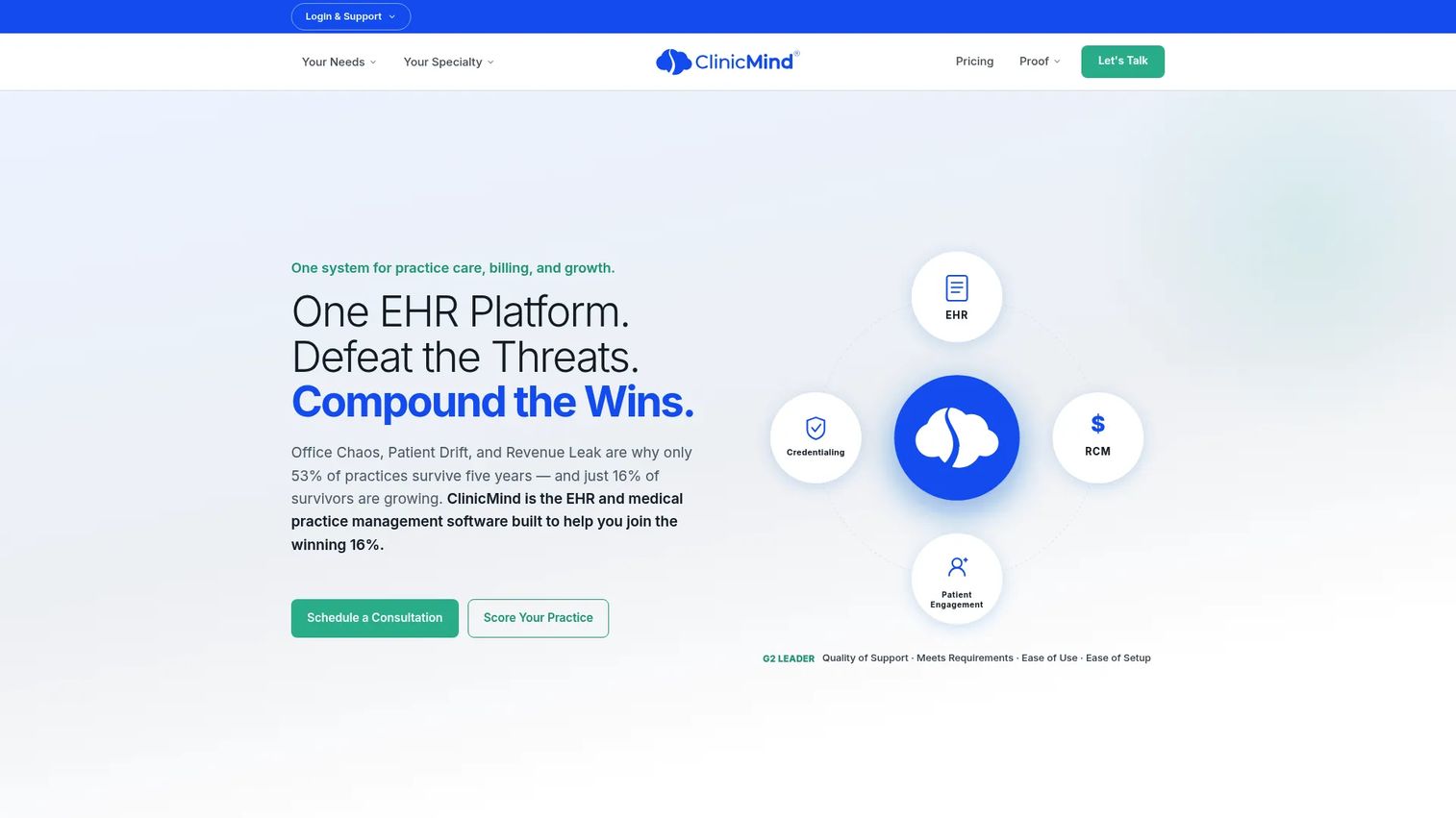
ClinicMind is a healthcare practice operating platform that combines an ONC-certified EHR, full revenue cycle management, patient engagement, credentialing, and payments in one system. It is built for independent practices that want the clinical record, the billing engine, and the patient growth layer under one roof. For a group scaling across locations, that consolidation is the entire pitch.
Best for: Independent healthcare practices needing an all-in-one clinical, billing, and patient growth platform across multiple sites.
Key strengths
- EHR and RCM together: ONC-certified charting plus full billing services in a single workflow
- PatientHub engagement: reactivation, recall, and patient communication to keep the schedule full
- Credentialing and payments: CredEdge credentialing, ClinicMindPay, Virtual Front Desk, and AI Scribe in one stack
Why choose ClinicMind: It centralizes operations that most clinics run across three or four vendors. For a multi-location practice, one platform for charting, billing, credentialing, and engagement means one source of truth and one team to manage instead of several. That is the operational simplicity a scaling operator is after.
ClinicMind pricing: Core EHR and RCM platform pricing is quoted directly. Public pricing is available for the PatientHub engagement product: Pro at $297/month, Premium at $397/month, and Elite AI at $597/month, each with a setup fee and included SMS credits. ClinicMind carries a 4.6/5 rating on G2 across 229 reviews.
3. ChiroTouch

ChiroTouch is a cloud-based chiropractic EHR and practice management platform with AI-assisted documentation, scheduling, billing, payments, and patient engagement. Its Rheo AI Scribe is the headline: it drafts notes from the visit so providers spend less time charting and more time treating. For clinics that want workflow depth plus an AI assist, it is the most complete option on this list.
Best for: Chiropractic practices that want an all-in-one EHR and practice management platform with AI charting support.
Key strengths
- Scheduling and patient management: full calendar, check-in, and patient workflow in one interface
- Charting with AI Scribe (Rheo): AI-assisted documentation that speeds up note completion
- Integrated payments and billing: CT Pay, CT Billing Suite, and clearinghouse options built in
Why choose ChiroTouch: It suits the clinic that wants depth over simplicity and is willing to invest in charting automation that compounds over time. The plan tiers (Start, Grow, and Scale) let you match the platform to your stage, and the AI Scribe removes a real daily drag on provider time. If documentation is your bottleneck, this is where the payoff shows up first.
ChiroTouch pricing: The pricing page lists three plans, Start, Grow, and Scale, without public numeric prices; it prompts a booked demo for a quote. Add-ons include CT Pay, the CT Billing Suite, and clearinghouse options. ChiroTouch holds a 3.6/5 rating on G2.
4. Atlas Chiropractic System
Atlas Chiropractic System is a chiropractic practice management platform for scheduling, billing, charting, patient communication, and clinic operations. Its appeal is straightforward: public monthly pricing, a clinic-branded patient app, and the core workflow included rather than gated behind add-ons. For a clinic that wants a simple, predictable cloud system without a sales-heavy buying process, it is an easy shortlist candidate.
Best for: Chiropractic clinics that want an all-in-one practice management system with transparent, public pricing.
Key strengths
- Scheduling and check-in: calendar, online booking, and patient check-in in one flow
- Billing and payments: claims and billing included in the plan, not sold separately
- Patient app and online booking: a clinic-branded app that keeps patients booking and engaged
Why choose Atlas Chiropractic System: The pricing transparency is the differentiator. Charting, scheduling, billing, claims, and reminders are stated as included, so you are not decoding which features live in which tier. For a growth-oriented clinic that wants to know its full cost before it commits, that clarity shortens the evaluation.
Atlas Chiropractic System pricing: Three public monthly plans: Essential at $99/month, Professional at $199/month, and Unlimited at $340/month. The pricing page states charting, scheduling, billing, claims, and reminders are included, with SMS credits as the main à-la-carte cost. There is no free tier. Atlas holds a 3.8/5 rating on G2.
5. SpryPT
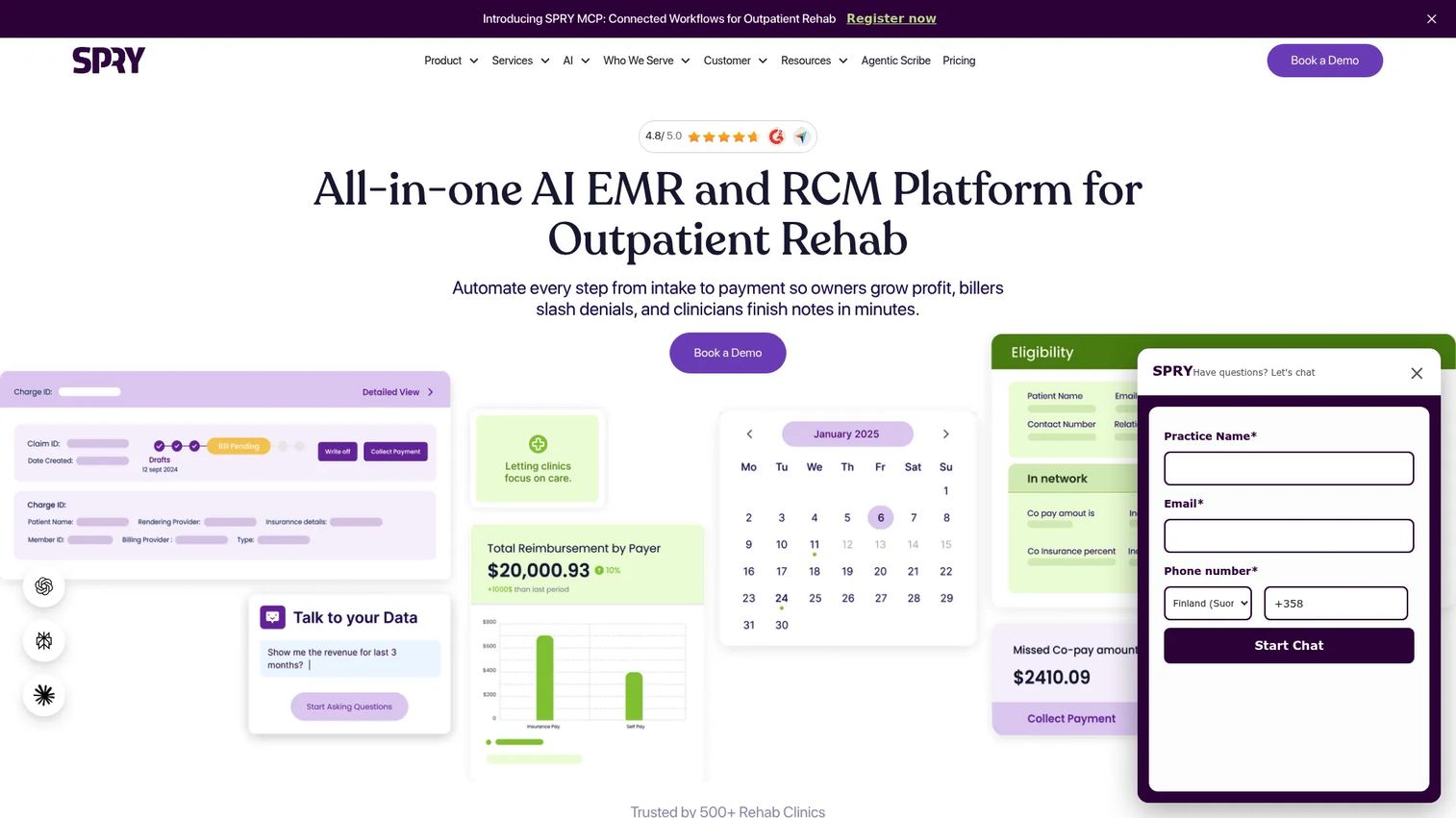
SpryPT is an AI-native EMR and RCM platform built for outpatient rehab therapy clinics, with strong crossover for chiropractic practices that lean into rehab and movement-based care. It combines digital intake, eligibility verification, prior authorization tools, SOAP notes, billing, scheduling, and reporting. For a practice that wants automation and reporting depth rather than a lighter-weight system, SpryPT is the standout.
Best for: Outpatient PT/rehab clinics, and rehab-heavy chiropractic practices, wanting integrated EMR, billing, and patient engagement.
Key strengths
- Digital intake and patient portal: structured intake that populates the chart before the visit
- Eligibility and prior authorization tools: verification built in to reduce claim rejections
- SOAP notes, billing, scheduling, and reporting: AI-native documentation with a full reporting layer
Why choose SpryPT: It fits practices that need stronger automation and reporting than a basic EHR delivers, especially where rehab workflows overlap with chiropractic care. The AI-native documentation and reporting reduce manual work, which is exactly the leverage a clinic wants when it is scaling visit volume without scaling admin.
SpryPT pricing: The Essentials plan starts at $79/provider/month, billed monthly and scaled by visits per full-time provider. A Plus plan is also offered. The billing service is priced at 4 to 6% of collections based on billable appointments. SpryPT holds a 4.8/5 rating on G2, the highest on this list.
6. Jane App
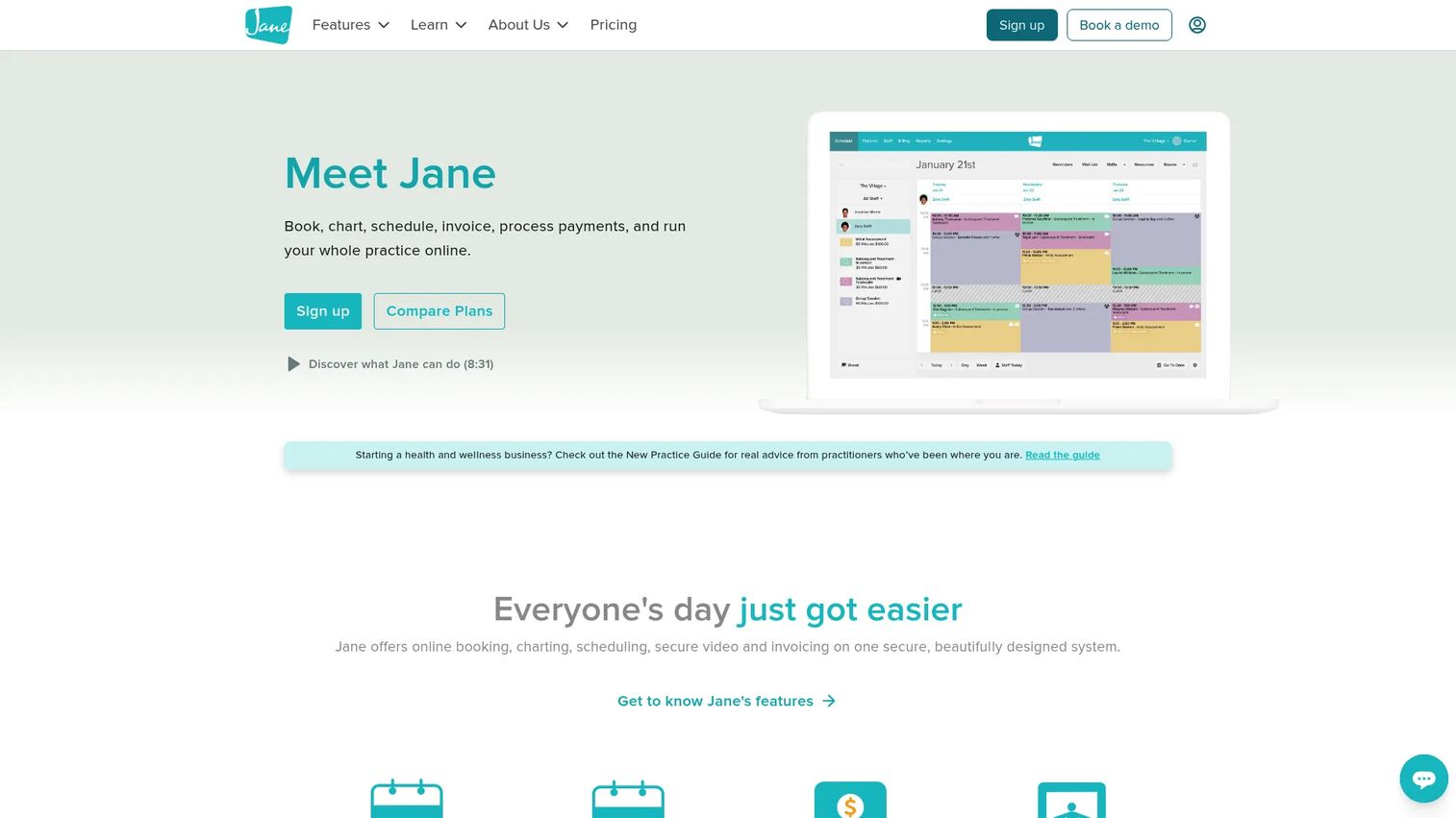
Jane App is practice management software for health and wellness clinics, covering online booking, scheduling, charting, billing, and telehealth. It is not chiropractic-specific in the way the top picks are, but it fits chiropractic clinics with simpler needs and a preference for ease of use. If your priority is a clean patient-facing experience and fast setup, Jane is a strong candidate.
Best for: Health and wellness practices, including chiropractic clinics with simpler needs, that want booking, charting, billing, and telehealth in one system.
Key strengths
- Online booking: a patient-friendly booking experience that fills the schedule
- Scheduling and charting: flexible calendars and customizable charts across practitioners
- Telehealth and payments: built-in telehealth plus card processing for a full patient flow
Why choose Jane App: It wins on ease of use and patient-facing convenience. For a smaller clinic or a mixed-service practice, the flexible workflows and clean interface make onboarding fast without a heavy implementation. The trade-off is that chiropractic-specific claim and coding depth is lighter than the dedicated platforms, so confirm your billing needs fit before committing.
Jane App pricing: Three core plans: Balance at USD $54/month, Practice at USD $79/month, and Thrive at USD $99/month. Add-ons include AI Scribe and Group Telehealth at $15/month per opted-in practitioner, Insurance Billing from $20/month, and Jane Websites at $59/month per clinic. There is no free trial, but a demo account is available. Jane App holds a 4.0/5 rating on G2.
7. SimplePractice

SimplePractice is practice management software built primarily for therapists and behavioral health practitioners, with scheduling, billing, insurance claims, telehealth, and secure messaging. It is a broader care platform, not chiropractic-specific like the top picks, but it works as a simpler alternative for smaller or mixed-service clinics that want an easy all-in-one system.
Best for: Independent and group practices, including small or mixed-service clinics, needing an easy all-in-one EHR and practice management platform.
Key strengths
- Scheduling and online booking: calendar management and self-scheduling for patients
- Billing and insurance claims: claim submission and billing workflows in one place
- Telehealth and secure messaging: built-in video visits plus HIPAA-conscious client messaging
Why choose SimplePractice: It suits smaller or mixed-service clinics that value simplicity and a low entry price over chiropractic-specific depth. The setup is fast and the interface is approachable, which makes it a reasonable starting system for a lean practice. As with Jane, verify that its claim and coding workflows match chiropractic billing before you switch.
SimplePractice pricing: Three plans: Starter at $49/month, Essential at $79/month, and Plus at $99/month. The pricing page shows a 30-day free trial. SimplePractice holds a 4.1/5 rating on G2.
Considerations before you buy
Two or three of these will shortlist for most clinics. Before you sign, pressure-test each finalist against the criteria below.
Total cost, not sticker price
Published starting prices rarely capture the full bill. Check setup fees, SMS credit costs, payment processing rates, add-on modules, and whether billing services take a percentage of collections. Build the real monthly number for your provider count before comparing chiropractic software pricing across vendors.
Implementation speed and support
Ask how long a typical clinic takes to go live and what support is included during chiropractic software implementation. Cloud platforms usually stand up faster than server-based systems. Confirm whether onboarding, data entry help, and training are bundled or billed separately.
Cloud versus server
Cloud based chiropractic software runs in the browser with updates handled for you and access from any location, which matters for multi-site practices. Server-based systems give you local control but require IT maintenance. For most growing clinics, cloud is the lower-overhead choice. Confirm the vendor is HIPAA-compliant either way.
Billing and claims depth
If revenue speed is your pain, scrutinize the billing layer. Look for electronic claim submission, clearinghouse connections, claim scrubbing, and denial management. Chiropractic billing software with these built in collects faster than a generic care platform bolted onto a clearinghouse.
Migration path
Ask exactly how chiropractic software migration works. What data imports (patients, notes, ledgers, appointments), in what format, and who does the work? A clean migration protects your history; a messy one costs weeks. Get the process in writing before you commit.
Conclusion
The right pick comes down to clinic type. ChiroTouch is the strongest all-around choice for practices that want workflow depth plus AI charting. ChiroFusion is the budget-conscious cloud pick with transparent pricing. ClinicMind is built for multi-location groups that want everything under one roof. Atlas Chiropractic System delivers simple, public-priced cloud access. SpryPT leads on automation and reporting for rehab-heavy practices. Jane App and SimplePractice are the simpler, easy-to-adopt options for smaller or mixed-service clinics.
Here is the practical next step. Shortlist the two systems that match your clinic size and workflow gaps. Request a demo of each, and ask the same questions to both: total monthly cost for your provider count, go-live timeline, and how data migration works. Then compare the onboarding timelines side by side. The system that gets you to a first clean claim fastest, without adding admin headcount, is usually the right call.
FAQs
Published starting prices in this guide range from about $49/month for a broad care platform to $129/month and up for a dedicated chiropractic cloud EHR, with multi-location and all-in-one platforms quoted higher or by demo. Your real cost depends on provider count, add-ons, payment processing rates, and whether billing services take a percentage of collections. Before buying, build the full monthly number for your specific clinic rather than comparing sticker prices.
At minimum, look for scheduling with automated reminders, chiropractic-specific SOAP notes, electronic claim submission, payment processing, digital patient intake, and a reporting dashboard. Patient engagement tools like recall and reactivation are increasingly standard. Verify the system covers both the clinical EHR side and the practice management side, since a gap in either forces you back into disconnected tools.
For most growing clinics, cloud based chiropractic software is the lower-overhead choice: no server to maintain, updates handled for you, and access from any location, which matters for multi-site practices. Server-based systems give you local control but require IT upkeep. Whichever you choose, confirm the vendor is HIPAA-compliant and ask how data is backed up.
Cloud platforms often go live in days to a few weeks, while more complex multi-location or server setups can take longer. Timeline depends on data migration volume, staff training, and how much onboarding the vendor includes. Before buying, ask for a typical go-live timeline for a clinic your size and confirm what training and setup support are bundled.
Yes. Strong chiropractic billing software includes electronic claim submission, clearinghouse connections, claim scrubbing, and denial management, which speeds collections and reduces rejections. Some platforms also offer full revenue cycle management as a service, priced as a percentage of collections. Verify the billing depth matches your volume before choosing a generic care platform over a dedicated system.
Migration usually involves exporting patient records, clinical notes, appointment history, and financial ledgers from the old system and importing them into the new one, often with vendor assistance. The cleaner the export format, the smoother the transfer. Before you commit, get the migration process in writing: what data moves, in what format, who does the work, and how long it takes.
Chiropractic EHR (or chiropractic EMR) is the clinical record: SOAP notes, diagnoses, and treatment plans. Chiropractic practice management software is the business layer: scheduling, billing, claims, and reporting. Most modern platforms bundle both, but some tools lean heavier on one side, so confirm a candidate covers the full workflow you need rather than just charting or just scheduling.